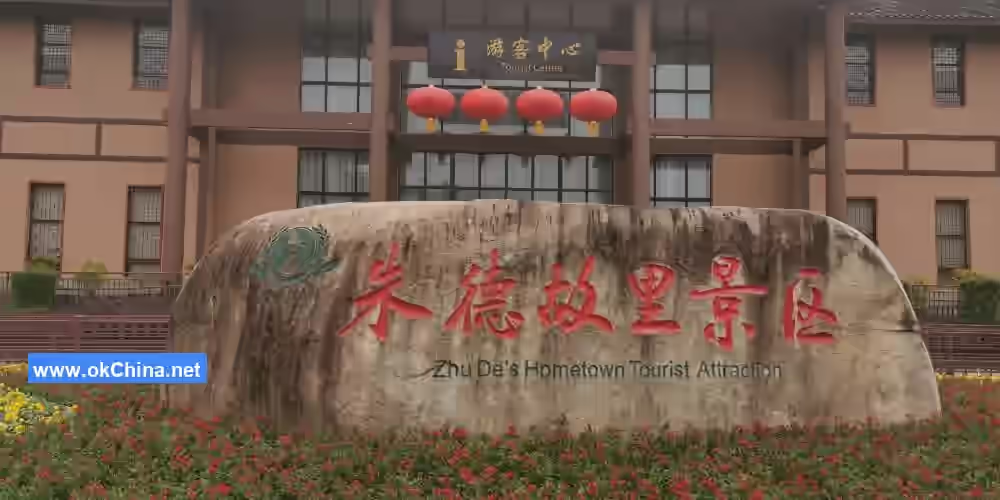
Zhu De's Former Residence
1. Introduction
The Zhu De's Former Residence Scenic Area is located in Ma'an Town, Yilong County, Sichuan Province, and is the birthplace and childhood home of the great proletarian revolutionary, military strategist, and Marshal Zhu De. Centered around Zhu De's former residence, the scenic area includes the Zhu De Memorial Hall, the Zhu De Former Residence Exhibition Hall, and the Zhu De Bronze Statue Square, comprehensively showcasing the life story and revolutionary spirit of Marshal Zhu De. The area features towering ancient trees and a tranquil environment, rich in both historical and cultural significance as well as natural beauty. It serves as an important base for commemorating revolutionary martyrs and receiving patriotic education, and is also a popular destination for tourists to learn about China's revolutionary history and experience its red culture.
2. Geographical Environment
2.1 Location and Territory
The Zhu De's Former Residence Scenic Area is located in the eastern part of Yilong County, Nanchong City, Sichuan Province, between longitude 106°13″-106°52″ east and latitude 31°11″-31°39″ north.
2.2 Topography and Landforms
The scenic area features a mid-hill and mid-valley landscape. The highest point is Guandao Mountain at 657.75 meters above sea level, and the lowest point is the main entrance at 416.38 meters, with a relative height difference of 241.37 meters. Within the area, the mountain ridge line from Guandao Mountain—Linlang Mountain—Shidunbao—Jiaoding Mountain runs from high to low, winding from northeast to southwest, dividing the scenic area into two parts: the northwest part is Zhujiawan, and the southeast part includes Linlang Reservoir and Dawanyan, both characterized by deep, undulating hill terrain. The area is crisscrossed by mountain ridges and winding streams, forming a complex, undulating topography that resembles a tiger in its overall shape.
2.3 Climate Characteristics
The climate of the Zhu De's Former Residence Scenic Area is classified as a cool, temperate climate of the deep hills and low mountains in northern Sichuan. The annual average temperature is 16.7°C, with an average annual sunshine duration of 1,566 hours and a frost-free period of 224 days per year. Rainfall is abundant, concentrated in autumn, with an average annual precipitation of 1,015-1,323.5 mm. Winters are cold, summers are hot, and spring and autumn are cool, with distinct seasons. The prevailing wind direction throughout the year is northeast.
3. Main Attractions
3.1 Zhu De Bronze Statue Memorial Park
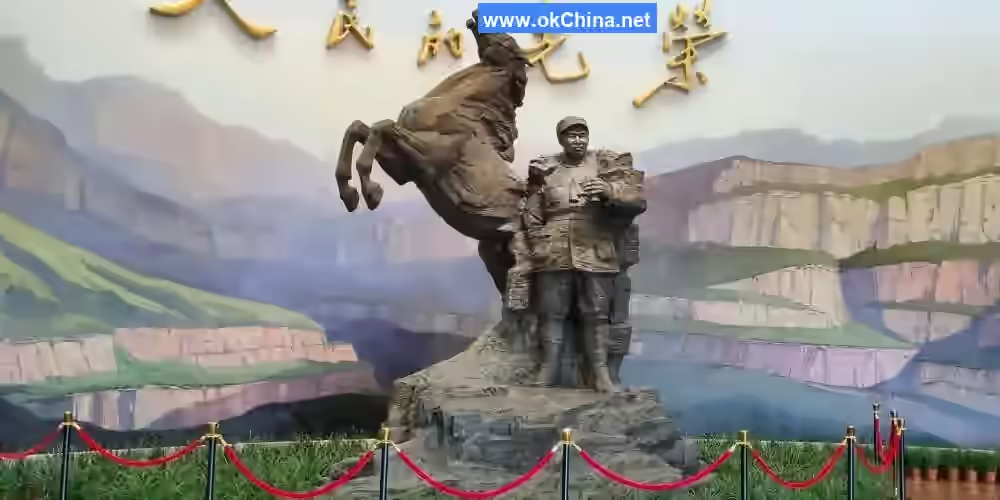
In May 1990, the Central Military Commission decided to erect a bronze statue of Comrade Zhu De and build the Zhu De Bronze Statue Memorial Park in his hometown of Jincheng Town, the old county seat of Yilong. The foundation stone for Marshal Zhu De's bronze statue was laid on July 6, 1991, and the statue was unveiled on November 22, 1991.
The Zhu De Bronze Statue Memorial Park is a sacred place for people to pay homage to Zhu De's bronze statue, study his thoughts, and receive revolutionary traditional education. The park covers an area of 6,000 square meters, with a construction area of 3,000 square meters. The bronze statue of Marshal Zhu De stands in the center of the park, surrounded by exhibition rooms, the Meritorious Service Archway, and a wall inscribed with calligraphy by famous figures. The park is terraced, higher in the north and lower in the south, divided into four levels. Upon entering the main gate, visitors are greeted by a dark granite wall bearing the park's name, with the front side inlaid with five golden characters "Zhu De Memorial Park" inscribed by Comrade Jiang Zemin, then General Secretary of the CPC Central Committee. The back of the wall is engraved with a biography of Comrade Zhu De. Ascending the steps, one encounters the 9.5-meter-high, 6.5-meter-wide Meritorious Service Archway, topped with the flag and emblem of the Chinese People's Liberation Army. The two sides of the archway's plaque bear inscriptions by Mao Zedong, "Glory of the People," and Li Xiannian, "Light of the People." Continuing upward, marble walls on both sides are engraved with two major works by Comrade Zhu De: "How to Create an Iron Red Army" and "In Memory of My Mother." Further up is the Zhu De Bronze Statue Square. The bronze statue of Marshal Zhu De stands at the highest point of the park. The front of the statue's base is inlaid with four gilded bronze characters "Marshal Zhu De" inscribed by Comrade Jiang Zemin, while the back is engraved with an epitaph composed by Kang Keqing and written by Zhao Puchu. Behind the bronze statue is the Zhu De Military Life and Thought Exhibition Hall, which comprehensively displays Comrade Zhu De's combat achievements, scholarly demeanor, military thoughts, and the progressive course of the Chinese revolution.
3.2 Zhu De's Former Residence
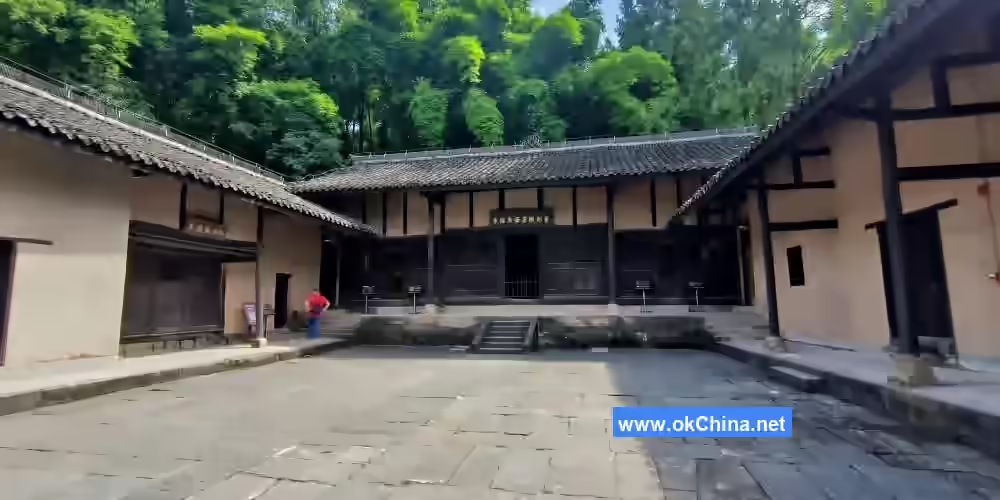
Zhu De's Former Residence was built in the 25th year of the Jiaqing reign of the Qing Dynasty (1820). It was the second dwelling place of the Zhu family after they migrated from Guangdong to Sichuan and has a history of over 190 years.
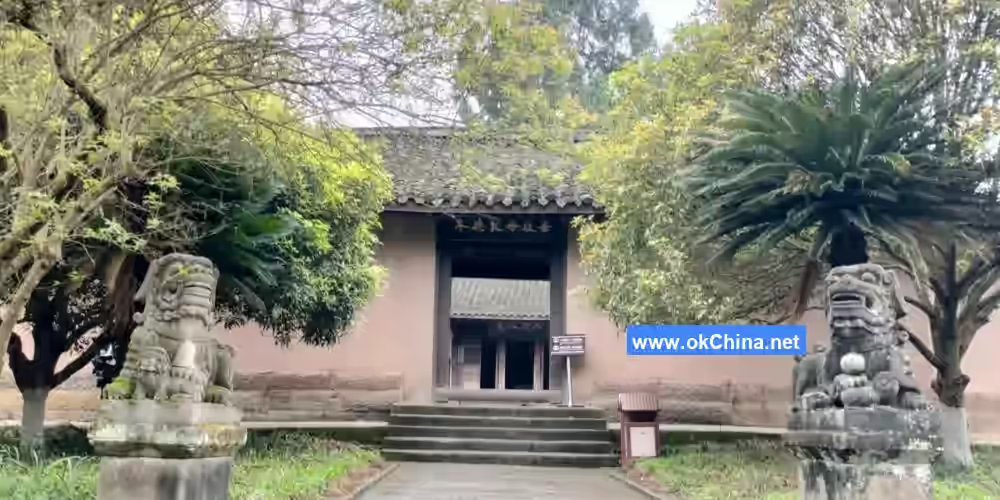
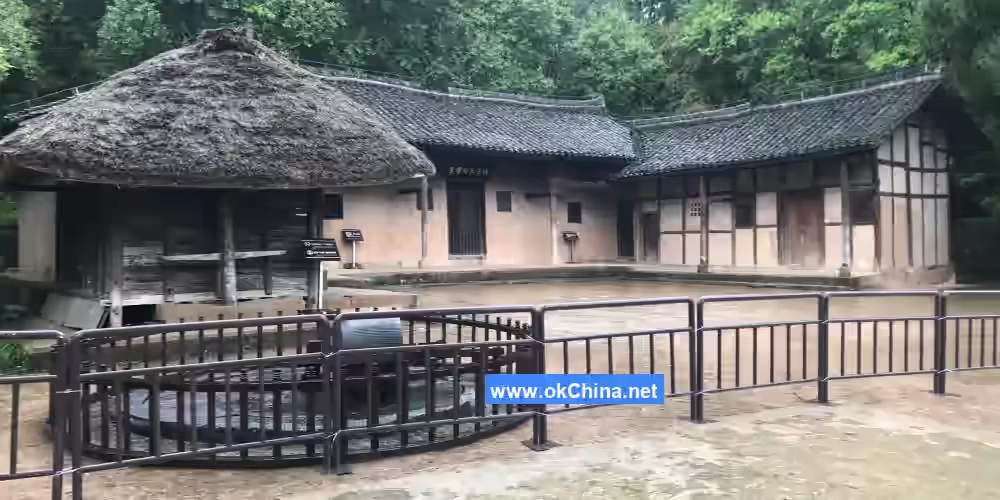
This is a south-facing, earth-and-timber structure, a typical northern Sichuan farmhouse courtyard. Zhu De lived here from the age of 9 for a full 14 years, spending his youth. The interior is arranged according to its original state when Zhu De left home, displaying items used by Zhu De and his family. The plaque above the main hall's lintel was personally inscribed and presented by the literary giant Guo Moruo. The "Twin Cypress Trees" and "Linlang Well" beside the house bear witness to Zhu De's labor, life, and studies during that time.
It was designated as a National Key Cultural Relics Protection Unit by the State Council in 1988.
3.3 Comrade Zhu De's Former Residence Memorial Hall
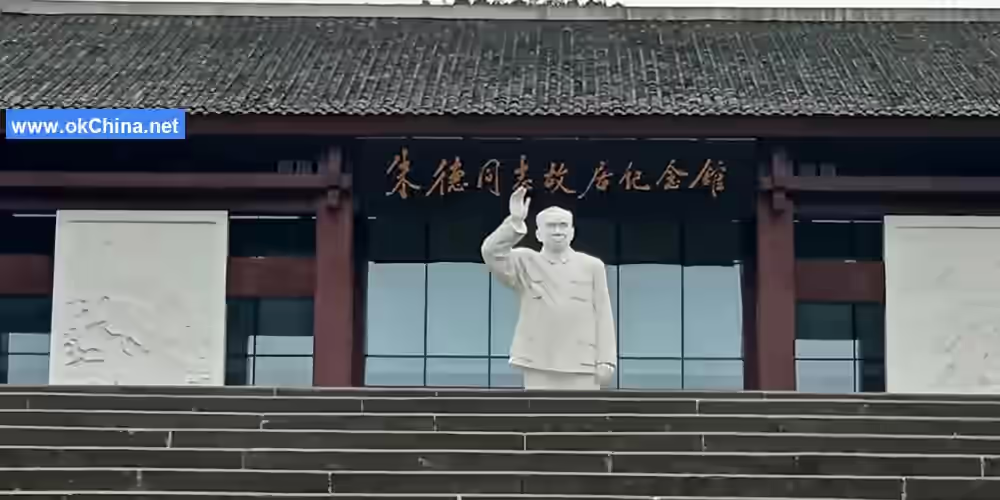
Comrade Zhu De's Former Residence Memorial Hall is located in Ma'an Town, Yilong County, Nanchong City—the birthplace of Zhu De, an ancient Hakka town, and the origin place of Northern Sichuan large puppetry. It was approved for construction by the State Council in 1979 and opened to the public on August 1, 1982. On August 14, 2004, after Comrade Hu Jintao, then General Secretary of the CPC Central Committee and President of the People's Republic of China, inspected Yilong and issued the important instruction to "definitely protect Zhu De's former residence well and definitely build Zhu De's hometown well," the memorial hall underwent renovation and expansion, reopening on December 1, 2006. The exhibition was updated again in 2016, reopening on December 1 of that year.
Comrade Zhu De's Former Residence Memorial Hall covers an area of 27 mu (approximately 1.8 hectares), with a construction area of nearly 5,600 square meters and an exhibition area of nearly 4,600 square meters. It is divided into three main exhibition areas: the basic exhibition on Zhu De's life and deeds, the Memorial Hall, and the Interactive Experience Zone.
Comrade Zhu De's Former Residence Memorial Hall is a National First-Class Museum, a National Patriotic Education Demonstration Base, a National Patriotic Education Base for Primary and Secondary Schools, a National Youth Education Base, a National Defense Education Base, a National Integrity Education Base, a National Defense Education Base (state-level), a National Youth Civilization Unit, a National Civilized Unit, and one of the National Red Tourism Classic Routes.
3.4 Zhu De's Birthplace
Zhu De's Birthplace is located in Lijiawan at the foot of Linlang Mountain. It was a dilapidated wooden granary room, covering 420 square meters, rented by the Zhu family from a landlord surnamed Ding. On the morning of December 1, 1886 (the 6th day of the 11th lunar month), Zhu De was born in this narrow, low wooden granary room, which was only 16 square meters in area, and lived here for eight years.
It was designated as a National Key Cultural Relics Protection Unit by the State Council in 2006.
3.5 Former Residence of Zhu De's Parents
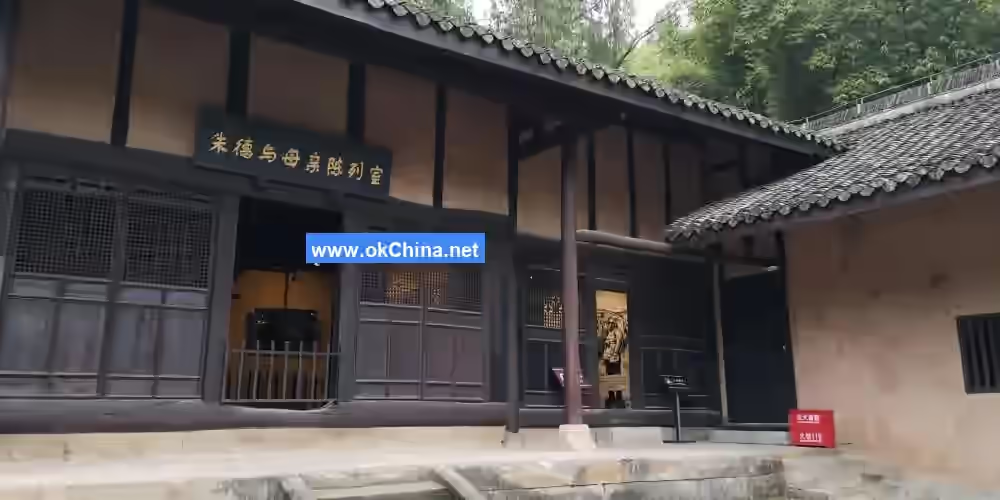
The Former Residence of Zhu De's Parents was built in the mid-Qing Dynasty. In the 6th year of the Republic of China (1917), Zhu De's grandparents, biological parents, adoptive parents, and Madame Liu lived here. The plaque above the main hall's lintel inscribed with "Light of the People" was presented by the CPC Northern Sichuan Work Committee in 1950. From 1958 until the opening of the memorial hall, the "Exhibition on Zhu De's Life and Deeds" was held here, receiving tens of millions of visitors. In August 2004, its original appearance from that time was restored, and an exhibition on Zhu De's family history was established.
3.6 Ding Family Manor
The Ding Family Manor was jointly built by the four wealthy Ding brothers—Ding Qiunan, Ding Qiuyu, Ding Qiuyu, and Ding Qiuzhen. It is the best-preserved landlord manor in northern Sichuan. Construction began in the 32nd year of the Guangxu reign of the Qing Dynasty (1906) and was completed in the 14th year of the Republic of China (1925). It covers an area of 6,800 square meters, with a construction area of 3,800 square meters, containing 108 rooms of various sizes. It is a classic example of the fusion of northern Sichuan folk architecture and Hakka architecture.
It was designated as a National Key Cultural Relics Protection Unit by the State Council in 2013.
3.7 Yaopuya Private School
Yaopuya Private School is where Zhu De began his education in the 18th year of the Guangxu reign of the Qing Dynasty (1892). It is a historical witness to Zhu De's production, life, and studies during his youth. After liberation, the government established "Linlang Primary School" here, later renamed "Yaopuya Primary School," with the school name inscribed by the famous calligrapher Shu Tong. In 2006, the school relocated, and the private school was restored to its original appearance. Currently, a special exhibition titled "Zhu De's Teacher-Student Friendship" is open to the public free of charge.
3.8 Tomb of Zhu De's Biological Father, Zhu Shilin
The tomb of Zhu De's biological father, Zhu Shilin, features a round, steamer-shaped mound. A five-tiered, seven-niche, two-chamber stone archway with a coffin-pushing design, imitating a wooden structure, is built in front. It is 5.5 meters high and 4 meters wide, adorned with sculptures of figures, flowers, plants, patterns, and couplets. The tombstone's epitaph records Zhu Shilin's family background and narrates the achievements Zhu De made for the benefit of the country and its people during the National Protection and Constitutional Protection Wars. It possesses significant artistic and historical value.
3.9 Tomb of Zhu De's Biological Mother, Madame Zhong
The tomb of Zhu De's biological mother, Madame Zhong, is located southwest of Jiaoding Mountain within the scenic area. It was first built in the 33rd year of the Republic of China (1944) and underwent repairs and expansions in 1986 and 2003. It is an earth-and-stone tomb. The two-level platform in front of the tomb is engraved with the essay "In Memory of My Mother" and a report from the Yan'an Liberation Daily dated April 12, 1944, detailing the grand memorial service held by various circles in Yan'an for Madame Zhong.Madame Zhong, mother of Zhu De, was the only "great maternal figure" personally praised by Mao Zedong in his lifetime. Her noble character and lofty virtues influenced Zhu De throughout his life, leading to the creation of his classic work, Recalling My Mother. In 1944, Madame Zhong passed away in her hometown and was secretly buried there to prevent the Kuomintang reactionaries from desecrating her grave again. Two months later, the news reached Yan'an. At Mao Zedong's suggestion, the Central Committee of the Communist Party of China held a grand memorial service in Yan'an. Mao Zedong, Zhou Enlai, and other party and state leaders sent wreaths and elegiac couplets. Mao Zedong's elegy read: "A mother should emulate the virtuous mother of a national hero; this person is worthy of being a perfect example of the working class." The Central Committee's elegy stated: "Only the maternal spirit of the working people can nurture the leader of the working people." To promote the spirit of Madame Zhong, mother of Zhu De, the cemetery was expanded in 2004, adding a square, a worship platform, and greening facilities, making it an important site for people to "commemorate the great maternal figure and promote the spirit of Madame Zhong, mother of Zhu De."
3.10 Linlang Well
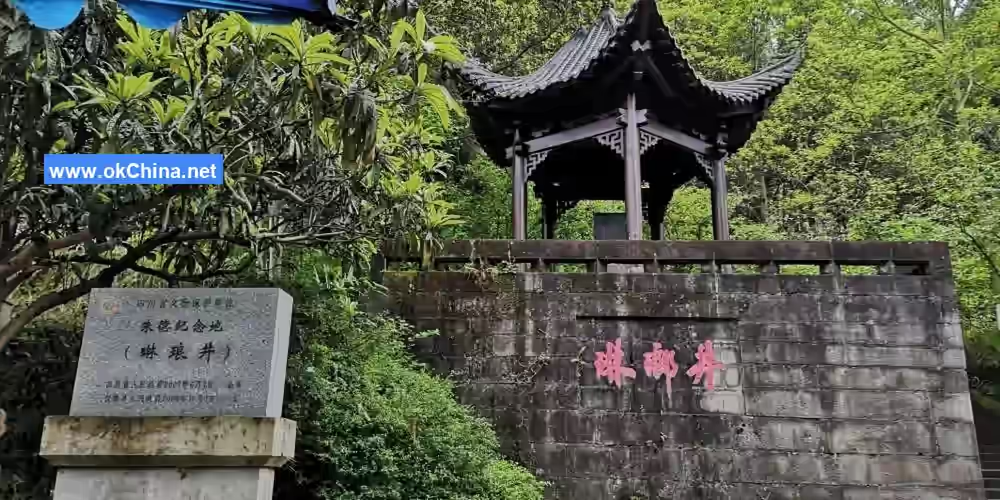
Linlang Well is a water well dug by Zhu De himself in the summer of the 26th year of the Guangxu reign of the Qing Dynasty (1900), when he was 14 years old. The entire well covers an area of 150 square meters, with a well platform of 30 square meters. The circular well mouth, built with stone slabs, has a diameter of approximately 0.7 meters and a depth of 7 meters, with stone slabs lining the walls. The well platform stands 1 meter above the ground, and a marble protective marker stele is erected outside it. To the north of the well platform is a 3-meter-high, 5-meter-wide screen wall, with the three large cursive characters "Linlang Well" carved in the center. Above the screen wall is a hexagonal pavilion inscribed with "Remember the Source When Drinking Water." Inside the pavilion stands a black marble stele, with "Remember the Source When Drinking Water" carved on the front and "Record of Linlang Well" on the back. This cultural relic is located on relatively flat terrain with a stable foundation.
3.11 Twin Cypress Trees
The Twin Cypress Trees are located east of Zhu De's former residence. During his youth, Zhu De would tie a wooden bar between these two cypress trees to practice horizontal bar exercises and build his physique. Later generations named these two cypress trees the "Twin Cypress Trees."
3.12 Square Field
The Square Field is located directly in front of Zhu De's former residence and was the only ancestral land of the Zhu family. Zhu De often worked in this field as a child, and he would raise small fish he caught while bathing in the river during the summer. In 2005, environmental improvements were made to the Square Field and its surroundings.
3.13 Linlang Mountain
Linlang Mountain is located at the center of the scenic area. Its central peak rises prominently, with five small ridges extending evenly in five directions. When viewed from above, the mountain resembles a large five-pointed star, earning it the name "Five-Star Linlang Mountain." It is one of the seven wonders of the scenic area.
3.14 Hammer and Sickle Stone
The Hammer and Sickle Stone is located at the southern entrance of the scenic area. It is a naturally formed peculiar stone, with three-quarters of its outer edge curved like a sickle, while the upper part of the stone is T-shaped, resembling a hammer. This natural shape closely resembles the emblem of the Communist Party of China.
3.15 Sedan Chair Mountain
Between Zhu De's birthplace and the tomb of his father, Zhu Shilin, lies a very peculiar mountain. The mountain body is columnar, and its peak is conical, resembling a large sedan chair, hence the name "Sedan Chair Mountain." It also looks like the official hat worn by Qing Dynasty officials, earning it the alternative name "Official Hat Mountain." The cypress trees on the mountain are as thick as a wrist and remain evergreen for decades. The treetops naturally form the shape of a "dragon" swaying with the wind, creating a unique sight. This mountain serves as a boundary: to the east, the wealthy Ding brothers emerged, while to the west, the great Marshal Zhu De was born. Thus, it is said that the east brings wealth, and the west brings nobility.
4. Cultural Activities
The Zhu De Former Residence Memorial Park focuses on the theme of "Zhu De's Spirit," with red culture as the main thread and natural ecology as the backdrop, recreating the scenes of Zhu De's youth. In 2005, it was listed as one of the 100 classic red tourism scenic spots in China.
Within the park, there are nationally protected cultural heritage sites such as "Comrade Zhu De's Former Residence," "Zhu De's Birthplace," and "Ding Manor." It also includes the national patriotic education demonstration base, "Comrade Zhu De Former Residence Memorial Hall," the "Zhu Family Ancestral Hall" displaying Zhu De's life story and family history, the旧址 of "Yaopuya Private School" and "Xijiabian Private School" where Zhu De studied as a youth, and the "Ding Manor," known as the first Hakka estate in northern Sichuan, which skillfully combines Hakka architectural style with the charm of northern Sichuan folk houses. The beautiful ecological environment, vivid farming culture, authentic Hakka culture, and deeply educational red culture create a tourist destination for visitors to cultivate their sentiments and relax.
4.1 Red Culture
The father of the Red Army, commander-in-chief of the three armed forces, chairman of the People's Republic, and founding father of the nation, Comrade Zhu De, was born on this land. The great achievements of Marshal Zhu De, his study and life in his youth, his family background, and the "Zhu De Spirit" are the highlights that attract domestic and international visitors to the scenic area. On this heroic land, an ordinary soldier named Zhang Side was also born. Comrade Mao Zedong's famous essay Serve the People outlines a shining example deeply etched in the hearts of generations. At the same time, as an old revolutionary base, proletarian revolutionaries of the older generation, such as Li Xiannian, Xu Xiangqian, Xu Shiyou, and Wang Shusheng, fought bloody battles here. A large number of revolutionary martyrs, represented by Xi Maozhao, who sacrificed his life escorting Comrade Chen Yun out of Sichuan, emerged successively. Over 5,000 sons and daughters of Yilong County gave their young lives for the birth of New China. The scenic area preserves sites such as the political department of the Red Ninth Army and the Red Army Street in Ma'an Town. To this day, more than 180 Red Army relics and over 80 Red Army stone inscriptions remain. The grand and well-preserved Ding Manor is hailed as the "First Hakka Estate in Northern Sichuan."
4.2 Hakka Culture
The Hakka people in Yilong migrated from Guangdong, Fujian, and Jiangxi during the late Ming and early Qing dynasties. To this day, 300,000 Hakka descendants still preserve Hakka traditions, making it the largest Hakka settlement in western China after Luodai in Chengdu. In Yilong, Hakka people account for 30% of the population. Currently, Lexing Town and Ma'an Town, the hometown of Zhu De, still maintain strong Hakka customs. In Lexing, known as the first Hakka township in Yilong, the architectural style of streets and houses is modeled after the ancestral towns in Guangdong.
The Hakka people in Yilong still retain their ancestors' preference for communal living, with three or four families sharing a courtyard house. Due to their clustered living, the Hakka flavor in Yilong remains authentic.
When the Hakka people entered Sichuan, they collectively funded the construction of numerous manors, guildhalls, and ancestral halls based on their surnames. The Ding Manor within the Zhu De Former Residence Memorial Park is known as the "First Estate in Northern Sichuan." Construction began in 1912 and was completed in 1925, with 108 rooms arranged in an orderly manner, second only to the landlord manor of Liu Wencai in Dayi. Currently, the renovation of Ding Manor, the exhibition of Hakka cultural relics, and the supporting attraction "Hakka Tribe" are progressing in an orderly manner.
4.3 Three Hometown Cultures
Since the 1980s, the "Three Hometown Cultures" represented by paper-cutting, seal carving, and calligraphy have flourished widely in Yilong County. With primary and secondary schools as the base and various art associations as the backbone, the county organizes training, guidance, creation, and exhibition activities involving government agencies, schools, enterprises, institutions, township communities, and art enthusiasts. This has fostered a large creative team, produced numerous artistic talents, and generated a wealth of artistic works. Yilong County has been named a "Culturally Advanced County" by the Sichuan Provincial Government and a "Hometown of Chinese Folk Culture and Arts" by the Ministry of Culture.
Jinsu Shuyan (Golden Millet Calligraphy Cliff) is located in Jincheng Park, Jincheng Town, Yilong County, Sichuan Province. It is an 800-meter-long calligraphy corridor stretching from the eastern cliff of Guanyin Pavilion to Liujia Rock. On November 19, 2020, cover news reporters learned from relevant sources in Yilong County that the landmark project of Shuyan—a 460-square-meter石刻 of the character "De" (virtue), taken from the handwriting of founding father Zhu De—is currently the world's largest single摩崖石刻 Chinese character.
4.4 Related Figures
Zhu De
Born on December 1, 1886, with the courtesy name Yujie. A native of Yilong, Sichuan. In 1909, he enrolled in the Yunnan Army Lecture Hall and joined the Chinese Revolutionary Alliance in the same year. He participated in the 1911 Revolution. After 1913, he served as battalion commander, deputy regiment commander, regiment commander, and brigade commander in the Yunnan Army. He took part in the National Protection War and the Constitutional Protection War. In 1922, he went to Germany to study and joined the Communist Party of China in the same year. In 1925, he went to the Soviet Union to study military affairs and returned the following year. In 1927, he founded the Third Army Officer Training Corps of the National Revolutionary Army in Nanchang, participated in leading the August 1 Nanchang Uprising, and served as deputy commander of the Ninth Army of the uprising forces. In 1928, he participated in leading the Southern Hunan Uprising, establishing a workers' and peasants' democratic government. In April of the same year, he led the uprising forces to Jinggangshan, where they joined forces with the troops led by Mao Zedong, forming the Fourth Army of the Chinese Workers' and Peasants' Revolutionary Army (later renamed the Red Army).
During the Agrarian Revolutionary War, he served as commander of the Fourth Army of the Chinese Workers' and Peasants' Revolutionary Army. Starting in 1930, he served as commander of the First Army Corps of the Chinese Workers' and Peasants' Red Army, commander-in-chief of the First Front Army, commander-in-chief of the Chinese Workers' and Peasants' Red Army, and chairman of the Central Revolutionary Military Commission. Together with Mao Zedong, he commanded the Red Army to victories in the first, second, and third counter-encirclement campaigns. In the spring of 1933, together with Zhou Enlai, he commanded the Red Army to victory in the fourth counter-encirclement campaign. In October 1934, he participated in the Long March. In January 1935, at the Zunyi Conference convened by the Party Central Committee, he sternly criticized the errors of "leftist adventurism" and firmly supported Mao Zedong's leadership position in the entire Party. During the Long March, he resolutely fought against Zhang Guotao's分裂 of the Red Army and叛党 activities.During the War of Resistance Against Japan, he served as Vice Chairman of the Central Military Commission and Commander-in-Chief of the Eighth Route Army (later renamed the 18th Group Army, where he served as Commander-in-Chief). He fought across provinces such as Shanxi, Chahar, Hebei, Shandong, and Henan, establishing and expanding anti-Japanese base areas. In the winter of 1940, he proposed the "Nanniwan Policy," making significant contributions to developing the mass production movement and breaking the Kuomintang reactionaries' blockade of the Shaanxi-Gansu-Ningxia Border Region.
During the Liberation War, he served as Vice Chairman of the Central Military Commission and Commander-in-Chief of the People's Liberation Army. He assisted Mao Zedong in organizing and commanding the three major campaigns—Liaoshen, Huaihai, and Pingjin—and later, together with Mao Zedong, issued the order to advance nationwide, directing the People's Liberation Army to cross the Yangtze River. He made tremendous contributions to overthrowing the reactionary rule of the Kuomintang and achieving the great victory of the Liberation War.
After the founding of the People's Republic of China, he successively served as Vice Chairman of the Central People's Government, Vice Chairman of the Central Military Commission of the Communist Party of China, Commander-in-Chief of the People's Liberation Army, Vice Chairman of the People's Republic of China, and Vice Chairman of the National Defense Commission. From November 1949 to May 1955, he also served concurrently as Secretary of the Central Commission for Discipline Inspection.
He was a member of the Political Bureau of the 6th Central Committee of the Communist Party of China, a member of the Political Bureau and Secretary of the Secretariat of the 7th Central Committee, Vice Chairman of the 8th Central Committee, a member of the Political Bureau of the 9th Central Committee, and a member of the Standing Committee of the Political Bureau of the 10th Central Committee. From April 1959, he served as Chairman of the Standing Committee of the 2nd, 3rd, and 4th National People's Congresses, and Vice Chairman of the 1st National Defense Commission.
In 1955, he was awarded the rank of Marshal of the People's Republic of China. He also received the First-Class August 1 Medal, the First-Class Order of Independence and Freedom, and the First-Class Order of Liberation.
He passed away in Beijing on July 6, 1976, at the age of 90.
Comments
Post a Comment