Yunqiu Mountain Scenic Area
I. Introduction
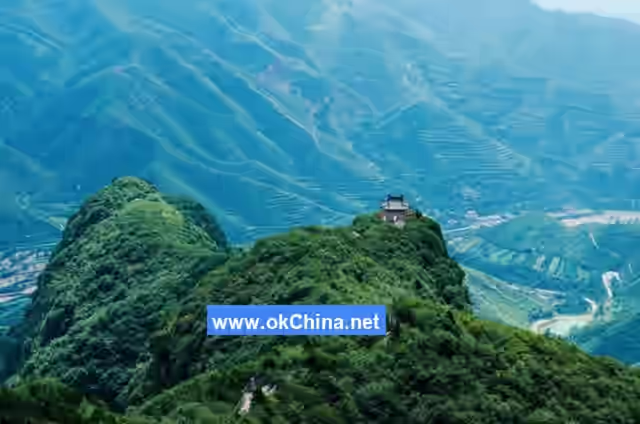
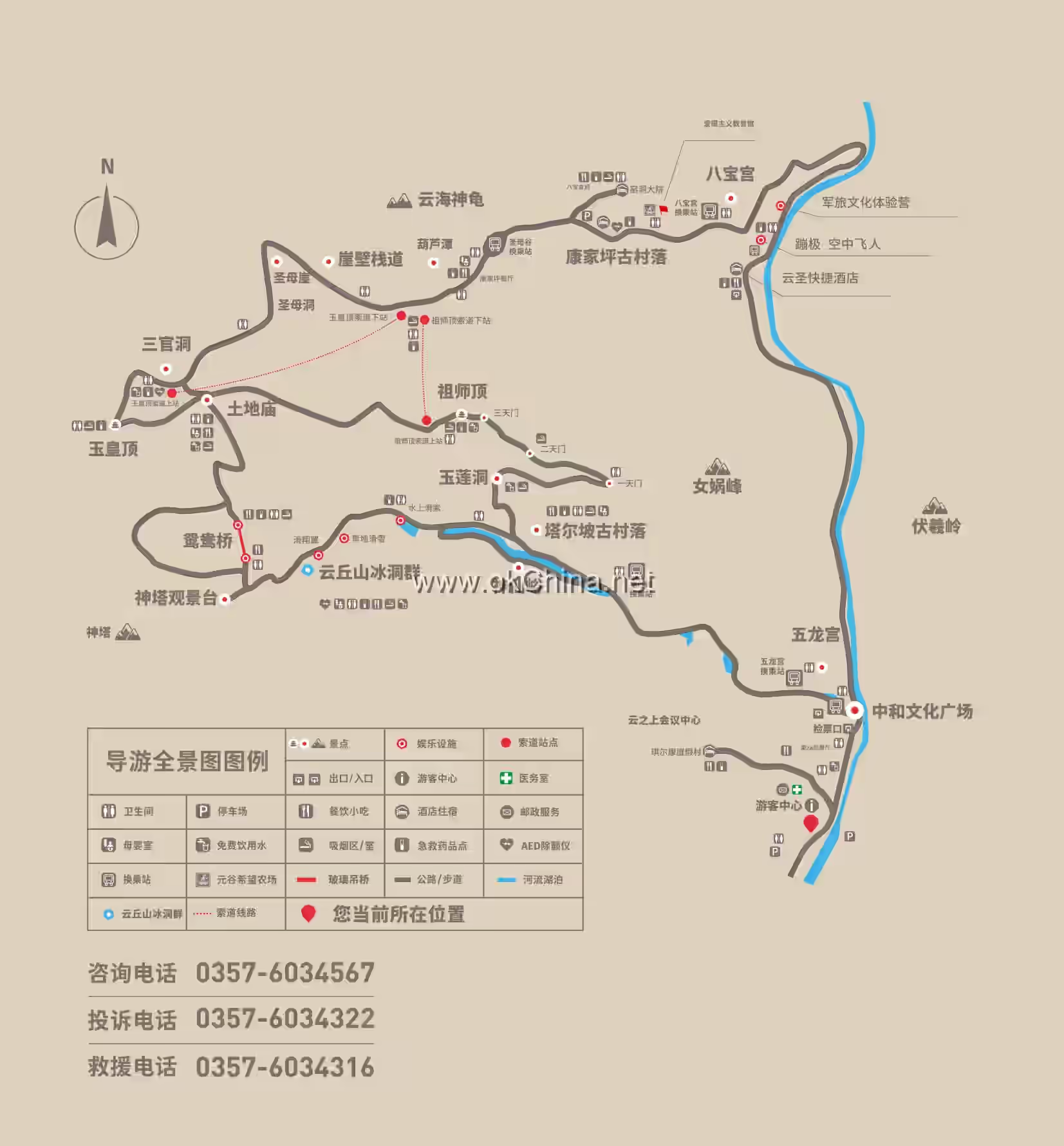
Yunqiu Mountain is located in Dahe Village, Guanwangmiao Township, Xiangning County, Linfen City, Shanxi Province. It is 16 kilometers from the Jishan County exit of the Houyu Expressway and 20 kilometers from National Highway 108, offering convenient transportation. The scenic area is renowned for its beautiful natural landscapes, rich flora and fauna resources, and profound cultural heritage, earning it the reputation of "the most beautiful peak of Guye" and "the top scenic spot along the Fen River."
II. Natural Landscape
Yunqiu Mountain features overlapping verdant peaks and picturesque scenery, boasting natural landscapes such as towering mountains, perilous cliffs, peculiar rocks, cascading waterfalls, deep ravines, clear springs, and sea of clouds. The area is home to over 2,700 species of plants and animals, with forest coverage reaching as high as 89%. It has an extremely high concentration of negative oxygen ions and serves as the habitat for national-level rare species like the brown-eared pheasant and the wingnut tree, making it a precious natural gene bank.
III. Main Attractions
Zhonghe Square
Standing at Zhonghe Square, one can see a group of giant stone carvings. The main carving depicts Fuxi and Nüwa with human heads and serpent bodies intertwined, with Fuxi on the east and Nüwa on the west, representing the yin and yang positions. They hold a square and a compass respectively, symbolizing the round heaven and square earth as well as social order. The main stone carving weighs over 80 tons and stands 9.95 meters tall from the base of the stone pedestal, symbolizing the "supreme九五至尊" and expressing reverence for the ancestors. The carvings on both sides represent the twelve Chinese zodiac signs with human bodies and animal heads, arranged clockwise to represent the twelve two-hour periods of a day. The position of the rat image for the Zi hour (11 PM–1 AM) is determined according to the Taiji diagram. As the saying goes, "A day in heaven is a year on earth." Taoism believes that each day, a celestial deity is on duty in heaven. The deity encountered in the year of one's birth becomes their lifelong guardian, corresponding to their zodiac sign. Therefore, visitors can find their own zodiac sign and take a photo with it, hoping for lifelong health and safety.
Five Dragons Palace (Wulong Gong)
Five Dragons Palace was built during the Ming Dynasty, approximately 600 years ago. It was constructed over several years with donations from the public by Taoist priests of the Longmen and Huashan sects. Its incense offerings flourished during the Ming and Qing dynasties. The palace is a five-tiered structure built against the mountain. The first tier is the Offering Hall, the second tier consists of two buildings: the Ten Marshals Hall, the third tier is the Main Hall (Pengsheng Hall), the fourth tier is the Hair Combing Hall, and the fifth tier includes four halls: the Holy Mother Hall, the Grinding Needle Hall, the Three Pure Ones Hall, and the Offspring Holy Mother Hall. The name "Five Dragons Palace" originates from a legend: while the True Martial Emperor (Zhenwu Dadi) was deeply immersed in Taoist cultivation in the Yunqiu Mountain area, he ascended to heaven during the day. At the moment of his ascension, a sudden thunderclap occurred in clear weather, and five colorful dragons, bearing auspicious signs, carried the True Martial Emperor into the sky from this spot. These five dragons later became his guardian deities. Subsequently, people built a Taoist temple at the place where the five dragons cultivated, naming it "Five Dragons Palace."
Ta'erpo Ancient Village
Ta'erpo Ancient Village has a history of over 2,500 years. It is named after Laozi (Li Er), who once stayed here during his travels. Later, Taoists, hearing of this place, found it an excellent feng shui site suitable for quiet cultivation. They began practicing asceticism in the nearby mountains, gradually forming a village by settling alongside local mountain dwellers. As Taoism in Yunqiu Mountain flourished, the Quanzhen Taoist Longmen sect established its ancestral temple at the Yulian Cave on the northern hillside of Ta'erpo Village. Later, they built the Five Dragons Palace at the foot of Ta'erpo. In the 21st year of the Republic of China (1932), to raise funds for education and alleviate the financial shortage of Yunqiu Academy, the Taoist priests of Five Dragons Palace sold all the land of Ta'erpo to local villagers. Out of reverence for three nearby sacred pagodas, the villagers renamed the village Ta'erpo.
Eight Treasures Palace (Babao Gong)
Eight Treasures Palace was built in the early Qing Dynasty and is a hall that integrates Confucianism, Taoism, and Buddhism. It was jointly funded by the 23rd generation of the Huashan sect and the 24th generation of the Longmen sect. It was named "Eight Treasures Palace" because Five Dragons Palace allocated eight silver ingots during its construction. Also, because it is located north of Five Dragons Palace and built later, it is commonly called the "Rear Palace." The founder, Taoist Gao Benzhi, was the 15th-generation successor of the Quanzhen Huashan sect. He came here in the early Qing Dynasty to preach and build the palace, which was passed down through eight generations during the Republic of China era: Ren, Yi, Li, Zhi, Xin, Jia, Xiang, and Zong. The palace is a five-tiered structure. The first tier has the Three Ancestors Hall in the center, flanked by the Medicine King Hall and the Salvation Celestial Worthy Hall. The second tier is the Holy Mother Hall, the third is the Patriarch Hall, the fourth is the Jade Emperor Hall, and the fifth is the Three Pure Ones Hall.
Patriarch Peak (Zushi Ding)
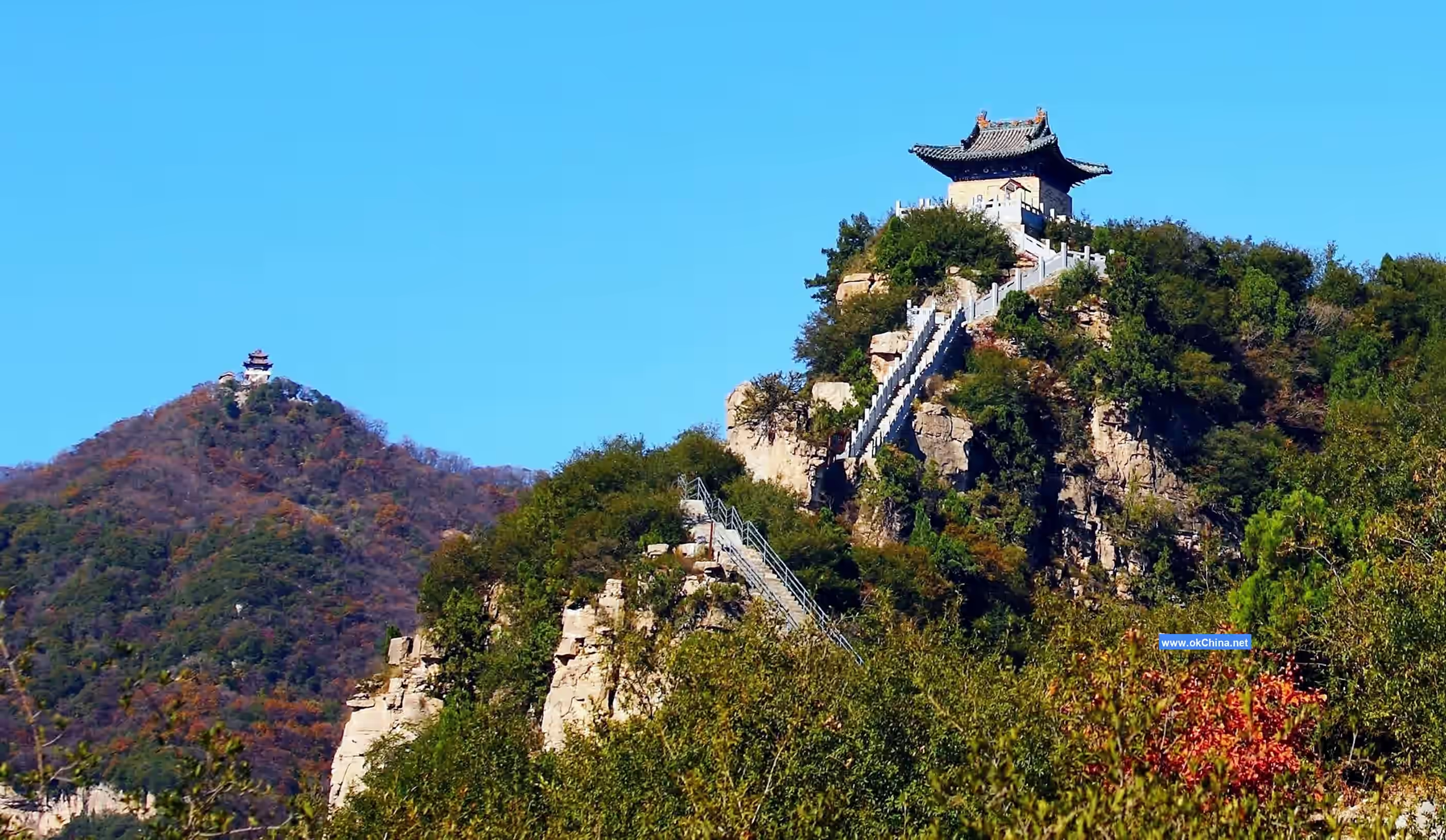
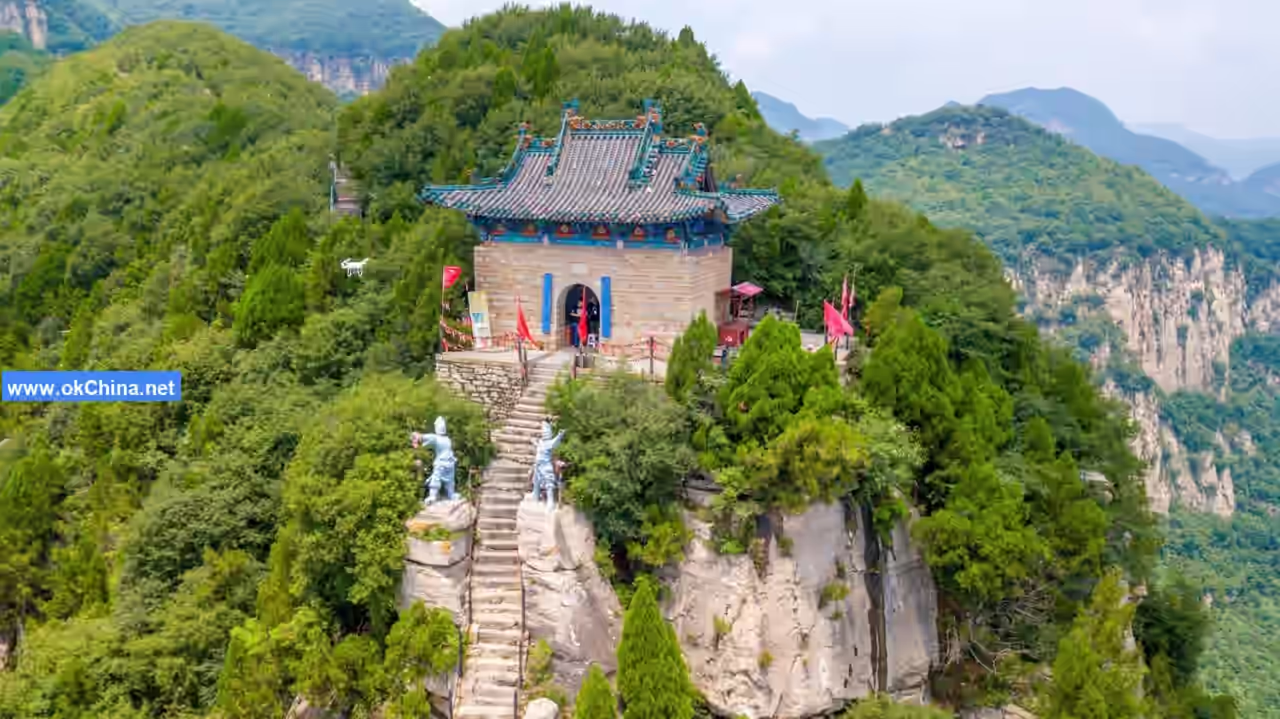
Patriarch Peak is the second highest peak of the Shenlong Ridge in Yunqiu Mountain, with an elevation of 1,330 meters. It connects to the Jade Emperor Peak above and the Three Gates below. With the Fen River bend in front and the Penholder Mountain behind, surrounded by mountains, it boasts excellent feng shui. Therefore, it was chosen by the True Martial Emperor as his cultivation site. After 42 years of cultivation, he achieved perfection and ascended to heaven in broad daylight. The Jade Emperor ordered him to guard the north and preside over the position of Xuanwu, hence he was called "Patriarch." People worship him as the god of peace. To commemorate his merits, the Patriarch Hall was built. The structures at Patriarch Peak date back to the Song and Yuan periods and are divided into three tiers: the first tier is the residence for Taoist priests, the second is a natural castle-like sandstone enclosure, and the top tier is the Patriarch Hall. Ascending the steps, one can see the statue of the True Martial Emperor. There are 35 steps in total, representing the 36 heavens in Taoism, with the final step leading to the highest level, the Patriarch Hall. The steps are quite steep, about 75 degrees, making the climb feel like taking a step and kneeling each time, which is meant to demonstrate piety towards the Patriarch. The Patriarch Hall is 7.34 meters long, 4.65 meters wide, and 15 meters high. The lower part is a beamless hall with a Song-Yuan period octagonal caisson ceiling, while the upper part features a double-eaved cross-hip and gable roof structure.
Jade Emperor Peak (Yuhuang Ding)
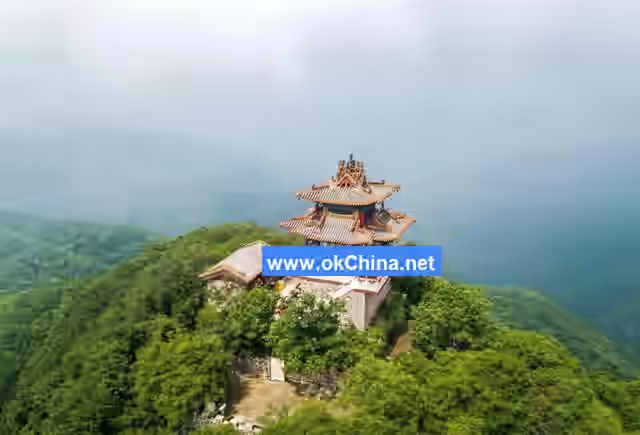
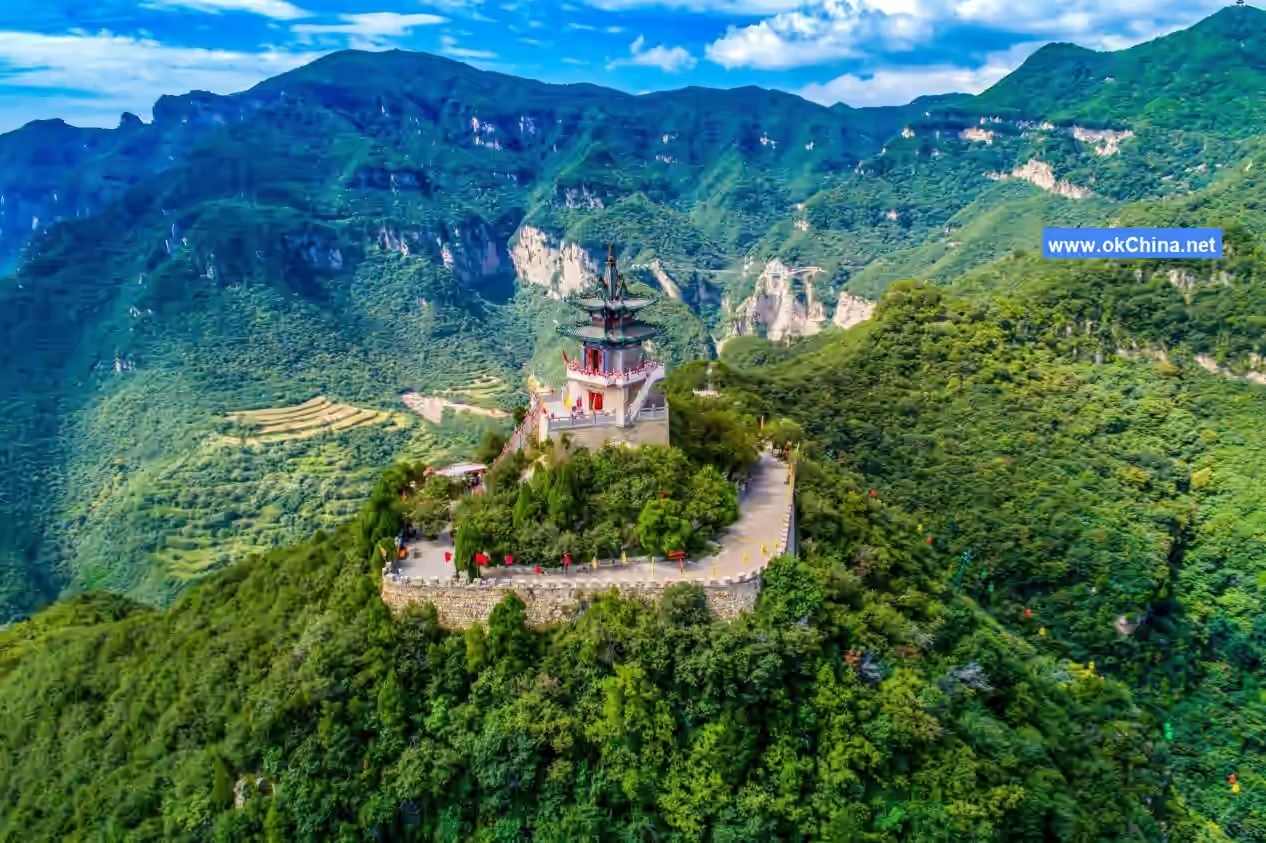
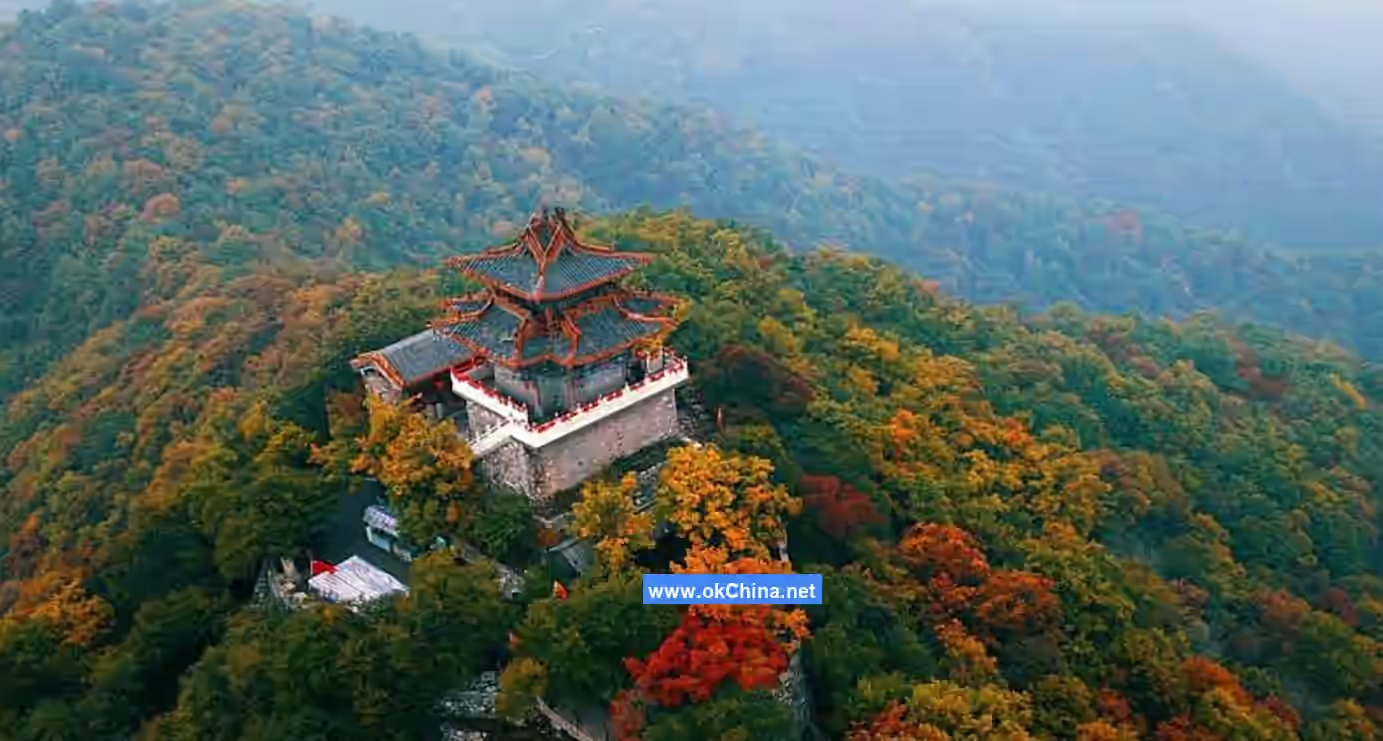
Jade Emperor Peak is located at the highest point of Shenlong Ridge in Yunqiu Mountain, with an elevation of 1,629 meters. It was built during the Song and Yuan periods and is divided into three tiers: the first tier is the residence for Taoist priests, the second tier houses the Star Dipper Hall and a beamless hall, and the third tier is the Jade Emperor Pavilion. On the second tier of Jade Emperor Peak, one can see the Star Dipper Hall, a building with a flush gable roof. Inside, it enshrines the six stars of the Southern Dipper and the seven stars of the Northern Dipper. In Taoist belief, the Southern Dipper governs life, while the Northern Dipper governs death. The Jade Emperor Pavilion is 6.4 meters long, 6.32 meters wide, and 15 meters high. It is a pavilion with a double-eaved cross-hip and gable roof built atop a beamless hall, surrounded by white marble railings. Inside, it enshrines the Jade Emperor, the Sun God, and the Moon God.
Jade Lotus Cave (Yulian Dong)
According to the Xiangning County records, Jade Lotus Cave was originally called "Liver Flower Cave." However, there is no actual cave; it is merely a cliff face hundreds of meters high, typical of karst topography, primarily composed of limestone. Over time, water erosion has formed naturally hanging inverted lotus shapes. The structures at Jade Lotus Cave were built during the Yuan Dynasty. It was chosen as a cultivation site through divination by Qiu Chuji (Changchun Zhenren) of the Yuan Dynasty and his direct disciples Sun Zhijian and Lü Zhizhong. Qiu Chuji founded the Quanzhen Longmen sect, making Jade Lotus Cave the birthplace of this sect. The overall architecture features upturned eaves and bracket sets, seemingly suspended on the cliff face. Inside Jade Lotus Cave are the Three Pure Ones Hall and the Patriarch Qiu Hall. The Three Pure Ones Hall is a wooden and stone structure with a flush gable roof, enshrining the highest Taoist deities, the "Three Pure Ones and Four Sovereigns." The "Three Pure Ones" refer to the Celestial Worthy of Primordial Beginning (Yuqing), the Celestial Worthy of Numinous Treasure (Shangqing), and the Celestial Worthy of the Way and Its Virtue (Taiqing). The "Four Sovereigns" are the four celestial emperors next in rank to the Three Pure Ones, who govern heaven and earth: the Jade Emperor, the Great Emperor of the North Star (Zhongtian Ziwei Beiji Dadi), the Great Emperor of the Highest Palace Gouchen (Gouchen Shanggong Huangtian Dadi), and the Empress of Earth (Houtu Huangdiqi).
Immortal Valley (Shenxian Yu)
Immortal Valley is lush with vegetation, featuring beautiful mountains and clear waters, making it a site with excellent feng shui. Legend has it that Gun, the predecessor of the True Martial Emperor, came here while searching for a sacred cultivation site. Seeing the babbling streams, gentle breezes, singing birds, fragrant flowers, and green mountains, he immediately recognized its superb feng shui and stayed longer. After Gun attained immortality, the common people named this place "Immortal Valley."
First Heavenly Gate (Yitian Men)
At the entrance of the First Heavenly Gate, on two protruding giant rocks stand iron statues over one meter tall, majestic and imposing. These are the generals guarding the celestial realm, known in Taoism as the Giant Spirit Gods. One holds a treasure pagoda, and the other holds a treasure ring. In local legend, the ring symbolizes clouds, and the pagoda symbolizes hills. Passing through the First Heavenly Gate means entering the celestial realm of Yunqiu Mountain. In the past, people gathered firewood here. To keep in touch, woodcutters would sing melodious songs in this beautiful and serene environment, calling and responding to each other. This is one of the eight ancient scenic spots of Yunqiu Mountain—"Heavenly Gate Woodcutter's Song." The railings along the Heavenly Street are covered with love locks. It is said that in the past, a man accidentally fell off a cliff on his way home after gathering firewood. His wife waited anxiously at home, but no one returned. Upon hearing her husband had fallen, she searched persistently for two days until he was finally rescued. Therefore, many young people make wishes for love here and lock them with love locks, believing their wishes will come true and the couple will remain united forever.
Second Heavenly Gate (Ertian Men)
The Second Heavenly Gate is a building with a hip and gable roof, serving as a passageway front and back. On both sides, the Four Heavenly Kings are enshrined, commonly known as the "Four Diamond Kings." They are the "Dhritarastra" of the East, the "Virudhaka" of the South, the "Virupaksha" of the West, and the "Vaisravana" of the North. In folk belief, they represent "favorable weather and good harvests." "The Gate of All Mysteries" (Zhongmiao Zhi Men) is a narrow stone passage in front of the Second Heavenly Gate, originally a giant rock carved by hand. It bears the four characters "众妙之门" inscribed by Zhou Di, the county magistrate of Xiangning during the Jiaqing period. In front of "The Gate of All Mysteries," one can also see a rock resembling a "fallen from the sky" stone, inscribed with "Shang Tian Ti" (Ladder to Heaven). The heavenly ladder is the means for deities to travel between the celestial and mortal realms. On the back of the giant rock are carved the three characters "Penglai Jing" (Penglai Realm). Penglai is called a celestial realm because it was where the Eight Immortals gathered during their journey across the sea. It borders the vast ocean, like a mountain abruptly rising from the sea.
Third Heavenly Gate (Santian Men)
Inside the Third Heavenly Gate are enshrined: the Earl of Wind (Fengbo), the Master of Rain (Yushi), the Duke of Thunder (Leigong), and the Mother of Lightning (Dianmu). "Fengbo" is the wind god, also called Fengshi or Jibo, named Feilian. He was the junior fellow apprentice of Chiyou and had a peculiar appearance. He and Chiyou once studied under a true Taoist master and cultivated on Qishan Mountain. The worship of wind gods in ancient China originated early, starting as far back as the Western Zhou Dynasty. Buddhism and Confucianism share similar views regarding the recognition of wind gods.One distinctive feature of the Three Heavenly Gates is the "Ascending Steps," which consist of 99 stairs, symbolizing enduring love. Another is the "Stairway to Heaven," where the steeper and more challenging the climb, the more inspiring it becomes, and the greater the rewards, leading to career advancement.
Yunqiu Mountain Ice Cave Group
Within the scenic area, a total of 16 ice cave groups have been discovered and explored. Among them, Ice Cave Group No. 1 is officially open to the public. The cavities of Yunqiu Mountain Ice Cave Group No. 1 are interconnected, with a total length of 199 meters, a maximum width of 12 meters, and a maximum height of 15 meters. The cave walls are covered in ice, with ice pillars, ice stalagmites, ice stalactites, ice flowers, and other ice crystal formations distributed throughout the space, creating a veritable fairy-tale world of ice.
IV. Cultural Resources
Cultural Heritage
Yunqiu Mountain carries profound humanistic resources and cultural heritage, with cultural roots traceable to ancient civilizations. Legend has it that Fuxi and Nüwa nurtured the descendants of China here; Xihe observed the heavens and earth here to establish the twenty-four solar terms; Houji passed down farming techniques here, marking the beginning of Central Plains agricultural civilization. Yunqiu Mountain integrates the cultures of Confucianism, Buddhism, and Taoism. The Longmen sect of Taoist Quanzhen School originated here, making it as renowned as Wudang Mountain. Taoist temples such as the Five Dragon Palace and Eight Treasures Palace coexist harmoniously with Confucian and Buddhist cultural sites like Yunqiu Academy and Duobao Lingyan Chan Temple.
Zhonghe Culture
Zhonghe culture is the core of traditional Chinese Confucian thought. The Book of Rites: Doctrine of the Mean mentions, "When equilibrium and harmony are achieved, heaven and earth will be in their proper positions, and all things will flourish." It can be said that in Chinese philosophical thought, Zhonghe represents the optimal state of heaven, earth, and all things, as well as the highest realm of human pursuit. Tracing the origins of Zhonghe culture reveals the Chinese reverence for nature and the concept of "following the way of heaven."
As the birthplace of Chinese civilization, Yunqiu Mountain looks back millennia: Fuxi and Nüwa propagated humanity here; Xihe observed the heavens and earth to establish the twenty-four solar terms calendar; Houji taught people farming, pioneering ancient agriculture... Starting from primitive society, people gradually transitioned from revering nature to utilizing it in their interactions with the natural world. Heaven, earth, all things, and humanity coexisted and supported each other, forming a state of Zhonghe. At Yunqiu Mountain, people thrived, engaged in agricultural production, and better understood how to harmoniously integrate with the mountains.
During the reign of Emperor Dezong Li Shi of the Tang Dynasty, minister Li Mi proposed naming the first day of the second lunar month as Zhonghe Festival to worship the God of Grains and the Sun God, encouraging farming. Starting from the fifth year of Zhenyuan (789 AD), Zhonghe Festival was officially established as an important holiday. However, the once-thriving Zhonghe Festival of the Tang Dynasty gradually declined in later generations, eventually merging with the "Dragon Raises Head" festival on the second day of the second lunar month and fading from history.
On May 23, 2011, Yunqiu Mountain's Zhonghe Festival was approved by the State Council and included in the National Intangible Cultural Heritage List, marking Yunqiu Mountain as a living fossil of China's Zhonghe culture "Zhonghe Festival."
Every year on the fifteenth day of the second lunar month, a grand sacrificial ceremony is held at Yunqiu Mountain to pray for divine protection, favorable weather, and abundant harvests. Since ancient times, Yunqiu Mountain has been a sacred site for prayers from surrounding communities. During Zhonghe Festival, people from hundreds of miles around come to burn incense and pray for blessings, happiness, and peace in the coming year. At the Five Dragon Palace and Eight Treasures Palace during each Zhonghe Festival, "Five Blessings Porridge" symbolizing "longevity, wealth, health, virtue, and a peaceful end" is distributed to praying visitors, wishing for favorable weather and abundant harvests in the new year.
Religious Culture
Yunqiu Mountain integrates the cultures of Confucianism, Buddhism, and Taoism: The Longmen sect of Taoist Quanzhen School originated here, making it as renowned as Wudang Mountain. Taoist temples such as the Five Dragon Palace and Eight Treasures Palace coexist harmoniously with Confucian and Buddhist cultural sites like Yunqiu Academy and Duobao Lingyan Chan Temple.
Among these, Taoism has the deepest connection with Yunqiu Mountain.
Taoism is an ancient indigenous Chinese religion originating during the Spring and Autumn and Warring States periods, advocating the ideas of "harmony between man and nature" and "following the way of nature." Taoism has been passed down for millennia in China and is widely spread, with many famous mountains gaining renown due to Taoism. Located in southern Shanxi, the birthplace of Chinese civilization, Yunqiu Mountain was anciently known as "Kunlun" and served as a sacred mountain during Emperor Yao's time. In the historical evolution of Yunqiu Mountain, Taoism played a very important role.
The connection between Yunqiu Mountain and Taoism can be traced back to the time of Laozi (Li Er). Li Er, while traveling the world to meditate and seek enlightenment, passed through here. Seeing Yunqiu Mountain's crisscrossing ravines and majestic peaks as an ideal retreat for self-cultivation away from worldly disturbances, he stayed here. Later generations named the hillside where he stayed "Ta'er Slope."
Another representative Taoist figure, Zhuangzi, mentioned Yunqiu Mountain again in Free and Easy Wandering: "On the distant Gushe Mountain, there dwells a divine being." Later research indicates that Gushe Mountain is located "north of the Fen River," precisely Yunqiu Mountain. Thus, in the eyes of Taoist sages, Yunqiu Mountain was indeed a geomantic treasure land with divine aura.
Later Taoists flocked here upon hearing of its fame, making Yunqiu Mountain an excellent place for cultivation and seeking enlightenment. Taoists practiced asceticism in the mountains, settling in caves on Ta'er Slope, gradually forming villages. Taoism often pursues tranquility and non-action, living in seclusion. However, at Yunqiu Mountain, Taoists and local villagers lived side by side, forming a harmonious society of "coexistence between Taoists and people."
Due to long-term proximity to Taoists, the lifestyle habits and philosophies of the Taoists greatly influenced the villagers. Villagers practiced martial arts in front of their homes and courtyards for fitness; they gathered herbs in the mountains, brewed them into tea for medicinal purposes and health. The already simple folk customs gained an otherworldly, transcendent quality under Taoist influence. Touched by the villagers' sincerity and affection, the Taoists also contributed greatly to the community. In the 21st year of the Republic of China (1932), Yunqiu Academy faced financial difficulties and was on the verge of closure. The Taoists of Five Dragon Palace, acting for the public good, resolutely sold the Taoist temple's land on Ta'er Slope to fund the academy. Although Ta'er Slope was later renamed Ta'er Slope, the ancient tradition of mutual support between Taoists and people has been passed down and celebrated through the ages.
Time passed. Starting from the Sui and Tang dynasties, large-scale Taoist temples were successively built on Yunqiu Mountain, reaching their peak during the Ming and Qing dynasties. During this period, the establishment of the Longmen sect of Quanzhen Taoism was of great significance. Qiu Chuji, one of the Seven Northern Masters of Quanzhen Taoism, personally led his disciples Sun Zhijian and Lü Zhizhong to Yunqiu Mountain during the Yuan Dynasty, selecting Yulian Cave as their cultivation site and founding the foremost Taoist sect—Longmen sect. Today, Yulian Cave still preserves two stone tablets recording the historical materials of the Longmen sect's founding. Later, Gao Benzhi, a master of another major Quanzhen sect, the Huashan sect, also came to Yunqiu Mountain to preach, with a stone tablet still standing in front of Eight Treasures Palace recording this. The prosperity of Taoism made Yunqiu Mountain a spiritual land longed for by the people of southern Shanxi. During Zhonghe Festival and other major solar terms, crowds of believers flocked to the mountain temples to pray and fulfill vows, creating a spectacular sight.
Ancient Culture
The area between the Yellow River and Fen River is the birthplace of early human civilization and the cradle of five-thousand-year Chinese civilization. Yunqiu Mountain, located north of Jishan Mountain and at the southern end of the Lüliang Mountains in this riverine region, holds a special geographical position as part of the Kunlun Mountains. This is where ancient humans transitioned from hunting to agricultural civilization, and where ancient figures such as Yao, Shun, Yu, Houji, and Xihe were active. The capital of Yao, Pingyang, was east of Yunqiu Mountain; the capital of Shun, Puban, was south; and Yu the Great's flood control efforts were at Longmen, west of Yunqiu Mountain. Jishan Mountain is where Houji, the ancestor of Chinese agricultural culture, taught people farming. Houji, as Yao's agricultural official, relied on the four seasons for teaching farming. Yao commanded Xihe to observe celestial phenomena at the southern foothills of Yunqiu Mountain. Using Yunqiu Mountain's circular formation as the northern high reference, Xihe observed sundials and the Big Dipper to establish the Xia calendar. The Xihe Temple and Xihe Tomb are located at the southern foothills of Yunqiu Mountain. Combined with historical records of Xihe, there is evidence that Yunqiu Mountain is the starting point of Chinese agricultural civilization and the birthplace of the Xia calendar.
Comments
Post a Comment