Yungang Grottoes
1. Introduction
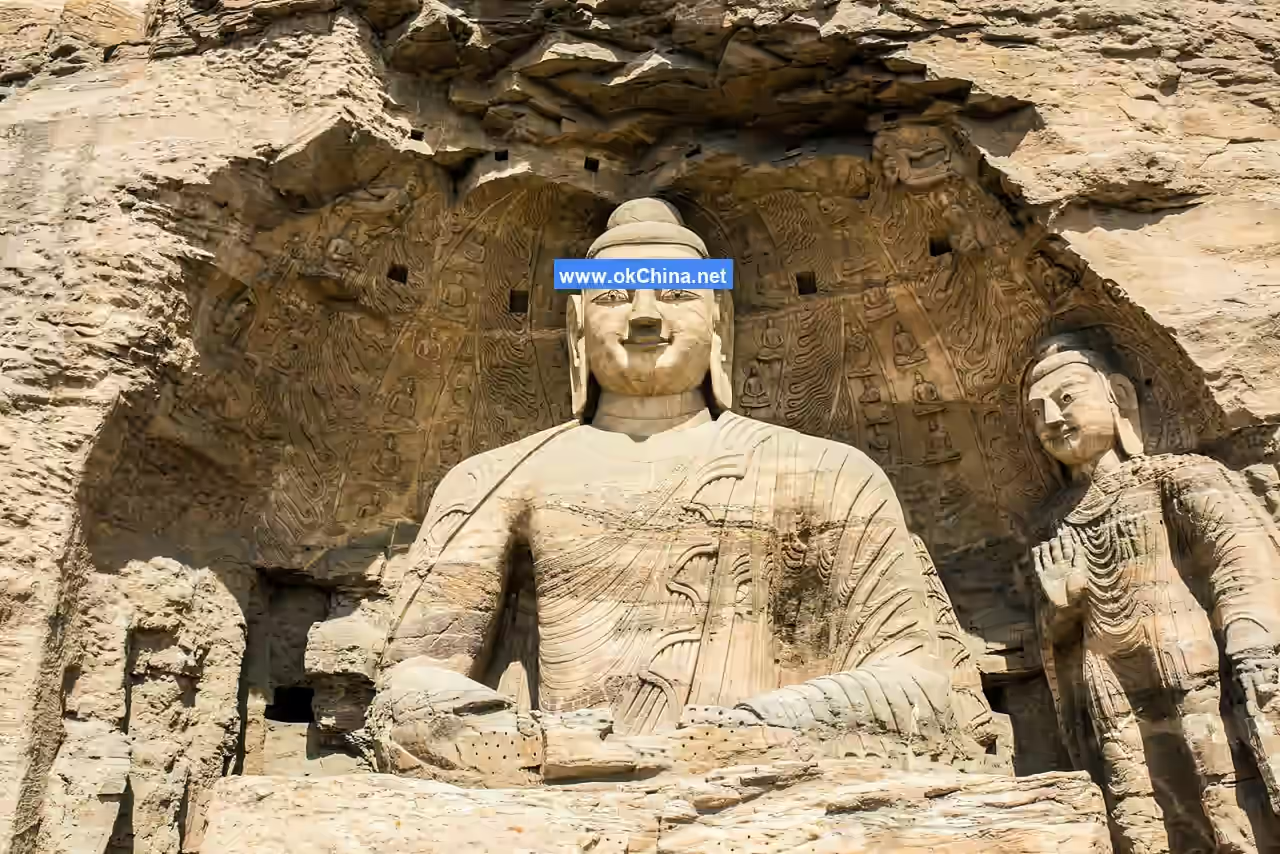
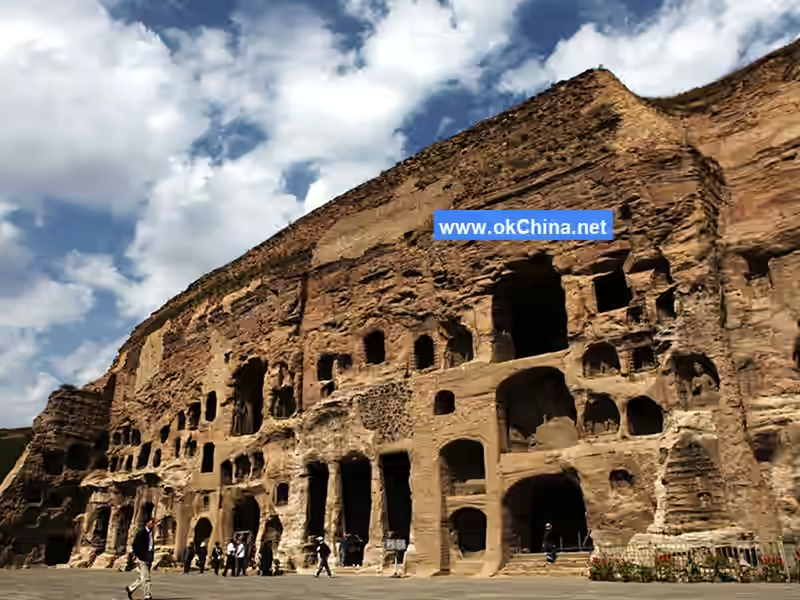
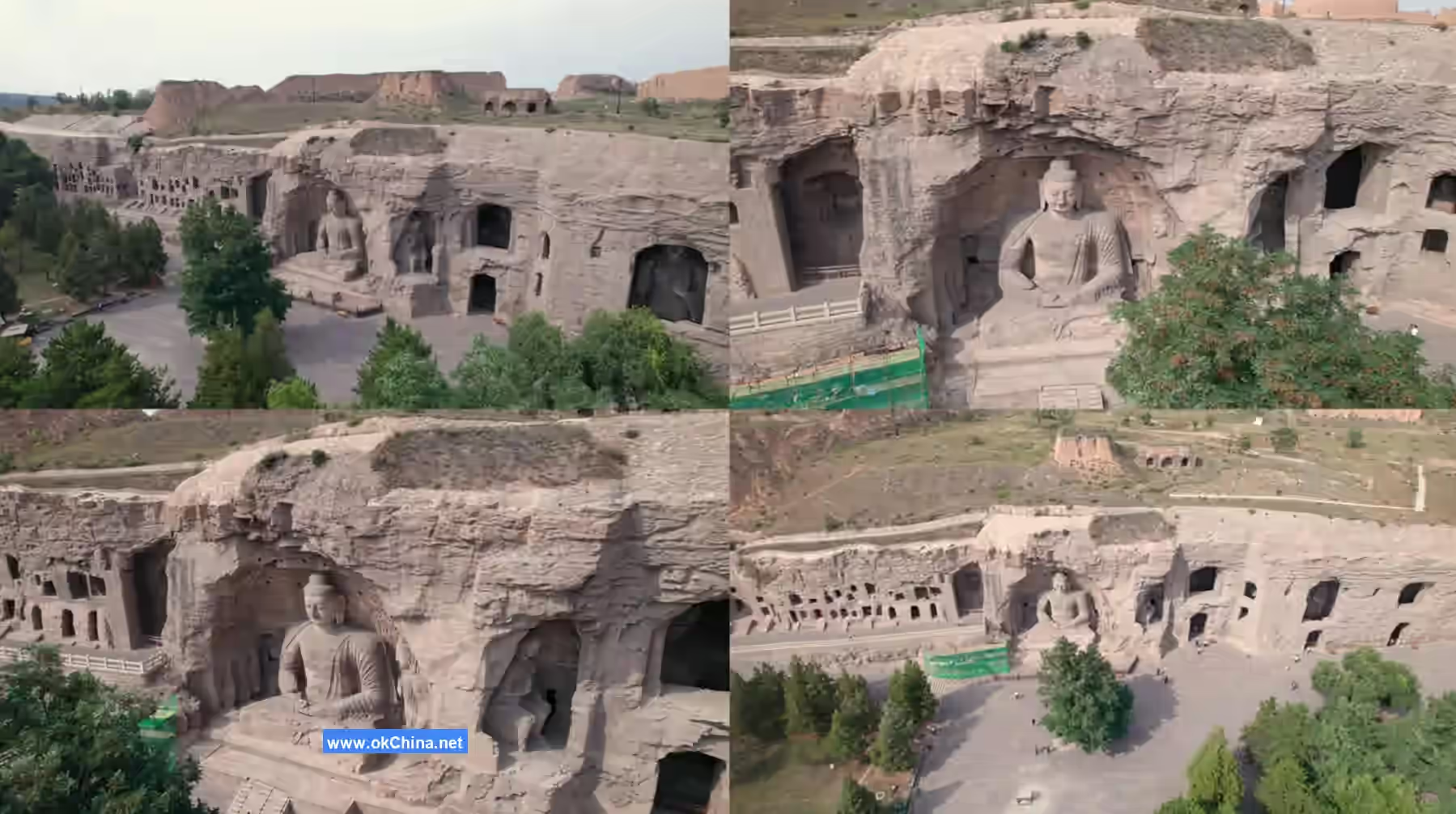
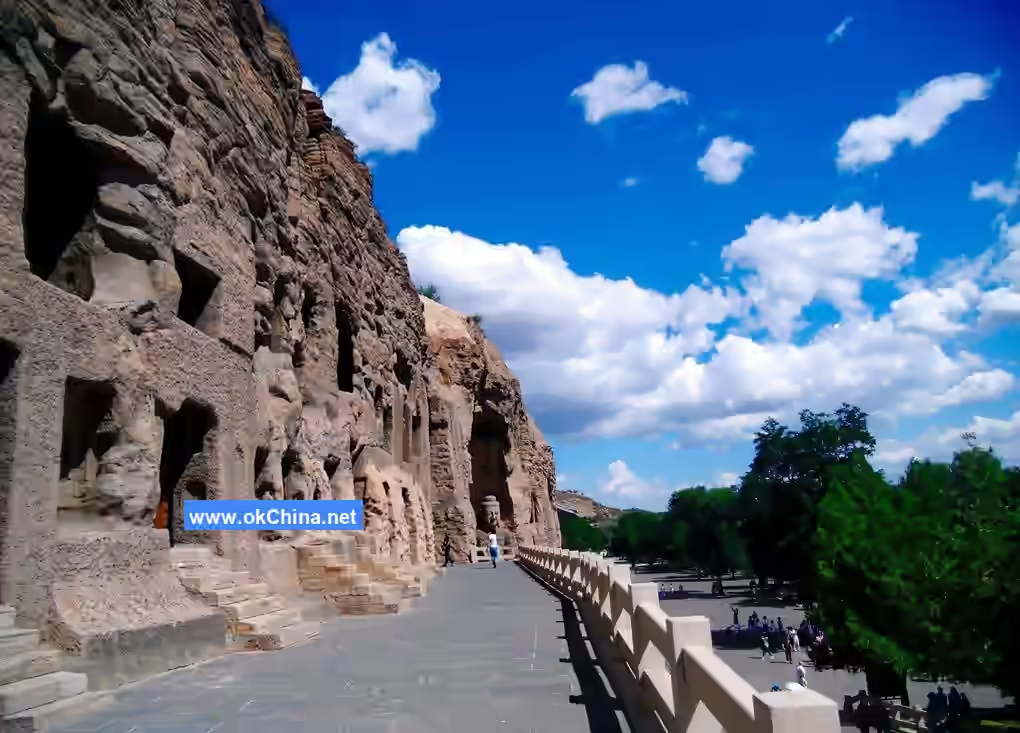
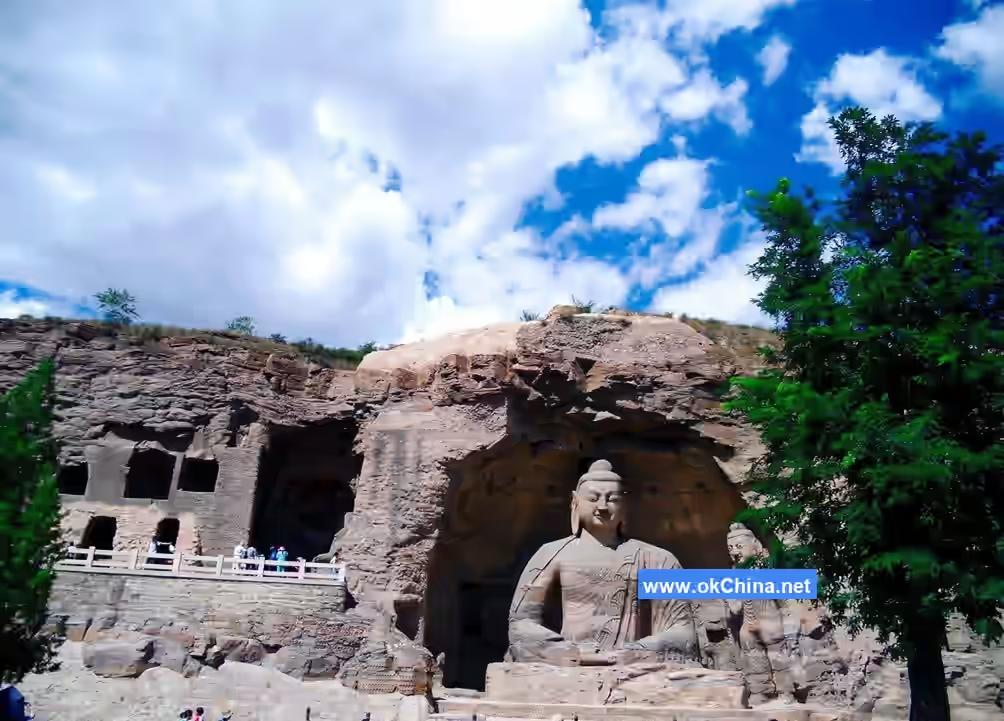
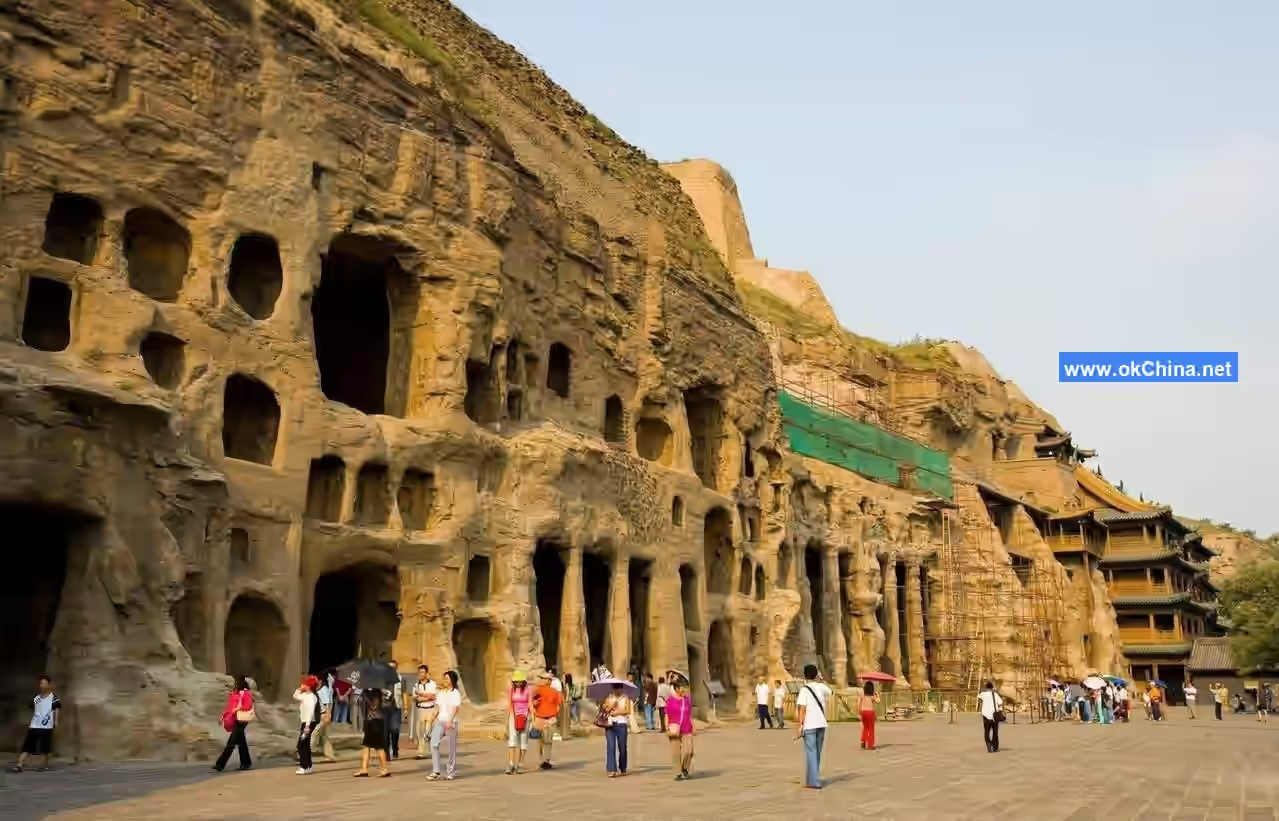
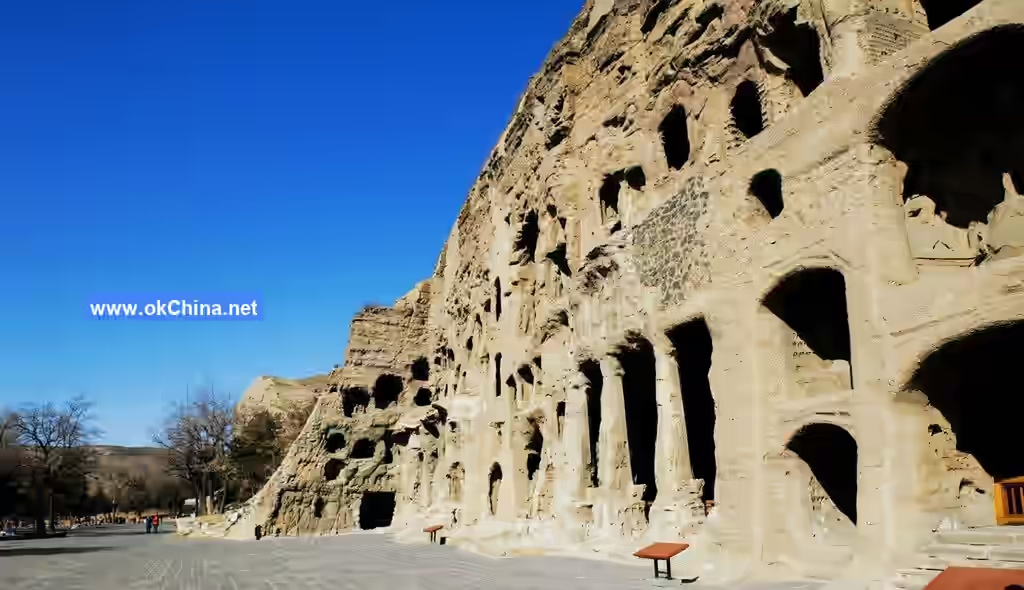
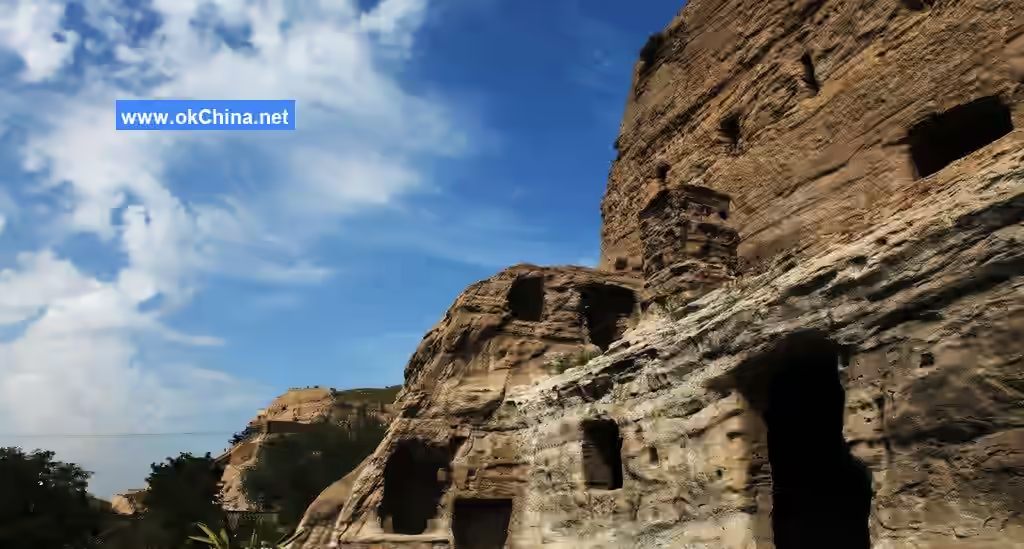
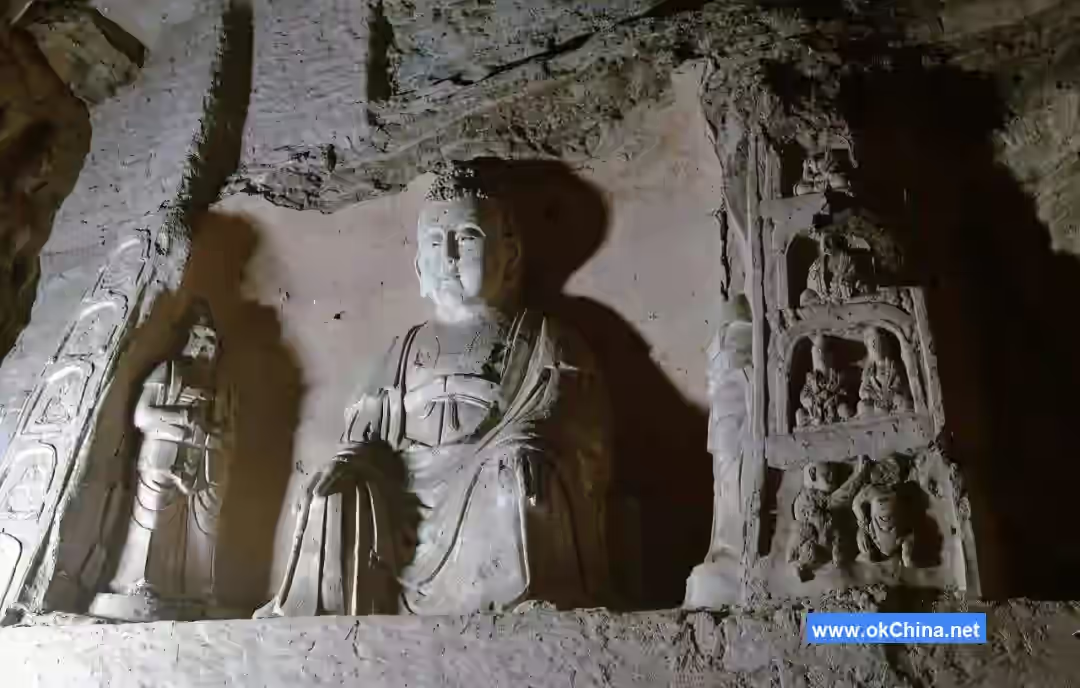
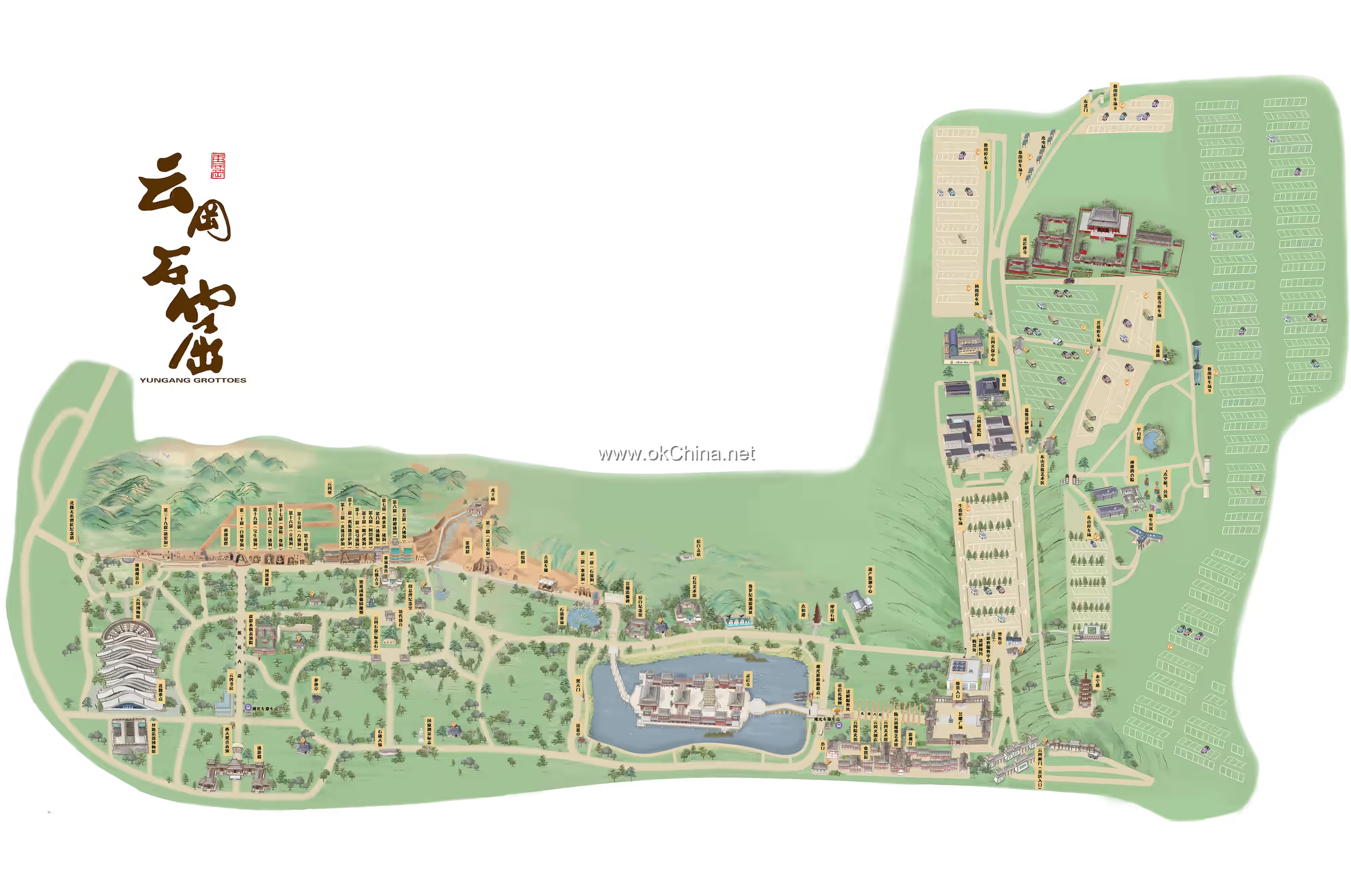
The Yungang Grottoes are located on the southern cliff of Wuzhou (Zhou) Mountain, about 16 kilometers west of Datong City, Shanxi Province, China, on the northern bank of the Wuzhou River. Carved into the mountain, the grottoes are grand in scale and majestic in presence, stretching approximately 1 kilometer from east to west. The grotto area is naturally divided into eastern, central, and western sections along the mountain terrain. There are 45 major caves and 209 subsidiary caves, with a total carved area of over 18,000 square meters. The tallest statue is 17 meters high, while the smallest is only 2 centimeters. There are about 1,100 niches and over 59,000 statues of various sizes. With a history of 1,500 years, the Yungang Grottoes represent the first royal-style Buddhist art treasure in China created by a single ethnic group during one dynasty after Buddhism spread eastward to China. They stand as a historical monument to the fusion of Chinese and Western cultures in the 5th century AD. In March 1961, they were announced by the State Council as one of the first batch of Major Historical and Cultural Sites Protected at the National Level. In December 2001, they were approved by UNESCO for inclusion in the World Heritage List. In May 2007, they became one of the first national 5A-level tourist attractions.
Originally known as the Wuzhou (Zhou) Mountain Grotto Temple, the name Yungang Grottoes began to be used in the Ming Dynasty. The Northern Wei geographer Li Daoyuan recorded in his Commentary on the Water Classic: "The Wuzhou River flows southeast, and beside the water there are stones, monasteries, and various cave chambers where bhikkhunis reside. The water then turns east past the south of Lingyan, where rocks were cut and mountains opened, structures built against the cliffs, truly majestic and rare in the world. Mountain halls and water pavilions, misty temples facing each other, forests and deep pools like brocaded mirrors, offer refreshing views." As a large-scale grotto temple cultural relic from the period when the Northern Wei Dynasty established its capital at Pingcheng (present-day Datong, Shanxi), the construction started with Emperor Wencheng's revival of Buddhism and ended around the Zhengguang era of the Northern Wei, spanning nearly 70 years. The grotto art is rich in content and exquisitely carved, created by the Northern Wei royal family, which ruled northern China, by pooling the nation's craftsmanship, manpower, and material resources. It is a Buddhist sanctuary created by generations of skilled artisans and represents the earliest large-scale grotto complex east of Xinjiang. Distinguished by its magnificent royal-style statues, it differs from other early grottoes. Compared to many other grotto temples in China, the Yungang Grottoes exhibit the strongest Western influences, with a distinct foreign style and flavor. The later grottoes also pioneered the localization, secularization, and nationalization of Chinese Buddhist art, making them unique in China's artistic treasury. The Buddhist culture and art displayed here involve history, architecture, music, and other aspects, representing the essence of Eastern stone carving art and a model of Sino-Western cultural fusion. They also represent the highest achievement of Buddhist art in the 5th-6th centuries AD and are known as one of the world's three great stone carving art treasures, alongside the Ajanta Caves in India and the Bamiyan Buddhas in Afghanistan.
The carving of the Yungang Grottoes is closely related to the eastward spread of Buddhism and cultural exchanges between China and the West. Buddhism originated in the Ganges River valley in India. Around the 1st century BC, a new Buddhist sacred site formed in the upper reaches of the Indus River. Centered in Gandhara (present-day Peshawar region in northern Pakistan), Gandharan Buddhist art emerged, blending ancient Indian art with Greek and Roman classical art. Subsequently, the eastward spread of Buddhism gradually gained momentum. When Emperor Taiwu of the Northern Wei, Tuoba Tao, conquered Northern Liang (with its capital at Wuwei), Buddhist activities shifted eastward to Pingcheng. Later, the conquest of the Western Regions (present-day Xinjiang) directly led to the second peak of cultural exchange between China and the West in history. The Yungang Grottoes emerged as the royal grotto temple of the Northern Wei Dynasty.
2. Historical Development
2.1 Northern Wei Dynasty
In 460 AD, Emperor Wencheng ordered the monk Tan Yao to carve grottoes, selecting the "sacred mountain" Wuzhou Mountain in the western suburbs of Pingcheng. Five grottoes were carved, now numbered Caves 16 to 20, known as the earliest "Five Caves of Tan Yao." The carving of the Yungang Grottoes began during the Heping era (460-465) after Emperor Wencheng revived Buddhism, flourished during the Taihe era (477-494) under Emperor Xiaowen when Pingcheng was the capital, and declined in the late Northern Wei period after the capital moved to Luoyang (494-525), spanning about 60 years. During the subsequent Eastern Wei, Northern Qi, Sui, and early Tang periods, Pingcheng was renamed Yunzhong Prefecture and administered as the Heng'an Garrison.
2.2 Tang Dynasty
After the early Tang period, Pingcheng fell into decline, and the construction of the Yungang Grottoes saw no major projects due to various factors. According to the Stele Inscription on the Renovation of the Great Grotto Temple at Wuzhou Mountain in the Western Capital of the Great Jin written by Cao Yan in 1147 (the 7th year of the Huangtong era of the Jin Dynasty), "In the 15th year of the Zhenguan era (641), local officials rebuilt it." The Ancient Records of Qingliang by Tang Huixiang records that a certain Chan Master Yan "often repaired the old statues of Emperor Xiaowen's grottoes in Heng'an... and passed away in the stone chamber in the 4th year of the Xianheng era (673)."
2.3 Liao and Jin Dynasties
During the reigns of Emperor Xingzong and Emperor Daozong of the Liao Dynasty, the Liao royal family conducted a large-scale renovation of the Wuzhou Mountain Grotto Temple lasting ten years. They built ten large temples with wooden cave eaves in front of the grottoes: Tōnglè, Língyán, Jīngchóng, Zhènguó, Hùguó, Tiāngōng, Chóngfú, Tóngzǐ, Huáyán, and Dōushuài, and repaired over a thousand Buddha statues. In 1122 (the 2nd year of the Baoda era of the Liao Dynasty), Jin troops captured Datong, and "the temples were burned and looted, with Lingyan's structures completely destroyed" (Stele Inscription on the Renovation of Huayan Temple in the Western Capital of the Great Jin). From 1143 to 1146 (the 3rd to 6th years of the Huangtong era of the Jin Dynasty), Abbot Huì rebuilt the "Lingyan Grand Pavilion" (the pavilion outside present-day Cave 3), and "from then on, the mountain gate's grandeur was restored" (Jin Stele).
2.4 Yuan Dynasty
The temple complexes of the Wuzhou Mountain Grottoes still existed.
2.5 Ming Dynasty
The Yungang Grottoes in Datong fell into disrepair again. The name "Yungang" began to be used during the Jiajing era of the Ming Dynasty. In 1644 (the 17th year of the Chongzhen era), Li Zicheng's rebel army passed through Datong, leaving general Zhang Tianlin to guard it. Later, Qing forces entered the pass and captured Datong, and the Yungang temples were again ravaged by war, reduced to ashes.
2.6 Qing Dynasty
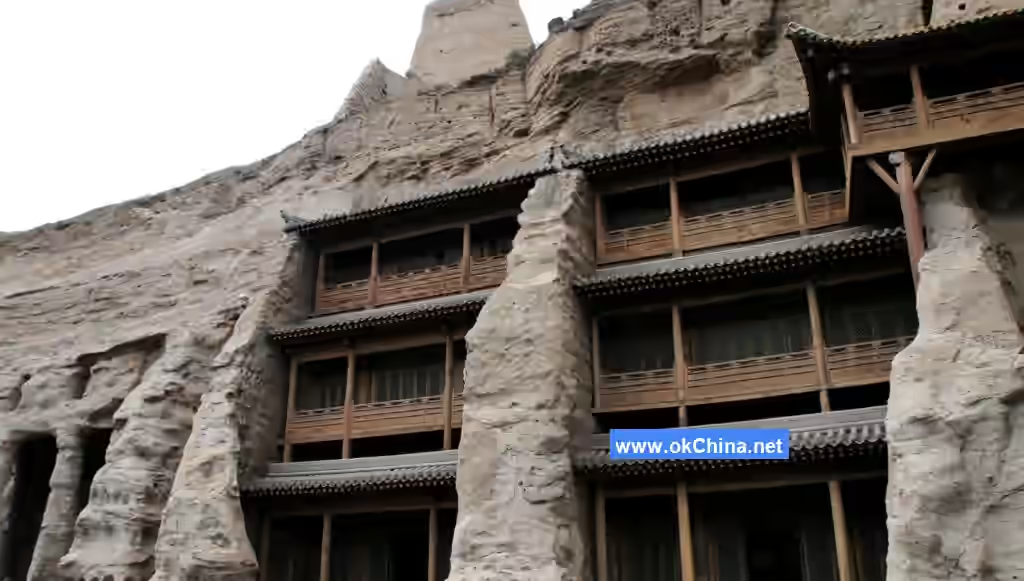
In 1651 (the 8th year of the Shunzhi era), the Yungang temples were rebuilt. The existing wooden cave eaves and temple structures of Caves 5 and 6 date from this reconstruction. In 1696, Emperor Kangxi visited Yungang Temple during a winter inspection and inscribed the plaque "Zhuāngyán Fǎxiàng" (Majestic Dharma Form). The Yungang Grottoes were also repaired during the Qianlong era of the Qing Dynasty.
2.7 Modern Era
After the founding of the People's Republic of China in 1949, the main caves and the wooden structures in front of the caves (Caves 5, 6, and 7) of the Yungang Grottoes were well preserved. In 1952, a specialized protection agency was established, ensuring proper conservation of the grotto relics and opening them to the public.
3. Historical Periods
The Buddhist art of the Yungang Grottoes can be divided into three stages based on the development of cave forms, statue content, and styles: early, middle, and late.
3.1 Early Grottoes
These are present-day Caves 16 to 20, also known as the Five Caves of Tan Yao. According to the Book of Wei: "In the early Heping era, Master Xian passed away. Tan Yao succeeded him, renamed as the Monk Commander. Initially, Tan Yao was summoned to the capital from Zhongshan the year after Buddhism was revived. He met the emperor on the road, and the emperor's horse took hold of Tan Yao's robe in its mouth. People at the time thought the horse recognized a good man, and the emperor later treated him with the respect due a teacher. Tan Yao proposed to the emperor to carve five caves into the stone cliffs at Wuzhou Pass west of the capital, each with a statue, the tallest being seventy feet, the next sixty feet, exquisitely carved and unparalleled in the world." The five caves mentioned are the magnificent Five Caves of Tan Yao, carved by the renowned monk Tan Yao at the spiritually endowed Wuzhou Mountain, marking the beginning of the Yungang Grottoes. Caves 16 to 20, the Five Caves of Tan Yao symbolizing emperors, are the earliest five caves in the entire Yungang complex based on statue style and carving techniques. They have a horseshoe-shaped layout with a domed ceiling and outer walls fully carved with thousands of Buddhas. The main statues represent the Buddhas of the Three Ages (past, present, and future). The Buddha statues are tall, with full, round faces, high noses, deep-set eyes, and broad shoulders, displaying a vigorous, robust, and simple style. The carving techniques inherited and developed the fine traditions of the Han Dynasty, absorbing and blending the essence of ancient Indian Gandhara and Mathura art to create a unique artistic style—a new style formed through the fusion of Chinese and foreign influences.
3.2 Middle Period Grottoes
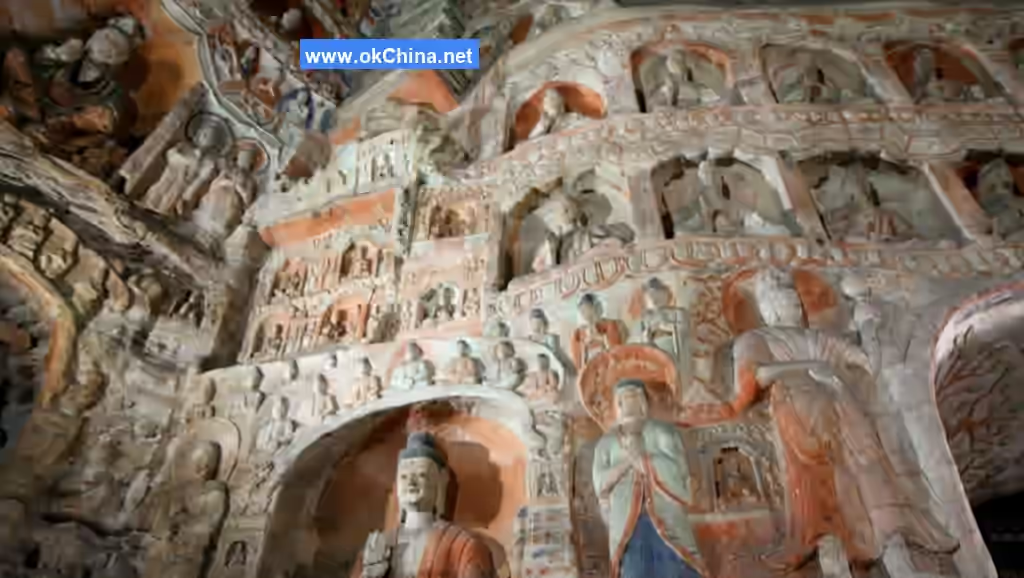
This was the peak period of carving at the Yungang Grottoes, mainly including Caves 1 and 2, Caves 5 and 6, Caves 7 and 8, Caves 9 and 10, Caves 11, 12, and 13, as well as the unfinished Cave 3. This period corresponds to the Taihe era (471-494) of Emperor Xiaowen, before the Northern Wei moved its capital to Luoyang. It was the most stable and prosperous period of the Northern Wei. The Yungang Grottoes, with the nation's strength as guarantee, gathered the country's finest talents to carve even more splendid and exquisite large caves and statues. Starting from Emperor Wencheng, the royal construction of large caves and statues began with the Five Caves of Tan Yao. Through Emperor Xianwen and Empress Dowager Feng, until Emperor Xiaowen moved the capital, all royal large caves and statues were completed over more than 40 years. The middle-period caves often have square or rectangular layouts, some with central pagoda pillars or front and rear chambers. The wall layouts are layered vertically and segmented horizontally, with many ceilings featuring coffered designs. The themes of the statues diversified, emphasizing the status of Sakyamuni and Maitreya. The popularity of statues depicting Sakyamuni and Prabhutaratna sitting side by side increased, and guardian deities, celestial musicians, rows of donors, as well as stories of the Buddha's life, Jataka tales, cause and effect, and Vimalakirti appeared. The Buddha faces are moderately full and round, with the style of loose robes and wide sashes becoming prevalent. Many new themes and statue combinations emerged, focusing on guardian figures and various decorations. The middle period was also a time of active reform and innovation, initiating the process of sinicization in Buddhist grotto art.The convergence of these multiple factors gave rise to the so-called magnificent Taihe style, characterized primarily by a rapid trend toward Sinicization. The art of cave temples began and completed its process of Sinicization during this period, which corresponds to the middle phase of the Yungang Grottoes. The artistic features of this phase, with their intricate content and exquisitely carved decorations, differ significantly from those of the early grottoes. The sculptural forms pursued neatness and opulence, and from the cave structures to the carving content and style, distinct Sinicized characteristics are evident.
3.3 Late Phase Grottoes
After the Northern Wei capital was moved to Luoyang (494 AD), large-scale excavation activities at the Yungang Grottoes ceased. However, the practice of carving caves and statues spread among the middle and lower classes. Nobles, mid-to-low-level officials, and local devotees fully utilized the existing craftsmanship in Pingcheng to excavate a large number of small and medium-sized caves at Yungang. The construction of these small caves and niches continued until the fifth year of the Zhengguang era under Emperor Xiaoming (524 AD). After the capital moved to Luoyang, Pingcheng, as the northern capital, remained an important Buddhist center of the Northern Wei. During this period, large caves decreased, while small and medium-sized caves and niches densely covered the cliff face from east to west. They are mainly distributed west of Cave 20, including small niches on the cliff faces west of Caves 4, 14, 15, and 11, totaling about 200 small and medium-sized caves. Most caves appeared individually rather than in groups. The common themes of the statues were Sakyamuni and Prabhutaratna, or Maitreya above and Sakyamuni below. The Buddha and Bodhisattva figures had thin faces, long necks, narrow and sloping shoulders. This style emerged as a fresh and elegant "slender and graceful" artistic image during the late Northern Wei's implementation of Sinicization reforms, becoming a distinctive feature of Buddhist statues in the late Northern Wei period. This characteristic and style are evident in both the late-phase grottoes of Yungang and the Northern Wei caves at the Longmen Grottoes, profoundly influencing the development of Chinese cave temple art.
Compared to many other cave temples in China, the Yungang Grottoes exhibit the strongest Western influences, with the so-called "barbarian" style and charm being most pronounced. The later-phase caves also pioneered a new trend of localization, secularization, and nationalization in Chinese Buddhist art, making them unique in the treasure trove of Chinese art. Today, the expansive Yungang Grottoes scenic area, with its grand imperial majesty, natural ecological gardens, and elegant cultural environment, has become a revered destination attracting visitors from both home and abroad.
4. Main Attractions
4.1 Ancient Stone Buddha Temple
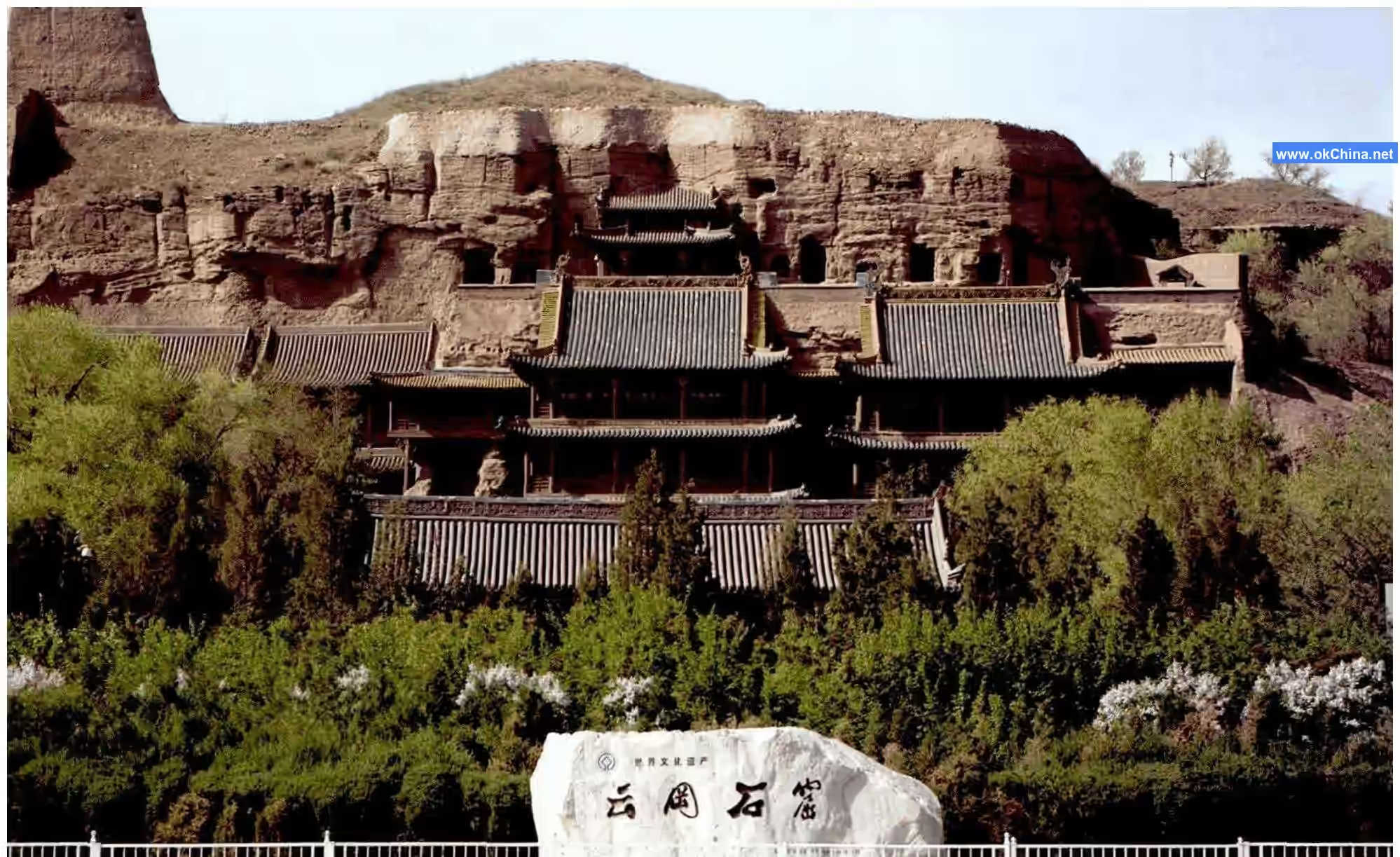
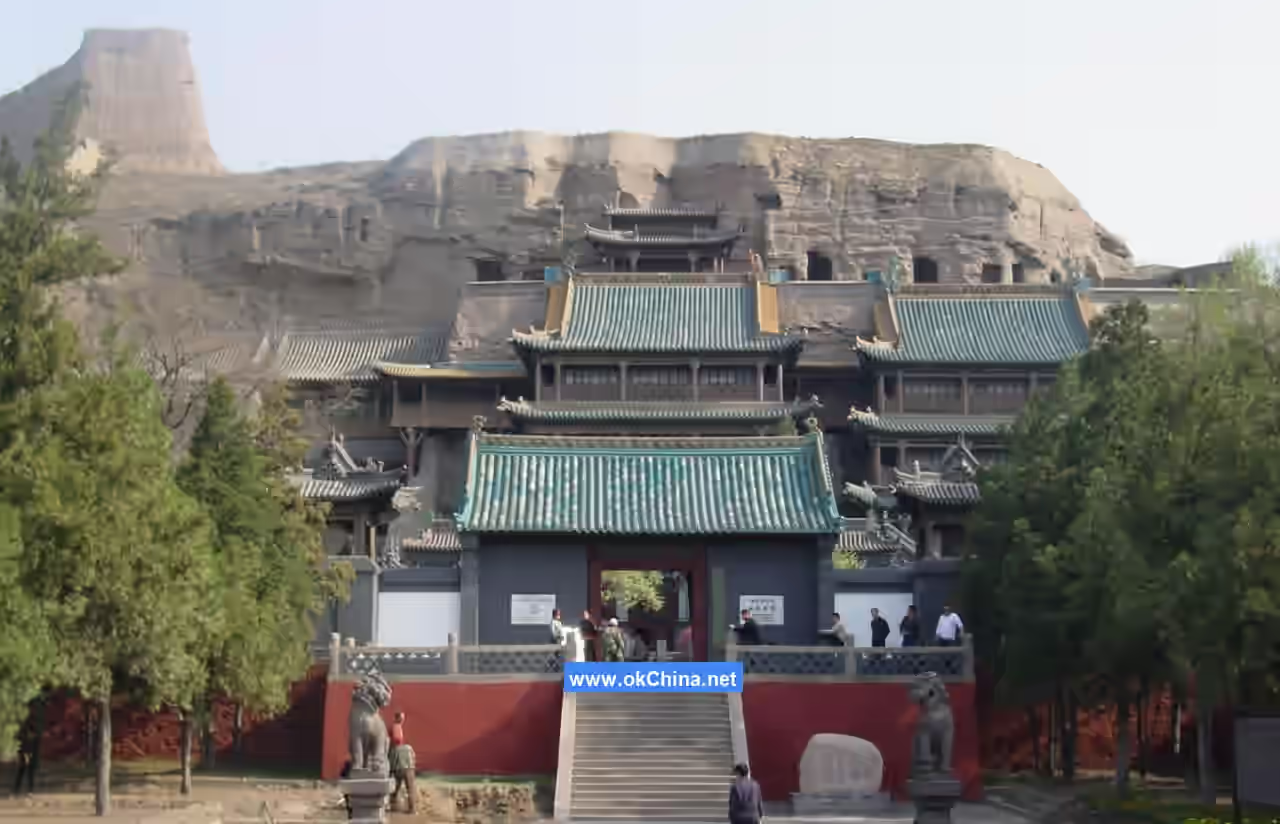
The Ancient Stone Buddha Temple refers to the Yungang temple complex in front of the existing Caves 5 and 6. Remaining structures include the mountain gate, Heavenly King Hall, side rooms, stone lions, and bell and drum towers. The mountain gate (Qing Dynasty) is located at the southernmost end of the north-south central axis of the temple complex. It is constructed with a mix of brick and stone, featuring a hard gable roof and situated on a high platform. The old inscription on the gate reads "Ancient Stone Buddha Temple," with two characters embedded on each side of the wall: "薹頭" (Taitou) on the left and "念佛" (Nianfo) on the right. The current inscriptions on the left and right archways of the Heavenly King Hall read "Imperially Commissioned—Great Buddha Temple" and "Ancient Temple—Stone Buddha Temple," respectively. This simple and elegant Yungang temple—the Ancient Stone Buddha Temple—was originally built as the Stone Buddha Temple by Governor Tong Yangliang in the eighth year of the Shunzhi era (Qing Dynasty). It has been repaired in later generations and now serves as a landmark Qing Dynasty architectural complex within the Yungang Grottoes.
4.2 Lotus Avenue
Where Buddha's light and ginkgo trees merge with heaven and earth, pure water and lotuses cleanse past and present. The Lotus Avenue is located in front of Cave 20 at the Yungang Grottoes. This straight and tranquil avenue connects to the Welcoming Buddha Hall. Flanking both sides of the avenue stand 74 pairs of exquisite Boshan censers. Made of bronze and crafted in 2010, the censer lids are carved into mountain shapes adorned with figures of feathered immortals and roaming beasts. Boshan censers first became popular during the Han, Wei, and Jin dynasties. They are extensively depicted in the artistic expressions of the Yungang Grottoes as the most important ritual object for Buddhist offerings, symbolizing reverence for the Buddha. The appearance of such censers originates from one of the sculptural themes in ancient Indian Buddhist art. The creative elements of the Boshan censers along the Lotus Avenue are derived from the carvings within the Yungang Grottoes.
4.3 Snail Apartments
Located on East Mountain within the Yungang Grottoes scenic area, the Snail Apartments are part of the East Mountain Bodhi Art District. Creatively led by the Yungang Grottoes Research Institute, these environmentally friendly sketching buildings were constructed using recycled materials such as discarded cement pipes and scrap steel. Inside the "Snail Apartments," there is a reception area, 28 bedrooms, washbasins, and toilets. The underground public area also includes recreational facilities like a movie screening room, billiards room, bar, and café. The walls of the long corridor are available for graffiti by artists or art students. This uniquely casual and artistic space provides high-quality, comfortable accommodation, creative workspace, and entertainment for people who come to the Yungang Grottoes scenic area for sketching, creation, tourism, and leisure.
4.4 Inscription of the Nun Tanmei
Located in front of the mountain gate of Cave 1 at the Yungang Grottoes, the stone inscription "Inscription of the Nun Tanmei" dates to 503 AD (the fourth year of the Jingming era). This stele contains 110 characters, reflecting the social context of the time and expressing the deep faith, piety, and hopes for the revival and development of Buddhism held by the vow-maker, Nun Tanmei. Its elegant writing is considered among the finest Buddhist vow texts. This stele also showcases a unique script style from the Northern Wei period. As this script was commonly used for inscriptions at the time, later generations refer to it as the "Weibei" style. The Weibei script features square exteriors and rounded interiors, appearing simple yet powerful, and represents a transitional form between clerical script and regular script. Thus, Weibei calligraphy is considered a creation of the Northern Wei Pingcheng era. The original artifact is quite small, only 30 cm high and 28 cm wide. It was unearthed during archaeological excavations in front of Cave 20 in 1956 and is now housed in the Yungang Museum.
4.5 Royal Buddhist Procession Relief Wall
Heading west through the Buddha's Light Avenue lined with divine pillars, visitors are presented with two opposing扇形-shaped royal Buddhist procession relief walls. This set of facing relief walls forms an overall arc shape, approximately 20 meters long and 4 meters high. The composition is perfect, and the carving is meticulous. In high relief, they vividly depict the grand imperial Buddhist procession of the Northern Wei court. The atmosphere, with its rumbling carriages and neighing horses, fully recreates the solemn and majestic grand occasion of the Northern Wei emperor and empress proceeding to pay homage to the Buddha. This scene naturally evokes the former glory of the Yungang Grottoes as an imperial temple over 1,500 years ago, captivating the gaze of onlookers.
4.6 Buddhist Pilgrimage Avenue
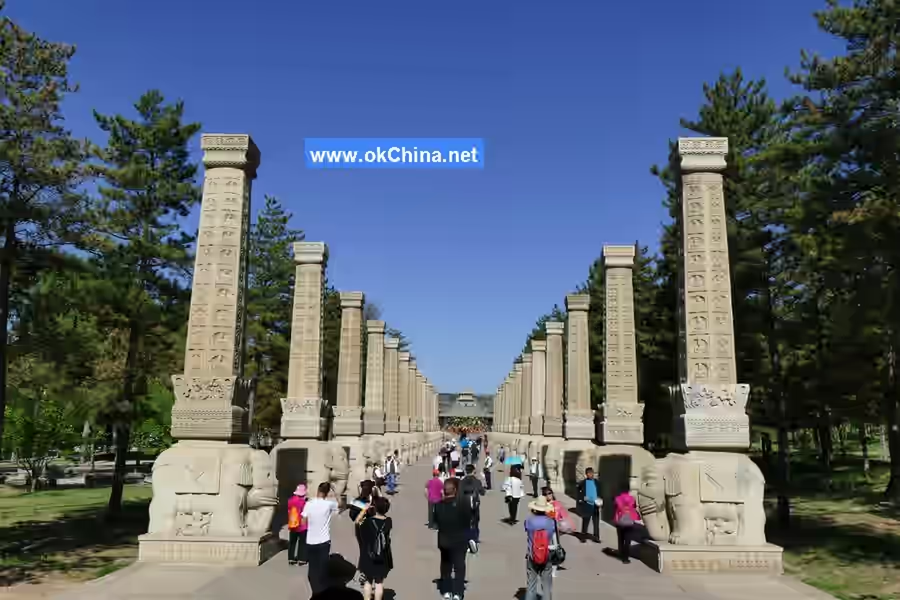
The so-called Buddhist Pilgrimage Avenue: "Grace extends across Wuzhou, the merciful ferry reaches the shore of Dharma." Walking westward, thirteen pairs of Thousand Buddha Pillars line both sides of the avenue in sequence. The divine pillars, standing 8.73 meters tall, are carved from yellow sandstone. From bottom to top, they consist of a perfect combination of a Sumeru base, a strongman figure, a white elephant, and the pillar body. Their towering and exquisitely unique forms, set against the backdrop of dense pine forests on either side, appear majestic and spectacular, as if connecting heaven and earth. It seems only a path paved with such divine pillars can be called the Buddhist Pilgrimage Avenue. The prototypes for the Thousand Buddha Pillars can be found in Caves 9, 10, 12, 14, etc., where they are borne by divine creatures like elephants and lions, creating a three-dimensional and grand presentation reminiscent of the magnificent Northern Wei imperial palace during the Pingcheng period.
4.7 Tanyao Square
Located at the entrance of the Yungang Grottoes scenic area, Tanyao Square covers over 6,000 square meters and was built to commemorate the founder of the Yungang Grottoes, the eminent monk Tanyao. The entire square and its pavilion corridors are imbued with a strong Northern Wei imperial atmosphere. The Tanyao sculpture at the center of the square uses a free and bold impressionistic technique to portray the artistic image of this great Buddhist master—lofty, elegant, and serene. He appears as if having traversed a difficult path, dusty from travel, yet with his kasaya flowing gracefully, as if emerging from the dust of a thousand years ago. In 460 AD, Emperor Wencheng of the Northern Wei revived Buddhism and ordered the eminent monk Tanyao to oversee the excavation of the large-scale Yungang Grottoes. Therefore, Tanyao is not only the founder of the Yungang Grottoes but also a renowned Northern Wei Buddhist master and translator of scriptures, a foundational figure in the flourishing of Northern Wei Buddhism.
5. Key Caves
5.1 Caves 1 and 2
Caves 1 and 2 are the easternmost caves of the Yungang Grottoes, forming a pair of twin caves excavated between 471 and 494 AD. On the eastern and western sides of the outer walls of both caves, remnants of single-story square pagodas survive. The caves feature a window opening above and a door opening below. The floor plan is square with a flat ceiling. A central pillar pagoda extends to the cave roof, and niches with statues are carved on the four walls, allowing monks to circumambulate the pagoda for meditation and worship, making them typical pagoda caves. Research indicates that before the Liao Dynasty, a Huguo Temple (State-Protecting Temple) was built in front of Caves 1 and 2, which was one of the Ten Temples of Yungang. During the Ming and Qing dynasties, it was known as "Stone Drum Cold Spring," one of the Eight Scenes of Yunzhong.
5.1.1 Cave 1
Cave 1 is commonly known as the "Stone Drum Cave." On the eastern side of the exterior window, a Qing Dynasty poetic inscription by Zhu Tinghan titled "Visiting the Yungang Stone Buddha Temple" is preserved. The cave's floor plan is rectangular. The central square pagoda imitates a wooden structure with roof eaves and is divided into upper and lower levels. The lower level has a round-arched niche on each side, each containing a seated Buddha. The upper level features three盝-shaped curtained niches on each side, with seated Buddhas carved on the north and south sides and cross-ankled Maitreya Bodhisattvas on the east and west sides. Coiled dragons and winding Mount Sumeru are depicted at the pagoda's summit. The north wall features a large three-bay盝-shaped niche. The main image in the central bay is a 3.15-meter-high cross-ankled Maitreya Bodhisattva. The left and right side bays symmetrically contain contemplative Bodhisattvas in a relaxed seated posture. The lower part of the east wall features reliefs depicting the Buddhist story of "The Jataka of Shanzi" illustrating filial piety, though most are severely weathered, with only two scenes remaining. In the house-shaped niches on either side of the south wall's door and window, carvings depict the Buddhist theme of "Manjusri Inquiring About Illness" from the Vimalakirti Nirdesa Sutra.
The top of the door arch is carved with two intertwined dragons. This motif of a male and female dragon pair carved on a door arch clearly embodies the Buddhist concept of Dharma protection and is unique within the Yungang Grottoes. On the southern part of the ceiling, three large浅浮雕 lotus medallions, each 1.4 meters in diameter, are carved. Flying Apsaras dance gracefully around the lotus medallions on the ceiling, creating an atmosphere that is both magnificent and solemn, rigorous yet cleverly lively. While conveying specific Buddhist meanings, they also add a strong artistic dynamism to the cave.#### 5.1.2 Cave 2
Commonly known as the "Cold Spring Cave" because a fine spring flows year-round from the western end of its north wall. Above the bright window and on the west side of the outer wall are inscriptions reading "Landscape Holds a Pure Sound" and "Deep in the Clouds."
Inside the cave, a three-tiered square stupa stands centrally. Its surface is carved with wooden architectural components such as roof tiles, eaves rafters, and bracket sets (dougong). The layered tile ridges project from the eaves, and the upper tier features openwork carvings of octagonal prismatic pillars at its four corners, forming a surrounding corridor. This provides physical evidence for the study of Northern Wei architecture.
The cave walls are arranged in layered sections. The uppermost level features a row of celestial musician niches, with celestial beings inside playing instruments like the bili (a reed instrument), pipa, qin (zither), and panpipes. The wall surfaces sequentially depict a band of seated Buddhas in meditation, large rows of niches, long-scroll narrative reliefs, and at the lowest level, a procession of donor figures. The main image on the north wall is a cross-ankled Buddha, severely weathered. The lower part of the east wall depicts the Buddhist narrative story of Prince Siddhartha "Shooting an Iron Drum with an Arrow," illustrating the scene where Shakyamuni, as a prince, competed in archery with others.
5.2 Cave 3
Also known as the "Lingyan Temple Cave," this is the largest cave at Yungang and features a relatively unique layout. The overall cave is tall, majestic, and expansive. It has two entrances and four windows. A massive platform was built externally, with a rectangular cave at its center housing a cross-ankled Maitreya, commonly called the "Maitreya Cave." At the eastern and western ends of the platform stand square three-story stone pagodas, both heavily weathered. The platform's stone wall is flat and towering. Above the 10-meter mark on this wall, twelve vertical rectangular beam holes are neatly arranged, all deeply connected to vertical shafts leading to the mountaintop.
The rear chamber features three large statues. The central figure is a seated Buddha, approximately 10 meters tall, with a high ushnisha (cranial protuberance), a full and rounded face, regular features, large eyes, broad ears, and a distinct urna (fleshy protuberance) between the eyebrows. The posture is upright and well-proportioned. The samghati robe, covering both shoulders, clings closely to the body. The thick, rounded hands form the abhaya (fear-not) and varada (wish-granting) mudras. The attendant Bodhisattvas on the left and right are 6 meters tall, with high, orderly topknots; strands of hair cascade over both shoulders. Their jeweled crowns are exquisitely carved, demonstrating rigorous design and mature carving skills. Compared to other statues at Yungang, these three figures are fuller and more rounded, distinctly different in artistic expression. Their dating is currently debated among four theories: Northern Wei, Sui, Tang, and Liao, mostly inferred based on artistic style.
The cave floor is crisscrossed with grooves of varying depths, presenting a scene of large-scale stone quarrying and ongoing cave excavation. The existence of these traces provides important evidence for studying cave excavation methods.
5.3 Cave 4
A pagoda-pillar cave with one entrance and two windows. As the project was not fully completed, the uneven ground inside and outside the cave gives the overall grotto a somewhat chaotic appearance.
The cave plan is square, with a central pagoda pillar carved in the middle. Above the entrance, one bright window is opened on each side, with the arched door and windows forming an inverted "品" character structure.
The central pagoda pillar features images on all four sides, each depicting one Buddha flanked by two Bodhisattvas. The cave walls are severely weathered. The south wall bears an inscription from the Zhengguang era (520-525) titled "Record of Making Images for the Deceased Husband, the Palace Attendant," about 100 characters long. This is the latest Northern Wei inscription found at Yungang Grottoes, now weathered and illegible. At the eastern end of the cave ceiling, a lotus medallion and flying apsaras can be seen.
5.4 Cave 5
Cave 5 is located in the central part of the Yungang Grottoes complex. Together with Cave 6, it forms a pair of caves designed and constructed as a unified project, belonging to the middle period of Yungang. Outside each cave stands a four-story, five-bay wooden pavilion added in the eighth year of the Shunzhi reign (Qing Dynasty). Known in the Qing Dynasty as the "Yungang Buddha Pavilion" or "Cloud-Scraping Grotto," it was one of the Eight Scenic Views of Yunzhong. This pair of vertically designed twin Buddha pavilions are both elegant and dignified in their unity, reflecting our ancestors' precise understanding of cave temple architecture. They are also the only surviving ancient cave-eave structures at Yungang. Besides serving as Buddha halls, they also provide shelter from wind and rain, particularly maintaining relatively constant temperature and humidity inside the caves. This has resulted in the sculptural preservation state of Caves 5 and 6 being far superior to other caves without such eaves.
The east and west walls of Cave 5's antechamber are painted with images of "Dharma-Protecting Deities," likely works from the early Qing renovation of the pavilion. The "Stele Record of Renovating the Yungang Great Stone Buddha Pavilion," composed by Tong Yangliang, Governor-General of Xuanhua and Datong, stands beside the west wall.
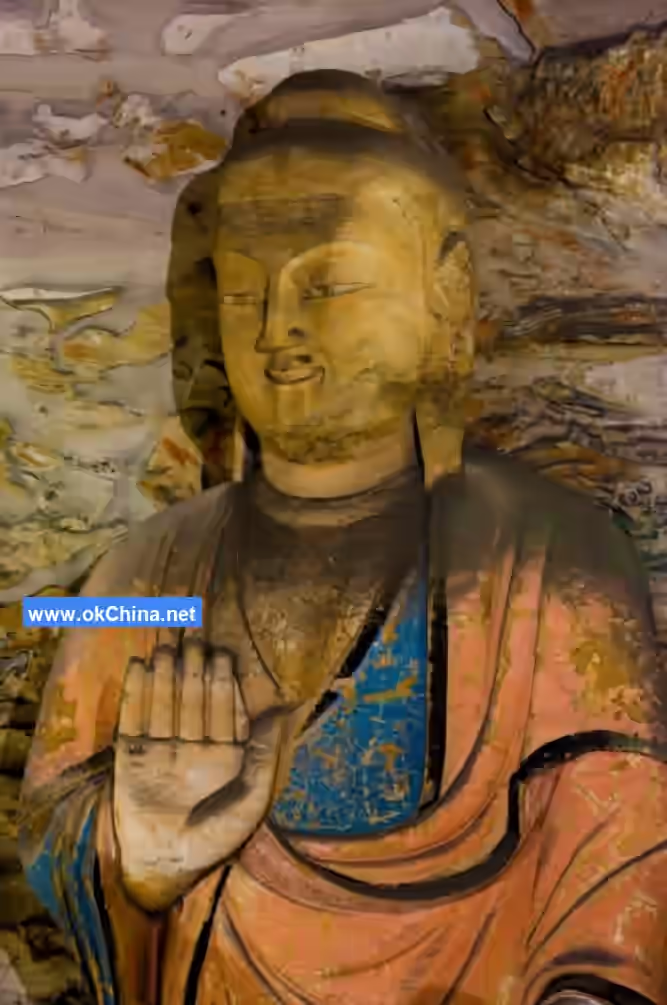
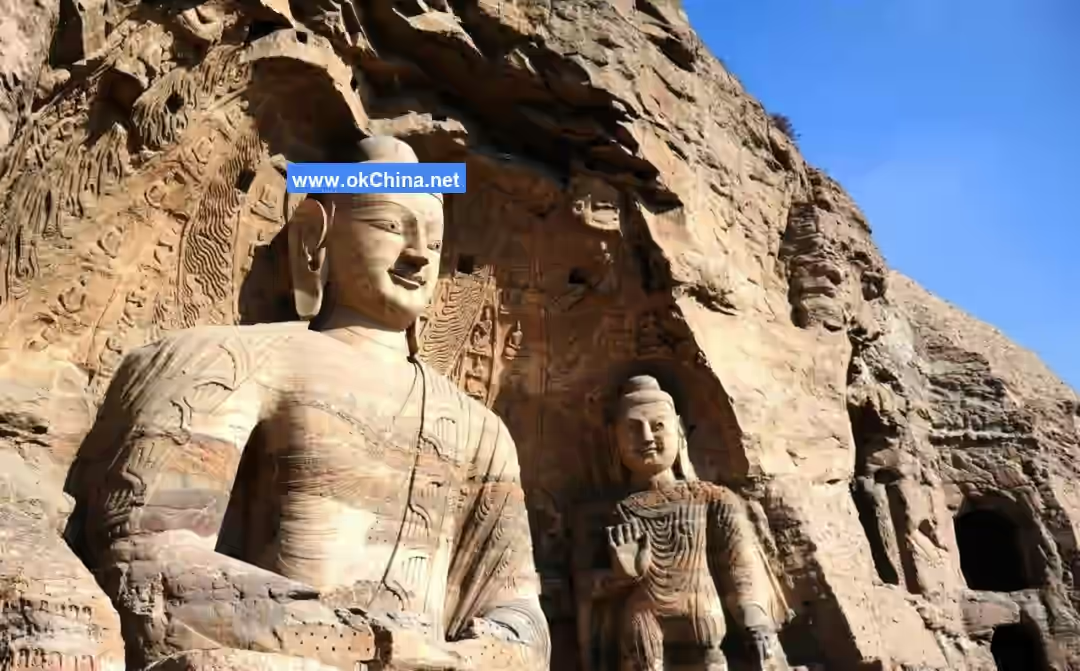
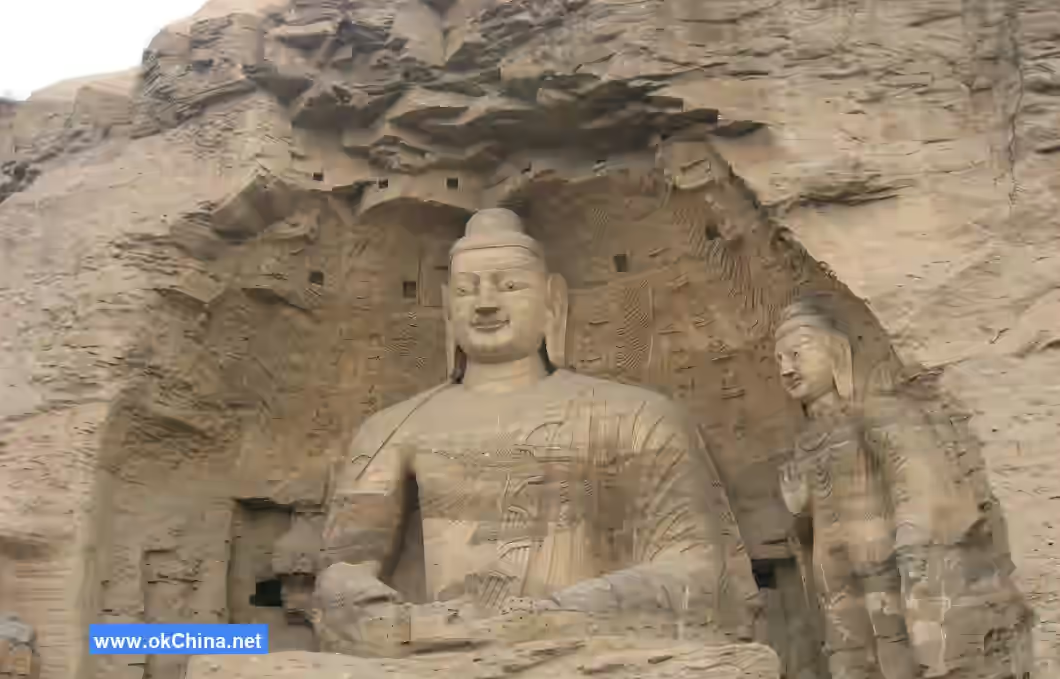
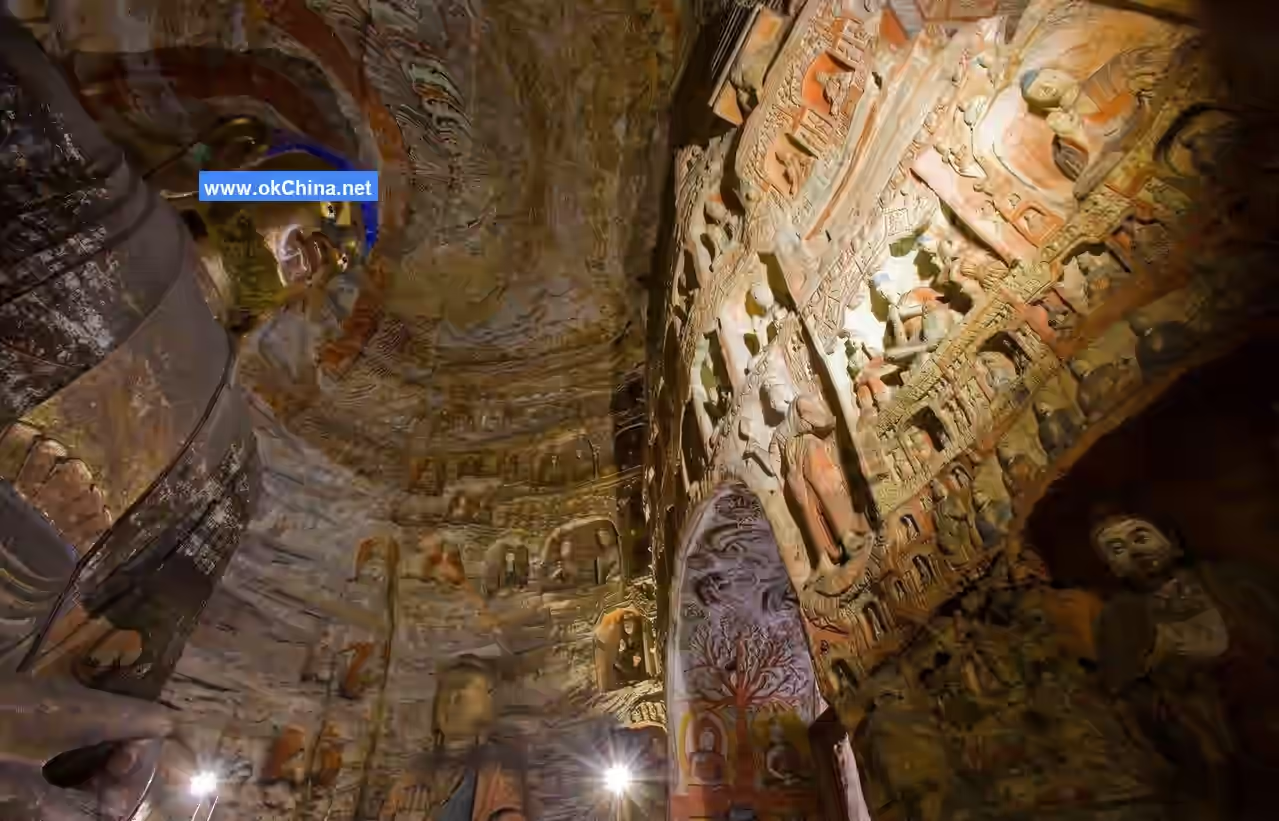
Cave 5 is a colossal image cave with an elliptical plan and a domed ceiling. Its maximum width east-west is about 22 meters, and maximum depth north-south about 17 meters, making it the largest of its type at Yungang. The main seated Buddha is 17.40 meters tall, the largest Buddha at Yungang. This tallest Yungang Buddha is entirely covered with clay and painted from head to toe, with gold leaf applied to the face and chest, and indigo-blue snail-shell curls and long eyebrows. The two lappets of the great robe hang vertically from the shoulders, flowing naturally. Symmetrical folds are neatly arranged at the center of the waistband of the wrapped undergarment, presenting a tidy and aesthetic appearance. The clothing is loose yet well-fitted, with a strong sense of drapery, as if made from high-quality silk fabric, demonstrating superb clay sculpting skills. The attendant Buddha images on the east and west walls are as tall as 8 meters. A wide circumambulation passageway is carved behind the main Buddha image, providing a path for monks and pilgrims to walk around in worship. Additionally, above the guardian dvarapalas (powerful beings) on the walls flanking the arched entrance, two Buddhas in meditation posture are carved. Seated cross-legged under lush ashoka trees, they highlight a symmetrical and solemn beauty, leaving a deep impression.
Between the entrance and the bright window on the south wall, two rows of niches are carved. The upper row consists of eight arched niches, and the lower row eight truncated pyramidal niches with curtain valances. Each niche contains a seated Buddha, arranged orderly, solemn, and majestic. On the upper eastern and western sides of the south wall, high-relief sculptures depict elephants carrying five-tiered, tile-roofed, eaved pagodas on Sumeru pedestals. Exquisitely designed and vividly lifelike, these are masterpieces of pagoda carving at Yungang and exemplify the combination of traditional Chinese architectural art with Indian Buddhist art. In the arched niche on the north side of the fifth tier of the west wall is a cross-ankled Buddha adorned in Bodhisattva attire. The left hand rests on the knee in the bhumisparsha (earth-touching) mudra, and the right hand is extended at the chest in the abhaya (fear-not) mudra. The Buddha has a high ushnisha, a full, square-round face, an upright posture, with the crossed uttariya (upper garment) ends upturned over the arms, a long skirt tied below, and sits barefoot on a lion throne. This is the only example of a Buddha in Bodhisattva attire at Yungang, representing a new expression of the prevalent Maitreya belief of the Northern Wei period within the grottoes.
5.5 Cave 6
Cave 6 was completed in the 18th year of the Taihe era, before the capital moved to Luoyang. The east and west walls of Cave 6's pavilion are painted with images of the Eighteen Arhats, nine on each wall, holding different ritual implements and standing amidst clouds and sea. These are works from the early Qing reconstruction of the pavilion. Above the cave entrance, a plaque inscribed by the Kangxi Emperor with the characters "莊嚴法相" (Zhuangyan Faxiang, "Majestic Dharma Appearance") was formerly hung but was destroyed during the Cultural Revolution's "Destroy the Four Olds" campaign. The octagonal pillars carved on either side of the entrance were originally borne by elephants and lions. The walls beside the pillars feature sculptures of the Four Heavenly Kings (Lokapalas), fierce-eyed, frowning, and robust. Above the kings on the cliff wall, a pair of five-clawed dragons, white on a red background, are painted, their forms lively and imposing.
The cave layout is that of a central pagoda pillar cave. The central pillar is about 14.4 meters high, divided into upper and lower tiers, reaching the cave ceiling. The overall cave design features a central axis with symmetrical sides; the wall surfaces are regular and orderly, the niches and images are arranged in horizontal layers, and narratives continue from left to right. It is the cave at Yungang with the largest scale, most complete design, richest content, most exquisite carvings, and most magnificent appearance, also one of the best-preserved caves. Preliminary statistics indicate over 2,900 various Buddhist statues exist in this cave, interspersed with decorative patterns, presenting a multitude of forms and diverse styles.
In the lower niche on the south face of the central pillar sits a clay-sculpted Buddha image wearing a dragon-patterned kasaya (monastic robe). The left hand rests on the knee, the right hand forms the abhaya mudra, the hair is indigo-blue snail-shell curls, and the expression is serene. This is a later clay-covered and painted Buddha image. It is the only Buddha at Yungang wearing a dragon robe. The clay layer is firm, the drapery lines are smooth, the decoration is refined, and the colors are antique. Particularly noteworthy are the dragon-shaped appliqués on the kasaya, likely dating to the Liao or Jin period.
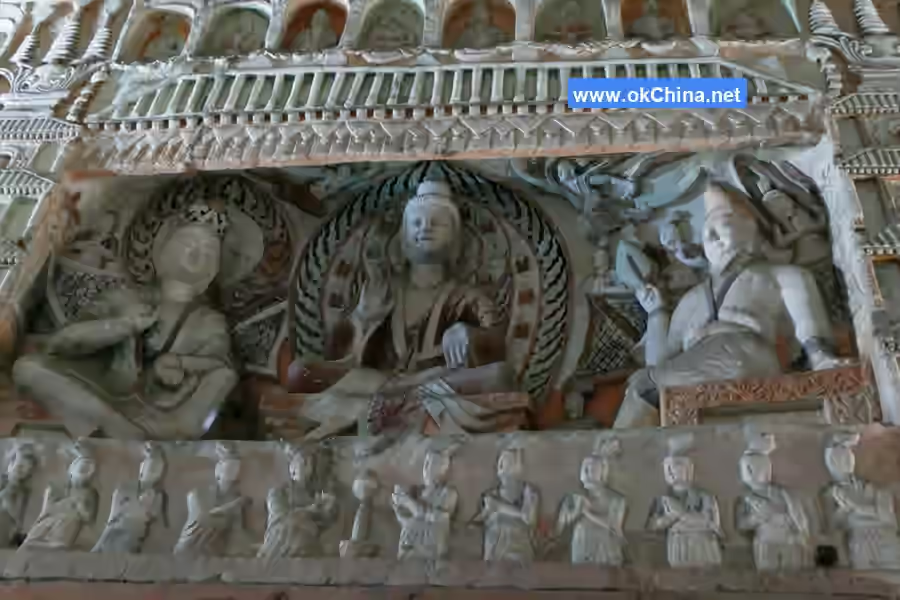
The upper tier of the pagoda pillar features standing Buddhas on four sides. At each corner stands a nine-tiered openwork pagoda pillar borne by an elephant. Inside, leaning against the pagodas, stand eight attendant Bodhisattvas, corresponding in height to the four standing Buddhas. Between the entrance and the bright window on the south wall, a large house-shaped niche is carved. Under the roof and curtain valance sit three sages in different postures: Shakyamuni, Manjushri, and Vimalakirti. The Buddha sits cross-legged on a central Sumeru throne, forming the abhaya and varada mudras, listening quietly. Manjushri Bodhisattva is on the Buddha's right, half-seated on a couch, hand gestures suggesting speech. Vimalakirti, on the Buddha's left, wears a pointed hat and a cloak, raises a chowry (fly-whisk) in his right hand, and turns sideways as if conversing with the Bodhisattva. This relief depicts a scene from Chapter 11, "The Practice of the Bodhisattva," of the Vimalakirti Sutra.
Additionally, on the south side of the middle tier of the east wall is "Preaching in the Deer Park," corresponding to "Maitreya's Advent" on the west wall. On the north side of the east wall is a story niche of "Subduing the Fire Dragon," and in the center of the middle tier of the west wall is a story niche of "Subduing Mara and Attaining Enlightenment." Outside the "Subduing the Fire Dragon" niche, among towering mountains, are nine emaciated brahmacarin (ascetic) figures wearing shorts, carrying packs, and climbing. Outside the "Subduing Mara" niche are seventeen ferocious-faced demon soldiers wielding various weapons, attacking the Buddha. The creation of these images incorporates the artists' understanding of the Buddhist stories, vivid and exaggerated, splendid and rich, truly breathtaking.
The life stories of the Buddha (Jataka tales) are one of the main themes expressed in Cave 6. From the four sides of the lower tier of the central pillar to the lower parts of the east, south, and west walls, following the order of clockwise circumambulation (pradakshina), reliefs depict dozens of episodes from Shakyamuni's life. They tell the story of Prince Siddhartha Gautama of the Shakya clan in ancient India, born extraordinary and intellectually superior, yet deeply troubled by the sufferings of life, determined to leave home in search of liberation, enduring various hardships, subduing demon armies and heretics, and finally attaining enlightenment and becoming a Buddha.6 Cave 7
Caves 7 and 8 form a pair of twin caves located in the central section of the Yungang Grottoes. They were excavated following the early Tanyao Five Caves. Outside the cave, there is a three-story, three-bay cave-eave structure, which was reconstructed in 1993 based on the original Qing Dynasty pavilion style.
The north wall of the front chamber of Cave 7 features an open window above and a cave door below. The wall surface is severely weathered, but the remaining multi-layered sculptures on the exterior of the window and door bear a striking resemblance to the carvings on the outer walls of the large arched cave at India's Ajanta Caves. The upper part of the east wall in the front chamber of Cave 7 is carved with scenes from the Jataka tales, arranged in layers and panels. The sculptures on the north wall of the rear chamber are divided into two large niches, upper and lower. The lower niche contains two seated Buddhas side by side. The central main figure in the upper niche is a cross-ankled Maitreya Bodhisattva, flanked by seated Buddha images on both sides.
The carvings on the open window and the arched door are particularly exquisite. The open window has an arched top. The exterior of the arch is weathered, while the inner upper edge features two intertwined dragons with their heads facing downward, each side flanked by a standing Bodhisattva on a bundled silk pedestal. On both sides of the arch, below are mountains, and rising from the ground are ancient, gracefully growing large trees. Under the shade of each tree sits a meditating monk figure.
The center of the arched door lintel is carved with a round lotus, surrounded by dancing celestial beings (Apsaras). The inner upper arch border is decorated with a continuous pattern of honeysuckle leaves, surrounded by carved celestial musicians (Gandharvas). The inner walls of the arch are divided into upper and lower layers. The lower layer features guardian deities (Dvarapalas) with rebellious hair and foreign (Hu) appearances, holding vajras or tridents. The upper layer is carved with multi-headed, multi-armed deities: the east wall has a three-headed, four-armed figure, and the west wall has a three-headed, six-armed figure.
On either side of the cave door on the south wall, a pair of pagoda-shaped door pillars is carved. The pagoda bodies are square, with each layer featuring yakshas in the form of children. Two children are depicted in playful, teasing postures, lively and amusing. At the base of the pagoda is a figure of a strongman holding up the pagoda, weathered to only an outline. The top of the pagoda features spreading palmetto leaves, with a child seated in the center. Similar pagoda pillars appearing in the Yungang Grottoes clearly originate from Gandharan culture. The horizontal rectangular niche between the open window and the cave door is draped with a curtain and flanked by pillars. Inside the niche are carved six celestial devotees (供养天人), either kneeling respectfully or sitting casually, with vivid expressions and graceful postures.
5.7 Cave 8
The north wall of the front chamber of Cave 8 features an open window above and a cave door below, with the wall surface severely weathered. The west wall of the front chamber was carved with a thousand Buddhas and donors, but all are severely weathered and no longer extant. The east wall is carved with Jataka tales and donors, but due to severe weathering, they are unrecognizable. On the lower north side, there is an arched door connecting to Cave 7.
On the north wall of the rear chamber, below the carved triangular pattern band at the top, there are upper and lower large niches. The lower niche is a round-arched niche, 4 meters high, containing a carved seated Buddha. The upper niche is a truncated pyramidal (盝形) curtained niche. The center of the niche contains a seated Buddha, flanked on each side by a cross-ankled Bodhisattva, and on the outermost sides by contemplative Bodhisattvas. The twelve panels of the niche lintel each contain one carved celestial being (Apsara). Above the lintel are carved fourteen celestial musicians (Gandharvas).
The carvings on the east and west walls of the open window are similar in content, presenting a symmetrical appearance. The lower layers on both walls are carved with continuous mountain ranges, while the upper layers both depict meditating disciples. Simultaneously, the north side of each wall is carved with a lush Bodhi tree, its branches intertwining towards the arch top. North of each Bodhi tree stands a Bodhisattva, with graceful posture and serene expression, standing on a bundled silk pedestal.
The lower parts of the east and west walls of the arched door each retain one figure of a strongman (力士), but the lower parts are severely weathered. The upper part of the east wall is carved with a three-headed, eight-armed guardian deity riding an ox. The upper part of the west wall is carved with a five-headed, six-armed guardian deity riding a peacock. If the guardian carvings on both sides of the arched door are marks of foreign cultural fusion, then the existing group carving on the south wall beside the door of Cave 8, featuring a honeysuckle-waisted, double-stemmed, four-cluster lotus design, further highlights the uniqueness of the Yungang Grottoes. This surreal artistic style reflects the bold artistic creation of the excavators of the Yungang Grottoes.
5.8 Caves 9 and 10
Caves 9 and 10 are located in the central section of the Yungang Grottoes, forming a pair of twin caves. In 2014, a new seven-bay wooden cave-eave structure was built to protect the cultural relics. Caves 9 and 10 are adjacent to each other, and the front courtyards of these two caves were also uniformly designed and constructed. In 1938, a survey team from Kyoto University, Japan, conducted a partial excavation of the ground in front of Caves 9 and 10, discovering decorative carvings on the Northern Wei bedrock. In 1972 and 1992, two archaeological excavations by the Yungang Grottoes Cultural Relics Preservation Institute further obtained comprehensive information about the remains of the front courtyard ground of this cave group. The remains show that on the ground in front of Caves 9 and 10, four large shallow relief round lotus patterns were arranged east to west, framed by bands of lotus petal and pearl roundel motifs; between the columns (the passageway) and around the lotuses, there were carvings of tortoiseshell patterns. Such carved bedrock ground decoration in front of the caves is unique in Yungang, reflecting the special structural form of this twin-cave group and the principle of integrity between the interior and exterior.
Caves 9 and 10 share a roof, forming a unified external appearance. Both caves consist of a front hall and a rear chamber, symmetrical, balanced, and similar in size; the design of each wall also strives for correspondence. Outside the east side of Cave 9 and the west side of Cave 10, a tall, multi-story pagoda stands respectively. The outer walls of the caves each have two stone pillars standing side by side, both with three bays. The stone pillars are also carved with a thousand Buddhas, and the pillar bases are supported by lions and elephants, creating a magnificent spectacle.
The door of Cave 9 imitates traditional Chinese hip-and-gable roof (庑殿式) architecture, with symmetrically arranged niches on both sides, combining Chinese and Western styles, possessing a strong decorative flavor. The four walls inside the cave are arranged with niches in layers, and the themes of the statues mostly originate from the Lotus Sutra. The cave ceiling is in a coffered grid pattern, with round lotuses and celestial beings (Apsaras) carved within the grids. Eight yakshas, robust and powerful, support the crossbeams with single hands. The main image on the north wall of the rear chamber is a carving of Sakyamuni, with an attendant Bodhisattva on each of the east and west walls. The north wall of the rear chamber of Cave 9 is carved with a seated Buddha, 9.8 meters high, later repaired and colored. On the north side of the east and west walls, an attendant Bodhisattva is carved respectively, each 5.3 meters high, both later repaired. The carvings on the south wall are relatively well-preserved and extremely rich in content, depicting numerous Buddhist stories of cause and condition (因缘故事), such as: the story of Hariti losing her child, the story of two brothers leaving home to become monks, the story of the Nirgrantha throwing himself into the fire, the story of the celestial maiden making offerings, etc. These stories all originate from the Buddhist scripture Samyuktaratnapitaka-sutra (杂宝藏经) translated by the eminent monk Tanyao.
Between the open window and the cave door on the north wall of the front chamber of Cave 10, a scene is carved primarily composed of mountains, with numerous figures, animals, and plants. In its center are layered mountains, undulating and full of vitality; around the mountainside, two dragons are entwined, with their heads facing outward, forming the shape of Mount Sumeru—larger at the bottom, smaller at the top, and slender in the middle. On both sides, celestial deities with three heads and four arms, and five heads and six arms are carved, holding the sun and moon, bows and arrows, sitting majestically. This is the famous Yungang Mount Sumeru diagram, telling the story of the battle between the two dragon kings, Indra (帝释天), and the Asura king. The east and west walls of the front chamber each have a three-bay house-shaped niche. The Buddha images inside the niches have compassionate and harmonious faces, and the Bodhisattvas have serene expressions. Under the Jambu tree, a half-cross-legged contemplative Bodhisattva rests his cheek on one hand, immersed in the Four Noble Truths. The guardian deities (Vajrapani) on the east and west sides of the cave door wear bird-feather crowns, hold vajras, and have kind expressions. The Northern Wei statues on the north wall of the rear chamber have been almost completely eroded and weathered away. The existing seated Buddha image is a later restoration. Based on analysis and speculation from the remaining outlines of the shoulders, the seated Buddha, celestial beings (Apsaras), and flame patterns within the head and body halos, as well as the protruding toes of the feet on the lower sides of the Ming-Qing era Buddha pedestal, it is inferred that a cross-ankled Bodhisattva statue no less than 9.8 meters high was once carved here. On the east and west walls, there were contemplative Bodhisattva statues about 6 meters high, later covered with clay.
The rear chamber of Cave 10 contains Jataka stories such as "Mara Papiyas Attempting to Disturb the Buddha," "The Cause and Condition of Devadatta and the Buddha," "King Mahaprabhasa Initially Developing the Bodhi Mind," "The Cause and Condition of the Auspicious Bird," and "The Woman Disgusted with the World Leaving Home." Such a large number of carved Jataka and cause-and-condition stories all originate from Buddhist scriptures concerning parables and causes and conditions, all embodying the vastness, tolerance, and infinite power of the Dharma. These Mahayana Buddhist stories are vivid, interesting, and rich in philosophy.
5.9 Cave 11
Caves 11, 12, and 13 form a group of caves excavated simultaneously, belonging to the middle period of the Northern Wei Yungang Grottoes, all works from the mature period of Yungang art. The central square pagoda pillar in Cave 11 reaches the ceiling, classifying it as a central-pagoda-pillar cave.
Upon entering Cave 11, the first thing that catches the eye is the tall and straight central pagoda pillar. The pagoda is divided into upper and lower layers, consisting of a base, body, and top. The lower part of the square pagoda is tall, accounting for about two-thirds of the total height. Niches are set on the east, south, west, and north sides, each containing a standing Buddha sculpture, belonging to the theme of the "Four Buddhas of the Four Directions" preached in the Suvarnaprabhasottama Sutra (金光明经). Flanking the main standing Buddha on the front side are attendant Bodhisattvas, with slender necks and waists, gentle and elegant in demeanor, added during the Liao Dynasty. The upper layer also has Buddha niches on four sides. The front side is carved with a cross-ankled Bodhisattva and a contemplative Bodhisattva in a relaxed seated posture (舒相坐). The east, west, and north sides each have two standing Buddha images side by side. On the Sumeru pedestal at the pagoda top, the palmetto leaves are large and spreading, with a three-headed Asura image in the center, connected to the cave ceiling. This earliest square stone pagoda in Yungang is distinctly different from the later pagodas in cave pagodas and the commonly prevalent eaved square pagodas, reflecting more the artistic characteristics of Western Regions architecture.
Inside the large house-shaped niche on the west wall are seven standing Buddhas, with wavy hairstyles, full faces, tall figures, and elegant, flowing robes. Also, on the upper part of the east wall of Cave 11, there is a Northern Wei statue stele from the 7th year of the Taihe era (483 AD). The calligraphy on the stele is upright, simple, archaic, and skillful within its simplicity. It is the inscription with the most characters and the most complete stele record among the Northern Wei inscriptions in Yungang. The inscription has 24 columns and 341 characters, recording the historical fact that fifty-four pious lay devotees (邑义信士女) from the capital region of Northern Wei voluntarily funded the creation of ninety-five Buddha statues in the Wuzhou Mountain Grottoes. This is the earliest existing Northern Wei statue record in the Yungang Grottoes.
Apart from the cave ceiling and the central pagoda pillar adhering to the principle of overall standardization, the remaining wall surfaces of Cave 11 are disorderly and randomly patched. It is evident that what was originally a unified state project was suspended, forced to introduce private capital, and transformed into scattered public donation projects.However, the abandoned planned projects and the caves left unfinished midway at Yungang perhaps leave us not only with regret and mysteries but also help us gain a deeper understanding of the rich connotations such as the procedures of cave excavation, the prevailing Buddhist beliefs of the time, and the changes in artistic styles.
5.10 Cave 12
Cave 12 is named the "Music Cave" due to the numerous statues of musicians playing instruments in its front chamber. The cave consists of a front chamber and a rear chamber. It is designed as a Buddha hall cave, with a regular layout and ornate decorations. The design inside and outside this cave reflects the standardization and completeness of imperial palace-style architectural patterns.
The music-making figures carved in the front chamber of Cave 12, each holding different instruments, are particularly captivating. The celestial musicians on the uppermost layer of the north wall of the front chamber are depicted in a continuous frieze form, composed of fourteen arched niches arranged in a row. Each of the fourteen musicians occupies one arched niche, with pillars between the niches closely connecting them. The child figures in the upper corners between the niches add more vitality and liveliness. From east to west, the musicians are depicted playing instruments such as the shoulder drum, xun (an ancient egg-shaped wind instrument), yizui flute, waist drum, qin (a seven-stringed zither), konghou (an ancient harp), bili (a reed instrument), pipa (a lute), zheng (a zither), transverse flute, pipa again, panpipes, qigu (a drum), and finger whistling, creating a grand structure, extravagant form, and spectacular scene.
On the curved surface where the ceiling meets the walls of the front chamber of Cave 12, six yaksha figures standing and playing different instruments are prominently carved. Three are on the south wall: the central one stands with crossed feet, both hands raised high, index fingers plucking; the eastern one carries a waist drum, and the western one carries a shoulder drum. One each in the southeast and southwest corners holds a bili and a xun. Another is located above the east wall, holding a curved-neck pipa. These yaksha musicians, with halos, have large bodies, round and stout limbs, wearing shorts and bare-chested. The central figure with raised hands twists its waist, thrusts its hips, crosses its legs, and gestures as if plucking or striking, resembling a conductor or lead dancer.
A group of dancing figures on the lintel of Cave 12 exhibits continuous movements and unrestrained rhythm, artistically reproducing human dance postures. The celestial musicians with upward-flowing hair on the cave ceiling have robust physiques, reflecting the characteristics of northern ethnic minorities. The forms of the instrument carvings, playing methods, and the composition of the musical ensemble in this cave reflect the fusion of Eastern and Western cultures and arts, as well as the characteristics of the development of music and dance in Northern Wei society, making it an invaluable and unique relic in the history of Chinese music.
5.11 Cave 13
Upon entering the cave, a cross-ankled Bodhisattva about 13.6 meters high sits majestically. Wearing a jeweled crown, a bell necklace and pearl ornaments around the neck, a snake-shaped chest ornament, a pearl in the mouth, and standing on a lotus, its massive body occupies most of the oval-shaped cave. Despite a millennium of weathering and erosion that has damaged the Bodhisattva's form, its tall and majestic posture still inspires awe and amazement.
The seven standing Buddha statues on the middle layer of the south wall are solemn and grand; the kneeling celestial devotees on the lower layer of the east wall are orderly and uniform; the guardian Vajra warriors on both sides of the cave entrance, the offering Bodhisattvas on both sides of the window, and the splendid carvings of coiling dragons and circular honeysuckle patterns on the ceiling form the main framework of the cave's Buddhist content and artistic expression.
Due to the colossal size of the main statue, the free-standing sculpted right arm of the Bodhisattva in Cave 13, raised in the Abhaya Mudra (fearlessness gesture), could not be left unsupported. Therefore, the Yungang craftsmen "custom-made" a four-armed strongman to support the giant arm. This design is simply marvelous. While securely solving the support issue for the huge arm, it appropriately exaggerates the grandeur of Maitreya Bodhisattva and the bravery of the guardian strongman, being both reasonable and awe-inspiring.
In Cave 13, whether it is the large procession of donors on the lower part of the walls or the smaller groups of donors under different niches on the walls, except for the leading monks, all male and female donors wear Xianbei clothing. They wear hats with hanging flaps that reach the shoulders. In this era dominated by the northern Xianbei ethnicity, it was natural for the Xianbei people to lead the excavation of the caves.
5.12 Cave 14
Cave 14 was excavated as a supplementary project after the completion of the Tanyao Five Caves. It is not large in scale, likely designed and excavated based on the limited remaining rock mass, belonging to a late-phase project. Located under the rocky slope at the easternmost end of the western cave area, Cave 14 has suffered extremely severe water damage historically due to exposed and thin rock layers on its ceiling. In response to this severely weathered, collapsed, and endangered cave, a series of emergency conservation projects have been carried out since 1962, simultaneously restoring three pillars and the collapsed rock wall on the upper part of the front wall. After restoration, Cave 14 presents itself as a cave with a four-pillar, front-and-rear chamber layout.
The outer wall of the cave features a form with two rows of pillars and three bays. The eastern and western pillars inside the cave reach up to the ceiling beam, which retains carvings of a truncated pyramidal canopy fringe, dividing the cave into front and rear chambers. The front chamber has a flat, rectangular ceiling, while the rear chamber has a horseshoe-shaped dome, with a height similar to the front chamber. Due to the small spacing between the front and rear rows of pillars, the four stone pillars, each with a side length of about 1 meter, occupy too much space, making the interior of the cave feel cramped. This four-pillar cave layout is unique in Yungang.
In the weathered and damaged Cave 14, the main wall features a central Buddha with two Bodhisattvas. Except for the lower niche statues, which were added later, the middle and upper niche statues were roughly carved according to plan. The east and west walls of the rear chamber are divided into three layers: the upper layer mainly features cross-ankled Bodhisattvas in truncated pyramidal niches, with a small seated Buddha in an arched niche inside; the middle layer consists of larger and deeper arched niches with seated Buddhas, flanked by three-story eaved pavilion pagodas on both sides of the niches; the lower deep niches appear to have carved canopies, with a seated Buddha on the east wall, while the niche on the west wall was left unfinished and later recarved. The entire cave is meticulously designed and exquisitely carved.
5.13 Cave 15
Cave 15 features towering walls lined with thousands of Buddha statues reaching up to the ceiling, commonly known as the "Cave of Ten Thousand Buddhas." The cave's design is straightforward and simple: a vertical cubic space with a flat ceiling, the upper parts of the four walls slightly tapering inward, making the ceiling area smaller than the floor area. The cave walls are designed in two sections, divided at a height of about 4 meters. The lower section features shallow niche patterns, while the upper section is almost entirely a wall of thousand Buddhas.
The ceiling features a central lotus medallion, with diagonal beams and coffered panels in the four corners. Within the four isosceles trapezoidal panels, pairs of intertwined dragons are carved, representing the Eight Dragon Kings. The upper parts of the four walls are uniformly covered with small single-Buddha niches, thousands upon thousands, arranged in a crisscross, orderly grid. Occasionally, two Buddhas appear within the small niches at wall junctions. However, among the thousand Buddhas on the upper part of the north wall, a theme common in the middle period of Yungang is carved: the Three Buddhas of the Three Periods, composed of Maitreya, Sakyamuni, and Prabhutaratna. Above is a truncated pyramidal niche with two pillars, but unfortunately, the Maitreya statue inside has completely weathered away, with only the standing postures of the Bodhisattva figures in the side spaces visible. Below is a large arched niche with two seated Buddhas side by side, but the forms of Sakyamuni and Prabhutaratna inside are severely eroded.
According to preliminary statistics, Cave 15 currently contains over 13,200 thousand-Buddha statues. Adding other types of statues, the total reaches over 13,600 figures, accounting for more than 23% of the approximately 59,000 existing human figure carvings in the Yungang Grottoes. The entire cave collectively expresses the Mahayana Buddhist concept of time and space: that all three periods and ten directions are Buddha-lands, and all sentient beings equally can attain Buddhahood. This is undoubtedly a great creation from Yungang's mature period.
5.14 Cave 16
Caves 16–20 are the earliest group of caves excavated at Yungang. As they were constructed under the supervision of the eminent monk Tanyao, they are called the "Tanyao Five Caves." The Tanyao Five Caves belong to the Northern Wei period's project of "carving the mountain rock walls," comprising five uniformly planned caves. The caves are grand in scale, with basically the same layout: a horseshoe-shaped plan and a domed ceiling. The front wall of each cave has a window opening above and an entrance below. The main statues inside are primarily the Three Buddhas of the Three Periods. The main Buddhas are colossal, reaching from floor to ceiling, with extraordinarily magnificent carvings, unparalleled in their time, each symbolizing one of the five emperors of the Northern Wei dynasty. Besides the prominent theme of the Three Buddhas, the upper parts of the curved walls inside and the outer facade walls of each cave are carved with numerous thousand Buddhas, clearly expressing the concept of all Buddhas in the ten directions and three periods.
Among the Tanyao Five Caves, Caves 16 and 17 form a pair. Cave 16 is located at the eastern end of the Tanyao Five Caves. Its plan is horseshoe-shaped with a domed ceiling. The main statue is a standing Sakyamuni Buddha, 13.5 meters high, with wavy hair, deep-set eyes, a high nose, delicate features, and a slender figure. The Buddha wears a robe with wide sleeves and a broad belt, a style of clothing promoted during the Taihe period of the Northern Wei as part of the Sinicization policy.
5.15 Cave 17
Cave 17 is the only large cave with a cross-ankled Bodhisattva statue among the early Yungang caves. Its plan is horseshoe-shaped with a domed ceiling. The front wall has a window opening above and an entrance below. The cave floor is one meter lower than the ground outside, still retaining the rough, uneven surface from the time of excavation. The four walls of the cave are primarily carved with thousand Buddhas. The statues are simple, vigorous, straightforward, pure, and质朴, reflecting the artistic characteristics of early Yungang sculpture.
The main statue on the north wall is a large cross-ankled Maitreya Bodhisattva, 15.6 meters high. The Bodhisattva wears a jeweled crown, with hair strands falling to the shoulders, a dragon-shaped necklace and jeweled ornaments on the chest, armlets, an upper garment draped diagonally across the torso, a cinched waist, a long pleated skirt, and sits on a lion throne, exuding a strong exotic flavor. The standing Buddha on the west wall has a full, round face and a古朴 style. Cave 17 is not only the first large cave with a cross-ankled Maitreya Bodhisattva at Yungang but also the earliest colossal Maitreya statue in Chinese Buddhism. The spread of Maitreya belief was used not only to宣扬 the succession of Buddhas in the past, present, and future worlds but also aligned with the idea of eternal imperial power. The truncated pyramidal niches on the east and west walls contain large seated and standing Buddha statues respectively, forming the Three Buddhas组合 together with the main Maitreya Bodhisattva. The seated Buddha on the east wall has square shoulders, with smooth lines in the clothing and娴熟 carving technique. The celestial devotees on the outer edge of the Buddha's halo on the west wall kneel on one leg, holding lotuses with both hands, with serene expressions and优美 forms. The statue niche dated to the 13th year of the Taihe era (487 AD) on the east wall of the window is an important chronological marker for the分期 of the Yungang Grottoes.16 Cave 18
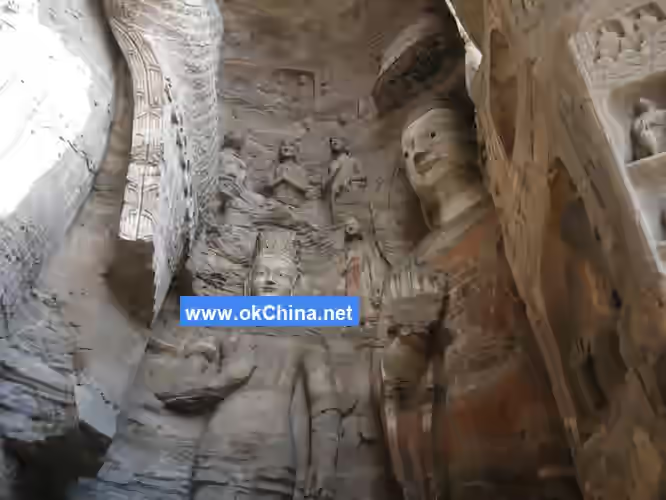
Cave 18 is meticulously designed with a complete arrangement of statues. The central standing Buddha on the north wall is 15.5 meters tall, with broad shoulders, a robust physique, and a majestic presence. It wears a kasaya adorned with a thousand Buddhas, features a high ushnisha (fleshy protuberance), full round cheeks, a prominent nose bridge, and an overall impression of solidity and simplicity. The attendant Buddhas on the east and west walls stand symmetrically, dignified and solemn, forming a layout of the Buddhas of the Three Periods together with the main statue. The attendant Buddha on the east side is crowned with a canopy, has a rounded face, and a towering stature. Between the main Buddha and the attendant Buddhas are carved attendant Bodhisattvas and the Ten Great Disciples. We can see that the left attendant Bodhisattva wears a floral crown, appearing elegant and graceful. The five disciples carved above all exhibit characteristics of people from the Western Regions. They are depicted either standing quietly holding a vase, smiling while holding a flower, listening with closed eyes, appearing as if in realization, or expressing joy from within—a testament to divine craftsmanship that inspires awe. This layout, centered on the main Buddha with symmetrically arranged attendant Buddhas, Bodhisattvas, and disciples on both sides, distinguished by size and arranged in pairs, creates a classic scene of orderly hierarchy and complete composition, evoking an extremely sacred and solemn religious atmosphere. On the west side of the cave entrance is an inscription titled "The Inscription of the Great Ruru Carving," left by the Rouran Khagan's empress during her visit to the Wuzhou Mountain Grotto Temple when the Rouran Khagan invaded Pingcheng in the fourth year of the Zhengguang era of the Northern Wei Dynasty (523 AD).
5.17 Cave 19
Cave 19 features the Buddhas of the Three Periods as its main statues, with the principal Buddha standing 16.8 meters tall, making it the second-largest Buddha statue among the Yungang Grottoes carvings. Cave 19 consists of three caves: a central main cave and two side caves. The main cave was excavated inward from the central cliff face, with an entrance below and a lighting window above. The interior is oval in plan and crowned with a dome. On the two sloping cliff surfaces forming a "V" shape, smaller caves identical in form to the main cave were excavated, resulting in a symmetrical cave layout. This makes it the largest and most uniquely structured cave among the Tanyao Five Caves. Because the outer wall of the central main cave is set back, shifted about 5 meters north compared to the outer walls of the other Tanyao Five Caves excavated during the same period, some scholars speculate that a collapse occurred during excavation, forcing a relocation and reconstruction.
The main Buddha statue in Cave 19 sits in the lotus position (padmasana). The Buddha's earlobes reach the shoulders, the chin is damaged, and it wears a kasaya that bares the right shoulder, which is light, close-fitting, and features simple, clear drapery folds. The Buddha's right hand is raised to the chest in the abhaya mudra (gesture of fearlessness), while the left hand rests palm-up on the knee, holding the monastic robe, symbolizing the fearlessness and transmission of the Dharma. In the east and west ear caves outside the main chamber, each houses a seated Buddha statue leaning slightly. The Buddha in the west ear cave has large earlobes reaching the shoulders and an upright, vigorous physique. This design of housing the Buddhas of the Three Periods in separate caves is both varied and solemn, representing an innovative cave layout form during the Northern Dynasties.
5.18 Cave 20
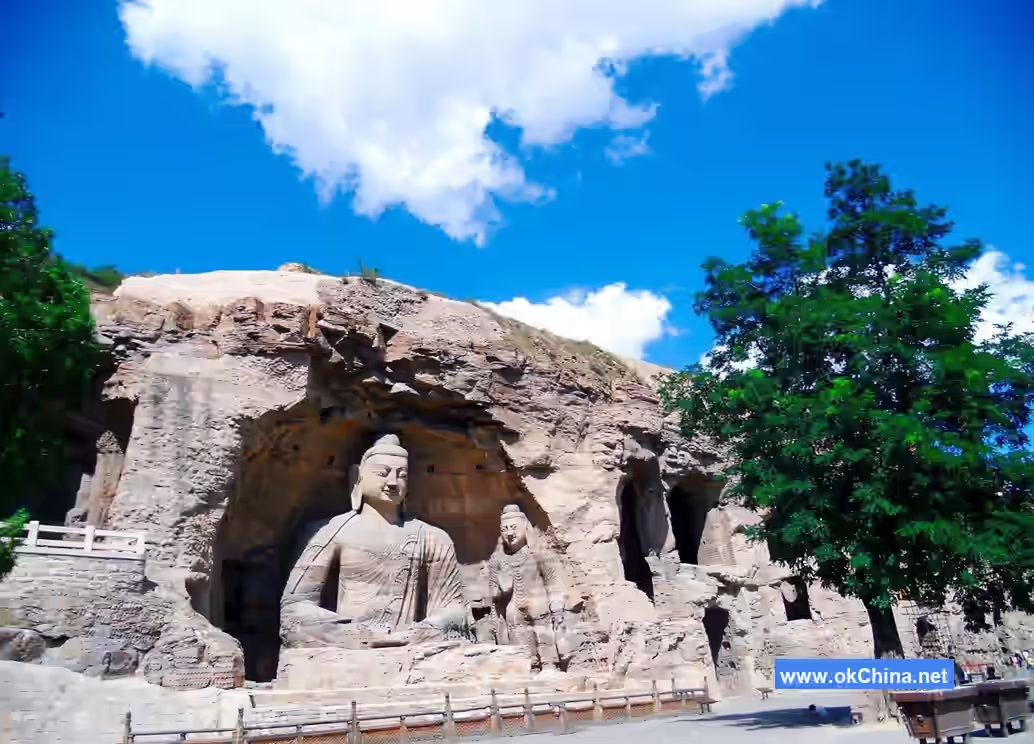
Cave 20 is one of the early-excavated Tanyao Five Caves in Yungang and is also a large statue cave, located at the western end of the five caves. Due to the collapse of the front wall, the Buddha statue is exposed to the open air, hence it is also called the "Open-Air Great Buddha" and was referred to as the "Great Exposed Buddha" during the late Qing and early Republican periods. Based on archaeological evidence from the front of the cave, the collapse of the front wall likely occurred during the Northern Wei period itself. During the Liao Dynasty, a wooden cave eave structure was built, which was later destroyed by warfare.
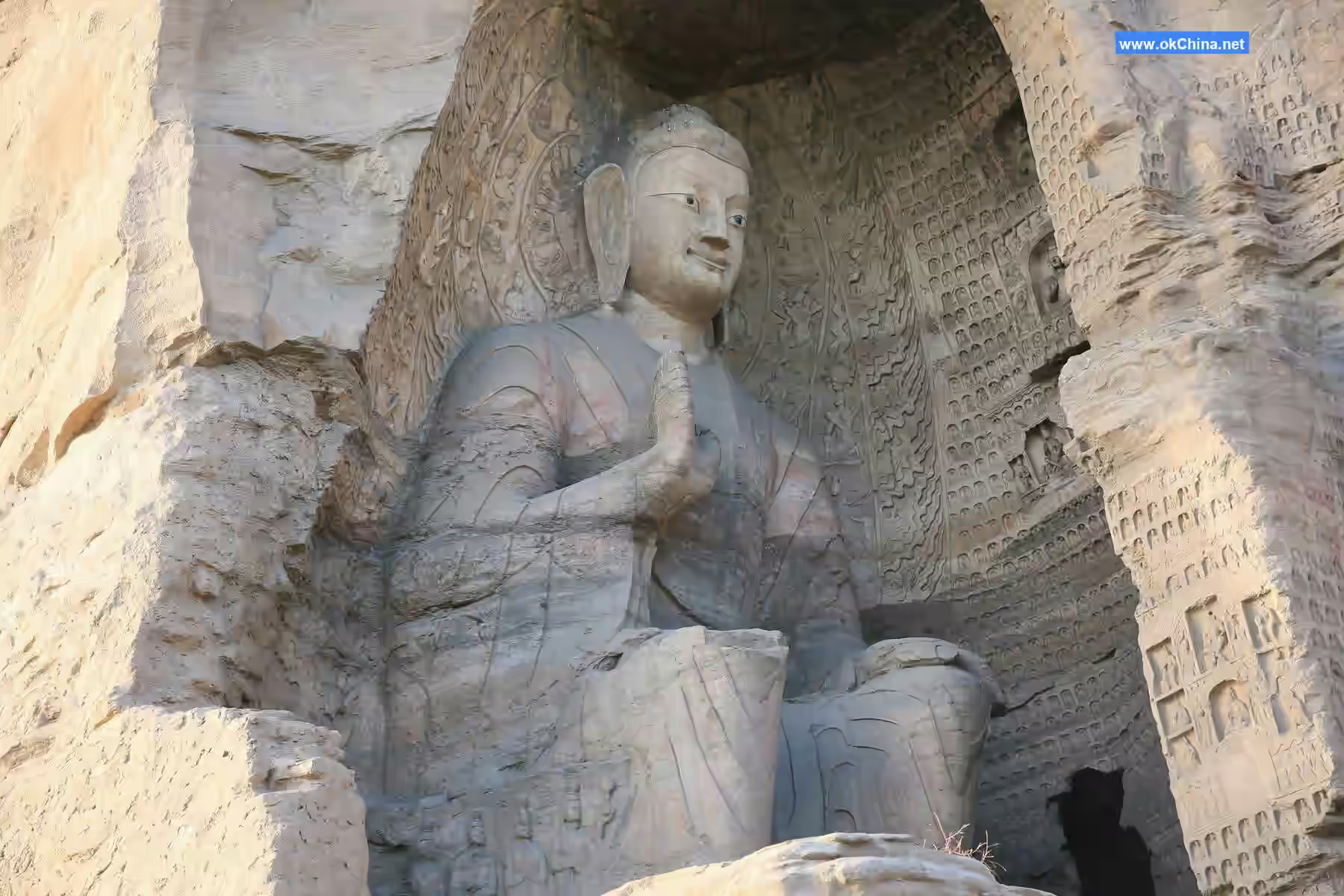
The Open-Air Great Buddha is approximately 13.7 meters tall, seated upright on a stone pedestal. The Buddha's head has a polished ushnisha, a square-round face, a broad forehead, full cheeks, slender eyes and eyebrows, a straight nose bridge, and large ears reaching the shoulders. There is an urna (fleshy protuberance between the eyebrows), slightly thin lips, and a mustache forming a "八" shape above the lips and on the chin. The pupils of the eyes are inlaid with glass, likely installed during the Liao Dynasty. The Buddha's body is upright and robust, with broad, thick shoulders, wearing a kasaya that bares the right shoulder. The kasaya is made of heavy material with natural, flowing drapery folds, showing influences from Gandharan sculpture. The Buddha's inner garment is light and close-fitting. The overall carving achieves a good balance between density and openness, demonstrating exquisite craftsmanship. The Great Buddha's expression is solemn, compassionate, and serene, seated in the lotus position with hands overlapping at the abdomen in the dhyana mudra (meditation gesture). Unfortunately, the hands and legs have been eroded by wind and rain, losing all decorative carving. However, the Buddha's posture remains majestic, dignified, and vibrant, blending Eastern and Western sculptural arts. It is a precious statue embodying the Buddha's "Thirty-Two Major Marks and Eighty Minor Characteristics."
Behind the Great Buddha, a circular flaming mandorla and a large boat-shaped aureole are carved, regular and orderly, rich and magnificent. In the upper corners of the outer edge of the aureole, flying apsaras dressed in Bodhisattva attire hold lotus buds. Their bodies are slightly bent, legs together, feet bare, their posture dignified and steady, their image simple and archaic, representing early flying apsaras in the Yungang Grottoes. Inside and outside the aureole, kneeling offering Bodhisattvas holding objects wear floral crowns and earrings. Their arms are slightly slender, and their drapery is densely folded, showing a posture of devout worship with a strong exotic flavor.
Originally, standing Buddhas and standing Bodhisattvas flanked the Great Buddha on both sides, forming a layout of the Buddhas of the Three Periods and five statues. Unfortunately, today only one Buddha remains standing on the east wall. The east standing Buddha is approximately 9.5 meters tall, with a polished ushnisha, a round face, large ears, deep-set eyes, a high nose bridge, and wears a kasaya covering both shoulders. The right hand is raised to the chest in the abhaya mudra, while the left hand holds the corner of the robe hanging down. It stands barefoot on a lotus pedestal. The drapery carving and statue characteristics strongly reflect the artistic charm of the Western Regions. The standing Buddha on the west wall likely once stood opposite the east Buddha as an attendant but has long since collapsed without a trace. Only the circular mandorla, bare feet, and lotus pedestal remain today.
Cave 20 is the most representative masterpiece of the Yungang Grottoes, vividly and sublimely expressing the fierce and powerful, rugged and unrestrained, broad-minded and wise national spirit of the Tuoba Xianbei, delivering a profound spiritual impact.
5.19 Western Cave Group
In 494 AD, Emperor Xiaowen moved the capital to Luoyang, marking the end of the imperial project at Yungang. The western cliffs then became a fertile ground for folk statue carving. The group of small and medium-sized caves in the western part of Yungang starts from Cave 21 and extends westward for about 240 meters, containing nearly a hundred caves of various sizes. Among them, 25 are major caves, accounting for more than half of Yungang's major caves. Although this group is large in number, most caves are small in scale, with diverse layouts and varying cave forms, distinctly different from the uniform imperial caves of Yungang's early and middle periods.
The late-period caves at Yungang are numerous but generally smaller in scale, predominantly featuring flat-ceilinged square caves. While inheriting the forms of the early and middle imperial caves, they were adapted and innovated according to local conditions. On both sides of the arched doors of many late-period caves, standing guardian deity statues are carved. Some door lintels have single rows of honeysuckle patterns with leaves pointing upward, symbolizing flames. While most Yungang caves feature a lighting window above and an entrance below, late-period caves also show forms with one door and two windows or one door and five windows. Diverse flat coffered ceilings appear in late-period caves.
The diversity and secularization trend in the carving art of late Yungang caves are evident. Figures become increasingly slender, and the folds of clothing at the lower part become more overlapping, making this the birthplace of the "elegant bones and clear images" style in Chinese Buddhism. In fact, changes in the statues of Yungang's middle-period caves had already begun. Not only did the Buddhas start wearing Han Chinese clothing, but the facial features and body shapes of figures also gradually transformed towards a more delicate and refined type.
5.20 Cave 39
This is a pagoda temple cave with a round-arched entrance decorated internally with honeysuckle patterns on the lintel. Above the entrance are two lighting windows. The interior walls are carved with a thousand Buddhas. A five-story square pagoda, 6 meters high, stands in the center. Each story has niches on all four sides, with tapered square pillars carved between the niches. Beams are carved on the pillars. Each story features dense eaves with tile ridges. Below the eaves are one-block-three-step brackets and inverted-V-shaped arches. The square pagoda base is accurately carved with architectural components and well-preserved, serving as important material for studying early Chinese Buddhist pagodas. Cave 39 is the largest cave from the late period at Yungang. The flat coffered ceiling compartments are carved with Asura holding the sun and moon, clustered lotuses, and coiling dragons respectively.
The arched entrance is 3.1 meters high and 2.25 meters wide. The exterior is carved with a pointed lintel, internally decorated with honeysuckle patterns. The west side outside the entrance has collapsed and was recently repaired. The east side retains a severely weathered guardian figure (dvarapala). The lower part of the west wall of the entrance is heavily weathered. On the northern side of the middle section, a round-arched niche is carved containing a seated Buddha. On both sides outside the niche, an attendant Bodhisattva is carved each. Inside the niche lintel, seven Buddhas are carved. On both sides of the niche, five rows of thousand-Buddha niches are carved each. On the southern side of the middle section, a square niche is carved containing a seated Buddha, with an attendant Bodhisattva carved on each side outside the niche. The upper level features a square curtained niche. The west wall is carved with a seated Buddha on a lotus pedestal, with an attendant Bodhisattva carved on each side. The south and north walls each have a standing Buddha carved, with lotus pedestals below. The middle and lower parts of the east wall of the entrance are carved with scattered small niches, heavily weathered. On the upper northern side, a three-story pagoda is carved. Below the pagoda, a round-arched niche is carved containing a seated Buddha. On the southern side, a truncated pyramidal (盝形) curtained niche is carved, originally containing a cross-ankled Bodhisattva, but the south side of the niche has collapsed. Currently, a pensive Bodhisattva and a flying apsara remain on the north side. The squares within the niche lintel are carved with seated Buddhas.
6. Cultural Relic Value
As China's first imperially authorized cave complex, the Yungang Grottoes reflect the political ambitions of the Northern Wei Dynasty. Their many Western-influenced styles reveal connections with major world civilizations, which is unique among China's artistic treasures and holds significant importance for the development of later Chinese culture and art.
With its rich statuary, distinct characteristics of its era, and superb artistic expressiveness and impact, the Yungang Grottoes earned the crown of Chinese stone carving art in the 5th century AD. The statuary style of the Yungang Grottoes is known as the "Yungang Model." This style not only formed its own system but also deeply influenced the excavation of caves in surrounding areas of the Central Plains. Consequently, it was announced by the State Council as one of the first batch of Major Historical and Cultural Sites Protected at the National Level. At the Yungang Grottoes, we can see not only traces of statuary styles from the distant West but also artistic styles after Sinicization. Yungang's special geographical location and the statuary styles within its caves make it a typical specimen for observing the eastward spread of Buddhism from the West. Precisely based on these important characteristics, the Yungang Grottoes were inscribed on the UNESCO World Heritage List by the World Heritage Committee in 2001, becoming a globally significant cultural heritage site.
Comments
Post a Comment