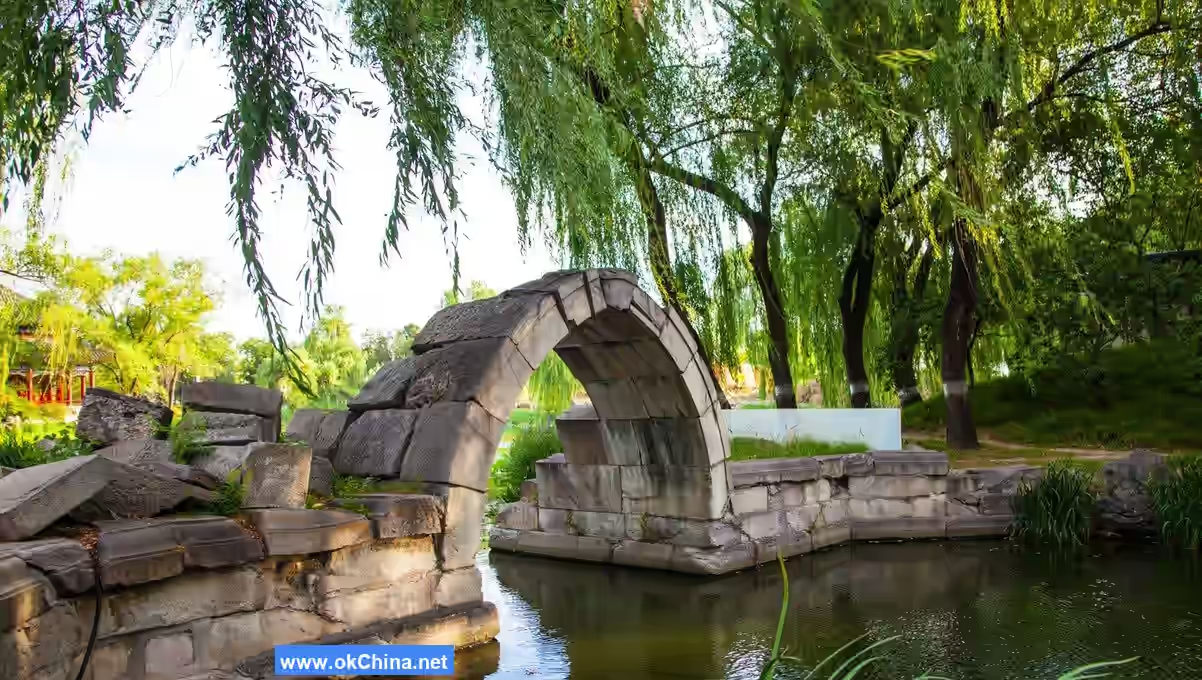
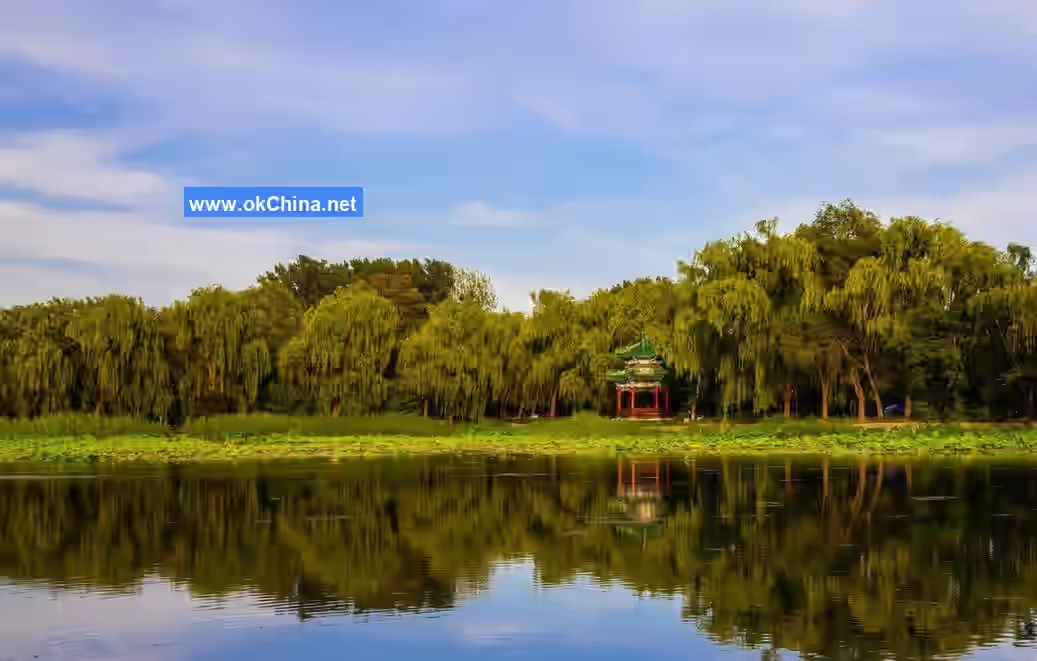
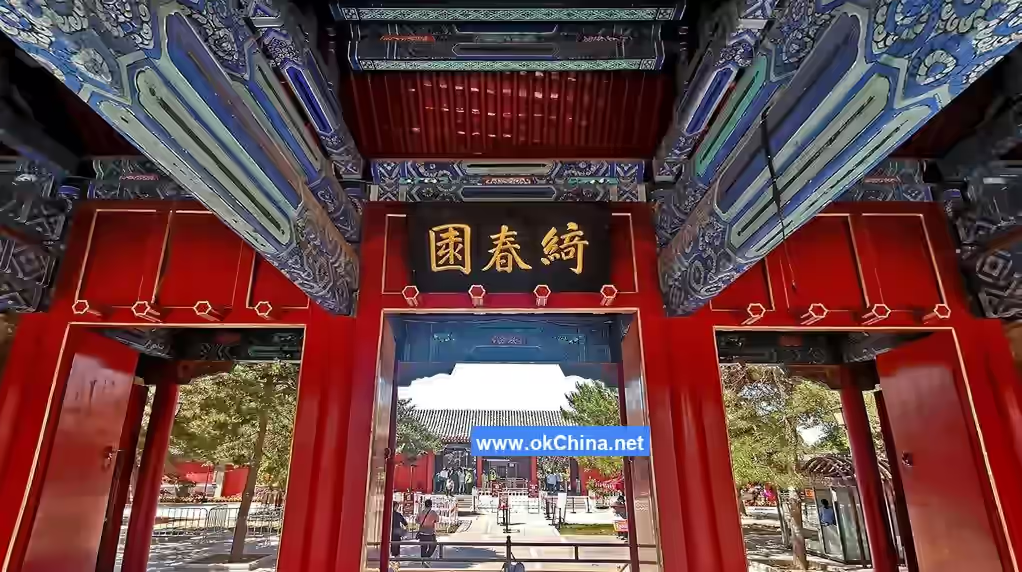
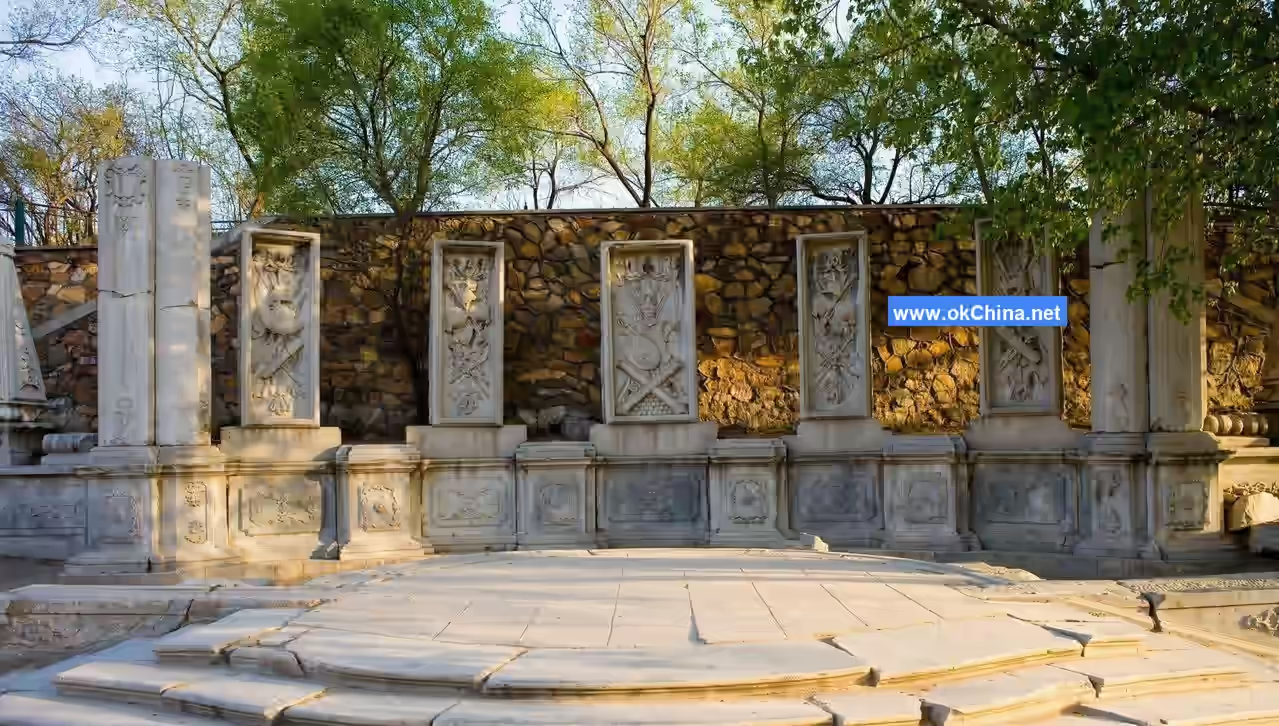
The Old Summer Palace
I. Introduction
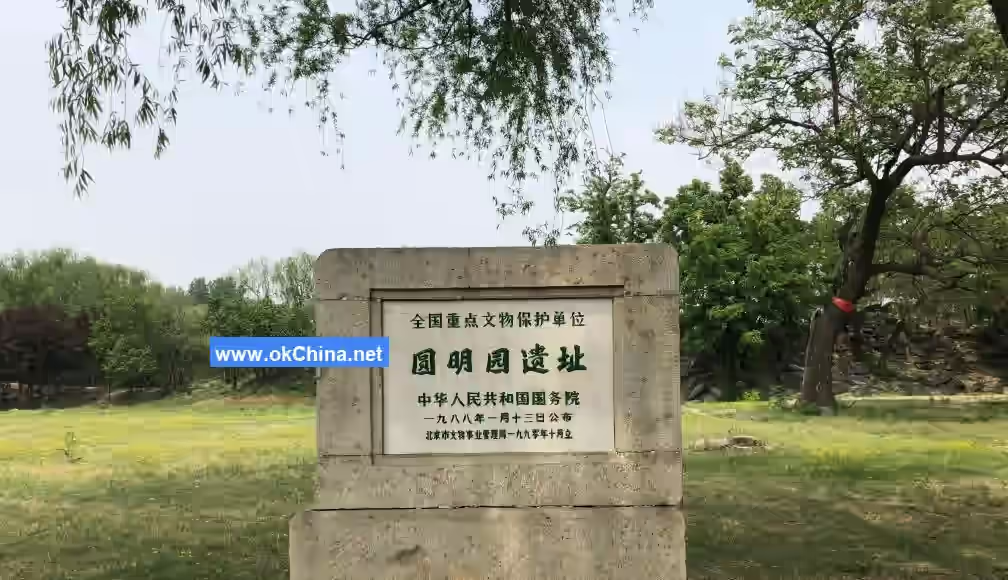
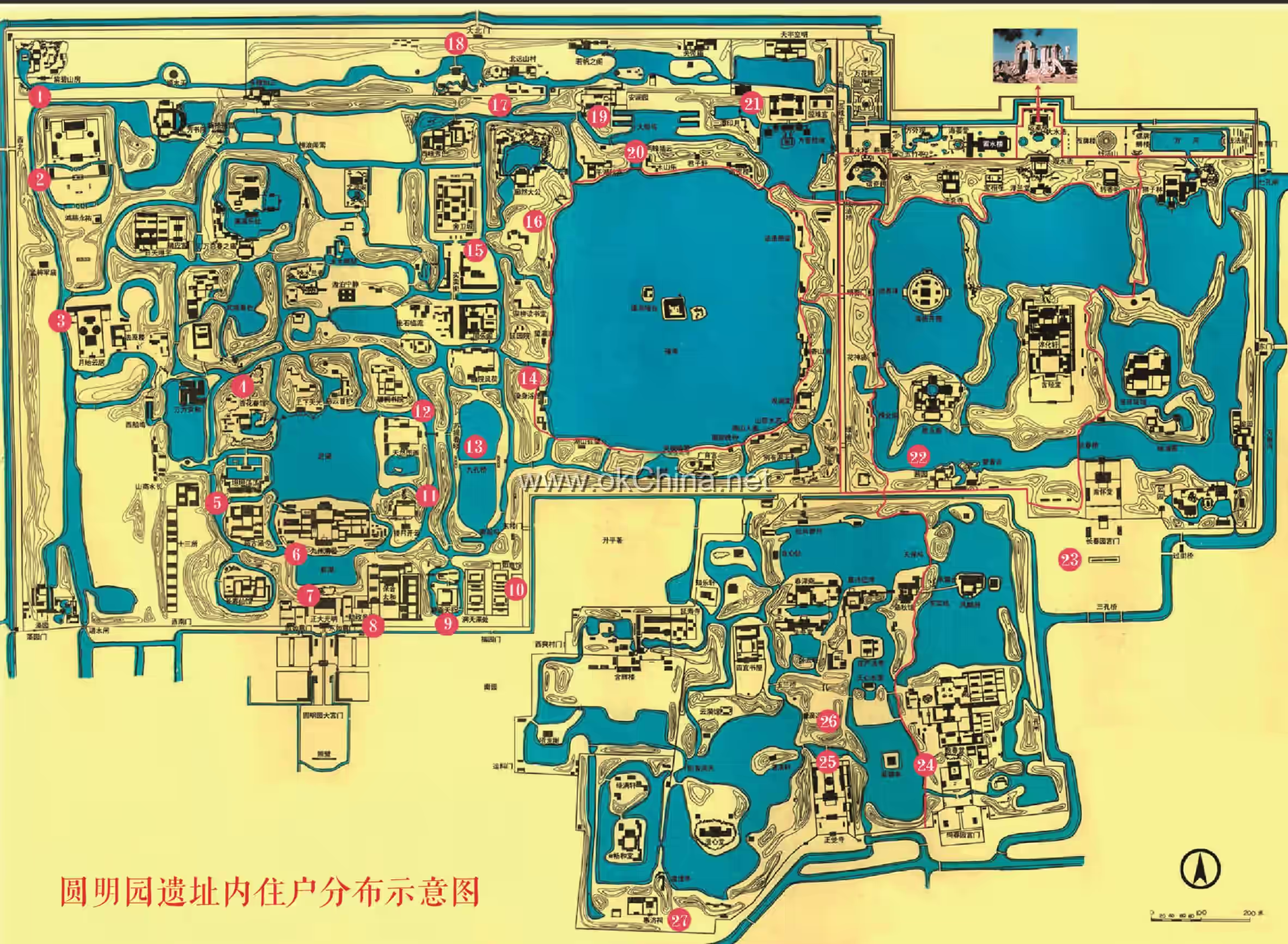
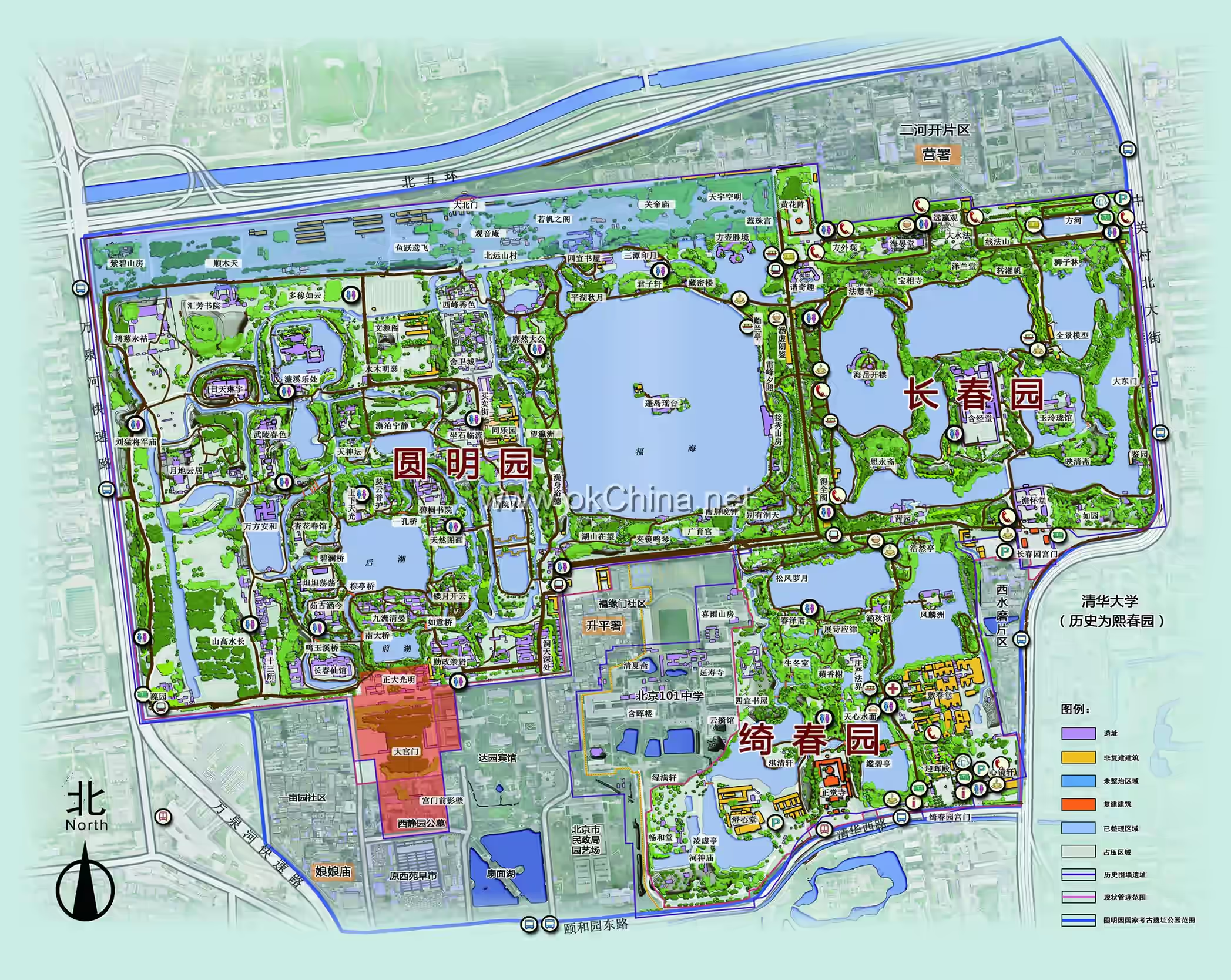
The Old Summer Palace, a large imperial garden of the Qing Dynasty in China, is located at No. 28, Qinghua West Road, Haidian District, Beijing. Covering an area of over 350 hectares, with a water surface of about 140 hectares, it consists of the Yuanmingyuan, Qichunyuan, and Changchunyuan gardens. Among them, Yuanmingyuan is the largest, hence the collective name "Yuanmingyuan" (also known as the "Three Gardens of Yuanming"). The Old Summer Palace not only incorporates several famous scenic spots from the Jiangnan region but also transplants Western garden architecture, representing the pinnacle of garden art from both ancient and modern times, as well as from China and abroad. It is considered one of the treasures of human culture and was the largest museum in the world at the time.
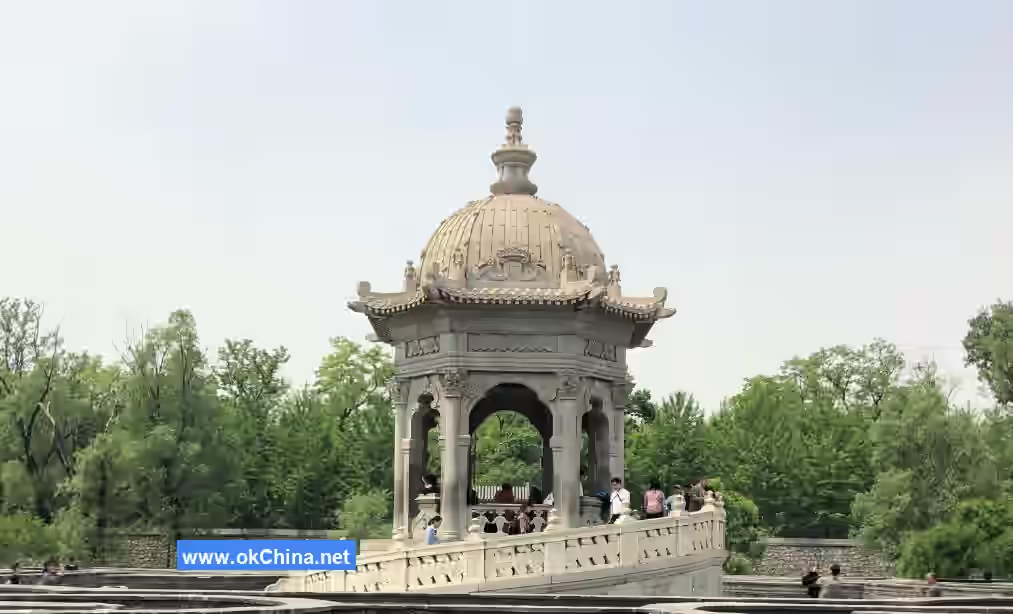
Construction of the Old Summer Palace began during the late Kangxi and Yongzheng periods. In the second year of the Yongzheng reign (1724), the expansion project officially commenced. After Emperor Qianlong ascended the throne, he adjusted the garden's landscapes and added architectural complexes. In 1860, British and French invaders set fire to the Old Summer Palace, burning it along with nearby gardens such as the Qingyiyuan, Jingmingyuan, Jingyiyuan, Changchunyuan, and Haidian Town. In the 26th year of the Guangxu reign (1900), the Eight-Nation Alliance occupied Beijing, leading to the complete destruction of the palace's buildings and ancient trees. After the fall of the Qing Dynasty, the relics of the Old Summer Palace were further plundered by bureaucrats, warlords, and unscrupulous merchants. After the founding of the People's Republic of China, the Chinese government began preservation and restoration work on the Old Summer Palace.
The Old Summer Palace extensively replicated many famous gardens and scenic spots from across China, particularly those in the Jiangnan region. Its main architectural types include halls, pavilions, towers, terraces, multi-story buildings, verandas, water-side pavilions, corridors, studios, study rooms, houses, boat-shaped structures, halls, bridges, sluice gates, walls, pagodas, as well as temples, Taoist monasteries, village residences, and market streets. The garden's layout features 38 different architectural plans. The garden's landscaping often revolves around water, and some buildings incorporate significant religious elements.
II. Layout and Orientation
Architectural Layout
The Old Summer Palace covers an area of over 350 hectares, with a water surface of about 140 hectares. Its land-based architectural area exceeds that of the Forbidden City by 10,000 square meters, while its water area is equivalent to that of the Summer Palace. The total area is equal to 8.5 times that of the Forbidden City. Qichunyuan is located southeast of Yuanmingyuan and consists of several small gardens, covering approximately 5,370 square meters. The Western-style buildings in Yuanmingyuan occupy about 5.3 hectares, situated north of Changchunyuan, accounting for roughly 1.5% of the total area of the Three Gardens. Wenyuan Pavilion measures about 60 meters east to west and 90 meters north to south, covering an area of 0.54 hectares.
The Old Summer Palace stretches over 10 kilometers and is composed of Yuanmingyuan, Qichunyuan, and Changchunyuan. Among them, Yuanmingyuan is the largest, hence the collective name "Yuanmingyuan" (also known as the "Three Gardens of Yuanming"). Additionally, there are many subsidiary gardens distributed to the east, west, and south of the Old Summer Palace, including the Jingyiyuan at Fragrant Hill, Jingmingyuan at Jade Spring Hill, and Qingyiyuan (on which the later Summer Palace was built). The total area of the entire garden complex exceeds 5,000 mu.
The Old Summer Palace is located north of Guajiatun, about one li from Changchunyuan, which is north of present-day Peking University and west of Tsinghua University. During the Kangxi period, the Old Summer Palace featured lakes such as the Front Lake and Back Lake, with garden scenes like the "Peony Terrace" and "Natural Picture." At that time, the Old Summer Palace was still a princely garden, and its scale could not exceed the emperor's Changchunyuan, so it had few scenic spots and limited fame. However, with the ascension of Emperor Qianlong and the arrival of the Qing Dynasty's golden age, its continuous expansion over the years eventually made it the most magnificent imperial garden in China.
The chief designer of the Old Summer Palace was named Lei Jinyu, who was favored by Emperor Kangxi during the construction of the Forbidden City. However, the actual construction largely reflected the emperors' visions, with Kangxi, Yongzheng, and Qianlong all personally overseeing the project. They also created the "tangyang" model-making method, which was damaged during the Xianfeng period.
Architectural Style
A notable feature of the Old Summer Palace is its extensive replication of famous gardens and scenic spots from across China, particularly those in the Jiangnan region.
Emperor Qianlong made six southern tours to Jiangsu and Zhejiang, multiple western tours to Wutai Mountain, eastern tours to Mount Tai, and visits to Rehe, Shengjing (present-day Shenyang), and Panshan. Whenever he encountered a scenic spot or garden he admired, he would have accompanying painters sketch it, and upon returning to Beijing, he would order its replication in the garden. According to incomplete statistics, there are no fewer than 40 to 50 direct replicas of garden scenes in the Old Summer Palace. The Ten Scenes of West Lake in Hangzhou were replicated in the garden, even retaining their original names.
In the 27th year of the Qianlong reign (1762), Emperor Qianlong used the Chen family's Yuyuan in Haining as a temporary residence during his southern tour and bestowed upon it the name "Anlan Garden." The emperor admired the garden's exquisite structure and, upon returning to Beijing, ordered its replication and expansion near the Siyi Study in Yuanmingyuan. After completion, it was also named "Anlan Garden." Three other famous gardens were replicated in Changchunyuan during this period: one was the Xiaoyoutian Garden, built in the 23rd year of the Qianlong reign (1758) in the eastern courtyard of Siyongzhai, modeled after the Wang family garden at West Lake in Hangzhou; another was the Ruyuan Garden, built in the 32nd year of the Qianlong reign (1767), modeled after the Zhan Garden in Jiangning (present-day Nanjing); and the third was the Lion Grove Garden, built in the 37th year of the Qianlong reign (1772), modeled after the famous Suzhou garden. Both Ruyuan and Lion Grove Gardens feature more than 16 scenic spots each.
Architectural Forms
The main architectural types of the Old Summer Palace include halls, pavilions, towers, terraces, multi-story buildings, verandas, water-side pavilions, corridors, studios, study rooms, houses, boat-shaped structures, halls, bridges, sluice gates, walls, pagodas, as well as temples, Taoist monasteries, village residences, and market streets—essentially everything one could imagine. During its peak, the architectural styles of the Old Summer Palace encompassed nearly all possible planar layouts and forms in ancient Chinese architecture: from the common single-eave, rolled-roof gray-tiled structures to palace-style double-eave buildings covered with glazed colored tiles; from regular courtyards with one or two wings to flexible and varied architectural complexes.
The Old Summer Palace features 38 different architectural layouts, including not only common shapes like rectangles, squares, circles, the character "工,"凹凸 shapes, hexagons, and octagons but also many unique and innovative forms, such as crescent shapes, swastika shapes, scroll shapes, cross shapes, field shapes, L-shapes, plum blossom shapes, triangles, fan shapes, and even interlocking rings and double diamond shapes.
The Three Gardens of Yuanming collectively contain over a hundred garden-within-garden complexes and scenic architectural groups, commonly referred to as the "Hundred Scenes." These include halls, towers, pavilions, terraces, studios, study rooms, and corridors, covering a total area of approximately 160,000 square meters. The buildings in the garden not only drew on the strengths of palace-style architecture from previous dynasties but also broke free from the constraints of official norms in terms of planar configuration, exterior design, and group composition. They incorporated diverse forms and styles, creating many architectural types rarely seen in both southern and northern China, such as character-shaped studios, crescent-shaped studios, field-shaped halls, and fan-shaped, bow-shaped, circular mirror-shaped,工-shaped,山-shaped, cross-shaped, double diamond-shaped, and scroll-shaped structures. Combined with the garden's layout, which adapts to the natural terrain and features ever-changing scenes, and the interconnected and layered progression of its scenic spots, the Old Summer Palace achieves a rich, diverse, natural, and harmonious overall beauty.
Architectural Elements
Water Elements
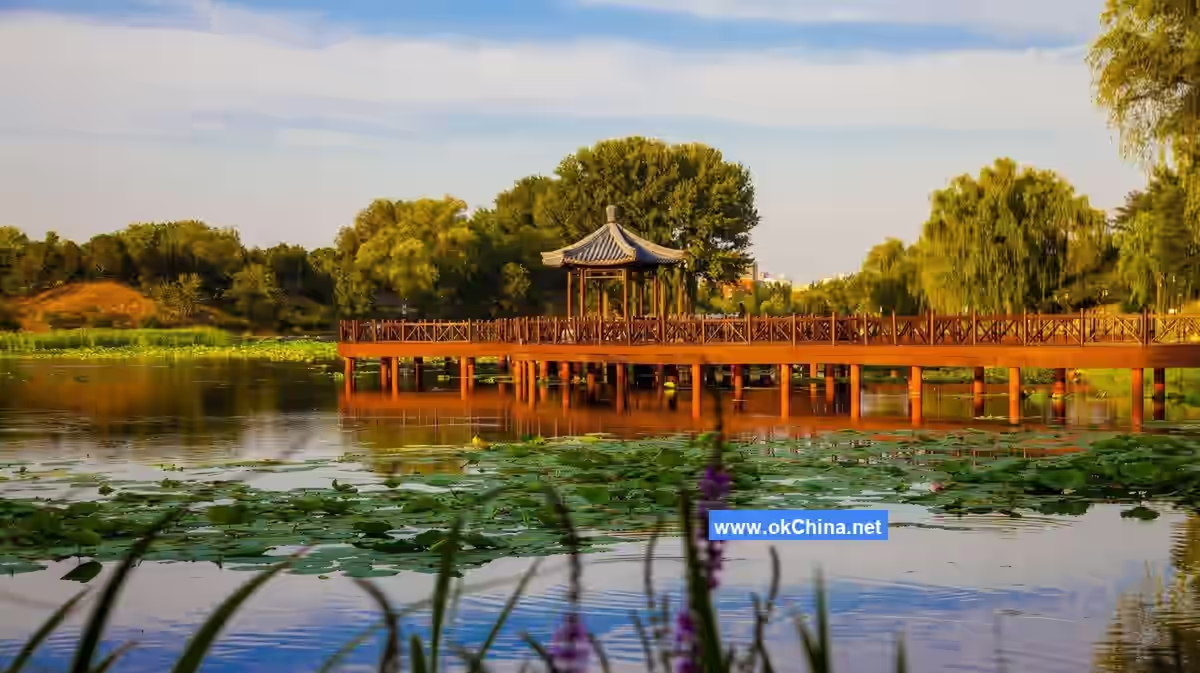
The landscaping of the Old Summer Palace often revolves around water, with many scenes directly inspired by famous water features in the Jiangnan region. The Back Lake scenic area features nine small islands encircling the lake, symbolizing the "Nine Provinces" described in the ancient Chinese text "Tribute of Yu." The small gardens or scenic groups on each island have their own unique characteristics while also complementing one another. The "Upper and Lower Sky Light" on the northern shore offers a view reminiscent of the grandeur of Yueyang Tower overlooking Dongting Lake. The "Open and Expansive" on the western shore resembles the Jade Spring Fish Viewing in Hangzhou, commonly known as the Goldfish Pond.
The "Ten Thousand Directions of Peace and Harmony" in the western part of Yuanmingyuan features buildings constructed in the shape of a swastika on the lake, providing warmth in winter and coolness in summer. From a distance, the opposite shore appears adorned with exotic flowers like embroidered silk. Emperor Yongzheng enjoyed residing here. The "Clear Waters and Verdant Trees" in the northern part of Yuanmingyuan used Western water techniques to channel water indoors, powering fans to create a serene atmosphere described as "rustling trees, gurgling water, the sound of breeze in the valley, and the chirping of mountain birds." Emperor Qianlong liked to spend his summers here. The "Open Sea and Sacred Mountain" in the West Lake of Changchunyuan features a three-story pavilion built on a large circular platform of white jade stone.
The "Penglai Yaotai" in Fuhai draws inspiration from the mythical Penglai Immortal Island, originally named Penglai Isle. Emperor Yongzheng ordered artisans to pile rugged rocks into three islands of varying sizes in the East Lake of Yuanmingyuan, symbolizing the legendary "Three Immortal Mountains" of Penglai, Yingzhou, and Fangzhang. The islands were adorned with halls, pavilions, and terraces, appearing like "five golden halls and twelve jade towers." In line with the寓意 of "Xu Fu's search in the sea," the East Lake was named "Fuhai" (Sea of Blessings). More than ten other exquisite garden scenes were built along the shores of Fuhai. Fuhai measures about 500 to 600 meters from east to west and north to south, and together with the surrounding smaller water bodies, covers approximately 35 hectares, equivalent to the water surface of Beihai Park. With its expansive water surface and beautiful scenery, large dragon boat races were held here during the Dragon Boat Festival. On the night of the 15th day of the seventh lunar month, the Qing emperors would watch river lanterns here. In winter, when the lake froze, the emperor would ride ice sleds to enjoy the scenery. Fuhai essentially served as the water entertainment center of the Old Summer Palace.
Religious Elements
The temple gardens in the Old Summer Palace also reflect an aspect of ancient Chinese culture.
Anyou Palace (Hongci Yonghu) was built following the precedent of the Shouhuang Hall at Jingshan. It was used to worship the "divine spirits" of Emperors Kangxi and Yongzheng and served as the imperial ancestral temple within the garden. The palace has nine bays, with a double-eave hip-and-gable roof covered in yellow glazed tiles, making it the largest structure in the garden. Surrounded by towering pine trees, the central axis features two pairs of ornamental columns at its southern end, creating a solemn and majestic atmosphere. Fanghu Shengjing, located on the northeastern shore of Fuhai Bay, was built according to the幻想 of a fairyland of jade palaces. Historical records indicate that it housed over 2,200 Buddhist statues and more than 30 pagodas. The front base of this structure is built with white marble in the shape of the character "山," extending into the water.The entire structure is massive in scale. The style and grandeur of this building are rarely seen among existing Chinese garden architecture.
The City of Shewei is a typical Buddhist structure. According to historical records, the building was modeled after the layout of the ancient capital of the Kosala Kingdom in India, containing a total of 326 halls and rooms. Since the Kangxi era, whenever the emperor or empress dowager celebrated their birthdays, the Buddhist statues presented by princes and ministers were stored here. Among them were statues made of pure gold, silver-plated, jade-carved, and bronze-cast. Year after year, they accumulated to hundreds of thousands. The looting and burning of the Old Summer Palace resulted in losses from this site alone—both in economic value and cultural and artistic significance—that are difficult to quantify.
III. Natural Resources
Plant Resources
During its heyday, the Old Summer Palace was considered the royal botanical garden of its time. Many scenic spots within the garden, such as the Peony Terrace, Bamboo Courtyard, Phoenix Tree Courtyard, Apricot Blossom Village, Peach Blossom Cove, Fragrant Water Lily, Gentleman’s Pavilion, Pine Wind and Vine Moon, and the Deep Willow Reading Hall, were renowned for their distinctive plant landscapes. In addition to over a hundred species of native flowers and trees, such as pine, bamboo, willow, lotus, phoenix trees, oriental arborvitae, Chinese scholar trees, maple trees, crabapple, mountain peach, apricot, magnolia, peony, rose, chrysanthemum, orchid, and wisteria, the garden also introduced and cultivated more than 20 species of trees and flowers from other regions. These included plum blossoms and banana trees from Jiangnan, lotus from Aohan and Wusha’erqi in the northern frontier, golden lotus flowers from Mount Wutai, mulberry trees from Xinjiang, Persian peaches from South Asia, and sensitive plants from the West. The saying "Twenty-four seasonal breezes are all pleasant, three hundred and sixty days of blooming flowers compete in beauty" describes the Old Summer Palace’s endless array of flowers throughout the seasons, its lush green trees, layered hills, murmuring streams, and the songs of birds.
The ancient trees in the Old Summer Palace are primarily oriental arborvitae and Chinese juniper, weathered and rugged with age. They are mainly distributed within the Zhengjue Temple, totaling 27 trees. The ancient trees are numbered from 11010802191 to 11010802217, and the species include oriental arborvitae, Chinese juniper, lacebark pine, Chinese scholar tree, and black date tree. Except for the Chinese juniper numbered 11010802198, which is a first-grade ancient tree, all others are second-grade ancient trees.
During its heyday, the four major garden plants in the Old Summer Palace were pine, bamboo, willow, and lotus:
Places where pines were planted in the garden included: Kuoran Dagong, Yuedi Yunju, and Anyou Palace in the Old Summer Palace; Haiyue Kaijin and Hanjing Hall in the Changchun Garden; and Fenglinzhou East Hill and Wenyue Tower in the Qichun Garden.
Places where bamboo served as the main theme of the plant composition included: Tianran Tuhua, Junzi Xuan, and Fangbi Cong in the Old Summer Palace; Xushou Xuan and Qianfang Study in the Changchun Garden; and the Bamboo Forest Courtyard in the Qichun Garden.
Places where both pines and bamboo were planted included: Shuanghe Zhai, Pengdao Yaotai, Pinghu Qiuyue, Fanghu Shengjing, Wanfang Anhe, Yingshui Lanxiang, and Zaoyuan in the Old Summer Palace; Lion Grove, Ruyuan, Yulinglong Guan, and Sanyou Xuan in the Changchun Garden; and Fuchun Hall, Qingxia Zhai, and Changhe Hall in the Qichun Garden.
The lake shores, pond banks, and stream edges of the three gardens were dominated by weeping willows. The four shores of the Back Lake, around Fuhai Lake, and inside and outside Nanhu Lake were all planted with willow trees. From Beiyuan Shancun to Jixiang, winding streams passed through thousands of willows; at Wanchun Xuan, a single willow tree shaded the entire courtyard; and at Shuanghe Zhai and Shenliu Dushu Tang, ancient willows surrounded the halls, embracing them.
Animal Resources
Rare animals in the Old Summer Palace included white gibbons, milu deer, crested ibises, red-crowned cranes, peacocks, swans, and multicolored koi. At the Yangque Cage in the Western-style buildings alone, over 400 birds of various species were kept year-round.
Water Resources
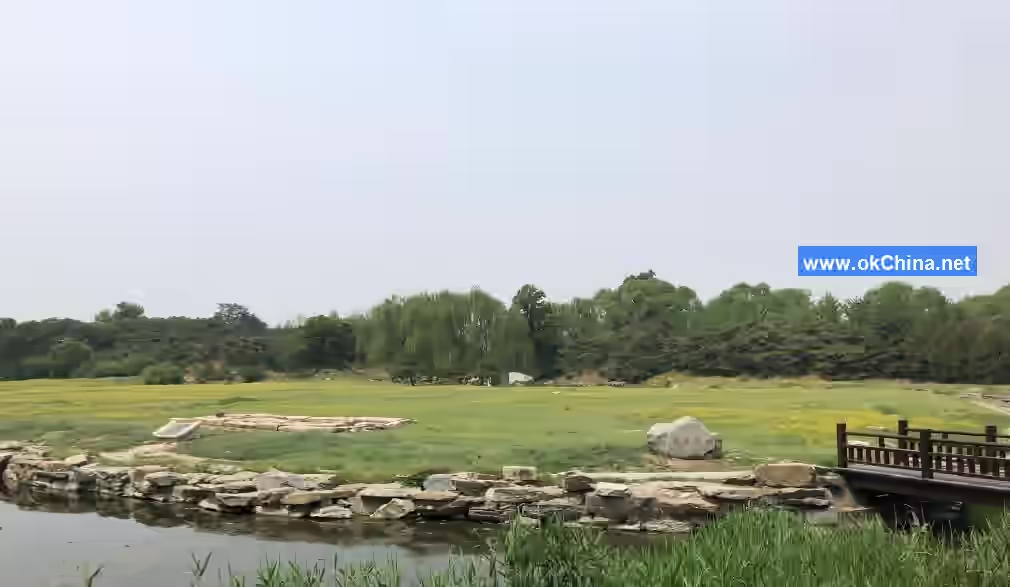
Historically, the water surface area of the Old Summer Palace totaled 1,237,300 square meters, accounting for four-tenths of the garden’s total area, approximately 2,080 mu. The combination of large, medium, and small water bodies formed a complete water system within the garden, serving as its veins and links, used for boating and water transport of materials. The water source of the Old Summer Palace mainly came from Yuquan Mountain. During the Qing Dynasty, this water source was abundant. According to historical archives and drawings from the National Library and the Palace Museum, the Old Summer Palace had two water sources, nine inlets, and three outlets. Additionally, there was a moat outside the garden to control water levels and ensure water supply for the three gardens.
IV. Main Structures
Qichun Garden
Located southeast of the Old Summer Palace, the Qichun Garden was composed of several small gardens from different periods, with an irregular shape, resulting in a relatively loose overall layout. The small gardens formed clusters, separated by walls or scattered along the water’s edge and among the hills.
Emperor Jiaqing of the Qing Dynasty began constructing the Qichun Garden upon his accession, and by the tenth year of his reign, he had completed the "Thirty Scenes of Qichun Garden": Fuchun Hall, Jiande Study, Cuihe Xuan, Lingxu Pavilion, Xiexing Zhai, Chengguang Xie, Wenyue Tower, Wojian Shi, Weizao Hall, Aifang Pu, Jinglv Pavilion, Congyu Xuan, Shuhui Xuan, Zhulin Yuan, Xifei Xie, Qingxia Zhai, Jinghong Guan, Xiyu Shanfang, Hanguang Tower, Hanqiu Hall, Huazi Ting, Taixiang Shi, Xuming Jing, Hanchun Hall, Chunze Zhai, Shuixin Xie, Siyi Study, Mingke Jingshe, Laixun Shi, and Bore Guan. Later, more than 20 additional scenes were built.
Ehui Garden (the predecessor of Qichun Garden) was located northeast of Changchun Garden, roughly east of Suoqiwan Garden (later Chenghuai Garden) north of the imperial garden, north of Shuchun Garden, and west of Xichun Garden. This area corresponds to the current location of Beijing 101 Middle School.
North of Zhengjue Temple, there is a group of islands that were not specifically developed for architectural space. Instead, surrounding earthen hills formed a natural space. In terms of overall layout, these islands were centrally located, serving to separate scenic areas and water surfaces.
The seasonal landscapes of Qichun Garden: The most prominent feature of Qichun Garden’s landscaping was its representation of the four seasons—spring, summer, autumn, and winter—through the scenes of Fuchun Hall, Qingxia Zhai, Hanqiu Hall, and Shengdong Shi.
Fuchun Hall: The spring scene is represented by Fuchun Hall. As the main residential area for the royal family in Qichun Garden, Fuchun Hall was large in scale and surrounded by rich landscapes of hills and water. To the north and west of Fuchun Hall were open lake surfaces.
Qingxia Zhai: The summer scene is represented by Qingxia Zhai. Originally a structure within Xishuang Village, it was later renovated and renamed Qingxia Zhai. The architectural space of Qingxia Zhai did not adhere to a symmetrical layout but combined elements such as buildings, pavilions, corridors, outdoor waterfront areas, lakes, and hills. It featured both outdoor recreational spaces and indoor living spaces, with "several stalks of bamboo and a hundred feet of ancient pines" within the courtyard.
Hanqiu Hall: The autumn scene is represented by Hanqiu Hall. Located at the junction of the two largest lakes in Qichun Garden, Hanqiu Hall connected the spaces on both sides. Additionally, in the mountain depression east of Hanqiu Hall, there was the Xianren Chenglu Terrace, a feature that aligned with the autumn theme of "governing all things and nurturing all beings."
Shengdong Shi: The winter scene is represented by Shengdong Shi. Its origins can be traced back to the Qianlong era of the Qing Dynasty, when it was known as "Mingshan Hall." After successive renovations, it was renamed "Hanchun Hall" and, in the twelfth year of the Jiaqing era (1807), this group of buildings was named Shengdong Shi, with accompanying inscriptions. Shengdong Shi stood separated by water from the buildings to its north and south.
Changchun Garden
The southern part of Changchun Garden features large water landscapes, with an overall layout that is spacious, open, and well-balanced. The garden gate is the Changchun Garden Palace Gate, with five bays, and a pair of bronze qilins (now only one remains, displayed in front of Renshou Hall in the Summer Palace). To the south of the gate, a screen wall was built. Inside the gate is Danhuai Hall, with nine bays, a rolled-eave hip-and-gable roof, and a moon platform with red steps in front, flanked by east and west side halls with five bays each. North of the main hall is a riverbank, where a square pavilion was built, connected to the main hall by a corridor. West of the pavilion is the Changchun Bridge, with ten arches. Crossing the bridge and heading north through a mountain pass leads to the core building of the garden—the Hanjing Hall complex. In front of Hanjing Hall, three memorial archways were erected, with screen walls on both sides in a "八" shape. Inside the gate is the five-bay Hanjing Hall, where Emperor Qianlong recited scriptures. Further north are Chunhua Xuan (the grandest building among the three gardens, housing the Chunhua Ge Tie rubbings) and Yunzhen Zhai. Exiting the back door leads to the "Deshenggai" open hall, built in the twenty-fourth year of Qianlong’s reign (1759) to commemorate the victory in the平定大小和卓之役. Other structures include Hanguang Shi, Lixin Tower, Weiyu Study, and the Dongqiangwai Market Street.
The Hanjing Hall complex was magnificent and grand in scale, modeled after the Ning Shou Gong in the Forbidden City. It was intended as Emperor Qianlong’s residence after his abdication. West of Hanjing Hall is Siyong Zhai, built as a seventeen-bay工字殿. In front of Siyong Zhai, Xiaoyoutian Garden was constructed. North of Siyong Zhai is Haiyue Kaijin, a double-layer circular stone platform built on the lake, with a three-story hall on top. East of Haiyue Kaijin, across the water, is the Xianren Chenglu Terrace. South of the terrace is Qian Garden, renowned for its rocks and featuring the Eight Scenes of Qian Garden. The "Qinglian Duo" stone, a relic from the Southern Song Dynasty’s Deshou Palace transported by Emperor Qianlong from Hangzhou, was also displayed here. East of Hanjing Hall are scenic spots such as Yulinglong Guan, He’an Zhai, Yingqing Zhai, Ruyuan, and Jian Garden. At the northeastern corner of the garden is the Lion Grove (modeled after the Lion Grove in Suzhou). North of the garden are structures such as Fahui Temple, Duobao Glazed Pagoda, Baoxiang Temple, and Zelan Hall. Further north is the Western-style Buildings scenic area.
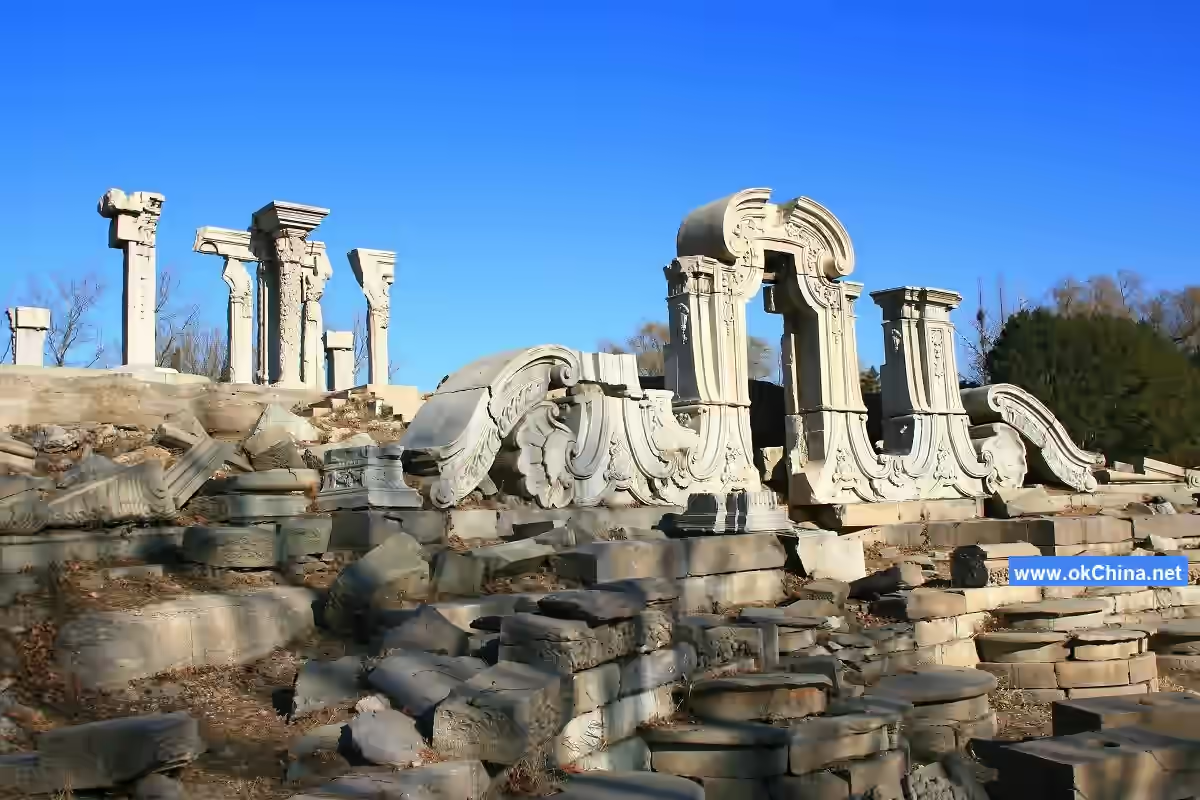
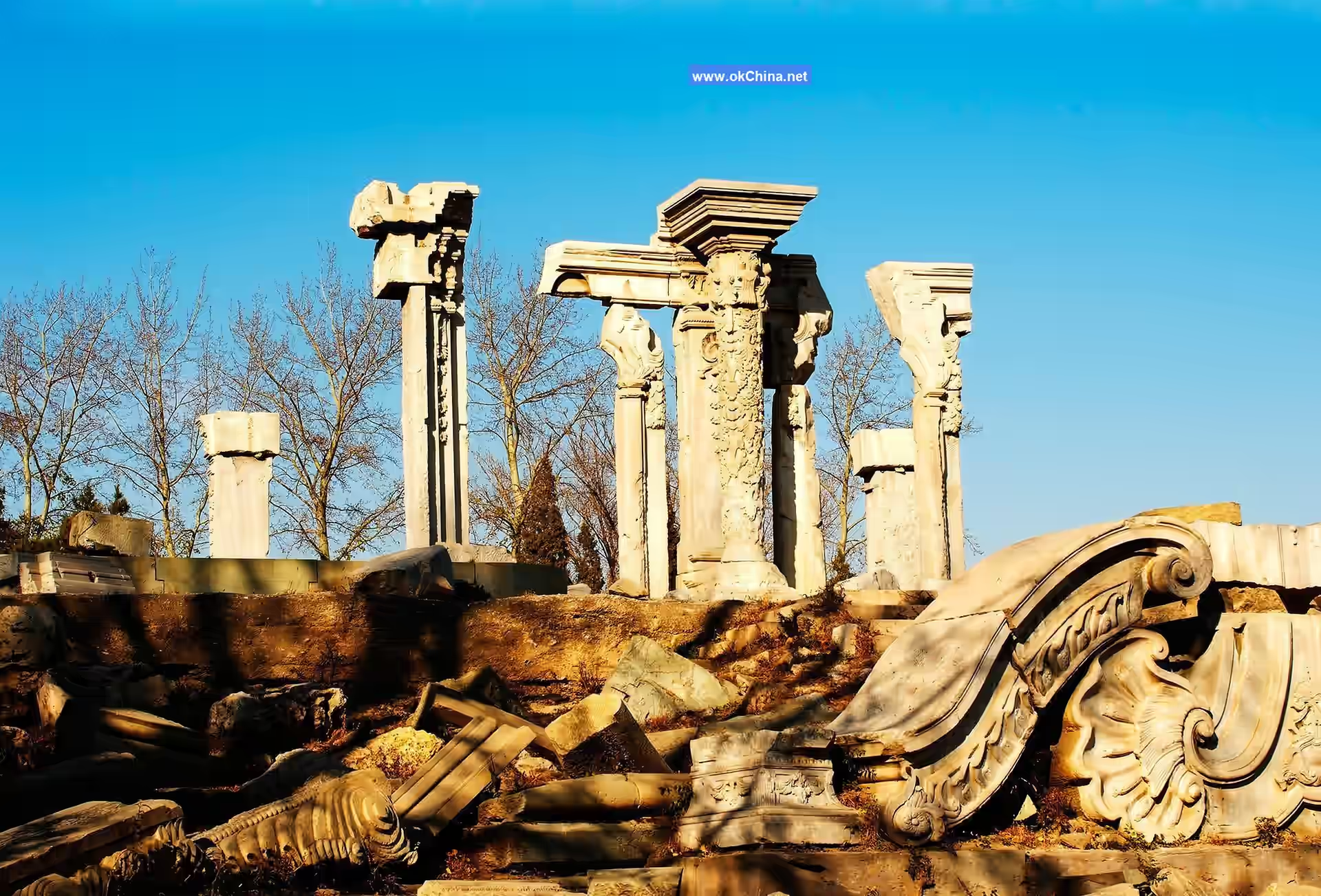
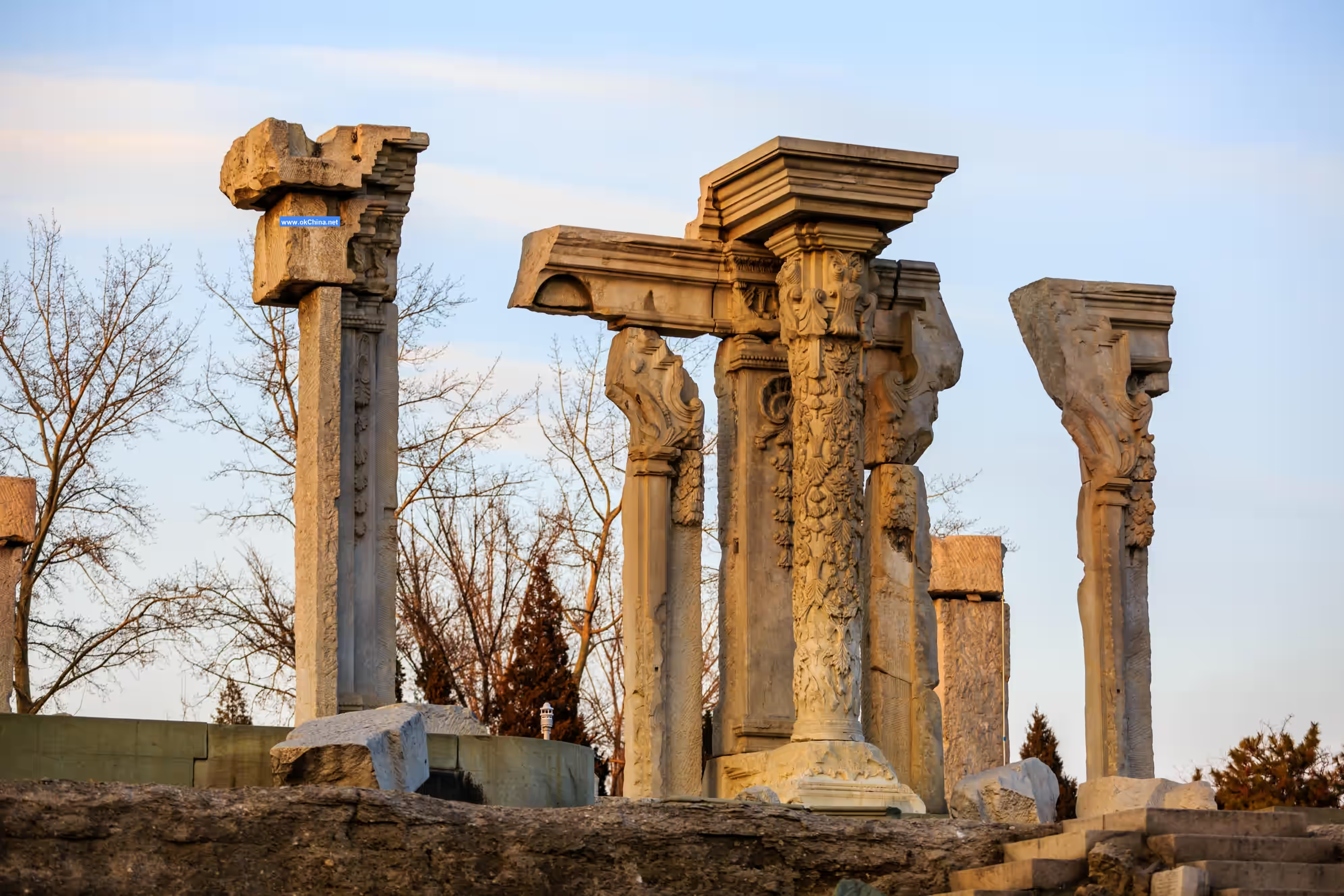
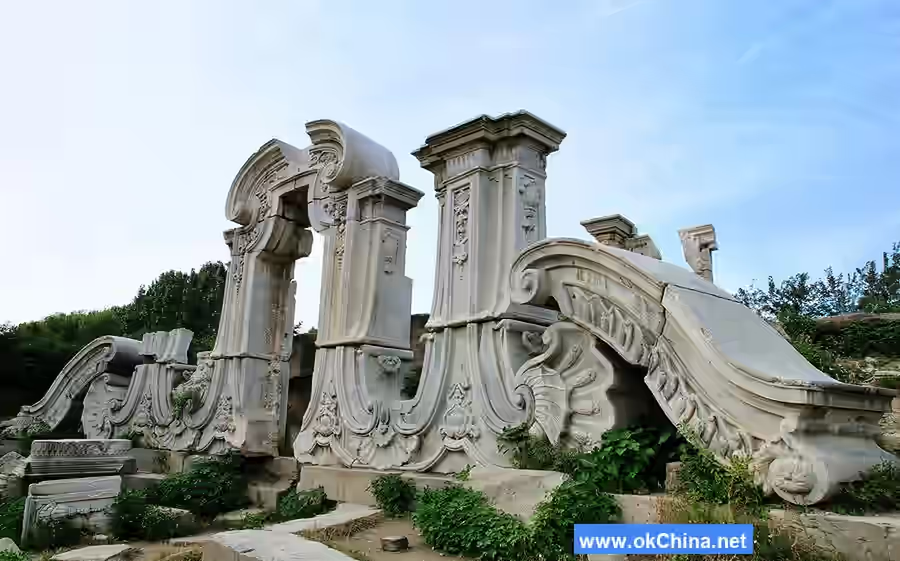
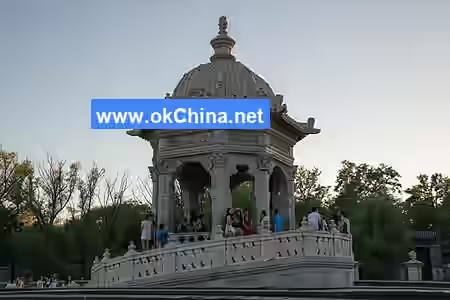
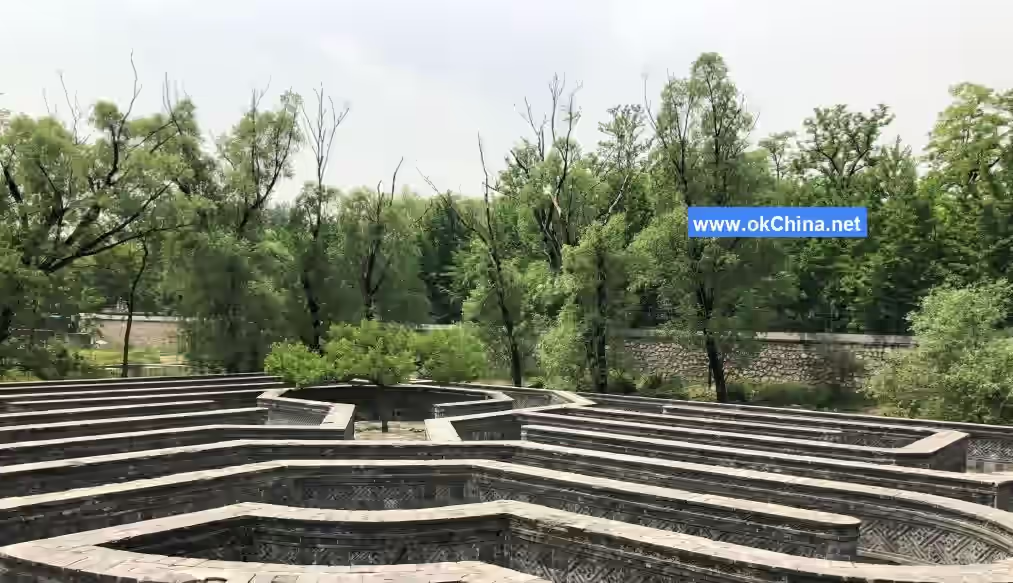
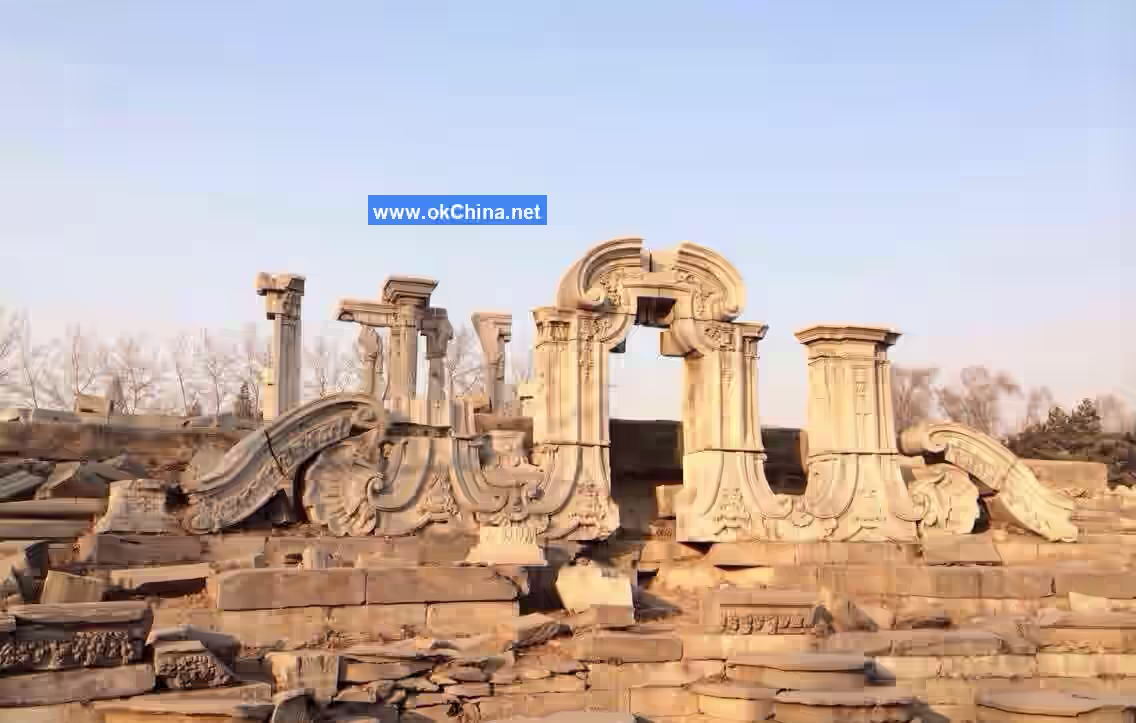
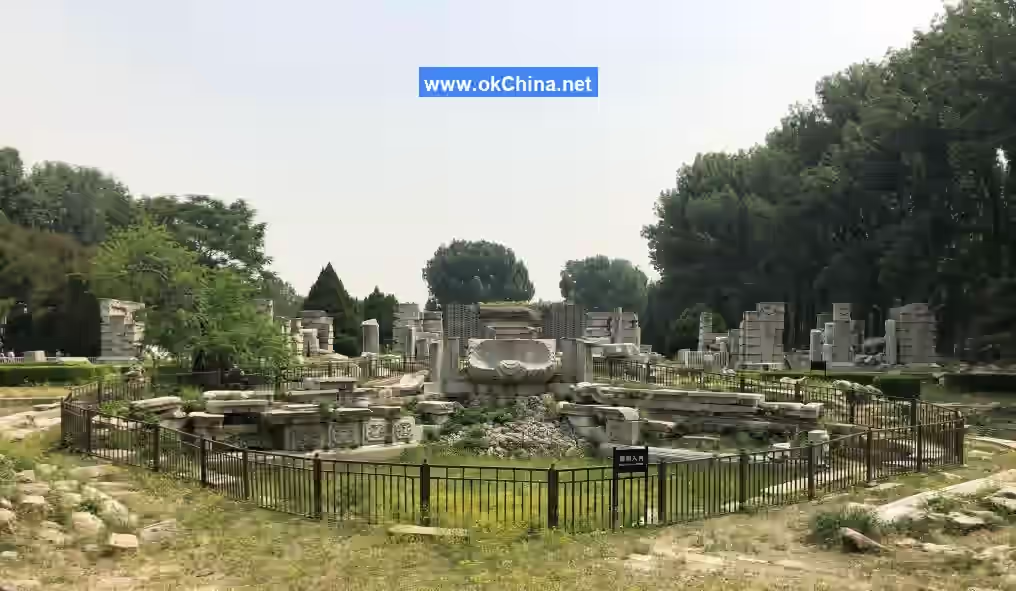
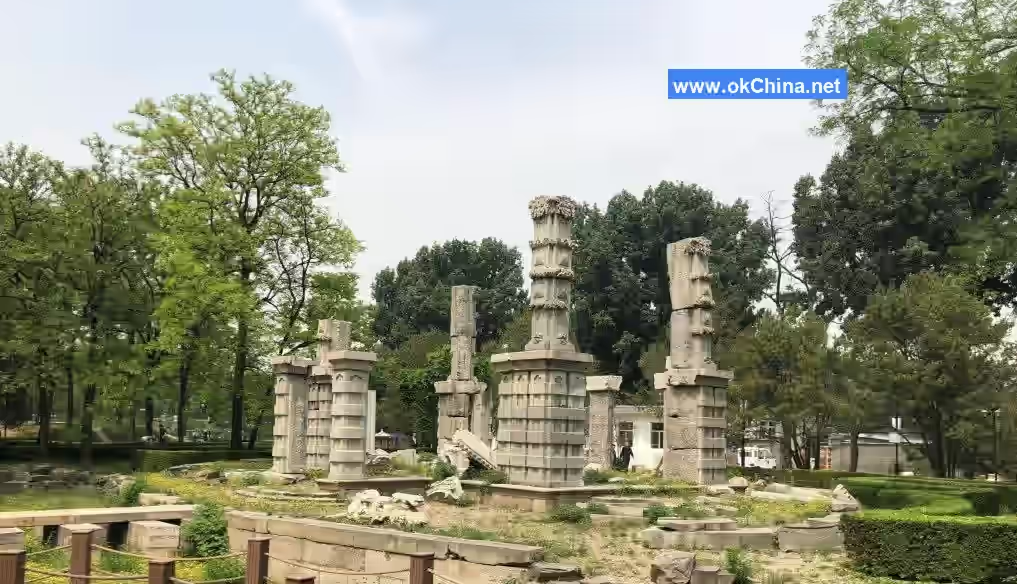
The Western-style Buildings scenic area of the Old Summer Palace is located north of Changchun Garden and represents China’s first attempt to imitate Western architecture and gardens in a garden setting. The Western-style Buildings scenic area was designed and supervised by the Italian missionary Giuseppe Castiglione (1688–1766) and the French Jesuit missionary R. Michel Benoist (1715–1744), who served in the imperial painting academy Ruyi Guan, and was constructed by Chinese craftsmen.In pursuit of diverse pleasures, the Qing emperors introduced a section of European-style garden architecture at the northern boundary of the Eternal Spring Garden, commonly known as the "Western-style Buildings." From west to east, it consisted of over ten structures and gardens, including the Harmonious Wonder, the Linear Perspective Bridge, the Maze, the Aviary, the Square-shaped Exterior, the Hall of Peaceful Seas, the Distant View of the Ocean, the Grand Waterworks, the Viewing Waterworks, the Linear Perspective Hill, and the Linear Perspective Wall. The planning for the Western-style Buildings scenic area in the Old Summer Palace began in the 12th year of the Qianlong reign (1747) and was largely completed by the 24th year of the Qianlong reign (1759). It was designed and supervised by Western missionaries such as Giuseppe Castiglione, Michel Benoist, and Jean-Denis Attiret, and constructed by Chinese craftsmen. The architectural style followed the late Renaissance "Baroque" style, while the garden layout was in the "Le Nôtre" style. However, many traditional Chinese techniques were also incorporated into the garden design and architectural decoration. The primary building material was white marble, intricately carved, with roofs covered in glazed tiles. The main feature of the Western-style Buildings was the artificial fountains, known at the time as "waterworks," characterized by their large number, grand scale, and ingenious designs. The three major fountain groups were the Harmonious Wonder, the Hall of Peaceful Seas, and the Grand Waterworks.
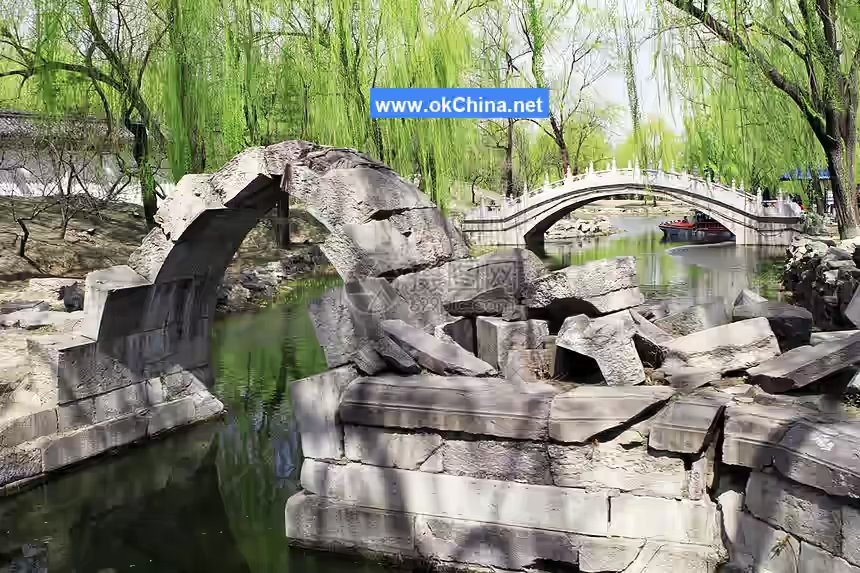
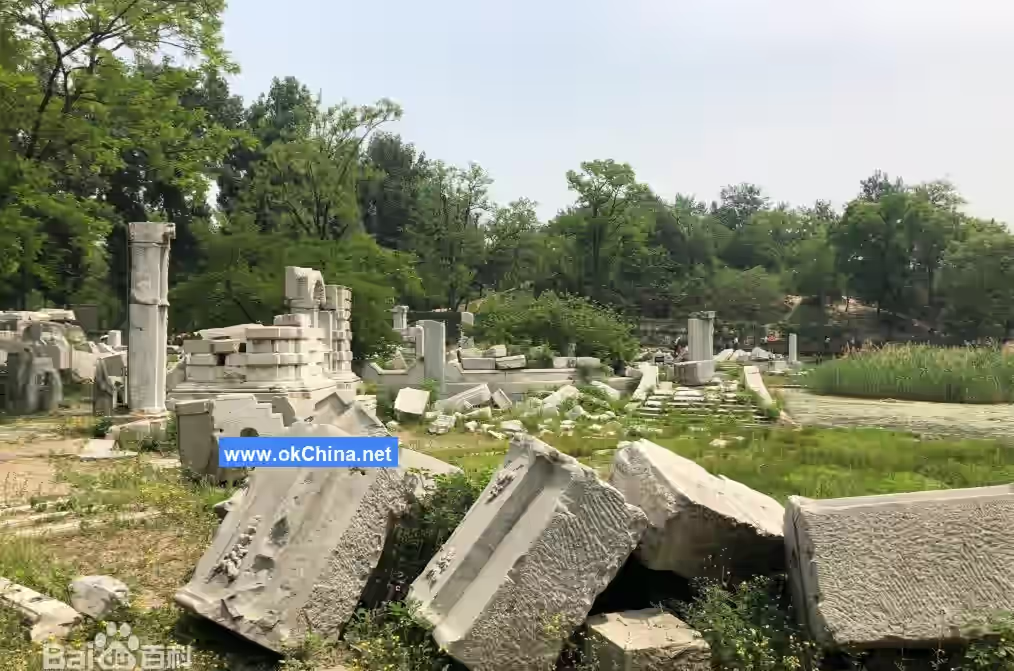
The Western-style Buildings scenic area was burned down in the 10th year of the Xianfeng reign (1860). Since the establishment of the Old Summer Palace Management Office in 1976, ongoing efforts have been made to organize and restore the architectural ruins, foundation sites of halls, fountain pools, and stone columns and walls. The ruins of the Western-style Buildings and their landscape environment have suffered multiple human and natural damages since the destruction of the Old Summer Palace, referred to as the "four great calamities: fire, wood, stone, and earth." Particularly, the "earth calamity" severely damaged the hills and water systems, resulting in significant differences between the landscape environment during the peak period of the Western-style Buildings and what is preserved today.
The Western-style Buildings scenic area is relatively independent in space, with a continuous east-west mountain range to its south. The northern side of the mountain range is steep, separating the Western-style Buildings area from other scenic areas of the Eternal Spring Garden. Additionally, the other three sides of the scenic area are enclosed by walls. Within the scenic area, the hills are scattered in a dotted layout. In the southwestern part, near the Harmonious Wonder, there are small hills made of piled earth and stacked stones to the northeast and northwest of the building. To the north of the Maze attraction, there is an earthen hill with a pavilion nestled in the valley formed by the surrounding hills. To the southwest and northwest of the Square-shaped Exterior building, there are small artificial hills. At the curved stone steps of the western pool of the Hall of Peaceful Seas, there are four stacked stone hills. On the east and west sides of the central pool of the Distant View of the Ocean and Grand Waterworks, there are stacked stone hills, with two more at the curved stone steps to the north. To the east of the Distant View of the Ocean is the spiral-shaped Linear Perspective Hill, the highest point in the Western-style Buildings scenic area. On the north and south sides of the Snail Archway, there are artificial hills made of piled earth and stacked stones. Apart from these scattered small hills, the rest of the scenic area is relatively flat.
The water system in the Western-style Buildings scenic area generally runs east-west, with a main canal running through the northern part of the area. This water body is drawn from the Heavenly Clarity and Openness water system west of the Maze, flows past the west and south sides of the Maze, enters the space between the inner and outer walls, runs parallel to the walls, and finally exits northeast of the Linear Perspective Painting attraction, merging into the Wanquan River. This water body has four tributaries: one in the north of the Maze, drawn from the moat, flows east of the Maze before merging into the main canal; another in the southwest of the Maze, with a branch connecting to the Water Storage Tower to the south; a third at the Square-shaped Exterior, diverging from the northwest side of the building, encircling it, and merging into the main canal from the northeast side; and the last diverging from the northwest side of the Square River, flowing north and east of the Square River pool to connect with the Lion Grove attraction. Other water bodies in the scenic area include dot-distributed fountains or pools. South of the Harmonious Wonder, there is a pool connecting the Square Pot Wonderland water body of the Fuhai scenic area at its west end and the large lake of the Eternal Spring Garden at its east end. In the eastern part of the scenic area, the Square River water body has a canal in its middle southern section connecting to the Lion Grove attraction to the south. Additionally, there are fountain pools at the center of the garden square, a flower-shaped pool south of the Harmonious Wonder building, a circular pool south of the Square-shaped Exterior and two heart-shaped pools on either side, the twelve zodiac animal fountain pool of the Hall of Peaceful Seas and two circular pools to its west, four fountain pools on the north and south sides of the Water Storage Tower of the Hall of Peaceful Seas, and a lotus-shaped pool at the Grand Waterworks of the Distant View of the Ocean with two circular fountain pools on either side.
Wenyuan Pavilion
Wenyuan Pavilion is located in the northern Kan position of the Old Summer Palace scenic area, corresponding to the White Water Star, representing water in the Five Elements. According to extant Yangshi Lei archives: Wenyuan Pavilion faces south, with its plaque and the interior plaque "Drawing from Antiquity and Observing the Waves," as well as couplets, all inscribed by Emperor Qianlong. The roof is covered with black glazed tiles trimmed with green edges. Externally, it appears as a two-story structure with six bays on each floor and a double-eave hip-and-gable roof. Internally, it actually consists of three levels: upper, middle, and lower, with corridors extending front and back. The ridges, ridge beasts, and running beasts of Wenyuan Pavilion are all green, with the main ridge decorated with nine purple dragons swimming in a sea of clouds made of glazed tiles.
In front of Wenyuan Pavilion, there is a rectangular pool measuring fifteen zhang north-south and seven zhang east-west. In the pool stands a lake stone rising over three zhang above the water level, inscribed with the characters "Ling Feng" by Emperor Qianlong. This stone is now broken into several pieces, lying on the ruins of Wenyuan Pavilion. South of the pool, there is an artificial hill, with a square pavilion named "Qu Ting" to its west and a platform to its east, inscribed with "Yue Tai" by Emperor Qianlong. In front of Wenyuan Pavilion, to the east, stands the Wenyuan Pavilion Stele.
V. Forty Scenic Spots of the Old Summer Palace
Hall of Uprightness and Brightness
The Hall of Uprightness and Brightness, as its name suggests, conveys openness and righteous grandeur. This section of architecture was entirely replicated from the Hall of Supreme Harmony in the Forbidden City. It served both as a place for court assemblies and political hearings and as a venue for major celebrations. The annual Longevity Banquet (the emperor's birthday) and the Thousand Autumn Banquet (the empress's birthday) were held here. Starting from the Qianlong reign, the Qing emperors held the "Three Lantern Festival Banquets" annually in the Old Summer Palace: the Imperial Clan Banquet on the 14th day of the first lunar month, the Foreign Vassal Banquet on the 15th day, and the Court Officials Banquet on the 16th day. Among these, the Foreign Vassal Banquet and the Court Officials Banquet were also held in the Hall of Uprightness and Brightness. This hall was also where the emperor celebrated his birthday, held New Year banquets for relatives, small banquets for court officials, the Mid-Autumn Festival banquet, watched dragon dances, conducted imperial examinations, and presided over provincial examinations and re-examinations.
In 1793 (the 58th year of Qianlong's reign), the British envoy George Macartney (1737-1806) visited China, and the gifts from the British king to congratulate Emperor Qianlong on his birthday were displayed in this hall. In October 1860, during the ravaging of the Old Summer Palace by the British and French allied forces (the Gengshen Incident), the command headquarters for the looting and burning of the Old Summer Palace and other western suburban gardens was set up here. This hall served as the temporary command center for the invading leaders before being set on fire.
Hall of Diligence and Proximity to the Virtuous
This hall, located east of the Hall of Uprightness and Brightness, is the front chamber of the western warm room of the Hall of Mental Cultivation. It served as the emperor's office during the height of summer, consisting of five bays. A throne was placed in the north, windows in the south, and a paneled wall with a door in the east, connecting to the main room of the Hall of Mental Cultivation, where the emperor received ministers. Outside the windows, a wooden screen enclosed the veranda, separating it from the main room for privacy. It is now displayed in its original state as part of court life.
The western warm room of the Hall of Mental Cultivation was where the emperor handled daily state affairs, received ministers individually, and reviewed imperial examination papers. On the north wall of the warm room hangs a plaque inscribed by Emperor Yongzheng: "Diligence and Proximity to the Virtuous," with a screen below bearing a poem by Emperor Qianlong.
Nine Continents Clear and Peaceful
Located on the northern shore of the Front Lake, facing the Hall of Uprightness and Brightness across the water, it consists of three south-facing halls. The first is the Old Summer Palace Hall, the middle is the Hall of Serving Three Selflessly, and the northernmost is the Hall of Nine Continents Clear and Peaceful. To the east of the central axis is "Heaven and Earth as One Spring," where Emperor Daoguang was born; to the west is "Peace and Harmony," the sleeping quarters of Emperor Qianlong; further west is the Clear Radiance Pavilion, where a large panoramic painting of the Old Summer Palace once hung on the north wall (the original is now in the Musée Guimet in Paris, France). In the 10th year of Daoguang's reign (1830), the Hall of Prudent Virtue and other structures were built near "Pleasure in Books and History," all serving as imperial sleeping quarters. In the 16th year of Daoguang's reign (1836), the Old Summer Palace Hall, the Hall of Serving Three Selflessly, and the Hall of Nine Continents Clear and Peaceful were simultaneously destroyed by fire. Emperors Yongzheng and Daoguang both died in the Hall of Nine Continents Clear and Peaceful.
Emperor Qianlong's imperial poem for this scene is titled "Nine Continents Clear and Peaceful." He changed "continents" to "states," actually borrowing the concept of the "Great Nine Continents Theory" from the late Warring States period philosopher Zou Yan. Today, people often mistakenly write "Nine Continents Clear and Peaceful" as "Nine Continents Clear Banquet," which should be strictly avoided.
Eternal Spring Fairy Hall
The Eternal Spring Fairy Hall is located west of the Front Lake, west of the Hall of Uprightness and Brightness, and south of Embracing Antiquity and Containing the Present. Bordered by the garden wall to the south and surrounded by hills and water on all sides, it is a garden-within-a-garden architectural landscape group. Its construction began no later than the 4th year of the Yongzheng reign (1726), initially named the Lotus Hall, with a three-bay gate and a five-bay main hall. Starting from the 7th year of the Yongzheng reign, it became the residence granted to the fourth prince, Hongli (the future Emperor Qianlong). During the mid-Daoguang period, when the imperial sleeping quarters of the Nine Continents Clear and Peaceful area were renovated, the emperor and empress also resided here. This scene can be considered the second imperial sleeping quarters area in the imperial garden.
The Eternal Spring Fairy Hall is surrounded by water on all sides, connected to other scenic areas by wooden bridges. The island consists of four courtyards, with the eastern courtyard being the main one—a complete small quadrangle with an inverted house, a moon gate, east and west wing rooms, and a main hall. Under the eaves of the main hall hangs Emperor Qianlong's inscription "Eternal Spring Fairy Hall." In the 42nd year of Qianlong's reign (1777), after the death of Qianlong's birth mother, Empress Dowager Xiaosheng, this place was converted into a Buddhist hall to express Qianlong's longing for his mother. To the west of the Eternal Spring Fairy Hall are the Green Shade Pavilion, Beautiful Scenery Pavilion, and Spring Delight Pavilion. These were places where Hongli studied in his youth and later served as sleeping quarters for imperial concubines during the Jiaqing and Daoguang periods. On the western shore of the Eternal Spring Fairy Hall island, there were also imperial kitchens, imperial tea rooms, imperial medicine rooms, and eunuch duty rooms.
Carved Moon and Opened Clouds
Originally called the Peony Pavilion, Carved Moon and Opened Clouds is located at the southeastern corner of the Rear Lake in the Nine Continents scenic area, east of Nine Continents Clear and Peaceful and south of Natural Picture.Built in the ninth year of the Qianlong era (1744), the three emperors Kangxi, Yongzheng, and Qianlong once admired peonies here together (see the note on the two lines "still recalling" in this poem). Thus, this place is regarded as a symbol of "peace and prosperity." In the ninth year of the Qianlong era (1744), the Peony Terrace was renamed "Hall of Recorded Favor" to commemorate the gathering of three generations of ancestors and descendants here to enjoy flowers in the sixty-first year of Kangxi's reign.
The main structure of Carved Moon and Unfurled Clouds is the Hall of Recorded Favor. The hall is constructed of nanmu wood and topped with glazed tiles in gold and green, shining brilliantly. In front, hundreds of peonies are planted, while behind, ancient pines stand verdantly, surrounded by clusters of famous flowers. After Qianlong ascended the throne, it was renamed "Carved Moon and Unfurled Clouds." In the thirty-first year of Qianlong's reign, he personally inscribed the plaque "Hall of Recorded Favor." The courtyard is planted with hundreds of peonies of various colors. The scenic area includes a resting room (Imperial Orchid Fragrance), a study (Cultivating Simplicity Study), and a viewing pavilion. The Nourishing Spring Pavilion is located outside the western mountain pass, adjacent to the Rear Lake.
Green Phoenix Tree Academy
Green Phoenix Tree Academy is one of the Forty Scenes of the Old Summer Palace, located at the northeast corner of the Rear Lake in the Nine Continents Clear and Peaceful scenic area. It is a study hall, measuring 120 meters from north to south and 115 meters from east to west, covering an area of 13,500 square meters. It was built in the ninth year of the Qianlong era, 1744 AD. The front hall of Green Phoenix Tree Academy has three bays, while the middle and rear halls each have five bays. To the south, it neighbors Natural Picture, and to the west, it faces Compassionate Clouds and Universal Protection across the water. On the western rocks stands the Cloud Peak Pavilion.
Green Phoenix Tree Academy is one of the earlier constructed building complexes in the Old Summer Palace. During the Yongzheng period, it was called "Phoenix Tree Courtyard." Surrounded by mountains and dense forests, Green Phoenix Tree Academy is a very tranquil place. The architecture consists of large and small courtyards arranged in an orderly yet varied manner, forming three sequential courtyards. Under the eaves of the main hall hangs a plaque inscribed by Emperor Yongzheng, "Green Phoenix Tree Academy." Inside the main hall, there are beds and kang (heated platforms) for the emperor to rest. Green Phoenix Tree Academy served as a place for Qing emperors to read and paint, with numerous phoenix trees planted around the academy.
During the Qianlong era, Green Phoenix Tree Academy also served as the birthplace and residence for imperial princes. Qianlong's sixth son, Yongrong, Princess Heshuo Hejia, and the sixteenth prince were all referred to in archives as "Green Phoenix Tree Academy Prince" and "Green Phoenix Tree Academy Princess."
Upward and Downward Sky Light
Upward and Downward Sky Light is one of the earlier constructed building complexes in the Old Summer Palace, completed during the Yongzheng era. The name of the Upward and Downward Sky Light scenic area comes from a line in the famous work "Record of Yueyang Tower" by the Northern Song literary giant Fan Zhongyan: "When spring is harmonious and the scenery bright, the waves are calm, upward and downward the sky light, a vast expanse of blue." Besides "Upward and Downward Sky Light," "A Vast Expanse of Blue" was also used to name other scenic areas in the garden.
The main structure is "Moon-Embracing Tower," a two-story open pavilion with Emperor Qianlong's inscription "Upward and Downward Sky Light" hanging on the outer eaves. Moon-Embracing Tower is a complex of waterside buildings, with the front part extending into the water. On both the left and right sides, there are water pavilions and waterside pavilions connected by a zigzag bridge. This architectural arrangement is exceptionally beautiful and ingenious. By the seventh year of the Daoguang era (1827 AD), the Upward and Downward Sky Light scenic area underwent significant changes. The original zigzag bridge, water pavilions, and waterside pavilions were demolished, and the main structure, Moon-Embracing Tower, was rebuilt into "Misty Rain Tower," modeled after the Misty Rain Tower in Jiaxing. This renovation greatly diminished the original artistic conception, though it remained unique. During the Xianfeng era, a canopy was erected north of Misty Rain Tower, and the old name "Upward and Downward Sky Light" was restored.
Apricot Blossom Spring Hall
Apricot Blossom Spring Hall is located in the northwest of the Nine Continents scenic area, at its highest point, symbolically imitating the Kunlun Mountains in the northwest of the motherland. During the Kangxi era, Yinzhen (the future Yongzheng Emperor) called it "Vegetable Garden." It was renamed in the fourth year of the Yongzheng era, covering an area of 22,000 square meters with a building area of 1,200 square meters. It is a garden landscape themed on rural scenery. The architectural layout of the entire scenic group is casual, featuring low houses, sparse fences, paper windows, and wooden beds. In the vegetable garden in front of the hall, various melons, fruits, and vegetables are planted according to the season, exuding a strong pastoral flavor. In its heyday, during spring, apricot blossoms would bloom profusely, and the emperor would always come here to enjoy fine wine while admiring the apricot blossoms.
During the Yongzheng era, the architecture of this scenic area still retained some rustic charm, but by the Qianlong era, its appearance had completely changed. Here, there is a grand hall with five bays and front and rear verandas (Spring Rain Pavilion), the Apricot Blossom Spring Hall with a double-eaved square pavilion, a study, a Earth God shrine, and even a city gate. The garden's artistic conception was entirely based on Qianlong's imagined mountain villa scenery. The rockery art of Apricot Blossom Spring Hall is highly esteemed, holding equal artistic value with the rockeries of Vastness and Impartiality and Lion Grove. To the northeast, there are rockeries combined with earthen hills, predominantly earthen, with mountain paths and a city gate. In the central area, the peaks surrounding the main buildings are piled with Taihu stones. At the boundary with Openness and Magnanimity, bluestones are piled, adorned with caves and mountain pavilions.
Openness and Magnanimity
Openness and Magnanimity is located in the northwest of the Nine Continents scenic area, covering an area of 1,050 square meters. It is one of the earlier constructed scenic areas in the Old Summer Palace, completed by the end of the Kangxi era and initially called "Goldfish Pond." Openness and Magnanimity is divided into two major scenic areas, north and south. The southern part consists of a group of Chinese-style buildings, with a central main hall whose outer eaves bear Emperor Qianlong's inscribed plaque "Hall of Simple Heart." This hall was typically a place for the emperor, empress, and empress dowager to visit and rest. The east hall of the Hall of Simple Heart is Half-Mu Garden, where the emperor, empress, and empress dowager dined.
North of the Chinese-style buildings lies the main structure of Openness and Magnanimity—the largest fish-viewing pond in the Old Summer Palace. The pond is square in plan, with an open pavilion built in the center, bearing Emperor Qianlong's inscribed plaque "Light Breeze and Clear Moon" on its outer eaves. North and south of the Light Breeze and Clear Moon Hall are three groups of fish ponds, with the southern one being larger and the two northern ones slightly smaller. In the northwestern pond, a square pavilion was built, where Qing emperors enjoyed watching goldfish. The overall layout of Openness and Magnanimity closely resembles the "Jade Spring Fish Leaping" in Hangzhou. The entire pond was stocked with thousands of goldfish of various sizes. Emperor Qianlong particularly favored this scene, visiting it every time he came to the Old Summer Palace and composing several poems here.
Universal Peace
Universal Peace is located west of the Rear Lake, east of Apricot Blossom Spring Hall, and southwest of the lake beyond the mountains, featuring a landscape garden centered on the Swastika Pavilion. Universal Peace was built in the early years of the Yongzheng era and was formerly called the Swastika House. The Swastika Pavilion of Universal Peace has a unique design and beautiful scenery, suitable for residence in all seasons. Emperor Yongzheng particularly enjoyed staying here, and during the Qianlong era, it remained one of the leisure palaces. On the Dragon Boat Festival, it was customary to host banquets here for the empress dowager. Emperor Jiaqing also composed poems on "Universal Peace" 23 times.
The architectural plan of Universal Peace is in the shape of a swastika. The entire white marble foundation is built over water, with thirty-three interconnected rooms extending in all directions. This was Emperor Yongzheng's favorite scenic area. The Swastika House is surrounded by water on all sides, with an imperial throne in the center. Above the throne hangs Emperor Yongzheng's inscription "Universal Peace." The western wing houses an indoor theater, ingeniously designed so that performers are in the northwest hall while the emperor watches from the due west hall, separated by water. To the southeast of the Swastika House is a waterside dock, where the emperor usually arrived by boat when visiting Universal Peace. Opposite Universal Peace stands a large cross-shaped pavilion, commonly known as the "Cross Pavilion," topped with a copper phoenix. Around the Cross Pavilion, many precious flowers and tree species were planted.
High Mountains and Long Rivers
High Mountains and Long Rivers is located in an open area in the southwest of the Old Summer Palace, commonly known as the "Western Garden" or "Western Park," personally named by Emperor Qianlong as "High Mountains and Long Rivers." It covers an area of 1,150 square meters. The terrain here is flat and expansive, resembling the northern grasslands, with a total area equivalent to the entire Nine Continents scenic area. It served as a large training ground for imperial descendants and garrison troops to practice martial arts.
The main structure of High Mountains and Long Rivers is a rolling shed hip-roofed building, located west of Openness and Magnanimity. It is a two-story building facing west, with nine bays on each floor. A small stream flows in front, while continuous ridges embrace it from behind, with flat terrain in the middle. The outer eaves bear Emperor Qianlong's inscription "High Mountains and Long Rivers." To the west of High Mountains and Long Rivers, a horse track was set up for archery and riding competitions. Periodically, Qing emperors would watch the Eight Banners competitions here, signifying that they should never forget the ethnic characteristics of the Manchu people or that their ancestors founded the empire from horseback. This was also where Qing emperors held military tent banquets. The military tent banquet, commonly known as the "Great Mongolian Ger Banquet," began during the Yongzheng era and reached its peak under Qianlong. It was held annually before the thirteenth day of the first lunar month, primarily entertaining Mongolian princes and foreign envoys. During the Lantern Festival, High Mountains and Long Rivers also hosted grand "fire plays," meaning fireworks displays. Additionally, there were performances by the Wrestling Camp showcasing wrestling, the Jianrui Camp demonstrating spear skills, and Hui ethnic performances of tightrope walking (Dawaz, high-wire walking by Hui people), accompanied by music from Mongolian, Korean, and other ethnic groups. To the south of High Mountains and Long Rivers, thirteen storage buildings were constructed for military tent banquets and fireworks.
Eternal Blessing of Vast Compassion
Also known as Anyou Palace, it is located in the northwest corner of the Old Summer Palace and served as the imperial ancestral temple. Modeled after the Shouhuang Hall on Jingshan Hill, it was built in the seventh year of the Qianlong era (1742 AD), entirely仿照the Imperial Ancestral Temple in the Forbidden City. The hall once displayed portraits of Kangxi, Yongzheng, and Qianlong. It is the highest规格building in the garden, with yellow glazed tiles, double-eaved hip roofs, nine bays, and yellow glazed tiles. Inside the hall, the central portrait is of Emperor Kangxi, with Emperor Yongzheng to the east and Emperor Qianlong to the west. In front of the hall gate are two glazed memorial archways, each with a pair of ornamental columns.
According to historical records, when British invading forces burned down Anyou Palace, their sudden arrival and the head eunuch's locking of the main gate resulted in the tragic death of about 300 eunuchs, palace maids, and craftsmen who were burned alive inside.
Clear Waters and Bright Woods
Clear Waters and Bright Woods is located in the central area of the small garden cluster north of the Rear Lake, northeast of Reflected Waters and Orchid Fragrance.This scene is an imitation of the Water Bamboo Residence in Yangzhou. Inside, a Western-style hydraulic mechanism drives a fan, making it a pioneering example in Chinese imperial gardens of using "Western water techniques" to create landscapes with the sound of water. To the north is the Wenyuan Pavilion, one of seven imperial libraries built nationwide by the Qing court, housing the Complete Collection of Ancient and Modern Books and the Complete Library of the Four Treasuries.
The Shuimu Mingsi scenic area was constructed during the Yongzheng period and was initially named "Plowing and Weaving Pavilion." The main structure of Shuimu Mingsi is built beside a stream and is called Fengle Pavilion. North of Fengle Pavilion are the "Knowledge of Plowing and Weaving" and "Zhuolin Pond" halls. Northeast of Fengle Pavilion is the famous "Shuimu Mingsi" hall, commonly known as the Fan Room. Water was channeled into the hall, mimicking Western hydraulic techniques to power fans, providing both cooling and the soothing sound of flowing water. During the hot summer months, this was a favored retreat for the emperor and empress.
Kuoran Dagong
Also known as Shuanghezhai (Twin Crane Studio), it is located northeast of Shewei City and is a relatively large architectural complex in the garden. The main building faces a large pond to the north, with the garden's scenery reflected in the water, creating a dual-view effect. Other attractions include the Shiyong Hall and Linghe Shenchu (Deep Among Lotus).
Kuoran Dagong, later also called Shuanghezhai, was modeled after the Jichang Garden in Huishan, Wuxi. The northern part of this scene was constructed during the mid-Qianlong period, imitating the rock formations of Yunlin Stone Chamber in the Jingji Villa of Panshan. Emperor Jiaqing praised Shuanghezhai in a poem: "Built long ago in imitation of Huishan, the famed garden Jichang offers a serene and leisurely ambiance. Winding paths are lush with pines, and small caves are rugged yet not obstinate." While it is known that the Xiequ Garden in the Summer Palace was modeled after the Jichang Garden, the Yuanmingyuan also had its own imitation. However, the artistic conception of the two imitations differed. The Wuling Spring Scenery recreates the artistic ambiance of Tao Yuanming's Peach Blossom Spring. Built in the late Kangxi period and called Peach Blossom Cove during the Yongzheng era, it was once a study place for Hongli (the future Qianlong Emperor), with the study named "Leshan Hall." This scene is famed for its ten thousand mountain peach trees. Suzhou's Peach Blossom Cove inside the Chang Gate was said to be the former residence of Tang Bohu. Although the Yuanmingyuan's Peach Blossom Cove borrowed the name, its abundance of peach blossoms far surpassed that of the Suzhou area.
Xifeng Xiuse
Known as the "Little Lushan" of the garden, it was remodeled in imitation of Jiangxi's Lushan Mountain and was where Emperors Yongzheng and Qianlong held the Qixi Festival banquet on the seventh day of the seventh lunar month. The "Viewing Fish at Flower Harbor" at the rear wall was modeled after the famous West Lake scene in Hangzhou. Every year during the Qixi Festival, a grand banquet was held here. To the west, across the river, is Little Kuanglu, which borrows the distant scenery of the Western Hills. On the western bank of the river, there is a group of stacked rocks with towering pines and a waterfall cascading through a mountain stream. Viewed up close, it evokes the majestic aura of Lushan Mountain, hence the name "Little Kuanglu." Behind it is the Dragon King Temple. To the east are Hanyun Pavilion, Yi Tang He Qi (Hall of Harmony), Zide Pavilion, and Lan Jing Fang. The northern part, "Viewing Fish at Flower Harbor," imitates the意境 of the同名 scene at Hangzhou's West Lake.
Siyi Shuwu
Located northeast of Kuoran Dagong, it consists of five halls, with the main hall called Anlan Garden. To the south are Caifangzhou and the Boundless Wind and Moon Pavilion; to the southwest are Hanqiu Hall and Yuanxiu Shanfang; to the north is the Yan Yue Qingzhen Tower. It differs from the Siyi Shuwu in the Qichun Garden. After Emperor Qianlong's southern inspection tours, it was remodeled in imitation of a Chen family garden called Yu Garden on the shores of Hangzhou Bay in Haining.
Beiyuan Shancun
Located east of Yuyue Yuanfei, Beiyuan Shancun covers an area of 13,000 square meters. It was built during the Yongzheng period as a rural landscape模仿ing a fishing village and farmhouses. Situated in the northernmost part of the Yuanmingyuan, it lacks任何 exquisitely constructed halls, built simply and plainly. The buildings are distributed on both banks of a river, resembling a countryside village. When the emperor was weary from state affairs or in low spirits, he could come here for a few days to experience rural life, try plowing, taste the essence of farming, and personally savor the peace and prosperity of the era.
The buildings of Beiyuan Shancun are distributed on the northern and southern banks of the river. Entering this scene requires passing through the southeastern water gate, which bears a stone plaque inscribed by Emperor Qianlong with "Beiyuan Shancun." Beyond the water gate are low-lying farmhouses, many with mulberry trees in their courtyards, making this the garden's primary silkworm-raising area. The main structure is a large hall with five bays and two卷, featuring a front porch, named "Kenong Pavilion." This hall did not exist during the Yongzheng and Qianlong periods and was merely a waterside structure until it was改建 into a large hall in the 22nd year of Jiaqing (1817). West of Kenong Pavilion is a small temple called Guanyin Nunnery. Southwest of the nunnery, there is a small凉亭 named Guanlan Pavilion. Sitting in Guanlan Pavilion, one can enjoy the full rural scenery of Beiyuan Shancun to the east and view the distant Xifeng Xiuse scenic area to the west. During the Qianlong period, three main rooms were built east of Kenong Pavilion, with the outer eaves悬挂ing Emperor Qianlong's inscription "Huiyu Jingshe," also known as Huiyu Shanfang. This structure closely resembles the Chunyu Shanfang on Qixia Mountain in Jiangsu.
Fanghu Shengjing
Fanghu Shengjing covers an area of approximately 20,000 square meters. It was largely completed in the third year of Qianlong (1738 AD), located in the bay on the northeastern shore of Fuhai Lake, east of Siyi Shuwu and north of Hanxu Langjian. It is widely recognized by later scholars as the most magnificent and beautiful建筑 in the Yuanmingyuan, constructed based on the theme of imagined immortal mountains and pavilions.
The front part of this scene features three large double-eaved pavilions extending into the lake in a "mountain" shape. The middle and rear sections house nine pavilions供奉ing over 2,000 Buddha statues and more than 30 pagodas. The architecture is grand and splendid, creating a famous landscape reminiscent of a celestial mountain and jade palace. The main pavilion is actually a temple building. The entire architectural complex employs strict symmetrical布局 in both plan and elevation, with a central axis connecting the northern and southern groups. West of Fanghu Shengjing is another意境-filled scenic area—Santan Yinyue, one of the Yuanmingyuan's imitations of the Ten Scenes of the West Lake.
Pengdao Yaotai
Constructed around 1725 (the third year of Yongzheng), it was initially called Penglai Islet and was named Pengdao Yaotai in the early Qianlong period. In the center of Fuhai Lake, three islands of varying sizes—Fangzhang, Penglai, and Yingzhou—were created, with buildings on the islands resembling celestial mountains and pavilions.
The structure and layout of Pengdao Yaotai were designed based on the ancient painter Li Sixun's painting "Immortal Mountains and Pavilions." It features a three-bay palace gate and a seven-bay main hall. East of the hall is Changjin Tower, and to the west is Shenzhou Sandao. The eastern side hall is Sui'an Room, and the western side hall is Riri Ping'an Bao Haoyin. To the southeast, a bridge leads to the eastern island, which houses the Yinghai Xianshan small pavilion. To the northwest, a curved bridge connects to the northern island, where a three-bay hall stands. The large island in Pengdao Yaotai symbolizes the "Penglai" immortal mountain, while the smaller islands to the northwest and southeast represent the other two immortal mountains, "Fangzhang" and "Yingzhou." The southeastern island also features a hexagonal pavilion, with大量 piled rocks and numerous imperial inscriptions on stones, some of which are preserved to this day.
Danbo Ningjing
The Danbo Ningjing遗址 is located in the northwestern part of the Yuanmingyuan and was completed in the fifth year of Yongzheng (1727). Its name is derived from Zhuge Liang's Admonitions to My Son: "Without indifference, one cannot clarify his aims; without tranquility, one cannot achieve far-reaching goals."
The main structure of the scenic area is a "field"-shaped hall, commonly known as the "Field Character House," formed by connecting 33 square rooms of uniform size, each with sides measuring 4.48 meters, into the shape of the Chinese character for "field." The four openings in the center of the "field" correspond to four courtyards. Zhang Zhonghua, associate researcher and archaeological director of the Beijing Municipal Institute of Archaeology, explained that the platform of the "Field Character House" is relatively well-preserved, while the above-ground部分 was burned down, likely related to the 1860 burning of the Yuanmingyuan by the Anglo-French联军.
Jiexiu Shanfang
Jiexiu Shanfang is located south of Hanxu Langjian and was built during the Yongzheng period. Its architectural form closely resembles that of Hanxu Langjian, both arranged along the shore and echoing each other from north to south, creating a harmonious景观 along the eastern shore of Fuhai Lake.
The main hall of Jiexiu Shanfang is a three-bay hall facing west, with a plaque inscribed by Emperor Yongzheng reading "Jiexiu Shanfang" hanging under the eaves. Promenades extend from both ends of the hall, perfectly connecting the southern Lancui Pavilion with the northern Chenglian Tower, enhancing the整体感 of the scenic area's architecture. South of the Jiexiu Shanfang hall, there was originally an independent building called "Guanyu Yue." Around the 22nd year of Jiaqing (1817), it was demolished and改建 into a south-facing, three-卷, five-bay hall. Emperor Jiaqing's inscription "Guanlan Hall" was悬挂 under the eaves of the new hall. The newly built Guanlan Hall closely resembles the Shende Hall in Jiuzhou Qingyan and is the largest building along the shores of Fuhai Lake. Guanlan Hall was lavishly decorated, with beams, columns, doors, windows, and室内 furniture made of precious rosewood, inlaid with gold, silver, pearls, jadeite, and other precious gems. To the east of the hall is a Buddhist shrine, and to the west is a throne bed for the emperor to rest. Emperors Jiaqing, Daoguang, and Xianfeng all enjoyed residing here and left numerous poems describing Guanlan Hall.
Pinghu Qiuyue
Pinghu Qiuyue is located on the northern shore of Fuhai Lake, sharing its name with one of the Ten Scenes of the West Lake in Hangzhou and being one of the Ten Scenes of the West Lake within the Yuanmingyuan. It was built during the Yongzheng period, with the main hall being a three-bay hall under whose eaves hangs a plaque inscribed by Emperor Yongzheng reading "Pinghu Qiuyue." North of the main hall is an open hall with three bays, its outer eaves bearing Emperor Qianlong's inscription "Huayu Lan Gao." In the northwest corner, a promenade connects to the Liushui Yin Pavilion. In front of the hall is a three-bay waterside open hall,紧临 the water, embodying the意境 of "the waterside pavilion gets the moonlight first." Sitting in the open hall, one can enjoy the beautiful scenery of the western and eastern shores of Fuhai Lake, making it also a great place to escape the summer heat.
East of the Pinghu Qiuyue hall is a drawbridge, through which large pleasure boats on Fuhai Lake enter the northern dock. On the elevated platform at the eastern end of the bridge stands a double-eaved, pointed wooden pavilion, with Emperor Qianlong's inscription "Liangfeng Chayun"悬挂 outside, sharing its name with the "Twin Peaks Piercing the Clouds" scene of Hangzhou's West Lake and being one of the Ten Scenes of the West Lake within the Yuanmingyuan. Every year during the Double Ninth Festival, this was where the emperor and empress ascended to enjoy the view. This scene was completed before 1728 (the sixth year of Yongzheng).Outside the five-arch bridge on the eastern side stands a square pavilion with double eaves and a high platform, inscribed with the plaque "Two Peaks Piercing the Clouds," also named after a scenic spot from West Lake in Hangzhou. In 1810, the Jian Garden in the Eternal Spring Garden was renovated, and new inscriptions were added. That same year, the Mirror Distant Isle at the Autumn Moon on the Calm Lake on the northern shore of the Sea of Blessing was likely newly reconstructed. The lakeside courtyard in the southwest of this scene was transformed into a three-volume grand hall around 1811 (the 16th year of the Jiaqing reign), with an additional plaque inscribed "Mirror Distant Isle." Emperor Jiaqing frequently composed poems in praise of this site.
Lotus in the Breeze at the Crooked Courtyard
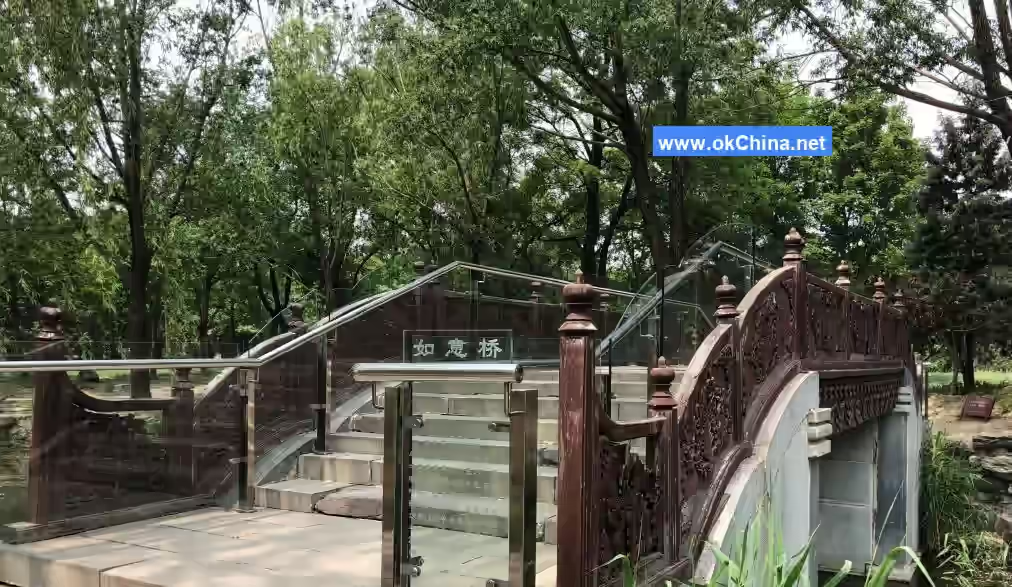
Located south of the Garden of Shared Joy on the western shore of the Sea of Blessing, this area serves as a transitional zone between the Nine Continents scenic area and the Sea of Blessing scenic area. The main hall consists of five bays in a row, modeled after the Crooked Courtyard at West Lake in Hangzhou. Spanning the pond is a large nine-arch stone bridge. Imitating the scenery of "Lotus in the Breeze at the Crooked Courtyard" from Hangzhou's West Lake, the main structure is the nine-arch stone bridge (with the archway on the west side inscribed "Golden Turtle" and the one on the east side inscribed "Jade Rainbow," hence also known as the Golden Turtle and Jade Rainbow Bridge). To the north lies the Crooked Courtyard.
Deep Within the Cave Heaven
Located inside the Gate of Blessing Garden in the southeastern corner of the palace gate area of the Yuanming Yuan, Deep Within the Cave Heaven is a scenic architectural complex primarily composed of the study and residences of the imperial princes. The main features of this scene are the Eastern and Western Compounds, along with the Imperial Study on the northern and southern islands to the west. In the northeast is the small courtyard of the Ruyi Studio, the Qing palace painting academy, while a long, narrow warehouse courtyard lies adjacent to the garden wall outside the eastern passageway.
In the ninth year of the Qianlong reign (1744), the emperor composed a preface to a poem titled "Deep Within the Cave Heaven," which reads: "Following the stream eastward, the path winds like an ant's trail. Short rafters and narrow rooms are fitting for seclusion. A variety of flowers and trees are planted, with reds and greens in delightful confusion. Secluded rocks and caverns create a world apart from the human realm. A little to the south is the former 'Bestowed by Heaven' plaque, inscribed by my imperial father, where my brothers and I studied in our youth." The Ruyi Studio in the Yuanming Yuan was the location of the Qing palace painting academy. Western painters such as Giuseppe Castiglione (Lang Shining) and Jean-Denis Attiret (Wang Zhicheng), along with many Chinese painters, served in the Ruyi Studio and created paintings there. Emperor Qianlong (Hongli) personally visited the studio on multiple occasions to view the artworks. In the 21st year of the Qianlong reign (1756), Hongli resided in the garden for 157 days and visited eight times to watch the painters at work. Inside the Gate of Blessing Garden, there are two courtyards, east and west, serving as the garden residences for the imperial princes. Initially, there were four residences: northeast, southeast, northwest, and southwest, collectively known as the Four Eastern Compounds of the Gate of Blessing Garden. In the 26th year of the Daoguang reign (1846), approval was granted for a large-scale reconstruction of the Four Eastern Compounds into the Eastern and Western Compounds. Each compound was to have a front moon gate, the main buildings were to be changed to three rows of five bays each, and east-west wing rooms of five or three bays were to be added.
Embracing Antiquity and Containing the Present
Also collectively known as the Pavilion of Beautiful Scenery, Embracing Antiquity and Containing the Present is located west of the Nine Continents of Peace and Clarity, adjacent to the Rear Lake to the east. It covers an area of 9,000 square meters, with a building area of 3,300 square meters. Constructed around the fourth year of the Qianlong reign (1739), this scene originally comprised 39 structures with 148 rooms (including 73 covered corridors), one double-eaved grand pavilion, one moon gate, and five wall gates. A significant renovation took place in the 33rd year of the Qianlong reign (1768). This site served as the emperor's winter reading place and was luxuriously decorated. The interiors featured nanmu paneling, with windows framed in zitan wood and nanmu window cores. In its heyday, the area was planted with pine and willow trees, and a bamboo grove stood in front of the Bamboo Fragrance Studio.
The main structure of Embracing Antiquity and Containing the Present is a square grand hall, inside which hangs the Qianlong Emperor's inscribed plaque "Pavilion of Beautiful Scenery." The Pavilion of Beautiful Scenery is located at the northernmost part of this scenic area, and its second floor offers the best vantage point for admiring the Western Hills and the Rear Lake. To better appreciate the views of the Western Hills and the Rear Lake, the surroundings of Embracing Antiquity and Containing the Present are flat, without high mountains, and the other buildings were constructed relatively low. The area around Embracing Antiquity and Containing the Present is spacious and tranquil, serving as a place where Qing emperors and ministers would discuss ancient and modern affairs, compose poetry, and paint. The Embracing Antiquity and Containing the Present scenic area also housed a large collection of original calligraphy and paintings by successive Qing emperors and their ministers.
Benevolent Clouds Offering Universal Protection
Located directly north of the Nine Continents scenic area, Benevolent Clouds Offering Universal Protection is a temple garden covering an area of 10,000 square meters, with a building area of 800 square meters. This scene was built in the later years of the Kangxi reign and was initially named "Ravine Pavilion." After the Yongzheng Emperor ascended the throne and the Yuanming Yuan was elevated to an imperial garden, a feng shui master advised that the main palace gate should be established in the due south, signifying governance in the light; the main hall should be positioned centrally, establishing the imperial axis with all directions paying homage. This scene lies directly north on the central axis, where "a self-ringing bell tower was erected, three zhang high, corresponding to the white water star."
The temple architecture at Benevolent Clouds Offering Universal Protection fully reflects the complexity of the Yongzheng Emperor's religious devotion. As a prince, Yongzheng was a devout Buddhist, frequently inviting renowned monks to lecture on Buddhist scriptures in his princely mansion and the then-princely garden, the Yuanming Yuan. Even his birthday gifts to the Kangxi Emperor were handwritten Buddhist sutras. After ascending the throne, he developed a particular fondness for Daoism, listening to Daoist lectures and practicing cultivation in the Yuanming Yuan, and even taking elixirs in the Xiucqing Village in pursuit of longevity. The Hall of Joyful Buddha within Benevolent Clouds Offering Universal Protection enshrined the Tibetan Tantric Yab-Yum deity, prayed to for numerous offspring. In its main hall, Benevolent Clouds Offering Universal Protection, Guanyin Bodhisattva was enshrined, also for seeking progeny, though the object of prayer differed. The Dragon King Hall housed the Dragon King, prayed to for favorable weather and bountiful harvests. The large self-ringing clock in the bell tower served to remind the emperor to rise early and attend to state affairs. Thus, although the structures in this scene were few, their practical functions were highly significant.
Natural Picture
Located on the eastern shore of the Rear Lake in the Nine Continents scenic area, north of Cloud-Dispelling Pavilion Welcoming the Moon, the main structure of Natural Picture is a square building. To the north of this building are the Clear Chanting Tower, the Bamboo Cottage Tower, the Hall of Five Blessings, and Deep Bamboo and Quiet Lotus; to the west is Quietly Knowing the Beauty of Spring; to the east is Spring Dawn on Su Causeway.
At Natural Picture, the Clear Chanting Pavilion and the Bamboo Cottage Tower were built facing the lake. Ascending these towers allowed one to gaze upon the distant peaks of the Western Hills, observe the reflections of the Jade Spring Hill and Longevity Pagoda in the middle distance, and enjoy the scenery along the four shores of the Rear Lake up close. The myriad scenes resembled a natural painting. The garden's plant arrangement was also uniquely conceived: within the courtyard were ten thousand verdant bamboo stalks and two paulownia trees reflecting each other. In the shade of the Hall of Five Blessings, magnolia flowers bloomed profusely. This magnolia tree was planted during the initial construction of the Yuanming Yuan. Hongli (the future Qianlong Emperor) often played beneath its flowers as a child, considering it his coeval. This tree was called the ancestor of the imperial garden's magnolias. In the 51st year of the Qianlong reign (1786), when Hongli was nearly eighty years old, he happened to stand before the hall facing the flowers and, filled with emotion, composed a poem titled "A Long Song Expressing My Feelings on the Magnolia at the Hall of Five Blessings." The poem states: "This is the most ancient hall in the imperial garden, its years nearly matching mine. The pine at the Pavilion of Clear Radiance and this flower were planted together in the courtyard at that time... I recall in my youth when the flowers bloomed, we found joy in companionship and dedication to our studies." After completing the poem, it was engraved on a recumbent stele placed beside the flowers. He also ordered the renovation of the windows and doors and the addition of ornamental stones.
Furthermore, during the Qianlong period, the Hall of Five Blessings and the Green Paulownia Academy also served as the birthplaces and residences for several imperial princes and princesses. The Qianlong Emperor's eleventh son, Yongxing, and his daughter, the Princess Gulun Hejing, were referred to in palace records as "the Fifth Blessings Hall Prince" and "the Fifth Blessings Hall Princess," respectively.
Moon Land and Cloud Abode
This scene is a Buddhist temple located west of the Yuanming Yuan, south of Eternal Blessing of Magnificent Kindness. The main hall has five bays, with a square hall in front and a seven-bay rear building. To the east is the Source of Dharma Tower, further east is a quiet chamber, and to the northwest is the Temple of General Liu Meng.
Spring Colors at Wuling
This scene artistically recreates the意境 of Tao Yuanming's "Peach Blossom Spring." Located northeast of Peace and Harmony Across All Directions, it was built in the late Kangxi period. During the Yongzheng reign, it was called Peach Blossom Cove and served as a study place for Hongli (the future Qianlong Emperor), with his study named "Hall of Delighting in Goodness." This scene was said to contain ten thousand mountain peach trees. Within the Chang Gate of Suzhou, there was an old Peach Blossom Cove, traditionally said to be the former residence of Tang Bohu. The Peach Blossom Cove in the Yuanming Yuan, while drawing inspiration from various sources, broke free from the constraints of official norms, extensively incorporating diverse forms. Passing through a stone cave, north of the pond is the five-bay open pavilion "Long Days and Months Within the Pot"; to the east is "Natural Excellence and Wonder"; to the south is "Many Fine Scenes in the Cave Heaven of Sun and Moon." Further past the mountain pass are Peach Blossom Cove, Deep Within the Peach Blossom Spring, Pavilion of Retaining Spring, and Hall of Savoring Poetry.
Joy at Lianxi
This is the largest garden-within-a-garden in the Yuanming Yuan. At its center is an island surrounded by a lake, with outer hills encircling it. The main hall has nine bays; behind it is "Clear Victory of Cloud Fragrance"; to the east are the "Fragrant Snow Corridor" and "Clouds and Mist Unfurl and Roll"; to the south is the "Temple of Gathering Ten Thousand Springs." The garden center features a large island, slightly offset to the northwest, surrounded by a lake and streams, with broader water surfaces to the southeast. The lake is completely encircled by hills, connecting the landscape into a cohesive whole.
In the tenth year of the Xianfeng reign (1860), the Anglo-French Allied Forces destroyed the Yuanming Yuan. However, the two halls "Prudent Cultivation and Eternal Thought" and "Hall of Knowing One's Faults" within the Joy at Lianxi scenic area escaped destruction and were not burned down. During the Guangxu reign, minor repairs were made. By 1900, when the Eight-Nation Alliance invaded Beijing, these two halls were finally completely destroyed in the warfare.
Gathering Fragrance Academy
Located in the northern corner of the Yuanming Yuan, south of Purple-Blue Mountain Lodge and east of the Palace of Ancestral Worship, the Gathering Fragrance Academy is surrounded by ponds on its west, south, and east sides. With its beautiful environment and pleasing scenery, it is a garden complex of the academy type.
The Gathering Fragrance Academy was completed in the seventh year of the Qianlong reign (1742). The outer eaves of the palace gate bore the Qianlong Emperor's inscribed plaque "Gathering Fragrance Academy." Within the academy were structures such as the Pavilion of Expressing Literary Grace, the Studio of Far-reaching Embrace, and the Pavilion of Verdant Reflection. A stage was also built inside the Pavilion of Expressing Literary Grace, where Emperor Qianlong often read and watched performances. East of the Pavilion of Expressing Literary Grace was a crescent-moon-shaped platform hall. The outer eaves of the first floor bore the Qianlong Emperor's inscribed plaque "Crescent Moon Pavilion," while the second floor was a platform from which one could view the northwestern scenic areas of the Yuanming Yuan. Southeast of the Gathering Fragrance Academy, an open hall was also built, with the outer eaves hanging the Yongzheng Emperor's inscribed plaque "Asking the Ford." East of "Asking the Ford" stood a stone memorial archway, its lintel inscribed with the Qianlong Emperor's calligraphy "Melting Snow on the Broken Bridge." "Melting Snow on the Broken Bridge" is one of the Ten Scenes of West Lake.
Heavenly Palace of the Sun
Located northwest of Spring Colors at Wuling, the Heavenly Palace of the Sun was built during the Yongzheng period and was initially called the Buddha Tower. In the ninth year of the Qianlong reign (1744), it was renamed Heavenly Palace of the Sun. During the Yongzheng and Qianlong periods, large-scale religious activities were held here annually on the ninth day of the first lunar month (the birthday of the Jade Emperor) or on the fifteenth day of the first lunar month (the Lantern Festival). The emperor would personally come each time to kowtow and offer incense.
The Heavenly Palace of the Sun was a large imperial monastery, divided into western, central, and eastern sections. The western section consisted of two parallel groups of Buddha towers. Behind each Buddha tower was a rear covering building, connected to the front building by a linking corridor building. The front facade was designed asymmetrically.In the Buddhist hall to the west, the lower hall is hung with the plaque "日天琳宇" (Temple of the Sun and Sky) inscribed by Emperor Qianlong himself, while the upper floor enshrines the Jade Emperor. To the southwest of the hall is a corner tower, which serves as the Tai Sui Altar. The outer eaves of the Buddhist hall to the east bear the plaque "极乐世界" (Land of Ultimate Bliss) inscribed by Emperor Yongzheng, and the upper floor enshrines Guan Yu. Both Buddhist halls house numerous Buddha statues and a large collection of hand-copied scriptures. The design of the second floor follows the style of the Yonghe Temple. To the east of the Buddhist halls stands the Dragon King Temple, dedicated to the Dragon King. The temple’s mountain gate is adorned with the plaque "瑞应宫" (Palace of Auspicious Responses) inscribed by Emperor Yongzheng. In the later years of Emperor Qianlong’s reign, the Thunder God Hall was added to the Ruìyìng Palace, housing a statue of the Thunder God.
Reflected Fragrance of Orchids
Located to the west of Tranquil Simplicity, the main hall has five bays facing west. To the southeast lies the Fishing Rock, while to the north are the Moon Reflection Pond and the Hall of Farming and Weaving Knowledge.
Sitting by Streamside
Modeled after the Orchid Pavilion in Shaoxing’s Kuaiji Shanyin, this structure was built during the Yongzheng era and is commonly known as the Flowing Cup Pavilion. It features the "Eight Pillars of the Orchid Pavilion" stone carvings. To the east lies the Tongleyuan, the largest entertainment venue in the garden, which includes a market street and the Qingyin Pavilion Grand Theater. North of Tongleyuan is another market street, where palace markets were held annually on the thirteenth day of the first lunar month. Further north lies the Shewei City, complete with city walls and gates. Inside, there are Buddhist temples such as the Duobao Pavilion, the Benevolence Hall, the Pufu Palace, and the Most Victorious Pavilion, enshrining over 360,000 statues of Buddha made of gold, silver, copper, jade, enamel, and sandalwood.
The Orchid Pavilion in the Old Summer Palace is situated in a narrow stream, surrounded by steep and oddly shaped rocks, with rushing waves dividing and flowing around it. It features a three-bay open pavilion with double eaves. In the 44th year of Emperor Qianlong’s reign, six calligraphic works of the "Preface to the Orchid Pavilion" by renowned masters from various dynasties were collected. Together with the works of Grand Secretary Yu Minzhong and Emperor Qianlong himself, they formed the "Eight Pillars of the Orchid Pavilion Album." Emperor Qianlong ordered the pavilion to be reconstructed into an octagonal shape with stone pillars, each engraved with one of the calligraphic works, creating the famous Eight Pillars of the Orchid Pavilion in the Old Summer Palace.
Cleansing Body and Cultivating Virtue
Located southwest of the Sea of Blessings, the main hall is the Clear Void Pavilion, with three bays. To the south lies the Hall of Clear Radiance, and to the north is the Hall of Profound Insight. To the southwest is the Quiet Fragrance Study. Crossing the river to the north leads to the Isle of Immortals, the Pine Moon Creek Breeze, and the Deep Willow Reading Hall.
Vast Mirror of Emptiness
Vast Mirror of Emptiness, also known as Leifeng Pagoda in the Sunset Glow, is located on the eastern shore of the Sea of Blessings. It was modeled after the Leifeng Pagoda in the Sunset Glow of Hangzhou’s West Lake. The Leifeng Pagoda in the Sunset Glow is the only scenic spot among the Ten Views of West Lake that remains to be restored and rebuilt. On the Sunset Hill, a branch of Nanping Mountain on the southern shore of West Lake, stands an octagonal, five-story brick pagoda built in 975 AD by Qian Hongshu, the King of Wuyue, to celebrate the birth of a son by his consort Huang. It is commonly known as the Huangfei Pagoda. Because it was located outside the West Gate, it was also called the West Gate Brick Pagoda. Later, as the pagoda stood on a small hill named Leifeng, it was renamed "Leifeng Pagoda." At sunset, the pagoda’s shadow stretches across the sky, glowing with golden splendor, giving rise to the name "Leifeng Pagoda in the Sunset Glow."
Vast Mirror of Emptiness was built in the early Qianlong era. The entire structure faces west, with a platform built along the lakeshore. Emperor Qianlong composed a poem describing it: "To the left and right, winding cloud-like embankments and layers of green peaks; before it, the vast expanse of clear water, a pure and serene lake. The sun and moon rise and set, clouds and rosy clouds roll and unfold, distant mountains shrouded in mist, and nearby waterside pavilions." This is an excellent spot to admire the lake scenery and gaze at the evening glow over the Western Hills. The Vast Mirror of Emptiness scenic area is divided into northern and southern sections. In the north stands a square pavilion with double eaves, bearing the plaque "贻兰庭" (Orchid Garden) inscribed by Emperor Qianlong. To the south of the pavilion is a platform with railings on the west side and a moon gate on the east for entry and exit. The walls are adorned with various decorative windows. To the south of the platform, the Hall of "会心不远" (Understanding Is Not Far) connects to it.
Another World of Wonder
Another World of Wonder is located at the southeastern corner of the Sea of Blessings. This scenic spot was completed during the Yongzheng era and was initially named "秀清村" (Elegant and Clear Village). As Emperor Yongzheng was a devout Taoist, this place once served as a site for Taoist alchemy in the Old Summer Palace.
Another World of Wonder is situated in a secluded corner, surrounded by high mountains, with a narrow lake formed between two hills. A city gate is built to the west of the lake, and structures are distributed on both the northern and southern shores. The main hall, Another World of Wonder Hall, is located on the northern shore of the lake. Originally a five-bay hall with a suspended hill roof, it was rebuilt into a three-volume, five-bay hall during the mid-Qianlong era. In the 26th year of Emperor Qianlong’s reign (1761), a small courtyard with a winding corridor was added to the west of Another World of Wonder Hall, housing a Taihu stone named "青云片" (Green Cloud Slice). This stone and the "青芝岫" (Green Fungus Rock) in the Leshou Hall of the Longevity Hill are sister stones, both collected by the Ming Dynasty calligrapher Mi Wanzhong from Fangshan. Originally intended for his own Shao Garden, they were abandoned in Liangxiang due to various reasons. Emperor Qianlong encountered these two stones after paying homage at the Western Mausoleum and ordered them transported to the western suburbs. The larger stone was placed in the Qingyi Garden (now the Summer Palace), while the smaller one was placed in the Shishang Study of Another World of Wonder and named "Green Cloud Slice."
Mirroring Chimes
Located on a bridge pavilion spanning the water in the southern part of the Sea of Blessings, this scenic spot draws inspiration from Li Bai’s poem: "Two streams mirror the bright moon, twin bridges descend like rainbows." To the east are the Evening Bell of Nanping, the Western Hills in Painting, and the Mountain and Water Scenery. To the west are the Lake and Mountain View, Beautiful Landscape, and Everlasting Spring in the Cave.
The Mirroring Chimes scenic area on the southern shore of the Sea of Blessings in the Old Summer Palace is a typical example. The main feature is a bridge pavilion with double eaves and a pyramidal roof spanning the water, enriching the landscape outline of the western section of the southern shore. The term "mirroring" refers to the vast expanse of the Sea of Blessings to the north and the inner harbor to the south, connected by a circular arched bridge pavilion. Combined with the reflections on the water, it resembles a round mirror. The term "chimes" refers to the sound of flowing water cascading down the eastern cliff and striking the rocks, producing a melody like a chiming instrument. Whether ascending the bridge pavilion by steps or passing through the bridge arch by boat, one can appreciate the designer’s ingenuity: on one side lies the Sea of Blessings, broad and expansive; on the other side is the harbor, winding and narrow. The contrast between the two creates a distinctly different atmosphere.
Fish Leaping and Birds Flying
This is a five-bay square hall with doors on all four sides. To the east is the Changguan Pavilion, to the southwest is the Emerald Ring Stream, and to the south are rolling hills, with the Duozi Pavilion at the mountain pass.
Abundant Crops Like Clouds
Abundant Crops Like Clouds is located in the northern part of the Old Summer Palace, northeast of the Huifang Academy and west of Fish Leaping and Birds Flying. It covers an area of 1,050 square meters and is surrounded by rice fields. This scenic spot was built during the Yongzheng era and was initially named the Observation of Farming Pavilion. A large number of lotus flowers were planted here. Emperor Qianlong often dined here with his mother, Empress Dowager Chongqing, while admiring the lotus flowers. He also occasionally brought civil and military officials, princes, and grandsons here to enjoy the lotus blossoms, leaving behind numerous poems. Emperor Jiaqing was granted residence here shortly after ascending the throne. He also cherished this place and wrote the line, "Ten acres of pond with ten thousand lotus stems."
The Abundant Crops Like Clouds scenic area is divided into northern and southern sections. The southern part features a lotus pond, while the northern part consists of a two-courtyard complex. The front hall has three bays, with the plaque "芰荷香" (Fragrance of Lotus) inscribed by Emperor Qianlong hanging from the outer eaves. This is the best spot to admire the lotus flowers. The rear hall is the main hall, with five bays facing south. A copper plaque inscribed with "多稼如云" (Abundant Crops Like Clouds) by Emperor Qianlong hangs from the outer eaves, and the hall also contains a throne. This hall served as a resting place for emperors and empresses while admiring the lotus flowers.
Western-Style Architectural Complex
Harmonious Wonder
Completed in the autumn of the 16th year of Emperor Qianlong’s reign (1751), this was the first Western-style building in the Old Summer Palace. The main structure has three floors, with a large begonia-shaped fountain pool to the south, featuring fountains composed of bronze geese, bronze sheep, and Western-style stone fish with upturned tails. On either side of the building, octagonal pavilions extend from winding corridors, serving as venues for performing Chinese and Western music.
To the south of the building is a large begonia-shaped fountain pool, containing fountains made of bronze sheep, bronze ducks, and Western-style stone fish with upturned tails. To the north of the building is a small chrysanthemum-shaped fountain pool. The water supply for the fountains comes from a water storage tower located northwest of Harmonious Wonder. Mules were used to draw water carts, lifting water to the rooftop reservoir, which functioned as a water tower. The water then flowed down through copper pipes to power the various fountain mechanisms. In 1753 (the 18th year of Emperor Qianlong’s reign), Portuguese envoy Bázhégé admired the fountain spectacle here.
Sea of Serenity Hall
This is the largest palace in the Western-style architectural complex. The main entrance faces west, with a large fountain pool in front of the steps. On either side of the pool, arranged in a V-shape, are twelve bronze statues of animal-headed human figures (representing the twelve zodiac animals: rat, ox, tiger, rabbit, dragon, snake, horse, sheep, monkey, rooster, dog, and pig). Each statue spouted water in sequence for one shichen (two hours) throughout the day and night. At noon, all twelve zodiac animals spouted water simultaneously, earning it the nickname "Water-Powered Clock." Originally designed with European-style nude female figures, Emperor Qianlong found them inconsistent with Chinese customs and replaced them with the twelve zodiac animal statues, crafted from bronze.
Grand Fountain
This is the most spectacular fountain in the Western-style architectural complex. The structure is designed in the shape of a stone niche, resembling a gateway. Below it, a large lion’s head spouts water, forming a seven-tiered water curtain. In front and below is an oval chrysanthemum-shaped fountain pool, with a bronze plum blossom deer at its center, spraying eight streams of water from its antlers. On either side are ten bronze dogs, spouting water from their mouths directly at the deer, creating layers of splashes. This is commonly known as "Hunting Dogs Chasing a Deer." To the left and right front of the Grand Fountain stand two massive fountain towers, square in shape with thirteen tiers. Water jets from the top, and eighty-eight copper pipes around the towers also spout water simultaneously. In the past, the emperor would sit opposite at the Fountain Viewing Platform to admire this fountain ensemble. British envoy Lord Macartney and Dutch envoy Isaac Titsingh, among others, once "beheld" the spectacle of the fountains here. It is said that when all the fountains were fully operational, the effect was like a mountain torrent, with the sound audible for miles, and people nearby had to use gestures to communicate.
Fountain Viewing Platform
Located at the southern end of the central axis of the Distant Ocean Observatory, the main structure includes a platform for the emperor’s throne, backed by a tall stone-carved screen. On either side are Baroque-style gates, flanked by two massive water towers and pools to receive the fountain water. Beside the pools, various animal statues are arranged in a semicircle, depicting scenes of animal battles and deer hunting in the forest. The fountain nozzles are equipped with clocks, using the names of twelve animals according to traditional Chinese timekeeping to represent the twelve two-hour periods of the day. Every shichen, one animal would spout water into the pool.#### Linear Mountain (Xianfa Shan)
Located east of the Grand Waterworks (Dashuifa), the Yuanmingyuan Administration was established in 1977, and the site was developed into a park in 1984. Restoration projects for the Grand Palace Gate, the Fuhai Scenic Area, the Wanshou Garden Scenic Area, and the maze in the Eternal Spring Garden (Changchunyuan) have been completed.
Between Linear Mountain and the Linear Wall (Xianfa Qiang), there is a square river. A water tank was installed beneath the Linear Wall, containing a model of Venice. The emperor would sit on Linear Mountain to view the scene.
Linear Wall (Xianfa Qiang)
Five parallel brick walls were arranged from north to south, with oil-painted backdrops hung on them. These depicted Western-style streets and buildings, known as the "Ten Scenes of Aksu."
Square View (Fangwaiguan)
Located east of the Birdcage (Yangquelong), it was built in the 24th year of the Qianlong Emperor's reign (1759). This two-story Western-style building featured circular stone staircases on both sides leading to the second floor. It served as a mosque for the Qianlong Emperor's Uyghur consort, Consort Rong (also known as Fragrant Consort). "Inside, two Islamic inscriptions were placed, carved on white marble slabs four feet in diameter. These two stone tablets no longer exist, but their inscriptions have been reproduced: 'Osman loves God, and God loves Osman,' 'Ali loves God, and God loves Ali.'"
Yellow Flower Maze (Huanghuazhen)
Also known as the Ten Thousand Flower Maze, it is a garden maze located north of Harmonious Wonder (Xieqiqu), modeled after European mazes. The maze is rectangular from north to south, with a Western-style octagonal pavilion on a high circular platform at its center. The maze walls extend over 1,600 meters, standing about 1.2 meters high, and are adorned with carved blue bricks featuring the swastika pattern, hence the name Ten Thousand Flower Maze. During its heyday, on Mid-Autumn nights, the emperor would host lantern parties here. The emperor would sit in the circular pavilion, while palace maids holding lotus lanterns made of yellow silk waited at the four gates. At his command, the maids would race through the maze, and the first to reach the pavilion would receive a reward from the emperor. The emperor would watch from the pavilion, delighting in the sight of the lotus lanterns moving east and west.
Birdcage (Yangquelong)
Located east of Harmonious Wonder, it served as the entrance to the eastern Western-style scenic areas. The west side featured a Chinese-style archway, while the east side resembled a Western palace gate. Small fountain towers were installed under the arched windows on both sides of the east and west gates. It was completed around the 24th year of the Qianlong Emperor's reign (1759). Birds such as peacocks were displayed in cages on the north and south sides, giving it the name Birdcage, also commonly known as the Bird Aviary. Today, the base of the western Chinese-style archway and some stone components of the eastern Western-style palace gate remain.
Other Attractions
Grand Palace Gate (Dagongmen)
Consisting of five bays facing south, it featured a large platform in front. There were five-bay morning audience halls on the east and west sides, with an additional 27 L-shaped corner audience halls behind them. The east side housed offices such as the Imperial Clan Court, Grand Secretariat, Ministry of Rites, Ministry of Personnel, Ministry of War, Censorate, Court of Colonial Affairs, Hanlin Academy, Supervisorate of Imperial Instruction, Imperial Academy, Imperial Procession Guard, and offices for the Four Banners of the East. The west side housed offices such as the Ministry of Revenue, Ministry of Justice, Ministry of Works, Imperial Observatory, Imperial Household Department, Court of Imperial Entertainments, Office of Transmission, Court of Judicial Review, Court of State Ceremonial, Court of Imperial Sacrifices, Court of the Imperial Stud, Imperial Library, Imperial Stables, and offices for the Four Banners of the West.
Tongleyuan
Located northeast of the Rear Lake, it was the largest theater stage in the garden, featuring the three-story Qingyin Pavilion, 10 zhang wide, with mechanical devices for special effects on the lower level. To the south were five makeup rooms, and to the north were five viewing pavilions. During the Qianlong era, an annual festival was held here starting from the 13th day of the first lunar month, with banquets for imperial clan members, princes, and foreign envoys, as well as opera performances. The theater also hosted performances for several days to celebrate the emperor's birthday.
Tongleyuan was the largest theater stage in the Three Gardens of Yuanmingyuan—the Qingyin Pavilion. The Qingyin Pavilion stage faced north and consisted of three levels. The first level had an underground well, while the second and third levels were connected by partitions. Depending on the performance, the well could spray water, and the second and third levels could be accessed freely. The Qing emperors enjoyed opera, and performances were held here for the birthdays of the empress dowager and the emperor, as well as for other occasions such as the birthdays of imperial consorts, the Lantern Festival, and the Dragon Boat Festival. Performances continued here until just months before the destruction of Yuanmingyuan.
Shewei City (Sheweicheng)
Located east of the Water and Trees Clear and Bright (Shuimu Mingsi), it was a small town specially built within the garden, modeled after the layout of the ancient Indian capital of Kosala. It served as a place for enshrining Buddhist statues and storing Buddhist scriptures. The town was rectangular, longer from north to south and narrower from east to west, surrounded by walls with four gates. The streets inside formed a cross shape, with 326 halls and rooms connected by covered corridors. Several magnificent archways were also built. A market street, known as Suzhou Street, ran north-south in front of the town, where palace eunuchs dressed as merchants to sell goods. French missionary Jean-Denis Attiret provided a detailed account of this market street.
Wenyuan Pavilion (Wenyuange)
Located north of the Water and Trees Clear and Bright, it was originally called the Four Directions Pavilion. After the Qianlong Emperor's inspection tour of Zhejiang, it was remodeled after the Ming Dynasty Tianyi Pavilion in Ningbo to store the Complete Library of the Four Treasuries.
Emperor Qianlong placed great importance on traditional Chinese culture. One of his major contributions was the construction of the Wenyuan Pavilion in Yuanmingyuan in the 39th year of his reign and the compilation of the Complete Library of the Four Treasuries. The Wenyuan Pavilion is located north of the Water and Trees Clear and Bright scenic area, facing Shewei City across the lake. In his Imperial Record of the Wenyuan Pavilion, Emperor Qianlong wrote: "There are many families with book collections, but the Tianyi Pavilion of the Fan family in Zhejiang is the greatest. While compiling the Complete Library of the Four Treasuries, I ordered its design to be used for constructing a storage place... Thus, on an empty plot in the imperial garden, I built one in imitation of its design, naming it Wenyuan Pavilion." The compilation of the Complete Library of the Four Treasuries during the Qing Dynasty was a significant literary activity in Chinese cultural history. This unprecedented state-sponsored project ostensibly aimed to promote culture and showcase literary achievements, but its true purpose was to suppress anti-Manchu sentiments and eliminate dissenting ideas and texts through measures such as book collection, prohibition, destruction, and compilation—a practice later described as "prohibition through collection." The Complete Library extensively gathered all works from ancient times to the early Qing Dynasty, categorizing them into four major sections: Classics, History, Philosophy, and Literature. It included 3,461 works, totaling 79,337 volumes and approximately 97.7 million characters. It not only comprehensively summarized and systematically organized the academic achievements of three thousand years of Chinese feudal culture, preserving a wealth of texts, but also featured contributions from many renowned scholars of the time who worked in the "Four Treasuries Library." Their decade-long effort undoubtedly made a significant contribution to ancient Chinese culture.
Chunhua Pavilion (Chunhuaxuan)
The main building in the center of the Eternal Spring Garden, it was named after the completion of the Re-engraved Chunhua Pavilion Calligraphy Collection. The engraved plates were embedded in the walls of the left and right corridors. The Re-engraved Chunhua Pavilion Calligraphy Collection consisted of 144 plates in 10 volumes, featuring the authentic works of 99 calligraphers from various dynasties. After completion, 400 copies were made and distributed to imperial relatives, ministers, and various palaces and scenic spots in Zhili, Shandong, and Zhejiang. Chunhua Pavilion thus became a famous stele forest in the Beijing area.
Open Sea and Mountains (Haiyue Kaijin)
Open Sea and Mountains is the most luxurious group of buildings among all the pavilions in Yuanmingyuan. It was built in the West Lake of the Eternal Spring Garden, with a circular platform nearly 100 meters in diameter and two levels surrounded by white marble railings. The main building is a three-story pavilion with four projecting wings. The lower level is called Open Sea and Mountains, with the inscription "Qingyao Islet" on the southern eaves. The middle level is called Dejin Pavilion, inscribed with "Heaven's Heart, Water's Surface." The top level is inscribed with "Riding Six Dragons." Four archways were erected on each side of the platform. Symmetrically arranged around it are side halls, archways, square pavilions, and circular corridors, creating a magnificent and dignified architectural landscape.
Lion Grove (Shizilin)
Located in the northeast corner of the Eternal Spring Garden, Emperor Qianlong visited Suzhou and later imitated the Suzhou Lion Grove, initially constructing eight scenes and later adding eight more, totaling 16 scenes, forming a unique small garden area.
Construction began in 1747 (the 12th year of the Qianlong Emperor's reign) and was completed in 1772 (the 37th year of the Qianlong Emperor's reign). It is located on the north bank of the East Lake in the Eternal Spring Garden. The western part of this scenic area, including the Congfang Pavilion, was built in 1747. After visiting Suzhou in 1767, Emperor Qianlong added the Lion Grove to the east, imitating the Suzhou attraction of the same name. Initially, eight scenes were built, followed by eight more, totaling 16 scenes, forming a unique small garden area. The garden features rugged rockeries and exquisite, delicate buildings, embodying the artistic conception of the Lion Grove paintings by the Yuan Dynasty painter Ni Zan and the "small yet grand" style of Jiangnan private gardens. It includes over ten buildings, halls, pavilions, and studies with more than a hundred rooms, renowned for its rockery arrangements, which were crafted by skilled stone artisans from Suzhou. Emperor Qianlong composed poems ten times for the "Sixteen Scenes of Lion Grove" (including Lion Grove, Rainbow Bridge, Rockery, Najing Hall, Qingxin Pavilion, Vine Frame, Stone Steps, Zhanfeng Pavilion, Qingshu Studio, Xiaoxiang Pavilion, Tanzhen Study, Yanjing Tower, Painted Boat, Yunlin Grotto, Hengbi Pavilion, and Water Gate), with numerous inscribed plaques and stone carvings.
Ruyuan Garden (Ruyuan)
Located in the southeast corner of the Eternal Spring Garden, Ruyuan originally belonged to the architectural landscape of Yuanmingyuan. After Emperor Qianlong's southern tour to Jiangning (present-day Nanjing) in 1767, it was modeled after the Zhan Garden of Ming Dynasty general Xu Da in Nanjing. The garden features a seven-meter-high artificial hill, as well as structures such as the Qingyao Pavilion, Hanbi Tower, Yanqing Pavilion, and Hancui Pavilion.
Ruyuan was built in the style of Nanjing's Zhan Garden. This garden has unique rockeries and earthworks, even larger than Zhan Garden. The scenic highlights of Ruyuan are located in the east, where a large pond separates the northern halls from the southern pavilions.To the east of the pond rises an artificial hill seven meters high, with pavilions on both sides at its foot and at the top of the steps. From one direction on the steps, one can see the Changchun Garden, while the other side offers a view of the countryside outside the southern wall. At the base of the steps are hundreds of precious peonies in various colors. To the west of the pond are many rockeries and caves, and atop this rockery stands the Qingyao Pavilion, facing the Hanbi Tower. Behind a hexagonal pavilion, the Weilü Pavilion is visible, while to the north of Qingyao Pavilion is the Yanqing Pavilion, seven bays wide, and to the west of the pavilion is the Hancui Pavilion. From the terrace of this hall, looking northward, one can see lakes and hills 600 meters away. Thus, although this small garden is isolated within a vast area, it further utilizes the technique of "borrowing scenery."
VI. Cultural Relics Collection
In 1860, when the Anglo-French Allied Forces captured the Old Summer Palace, officials such as Baojun, the Minister of the Imperial Household Department, twice reported to Emperor Xianfeng that the British and French invaders had broken into the Qingyi Garden, Jingming Garden, and other places, "looting the furnishings of various halls, damaging large items, and taking away small items entirely" and "looting the furnishings of various halls, damaging large items, and taking away most small items." However, they failed to provide specific numbers of the looted treasures and did not mention the tragic plundering of the Old Summer Palace. The specialized inventory records detailing the quantity and names of cultural relics in the Old Summer Palace may have been destroyed along with the burning of the garden by British troops, or they might have been lost and discarded. Some scholars, based on ancient texts, argue that such inventory records for the Old Summer Palace were never compiled. Regardless of the reason, it is impossible today to know the exact number of cultural relics in the Old Summer Palace. For a long time, Chinese scholars have not made such a clear distinction, only vaguely claiming that there were as many as 1.5 million items.
According to historical records, the Jiaotai Hall in the Forbidden City housed 39 imperial seals from successive dynasties, undoubtedly the most important cultural relics of a dynasty. Additionally, 560 snuff bottles that Emperor Qianlong used for daily amusement were stored in drawers in the Jingshengzhai of the Forbidden City. For the emperors of the Qing Dynasty, snuff bottles were not of high collection value and were meant to be carried and enjoyed at any time and place. Yet, even so, Emperor Qianlong did not bring them into the Old Summer Palace but kept them locked away in the deep confines of the Forbidden City.
According to the book Who Collected the Old Summer Palace, among the lost cultural relics from the Old Summer Palace are calligraphy, paintings, porcelain, enamelware, bronze ware, lacquerware, books, clocks, and more. This is the first domestic monograph on the lost cultural relics of the Old Summer Palace, covering major museums in Britain, France, and the United States, the National Palace Museum in Taiwan, and private collections. However, in total, only about 700 cultural relics are mentioned. This is a far cry from the impression that the Old Summer Palace was filled with gold, silver, and cultural relics everywhere. From this, it can be basically concluded that the Old Summer Palace did not contain the highest-grade important cultural relics.
Antiques and Paintings
Calligraphy
- Su Dongpo's Cold Food Observance: A national treasure-level cultural relic, hailed as the "third best running script in the world."
- Zhong Yao's Recommendation of Ji Zhi: A classic work in the history of Chinese calligraphy, possessing extremely high artistic value.
Paintings
- Copy of Li Gonglin's Painting of Figures and Horses: A work by Zhao Yong of the Yuan Dynasty, copying the Tang Dynasty artist Li Gonglin, showcasing superb painting skills.
Enamelware
- Enamel Kylin: Housed in the Palace of Fontainebleau, with an identical set in the Yonghe Temple.
- Enamel Five Offerings: Precious enamelware lost from the Old Summer Palace, along with the Enamel Kylin.
- Yongzheng Period Cloisonné Enamel Double Crane Incense Burner: This pair of incense burners features lifelike shapes and exquisite craftsmanship. They were sold for HKD 129.46 million at Christie's Hong Kong on December 2, 2010.
Bronze Ware
- Gilt Bronze Pagoda in the Palace of Fontainebleau: A heavyweight cultural relic with high gold content, possessing significant religious and artistic value.
- Bronze Ding: Estimated to be a later imitation, not an original from the Shang or Zhou dynasties.
- Old Summer Palace Twelve Zodiac Animal Heads: The bronze statues of human bodies with animal heads at the entrance of the Haiyan Hall, each spraying water in turn according to the hour, and all spraying together at noon, commonly known as the "Water Clock." On February 25, 2009, the rat and rabbit heads were auctioned for 14 million euros at Christie's Paris but went unsold due to Chinese collector Cai Mingchao's "bid without purchase."
Porcelain
- Qianlong Period Pale Yellow Ground Yangcai 'Longevity' Vase: The highest-priced Chinese porcelain, sold for HKD 253 million at Sotheby's Hong Kong in 2010.
- Qianlong Period Imperial Powder Blue-Glazed Dragon Jar: Carved with exquisite patterns of a dragon teaching its young, sold for HKD 94.2 million at Sotheby's Hong Kong on October 8, 2014.
Gold Ware
- Jin'ou Yonggu Cup: Extremely intricate craftsmanship, reflecting the skills of imperial artisans.
Clocks
- Table Clocks: Exquisitely crafted and ingeniously designed.
- Pocket Watches: Both are Western items.
Stone Artifacts
- Stone Components: Such as the ornamental columns now located at the Red Building of Peking University.
Books and Classics
The Old Summer Palace housed an extremely rich collection of books and cultural relics, of which only a few examples are listed here. The Wenyuan Pavilion, modeled after the Tianyi Pavilion of the Fan family in Ningbo, was one of the famous royal "Four Northern Pavilions," completed in the 40th year of Emperor Qianlong's reign (1775). It housed one copy each of the Complete Library of the Four Treasuries and the Complete Collection of Ancient and Modern Books, as well as a set of Yellow Dragon stamps. During the destruction of the Old Summer Palace, the Complete Library of the Four Treasuries, Essentials of the Complete Library, Complete Collection of Ancient and Modern Books, and the engraved plates of the Chunhua Ge Tie were all lost.
Complete Library of the Four Treasuries
The Complete Library of the Four Treasuries is the largest comprehensive series in ancient China, containing over 3,400 titles, nearly 80,000 volumes, and more than 36,000 books. Due to its vast scale, a condensed version, the Essentials of the Complete Library of the Four Treasuries, comprising 12,000 volumes, was compiled.
During the Qianlong period of the Qing Dynasty, the national strength was at its peak in the Kangxi-Qianlong Prosperity. To gain a reputation for respecting ancient culture and to destroy rebellious books, Emperor Qianlong utilized the social environment and economic power of the time to initiate a large-scale search and organization of literature.
In the 37th year of Emperor Qianlong's reign (1772), an imperial edict stated: "Now the imperial collection of books is not lacking in abundance, but throughout history, there have been thousands of authors whose works remain hidden in remote mountains and have not been recorded. It is timely to collect and compile them to showcase the prosperity of respecting ancient culture."
In the 38th year of Emperor Qianlong's reign (1773), Emperor Qianlong ordered the establishment of the Siku Library to compile the Complete Library of the Four Treasuries. To properly store this monumental work, he specifically ordered the construction of seven libraries in the north and south, deciding to distribute the Complete Library of the Four Treasuries across the country. He organized over 3,800 scholars to hand-copy the Complete Library of the Four Treasuries in seven sets. The first four copies were stored in the Wenyuan Pavilion of the Forbidden City, the Wensu Pavilion in Shenyang, the Wenyuan Pavilion in the Old Summer Palace, and the Wenjin Pavilion in Chengde, collectively known as the "Four Northern Pavilions." The later three copies were stored in the Wenhui Pavilion in Yangzhou, the Wenzong Pavilion in Zhenjiang, and the Wenlan Pavilion in Hangzhou, collectively known as the "Three Southern Pavilions."
The Complete Library of the Four Treasuries suffered repeated disasters during the continuous wars in modern China. Today, the books in the "Three Southern Pavilions" and "Four Northern Pavilions" are half preserved and half destroyed: the Wenyuan Pavilion copy is now housed in the National Palace Museum in Taipei, the Wensu Pavilion copy is in the Gansu Provincial Library, the Wenyuan Pavilion copy was burned when the Anglo-French Allied Forces captured the Old Summer Palace, the Wenjin Pavilion copy is in the National Library of China, the Wenzong and Wenhui Pavilion copies were also destroyed in wars, and the Wenlan Pavilion copy lost some books during wars but was later restored through the efforts of Ding Shen, Ding Bing, Zhang Zongxiang, and others, and is now housed in the Zhejiang Provincial Library.
Two copies of the Essentials of the Complete Library of the Four Treasuries were made, one stored in the Chizao Hall of the Forbidden City and the other in the "Weiyu Study" in the eastern wing of the Hanjing Hall in the Changchun Garden.
Chunhua Ge Tie
The Hanjing Hall also housed the Chunhua Pavilion, built specifically to store the engraved plates of the famous calligraphy collection Chunhua Ge Tie. The Chunhua Ge Tie was originally engraved in the third year of the Chunhua era of the Northern Song Dynasty (992), including calligraphic masterpieces by 99 individuals, from Wang Xizhi and Wang Xianzhi to Cangjie, Xia Yu, and Confucius. Divided into ten volumes, it is China's first large-scale collection of engraved calligraphy.
During the Qianlong period, based on the Northern Song "first rubbing gift copy" of the Chunhua Ge Tie, after careful revision, it was traced and engraved onto stone. Over three years, by the spring of the 37th year of Emperor Qianlong's reign (1772), the 144 engraved plates were embedded in the 24 corridors on either side in front of the Chunhua Pavilion, creating the Qianlong Re-engraved Chunhua Ge Tie.
Complete Collection of Ancient and Modern Books
The Complete Collection of Ancient and Modern Books is the most systematic, largest in scale, and richest in materials among ancient Chinese encyclopedias.
In the 40th year of Emperor Kangxi's reign (1701), Chen Menglei began compiling the Complete Collection of Ancient and Modern Books with the support of Yinzhi.
It was completed in the 45th year of Emperor Kangxi's reign (1706). However, after completion, it was shelved due to issues related to Yinzhi. It was not until Emperor Yongzheng ascended the throne that he sent Jiang Tingxi to re-edit and proofread the finalized Complete Collection of Ancient and Modern Books.In the fourth year of the Yongzheng reign of the Qing Dynasty (1726), the "Complete Collection of Ancient and Modern Books" was printed using copper movable type, producing 64 sets comprising 10,000 volumes.
Yellow Dragon Stamps
In the eighteenth year of the Daoguang reign of the Qing Dynasty (1839), court officials proposed to Emperor Daoguang the development of postal services. Emperor Daoguang "approved the proposal," leading to the printing of China's earliest stamps—the Yellow Dragon Stamps. After printing, this precious set of stamps was kept in the Wenyuan Pavilion of the Old Summer Palace and was never publicly issued.
In the tenth year of the Xianfeng reign of the Qing Dynasty (1860), British and French allied forces captured Beijing. While looting treasures in the Old Summer Palace, several British soldiers discovered the Yellow Dragon Stamps in the Wenyuan Pavilion. Mistaking them for insignificant pictures, they threw them into the raging flames. A British officer named William Robert retrieved a complete stamp from the fire and preserved it.
In 1997, when Hong Kong returned to China, Shi Ruiyu and the Yellow Dragon Stamps also returned to China along with Hong Kong.
7. Value and Significance
The Old Summer Palace housed countless priceless treasures of various styles, extremely rare historical texts, and a wealth of precious historical artifacts, such as paintings and calligraphy from successive dynasties, gold and silver jewelry, and porcelain from the Song and Yuan dynasties. It was regarded as one of the treasure troves of human culture and the largest museum in the world.
The architectural ruins of the Old Summer Palace represent the core and soul of the garden's landscaping art. The ruins encompass a wide range of traditional architectural forms, including pavilions, terraces, towers, halls, verandas, waterside pavilions, and corridors. In terms of individual structures, techniques such as large-scale woodwork, small-scale woodwork, brick and stone masonry, earthwork, decoration, color painting, and tilework were employed. In terms of construction craftsmanship, the integration of the essence of ancient Chinese traditional architecture resulted in a masterpiece that represents the pinnacle of Chinese garden architecture. Historical records of the Old Summer Palace's architectural ruins are also documented in the "Regulations for Construction in the Old Summer Palace" and the "Yangshi Lei Archives," providing scientific materials for the study of traditional Chinese architectural forms and construction techniques.
The ruins of the Old Summer Palace are a famous imperial garden from the Qing Dynasty, once hailed as the "Garden of Gardens." They epitomize the essence of traditional Chinese architectural art while incorporating Western architectural techniques, holding an important place in the history of world garden art.
The fire set by the British and French allied forces in 1860 destroyed the Old Summer Palace, reducing its former glory to countless fragments of memory. Today, the Old Summer Palace is no longer just a garden in people's minds. The significance carried by its ruins is irreplaceable, possessing exceptionally unique historical and cultural value. It is not only a symbol of the unparalleled brilliance of Chinese civilization but also a memorial site for the humiliation suffered by the Chinese nation in modern times. Moreover, it is a cultural heritage that warrants deep reflection and introspection by all of humanity.
Comments
Post a Comment