Xikou-Tengtou Tourist Area in Ningbo
1. Introduction
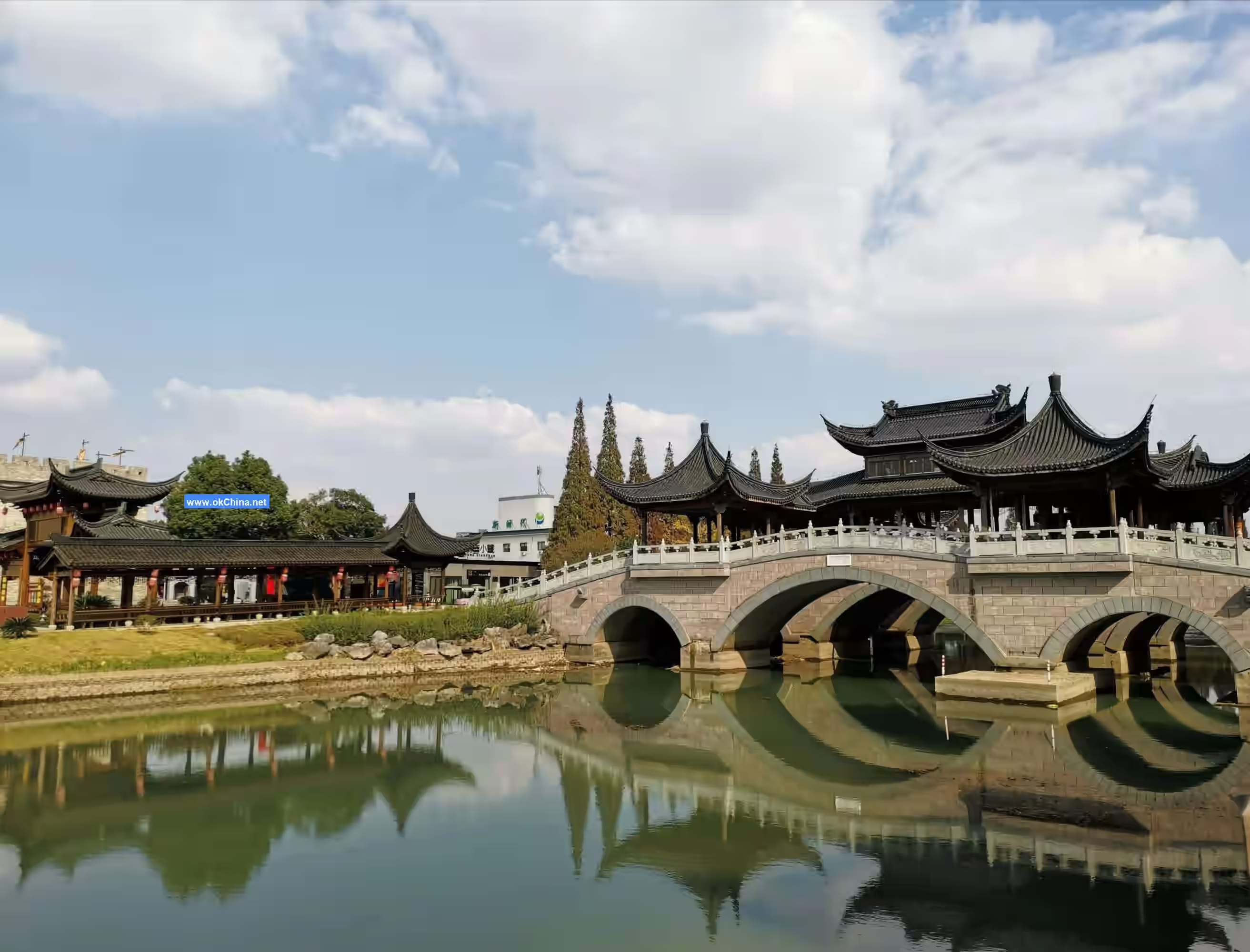
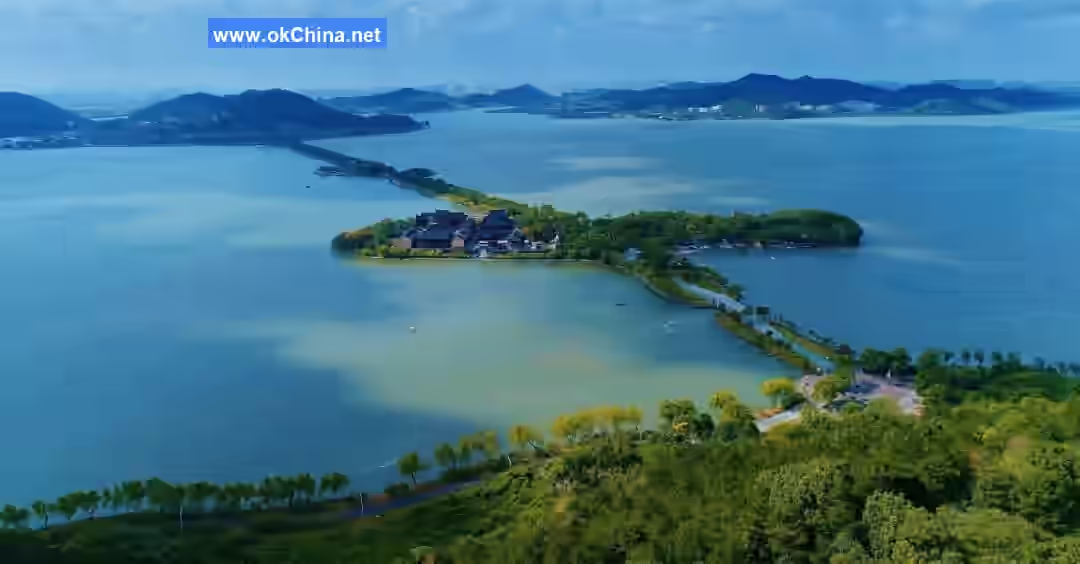
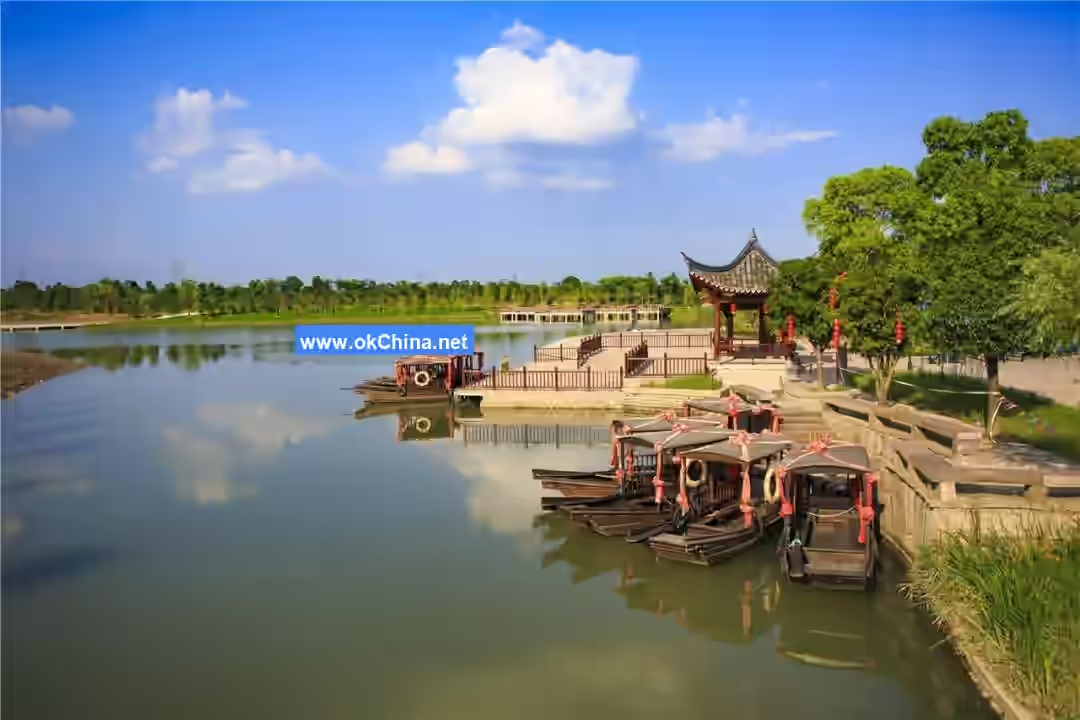
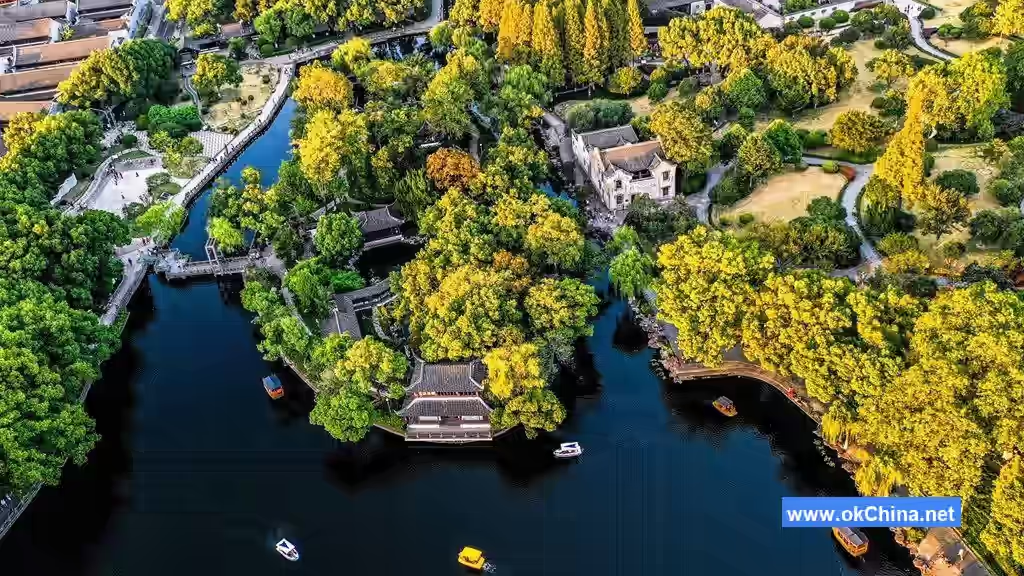
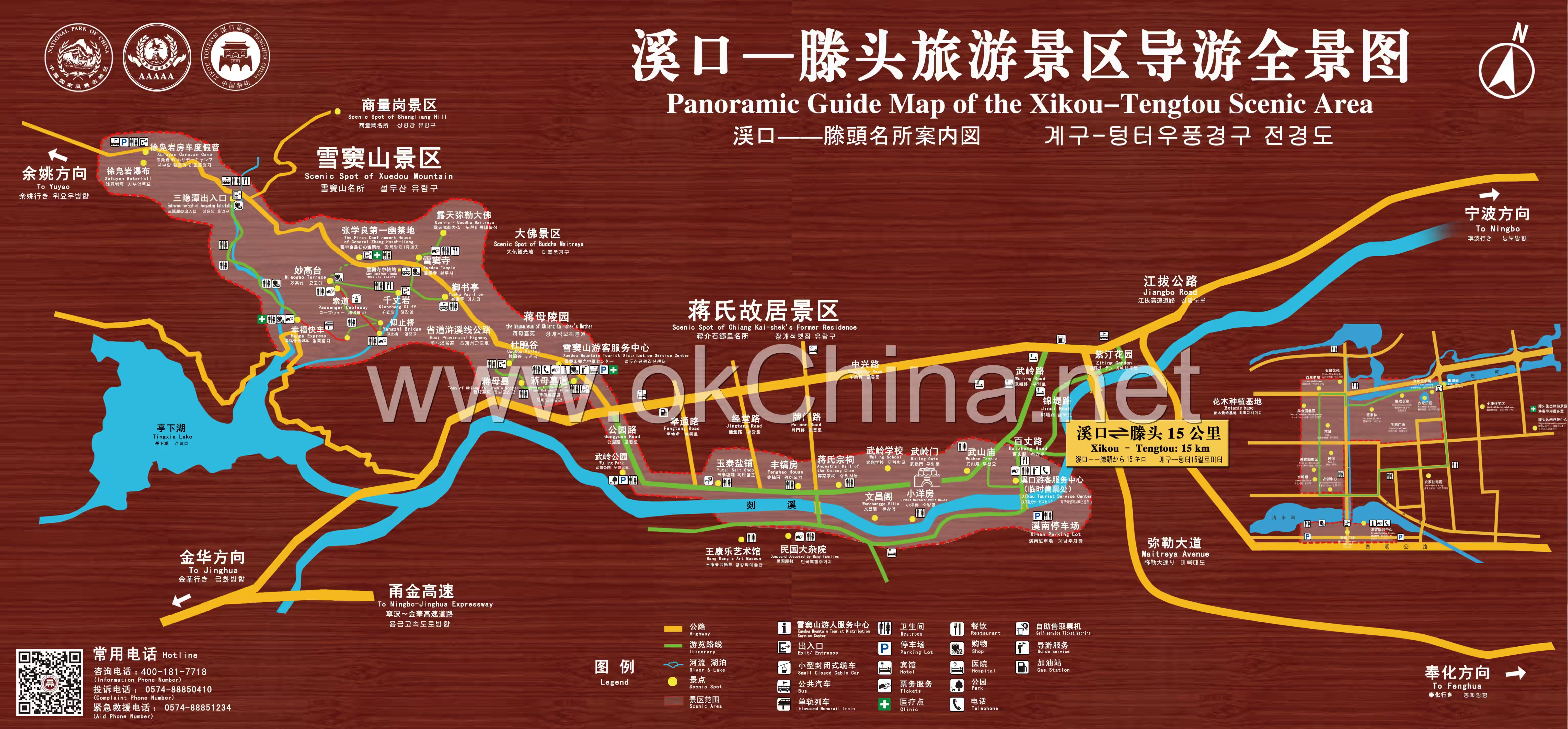
The Xikou-Tengtou Tourist Area, a National 5A-level tourist attraction, is primarily composed of two major scenic areas: Xikou (including the Chiang Family's Former Residence and Xuedou Mountain) and Tengtou. Located within Fenghua, Zhejiang, in the southwestern part of Ningbo—a central city in the southern wing of the Yangtze River Delta—it covers a total area of 45.48 square kilometers. Xuedou Mountain within the area is traditionally known as the Maitreya Dojo and one of China's Five Great Buddhist Mountains. It is also a National Scenic Area, National Forest Park, and a Cross-Strait Exchange Base. Xikou Town is the hometown of Chiang Kai-shek and his son, with the "Chiang Family's Former Residence" architectural complex designated as a Major National Historical and Cultural Site. Tengtou Village is a model of China's new socialist countryside, recognized as one of the "Global 500 Roll of Honour for Environmental Achievement" and the "World's Top Ten Harmonious Villages." It was also the only rural village featured in the "Best Urban Practices Area" at the 2010 Shanghai World Expo. The tourist area boasts a diverse range of attractions on a large scale, integrating high-quality tourism resources of national top-tier and global influence, including Republican-era culture, Maitreya culture, landscape culture, and ecological culture. It holds immense historical, cultural, and recreational value. These elements blend perfectly, showcasing boundless charm and establishing it as a representative tourist destination in the Yangtze River Delta region.
2. Main Attractions
The Xikou-Tengtou Tourist Area, a National 5A-level tourist attraction, is primarily composed of two major scenic areas: Xikou (including the Chiang Family's Former Residence and Xuedou Mountain) and Tengtou.
2.1 Xuedou Mountain Scenic Area
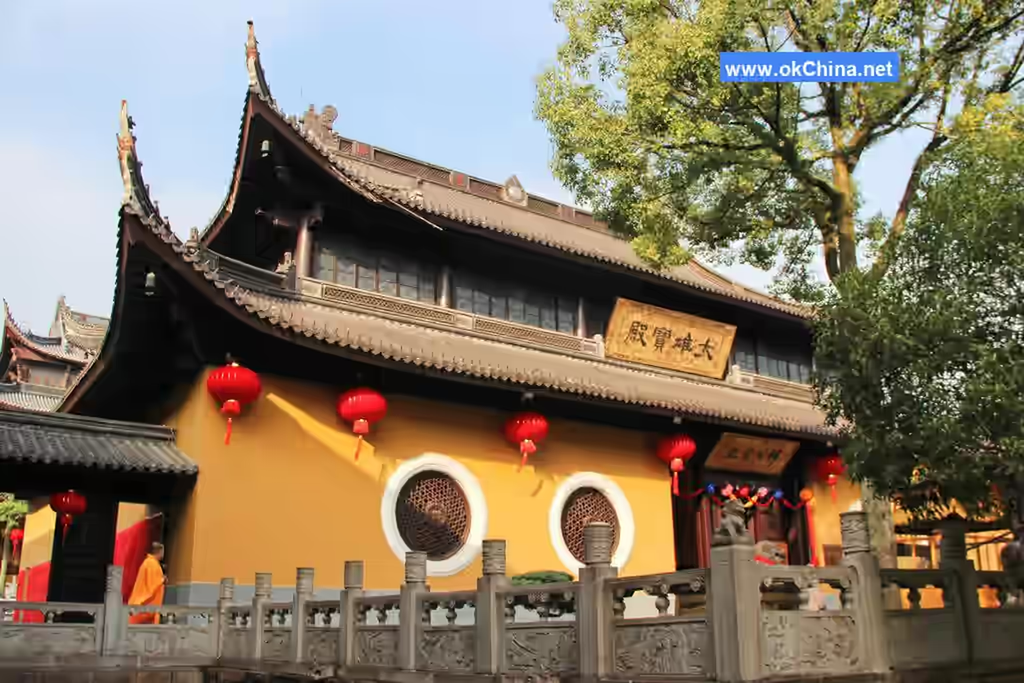
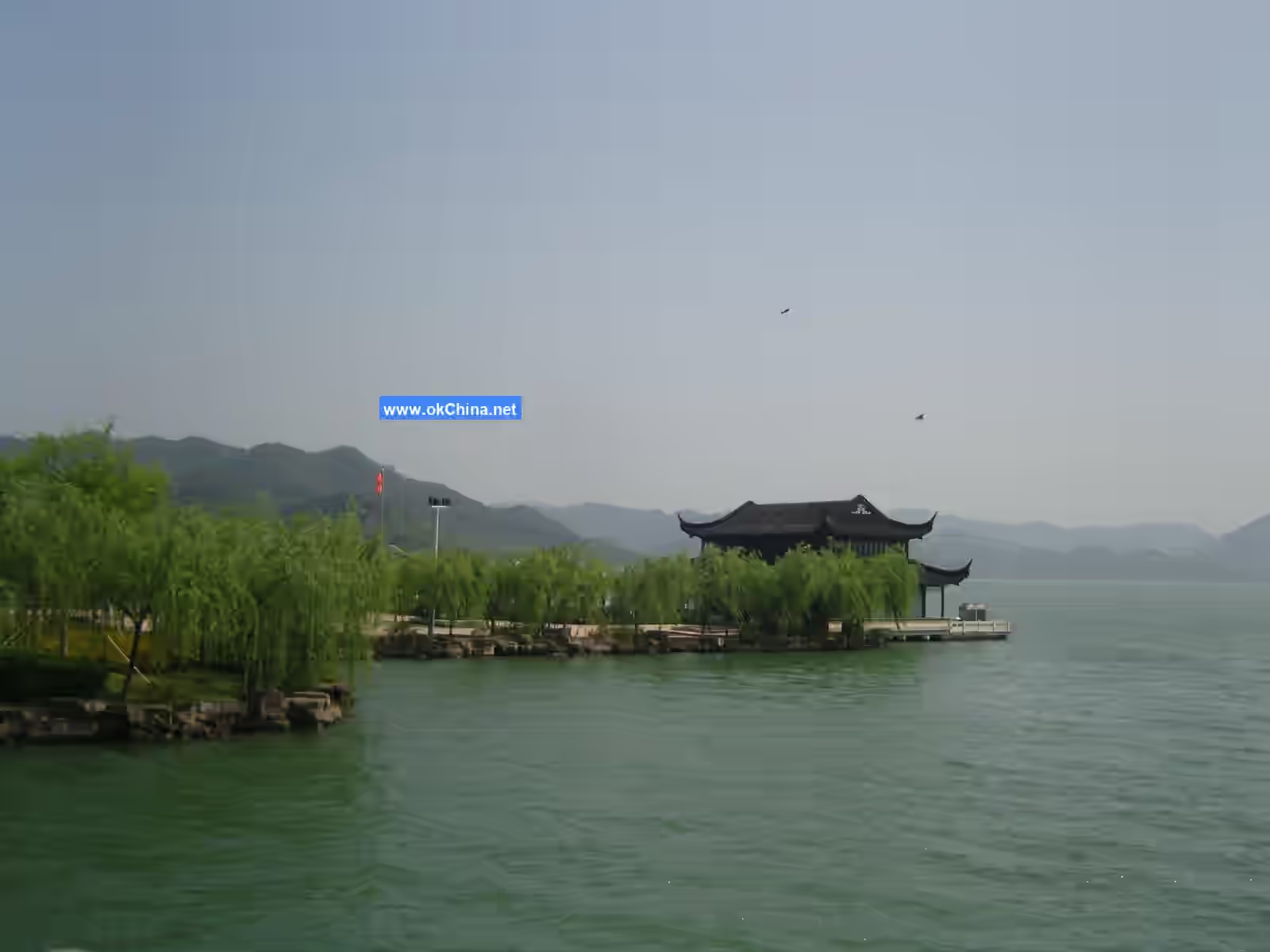
Xuedou Mountain is located northwest of Xikou Town, forming the southern wing of the Siming Mountain Range in eastern Zhejiang. Among the 280 peaks of the majestic Siming Mountains, Xuedou Mountain is hailed as the "First Mountain of Siming." It stretches from Xikou Town in the east to Xufuyan in the west, borders the northern foothills of Dongshan in the south, and reaches Shanglianggang in the north, covering an area of nearly 100 square kilometers. A fairyland landscape—the Dream-Responsive Famous Mountain. Xuedou Mountain in Xikou features layered beautiful peaks and cascading waterfalls. As early as the Jin Dynasty, it was admired by renowned scholars like Wang Xizhi and Sun Chuo. During the Tang Dynasty, many poets who admired the travels of Jin Dynasty scholars followed the Xuedou Mountain touring route, strolling and singing along the way, forming the eastern branch of the "Tang Poetry Road of Eastern Zhejiang." In the Song Dynasty, the scenic beauty of Xuedou Mountain was recognized by Emperor Renzong as a place he dreamt of visiting, earning it the imperial edict name "Dream-Responsive Famous Mountain." Emperor Lizong, following his predecessor's will, specially inscribed "Dream-Responsive Famous Mountain" and bestowed it upon Xuedou Temple. Xuedou Mountain was anciently called "Waterfall Mountain," renowned in southeastern China for its natural scenery of flying waterfalls. It primarily features three major waterfalls: Qianzhangyan, Xufuyan, and Sanyintan. The Qianzhangyan Waterfall has a drop of 186 meters and was named "Eastern Zhejiang Waterfall" by Emperor Zhenzong of the Northern Song Dynasty, praised by numerous celebrities like Wang Anshi and Zeng Gong. The Xufuyan Waterfall boasts a drop of 242 meters, flowing directly to the bottom, earning the title "Number One Waterfall in Eastern China." The Sanyintan Grand Canyon waterfall group lies beneath the main peak of Xuedou Mountain, Shanglianggang, with the Upper, Middle, and Lower Hidden Pools forming a connected series of waterfalls renowned for their seclusion, peril, wonder, and beauty. Additionally, Shanglianggang at the northern end of Xuedou Mountain, known as the "Second Lushan," Miaogaotai with its towering central plateau, and Tingxia Lake with its vast expanse of blue water in the southern wing are all rare summer resorts in eastern Zhejiang. Xuedou Mountain is famous for its beautiful natural scenery, with iconic attractions including Qianzhangyan, Xuedou Temple, Sanyintan, Xufuyan, Miaogaotai, and the world's tallest seated bronze statue of Maitreya Buddha. Xuedou Temple, located at the heart of the mountain, was founded in the Jin Dynasty, flourished in the Tang, and peaked in the Song, boasting a history of over 1,700 years. For millennia, it has enjoyed thriving incense offerings and produced numerous eminent monks, serving as the fundamental dojo of Maitreya Buddha. Xuedou Mountain in Zhejiang is ranked among China's Five Great Buddhist Mountains alongside Wutai Mountain in Shanxi, Putuo Mountain in Zhejiang, Emei Mountain in Sichuan, and Jiuhua Mountain in Anhui.
2.1.1 Jinjing Pool
This is an ancient pool excavated during the Song Dynasty. In the 11th year of the Chunxi reign of the Song Dynasty (1184 AD), it was organized and dug by Zen Master Zu'an, the 11th generation patriarch of the Caodong school and abbot of Xuedou Temple. It was later named "Jinjing Pool" by the Southern Song poet Zhang Liangchen. The pool collected water from the eastern and western streams of Xuedou Temple, originally covering an area of 7,800 square meters. A bridge and sluice gate were built over it to control the Qianzhangyan Waterfall. The current Jinjing Pool covers about 200 square meters and was renovated in 1986. A 300-meter embankment and path were built along its bank, with Guanshan Bridge at the upper end and Qingsuo Pavilion on the bridge, creating a picturesque and more enchanting view of Qianzhangyan.
2.1.2 Miaogaotai
"Miaogaotai," also known as Miaogaofeng or Tianzhufeng, is a main scenic spot within the Xuedou Mountain area. Although its altitude is only 396 meters, it is backed by a large mountain, protrudes in the middle, with cliffs on three sides and a deep abyss below, making the terrain extremely precipitous. In the narrow sense, Miaogaotai refers to a platform of about 350 square meters. Standing at its front edge, one can overlook the natural scenery of Tingxia Lake. The area around Miaogaotai is densely covered with ancient trees and bamboo groves that block the sun, with cool breezes, making it an ideal summer resort.
The building behind Miaogaotai is a private villa built by Chiang Kai-shek in 1927. Looking up, a horizontal plaque with black characters on a white background reading "Miaogaotai" hangs in the center of the second floor, inscribed by Chiang Kai-shek himself. The entire villa has two floors, with six rooms in total on the upper and lower levels, connected by a Western-style terrace, covering a total floor area of 436 square meters. Entering the main gate, the ground floor centers around a courtyard, with one room on each side. The second floor has a cement corridor connected to a balcony, with a reception room in the center, a bedroom to the east, and a study to the west.
In the middle of the villa's courtyard stands a stone pagoda, the relic pagoda of Zen Master Shiqi, an abbot of Xuedou Temple in the early Qing Dynasty. Zen Master Shiqi rebuilt Xuedou Temple in the 8th year of the Shunzhi reign (1651 AD), reviving its Buddhist glory. After his death, later generations built this stone pagoda in the 4th year of the Yongzheng reign (1726 AD) to commemorate his achievements and cherish his memory.
Miaogaotai was also a place where Chiang Kai-shek strategized. In January 1949, after his third retirement, Chiang Kai-shek stayed in his hometown for three months and three days, making Miaogaotai his headquarters for behind-the-scenes command. During this period, he received over thirty Kuomintang military and political officials here. For a time, Miaogaotai replaced Nanjing as the temporary political and military center of the Kuomintang.
2.1.3 Qianzhangyan
"Qianzhangyan" is a historically famous scenic spot within the Xuedou Mountain area. The Qianzhangyan Waterfall has a drop of 186 meters and is renowned for its majestic and spectacular view. Emperor Zhenzong of the Northern Song Dynasty, Zhao Heng, bestowed upon it the name "Eastern Zhejiang Waterfall." Standing on Feixue Pavilion, one can see the waterfall cascading down the cliff ahead. The three large characters "Qianzhangyan" carved into the cliff face were written by Mr. Huang Qi, Vice Chairman of the Chinese Calligraphers Association, and were carved in 1992.
The marvelous scenery of Qianzhangyan has attracted many literati to compose poems in its praise. Among them, the poem "Qianzhangyan Waterfall" by the Northern Song literary figure Wang Anshi is the most famous: "Towering green cliffs rise ten thousand folds from the ground; A thousand-zhang white stream hangs divided in the air; All gaze upon the Jade Maiden's loom-hung silk threads; Reflecting sunlight, they weave a five-colored pattern."
2.1.4 Zhang Xueliang's Place of Confinement
This is a Western-style building with six guest rooms and a dining hall, covering an area of 438 square meters. It was originally the Xuedou Mountain Hostel of the Shanghai China Travel Service, abbreviated as "CTS Hostel." It was completed and opened in June 1934. In January 1937, the building was requisitioned by the Kuomintang Military Commission and renamed "Mr. Zhang Xueliang's Hostel."
On December 12, 1936, patriotic generals Zhang Xueliang and Yang Hucheng launched a military remonstrance in Xi'an, detaining Chiang Kai-shek for 13 days to force him to resist Japanese aggression. After the peaceful resolution of the Xi'an Incident, Zhang Xueliang escorted Chiang Kai-shek back to Nanjing. Chiang then organized a military tribunal that sentenced Zhang to ten years imprisonment; this was subsequently commuted, and Zhang was handed over to the Military Commission for "strict supervision," placing him under indefinite house arrest. Thus, Xuedou Mountain in Xikou became the first place of confinement for General Zhang Xueliang.
In the outdoor courtyard stands a bronze statue of Zhang Xueliang in military uniform, looking heroic and spirited, his dignified and righteous demeanor seemingly present before one's eyes.
Inside, the three south-facing rooms were Zhang Xueliang's quarters. From inner to outer, they were his bedroom, study, and reception room. The north-facing rooms housed the secret service team leader, Zhang's adjutant, nurses, and others. The room facing the main gate was the bedroom of Qian Junzhi, the manager of the CTS Hostel.
During Zhang Xueliang's stay at Xuedou Mountain, sentries were posted both in front and behind this building, and a company of military police was stationed at Xuedou Temple. The activity space allowed by Chiang Kai-shek for Zhang Xueliang was "not east beyond Zhenhaikou, not west beyond Cao'e River." After his confinement, figures like Shao Lizi, Wang Jingwei, T.V. Soong, and Chen Bulei visited him. Miss Zhao Yidi and his first wife, Yu Fengzhi, took turns coming to accompany him.
On November 7, 1937, a kitchen fire completely destroyed the building. Zhang Xueliang temporarily moved to Xuedou Temple. On November 9, he was escorted to Huangshan in Anhui, beginning a life of displacement under house arrest.
2.1.5 Sanyintan
Sanyintan is a landscape formed by a three-step waterfall within Xuedou Mountain. It is called Sanyintan (Three Hidden Pools) because it is hidden in a valley and consists of three pools. The water of the Hidden Pools originates from Dong'ao Village, forming a three-level waterfall with a total length of over 1,600 meters. From top to bottom, they are called: Upper Hidden Pool, Middle Hidden Pool, and Lower Hidden Pool. The Upper Hidden Pool is known for its seclusion and peril.
Upper Hidden Pool Sanyintan is a landscape formed by a three-step waterfall within Xuedou Mountain. It is called Sanyintan (Three Hidden Pools) because it is hidden in a valley and consists of three pools. The water of the Hidden Pools originates from Dong'ao Village, forming a three-level waterfall with a total length of over 1,600 meters. From top to bottom, they are called: Upper Hidden Pool, Middle Hidden Pool, and Lower Hidden Pool.
The Upper Hidden Pool is known for its seclusion and peril. From the cliff top down to the pool bottom, there are 216 stone steps shaped like a ladder to heaven. A stone bridge spans the bottom of the pool. The waterfall pours down along the cliff, about 40 meters high, with water flowing in linear streams, creating a roaring sound. Standing on the bridge by the pool, one is enveloped in mist, splashed by water droplets, and feels a penetrating coolness.At the Upper Hidden Pool waterfall, there is a Dragon King Temple covering an area of approximately 160 square meters. The temple enshrines three Dragon Kings: the Green Dragon in the center, prayed to for national peace, prosperity, and bountiful harvests; the Purple Dragon on the left, believed to bless scholars with success in examinations and official careers; and the Yellow Dragon on the right, said to grant wealth and prosperity. Visitors may pray according to their needs.
Middle Hidden Pool
Descending about 500 meters from the Upper Hidden Pool leads to the Middle Hidden Pool. Here, massive rocks lie across the stream, and the waterfall plunges down from the cliffs, winding east and west with alternating swift and gentle flows. Water spray, carried by the wind, creates a misty, rain-like atmosphere, blending poetic charm with the wild beauty of the valley, making it particularly renowned for its elegance.
Lower Hidden Pool
From the Middle Hidden Pool, a 500-meter descent along a mountain path leads to the Lower Hidden Pool, a scenic spot that combines peaks, caves, pools, and streams into a strikingly beautiful landscape. The waterfall here splits into two streams, known as the "Mandarin Duck Waterfall." A large rock in the Lower Hidden Pool, about 10 square meters in size, stands beside a stone stalagmite over 20 meters tall, called the "Stone Stalagmite Peak." The peak towers above the pool, while the pool lies at its base, partially hidden from view. The entire Lower Hidden Pool resembles a grand pavilion on water, with the waterfall cascading over its edge. Looking up, it appears like a colorful cloud stretching across the sky, radiant and vibrant.
2.1.6 Cableway and Monorail Train
To further enhance the service facilities and hardware of the Xikou-Tengtou Tourist Area and provide visitors with a safe and comfortable experience, the Xuedou Mountain Sightseeing Monorail and Cableway have been suspended for upgrades since May 10, 2023. During this period, all attractions on Xuedou Mountain remain open. For specific operation times, please refer to the scenic area announcements.
In September 2007, the second phase of the Three Hidden Pools project, a key initiative in Fenghua City, commenced with a total investment of over 60 million yuan. By early July 2010, the project was completed, and the sightseeing monorail train and cableway from the Lower Hidden Pool to Miaogaotai officially began operations. Visitors can board the monorail train at the West Station near the Lower Hidden Pool and travel directly to the East Station at the base of the Thousand Zhang Rock Waterfall. The track spans 3,118 meters, with the journey taking seven to eight minutes. Near the East Station, at the Yangzhi Ancient Bridge, visitors can look up at the "First Waterfall of Eastern Zhejiang," the Thousand Zhang Rock. From there, a 500-meter-long sightseeing cableway ascends to the Miaogaotai scenic spot. The Xuedou Mountain Monorail Train is China's self-designed and manufactured detachable sightseeing train, featuring the most mature technology and the largest scale of its kind. The entire track is elevated, with a mid-section bridge standing 30 to 40 meters high, while the cableway soars through the air, offering visitors a unique "aerial journey."
2.1.7 Xufu Cliff
The Xufu Cliff RV Tourism Resort is located 7.5 kilometers northwest of the Xuedou Temple, the Maitreya Buddhist site on Xuedou Mountain, the fifth great Buddhist mountain in China. It lies within the Xuebin Mountain 5A Scenic Area at the foot of the Siming Mountains in Xikou Town, Fenghua District, Ningbo City. Nearby attractions include the Chiang Family Former Residence, Chiang's Mother Cemetery, Zhang Xueliang's First Place of Confinement, Thousand Zhang Rock Waterfall, Xufu Cliff Waterfall, Three Hidden Pools, Xuedou Temple, and the Shanglianggang Ski Resort. The resort covers an area of 150 mu and features attractions such as the Xufu Cliff Waterfall, Lingyundu Glass Walkway, Via Ferrata Climbing, RV Accommodations, Buyun Ladder, and Immortal Cave.
2.1.8 Maitreya in the Human World (Xuedou Temple)
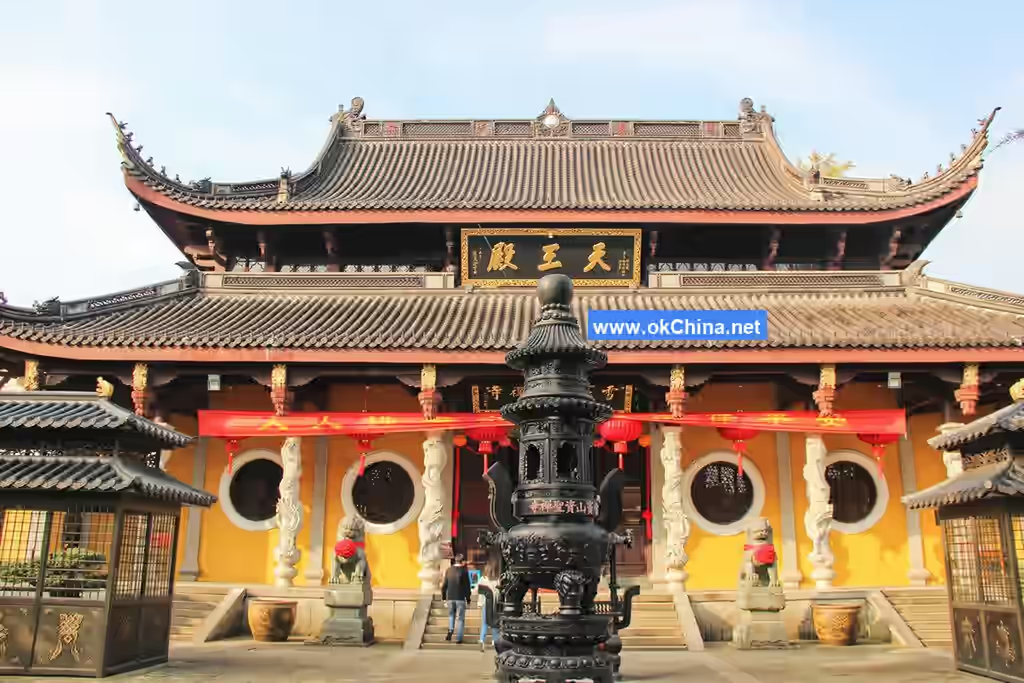
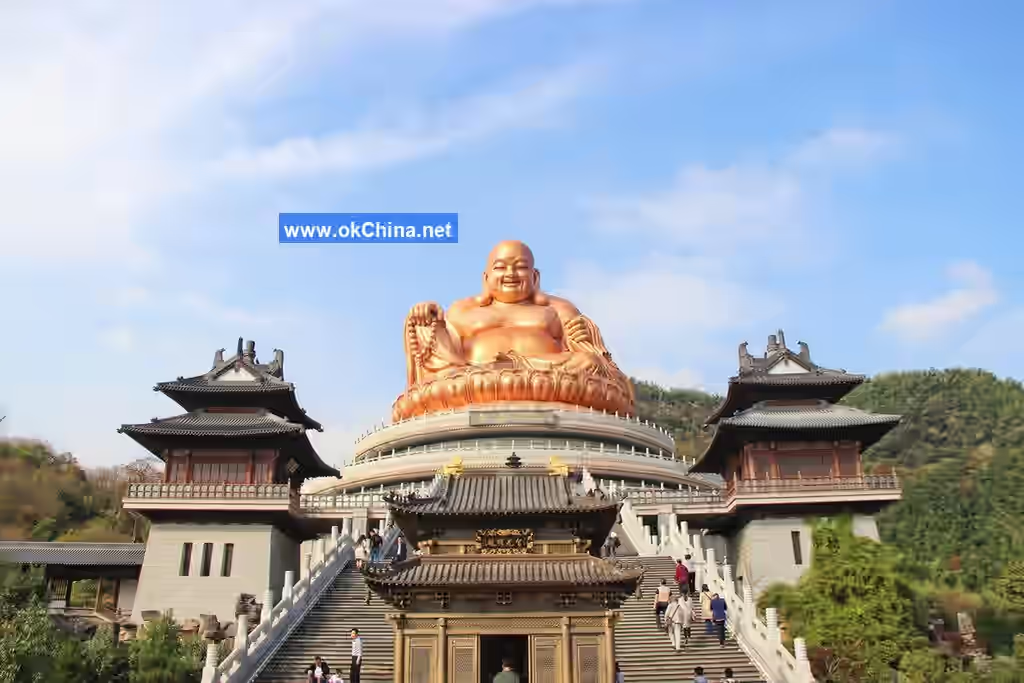
As early as the Five Dynasties period, Xuedou Temple, a renowned Chan Buddhist temple, was where the Fenghua-native Monk Budai (Cloth Bag Monk) preached and propagated Buddhist teachings. After his passing, Monk Budai was first revered by devotees in southeastern China as the reincarnation of Maitreya, becoming the embodiment of the "Future Buddha," the successor to Shakyamuni. Thus, Xuedou Mountain became known as the "Land Where the Great Compassionate Maitreya Bodhisattva Manifested." During the Song Dynasty, the iconic round-carved stone statue of Maitreya as Budai at Feilai Peak in Hangzhou was unveiled, solidifying the national image of Maitreya. By the 1930s, Xuedou Mountain was recognized by Chinese Buddhist circles as a Maitreya Buddhist site. Modern Buddhist master Taixu and contemporary Buddhist leader Zhao Puchu successively advocated for Xuedou Mountain as the fifth great Buddhist mountain in China. In the new century, China's first Taixu Memorial Hall—Taixu Pagoda Courtyard—was completed on Xuedou Mountain, and the Great Compassion Temple was reconstructed at its foothills. Additionally, sites related to Monk Budai in Fenghua, such as his birthplace at Honglang Pool in Changting Village, his place of service at Yuelin Zhuang Temple, his ordination and passing site at Yuelin Temple, and his burial site at Zhongta Temple, have been renovated or rebuilt and opened to devotees and tourists, forming a comprehensive and interconnected "Maitreya Sacred Land" system. On November 8, 2008, the Xuedou Mountain Open-Air Maitreya Buddha, blending religious symbolism with humanistic expression, was unveiled, and the Great Buddha Scenic Area centered around it officially opened. The annual Xuedou Mountain Maitreya Culture Festival has significantly enhanced the fame and influence of the Maitreya Sacred Land. The hopeful and visionary Xuedou Pure Land has gradually been widely praised by domestic and international visitors as a "Harbor of the Soul" and a "Land of Future Imagination." The Maitreya Buddha faces south in a seated copper posture, holding a cloth bag in his left hand and prayer beads in his right, with kind eyes, a beaming smile, and an exposed chest and belly. This is a Sinicized Maitreya statue based on the form of Fenghua's Monk Budai. The statue overlooks the area, integrated with the rock mass, solid as a rock, grand and majestic, dignified in appearance, exquisitely crafted, and lifelike. The total height of the open-air Maitreya Buddha statue is 56.74 meters, including a 33-meter copper body, a 9-meter lotus pedestal, and a 14.74-meter base. The entire statue is made of over 500 tons of tin bronze, supported by more than 1,000 tons of steel framework, and integrated with the rock mass, ensuring stability and grandeur. It is currently the tallest seated open-air Maitreya Buddha statue in the world.
2.2 Chiang Family Former Residence Scenic Area
During Chiang Kai-shek's national rule, he returned to his hometown multiple times, especially during three periods of retreat from power, when Xikou Town effectively served as the temporary national political center. To this day, Xikou Town preserves over 22 intact historical sites from the Republic of China era. The representative attraction of Xikou's Republican-era sites is the "Chiang Family Former Residence" complex, comprising eight individual structures: the ancestral home of Chiang Kai-shek and his son, Fenggao House; the villa Wenchang Pavilion shared by Chiang Kai-shek and Soong Mei-ling; the Western-style House where Chiang Ching-kuo's family lived; Yutai Salt Shop, Chiang Kai-shek's birthplace; and Chiang's Mother Cemetery. Since 1996, it has been listed as a National Key Cultural Relics Protection Unit, possessing unique and irreplaceable cultural value.
2.2.1 Yutai Salt Shop
Yutai Salt Shop is Chiang Kai-shek's birthplace. According to clan records, Chiang Kai-shek was born on the upper floor of Yutai Salt Shop on the 15th day of the ninth lunar month in the 13th year of the Guangxu reign of the Qing Dynasty (1887).
Yutai Salt Shop was established by Chiang Kai-shek's grandfather, Chiang Siqian, in 1871 and later inherited by his father, Chiang Zhaocong. After Chiang Zhaocong's death, the brothers divided the family assets, and the salt shop was managed by Chiang Kai-shek's elder brother, Chiang Jieqing. In 1919, Chiang Jieqing left to seek opportunities elsewhere, and the salt shop closed. The current structure includes three two-story buildings, three single-story houses, and auxiliary buildings such as a kitchen and toilets.
After Chiang Kai-shek's birth, the salt shop suffered two fires and one termite infestation. The existing building was renovated by Chiang Kai-shek in 1948. The main gate features a stone frame with the inscription "Qing Lu" on the lintel. On the boundary wall to the west of the gate, six large characters written by Chiang Kai-shek read, "Original Site of Yutai Salt Shop."
2.2.2 Chiang's Mother Cemetery
Chiang's Mother Cemetery, located in the western outskirts of Xikou Town, is nestled among pine forests on Yulin'ao of Baiyan Mountain, a branch of Xuedou Mountain. The cemetery's series of structures were initially built in 1923 and fully completed by 1930. In May 2006, the "Chiang's Mother Tomb" in Xikou became a National Key Cultural Relics Protection Unit. The cemetery begins with a stone archway at the foothills, featuring four pillars and three gates, with the main gate inscribed "Chiang's Mother Tomb Path." A 668-meter-long uphill path leads to Chiang's Mother Tomb at Yulin'ao. Along the way, auxiliary structures include the Dismounting Pavilion, Filial Son Pavilion, Yangci Pavilion (where Chiang Kai-shek chose his own burial site), the tomb cottage Ci'an, and the Square and Round Ponds.
Archway
This is the archway leading into Chiang's Mother Cemetery. The stone archway has four pillars and three gates, with the central gate inscribed "Chiang's Mother Tomb Path." Thus, the area from here to the tomb is collectively referred to as "Chiang's Mother Tomb Path." Chiang's mother, Wang Caiyu, was from Gezhu Village in Fenghua. She was born on November 9, 1864, and passed away on June 14, 1921, at the age of 58.
Dismounting Pavilion
From the stone archway to Chiang's Mother Tomb, a 668-meter-long cobblestone path is flanked by pine forests. About 300 meters along, a pavilion spans the path, resembling the square hat of ancient scholars. It is said that Chiang Kai-shek would dismount from his sedan chair here every time he returned to pay respects to his mother, demonstrating filial piety. Hence, this pavilion is called the "Dismounting Pavilion."
Ci'an
The tomb cottage in Chiang's Mother Cemetery is called "Ci'an," locally referred to as the grave manor. It served as a residence for Chiang's descendants during mourning periods. Since only the compassionate mother is buried here, without the strict father, it is named "Ci'an." Initially built in 1923, it was expanded in 1930, comprising three single-story buildings with five main rooms.
Inside the main hall of Ci'an, four stone tablets are worth noting. Facing the entrance is Sun Yat-sen's "Eulogy for Madame Chiang," handwritten by senior Kuomintang member Tan Yankai, detailing Sun Yat-sen's relationship with Chiang Kai-shek and his evaluation of him. On the back is "A Brief Account of Madame Wang Tai," dictated by Chiang Kai-shek and handwritten by Yu Youren, recounting Wang Caiyu's life. The left and right walls are inscribed with Chiang Kai-shek's "Lament for Mother" and the Kuomintang Central Executive Committee's "Condolences to Generalissimo Chiang." The calligraphy for "Portrait of Elder Madame Chiang" was done by Wang Jingwei.
A two-room suite on the left served as one of Chiang Kai-shek's frequent residences when he returned to sweep the tomb or retreated from power. After the Xi'an Incident in December 1936, he stayed here for over 110 days, his longest stay in his hometown. The two rooms on the right were used for attendants and hosting relatives and friends.Tomb of Chiang's Mother
Ascending 168 meters from the tomb lodge leads to the tomb of Chiang Kai-shek's mother. At the center of the tomb, on the fan-shaped stone railing, are inscribed four large characters: "Kǔn Fàn Zú Shì" (A Model of Womanly Virtue), personally written by Sun Yat-sen. The character "壼" (kǔn), which resembles "壶" (hú) with an extra stroke, means "paths within the palace," symbolizing women; "范" (fàn) means model; "足" (zú) means sufficient or perfect; "式" (shì) means example. Together, the phrase signifies "a model among women, a perfect example."
The horizontal tombstone inscribed "Tomb of Chiang's Mother" is also in Sun Yat-sen's handwriting. The worship platform is carved with a phoenix-and-bamboo motif, alluding to the idea that Chiang's mother was a golden phoenix that flew out of Gezhu Village.
On the two side pillars is a couplet composed by Chiang Kai-shek and handwritten by Zhang Jingjiang, a senior Kuomintang figure. The first line reads: "Misfortune befell my virtuous mother; my stubborn mischief then brings regret too late." The second line reads: "Ashamed to be an unfilial son, lifelong sorrow knows no bounds." This expresses Chiang Kai-shek's remorse for having caused his mother trouble due to his mischievous behavior in childhood.
2.2.3 Chiang Family Ancestral Hall
The Chiang Family Ancestral Hall is the traditional venue for clan activities of the Chiang family in Xikou. Events such as ancestor worship, celebrations, weddings, and funerals were held here. The horizontal plaque above the entrance archway, inscribed with "Loyalty and Filial Piety Handed Down Through the Family," is in Chiang Kai-shek's handwriting. The hall consists of two sections, covering a total area of 3,000 square meters, with a built-up area of 1,800 square meters.
The front section is the new ancestral hall, funded and built by Chiang Kai-shek in 1930. The east wing of the new hall displays historical materials about the Chiang Family Ancestral Hall, as well as educational panels on Taiwan produced by the Taiwan Affairs Office and the Information Office of the State Council. These panels systematically introduce Taiwan's history, cross-strait relations, and the Chinese Communist Party's policies toward Taiwan.
The rear section is the old ancestral hall, renovated in the 55th year of the Kangxi reign (1716). It features a stage connected to the central gate, double-eaved gable-and-hip roofs, and a spiral caisson ceiling. Chiang Kai-shek once worshipped ancestors, hosted clan banquets, reviewed genealogical records, and watched performances here. The funerals of his elder brother Chiang Jieqing and his first wife Mao Fumei were also held here.
2.2.4 Fenggao House
"Fenggao House" is the former residence of the Chiang family and the most important cultural landmark in Xikou. In November 1996, it was designated as a National Key Cultural Relics Protection Unit by the State Council.
Traditionally, each household in the area had a house name. Chiang Kai-shek's father's house was named "Zhou House." As Chiang Kai-shek belonged to the "Zhou" generation in the family genealogy, he drew inspiration from the capitals of the Western Zhou dynasty—Fengyi and Haojing—to name his own house "Fenggao," hoping his family would prosper like the Western Zhou. Thus, the name Fenggao House was established. Following this naming convention, Chiang Kai-shek also gave his sons Jingguo and Weiguo the childhood names Jianfeng and Jianhao, respectively.
Fenggao House is also known as "Suju" (Vegetarian Residence) because the Chiang family practiced Buddhism for generations, adhering to a vegetarian diet and reciting sutras.
Fenggao House covers an area of 4,800 square meters, with a built-up area of 1,850 square meters. Its layout follows the traditional style of a scholarly mansion, featuring a front hall, a rear hall, and two wings with four corridors. The front hall and its sides include three interconnected gardens with moon gates. In the central courtyard stand two osmanthus trees, one golden and one silver, planted by Soong May-ling herself. The east wing was reserved for Soong May-ling but remained unoccupied. The west wing was the residence of Mao Fumei. To the west of the west wing stands a small independent building, originally a three-room ancestral house where Chiang's mother, Wang Caiyu, lived. To respect the ancestors and preserve feng shui, during the expansion of Fenggao House, the foundations of all new buildings were not allowed to exceed the height of this ancestral house.
Entering the rear hall, Baoben Hall, three inscribed plaques and couplets are noteworthy: First, the inscription "Yuli Shuaiqi" (Embracing Reason to Command Spirit) and its accompanying text, written by Chiang Kai-shek for his son Chiang Ching-kuo's 40th birthday, conveying the idea that only by reasoning with others can one command respect and lead effectively. Second, the couplet on the entrance pillars, also by Chiang Kai-shek: "Honoring ancestors and respecting parents are the highest virtues; glorifying the past and enriching the future are the hopes for filial descendants." Third, the horizontal plaque "Baoben Hall," inscribed by Wu Jingheng, a senior Kuomintang figure and renowned calligrapher.
Fenggao House also features three highlights: carvings, colored paintings, and molded sculptures. Upon entering the front hall, one can see molded sculptures on the ceiling, depicting the "Three Stars of Fortune, Prosperity, and Longevity" in the center, flanked by "Two Dragons Playing with a Pearl." Baoben Hall, where Chiang Kai-shek worshipped ancestors and heaven, is the core of Fenggao House. On the walls at both ends of the corridor are two colored paintings: "The Eight Immortals Crossing the Sea" on the east and "Jiang Ziya Fishing" on the west. The wooden carvings on the corbels (known as "ox legs") on both sides of the pillars depict stories from Romance of the Three Kingdoms, from east to west: "Liu Bei's Marriage," "Night Battle with Ma Chao," "Guan Yu's Battle at Changsha," and "Return to Jingzhou." The wooden carvings on the four pillar tops in the east and west wings also draw from Romance of the Three Kingdoms, namely "Escorting Sister-in-Law," "Reunion at Gucheng," "Presenting Gold Before Mounting," and "Beheading Yan Liang." The wooden carvings in the east wing corridor depict stories from The Story of Yue Fei, including "The Great Flood in Tangyin," "Apprenticing Under Zhou Tong," "Martial Arts Competition on the Training Ground," and "Yue Fei's Mother Tattooing His Back." The carvings in the east wing corridor also feature the Eight Immortals, including Tieguai Li, Lü Dongbin, Han Xiangzi, and He Xiangu. Other colored paintings include "Grand Tutor Wen Returning to Court," "Chen Lin Holding the Box," and "Yue Fei Receiving the Flower Spear."
Fenggao House witnessed many interesting stories of the Chiang family. For instance, both father and son held their weddings here: Chiang Kai-shek married Mao Fumei here at the age of 15. After rising to prominence, Chiang Kai-shek would pay respects to his ancestors at Fenggao House during his visits to Xikou, though he did not reside there. On New Year's Eve in 1948, Chiang Kai-shek hosted his last reunion dinner in Baoben Hall.
In April 1937, Chiang Ching-kuo returned from the Soviet Union after 13 years away. During the reunion with his mother, someone deliberately placed Mao Fumei in an inconspicuous spot, but Chiang Ching-kuo recognized her immediately. Mother and son embraced and wept. Under his mother's arrangements, Chiang Ching-kuo and his Russian wife, Faina Vakhreva (later known as Chiang Fang-liang), held a belated wedding ceremony at Fenggao House. On December 2, 1939, during the Japanese bombing of Xikou, Mao Fumei was killed by a collapsing wall near the back door of Fenggao House while trying to escape.
2.2.5 Small Western-Style House
Built in 1930, this structure is called the "Small Western-Style House" due to its compact size and the use of cement, then known as "foreign ash." In April 1937, after returning from studying in the Soviet Union, Chiang Ching-kuo was assigned to live and study here. He spent his time improving his Chinese, studying works such as Letters of Zeng Guofan, Complete Works of Wang Yangming, and The Teachings of the National Father, while also writing his Report on My Stay in Russia to reflect on the "red imprint" from his Soviet education and undergo ideological reorientation. During his stay, the east room upstairs served as his bedroom, the west room as his study, and the central room as a reception area. The Small Western-Style House also accommodated foreign military advisor W. H. Donald and Chen Bulei, head of Chiang Kai-shek's personal secretariat.
2.2.6 Wuling Gate
Wuling Gate is the essential entrance to Xikou Town, named for its location on the ridge of Wu Hill. Before 1929, it was a small nunnery where Chiang Kai-shek's devoutly Buddhist mother often came to chant sutras and worship. In 1930, Chiang Kai-shek rebuilt it into a two-story, three-bay gatehouse in the style of a military pass. The inscription "Wuling" appears on both sides of the gate: the front side was written by Yu Youren, a senior Kuomintang figure and renowned calligrapher, while the back side is in Chiang Kai-shek's handwriting. Inside the gate, a three-mile-long street runs alongside the winding Shan Creek, creating a scene reminiscent of the "Peach Blossom Spring" described by Tao Yuanming, as if entering a hidden paradise. This three-mile-long Wuling Road is the hometown where the Chiang father and son grew up.
2.2.7 Wenchang Pavilion
Thanks to its prime location, Wenchang Pavilion is the most scenic spot in Xikou Town. Situated at the southern end of Wu Hill, by the Shan Creek, it offers views of the southern mountains, overlooks the three-mile-long street, and enjoys breezes from all directions, presenting splendid scenery.
First built in the 9th year of the Yongzheng reign (1731), the pavilion was originally dedicated to the deity Kui Xing, hence also called "Kui Pavilion." Known as "Kui Pavilion Reaching the Clouds," it was one of the Ten Scenes of Xikou during the Qing dynasty. During the Qingming Festival in 1924, Chiang Kai-shek returned to his hometown to sweep the tombs and found the pavilion in disrepair. He funded its demolition and reconstruction, completing a two-story pavilion with upturned eaves and corners in 1925, covering an area of 500 square meters. Chiang Kai-shek named it "Leting" (Joy Pavilion) and wrote An Account of Wuling Leting to describe its beauty. After marrying Soong May-ling in December 1927, the couple often stayed here during their visits to Xikou, making it their private villa. The first floor served as a reception room, while the second floor contained their bedroom and living quarters.
After the Xi'an Incident, on January 13, 1937, General Zhang Xueliang was sent to Xikou under house arrest, initially staying at Wenchang Pavilion for ten days before being moved to Xuedou Mountain. On December 12, 1939, six Japanese warplanes bombed Xikou, reducing Wuling Pavilion to rubble. The current structure was rebuilt in 1987 according to the original design.
2.2.8 Wuling School (Xikou Museum)
This outstanding architecture from the Republican era is called Wuling School, founded by Chiang Kai-shek in 1929 in accordance with his mother's will. The school cost 300,000 silver dollars and covered over 90 acres. It boasted first-class facilities, including teaching buildings, dormitories, a library, a sports field, and a dining hall. Since its establishment, the school was highly favored by the Chiang family. Starting in 1932, Chiang Kai-shek served as its principal, while Soong May-ling, Chiang Ching-kuo, and Chiang Weiguo were board members.
The Wuling School auditorium was the main venue for school gatherings. It is said that important events, including Soong May-ling's 49th birthday party, were held here. The cornerstone inscription by Chiang Kai-shek for the school is carved into the auditorium's foundation. Entering the auditorium, one can imagine Chiang Kai-shek addressing the students. The upstairs served as high-end accommodations for important party and state figures, while a room in the northeast corner downstairs was Chiang Kai-shek's office. East of the auditorium, on a hillside, stands a large rock inscribed with "Wuling You Sheng" (Secluded Beauty of Wuling), also in Chiang Kai-shek's handwriting.
It now houses the Xikou Museum.#### 2.2.9 Azalea Valley Forest Park Azalea Valley Forest Park is located adjacent to the west parking lot of the Xikou Tourist Center, covering an area of over 300 mu, with its highest point at an elevation of 128.8 meters. The scenic area boasts lush forest vegetation and is home to over a hundred plant species, including more than 30,000 plants of the "Azalea Grace" variety. During the peak blooming season, the valley is ablaze with red flowers, which is how Azalea Valley got its name.
In recent years, with the transformation and upgrading of the tourism consumption market, the requirements of the national "14th Five-Year Plan for Tourism Development," and the favorable policies of the "Double Reduction" initiative, Ningbo Xinjingze Cultural Tourism Development Co., Ltd. has invested 20 million yuan to renovate and upgrade the tourism service facilities in Azalea Valley. A series of leisure and experiential projects have been successively developed, including forest motorcycles, ridge skateboarding, the Rising Magic Carpet, green slides, extreme-speed slides, high-tree climbing, obstacle tracks, bouncing cloud peaks, flying birds into the forest, "Dad-Dragging" slides, triple slides, and forest cabins. These developments have transformed Azalea Valley into a diversified comprehensive scenic area integrating leisure vacations, parent-child entertainment, study tours, forest oxygen bars, and immersive experiences. This injects fresh elements into the entire Xikou 5A-level scenic area, accelerates the high-quality development of Xikou tourism, and meets the growing needs of tourists for a better life.
The project mainly consists of three parts: a forest study base, a non-powered amusement park, and an ecological camp. The Happy Garden scenic area of Azalea Valley Forest Park adopts the overall positioning of "Whimsical Forest, Wild Learning," with design principles centered on "ecology, interaction, and joyful learning." Using common natural ecological elements—mountains, forests, water, and valleys—as the foundation for landscape and interactive experiences, it aims to create a mountain ecological micro-vacation destination that combines "forest exploration experience + ecological nature conservation."
2.3 Tengtou Scenic Area
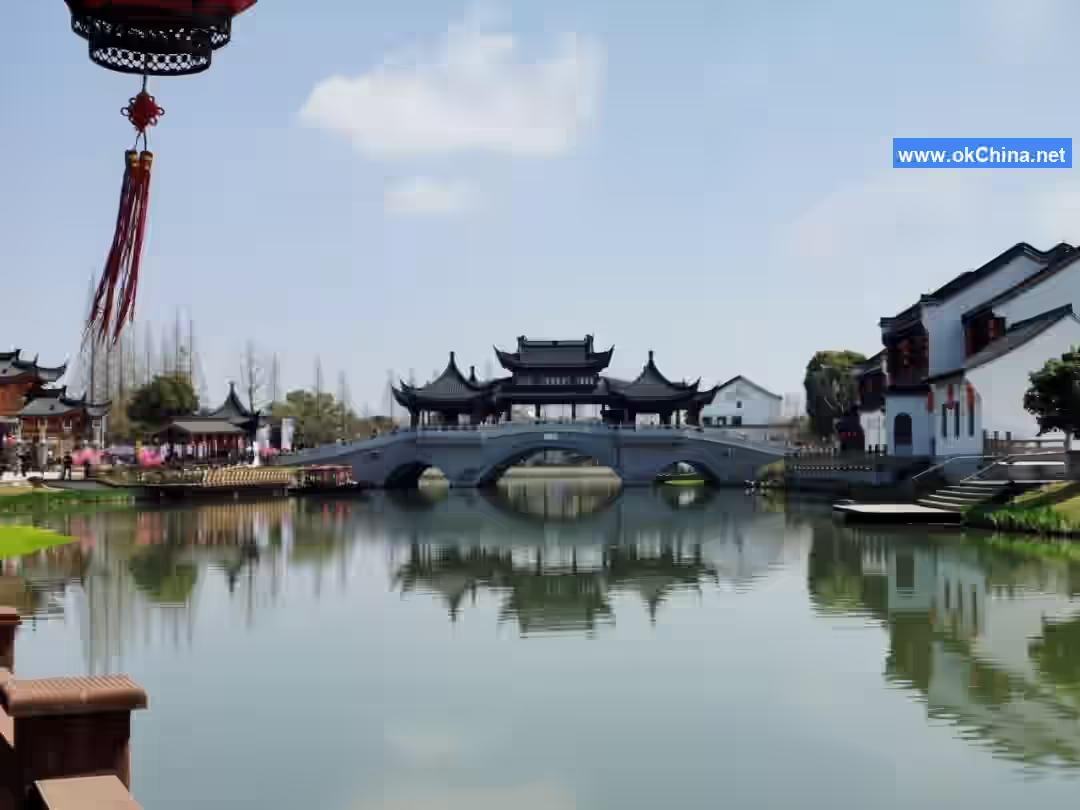
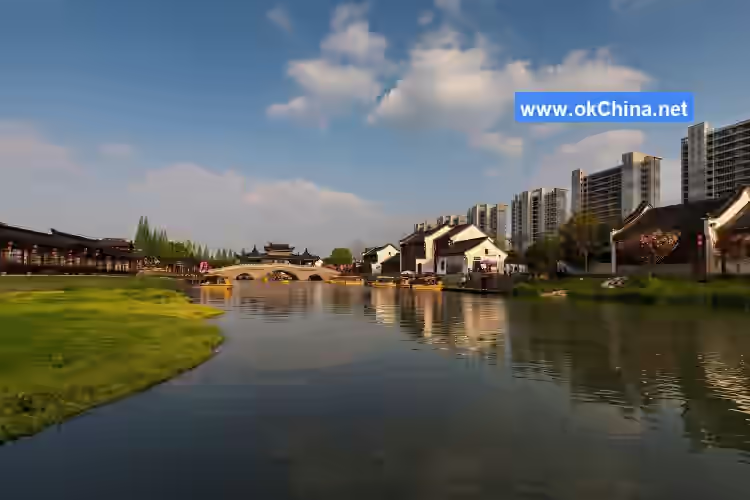
Tengtou, China—a village within the city, a city within the village. The scenic area includes over 20 attractions such as the Agricultural Innovation Center Food Garden, the century-old house Ningxiang Residence, and the Stone Window Museum.
The Tengtou Agricultural Innovation Center comprises five major sections: the Food Garden, homestay area, picking base, bonsai garden, and recreational facilities. The Tengtou Agricultural Innovation Center project covers an area of over 100 mu, with a construction area of over 30,000 square meters and a total investment of 300 million yuan. With the concept of "the village within the scenery, the scenery within the village," to tackle development challenges and provide a more distinctive rural tourism experience, Tengtou Tourism fully leverages rural advantages and promotes industrial integration. Around the 5A scenic area, nearly 20 popular tourism experience projects have been successively developed and operated, such as the Expo Tengtou Case Pavilion, Tengtou Amusement Park, Rainbow Slide, Tengtou Sightseeing Train, and Tengtou Agricultural Industrial Park. The Tengtou tourism footprint has expanded to 1.2 square kilometers.
Comments
Post a Comment