
Wunv Mountain Scenic Area in Benxi City
1. Introduction
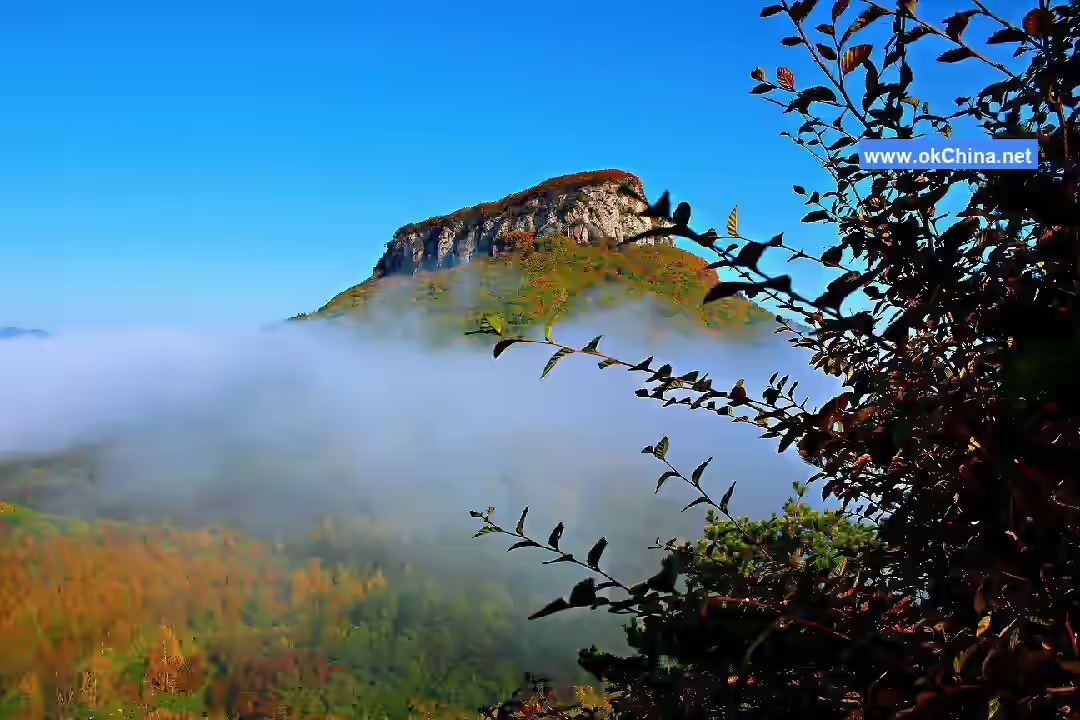
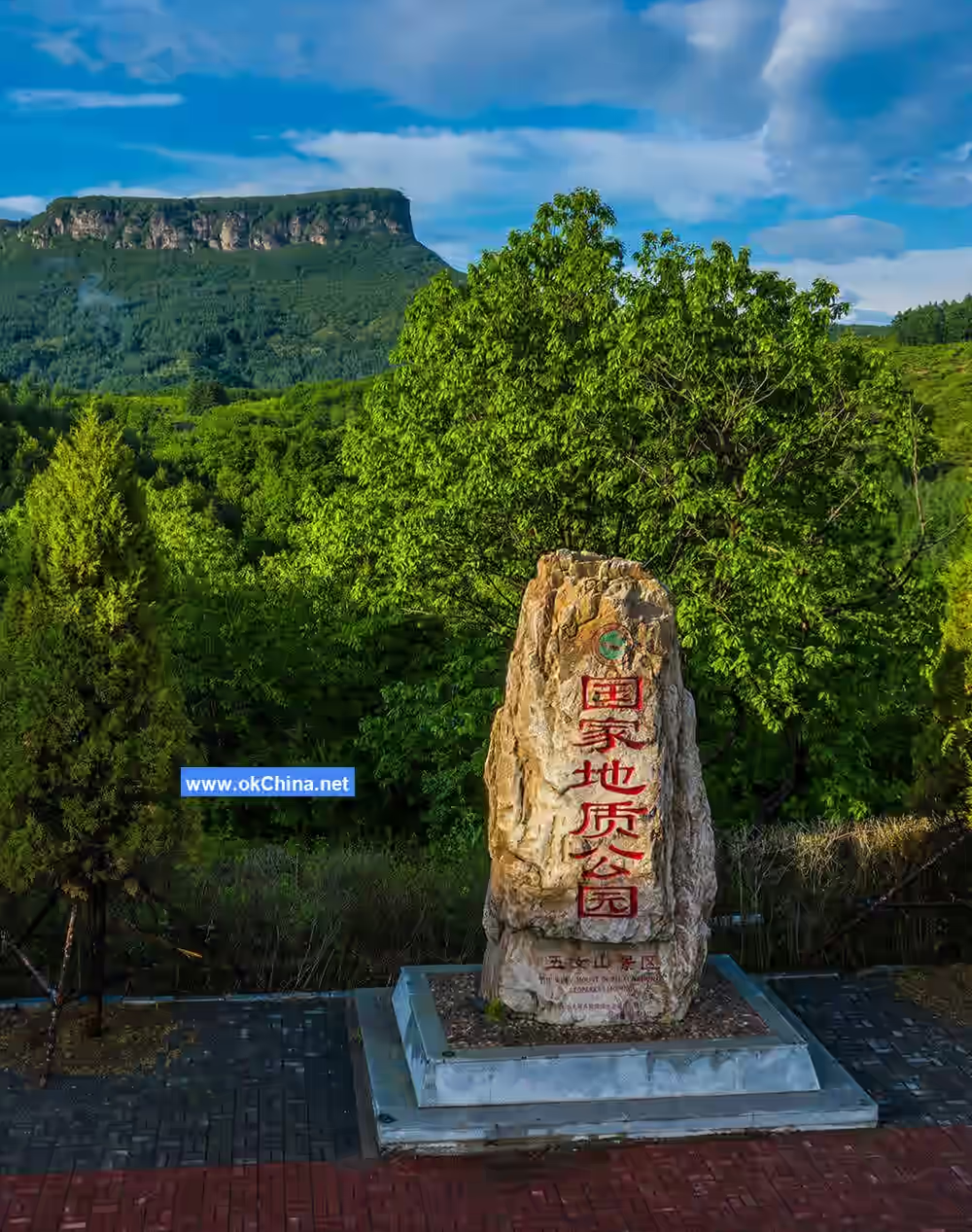
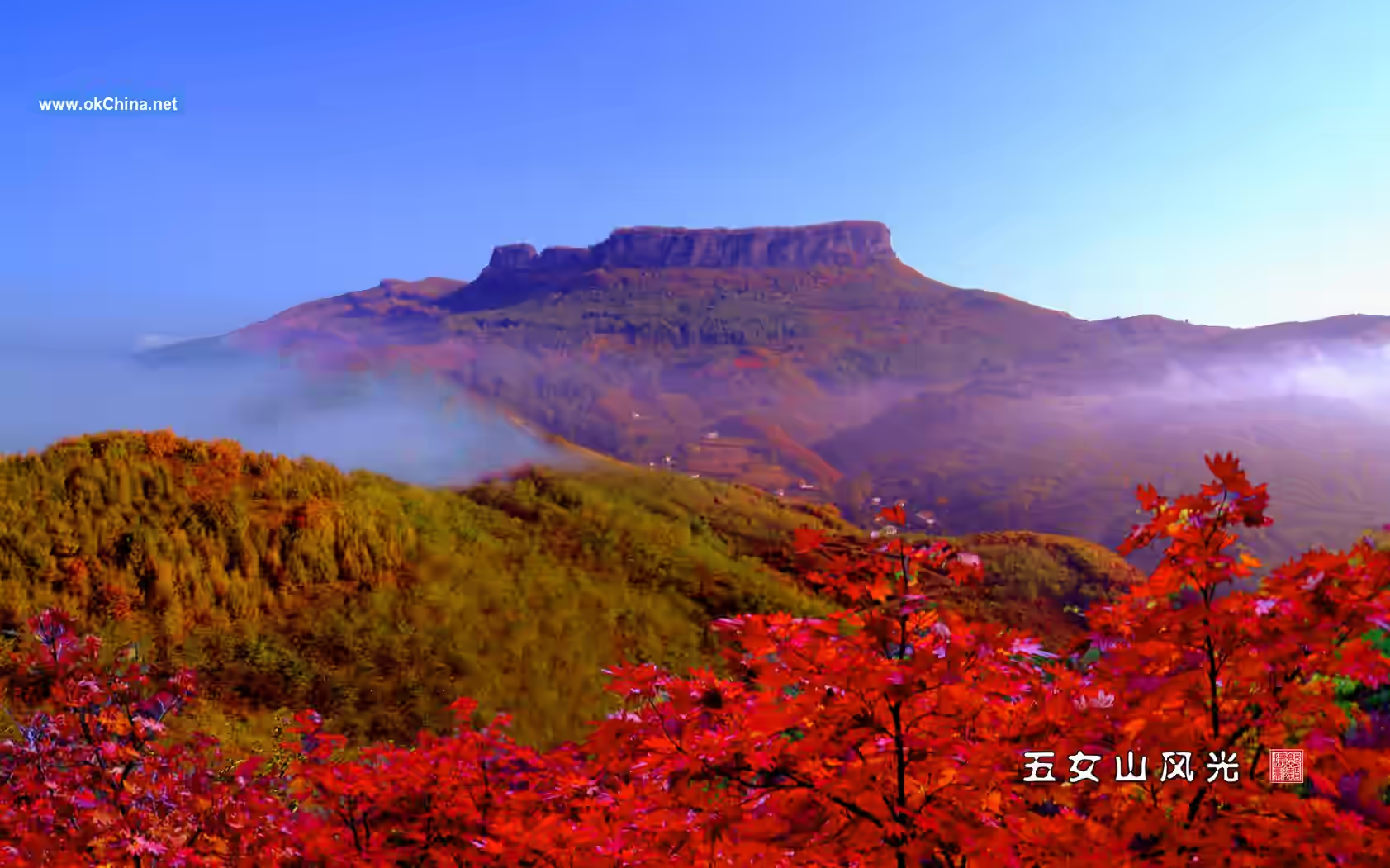
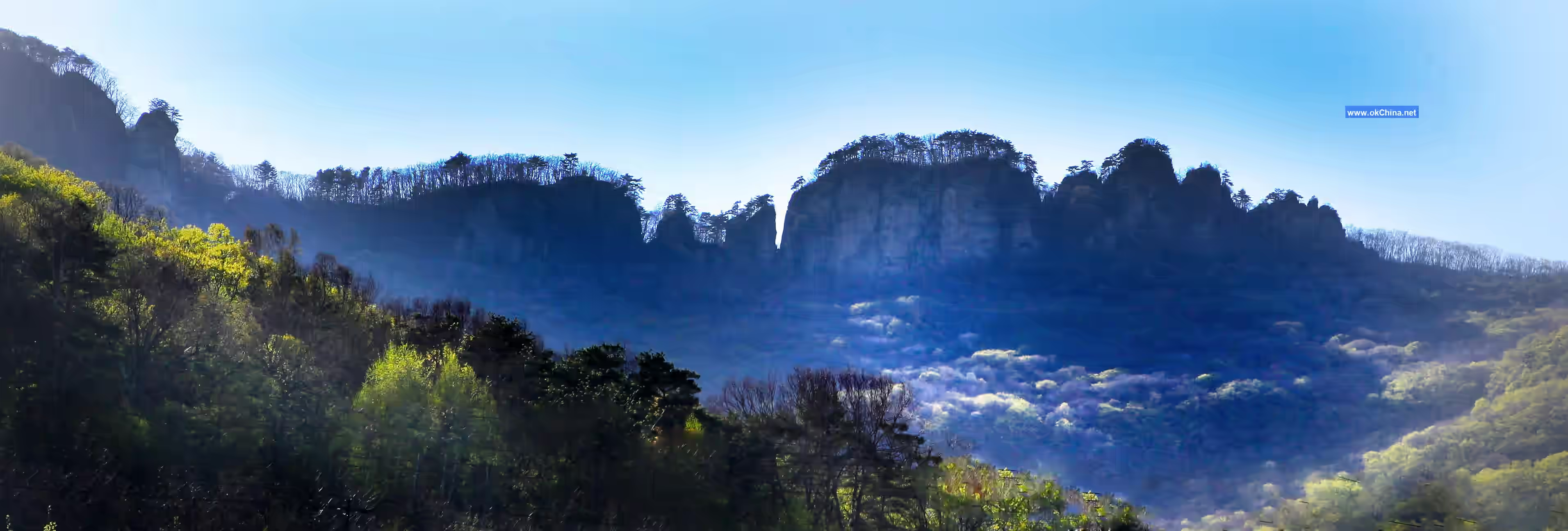
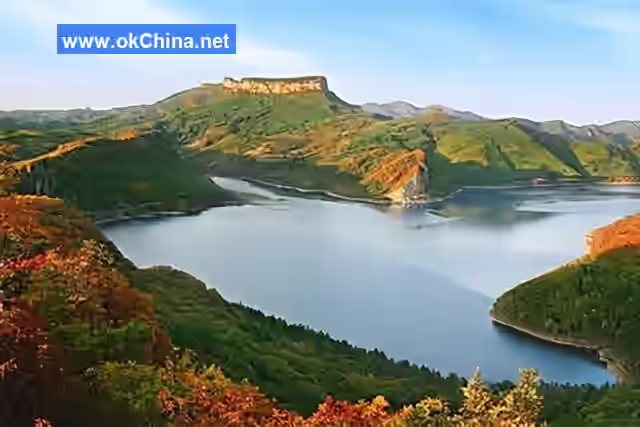
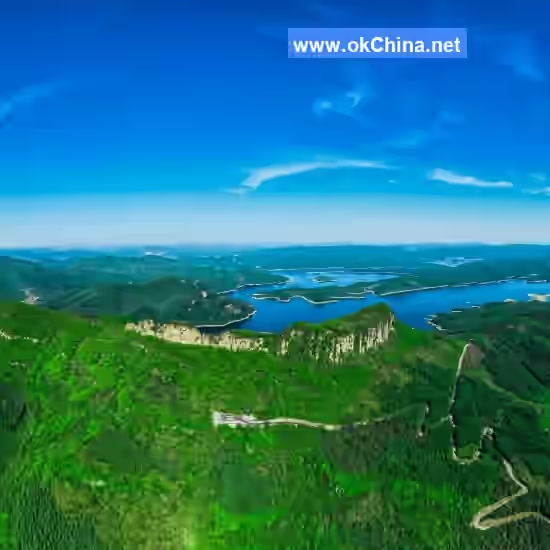
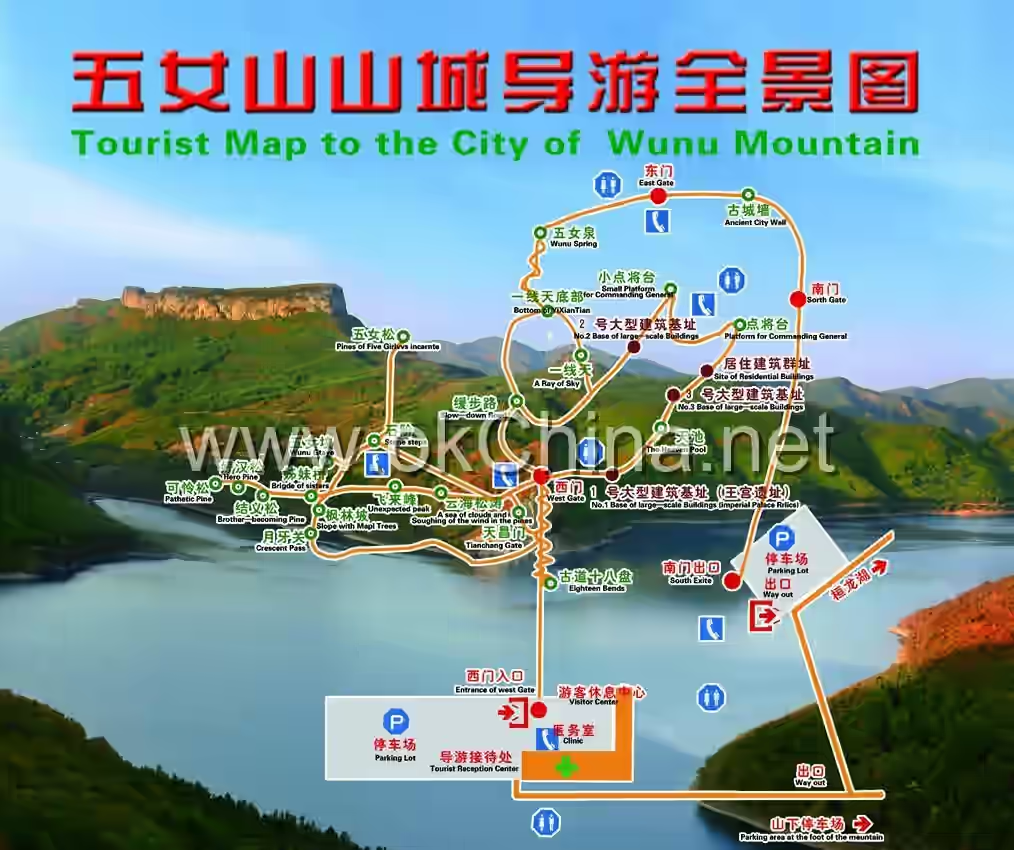
The Wunv Mountain Scenic Area in Benxi City, abbreviated as Wunv Mountain Scenic Area, is located on the right bank of the Hunjiang River, 8 kilometers northeast of the county seat of Huanren Manchu Autonomous County, Benxi City, Liaoning Province. Covering an area of 10.8 square kilometers, it includes three parts: the Wunv Mountain Ancient City Ruins Exhibition Area, the Natural Landscape Area, and the Wunv Mountain Museum.
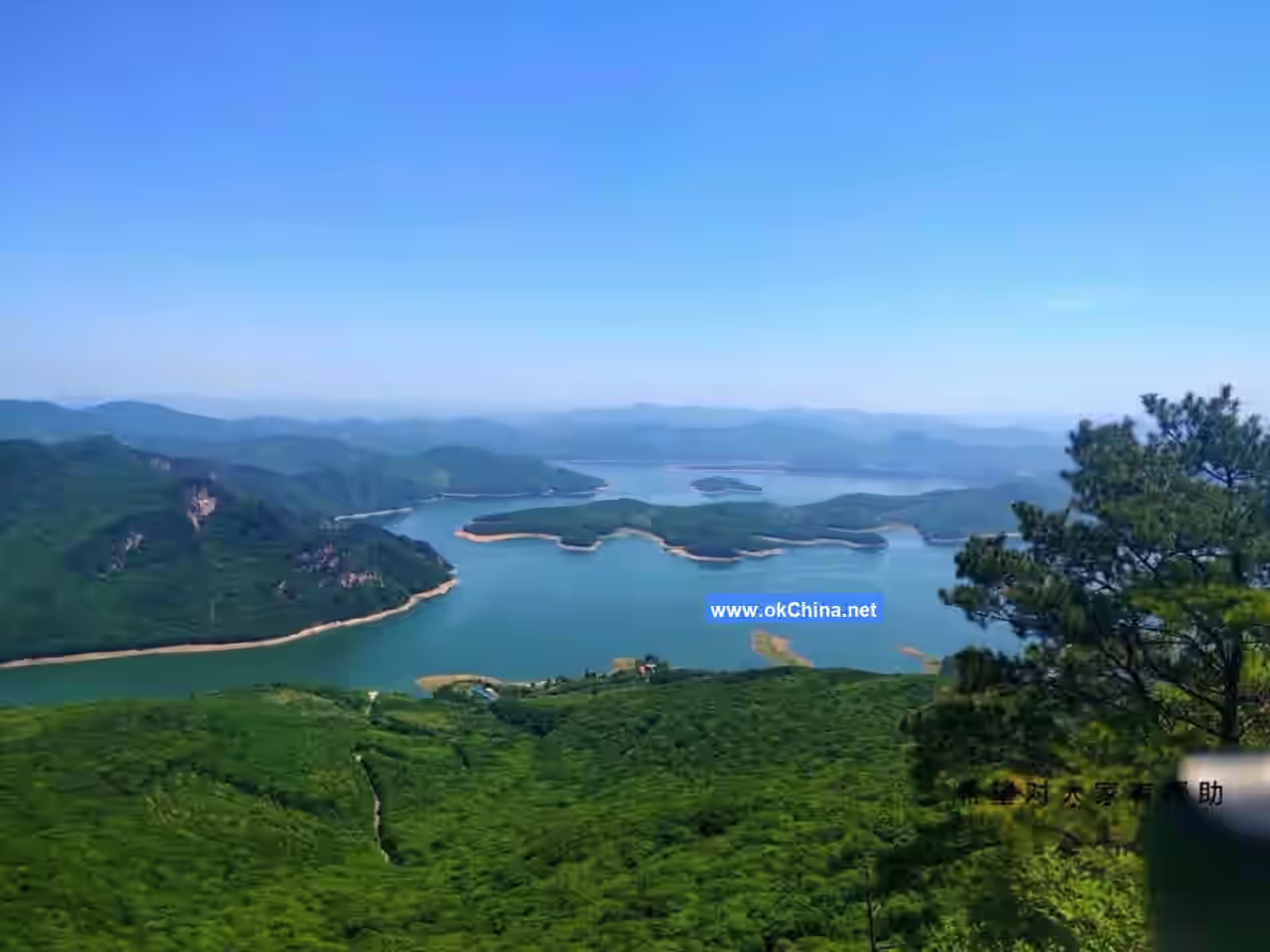
Wunv Mountain Ancient City is connected to Huanlong Lake. In 37 BC, Jumong, a prince of the Northern Buyeo Kingdom, arrived in the Hunjiang River basin within present-day Huanren and established the Goguryeo regime. Three years later, he built the royal palace on Wunv Mountain. As the first capital city in the early founding period of Goguryeo, Wunv Mountain Ancient City was designated as a National Key Cultural Relics Protection Unit by the State Council in 1996. The Wunv Mountain Museum is situated at the southwestern foot of the UNESCO World Heritage site, Wunv Mountain Ancient City, on the right bank of the Hunjiang River, nestled against the mountain and beside the lake, offering an elegant environment.
The museum features a unique and elegant architectural design with a classical style. It has a construction area of 3,400 square meters and an exhibition area of 1,500 square meters. Inside, multimedia phantom imaging, scene restoration, electronic books, and other display methods are used to recreate the glorious history and distinctive ethnic culture of the early Goguryeo period.
2. Development History
The beautifully scenic Wunv Mountain is renowned both domestically and internationally, long celebrated as a famous mountain in the northern frontier. Japanese scholars such as Kikuta Teiji and Uematsu Jiro also wrote about it. Page 203 of the main text of "Historic Sites and Relics of the Three Northeastern Provinces" by Kikuta Teiji, published on August 5, 1925 (the 4th year of the Taisho era), records: "Fifteen li north of Huanren County lies Wunv Mountain. Legend has it that five women from the Tang Dynasty occupied the mountain as a stronghold. The mountain is a thousand ren high, with two peaks facing each other, presenting a majestic and perilous terrain. The first peak forms a flat circle, enclosed by giant stones, with east and west gates, creating a natural stone city capable of accommodating ten thousand people..."
According to historical records, in 37 BC (the 2nd year of the Jianzhao era of Emperor Yuan of Han), Jumong, a prince of Northern Buyeo, fled here due to court conflicts and established the first capital of Goguryeo on the mountain, historically known as Gaseopgol Fortress (then under the jurisdiction of Goguryeo County in Xuantu Commandery). He built city walls and established the Goguryeo Kingdom, making this mountain the founding capital of Goguryeo. From the 3rd to the 5th centuries, Goguryeo reached its peak, occupying a vast area east of the Liao River, west of the Sea of Japan, south of the Second Songhua River, and north of the Han River. It lasted for 705 years in history until it was conquered by the Tang Dynasty in 668 AD (the 1st year of the Zongzhang era of Tang).
In 1424 AD (the 22nd year of the Yongle era of the Ming Dynasty), Li Manzhu, the grandson of Aha Chu (Li Chengshan) and son of Shijianu, the third-generation leader of the Jianzhou Jurchens, resided at Weng Village on the southern foothills of this mountain city when advancing into Liaoning.
Subsequently, Wunv Mountain City consistently served as a defensive garrison for the Jianzhou Jurchens. Numerous unearthed cultural relics attest that this mountain city housed troops or tribal settlements during the Tang, Liao, Jin, Yuan, and Ming dynasties.
Around 1986, the archaeological team of the Liaoning Provincial Museum and the Benxi Museum conducted small-scale archaeological excavations in the western part of the construction site for a television transmission tower near the Jade Emperor Temple. Artifacts from the Liao and Jin periods were unearthed from the upper layer, while early Goguryeo reddish-brown pottery shards were discovered in the lower layer.
In 1996, 1997, 1998, and 2003, the Liaoning Provincial Institute of Cultural Relics and Archaeology, the Benxi City Museum, and the Huanren County Cultural Relics Management Office jointly conducted four excavations at Wunv Mountain Ancient City, uncovering many important ruins and artifacts within the city.
3. Attraction Introduction
3.1 Yifu Pass
Yifu Pass is 26 meters long, 0.5 to 1 meter wide, with a vertical drop of 23 meters. The mountain path is narrow and steep, with a gradient exceeding 60 degrees, making it the most challenging and strategically important location on Wunv Mountain. After the Goguryeo dynasty moved its capital to Gungnae Fortress (present-day Ji'an City), they still stationed troops to guard this sacred birthplace. A mighty warrior named Boqi was assigned to defend this pass. Using stones as weapons, he hurled them down the pass, repeatedly repelling invading enemies and instilling fear in them, truly embodying "one man can hold the pass against ten thousand."
3.2 Smiling Ape Welcoming Guests
A protruding black bare rock on the side of a nearby high mountain resembles a monkey's head, vivid and lifelike. With a raised nasal bone, a receding forehead, gazing out from the heights, and upturned corners of the mouth, it seems to be welcoming arriving guests.
3.3 Wunv Spring
Legend has it that during the Tang Dynasty's Bohai Kingdom period, five women garrisoned troops on the mountain and repeatedly defeated military rebellions. The rebellious army, enraged, besieged the mountain for a long time, leading to exhaustion of supplies for those on the mountain. The five women prayed devoutly to heaven, and suddenly Guanyin (the Bodhisattva of Compassion) appeared, sprinkling sweet dew from her vase, which transformed into a mountain spring, saving everyone. It was later called "Wunv Spring." To this day, the spring flows continuously throughout the four seasons and does not freeze in winter.
The spring is over 8 meters long and 5 meters wide. To the south of the spring stands a giant stone over 4 meters high, inscribed with Wang Xizhi's calligraphy "Wunv Spring." Beneath the stone are buried two sacred water gourds, with water flowing from their spouts; it is said that drinking this water can cure illnesses and ward off disasters. To the north of the spring stands a scenic stone 4 meters long and 2.5 meters high, featuring a deep relief of the "Five Women Gathering Herbs" on the front and the "Legend of the Five Women" carved on the back. The area around the spring is paved with stone slabs, forming a leisure square where visitors can taste the sweet sacred water and rest.
3.4 Crouching Tiger Stone
This "One-Stroke Tiger" is the calligraphic work of Weng Tonghe, a late Qing Dynasty politician and calligraphy artist. It is vivid in spirit and coherent in brushwork. The character is carved into stone, symbolizing a tiger crouching in the mountain forest, surveying heaven and earth, signifying an imperial residence site.
3.5 Wangjiang Pavilion
Wangjiang Pavilion is a wooden scenic pavilion with four pillars and a single-eave pyramidal roof. Built near the water on high ground, it offers a panoramic view of the mountain city and water scenery, hence its name. About 20 meters south of the pavilion, there is a small gallery 5.5 meters long and 2.6 meters wide, with "beauty's leans" (resting rails) on both sides for visitors to rest. About 30 meters southeast, a viewing platform is built on the cliff edge overlooking the river. Standing on the viewing platform is like being on a boat moored by the lake, with water and sky merging into one, surrounded by continuous forests around the lake, creating a refreshing and captivating experience.
3.4 Tianchang Gate
This natural stone gate is about 60 meters long and 5 meters wide, with the narrowest point being only 3.5 meters. The stone walls on both sides are steep as if cut by a knife, making it one of the natural defenses of Wunv Mountain. Legend has it that when Jumong, the founder of Goguryeo, passed by this place, he suddenly saw the four large characters "Tian You Heng Chang" (Heaven Blesses Eternal Prosperity) flashing on the right cliff wall. Taking it as a divine revelation to establish his capital here to ensure the everlasting prosperity of his kingdom, he decided to build the royal capital on the mountain and named this natural stone gate "Tianchang Gate."
3.5 South Gate and South City Wall
According to the "Samguk Sagi" (History of the Three Kingdoms), Wunv Mountain Ancient City was built by Jumong leading the Goguryeo people in 34 BC. The city had three gates, and this is the ancient city's South Gate, located at the southeastern corner of the mountain city. The South Gate was ingeniously designed, utilizing a natural cliff as one side of the city wall and a man-made wall to block the other side of the gentle ridge, allowing for a pincer attack on enemies invading here, making it easy to defend and hard to attack. The city wall on the ridge totals 424 meters in length, formed by connecting natural cliff walls with man-made walls. The upper end closely connects with the cliff of the Commander's Platform, while the lower end is a 200-meter-long, over-20-meter-deep transverse cliff, ingeniously forming a T-shaped city gate for the passage of soldiers, civilians, and vehicles in and out of the mountain city. Comparable to the Acropolis of Athens, it is hailed as the "First Acropolis of the East." The inner part of the wall uses shuttle-shaped stones, while the outer part is faced with wedge-shaped stones, layered and exceptionally sturdy, known as "Goryeo stone," celebrated in the ancient saying "Qin bricks, Han tiles, Goryeo stone." To this day, after more than 2,000 years, its majestic appearance remains, as if narrating the wisdom and brilliant historical culture of the Goguryeo people.
3.6 Residential Sites · Barracks Ruins
On this relatively flat mountain land, there are distributed numerous pits, totaling 21. Each pit represents a house site, densely packed and close to each other, all being semi-subterranean structures with a plan in the shape of a rounded rectangle. How were these houses built? First, a rectangular pit about half a meter deep was dug into the ground, and the excavated soil was piled around the house site to form a low waterproof wall. Some house sites had stone slabs attached or stone walls built around the interior walls. Inside, L-shaped heated brick beds (kang) or heated walls were installed. Under the kang, there were generally 2 or 3 flues, covered with stone slabs, and the surface was plastered with mud to form the kang bed. Here is the stove, with the chimney on the earthen wall outside the house. The base of the chimney only had a circle of stones, so the chimney at that time was likely a hollow wood. No stone walls or post holes were found on the earthen walls, suggesting the walls were probably built with horizontal logs. On the sloping ground outside, traces of drainage ditches are faintly visible.
These house sites yielded a large number of artifacts such as pottery and ironware. Particularly, after two houses caught fire, items inside were buried in the pits, yielding many weapons, including iron arrowheads, iron spears, iron armor pieces, and even an iron armor coat, reflecting the military nature of these sites. Therefore, this area was likely a barracks, the garrison for troops defending the mountain city. These troops combined military and civilian roles, being civilians in peacetime and soldiers in wartime.
3.7 No. 2 Large Building Foundation Site
This site is the "No. 2 Large Building Foundation Site," a super-large semi-subterranean building foundation from the Goguryeo period, measuring 22 meters long and 16 meters wide. Three sides have 2-3 meter wide wedge-shaped stone wall foundations. The east side uses an excavated earthen ledge as a wall, with inner and outer walls separated by a 40-centimeter-wide concealed ditch built between them. The ground is a naturally flat bedrock sloping southward. Thirty-nine cultural relics, including pottery, ironware, and bronze ware, were unearthed here. As the building on the site no longer exists, it is difficult to verify its structure, style, and purpose today. However, the fact that the Goguryeo people over 2,000 years ago could construct a single building covering more than 350 square meters demonstrates their advanced architectural skills.
3.8 East Gate and East City WallThis is the East Gate of the Mountain City, the foremost of the three gates, with a width of 4.3 meters. The flanking walls form a zigzag shape, ensuring that any attacking enemy would be caught in a crossfire from both sides, making it easy to defend and difficult to assault. On the right side, a straight wall connects to the steep cliff of the Hengshan Mountain's southern slope. This man-made wall is 118 meters long, with a base width of 4-6 meters and a top width of 3-4 meters. On the left, the man-made wall curves, connecting intermittently with natural cliffs and extending over 390 meters. The wall is exceptionally sturdy; even after more than 2000 years, the remnants remain largely intact. Research indicates that external supplies were often transported into the city through this gate. During periods such as the first capital of Goguryeo, this gate was a crucial military stronghold.
3.9 Hero Pine
This ancient pine, standing proudly on a steep cliff, has an elegant and extraordinary posture. Like a hero, it stands firm in the face of danger, unafraid of wind and frost, making it the most distinctive ancient pine on Wunu Mountain.
3.10 Qiyun Road
Starting from Qiyun Pavilion and climbing straight up along the mountain slope, passing through the ancient Eighteen Bends path to the West Gate ruins, this route consists of 999 stone steps. It resembles a ladder to heaven, symbolizing proactive advancement and steady progress.
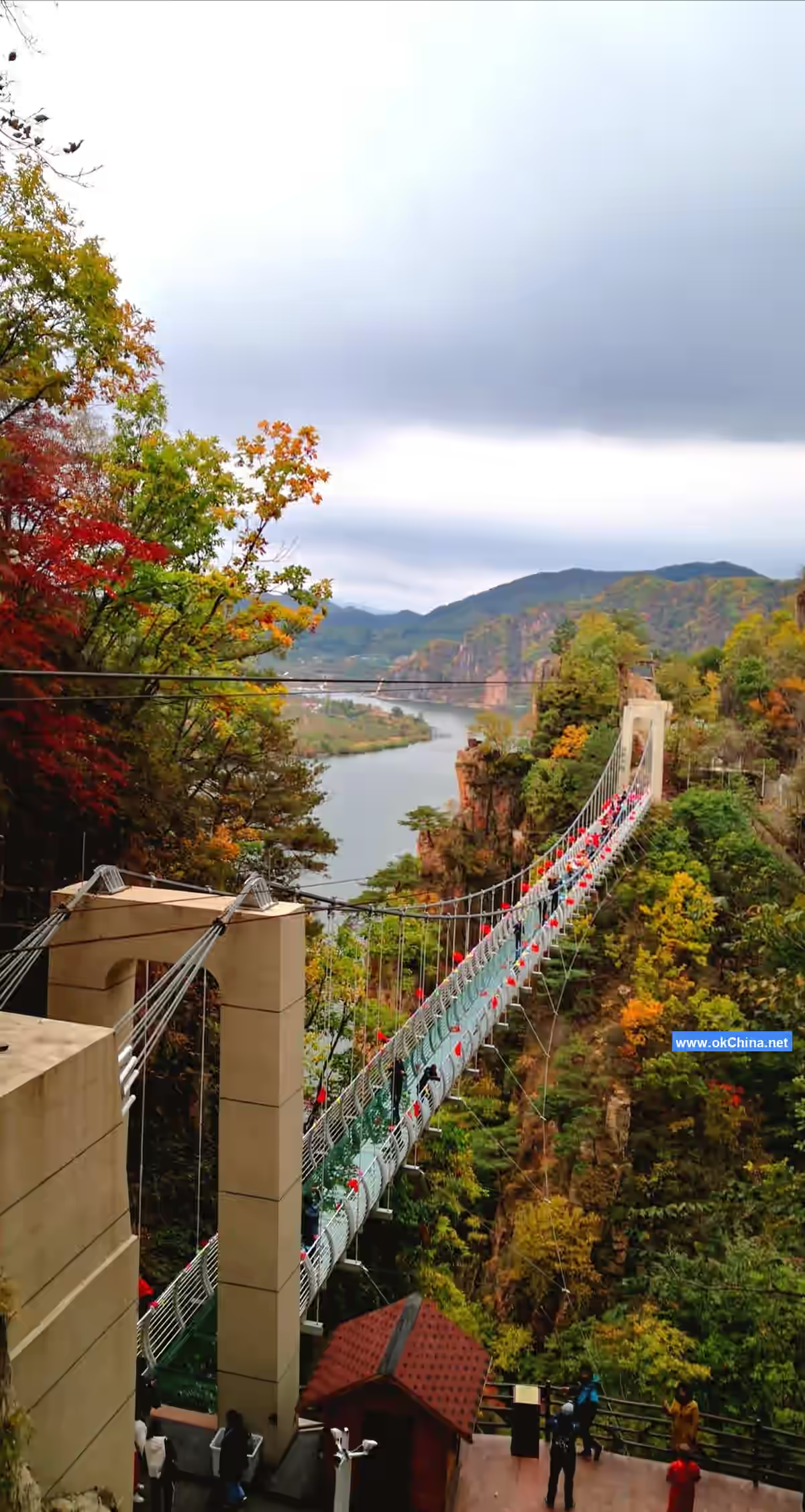
3.11 Sisters Bridge
Legend has it that in a village below the mountain lived a beautiful girl named Chunlian. When a local bully named Tongniu proposed marriage and was rejected, he led his men to kidnap her. Chunlian fled to this spot, but faced with a deep ravine and no escape, she contemplated ending her life. At that moment, five heroic women appeared on the opposite cliff, leading a rescue party. One of the women swung a large axe, felling a tree in front of the cliff, which instantly transformed into a bridge spanning the two cliffs. The five women led the charge against Tongniu and his men, eventually capturing them. That night, the five women and Chunlian met on the bridge and swore sisterhood. The local people thereafter called this bridge the "Sisters Bridge."
3.12 Solitary Beauty Peak · Immortal Gathering Terrace
Ahead stands a solitary, prominent rock peak with an elevation of 826 meters. Its four sides are steep and upright, rising elegantly, hence the name Solitary Beauty Peak. The summit platform covers nearly 4000 square meters, lush with verdant pines and cypresses.
Historical legend tells that the five women garrisoned troops on the mountain to resist government forces and bandits. After fighting until their ammunition and supplies were exhausted, they chose to burn themselves on the summit of Solitary Beauty Peak rather than surrender. The Republican-era poet Yuan Shuzi praised the five women: "The Heavenly Pool's water is clear, / Looking north to the Immortal Gathering Terrace, / Four or five jade maidens, / Riding the wind descend from the highest heavens." Thus, the platform atop Solitary Beauty Peak was named "Immortal Gathering Terrace." In the winter of 1934, Li Guangda, leader of a Northeast Anti-Japanese guerrilla unit, and his comrades were surrounded by Japanese garrison troops. Outnumbered, they fought until nightfall, but the enemy did not retreat. Li Guangda led his team to the base of Solitary Beauty Peak, used ropes to climb up to the Immortal Gathering Terrace, and safely broke through the encirclement from its northern end at midnight. At dawn, the enemy searched the mountain but found no one. This left behind a heroic song of the Anti-Japanese联军 achieving victory against overwhelming odds.
3.13 Gate Guard General
This nearly 20-meter-high stone pillar by the cliff is the "Gate Guard General." At first glance, it resembles a heroic figure standing tall and proud. Legend says that in 3 AD, when the Goguryeo dynasty moved its capital from Wunu Mountain to Gungnae Fortress (present-day Ji'an City), Fuli, son of Zhu Meng's close minister Wu Yi, was ordered to guard the old capital. He performed his duties faithfully, vigilantly watching the movements below the mountain and constantly protecting Wunu Mountain City. Exhausted from his ceaseless work and toil, Fuli passed away heroically. Yet, he remained standing, transformed into this massive stone pillar, continuing to guard Wunu Mountain City for over 2000 years. Truly, "Clad in armor guarding the heavenly gate, awe-inspiring and inviolable." The loyalty and righteousness of such a man are remembered through the ages.
3.14 Sea of Clouds and Pine Waves
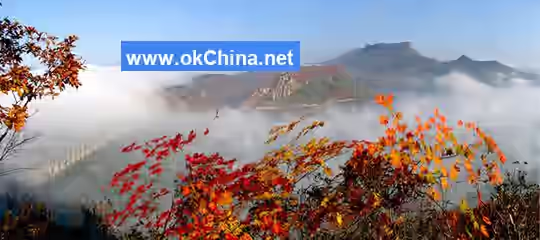
This area is often shrouded in white clouds, with pine trees standing tall all around. From here, one can view the distant sea of clouds and hear the nearby sound of wind through the pines. Standing here, one can see the faint, undulating distant mountains stretching continuously; village houses scattered in an orderly, tiered fashion; and winding mountain paths,灵动优美. It evokes endless reverie and a sense of being far removed from the mundane world, transcendent and detached.
3.15 Flying Peak
The strange peak ahead, seemingly thrust diagonally into the mountain, is Flying Peak. It stands over 70 meters high but is only two to three meters wide, with a peak like a finger pointing straight at the sky. On misty mornings after rain, with clouds churning, it appears as if it flew here from beyond the heavens. Several hardy pines stand on the rocky slopes of the peak, complementing it like a盆景,堪称一绝.
3.16 South Heavenly Gate
This site is rumored to be where Zhu Meng subdued a yellow dragon and ascended to heaven. Three straight, bare rocks, each about seven to eight meters high and spaced 10-20 meters apart, stand like two并列的山门, hence the name "South Heavenly Gate." Legend has it that Zhu Meng once dreamed of a heavenly deity saying, "When the South Heavenly Gate opens, the Heavenly Emperor will send a yellow dragon to escort the king to the celestial palace." Soon after, on a stormy night with thunder and lightning, two gaps suddenly appeared in the mountain peak after a霹雳. Knowing this was the opening of the South Heavenly Gate and seeing a yellow dragon descend from auspicious clouds, Zhu Meng mounted it and, accompanied by celestial music, ascended to heaven. The Gwanggaeto Stele records: "Not delighting in worldly position, Heaven sent a yellow dragon down to welcome the king. The king, on the eastern ridge of Holbon, was borne aloft by the yellow dragon and ascended to heaven."
3.17 West Gate Ruins
The West Gate is one of the important gate sites of the mountain city and the only gate located on the mountaintop. Remains include the gate steps, pivot foundation stones, stone walls, and guardroom. The gate steps are paved with stone slabs, totaling five steps, 3.3 meters long and 2.4 meters wide. On both sides of the steps are pivot foundation stones made of granite, featuring circular sockets with an opening diameter of 16 cm, base diameter of 11 cm, and depth of 8 cm, used for installing and rotating the gate leaves. Behind these are remnants of a stone wall nearly one meter high, with凹形 buildings on each side constructed with楔形石 on three sides, each about one square meter in area. These are actually the ruins of guardrooms where soldiers stood watch.
In terms of city layout, wall construction, and stone processing, Wunu Mountain City pioneered the Goguryeo people's construction of mountain fortresses, exerting a significant influence on later Goguryeo mountain city architecture and even Northeast Asian construction techniques.
3.18 Taiji Pavilion
Built in 2006, this is a four-pillar, single-eave, pointed-roof square pavilion with sides measuring 3 meters. The upper plaque bears the three large characters "Taiji Pavilion." It has doors on the north and south sides, with "beauty rests" (leaning rails) on the east and west rows. The two pillars of the north door bear a couplet: "The Great Simplicity knows constancy, rise and fall initiate traces of a thousand-year history; / The Ultimate Gate observes phenomena,风水 follows heaven's八卦 city." It is named because standing here and looking down reveals a breathtaking natural wonder—a天然太极图.
3.19 Heavenly Pool
An ancient myth says, "Drink a cup of Heavenly Pool water, and you will返老返童," referring to this reservoir. Located at the lowest point within the mountain city, it collects rainwater, forming a pool commonly called the "Heavenly Pool," carved out of rock by the Goguryeo people. The pool is about 12 meters long, 5 meters wide, and over 2 meters at its deepest point, never drying up year-round. Retaining stone walls surround the pool to keep the water clean. A one-meter-square small well, 1.2 meters deep, is built at the southeast corner; water from the pool seeps into it for direct drinking. Below, a circular small池 about 5 meters in diameter was constructed. When the large pool fills, water flows into it. Records state this small池 provided生活用水 for people on the mountain and water for soldiers' horses.
3.20 General Reviewing Platform
The General Reviewing Platform, historically called the "Watchtower," is located at the southeastern extremity of the mountain city at an elevation of 804 meters. It is a natural stone platform 17 meters long and 15 meters wide, the highest point of Wunu Mountain overlooking the river. From here, one can see for over a hundred li in all directions. Legend says Goguryeo's founder Zhu Meng and the Tang Dynasty's Grand Governor Xue Rengui reviewed their troops here, hence the name "General Reviewing Platform." A stele exists with the inscription "General Reviewing Platform" in three large characters, carved from the handwriting of Tang Yin. During the Goguryeo period, as the highest point of the mountain city, it was used to light beacon fires in紧急战况 to signal surrounding garrison cities and summon reinforcements, making it the best lookout point for the "First Eastern Garrison City." Today, it is公认 by tourists as the "Number One Scenic Spot in Liaoning." Standing on the platform and gazing into the distance: beneath lies a continuous forest sea, Huanlong Lake shrouded in misty waves, its golden shoreline winding like a colorful ribbon—a breathtaking sight that stirs the heart.
3.21 Cloud Viewing Pavilion
This "Cloud Viewing Pavilion" is a six-pillar, six-corner, double-eave, pointed-roof viewing pavilion. Because it is near water, the scenery resembles flowing clouds like a sea, as if flying over山水, making it an excellent spot for viewing clouds, especially in autumn, hence the name. The pavilion has a平面 diameter of 4.9 meters, doors on two sides, and beauty rests on all four sides. The northwest door hangs a couplet: "Flowing clouds wash the feet, refreshing, / Refreshment gives visitors' delight dancing with clouds; / Blue water reflects the sky, clear, / Clarity of spirit endures with the water." To the southeast, it is surrounded by Huanlong Lake. To the right, the General Reviewing Platform towers high, its岩壁 covered with climbing plants, resembling a huge mural. To the left stands the small General Reviewing Platform amidst the forest, offering a panoramic view of the mountain city's beauty—truly marvelous and leisurely.
3.22 Zhu Meng Statue
Wunu Mountain City was built by the first Goguryeo候, Zhu Meng, leading his people. It is strategically located by mountains and water, easy to defend and hard to attack. To commemorate this splendid history and culture and to honor Zhu Meng, the Wunu Mountain Tourism Development Group Company erected a statue of Zhu Meng in 2020. On a 1.8-meter-high imitation stone基座 stands a bronze statue of Zhu Meng riding a Guoxia horse, equipped with a bow and arrows. The total height of man and horse is 2.5 meters. The forms of the Guoxia horse and Zhu Meng were determined after多次论证 by provincial archaeological experts. The front of the基座 is inscribed with the time of Zhu Meng's founding of the Goguryeo Kingdom and the construction of the capital. Gazing at the statue, one由衷感叹s Zhu Meng's great vision and talent, which开创了 the 705-year glorious history of Goguryeo. He is尊称ed in historical records as the "Holy King Dongmyeong."
3.23 No. 1 Large Building Site
This site is the "No. 1 Large Building Foundation of Wunu Mountain City," measuring 13.5 meters long and 5 meters wide. Because seven irregular quadrilateral large stone slabs are arranged in a row from east to west in the front, spaced about 1.7 meters apart, resembling column foundation stones for a six-bay building, and due to its large scale, south-facing orientation (背风朝阳), and proximity to a water source, it is推测 to be the palace site built by Zhu Meng when establishing the capital. Early Goguryeo竖耳陶罐, Han Dynasty "Wuzhu coins," and Wang Mang period "Daquan Wushi coins" have been unearthed here, but no琉璃瓦 or stone steps have been found. Since the Goguryeo people over 2000 years ago could not yet烧制砖瓦, it is推测 that the palace at that time was a土木石 structure with thatched roofs—what historians call "living in结芦 dwellings."
3.24 Ancestral ChairThis natural scenic rock resembles a mountain king's armchair, and legend has it that Zhu Meng, the founder of Goguryeo, often rested on this stone chair, hence it is named the "Ancestor's Chair." Not far above, two scenic stones stand, carved with the characters "dragon" and "phoenix," symbolizing the auspicious union of dragon and phoenix, and the peace and prosperity of the nation.
3.25 Taiji Diagram
The benevolent love mountains, the wise delight in water, and Huanren is a place blessed with beautiful landscapes and outstanding people. Ascending the Taiji Pavilion and gazing into the distance, the breathtaking view of "Fuxi's Taiji, a wonder of the world" unfolds before us. This Taiji Diagram is formed by the convergence of the Hada River and the Hun River, which encircle and swirl around the county town. Huanren County is situated on the yang fish of the Taiji Diagram. According to the Book of Changes, from Wuji comes Taiji, from Taiji come the two polarities (yin and yang), from the two polarities come the four phenomena, from the four phenomena come the eight trigrams, and from the eight trigrams evolve the 64 hexagrams. In the third year of the Guangxu reign of the Qing Dynasty (1877 AD), Huanren was established as a county. The first magistrate, Zhang Yue, and the Eastern Circuit Intendant, Chen Benzhi, surveyed the area of 5,958 square kilometers and finally arrived at the mountain. Guided by the design philosophy of "assessing the terrain, selecting this land, two rivers encircling like a belt, gathering qi and storing wind, five peaks standing like a screen, securing the open plain, the city shaped like the eight trigrams to propagate the eight winds, and three gates opened to establish the three talents," they constructed the Eight Trigrams County Town. (The phrase "assessing the terrain, selecting this land" refers to surveying the topography and selecting the land, with heavier soil considered superior in ancient times; "two rivers encircling like a belt, gathering qi and storing wind" refers to the natural Taiji formed by the Hada and Hun Rivers, a feng shui treasure that gathers qi and stores wind; "five peaks standing like a screen, securing the open plain" means that the mountains in the four directions, along with the backing mountain, firmly anchor this spacious small plain, symbolizing eternal stability and national prosperity; the county town built on the yang fish of the Taiji is shaped like the eight trigrams, signifying the propagation of influence in all directions, with three gates opened to harmoniously establish heaven, earth, and humanity—thus, the world's unique, heaven-humanity-unified Taiji Eight Trigrams County Town was conceived and built.) This illustrates Zhang Yue's original intention to build the Eight Trigrams City based on the mountainous and riverine terrain and expresses his hope to connect with the sun, moon, and stars, nurturing and establishing the three talents of heaven, earth, and humanity.
Thus, the entire tourism image of Huanren—"Taiji Landscapes, Nourishing Huanren"—can be clearly understood from here. Huanren's tourism resources are planned and positioned according to the four phenomena of Taiji. Looking now at the Azure Dragon direction of the Taiji four phenomena, i.e., the left side, there are tourism resources such as Maple Forest Valley, Huilong Lake, Jinlong Lake, Longxi Valley, Benxi Dry Cave (the main cave is called Azure Dragon Cave), Huabo Mountain, Tiger Valley Gorge, and the Geothermal Anomaly Zone. In the Taiji four phenomena, the Azure Dragon governs joyous events; a tall and extensive Azure Dragon indicates assistance from noble people and continuous wealth. The Vermilion Bird direction, i.e., straight ahead, features tourism resources like Fengming Lake, Yunfeng Gorge, Yunfeng Mountain, Niumao Mountain, Laotudingzi, Dream Valley, and Gaoli Valley. The Vermilion Bird governs career success; this direction should have water and gentle mountains for smooth career prospects and a bright future (tall buildings should be avoided). The White Tiger governs unfortunate and mourning events; the White Tiger direction we see now refers only to the small hill at the bridgehead of Shangguchengzi. In feng shui, a low White Tiger direction that does not overpower the Azure Dragon is considered optimal (Huanren's Taiji landscapes consist of eight parts mountain and one part water. The mountainous terrain harbors dragons and tigers. Its qi and fortune are exceptionally rare and superb). The Black Tortoise governs fortune and health, led by Wunv Mountain, and includes resources like Sidaolingzi, Dachuan Hot Springs, and Gangshan Ridge (a branch of the Longgang Range of the Changbai Mountains). A tall and majestic Black Tortoise signifies support, foundation, and backing, ensuring smooth progress and success in all endeavors.
3.26 One-Line Sky
This is the world wonder known as "One-Line Sky," a fissure in the main peak's rock mass. The rock walls on both sides stand upright as if chopped by an axe or split by a knife, exhibiting the imposing presence of towering cliffs. From the deepest part of the fissure, looking upward, only a sliver of blue sky is visible, hence the name "One-Line Sky." The deepest point is 31 meters, with a total length of 71 meters. The widest part is about two meters, while the narrowest is less than half a meter. The bottom has a slope of 40-50 degrees, allowing only one person to pass through in a semi-walking, semi-crawling posture. Originally an impassable natural chasm, the county government funded the construction of a stone staircase over 80 meters long with more than 490 steps in 1999 for tourists to climb. Research indicates that One-Line Sky formed approximately 3 billion years ago during the Mesoarchean era due to folding and faulting of the strata. It has been evaluated by experts as a Grade II geological heritage and was regarded by Zhang Xinsheng, Chairman of the 28th Annual Conference of UNESCO, as "absolutely world-class natural scenery."
4. Cultural Value
Wunv Mountain Scenic Area features magnificent peaks, rippling lakes, and enchanting landscapes. It is renowned worldwide for four major distinctions: a UNESCO World Heritage site, the sacred birthplace of Goguryeo, the origin of the Qing Dynasty, and a model site for Chinese Yi studies. Within the mountain city, there are over 50 early Goguryeo ruins, including city walls, palaces, barracks, residences, sentry posts, watchtowers, storage facilities, and reservoirs, which hold immense historical value for the study of early Goguryeo civilization.
Comments
Post a Comment