
Wudang Mountain Scenic Area, Shiyan City
1. Introduction
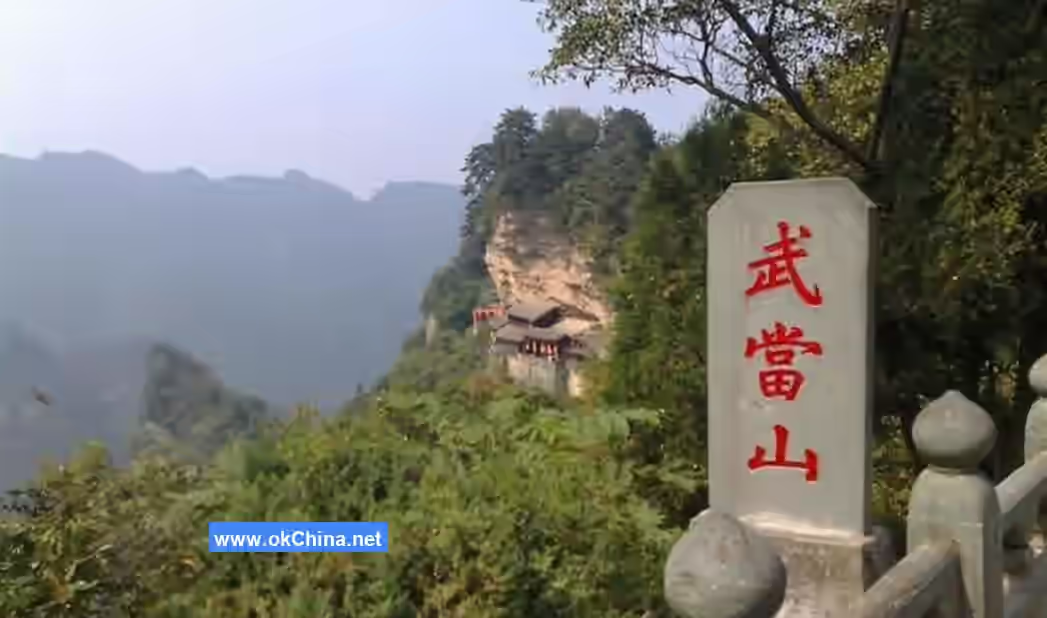
Wudang Mountain, also known as Taihe Mountain and Canshang Mountain, is located in Shiyan City, Hubei Province. It is a famous Taoist sanctuary in China, one of the first national key scenic spots, and a UNESCO World Heritage Site.
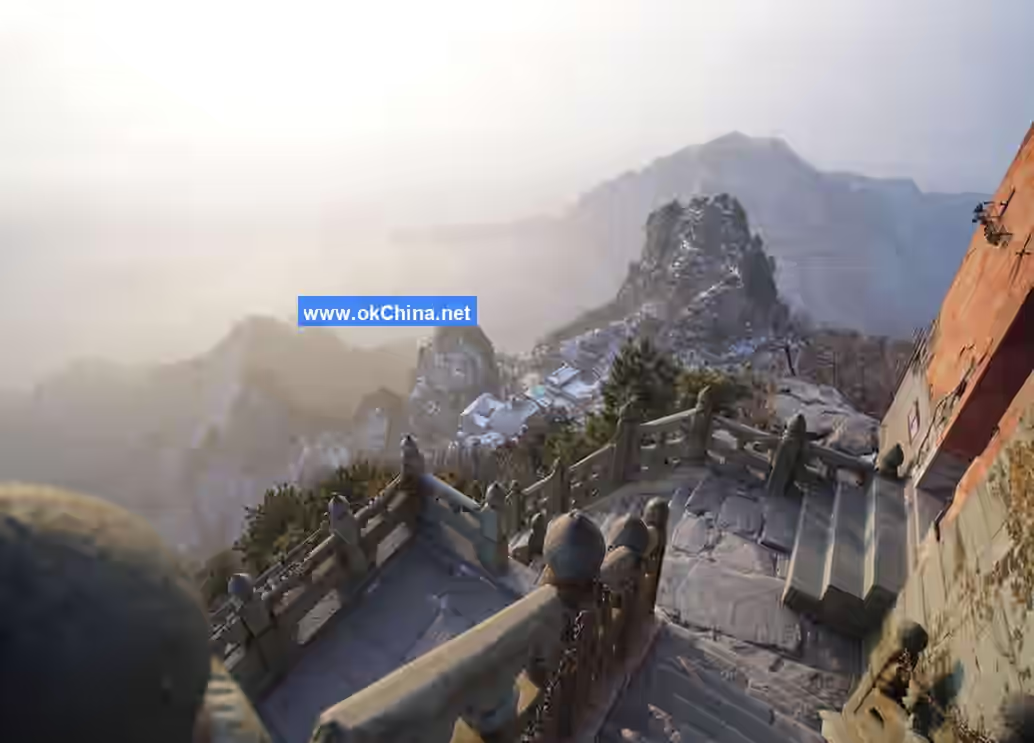
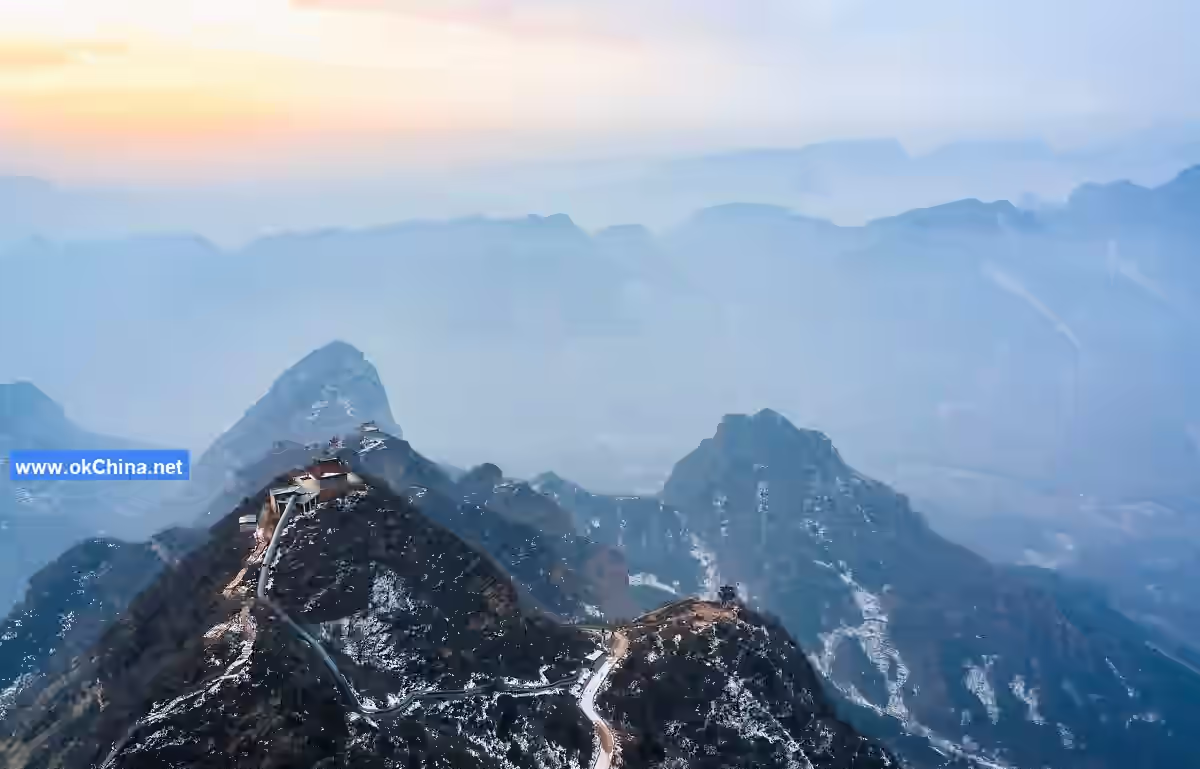
Wudang Mountain stretches for 800 li (approximately 400 kilometers). Its natural landscape is primarily majestic, also featuring elements of peril, wonder, seclusion, and elegance. Since the Yuan Dynasty, it has been known for its 72 peaks, 36 cliffs, 24 streams, 11 caves, 3 pools, 9 springs, 10 rocks, 9 wells, 10 ponds, and 9 platforms. The main peak, Tianzhu Peak, stands at an altitude of 1,612 meters, towering into the sky like a precious pillar of gold and jade, crowning the mountain range. The surrounding peaks slope towards the main peak from all directions, creating the unique natural wonder described as "seventy-two peaks paying homage to the great summit, twenty-four streams flowing endlessly." It is praised as "an unparalleled scenic wonder since ancient times, the foremost celestial mountain under heaven."
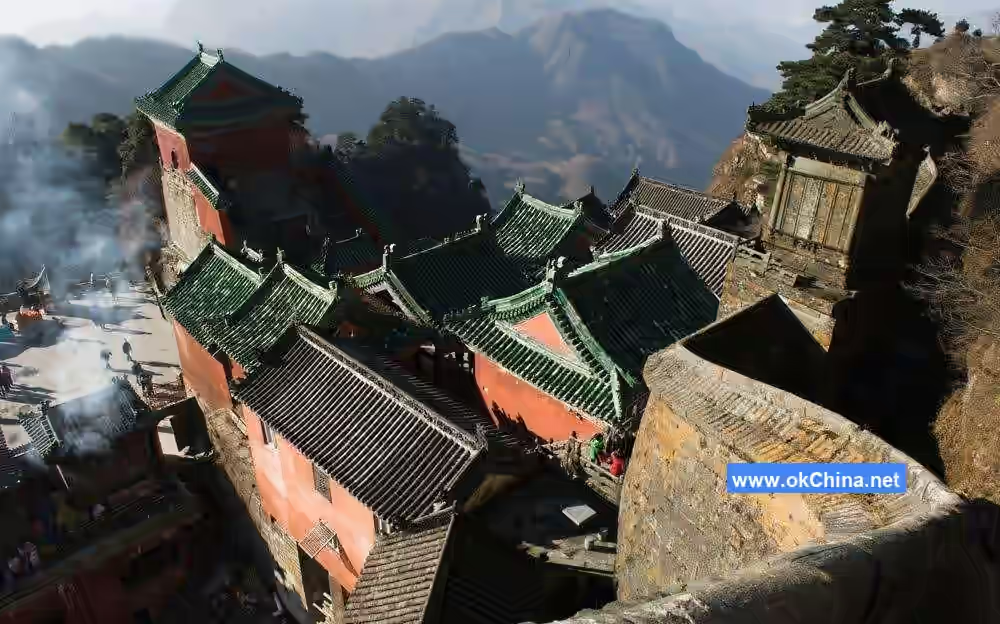
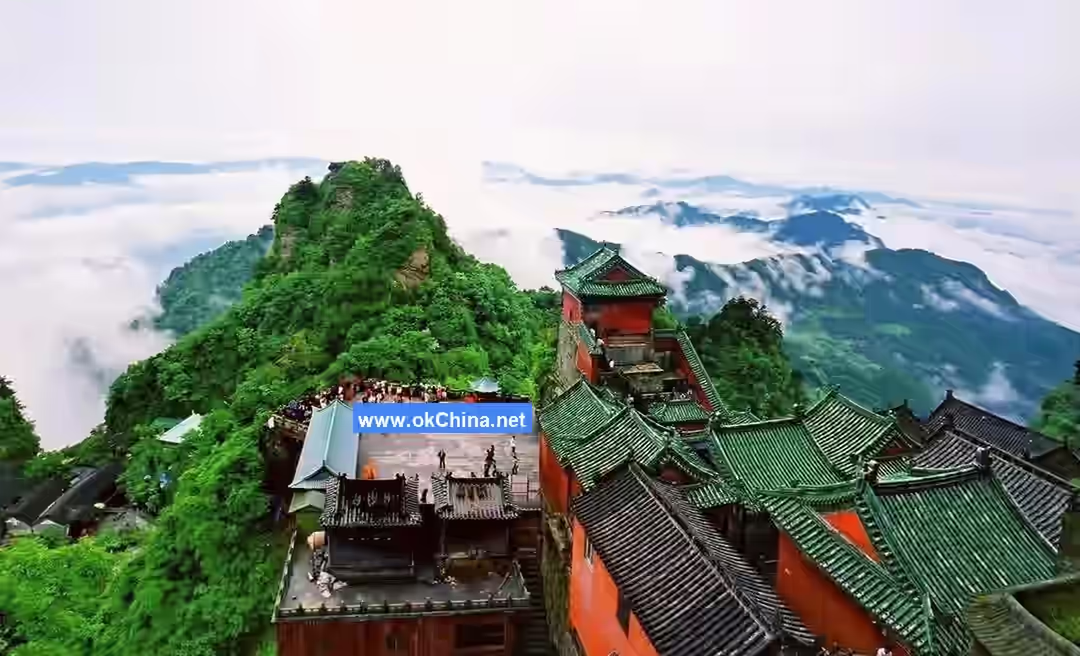
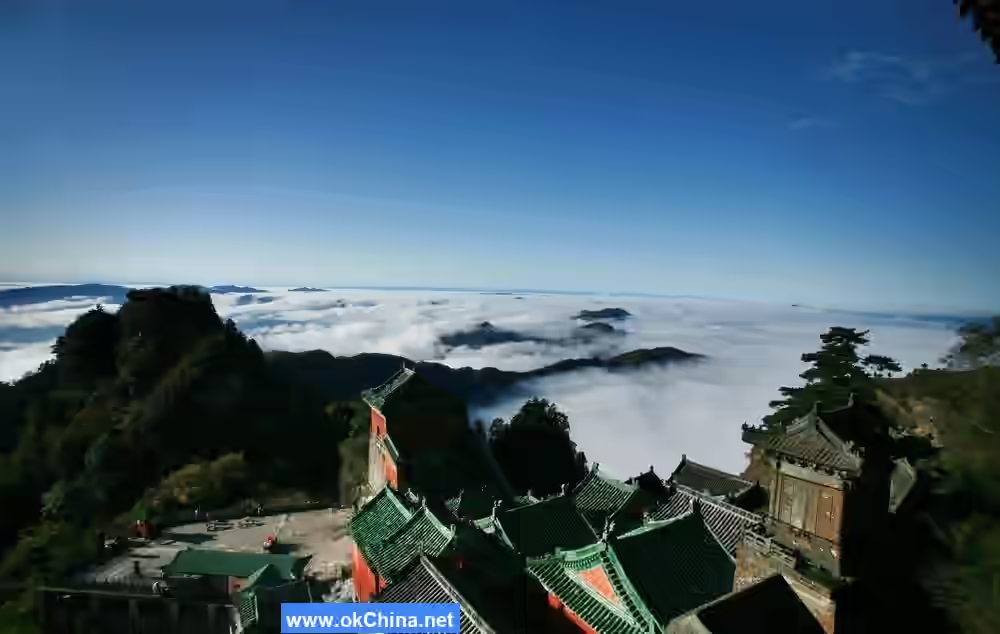
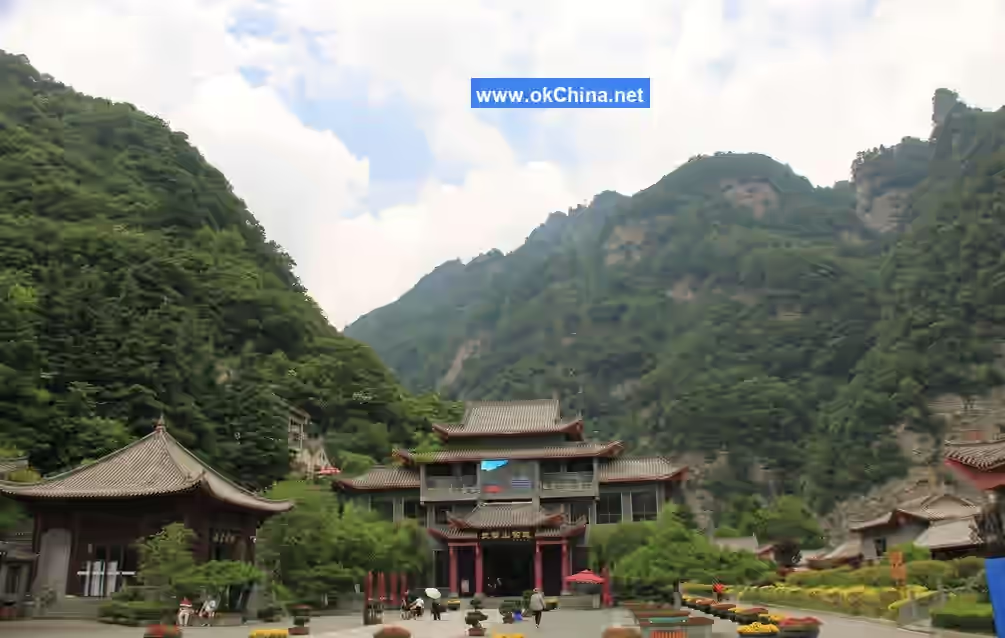
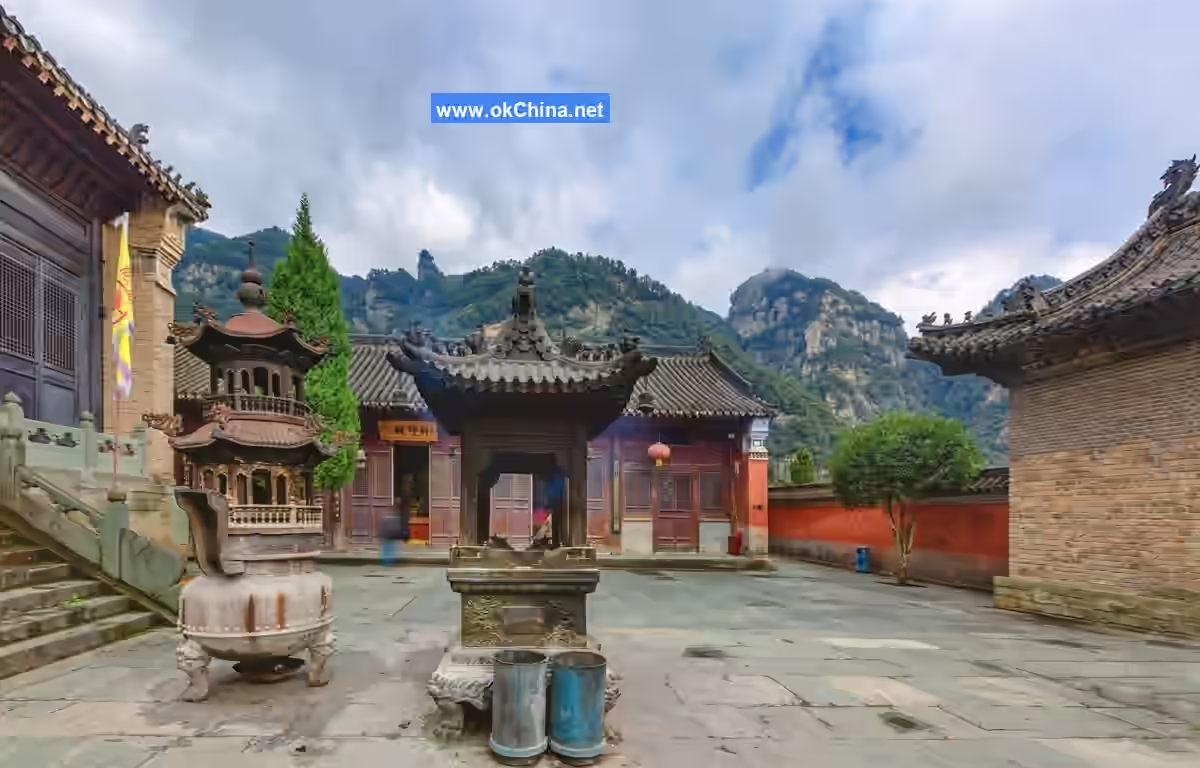
Wudang Mountain is renowned worldwide for its grand architectural scale. Its ancient buildings were initially constructed during the Tang Dynasty, with subsequent additions and renovations during the Song, Yuan, Ming, and Qing Dynasties, reaching their peak in the Ming Dynasty. A total of 33 architectural complexes were built, covering over 1 million square meters. Having weathered centuries of change, about 50,000 square meters remain today. The entire architectural system was uniformly designed and laid out according to the Taoist story of "Zhenwu's cultivation to immortality," employing imperial architectural standards. The scale and spacing of the structures are perfectly balanced, skillfully arranged to follow the mountain's contours, creating a harmonious and interconnected layout. Built either atop perilous peaks, hidden within sheer cliffs, or nestled in deep forests, they embody a high degree of harmony between architecture and nature, achieving the artistic conception of "a celestial mountain with jade palaces." It is hailed as "an exhibition of China's ancient architectural achievements." In 1994, the Ancient Building Complex in Wudang Mountain was inscribed on the UNESCO World Heritage List.
2. Geographical Location
2.1 Location and Territory
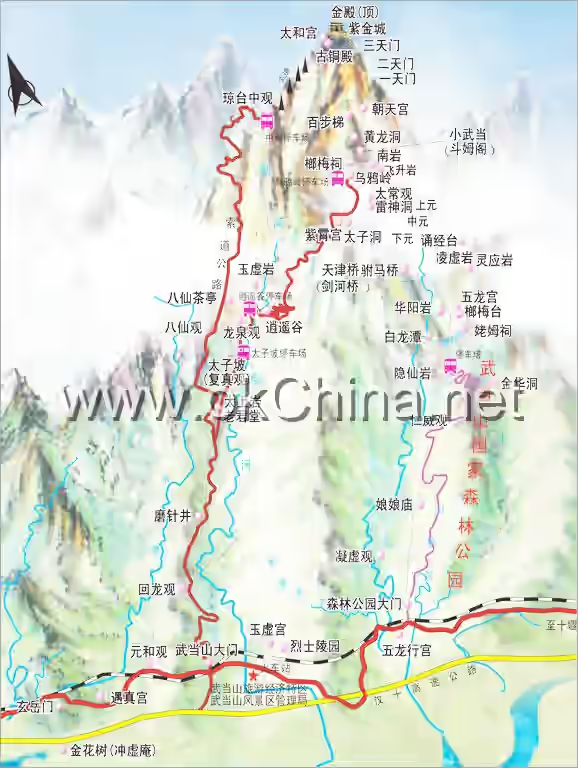
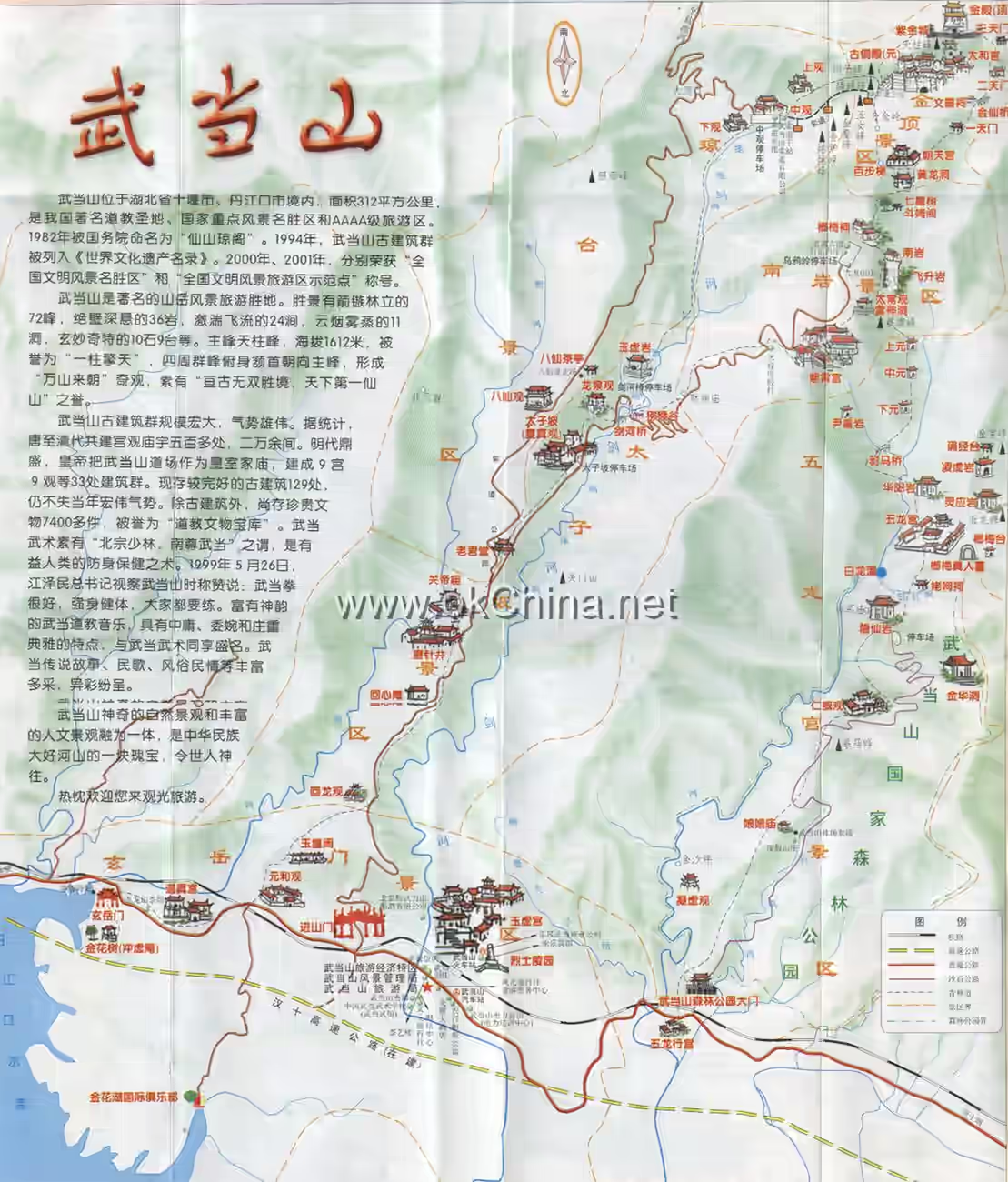
The Wudang Mountain Scenic Area is located within Danjiangkou City, Shiyan City, Hubei Province. It borders the historic city of Xiangyang, Hubei Province to the east, adjoins the urban area of Shiyan City (known as the "Motor City") to the west, lies next to the primeval forest of the Shennongjia Forestry District to the south, and faces the Danjiangkou Reservoir—the source of the central route of the South-to-North Water Diversion Project—to the north.
2.2 Topography and Geology
Wudang Mountain is a branch of the Daba Mountains within the Qinling Mountain system, stretching from northwest to southeast, covering an area of approximately 400 square kilometers. The main body of Wudang Mountain is composed of metamorphic rocks, along with some igneous rocks, belonging to the Neoproterozoic Wudang Group (formed 780-670 million years ago) and the Yaolinghe Group (formed 680-630 million years ago). The exposed metamorphic rocks on the mountain are mainly phyllite, slate, and schist.
2.3 Climate Characteristics
Wudang Mountain features a subtropical monsoon climate with distinct vertical climatic zones. Temperature decreases with increasing altitude, with an annual average temperature around 16°C. It is also one of China's top ten summer resorts.
3. Main Attractions
3.1 Taihe Palace (Golden Summit)
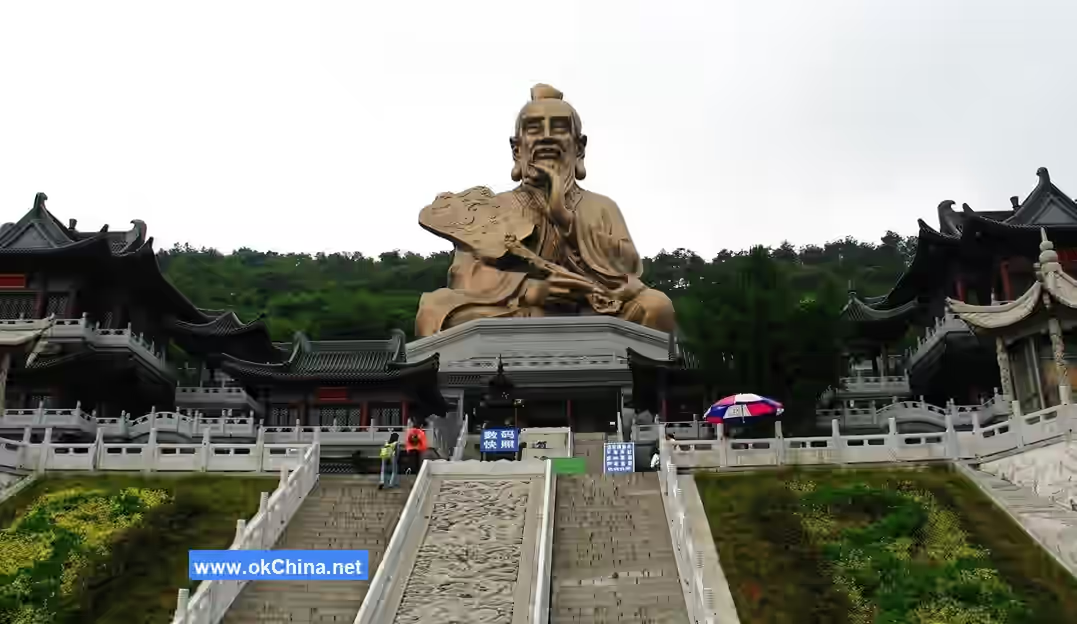
Taiyue Taihe Palace, commonly known as Taihe Palace, is located at the summit of Tianzhu Peak. Its architectural complex is distributed along a construction line about 2 kilometers long, at an altitude of around 1,500 meters. The overall layout of the palace fully utilizes the towering momentum of Tianzhu Peak, employing Ming Dynasty imperial architectural standards in a sequential arrangement to emphasize the concept of divine authority. In the early Yuan Dynasty, a stone hall stood at the summit of Tianzhu Peak, containing an incense burner and a statue of the Dark Emperor (Xuan Di). In the 11th year of the Dade era (1307 AD), a bronze hall was placed at the summit to house the statue. From the 10th to the 14th year of the Yongle era (1412-1416 AD) of the Ming Dynasty, the Golden Hall was built atop the summit. By the Jiajing era, the palace had expanded to 520 rooms. Due to long-term neglect, most of the ancient buildings have been lost. Over 150 rooms remain today, with a floor area of more than 3,000 square meters. The existing buildings and ruins cover a total area of 87,500 square meters. The Golden Hall is a Ming Dynasty bronze-cast, wood-structure imitation palace-style building, situated on a stone platform of about 160 square meters at the summit of Tianzhu Peak. It was built in the 14th year of the Yongle era (1416 AD). In the 31st year of the Jiajing era (1552 AD), the foundation, stone railings, and steps were partially repaired, and vermilion wooden railings were added outside the hall. In the 42nd year of the Kangxi era (1703 AD) of the Qing Dynasty and the 3rd year of the Republic of China (1914 AD), brick-and-wood ancillary buildings such as dressing rooms on both sides and the Parental Hall behind the main hall were added.
3.2 Nanyan Palace
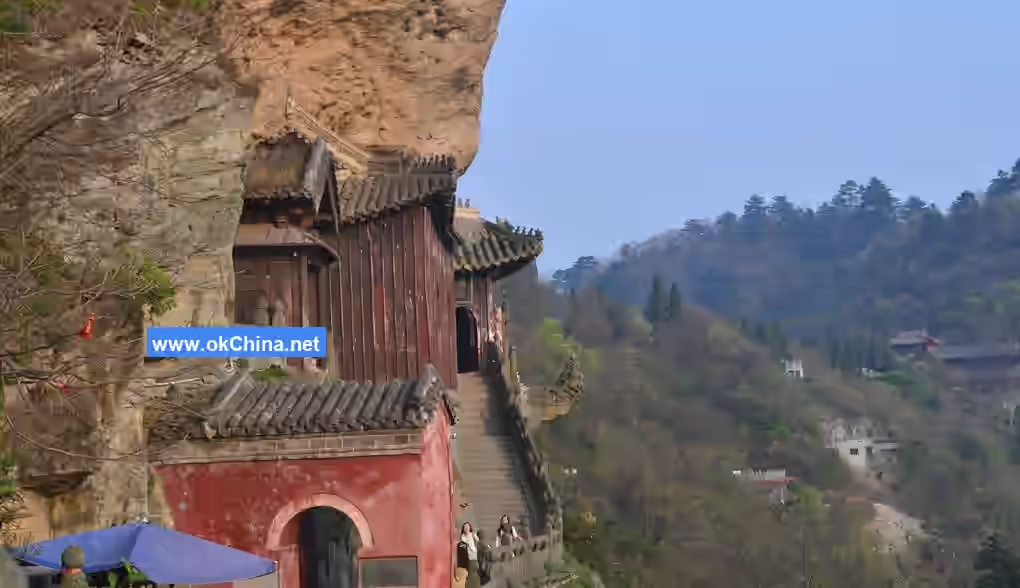
Nanyan Palace, fully named "Dasheng Nanyan Palace," is the most beautiful among the "Thirty-Six Cliffs" of Wudang Mountain. The overall construction fully utilizes perilous locations like mountain tops, saddles, cliffs, and caves to build palaces, pavilions, mountain gates, and more. During the Yuan Dynasty, cliffs were carved and valleys leveled at Nanyan to extensively construct palace halls and courtyards, involving immense labor and cost over more than 20 years for completion. In the 3rd year of the Zhida era (1310 AD), the Empress Dowager bestowed the plaque "Tianyi Zhenqing Wanshou Palace." In the 1st year of the Yanyou era (1314 AD), it was granted the plaque "Datianyi Zhenqing Wanshou Palace." By the end of the Yuan Dynasty, most of this palace was destroyed by war. In the 10th year of the Yongle era (1412 AD) of the Ming Dynasty, the Dark Emperor's Main Hall, mountain gate, and corridors were built; it was granted the plaque "Sheng Nanyan Palace." In the 32nd year of the Jiajing era (1553 AD), the palace had 640 rooms. By the late Qing Dynasty, due to long-term neglect, the palace buildings were dilapidated and offered little shelter from the elements. Major repairs were carried out on the halls in the early years of the Tongzhi era (around 1862 AD). In the 27th year of the Guangxu era (1901 AD), a monastic community (Shifang Conglin) was established. In the early Republic of China period, funds were raised to build over 20 structures including the Wansheng Tower, Merit Shrine, Lingguan Hall, Tianhe Courtyard, monastic residences, warehouses, and east-west guardhouses. In the 15th year of the Republic of China (1926 AD), a fire destroyed the main hall and surrounding monastic residences. In the 16th year (1927 AD), the Dragon-Tiger Hall and side rooms were rebuilt. The Dark Emperor's Hall was restored in 2006. The existing buildings and ruins of this palace cover an area of 61,187 square meters, with 83 remaining temple rooms and a floor area of 3,539 square meters.
3.3 Zixiao Palace
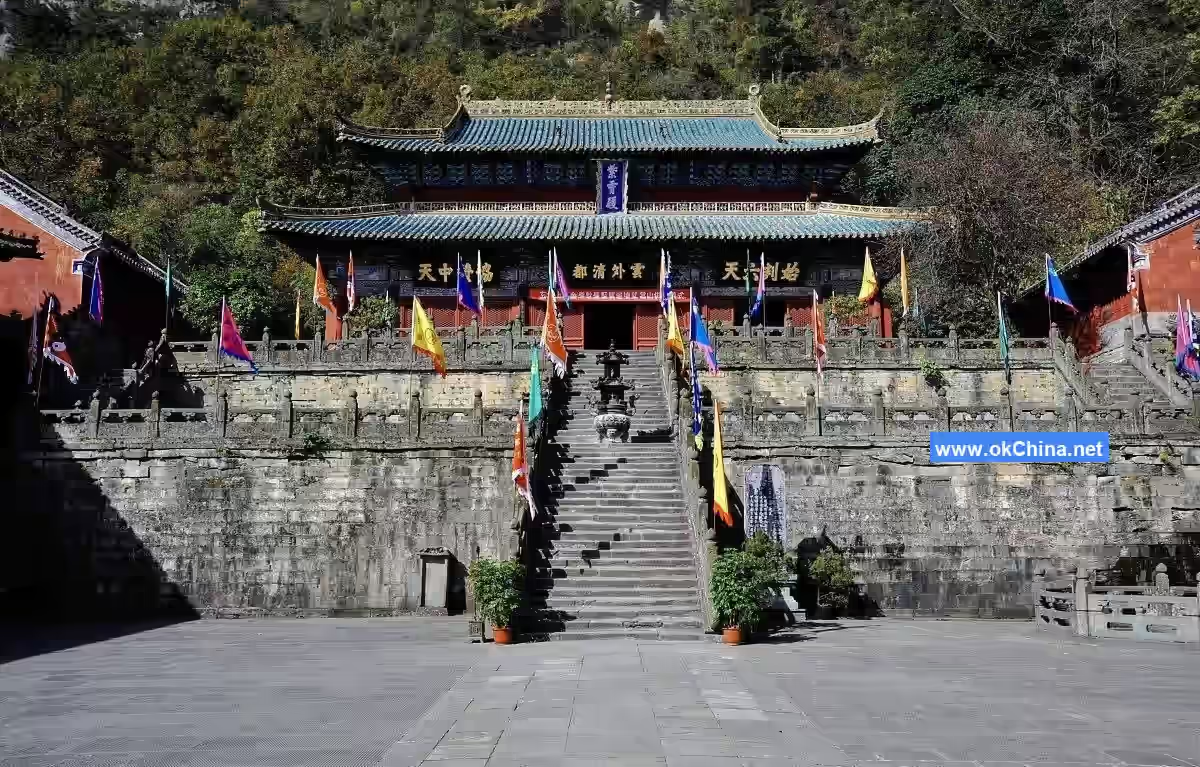
Zixiao Palace is one of the most complete palaces in Wudang Mountain. Located at the foot of Zhanqi Peak at an altitude of 804 meters, it faces south. It overlooks peaks such as Sangong, Wulao, Baozhu, Zhaobi, and Fudi; behind it are Prince Rock and Prince Pavilion; to the right is Leishen Cave; to the left is Penglai First Peak. The surrounding mountain formations resemble two dragons playing with a pearl on an armchair, with Zixiao Palace situated in the center. Zixiao Palace was initially built during the Xuanhe era of the Song Dynasty (1119-1125 AD) and was named "Zixiao Yuansheng Palace" in the Yuan Dynasty. The Ming Dynasty renamed the remaining Yuan-era main hall "Incense Hall." In the 10th year of the Yongle era (1412 AD) of the Ming Dynasty, 160 structures were built, including the Dark Emperor's Main Hall, mountain gate, corridors, left and right Imperial Edict Stele Pavilions, Divine Kitchen, Divine Storehouse, Patriarch Hall, Holy Parental Hall, Abbot's Quarters, Dining Hall, Alms Bowl Hall, Kitchen, Warehouses, and Pond Pavilion. It was granted the name "Taixuan Zixiao Palace." By the 31st year of the Jiajing era (1552 AD), the palace had expanded to 806 rooms. Since the Jiajing era, it has overseen Fudi Hall, Weilie Temple, Longquan Temple, and Fuzhen Palace. Currently, 182 rooms remain, with a floor area of 8,553 square meters. The buildings and ruins cover an area of 74,000 square meters.
3.4 Taiji Lake
Wudang Taiji Lake lies at the northern foothills of Wudang Mountain in northwestern Hubei Province. It relies on the World Heritage site, the Chinese Taoist sanctuary Wudang Mountain, and Asia's largest artificial lake, the Danjiangkou Reservoir. A dam was constructed within the Danjiangkou Reservoir (the water source for the central route of China's South-to-North Water Diversion Project) after water storage, forming this lake surface.
3.5 Jingle Palace
Jingle Palace is the foremost among the Eight Palaces of Wudang Mountain. Originally built in the 11th year of the Yongle era (1413 AD) of the Ming Dynasty, it was submerged in the Danjiangkou Reservoir during its construction in 1958. A batch of cultural relics from the palace, such as the memorial archway and turtle-borne steles, were relocated to Danjiangkou City. In 2002, Danjiangkou City attracted 70 million yuan in investment to fully implement the restoration of Jingle Palace. After over two years of construction, the first phase, including the square, mountain gate, Imperial Stele Pavilion, three main halls, and side halls, has taken initial shape, becoming an example of above-ground cultural relic relocation and restoration for the Danjiangkou South-to-North Water Diversion Project.
3.6 Prince Slope
Prince Slope, also known as Fuzhen Temple, largely retains its original scale and is a unit within the Wudang architectural complex. Fuzhen Temple was built in the 10th year of the Yongle era (1412 AD) of the Ming Dynasty and rebuilt in the 22nd year of the Kangxi era (1683 AD) of the Qing Dynasty. Located in front of Lion Peak, it currently has 20 buildings, with a floor area of 3,505 square meters, covering 60,000 square meters. The temple gate is set sideways, with nine winding paths following the mountain slope, creating double walls and covered passageways. The central axis features a screen wall, incense burner, Dragon-Tiger Hall, main hall, and Prince Hall. On the left side, the monastic compound includes the Imperial Scripture Hall, Zhijing Pavilion, temple pavilion, and dining rooms, arranged in overlapping layers following the mountain terrain. In front stands the Five-Cloud Tower, a five-story building where 12 beams and purlins are set on corner columns, forming an interlocking structure rare in large wooden architecture, known as "one column supporting twelve beams."
3.7 Grinding Needle Well
Grinding Needle Well, also called Chunyang Palace, is located 12 kilometers south of Laoying. It was initially built during the Yongle era of the Ming Dynasty. The current Grinding Needle Well was rebuilt in the 2nd year of the Xianfeng era (1852 AD) of the Qing Dynasty and restored to its original state in 1984. It has over 50 side rooms, covering an area of 1,700 square meters.
3.8 Xuanyue Gate
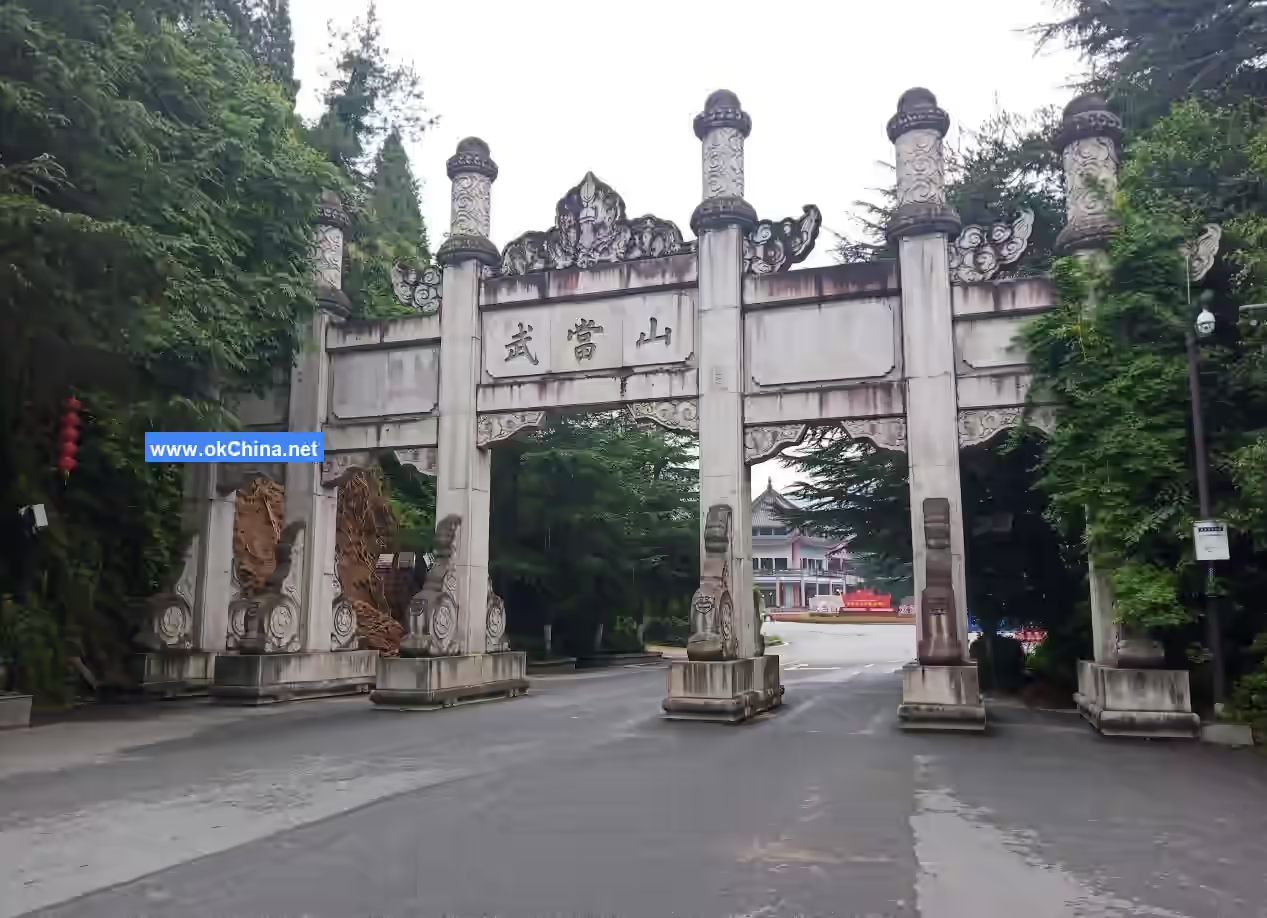
Xuanyue Gate is the common name for the "Zhishi Xuanyue" memorial archway, a stone structure with three bays, four pillars, and five stories. The "Zhishi Xuanyue" archway was built in the 31st year of the Jiajing era (1552 AD) of the Ming Dynasty. Located 4,000 meters east of Wudangshan Town, it serves as the first gateway into Wudang Mountain, also called Xuanyue Gate. It is a stone-carved imitation of large wooden architecture, a three-bay, four-pillar, five-story archway, 12 meters high and 14 meters wide. The ratio between the central bay and side bays is 5:3. The pillars are 6 meters high, surrounded by clamping stones reinforced with iron hoops. A lintel spans the top of the pillars. Below the lintel in the central bay are relief-carved large and small architraves, with upper parts featuring scrolling grass and floral corbel brackets (que ti) supporting the relief-carved upper and lower purlins. Decorative panels are embedded between the purlins, forming three gateways: a high and spacious central one with slightly lower ones on both sides. The main story rests on the lintel, with pillars standing left and right of the central bay, embedding a rectangular horizontal plaque. Each side bay is divided into two levels supporting side stories, cloud panels, and secondary stories, forming the broad and towering main and side stories. From top to bottom, the three-tiered hip-and-gable roof (xieshan) of the archway stories extends outward layer by layer. A horizontal plaque in the center is inscribed with the characters "Zhishi Xuanyue," bestowed by Emperor Jiajing.
4. Cultural SignificanceThe Taoist culture of Wudang Mountain is profound and has a long history. Since the Eastern Han Dynasty, Taoist practitioners have built thatched huts on Wudang Mountain for secluded cultivation. It gradually became a sacred site for Taoist activities in the Central Plains. The imperial endorsement of Taoism on Wudang Mountain began in the early Tang Dynasty. During the Zhenguan period (627–649), a severe drought occurred, and Emperor Taizong of Tang, Li Shimin, sent Yao Jian, an official from Junzhou, to pray for rain at Wudang Mountain. The prayer was answered, and the "Five Dragon Shrine" was subsequently built on Lingying Peak. From the Song Dynasty to the Qing Dynasty, successive emperors highly revered the deity Zhenwu of Wudang Mountain, honoring him as the "guardian deity of the state and the imperial family." During the Yuan Dynasty, Taoist communities cultivated hundreds of hectares of land, supported tens of thousands of followers, and established nine palaces, eight temples, and over a hundred shrines, altars, pavilions, platforms, and bridges. The Ming Dynasty marked the peak of its development. In the tenth year of the Yongle era (1412), the emperor dispatched high-ranking officials to lead over 200,000 soldiers, civilians, and craftsmen. Over twelve years, they constructed 33 Taoist temples, including nine palaces and nine temples. Each temple housed between 300–400 to 500–600 Taoist priests, making the Taoist complexes on Wudang Mountain unprecedentedly grand. They became Taoist sites directly controlled by the Ming emperors, earning Wudang Mountain the title "Imperial Family Temple." The Taoist cultural relics of Wudang Mountain are renowned far and wide. In addition to the ancient architectural complexes, rulers and devotees from various regions, especially during the peak of the Ming Dynasty, crafted tens of thousands of ritual objects and deity statues from materials such as gold, silver, copper, iron, tin, jade, pearls, stone, clay, silk, and wood, which were placed in Wudang Mountain. This adorned the temples with magnificent decorations, earning the mountain the reputation of a "world of gold and white jade." Although many treasures have been lost, over 7,000 registered cultural relics remain on the mountain to this day. Wudang Taoist music, long celebrated, is an important component of Wudang Taoist culture. Since Emperor Taizong of Tang built the "Five Dragon Shrine," Wudang Mountain has been a significant site for emperors, officials, and commoners to pray for blessings and avert disasters. The uniquely enchanting Taoist music blends court, folk, and religious music, characterized by a solemn, majestic, mysterious, and ethereal style.
4.1 Wudang Taoism
4.1.1 Historical Development
From the Spring and Autumn period to the end of the Han Dynasty, many high-ranking officials and nobles practiced cultivation on Wudang Mountain, including Yin Xi, a senior official of the Zhou Dynasty, and the famous alchemists Ma Mingsheng and Yin Changsheng, who also secluded themselves on the mountain for cultivation. From the late Han Dynasty to the Northern and Southern Dynasties, due to social turmoil, hundreds of scholars and officials either resigned from their posts or abandoned their families to gather on Wudang Mountain for Taoist practices such as bigu (abstention from grains). During this period, scriptures related to Zhenwu also emerged.
During the Sui and Tang Dynasties, the Li family of the Tang Dynasty claimed descent from Laozi, supporting and revering Taoism and elevating it to the foremost of the three teachings. During the Zhenguan period of the Tang Dynasty, Yao Jian, the military governor of Wudang, was ordered to pray for rain at Wudang Mountain, and his prayers were answered. The emperor subsequently ordered the construction of the Five Dragon Shrine, the first temple built on Wudang Mountain by imperial decree. During this time, many renowned Taoist masters, such as Yao Jian, Sun Simiao, Tao You'an, and Lü Dongbin, secluded themselves on Wudang Mountain for cultivation. By the late Tang Dynasty, Wudang Mountain was listed as the ninth of the seventy-two blessed lands in Taoism, significantly elevating its status in Taoism.
During the Song and Yuan Dynasties, due to the rulers' vigorous promotion and reverence for the deity Zhenwu of Wudang Mountain, Zhenwu's divine status continuously rose, contributing to the formation of Wudang Taoism and its growing influence in society. In the second year of the Tianxi era (1018), Emperor Zhenzong of Song bestowed the title "Zhenwu Lingying Zhenjun" (Perfected Lord of Numinous Response) upon Zhenwu, ordering the construction of temples and statues for worship and upgrading the Five Dragon Shrine to a temple. Emperor Renzong of Song revered Zhenwu as the "guardian deity of the state and the imperial family," building temples and statues for worship. Emperors Huizong, Ningzong, and Lizong also bestowed titles upon Zhenwu and conducted devout rituals.
During the Yuan Dynasty, Taoism enjoyed the favor of the Yuan rulers, and Wudang Mountain became an important site for the Yuan emperors to "pray to heaven and wish for longevity." Wudang Taoism developed fully, attracting many devotees on pilgrimages, with incense offerings flourishing. The social influence of Wudang Taoism grew increasingly significant, and Wudang Mountain became a Taoist sacred site on par with Longhu Mountain, the headquarters of the Celestial Master Taoism.
During the Ming Dynasty, Wudang Mountain was consistently supported by the emperors as the "Imperial Family Temple," and the deity Zhenwu of Wudang was revered as the "guardian deity of the nation." The status of Wudang Mountain rose to that of the "Number One Immortal Mountain Under Heaven," surpassing the Five Sacred Mountains and becoming the center of Taoist activities nationwide. This peak period lasted for over two hundred years. Emperor Taizu of Ming, Zhu Yuanzhang, revered Zhenwu, laying the foundation for subsequent emperors' devotion to the deity. The emperor who propelled Wudang Taoism to its zenith was Emperor Chengzu of Ming, Zhu Di. After seizing power from his nephew Zhu Yunwen, Zhu Di claimed that Zhenwu had protected him and his father in securing the empire. To repay the deity, in the tenth year of the Yongle era (1412), he dispatched officials to construct 33 temples, including nine palaces and nine temples, on the sites of the Yuan Dynasty. Following Emperor Chengzu, successive Ming emperors, imperial relatives, local officials, and devotees continued to build and expand temples on the mountain. Emperor Shizong of Ming, Zhu Houcong, dispatched officials in the thirty-first year of the Jiajing era (1552) to lead soldiers and civilians from Huguang in large-scale reconstruction and expansion projects on Wudang Mountain, making the Taoist complexes unprecedentedly grand. In the same year, he bestowed upon Wudang Mountain the title "Zhi Shi Xuan Yue" (Mystical Mountain Governing the World), honoring it as the supreme Imperial Family Temple and proclaiming its prominent status as the "crown of the Five Sacred Mountains," with "the four famous mountains bowing in reverence and the five immortal peaks paying homage." By the Jiajing era (1522–1566), each major temple on the mountain housed between three to four hundred to five to six hundred Taoist priests, with over ten thousand people, including Taoist officials, followers, soldiers, and craftsmen, residing on the mountain. Pilgrims to Wudang Mountain were ceaseless. Zhang Kaidong of the Ming Dynasty described its prosperity in "Ode to the Great Mountain": "Footsteps wear through the stones, and voices crack the mountains," reflecting the bustling scene of the time.
During the Qing Dynasty, the rulers favored Buddhism over Taoism, leading to the gradual decline of Wudang Taoism. During the Republican era, Wudang Mountain fell into further decline.
After the founding of New China, the Party and government implemented the policy of "freedom of religious belief," bringing significant changes to Wudang Taoism. Taoist followers resumed normal religious activities. Especially after the reform and opening-up, the Wudang Taoist Association was established, formulating the "Charter of the Wudang Mountain Taoist Association" and management systems for each temple. The State Council placed Zixiao Palace and Taihe Palace under the management of the Wudang Mountain Taoist Association, opening them as key religious sites to the public. In 1997, the Hubei Provincial Government transferred the management of Wulong Palace, Qingwei Palace, and Qiong Tai Zhong Guan to the Wudang Mountain Taoist Association. Taoist activities became orderly, and Taoist practitioners gained a certain political status. Leaders of the Wudang Mountain Taoist Association were successively elected as vice chairpersons of the Danjiangkou City and Shiyan City Political Consultative Conferences, standing committee members of the Hubei Provincial Political Consultative Conference, and members of the National Committee of the Chinese People's Political Consultative Conference. Since its establishment, the Wudang Mountain Taoist Association has invested tens of millions of yuan in large-scale renovations of ancient structures such as Taihe Palace, the Main Hall of Zixiao Palace, the Imperial Stele Pavilion, Yuji Pond, and Qiong Tai Zhong Guan, revitalizing them. Efforts have been made to excavate, organize, and research Taoist culture. In September 1992, the "International Academic Symposium on Chinese Wudang Taoist Culture" was successfully held. At the same time, exchanges in Taoist culture and Wudang martial arts have been conducted with Taoist organizations in countries such as Italy, Singapore, Thailand, and Malaysia, as well as in Taiwan, Hong Kong, and Macau, expanding the influence of Wudang Taoism at home and abroad and propelling Wudang Taoist culture into a new stage of development.
4.1.2 Zhenwu the Great Emperor as the Principal Deity
Zhenwu, originally known as Yuanwu (with "Yuan" interchangeable with "Xuan"), is also called Xuanwu. Emperor Zhenzong of Song, Zhao Heng, changed Xuanwu to Zhenwu to avoid the taboo of his ancestor Zhao Xuanlang's name, honoring Zhenwu as the "You Sheng Di Jun" (Imperial Lord of Protection). According to the "Taishang Shuo Xuantian Dasheng Zhenwu Benzhuan Shenzhou Miaojing" (The Supreme's Explanation of the Divine Incantation and Wondrous Scripture of the Great Sage Zhenwu of the Mysterious Heaven), Xuanwu is the eighty-second incarnation of Laozi. He cultivated on Wudang Mountain for forty-two years, achieved perfection, ascended to heaven as a deity, and was enfeoffed by the Jade Emperor as "Xuantian Shangdi" (Supreme Emperor of the Mysterious Heaven), among other titles, to guard the north. Therefore, Wudang Mountain is revered in Taoism as the sacred site where Xuantian Zhenwu Shangdi cultivated.
4.1.3 The Wudang Sect of Taoism
The Wudang Sect is an important school of Chinese Taoism, characterized by "taking Wudang Mountain as its base, venerating Zhenwu—Xuanwu, emphasizing inner alchemy cultivation, excelling in thunder rituals and talismans, and stressing loyalty, filial piety, ethics, and the integration of the three teachings." The Wudang Sect was founded by Zhang Sanfeng during the Ming Dynasty. Its main features include: worshipping "Zhenwu the Great Emperor" as the principal deity; emphasizing the practice of Zhang Sanfeng's Wudang internal martial arts; advocating the unity of the three teachings, with the "Dao" as their common source; and focusing on inner alchemy methods, promoting the dual cultivation of nature and life.
4.2 Ancient Architecture of Wudang
The ancient architecture of Wudang can be traced back to the Qin and Han Dynasties, when many hermits and Taoist followers built thatched huts on the mountain. During the Zhenguan period of the Tang Dynasty (627–649), Emperor Taizong of Tang ordered the construction of the Five Dragon Shrine. During the Dali period (766–779), temples such as "Taiyi" and "Yanchang" were built. In the third year of the Qianning era (896), the "New Temple of Shenwei Wugong" was constructed.
During the reign of Emperor Zhenzong of Song, the Five Dragon Shrine was upgraded to the Five Dragon Temple. During the Xuanhe period of the Song Dynasty (1119–1125), Zixiao Palace was built.
During the Yuan Dynasty, nine palaces and eight temples were constructed.
During the Yongle period of the Ming Dynasty, Emperor Yongle dispatched officials such as Zhang Xin (Marquis of Longping), Mu Xin (Imperial Son-in-Law and Commandant), Jin Chun (Vice Minister of Rites), and Guo Jin (Vice Minister of Works) to lead over 300,000 soldiers, civilians, and craftsmen. Over twelve years, they constructed 33 architectural complexes, including nine palaces and nine temples, along a 160-li construction line on Wudang Mountain. During the Chenghua and Jiajing periods, further expansions and additions were made, making Wudang Mountain the largest Taoist site in the country at the time. According to incomplete statistics, there were over 500 structures of various types during the Ming Dynasty, comprising more than 20,000 rooms.
After the completion of the Taoist palaces and temples on Wudang Mountain, it transformed from a "site for lofty cultivation" into the "Imperial Family Temple." Upon ascending the throne, each Ming emperor would dispatch imperial envoys to Wudang Mountain to offer sacrifices to Zhenwu and conduct rituals. Moreover, on occasions such as the installation of imperial-bestowed deity statues and the annual "celebrations of the emperor's birthday and the sacred birth of the Mysterious Emperor," imperial decrees would order the performance of rituals.The entire architectural complex is strictly laid out according to the story of Zhenwu's cultivation of immortality, employing imperial architectural regulations to create the artistic conception of "a temple every five li, a palace every ten li, with vermilion walls and emerald tiles shimmering exquisitely; towers and pavilions faintly reflecting an aura of gold and silver, amidst forests and peaks winding like a painted mirror"—a "fairy mountain and jade palace." Stretching over 140 li, it is the largest religious architectural complex in the world today. It possesses a profoundly mystical and transcendent, naturally harmonious artistic effect, fully embodying the Daoist philosophy of "the unity of heaven and humanity." It is hailed as a marvel in the history of ancient Chinese architecture, praised as "a museum of ancient Chinese architectural achievements" and "the Forbidden City hanging on cliffs."
From the Qing Dynasty to the Republic of China era, many structures were destroyed by war, damaged, or collapsed, gradually reducing the scale of the Wudang Mountain architectural complex.
After liberation, the Party and government implemented a series of protective measures for the ancient buildings on Wudang Mountain. The Hubei Provincial Government designated all ancient mountain structures as key provincial-level cultural relics protection units. The Golden Hall, Purple Cloud Palace, the stone memorial archway "Governance of the Mysterious Peak," Nanyan Palace, and the ruins of Yuxu Palace were listed as national key cultural relics protection units. The state allocated special funds to restore and reconstruct over 200 buildings covering more than 30,000 square meters, repair three ancient mountain pilgrimage paths, and over a dozen ancient bridges. Currently, 129 relatively well-preserved structures remain, comprising 1,182 temple rooms with a total floor area of 43,332 square meters, still retaining their majestic grandeur.
The ancient architectural complex of Wudang Mountain is designed and laid out based on the myth of Zhenwu's cultivation from the Zhenwu Scripture, highlighting the theme of Zhenwu belief. According to the Zhenwu Scripture, Zhenwu was born in the Pure Joy Kingdom; hence, the Pure Joy Palace was built outside Junzhou City. Wulong, Purple Cloud, and Nanyan are places where Zhenwu cultivated. Yuxu Palace is named after Zhenwu's title "Jade Void Master Minister." Yuanhe Temple was built because Zhenwu once presided over the Yuanhe Promotion Office. Sites such as Huilong Temple, Huixin Nunnery, Grinding Needle Well, Prince Slope, Longquan Temple, Upper and Lower Eighteen Bends, Tianjin Bridge, and Jiudu Stream are all related to the myth of Zhenwu's cultivation, creating a strong religious atmosphere. Pilgrims entering Wudang Mountain are immersed in the mythological ambiance of Zhenwu's cultivation, subtly deepening their faith and reverence for Zhenwu.
The overall layout of the ancient architectural complex of Wudang Mountain centers on the Golden Hall of Tianzhu Peak, radiating outward along official roads and ancient pilgrimage paths. It extends 80 kilometers north to the stone memorial archway by Xiangshui River, 25 kilometers south to Yousheng Temple by Yanchi River, 50 kilometers west to Bailang Black Dragon Temple, and 35 kilometers east to Jieshan Temple. Designed and laid out uniformly using imperial architectural standards, the entire complex is grand in scale, thematically focused, and orderly. It also reflects the Daoist idea of "revering nature," preserving the natural and primitive landscape of Wudang Mountain. Craftsmen followed the principles set by Emperor Chengzu of the Ming Dynasty, Zhu Di: "assess its breadth and narrowness," "determine its regulations," and "do not alter the mountain itself in the slightest." Construction materials were not sourced locally but purchased from Shaanxi, Sichuan, and other regions. During construction, the majestic peaks and the secluded, rugged cliffs and streams were fully utilized, placing each architectural unit in an appropriate position on peaks, ridges, cliffs, or streams. The spacing and scale of the structures were perfectly arranged, allowing the architecture to organically integrate with the surrounding environment, achieving an artistic effect of being sometimes hidden, sometimes visible, blending into one.
Overall, the ancient architectural complex of Wudang Mountain brings together excellent ancient Chinese architectural styles, embodying the grandeur of imperial palaces, the mystical profundity of Daoism, the tranquility and elegance of gardens, and the simplicity and frugality of folk traditions. It forms a rich and diverse traditional architectural style. Zhang Kaidong of the Ming Dynasty described Wudang Mountain's architecture as "complementing what Qin Shi Huang and Emperor Wu of Han left behind, rare throughout dynasties; displaying the splendor of golden palaces and jade halls, unmatched in the world."
In 1982, when the State Council designated Wudang Mountain as a national key scenic area, it praised the ancient architectural complex as "a project of immense scale and exquisite craftsmanship, successfully embodying the artistic conception of a 'fairy mountain and jade palace,' akin to an exhibition of China's ancient architectural achievements."
On December 17, 1994, it was inscribed on the UNESCO World Heritage List.
4.3 Wudang Martial Arts
Wudang martial arts are a gem of Chinese martial arts, often described as "revering Shaolin in the north and honoring Wudang in the south."
Wudang martial arts have deep roots in Wudang Daoism. Wudang Daoist priests often practiced martial arts while cultivating Daoist practices. Before the Song Dynasty, there were many martial arts masters among Wudang Daoists. In the late Yuan and early Ming dynasties, Wudang Daoist Zhang Sanfeng synthesized the essence of Wudang boxing techniques and founded Wudang Neijiaquan (Internal Family Boxing), revered as the founder of Wudang martial arts, laying the foundation for its development. Influenced by the Daoist tradition of secretive, single-line transmission, Wudang martial arts remained obscure for a long time. During the Qing Dynasty and the Republic of China era, due to social turmoil and the decline of Daoism, many Daoists left the mountain and returned to secular life, causing Wudang martial arts to spread among the people.
Building on ancient martial arts theories of attack and defense, Wudang martial arts incorporated principles from the Book of Changes and experiences from Daoist internal alchemy practices, gradually forming their own theoretical system and unique routine styles. Its theoretical core revolves around the waxing and waning of yin and yang, the evolution of the eight trigrams, and the mutual generation and restraint of the five elements. It aims at nurturing health, self-defense, and healthcare, emphasizing intention over brute force, using four ounces to deflect a thousand pounds, overcoming hardness with softness, striking only after the opponent has struck, discerning positions within inches, and subduing enemies through grappling and sealing techniques.
Wudang martial arts include Taijiquan, Xingyiquan, Baguazhang, Wudang Qigong, Wudang sword techniques, and other boxing and weapon arts. Over its long development, it has formed many boxing styles and schools, such as Neijiaquan, Wudang Taiyi Five Elements Boxing, Wudang Chunyang Boxing, Wudang Dan School Swordplay, Zhaobao Taijiquan, Chen-style Taijiquan, Yang-style Taijiquan, Wu-style Taijiquan, Sun-style Taijiquan, and Gongjia Southern School.
To promote Wudang martial arts, in 1982, Danjiangkou City established the Wudang Mountain Wudang Boxing Research Association and founded the magazine Wudang. In March 2003, the Shiyan City Wudang Association was established. Over 150 types of boxing, sword, saber, and qigong routines have been excavated and systematized. In the Wudang Mountain area, Wudang martial arts have been included as a compulsory course in primary and secondary schools. Dozens of martial arts academies, schools, and training centers, as well as martial arts training classes, have been established to cultivate successors. Events such as the "China Wudang Culture and Martial Arts Festival," "Wudang Mountain Martial Arts Competition," "International Wudang Boxing Exchange Conference," and "Wudang Boxing Theory and Practice Seminar" have been successfully held on Wudang Mountain, further promoting Wudang martial arts. There are dozens of Wudang martial arts research institutions, with millions of practitioners in China and abroad. Many martial arts enthusiasts from the United States, Canada, the United Kingdom, France, Singapore, Japan, and other countries and regions come to Wudang Mountain to study under masters. In 1996, Wudang Mountain was designated as a "National Hometown of Martial Arts."
4.4 Wudang Health Preservation
Wudang Neijiaquan prioritizes health preservation, viewing combat skills as a byproduct of health preservation (i.e., applying combat skills without violating health preservation principles). Even in combat, it emphasizes transformation over confrontation, using the opponent's force against them. In terms of consciousness, it stresses innate intuition and inspiration; in terms of power, it manifests internal qi and internal force. Therefore, Neijiaquan typically exhibits relaxed, soft, balanced, gentle, and slow movements. Thus, some say that Neijiaquan is essentially an advanced form of health-preserving qigong.
In the practice of Wudang Neijiaquan, great importance is placed on cultivating the essence, qi, and spirit of the human body, focusing on refining essence into qi, refining qi into spirit, and refining spirit into emptiness. The "three adjustments" (adjusting the mind, breath, and body) are consistently applied, never violating health principles. Regardless of the specific practice, externally it emphasizes training the hands, eyes, body, techniques, and steps; internally it emphasizes cultivating essence, spirit, qi, force, and skill. Both internally and externally, it adheres to the eight-character principle of "centered, upright, balanced, rounded, relaxed, calm, soft, and harmonious," focusing on the transformation of yin and yang and emptiness and fullness. Upon reaching a certain level of cultivation, it enhances one's vitality, achieving disease prevention and longevity, while also leveraging the rational application of human physiological characteristics to produce unexpected combat effects. This is something other martial arts and sports cannot achieve. The dual focus on health preservation and combat is precisely the enduring charm of Wudang martial arts (health preservation practices) over thousands of years.
Wudang Neijiaquan is a discipline that skillfully integrates health preservation, combat, and human aesthetics. Setting aside its combat aspects, it serves as a therapeutic technique of traditional Chinese medicine and a method for longevity akin to immortals.
Wudang Neijiaquan is a discipline that values softness and stillness, with limb movements always moderate and never exceeding limits, embodying the eight essentials of "centered, upright, balanced, rounded, light, agile, soft, and harmonious." It includes various practices differentiated by walking, standing, sitting, lying, and movement versus stillness. For example, Taijiquan is one of the dynamic practices. Clearly, it can be adapted for people of different ages, genders, professions, and physical conditions (including the disabled), demonstrating strong universality.
Comments
Post a Comment