




Guilin Two Rivers and Four Lakes · Elephant Trunk Hill Scenic Area
1. Introduction
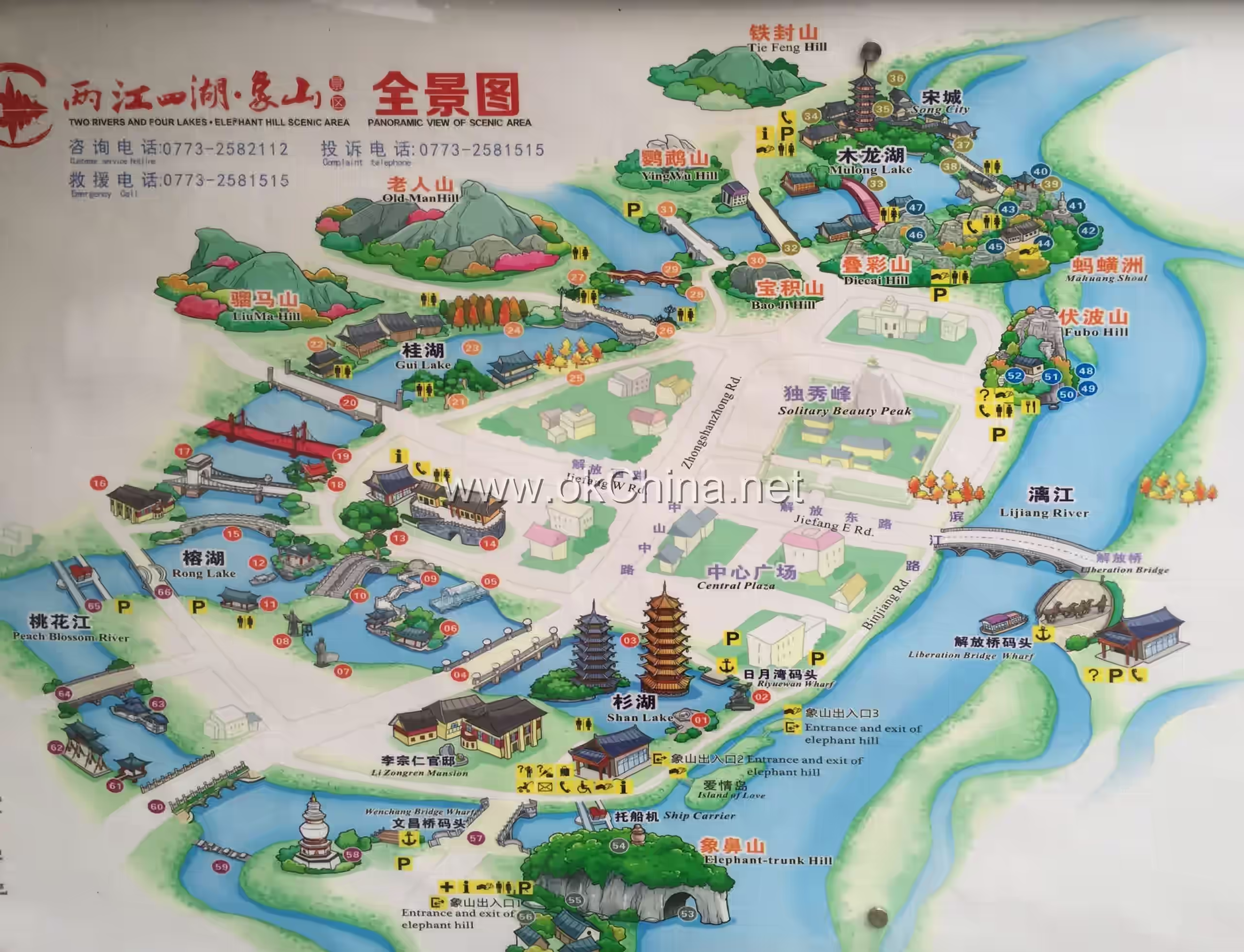
The Guilin Two Rivers and Four Lakes · Elephant Trunk Hill Scenic Area, abbreviated as the Two Rivers and Four Lakes · Elephant Trunk Hill Scenic Area, is a tourist attraction located in Guilin City, Guangxi Zhuang Autonomous Region. It comprises the Two Rivers and Four Lakes Scenic Area, the Elephant Trunk Hill Scenic Area, the Diecai Hill Scenic Area, and the Fubo Hill Scenic Area, with a total area of 3.1 square kilometers.
The Two Rivers and Four Lakes refer to the Guilin city-surrounding water system formed by the Rong Lake, Shan Lake, Gui Lake, Mulong Lake, Li River, and Taohua River. A boat ride offers views of over ten traditional famous mountains such as Elephant Trunk Hill, Fubo Hill, Diecai Hill, Old Man Hill, and Baoji Hill; as well as historical sites like the Sarira Pagoda, Hongqiao Dam, Zhuzi Memorial Archway, and One-Legged Pavilion. The Elephant Trunk Hill Scenic Area is situated at the confluence of the Taohua River and the Li River in Guilin. Its main attractions include Elephant Trunk Hill, Water-Moon Cave, Elephant Eye Rock, Puxian Pagoda, Sanhua Wine Cellar, Love Island, and the Yunfeng Temple Exhibition Hall of the Taiping Heavenly Kingdom Revolutionary Site. The famous Water-Moon Cave at Elephant Trunk Hill contains 22 historical stone inscriptions from the Tang and Song dynasties, comprising 3,065 characters. Diecai Hill commands a high vantage point, offering a panoramic view of Guilin. Its Mingyue Peak, one of the four peaks of Diecai Hill, is the highest peak in the urban area with a relative height of 73 meters. The hill is named Diecai (Piled Silk) because its body consists of layers of multi-colored rocks, resembling piled pearls and jade. Midway up the hill is a unique Windy Cave, housing 178 stone inscriptions and 24 niches with 98 cliff carvings. Fubo Hill is known as the "Guardian Deity of the Li River." Its solitary and proud form rests half on land and half in the river. Every spring and summer, when the river swells, the hill's base blocks the turbulent waves, causing the water to swirl back, demonstrating its power to subdue the torrents. The scenic area boasts numerous rare plants and historical relics, such as a large iron bell, a thousand-person cauldron, and Tang Dynasty Buddha statues. Particularly precious are the portrait and calligraphy of Mi Fu in the Return-the-Pearl Cave.
2. Geographical Environment
2.1 Location and Territory
The Two Rivers and Four Lakes · Elephant Trunk Hill Scenic Area is located in the Xiufeng District, Xiangshan District, and Diecai District of Guilin City, Guangxi Zhuang Autonomous Region. Its total area is 3.1 square kilometers.
2.2 Climatic Features
Guilin City, where the Two Rivers and Four Lakes · Elephant Trunk Hill Scenic Area is situated, lies at a low latitude and belongs to the subtropical monsoon climate zone. The local climate is mild with abundant rainfall, long frost-free periods, ample sunshine, rich heat resources, long summers and short winters, distinct seasons, and rainfall and heat generally occurring in the same season, making climatic conditions highly favorable. The Tang Dynasty poet Du Fu praised Guilin's climate with the line, "All the Five Ridges are scorching hot; only Guilin is pleasant." Guilin has little snow in winter and flowers bloom all year round. The (1981-2010) annual average temperature is close to 19.1°C. July and August are the hottest months, with an average temperature around 28°C, while January and February are the coldest, with an average temperature around 9°C. The minimum temperature occasionally drops below 0°C. The annual average number of precipitation days is 166, with the longest consecutive precipitation period lasting 30 days. The annual average rainfall is 1887.6 mm, and the annual average relative humidity is 76%. The prevailing wind direction throughout the year is northerly, with an average wind speed of 2.2-2.7 m/s. The annual average sunshine duration is 1447.1 hours, and the average atmospheric pressure is 995.1 hPa.
3. Main Scenic Areas
3.1 Two Rivers and Four Lakes Scenic Area
3.1.1 Overview
The Two Rivers and Four Lakes Scenic Area is located in the heart of Guilin city, comprising the Li River, Taohua River, Rong Lake Scenic Area, Shan Lake Scenic Area, Gui Lake Scenic Area, and Mulong Lake Scenic Area. The lakes within the area—Rong Lake, Shan Lake, and Gui Lake—were part of Guilin's moat during the Song Dynasty, possessing profound historical accumulation and cultural significance. The rivers and lakes encircle the city center, forming a city-surrounding water system with numerous scenic spots along the banks. A boat tour of the Two Rivers and Four Lakes Scenic Area offers views of over ten traditional famous mountains such as Elephant Trunk Hill, Fubo Hill, Diecai Hill, Yao Hill, Baoji Hill, Chuanshan Hill, Ta Hill, Yu Hill, and Old Man Hill, as well as the beautiful scenery of the Li River.
The Two Rivers and Four Lakes Scenic Area features performances integrating Zhuang and Yao ethnic customs like the Bronze Drum Lusheng Dance and Lishui Yao Bathing, as well as original ecological performances showcasing the traditional life of Li River fishermen, such as Cormorant Fishing. There are also performances by the Women's Crystal Music Workshop, local Guilin opera (Caidiao Guiju), and the intangible cultural heritage Guilin Fisherman's Drum performances. Folk song gatherings are spontaneously organized by Guilin's civil society groups. Among these, the "Gui Lake Fishing Fire" is a grand, spectacular, and traditionally performed original ecological show in Guilin. The Guangxi "Bronze Drum" featured in the Bronze Drum Lusheng Dance is a cultural relic from the Bronze Age and a treasure of ancient Chinese bronze culture, with a history of over 2,700 years. The "Lusheng" has a history of over 3,000 years and is one of the main musical instruments of the ancient southern Miao people, serving as a symbol of Miao culture.
3.1.2 Mulong Lake Scenic Area
The Mulong Lake Scenic Area features the Ancient Mulong Ferry, one of the old Eight Scenes of Guilin. The Tang Dynasty Mulong Stone Pagoda beside the ferry is a key cultural relic protection unit of Guangxi Zhuang Autonomous Region. The area contains a large number of ancient stone inscriptions, among which the Southern Song Dynasty cliff inscription "Map of Jingjiang Prefecture City Defense" on Parrot Hill is one of the world's relatively well-preserved stone inscriptions. Baoji Hill hosts the Baoji Cave, a Paleolithic site dating back over 30,000 years. The area also has numerous Song Dynasty relics, such as the Dongzhen Gate, the remaining ancient post road city wall, the Yiwu Road city wall, the Baoji Hill soldier-hiding cave, and ancient fortresses. Historical and cultural sites like the former residence of Li Jishen are also located here.
3.1.3 Rong Lake Scenic Area
The Ancient South Gate tower in the Rong Lake Scenic Area is a key cultural relic protection unit in Guilin. It was built in 621 AD (the fourth year of the Wude era of the Tang Dynasty) by the famous Tang general Li Jing and served as the south gate of Guilin's "Tang City." Nearby is the mooring site of the Song Dynasty poet Huang Tingjian. The former residence of Bai Chongxi by Rong Lake houses a large collection of antique furniture from the Republican period and rare overseas antiques such as pianos, gramophones, mantel clocks, and pictures. The official residence of Li Zongren by Shan Lake is a national key cultural relic protection unit. The Wenchang Bridge Pier features the Sarira Pagoda, originally built in the Tang Dynasty, containing over ten Ming and Qing Dynasty pottery jars for holding sarira, with the full text of the Diamond Sutra written in ink on the inner walls.
3.1.4 Shan Lake Scenic Area
The Sun and Moon Pagodas in the Shan Lake Scenic Area were reconstructed in 2001 on the foundation of Tang Dynasty Buddhist pagodas. They are now a cultural landmark of Guilin and China's first cultural park themed on the "Harmony of Confucianism, Buddhism, and Taoism." The Sun Pagoda holds three world records: the world's tallest copper pagoda, the world's tallest underwater elevator tower, and the world's tallest copper structure. The Two Rivers and Four Lakes Scenic Area is also a World Famous Bridge Exhibition Garden, featuring 14 distinctive bridges. The Lize Bridge is China's first self-anchored flexible steel truss suspension bridge with a single span of 70 meters, using over 80,000 bolts. Another example is the Yingbin Bridge, which perfectly combines the architectural form of a Western triumphal arch with the design of an ancient Chinese suspension bridge, creating a unique bridge landscape. The scenic area also features high-tech boat lock facilities, such as the Mulong Lake ship lift, the Spring Lake lock, and the Elephant Hill tugboat lift. These high-tech facilities connect Rong Lake, Shan Lake, Gui Lake, Mulong Lake with the Li River and Taohua River, solving the nearly 2-meter water level difference between the four inner lakes and the two rivers.
3.2 Elephant Trunk Hill Scenic Area
3.2.1 Overview
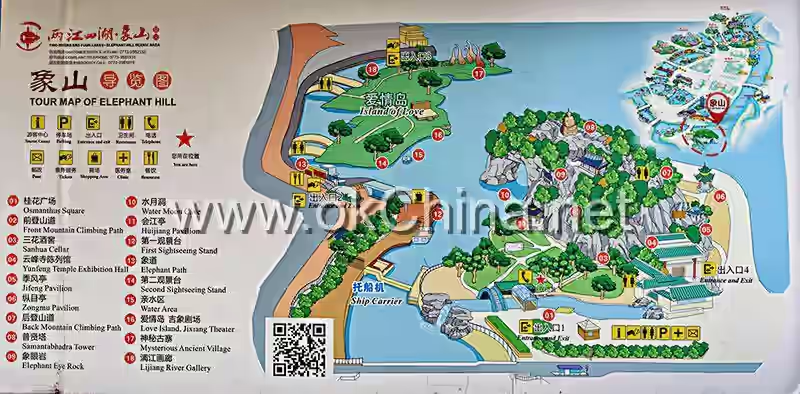
The Elephant Trunk Hill Scenic Area is located in the center of Guilin, on the west bank of the Li River at the confluence of the Taohua River and the Li River. It is a representative of Guilin's landscape and a national key scenic area. The area integrates strange hills, beautiful waters, caves, stone inscriptions, and ancient pagodas. With its unique natural landscape, beautiful scenery, and rich historical and cultural heritage, it is a tourist destination for experiencing landscapes, touching history, and feeling local customs.
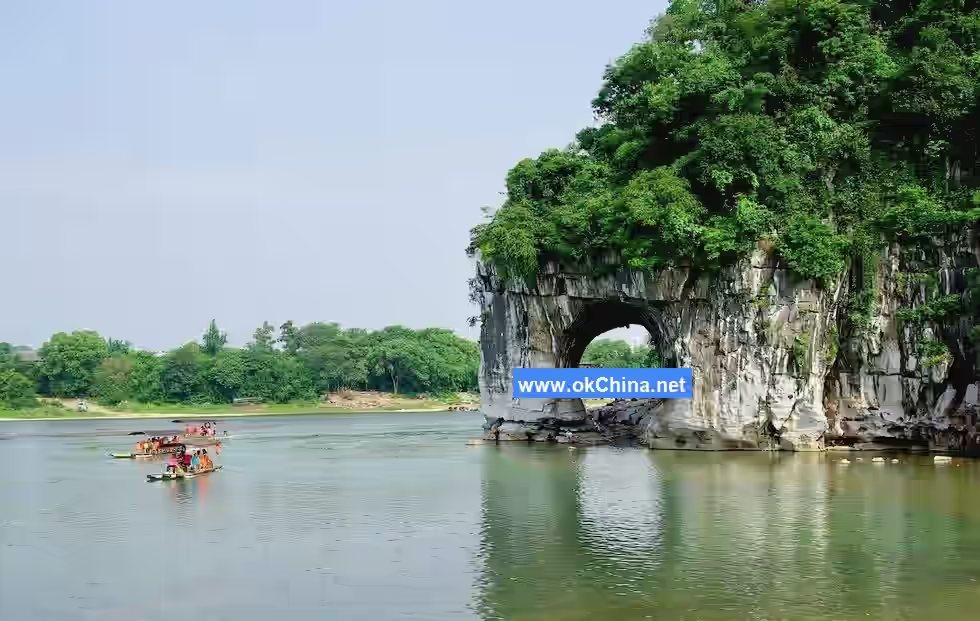
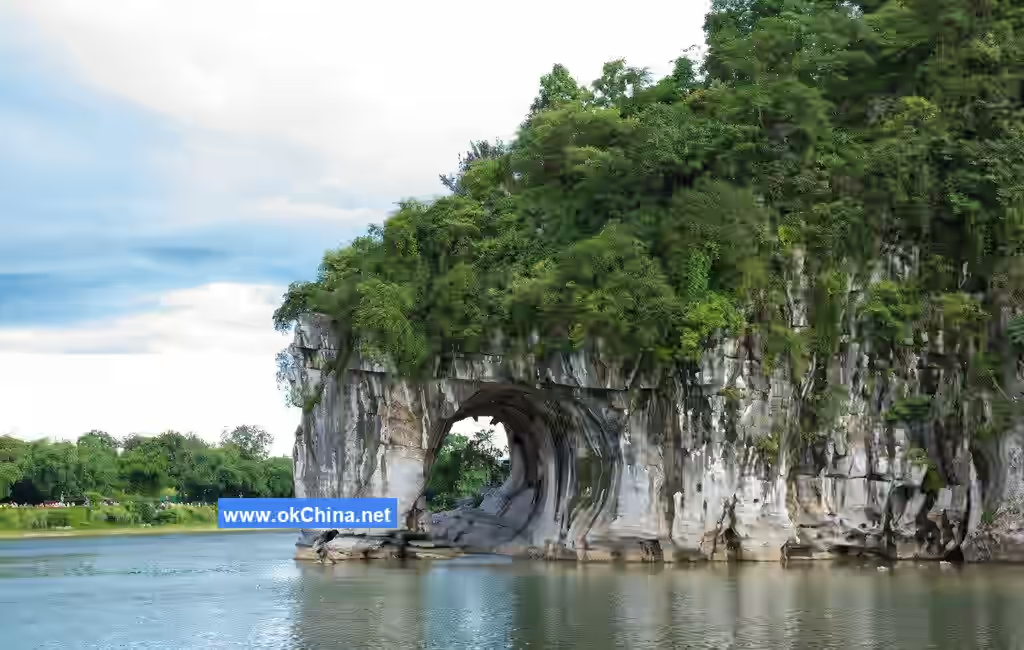
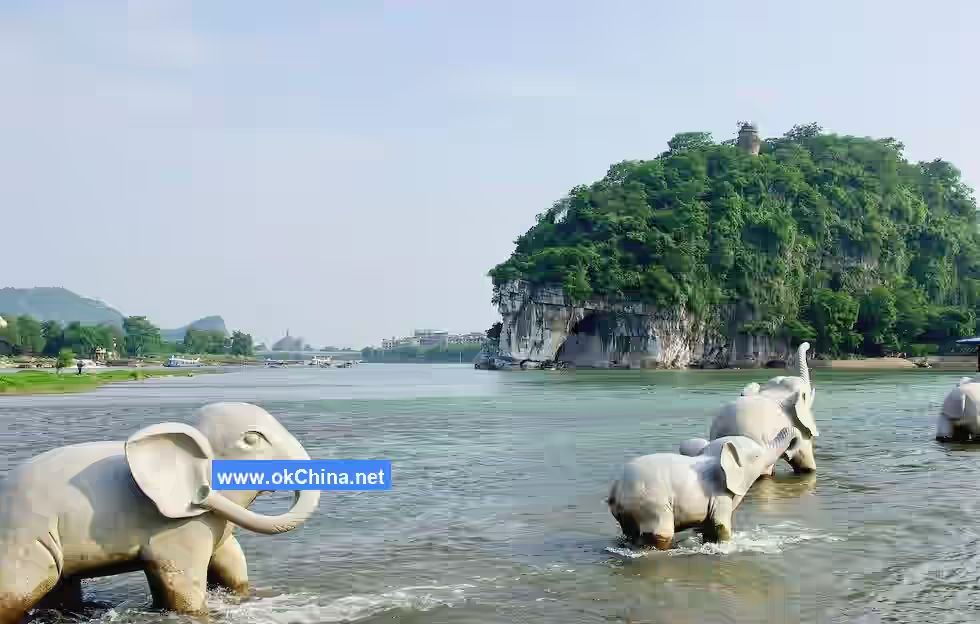
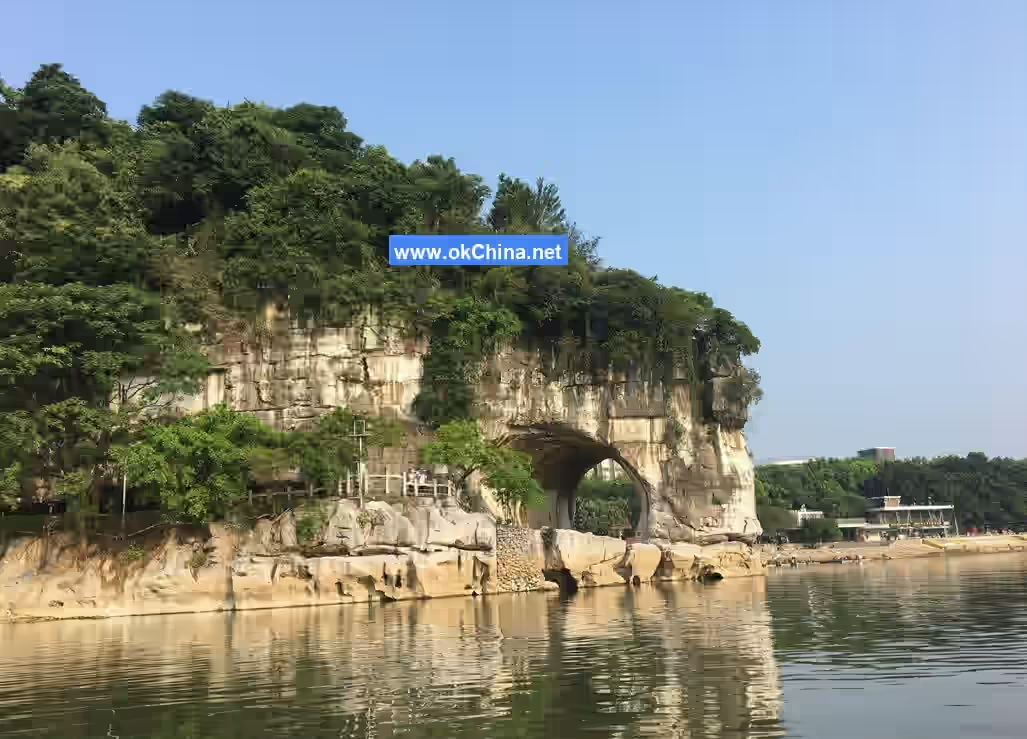
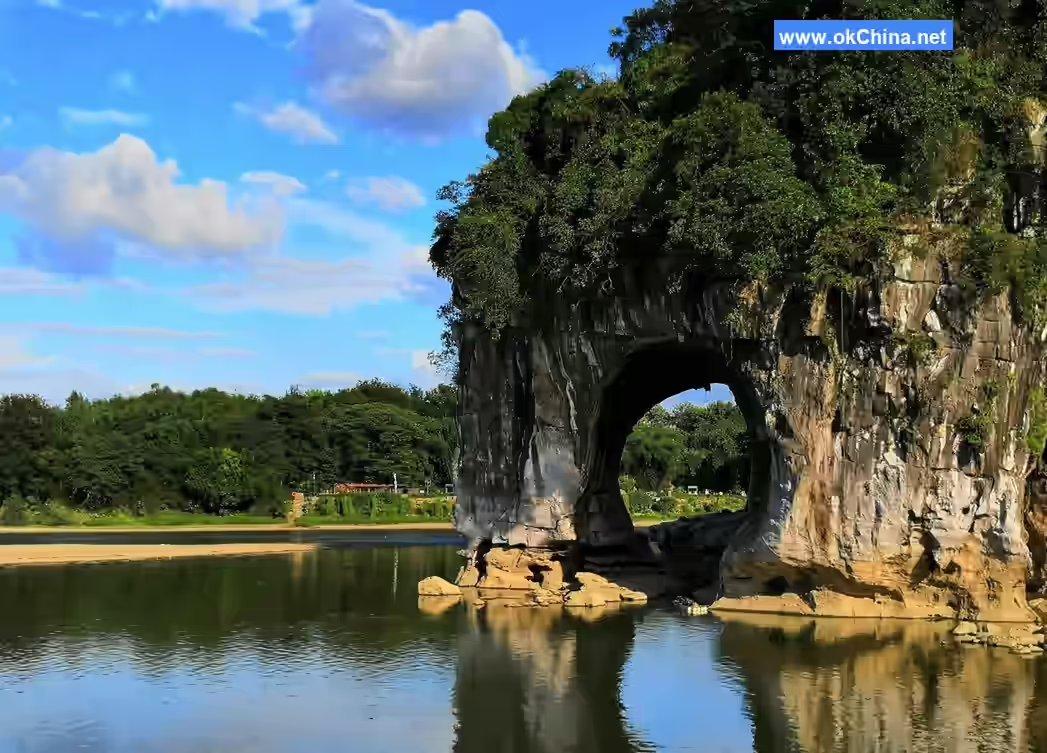
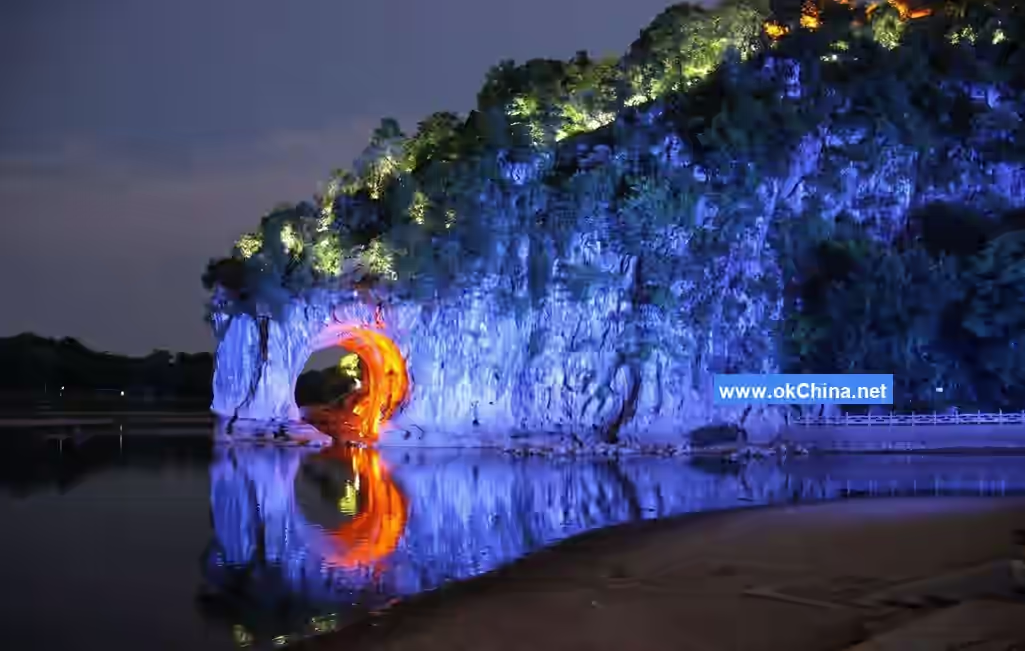
The Elephant Trunk Hill Scenic Area boasts rich, distinctive, diverse, and high-quality tourism resources. Its main attractions include: Elephant Trunk Hill, Water-Moon Cave, Elephant Eye Rock, Puxian Pagoda, Zongmu Pavilion, Huijiang Pavilion, Love Island, Sanhua Wine Museum, Yunfeng Temple, and Elephant Hill Square. Elephant Trunk Hill has an elevation of 220 meters. It borders the Li River to the east, half resting on land and half submerged in the river. The hill rises 55 meters above the water surface and covers an area of 1.3 hectares. It is a masterpiece formed hundreds of millions of years ago by the uplift of the earth's crust, composed of pure limestone deposited in the ocean 360 million years ago, belonging to a typical karst landform. Its shape is peculiar, remarkably resembling a giant elephant stretching its trunk to drink water, vivid and naturally formed. It is regarded as the soul of Guilin's landscape and the symbol of Guilin city, earning the scenic area the beautiful title of Guilin's City Emblem Scenic Area. The Water-Moon Cave is a clear, round stone cave located on the eastern side of Elephant Trunk Hill, between the elephant's trunk and body. This cave and its reflection in the water resemble a moon on the water, one submerged and one floating on the surface. On nights with a bright moon, the moon in the sky, the moon in the cave, and the moon at the bottom of the water compete in brilliance, reflecting each other, forming the famous "Elephant Hill Water Moon" spectacle.Elephant Trunk Hill has long been a tourist destination, with a history of over 1,000 years of visits. Inside and outside the Water Moon Cave of Elephant Trunk Hill, there are many stone inscriptions and cultural relics from various dynasties, most of which are inscriptions by people from the Song Dynasty. The earliest existing inscription is the three seal characters "Water Moon Cave" inscribed by Yuan Jie of the Tang Dynasty. The most famous include the poems and letters of the patriotic poet Lu You from the Song Dynasty, as well as over 50 precious cliff inscriptions such as Zhang Xiaoxiang's "Record of the Chaoyang Pavilion," Fan Chengda's "Inscription on the Restoration of the Water Moon Cave," and the calligraphic plaque "Reading Rock." It is a key cultural relic protection unit in Guangxi. The Ming Dynasty geographer and traveler Xu Xiake visited Elephant Trunk Hill three times to make rubbings of the exquisite stone inscriptions in the Water Moon Cave. The Samantabhadra Pagoda on the summit of Elephant Trunk Hill was built during the Ming Dynasty. It is a solid brick pagoda in the Tibetan style, standing 13.6 meters tall. The pagoda base is a double-layered octagonal Sumeru pedestal. On the north side of the second layer of the base, a green stone line-carved Bodhisattva image is embedded. The pagoda body is shaped like a round treasure vase with plain green brick exterior, standing elegantly among the green trees on the hilltop, vividly reflecting the Buddhist legend of Samantabhadra Bodhisattva riding an elephant. Yunfeng Temple at the southwestern foot of Elephant Hill was rebuilt during the Kangxi period of the Qing Dynasty on the original site of the Wenling Temple from the Tang Dynasty. In April of the Xianfeng period of the Qing Dynasty, when the Taiping Heavenly Kingdom besieged Guilin, Yunfeng Temple became an important activity site for the Taiping Army passing through Guilin. The temple has now been converted into a Taiping Heavenly Kingdom Historical Exhibition Hall.
3.2.2 Elephant Trunk Hill
Elephant Trunk Hill, originally named Li Hill, is located at the confluence of the Taohua River and the Li River in Guilin. It earned its current name because it resembles an elephant drinking water with its trunk. As a landmark attraction of Guilin tourism, Elephant Trunk Hill was designated as the city emblem of Guilin in 1995 and is also praised by foreign tourists as a "Chinese symbol."
3.2.3 Water Moon Cave
The Water Moon Cave is located at the eastern end of Elephant Hill, backed by Elephant Hill to the north, facing the Li River to the east, and bordered by the Taohua River to the west. It is a round cave that runs through both sides. The cave is 12 meters high, 9.5 meters wide, and 17 meters long, resembling a large arched cave entrance. The river water ripples within, looking like a bright moon floating on the water. A poem by the Song Dynasty scholar Ji Beichushi says: "The moon is at the bottom of the water, and the moon floats on the water. The water flows but the moon does not leave; the moon leaves but the water still flows." Hence, it is named the Water Moon Cave. The cave also preserves 22 Tang and Song Dynasty stone inscriptions, including the famous lines by the Tang Dynasty poet Han Yu: "The river is like a green silk ribbon, the mountains are like jade hairpins." The cave contains as many as 3,065 characters, making it the water cave with the smallest wall area but the most Tang and Song Dynasty stone inscriptions in the world. In 2015, it was awarded a Guinness World Record.
3.2.4 Samantabhadra Pagoda
On the summit of Elephant Trunk Hill stands the Samantabhadra Pagoda. From a distance, it looks like a sword hilt inserted into the elephant's back or an elegant ancient treasure vase. The pagoda was first built during the Ming Dynasty and is a solid brick pagoda in the Tibetan style, with a history of over 400 years. It stands 13.6 meters tall, and on the north side of the pagoda body, a green stone line-carved Bodhisattva image is embedded, with the words "Namo Samantabhadra Bodhisattva" inscribed above. Buddhist scriptures say that Samantabhadra Bodhisattva governs wisdom and morality, and his mount is a six-tusked white elephant.
3.2.5 Statue of Child-Giving Guanyin
On the cliff behind Yunfeng Temple at the southern foot of Elephant Trunk Hill, there is a niche containing the Ming Dynasty "Statue of Child-Giving Guanyin." This is also the only colored cliff statue in Guilin. Guanyin Bodhisattva is dressed in splendid attire, wearing a heavenly crown, holding a child on her lap with both hands, and seated on a lotus throne. Behind her is a circular flame-shaped body halo and head halo. On either side of the main statue stands a female attendant, with hair tied in a bun and wearing a wide-sleeved, long-robed palace dress. Outside the niche, on the left and right sides, stand two children with their hands clasped in greeting.
3.2.6 Yunfeng Temple
Yunfeng Temple is located at the southwestern foot of Elephant Hill. It was first built during the Tang Dynasty and has been renovated multiple times since. It was rebuilt in the 17th year of the Guangxu period of the Qing Dynasty (1891) and was inhabited by nuns. In 1978, the Guilin Cultural Relics Management Committee renovated the temple according to its original layout. The temple now houses a Taiping Heavenly Kingdom historical relics exhibition room and is open to the public.
3.2.7 Sarira Pagoda
The Sarira Pagoda is located about 500 meters southwest of Elephant Trunk Hill, in Wanshou Lane on Minzhu Road, not far from the southern end of Wenchang Bridge. The Sarira Pagoda is a relic of the ancient "Kaiyuan Temple" in Guilin, built in the fourth year of the Xianqing period of the Tang Dynasty (659). Originally a seven-story brick pagoda over 30 meters tall, it was used to preserve the "sarira" (relics) of high monks after their cremation. The existing Sarira Pagoda was rebuilt in the 18th year of the Hongwu period of the Ming Dynasty (1385). It stands 13.22 meters tall and is 25 meters wide from east to west, featuring a three-story Tibetan-style brick pagoda. The main entrance, the south gate, has the inscription "Sarira Treasure Pagoda" on its lintel, with the names of the Eight Great Vajras (Diamond Kings) inscribed on either side of the lintels of the four gates.
3.2.8 Sanhua Wine Cellar
In the belly of Elephant Hill, there is a wine storage cave covering nearly 3,000 square meters, capable of storing thousands of vats, up to 2,000 tons, of "Guilin Sanhua Wine." The cave storage of wine at Elephant Trunk Hill has a long history, having served as an official wine cellar since the Northern Song Dynasty. The cave maintains a constant temperature of around 20 degrees Celsius and a humidity of 80–100%, which is conducive to the esterification of the wine. The wine stored in the cellar is generally aged for 20 years, some even over 30 years, with the best wines aged for 50 years.
3.2.9 Love Island
In Elephant Hill Park, not far from Elephant Trunk Hill, there is a small island often frequented by young couples for dates, hence the name "Love Island." From the island, one can enjoy the beautiful "Three Hills Scenery" formed by Elephant Trunk Hill, Chuan Hill, and Pagoda Hill.
3.3 Diecai Hill Scenic Area
3.3.1 Overview
Diecai Hill belongs to the Binjiang Scenic Area and is the highest peak in Guilin's urban area. It consists of four peaks: Yuyue Hill, Siwang Hill, Mingyue Peak, and Xianhe Peak, and is known as the "Meeting Place of Rivers and Mountains." The hill features natural landscapes such as Wind Cave, Su Cave, and Mulong Cave, as well as numerous historical and cultural structures left from ancient times, including the Hundred Birds Garden, Yangzhi Hall, Chengren Stele, Reverse Character Stele, Wind Cave Cliff Inscriptions, Nayun Pavilion, Yuyue Pavilion, Diecai Ancient City Wall, and the Bloodstone Jade Museum. Many notable figures from ancient and modern times, both Chinese and foreign, such as Kang Youwei and Sun Yat-sen, have left their footprints on Diecai Hill. Exquisite stone inscriptions are随处可见 at the Wind Cave halfway up the hill. Representative examples include Marshal Chen Yi's inscription "I'd rather be a Guilin resident than an immortal" above the right side of Wind Cave, the statue of Master Ma Xiangbo at the cave entrance, and Li Bingshou's "Orchid and Bamboo Painting" inside the cave. The Wind Cave is breezy year-round, with refreshing gusts that uplift the spirit. Described by ancients as "wind without a source," it is praised as "not knowing where it comes from, but feeling it endlessly." The Wind Cave currently preserves 172 cliff inscriptions and 24 niches with 90 cliff statues. Mingyue Peak, praised by ancients as the "Meeting Place of Rivers and Mountains," is the highest peak within Guilin city. Climbing Mingyue Peak and standing at Nayun Pavilion offers a panoramic view of the entire city.
3.3.2 Diecai Pavilion
Diecai Pavilion is located on the hiking trail of Diecai Hill. It is a single-story, flat-roofed, red-pillared structure with four corners, about 5 meters high, 7.5 meters long, and 8.5 meters wide, covering an area of 64 square meters. It is cross-shaped and spans the hiking trail. The front side hangs a plaque inscribed with "Diecai Hill" by calligrapher Wang Xiaju. Diecai Pavilion is nestled against Yuyue Hill to the east, adjacent to Siwang Hill to the west, and faces Mingyue Peak to the north, harmonizing with the mountain scenery. Seating benches are placed on the east and west sides. The northern corner offers the best angle to view the "intertwining colors." To the west of the pavilion is the Ming Dynasty inscription "Meeting Place of Rivers and Mountains" by Yu Qing.
3.3.3 Diecai Qionglou
Diecai Qionglou is located between Mingyue Peak and Yuyue Hill on Diecai Hill. It is a large-scale landscape architectural complex featuring the architectural style of northern Guangxi's Dong ethnic group, with a construction area of 1,300 square meters, completed in 1990. The main drum tower is a two-story pavilion with a hip-and-gable roof. In front is a small open pavilion with a round ridge roof. The rest of the buildings are one or two stories with sloping roofs, some featuring protruding double or triple eaves, round ridge hip-and-gable roofs, or hexagonal or octagonal pointed roofs. The entire complex is well-organized, with a clear hierarchy and harmonious integration with the natural environment, creating an ethereal fairyland atmosphere.
3.3.4 Diecai Butterfly Museum
The Diecai Butterfly Museum has an exhibition area of 163 square meters, displaying over 5,000 butterflies from more than 300 species across 11 families from around the world. It includes three exhibition halls and one live butterfly garden. Since its establishment in 1995, it has been widely welcomed by domestic and international tourists and has become one of the larger butterfly museums in China.
3.3.5 Diecai Hill Gate
The Diecai Hill Gate is located in front of Yangzhi Hall on Diecai Hill. It is an antique-style building with a sloping roof and gray tiles. The gate bears a horizontal plaque inscribed with "Diecai Hill" in clerical script by the late Guilin Vice Mayor Wei Jichang. The couplet on both sides, "Arrive at the cool realm, give rise to a joyful heart," was composed by Zhang Xianghe of the Qing Dynasty and calligraphed by contemporary artist Wu Chundao. Passing through the gate, one enters a scenic area blending historical relics, religion, and natural landscapes.
3.3.6 Chengren Stele
The Chengren Stele is located inside the Diecai Hill Gate. The stele is 167 cm high and 83 cm wide. The inscription consists of 28 characters in regular script. The main text reads, "The place where Lord Qu Zhongxuan of Changshu and Lord Zhang Zhonglie of Jiangling achieved righteousness." It was inscribed and erected by Liang Zhangju, the Governor of Guangxi, in the 20th year of the Daoguang period of the Qing Dynasty (1840), to honor the integrity of the late Ming anti-Qing generals Qu Shisi and Zhang Tongchang.
3.3.7 Yangzhi Hall
Yangzhi Hall is located to the right inside the Diecai Hill Gate, in front of the Wind Cave. It was built during the Anti-Japanese War, with the meaning "admiring the martyrs to the utmost." The original building was destroyed and rebuilt in 1958. The hall is 11.5 meters long from east to west and 7.1 meters wide from north to south. It has doors on the east and west sides. The north wall is embedded with stone carvings of portraits of Qu Shisi and Zhang Tongchang, their prison exchange poems "Song of Noble Spirit," and a eulogy poem for the two lords by Guo Moruo.
3.3.8 Reverse Character Stele
To the east of the Wind Cave stands the unique Reverse Character Stele in Guilin. The stele is inscribed in reverse with the title "Namo Amitabha Buddha" and the "Twelve-Month Buddha Worship Sin-Reduction Text." The most remarkable feature of the stele is the carving of the "Three Grades and Nine Births Diagram," reflecting the hierarchical system of the Western Pure Land. The Reverse Character Stele and the "Three Grades and Nine Births Diagram" stone carving are rare in China.#### 3.3.9 Wind Cave The Wind Cave is located above Yangzhi Hall on the mountainside of Mingyue Peak. It runs north-south through the mountain, resembling a gourd in shape, with a narrow middle section that allows only one person to pass through, while the front and rear sections are spacious like halls. In ancient times, the front and rear caves were divided into two: the southern cave, named Diecai Rock (also known as Hundun Rock or Futing Cave), was named after the mountain. According to the Tang Dynasty record "Diecai Shan Ji" by Yuan Hui: "There is a stone gate in its western rock, containing stone statues, hence it is called Futing." This cave is 12.5 meters long, 3.65 meters high, and 5.6 meters wide. The northern cave, named Beiyou Cave, has a north-facing entrance resembling a window. The Tang Dynasty record "Guilin Fengtu Ji" by Mo Xiufu states: "The mountain cave penetrates to the north, hence the name Beiyou Cave." This cave is 7.5 meters long, 4.8 meters high, and 9.2 meters wide. At the entrance, there is an inscription of the three large characters "Beiyou Cave" by Chen Weixiang from the Qing Dynasty. Inside the cave, there is a stone seat resembling a niche. From the side of the niche, stone steps lead up to another cave called Taiji Cave, outside of which the Yingfeng Pavilion was built. The Wind Cave was originally an ancient underground river channel, wide at both ends and narrow in the middle. Situated at a high elevation, it connects to the "Xiang-Gui Corridor" in the north and faces the "gorge" between Jialing Ridge and Haiyang Mountain in the south, creating a convection effect. The cross-sectional area for wind passage is large at both ends and small in the middle, resulting in increased wind speed. With seasonal changes, the incoming wind varies in character—clear, mild, warm, or cold.
3.3.10 Wangjiang Pavilion
Wangjiang Pavilion is located on the northern mountainside of Diecai Mountain, along the path ascending Mingyue Peak. Originally built during the Ming Zhengde period (1506–1521) by the eunuch Fu Lun, the original pavilion was long destroyed. It was rebuilt on the original site in 1954 and 1990 as an antique-style pavilion with red pillars, green tiles, upturned eaves, and a pyramidal roof. To the right of the pavilion, there is a cliff inscription reading "Tan Qi Chu" (Place of Exploration). Ascending from the pavilion, one continuously encounters wondrous scenery to explore.
3.3.11 Mingyue Peak
Mingyue Peak is located in the northeastern part of Diecai Mountain. With an elevation of 223 meters, a relative height of 73 meters, and a total area of 1.41 hectares, it is the main peak of Diecai Mountain and the best spot for enjoying the scenery. Dominating the riverside with a peak sharp like a bamboo shoot, ascending to its summit offers an unobstructed view of the cloud-capped mountains, cityscape, and river, making it the best place to admire the panoramic view of Guilin.
3.3.12 Nayun Pavilion
Nayun Pavilion is situated atop Mingyue Peak. The peak features a small gourd-shaped platform. During the Five Dynasties period, King Ma Yin of Chu built a terrace here, later known as Mawang Terrace. During the Southern Song Dynasty, Zhang Shi, the prefect of Jingjiang, built two altars named "Yaoshan" and "Lishui" here for mountain and river worship, and wrote "Yaoshan Lishui Er Tan Ji." The ancient terrace and altars were long destroyed. In 1955, Nayun Pavilion was built on the old site. It was struck by lightning in 1988 and subsequently rebuilt. The pavilion is approximately 5 meters high, covering an area of 19.36 square meters. It features red pillars, a single-eave pyramidal roof with blue tiles, and open sides with pillars, between which seating benches are installed. The pavilion base has three levels, symbolizing ascent to the highest heavens. The plaque "Nayun Pavilion" was inscribed by the Hong Kong painter Zhao Shao'ang. From the pavilion, one can gaze into the distance with an unimpeded view.
3.3.13 Xianhe Peak
Xianhe Peak is located northwest of Mingyue Peak. With an elevation of 253.6 meters, a relative height of 103.6 meters, and an area of 2.1 hectares, it is the highest peak of Diecai Mountain. The mountain is steep, especially with perilous cliffs and paths on its northern side. Within the mountain lies the two-story Xianhe Cave. Viewed from the west, Xianhe Peak resembles a crane squatting on the ground, with its tail pointing south and head facing north. Xianhe Cave looks like a large, bright eye gazing into the distance with keen expression. To the right of the cave entrance, there is an inscription by Lin Suyuan reading "Zhen He Ming Gao," meaning the crane spreads its wings and cries out over the marshlands. On the peak, there is another large through-cave named Baihe Cave, approximately 14 meters high, 8.6 meters wide at the base, 60 meters long, covering an area of 516 square meters, and triangular in shape. The eastern and western openings serve as framed views: the eastern opening faces Mingyue Peak and Yuyue Peak, presenting layered, overlapping peaks and verdant mountains; the western opening faces the northern part of the city, with densely packed houses and buildings. Within a single cave, two distinct landscapes converge.
3.3.14 Yuyue Mountain
Yuyue Mountain, anciently named Mihou Rock (Macaque Rock), is located in the southeastern part of Diecai Mountain, adjacent to Siwang Mountain, covering an area of 0.79 hectares. The mountain's name originates from the ancient Yuyue tribe, a branch of the ancient Yue people who entered Guangxi during the Qin and Han dynasties due to warfare. During the Tang Dynasty, Yuan Hui, serving as the Guiguan Observation Commissioner, particularly loved Yuyue Mountain. He built "Xiezhen Hall" in a mountain recess, where he read, painted, and wrote "Yuyue Shan Ji," making the mountain famous through his writing. On the mountaintop stands Yuyue Pavilion, also known as Yue Pavilion, originally built by Yuan Hui but long destroyed; the current pavilion is a reconstruction. At the mountain's base are "Kang Rock" and "Su Cave." The cave faces north, is 3.2 meters high, 1.7 meters wide, 10.5 meters long, and covers approximately 18 square meters. In December 1894 (the 20th year of the Qing Guangxu reign), Kang Youwei came to Guilin to lecture. Residing at Jingfeng Pavilion in front of the Wind Cave on Diecai Mountain, he discovered two caves beneath Yuyue Mountain and named them after his own style name: the eastern one "Kang Rock" and the northern one "Su Cave," inscribing their names in seal script on the cliff.
3.3.15 Siwang Mountain
Siwang Mountain is located in the southwestern part of Diecai Mountain, opposite Yuyue Mountain to the southeast, separated by a mountain path, with an area of 3.32 hectares. The mountain rocks are peculiar, covered with stone sprouts, grooves, and blocks resembling "jade piled like a celestial isle." On the cliff face are the Tang Dynasty stone inscription "Siwang Shan Ji" by Yuan Hui and the Qing Dynasty inscription "Yu Die Peng Hu" (Jade Piled Like a Celestial Isle) by Li Shaolian. In recent years, inscriptions of famous writers such as Mao Dun and Liu Yazi have been newly carved.
3.3.16 Mulong Cave
Mulong Cave is located at the eastern foot of Diecai Mountain, by the Li River. The cave is 4 meters high, 2–3 meters wide, 10 meters long, and covers an area of 40 square meters, running north-south through the mountain. It lies tens of meters west of Mingyue Peak and about 1,000 meters south of Fubo Mountain, serving as the necessary passage between Longzhu Road and Yiqian Street. The name Mulong Cave comes from an ancient legend. It is said that in the past, there was a coiled ancient tree at the cave entrance, which transformed into a dragon and entered the sea during a flood, hence the name Mulong Cave. Outside the cave by the river is the ancient Mulong Ferry. In ancient times when there was no bridge over the river, Mulong Ferry was a busy crossing point. At Mulong Ferry, the cliffs of Diecai Mountain stand by the clear, emerald river, creating an elegant scene. On the riverbank stands a stone pagoda built during the Tang Dynasty, a typical Lamaist stupa. Legend says it was originally built to ward off evil, but it actually served as a hydrological record. On the opposite bank, green bamboo screens rows of houses and buildings. Experiencing the ancient ferry scenery from a boat offers a unique charm. "Mulong Ancient Ferry" is one of Guilin's new twenty-four scenic spots.
3.4 Fubo Mountain Scenic Area
3.4.1 Overview
Fubo Mountain belongs to the Binjiang Scenic Area and is hailed as a microcosm of Guilin's landscape, integrating mountains, water, caves, and rocks. Its natural landscapes include: the independent mountain body, Fubo Evening Oar, Fubo Pool, Huanzhu Cave, Test Sword Stone, etc. Cultural landscapes include: Fubo Corridor, Tingtao Pavilion, Thousand-Person Cauldron, Princess Bell Pavilion, Huanzhu Cave Cliff Carvings, etc. Due to its unique geographical location and mountain shape, it has the effect of checking backflows and is known as the "Guardian Deity of the Li River." In the 18th year of the Jianwu era of the Eastern Han Dynasty, General Fubo Ma Yuan was ordered to lead troops to Jiaozhi. He "built city walls, dug irrigation channels, and benefited the people." To commemorate Ma Yuan, people built a shrine on the mountain to worship him and named the mountain after his title, General Fubo. The scenic area is rich in historical sites: Guishui Pavilion, Tingtao Pavilion, and Banshan Pavilion are elegant, refined, and ancient in style; the Thousand-Person Cauldron and the large iron bell, though weathered, remain intact. Inside Huanzhu Cave, exquisite stone carvings and sculptures abound. There are 45 niches with over 200 cliff statues, mostly from the late Tang Dynasty, and 112 pieces of cliff inscriptions. Among them, the self-portrait and signature by the great Song Dynasty painter and calligrapher Mi Fu hold the highest artistic value. In the Thousand Buddha Rock, hundreds of arhats display varied expressions; a precious pearl hidden deep in the cave emits spiritual light, blessing all beings with happiness and peace. The giant Test Sword Stone hangs down from the cave ceiling, thick at the top and thin at the bottom like an elephant's trunk or an inverted giant bamboo shoot, stopping abruptly about an inch from the ground—a true wonder of the world.
3.4.2 Huanzhu Cave
Huanzhu Cave, also known as Fubo Rock or Wanzhu Rock, is located within Fubo Mountain. The main cave runs north-south, winding and deep. The southern entrance is 2 meters high. The cave is 127 meters long in total, 4–6 meters high, and 6–8 meters wide. During the Tang and Song dynasties, it was called East Rock because one could only enter for sightseeing by boat to its eastern entrance at that time. Poems by Tang Dynasty poets Zhao Ge and Liu Xubai contain the phrase "inscribed at East Rock." Song Dynasty poet Fang Xinru's poem also mentions "revisiting East Rock." During the Song Dynasty, Meng Pavilion was built by the river at the cave entrance. Li Shizhong wrote "Meng Ting Ji" inscribed on the cave wall, so the cave was also called Mengting Rock. Inside the cave, stone patterns on the wall resemble purple and white dragons winding towards each other, with a circular halo in the middle like a pearl, as if two dragons are playing with a pearl, hence its old name Wanzhu Rock. Legend says an old dragon played with a pearl and slept in the cave; a young fisherman took the pearl but, persuaded by his father, returned it, hence the name Huanzhu Cave, inscribed by Zhang Xiaoxiang at the entrance. Legend also says that Han Dynasty General Fubo Ma Yuan tested his sword here, so the cave is also called Fubo Rock. Tang Duo, the magistrate of Lingui, excavated a rock opening on the northwestern side of the mountain, opening a land route for visiting the cave. The main southern entrance was artificially excavated during the War of Resistance against Japan. Entering from the southern entrance and walking 18 meters, one suddenly finds an open space. To the left is a stone gate named Shanhu Rock (Coral Rock), whose opening faces Fubo Pool. Exiting below the rock, a stone hangs down, almost touching the ground as if cut by a sharp sword, named Test Sword Stone.
3.4.3 Bell Pavilion
The Bell Pavilion is located at the southern foot of Fubo Mountain, west of the southern entrance to Huanzhu Cave. The pavilion contains an ancient iron bell, hence the name. The iron bell is 7 chi high, 5 chi in diameter, weighs 2048 jin, and was cast in the 8th year of the Qing Kangxi reign (1669) to commemorate Kong Youde's achievements in establishing his banner and domain.
3.4.4 Tingtao Pavilion
Tingtao Pavilion is built on the southeastern cliff of Fubo Mountain. Constructed in 1964, it is a two-story building with a sloping roof, attached to the mountain cliff, used for reception and sightseeing. It covers a total area of 106.34 square meters. The large balcony on the upper floor extends outward, offering broad views suitable for distant gazing. Beside the pavilion are stone carvings such as Li Bingshou's orchid and bamboo painting, and several niches of Taoist and Buddhist cliff statues including Zhenwu and Weituo.
3.4.5 Fubo Corridor
Fubo Corridor is located on the second-level platform of Fubo Mountain. In front of the corridor stands a pavilion housing the relic "Thousand-Person Cauldron" from Dingyue Temple. The corridor allows visitors to stroll and enjoy the scenery.
4. Cultural History### 4.1 Origin of the Name
The name "Two Rivers and Four Lakes" originates from the unique layout of two main rivers and four lakes in the area. The two rivers refer to the Li River and the Taohua River, which are the main components of the water system within Guilin city. The Li River is renowned for its clear water and the karst landscape along its banks, serving as an important representative of Guilin's landscape. The Taohua River is relatively narrower, flowing through the urban area and converging with the Li River, together forming the core of Guilin's urban water system. The four lakes include Shan Lake, Rong Lake, Gui Lake, and Mulong Lake. These lakes not only beautify the urban environment but also play a role in regulating the city's climate and ecological balance.
Elephant Trunk Hill has historically been referred to as Li Hill, Yi Hill, and Chenshui Hill, among other names. In the "Records of Guilin's Local Conditions" written by Mo Xiufu during the Tang Dynasty, it was recorded as "Li Hill." Because the hill is situated in the water, it was also called Chenshui Hill. The literary scholar Yuan Hui considered that the character "Li" in Li Hill was homophonic with the character "Li" in Lishan Hill in Zhaoying County, Chang'an, where there was an imperial palace. To avoid this association, he changed "Li" to "Yi," calling it Yi Hill. The "Overview of Famous Mountains and Scenic Spots in the World" from the Jiajing period of the Ming Dynasty records: "Elephant Trunk Hill, located west of Zijiazhou, rises abruptly by the water, resembling the shape of an elephant, hence the name." Despite this, the original name Li Hill continued to be used. In the Ming Dynasty, Zhang Mingfeng wrote in "Guilin's Scenic Spots": "The Yang River flows from the west into the Li River, majestically rising at the southern end, which is Li Hill." This shows that both names, Li Hill and Elephant Trunk Hill, were in use earlier. Later, because the hill's shape and the name "Elephant Trunk Hill" left a deep impression, the name Elephant Trunk Hill gradually became more widely adopted.
Comments
Post a Comment