Tianya Haijiao (Ends of the Earth) Scenic Area, Sanya City
1. Introduction
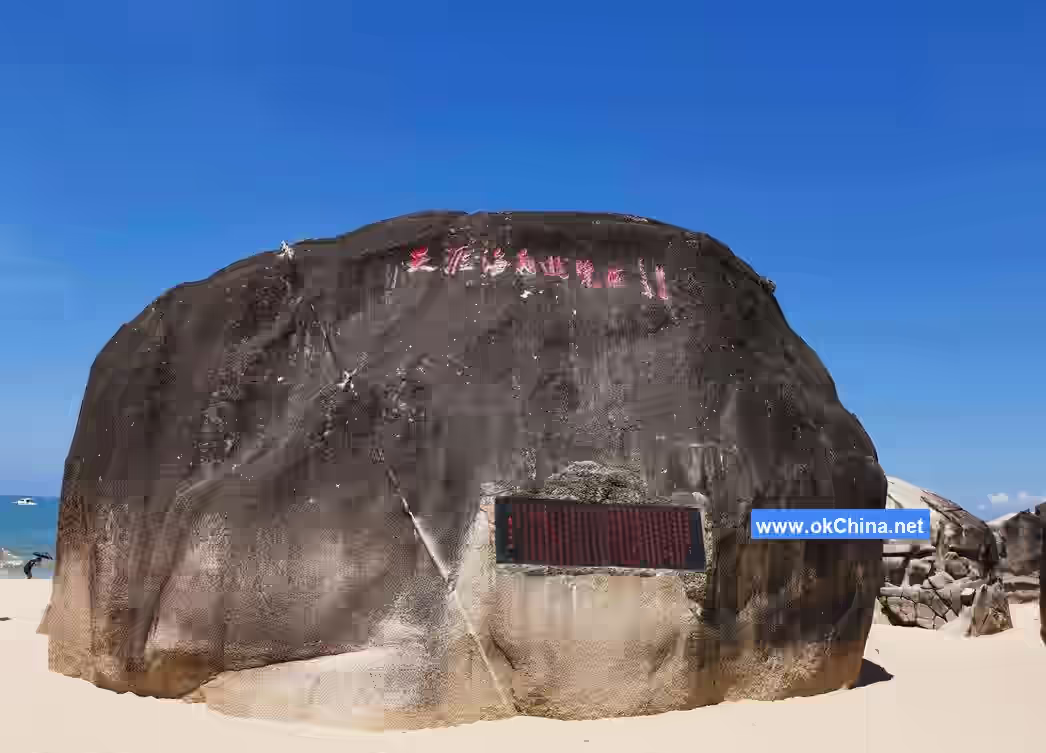
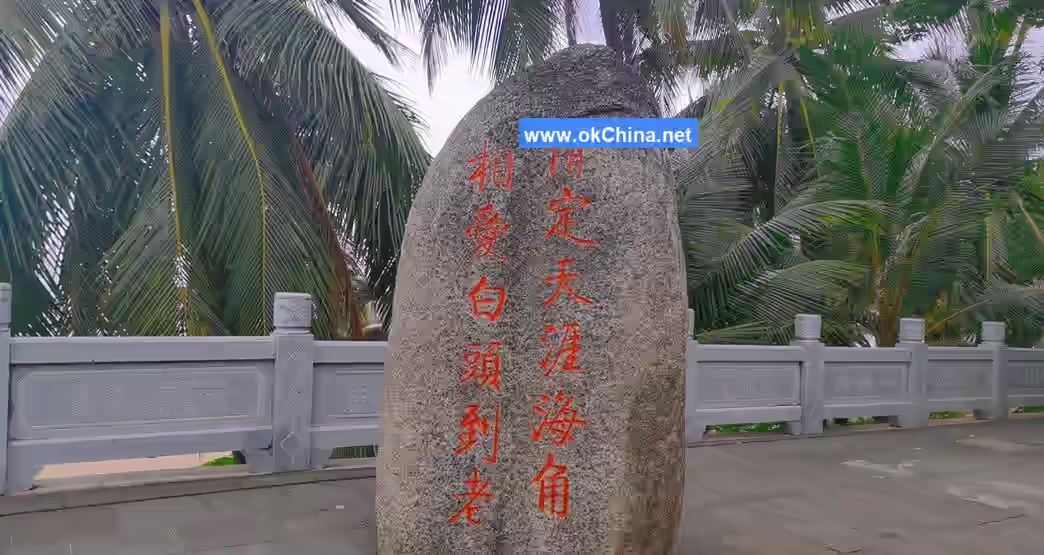
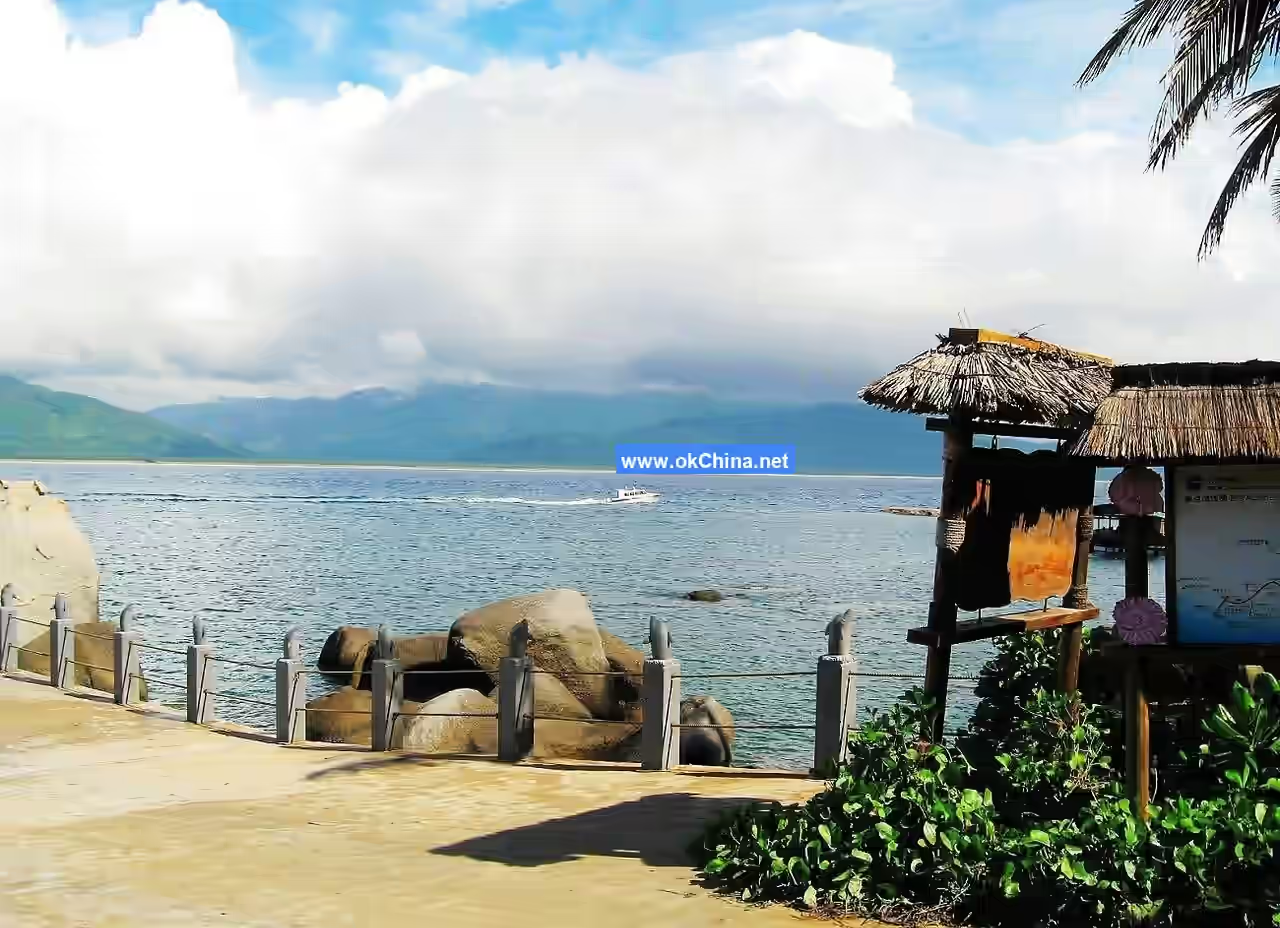
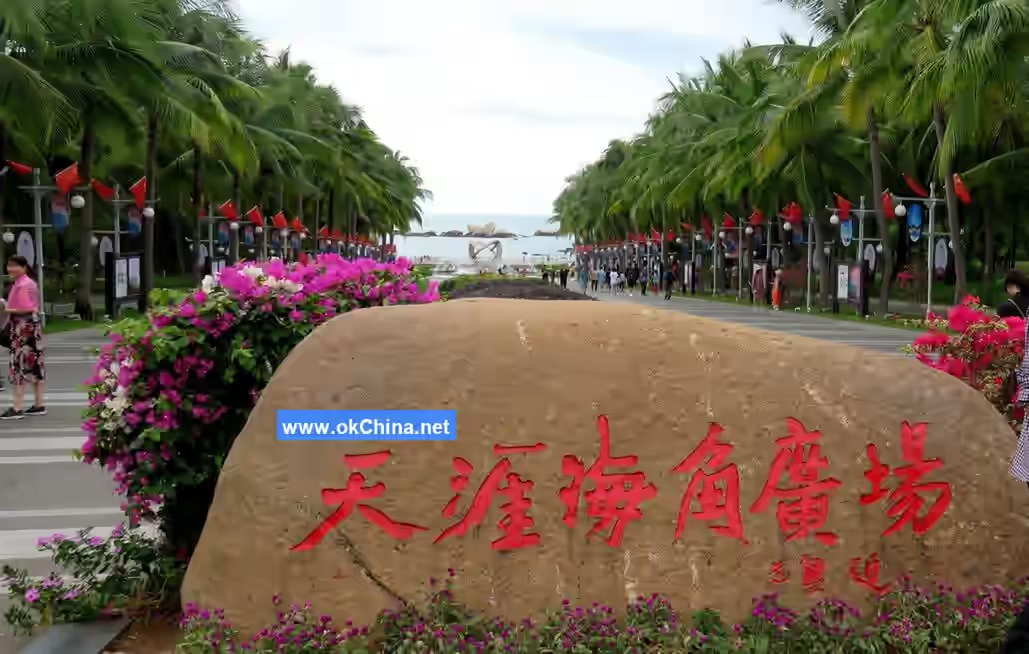
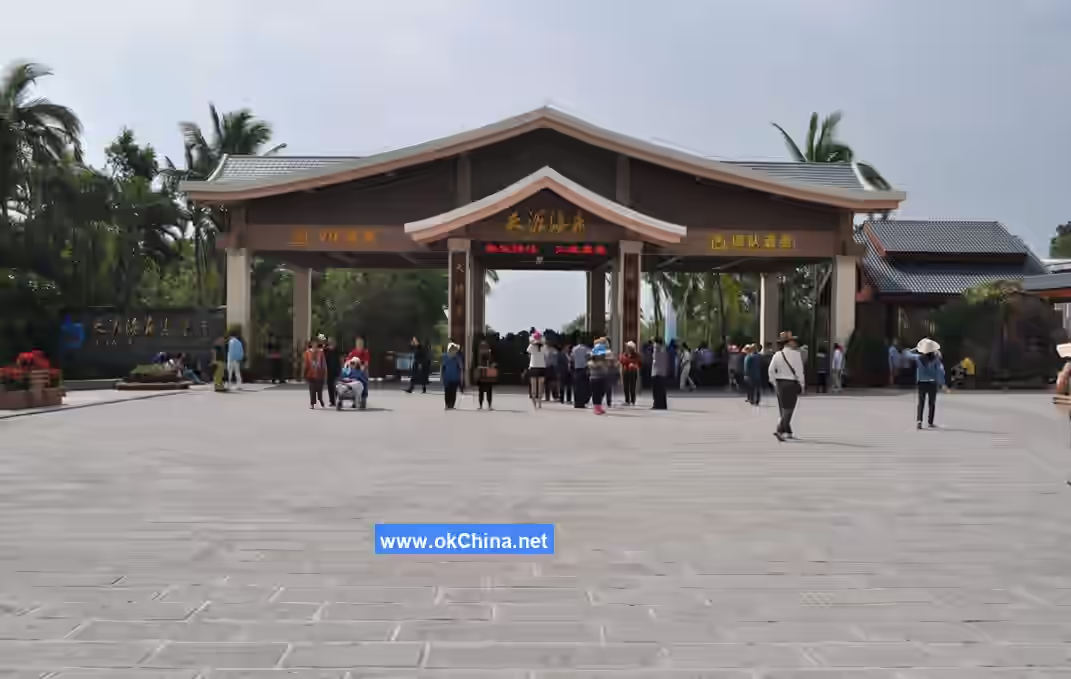
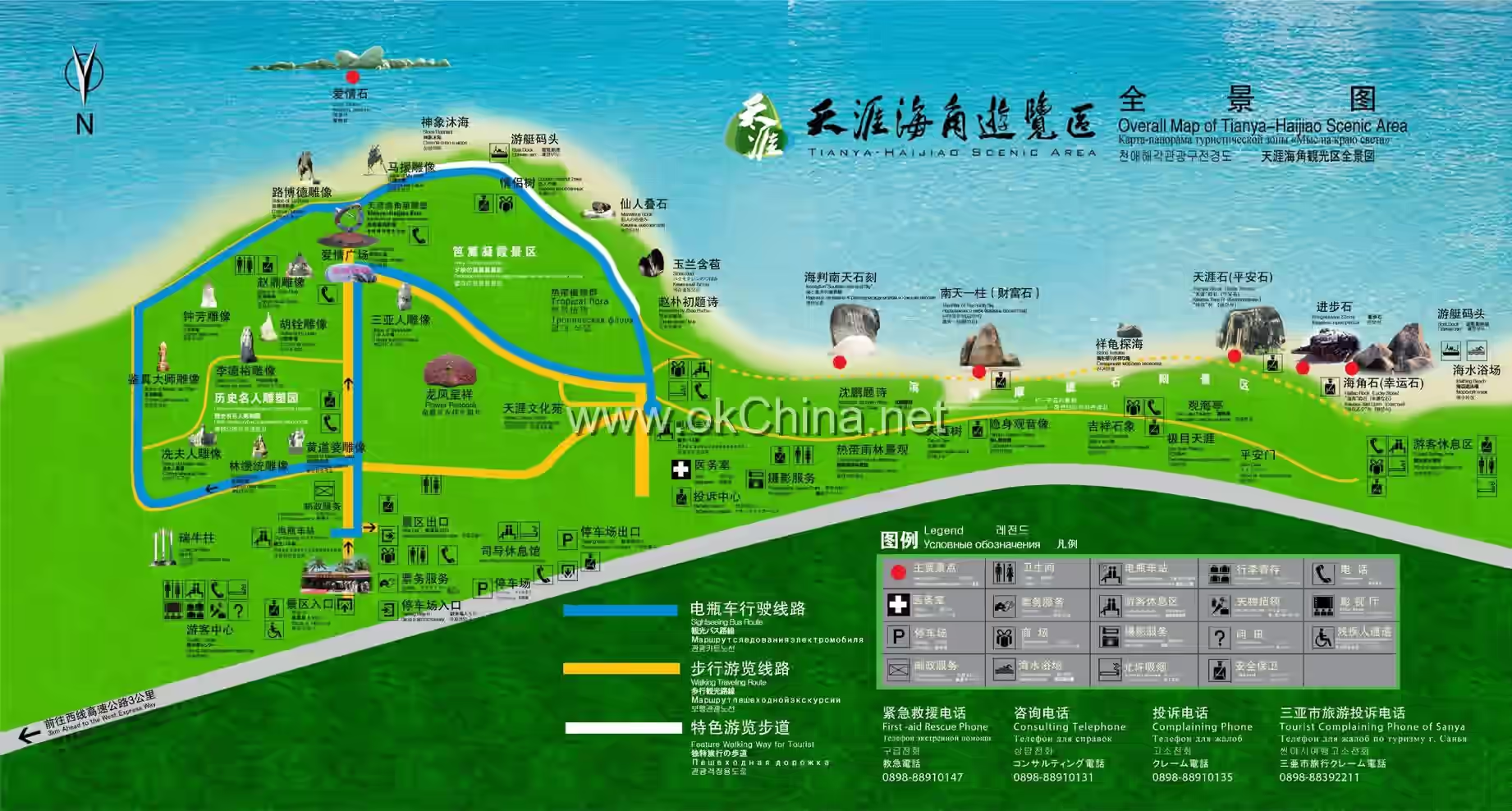
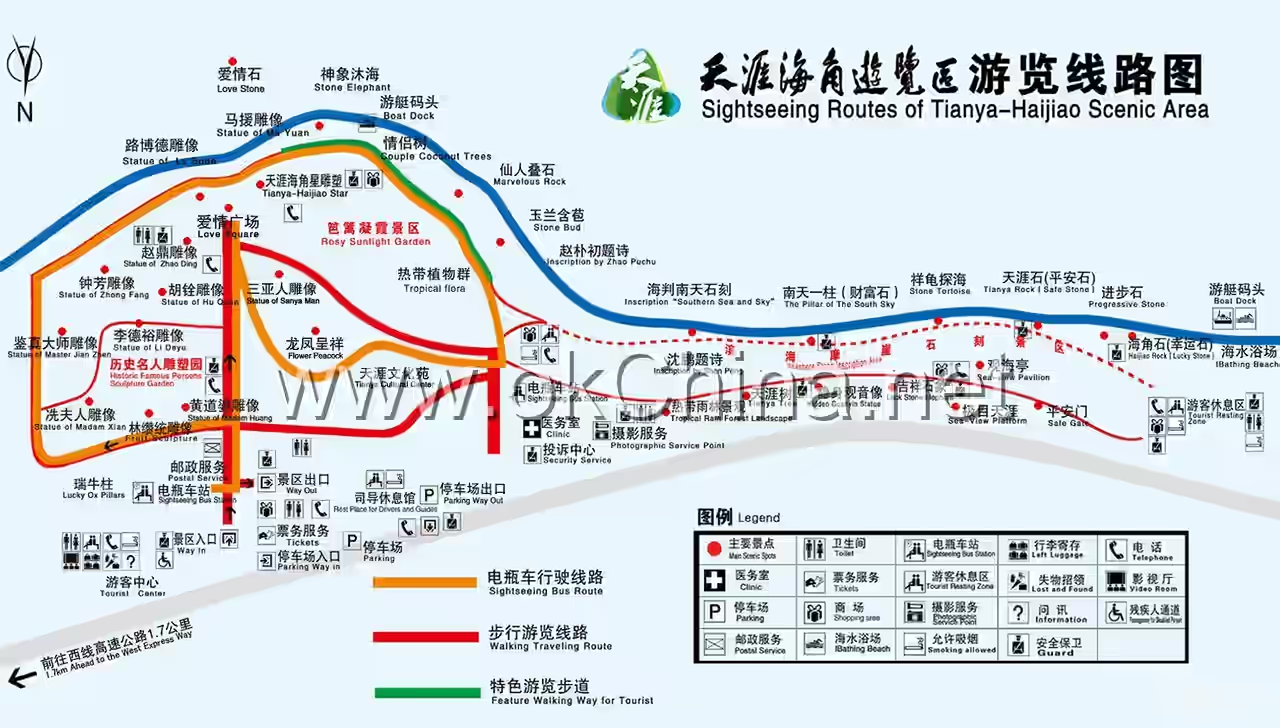
The Tianya Haijiao Scenic Area, also known as the Ends of the Earth Scenic Area, is located approximately 23 kilometers southwest of Sanya City in Hainan Province, at the foot of Maling Mountain in Tianya District, Sanya. Covering a total area of 16.50 square kilometers, with 10.4 square kilometers of land area and 6 square kilometers of sea area, it is a scenic spot themed around the "Ends of the Earth" culture and love culture. The name originates from two giant rocks within the area inscribed with the characters "Tianya" (天涯, End of the Sky) and "Haijiao" (海角, Corner of the Sea), along with the inscription "Tianya Haijiao Scenic Area" by Mr. Guo Moruo.
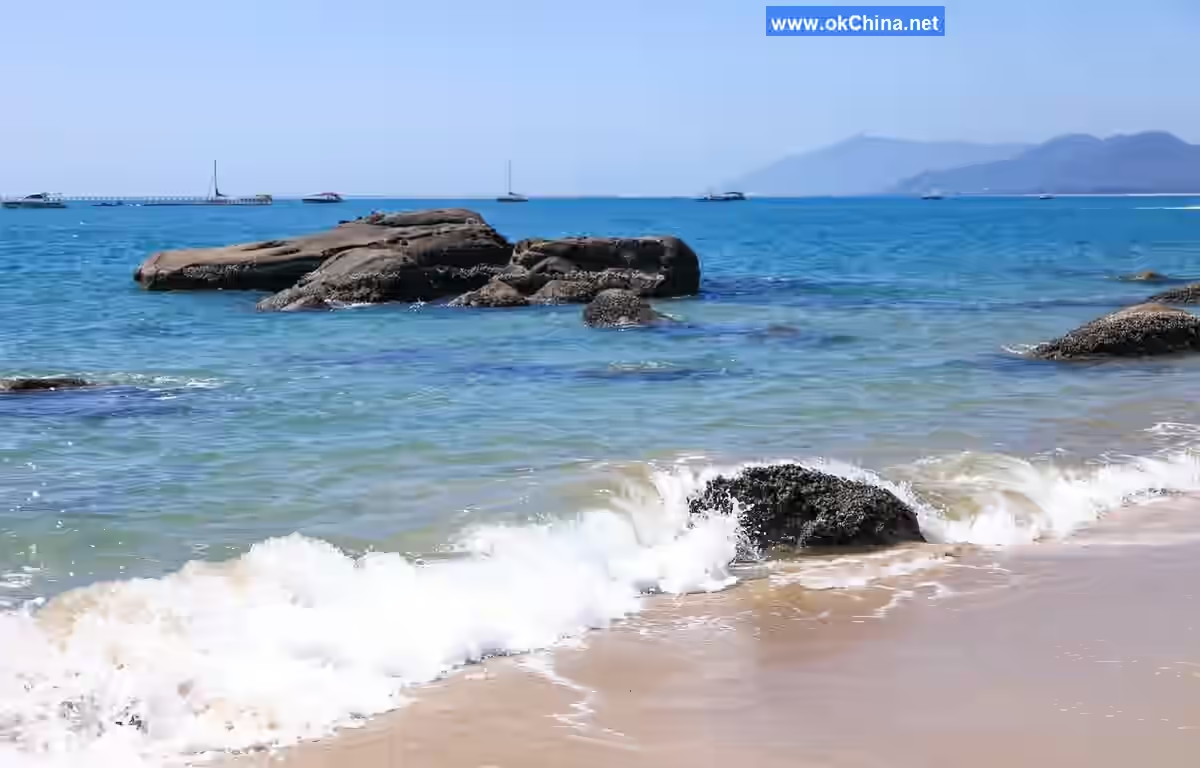
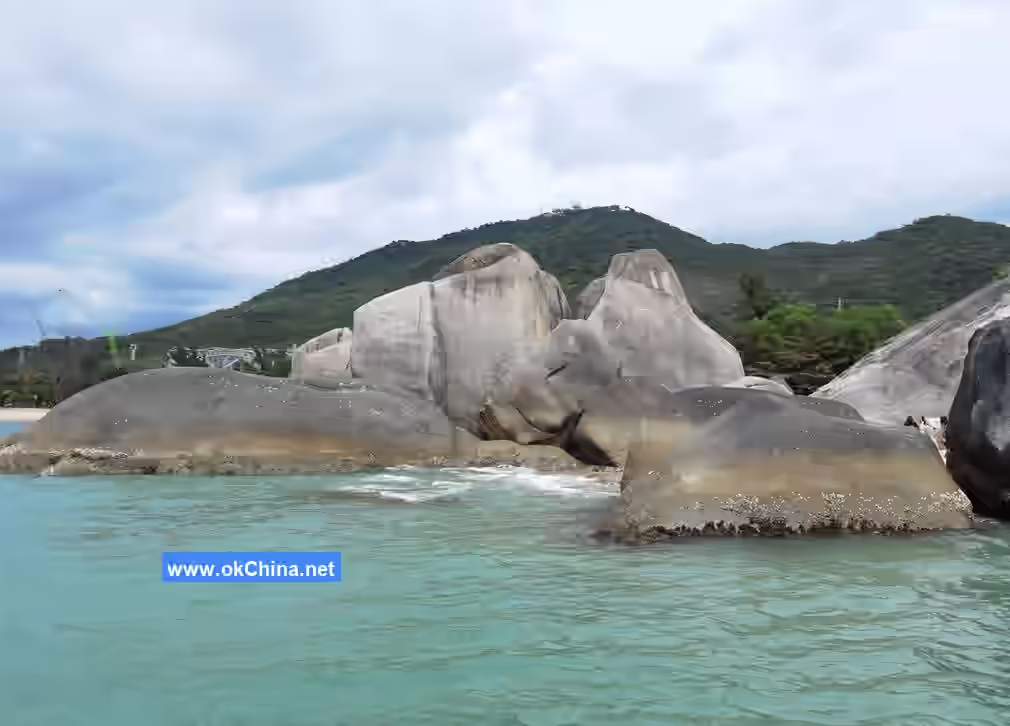
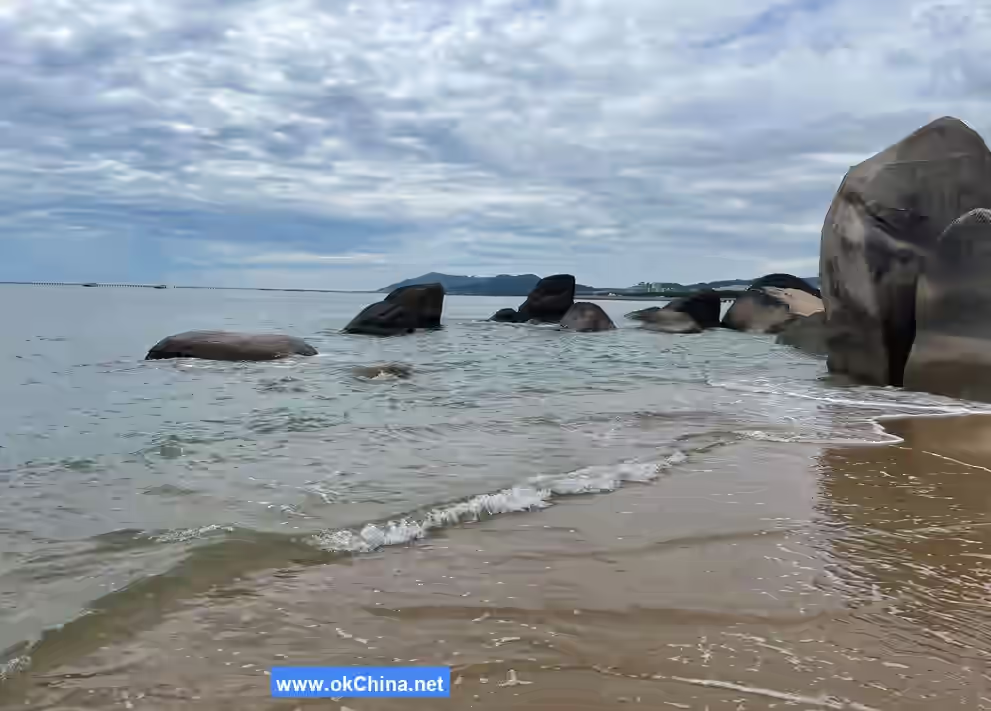
The Tianya Haijiao Scenic Area is a nationally renowned scenic spot representing the quintessential landscapes of Hainan. Its natural scenery comprises large beach rocks, Xiamaling, Tianya Bay, beaches, and seawater. The main attractions within the scenic area include the "Tianya" Rock, "Haijiao" Rock, and "Southern Sky Pillar."
2. Geographical Environment
2.1 Location and Territory
The Tianya Haijiao Scenic Area is situated 23 kilometers southwest of Sanya City, on a cape between Sanya Bay and Hongtang Bay. Its eastern boundary starts from the intersection of the highway and the Dabing River, following the western bank of the Dabing River to its estuary. The northern boundary is defined by the West Line Expressway, the western boundary by the highway bridge at the foot of Maling Mountain's paddy fields, and the southern boundary by a line equidistant 1.5 kilometers from the coastline. The total area is 16.50 square kilometers, consisting of 9.04 square kilometers of land and 7.46 square kilometers of sea.
2.2 Topography and Landforms
The scenic area faces the sea with mountains at its back. The highest peak within the area is Xiaqiao Ridge (41.7 meters above sea level), with other hills including Ping'an Ridge (240.5 m) and Boji Ridge (96.6 m). The terrain is slightly lower in the northeast with gentle undulations. The Dabing River flows from north to south through the area, emptying into the South China Sea at Xiaoqi Harbor in the northeastern part of the scenic area.
2.3 Climate Characteristics
Located in a tropical low-latitude region, the Tianya Haijiao Scenic Area experiences a tropical maritime monsoon climate characterized by oceanic features: long summers with no winter; abundant sunshine; high evaporation; and influences from tropical air currents and monsoons.
3. Main Attractions
3.1 "Tongjing-Maling" Railway Station Sign
During the War of Resistance against Japanese Aggression, the Japanese extensively plundered rich iron ore from Shilu, located in today's Changjiang County, Hainan. The Shilu Iron Mine is one of China's most famous rich iron ore deposits. The ore was transported via this railway line from Changjiang in western Hainan Island to Sanya Port in the south, then shipped to Japan for steel smelting and weapon manufacturing. This railway stands as ironclad evidence of Japan's occupation of Chinese territory and theft of Chinese resources. After the victory in the War of Resistance, this railway became the sole major transport artery in southern Hainan Island, making indelible contributions to the island's development. This railway has a history of over 70 years.
3.2 Huaiyuan Pavilion
Huaiyuan Pavilion was originally built in Yazhou during the Northern Song Dynasty by Prime Minister Ding Wei, but was later destroyed. It was reconstructed at Tianya Haijiao in 2021. The couplet on the pavilion, composed by renowned calligrapher Tian Yunzhang, reads: "The autumn moon hangs high in the Milky Way, who knows if the corner of the sea is free from wind and rain? / A small boat sails straight to the azure sky, confident that the ends of the earth harbor sages." Ascending the pavilion offers a panoramic view of the vast sea and sky, uplifting the spirit and making one forget worldly gains and losses. Looking around, one sees layered green mountains and ever-changing scenery, evoking reflections on the past and present while broadening one's mind. It is a cultural landmark within the scenic area for ascending heights and contemplating the distance.
3.3 Fubo General - Ma Yuan
The statue on the other side of the Love Square depicts another Fubo General from the Han Dynasty — Ma Yuan. Ma Yuan, from Maoling, Fufeng in the Eastern Han Dynasty, was a famous military strategist. In the 17th year of the Jianwu era of Emperor Guangwu of Han (41 AD), Emperor Guangwu appointed Ma Yuan as Fubo General, leading troops to suppress a rebellion in Vietnam, where he achieved a great victory and erected a bronze pillar marking the southernmost boundary of the Han Dynasty. Subsequently, Ma Yuan traveled between the South China Sea, establishing cities, walls, wells, and settlements, and reinstated Zhuya County, playing a positive role in strengthening the connection between Hainan Island and the mainland and promoting the feudalization of Hainan society. On the pillars beside the two generals stand two mythical beasts, the Vermilion Birds, deities guarding the southern direction, who together with the two Fubo Generals safeguard China's South China Sea.
3.4 Fubo General - Lu Bode
This general is named Lu Bode, from Pingzhou, Xihe in the Western Han Dynasty. In the first year of the Yuanding era of Emperor Wu of Han (110 BC), when the King of Nanyue rebelled, Lu Bode was appointed Fubo General and commanded troops to quell the rebellion. Lu Bode was brave and skilled in warfare, leading the Han army to a decisive victory. After pacifying the Yue lands, nine commanderies were established, among which Zhuya and Dan'er were located on Hainan Island. It was after General Lu Bode's conquest that Hainan was formally incorporated into Chinese territory. Lu Bode's southern expedition made tremendous contributions to expanding the southern frontier of the motherland, and he is recognized as a meritorious figure in the development of Hainan Island. Hence, a statue was erected in his honor.
3.5 Tianya Bookstore
Designed by the "most beautiful" bookstore architect Yu Ting, the Tianya Bookstore features an all-glass curtain wall structure, offering 360° transparent views. It houses 1,800 types of books, nearly 20,000 volumes, and serves as a gathering place for local cultural and creative products alongside national文创 offerings. Nothing is more beautiful than meeting you. The Tianya Bookstore, the southernmost seaside bookstore in China, rides the waves of the new chapter of the Free Trade Port, arriving within reach at the place closest to the sea. Surrounded by panoramic views, books, and collections of local and national文创 products, it's a place where shopping never stops. It will be a unique urban card, an international, quality, lifestyle-oriented platform. Centered on contemporary aesthetic living, the Tianya Bookstore is a public cultural space encompassing books, aesthetic new retail goods, coffee, light meals, music, fashion, cultural salons, and art exhibitions, creating a ". In the post-bookstore era emphasizing reading experience and spatial design, more and more consumers find spiritual fulfillment in physical bookstores. Sharp, hard, yet隐含 warmth like fire within an iceberg, the bookshelves frame openings and gaps within the line of sight and the framed scenery, allowing you to focus more intently on appreciating the beauty of the sea. The all-glass curtain wall brings the seascape into the bookstore—a building without a facade, where the bookshelves themselves become its立面, creating China's most romantic seaside bookstore.
3.6 Magnolia in Bud
The stone landscape "Magnolia in Bud." Originally an oval granite boulder, through prolonged marine erosion and weathering, it split into several petals under its own weight, forming the unique shape of a "magnolia in bud,"堪称 the world's largest magnolia "flower." This flower stands serene like a maiden,矗立 by the seaside, laughing proudly at the roaring waves, witnessing the changes of time. Just like Tianya Haijiao itself, having endured centuries of temporal and spatial transformation, it carries millennia of cultural and emotional积淀, becoming a deep-seated sentiment in people's hearts. This petrified "magnolia" flower is also likened to a "lotus," facing the distant 108-meter-tall Nanshan Guanyin Statue across the sea, which is the origin of the name "Lotus Bridge."
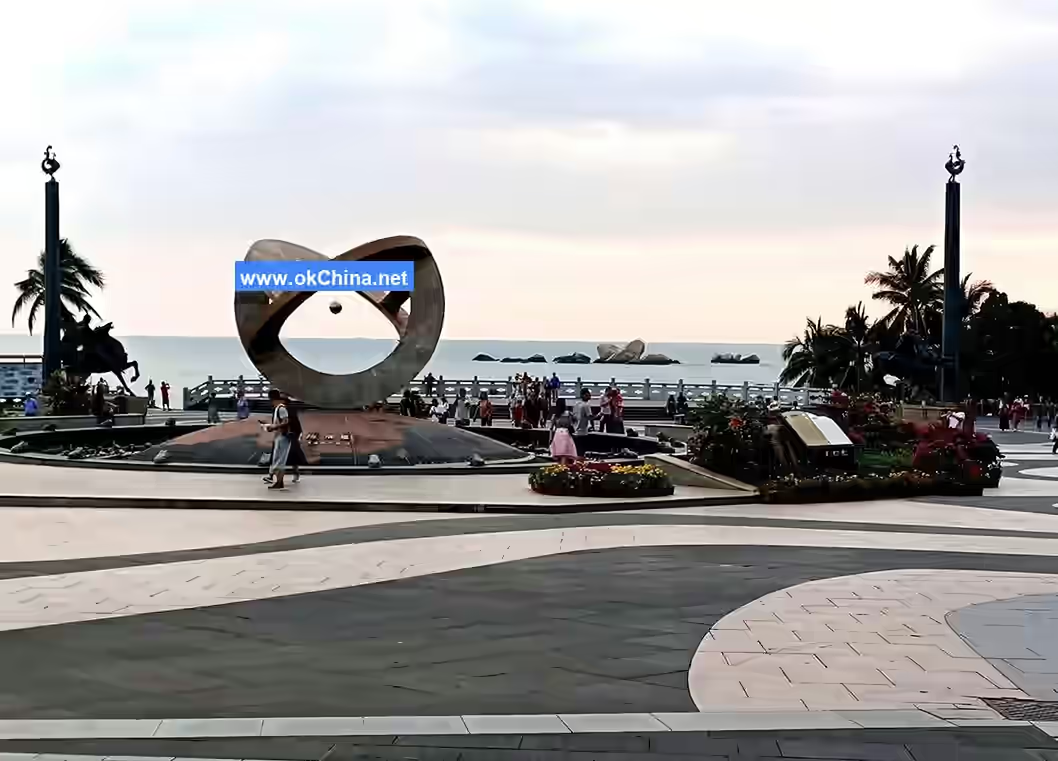
3.7 Tianya Haijiao Star
On June 3, 1997, a minor planet was discovered by the National Astronomical Observatories' Xinglong Observatory Base in Hebei, with the provisional designation 1997LK. On July 14, 2002, the Minor Planet Center officially granted it the permanent number 9668. In November 2006, approved by the International Astronomical Union's Committee on Small Body Nomenclature, this minor planet was named "Tianya Haijiao." To commemorate this naming, the "Tianya Haijiao Star" memorial sculpture was established in Sanya in 2008, designed by Professor Jiang Zhiqiang from Xiamen University. The main body of the sculpture is made of stainless steel, inspired by ancient astronomical instruments—the armillary sphere and the equatorial theodolite. It consists of three arcs representing the "meridian circle," "declination circle," and "right ascension circle." The central crystal sphere symbolizes the "Tianya Haijiao Star" roaming the cosmos,寓意 its close connection with the vast universe. The sculpture square is designed based on the concepts of the Zhouyi (I Ching) and the Eight Trigrams. The semi-arc-shaped base突出 Sanya's location on Earth, symbolizing Sanya as the pearl of the motherland's South China Sea shining in concert with the "Tianya Haijiao Star." Around the pool are 24 toad statues, representing the "24-hour"刻度 of the celestial equatorial coordinate system and the 24 solar terms of the Chinese lunar calendar,寓意 the unity of heaven and earth and the prosperity of all things.
3.8 Gazing at the Ends of the Earth
The Gazing at the Ends of the Earth sea-viewing platform is the best spot within the scenic area for ascending heights to view the sea. Standing on the platform, one can use the Tianya Rock, the 108-meter Nanshan Guanyin Statue, the South China Sea, the beach, and other beautiful and highly representative Hainan landscapes as backdrops for photography.
3.9 Tianya Haijiao Wedding Chapel
With a pure white base paired with rainbow-colored glass, the entire chapel resembles a crown floating on water. As night falls, the chapel, accentuated by fountains and colored light strips, becomes even more magnificent. Large transparent glass panels on the chapel's立面引入 the碧水, blue sky, and绿地 indoors. Inside, adorned with pure white decorations and点缀 with鲜花 and烛台, one can欣赏 the beautiful scenery while感受 the romance and solemnity of a church-style wedding. The Tianya Haijiao Wedding Chapel can host personalized定制 weddings for up to 50 people. The chapel is配套 with a guest rest area and over a thousand square meters of outdoor草坪, suitable for hosting various parties and晚宴.
3.10 Sun and Moon Rocks
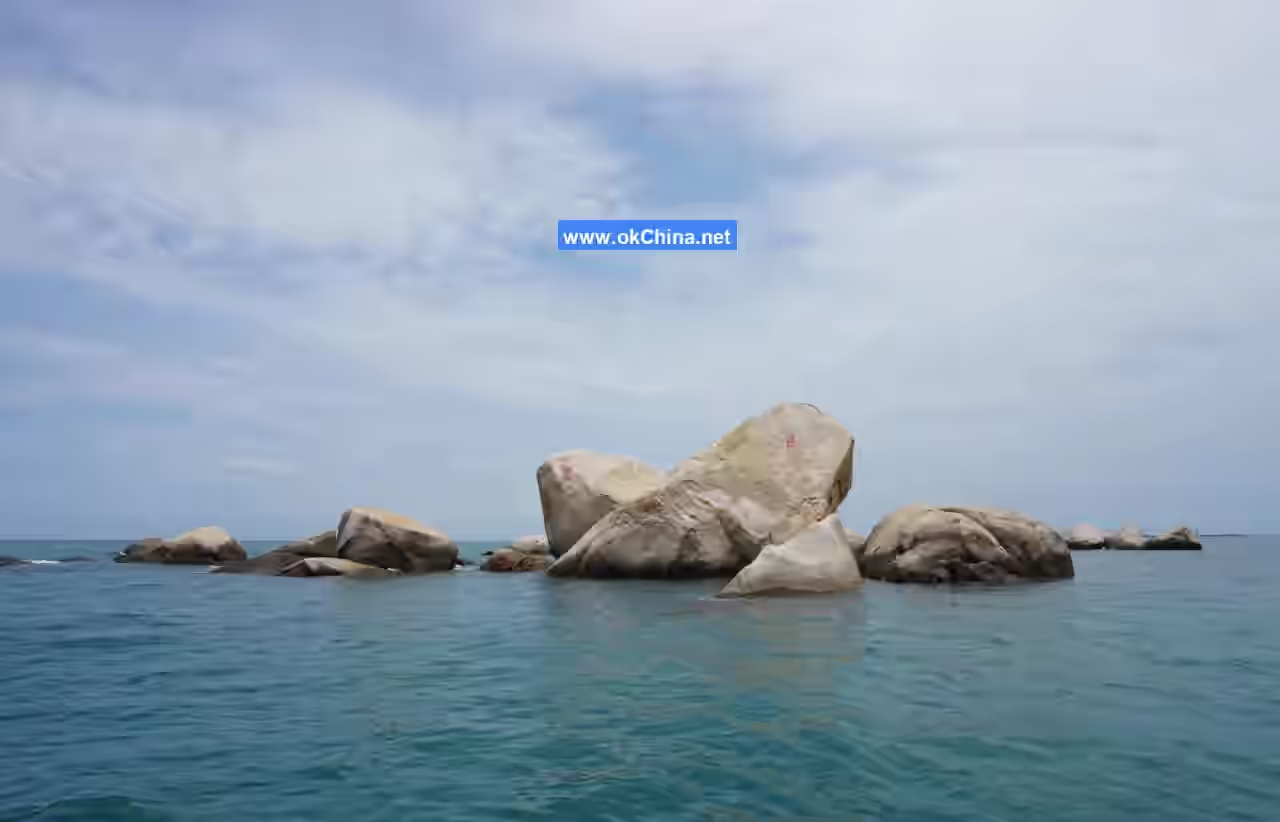
The Sun Rock and Moon Rock stand相依傍, their unwavering love serving as testament. On the sea surface stand two交叉矗立 giant rocks,分别 inscribed with the characters "日" (Sun) and "月" (Moon)—the famous Sun and Moon Rocks. The inscriptions were penned by Fan Jingyi, former editor-in-chief of the People's Daily.### 3.11 The Sea Corner Stone Giant granite rocks stand majestically by the seaside, towering and magnificent, like a natural copper wall and iron bastion, firmly rooted on the shores of the South China Sea. As inscribed by General Secretary Jiang Zemin during his third visit to Tianya Haijiao on December 22, 2000: "Let the winds rise and the waves surge, I stand unshaken." Among these massive rocks, the highest pointed stone is carved with the characters "海角" (Sea Corner), echoing the characters "天涯" (Sky's Edge) from afar, together forming the complete Tianya Haijiao landscape. Behind the "Sea Corner" stone, within the cluster of rocks, a fort was constructed. In October 1938, after the fall of Guangzhou, Nationalist General Wang Yi was appointed commander of the Qiongya Garrison Command, responsible for the defense of the Qiongya region. On January 8, 1939, Wang Yi held a blood oath alliance with six thousand Li people at Maling (present-day Tianya Town), calling for unity among the Li people to face the national crisis together. Subsequently, he came to the seaside of Xiamaling and carved the characters "海角" on a massive rock. On May 10 of the same year, General Wang Yi led his troops to the Chengpo River in Heping Town, Qiongzhong County, where he carved the four characters "唯战能存" (Only Through War Can We Survive) on layered rocks to boost morale. Both stone carvings are signed "Wang Yi," serving as historical witnesses. The characters "海角" not only symbolize the geographical end but also signify new beginnings and hope. Just like an island or a landmass, through hundreds of millions of years of crustal changes, it gradually grows and expands from a small corner.
3.12 The Sky's Edge Stone
The "Sky's Edge Stone" is the landmark and symbol of the Tianya Haijiao scenic area. This massive rock stands 10.8 meters tall with a circumference of approximately 66 meters. Nestled against the mountains and facing the sea, it combines roundness and squareness, oriented toward the east, stable and occupying a corner of the bay. With a history spanning hundreds of millions of years, it is truly "as solid as a rock." In the fifth year of the Yongzheng reign (1727), Cheng Zhe, the magistrate of Yazhou, looked up at the sky and gazed at the sea, feeling inspired, and carved the characters "天涯" on a massive rock. Cheng Zhe, a native of She County in Jiangnan (present-day Anhui She County), served as the magistrate of Yazhou from the second to the fifth year of the Yongzheng reign. He was not only an official of Yazhou but also a notable figure from Huizhou and a renowned calligrapher and carver of the Qing Dynasty. His work Yaogi Shuo is a classic in ancient ceramic appreciation. Over 30 types of books from Cheng Zhe's Qilue Study have been passed down, totaling more than 660 volumes. Particularly notable is the exquisitely printed Daijingtang Quanji for his teacher Wang Shizhen, renowned as a masterpiece in printing history. Directly below the "Sky's Edge" stone, the four large characters "海阔天空" (Vast Sea and Sky) are carved in clerical script. It is said to have been inscribed by a literati of the late Qing Dynasty, but the specific inscriber and time remain to be verified.
3.13 Good Fortune Tianya Scenic Avenue
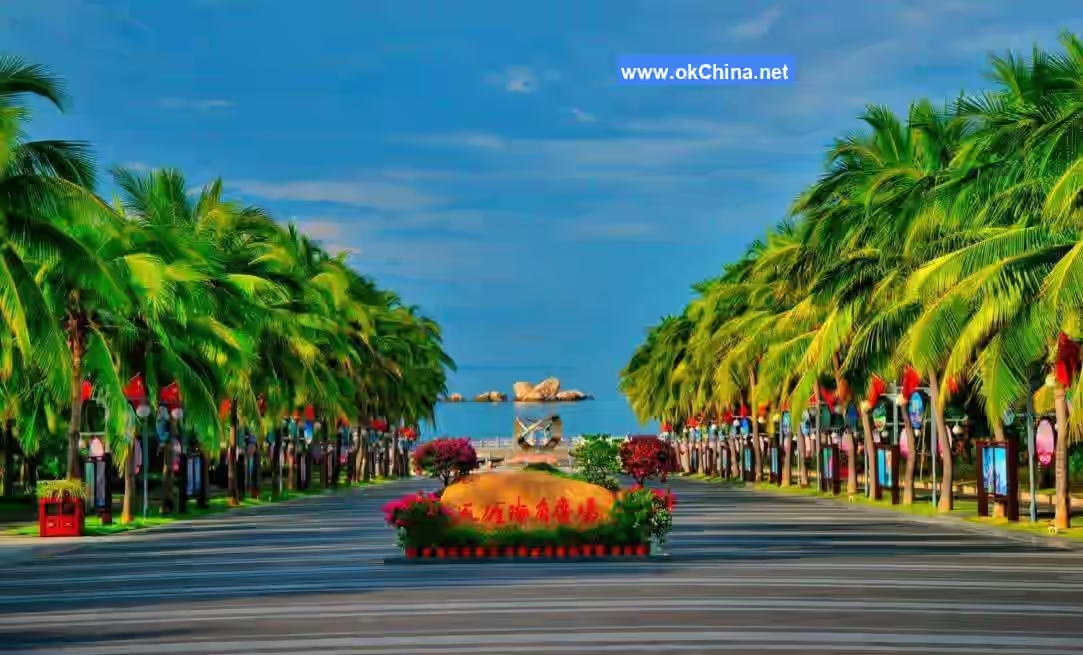
Everyone holds a unique "Tianya complex" in their heart. As times change, visiting "Tianya Haijiao" has now become a fashionable way to travel, symbolizing happiness and good fortune. It is an ideal place to release the soul,寄托情怀, and express romantic love and forge bonds. Looking out, the blue sea and sky form a picturesque scene, as if foretelling a beautiful vision of life. In ancient times, due to Hainan Island's distance from the Central Plains, the ancients regarded it as a symbol of "the ends of the earth." Today, the place that fully embodies the culture of Tianya Haijiao is precisely the Tianya Haijiao scenic area where we stand. It is not only a symbol and landmark of Hainan tourism but also carries the vicissitudes of ancient Hainan Island's history. The Tianya Haijiao scenic area is a representative microcosm of Hainan Island's culture,集中体现了 the island's historical and cultural heritage.
3.14 Tianya's Lone Tree
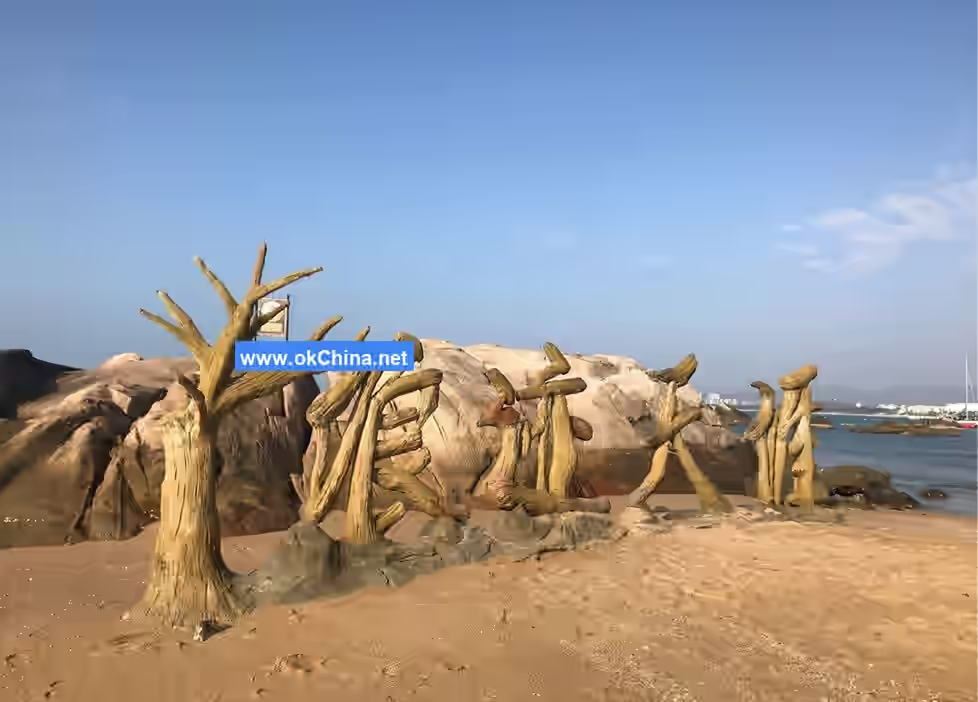
Opposite the "Southern Sky Pillar," there is a massive rock under which a large tree grows. Remarkably, this tree has grown from beneath the rock crevice, with its roots and trunk pressed under the巨石, yet it refuses to bow to fate. Instead, it seeks gaps between the rocks under the immense pressure, growing tenaciously and flourishing with lush branches and leaves. This tree has become a symbol of a life philosophy and spirit that fears no heavy burden, remains unyielding, self-reliant, and strives upward, known as "Tianya's Lone Tree."
3.15 The Sea Judges the Southern Sky Stone
The "Sea Judges the Southern Sky Stone" carving is the earliest cliff inscription in the Tianya Haijiao tourist area. The original Tianya Haijiao was not located here. During the Song and Yuan dynasties, there were "Sky's Edge Pavilion" in Qinzhou (then under Guangdong's jurisdiction) and "Sea Corner Pavilion" in Lianzhou, Hepu. At that time, the ancients believed that China's South China Sea corresponded to China's Southern Sky, which referred to the sun's path or, specifically, the area south of the Tropic of Cancer. The Qing Dynasty's Kangxi Emperor重新划定了 the boundaries of the Southern Sky based on Confucian classics like the Shangshu. Research indicates that the "Sea Judges the Southern Sky" inscription was left as a latitude marker during the first nationwide map survey (Huangyu Quanlantu) in Chinese history during the Kangxi period of the Qing Dynasty. In the 53rd year of Kangxi (1714), Emperor Kangxi dispatched Qing ministers Miao Shou and Chuo Er Dai, along with French envoy and Jesuit Jean de Fontaney sent by King Louis XIV, as imperial commissioners to preside over the survey and carve the four large characters "海判南天" on the rock. "Sea" refers to the South China Sea, "判" means to divide, so "海判南天" signifies dividing the South China Sea into the South Sea and the Southern Sky. It is known that China is called the "Red County Divine Land," and "海判南天" precisely means the天地分界线 of China's territory, with the south being the Red County and the north being the Divine Land.
3.16 The "Sea Judges the Southern Sky" 300th Anniversary Sculpture Wall
The "Sea Judges the Southern Sky" 300th Anniversary Sculpture Wall was unveiled in November 2014. The commemoration of the 300th anniversary of "Sea Judges the Southern Sky" was also part of the 50th anniversary celebrations of Sino-French diplomatic relations in 2014. The "Sea Judges the Southern Sky" stone carving dates back to the 53rd year of Kangxi, 300 years before 2014—in 1714. The Qing court sent Miao Shou (五官正 of the Imperial Observatory), Chuo Er Dai (from the Court of Colonial Affairs), and French scientist Jean de Fontaney to the Yazhou observation point to carve the "海判南天" inscription. It is an important relic of Kangxi's astronomical and geodetic survey and serves as historical evidence of Sino-French scientific and technological exchange in the early 18th century. The astronomical and geodetic survey conducted from the 47th to the 57th year of Kangxi (1708–1718) was an unprecedented grand undertaking in the history of map surveying, both in China and the world. The survey employed三角 and astronomical measurement methods. Emperor Kangxi appointed French scientists Joachim Bouvet, Jean-Baptiste Régis, Pierre Jartoux, Jean de Fontaney, de Mailla, de Moyriac de Mailla, and others, along with Austrian Fridelli and Portuguese Cardoso, to collaborate with Chinese officials. The Qing Huangyu Quanlantu was completed in the 57th year of Kangxi. The relief图案 on the commemorative wall is取自 from one of the series of tapestry hangings titled Histoire de l'Empereur de la Chine created by the French Beauvais factory in the late 1680s, depicting Emperor Kangxi discussing astronomical measurements with French scientists.
3.17 The Southern Sky Pillar Stone
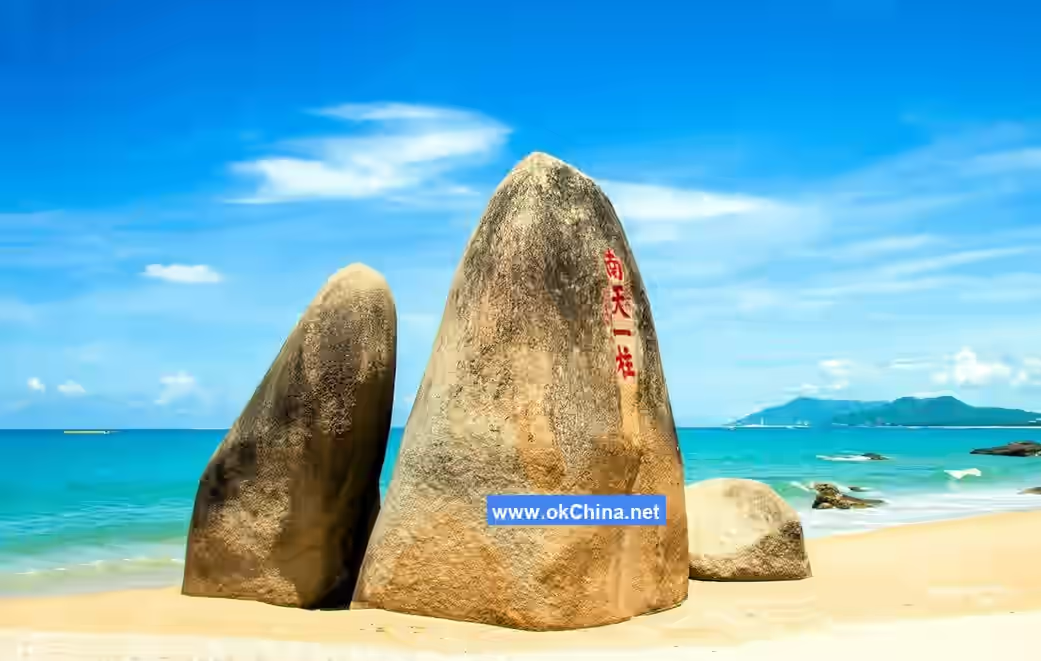
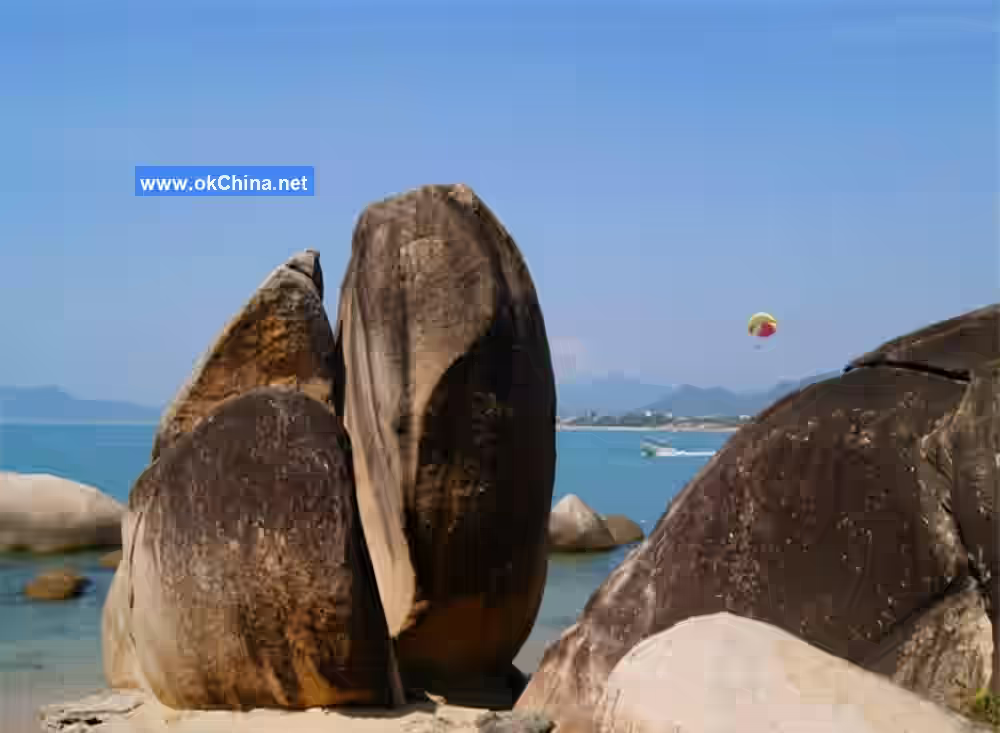
A towering conical奇石, approximately 7 meters high, resembles a "double-masted sail" rising from an ancient ship when viewed from the side. Viewed from the front, it looks like a divine pillar standing here,坚韧不拔,顶天立地, enduring the冲刷 of raging waves,巍然屹立不倒. We can see the "Southern Sky Pillar" stone背倚 the vast sea,擎天拔地, possessing the imposing manner of独立南天. Historical records state: During the Xuantong period of the Qing Dynasty, in 1911, Fan Yunti, the magistrate of Yazhou, frequently traveled to this area to observe the people's conditions. Seeing this rock so浩瀚 and upright, he made a vow in his heart: "Serve as an official for a day, serve the people for a lifetime." In 1909, Fan Yunti was transferred to serve as the magistrate of Yazhou直隶州. It is said that during the Spring Festival that year, he posted a couplet he composed at the州城衙门: "In office for a day, devote heart for a day; selfless and strict in law enforcement, dare not treat the office as a mere lodging. Yield some情, speak some理; when everyone has matters, discuss them well; do not bring disputes to the公门." The scenic area's "Tianya Culture Garden" preserves a half-couplet, with the完整的一副 reading: "With such锦绣江山, it aptly称天南极地; looking at the future文明气象, it truly is a海上雄州." The inscription time is "Autumn month of the second year of Xuantong," signed "Acting Magistrate of Yazhou直隶州, Yong'an Fan Yunti." "The calligraphy style of the couplet matches that of 'Southern Sky Pillar,' especially the strokes of '南天' and '天南,'简直如出一辙!" At that time, the last emperor had ascended the throne, the Qing Dynasty was declining, and it suffered from imperialist aggression. In this critical moment, Fan Yunti painstakingly managed Hainan Island, hoping it could become a擎天玉柱 for the motherland's mountains and rivers. Hence, he inscribed "南天一柱" on the巨石, praying for smooth governance, national peace and prosperity, and ample food and clothing. The Southern Sky Pillar stands独立 among the rocky磊,屹立 on the shores of the South China Sea,雄奇壮观, adding a touch of strength to the柔情海景. The "Southern Sky Pillar" cliff inscription thus came into being and has a history of over a hundred years. After visiting, Guo Moruo wrote the诗句: "The Southern Sky Pillar stands, together we盘旋," expressing his heartfelt感慨.
Regarding the Southern Sky Pillar, there is also a beautiful legend. It is said that long ago, the seas around Lingshui Li'an were plagued by fierce waves, causing hardship for the people. Two仙女 under the Queen Mother of the West learned of this and secretly descended to the mortal world, standing in the South China Sea to guide local fishermen. The Queen Mother was angered and sent the Thunder God and Thunder Mother to capture them. The two仙女 refused to return and turned into the Twin Peak Stone, which was then split in two by lightning. One part fell into the sea near Li'an, and the other flew to the side of Tianya, becoming today's "Southern Sky Pillar."### 3.18 The Lover Trees In the famous poem "The Farthest Distance in the World" by Nobel laureate and Indian poet Rabindranath Tagore, there is a line: "The farthest distance in the world is not the distance between trees, but the branches growing from the same root that cannot lean on each other in the wind." Before us stand two coconut trees, their trunks leaning against each other and their leaves intertwined, symbolizing a life of love and harmony. Just as the verse "In heaven, we wish to be birds flying side by side; on earth, we wish to be trees with branches intertwined" describes, these two trees are affectionately known as the "Lover Trees" or "Couple Trees," representing one of the iconic scenic spots of Hainan's coconut groves and sea charm.
Within the Tianya Haijiao (Ends of the Earth) scenic area, there are also several coconut trees with unique shapes, known as "Crooked-Neck Coconut Trees." Tilted by typhoons, these trees still grow tenaciously, with their trunks leaning against the ground and their crowns pointing straight at the blue sky. Their distinctive forms add to the charm of the scenic area, making them representative plant landscapes of Tianya Haijiao.
3.19 Statue of Zhao Ding
Zhao Ding, a native of Shanxi, was a Southern Song dynasty chancellor who resisted the Jin invasion and served as the teacher of Yue Fei. It was under his careful cultivation that the Yue Family Army rose to prominence. In this statue, his hair is disheveled, his eyes filled with grief and indignation, his left hand clenched into a fist, and his right palm slamming on the table, vividly capturing his sorrow, anger, and fervor. In 1138, under military pressure from the Jin state, many in the Southern Song court advocated ceding territory for peace. However, Zhao Ding firmly opposed the traitorous actions of the surrender faction led by Qin Hui, earning Qin Hui's hatred. After Qin Hui became chancellor, he relentlessly persecuted Zhao Ding, fabricating charges to demote him repeatedly, eventually exiling him to Jiyang Army (present-day Sanya). Even in Jiyang Army, Qin Hui still sought to harm him. To avoid implicating his family and friends, Zhao Ding wrote his own epitaph: "Riding the tail of the Winnowing Basket, I return to heaven; my spirit becomes mountains and rivers, strengthening our dynasty." He then starved himself to death and was buried in Jiuzhou Village, present-day Dongfang County. In Chinese history, Zhao Ding is a tragic figure, but his noble spirit is celebrated by later generations. The Five Lords' Temple in Haikou includes him as one of the "Five Lords" for commemoration.
3.20 Statue of Master Jianzhen
Master Jianzhen, originally surnamed Chunyu, became a monk at the age of fourteen. Renowned both domestically and internationally for his extensive knowledge and exceptional talent, he was invited by the Japanese emperor in 742 AD (the first year of the Tianbao era of the Tang dynasty) to travel east to Japan to teach Buddhist precepts, as Buddhism was beginning to flourish there. To spread and promote Buddhism, Jianzhen gladly accepted. Due to the limitations of navigation at the time, his first four attempts to cross the sea to Japan were unsuccessful. In 748 AD (the seventh year of the Tianbao era), Jianzhen led a group of fifteen, including his disciples and Japanese monks, on a fifth voyage from Shaoxing, Zhejiang. However, they encountered a typhoon at sea, drifted for fourteen days, and landed in Zhenzhou, Hainan (present-day Sanya), where they stayed for over a year. During his stay in Zhenzhou, Jianzhen did not become disheartened by the shipwreck nor distressed by being at the ends of the earth. Instead, he remained composed and dedicated himself to spreading Buddhist culture. He and his disciples built the main hall of the Dayun Temple for the locals, preached scriptures and doctrines, "continuously lecturing on precepts and converting people," disseminating Central Plains culture, civilizing local customs, and becoming pioneers in developing Hainan's culture and education with a lasting impact. Later, he returned north from Zhenzhou and finally succeeded on his sixth voyage to Japan in 753 AD (the twelfth year of the Tianbao era). He became the founder of the Ritsu school of Buddhism in Japan, making outstanding contributions to cultural exchanges between China and Japan.
3.21 Statue of Zhong Fang
Zhong Fang, originally from Qiongshan County, was born in Yazhou Gaoshan Suo during the Ming dynasty, which is present-day Shuinan Village in Yazhou, Sanya, renowned as "Hainan's First Ancient Cultural Village." He was a famous scholar and politician of the Ming dynasty, serving as a civil official, military officer, judge, educational official, and financial official. Known as the "Yazhou Prodigy," Zhong Fang could compose poetry at age seven, passed the county-level imperial examination at ten, the provincial examination at twenty-five, and the highest imperial examination at thirty-two, entering the Hanlin Academy. He later rose to the positions of Right Vice Minister of the Ministry of War and Right Vice Minister of the Ministry of Revenue in Nanjing. Zhong Fang was exceptionally talented and knowledgeable, mastering books on law, history, medicine, divination, and more. His writings were described as "vigorous and profound, with spirit following reason." When he lectured at the Imperial Academy, "no student was unmoved." Zhong Fang explicitly proposed the philosophical view of "the unity of knowledge and action, with knowledge guiding action and action practicing knowledge." His poetry and prose were diverse in form, unique in style, profound in skill, and novel in literary grace. Throughout his life, Zhong Fang authored numerous works covering literature, history, politics, economics, culture, education, medicine, sports, and military affairs. His works "Collected Essentials of the Spring and Autumn Annals" and "Doubts and Meanings in Studying the Book of Changes" were selected as required reading for examination candidates. The Qing dynasty included his major works in the "Complete Library of the Four Treasuries." His other works include "Broad Meanings of Elementary Learning," "Chart of the Imperial Ultimate Through the Ages," "Continuation of Ancient and Modern Summaries," "Brief Records of Yazhou," "Summary of Health Preservation," "Collected Poems and Essays of Mr. Junxi," "Reading Notes," and more. Zhong Fang is a significant milestone in Hainan's cultural development, truly "succeeding Wenzhuang (Qiu Jun) and inspiring Zhongjie (Hai Rui)," playing a connecting role between past and future. He is revered as the "Great Confucian of Lingnan" and "Extraordinary Talent of the Southern Sea," alongside Qiu Jun, the top talent of Hainan in the Ming dynasty, and Hai Rui, the "Sea Blue Sky," collectively known as the "Three Stars of Qiongzhou." Zhong Fang and his son are also one of Hainan's seven father-son pairs of imperial examination graduates. His son, Zhong Yunqian, passed the highest imperial examination in 1529 AD (the eighth year of the Jiajing era) and served as the magistrate of Ninghai County in Zhejiang, a director in the Ministry of Justice, prefect of Fuzhou, prefect of Laizhou, and other positions. Father and son successively passing the highest examination and serving as imperial officials has been celebrated as a beautiful story for generations.
3.22 Statue of Lady Xian
Lady Xian, originally named Xian Ying, was from Gaozhou, Guangdong. She married Feng Bao, the prefect of Gaozhou. After unifying the Lingnan region, she petitioned Emperor Wu of Liang to "re-establish Yazhou," ending the nominal control of Hainan Island by the Central Plains government since the Eastern Han dynasty, making her the most contributing historical figure to Hainan. Lady Xian lived during the Liang, Chen, and Sui dynasties of the Northern and Southern Dynasties period. She was not only a leader of the Baiyue people in the Lingnan region but also actively upheld national unity during major historical changes. She was enfeoffed by the Liang dynasty as "Lady Protector Marquis," by the Chen dynasty as "Grand Lady of Shilong Commandery," and by Emperor Wen of Sui as "Lady of Qiao State." Under her governance, the Lingnan region enjoyed over 110 years of prolonged peace and stability. Due to her outstanding achievements in maintaining national unity and promoting ethnic solidarity, Premier Zhou Enlai praised her after the founding of New China as "the foremost heroine in Chinese history."
3.23 Statue of Lin Zuantong
Lin Zuantong, a provincial graduate of the late Qing dynasty and a gentleman of the Hundred Days' Reform (Wuxu), was the only outstanding figure from Hainan to participate in the reform. At twenty, he ranked first in the prefectural examination. Later, he went to Guangzhou to attend lectures by Kang Youwei at the Guangya Academy and Wanmu Caotang, becoming a fellow student with Liang Qichao. In 1895 AD (the twenty-first year of the Guangxu era), he went to the capital for the metropolitan examination, participated in the Gongche Shangshu (Public Vehicle Memorial) and the Hundred Days' Reform organized by Kang Youwei and Liang Qichao, serving as a core member of the reform movement. After the reform failed, Lin Zuantong secretly returned to Hainan, where his scholarly rank was revoked by the Qing court. Back in Hainan, he remained loyal to the country, repeatedly meeting with merchants in Wanning, Qionghai, and other places with friends to plan the development of the Paracel Islands, praised as "a fortunate event for expanding China's territory." He was the first person in China to advocate for the development of the Paracel Islands, making indelible contributions to Hainan's development. He died of illness in 1922 AD (the eleventh year of the Republic of China) in present-day Wanning City at the age of seventy.
3.24 Statue of Huang Daopo
Huang Daopo, also known as Huang Qiao'er, lived during the late Song and early Yuan dynasties. Sold as a child bride in her youth, she later traveled by boat to Yazhou (present-day Sanya) at the southern tip of Hainan Island. In feudal society, she found herself alone in a foreign land facing many difficulties but was accepted and helped by the Li ethnic compatriots in Sanya. The Li people not only provided her with shelter but also taught her their advanced textile techniques. Huang Daopo studied diligently, integrating Li and Han weaving skills to become an excellent textile artisan, deeply loved by the local people, and lived in Sanya for nearly thirty years.
Later, longing for her hometown, Huang Daopo returned to Wunijing (present-day Xuhui District, Shanghai) during the Yuanzhen era of the Yuan dynasty. At that time, although cotton was widely cultivated in the Yangtze River basin, textile technology remained relatively backward. Drawing on her weaving experience from Hainan, Huang Daopo dedicated herself to reforming her hometown's textile tools and teaching exquisite weaving techniques. She not only taught local women Li textile skills but also innovated textile tools, making "Wunijing quilts" famous far and wide. The Songjiang area quickly became the national center of the cotton textile industry, with products sold across the country and even exported to Europe and America, earning the reputation of "clothing and covering the world."
Huang Daopo is hailed as a pioneer of China's cotton textile industry and an outstanding textile innovator of the 13th century, revered as the "Mother of Clothing." Her achievements were inseparable from the support and teachings of the Li compatriots in Yazhou, and she was also an important envoy for cultural exchange between ancient Hainan and the mainland. The ballad流传 in the Shanghai area, "Granny Huang, Granny Huang, teach me to spin, teach me to weave, two spindles, two bolts of cloth," expresses gratitude for her exceptional contributions.
3.25 Statue of Hu Quan
Hu Quan, a native of Luling Prefecture in Jiangxi (present-day Ji'an, Jiangxi), served as the Vice Minister of War in the Southern Song dynasty and was a famous politician, writer, and patriotic statesman. When the Jin troops crossed the Yangtze River to attack the south, he strongly advocated resistance, recruiting volunteers to defend his hometown. Like Zhao Ding, he vehemently opposed Qin Hui's peace negotiations with the Jin and even submitted a memorial to the emperor requesting Qin Hui's execution. As a result, Qin Hui instigated Emperor Gaozong of Song to repeatedly demote and exile him to Jiyang Army, which is present-day Yazhou District in Sanya. After Qin Hui's death, Hu Quan was finally able to return north. He is listed as one of the "Five Lords" in the Five Lords' Temple in Haikou, commemorated by later generations.In the 18th year of Shaoxing, 1148 AD, Hu Quan set out from Xinzhou to his new place of exile, Jiyang Army. He traveled by boat from the Leizhou Peninsula, disembarked at Tongchao Post in Chengmai County (present-day Laocheng Town), and proceeded along the western route around the island, passing through Lingao. At Maichou Village in Lingao (present-day Meichao Village, Huangtong Township), he composed a seven-character quatrain titled "Maichou Village": "Gazing north, I long for Wenxi County; / Coming south, I dread entering Maichou Village. / A rugged journey of ten thousand miles to the ends of the earth, / Wild grass and desolate mist shatter the soul." The poem reflects his nostalgia for the deceased Zhao Ding and his anxiety about his own future, revealing the poet's state of mind at the time. Fortunately, while exiled in Xinhui County, Guangdong, Hu Quan encountered a beautiful woman named Li Qian, who accompanied him to Yacheng, where they lived in exile for eight years. Their love story became widely celebrated, showcasing his broad-mindedness and resilience despite being banished to the remote corners of the earth. As the saying goes: "Official fame pales before literary renown; the depths of the sea of love surpass the perils of the political arena."
3.26 Statue of Li Deyu
Li Deyu was a chancellor of the Tang Dynasty, originally from Zhaoxian County in present-day Hebei Province. He served as chancellor twice. In the second year of Dazhong during the reign of Emperor Xuanzong of Tang (848 AD), he was demoted to the position of Household Registrar of Yazhou and arrived there in the first month of the following year. He passed away in the first month of the fourth year of Dazhong (850 AD) at the age of 63 at his place of exile. Posthumously, he was granted the title of Grand Commandant and Duke of Wei. At that time, Yazhou was located in present-day Qiongshan, Haikou. He once wrote the poem "Climbing the Walls of Yazhou City": "Alone, I climb the high tower, gazing toward the imperial capital; / Even birds take half a year to fly the distance. / The green mountains seem intent on keeping me here, / Encircling the city walls a hundred times over." It is said that Li Deyu has descendants scattered in the Qiongshan area of Haikou. From the Sui Dynasty to the Yuan Dynasty, a total of 49 high-ranking officials at the chancellor level were exiled to Hainan, with Li Deyu being a representative figure. His poem, "Once gone, ten thousand miles away; / A thousand thoughts, a thousand times no return. / Where is Yazhou? / I pass through the gates of hell to reach it," became a representative portrayal of the mindset of exiled officials. During his exile on Hainan Island, Li Deyu resided in the ancient administrative seat of Yazhou during the Tang Dynasty, located in present-day Qiongshan, Haikou. Despite adversity, he remained dedicated to writing, promoting virtue, condemning vice, and enthusiastically spreading Central Plains culture, making positive contributions to the cultural development of Hainan Island. The Five Lords Temple in Haikou commemorates him as one of the "Five Lords."
4. Historical Evolution
The earliest landmark in the Tianya Haijiao Scenic Area is the "Haipan Nantian" stone inscription from the 53rd year of Kangxi (1714 AD), carved by Imperial Envoy Miao Caotang. It marks the southern boundary of the Qing territory, known as the "Nan Jiao," and was considered a scenic spot of Yazhou at the time. [4]
In the fifth year of Yongzheng during the Qing Dynasty (1727 AD), Cheng Zhe, the prefect of Yazhou, inscribed the characters "Tianya" (End of the Sky) on a large coastal rock. [4]
In the first year of Xuantong during the Qing Dynasty (1909 AD), Fan Yunti, the prefect of Yazhou, inscribed the characters "Nantian Yizhu" (Pillar of the Southern Sky). [4]
During the Anti-Japanese War, General Wang Yi, commander of the Qiongya Garrison of the Kuomintang, inscribed the characters "Haijiao" (End of the Sea) on an adjacent large rock. [4]
In January 1983, the Yaxian County government designated Tianya Haijiao as a scenic area and established a management organization. [35]
Comments
Post a Comment