

Tenglong Cave Scenic Area in Enshi Tujia and Miao Autonomous Prefecture
1. Introduction
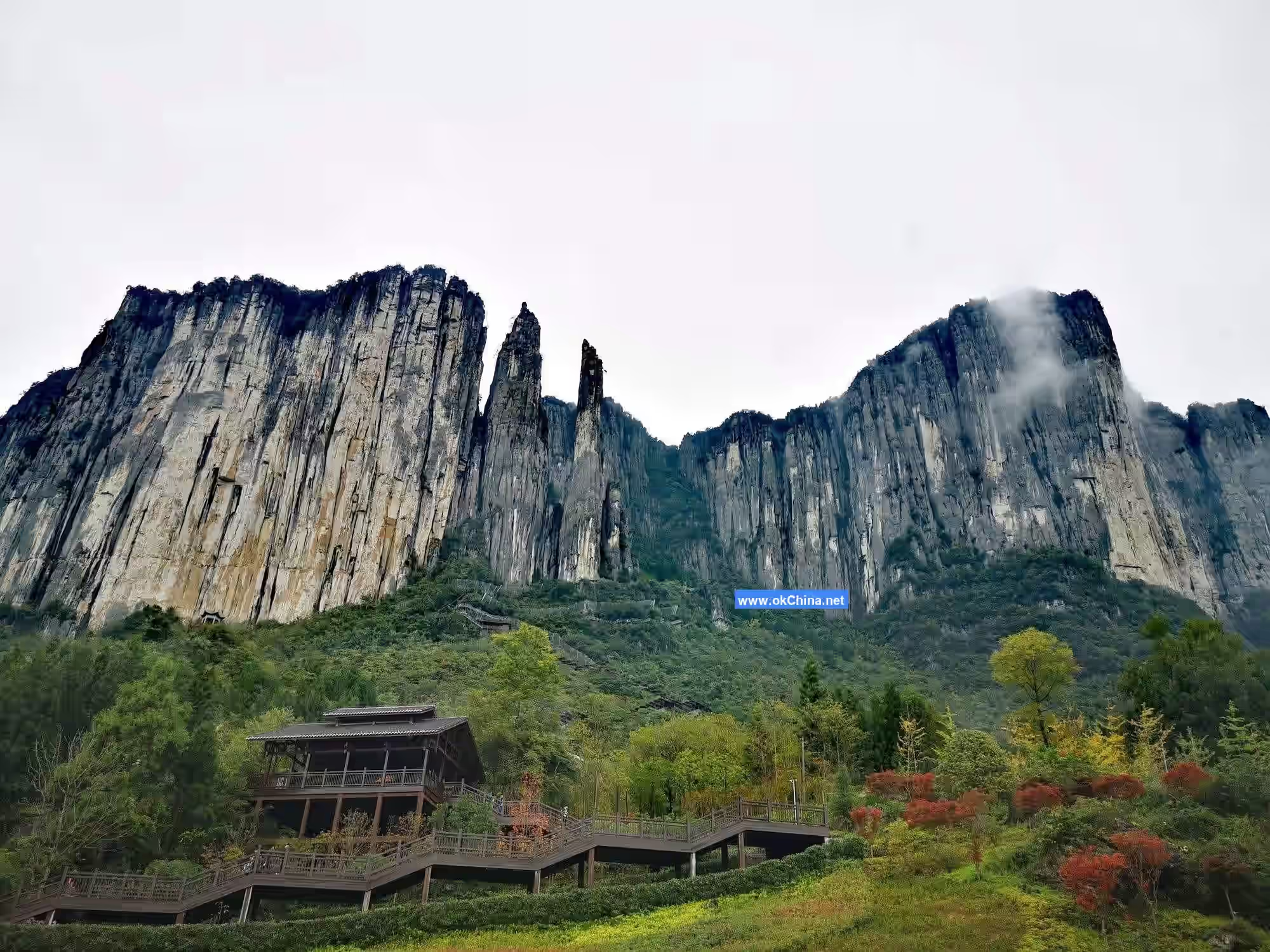
Tenglong Cave Scenic Area in Enshi Tujia and Miao Autonomous Prefecture, abbreviated as Tenglong Cave Scenic Area, is a tourist attraction located in Lichuan City, Enshi Tujia and Miao Autonomous Prefecture, Hubei Province. It is also the main park of the Hubei Enshi Tenglong Cave Grand Canyon National Geopark. It is only 4 kilometers from the urban area of Lichuan City, with a total area of 69 square kilometers.
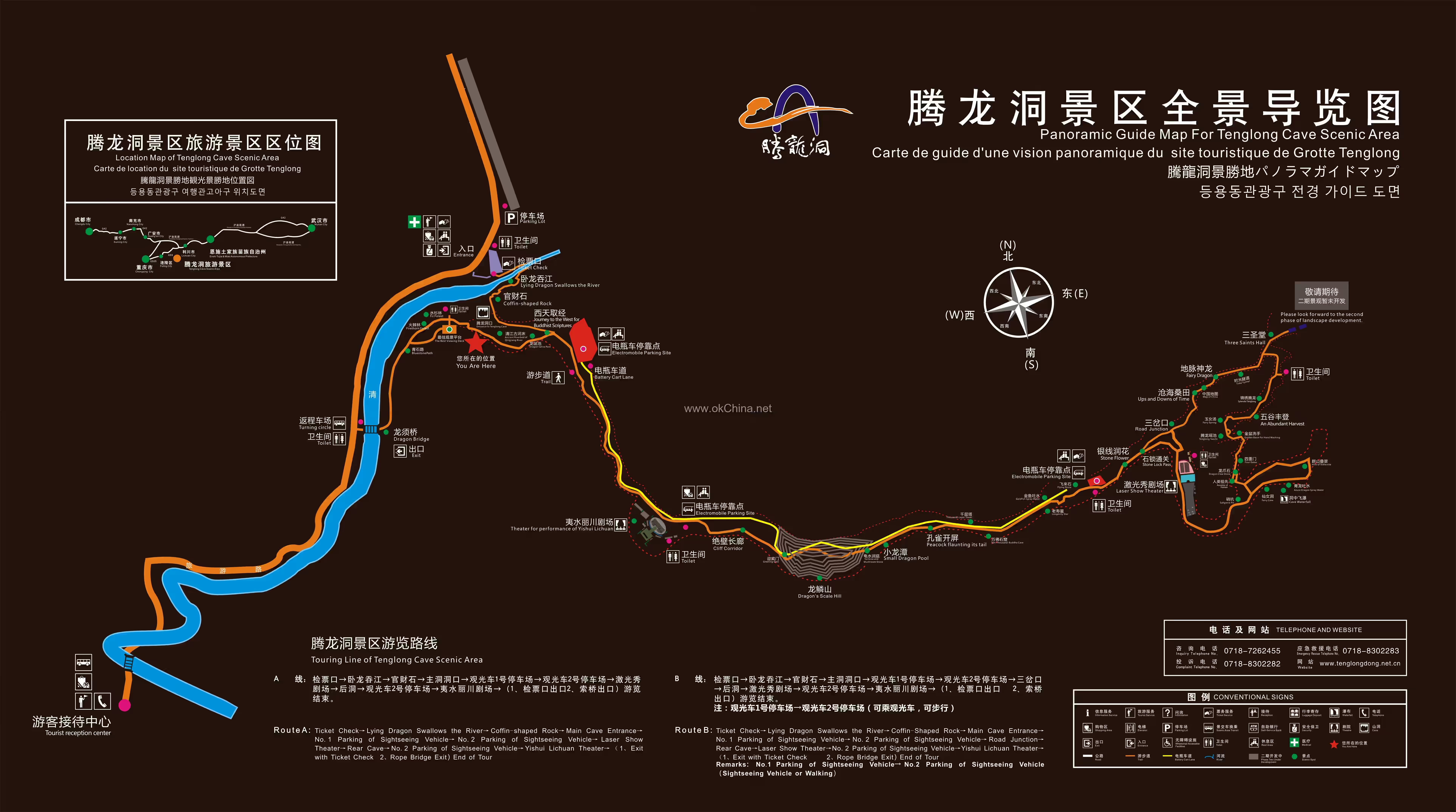
Tenglong Cave Scenic Area consists of the Water Cave, Dry Cave, Carp Cave, Cool Breeze Cave, Dujia Village, Three Dragon Gates, and Huaxian Pit. Tenglong Cave boasts China's most extensive cave system, with the entire cave group comprising five levels from top to bottom. The currently explored total length of the caves is 59.8 kilometers, covering an area of over 2 million square meters. Through two on-site investigations and evaluations by Chinese and foreign cave experts, Tenglong Cave has been recognized as one of the world's top-tier caves. The scenic area features a cave system landscape characterized by grandeur, peril, wonder, serenity, and beauty, along with stunning and innovative ethnic cultural performances as its main resources, forming a multi-level and multi-type tourism landscape system. The magical landscape characteristics of Tenglong Cave constitute its core brand value: "Tenglong's Might Under Heaven, Performing the Beauty of the Human World."
2. Geographical Environment
2.1 Location and Territory
Tenglong Cave Scenic Area is located in Lichuan City, Enshi Tujia and Miao Autonomous Prefecture, Hubei Province, at the intersection of the Daba Mountains and Wulingyuan, and at the source of the Qingjiang River. It spans from 108°21' to 109°8' east longitude and 29°44' to 30°39' north latitude.
2.2 Topography and Landforms
Tenglong Cave Scenic Area belongs to karst topography.
2.3 Climate Characteristics
Lichuan City, where Tenglong Cave Scenic Area is located, has a subtropical continental monsoon climate. Due to undulating mountains, deep ravines, and varying altitudes, the climate exhibits significant differences, typical of a mountainous climate. Summers are not extremely hot, with many clouds, heavy fog, less sunshine, abundant rainfall, and humid air. In the low mountain zone below 800 meters above sea level, the four seasons are distinct, with warm winters and hot summers. The annual average temperature is 16.7°C, annual precipitation ranges from 1300 to 1600 mm, and sunshine duration is 1409.2 hours. In the mid-mountain zone between 800 and 1200 meters above sea level, springs are late and autumns come early, with high humidity, frequent rain, and lower sunshine. The annual average temperature is 12.3°C, the frost-free period is 232 days, annual precipitation ranges from 1200 to 1400 mm, and sunshine duration is 1298.9 hours. In the high mountain zone above 1200 meters above sea level, the climate is cold, with long winters and short summers, strong winds, heavy snow, prone to waterlogging and less drought. The annual average temperature is 11.1°C, the frost-free period is 210 days, annual precipitation is 1378 mm, and sunshine duration is 1518.9 hours. Major climatic hazards include prolonged low temperatures with continuous rain, drought, torrential rain and flooding, strong winds, and hail. The main climatic characteristics of Lichuan are insufficient sunlight, relatively low heat, abundant precipitation, and significant climatic variations.
3. Main Attractions
3.1 Outside the Cave
3.1.1 Wolong Tunjiang Waterfall
The Qingjiang River, spanning eight hundred li, drops over 30 meters as it flows past the entrance of Tenglong Water Cave. The mighty river water plunges straight down, "silver waves tumbling into an icy kettle, splashing foam onto tourists' clothes," creating the magnificent spectacle of "Wolong Swallowing the River." In the Karstology Dictionary (published by Geological Publishing House in 1988), edited by Academician Yuan Daoxian of the Chinese Academy of Sciences, the definition of an underground river uses the Lichuan Qingjiang underground river as an example, calling it a rare and typical representative of cave systems in the world.
3.1.2 Guancai Stone (Official Wealth Stone)
Resembling a coffin in shape, it is hidden deep within a cliffside karst cave, reminiscent of the hanging coffin burials of the ancient Ba people. "Coffin" (棺材) and "official wealth" (官财) are homophones in Chinese. The heavenly and earthly stones are positioned to complement each other, as "heaven and earth set up wondrous stones to manifest the spiritual wonders of scenery." The Guancai Stone not only symbolizes promotion and wealth but also embodies the religious beliefs of the ancient Ba people transcending life and death.
3.1.3 Observation Deck
The observation deck offers distant views of the surrounding beautiful scenery; one can look up at the entrance of the Dry Cave and admire the mouth of this world-class karst cave.
3.1.4 Metasequoia Forest
Metasequoia is a relict species from the Quaternary glacial period, among the first batch listed as rare species under China's National First-Class Protected Plants, known as the "living fossil" of the plant kingdom. Lichuan is the hometown of metasequoia. The lush metasequoia forest and Tenglong Cave complement each other, jointly witnessing the changes in mountains and rivers since the Quaternary glacial period.
3.1.5 Firethorn Forest
Firethorn (Pyracantha): Belonging to the Rosaceae family, it is an evergreen shrub or small tree with an elegant shape, blooming profusely in summer and bearing red fruits in autumn. It is the most common plant in the mountainous areas of Lichuan and also served as life-saving food for the Tujia mountain people during famine years.
3.1.6 Bluestone Path
The Bluestone Path is built along the southern bank of the Qingjiang River. It is entirely paved with natural stone slabs, with a total length of 500 meters and a width of 2.5 meters.
3.1.7 Longxu Bridge (Dragon Whisker Bridge)
Longxu Bridge is the first sightseeing pedestrian bridge on the upper reaches of the Qingjiang River, with a total length of 96 meters and a width of 2.5 meters. Among the local Tujia people, such pedestrian bridges are called "swaying bridges." There is a saying: "Sway once on the Longxu Bridge, and all your troubles will disappear."
3.2 Front Cave
3.2.1 Entrance of Tenglong Cave
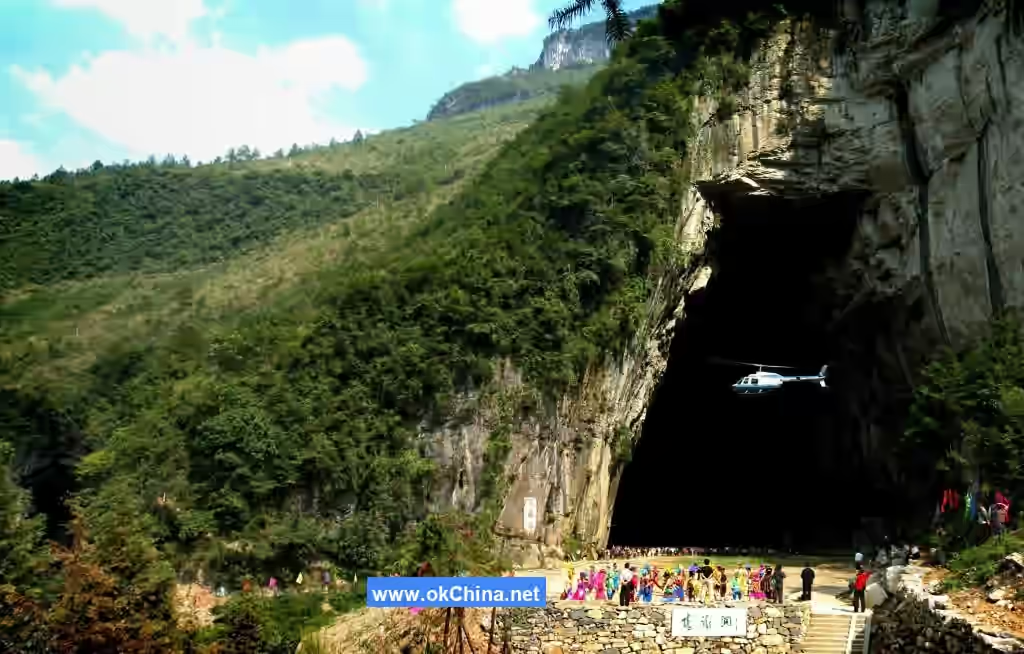
Tenglong Cave has a total length of 59.8 kilometers. The cave entrance is 72 meters high and 64 meters wide, large enough to allow more than 20 trucks to enter side by side or a helicopter to fly in and out freely, demonstrating its grand scale. On the left side of the entrance is the inscription "Tenglong Cave" personally written by Wang Renzhong, former Vice Chairman of the Standing Committee of the National People's Congress.
3.2.2 Ancient Qingjiang Riverbed
The several sections of wood in the center of the cave entrance are ancient logs that sank into the water and soil, forming "sinking wood" (阴沉木). Sinking wood is extremely hard with a unique fragrance and is considered a "treasure" or "divine artifact." These pieces of sinking wood prove that Tenglong Cave was once a passage for the Qingjiang River. In ancient times, the Qingjiang River rushed past right beside it.
3.2.3 Journey to the West
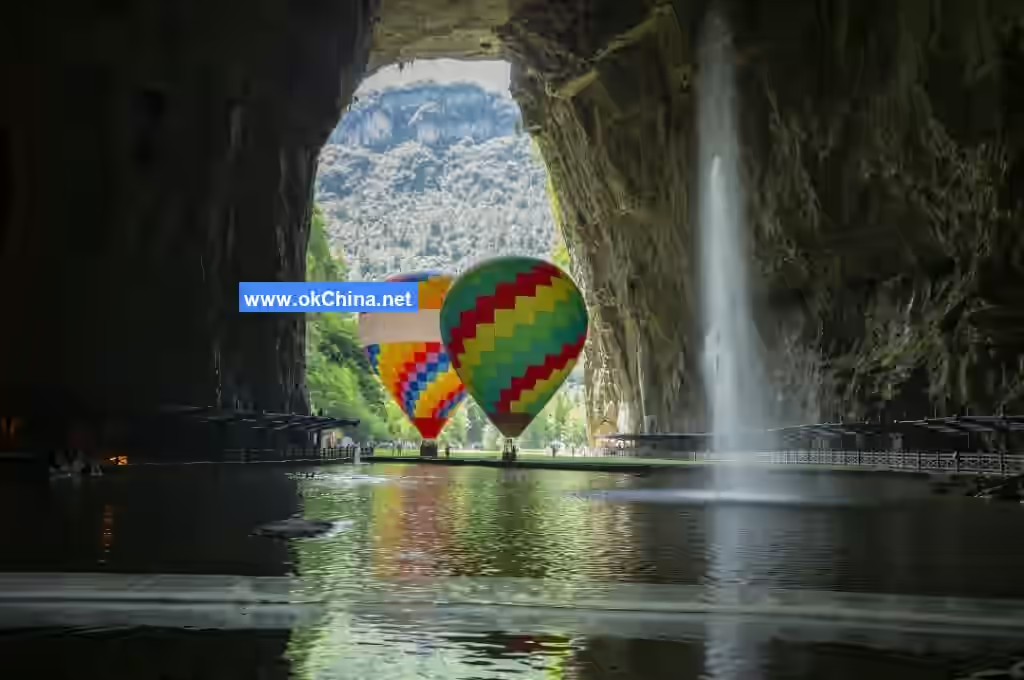
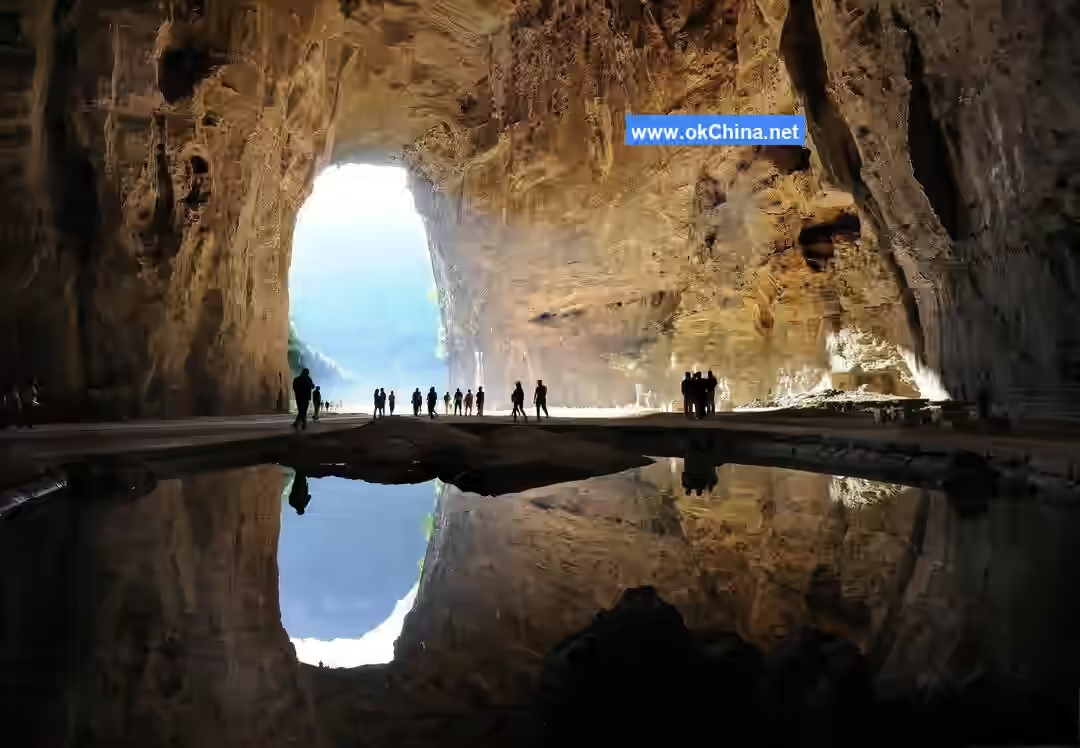
By the pond at the cave entrance, viewing the reflection of stalactites hanging from the cave ceiling in the water, light, water, and shadows combine to form a marvelous picture of the monk Xuanzang and his disciples on their pilgrimage to the West for Buddhist scriptures. With a meditative heart like clouds and Buddhist affinity like water, those with predestined connections can contemplate enlightenment by the water's edge and gain sudden insight into life.
3.2.4 Yishui Lichuan
The Yishui Lichuan Theater is China's largest and most well-equipped in-cave primitive ecological scenario theater, located in the natural dome-shaped karst hall inside Tenglong Cave. The magnificent karst cave, paired with the antique-style Tujia stilted buildings, presents a simple, primitive environmental atmosphere.
The large-scale Tujia scenario song and dance Yishui Lichuan is the first large-scale live-action show in Hubei Province. It integrates the essence of Tujia ethnic culture, narrating the arduous struggles of the Tujia ancestors against nature and their indomitable spirit, artistically showcasing the rich, ancient customs and traditions of the Tujia people.
3.2.5 Cliffside Corridor
In the 1980s, when the first scientific expedition team entered the mysterious Tenglong Cave, the cave floor was full of mud and scattered rocks. The expedition members could only crawl艰难地 along the cave walls. This V-shaped walkway on the cliff is the best commemoration of that scientific expedition.
3.2.6 Dragon Scale Mountain
The wonder of Tenglong Cave lies in having mountains within the cave and caves within the mountains. Dragon Scale Mountain is 35 meters high and lies horizontally inside the cave. Folklore says that the cave's guardian dragon comes here every 5,000 years to shed its skin and scales. Over time, this accumulated to form Dragon Scale Mountain. Above Dragon Scale Mountain, the cave ceiling spirals upward, shaped like a well, 118 meters from the cave floor. Every summer, smoke swirls upward from here, hence its name "Smoke Rising Well."
3.2.7 Old Man of Longevity
Since the formation of Tenglong Cave, it has stood here majestically and immovably. With its long beard brushing its face, one could say its age rivals that of heaven, truly worthy of being called the Old Man of Longevity.
3.3 Rear Cave
3.3.1 Stone Lock Pass
Using stone as a lock and mist as a gate, it is mysterious and unpredictable. Therefore, this cliff is named Stone Lock Pass, meaning: "Pass the Stone Lock Gate, and beautiful scenery lies ahead."
3.3.2 Laser Show Theater
The only comprehensive in-cave laser performance show in China staged inside Tenglong Cave. Through the innovative integration of high-tech means and the perfect fusion of virtual and real elements, it presents visitors with a series of breathtaking and unforgettable scenes, pioneering the combination of natural scenic areas and high technology.
3.3.3 Vast Changes Over Time (Canghai Sangtian)
Natural cave water flow, over millions of years, has eroded and formed peculiar karst wonders, layered like terraced fields.
3.3.4 Guanyin Meets Buddha
Guanyin holds a pure vase, adorned with jewels all over her body; to the lower right of Guanyin is Buddha, with a solemn and dignified appearance, jointly guarding this magical and beautiful land.
3.3.5 Human Ancestor
The Qingjiang River is not only the birthplace of the Ba people but also the cradle of humanity. After ancient humans took their first steps in the Qingjiang River basin, they drilled wood for fire and lived in karst caves. Above the cave, there is a huge human head, which is the skull left behind by ancient humans after they migrated out of the Qingjiang River basin. It has turned into rock, watching over humanity's homeland.
3.3.6 Splendid Tenglong
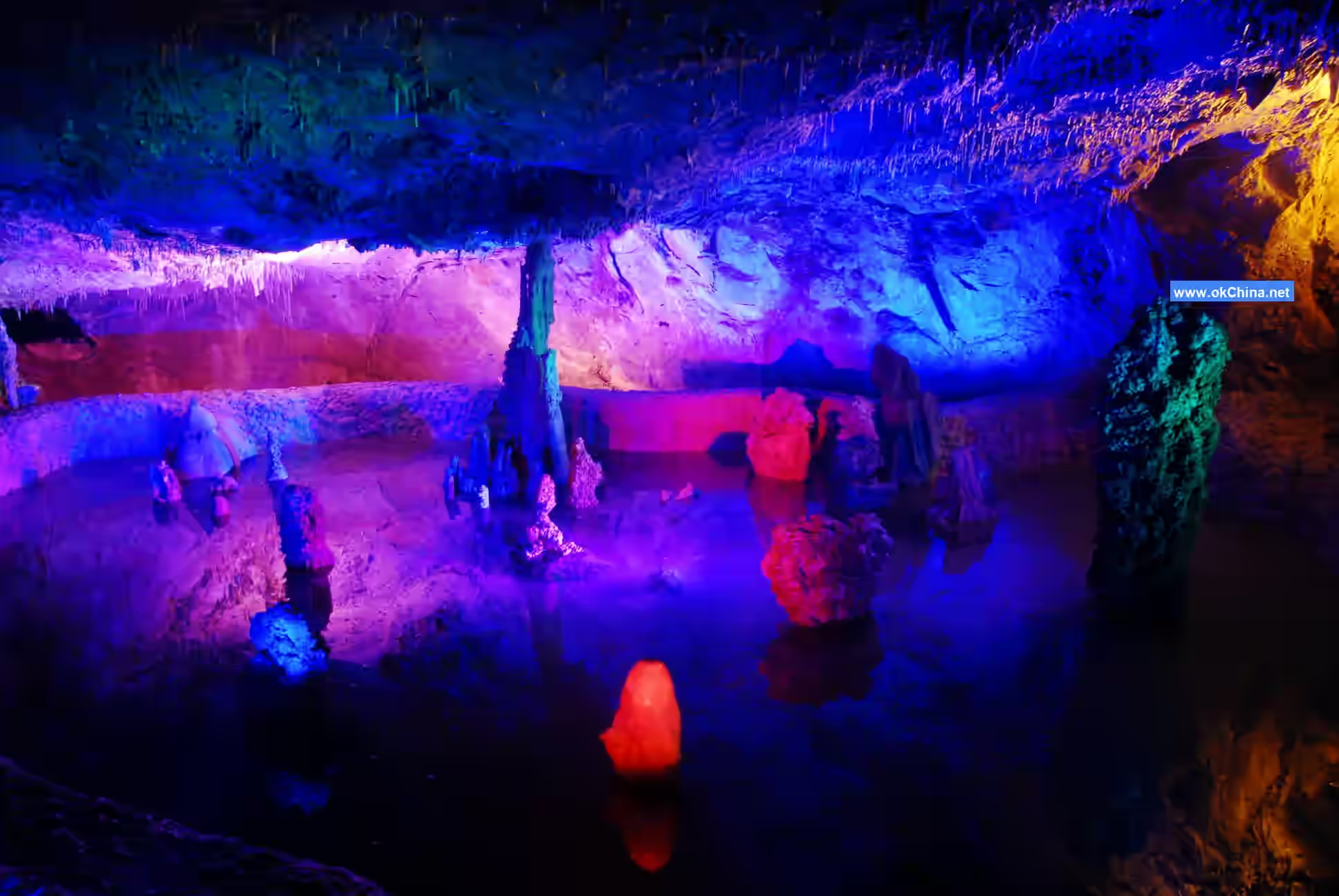
The giant Tenglong Cave is magnificent and unparalleled in the world. Even more astonishing is that stalactites deep within Tenglong Cave have formed a natural miniature model of Tenglong Cave, remarkably lifelike. Two Tenglong Caves, one large and one small, reflect each other, further testifying to the extraordinary nature of Tenglong Cave.
3.3.7 Jade Maiden's Bath (Yunü Tang)
Mountain springs cascade down, and a beautiful maiden half-reclines in the pool, reminiscent of Bai Juyi's poem: "In spring's chill, granted a bath at Huaqing Pool, the warm spring water smooth, washing the congealed fat."#### 3.3.8 Bumper Harvest of Grains The fragrance of rice fills the air, corn glows golden, and plump soybeans and wheat hang in abundance, creating a lively scene of a "bumper harvest of grains." Here, one can almost see the farmers' golden, beaming smiles during the harvest season and hear their hearty laughter as the grains are stored in the barns.
3.3.9 The Four Gates
Four cave openings are arranged in an orderly yet staggered fashion before your eyes, representing the four stages of life one must pass through: youth, young adulthood, middle age, and old age. Walking through these four gates symbolizes growing younger with each step.
3.3.10 Saltpeter Pit
China has a long history of producing gunpowder. Long ago, local explosives were made using the formula "one part saltpeter, two parts sulfur, and three parts charcoal." Saltpeter is a crucial ingredient for making explosives. Tenglong Cave was formerly known as the Saltpeter Cave. The Lichuan County Annals compiled during the Guangxu reign of the Qing Dynasty records: "In the tenth year of Guangxu (1884), over ten saltpeter miners ventured dozens of li into the cave carrying torches."
3.3.11 Layers of Verdant Peaks
Stalactites formed over hundreds of millions of years of sedimentation have created mountains, valleys, and peak forests of myriad forms and shapes here.
3.3.12 Tiger Roaring at the Qingjiang River
A white tiger stands atop a high cliff, roaring towards the sky facing the Qingjiang River. Legend has it that after the death of Lin Jun, the ancestor of the Tujia people, he transformed into a white tiger. The hardworking and kind-hearted Tujia people thus regard the white tiger as the totem of their ethnic group.
4. Cultural History
Lichuan, historically part of the ancient Ba State, was considered barbarian territory under the Nan Commandery during the Qin and Han dynasties. Its long-standing historical culture and relatively isolated geographical features in ancient times have preserved a rich ethnic flavor here. As the birthplace of the world-renowned folk song "Dragon Boat Tune" and the source of the eight-hundred-li Qingjiang River, Lichuan exhibits a seamless blend of Ba and Chu cultures, with uniquely charming folk customs. During festivals, weddings, and funerals, traditional musical forms like shua luogu (percussion play) and chuishou yinzi (wind instrument preludes) are popular among the local people. The melodies of shua luogu yinzi are rich and varied. For joyous red occasions (like weddings), the bright and cheerful seven-character tune is often used, while for white occasions (funerals), the low and mournful eight-character tune is preferred. Wind instruments include the duangong's divine horn, the Taoist priest's sea horn, and the castrator's goat horn, each with its own characteristics. They can be played solo or in ensemble. Commonly played tunes like "Eagle Flashing Wings" and "Luoyang Bridge" serve both professional and entertainment purposes. Lichuan's folk songs are diverse in form: there are weeding songs and weeding percussion songs for rice transplanting and weeding; mountain songs for herding cattle; love songs for courtship; bridal lament songs for weddings; funeral dirges; and work chants for stonemasons, porters, earthworkers, and boatmen, showcasing the Tujia people's rich musical culture.
The Tujia people have their own language. "Bizika" is their self-designation, and "Sheba" refers to the Hand-Waving Dance. The Tujia language is unique; for example, father is called "die," mother is called "naizi," and father-in-law and mother-in-law are called "laozhang" and "laozhangmu," respectively. The Tujia "Maogusi" dance, called "Babuchang" in Tujia language, meaning "old man," is an ancient dance commemorating the ancestors' pioneering achievements in reclaiming wilderness, fishing, and hunting. Performances of "Maogusi" are often interspersed during the Hand-Waving Dance at New Year festivals. Dancers wrap their entire bodies, even covering their faces, with straw, thatch, and leaves, and tie five large palm leaf strips on their heads. Their forms are primitive and rugged, their movements humorous and amusing, integrating song, dance, and speech. It is known as a "living fossil" of ancient culture and art. Furthermore, Lichuan's "Dragon Boat Tune" is a masterpiece of Tujia folk songs. As early as the 1980s, it was recognized by UNESCO as one of the world's 25 outstanding folk songs. Originally a song often sung by people rowing lotus boats during festivals, it later became known as the "Melon Planting Tune" or "Melon Seed Tune" due to its lyrics about planting melons. It is widely sung in areas like Baiyang, Moudao, and Wangying in Lichuan, earning Lichuan the title "Hometown of the Dragon Boat Tune."
Lichuan's folk arts are equally rich and varied. Handmade shoe pads and "Qingjiang Meiwai" cloth shoes are representatives of Tujia traditional handicrafts. Made from pure cotton cloth and thread through dozens of steps entirely by hand, they are known for being odor-resistant, breathable, and sweat-absorbent,深受人们喜爱深受人们喜爱 (deeply loved by people). "Roulianxiang" is a unique physical dance of the Lichuan Tujia people, named for the rhythmic sounds produced by slapping various parts of the body with the palms. Its movements are humorous and lively, highly观赏性观赏性 (enjoyable to watch). The Eight Treasures Bronze Bell Dance uses the clear and pleasant sound of bells to regulate the dance rhythm and is an important part of Tujia sacrificial dances. The Maogusi Dance, called "Gusibupu" in Tujia language, meaning "story of the ancestors," is the most primitive classical dance of the Tujia people. By simulating the labor and life scenes of ancient ancestors, it showcases Tujia history and culture and is hailed as a "living fossil" of Chinese drama.
Lichuan's cuisine is also distinctive. Hezha is a local small hotpot with a base of soybean residue, peanut residue, minced meat, etc., paired with pork, beef, or mutton, offering unique flavors at affordable prices. Cured meat is a traditional delicacy in Lichuan; after smoking, the meat becomes delicious and fragrant. Tujia Oil Tea Soup is one of the representative culinary cultures of the Tujia people. Made with tea leaves, ginger, scallions, garlic, etc., and paired with "toppings" like fried rice puffs and peanuts, it is rich in taste and nutrition. Tujia Suoyi Rice, a mixture of cornmeal and rice, has a delicate texture and a sweet, fragrant taste. Named for its resemblance to a straw rain cape (suoyi), it is a traditional staple food of the Tujia people. Additionally, Lichuan's specialties such as Chinese yam, water shield, Baiyang dried tofu, Lichuan black tea, and rattan tea are renowned far and wide. Chinese yam is rich in trace elements like selenium and germanium, making it a nourishing product. Water shield is rich in colloid and has health benefits. Baiyang dried tofu has a long history and a mellow taste. Lichuan black tea has a strong aroma and a golden liquor. Rattan tea aids digestion and promotes bowel movement, representing healthy food.
Lichuan's folk customs, folk arts, and culinary culture together constitute the unique charm of this land. Whether it's the primitive dances, melodious folk songs, or authentic local flavors, they all showcase the profound historical heritage and rich ethnic characteristics of the Tujia people, attracting countless people to explore and experience.
4.1 Origin of the Name
Tenglong Cave, a place full of mystery. Legend has it that in the distant past, Lichuan was once a vast sea where the ancestors of the Tujia people made a living by fishing. At that time, an arrogant flood dragon was dispatched to oversee this sea area, helping the Tujia ancestors fish and navigate boats. However, this flood dragon often stirred up storms and waves, causing dissatisfaction and complaints among the fishermen. Finally, the grievances disturbed the Dragon King, who sent Lord Pangu and the God of Thunder to defeat the flood dragon. With a cataclysmic event, a deep and long cave was torn open in the seabed, and seawater surged into it like a raging tide. Seeing this, Lord Pangu and the God of Thunder showed mercy and spared the flood dragon. Several days later, the seawater receded, the vast sea disappeared, replaced by beautiful surrounding mountains and the winding Qingjiang River. Tenglong Cave, resembling a crouching dragon dancing gracefully, thus got its name.
4.2 Development History
In 1985, after the publication of the article "Lichuan's Luoshui Cave Should Rank Among the World's Best" by Professor Zhang Lianggao from the Department of Ancient Architecture at Huazhong University of Science and Technology, a wave of enthusiasm for exploring Tenglong Cave surged. The exploration team consisted of six officers and soldiers from the county's People's Armed Forces Department, with Minister Zhang Guofang as the team leader and Political Commissar Yi Shaoyu as the instructor. From June 1985 to October 1986, after arduous exploration, they finally unveiled the mysterious veil of Tenglong Cave.
In 2003, the Lichuan Municipal People's Government signed a contract with relevant development enterprises to invest in and operate the Tenglong Cave Scenic Area. The largest original ecological cave theater in China was built inside the cave, staging the large-scale Tujia folk song and dance performance "Yishui Lichuan," and the largest cave fantasy laser show in China was also launched.
In 2015, the Tenglong Cave Scenic Area was included in the national 5A-level scenic area creation sequence. Lichuan City mobilized all its resources to advance the creation work, successively investing 192 million yuan to upgrade infrastructure, refined culture, standardized management, service quality, and brand promotion, thereby enhancing the tourism quality of the scenic area.
On July 29, 2020, Hubei Longchang Tourism Development Co., Ltd. signed a land transfer contract with Bijia Mountain Village, Dongcheng Subdistrict Office, Lichuan City, marking the official launch of the development project for the rear section of the Tenglong Cave Scenic Area.
Comments
Post a Comment