Taihao Fuxi Mausoleum Cultural Tourism Area in Zhoukou City
1. Introduction
The Taihao Fuxi Mausoleum Cultural Tourism Area in Zhoukou City, abbreviated as the Taihao Fuxi Mausoleum Cultural Tourism Area, is located in Huaiyang District, Zhoukou City, Henan Province. It comprises two core scenic areas: the Taihao Mausoleum and the Longhu (Dragon Lake) Scenic Area.
The Taihao Mausoleum is a large-scale mausoleum-temple complex built to worship Taihao Fuxi, revered as the "First of the Three Sovereigns." Facing south, it is a rare example of a large-scale palatial-style ancient architectural complex that integrates both a mausoleum and a temple. It was announced by the State Council in 1996 as part of the fourth batch of Major Historical and Cultural Sites Protected at the National Level.
Longhu (Dragon Lake) derives its name from Fuxi establishing his capital at Wanqiu and organizing his officials with dragon titles, earning the name "Dragon Master." With a water area of nearly 10,000 mu, it is a National Wetland Park, a National Water Conservancy Scenic Area, and also China's largest inland city-encircling lake. It is acclaimed as the "Pearl of the Central Plains" and an "Inland Marvel."
2. Main Scenic Areas
2.1 Taihao Mausoleum Scenic Area
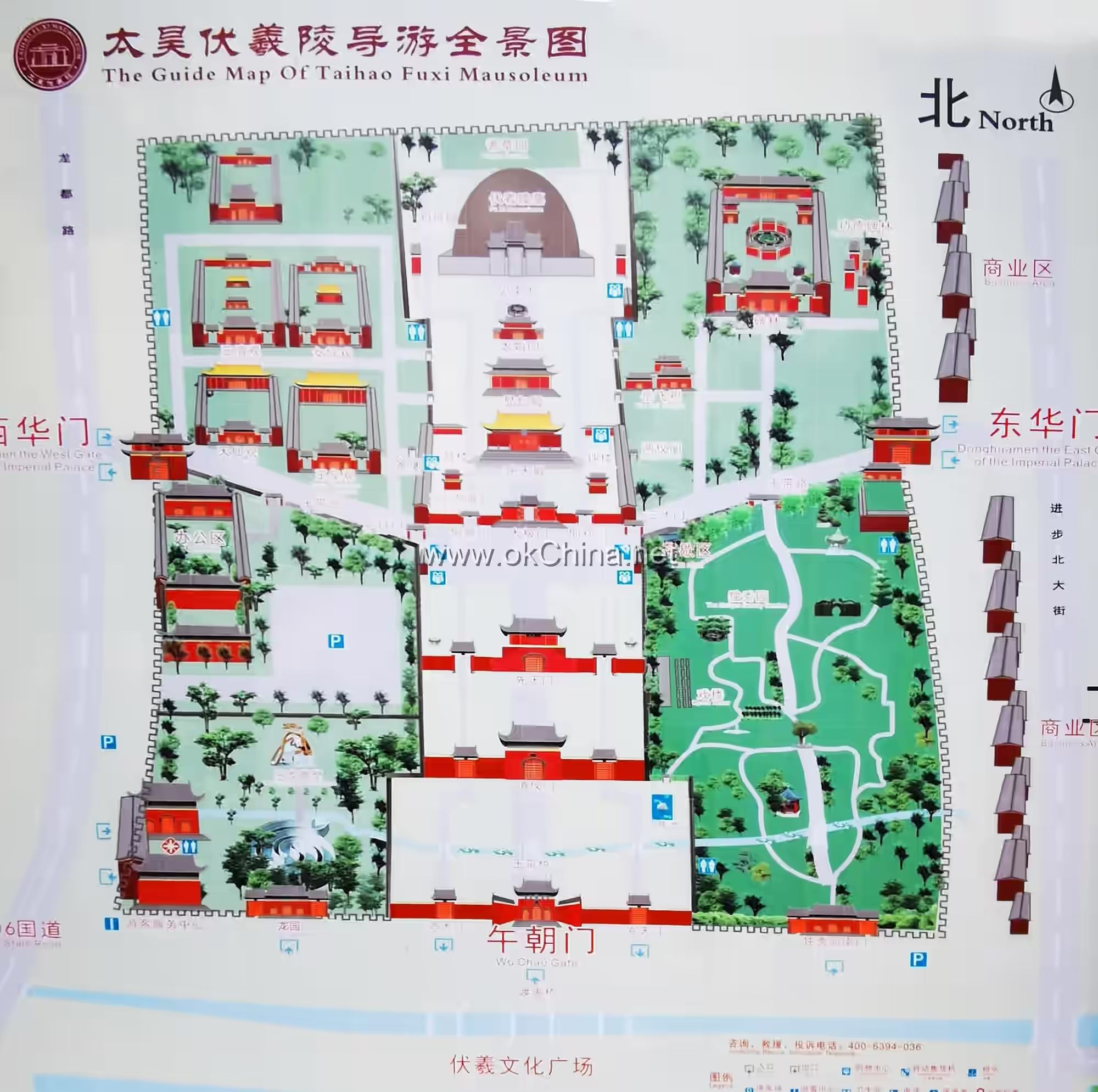
The Taihao Fuxi Mausoleum is the mausoleum-temple dedicated to Taihao Fuxi, the "First of the Three Sovereigns and Predecessor of All Kings." The existing structures were initially built in the first year of the Zhengtong era of the Ming Dynasty (1436 AD). The complex is divided into three imperial city enclosures: the inner city, outer city, and the Forbidden City. The mausoleum-temple was constructed based on the principles of the Primordial Eight Trigrams created by Fuxi. It features numerous gates and halls including the Meridian Gate (Wuchaomen), Daoyi Gate, Primordial Gate (Xiantianmen), Three Talents Gate and Five Elements Gate, Taiji Gate, Bell and Drum Towers, eastern and western corridor rooms, Tongtian Hall, Xianren Hall, Taishi Gate, and the Primordial Eight Trigrams Altar. With its multiple gates and halls, it resembles an imperial palace. Such a grand, well-planned, historically rich, and culturally profound mausoleum-temple complex is rare not only in Henan but also nationwide. It is a sacred site for Chinese descendants worldwide to trace their roots, pay homage to ancestors, pray for blessings, and engage in tourism.
2.2 Longhu (Dragon Lake) Scenic Area
Longhu is 4.4 kilometers wide from east to west and 2.5 kilometers long from north to south, with a surrounding embankment of 14 kilometers. The water surface consists of four lake areas: Liu Lake, East Lake, Xiangge Lake, and Nantan Lake. Liu Lake, located in the northwest, covers a water area of 1,877 mu. Nantan Lake, in the southeast, covers 2,817 mu. East Lake, in the northeast, is the largest of the four, covering approximately 4,582 mu. Xiangge Lake, in the southwest, covers 1,574 mu. The lake encircles Huaiyang District's city area, which sits within the lake, connected to the outside only by four roads at the four city gates.
3. Main Structures
3.1 Dushan Bridge
Dushan Bridge is a stone bridge spanning the Cai River, with a width of 11 meters. Commonly known as the "Face Bridge," the original construction date of the bridge is unknown. It was restored in 1985 as an open-spandrel arch bridge. In 1997, it was rebuilt into a flat bridge, 11 meters wide and 25 meters long. In 2004, it was further renovated, and two auxiliary bridges were added on the east and west sides corresponding to the East Heavenly Gate and West Heavenly Gate. All bridge railings were replaced with white marble. Originally, there were two stone memorial archways on the north side of the bridge, east and west. The eastern one was inscribed "Kai Wu Cheng Wu" (Initiating Things and Completing Affairs), and the western one "Ji Tian Li Ji" (Succeeding Heaven and Establishing the Ultimate). The bridge where the eastern moat meets the Cai River is called Shangma Bridge (Dismounting Bridge), and the one where the western moat meets the Cai River is called Xiama Bridge (Mounting Bridge).
3.2 Meridian Gate (Wuchaomen)
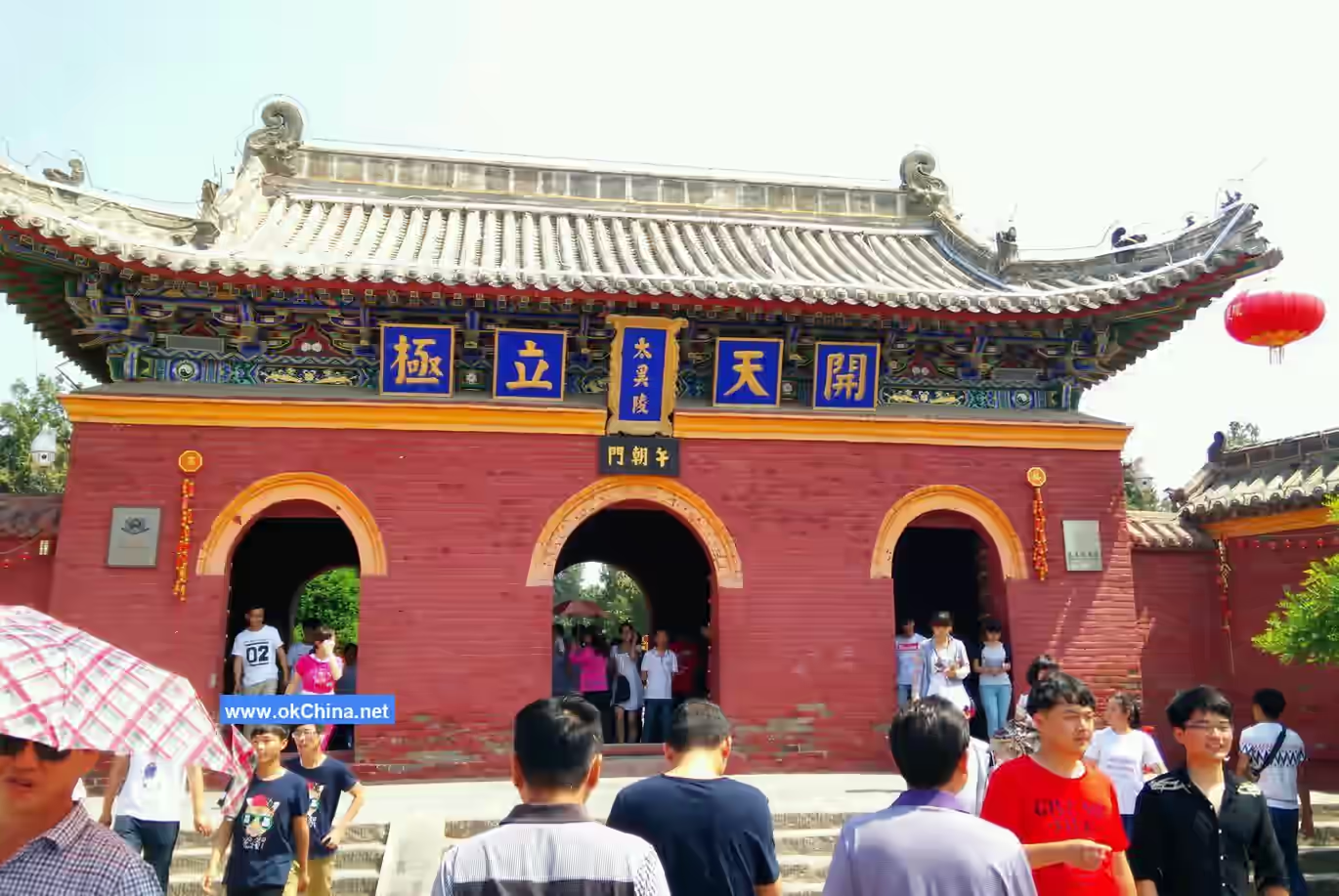
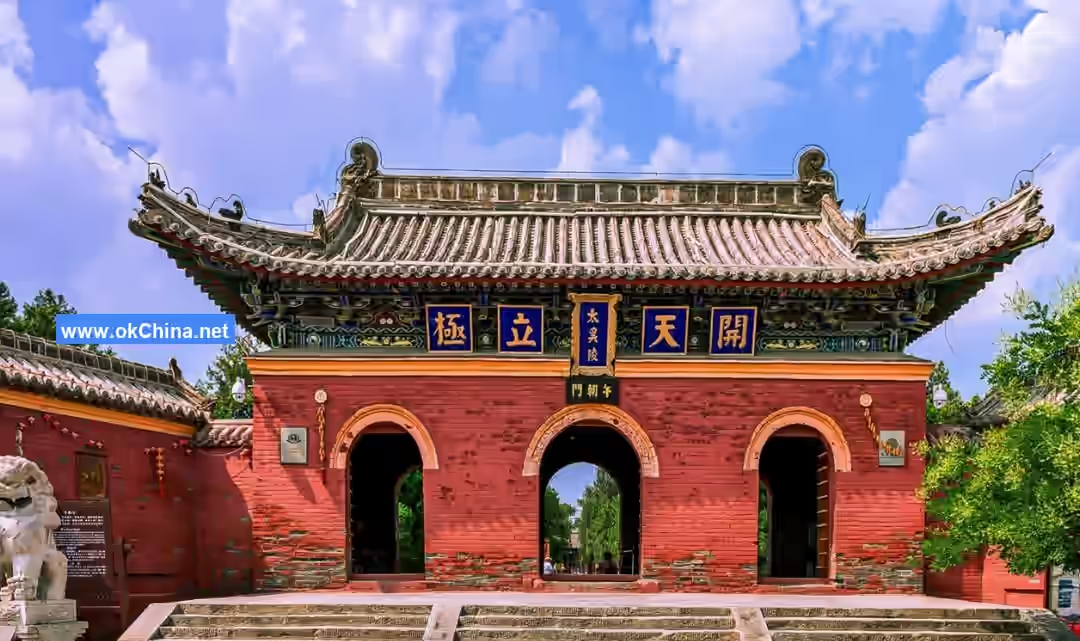
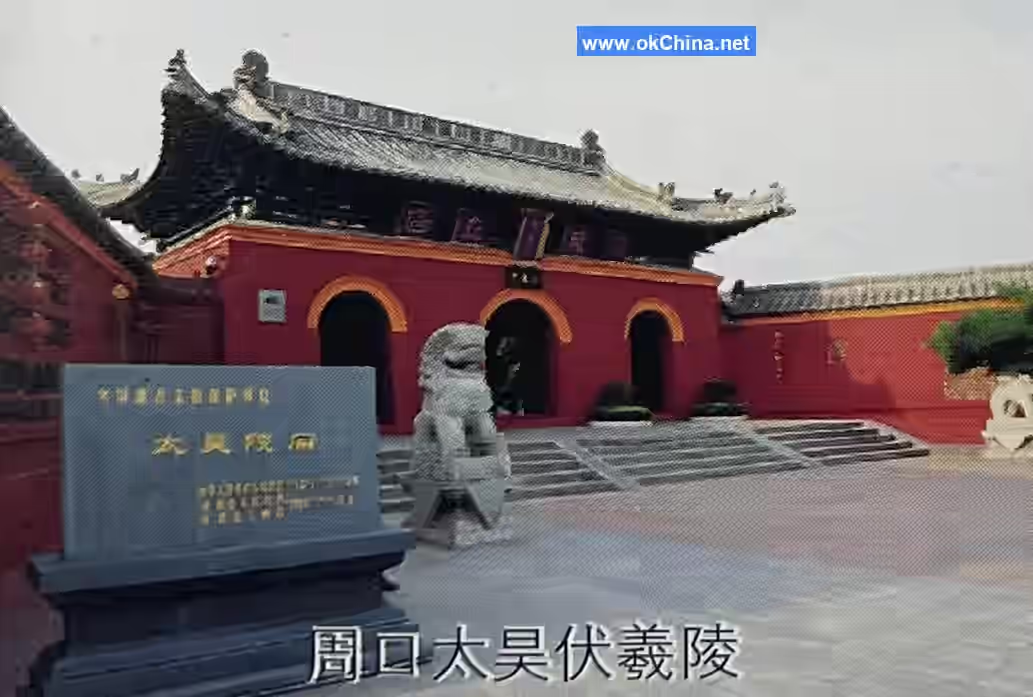
The Meridian Gate is the first main gate of the Taihao Mausoleum-temple, built according to palatial architectural regulations, serving as the main entrance. It is a single-eave hip-and-gable structure with three bays. The red doors have golden nails, with the central door having 9 rows of 9 nails and the side doors having 7 rows of 9 nails, conforming to imperial standards. There is a platform in front of the gate, with a three-section, five-step cascade-style staircase in front. Flanking it are hard gable-style "八"-shaped walls. On the east and west sides are two side gates, called the East Heavenly Gate and West Heavenly Gate respectively. In ancient times, only the emperor or imperial envoys holding the imperial edict would use the central gate when paying homage to the ancestral sovereign. Civil officials typically used the East Heavenly Gate, and military officials the West Heavenly Gate, commonly known as "Civil East, Military West."
3.3 Daoyi Gate
The Daoyi Gate is 24 chi high (approx. 7.68m), with a hard gable roof, three bays wide, and a depth of 16 chi (approx. 5.12m). It has six purlins, three brick-arched doorways, a clear-water main ridge with dragon-shaped ridge ornaments (zhengwen). The descending ridges have mythical beasts, with fish and seahorses decorated before the beasts, and heavenly horses and dragons after. The roof is covered with gray cylindrical tiles, with dragon-patterned eave tiles and phoenix-patterned drip tiles. Daoyi Gate is also called the Ceremonial Gate, meaning the gate of etiquette. In ancient times, emperors, officials, and common people coming to pay homage or worship Taihao Fuxi had to straighten their hats, dust off their clothes, compose their demeanor, and proceed solemnly and respectfully upon reaching this point. On both sides of the gate are couplets: "Gaze at the Dipper and Ox constellations, embracing immortals to roam freely; Ride the clear breeze, hold the bright moon to last forever," collected from Su Dongpo's "First Ode to the Red Cliff." The plaque on the right, "Kai Tian Li Ji" (Initiating Heaven and Establishing the Ultimate), was inscribed by Shen Peng, former Chairman of the Chinese Calligraphers Association, referring to Fuxi creating the Eight Trigrams, initiating heaven with one stroke, revealing the principles of "Heaven and Earth," "Qian and Kun," and "Yin and Yang." The plaque on the left, "Zhen Dao Dao Zhen" (True Way, Way True), was inscribed by the modern Chinese calligrapher and poet Shen Yinmo. This is a palindrome, reading the same forwards and backwards, implying that only the true way can express the true principle.
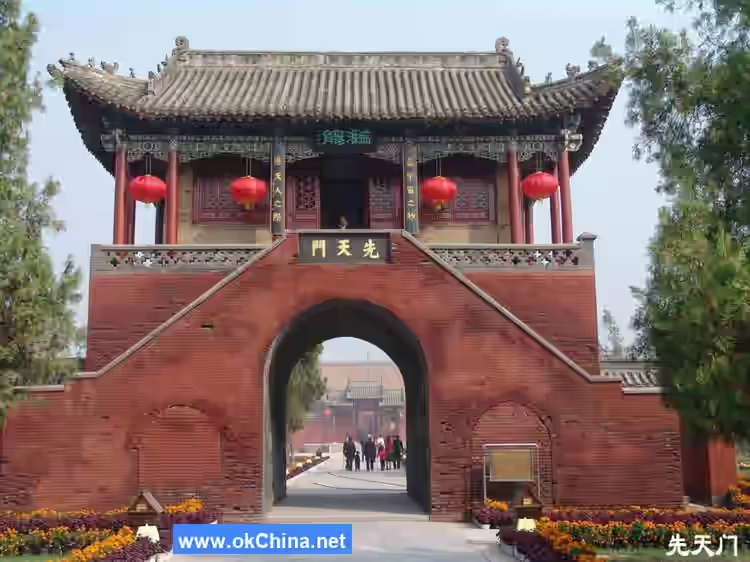
3.4 Primordial Gate (Xiantianmen)
Passing through the Daoyi Gate and proceeding north along the main sacred path for 36 zhang (approx. 115.2m), one reaches a high-platform structure, the Primordial Gate. It is named after the Primordial Eight Trigrams created by Fuxi. The two characters on the plaque, "Lan Shang," mean the source of a river so small it can only float a tiny wine cup, used here metaphorically to mean the source of culture. The Primordial Gate is a gate-tower style high-platform structure built in the Ming Dynasty. Originally, it could only be viewed from afar as there were no stairs to ascend. In the 1970s, stairs were added on both sides for the convenience of tourists to climb up to the pavilion.
3.5 Taiji Gate
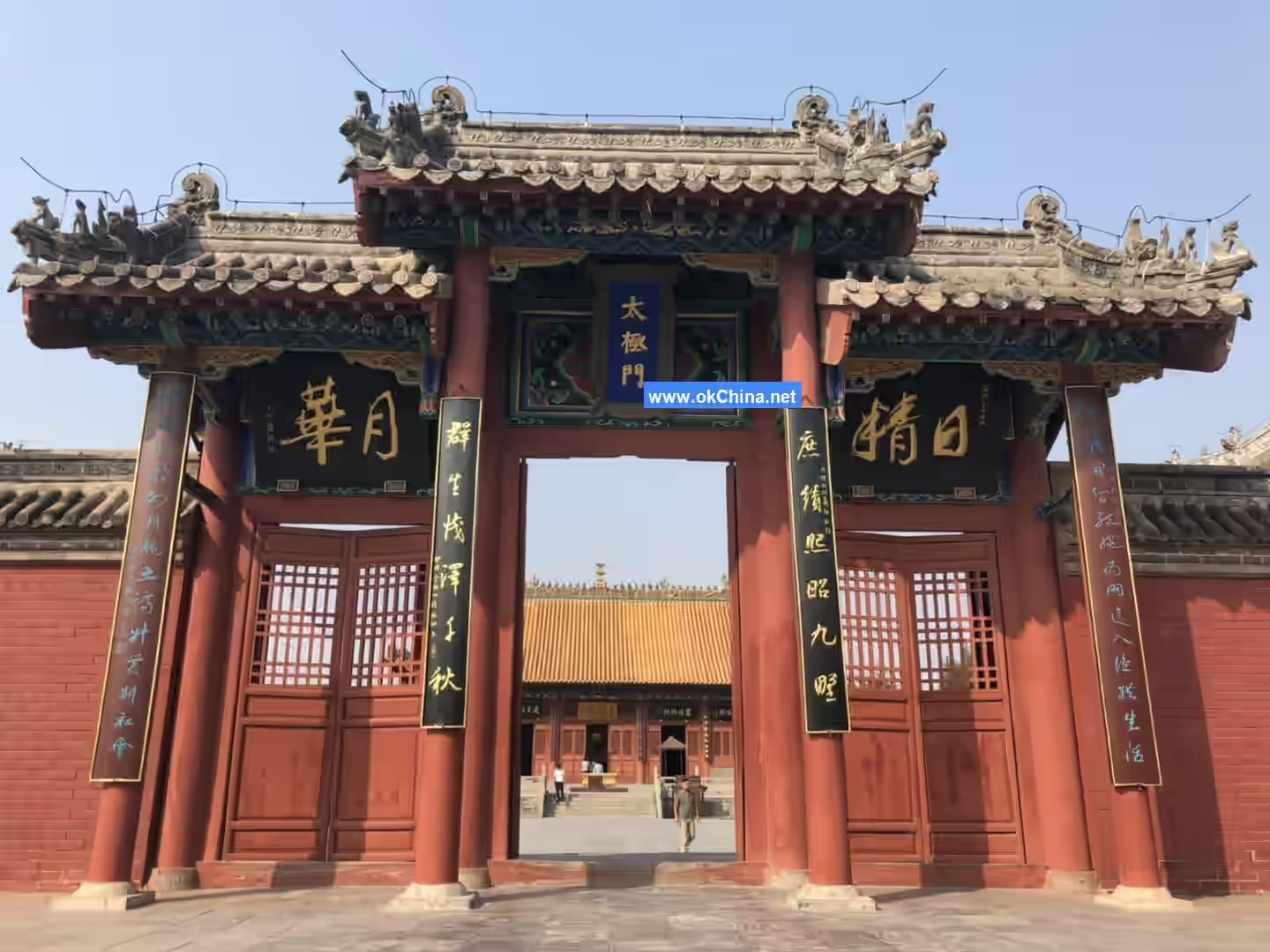
Passing through the Primordial Gate and proceeding north along the main sacred path for 25 zhang (approx. 80m), one reaches the Taiji Gate. Taiji represents the period before the division of Yin and Yang, when heaven and earth were in chaos, from which all things in the universe originated. It is the source from which all things are derived. Therefore, the Taiji Gate is located at the center of the Taihao Mausoleum complex. On each side of the Taiji Gate is a side gate: Yangguan Gate (Gate of Looking Up) on the east and Fucha Gate (Gate of Looking Down) on the west. These names are taken from the Book of Changes: "Those who look up observe the images in the heavens; those who look down observe the patterns on earth," symbolizing Taihao Fuxi observing astronomy above, geography below, and all things in between, thereby creating the Eight Trigrams and mastering the origin and laws of change of all things. The plaques "Ri Jing" (Sun Essence) and "Yue Hua" (Moon Splendor) were inscribed by calligrapher Li Zhonghua, praising Fuxi for absorbing the vital energy of heaven and earth and gathering the essence of the sun and moon when creating the Eight Trigrams. The central couplet, "Shu Ji Xi Zhao Jiu Ye, Qun Sheng Mao Ze Qian Qiu" (His numerous achievements shine brightly over the nine regions; All living beings flourish, nourished for a thousand autumns), was inscribed by Ms. Lin Xiu, Vice Chairman of the Chinese Calligraphers Association, praising Fuxi's merits shining like sunlight over the land of the Nine Provinces, nourishing all living beings to prosper for generations.
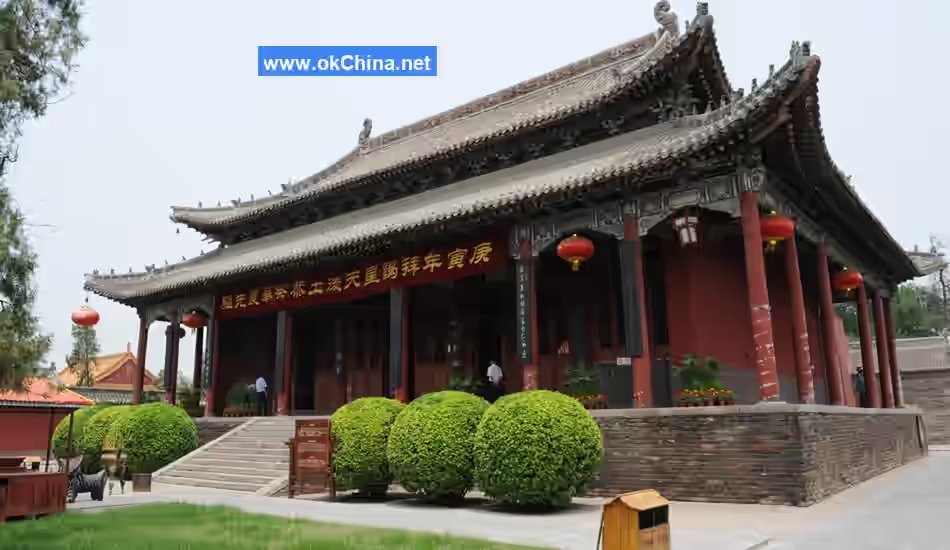
3.6 Tongtian Hall
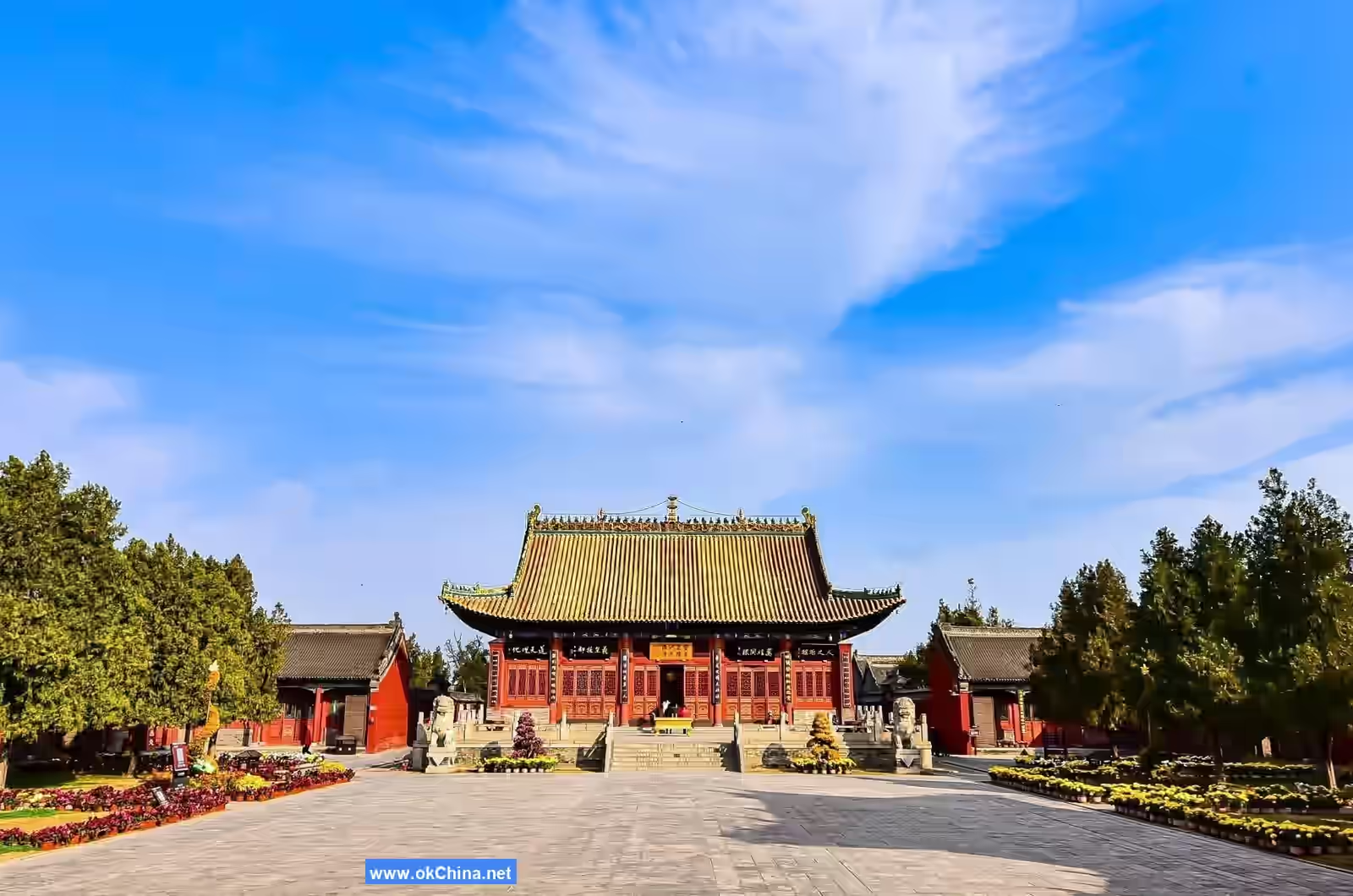
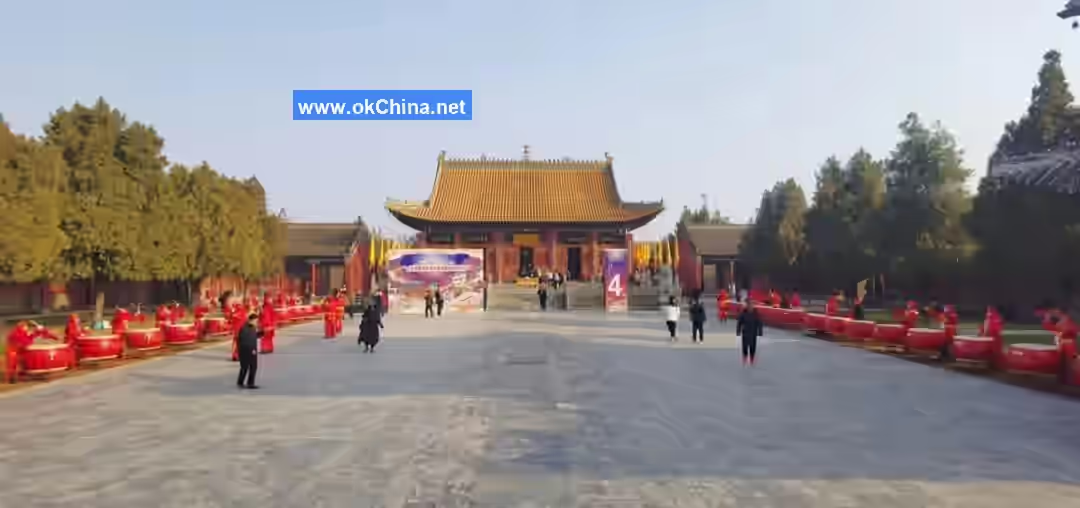
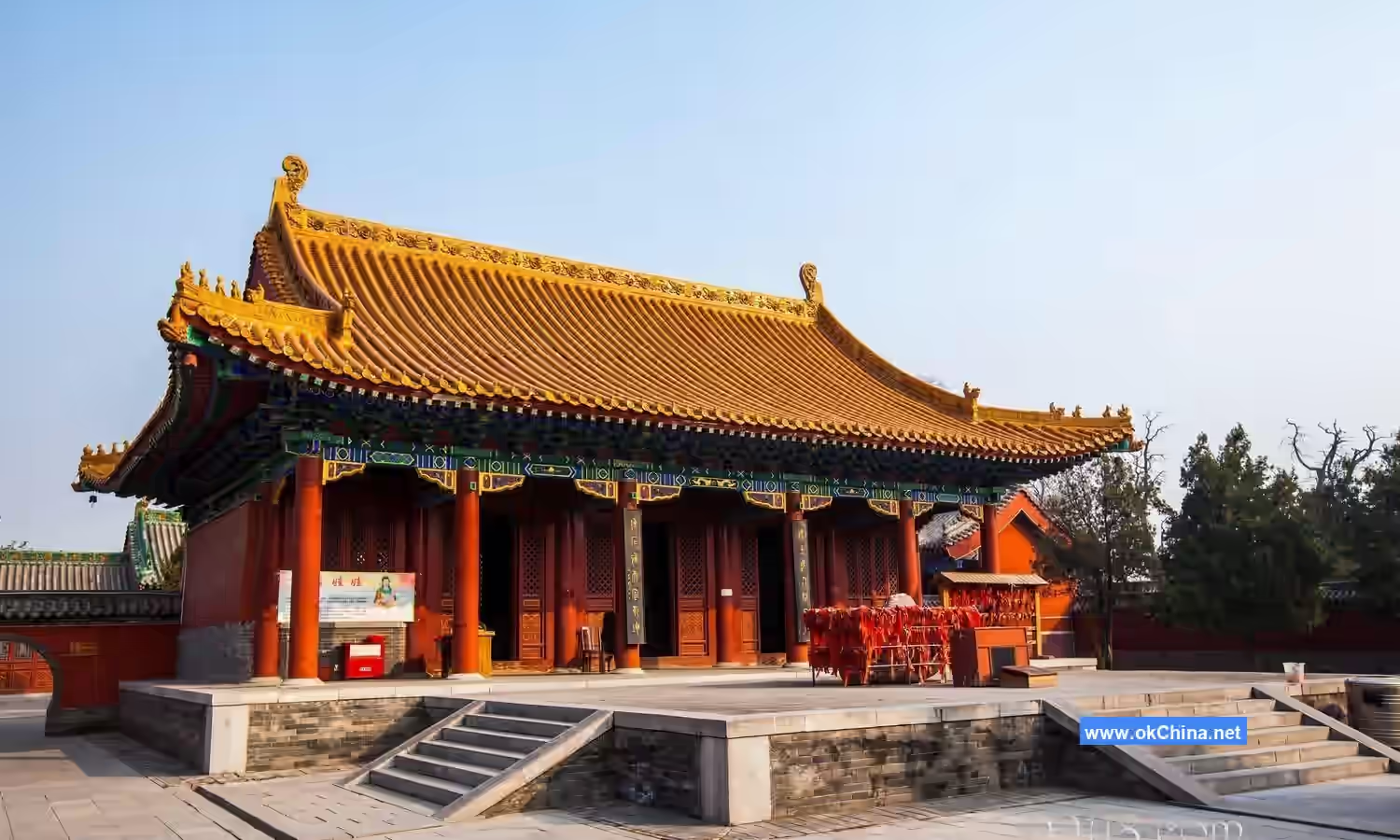
Tongtian Hall, commonly known as the Main Hall, was built in the Ming Dynasty. It is a higher-ranking hall within the Taihao Mausoleum. In front of the hall is a connected straight-walled platform (yuetai) paved with blue bricks and bordered with curb stones, covering an area of over 300 square meters. This was the central venue for holding ancestral worship ceremonies throughout history. There are cascade-style staircases on the east, west, and south sides, with brick-built triangular side panels (xiangyan). Together with the eastern and western corridor rooms, the Bell and Drum Towers, and the Taiji Gate, it forms an ancient courtyard-style (siheyuan) layout. In 1998, bluestone railings were installed around the hall platform. Flanking Tongtian Hall are the Eastern and Western Corridor Rooms. At the northern end of each corridor room is a gate: the eastern one is called Liangyi Gate (Gate of the Two Forms, referring to Yin and Yang). Tongtian Hall is five bays wide and three bays deep. The upper part is covered with yellow glazed tiles, symbolizing imperial status, with a large ridge decorated with dragons and phoenixes. The ridge decoration is elaborate, prominently featuring a three-section colored-glaze ceramic tower in the middle, inscribed with the four characters "Tian Xia Yi Tong" (All Under Heaven Unified) above and "Tai Hao Fu Xi Dian" (Taihao Fuxi Hall) below. The 28 small figures on the left and right symbolize the 28 Lunar Mansions, representing heaven. The riding colored pottery figures on the four upturned corners of the hall roof are four historically selected exceptional figures: Pang Juan, Zi Du, Han Xin, and Luo Cheng.
3.7 Xianren Hall
Located about 10 zhang (approx. 32m) north of Tongtian Hall is Xianren Hall, commonly known as the "Second Hall." As stated in the Book of Changes, Appended Remarks, Part I: "It manifests in benevolence and hides in its function," meaning it appears with a benevolent countenance, allowing its grace to be bestowed upon all things under heaven, hence the name Xianren Hall (Hall of Manifesting Benevolence). Xianren Hall has a total height of 16.4 meters, is seven bays wide and five bays deep, with a double-eave hip-and-gable roof covered with gray cylindrical tiles. It features a high-platform corridor surrounded by massive columns. Inside, a statue of the goddess Nüwa is enshrined.
3.8 Taishi Gate
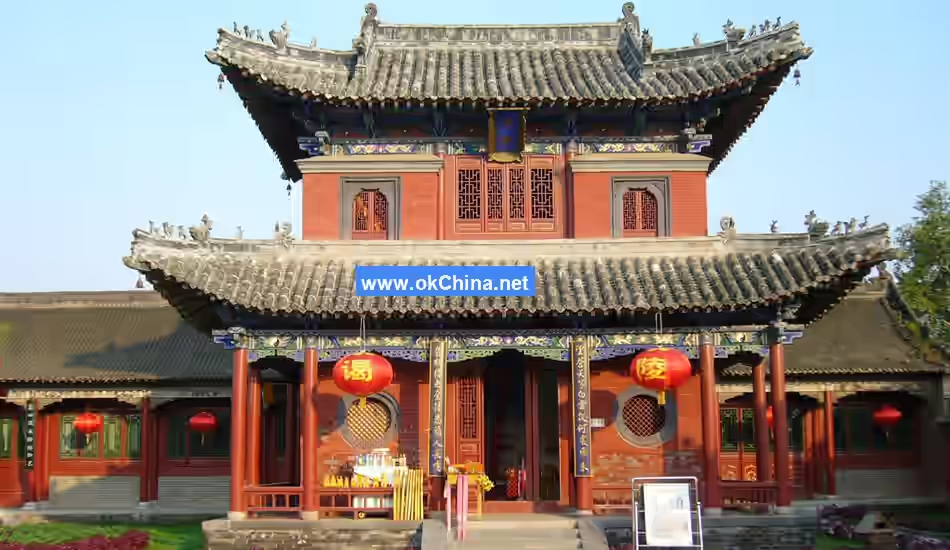
Taishi Gate, also known as the Resting Palace (Qindian), is located 7 meters from Xianren Hall. It is a double-eave hip-and-gable high-platform structure with a total height of 16.66 meters, three bays wide and three bays deep, covered with gray cylindrical tiles. The lower part of this structure is a city gate-style archway. Below the archway, the three characters "Tai Shi Men" are embedded in intaglio regular script. On the right hangs an iron plaque "Ji Tian Li Ji" (Succeeding Heaven and Establishing the Ultimate), and on the left, "Zan Shen Ming" (Praising the Divine and the Enlightened). It also houses an imperial stele from Emperor Taizu of the Ming Dynasty, Zhu Yuanzhang, dated the eighth year of the Zhengde era (1513 AD), hence it is also called the "Imperial Stele Pavilion." This is one of the earlier dated ancient steles extant in the Taihao Mausoleum-temple, with the stele text beginning with the characters "Hongwu Fourth Year." Originally closer to the mausoleum, it was ordered to be rebuilt in the 24th year of the Jiajing era of the Ming Dynasty (1545 AD) when Emperor Jiajing sent the imperial envoy Wu Shushan to inspect Chenzhou. The upper part of Taishi Gate is built as the Resting Palace. There are steps and corner doors on both sides, allowing circumambulation around the hall, hence it is also called "Zhuan Xiang Lou" (Revolving Corridor Building). The entire structure was initially built in the Ming Dynasty, constructed in three stages.
3.9 Eight Trigrams Altar
Behind Taishi Gate and in front of the Taihao Mausoleum tomb is the Eight Trigrams Altar, located 5.22 meters from the rear wall of Taishi Gate. In September 2004, the original brick structure was replaced with carved bluestone. It is in the style of a Sumeru pedestal, an equilateral octagon with side lengths of 1.8 meters and an altar height of 0.6 meters. In the center of the altar is a Taiji diagram. Originally, there was an iron-cast "Dragon Horse Bearing the Diagram." Surrounding it is the diagram of the Primordial Eight Trigrams.
3.10 Taihao Mausoleum Tomb
The Taihao Mausoleum tomb has a square base with sides 182 meters long. It is round on top and square at the bottom, signifying the concept of "round heaven and square earth." It is also the only mausoleum in China with this round-top, square-bottom form. Mausoleums before the Ming Dynasty were all square; it was Zhu Yuanzhang who changed them to round. Only the Fuxi Mausoleum retains the square base. Firstly, this reflects Zhu Yuanzhang's reverence for the ancestral sovereign Fuxi. Secondly, it aims to embody the supreme status of the ancestral sovereign. Thirdly, it represents the concept of round heaven and square earth, signifying that the ancestral sovereign initiated heaven with one stroke, separating heaven, earth, and the four directions. In front of the tomb stands a giant tombstone, 3.46 meters high and 80 centimeters wide, with large characters about one chi in size. It has neither a postscript nor a date.
3.11 Yarrow GardenThe Yarrow Garden is located behind the Taihao Mausoleum. Legend has it that Fuxi, the ancestral human figure, used the stems of this plant, combined with the patterns on the back of a white turtle, to "divine with yarrow and draw the trigrams," which is why it is known as the "divine grass." Yarrow is a perennial herb of the Asteraceae family, a rare plant with round stems symbolizing the heavens, embodying virtue and divinity.
4. Historical Culture
4.1 Historical Evolution
In the fourth year of the Zhenguan era of the Tang Dynasty (630 AD), Emperor Taizong Li Shimin issued an edict "prohibiting the people from grazing livestock."
In the first year of the Jianlong era of the Song Dynasty (960 AD), Emperor Taizu Zhao Kuangyin established households to guard the mausoleum and decreed a triennial sacrifice, using the grand sacrificial animals and creating ritual vessels.
In the fourth year of the Hongwu era of the Ming Dynasty (1372 AD), Zhu Yuanzhang personally composed a prayer for the sacrifice.
In the thirteenth year of the Zhengtong era of the Ming Dynasty (1448 AD), Prefect Zhang Zhidao petitioned for the construction of the resting hall, corridors, halberd gate, kitchen, slaughterhouse, and other buildings.
In the sixth year of the Tianshun era of the Ming Dynasty (1458 AD), the Taihao Mausoleum Temple underwent expansion and renovation.
In the tenth year of the Qianlong era of the Qing Dynasty (1745 AD), 8,000 taels of silver were allocated for the renovation of the Taihao Mausoleum Temple.
In 1949, the Fuxi Mausoleum Preservation Committee was established.
In 1970, the screen wall in front of the Meridian Gate of the Taihao Mausoleum Temple was destroyed.
In September 2010, part of the eastern mausoleum wall inside the Meridian Gate of the Taihao Mausoleum Temple collapsed due to continuous heavy rain.
From April 1 to June 30, 2011, repairs were carried out on the central axis mausoleum walls of the Taihao Mausoleum Temple, and waterproofing and renovation were performed on the Jade Belt River.
In August 2013, bluestone railings were installed in front of the Yarrow Garden and around the Xianren Hall of the Taihao Mausoleum Temple.
On April 26, 2014, the renovation project for the Tongtian Hall, Xianren Hall, and parts of the mausoleum walls of the Taihao Mausoleum Temple officially commenced. It was completed on October 20 of the same year.
On January 3, 2020, construction officially began on the shrine of the Tongtian Hall in the Taihao Mausoleum Temple.
4.2 Related Figures
Fuxi
4.2.1 Introduction
Fuxi is the first of the Three Sovereigns and Five Emperors, preceding all other kings. He is the first male ancestor recorded in literature as the Chinese people transitioned from a matrilineal to a patrilineal clan society. During the fishing and hunting era, when labor skills were underdeveloped, he invented nets for catching fish, beasts, and birds, alleviating the famine crises of the ancient people and pioneering animal husbandry. In the age of ignorance, he created the Eight Trigrams, transforming ignorance into wisdom. When people began to form groups, he established surnames, giving the ancient people family symbols. As Fuxi guided the Chinese ancestors from ignorance into early civilization, he is revered as the cultural ancestor of Chinese descendants worldwide. The Chinese nation refers to itself as "descendants of the dragon" or "children of the dragon," a tradition that also originates from Fuxi.
4.2.2 Mysterious Birth
Legend has it that Fuxi's birthday is the 18th day of the third lunar month. In the Central Plains region, there is a custom of offering sacrifices to Fuxi on this day.
According to legend, in ancient times, a maiden named "Huaxu Shi" from the Huaxu Kingdom went to play in a place called Lei Ze (now Heze City, Shandong Province). She accidentally saw a giant footprint and curiously stepped on it, after which she became pregnant. After twelve years of pregnancy, she gave birth to a son with the body of a snake and the head of a human, whom she named Fuxi.
The Book of Documents: Tribute of Yu states: "Lei Xia is a marsh, where the Yong and Ju rivers converge." The Records of the Grand Historian: Annals of the Five Emperors quotes the Classic of Mountains and Seas: "In Lei Ze, there is a thunder god with a dragon's head and human cheeks; when he drums his belly, thunder sounds." The Taiping Yulan, Volume 78, quotes the Shi Han Shen Wu: "A great footprint appeared in Lei Ze; Huaxu stepped on it and gave birth to Fuxi." "Lei Ze is a lake over twenty li from east to west and fifteen li from north to south, where Shun fished." Legend says there was a dragon in Lei Ze Lake, and Huaxu stepped on the dragon's large footprint on the shore of Lei Ze Lake, giving birth to Fuxi and Nüwa.
(Note: Legend holds that Huaxu Shi lived 8,000 years ago. According to the Classic of Mountains and Seas: Eastern Classic of the Inner Seas, "Huaxu stepped on a giant's footprint in Lei Ze (now Heze City) and gave birth to Fuxi.")
4.2.3 Cultural Ancestor
Fuxi possessed divine virtue, united and unified the Huaxia people, established his capital in Chen, and performed the Feng and Shan sacrifices on Mount Tai (now Tai'an City, Shandong Province). Fuxi combined the body of a python, the head of a crocodile, the antlers of a stag, the eyes of a tiger, the scales of a red carp, the legs of a giant lizard, the claws of an eagle, the tail of a white shark, and the whiskers of a baleen whale to create the totem of the Chinese nation, the dragon, from which the "descendants of the dragon" originate.
Fuxi observed the clouds, rain, snow, thunder, and lightning in the sky, as well as the winds, fog, birds, and beasts on the ground. Based on the principles of yin and yang changes between heaven and earth, he created the Eight Trigrams, using eight simple yet profound symbols to summarize all things in the universe. He imitated spiders weaving webs in nature to create nets for fishing and hunting. He also invented writing to replace the method of recording events by tying knots on ropes.
Fuxi established the human marriage system, implementing a monogamous pairing system with deer skin as betrothal gifts. He assigned surnames based on domesticated animals, plants, dwellings, or official positions to prevent promiscuity and incest, thus originating Chinese surnames, which have continued to this day.
4.2.4 Historical Evaluation
The "Three Sovereigns and Five Emperors" are revered as the cultural ancestors of the Chinese nation, with their genealogical order established during the Spring and Autumn, Warring States, Qin, and Han periods. Among the lineage of the "Three Sovereigns and Five Emperors," Fuxi holds the position of "first among the Three Sovereigns" and "preceding all kings." Pre-Qin classics such as the Zuo Zhuan, Guanzi, Zhouyi, Zhuangzi, and Chuci all contain records of Fuxi. In official history, Sima Qian wrote in the Records of the Grand Historian: Autobiography of the Grand Historian: "I heard from my ancestors: 'Fuxi was of utmost purity and integrity, and he created the Eight Trigrams of the Yi.'" This affirmed Fuxi's historical status.
Over the past century, with advances in archaeology and research on ancient tribes, the academic community has gained new insights into the origins of Chinese civilization. Yan Di and Huang Di are representatives of the Huaxia people, while Fuxi is a commonly revered ancestor. As a "greatly wise" thinker and inventor, Fuxi symbolizes the pursuit of survival and development, playing an immeasurable role in the civilization, progress, and development of the Chinese nation.
Comments
Post a Comment