Sun Yat-sen's Hometown
1. Introduction
The Tourism Area of Sun Yat-sen's Hometown, located in Cuiheng Village, Nanlang Town, Zhongshan City, Guangdong Province, is bordered by the Pearl River Estuary to the east and Wugui Mountain to the west. It is adjacent to Hong Kong and Macao, approximately 20 kilometers from downtown Zhongshan and about 90 kilometers from downtown Guangzhou. Across the Pearl River Estuary, it faces Shenzhen and Hong Kong.
The tourism area covers a total area of 3.15 square kilometers. It encompasses five core scenic spots: the Sun Yat-sen Former Residence Memorial Museum, Cuiheng Village, Zhongshan City (a film and TV town), the 1911 Revolution Memorial Park, and Litoujian Mountain. These sites present historical relics related to Sun Yat-sen's birth, upbringing, and revolutionary activities.
2. Main Attractions
2.1 Sun Yat-sen Former Residence Memorial Museum
Established in 1956, the Sun Yat-sen Former Residence Memorial Museum is open to the public and comprises six main areas: the Sun Yat-sen Memorial Exhibition Zone, the Cuiheng Folk Houses Exhibition Zone, the Farming Culture Exhibition Zone, the Intangible Cultural Heritage Exhibition Zone, the 1911 Revolution Memorial Park, and the Yang Yin & Lu Haodong Memorial Exhibition Zone. It forms a display system themed on "Sun Yat-sen and the Social Environment of His Growth," integrating historical commemoration, folklore, and both tangible and intangible cultural heritage.
2.1.1 Sun Yat-sen's Former Residence
Sun Yat-sen's Former Residence is located in Cuiheng Village, Nanlang Subdistrict. It faces west and covers a land area of 500 square meters, with a floor area of 340 square meters. On October 18, 1986, the State Council designated Sun Yat-sen's Former Residence as a Major Historical and Cultural Site Protected at the National Level.
2.1.2 Sun Yat-sen Memorial Hall
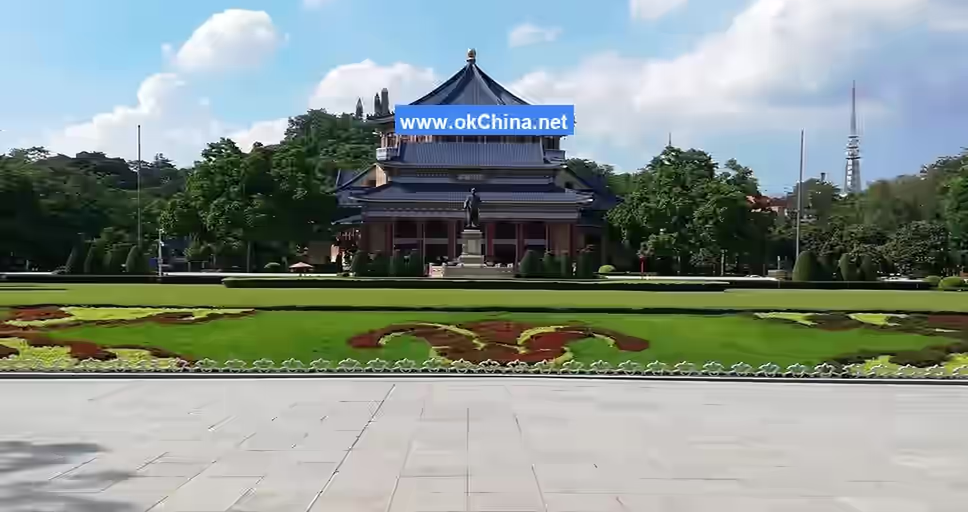
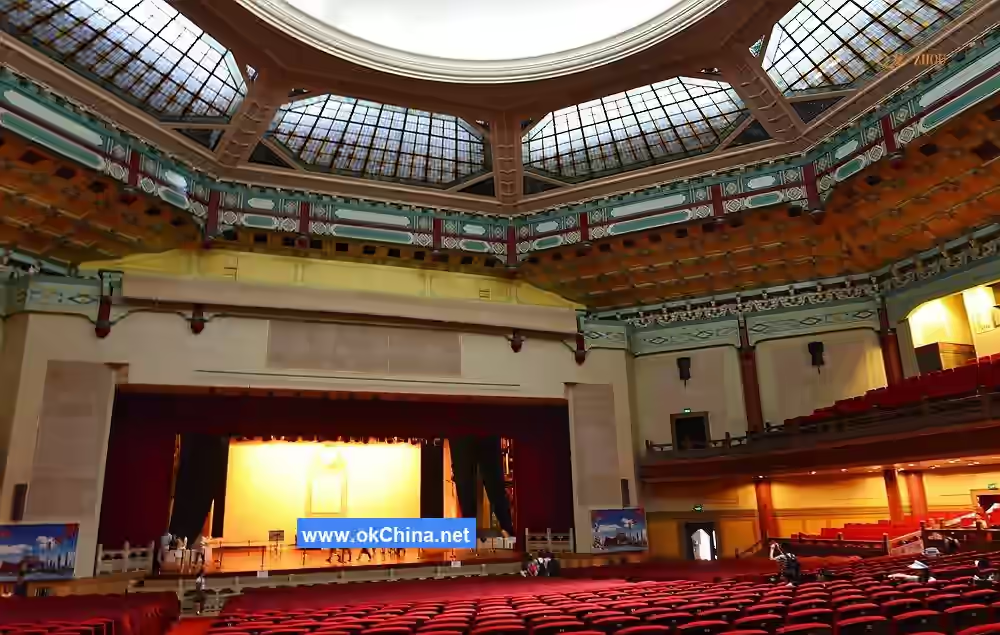
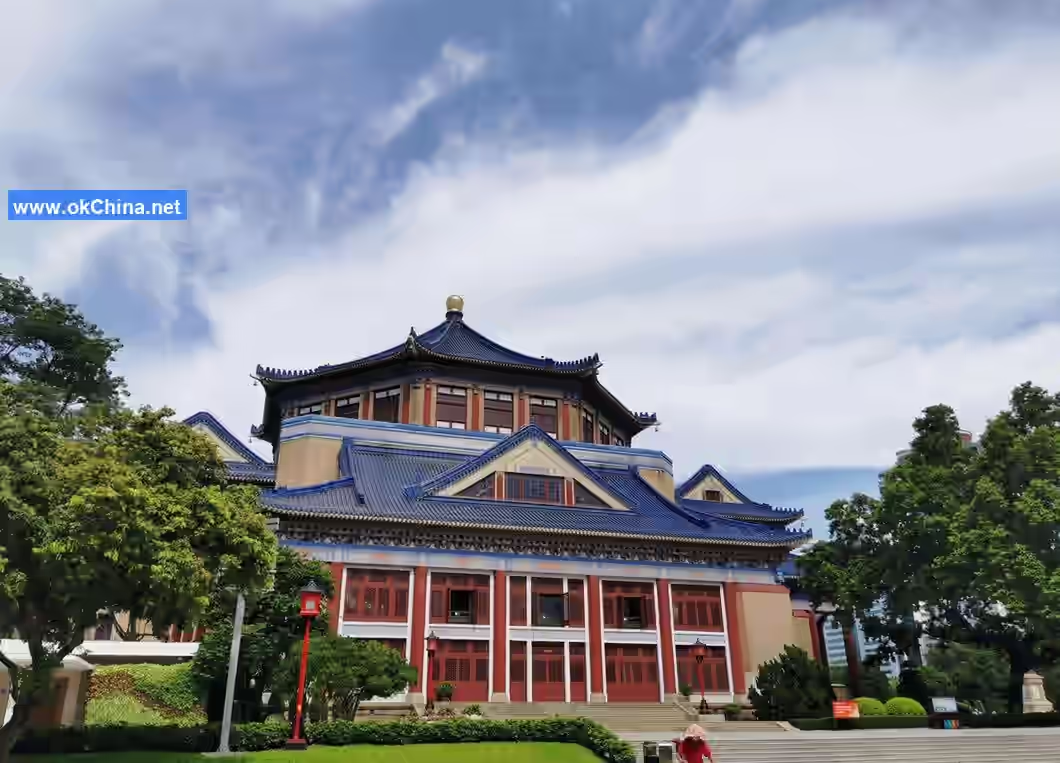
The Sun Yat-sen Memorial Hall is located northwest of Sun Yat-sen's Former Residence. Originally the Sun Yat-sen Former Residence Exhibition Hall, it was rebuilt in 1996 and opened to the public on November 12, 1999. The hall has a floor area of 6,000 square meters and consists of exhibition halls, a multi-purpose auditorium, VIP reception rooms, storage areas, and administrative offices.
2.1.3 Site of the Ancestral House
North of the front courtyard of Sun Yat-sen's Former Residence, there was originally a house about four meters wide and eight meters long. Sun Yat-sen was born here on November 12, 1866. After the completion of the main residence in 1892, this house was converted into a kitchen, and a well was dug. In 1913, Sun Mei (Sun Yat-sen's elder brother) expanded the backyard and built a new kitchen, after which this house was demolished.
2.1.4 The Tamarind Tree
The Tamarind Tree, also known as the "sour bean tree," is located in the south side of the front courtyard of Sun Yat-sen's Former Residence. It is said that Sun Yat-sen brought the seed back from Honolulu and planted it here in 1883. Around 1931, the tree was blown down by a typhoon but continued to grow tenaciously, becoming lush and verdant. On March 8, 1962, Mr. Guo Moruo visited and left a poetic line describing the tree's unique form: "A tamarind tree lies like a crouching dragon."
2.1.5 Bronze Sculpture "Roots"
As a child, Sun Yat-sen often listened to an elderly villager who had participated in the Taiping Rebellion tell stories about Hong Xiuquan under the large banyan tree in front of his home. Sun Yat-sen later recalled that his revolutionary ideas first took root here. A bronze sculpture named "Roots" now stands as a memorial.
2.1.6 The Zhongshan Ding (Tripod)
The "Zhongshan Ding" is situated at the central intersection point between Sun Yat-sen's Former Residence and the Sun Yat-sen Memorial Hall. Its rim diameter is 1866 mm, height 1925 mm, inscription height 590 mm, and base width 1912 mm. These dimensions respectively represent Sun Yat-sen's birth year, year of death, age at death, and the year he overthrew the monarchy and established the Republic.
2.1.7 The Bell of Admonition
The Bell of Admonition has a diameter of 1.2 meters, stands 2 meters high, and weighs 1.5 tons. The front is inscribed with his handwritten calligraphy "Advance Together Towards Great Harmony," and the back bears the text of Sun Yat-sen's 1924 speech "Exhorting the Nation." The bell not only commemorates Sun Yat-sen's lifelong efforts to awaken the Chinese nation and revitalize the motherland but also admonishes the people to strive for building a unified, prosperous, and powerful country.
2.1.8 Yang Yin Former Residence Exhibition Zone
The Yang Yin and Lu Haodong Memorial Exhibition Zone includes two provincial-level protected historical and cultural sites—the former residences of Yang Yin and Lu Haodong—as well as the Guangdong Provincial Party Member Education Base. It features original-state displays of Yang Yin's and Lu Haodong's former residences, memorial exhibitions for both figures, and a Party member education exhibition hall. It has become a must-visit site for Party member education in Zhongshan and even Guangdong, achieving significant social benefits and fully leveraging its role as an education base.
2.2 1911 Revolution Memorial Park
The 1911 Revolution Memorial Park, primarily designed by Professor Chen Keshi, integrates elements commemorating Sun Yat-sen and the 1911 Revolution with leisure and recreation. The park's overall architectural style leans towards a "fusion of Chinese and Western elements." It highlights the pioneering spirit of democratic revolutionaries led by Sun Yat-sen during the Xinhai Revolution. A granite diary wall is inscribed with diaries, memoirs, and poems related to the 1911 Revolution by figures such as Sun Yat-sen, Huang Xing, Cai Yuanpei, Mao Zedong, Zhu De, Dong Biwu, and Soong Ching Ling.
2.3 Zhongshan Film and TV City
Zhongshan Film and TV City covers an area of 300 mu (approximately 20 hectares). It features four themed areas—China, Japan, Britain, and the United States—along with an exhibition hall area, totaling 63 visiting spots. It is a themed cultural tourism attraction combining tourism, patriotic education, and film/TV production, condensing memorial sites related to Sun Yat-sen's revolutionary activities in China and around the world.
2.4 Cuiheng Village
Cuiheng Village is located in Nanlang Town, Zhongshan City, Guangdong Province, China. Originally named Caikeng Village, it was later renamed Cuiheng Village due to the lush green mountains nearby.
Cuiheng Village is the hometown of Dr. Sun Yat-sen, where he was born and spent his childhood and teenage years. This ordinary small mountain village was not only Sun Yat-sen's earliest window to understanding society but also the soil that nurtured his revolutionary ideas and the testing ground for his earliest social reforms. Sun Yat-sen's grandfather, Sun Jingxian, made a living by farming. His father, Sun Dacheng, worked as a shoemaker in Macau in his youth before marrying a woman from the Yang family in Getian Township. They had six children, with Sun Yat-sen being the fifth. Due to the family's poverty, they survived by renting and farming the "Longtian" field located northeast of the village. Like most farm children, the young Sun Yat-sen often followed his second elder sister, Sun Miaoxi, to gather firewood, cut grass, collect pig manure, and even herded cattle for others in exchange for the opportunity to use an ox for plowing. He rarely wore shoes or ate rice, often subsisting on sweet potatoes. These hardships of farm life gave Sun Yat-sen a deep understanding of peasants' suffering and planted the seed of wanting to change the status quo. He told Soong Ching Ling on several occasions: "From that time on, I thought that the life of Chinese peasants should not be so hard forever. Chinese children should have shoes to wear and rice to eat." His rural life in his youth not only shaped his independent character and strong physique but also laid the foundation for his later revolutionary ideas, such as the germination of the concept of equalization of land rights. Japanese friend Miyazaki Torazō once asked Sun Yat-sen: "Where did you get your idea of land equalization? From academic study or practical investigation?" He replied: "Stimulated by the circumstances of my childhood, I felt it quite necessary to study this problem both practically and theoretically. If I had not been born a poor peasant's child, I might have overlooked this important problem."
In Cuiheng Village, Sun Yat-sen's revolutionary ideas gradually sprouted. An elderly villager named Feng Guanshuang, who had participated in the Taiping Rebellion, often told children stories about Hong Xiuquan's anti-Qing uprising during evening breaks. Sun Yat-sen listened intently, filled with admiration for Hong Xiuquan, and even called himself the "Second Hong Xiuquan" when playing games with village children. Later, when answering his Japanese friend Miyazaki Torazō's question about "when his revolutionary ideas were conceived," Sun Yat-sen recalled: "Although my revolutionary ideas matured when I grew up, the initial motivation for revolution arose during my childhood from conversations with an elderly villager in my hometown. Who was this elderly man? He was a surviving old hero from the Taiping Heavenly Kingdom army." As a child, Sun Yat-sen was not only lively and active but also showed a strong rebellious spirit. Many stories about his childhood circulate in the village. For instance, he once smashed the tofu pot of "Tofu Xiu's" family after being bullied, earning him the nickname "Stubborn Kid." Another time, when Qing soldiers came to the village to arrest the Yang brothers for human trafficking, Sun Yat-sen fearlessly followed them to watch them seal the houses, running home each time to report which house was sealed. These stories reveal Sun Yat-sen's character of defying authority and daring to resist from a young age.
Sun Yat-sen did not begin his formal education until the age of nine. The village school was located in the Feng Clan Ancestral Hall, and the curriculum mainly consisted of traditional Confucian classics like the Three Character Classic, Hundred Family Surnames, and Thousand Character Classic. The teacher, surnamed Huang and nicknamed "Toad Huang," only required rote memorization without explaining the meaning of the texts. Sun Yat-sen was clever and had a strong memory but gradually became puzzled by this learning method. He once asked his teacher: "I study every day but don't understand the principles in the books. What's the use of reading this?" The teacher was very angry and punished him with a ruler, but Sun Yat-sen was not convinced, thinking, "There must be principles in these classics. I will seek them out one day." Later, the private tutor was replaced by Cheng Junhai, who not only imparted knowledge but also emphasized intellectual inspiration and moral cultivation. He often recounted historical facts about the Manchu invasion of China and the slaughter of Han people, which stimulated Sun Yat-sen's nationalistic thoughts. Cheng Junhai once gave the first line of a couplet: "Tigers and leopards can indeed be tamed," to which Sun Yat-sen responded with the second line: "Dragons and snakes remain unknown." Cheng Junhai thus believed he was "no ordinary person" and taught him more attentively. These educational experiences provided Sun Yat-sen with a preliminary foundation in Chinese classical learning and planted the seeds for his future revolutionary ideas.Although a small mountain village, Cuiheng was not isolated. Through letters from his elder brother Sun Mei, stories from villagers, and his own observations, Sun Yat-sen gradually developed a strong interest in the world beyond the village. In 1879, after persistent pleading, his father finally agreed to let him accompany his mother to Honolulu to join Sun Mei. In Honolulu, Sun Yat-sen received a Western-style education, broadened his horizons, and gradually formed ideas about reforming China. In 1883, on his journey back to his hometown from Honolulu, witnessing the corruption of Qing government officials further strengthened his resolve for reform. After returning to Cuiheng, he actively promoted the necessity of social reform to the villagers, criticized the corruption of the Qing government, participated in village administration, and attempted improvements such as repairing bridges and building roads. However, these attempts faced various obstacles and were unsuccessful, prompting Sun Yat-sen to gradually embark on the path of revolution.
In 1894, Sun Yat-sen drafted the "Letter to Li Hongzhang" in his study at home, proposing plans to learn from the West and reform China, but received no response. Thereafter, realizing that the path of peaceful reform was unfeasible, he turned to seeking the overthrow of the Qing government by force. In 1895, the Guangzhou Uprising failed, forcing Sun Yat-sen into exile overseas, and Cuiheng also suffered repercussions. It was not until 1912, after resigning as provisional president, that Sun Yat-sen returned to his hometown again, hosting a banquet for fellow villagers and delivering a speech expressing his care for his birthplace. In his later years, Sun Yat-sen continued to fund education and public welfare in his hometown and hoped to return again, but this wish remained unfulfilled due to his revolutionary commitments. Cuiheng is not only Sun Yat-sen's birthplace but also the cradle of his revolutionary ideas. His childhood experiences and education in his hometown profoundly influenced his life, propelling him onto the path of changing China's destiny.
2.5 Litoujian Mountain
Litoujian Mountain is located north of Cuiheng Village, named for its resemblance to a plowshare, and is the highest peak in Cuiheng. Together with Jinbinlang Mountain and Huangniu Mountain, it contributes to Cuiheng's geographical advantage of being surrounded by mountains on three sides and facing water on one side. Climbing the mountain offers a panoramic view of the Sun Yat-sen Hometown Tourism Area and a distant view of Qi'ao Island in Zhuhai City and the Qi'ao Bridge, known as one of the "Eight Scenes of Qi'ao."
The mountain is the burial site of Sun Yat-sen's grandfather Sun Jingxian, father Sun Dacheng, elder brother Sun Mei, nephew Sun Chang, and the Sun family cemetery cluster. The tombs are primarily built in the traditional armchair style, preserving the burial characteristics of Cuiheng Village. Among them, Sun Jingxian's tomb is located on the southern peak of Litoujian Mountain, facing the Pearl River Estuary, with excellent feng shui, locally known as "Emperor's Field."
3. Related Figures
3.1 Biography of Sun Yat-sen
Sun Yat-sen's childhood name was Dixiang, his school name was Wen, his courtesy name was Deming, and he initially adopted the literary name Rixin, later changing it to Yixian. While residing in Japan, he used the pseudonym Nakayama Kikori, from which the name "Zhongshan" (Sun Yat-sen) originated.
Sun Yat-sen was born on November 12, 1866, into an ordinary peasant family in Cuiheng Village. He began studying in the village school at age 9, went to Honolulu for education at 13, and returned to China at 17. In 1884, he married Lu Muzhen from the same county. From 1886 to 1892, he studied medicine in Guangzhou and Hong Kong. After graduation, he practiced medicine in Macau and Guangzhou while dedicating himself to political activities aimed at saving the nation. In 1894, his petition to Li Hongzhang was rejected, leading him to return to Honolulu, where he founded the Revive China Society, advocating to "expel the Manchus, restore China, and establish a united government."
In 1905, he established the Chinese Revolutionary Alliance in Tokyo, systematically proposing his Three Principles of the People, and engaged in fierce debates with royalists. From 1895 to 1911, he planned multiple anti-Qing armed uprisings, facing repeated setbacks but growing more determined. The Wuchang Uprising on October 10, 1911, received responses from various provinces, leading to the collapse of Qing autocratic rule, known as the famous "Xinhai Revolution."
On January 1, 1912, Sun Yat-sen assumed the position of Provisional President of the Republic of China in Nanjing, establishing the first republican government in Chinese history. In April 1912, he stepped down from the presidency to focus on promoting economic development. After Yuan Shikai usurped the presidency and conspired to restore the monarchy, Sun Yat-sen launched the "Second Revolution" against Yuan in 1913. In 1914, he organized the Chinese Revolutionary Party in Japan. In 1915, he married Soong Ching-ling.
In 1917, he convened an extraordinary parliament in Guangzhou, organized the Military Government of the Republic of China, was elected as Generalissimo, and initiated the Constitutional Protection Movement. In 1919, he reorganized the Chinese Revolutionary Party into the Chinese Nationalist Party (Kuomintang), serving as its Premier. In 1921, the extraordinary parliament in Guangzhou resolved to establish the formal government of the Republic of China, with Sun Yat-sen assuming the presidency and raising the banner of constitutional protection once more. In 1923, Sun Yat-sen established a government in Guangzhou for the third time, founding the General Headquarters of the Army and Navy and resuming the role of Generalissimo. That same year, accepting advice from Soviet Russia and the Chinese Communist Party, he decided on cooperation between the Kuomintang and the Communist Party to advance the National Revolution. In January 1924, he convened the First National Congress of the Chinese Nationalist Party, reorganizing the party and reinterpreting the Three Principles of the People. In the autumn of that year, Feng Yuxiang launched the "Beijing Coup," and Sun Yat-sen was invited north to discuss national affairs. On March 12, 1925, he died in Beijing due to liver cancer.
3.2 Soong Ching-ling
Soong Ching-ling was born on January 27, 1893, in Shanghai into a family of a pastor and industrialist. Her father, a friend and comrade of Sun Yat-sen, was her first启蒙 teacher. In her youth, she studied abroad, receiving a "European-style education" in the United States and undergoing the洗礼 of democracy. The Xinhai Revolution overthrew the Qing autocratic rule, filling her with hope for her country's independence, freedom, democracy, and prosperity. The continuous letters and newspaper clippings sent by her father built a bridge in her heart to the revolutionary cause led by Sun Yat-sen. However, with the republic strangled in its cradle and the revolutionary tide receding, Soong Ching-ling's aspirations to return and contribute to reforming and building her homeland found no outlet. She went directly to Tokyo, where exiled revolutionaries gathered, and soon became Sun Yat-sen's assistant, beginning her 70-year revolutionary career.
On October 25, 1915, defying her parents' opposition, Soong Ching-ling resolutely decided to marry Sun Yat-sen, who was in exile, and steadfastly followed him on the arduous struggle to defend the republican system. Sun Yat-sen passed away in Beijing on March 12, 1925, entrusting Soong Ching-ling and his comrades with the mission of "peace, struggle, and saving China."
In August 1927, Soong Ching-ling visited the Soviet Union and later lived in Europe for four years. She studied the world's first socialist country and several major capitalist powers, read Marx's works, and researched the core issues of the Chinese revolution—land and peasants—with many Chinese revolutionaries exiled in Europe, leading to a qualitative leap in her thinking.
As Japanese imperialist aggression against China expanded and ethnic矛盾 rose to become the principal social contradiction, Soong Ching-ling quickly made a scientific judgment and correct decision, believing that "in times of national crisis, past grievances should be set aside. The entire nation must unite to resist Japan and strive for final victory." Her ideas on national unity against Japan aligned with the Chinese Communist Party's strategic policy of establishing an anti-Japanese national united front, which had overcome "leftist" dogmatism. She also played an irreplaceable and special role in facilitating the second cooperation between the Kuomintang and the Communist Party.
From September 21 to 30, 1949, the First Plenary Session of the Chinese People's Political Consultative Conference was held in Beijing, where Soong Ching-ling was elected Vice Chairman of the Central People's Government of the People's Republic of China and Standing Committee member of the First National Committee of the Chinese People's Political Consultative Conference.
After the founding of the People's Republic of China in 1949, Soong Ching-ling undertook extensive state affairs for a long time. Simultaneously, she devoted much energy to cultural, educational, health, and welfare endeavors for women and children. She subsequently served as Honorary President of the All-China Democratic Women's Federation, Honorary President of the All-China Women's Federation of the People's Republic of China, and Chairperson of the Chinese People's National Committee for the Defense of Children. In 1950, she was elected as a member of the World Peace Council. In 1952, she was elected Chairperson of the Asian and Pacific Liaison Committee.
In September 1954, Soong Ching-ling was elected Vice Chairperson of the Standing Committee of the First National People's Congress. On April 7, 1959, during the First Session of the Second National People's Congress, she was elected Vice President of the People's Republic of China. In January 1965, during the Third National People's Congress, she again served as Vice President of the People's Republic of China. In January 1975, during the Fourth National People's Congress, she was re-elected Vice Chairperson of the Standing Committee of the National People's Congress. In February 1978, during the Fifth National People's Congress, she was re-elected Vice Chairperson of the Standing Committee. On August 30, 1980, during the Third Session of the Fifth National People's Congress, she served as Executive Chairperson of the session.
On May 14, 1981, Soong Ching-ling's coronary heart disease and chronic lymphocytic leukemia worsened. On the 15th, the Political Bureau of the Central Committee of the Communist Party of China announced her acceptance as a full member of the Communist Party of China. On the 16th, the Standing Committee of the National People's Congress conferred upon her the honorary title of Honorary President of the People's Republic of China. She passed away in Beijing at 20:18 on May 29, 1981.
Comments
Post a Comment