Fuzhou Three Lanes and Seven Alleys Historical and Cultural District
1. Introduction
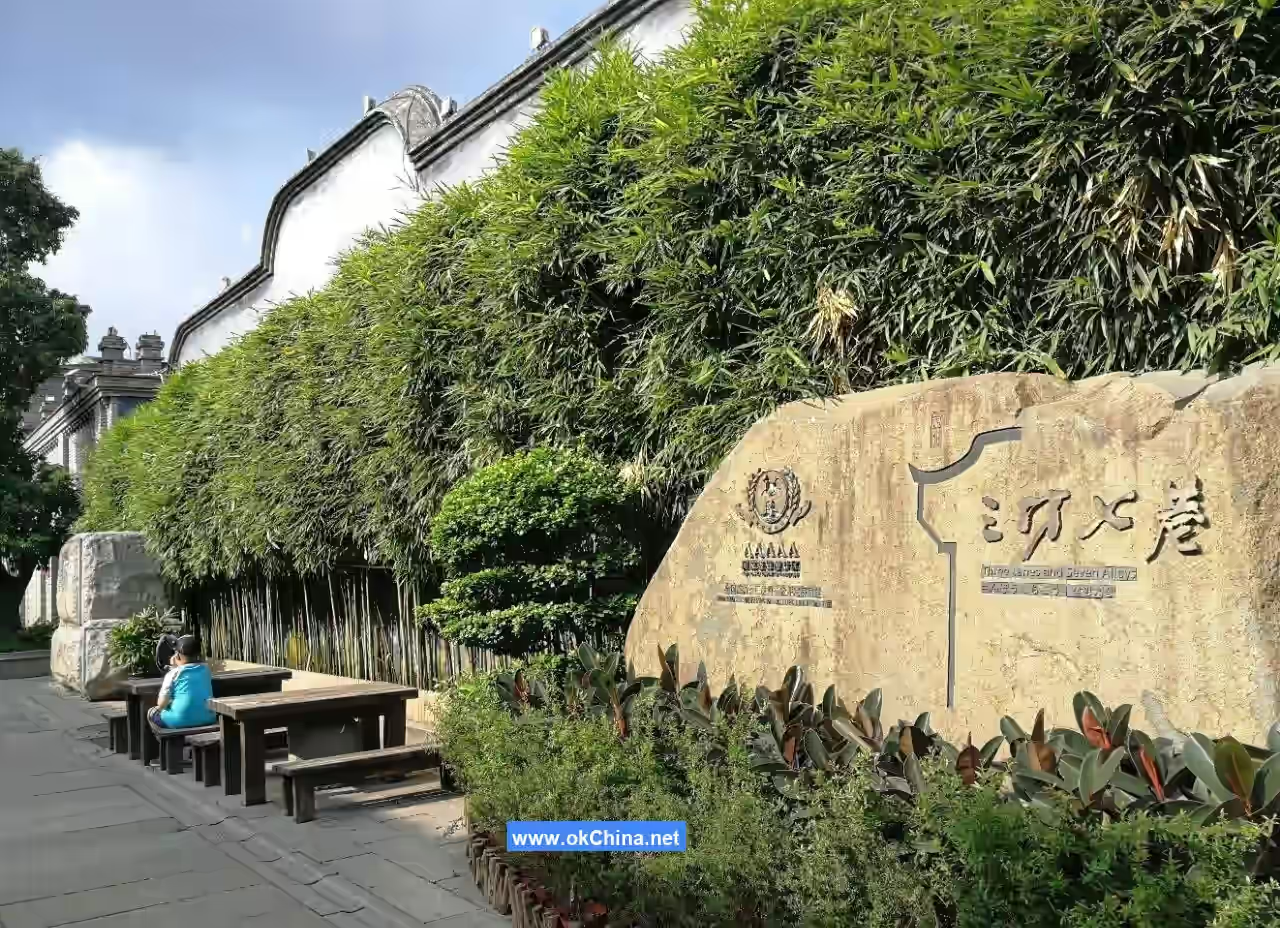
The Fuzhou Three Lanes and Seven Alleys Historical and Cultural District, also known as the Fuzhou Three Lanes and Seven Alleys Scenic Area, is a historical and cultural district and tourist attraction located within Gulou District, Fuzhou City, Fujian Province. Situated at No. 10 Yingfangli, it covers a total area of approximately 40 hectares.
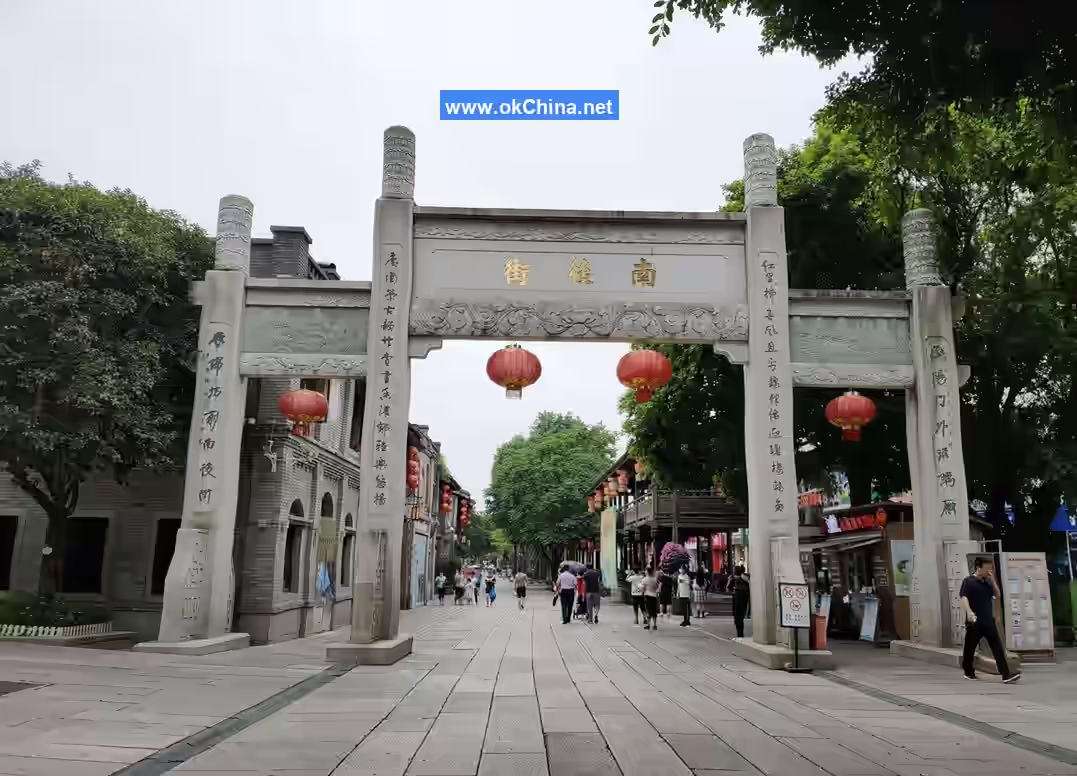
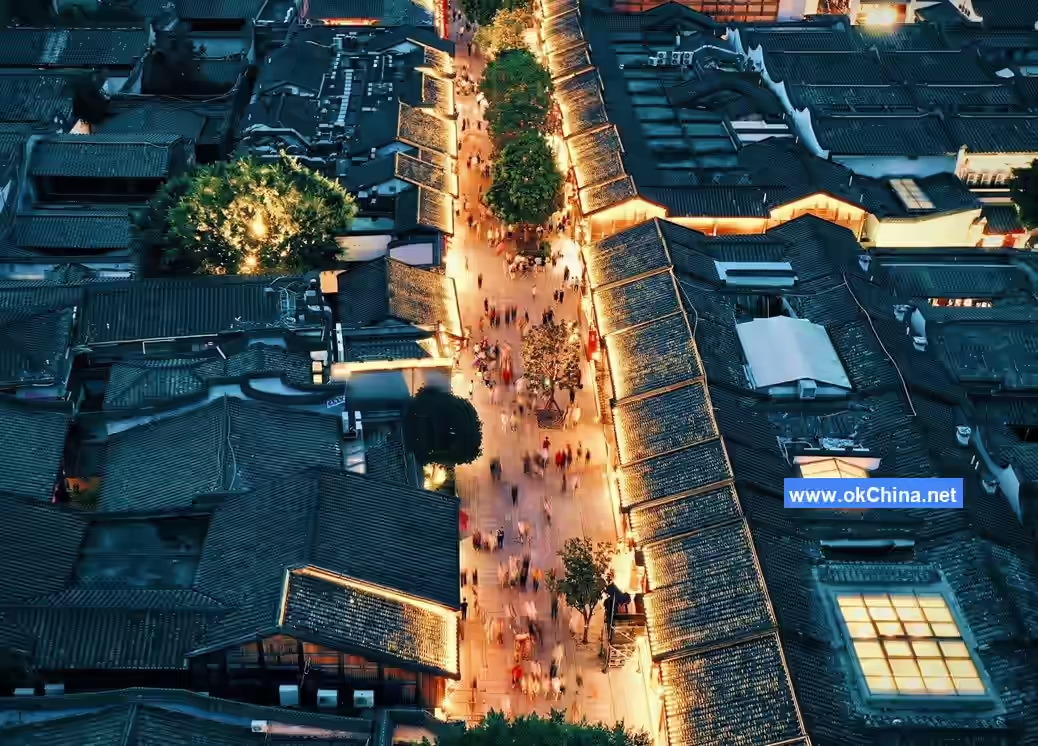
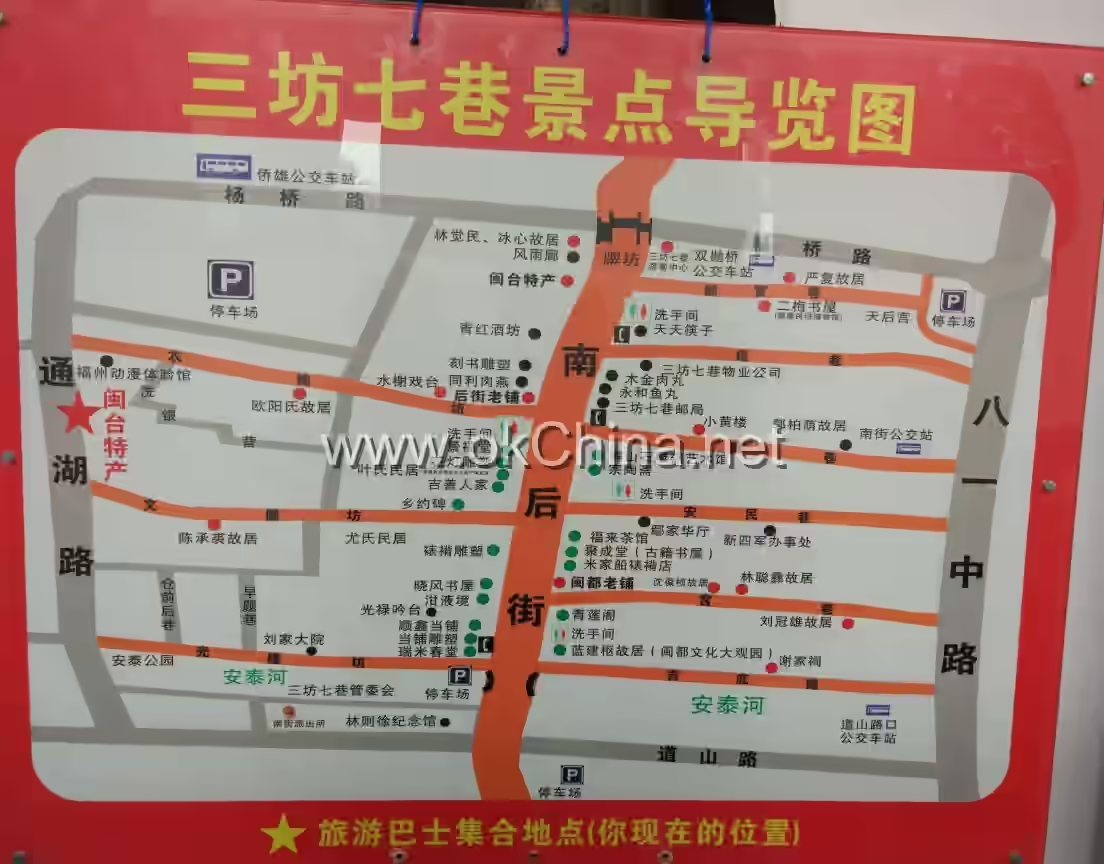
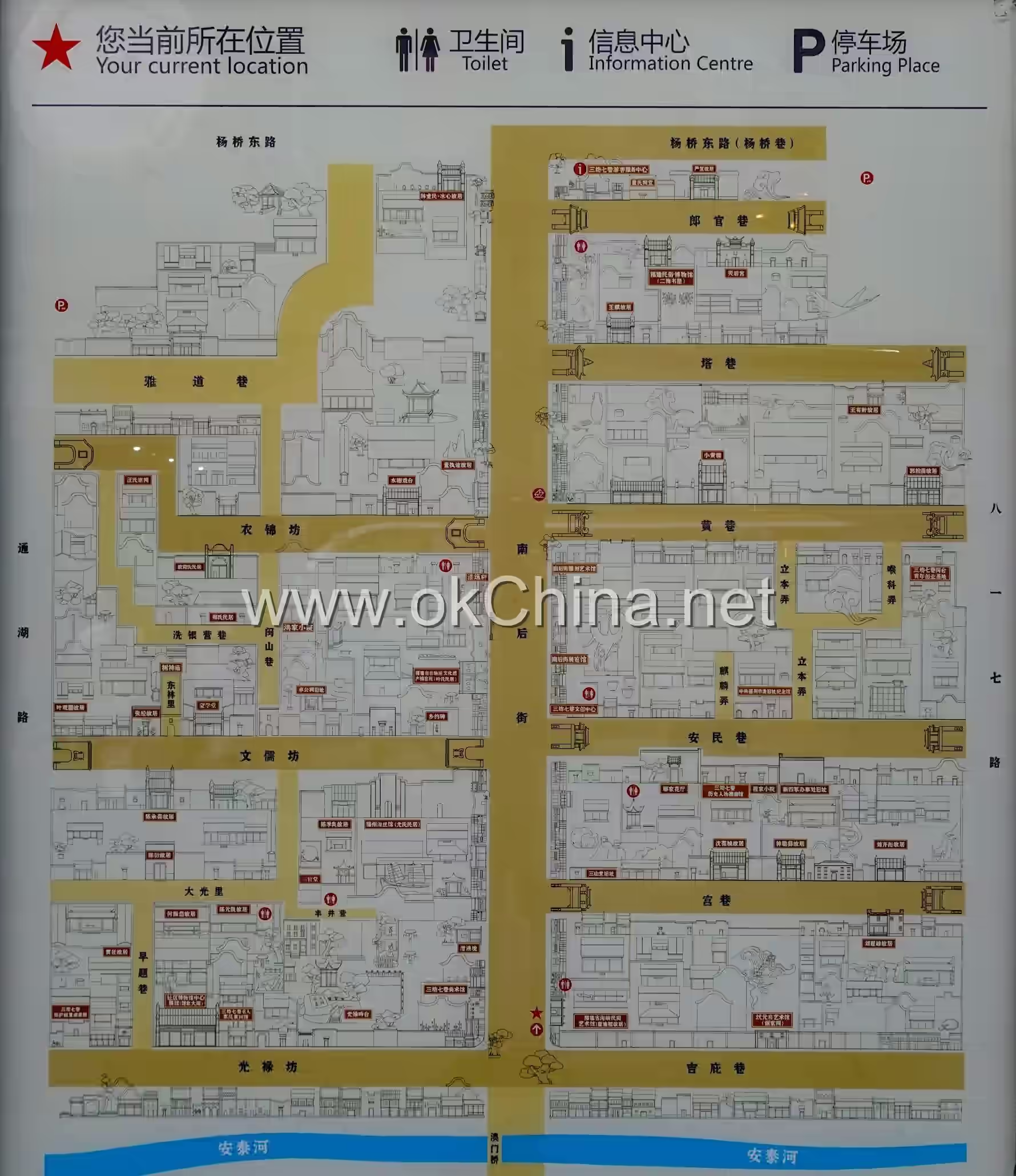
With Nanhou Street as its central axis, Three Lanes and Seven Alleys consists of three lanes (Yijin Lane, Wenru Lane, and Guanglu Lane) to the west and seven alleys (Yangqiao Alley, Langguan Alley, Ta Alley, Huang Alley, Anmin Alley, Gong Alley, and Jibi Alley) to the east, collectively known as "Three Lanes and Seven Alleys." It is the most representative historical and cultural district in Fuzhou and one of the larger, relatively well-preserved historical and cultural districts still existing in China. Its origins trace back to the Jin Dynasty, taking shape during the Tang and Five Dynasties periods, maturing during the Song Dynasties, and flourishing in the Ming and Qing Dynasties. It is hailed as a "living fossil of the Li-Fang system" and a "museum of Ming and Qing architecture." The district largely retains the lane and alley layout from the Tang and Song periods and a significant number of buildings from the Ming and Qing eras, including 29 cultural relics protection units at various levels. The area contains about 270 ancient residential buildings, with 159 listed as protected structures. The ancient architectural complex of Three Lanes and Seven Alleys, represented by 15 typical buildings such as the former residences of Shen Baozhen, Lin Juemin & Bing Xin, and Yan Fu, is a National Key Cultural Relics Protection Unit.
Three Lanes and Seven Alleys is known as the "Gathering Place of Fuzhou Celebrities." This area, blessed with outstanding people and spiritual energy, has historically produced 150 Jinshi (imperial examination graduates), over 300 Juren (provincial examination graduates), and more than 300 prominent figures who influenced the course of Chinese history, such as Lin Zexu, Shen Baozhen, Yan Fu, Chen Baochen, and Lin Juemin. Consequently, it also holds the reputation that "Three Lanes and Seven Alleys encapsulates half of China's modern history."
2. Geographical Environment
2.1 Location and Area
The Three Lanes and Seven Alleys Historical and Cultural District is located at No. 10 Yingfangli, Gulou District, Fuzhou City, Fujian Province, covering a total area of approximately 40 hectares.
2.2 Climate Characteristics
Fuzhou City, where the Three Lanes and Seven Alleys Historical and Cultural District is located, has a typical subtropical monsoon climate. Summers are long and winters are short, with little frost. Except for higher altitude mountainous areas, most regions experience frost-free periods exceeding 300 days. The city's annual average temperature is 19.7°C, with the lowest monthly average being 10.6°C (January) and the highest 28.8°C (August). The annual average precipitation is 1348.8 mm, and the annual average sunshine duration is 1755.4 hours. Fuzhou is rich in climatic resources, with suitable temperatures and ample rainfall, which is beneficial for agricultural production. Spring and summer bring abundant rainfall, suitable for hydropower generation. Autumn and winter feature stronger coastal winds and a drier climate, favorable for wind power generation and salt production. The seasonal division in the Fuzhou area is as follows: March to June is spring, July to September is summer, October to November is autumn, and December to February is winter.
3. Important Attractions
Scenic Area Layout
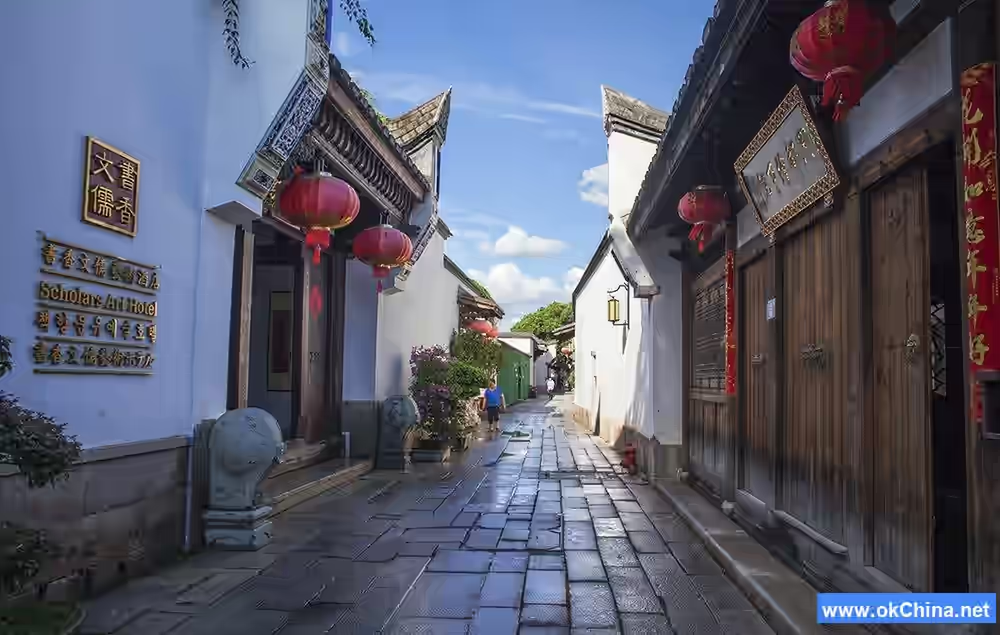
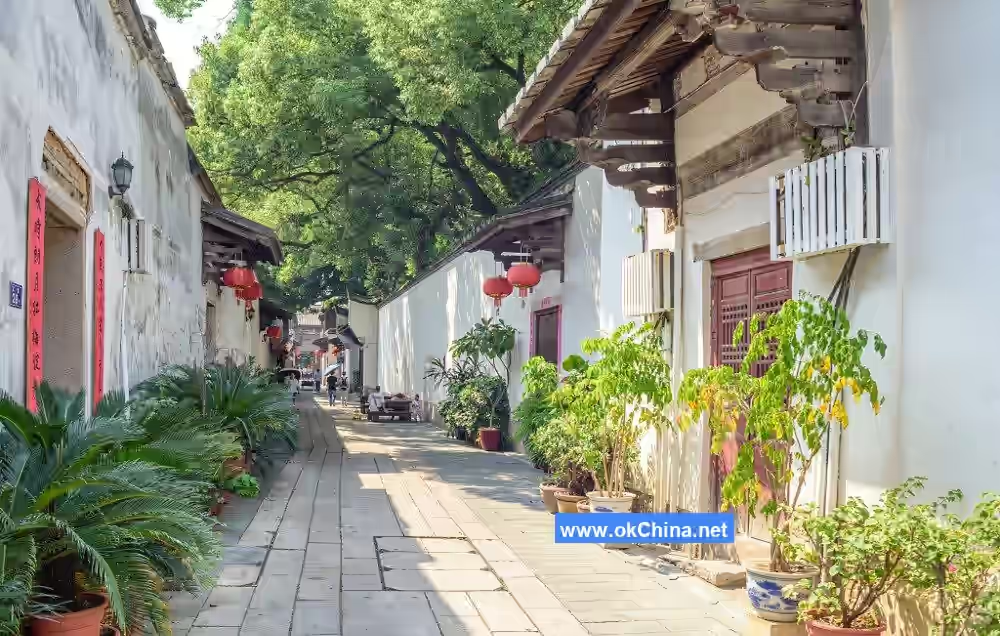
Three Lanes and Seven Alleys is located on the millennia-old central axis of the ancient city of Fuzhou. With Nanhou Street as the central axis, ten lanes and alleys are arranged parallel to each other from east to west. On the west side, from north to south, are Yijin Lane, Wenru Lane, and Guanglu Lane. On the east side, from north to south, are Yangqiao Alley, Langguan Alley, Ta Alley, Huang Alley, Anmin Alley, Gong Alley, and Jibi Alley. The lanes and alleys are interconnected, forming a chessboard-like pattern where "lanes contain alleys, and alleys connect to each other." The basic layout of Three Lanes and Seven Alleys originated in the Jin Dynasty, took shape during the Tang and Five Dynasties, reached its peak in the Ming and Qing Dynasties, and has remained largely unchanged for over a thousand years.
3.1 The Three Lanes
3.1.1 Yijin Lane
Yijin Lane is the first of the "Three Lanes," formerly known as Tongchao Alley. According to the Qing Dynasty's "Rongcheng Kaoguelue": "During the Song Dynasty, brothers Lu Yun and Lu Zao served as local officials and lived here, naming it 'Lujin.' Later, Wang Yixiang served as the Judicial Commissioner of Jiangdong and renamed it 'Yijin.'" It was called "Lujin" in the Song Dynasty and changed to "Yijin" in the Ming Dynasty. Both names essentially signify that someone from the lane achieved high office and returned home in glory, bringing honor to their hometown, hence the lane's name was changed to "Yijin" (literally "clothes of brocade," meaning returning home in glory). The old name "Tongchao" (connecting to the tide) came from this being a water network area where tides from Fuzhou's West Lake and South Lake could reach the canals of this lane.
No. 16 in the lane was the residence of Zheng Pengcheng, a Jinshi of the Qing Jiaqing period. The most distinctive feature here is the Yijin Lane Waterside Pavilion Theater. This is a single-story wooden platform with four pillars and a single bay, built over a clear water pond, separated by a courtyard, with a pavilion facing it. Watching performances here offers clear water, clear breeze, and clear sound, possessing acoustic principles and aesthetic value. It is the only surviving waterside pavilion theater in Fuzhou City.
3.1.2 Wenru Lane
Wenru Lane is the second of the "Three Lanes." This name already existed in the Song Dynasty. According to "Rongcheng Kaoguelue," this alley "was initially named Rulin. Because Song Dynasty Jijiu (Director of the Imperial Academy) Zheng Mu lived here, it was changed to its current name." Zheng Mu served as the Jijiu of the Imperial Academy, an important official of the nation's highest institution of learning, holding a third-rank position. Ming Dynasty anti-pirate general Zhang Jing and Qing Dynasty general Gan Guobao, who served as the Provincial Military Commander of Fujian and the Regional Commander of Taiwan, also lived here.
Within Wenru Lane, there is a deep and quiet small alley called Minshan Alley, commonly known as "Sanguantang" (Three Officials Hall), famous because a Sanguantang was built there in ancient times. According to Lin Feng's "Rongcheng Kaogulu" from the Qing Daoguang period, Volume II, "Lanes and Alleys, Part Two": "Sanguantang is located in Minshan Alley, south of Wenru Lane. A small alley to the south connects to Guanglu Lane, and the west exit reaches the riverbank of Changfengcang. Most places are named after temples. This one is named after the Minshan Baofu Temple." This shows the close relationship between Sanguantang and Baofu Temple.
3.1.3 Guanglu Lane
Guanglu Lane is the third of the "Three Lanes." Originally named Yuchi Mountain, it is one of Fuzhou's "Three Hidden Mountains." Historically, there was a Faxiang Temple within Guanglu Lane, commonly known as "Minshan Baofu Temple" (located within today's Guanglu Lane Park). Cheng Shimeng, a prefect of Fuzhou who had served as the Minister of Guanglu, often visited to recite poetry. The monks carved the four characters "Guanglu Yintai" (Guanglu Reciting Platform) on a rock. To thank the monks, he composed a poem: "I joyfully come alone under the clear shade all day long; The wild monk inscribed the rock to make a reciting platform. No poem can compare to that of Yan Guanglu; Each time I recall climbing here, I turn back by myself." The name Guanglu Lane originates from this. In the 1980s and 1990s, Guanglu Lane was turned into a road due to urban reconstruction. Later, for preservation needs, the road surface was restored with stone slabs, and the old modern buildings on both sides were demolished.
Guanglu Lane was also a gathering place for celebrities. In the late Ming Dynasty, there were Juren and painter Lin Youtai from the Wanli period, Educational Commissioner Sun Changyi, and Education Commissioner Xu Zhi, whose sons Xu You and Xu Bin, grandson Xu Yu, great-grandsons Xu Ding and Xu Jun, and great-great-grandsons Xu Liangchen and Xu Jinchen were all poets, calligraphers, and painters. During the Qing Kangxi period, there were the brothers Lin Tong and Lin Ji. Lin Tong was an archaeologist, author of "Laizhai Xuangu" and "Laizhai Jinshikao." Lin Ji excelled in poetry and prose, authoring "Puxuezhai Shiwenji," and was also skilled in calligraphy. His handwritten engraved editions of "Yuyang Shanren Jinghualu," "Yaofeng Wenchao," "Gufuyuting Zalu," and "Wuting Wenbian" are very famous, known as the "Four Engravings by Lin Ji," holding a place in Chinese printing history. There were also poet and famous inkstone collector Huang Ren, Ryukyu Kingdom envoy Qi Kun, brothers who passed the imperial examination in the same year—Liu Qiqu and Liu Qixian, naturalist Guo Bocang, modern novel translator Lin Shu, famous writer Yu Dafu, and others. Many talented women also emerged from here, such as Huang Ren's daughters Huang Shudi and Huang Shuyuan, Qi Kun's daughter Qi Xiangdi, and Guo Bocang's daughters Guo Shizhu and her sister, who were skilled in calligraphy, painting, poetry, or prose.
Among the scenic spots in Guanglu Lane, the Guanglu Reciting Platform is the most famous, renowned for its pond, platform, pavilion, rocks, flowers, and trees, as well as numerous cliff inscriptions from the Song to Qing Dynasties. It was listed as one of the first batch of Fuzhou Cultural Relics Protection Units in 1961. West of the Guanglu Reciting Platform, under a lychee tree, there was originally a stone inscription "Hedeng" (Crane Perch), commemorating the place where Lin Zexu released cranes in his later years. Also preserved are the large, spacious, and bright wooden structure of the Liu Family Compound (now a provincial-level cultural relics protection unit), the simple and古朴 ancient wooden house of Huang Ren's former residence from the late Ming Dynasty, the narrow-path, high-walled Zaoti Alley, and the old Fotting Bridge paved with Ming Dynasty stone slabs, all retaining the characteristics of Ming and Qing architecture.
3.2 The Seven Alleys
3.2.1 Yangqiao Alley
Yangqiao Alley is the northernmost of the "Seven Alleys." Its ancient name was Dengjun Lane, changed because it connected to Yang Bridge to the west. During the Republican era, due to urban construction needs, it was expanded into a road and later renamed "Yangqiao Road." At the intersection of Yangqiao Road and Nanhou Street stands the Lin family mansion, which was the former residence of martyr Lin Juemin. This martyr's former residence was later sold to Xie Luan'en, the grandfather of writer Bing Xin. Bing Xin lived here as a child and gave a vivid description of the former residence in "My Hometown." After the alley was widened into a road, significant portions of the former residences of martyr Lin Juemin and writer Bing Xin (see the entry "Fuzhou Bing Xin Former Residence") were preserved. In Yangqiao Alley (south), there is a "Shuangpao Bridge" (Double-Throwing Bridge), small in scale but rich in legends.
First, the inner river channel where this bridge is located is a place where eastern and western waters "converge with the tide." The inner river spectacle of "the tide from ten thousand miles arriving in one breath" can be most vividly felt here.
Second, a pair of banyan trees growing facing each other on both banks of Shuangpao Bridge have intertwined their branches and leaves in the air, embracing to form shade. This gave rise to a poignant love story of a young couple殉爱 (dying for love), passed down for so long that later generations can no longer tell whether love came first, then the trees, or the trees came first, then the bridge, or vice versa. Recently, it has been heard that overseas writers compare it to the tragic tale of "Romeo and Juliet," adding to its sorrow. However, due to river channel modification and urban construction, the Qiongdong River under the bridge has been filled in. Later, a landscape pond was built under the bridge to remind people of the former inner river's existence. Shuangpao Bridge has gradually transformed from a "bridge" into a roadside "pavilion," becoming a place for passersby to rest and enjoy tea.
3.2.2 Langguan Alley
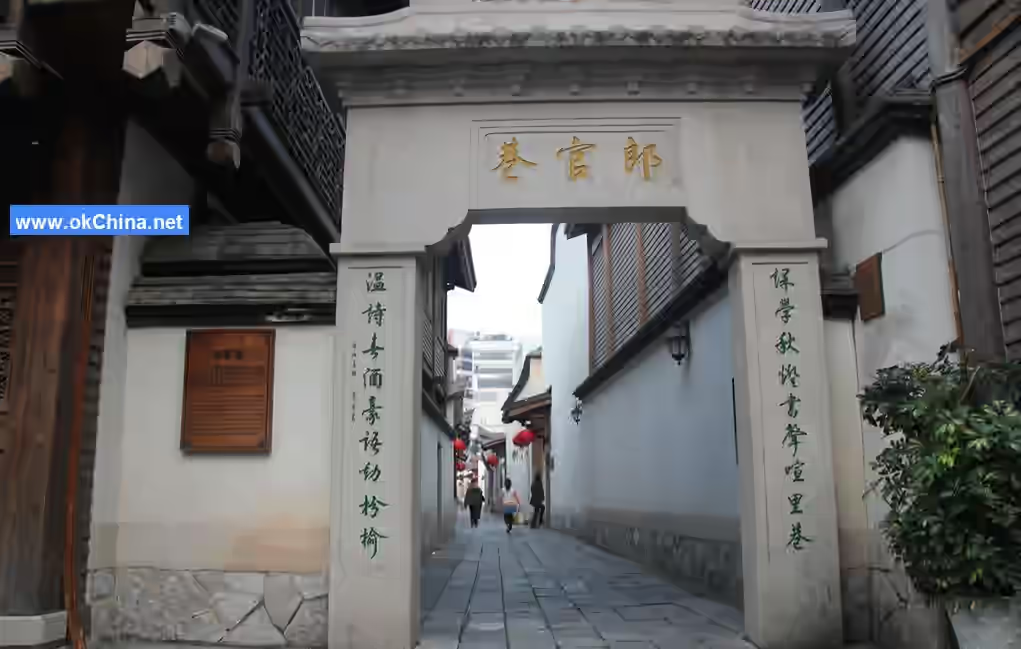
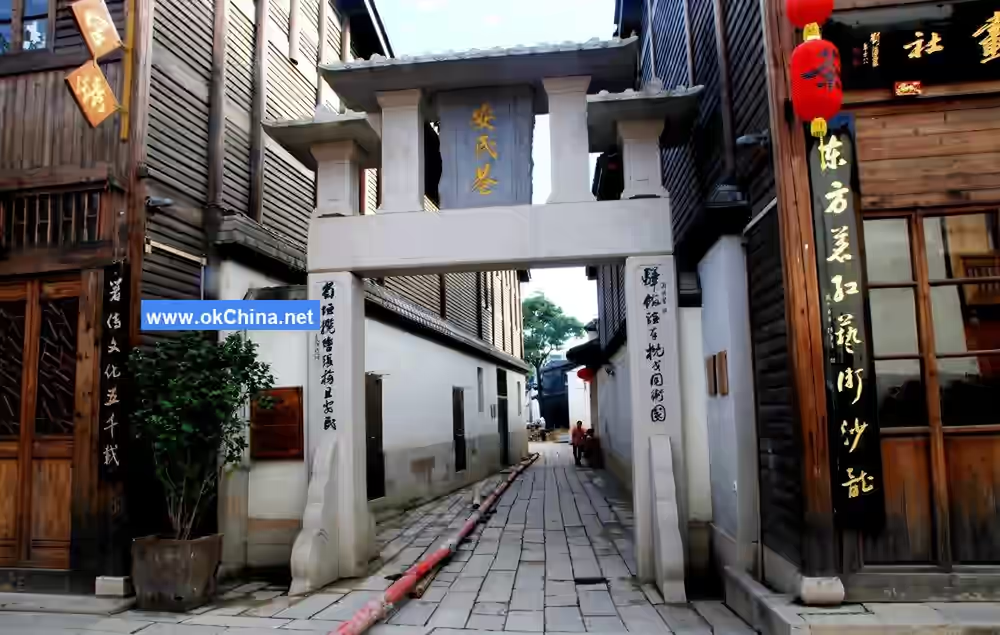
Langguan Alley is located south of Yangqiao Alley, on the east side of Nanhou Street. The east end of the alley connects to the bustling downtown area of Fuzhou at the Dongjiekou intersection of Bayiqi North Road. Langguan Alley also existed as a lane and wharf since the Song Dynasty. According to the Qing "Rongcheng Kaoguelue": "Song Dynasty's Liu Tao lived here, and his descendants for several generations all served as Langguan (court officials), hence the name Langguan Alley."The Song Dynasty poet Chen Lie was originally from Changle and also lived in Langguan Alley when he moved to Fuzhou. The former residence of Yan Fu, a modern Chinese enlightenment thinker and translator, is also located in this alley. At the western entrance of Langguan Alley stands an archway, with a couplet inscribed on its pillars: "Translations and writings shine brightly, Yan Fu's residence is still remembered; the courtyard flourishes, descendants trace back to Liu Tao's dwelling."
3.2.3 Ta Alley
Ta Alley is located south of Langguan Alley, connecting to the bustling North 817 Road in the east and Nanhou Street in the west. According to Rongcheng Archaeological Overview, "It was originally named Xiuwen, renamed Xingwen by County Magistrate Chen Su of the Song Dynasty, and later changed to Wenxing. It is now called Ta Alley because the Yuwang Pagoda Monastery was built here during the Min Kingdom." This large pagoda was located in the northern part of the alley, with a pagoda monastery overseeing it, regarded as a symbol of Fuzhou's flourishing literary culture. The pagoda still existed in the ninth year of the Chunxi era of the Southern Song Dynasty (1182), but there are no records of it thereafter.
During the Qing Dynasty, a half-sized small pagoda was built in the alley as a memorial to the ancient site. In the 1950s, the small pagoda was relocated to the top of the alley's archway gate. Ta Alley originally had a Jingxiao Archway, erected for the Ming Dynasty filial son Gao Weiyi. A poem praising him has been passed down: "For three years, flowing water was as scarce as you; a natural filial heart, pure and true. Last night, the moonlight shone on the three hills; sweet dew sprinkled the recluse, unknown still." This remains a celebrated tale.
3.2.4 Huang Alley
Huang Alley is located south of Ta Alley. Across Nanhou Street, it connects east-west with Yijin Lane. According to Fujian records, in the second year of Yongjia of the Jin Dynasty (308 AD), Huang Yuanfang (280–375), also known as Huang Yun, style name Yanfeng, a native of Gushi, fled turmoil and entered Fujian, settling on Nanhou Street in Fuzhou, hence the name Huang Alley. By the late Tang Dynasty, Huang Pu (837–920), a proofreader at the Chongwen Guan, retired and lived here.
When Huang Chao's army entered Fuzhou, upon hearing of Huang Pu's reputation, they ordered soldiers to pass through Huang Alley at night "extinguishing their torches" to avoid disturbing his household. From then on, Huang Alley gained great fame. Throughout history, the alley has been home to many scholars and literati, becoming a gathering place for cultural celebrities and social elites. Qing Dynasty officials such as Prefect Lin Wenying, second-place imperial examination candidate Lin Zhichun, Provincial Governor Li Fu, couplet master Liang Zhangju, and imperial examination graduates Chen Shouqi and Zhao Xin all lived in the alley. It was once renamed Xinmei Lane and later called Xinmei Li. A stone tablet inscribed "Tang Huang Pu Ju" (Residence of Huang Pu of the Tang Dynasty) was located in the alley and was still seen by some in the early 1950s. Within Huang Alley, there is a courtyard named "Xiaohuang Lou," which is a protected cultural heritage site.
3.2.5 Anmin Alley
Anmin Alley is located south of Huang Alley, facing Wenru Lane across Nanhou Street. Anmin Alley was originally named "Xilei Lane." Its name change to "Anmin" is related to Huang Chao's entry into Fujian. According to Fuzhou Local Chronicles, "When Huang Chao, the leader of the peasant uprising in the Tang Dynasty, entered Fujian, he issued a proclamation to pacify the people upon reaching this alley, hence the name." It originally had the Xilei Archway, named after Song Dynasty's Liu Zao, known for his filial piety. Later, Grand Councilor Yu Shen lived here and renamed it "Yuantai Yude."
Historically, the residents of the alley were mostly social elites. Yuan Dynasty provincial official Jia Ne lived here. The old residences on the western side of the alley still retain a symmetrical layout and古朴 charm. During the War of Resistance Against Japan, the New Fourth Army's Fujian Office was established here. Today, this old residence is listed as a revolutionary cultural heritage site.
3.2.6 Gong Alley
Gong Alley is located south of Anmin Alley, connecting to North 817 Road in the east and Nanhou Street in the west. According to the Qing Dynasty's Rongcheng Archaeological Overview, "It was originally named Xianju, named after the Zijigong Palace located within. Later, when the Cui and Li families became prominent, it was renamed Juyingda. In the Ming Dynasty, it was changed to Yingda."
The mansions in Gong Alley are exquisitely structured, with indoor wooden carvings and stone components alone being breathtaking. For example, the lattice windows are crafted using镂空精雕 techniques and joined with tenons, with various精心编排的木格骨骼 forming rich decorative patterns. Key carvings often adorn components such as wooden chuandou, chadou, tongzhu, and yueliang. Exquisite and vivid stone carvings can be seen everywhere on column bases, steps, door frames, flower pedestals, and railings. It can be said to be the epitome of Fuzhou's ancient architectural art.
3.2.7 Jibi Alley
Jibi Alley, one of the "Three Lanes and Seven Alleys" in Fuzhou, is commonly known as "Jibi Alley." When Song Dynasty's Zheng Xingzhi returned home in glory after achieving the top rank in the imperial examination, residents of the alley who had previously humiliated him hurriedly回避, leading to the name "Jibi Alley" (Emergency Avoidance Alley).
In the Ming Dynasty, it was renamed "Jibi Alley" using a homophone, implying good fortune and auspiciousness. After the reform and opening-up, Jibi Alley became a main east-west thoroughfare and was temporarily renamed "Jibi Road." In 2009, Fuzhou restored its name to "Jibi Alley" and began renovating the damaged ancient buildings on its northern side.
3.3 Nanhou Street
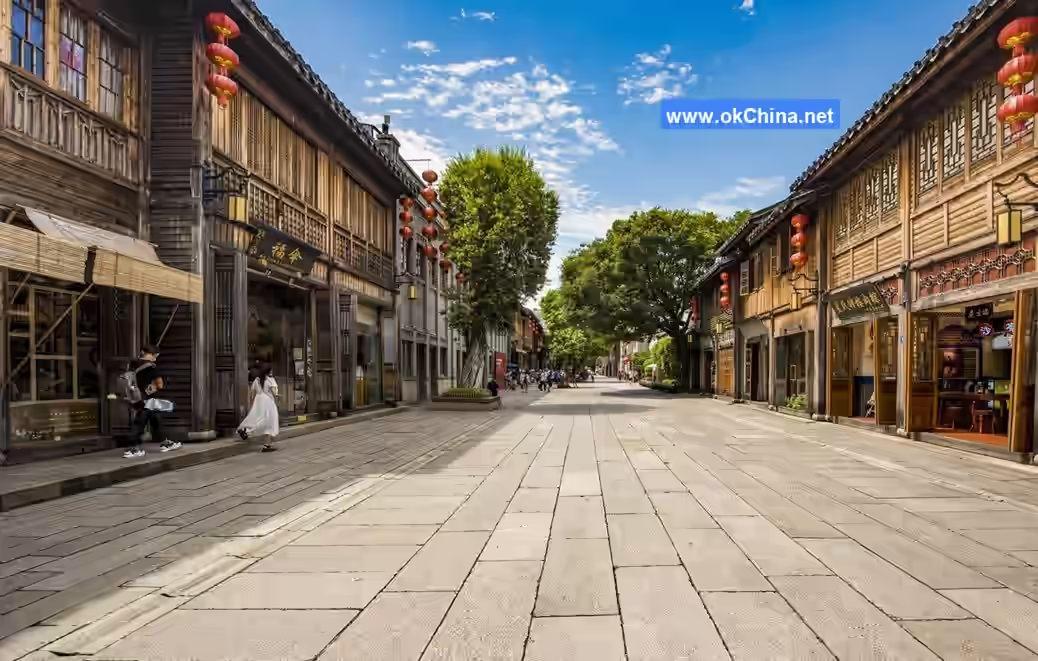
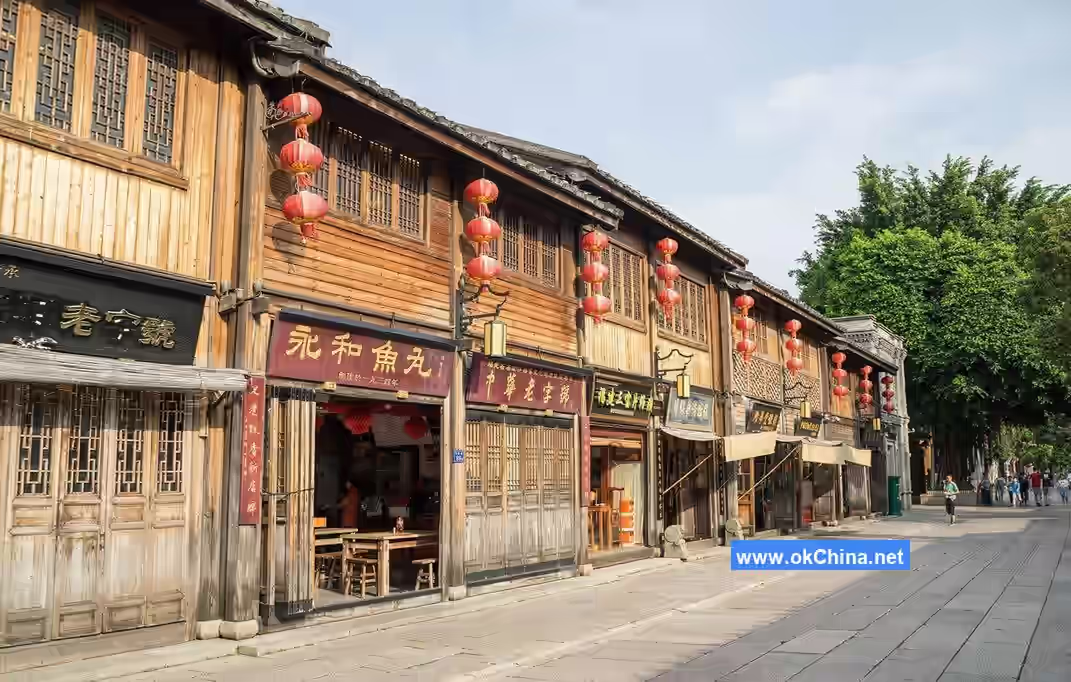
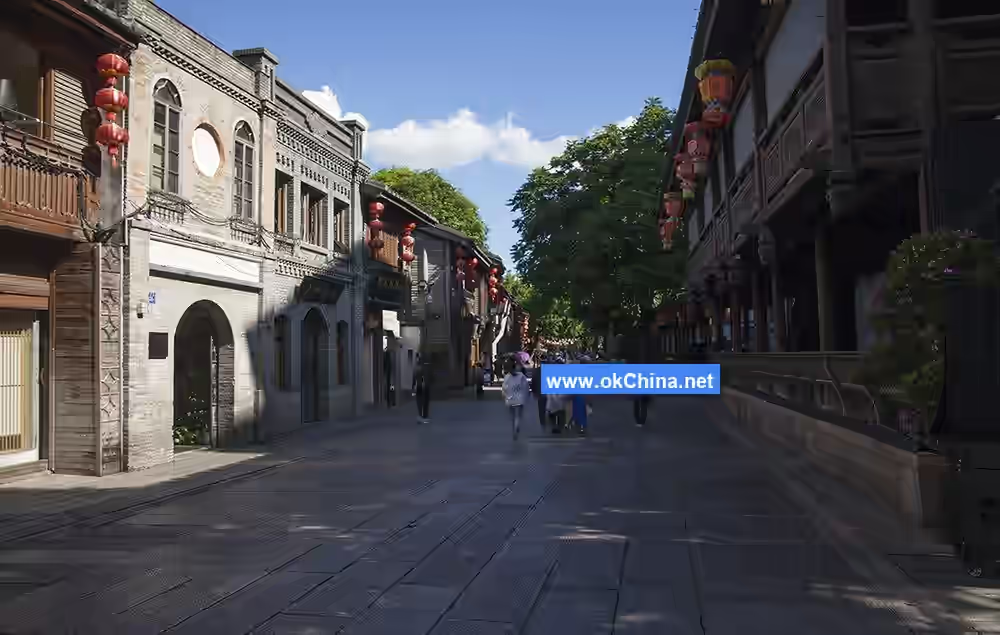
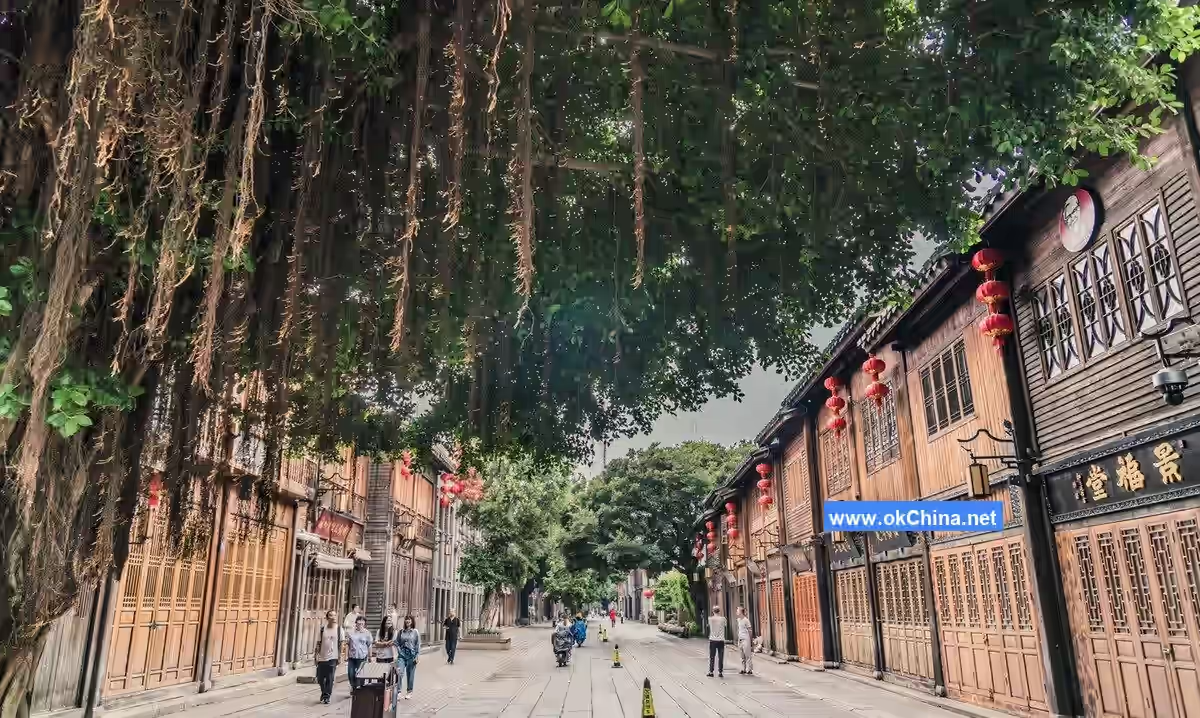
Fuzhou's Nanhou Street stretches from Yangqiao Road in the north to Jibi Road at Macau Bridge in the south, with a total length of about 1,000 meters. It serves as the central axis of Fuzhou's "Three Lanes and Seven Alleys." To its east are the seven alleys, and to its west are the three lanes. From the rise of the Three Lanes and Seven Alleys to the Republican era, it was the main commercial street, bustling with merchants from north to south.
Here, daily necessities such as firewood, rice, oil, and salt, along with shops of all trades, were fully available. There were also specialized services for literati, including engraving workshops, old book stalls, mounting shops, and lantern markets for the Lantern Festival and Mid-Autumn Festival. "Outside Zhengyang Gate lies Liulichang; before Yijin Lane stands Nanhou Street. Stealing leisure to visit the book market while away, seeing the unseen fills the heart with delight." In this poem by late Qing Dynasty举人 Wang Guorui, Nanhou Street is compared to Beijing's Liulichang outside Zhengyang Gate, reflecting the cultural ambiance of Nanhou Street in the past.
During the Ming and Qing Dynasties, Nanhou Street remained a lively marketplace with "white walls, black tiles, and stone-paved roads," lined with shops on both sides. By the Republican era, the road was widened and paved with asphalt.
4. Other Highlights
4.1 Lin Juemin and Bing Xin's Former Residence
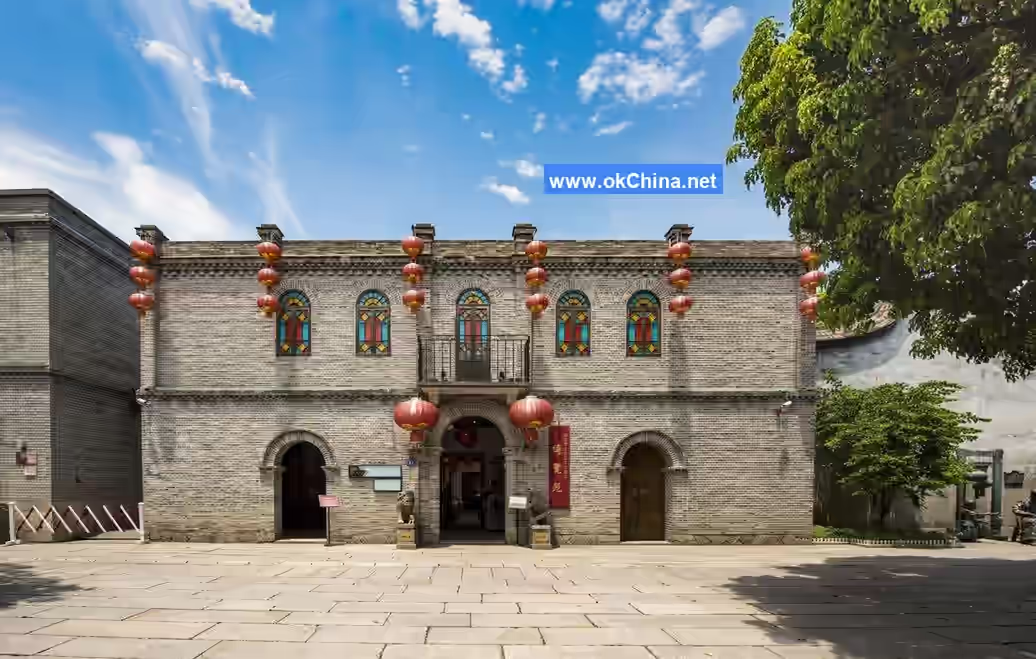
Lin Juemin and Bing Xin's former residence is located at the intersection of the northern entrance of Nanhou Street and Yangqiao Alley, at No. 17 Yangqiao Road. It was designated as a National Key Cultural Heritage Protection Unit in 2006 and now hosts exhibitions on "Lin Juemin's Life and Historical Relics" and "Bing Xin and Fuzhou." The residence originally belonged to the seven branches of Lin Juemin's ancestors (including Lin Changmin). After Lin Juemin's martyrdom in the Guangzhou Uprising, the Lin family moved away to avoid trouble, and the house was sold to Bing Xin's grandfather, Xie Luan'en. The Xie family lived there until the 1950s. Bing Xin lived here when she was around eleven or twelve years old.
The residence is a Qing Dynasty building, facing east with wind-fire walls on all sides. The front door faces the back street, and the gatehouse once served as the "Wansheng Barrel Stone Shop." The main structure consists of three courtyards, covering an area of 694 square meters, with the main gate now on Yangqiao Road. Originally, Bing Xin and her parents lived in the left wing of the second courtyard, while her grandfather lived in the right wing, with a study in the front and a bedroom in the back. South of the main hall, separated by a wall, is the Ziteng Study, connected to the front corridor of the main hall. Outside the southwestern corner of the wall, there is another small courtyard. The small house in the courtyard has two rooms—a living room and a bedroom—which were the living quarters of Lin Juemin and his wife. To the south is a small天井 with a flower bed planted with wintersweet trees.
Regarding the large courtyard, Bing Xin wrote vividly in her later years in My Hometown: "Our house had several courtyards, but they were not like the courtyards of Beijing's 'siheyuan.' Instead, there was a rectangular 'tianjing' in front of each row or section of rooms, each with a well—a characteristic almost unique to Fuzhou houses. In this large house, besides living quarters, there were guest rooms and studies. Almost all the pillars and walls of the halls, guest rooms, and studies were adorned with calligraphy and paintings."
4.2 Yan Fu's Former Residence
Yan Fu's former residence was designated as a National Key Cultural Heritage Protection Unit in 2006. Located at No. 20 on the northern side of the western section of Langguan Alley, it faces south and consists of two adjacent buildings: the main hall and the flower hall, covering an area of 609 square meters. The main hall follows Qing Dynasty regulations, with corridors on three sides inside the gate and a screen door at the front. The main hall has three bays, with the central bay divided into front and rear halls, and the side bays serving as front and rear wing rooms. A small door on the west side of the front corridor of the main hall leads to the flower hall. The corridors and railings of the flower hall imitate Western architectural motifs.
The residence was purchased for Yan Fu by Li Houji, the then Military Governor and Provincial Governor of Fujian. Yan Fu returned to Fuzhou at the end of 1920 and lived here until his death from illness in 1921. Although Yan Fu did not live here for long, it remains the place where he returned to his roots. Yan Fu's granddaughter, Yan Tingyun, pen name Hua Yan, is a renowned contemporary Taiwanese writer who was born and raised in Langguan Alley. In her essays such as My Grandfather Yan Fu and Childhood in Langguan Alley, she vividly recounts her life in the Langguan Alley residence and her grandmother's "Taiwan Lin" courtyard in Yangqiao Alley.
Yan Fu, also known as Chuanchu, Tiqian, and Zongguang, with the courtesy names Youling and Jidao, and the late pen name Yuyelao Ren, was a native of Yangqi Village, Houguan County (now part of Fuzhou City). He was a renowned educator, translator, and thinker. His translations and writings were compiled into the Collected Translations of Yan Fu, and other works such as Literary Selections of Yan Jidao and Poetry Collection of the Yuye Hall have been published.
4.3 Two-Plum Study
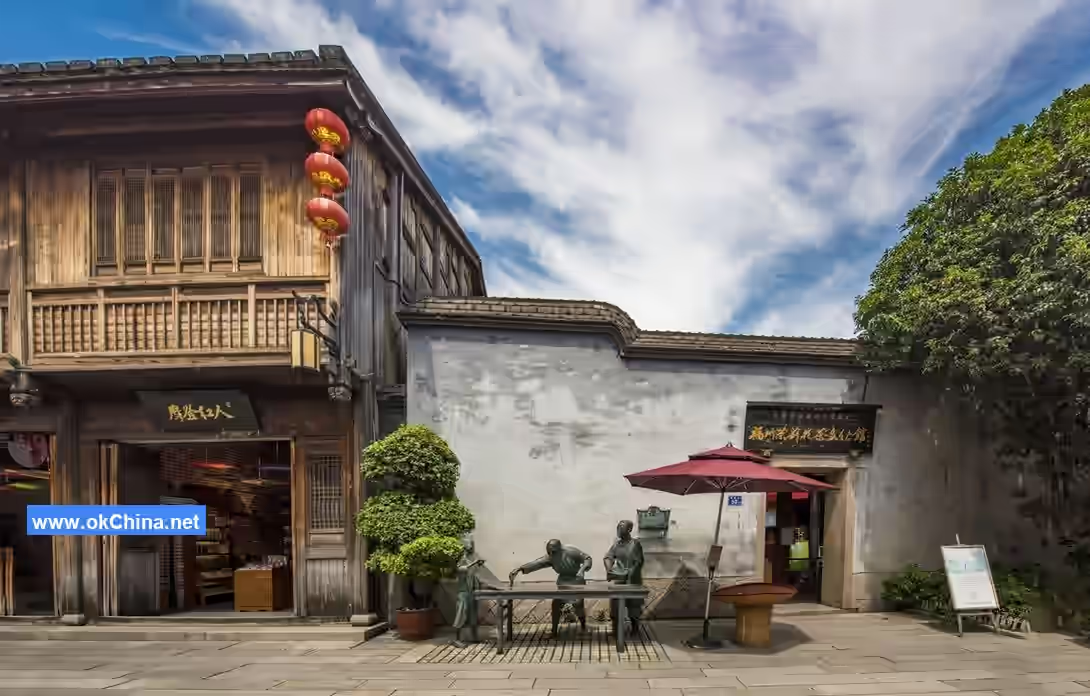
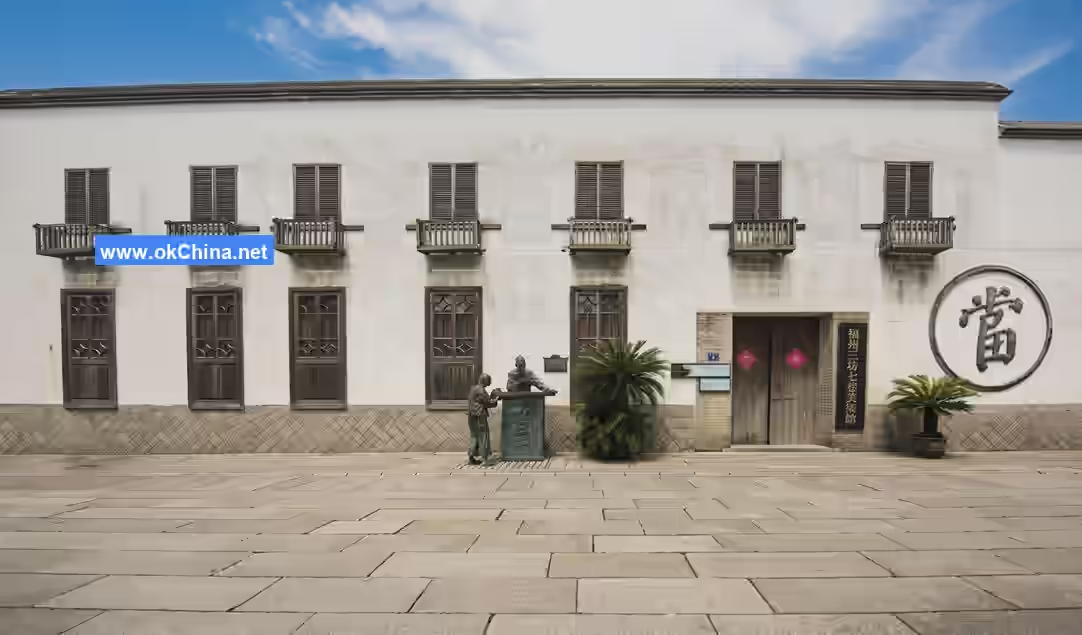
The Two-Plum Study was designated as a National Key Cultural Heritage Protection Unit in 2006 and now serves as the Fujian Folk Museum. Located at No. 25 on the southern side of the western section of Langguan Alley, it was the residence of Lin Xingzhang, a Jinshi graduate of the sixth year of the Daoguang era (1826) in the Qing Dynasty. It is named after the two plum trees planted in the courtyard. Originally built in the late Ming Dynasty, it underwent several major renovations during the Daoguang and Tongzhi eras of the Qing Dynasty and the Republican period. Facing north, the complex consists of five courtyards arranged front-to-back and side-to-side, covering an area of 2,434 square meters, connecting Langguan Alley to Ta Alley.
The large courtyard features six large doors facing the street. The main hall of the first courtyard is divided into front and rear halls using a彩金插屏门. The main hall is spacious and high, capable of accommodating seven layers of tables. The window lattices of the side rooms on both sides are woven into various patterns using wooden grids, and the door leaves, window sashes, and wall panels are all made of楠木. The second courtyard is roughly similar to the first. Each courtyard is separated by walls, and covered龟亭 shelters are installed in露天 passages to protect from rain.
Outside the eastern wall of the main hall is the "Two-Plum Study," with two plum trees in front, forming its own courtyard. To the east of the Two-Plum Study is a灰塑雪洞 called "Seven-Star Cave." The third courtyard is the flower hall, where all doors, windows, walls, and panels are made of楠木. The doors and windows feature双层漏花 designs, with window paper added in winter and window screens in summer. The wall panels and upper堵板 of the door leaves are漆画 with trees, flowers, birds, and戏剧故事. In the small garden in front of the hall, two ancient pavilions were built, one of which is a hexagonal半边亭. There is also a century-old lychee tree and a palm tree. Lin Huimin, an academician of the Chinese Academy of Sciences, once lived in this courtyard.### 4.4 Xiaohuang Lou (Little Yellow Tower) The landmark building "Xiaohuang Lou" in Huangxiang Lane, located at No. 36 on the north side of the middle section of Huangxiang Lane, was designated as a National Key Cultural Relics Protection Unit in 2006. It is said that the old ancestral house where Huang Pu studied in his youth was near Xiaohuang Lou. Liang Zhangju, a fellow student of Lin Zexu who rose to the position of Governor of Jiangsu, undertook a comprehensive renovation of Huang Pu's former residence during the Daoguang reign of the Qing Dynasty. He built the West Flower Hall "Xiaoxiaohuang Lou" (Little Little Yellow Tower) and the accompanying garden retreat "Dongyuan" (East Garden) on the east side of the old residence. This flower hall is a two-story pavilion, 9 meters wide and 24 meters deep, with three bays across the front and five purlins in depth, featuring a column-and-tie wooden structure and a double-slope roof. It has whitewashed walls and black tiles, with upturned ridges and flying eaves. The beams and frames are painted with dragons and phoenixes, and the doorframes and windows are all made of nanmu wood, showcasing exquisite craftsmanship and delicate carvings.
Historical records state that during the Yongjia Disturbance of the Eastern Jin Dynasty, the gentry migrated south, and the Huang clan from the Central Plains settled in this lane in Fujian, hence the name Huangxiang Lane. Huang Pu, a Tang Dynasty jinshi (advanced scholar) and Collator of the Chongwen Pavilion, lived here and built a tower named Huang Lou. From the Yongzheng reign to the early Qianlong reign of the Qing Dynasty, it was occupied by Lin Zhichun. From the late Qianlong reign to the Jiaqing reign, it belonged to the brothers Liang Shangzhi and Liang Shangguo, later passing to Liang Zhangju, and subsequently to his daughter Liang Huanzi and her husband Zhao Xin.
The flower hall is a two-story pavilion with three bays across the front and five purlins in depth, featuring a column-and-tie wooden structure. The beams and frames are painted with dragons and phoenixes, and the doorframes and windows are all made of nanmu wood, showcasing exquisite craftsmanship and delicate carvings. On the upper floor, corridors on both sides extend outward to balconies, connecting to the rockery. Against the walls on both sides of the building are snow grottoes made of glutinous rice and composite earth, which are well-preserved. In front of the building is a courtyard; opposite it lies a rockery made of Taihu stones, a small fish pond, and a small arched stone bridge spanning the pond. The bridge railing is inscribed with the four characters "Zhi Yu Le Chu" (Place of Knowing the Fish's Joy). The water is clear to the bottom, with schools of fish swimming. On the east side stands a half-pavilion, with hanging pillars carved with squirrels, sparrows, dragonflies, ears of grain, corn, etc. Around the pavilion are twelve hanging bells, each unique. Within the courtyard are several rows of bamboo and lush flowers and trees, creating a tranquil and elegant environment with the characteristics of a Jiangnan garden. The entire garden is enclosed by walls, forming its own compound, and contains a precious ancient mango tree.
4.5 Guo Baiyin Former Residence
The Guo Baiyin Former Residence is located at No. 4 on the north side of the eastern section of Huangxiang Lane, commonly known as the "Five Sons Achieving Success" residence. It is well-preserved, featuring architectural styles from both the Ming and Qing Dynasties, and is a typical residential building in Fuzhou. It is a National Cultural Relics Protection Unit.
The residence was initially built in the late Ming Dynasty, originally serving as a government office. In the 12th year of the Daoguang reign (1832) of the Qing Dynasty, jinshi Guo Baiyin purchased and renovated it after achieving prominence. His father, Guo Jiesan, had five sons who all passed the imperial examinations, hence the plaque "Five Sons Achieving Success" hung in front of the house. The building covers an area of 2,130 square meters. The main structure consists of three rows of courtyards from front to back, facing south, enclosed by walls on all sides. It is grand in scale with an impressive facade, spanning over twenty meters from east to west. The hall in the first row has five bays across the front and seven purlins in depth, featuring a post-and-lintel wooden structure with reduced columns. The front corridor is spacious, and the hall contains 28 large wooden columns made of massive timber with bluestone column bases, presenting a simple, majestic, and imposing appearance. The structure of the second row is the same as the first. Beyond the rear courtyard is a two-story study with five bays. Outside the east wall is a flower hall garden. The courtyard contains uniquely shaped rockeries, a fish pond with clear water, a small and exquisite flower pavilion, and well-arranged trees, possessing the charm of a Jiangnan garden. Among them is a precious ancient yangpo tree.
4.6 Ye Clan Residence
The Ye Clan Residence, located on the south side of Nanhou Street, is the former residence of Mr. Ye Zaiqi, a jinshi of the 12th year of the Guangxu reign. Mr. Ye Zaiqi was the Superintendent (equivalent to the principal of Fuzhou No. 1 High School) of the "Quanmin College" in the 27th year of the Guangxu reign. The Ye Clan Residence was initially built in the Ming Dynasty. The entire compound faces south and covers an area of 2,321 square meters. The old residence integrates architectural styles from the Ming, Qing, and Republic of China periods, making it one of the relatively well-preserved ancient residences on Nanhou Street. In 2005, the Ye Clan Residence was designated as a Provincial Cultural Relics Protection Unit. In 2009, the Fujian Provincial People's Government officially established the Ye Clan Residence as a permanent exhibition center for Fujian's intangible cultural heritage, promoting and弘扬 the rich and diverse intangible cultural heritage of Fujian Province, with over a thousand exhibits. It is now a National Cultural Relics Protection Unit.
4.7 Shuixie Getai (Waterside Pavilion and Singing Stage)
Shuixie Getai was designated as a National Key Cultural Relics Protection Unit in 2006 and now serves as a venue for local Fuzhou opera performances. Located at No. 4 on the north side of the east entrance of Yijin Fang, it was built during the Wanli period (1573-1620) of the Ming Dynasty, originally as a residence of the Zheng family. During the Daoguang period (1821-1851) of the Qing Dynasty, it came into the possession of the Sun Yimou family and was subsequently inhabited by Sun descendants for a long time. After multiple renovations, it became the largest compound in the entire lane, consisting of three adjacent buildings.
From west to east, the first is the main courtyard, the second is a separate courtyard, and the third is a flower hall garden. The entire architectural complex faces south and uses column-and-tie wooden structures throughout, covering a total area of 2,675 square meters. The main courtyard faces the street with six large doors. Entering through the stone-framed main gate, one finds corridors on three sides surrounding a central courtyard, all paved with flat stone slabs. The hall has three bays across the front and seven purlins in depth; the second row follows a layout of three apparent bays but five actual ones. On the east side of each row, there is a small door leading to the second separate courtyard, which comprises a study, Buddhist hall, kitchen, dining room, storeroom, etc. Further east, another small door leads to the third flower hall garden.
The most distinctive feature of the flower hall is the waterside pavilion stage, the only remaining one of its kind in Fuzhou. It was an important venue for celebratory banquets within the mansion. The pond covers an area of 60 square meters, with a spring at the bottom ensuring it never dries up year-round. The pond is stocked with goldfish, crucian carp, turtles, and other aquatic life. The stage built over the pond faces north and is a single-level platform. The inner ceiling features a square caisson with a central carving of a circular crane surrounded by bats, symbolizing both fortune and longevity. The stage is surrounded by water on three sides, separated by a courtyard from the facing pavilion, providing excellent acoustics. The stage is square, covering 30 square meters. The stone railings beside the pond are carved with floral reliefs. On the east and west sides of the pond are rockeries and snow grottoes. Directly opposite the stage stands a two-story pavilion, suitable for gatherings, watching performances, or enjoying distant views. The decorative plaster moldings on the wall tops, under the eaves, and along the roof ridges are all exquisitely crafted with unique and distinctive designs, remaining well-preserved to this day.
4.8 Lin Congyi Former Residence
The Lin Congyi Former Residence is located at No. 24 on the north side of Gongxiang Lane. The Fujian Provincial Institute of Culture and History, China News Service Headquarters, and China News Service Fujian Branch were once located here. It was designated as a National Key Cultural Relics Protection Unit in 2006.
This former residence was initially built in the Ming Dynasty. In the second year of the Shunzhi reign (1645) of the Qing Dynasty, when Prince of Tang Zhu Yujian ascended the throne in Fuzhou, the Dali Temple office was established here. During the Daoguang period, it was purchased by Lin Congyi, the second son of Lin Zexu. He lived here in his later years until his death. The residence is grand in scale with deep courtyards and spacious activity areas, which is rare among ancient Fuzhou residences, and its original layout remains largely intact.
The buildings face south and consist of three adjacent structures, covering an area of 3,056 square meters. Facing the street are six large doors. The wooden structure, with its brackets, sparrow braces, hanging bells, etc., is exquisitely carved, and there are fine plaster statues under the wall eaves. The main structure has four rows. On the southern screen wall of the first row is a molded xiezhi (mythical beast), the symbol of the Ming Dynasty Dali Temple office. High walls separate each row, with covered turtle pavilions in the passageways for shelter from rain. On the east side of each row, there is a small door leading to the flower hall and garden outside the east wall.
The garden is spacious, featuring banyan trees, bamboo groves, flower beds, fish ponds, and arched bridges, creating a pleasant scenery. Among them, the small-leaf banyan is particularly precious. In the northwest of the garden, a rear flower hall was built with a wooden structure. Its beams and columns are massive, and the craftsmanship is refined. Under the eaves, hanging bells are carved with motifs like Buddha's hand citrons, demonstrating exquisite elegance. The overall architecture of the former residence is lofty and imposing, possessing high artistic value.
4.9 Xie Family Ancestral Hall
The Xie Family Ancestral Hall was built in the Ming Dynasty and underwent multiple renovations during the Qing Dynasty and the Republic of China period. In 1958, it was modified due to road expansion. It was designated as a Fujian Provincial Cultural Relics Protection Unit in 2005 and now serves as the Fujian Zhuangyuanfu Art Museum.
This former residence faces south and covers an area of 1,025 square meters. It consists of four rows from front to back. The front is a shallow hall, and entering through the bluestone-framed main gate leads to the main structure. The main gate frame is finely made, with a pair of bluestone door pins on the lintel, following Ming Dynasty specifications, which is rare in the city. The main building uses massive timber, with corridors on three sides surrounding a central courtyard, all paved with stone slabs. Under the wall eaves are plaster moldings depicting scenes like "Eight Immortals Crossing the Sea" and "Two Lions Playing with a Ball." The flower hall is small and exquisite, formerly used as a study. The rear wall is adjacent to Gongxiang Lane.
Two "Martial Champion" plaques were discovered within the ancestral hall. In the late Qing Dynasty, Lin Juemin and others established a reading room here to enlighten the people. During the May Fourth Movement, progressive youth in the provincial capital established the Fujian Student Union here, organizing and developing the youth movement. During the Kuomintang rule, the Kuomintang Minhou County Party Headquarters and the Minhou Daily office were located here. On December 11, 1930 (the 17th year of the Republic of China), to commemorate the third anniversary of the Guangzhou Uprising, the Communist Party and Youth League organizations of Fuzhou launched a demonstration march to this location. Li Guang, leader of the Fuzhou Mutual Aid Society and a Communist Party member, was arrested here. Despite rescue efforts, he sacrificed his life. When Huang Zhanyun founded the "Yingqian Model Village," he also used this place as his city office.
4.10 Liu Family Compound
The Liu Family Compound, a National Cultural Relics Protection Unit, is located at Nos. 28, 30, 32, and 34 on the north side of the middle section of Guanglu Fang. It now serves as the main exhibition hall of the Community Museum.
The Liu Family Compound was the property of the Liu family of Longshan, known as "Electric Light Liu," and was one of the luxurious mansions in Fuzhou at the time. Four buildings stand side by side from west to east: stretching from Daonan Temple in the east to Zaoti Lane in the west, facing Guanglu Fang Street to the south and backing against Daguang Lane to the north. It covers a total area of 4,532 square meters, making it the largest single-surname residential compound in the urban area of Fuzhou. Facing north, it is vast in scale, neatly laid out, exquisitely crafted, and well-preserved. The architectural scale and materials used in the Liu Family Compound are also astonishing: the corridor stones under the front and rear eaves are long and wide; structural components like beams and columns are massive; many of the stone plinths in the courtyards are built from whole pieces of large bluestone. This fully reflects the characteristics of the Liu Family Compound as a Fuzhou residence, possessing the typical agility and transparency of southern architecture while also exhibiting stability and grandeur, showcasing the wealth and prominence of the Liu family.
4.11 Lin Zexu Memorial Hall
The Lin Zexu Memorial Hall is a National Patriotic Education Demonstration Base, National Drug Control Education Base, National National Defense Education Demonstration Base, and one of the important tourist attractions in the Three Lanes and Seven Alleys.The Fuzhou Lin Zexu Memorial Hall was established in 1961 and opened to the public in 1982. It consists of two main parts: the provincial-level cultural relic protection unit "The Ancestral Temple of Lord Lin Wenzhong" and the "Exhibition of Lin Zexu's Historical Achievements." Covering an area of 8,500 square meters, it serves as the national center for the collection of Lin Zexu's cultural relics, the display of Lin Zexu's spirit, and the research on Lin Zexu's materials. It is also the largest specialized memorial hall dedicated to Lin Zexu in China.
The Ancestral Temple of Lord Lin Wenzhong was built in the 31st year of the Guangxu reign (1905) by Lin Zexu's descendants and local gentry to commemorate him, with imperial approval. The temple includes a memorial archway gate, ceremonial gate, imperial stele pavilion, Shude Hall, flower hall, Yunzuo Pavilion, and gardens, representing a classical garden-style ancestral temple architecture with late Qing Dynasty Fuzhou characteristics.
The "Exhibition of Lin Zexu's Historical Achievements" includes five major sections: a patriotic son of Fuzhou dedicated to serving the country; an honest and pragmatic statesman; a visionary leader of the Left Sea (Fuzhou); a globally revered pioneer in the fight against drugs; and a national hero who resisted enemies and defended the nation.
5. Cultural Resources
5.1 Origin of the Name
Three Lanes and Seven Alleys is a general term for the ten lanes and alleys arranged from north to south on both sides of Nanhou Street. The three lanes are Yijin Lane, Wenru Lane, and Guanglu Lane. The seven alleys are Yangqiao Alley, Langguan Alley, Anmin Alley, Huang Alley, Ta Alley, Gong Alley, and Jibi Alley.
5.2 Historical Evolution
"Three Lanes and Seven Alleys" originated in the Jin Dynasty, took shape during the Tang and Five Dynasties, developed in the Song Dynasty, flourished in the Ming and Qing Dynasties, was preserved during the Republic of China era, and continues to this day.
In the 3rd year of the Tai Kang era of the Jin Dynasty (282 AD), Jin'an Commandery was established, with its administrative center located in present-day Fuzhou. The first governor of Jin'an Commandery, Yan Gao, found the old Yecheng too cramped and chose a new site south of Ping Mountain to build Zicheng. At this time, the southern end of Fuzhou City extended to Hujie Gate (now Hujie Road). Zicheng housed officials and soldiers, while residential and commercial areas were located outside the city. Scholars and families from the Central Plains, who migrated south during the "Clothing and Crowns Crossing South, Eight Surnames Entering Fujian," gradually settled south of the moat outside Zicheng's southern gate, Hujie Gate. At that time, the area outside Hujie Gate, known as Dahao or Dahangqiao River, was bustling with shipping, and residential areas gradually formed along its banks. According to the Sanshan Zhi: "In the old Huang Alley, the Huang family had already settled here during the Yongjia Southern Migration." This indicates that "Three Lanes and Seven Alleys" began to take shape.
In the 14th year of the Yuanhe era of the Tang Dynasty (819 AD), local resident Chen Quji passed the imperial examination, and the area where he lived was renamed Guizhi Lane, indicating that the lanes and alleys on the west side of Fuzhou's central axis had extended to the banks of the Guizhi River.
In the 1st year of the Tianfu era of the Tang Dynasty (901 AD), King Wang Shenzhi of Min, for the purpose of "guarding the land and nurturing the people," constructed Luocheng on a large scale. Its southern gate, called Lishe Gate, expanded to the banks of the Antai River. This brought the already formed residential and commercial areas south of Dahangqiao into the city. The layout of Luocheng still used the Dahang River as a boundary, with the political center and mansions of nobles in the north, and residential and commercial areas in the south. The design emphasized symmetry along the central axis, with government offices on both sides of the main road in the north and orderly lanes enclosed by high walls in the south. This layout was consistent with that of the Tang Dynasty capital, Chang'an. The Sanshan Zhi listed the lanes and alleys of "Luocheng and Jiacheng," including the three lanes and six alleys of today's "Three Lanes and Seven Alleys" (only Jibi Alley was missing), and even mentioned the place name "Houjie." This shows that by the late Tang Dynasty, the layout of ancient Fuzhou's "Three Lanes and Seven Alleys" had largely taken shape.
In the 1st year of the Kaiping era of the Liang Dynasty (907 AD), Wang Shenzhi expanded Jiacheng. In the 7th year of the Kaibao era of the Song Dynasty (974 AD), Fuzhou Prefect Qian Yu expanded the outer city. As the city continued to grow, "Three Lanes and Seven Alleys" gradually became the city center. During this time, many historical figures, such as Huang Pu, Chen Lie, Chen Xiang, Zheng Mu, Yu Shen, Lu Yun, Lu Zao, and Zheng Xingzhi, built residences here, some even passing them down through generations. By the Song Dynasty, "Three Lanes and Seven Alleys" had become a concentrated residential area for Fuzhou's high-ranking officials, nobles, scholars, and celebrities.
"Three Lanes and Seven Alleys" thrived through the Ming and Qing Dynasties, particularly from the mid-Qing to late Qing periods, reaching its peak. Most of the existing valuable ancient buildings date from this period. During the Jiaqing and Daoguang reigns of the Qing Dynasty, the scholar Liu Xinxiang immortalized "Three Lanes and Seven Alleys" in a poem: "Strolling through seven alleys and three lanes, the cool evening echoes with the soft calls of flower sellers. Purple water chestnuts, red lychees, and yellow wampees, a path of fragrant breezes leads to the wine tavern." During the Daoguang era, in Lin Feng's Rongcheng Kaoguelüe, the phrase "commonly known as Three Lanes and Seven Alleys" officially appeared. In the early Republic of China era, the famous poet Chen Yan's line, "Who would have thought the solitary guest of Five Willows and Lone Pine would reside among Three Lanes and Seven Alleys," further popularized "Three Lanes and Seven Alleys."
Comments
Post a Comment