1. Introduction
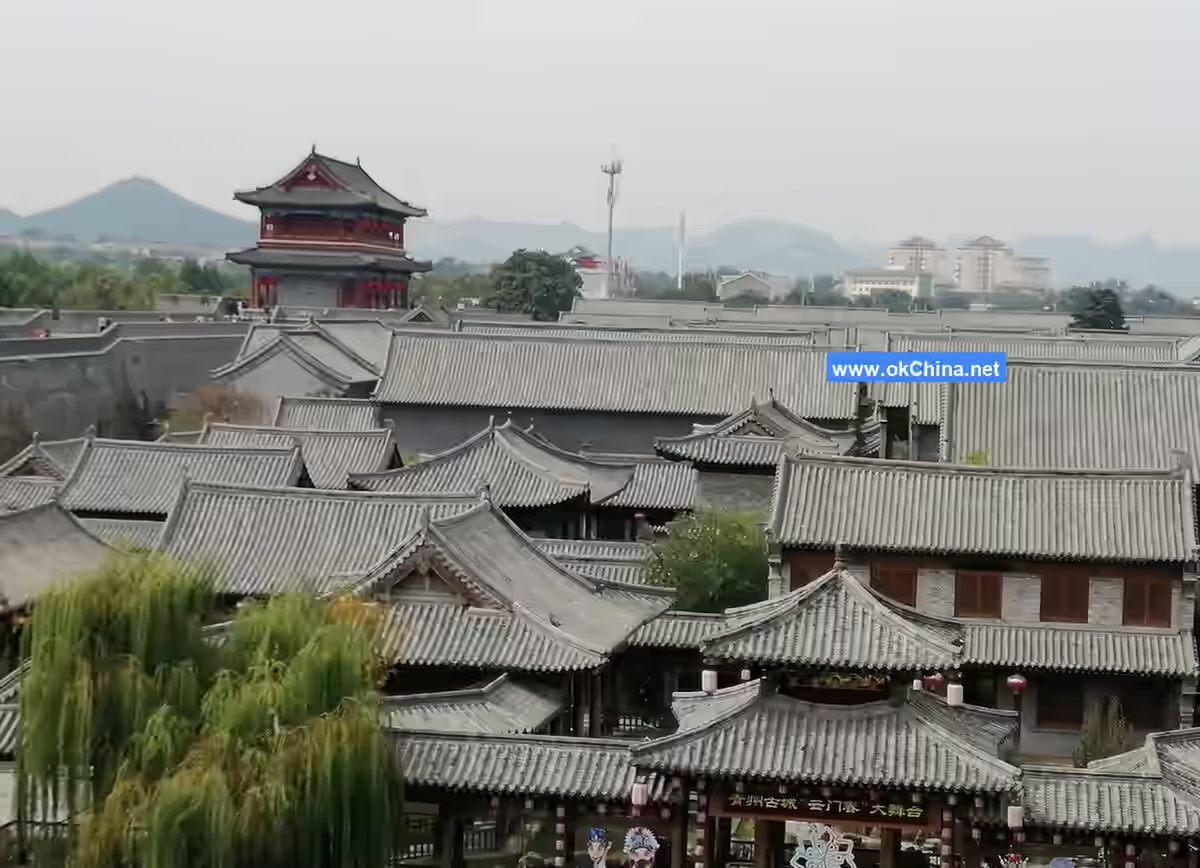
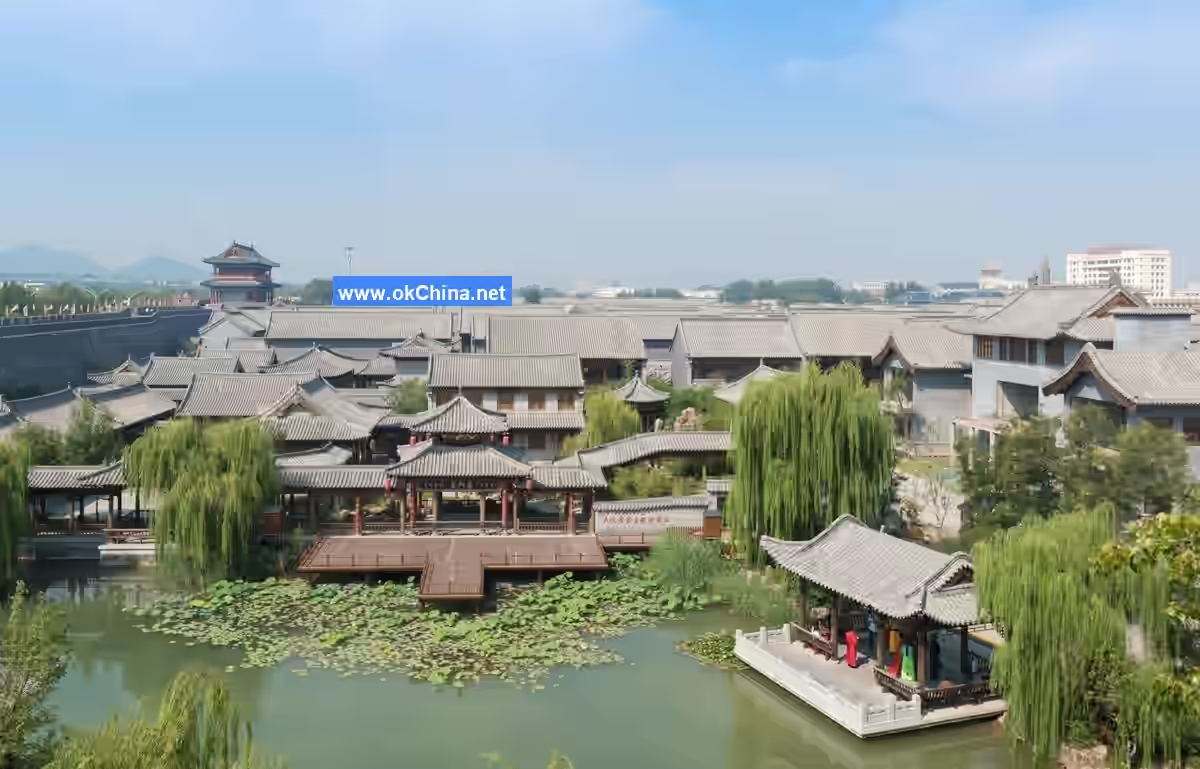
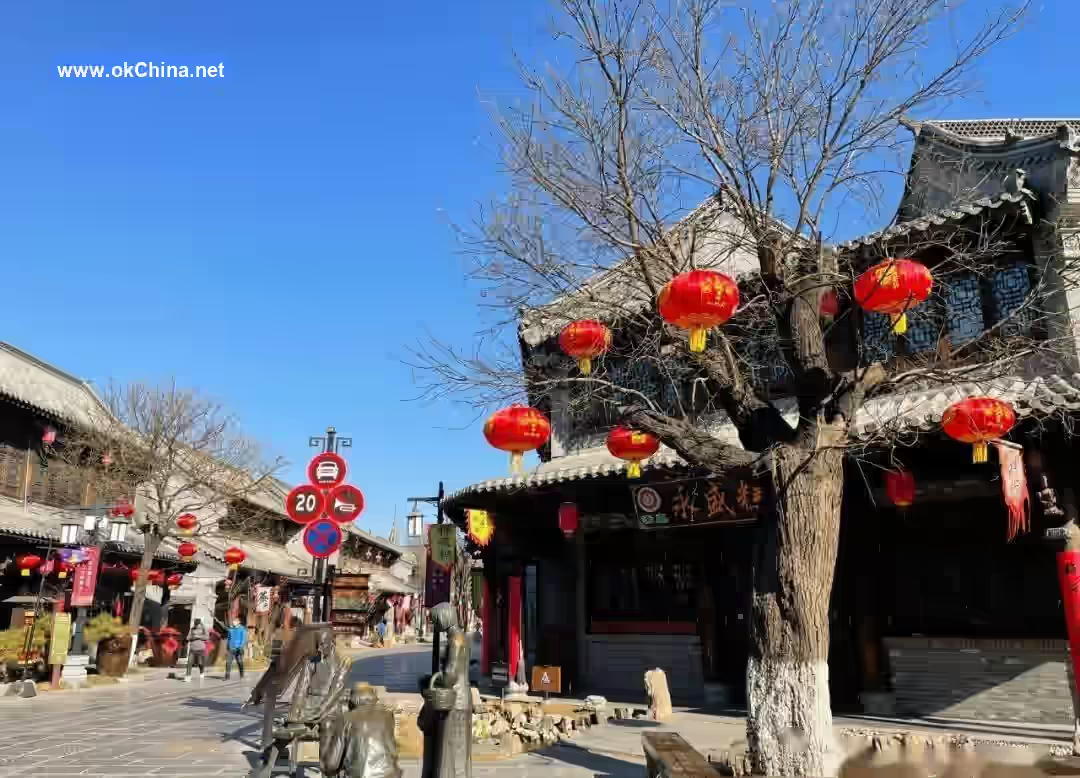
The Ancient City of Qingzhou, located at the intersection of Fangongting West Road and Ouyuan Street in Qingzhou City, Weifang, Shandong Province, boasts a history of over 2,200 years. It is an ancient city featuring a distinct regional style of Ming and Qing dynasty architecture. The Qingzhou Ancient City tourist area covers approximately 10 square kilometers, primarily including the Dongyangcheng Beiguan Historical and Cultural District, the Nanyangcheng Ouyuan Historical and Cultural District, and the Dongguan Historical and Cultural District, with an open area of 1.4 square kilometers.
Since the early Western Han Dynasty, the site of Qingzhou Ancient City has successively been home to six ancient cities: Guangxian City, Guanggu City, Dongyang City, Nanyang City, Dongguan Weizi City, and the Manchu Garrison Banner City. It served as the political, economic, military, and cultural center of the entire Shandong region for over 1,000 years. Qingzhou Ancient City features over ten scenic spots and exhibition halls, including the Qingzhou Prefecture Examination Hall, Fucai Gate, Kuixing Tower, Ouyuan Garden, Memory of the Ancient City Museum, Ouyang Xiu Memorial Hall, Li Cheng Memorial Hall, Qingzhou Folk Customs Museum, and the Fantasy Jurassic Experience Hall, making it a cultural tourism destination rich in local characteristics.
2. Main Scenic Areas
2.1 Qingzhou Ancient City Scenic Area
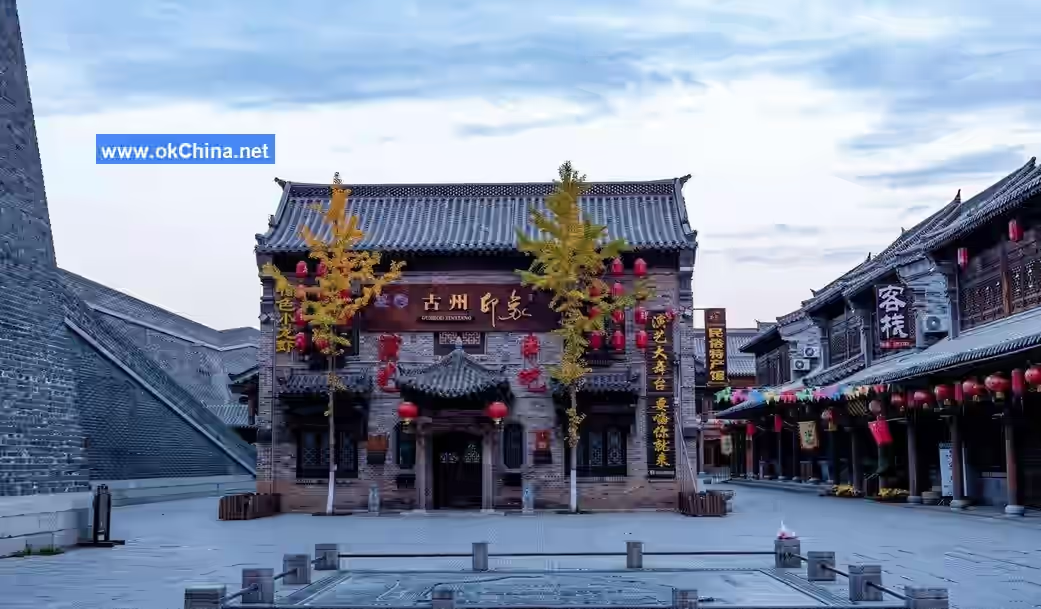
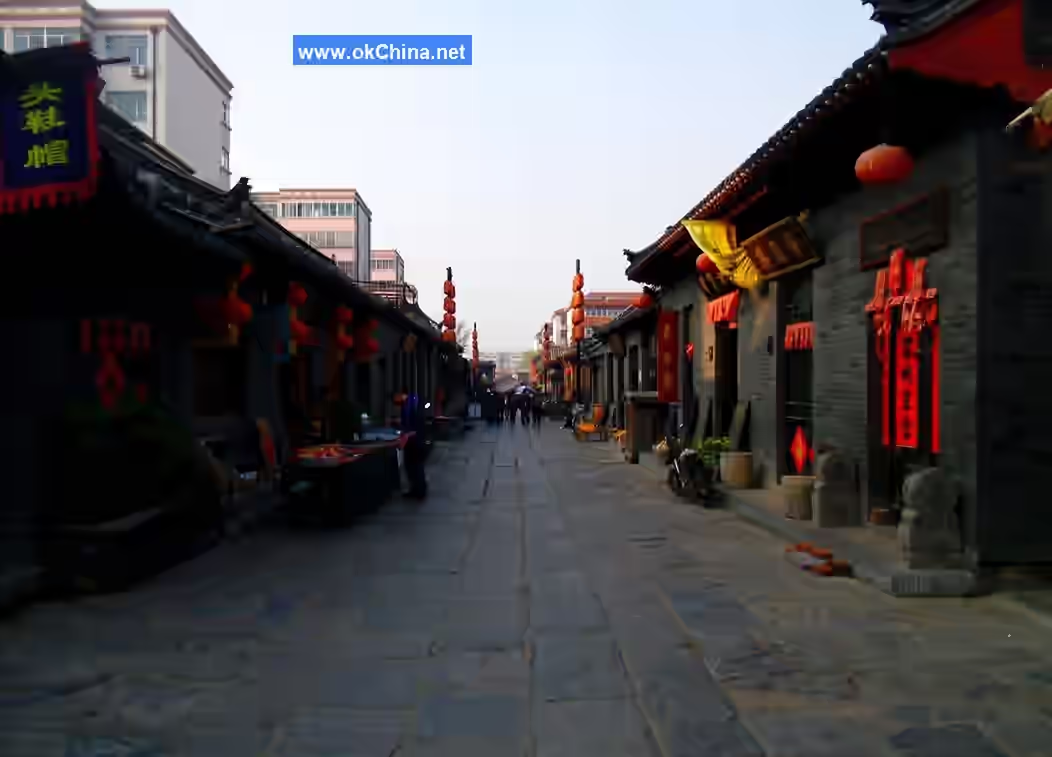
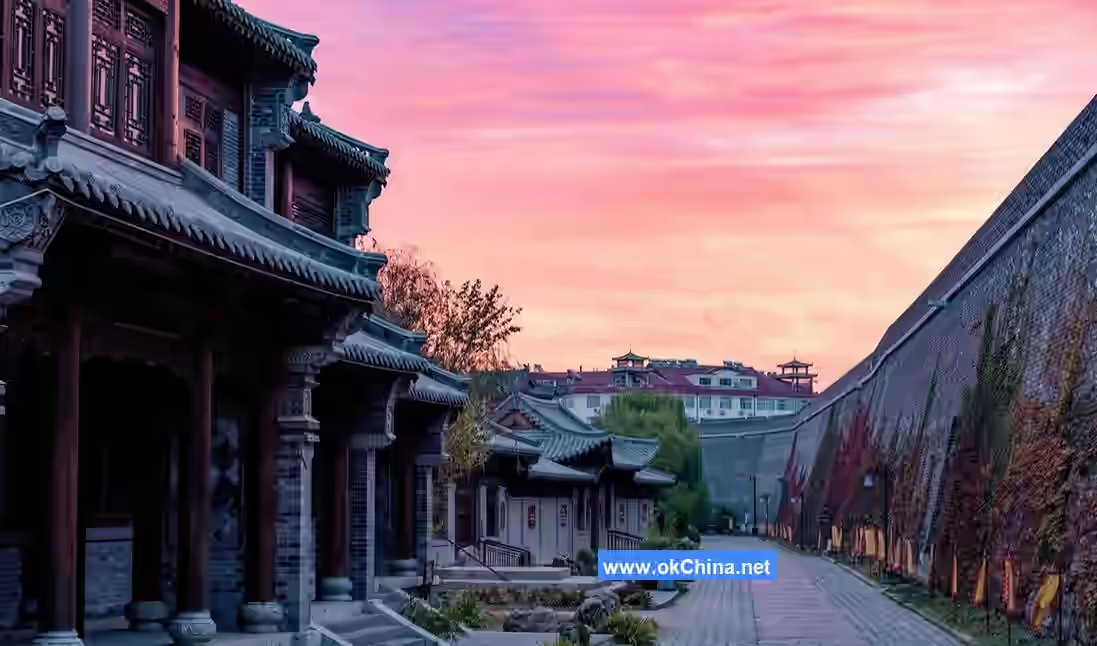
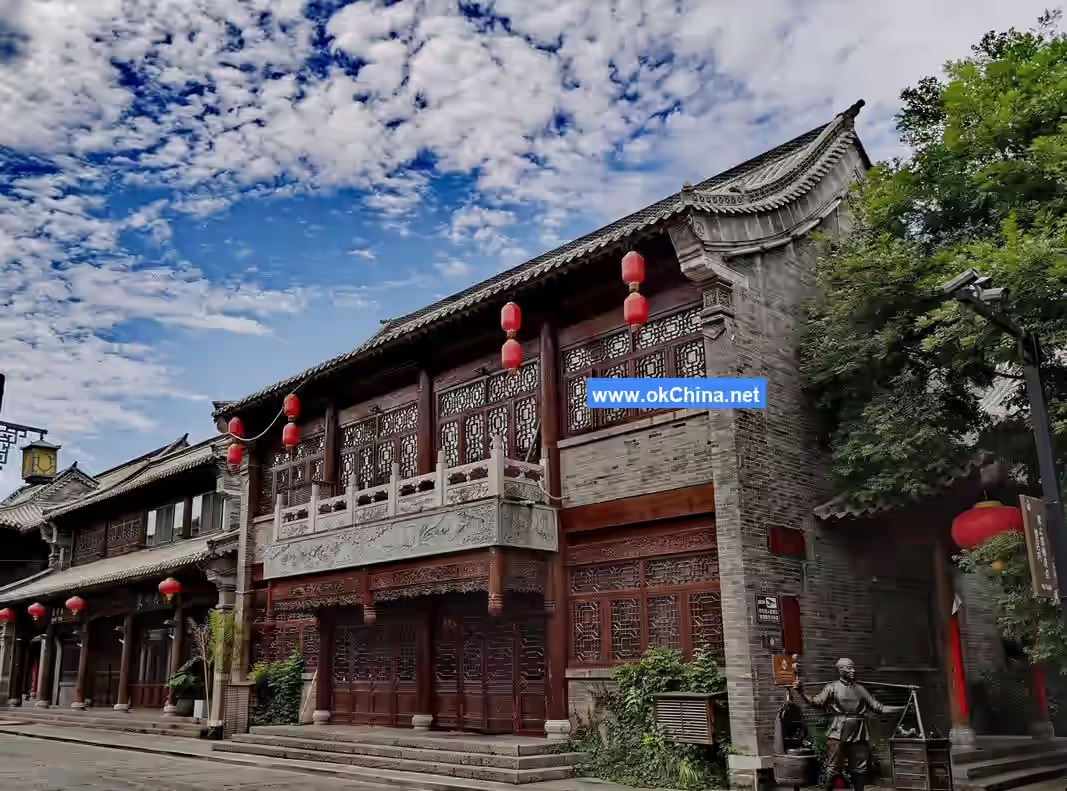
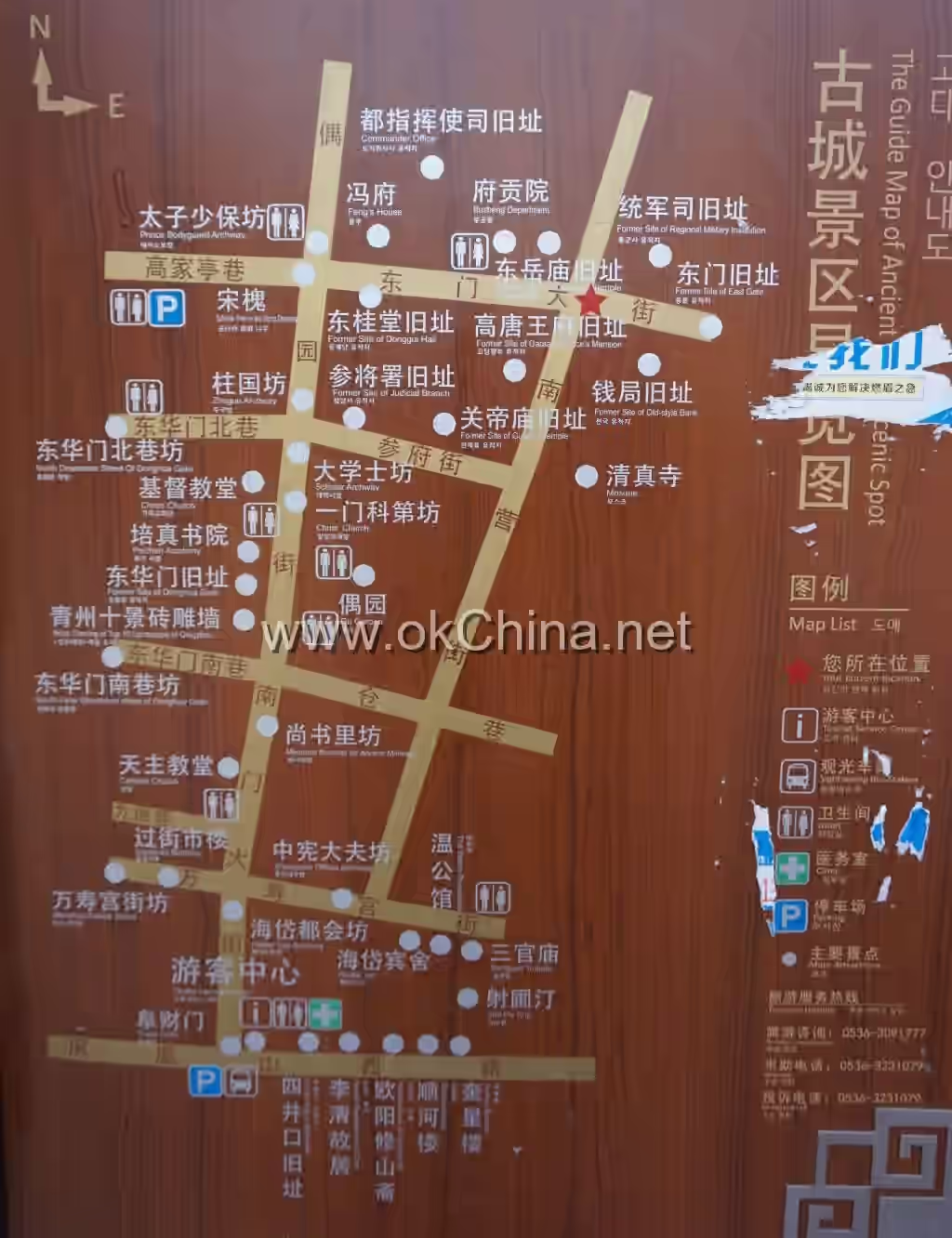
Qingzhou Ancient City has a long history, with urban construction dating back over 2,200 years. Since the early Western Han Dynasty, six ancient cities have successively existed here: Guangxian City, Guanggu City, Dongyang City, Nanyang City, Dongguan Weizi City, and the Manchu Garrison Banner City. It served as the political, economic, military, and cultural center of the entire Shandong region for over 1,000 years. The area mainly includes the Dongyangcheng Beiguan Historical and Cultural District, the Nanyangcheng Ouyuan Historical and Cultural District, and the Dongguan Historical and Cultural District. Currently, the open area is 1.4 square kilometers, primarily concentrated in the ancient Nanyang City. It is an ancient city with a distinctive regional Ming and Qing architectural style. The area contains over 100 ancient streets and alleys, such as Beimen Street, Ouyuan Street, Dongmen Street, Beiying Street, Nanying Street, Canfu Street, and Donghuamen South Lane. There are over ten scenic spots and exhibition halls, including the Qingzhou Prefecture Examination Hall, Fucai Gate, Kuixing Tower, Ouyuan Garden, the Beihai Family - Feng Clan Memorial Hall, Memory of the Ancient City Cultural Exhibition Hall, Ouyang Xiu Memorial Hall, Li Cheng Memorial Hall, Qingzhou Folk Customs Museum, and the Fantasy Jurassic Experience Hall. The area also features numerous government office buildings, traditional residences, classical gardens, and street memorial archways. It currently has one national key cultural relics protection unit and five provincial-level cultural relics protection units. Tourist services, characteristic homestays, bars, catering, and tourism facilities are well-developed, with a rich variety of businesses. The area is known for its internet-famous streets, distinctive theme performance zones, numerous time-honored specialty shops, and regular performances of intangible cultural heritage projects, making it a cultural tourism destination rich in local flavor.
2.2 Yunmen Mountain Scenic Area
Yunmen Mountain has been a famous mountain in central Shandong since ancient times. Its main peak, Dayunding, stands at an altitude of 421 meters. It is a national key scenic area and a national geopark. Yunmen Mountain is an extension of the Taiyi Mountain range, known for its lofty peaks and numerous historical sites, earning its fame in central Shandong since antiquity. The main peak, Dayunding, is 421 meters high, running east-west with towering cliffs. Notable Taoist structures include Wangshou Pavilion and Tianxian Yunü Temple. The Yunmen Cave runs north-south through the mountain, resembling a jade disc embedded in the cliff. During summer and autumn, clouds and mist swirl through the cave, making the mountaintop temples appear and disappear, earning it the reputation of "Yunmen Fairyland." During the Sui and Tang dynasties, Yunmen Mountain became a famous religious mountain, with over 300 Buddhist grotto statues densely covering the mountain body, reputed as the best in eastern China. These are national-level cultural relics under key protection. From the Tang and Song dynasties to the Ming and Qing dynasties, spanning over a thousand years, famous literati visited the mountain, inspired by the scenery, leaving behind over 100 poems and inscriptions carved onto the cliffs. The Ming Dynasty cliff carving of the character "Shou" (longevity) is considered a monumental work of its time, unparalleled in the culture of longevity, earning Yunmen Mountain the title "First Mountain of Ancient Chinese Longevity Culture."
2.3 Qingzhou Museum
Qingzhou Museum is a comprehensive museum housing over 50,000 cultural relics, including more than 3,000 nationally precious artifacts. Among them, the palace examination paper of Zhao Bingzhong from the 26th year of the Wanli era in the Ming Dynasty fills a gap in China's Ming Dynasty palace archives and is a unique copy worldwide. The Eastern Han Dynasty "Yizi Sun" jade disc and the Warring States period jade figure are rare jade treasures. The painted pottery and figurines unearthed from the burial pits of the Xiangshan Han Tomb are currently the best-preserved painted artifacts of their kind from the same period in China. The most famous collection is the over 600 Buddhist statues unearthed from the cache at the Longxing Temple site in 1996, spanning from the Northern Wei to the Northern Song dynasties over 500 years. This batch of statues is notable for its large quantity, complete variety, exquisite carving, well-preserved gilding and painting, and long time span, attracting high attention domestically and internationally. It has been successively rated as one of the "1996 National Top Ten Archaeological Discoveries," one of "China's 100 Major Archaeological Discoveries of the 20th Century," and one of the "Top 100 Archaeological Discoveries of the Century." It is hailed as a masterpiece that rewrites the history of Eastern art. It has been exhibited in large-scale thematic exhibitions at famous museums both in China and abroad, becoming a bridge for Qingzhou to reach the world. It is an outstanding representative of ancient Chinese sculpture art, astonishing viewers wherever it goes.
3. Overview
The main attractions of Qingzhou Ancient City include over 10,000 meters of Ming and Qing dynasty ancient streets, such as Beimen Street, Dongmen Street, Ouyuan Street, Beiying Street, Nanying Street, and Zhaode Street. There are over 120 scenic spots, including Qingzhou Museum, Sanxian Temple, Li Qingzhao Memorial Hall, Wannian Bridge, Song City, Ouyuan Garden, Hengwangfu Memorial Archway, Qingzhou Prefecture Examination Hall, Prefecture Government Office, Prefecture Confucian Temple, Zhenjiao Temple, Mosque, Christian Church, Catholic Church, Peizhen Academy, South Gate, Kuixing Tower, Ouyang Xiu's Mountain Studio, and Li Qingzhao's Former Residence.
3.1 Fucai Gate
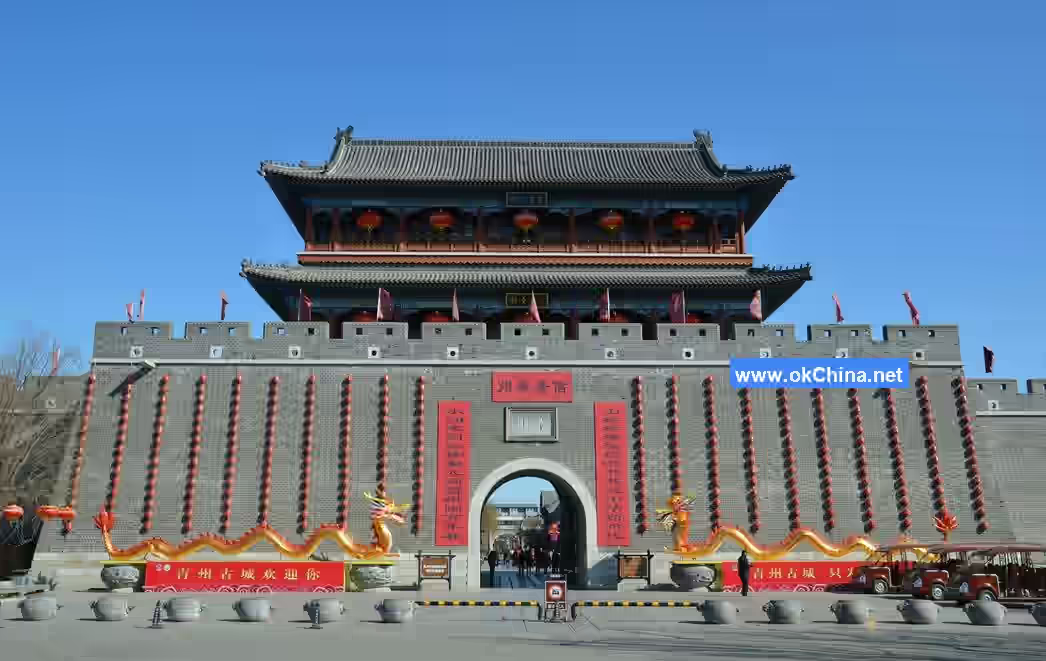
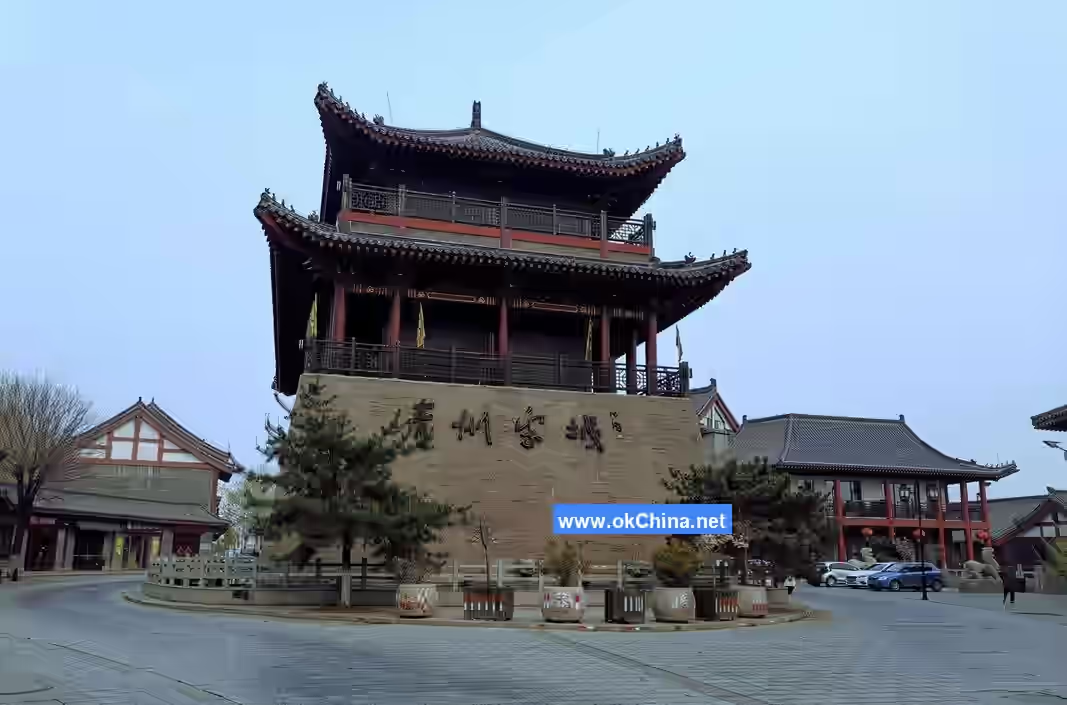
Fucai Gate is the south gate of the ancient Nanyang City. Nanyang Ancient City was initially built during the Northern Wei period and served as the location for the lu (circuit), provincial, and prefectural offices during the Jin, Yuan, Ming, and Qing dynasties. It was originally an earthen wall city. The brick city wall was built in the third year of the Hongwu era, standing 12 meters high, 6 meters thick, and 13 li and 108 bu in length, with a total of 1,777 battlements. It had four gates: Haiyan, Daizong, Fucai, and Zhanchen. Government offices, temples, churches, academies, mansions, guesthouses, guildhalls, shops, banks, and escort agencies were scattered within, making it truly the "First Prefectural City of Shandong." Minister of Rites Feng Qi once evaluated Qingzhou Ancient City thusly: "Controlling the coastal region, sweeping away the waves of whales for ten thousand li; opening the heavenly prefecture, a thousand mountains form a tiger-and-leopard pass." Wu Bin of the Ming Dynasty also wrote in his "Song of Qingzhou": "Qingzhou's high city dominates the nine provinces, its gates and towers seem to fly in the sky. The imperial guards are like bears and tigers, their swords and halberds gleaming coldly in the sunlight." Because the ancient Nanyang City resembled a reclining ox, it was also commonly called the "Reclining Ox City."
The currently reconstructed Fucai Gate and its platform were designed and rebuilt according to their historical appearance. The gate tower is a brick-and-wood structure, five bays wide and one bay deep, with two layers of eaves, a surrounding corridor, and a hip-and-gable roof. The south gate platform has two interior levels, which served as a troop concealment cave in ancient times. On both sides of the arched passage in the middle of the platform, there are three arched doorways each leading into the troop concealment cave. Stairs lead up to the interior of the gate tower. East and west horse ramps for ascending the wall are located on the eastern and western sides of the platform.
Fucai Gate was previously called Yunshan Gate. Historically, the south gate had two layers. Outside the first gate was a stone bridge spanning a stream, called the "Official Bridge." According to historical records, the south gate of Qingzhou Prefecture City was "majestic, grand, and vast, markedly different from the east, west, and north gates." This was because the city faced south, making it the main gate. Entering the south gate led to an enclosed courtyard (wengcheng), which was relatively spacious but had only two households at the time. There was once a screen wall inside the enclosed courtyard.
The second gate originally had a white marble plaque hanging on it, with patterns of peonies, a bear, and a ba bird. It is said that its寓意 (symbolism) was that Qingzhou was a prosperous and dominant region. On both sides of the gate passage, there were three troop concealment caves each. Although the cave entrances were small, the interiors were deep and spacious enough to conceal troops. In the past, after entering the south gate, to the east was an open space containing a temple commonly called "Geda Temple" (Bump Temple). It was said to be extremely efficacious for people suffering from hives. The temple's proper name should have been "Taiwei Temple," dedicated to a local, a certain Marshal Zhou from the Song Dynasty.
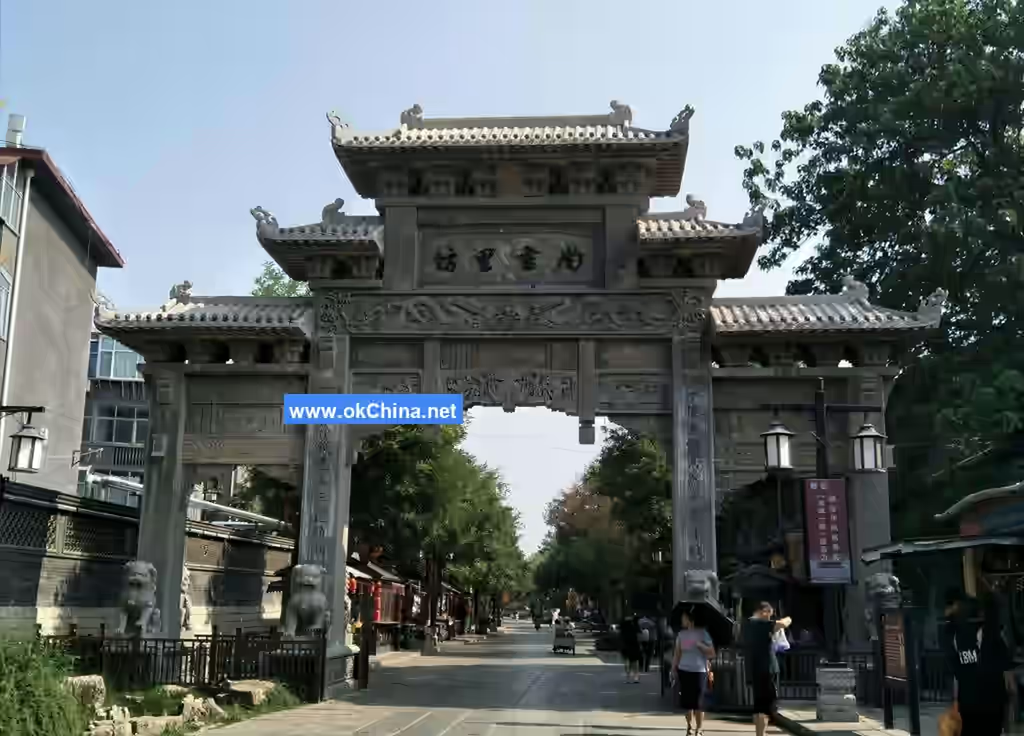
3.2 Shangshuli Memorial Archway
The Shangshuli Memorial Archway was initially built during the Jiajing era of the Ming Dynasty to honor the Qingzhou native Shi Maohua. It was destroyed and later rebuilt on its original site based on historical records. The archway has four pillars and three gateways, with a total width of 13.8 meters and a total height of 11.48 meters.
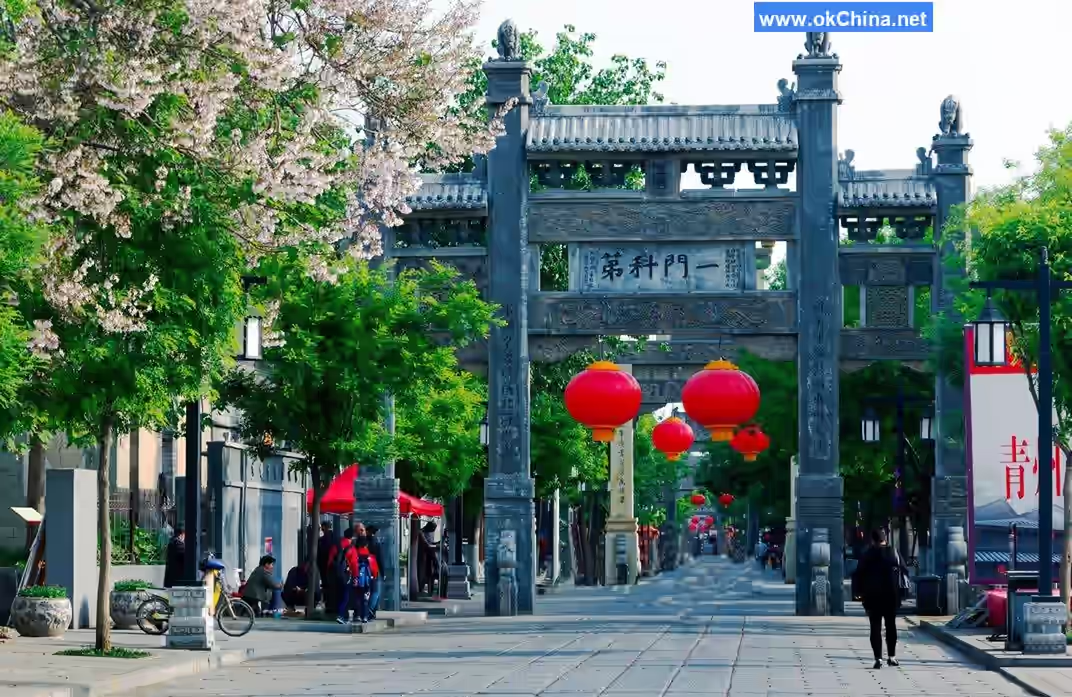
The inscription on the archway reads "Shangshuli Fang" (Shangshuli Memorial Archway). The couplet on the south-facing pillars reads: "With one pacification of an important town, it became a mighty bulwark for a thousand li; wielding the commander's tally again, it truly was the key to three frontiers" (composed by Jiang Yukun, calligraphy by Liu Sanmin). The couplet on the north-facing pillars reads: "Building great dikes and clarifying litigation, a major responsibility for the region; quelling internal rebellion and exterminating Japanese pirates, heroic for ten thousand generations" (composed by Yan Jinliang, calligraphy by Wang Jianjun).
3.3 Dongmen Street
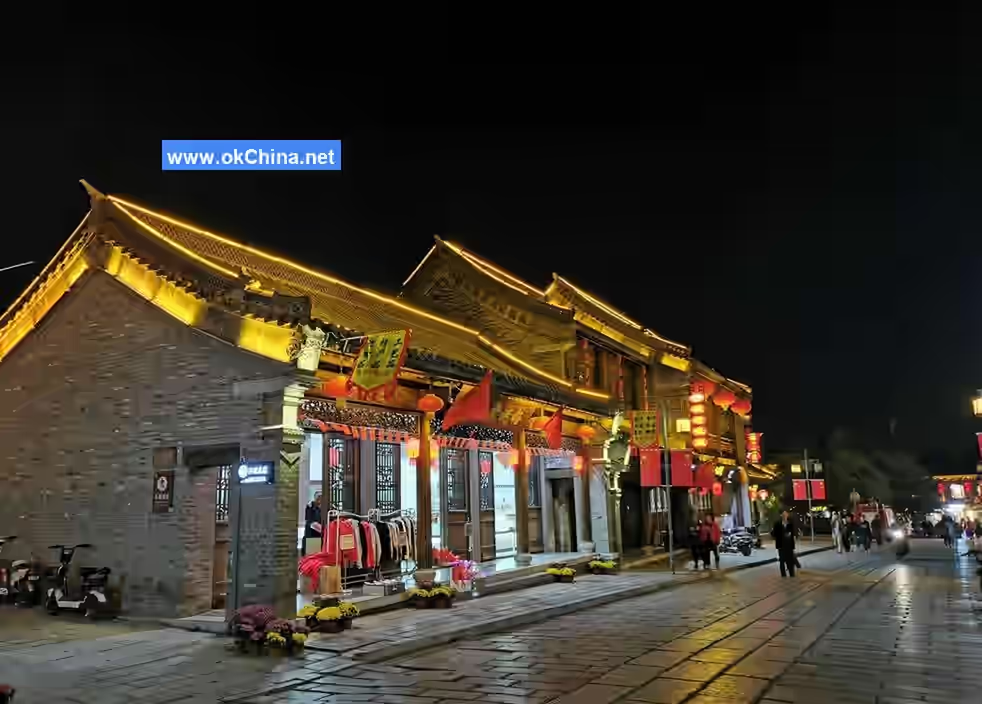
Dongmen Street is the main street of Qingzhou Ancient City, initially built in the early Northern Wei period. It was the most important east-west street within Nanyang City and also a significant commercial street at the time. This street, the eastern section is traditionally called Dongmen Street, while the western section was originally called Wei Street. Now it is collectively referred to as Dongmen Street. It stretches over 600 meters from the East Gate in the east to the western end of Wei Street in the west. At that time, the street contained a multitude of government offices, temples, famous residences, and time-honored shops, leaving rich remnants of everything from economy and military to academies. The Jin Dynasty Shandong East-West Circuit Military Command Office, the early Ming Shandong Provincial Administration Commission Branch Office, the Shandong Regional Military Commission Office, the Qingzhou Left Guard Office, and the Qingzhou Prefecture Examination Hall were all located on this street. Shops lined the street densely, including time-honored brands like Longsheng Pastry, Shunhe Brush Shop, Renhetang Pharmacy, Yihan Studio, Taishenghe, and Tian Zengyi Hat Shop. On both sides of the street were lanes such as Qianju, Housi, Nanying Street, Beiying Street, Weili Lane, Louli Lane, and Fengzhai Lane, as well as famous buildings like Ningcui Tower, Dongyue Temple, and the Feng Mansion. After liberation, the area was gradually converted for residential and commercial use.
3.4 Ouyuan Garden
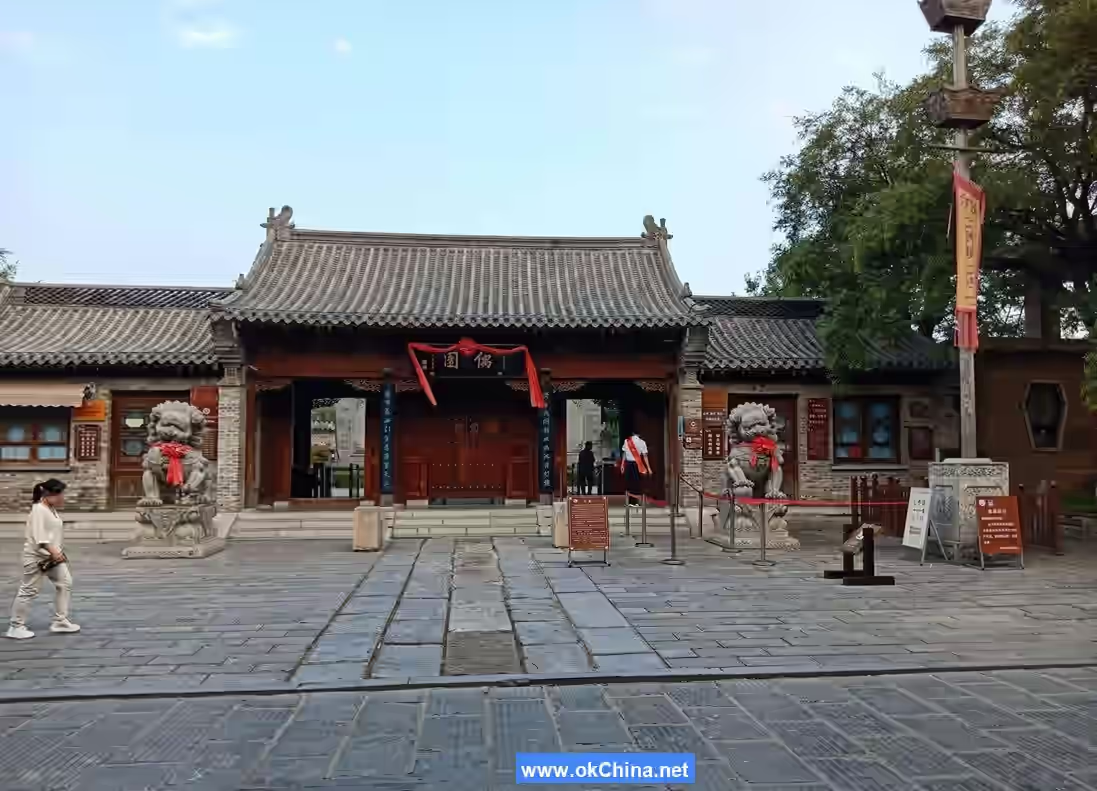
Ouyuan Garden is located on the east side of the middle section of Ouyuan Street. Ouyuan Street is approximately 1,000 meters long, connecting South Gate Street in the south and reaching the County Crossroads in the north. It was the main north-south thoroughfare of the ancient Nanyang City. It was previously called Guyi Market Street, Zhongshan Street, Xinmin Street, Minzhu Street, Minzhu North Street, and Dongfanghong Road. Later, it was renamed Ouyuan Street because of "Ouyuan Garden."Ouyuan Garden was originally the East Garden of the Prince of Heng's Mansion and later became the residence of Feng Pu, the Grand Secretary of the Wenhua Hall during the Kangxi reign of the Qing Dynasty, after his retirement.
To the north of Ouyuan Garden, it connects seamlessly with the simple and spacious Feng Clan Ancestral Hall and the Feng Residence with its staggered towers, complementing each other and forming a trinity of ancient architectural complex that combines a residence, ancestral hall, and garden. With a history of over five hundred years, it remains well-preserved. As the East Garden of the Prince of Heng, its layout and scale resemble those of the imperial gardens in the palace, especially the rockery within the garden, which is ingeniously conceived and masterfully crafted. The rockery consists of three peaks arranged along the eastern and southern walls of Ouyuan Garden. At first glance, it may seem unremarkable, but upon closer examination, it reveals great interest. Structurally, the rockery is divided into four parts: the flat area, peaks, streams, and platforms, each embodying its own theme with distinct characteristics. This design makes the entire rockery intricate yet orderly, serene yet dynamic, with clear layers and an elegant ambiance, creating a sense of vastness within the confines of the garden. According to expert research, the rockery in Qingzhou's Ouyuan Garden is the only surviving example of "Kangxi-style" garden rockery in China. Its artistic conception and stone-laying techniques are entirely consistent with those of Yingtai in Zhongnanhai. Landscape experts infer that Qingzhou's Ouyuan Garden is the work of Zhang Ran, a descendant of the renowned Ming Dynasty garden designer Zhang Nanyuan.
Within the garden, four osmanthus trees from the Ming Dynasty and three winter jasmine plants from the same period have retained their fragrance for over four hundred years. The garden also features four rare stones inscribed with the characters "Fu" (fortune), "Shou" (longevity), "Kang" (health), and "Ning" (peace), which are extremely precious. At the time, it was said that "one tael of stone is worth one tael of silver." Additionally, the garden boasts exquisitely crafted rockeries, delicate bridges over flowing water, and towering ancient cypress trees.
3.5 Zhenjiao Mosque
Zhenjiao Mosque is located on Zhaode Street in the Dongguan area of Qingzhou, where the Hui ethnic community is concentrated. The mosque blends Arabic architectural art with Chinese architectural art. From a distance, it resembles ancient Chinese architecture, but up close, traces of Arabic architectural style are evident everywhere. The main structures, including the main gate, secondary gate, prayer hall, and moon-viewing tower, are all arranged along an east-west central axis, with symmetrical layouts on both sides. The three courtyards ascend step by step, entirely reflecting the architectural style of Chinese palaces.
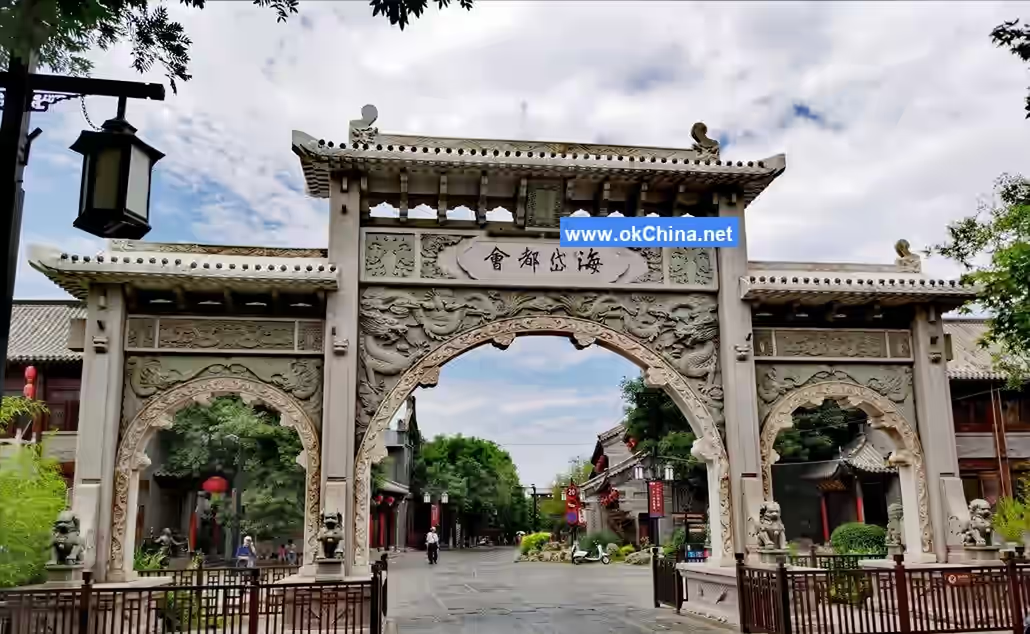
3.6 Haidai Metropolis Archway
Ancient Qingzhou was situated between the sea and Mount Tai (Dai), serving as a metropolitan area and military stronghold throughout history. It long functioned as the political, economic, cultural, and military center of the Shandong region, with thriving commerce and converging merchants, earning it the reputation as the "Key Town of Sanqi and Metropolis of Haidai." To highlight the historical status of ancient Qingzhou, this archway was erected. The archway features four pillars and three gates, with a total height of 9.4 meters and a total width of 14.4 meters. The central gate is wide enough to allow the passage of carriages and horses. Generally, officials could pass through the central gate, while commoners were only permitted to use the two smaller side gates.
4. Other Attractions
4.1 Qingzhou Folk Customs Museum
The Qingzhou Folk Customs Museum is located west of Sanguan Temple in the ancient city of Qingzhou, with an exhibition area of 483 square meters. The original site was the Wen Family Courtyard. Through artifacts, old photographs, sculptural simulations, interactive multimedia, and other means, it reflects the representative folk customs and their evolution in ancient and modern Qingzhou.
4.2 Memory of the Ancient City Cultural Exhibition Hall
Memory of the Ancient City is located inside Fucai Gate in the ancient city of Qingzhou, covering an area of 2,000 square meters. It is divided into three main exhibition areas: the first is the Qingzhou Three Carvings Culture Exhibition Area, featuring wood carving, brick carving, and stone carving; the second is the Old Photographs of Qingzhou Prefecture Exhibition Area, mainly displaying "Ancient City Scenes," "Historic Sites," and "Social Customs." The third is "Dream Across a Millennium," which primarily showcases the process of protecting, restoring, and constructing the ancient city, as well as sand table models of the six ancient cities that existed in Qingzhou's history and the current panorama of the ancient city.
4.3 Li Cheng Memorial Hall
The Li Cheng Memorial Hall is located north of the horse path on the east side inside Fucai Gate in the ancient city of Qingzhou, west of the Ouyang Xiu Memorial Hall, covering an area of 897.7 square meters. It mainly displays the life, works, and historical status of Li Cheng, a iconic figure in Chinese landscape painting.
5. Culture
5.1 Naming
In the ancient Nine Provinces, Qingzhou was located in the eastern part of the Central Plains. According to the ancient Chinese theory of the Five Elements, "the east belongs to wood, and the color of wood is green (qing)," hence the name "Qingzhou." The Book of Documents: Tribute of Yu records, "Between the sea and Mount Tai lies Qingzhou," where "sea" refers to the Bohai Sea and "Dai" is Mount Tai. The geographical territory of ancient Qingzhou included the vast area south of the Bohai Sea and north of Mount Tai.
5.2 Historical Evolution
5.2.1 Founding of Qingzhou City
In the fifth year of the Yuanfeng era of the Western Han Dynasty (106 BCE), the Qingzhou Cishi Department was established as one of the 13 cishi departments in the country. Its administrative seat was Guangxian County (located about 0.5 kilometers west of the present city), governing over 100 counties across 5 commanderies and 4 kingdoms. Since the early Western Han Dynasty, six ancient cities have existed successively: Guangxian City of the Han Dynasty, Guanggu City, Dongyang City, Nanyang City, Dongguan Weizi City, and the Manchu Banner City.
5.2.2 Administrative Evolution
Wei, Jin, and Northern and Southern Dynasties: The Qingzhou Cishi Department was still in place, governing 9 commanderies and 47 counties. During this period, from the first year of Hongzhi (399 CE) to the twelfth year of Hongzhi (410 CE), it served as the capital of the Southern Yan Kingdom, with Murong De becoming the only emperor within Shandong. Sui Dynasty: The Qingzhou Zongguan Prefecture was established, governing 4 commanderies and 36 counties. Tang Dynasty: The Qingzhou Zongguan Prefecture and Dudu Prefecture were successively established, governing 8 prefectures and 49 counties. Mid-Tang and Five Dynasties: The Pinglu Ziqing Jiezhen was established, governing 15 prefectures. Early Northern Song Dynasty: The Jingdong Circuit was established, governing 26 prefectures, subprefectures, military prefectures, and 89 counties. The seventh year of Xining (1074): The Jingdong East Circuit was established, governing 1 superior prefecture, 7 prefectures, and 36 counties. Jin Dynasty: The Shandong East Circuit was established, governing 2 superior prefectures, 11 prefectures, 53 counties, and 83 towns. Early Yuan Dynasty: The Yidu Branch Secretariat was established, later replaced by the Shandong East and West Circuits Pacification Commission, governing 3 routes, 12 prefectures, and 44 counties. Early Ming Dynasty: The Shandong Branch Secretariat was established, governing 6 superior prefectures, 15 prefectures, and 89 counties. The ninth year of Hongwu (1376): The administrative seat was moved to Licheng. Thereafter, during the mid-to-late Ming Dynasty and the Qing Dynasty, it continued to serve as the seat of Qingzhou Prefecture. The ancient city of Qingzhou also underwent changes along with historical transformations. Qing Dynasty: It served as the seat of Qingzhou Prefecture. Republican Era: Qingzhou Prefecture was abolished, and Yidu County was directly under the jurisdiction of Shandong Province. 1948: Qingzhou was liberated, and Qingzhou Special Municipality was established, with Chen Guang as the Party Committee Secretary and Feng Yizhi as the Mayor. 1952: Yidu County was restored. 1986: It was renamed Qingzhou City.
5.2.3 Modern Status
In 2010, the Qingzhou Municipal Party Committee and Government decided to initiate the Qingzhou Ancient City Protection and Restoration Project. Starting in 2012, municipal facilities, residential houses, and buildings along the main streets and alleys in the Ouyuan Historical and Cultural District of the ancient city were renovated. Multiple cultural heritage protection units and important historical buildings were protected and restored, and the South Gate area was repaired and reconstructed.
5.3 Related Culture
5.3.1 Notable Figures
Wang Zeng
Wang Zeng, a native of Yidu, Qingzhou (present-day Yidu, Qingzhou, Shandong), courtesy name Xiaoxian. He was born in the third year of the Taiping Xingguo era of Emperor Taizong of Song (978 CE) and died in the fifth year of the Jingyou era of Emperor Renzong of Song (1038 CE). He achieved the top rank in the imperial examination in the ren-yin year of the fifth year of the Xianping era of Emperor Zhenzong of Song (1002 CE).
Wang Zeng was orphaned at a young age but excelled in writing. He once wrote a poem about plum blossoms: "No need to prepare for the feast yet, let it bloom atop all flowers first." He also said, "My lifelong ambition is not merely warmth and fullness." During the Xianping era (998–1003 CE), he ranked first in the local, provincial, and palace examinations, becoming a "triple winner" in the history of the imperial examinations. Wang Zeng was the 27th top candidate in the Northern Song Dynasty. In the over 1,300 years of the imperial examination system, only 17 individuals achieved the "triple win," and Wang Zeng was one of them.
After achieving the top rank, Wang Zeng served as the Vice Commissioner of the Directorate for the Palace Buildings and concurrently as the Assistant Prefect of Jizhou. Soon after, he was summoned to the capital, tested in the Academy of Scholarly Worthies, and appointed as a Gentleman of Writings and a Compiler in the Historiography Institute. In the first year of the Jingde era (1004 CE), he became a Drafter of Edicts. When Emperor Zhenzong extensively built the Yuqing Zhaoying Palace, Wang Zeng strongly advised against it by listing five harms. Emperor Zhenzong then appointed Wang Zeng as the Chief Minister of the Court of Judicial Review, promoted him to Academician of the Hanlin Academy, and put him in charge of the Court of Judicial Review, holding him in high regard.
After serving as Assistant Executive of the Secretariat with the title of Right Admonisher, Wang Zeng was sidelined by Prime Minister Wang Qinruo and demoted to Vice Minister of Rites, serving as Prefect of Yingtian Prefecture. After being transferred to Tianxiong Army, he was reinstated as Assistant Executive. When Emperor Zhenzong passed away, Wang Zeng assisted the eleven-year-old Emperor Renzong in ascending the throne, insisting that Empress Liu could only act as regent. At that time, Wang Zeng served as Tong Zhongshu Menxia Pingzhangshi and Academician of the Jixian Hall. After Wang Qinruo's death, Wang Zeng became Academician of the Zhaowen Hall with the titles of Vice Director of the Chancellery and Minister of Revenue, overseeing the compilation of national history. After a fire at the Yuqing Zhaoying Palace, Empress Liu took the opportunity to demote Wang Zeng to Prefect of Qingzhou, later appointing him as Military Commissioner of Zhangde Army and again as Prefect of Tianxiong Army. During his tenure, the people were pleased with his governance and enshrined his portrait in temples. After Empress Liu's death, Emperor Renzong took personal control of the government and appointed Wang Zeng as Tong Zhongshu Menxia Pingzhangshi and Prefect of Henan Prefecture. In the first year of the Jingyou era (1034 CE), he became Military Commissioner. The following year, he was appointed Right Vice Director of the Department of State Affairs, concurrently Vice Director of the Chancellery, Pingzhangshi, and Academician of the Jixian Hall, and enfeoffed as the Duke of Yi. Later, due to his refusal to tolerate Lü Yijian's autocratic behavior, he was dismissed along with Lü and served as Left Vice Director of the Department of State Affairs and Academician of the Zizheng Hall, overseeing Yun Prefecture, where he died in office at the age of sixty-one. He was posthumously honored as Shizhong and given the posthumous title Wenzheng.
Zhao Bingzhong
Zhao Bingzhong's father, Zhao Xi, was an upright person. When he served as a county clerk, a commander was wrongly imprisoned. Zhao Xi investigated the facts and cleared his name. After being released, the commander was grateful and insisted on giving his daughter to Zhao Xi as a concubine. Zhao Xi waved his hand and said, "She is the daughter of a notable family; this cannot be done." The commander insisted, but Zhao Xi repeatedly said, "This cannot be done, this cannot be done," firmly refusing. He eventually rose to the position of Vice Minister of Rites.
Zhao Bingzhong was diligent and studious, showing exceptional talent from a young age. In the 25th year of the Wanli era (1597 CE), he passed the provincial examination. The following year, at the age of 25, he achieved the top rank in the palace examination due to his fluent writing, elegant prose, and insightful critique of contemporary issues. In his policy response, he pointed out the shortcomings of the time and advocated for reforms, while also lavishing praise on the emperor, with flattering words found throughout. Emperor Wanli was very pleased after reading it and wrote the six large characters "First Rank, First Place" in vermilion on the top of the paper.According to records, Zhao Bingzhong did not have good luck at the beginning of his imperial examination journey. During the county-level examination, because one candidate was found to have hidden cheat sheets in his shoes, he was forced by the examiners to take off his shoes and socks and stand barefoot in the icy snow while waiting for inspection.
After passing the imperial examination, Zhao Bingzhong was appointed as a compiler in the Hanlin Academy. In the 33rd year of the Wanli era (1605), he served as an associate examiner for the metropolitan examination and selected Sun Chengzong, who later became a famous general resisting the Qing. In the 40th year of the Wanli era (1612), Zhao Bingzhong served as the chief examiner for the provincial examination in Jiangnan. The candidates he selected, such as Zhang Wei, Yao Ximeng, and Zhou Shunchang, later became renowned ministers of their time. Zhao Bingzhong was highly praised by later generations for his talent selection. While serving as a lecturer in the imperial court, he provided many valuable insights. He once submitted a memorial requesting the addition of a temple name for Emperor Jianwen. He successively served as a Reader-in-Waiting, Vice Minister of Rites, in charge of the Supervisorate of Imperial Instruction, and was later promoted to Minister of Rites. In the 3rd year of the Tianqi era (1623), Zhao Bingzhong resigned and returned to his hometown due to his dissatisfaction with Wei Zhongxian's manipulation of power. In the 5th year of the Tianqi era (1625), he was stripped of his official status by Wei Zhongxian and reduced to a commoner. In the 6th year of the Tianqi era (1626), he was further stripped of his official position and salary due to the Liu Zhongying case, eventually dying of resentment and depression at the age of 53.
Zhao Bingzhong was dignified and handsome in appearance, his discussions were incisive, and his lectures in the imperial court were often highly praised. In the early years of the Chongzhen era, after the court eradicated the Wei faction, Zhao Bingzhong was posthumously restored to his official position, granted the additional title of Crown Prince's Grand Guardian, and buried with the honors due to a high-ranking minister. His works include Yang Ji and Jiangxi Yudi Tushuo.
Although Zhao Bingzhong held the prestigious position of Minister, he does not have a biography in the official histories. However, in the Ming Dynasty, only his palace examination "top graduate scroll" has been perfectly preserved. Moreover, his Top Graduate Scroll is the only original document from the 1,300-year history of China's imperial examination system that has survived intact. The scroll, paper-bound with silk backing and cover, measures 3.3 meters in length and 38 centimeters in width, containing a total of 2,460 characters written in small regular script in the "Guan'ge" style. The main text consists of 19 folds, with six lines per fold, punctuated with red ink, and is a typical "eight-legged essay." In 1983, his 13th-generation descendant Zhao Huanbin donated it to the state, allowing us today to witness the elegance of his Top Graduate Scroll. This precious national first-class cultural relic is preserved in the Qingzhou Museum in Shandong Province.
Li Qingzhao
Li Qingzhao (March 13, 1084 – May 12, 1155), styled Yi'an Jushi, was a Han Chinese female lyric poet from Zhangqiu, Jinan, Shandong Province, during the Song Dynasty (spanning the Northern and Southern Song periods). She was a representative of the "Graceful and Restrained" school of lyric poetry and is known as the "Greatest Talented Woman in History." She lived near the Nanyang River in Qingzhou for nearly 20 years, leaving behind a large number of beautiful lyric poems. Her early works often depicted her leisurely life, while her later works mostly lamented her personal misfortunes, with a sentimental tone. Stylistically, she excelled in using plain description, carving her own path with clear and elegant language. In her discourse on lyric poetry, she emphasized harmony with musical rhythms, advocated elegance, proposed that lyric poetry was "a distinct genre," and opposed composing lyrics using the methods of poetry and prose. She was also capable of writing poetry, though few of her poems survive. Some of her poetic works reflect on current events and history, with passionate and stirring language, differing from her lyric style. Her works include Collected Works of Yi'an Jushi and Yi'an Lyrics, which have been lost. Later generations compiled Shuyu Lyrics. Today, there is Annotated Collection of Li Qingzhao's Works.
Feng Pu
Feng Pu (1609–1692), styled Kongbo and also Yizhai, was a native of Yidu (present-day Qingzhou). He became a jinshi (advanced scholar) in 1646 (the 3rd year of the Shunzhi era). He successively served as a Bachelor, Compiler, Reader-in-Waiting of the Hongwen Academy, Vice Minister of Personnel, Minister of Justice, and other positions. In 1671 (the 10th year of the Kangxi era), he was appointed Grand Secretary of the Wenhua Hall.
Ouyang Xiu
Ouyang Xiu (1007–1072), styled Yongshu, also known as Zuiweng and "Liu Yi Jushi," was a native of Yongfeng, Jizhou (present-day Yongfeng County, Jiangxi Province). He was a politician, writer, and historian of the Northern Song Dynasty and one of the "Eight Great Prose Masters of the Tang and Song Dynasties." In 1068, Ouyang Xiu served as the prefect of Qingzhou while holding the position of Minister of War.
Fan Zhongyan
Fan Zhongyan, styled Xiwen, was a famous politician, thinker, military strategist, and writer of the Northern Song Dynasty, posthumously known as "Duke Wenzheng of Fan." In 1051, Fan Zhongyan was transferred from Hangzhou to Qingzhou, replacing Fu Bi as the prefect. The following year (1052), he was transferred to Yingzhou. Despite his illness, he set out for his new post but only reached Xuzhou, where he passed away on May 20 (June 19) at the age of 64.
Fu Bi
Fu Bi (1004–1083), styled Yanguo, was a native of Luoyang, Henan. He served as Tong Zhongshu Menxia Pingzhangshi, equivalent to the position of prime minister. In May of the 7th year of the Qingli era (1047), he was appointed as the prefect of Qingzhou with the additional titles of Academician of the Zizhengdian and Jishizhong, concurrently serving as the Pacification Commissioner of Jingdong Circuit. He left his post at the end of the 2nd year of the Huangyou era (1050). During his three and a half years as prefect of Qingzhou, he was diligent in governance, loved the people, and worked hard to bring order to the region, earning deep admiration from the local populace.
5.4 Cultural Activities
5.4.1 Celebrating the New Year in Qingzhou Ancient City
Qingzhou City holds the "Celebrating the New Year in Qingzhou Ancient City" event annually from the 23rd day of the twelfth lunar month to the 15th day of the first lunar month, centered around the Qingzhou Ancient City tourist area. The event organizes various cultural, folk, and tourism activities, such as the "Prosperous Opening—City Opening Ceremony and Large-Scale Ancient Costume Performance" in 2018, "Ancient City Scenery—Exhibition of Fine Peasant Paintings," "Red and Vibrant New Year" Traditional Folk Lantern Exhibition, and other sightseeing activities including museum tours to appreciate national treasures and culture, "Red Lanterns Illuminating the New Era" themed lantern exhibition for the New Year, and interactive experiences of traditional crafts at intangible cultural heritage workshops.
5.4.2 "The Legacy of the Great Ming" Water Stage
The "The Legacy of the Great Ming" themed performance project in Qingzhou Ancient City covers an area of 2,000 square meters. It primarily focuses on creating a Ming Dynasty cultural atmosphere and landscape through wearing Ming Dynasty costumes, arranging Ming Dynasty items, street performances, ancient entertainment programs, and special historical drama performances. The area is developed into a comprehensive historical and cultural project integrating tourism, entertainment, interaction, cuisine, shopping, and performances. Qingzhou Ancient City has been listed as a key performance project.
6. Value and Significance
6.1 One of the Ancient Nine Provinces
"The Nine Provinces" refers to the names of nine administrative regions in ancient central China. There are slight variations in the names of "the Nine Provinces," but the generally accepted version is from the "Tribute of Yu" chapter of the Book of Documents, which states that "the Nine Provinces" are: Ji Province, Yu Province, Yong Province, Yang Province, Yan Province, Xu Province, Liang Province, Qing Province, and Jing Province.
6.2 Gathering Place of Intangible Cultural Heritage
To explore the cultural heritage of the ancient city, the Qingzhou Municipal Government has successively established the Ancient City Art Troupe and the Intangible Cultural Heritage Art Troupe. Over 50 intangible cultural heritage items, such as Qingzhou shuttlecock kicking, cuoqin (a traditional musical instrument), and embroidery, are publicly performed and exhibited in the ancient city area.
6.3 Origin of the Ancient Silk Road
The ancient Qingzhou region was one of the most developed areas for silk production in ancient China. It was not only one of the main sources of the Silk Road, which connected ancient China with the Western Regions and European countries via the Hexi Corridor, but also the starting point of the Maritime Silk Road (also known as the Eastern Maritime Silk Road or the Silk Road East Route) from the Shandong Peninsula to countries like Japan and Korea.
6.4 Birthplace of Dongyi Culture
During the Xia and Shang dynasties, the Dongyi tribes and states within the Qingzhou region represented the developmental level of Dongyi culture. In the early Western Zhou Dynasty, after the last Dongyi state, the Lai State, was destroyed by the Qi State, its remnants were relocated to the Zi River valley in the southwest of Qingzhou. In summary, the ancient Qingzhou region was the main birthplace of Dongyi culture.
Comments
Post a Comment