




Chagan Lake
1. Introduction
Chagan Lake, known as "Chagan Nur" in Mongolian, meaning "white and holy lake," is located in the Qian Gorlos Mongolian Autonomous County in the northwest of Jilin Province. It lies in the water network area where the Nen River and the Huolin River converge. The lake stretches 37 kilometers from north to south, with an average width of 17 kilometers from east to west, covering a total area of 5002 square kilometers. Its average annual water storage capacity is 700 million cubic meters. It is one of China's top ten freshwater lakes and the largest inland lake in Jilin Province.
2. Geographical Overview
Chagan Lake is 45 kilometers from the urban area of Songyuan City, 193 kilometers south of Changchun, and 265 kilometers north of Harbin. Multiple national and provincial trunk lines, including the Changbai Railway, National Highway 203, the Tu-Wu Highway, and the Da-Guang Expressway, run through the area. Tourist roads encircle and intersect the region, making transportation very convenient, with efficient communication and postal services. Chagan Lake boasts a beautiful environment, picturesque scenery, charming landscapes, and abundant resources. It is rich in carp, silver carp, bighead carp, etc., with an annual production capacity of 6000 tons of fresh fish and 50,000 tons of reeds. Among these, the Chagan Lake bighead carp (commonly known as "fathead fish") has obtained both national AA-grade green food and organic food certifications, as well as the title of "China Famous Brand Agricultural Product." The lake area is home to 239 species of birds from 47 families and 16 orders, including 9 species under national first-class protection such as the Red-crowned Crane, Hooded Crane, and Oriental White Stork, and 35 species under national second-class protection such as the Black-faced Spoonbill, Common Crane, and Eurasian Sparrowhawk.
3. Main Attractions
3.1 Miaoyin Temple:
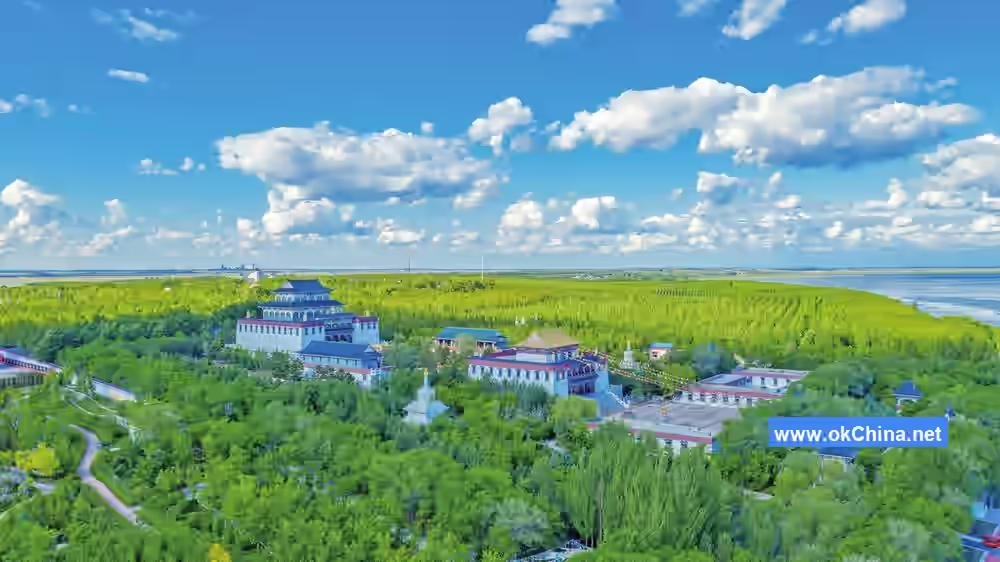
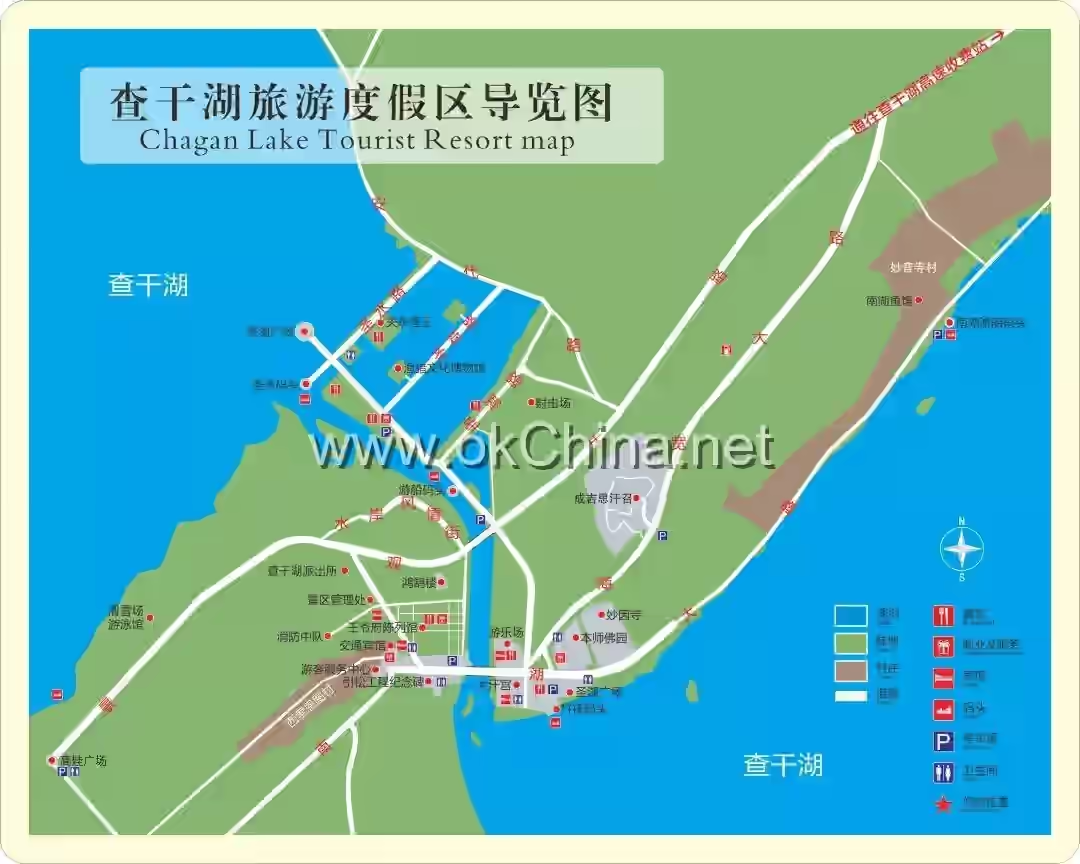
Ticket Price: 35 yuan/person/visit (price provided by Chagan Lake Tourism) Miaoyin Temple is one of the important attractions in the Chagan Lake tourist area. It was first built in the 20th year of the Qianlong Emperor's reign, i.e., 1755 AD, and was severely damaged after the founding of the People's Republic of China. It was not until 2000, with the approval of the Jilin Provincial Government, that reconstruction began, and it was completed in July 2002. The temple covers a construction area of 6999 square meters and a site area of 60,000 square meters. Facing south, the temple primarily adopts a combined Tibetan, Han, and Mongolian architectural style, built according to the traditional symmetrical layout. The overall arrangement is solemn, majestic, and magnificent. Its main structures include the Mountain Gate, the Hall of Heavenly Kings, the Mahavira Hall, and the Thousand Buddha Hall. Within the compound, besides the Bell Tower, Drum Tower, Dharma Object Circulation Office, Mongolian Medicine Clinic, and the east and west monks' quarters with side halls and the Dragon King Temple on the left and right, there are also a Tibetan-style white stupa and an Ovoo with Mongolian characteristics. In front of the white stupa, a 130-million-year-old fossilized ancient tree unearthed within the temple grounds is displayed. Upon first visiting Miaoyin Temple, one sees the imposing and spectacular Mountain Gate from afar. Entering the Mountain Gate gives a feeling of stepping into a celestial cave mansion, as if arriving at a pure and tranquil place, experiencing a refreshing and transcendent sensation akin to that of an immortal. In the center of the main gate, one first sees a Dharma wheel turning. This is a cylindrical manual Dharma wheel adorned with golden patterns on the outside. It is said that visitors and pilgrims who turn it can bring themselves good luck.
3.2 Gorlos Prince's Mansion:
Ticket Price: 35 yuan/person/visit The Prince's Mansion by Chagan Lake is the former residence of Chimedesampil, the last banner prince of the former Gorlos Banner. Located north of Chagan Nur Street and west of the Yinsong River, it is a large-scale architectural complex imitating late Qing Dynasty ancient architecture. It covers a site area of over 20,000 square meters, with a construction area of 5213 square meters. Including the front square and the rear garden, the total area exceeds 40,000 square meters. The Prince's Mansion features a rigorous architectural layout and grand气势. Based on courtyard compounds as units, with six rows of courtyards in and out, it showcases the profound, luxurious, and magnificent characteristics of a renowned mansion in the northern frontier, being a rare palace-style residence in Mongolian regions. The eastern and western zones are commercial areas, while the central part is the main exhibition area. It is an ideal place integrating tourism, historical exhibitions, exploration of folk origins, cultural development,餐饮娱乐, business negotiations, and leisure vacations. The Mansion's Historical Exhibition Hall displays an overview of the last banner prince Chimedesampil's aristocratic family, mansion reconstruction, princely rule, establishment of schools, royal life, integration of politics and religion, and struggles against land reclamation. It is also a microcosm of the modern and contemporary history of Gorlos. The Mansion's Folk Custom Exhibition Hall selects six aspects: clothing, food, housing, transportation, marriage customs and festivals, etiquette and beliefs, folk arts, sports and entertainment, and social production. It showcases the nomadic culture, customs, and spirit of the Mongolian people, known for being "accompanied by song and dance, guided by epic history," and the fine traditions and beautiful customs preserved through great historical changes.
3.3 Chagan Lake Fishing and Hunting Culture Museum & Chagan Lake National Nature Reserve Museum:
Ticket Price: 35 yuan/person/visit Located in the Chagan Lake Scenic Area of Songyuan City, Jilin Province, it is China's only museum themed on fishing and hunting culture. The museum was completed and opened to tourists in July 2011. Fishing and hunting activities were one of the primary lifestyles during humanity's primitive period. A large number of unearthed cultural relics and cultural sites along Chagan Lake and the Songhua River, such as the Qingshantou Hongshilazi site, prove that humans lived and multiplied by Chagan Lake as early as the Paleolithic Age. From the legendary three major tribes of Sushen, Donghu, and Yemaek to the Buyeo and Bohai periods, the ancestors by Chagan Lake still relied mainly on fishing and hunting for their livelihood. The unique natural resource environment allowed this primitive, ancient lifestyle to continue for over 1000 years. It was not until the Liao and Jin periods, with the increasing exchange and integration between the nomadic culture, fishing and hunting culture of the northern regions and the agricultural culture of the Central Plains, that agricultural culture gradually developed around Chagan Lake. From the Liao Dynasty to the Yuan Dynasty, emperors would lead their ministers and concubines to Chagan Lake every spring for the "Spring Nabbo" ritual, holding grand lake worship ceremonies by the shore, ice fishing, and hosting "First Fish Banquets" to entertain ministers and envoys. Legend has it that after Genghis Khan led his Mongol cavalry to capture the Jin Dynasty's important town of Tahu City, he came to the Qingshantou hill by the lake. Facing Chagan Lake, he personally offered nine types of tribute, burned incense, and worshipped, calling Chagan Lake "Holy Water." By the Ming and Qing periods, fishing and hunting activities at Chagan Lake had reached unprecedented prosperity, making it a fishing and hunting paradise in the northern deserts, a land of joy on earth.
3.4 Manchu-Mongolian Inscription Stele
Commonly known as the Kuli Stele. The inscription is in both Manchu and Mongolian scripts. In 1981, the Provincial People's Government approved this stele as part of the second batch of key cultural relics protection units in Jilin Province, naming it the "Manchu-Mongolian Inscription Stele," fully titled "Stele for Posthumously Conferring the Title of Loyal Prince and Loyal Prince's Virtuous Consort." The Manchu-Mongolian Inscription Stele is an important historical witness to the Manchu-Mongol marriage policy implemented by the Later Jin and early Qing Manchu rulers and the relationship between the Qing Dynasty and the Khorchin. The stele body is majestic, its shape unique, its carvings exquisite and ingeniously crafted. It is a rare artistic treasure of the Qing Dynasty in Mongolian regions and one of the larger-scale, finely carved, and artistically well-executed Qing Dynasty steles in Jilin Province, possessing high artistic value. The stele is made of igneous rock. The stele top (capstone) and base are brownish, while the stele body is light gray. The stele consists of three parts: the capstone, the body, and the base. Its total height is 5.82 meters. The capstone is rectangular, with slightly rounded top corners, measuring 145 cm in height, 130 cm in width, and 40 cm in thickness. The stele body is a slab-like rectangular shape, measuring 292 cm in height, 125 cm in width, and 34 cm in thickness. The stele face bears a total of 383 characters in intaglio printed-style Manchu and Mongolian scripts. The first line of each script reads "Stele for Posthumously Conferring the Title of Loyal Prince and Loyal Prince's Virtuous Consort." The base is a stone turtle carved from a single massive rock. Its tail is 310 cm long, height 145 cm, and its widest point is 132 cm. The turtle supports itself on four legs, with exquisitely carved patterns on its body. The Manchu-Mongolian Inscription Stele is the stele for the birth parents of Empress Dowager Xiaozhuangwen. Xiaozhuang, also named Bumbutai, was the daughter of Jaisang, Beile of the Khorchin tribe in Inner Mongolia during the early Qing Dynasty, renowned as the "First Beauty of the Manchus and Mongols." The "Draft History of Qing. Table of Imperial Relatives" records: "The father of Empress Dowager Xiaozhuangwen was Jaisang, son of Manggusi. In the 11th year of Shunzhi, May Renchen day, he was posthumously granted the title of Heshuo Loyal Prince." The "Draft History of Qing. Biographies. Imperial Consorts" also records similarly: "Empress Dowager Xiaozhuangwen, of the Borjigit clan, was the daughter of Jaisang, Beile of Khorchin, and niece of Empress Xiaoduan. In the 10th year of Tianming, February, she came to be married. In the 1st year of Chongde, she was enfeoffed as Consort Zhuang of the Yongfu Palace. In the 3rd year, first month, Jiawu day, Emperor Shizu was born. When Emperor Shizu ascended the throne, she was honored as Empress Dowager. In the 11th year of Shunzhi, the Empress Dowager's father Jaisang was granted the title of Heshuo Loyal Prince, and her mother was granted the title of Virtuous Consort." Loyal Prince Jaisang was the maternal grandfather of the Qing Shunzhi Emperor, and Loyal Prince's Virtuous Consort was the maternal grandmother of the Shunzhi Emperor. After their deaths, in May of the 11th year of Shunzhi (1654), they were posthumously granted the titles of Heshuo Loyal Prince and Virtuous Consort by the emperor. On the 7th day of the 5th month in the 12th year of Shunzhi, following the decree of the Shunzhi Emperor and Empress Dowager Xiaozhuang, a stele was erected in front of their tomb by Hetu, the eldest grandson of Jaisang and his wife.
3.5 Eight Scenic Spots within the Area#### 3.5.1 Chagan Lake Scenery
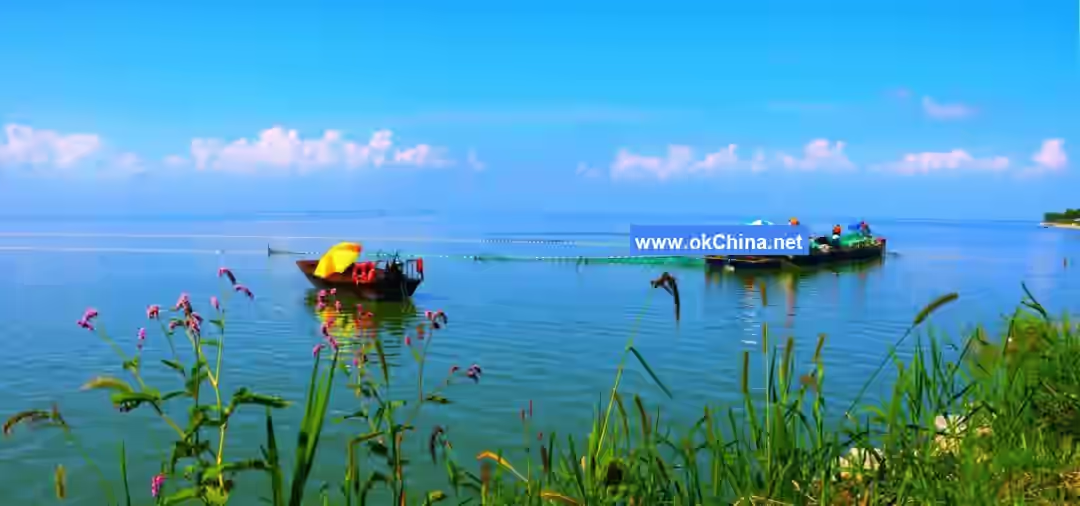
Known as the "Pearl of the North," Chagan Lake features crystal-clear water, vast misty waves, flocks of waterbirds, and reed beds like surging waves. Its landscape is magnificent, tranquil, and desolate, offering a breathtaking aesthetic experience.
3.5.2 Grassland Paradise
The Gorlos Grassland is located on the Songnen alluvial plain, characterized by its flat and expansive terrain. The Yinsong Canal, like a shining ribbon, is embedded within, irrigating rice fields and nourishing the grassland. The Mongolian villages in the area maintain an authentic and rich ethnic Mongolian culture. Colorful festival activities such as the Nadam Fair, Fire Worship, New Year celebrations, Oboo Worship, Genghis Khan Grand Sacrifice, and the Dragon Boat Festival Hunting Day hold strong appeal for tourists.
3.5.3 Reed Swaying
Chagan Lake's waters are vast and misty, with reeds swaying gently, creating a hazy and dreamy scene. The reed marshes of Chagan Lake are not only an important raw material for papermaking and a crucial habitat and refuge for birds but also a spectacular tourist attraction.
3.5.4 Birdsong in Abundance
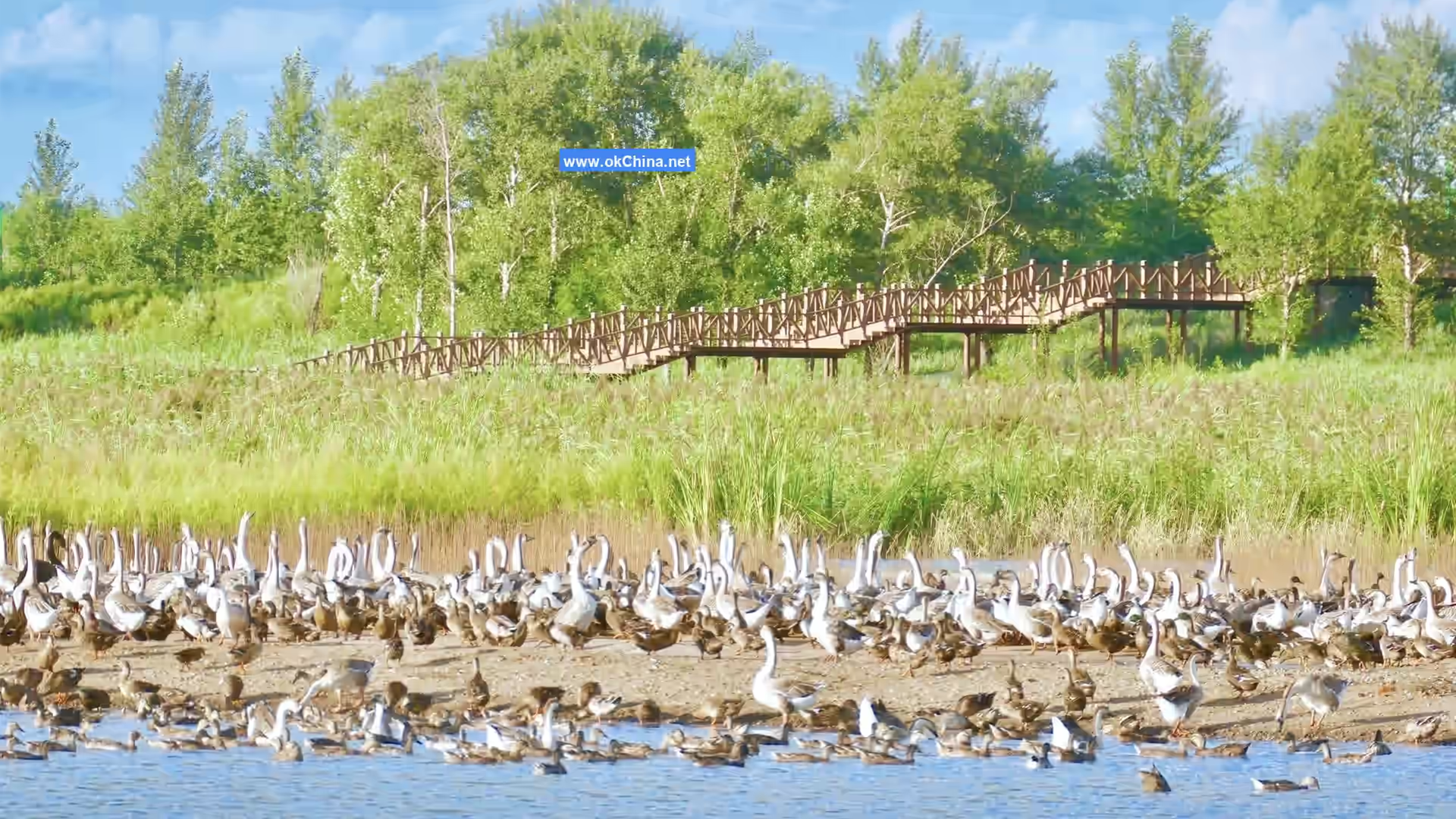
Chagan Lake is a significant wetland reserve in Jilin Province, serving as a habitat for birds and a stopover during migration. Xindian Pao, located in the core area of the Chagan Lake Reserve, is lush with reeds and aquatic plants. During bird breeding and migration seasons, it becomes a gathering place for numerous birds, earning it the title of a bird paradise.
3.5.5 Winter Fishing Spectacle
Chagan Lake is rich in dozens of fish species, including black carp, carp, and silver carp. Every winter, fishermen drill through ice up to 1.5 meters thick and slowly lower 200-meter-long fishing nets into the water. Chanting work songs, they haul out tens of thousands of kilograms of fish, transporting them in all directions—a truly spectacular scene.
3.5.6 Honghu Pavilion Overlooking
The Honghu Pavilion is situated at the commanding height on the shore of Chagan Lake. Standing 29 meters tall, its name derives from Chagan Lake's reputation as a bird paradise. With its upturned eaves, painted beams, and exquisite architecture, the pavilion boasts a unique style. From the top, one can gaze into the distance where water and sky merge, dotted with white sails, boundless clouds and water, and flocks of birds soaring—truly a magnificent earthly paradise.
3.5.7 Hundred Boats Racing
During the fishing season, thousands of sails set off, and hundreds of boats race, creating an exceptionally spectacular scene.
3.5.8 Water Park
Modern recreational facilities such as yachts on the vast water surface form a water park that attracts people, especially teenagers.
3.6 Eight Scenic Spots Beyond the Lake
3.6.1 Sunrise at Green Mountain
Green Mountain Head is surrounded by water on three sides, embraced by Chagan Lake. At sunrise, the misty waters and glowing clouds create a majestic and beautiful scene.
3.6.2 Sunset at the Dam
The oilfield dam borders Chagan Lake to the west, offering a vast water surface and an excellent vantage point for watching the sunset. At dusk, the brilliant sunset casts a golden shimmer on the water, creating an enchanting view.
3.6.3 Misty Rain at Long Mountain
Long Mountain is not high, resembling a crouching dragon stretching across the north of Chagan Lake. In the misty rain, the mountain seems to run and soar into the sky, presenting a wondrous scene.
3.6.4 Dawn Moon at the Buddhist Temple
Historically, the Miaoyin Temple was the religious and cultural center of the former Gorlos region. The temple was grand in scale, with thriving incense offerings and a continuous stream of worshippers from all directions. The reconstructed Miaoyin Temple, built on its original site against the mountain and facing the water, features exquisite architecture that reflects the orthodox Tibetan Buddhist style. It is a destination for self-cultivation and tourism.
3.6.5 Blue Sky and White Clouds
With a high sky and scattered white clouds, the vast land is dotted with herds of cattle and sheep, presenting an endlessly beautiful grassland landscape.
3.6.6 Flying Snow Welcoming Spring
Snowstorms envelop Chagan Lake and the grassland, heralding the imminent arrival of spring.
3.6.7 Galloping Wax Elephants on the Plain
In winter, ice and snow cover the grassland, dressing it in silver. The low hills gently rise from the plain, resembling galloping wax elephants—a magnificent sight.
3.6.8 Grassland Storm
The vast grassland becomes a world of raging winds in winter. Howling cold winds, carrying ice and snow, sweep across from the Mongolian Plateau, leaving the world desolate. This allows modern people, often numb to sensation, to feel the style and power of nature.
4. Cultural History
4.1 Historical Culture
Chagan Lake boasts a long history and splendid civilization. Archaeological discoveries indicate that as early as the late Paleolithic Age, over 13,000 years ago, ancient humans inhabited the Green Mountain Head by Chagan Lake. Human settlement and繁衍 continued here until the Neolithic Age, around 4,000 to 5,000 years ago.
During the Song and Liao periods, Chagan Lake was known as "Dashuibo" (Great Water Expanse). From Emperor Shengzong to Emperor Tianzuo of the Liao Dynasty, the emperor would lead ministers, empresses, and concubines on a long journey from the capital to Chagan Lake every spring for fishing and hunting, known as the "Spring Nabbo." During this time, they would meet tribal leaders and hold the "First Fish Feast" and "First Goose Feast." The Liao-Jin ancient city of Tahu City, located northeast of Chagan Lake, is a national key cultural relics protection unit and one of the larger, relatively well-preserved Liao-Jin ancient cities in Jilin Province.
Legend has it that in 1211, when Genghis汗 came to the Horqin Grassland to conquer the Jin Dynasty, he offered incense and prayers by Dashuibo (Chagan Lake). Since then, Chagan Lake has been revered as a "Sacred Lake." To this day, before the winter fishing begins at Chagan Lake, a traditional and mystical ceremony of "Worshiping the Lake and Awakening the Nets" is held. This ceremony shows respect for Chagan Lake and seeks prosperity and a bountiful harvest. Chagan Lake is also closely linked to Empress Dowager Xiaozhuang of the Qing Dynasty. After her parents passed away, Emperor Shunzhi issued an edict to establish their mausoleum by Chagan Lake, posthumously conferring upon them the titles "Prince Heshuo Zhong" and "Consort Zhong Xianfei." A stele inscribed in Manchu and Mongolian was bestowed to honor their virtues. The stele records the Qing policy of "marriage alliances in the north and enfeoffment of kings in the south," serving as physical evidence for studying Qing institutions and the history and culture of the Manchu and Mongolian peoples, as well as historical proof of the marriage alliances between the Qing imperial family and the Horqin Mongols. During the Qing Dynasty, this area was also the religious and cultural center for hundreds of kilometers around, with temples such as the Miaoyin Temple once built here. Today, after the restoration and reconstruction of the Miaoyin Temple, a series of religious and cultural activities have formed around it, including temple fairs, Cham dances, Thousand Lantern Dharma assemblies, lake worship, and oboo worship. To this day, the unique Eastern Mongolian culture and ethnic customs formed here remain well-preserved. Notably, the winter fishing at Chagan Lake is a living heritage of human fishing and hunting culture.
4.2 Fishing Culture
Winter fishing at Chagan Lake is an ancient fishing method. In 2004, based on the "Asia-Pacific Humanistic Ecological Value Evaluation System," the China Urban Research Association reviewed and included Chagan Lake winter fishing in the "Hundred Great Wonders and Spectacles of China" and listed it in the blue paper catalog of "Asia-Pacific Internationally Recognized Ecological and Historical Heritage of Outstanding Preservation Value." In 2008, Chagan Lake winter fishing was approved by the State Council and included in the National Intangible Cultural Heritage Protection List. In 2009, the spectacle of Chagan Lake winter fishing was successfully selected as one of the "Eight Scenic Spots of Jilin" and hailed as "Ice Lake Leaping Fish."
Before the winter fishing at Chagan Lake, ceremonies such as dancing to worship the lake and awaken the nets are held. This custom has continued from the Liao and Jin periods to the present day, spanning hundreds of years. The auction of the first fish is particularly lively, with a single fish sometimes selling for tens of thousands of yuan. Eating the first fish is said to bring good luck; historically, emperors enjoyed eating the first fish from Chagan Lake, believing it foretold a stable reign and favorable weather. Chagan Lake winter fishing once held the Guinness World Record for the largest single-net catch, with one net hauling over 100,000 kilograms of fish at most.
Chagan Lake is the only place that still retains the most primitive Mongolian fishing methods, which led to this activity being included in China's intangible cultural heritage list and has made Chagan Lake a new tourist attraction in Jilin Province. Winter fishing is held annually to ensure the tradition continues. Fishermen drill multiple holes in the thick ice on the lake to set their nets and then track the movement of fish schools through the transparent ice. The mesh of the fishing nets is traditionally kept wide to allow fish under five years old to escape, ensuring future catches. Despite this, in 2005, a single net caught 104,500 kilograms of fish, earning a place in the Guinness World Records. This record was broken in 2008 by a catch of 168,000 kilograms.
The "Chagan Lake Winter Fishing Festival" is the core tourist attraction of Chagan Lake every winter. Along with nearby attractions like the ancient Miaoyin Temple (Tibetan Buddhism) and the Chagan Lake Ski Resort, it vigorously promotes local tourism. Due to this increasingly commercialized activity, the first fish of the annual winter fishing often becomes a target for purchase by the local wealthy class, also serving as a status symbol.
As early as 10,000 years ago, the ancient Chagan Nao'er people lived here by fishing and hunting. The ancient Mongols called Chagan Lake the Sacred Water Mother Lake primarily because they lived a nomadic life following water and grass, were born and raised here, depended on the lake for survival, cherished it as life itself, and loved it like a mother. Especially during the long, cold winters, they relied on traditional fishing methods (Chagan Lake winter fishing) to overcome the severe cold, sustain their livelihood, and繁衍, passing it down through generations. The true winter fishing at Chagan Lake can be traced back to the Liao and Jin periods. Historical records indicate that Liao emperors particularly enjoyed eating "ice fish." Every December, the Liao king would lead his family north to set up tents on the ice of Chagan Lake. Inside the tents, they would scrape the ice underfoot until it was as thin as paper, allowing them to see fish swimming beneath. When they wanted to eat, they would break the thin ice, and fresh fish would jump onto the ice surface one after another... Historically, this winter fishing was习惯 called the "Spring Nabbo." Chagan Lake winter fishing is not only a fishing and hunting culture but also an ethnic culture. Winter fishing is a collective activity that facilitates交流 between different ethnic groups and individuals. All culture and spirit are fully displayed and传承 during the winter fishing days. Chagan Lake winter fishing is a grand, comprehensive, and glorious展示 and普及 of human survival achievements.The winter fishing at Chagan Lake not only boasts a long history but also continues to be inherited and promoted by modern people. Since the establishment of the Chagan Lake Development Zone, efforts have been made to deeply explore and organize this unique fishing and hunting method, reviving rituals such as the Lake Worship and Net Awakening Ceremony and winter net fishing. At the same time, activities like Cham dance, ethnic song and dance performances, the auction of the first fish, on-site fish viewing, and large-scale cultural events have been added to the Ice and Snow Fishing and Hunting Cultural Tourism Festival, continuously enriching its content. The Chagan Lake Development Zone has successfully held seven consecutive Ice and Snow Fishing and Hunting Cultural Tourism Festivals. In 2006, the festival was recognized as one of the "Top Ten Ecological Festivals in China" at the China Tourism Industry Annual Conference.
In his book The Last Fishing and Hunting Tribe, Mr. Cao Baoming wrote: "There are very few places left today where one can directly experience and feel this ancient cultural form of human survival. Approaching the winter fishing at Chagan Lake feels like stepping into the long-lost ancient land of Loulan or arriving at the ancient survival tribes of the Peruvian Indians. You will feel nature accepting you in its ordinary way while vividly embracing you. Yes, this is the world's only and last fishing and hunting tribe preserved intact by both nature and humanity. Preserving the essence of traditional cultural life within civilization is an extension of history. Its value lies not only in recording the direction of human culture but also in documenting the journey of the human spirit."
Before the winter fishing at Chagan Lake, a mysterious "Lake Worship and Net Awakening" ceremony is held. Historically, the Mongols worshipped heaven, earth, mountains, and rivers, with traditions of offering sacrifices to mountains and water. It is said that in 1211, Genghis Khan led his nine-winged cavalry to the "Qingshantou" terrace on the northern shore of Chagan Lake at dawn. Guided by the "Suluding," he and his followers held the "Nine-Nine Tribute" and, amid the crackling sounds of nine towering sacred fires, hung their belts around their necks and their crowns on their wrists. Standing before the altar and facing Chagan Lake, they knelt nine times to the sun and bowed nine times to the lake, chanting the Chagan Lake Prayer in unison. They then sprinkled fragrant milk wine into Chagan Lake, symbolizing the eternal fusion of the aromatic wine with the boundless lake.
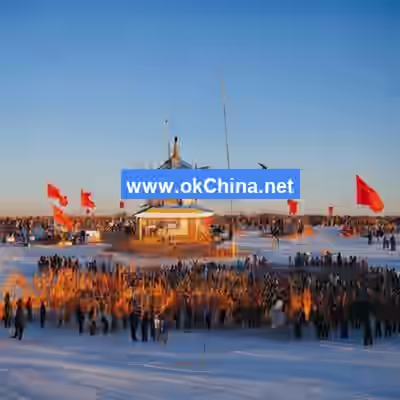
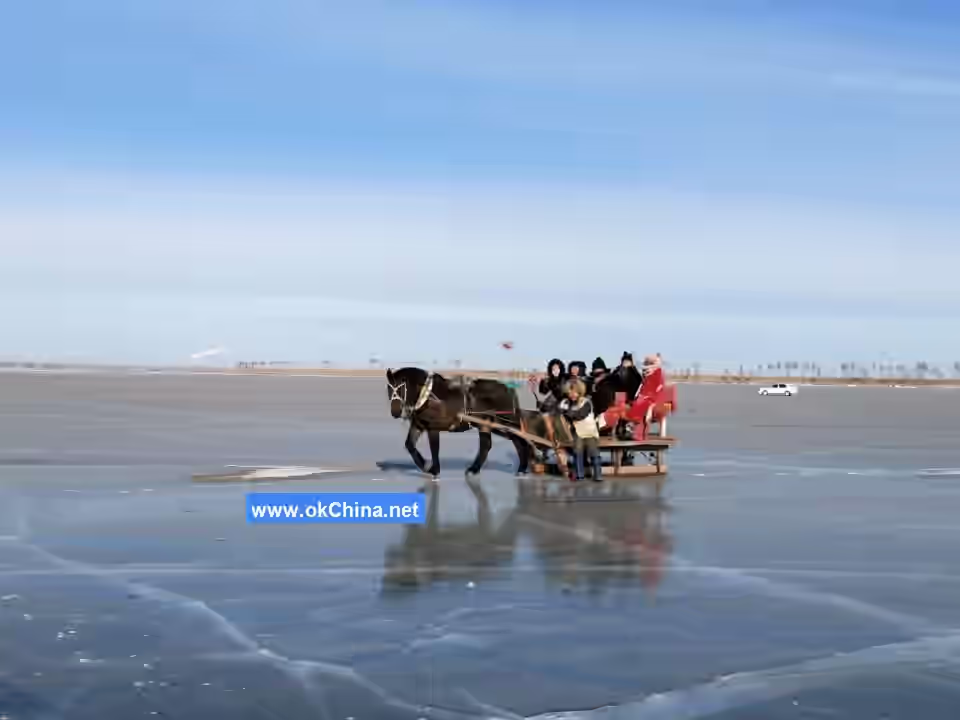
This centuries-old "Lake Worship and Net Awakening" ceremony, imbued with traditional religious significance, continues to this day, with scenes that are both grand and mysterious. The ceremony begins with the announcement by the fishing chief, dressed in Mongolian robes and sporting a full beard, followed by the sudden roar of thunderous drums and the blaring of ritual horns. Holding ritual bells and blowing conch shells and ox horns, participants circle three times around an altar laden with nine types of offerings, nine lit sandalwood incense sticks, an oboo adorned with hada scarves and pine branches, and a blazing charcoal fire. They then stand before the altar with palms together, chanting scriptures. The Cham dance begins, and fishermen clad in sheepskin coats with wide leather belts, along with tall horses draped in colorful ribbons and bells, pull sleds loaded with winter fishing gear into the ceremony site. The fishing chief raises a large wooden bowl filled with fragrant milk wine with his left hand, recites the lake prayer loudly to the sky and the sacred lake, and then kneels on the ice. He dips his right middle finger into the wine and flicks it toward the sky and the ground before pouring the remaining wine into an ice hole drilled in the lake. Meanwhile, lamas chant scriptures and toss offerings from the altar into the ice hole. The fishing chief receives a hada scarf from a Mongolian maiden and ties it around the oboo adorned with pine branches. Mongolian youths joyfully toss candies into the crowd and sprinkle milk from buckets into the sky and onto the ground.
The Lake Worship and Net Awakening ceremony is a ritual to worship the Heavenly Father, Earthly Mother, and Lake God, praying for the eternal prosperity of all living beings and the well-being and peace of the people. It expresses the wishes of the lakeside people for a better life and their gratitude for nature's blessings. It is also a distinctive cultural tourism brand carefully crafted by the people of Chagan Lake.
Prayer At the beginning of the ceremony, after paying nine grand tributes to Chagan Lake, the crowd chants the Chagan Lake Prayer aloud:
O Chagan Lake, the precious mirror of the heavens;
O Chagan Lake, the eyes of the earth.
All living beings, all life,
Gather in the embrace of your wisdom.
O Chagan Lake, the symbol of purity;
O Chagan Lake, the emblem of the mother.
All ancestors, all people,
Are held in the shelter of your hands.
We offer the Nine-Nine Tribute, with sincere hearts.
The rippling waves on the lake dance with spirits from all directions.
We light nine sticks of sandalwood incense, plant nine green pines;
We present nine hada scarves, with white horses and black cattle as offerings.
Winter fishing at Chagan Lake unfolds a unique charm!
Comments
Post a Comment