

Wuhan Mulan Cultural Eco-Tourism Zone
1. Introduction
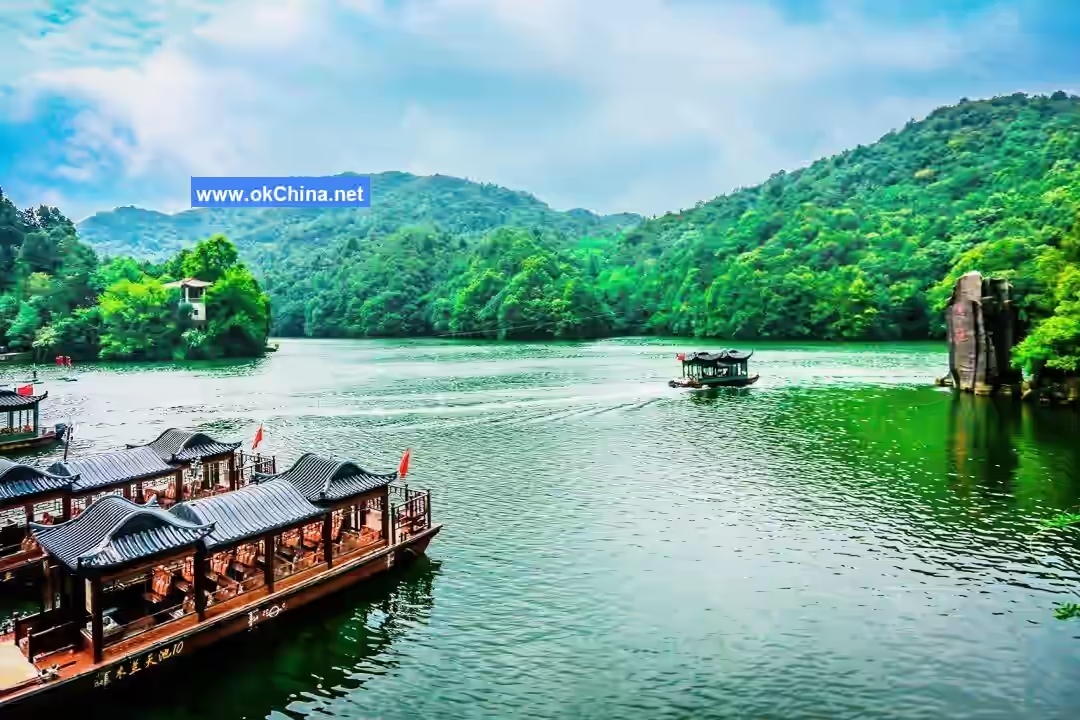
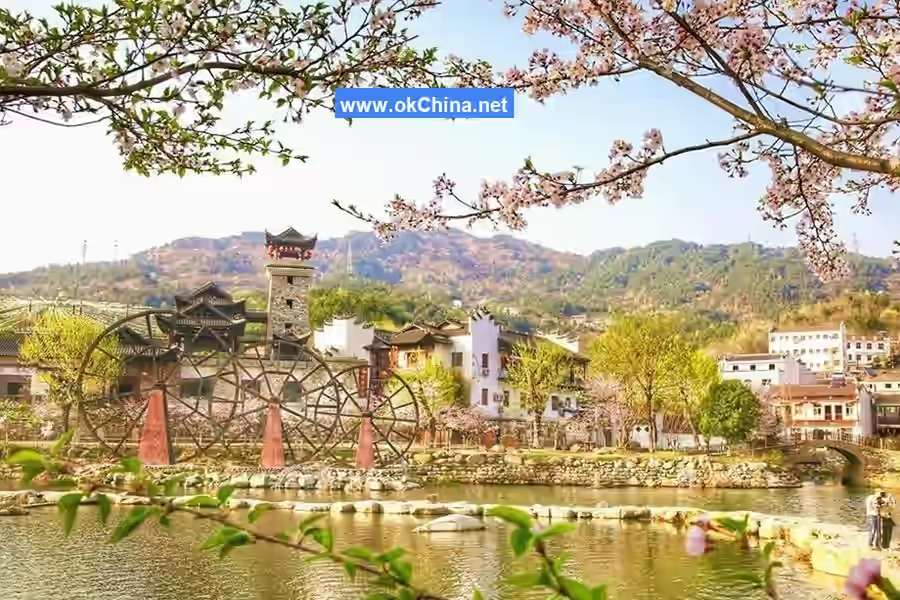
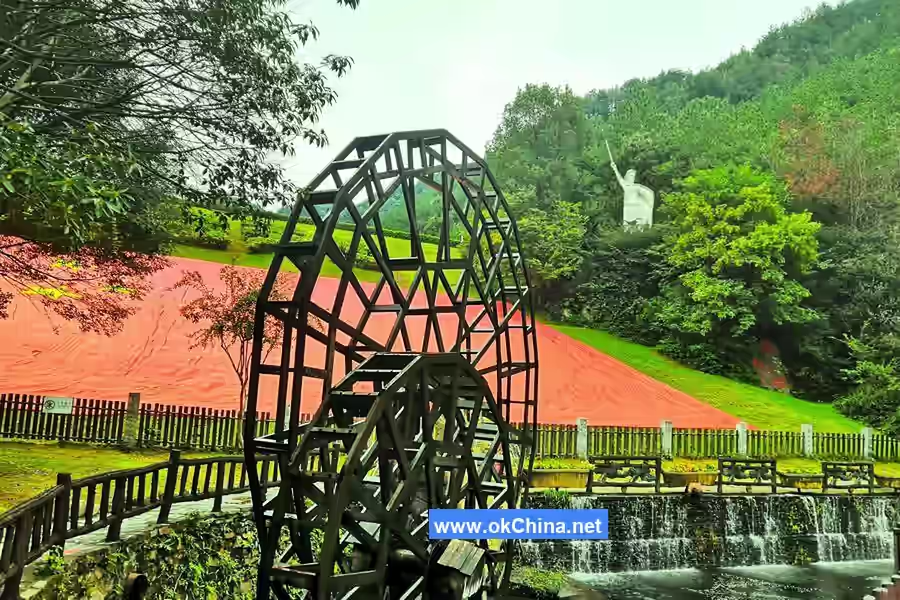
The Wuhan Mulan Cultural Eco-Tourism Zone, also known as the Huangpi Mulan Cultural Eco-Tourism Zone, is a tourist area located within Huangpi District, Wuhan City, Hubei Province. It comprises four major scenic areas: Mulan Mountain, Mulan Tianchi (Heavenly Pool), Mulan Grassland, and Mulan Yunwu Mountain (Cloud and Mist Mountain), covering a total area of 18.6 square kilometers.
Mulan Mountain, embracing Mulan Lake to the east, overlooking Mulan Chuan to the south, bordering the Sheshui River to the west, and resting against the Dabie Mountains to the north, stands at an elevation of 582.1 meters. It serves as a significant symbol of Huangpi's historical culture and external image. Mulan Tianchi primarily connects three thematic gardens—"Romantic Landscape," "High Gorge Homestead," and "Forest Park"—forming a north-south oriented forest and mountain canyon stretching over 10 kilometers. Mulan Tianchi is the hometown of Mulan's maternal grandmother and the place where Mulan grew up, recreating the joyful times of her childhood. The main landscapes of Mulan Grassland include the Grassland Homestead, Ancient Grassland City, Grassland Aobao (cairn), and thousands of acres of Gesang flowers. Entering Mulan Grassland, one can appreciate the pastoral beauty of "the wind blows the grass low, revealing cattle and sheep." Mulan Yunwu Mountain is the largest country park near Wuhan, renowned as the "Xiling Scenic Spot, Famous Northern Chu View, Western Barrier of Huangpi, and Ancestral Mountain of the Han Region." It is the place where General Mulan retired in seclusion, finding clarity in her thatched cottage and solace in the sea of flowers. It features Huayu Mountain (renowned for its Central China azaleas), Immortal Cave, and the ancient fortress Longwangjian Stone Village, remnants of military strategists' contests throughout history.
In October 2014, the Wuhan Mulan Cultural Eco-Tourism Zone was rated as a National AAAAA Tourist Attraction by the National Tourism Administration of the People's Republic of China. It became the third such attraction in Wuhan and the ninth in Hubei Province.
2. Geographical Environment
2.1 Location and Territory
The Huangpi Mulan Cultural Eco-Tourism Zone is located in Huangpi District, Wuhan City, Hubei Province. Mulan Mountain is situated within the Mulan Mountain Scenic Management Office of Huangpi District, with a total area of 78 square kilometers. Mulan Tianchi is located in Guantian Village, Changxuanling Street, Huangpi District, covering 13 square kilometers. Mulan Grassland is situated in Zhangjiazhai Village, Wangjiahe Street, Huangpi District, occupying 7,000 mu (approximately 4.67 square kilometers). Mulan Yunwu Mountain is located in Lijiaji Street, spanning about 25 square kilometers.
2.2 Topography and Landforms
The natural entity of Mulan Mountain runs north-south. It is approximately 6.2 kilometers long from north to south and 2.5 kilometers wide from east to west. It is bounded by Mulan Chuan to the east, follows the Sheshui River to the west, borders the Chang (Ling)-Ta (Er) Highway to the north, and reaches the Yan (Zi)-Shu (Dian) Highway to the south, covering an area of 15.5 square kilometers. The mountain shape remarkably resembles a resting male lion, with its head to the north and tail to the south. The central square precisely holds its throat, the ridge from the central square to Qisi Peak is like the lion's back, Qisi Peak resembles its hindquarters, and further south lies the lion's tail.
2.3 Climatic Characteristics
Mulan Mountain belongs to the subtropical monsoon zone. Influenced by monsoons, it enjoys ample sunlight and abundant heat. Meteorological monitoring indicates that due to the complex topography of the Mulan Mountain area, there are differences in sunshine between shaded and sunny slopes, significant temperature gradients, localized warmth in winter and coolness in summer, and various weather phenomena exhibit distinct microclimatic characteristics.
3. Natural Resources
3.1 Plant Resources
Mulan Mountain possesses very rich plant resources, with over 920 common plant species. Apart from nearly 200 introduced species, the vast majority are native species.
Main tree species for timber forests include pine, fir, cypress, locust, maple, paper mulberry, oak, elm, chinaberry, camphor tree, sassafras, poplar, willow, mulberry, Chinese wingnut, and sawtooth oak.
Main tree species for ornamental forests include flowering trees such as magnolia, camellia, yulan magnolia, southern magnolia, plum blossom, cherry blossom, osmanthus, redbud, crape myrtle, hibiscus, cotton rose, wintersweet, azalea, winter jasmine, and rose; foliage trees such as boxwood, glossy privet, holly, Chinese tallow tree, sweetgum, autumn maple, white poplar, pyramidalis juniper, pencil cedar, dragon juniper, cedar, silk tree, and Japanese apricot.
Main tree species for fruit forests include peach, plum, persimmon, pear, jujube, apple, pomegranate, loquat, chestnut, Chinese flowering crabapple, and hawthorn.
Bamboo species include mao bamboo, kikko-chiku, water bamboo, and clumping bamboo.
Tea plants include oil-tea camellia and green tea.
Flowers include peony, herbaceous peony, orchid, chrysanthemum, Chinese rose, narcissus, crabapple, rose, jasmine, banana shrub, night-blooming cereus, kaffir lily, salvia, asparagus fern, palm, canna, mimosa, and cactus.
There is a wide variety of medicinal herbs. As early as the Ming Dynasty, Fang Yushi noted that "Mulan Mountain is fully equipped with ginseng, poria, atractylodes, and various other medicines, long known as a natural medicine repository." Investigations have identified nearly a thousand species, among which precious medicinal herbs include red salvia, southern ladybell root, white fleeceflower root, glossy privet fruit, fritillary bulb, balloon flower root, glossy ganoderma, wolfberry, asparagus root, dwarf lilyturf tuber, yellow azalea, and hemp agrimony; more commonly growing ones include honeysuckle, clerodendrum, gold-dust plant, white jade-like plant, evergreen plant, cocklebur, common plant, thorowax root, golden peach, fragrant solomonseal rhizome, hyacinth bletilla tuber, perilla lily, pinellia tuber, and poria.
Various vegetable varieties are suitable for cultivation. Historically, white radish was one of the local specialties, valued equivalently to rice with the saying "one jin of radish for one jin of rice." In recent years, only small amounts of vegetables are privately grown on the mountain.
3.2 Animal Resources
In ancient times, the Mulan Mountain area abounded with wild beasts. Ancient texts record tales like "immortal monkeys offering peaches," indicating the presence of monkeys. Later, due to quarrying, deforestation, widespread pesticide use, and other reasons, many wild beasts gradually became extinct, leaving only small numbers of leopards, jackals, wolves, foxes, rabbits, yellow weasels, masked palm civets, badgers, donkey wolves (likely a local name), hedgehogs, martens, wild boars, etc.
With afforestation and forestry development, various bird species have returned to settle in Mulan Mountain in recent years. Common ones include eagles, owls, woodpeckers, magpies, azure-winged magpies, turtledoves, pheasants, mynas, orioles, hwamei, skylarks, bamboo leaf sparrows, russet sparrows, sparrows, and Chinese bulbuls.
Reptiles are mostly lizards and geckos, with rare species including pythons, black snakes, and white-spotted snakes. Crustaceans are mostly crabs.
Among mammals, there are over a hundred species of bats on this mountain. Large bats include flying foxes, fruit bats, and dog-faced fruit bats; small bats include mountain bats, fish bats, horseshoe bats, horseshoe-nosed bats, and big-eared bats. They often cluster in wind caves. Locals call bat droppings "night-brightening sand," which can treat eye diseases.
Among arthropods, spiders on this mountain include exceptionally large varieties.
3.3 Mineral Resources
Mulan Mountain contains abundant glaucophane. Qualitative analysis by the Guangdong Testing and Analysis Institute on June 3, 1986, indicated that glaucophane contains elements such as iron, aluminum, calcium, magnesium, titanium, zinc, lead, manganese, copper, chromium, nickel, zirconium, yttrium, scandium, molybdenum, dysprosium, beryllium, palladium, barium, silver, erbium, strontium, ruthenium, rhodium, and boron, many of which are rare metals, with palladium, ruthenium, and rhodium being particularly valuable.
The geological community also believes that the discovery of glaucophane confirms Mulan Mountain's location at a plate boundary, holding significant importance for the study of plate tectonics.
A survey by the Northeastern Hubei Geological Team of the Hubei Provincial Geological Bureau indicates that the Mulan Mountain area is rich in greenschist, blueschist, and piedmontite schist. Varieties include albite, actinolite, epidote, chlorite, crossite, quartz-albite, and spessartine garnet. The area covers about 10 square kilometers with total reserves of 113.9 million cubic meters. Building materials processed from these mineral stones have been appraised by relevant provincial authorities as being of excellent quality, with considerable mining value.
4. Main Scenic Areas
4.1 Mulan Mountain Scenic Area
Mulan Mountain rests against the Dabie Mountains to the north and overlooks the Jianghan Plain to the south, resembling a roaring lion crouching by the Sheshui River. Historically praised as "gazing south at E Zhu (Wuchang) connecting imperial aura, looking north at the Central Plains locking the imperial homeland," Ming Dynasty poet Tu Da called it "the most splendid in Xiling, arguably the ultimate view of the Three Chu regions." The Qing Dynasty compilations "Huanghu Mountain Records" and "West Lake Records" both celebrated its fame. With its towering peaks, rugged mountain paths, geological wonders from hundreds of millions of years ago, the spiritual aura of Buddhism and Taoism, and the historical records and legends of General Mulan from the Han Dynasty, it truly deserves its reputation as a Xiling scenic spot and a spiritual mountain of Jianghan.
As a significant symbol of Huangpi's historical culture and external image, Mulan Mountain not only carries the积淀 of Huangpi's millennia-old history and culture but also shoulders the historical task of developing the tourism industry and boosting Huangpi's economy. After nearly 30 years of development and construction, the Mulan Mountain Scenic Area has become a multifunctional tourist destination integrating religion, ecology, red tourism (revolutionary history), science education, and leisure, with reasonably distributed attractions and well-developed infrastructure.
Mulan Mountain, embracing Mulan Lake to the east, overlooking Mulan Chuan to the south, bordering the Sheshui River to the west, and resting against the Dabie Mountains to the north, stands at an elevation of 582.1 meters. It is named after General Mulan. The young woman Mulan, who lived in Qingshi Ridge (present-day Mulan Mountain), disguised herself as a man at age 18 to take her father's place in the army for twelve years, achieving numerous remarkable feats and being enfeoffed as the Filial and Valiant General. Later generations, moved by her loyalty and valor, built shrines, temples, and memorial arches for her, successively constructing the Mulan Hall, General's Shrine, and General Mulan Memorial Arch.
4.1.1 Mulan Hall
The memorial arch in front of Mulan Hall was erected during the Tang Dynasty to honor General Mulan, named the "Tang Dynasty General Mulan Memorial Arch." It bears the four large characters "Loyalty, Filial Piety, Courage, Integrity," summarizing General Mulan's life.
4.1.2 Golden Summit (Jin Ding)
The Golden Summit was initially built in the ninth year of the Zhenguan era of the Tang Dynasty (635 AD). In ancient times, it was called the "Imperial Court," legendarily the great hall where the True Martial Emperor (Zhenwu Dadi) lectured on scriptures and held discussions. The hall's roof originally had three large golden tiles, hence the name "Golden Summit." During the Ming Dynasty, the three golden tiles were replaced with copper tiles, later with iron tiles, and then with blue tiles. Its transformations over time are lamented by the world.
4.1.3 Jade Emperor Pavilion (Yuhuang Ge)
The Jade Emperor Pavilion is built on the First Heavenly Peak of Mulan Mountain. Legend has it that it was the place where the imperial court bestowed a crown upon General Mulan. To signify that Mulan's "merits hang with the sun and moon," the crown-bestowing site was set on the highest peak where one could seemingly touch the sun and grasp the moon—the Jade Emperor Pavilion. The pavilion enshrines a sacred statue of the Jade Emperor. In folk legends, the Jade Emperor governs heavenly deities, human ghosts, and earthly spirits, being the emperor of heaven, the human world, and the underworld, which is why many pilgrims come to worship here.#### 4.1.4 Stone Scenery Park Stone Scenery Park covers an area of 22.5 hectares. The park features numerous attractions, rich cultural landscapes, and lush natural vegetation. It boasts brilliantly colorful exotic flowers, ancient trees shrouded in legendary tales, verdant pine forests, as well as mysterious stone caves and fantastically shaped rocks.
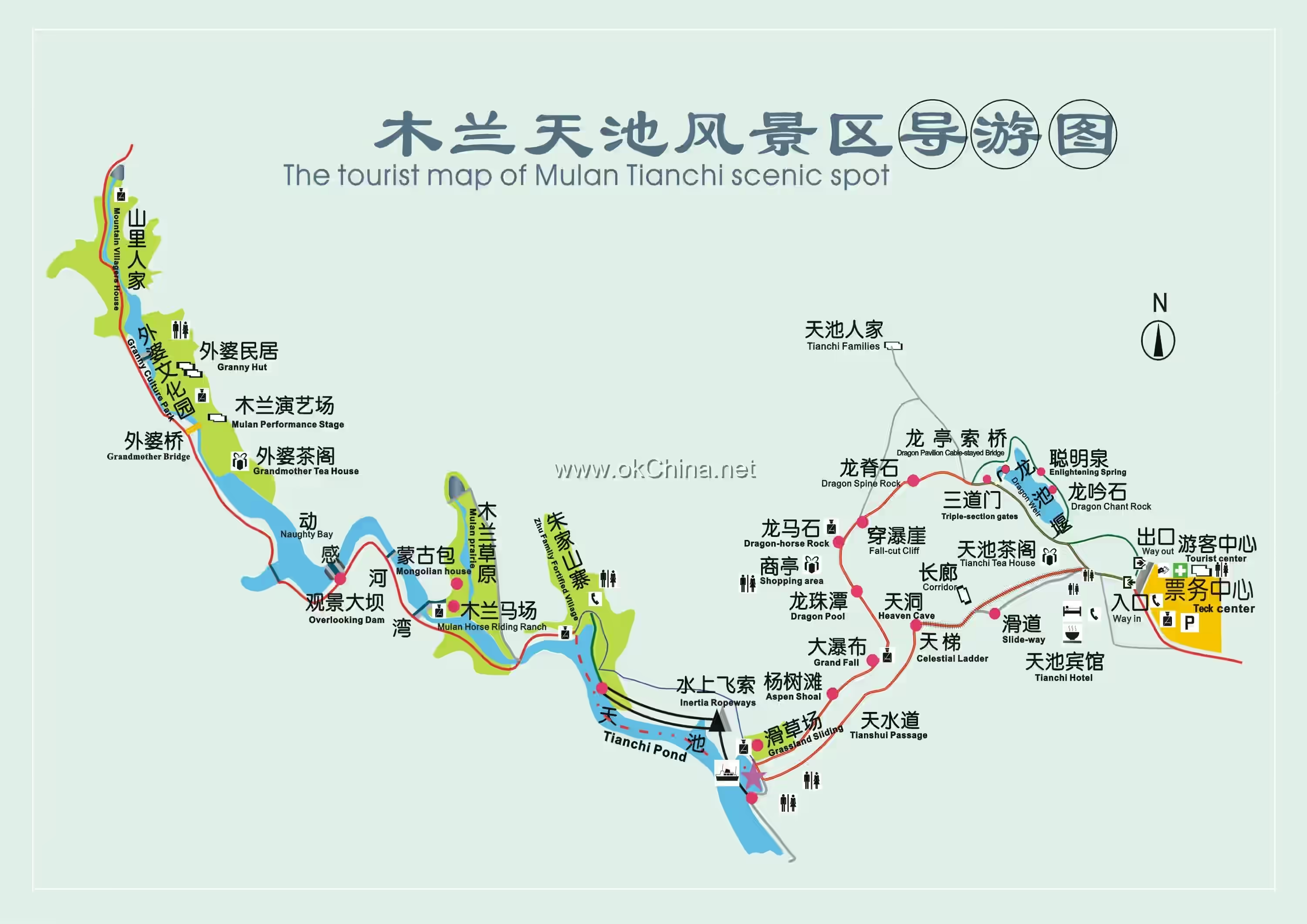
4.2 Mulan Heavenly Pool Scenic Area
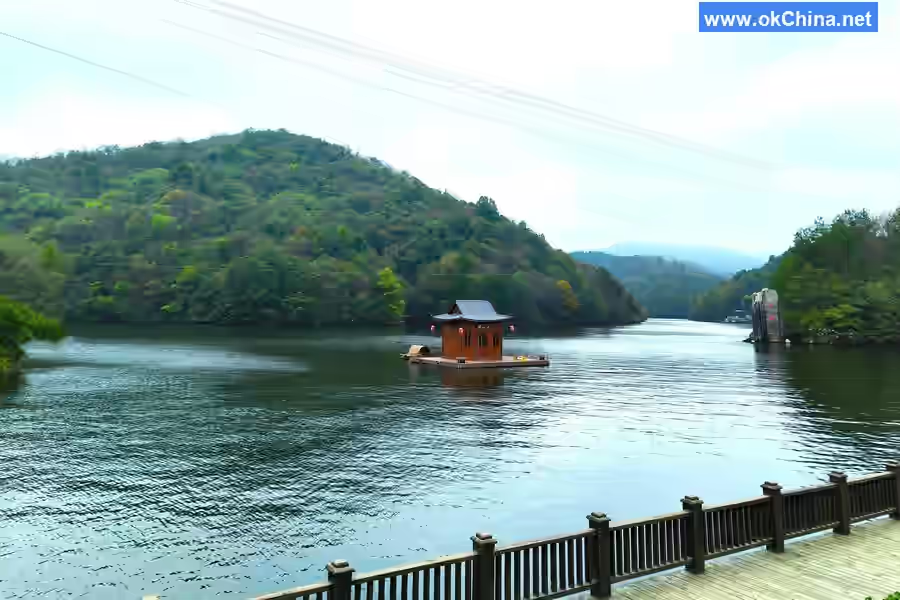
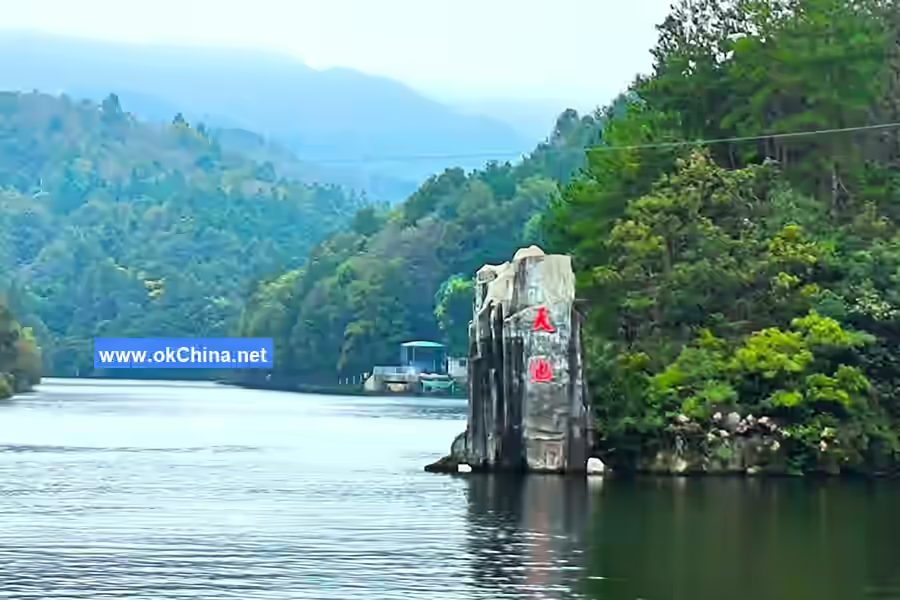
The Mulan Heavenly Pool Scenic Area is located in Changxuanling Subdistrict, northern Huangpi District, 45 kilometers from Wuhan Tianhe Airport. The forest coverage rate of the entire scenic area reaches 98%. Mulan Heavenly Pool is the hometown of Mulan's maternal grandmother and the place where Mulan grew up, recreating the joyful times of her childhood.
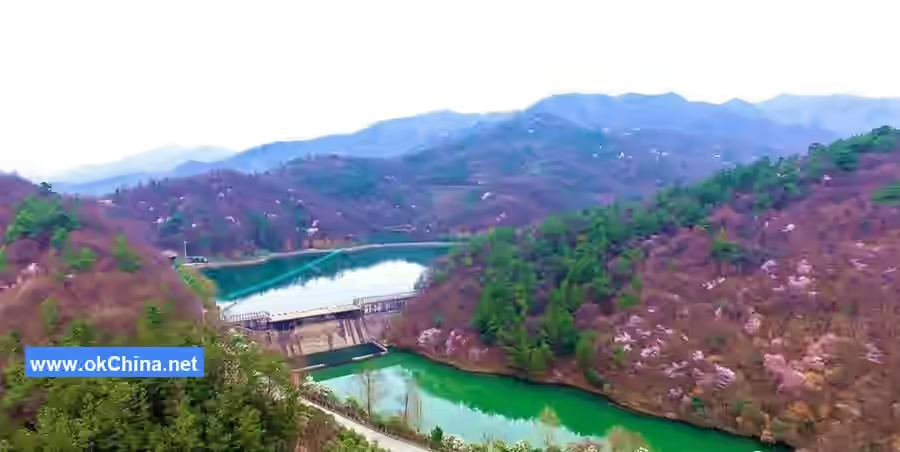
Mulan Heavenly Pool spans 13 square kilometers. It primarily links three major themed gardens—"Romantic Landscape," "High Gorge Homestead," and "Forest Park"—forming a north-south trending forested mountain canyon over ten kilometers long, designated as a National Forest Park. Wild apricot blossoms, wild chrysanthemums, and camellia flowers spread across ten miles along the canyon and the banks of the Greater and Lesser Heavenly Pools. Its main peak has an elevation of 520.6 meters, belonging to the southern foothills of the Dabie Mountains. The average annual temperature in the scenic area ranges between 15-22°C, with an average July temperature of 25.8°C.
4.2.1 Heavenly Pool Grand Gate
The Heavenly Pool Grand Gate is located at the entrance of the scenic area. Its pillars, over 8 meters high and more than 1.5 meters in diameter, are made of centuries-old natural nanmu wood. The couplets inscribed on the pillars were composed by nationally renowned couplet scholars and calligraphed by the esteemed calligrapher Mr. Chen Yijing, founder of the "Jingang Style," known for his vigorous and profound brushwork.
4.2.2 Wisdom Spring
Spring water from the Heavenly Pool percolates year-round, forming the Wisdom Spring. The spring water is crystal clear and sweet-tasting. Legend has it that when Hua Mulan lived here as a child, she would often bypass closer water sources to fetch water from this spring, which she named Wisdom Spring.
4.2.3 Mulan Heavenly Pool Apricot Blossom Valley and Camellia Valley
In spring, Mulan Heavenly Pool is ablaze with colorful mountain flowers. Set against the backdrop of lush greenery and blooming flora, the scenery along the route comes alive. It is a veritable "green treasure trove."
4.2.4 Horse Watering Pool
The Horse Watering Pool features clean, clear water where you can see the bottom. It is said that this is where young Mulan watered her horse while living and training at her grandmother's home.
4.2.5 Sushan Temple Forest Park
The Sushan Temple National Forest Park, awaiting development, covers a total area of 25,000 mu with a forest coverage rate of 98%. It hosts over 1,000 species of precious plants and serves as a protection and cultivation base for endangered plants from the Three Gorges area, providing a home for more than ten species of national first and second-class protected plants.
4.2.6 Heavenly Ladder
The Heavenly Ladder consists of 1,028 stone steps winding through the primeval forest. Standing on the steps and gazing into the distance, one is met with a vista of lush, verdant mountains.
4.3 Mulan Grassland Scenic Area
Mulan Grassland is located in Wangjiahe Subdistrict, Huangpi District, Wuhan City. The vast Mulan Grassland is where Mulan practiced horseback riding, archery, and military drills. With fresh air, green meadows, and clear blue skies dotted with white clouds, the area exudes a strong ethnic ambiance.
There is a magical legend about Mulan Grassland. The story of General Mulan disguising herself as a man to take her father's place in the army is well-known. Legend says that after Mulan served in the army for 12 years on the frontier and returned victorious, a group of soldiers who admired her followed her here. A large portion of these soldiers were ethnic minorities from the grasslands. To allow them to settle down and live peacefully while staying close to her, General Mulan decided to find them an ideal place to live. After careful consideration, she allocated the grassland where she practiced riding and archery in her youth to these soldiers. Upon seeing this lush and beautiful grassland, the soldiers fell deeply in love with it and subsequently built their homes here. Over time, the grassland's picturesque scenery, though not a natural steppe, rivals one. To commemorate Hua Mulan, people named this place Mulan Grassland. This legend adds to its mythical aura, and the influence of General Mulan's loyalty and filial piety continues to grow.
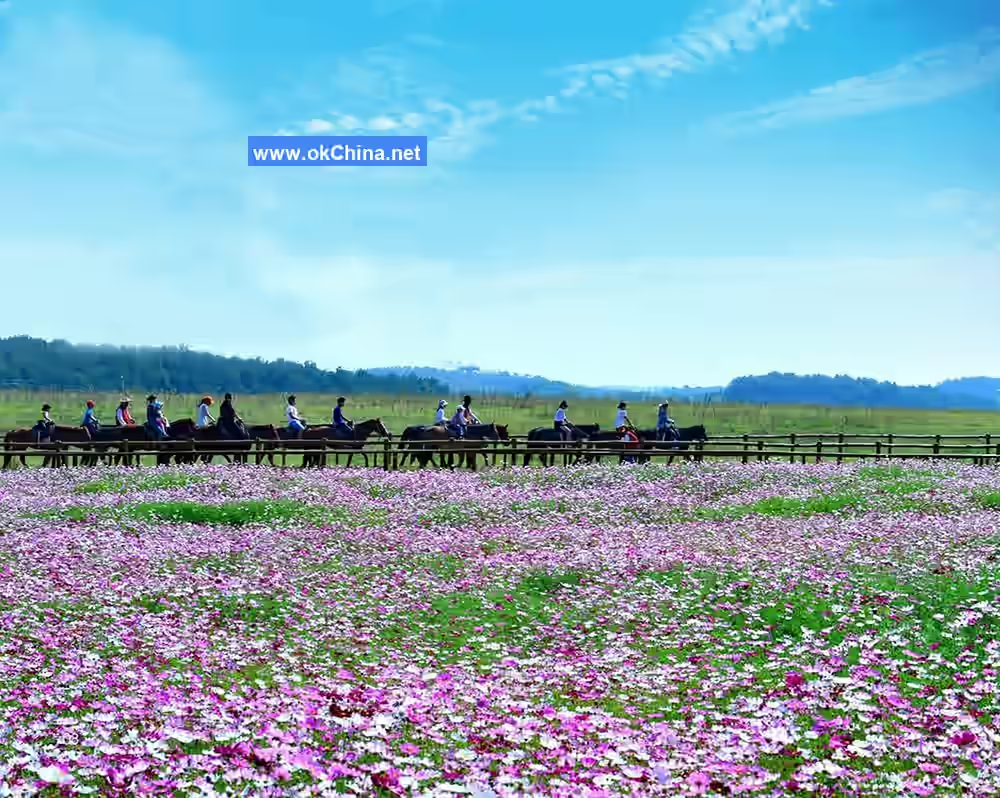
Mulan Grassland covers 7,000 mu, showcasing a southern grassland theme. Its main attractions include the Grassland Homestead, Grassland Ancient City, Grassland Aobao, and thousands of mu of Gesang flowers. Entering Mulan Grassland, visitors can enjoy the classic grassland vista where "the wind blows the grass low, revealing cattle and sheep."
4.3.1 Gate Tower
The Gate Tower is the landmark structure of Mulan Grassland. The powerful characters for "Wuhan Mulan Grassland" originate from the personal inscription by Liu Shanbi, former Chairman of the Wuhan Municipal Committee of the Chinese People's Political Consultative Conference. Its design concept distinctly reflects grassland characteristics.
4.3.2 Yurts
Yurts, unique structures of the grassland, are both aesthetically pleasing and practical.
4.3.3 Horse Viewing Pavilion
The horses in Mulan Grassland's equestrian area are fine steeds from the grasslands of Inner Mongolia, all extensively trained. Visitors can experience the feeling of galloping like the wind on Mongolian horseback.
4.3.4 Auspicious Square
Auspicious Square is equivalent to the place where Mongolian herders perform sacrifices at the Aobao. Sacrificing at the Aobao is a significant event in Mongolians' lives, comparable to the Han people's emphasis on the Spring Festival. The sacrificial activities usually take place in mid-May of the lunar calendar and last for 3 to 5 days.
4.4 Mulan Cloudy Mist Mountain Scenic Area
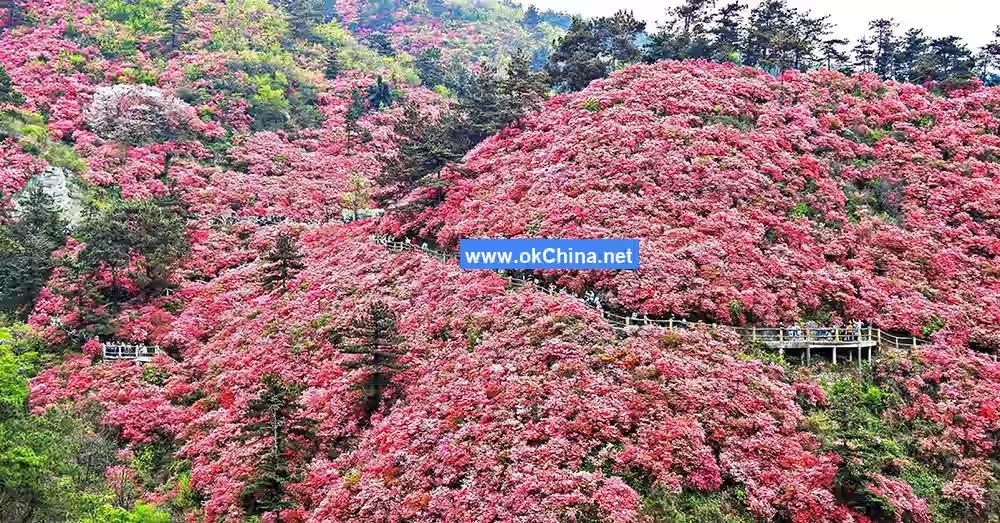
Mulan Cloudy Mist Mountain is the largest country park near Wuhan, renowned as the "Xiling Scenic Spot, Famous View of Northern Chu, Western Barrier of Huangpi, and Ancestral Mountain of Han Lands." It is the place where General Mulan retreated from public life, finding clarity in her thatched cottage and solace in the sea of flowers. It features Flower Language Mountain (home to Central China's finest azaleas), Immortal Cave, and the ancient Longwangjian Stone Fortress, remnants of strategic military contests throughout history.
Mulan Cloudy Mist Mountain is Wuhan's only urban country park, covering approximately 25 square kilometers. It boasts unique and beautiful landforms, integrating peaks, valleys, weirs, plains, ancient fortresses, and ancient architecture, earning it the title "Hundred-Scenes Garden" within the Mulan Ecological Tourism Zone. The area contains over 1,000 species of trees, more than 600 varieties of Chinese medicinal herbs, and exotic flowers and plants that bloom in succession throughout the seasons, with a forest coverage rate exceeding 95%. Every April and May, the competing azaleas bloom in red and white, covering the mountains and fields.
4.4.1 Bamboo Forest Temple
Bamboo Forest Temple is nestled in a secluded valley at the foot of Jiandao Mountain on the western slopes of Cloudy Mist Mountain. The temple complex is grandly laid out according to the mountain's contours, with imposing halls and towering pavilions.
4.4.2 Dinosaur Valley
Dinosaur Valley consists of a dinosaur viewing area, science exhibition area, and interactive entertainment zone. Adhering to principles of scenarization, three-dimensional presentation, and interactivity that harmonize with the mountain terrain, hundreds of fully simulated dinosaurs and dozens of dinosaur life scenario projects are distributed throughout the mountain forest.
4.4.3 Wuhan Summit Glass Viewing Platform
The "Wuhan Summit" at Mulan Cloudy Mist Mountain is 81.9 meters long, situated at an altitude of 709 meters. It holds the Guinness World Record for the "Longest Cantilevered Glass Viewing Platform." The super-long platform offers an excellent俯瞰 perspective, setting a new pinnacle for网红 photography spots in Wuhan.
4.4.4 Immortal Cave
Immortal Cave is a natural ancient cave with a long history. The explored section is about 1 kilometer long, featuring a natural corridor hall. The corridor has two levels resembling shrine halls, with stone tables and chairs below and stalactites hanging above. When candlelight reflects, it creates a dazzling, colorful display.
5. Cultural Resources
5.1 Historical Background
Hua Mulan is one of the four legendary heroines of ancient China, a figure steeped in legend from the Northern and Southern Dynasties period. Her story is also a poignant heroic epic. Hua Mulan first appeared in the narrative poem "The Ballad of Mulan" from the Northern and Southern Dynasties, composed around the time of the Northern Wei Dynasty and initially收录 in the Southern Chen dynasty's "Ancient and Modern Music Records."
During the Northern Wei Dynasty, the nomadic Rouran people from the north frequently harassed the southern borders. The Northern Wei government decreed that each household must send one man to the front lines. However, Mulan's father was elderly and frail, unable to go to war, and her younger brother was still too young. Therefore, Mulan decided to take her father's place in the army, thus beginning her military life that spanned over a decade. Going to the frontier to fight was arduous for many men, but Mulan had the added difficulties of concealing her identity while fighting alongside her comrades, making her service even more challenging than that of ordinary soldiers. Fortunately, Hua Mulan ultimately fulfilled her使命 and returned victorious after decades of service. The emperor, recognizing her great merits, pardoned her for the crime of deceiving the sovereign and believed she was capable of serving in the court, offering her an official post. However, Hua Mulan declined, citing the need to care for her elderly father, and requested permission to return home to补偿 and honor her parents. For thousands of years, Hua Mulan has been a woman respected by the Chinese people for her bravery and simplicity. In 1998, the American company Disney adapted Mulan's story into an animated film, which gained worldwide popularity. "The Ballad of Mulan" is included in middle school textbooks and has been recited by countless generations. Mulan's deeds and image have been adapted for the stage, enjoying enduring performances. Her spirit inspires成千上万 of Chinese people to defend their country, a story both admirable and moving.
5.2 Development History
In the first year of the Jianyuan era of the Southern Qi dynasty (479 AD), Mulan County was established at the northern foot of Mulan Mountain, serving as the seat of the Anman Left Commandery (according to the "Book of Southern Qi: Treatise on Commanderies and Provinces").
In the third year of the Yongming era of the Southern Qi dynasty (485 AD), it began to be called Mulan Mountain.
In April 1961, the state-owned Huangpi County Mulan Mountain Forest Farm was established.
On April 1, 1983, the Mulan Mountain Scenic Area opened to the public.
In June 1984, the Mulan Mountain Scenic Area Management Office was separated from the Mulan Mountain Forest Farm. In September of the same year, the Management Office and the Forest Farm merged, operating as "two signs, one team."
In the mid-1990s, a tourism development boom swept through the Mulan Mountain area and Mulan Lake. Due to a lack of unified planning and management, the boom began to cool down after two or three years.In 1996, after thorough research, Ding Lingsheng, then the mayor of Changling Town (now Changxuanling Street), wrote "The Call of Mulan Mountain, Lake, and River—Thoughts on Establishing the Wuhan Mulan Tourism Economic Zone." That year, this article, published in the internal reference of the Yangtze Daily, garnered widespread attention. The ideas on tourism development mentioned in the article, such as "building attractions and focusing on key projects," became the theoretical blueprint for Huangpi's development of its eco-tourism industry.
In 1999, Huangpi held the first Mulan Cultural Tourism Festival, officially launching the "Mulan" brand. Over the next two decades, except for interruptions due to special reasons, the festival continued and reached its 17th edition by 2023, becoming a hallmark of Huangpi's tourism industry.
On September 28, 2002, Mulan Tianchi, the first attraction in Huangpi developed with private capital, officially opened. This marked the first time the concept of the Mulan Tourism Economic Zone was put into practice.
On April 26, 2007, the Mulan Grassland Scenic Area opened, becoming the only grassland-themed attraction in Central China.
On March 28, 2009, the Mulan Yunwu Mountain Scenic Area opened.
Comments
Post a Comment