Mount Tai Scenic Area, Tai'an City
1. Introduction
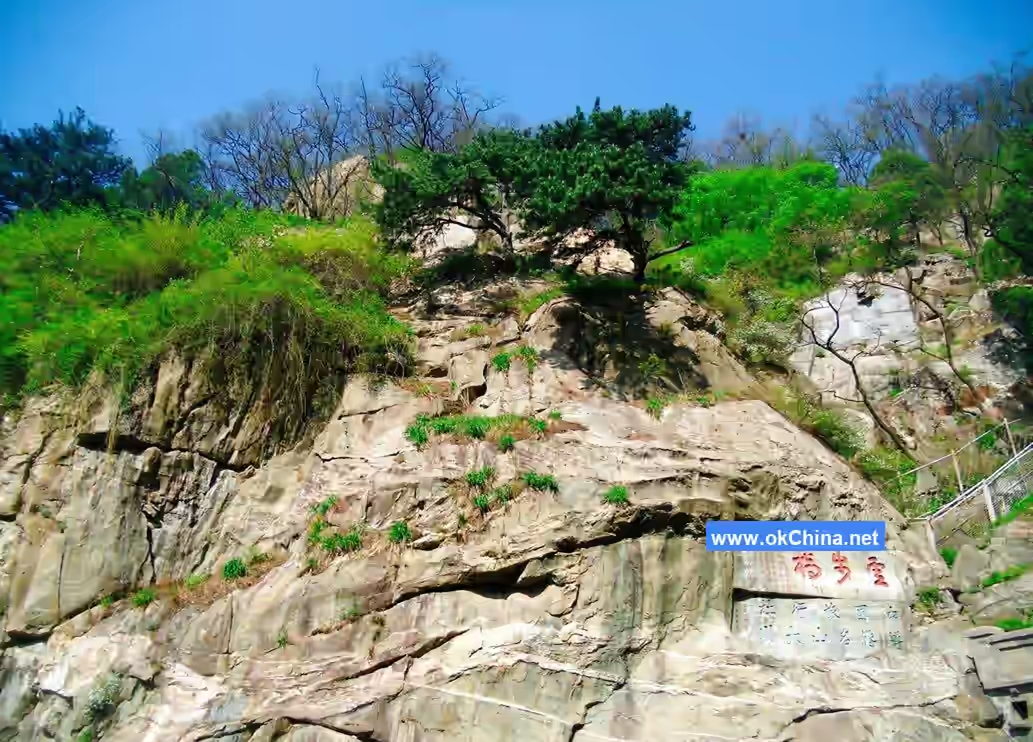
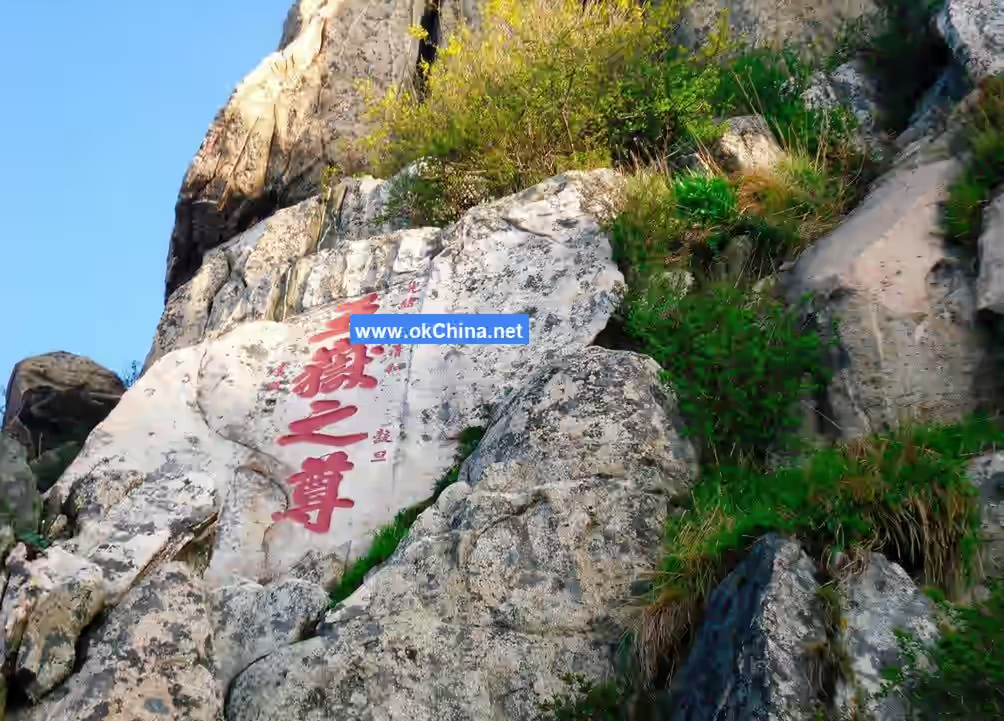
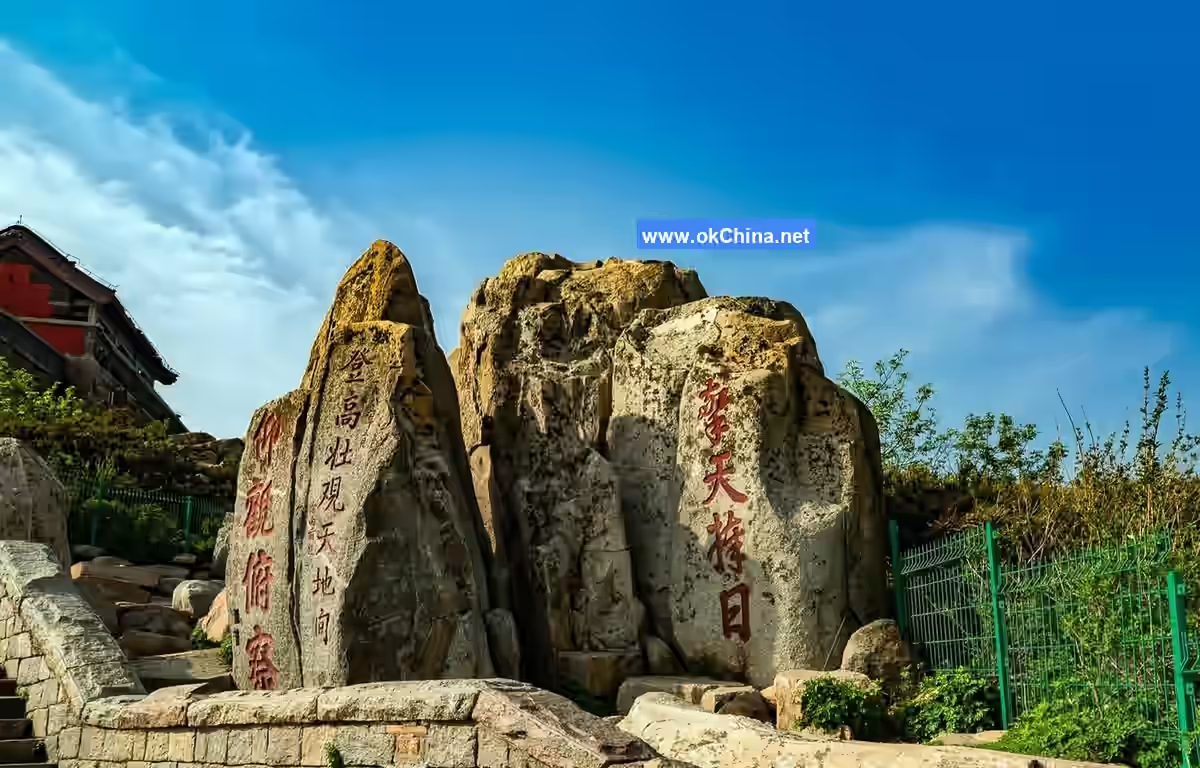
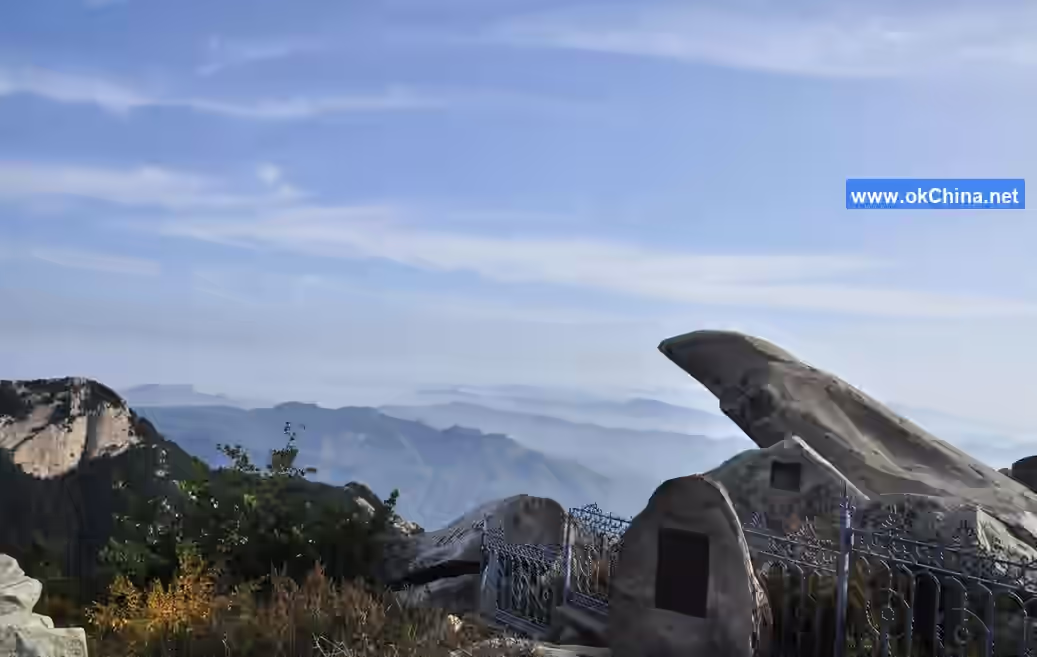
Mount Tai Scenic Area (Mount Taishan), abbreviated as the Mount Tai Scenic Area, is located in Tai'an City in central Shandong Province, covering an area of 148.97 square kilometers. Its main peak, the Jade Emperor Peak, stands at an altitude of 1,532.7 meters. Mount Tai is also known as Daishan, Daizong, Daiyue, Dongyue, and Taiyue. It is honored as the "Foremost of the Five Sacred Mountains" and is considered the leader among them. Beyond its beautiful scenery, the scenic area contains numerous cultural relics, historical sites, ancient trees, and famous woods, such as the Dai Temple and the Qin Dynasty Stone Inscriptions.
The Mount Tai Scenic Area in Tai'an City includes six major scenic zones: the Serene Zone, the Vast Zone, the Profound Zone, and others. Key attractions include the Puzhao Temple, the Guandi Temple, and the Eighteen Bends. The terrain is generally higher in the north and west, and lower in the south and east, characterized mainly by mountains and hills. Located in a warm temperate climate zone, the mountaintop features a semi-alpine humid climate with indistinct seasonal divisions, while the foothills experience a warm temperate continental monsoon climate with four distinct seasons. The mountain is densely dotted with springs and crisscrossed by rivers and streams, including the Yufu River and the Dasha River, which flow into the Yellow River. Notable waterfalls include the Black Dragon Pool Waterfall, the Three Pools Cascading Waterfall, and the Yunbu Bridge Waterfall. As early as 500,000 years ago, the "Xintai Man" of the Paleolithic Age thrived at the foot of Mount Tai. During the Xia, Shang, and Zhou dynasties, sacrificial rituals on Mount Tai reached their zenith as a representation of faith. Since the First Emperor of Qin, 12 emperors have personally conducted Fengshan (imperial worship) ceremonies on Mount Tai, with an additional 24 emperors dispatching officials to perform sacrifices 72 times, forming a unique imperial culture. During the Wei, Jin, and Northern and Southern Dynasties, Buddhism and Taoism established their presence on the mountain. In the Song Dynasty, the emergence of the Mount Tai Academy and the Mount Tai School of thought solidified its status as a "Cultural Mountain." Ancient people regarded Mount Tai as a heaven "directly connected to the imperial throne," a sacred mountain worshipped by common people and used by emperors for ceremonial offerings, giving rise to the saying, "When Mount Tai is stable, all under heaven is at peace." Mount Tai is a symbol of the Chinese nation, an epitome of Eastern culture, a place embodying the philosophy of "harmony between man and nature," and the spiritual homeland of the Chinese people.
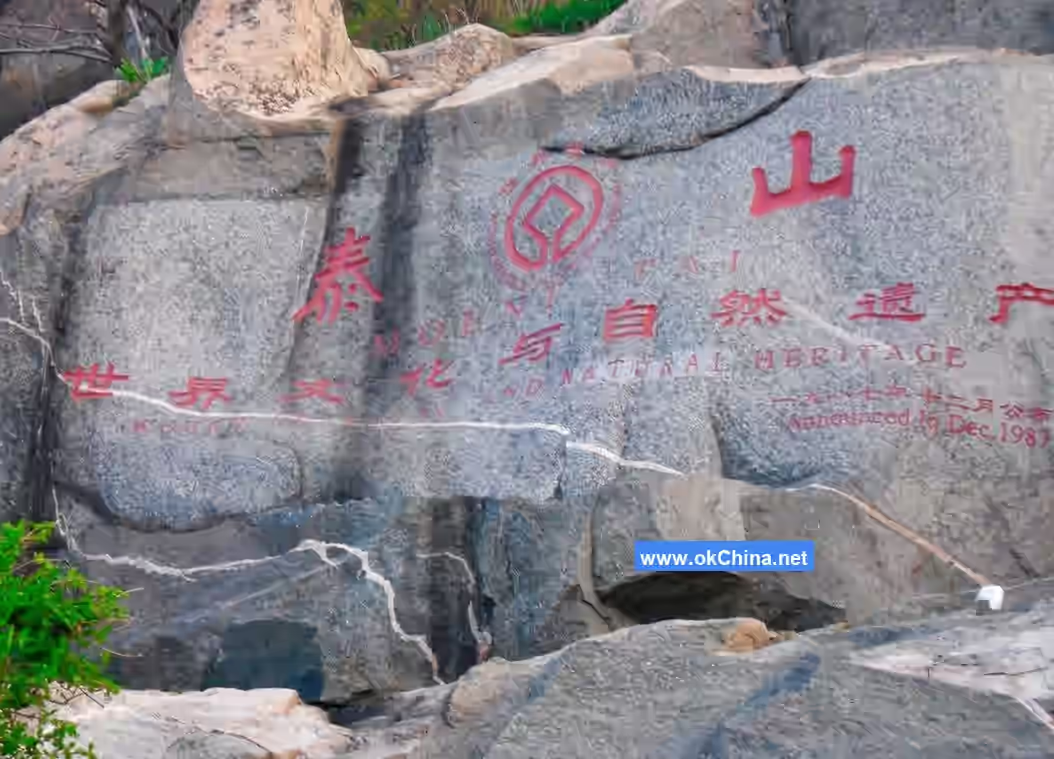
In 1978, the State Council designated the Tai'an (Mount Tai) Scenic Area for official opening to the public. In 1985, the Mount Tai Scenic Area Management Committee of Tai'an City was established. The Mount Tai Scenic Area of Tai'an City is a model of integration among Confucianism, Buddhism, and Taoism. It holds numerous honors, including being China's first World Cultural and Natural Dual Heritage site, a UNESCO Global Geopark, one of the first National Key Scenic Areas, and one of the first National 5A-level Tourist Attractions. In 2023, it received a cumulative total of 8.6197 million mountain visitors.
2. Geographical Environment
2.1 Location and Territory
The Mount Tai Scenic Area of Tai'an City is located in Tai'an City in central Shandong Province, stretching across the cities of Tai'an, Jinan, and Zibo. It extends approximately 200 kilometers from east to west and 50 kilometers from north to south, situated between 116°50'~117°12' east longitude and 36°11'~36°31' north latitude. The scenic area covers 148.97 square kilometers. The main peak, the Jade Emperor Peak, is north of the urban area of Tai'an City, at 117°6' east longitude and 36°16' north latitude, with an altitude of 1,532.7 meters. The scenic area entrance is located at No. 45 Hongmen Road, Taishan District.
2.2 Topography and Landforms
The overall terrain of the Mount Tai Scenic Area in Tai'an City is characterized by being higher in the north and west, and lower in the south and east. The main peak, the Jade Emperor Peak, is the highest peak in Shandong Province, standing at 1,532.7 meters with a relative height of 1,391 meters, towering north of Tai'an city.
2.3 Climate and Hydrology
Mount Tai lies within a warm temperate climate zone. Due to the influence of topography and altitude, the climate differs significantly between the summit and the foothills. The summit features a semi-alpine humid climate without distinct four seasons, divided only into winter and summer halves. The annual average temperature is 5.3°C, with an average temperature lapse rate of about 0.88°C per 100 meters. The urban area of Tai'an at the foothills experiences a warm temperate continental monsoon climate with four distinct seasons. The average annual precipitation on Mount Tai is 1,031.3 mm, with an average annual precipitation variation of 352.8 mm. Precipitation increases with altitude, reaching 1,132 mm at the summit and only 722.6 mm at the base. While the foothills have four distinct seasons, the summit enjoys spring-like conditions for three seasons. Spring brings strong winds and sandstorms. Winters on Mount Tai are long, with an ice period lasting up to 150 days. The lowest recorded temperature at the summit is -27.5°C, creating rime and glaze ice landscapes.
The Mount Tai Scenic Area is densely covered with springs and crisscrossed by rivers and streams, boasting relatively abundant water resources. The total water reserve is approximately 3.043 billion cubic meters, including 1.497 billion cubic meters of groundwater and 1.546 billion cubic meters of surface water, with 2.608 billion cubic meters being utilizable. The Jade Emperor Peak serves as the watershed for Mount Tai's rivers and streams. To the north, the Yufu River and Dasha River flow into the Yellow River. Rivers to the east (Shiwen River, Fengjiazhuang River), south (Shuxi River, West Stream), and west (Panwen River) all flow into the Dawen River. Due to Mount Tai's steep terrain, its rivers are short, fast-flowing, and highly erosive. Controlled by faults, the riverbeds feature many drops and waterfalls. The bedrock at valley bottoms is often eroded into potholes that fill with water, forming pools, easily creating alternating pool and waterfall landscapes. Major waterfalls include the Black Dragon Pool Waterfall, the Three Pools Cascading Waterfall, and the Yunbu Bridge Waterfall. Due to well-developed fissure structures, fissure springs are widely distributed across Mount Tai, from the summit to the foothills, creating a scene of competing springs and streams amidst towering peaks. There are dozens of famous springs, such as the Queen Mother Spring, Moon Spring, Jade Liquid Spring, Dragon Spring, Huanghua Spring, and Jade Maiden Pool. In the northern part of Mount Tai, the Middle-Upper Cambrian and Ordovician limestone strata dip northward, causing groundwater to emerge as springs where the terrain is cut. From Jinxiuchuan northward, springs are scattered everywhere. At the edge of the northern foothill hills, karst water flows northward underground and emerges in numerous locations.
2.4 Biodiversity
2.4.1 Plant Resources
Mount Tai encompasses ecosystems such as forests, shrublands, meadows, and wetlands. Forest types mainly include coniferous forests, deciduous broad-leaved forests, and mixed coniferous-broadleaf forests. As of 2017, the area of naturally regenerated Chinese pine (Pinus tabuliformis) forest on Mount Tai was about 700 mu, serving as a typical representative of natural coniferous forests in China's warm temperate zone, containing many ancient individual trees and communities of Chinese pine. The Chinese arborvitae (Platycladus orientalis) forests are mostly naturally regenerated or planted forests, with over ten thousand ancient trees older than 300 years. There are also large areas of deciduous broad-leaved forests dominated by oak species.
2.4.2 Animal Resources
As of 2022, the wild animals in the Mount Tai Scenic Area primarily represent the faunal geographical region of the hilly areas in central-southern Shandong and are mostly species commonly found in North China. This includes 25 species of mammals; 154 species and 1 subspecies of birds; 12 species of reptiles; 6 species of amphibians; and numerous, widely distributed terrestrial invertebrates. Terrestrial arthropods are also abundant, including Arachnida, Insecta, and Myriapoda. Approximately over 900 species of insects have been identified. There are 45 species of fish, belonging to 12 families including Cyprinidae, Cobitidae, Siluridae, and Salangidae. The recorded wild bird species on Mount Tai have reached 362 species across 19 orders and 64 families, accounting for 76.65% of Shandong Province's bird species (471 species in Shandong). Among these, there are 10 species of National First-Class Protected Wild Animals, 64 species of National Second-Class Protected Wild Animals, and 5 species of birds endemic to China.
2.5 Layout and Zoning
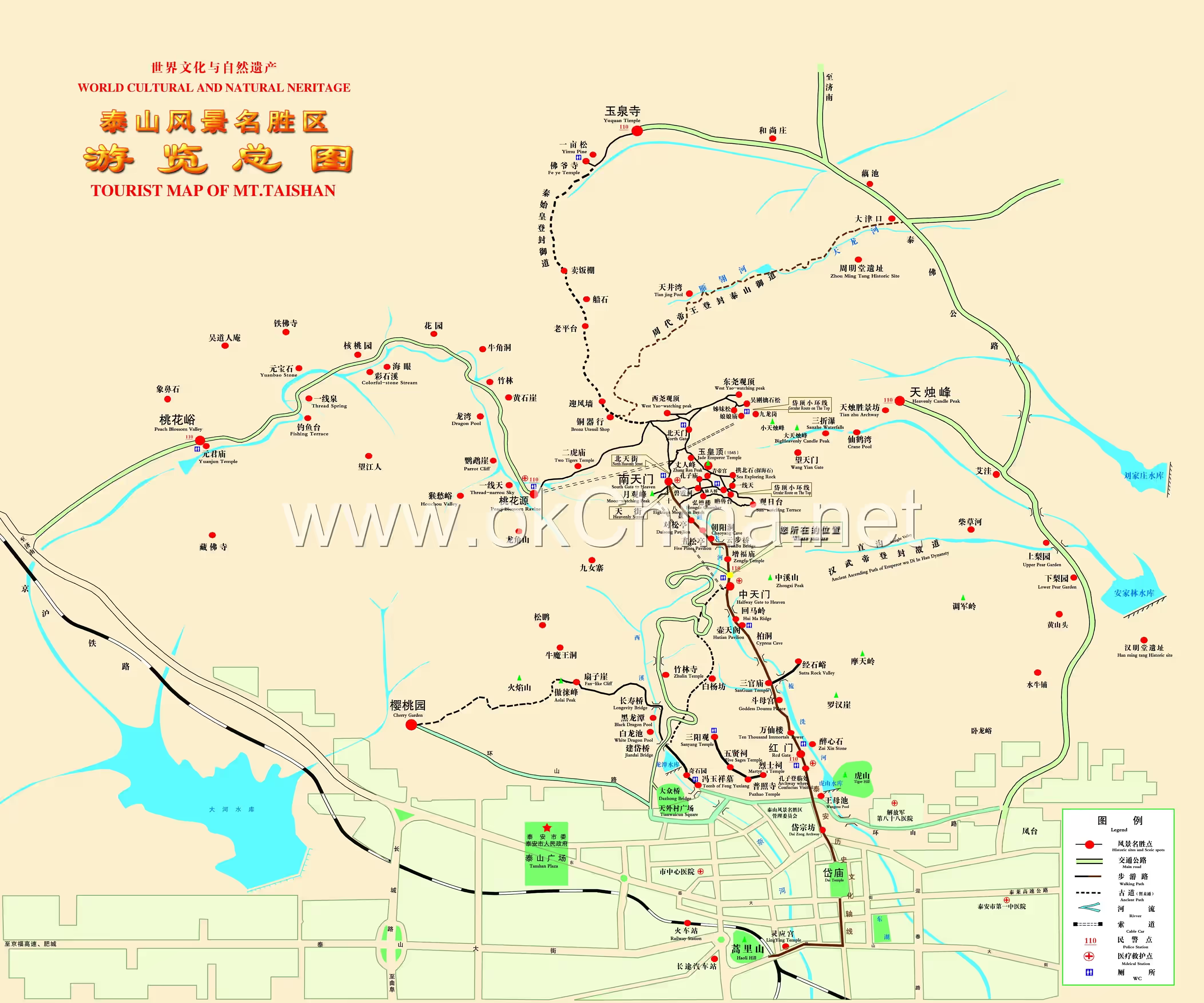
The total area of the Mount Tai Scenic Area in Tai'an City is 148.97 square kilometers. It includes six major scenic zones: the Serene Zone, the Vast Zone, the Profound Zone, the Exquisite Zone, the Elegant Zone, and the Beautiful Zone.
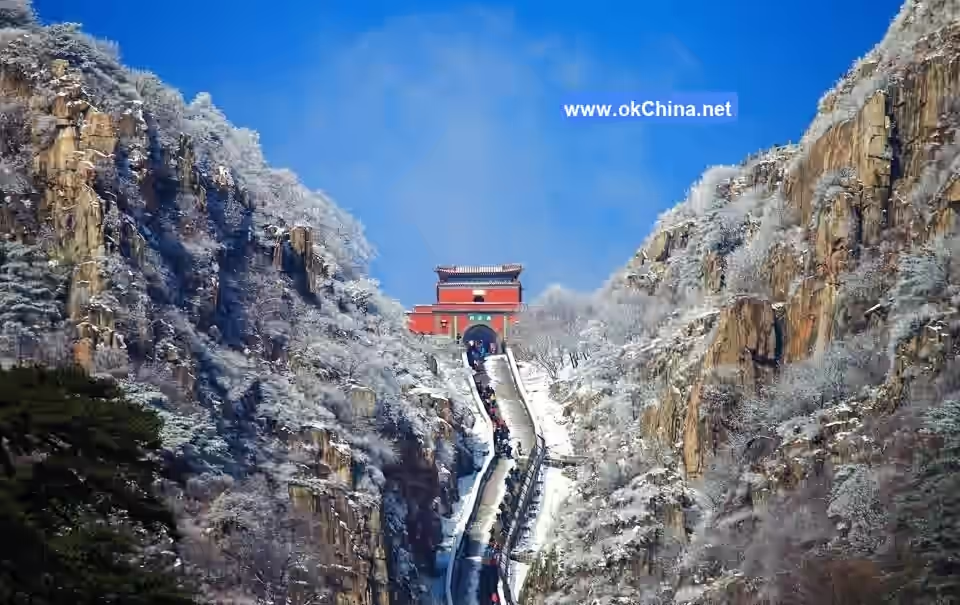
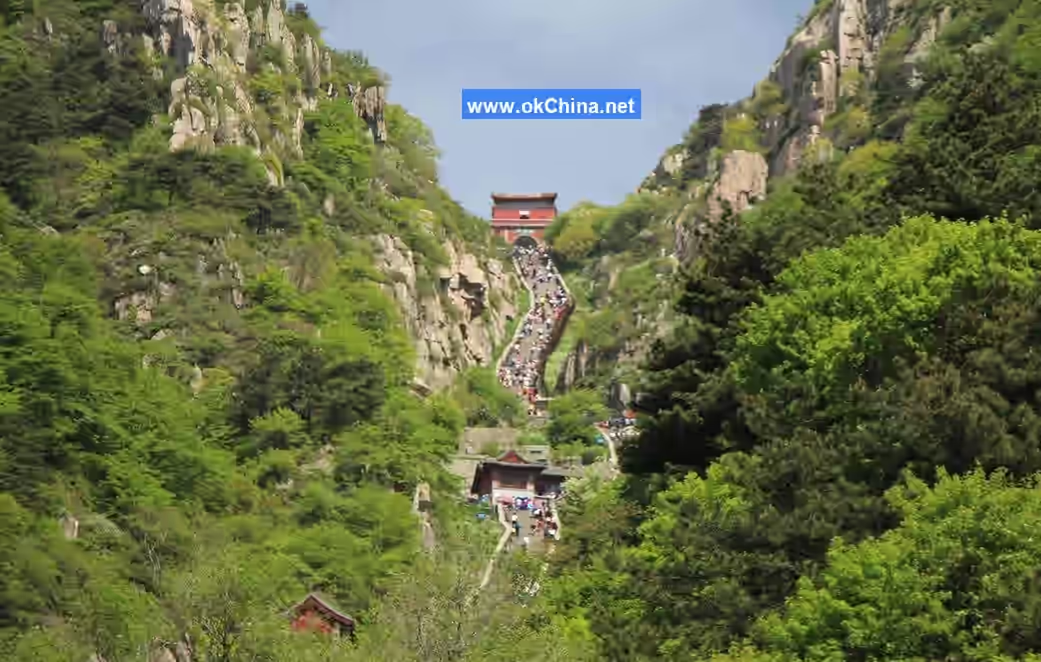
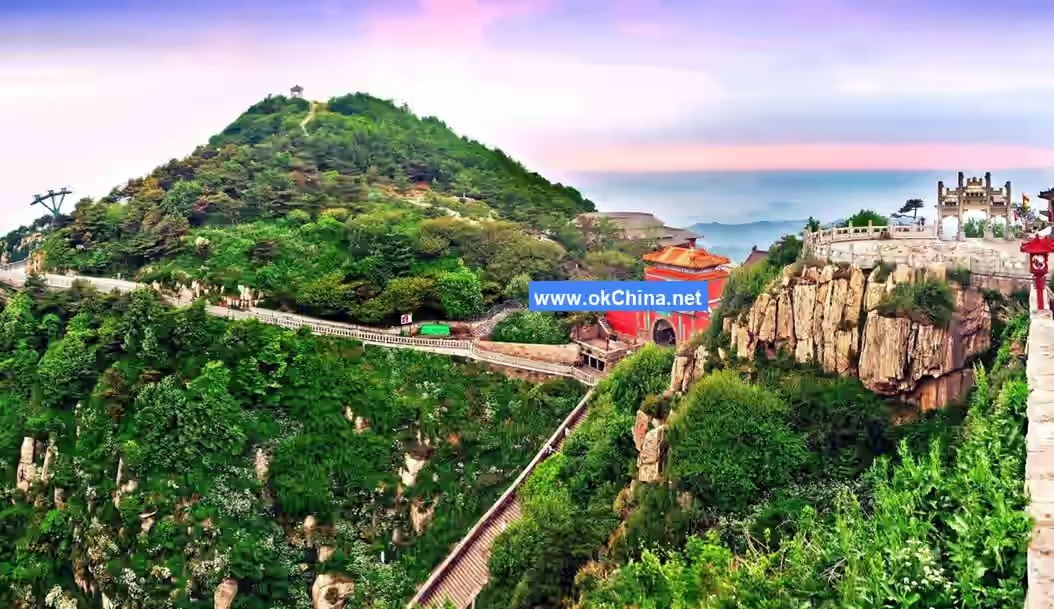
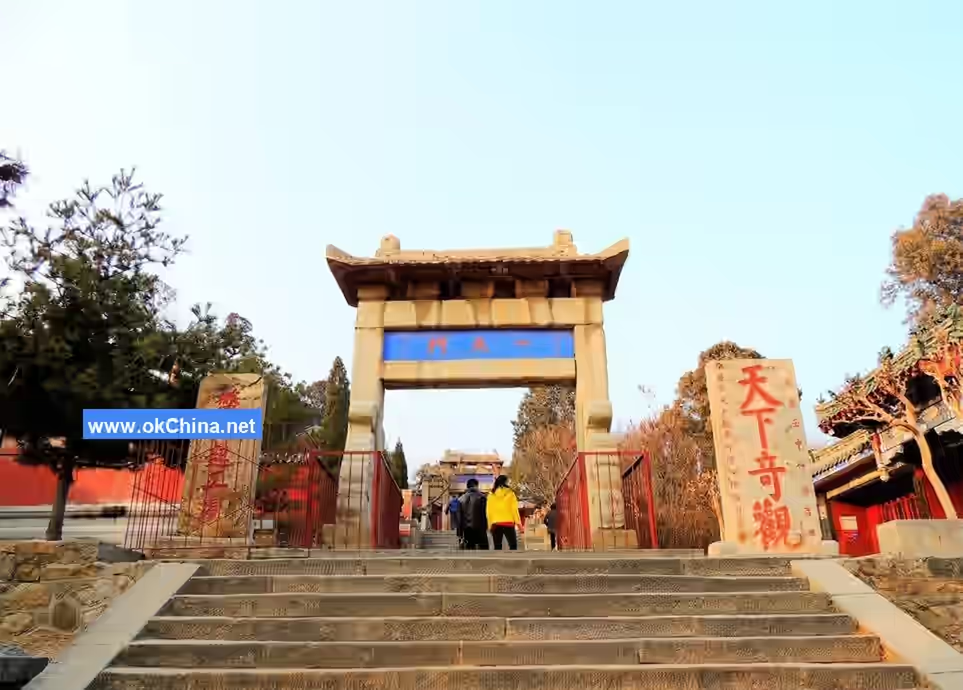
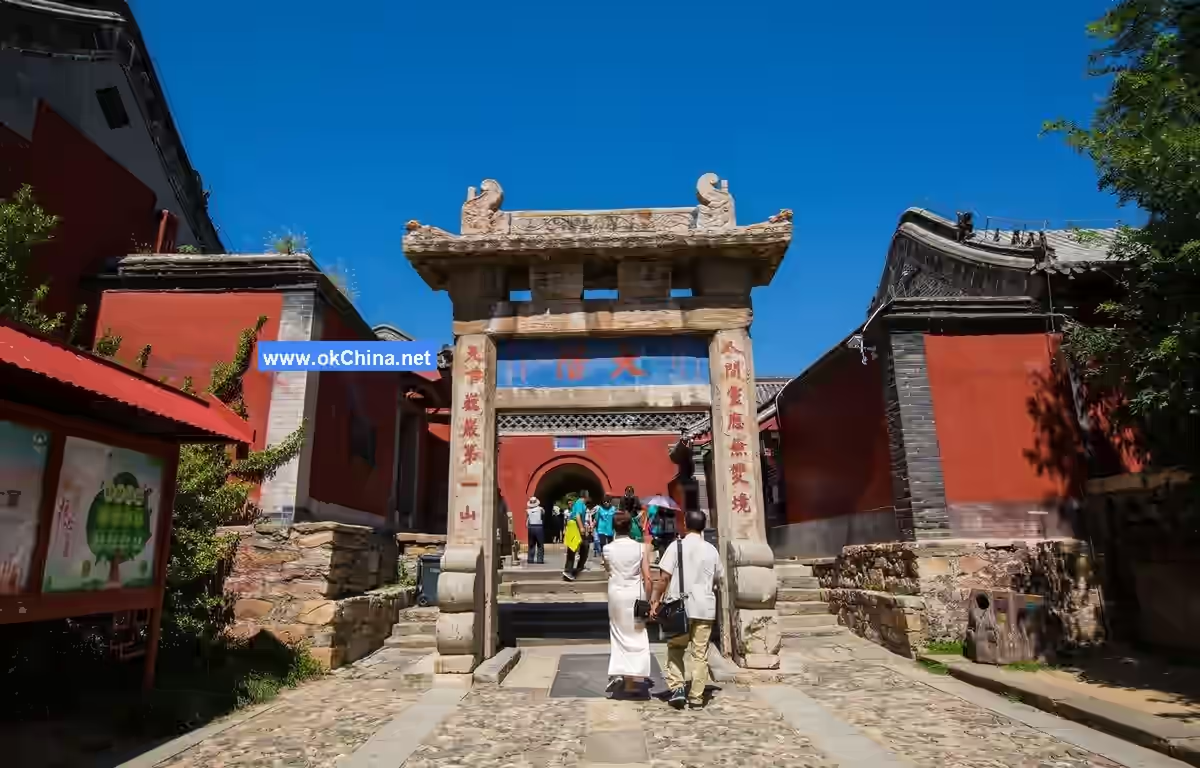
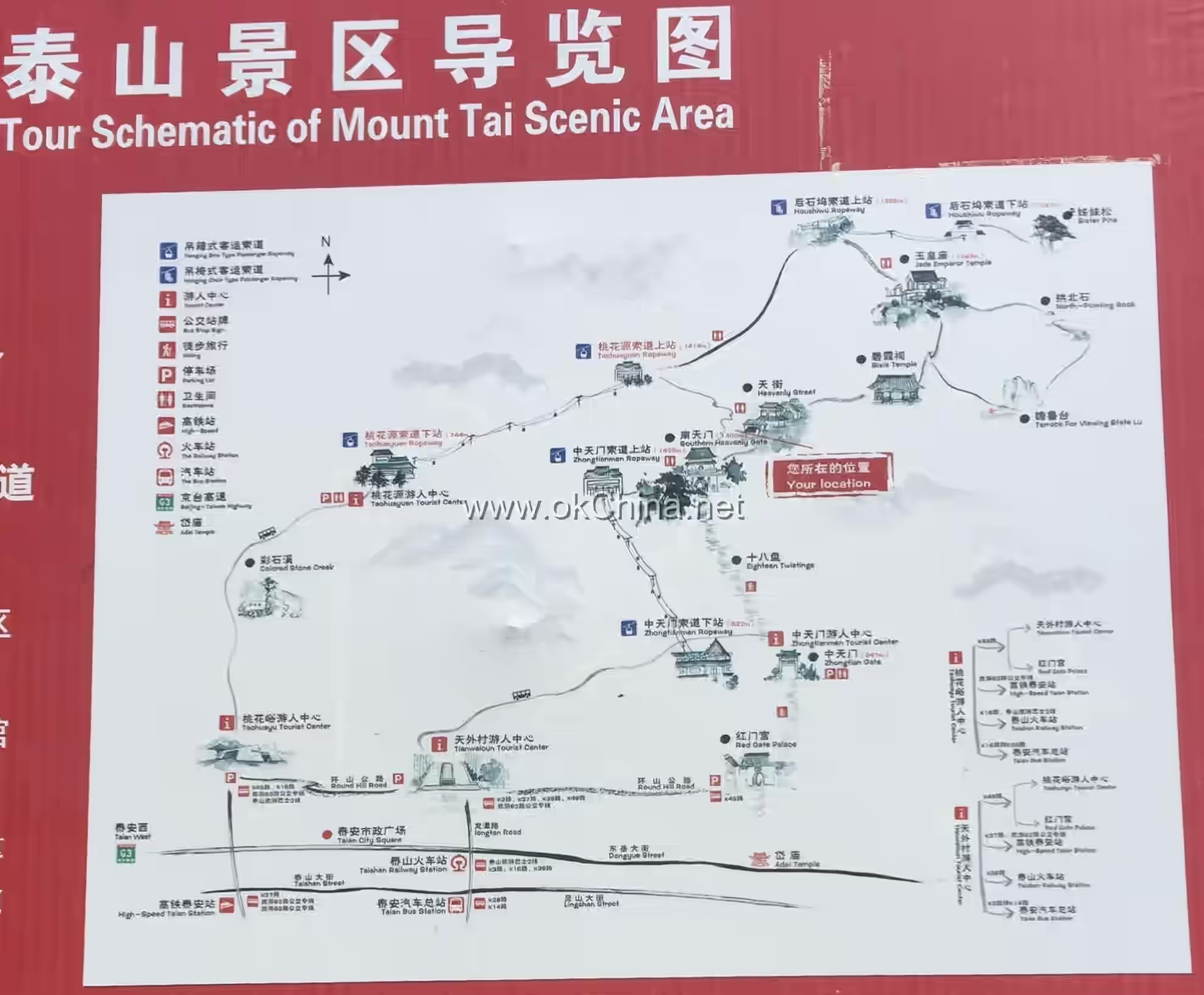
The Serene Zone of Mount Tai refers to the central route tourist area, stretching from the starting point of the mountain path at Yitianmen (First Heavenly Gate) through Zhongtianmen (Midway Gate to Heaven) to Nantianmen (South Heavenly Gate), with a total length of 5.5 kilometers, almost entirely consisting of winding paths with a total of 6,290 steps. Main attractions include the Guandi Temple, Yitianmen, Confucius' Ascension Point, Hongmen Palace, Wanxian Tower, Doumu Palace, Sutra Stone Valley, Hutian Pavilion, Zhongtianmen, Yunbu Bridge, Wusong Pavilion, Wangren Pine, Duisong Mountain, Mengxian Niche, Shengxian Archway, and the Eighteen Bends.
The Vast Zone of Mount Tai refers to the West Stream scenic area, which is the western route for ascending the mountain. Key landscapes in the Vast Zone include: Huangxi River, Longevity Bridge, Wuji Temple, Yuan Shi Tianzun Temple, Fan Cliff, Tiansheng Village, Black Dragon Pool, and White Dragon Pool.
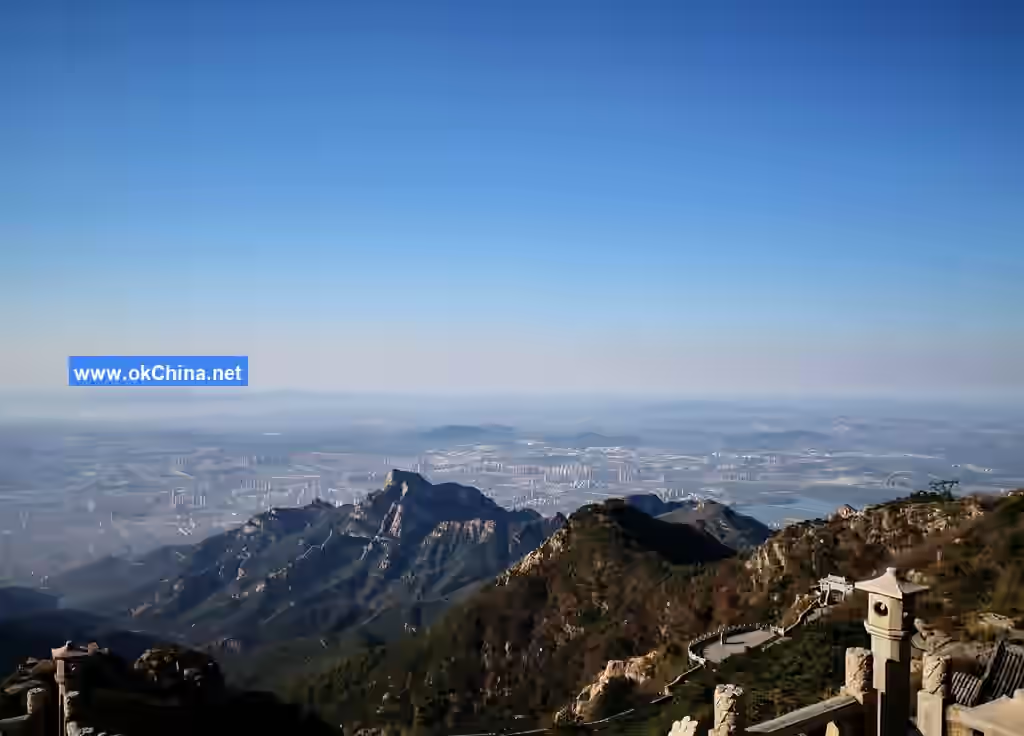
The Exquisite Zone of Mount Tai is reached by ascending from the Serene Zone, leading to the summit (Dai Ding) touring area. Main landscapes include Nantianmen, Moon Viewing Peak, Heavenly Street, White Cloud Cave, Confucius Temple, Tang Dynasty Cliff Inscriptions, Jade Emperor Peak, Sea-Probing Rock, Sun Viewing Peak, and Viewing Lu Platform.
The Profound Zone of Mount Tai centers around Houshiwu (Rear Stone Cottage). Its characteristics include majestic peaks, rugged rocks, and ancient pines vying in uniqueness. Main attractions include the Eight Immortals Cave, Grandma Temple, Duzu Pan, Tianzhu Peak, Jiulong Ridge, Huanghua Cave, Lotus Cave, and Yaoguan Terrace.
The Beautiful Zone of Mount Tai refers to the foothills and Tai'an city touring area. This zone allows visitors to appreciate the beauty of Mount Tai without climbing. Main landscapes include Shuanglong Pool, Yaocan Pavilion, Dai Temple, Daizong Archway, Wangmu Pool, Puzhao Temple, Five Sages Shrine, Han Mingtang, and Sanyang Temple.
The Elegant Zone of Mount Tai mainly includes the Peach Blossom Valley scenic area and the Cherry Orchard scenic area. Key attractions in the Peach Blossom Source scenic area include Sancha Stream, Menghu Gully, Colorful Stone Stream, Houzhai Gate, Wu Daoren Hermitage, and the Valley Entrance.## 3. Major Attractions
3.1 Dai Temple Scenic Area
Dai Temple is located in the northern part of Tai'an City, on the central axis stretching from the old South Gate of Tai'an City in the south to the South Heavenly Gate at the summit of Mount Tai in the north. It is rectangular, measuring 405.7 meters north-south and 236.7 meters east-west, covering an area of 96,000 square meters. Situated at the southern foot of Mount Tai in the central part of Tai'an City, it is also known as the Dongyue Temple, Taiyue Temple, or Daiyue Temple, commonly called the Tai Temple. It was the main site for ancient sacrifices to Mount Tai. Major attractions include: Yaocan Pavilion, Daimiao Archway, Zhengyang Gate, Han Cypress Courtyard, Tang Locust Tree Courtyard, Peitian Gate, Ren'an Gate, Eastern Imperial Seat, Three Treasures of Zhenshan, Qin Dynasty Mount Tai Stone Inscriptions, Tiankuang Hall, Tiankuang Hall Murals, Dai Temple Stele Forest, Eight Scenes of Dai Temple, Rear Living Quarters, Bronze Pavilion, Iron Pagoda, and Houzai Gate.
3.2 Dailu Scenic Area
The Dailu Scenic Area is located at the junction of Mount Tai and Tai'an City, traditionally known as the "Beautiful Area." The Ring Mountain Road runs east-west, connecting numerous attractions such as Tiger Mountain, Wangmu Pool, Guandi Temple, Golden Mountain, Puzhao Temple, Five Sages Shrine, Sanyang Temple, and Feng Yuxiang's Tomb. The Zhongxi and Xixi streams converge here to form the Tiger Mountain Reservoir and Black Dragon Pool Reservoir, which face each other east and west. Extending eastward from Dailu is the Mount Tai Agricultural Sightseeing Belt; extending westward are the Cherry Orchard and Mount Tai Tourist Resort. Major attractions include: Daizong Archway Tiger Mountain Park, Wangmu Pool, Guandi Temple, Puzhao Temple, Five Sages Shrine, Sanyang Temple, Feng Yuxiang's Tomb, and Cherry Orchard.
3.3 Hongmen Road Scenic Area
The Hongmen climbing route starts from Hongmen at the foot and ascends to the South Heavenly Gate, forming the central axis of Mount Tai. Ancient emperors ascending Mount Tai for imperial ceremonies mostly followed this winding route, hence it is called the "Imperial Path." Devotees making pilgrimages also worshipped at every temple along this path, so it is also known as the "Divine Path." With seven thousand steps leading directly to the summit, and thousands of poems and inscriptions left by literati, it is also a "Path of Ancient Poetry" and a "Path of Calligraphy." Leaving the bustling human world at Yitian Gate, climbing through Zhongtian Gate to reach Nantian Gate and enter the celestial realm, this path is also a "Path to Heaven." Major attractions: Hongmen Palace, Wanxian Tower, Doumu Palace, Sutra Stone Valley, Cypress Cave, Hutian Pavilion, Huima Ridge, Zhongtian Gate, Happy Three Li, Cloud Step Bridge, Five Pines of the Grandee, Chaoyang Cave, Duisong Mountain, and Eighteen Bends.
3.4 Daiding Scenic Area
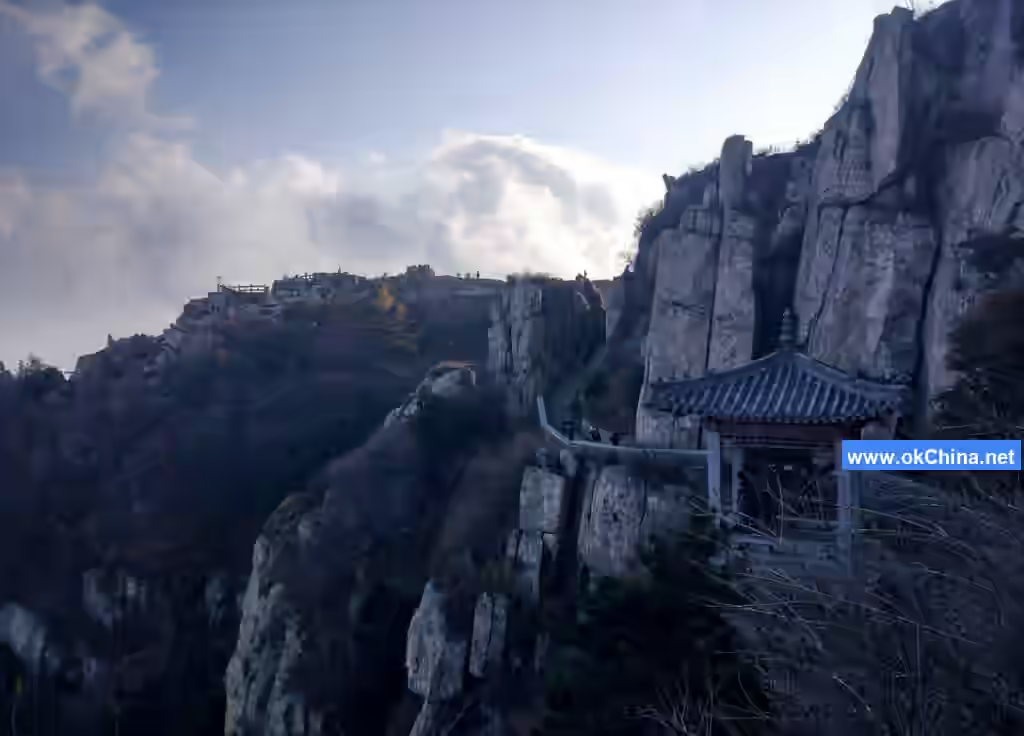
The area above the South Heavenly Gate of Mount Tai is Daiding (Summit Area), covering 0.6 square kilometers. In the overall spatial layout of Mount Tai, Daiding represents the "Celestial Realm." Ancient emperors came here to perform the Fengshan ceremonies, building altars to worship heaven, hoping to communicate with the heavens and pray for national peace and prosperity. The four wonders of Mount Tai are: Sunrise, Sunset Glow, Sea of Clouds, and Golden Belt of the Yellow River. Other natural phenomena include Buddha's Halo, Rime, and Glaze Ice. Major attractions: South Heavenly Gate, Heavenly Street, Bixia Temple, Tang Cliff Inscriptions, Jade Emperor Summit, Wordless Stele, Riguan Peak, Zhanlu Terrace, Immortal Bridge, Yueguan Peak, and Zhangren Peak.
3.5 Houshiwu Scenic Area
Located in the northeast of the Jade Emperor Summit within the Mount Tai Scenic Area of Taishan District, Tai'an City, and situated directly north of the Jade Emperor Summit, this area has been traditionally called the "Profound Area." Major attractions: Yaoguan Peak, Sister Pines, Crouching Dragon Pine, Crouching Tiger Pine, and Yuanjun Temple.
3.6 Tianwaicun Road Scenic Area
Tianwaicun in Tai'an is located at the mouth of the West Stream Valley, west of the Public Bridge, marking the starting point of the western route ascent, covering a total area of 35,000 square meters. The Tianwaicun Road, formerly called the "Western Route," is a scenic mountain road. Starting from the Tianwaicun Heaven and Earth Square, it follows the West Stream upwards, passing the Black Dragon Pool Reservoir, Jiandai Bridge, White Dragon Pool, and Black Dragon Pool, reaching Bamboo Forest Temple. From Bamboo Forest Temple, one can go west to climb Fanzi Cliff and Aolai Peak, or north to view Longjiao Mountain and Jiunvzhai. From Huangxi River, it ascends to Zhongtian Gate where it meets the Hongmen climbing route. The winding road is 13 kilometers long, taking about 30 minutes by tourist bus. Major attractions: Heaven and Earth Square, White Dragon Pool, Black Dragon Pool Waterfall, Bamboo Forest Temple, and Fanzi Cliff.
3.7 Taohuayuan Road Scenic Area
Taohuayuan (Peach Blossom Valley) is located in the northwest of Mount Tai and serves as the western gate to the summit. Entering from the mouth of Taohua Valley, the scenic road follows the valley floor for over 10 kilometers. Zhang Zhichun, a Taoist priest of Mount Tai during the Yuan Dynasty, wrote a poem: "Flowing water comes from the heavenly cave, a vein connecting the human world; Peach Blossom Spring is not far, where fallen red petals flow." The stream in Taohuayuan contains the Mount Tai specialty—the red-scaled fish, which was a tribute item during the Qing Dynasty. Major attractions: Yuanbao Stone, Colorful Stone Stream, Yixian Spring, Houchou Valley, and Yixiantian (Thread of Sky).
3.8 Tianzhufeng Road Scenic Area
The Tianzhufeng Scenic Area is located northeast of the Jade Emperor Summit on Mount Tai and serves as the eastern gate to the summit. The entrance to the climbing route is about 20 kilometers from Tai'an Railway Station. It is the most primitive and ancient among the conventional routes to the summit and also the most beautiful in terms of natural scenery, representing the pinnacle of Mount Tai's natural landscape. Taking a car from Tai'an along the Taifo Road northeast to Aiwa Village, one enters the mountain from the Tianzhu Shengjing Archway. Passing through ancient chestnut forests and Huixian Valley, and ascending steep stone steps leads to Xianhe Bay (Immortal Crane Bay). The stream flows through the stone bay, resembling the shape of an immortal crane. Crossing the stream and pulling on iron chains, one climbs Haohan Slope (Hero's Slope) and Xiaoshibapan (Small Eighteen Bends), where two peaks stand facing each other with Wangtian Gate (Gate Gazing at Heaven) built between them. North of Wangtian Gate is Shanhu Terrace (Mountain Call Terrace), overlooking a vast abyss and facing the Great Tianzhu Peak. Major attractions: Huixian Valley, Xianhe Bay, Xiaoshibapan, and Tianzhufeng.
3.9 Yuquan Temple Scenic Area
Yuquan Temple is located north of the summit, on the northern side of Mount Tai in Dajinkou Township. It is about 20 kilometers from Tai'an City along the Taifo Road, with a straight-line distance of 6.3 kilometers, covering over 20,000 mu. Yuquan Temple, also known as Gushan Temple or Foye Temple, was founded during the Northern Wei Dynasty, over 1,400 years ago. It was repeatedly renovated and expanded during the Jin and Yuan Dynasties, reaching its peak during the Ming and Qing Dynasties with over a hundred monks. The ancient temple complex houses the largest ancient ginkgo tree in the Mount Tai area. Major attractions: Mahavira Hall, One-Mu Pine, and West Buddha Foot.
3.10 Mount Tai Lingyan Temple
Mount Tai Lingyan Temple is situated at the northwestern foot of Mount Tai, within Wande Town, Changqing District, Jinan City. It is 45 kilometers north of Jinan and 25 kilometers south of Tai'an, with National Highway 104 and the Jingfu Expressway (which has a Lingyan Temple exit) passing nearby. Lingyan Temple was built during the Eastern Jin Dynasty, over 1,600 years ago. Since the Tang Dynasty, it has been known as one of the "Four Great Temples in China," alongside Guoqing Temple in Zhejiang, Qixia Temple in Nanjing, and Yuquan Temple in Hubei. Lingyan Temple is now an important component of Mount Tai, a UNESCO World Natural and Cultural Heritage site, a National Key Cultural Relics Protection Unit, a National Scenic Area, and one of the first batch of National 4A-level Tourist Attractions.
3.11 Mount Tai Puzhao Temple
Mount Tai Puzhao Temple is located at the foot of Linghan Peak on the Dailu, covering an area of 6,150 square meters. Puzhao Temple, meaning "Buddha's Light Shines Everywhere," is said to have been built during the Six Dynasties period and expanded in subsequent dynasties. The temple is centered around the Mahavira Hall and Mosong Tower, forming a three-courtyard complex with side halls, meditation rooms, and gardens. The Six Dynasties Pine resembles a canopy. Next to it is the Shaiyue Pavilion (Moon-Sifting Pavilion). When the bright moon is in the sky, silvery light filters through the pine needles like sifting moonlight, hence the name. Inside the pavilion is a square stone table that produces bell and chime sounds when struck, with different tones at its four corners and center, known as the Five-Tone Stone. North of the pavilion is the Mosong Tower. A couplet at Shaiyue Pavilion reads: "The winding path, deep with clouds, is suitable for planting bamboo; the empty pavilion, bright with moonlight, rightly faces the tower." When Mr. Feng Yuxiang lived in seclusion on Mount Tai, he wrote many vernacular poems based on local customs and people's hardships, calling them "soldier poems." They were illustrated by Zhao Wangyun and carved onto stone tablets erected in the courtyard. These were later destroyed but have now been re-carved. The rear courtyard is the Julin Courtyard, with a pine tree. During the Guangxu period of the Qing Dynasty, He Huanzhang visited and inscribed "First-Rank Official" on it. The main room of the rear courtyard connects to the Mosong Tower, with a plaque reading "Juliu Jiuyin" (Old Seclusion of Julin), which was the residence of Monk Yuan Yu in the early Kangxi period. It is now a memorial hall. A couplet reads: "The pine says it loves green, the bamboo says it loves verdure; heaven is my brick, earth is my tile."
3.12 Mount Tai Bamboo Forest Temple
In the West Stream Valley of Mount Tai, above the Black Dragon Pool and northeast of the present-day Longevity Bridge, there was originally a temple called Bamboo Forest Temple, also known as Xuanyun Temple (Hanging Cloud Temple). It was praised for its "small paths along the mountains, clear streams flanking the road, winding like a sheep's intestine, with scenery changing at every step." It is said that Bamboo Forest Temple is an ancient temple of Mount Tai, with its construction date unknown. It flourished and declined repeatedly after the Tang Dynasty. According to records, it was rebuilt by the famous Yuan Dynasty monk Fahai during the Yuanzhen period. By the Ming Dynasty, the Korean monk Mankong expanded it, and the temple prospered again. Later, it was destroyed in a fire and has now been rebuilt on the original site in Tang Dynasty style.
3.13 Yuquan Temple
Yuquan Temple is located north of the summit, with a straight-line distance of 6.3 kilometers and a mountain path of over 20 kilometers. There is a road connecting it to Tai'an City. To the southeast are Lotus Peak, Incense Burner Peak, the former site of Zhou Mingtang, and Tianjing Bay; to the west is Motian Ridge; to the south is Maifan Pengzi; to the north are Fandao Mountain and the Great Wall Ridge. Yuquan Temple was founded by the Northern Wei monk Yi, rebuilt by the Jin Dynasty monk Shanning, and expanded with the Seven Buddha Pavilion by the Yuan Dynasty monk Pujin. It flourished and declined repeatedly afterwards. In ancient times, villagers found Arhat statues in the valley, hence the names Foyu (Buddha Valley) and Fogu. Also, because there is Gushan to the south and Yuquan (Jade Spring) to the east, it is also called Gushan Temple or Gushan Yuquan Temple, commonly known as Foye Temple. The site contains 10 stone tablets, surrounded by over twenty thousand-year-old chestnut trees. Originally, there was a Mahavira Hall enshrining Sakyamuni with eighteen Arhats standing beside him and murals on the walls. The main hall worshipped early Tang politician Wei Zheng, among others. It was destroyed during the Cultural Revolution. Today, it is the site of the Lixin Forest Farm within the Yuquan Temple Scenic Area.
3.14 Dai Temple
Dai Temple is a National Key Cultural Relics Protection Unit, formerly known as the Dongyue Temple or Mount Tai Temporary Palace. Located north of Tai'an City at the southern foot of Mount Tai, it is the largest and most complete ancient architectural complex on Mount Tai. As a Taoist divine mansion, it was where emperors throughout history held the Fengshan ceremonies and worshipped the God of Mount Tai.There are records stating that "the Qin dynasty built the temple" and "the Han dynasty also erected palaces." During the Tang dynasty, in the thirteenth year of the Kaiyuan era (725), expansions were carried out, and further expansions occurred in the second year of the Dazhong Xiangfu era of the Song dynasty (1009). According to the "Stele Inscription of the Reconstructed Taiyue Temple," there were "813 bays of halls, sleeping quarters, main halls, side chambers, gates, pavilions, storehouses, guesthouses, towers, observatories, corridors, and verandas." Some structures were destroyed during the Jin dynasty, and further expansions were made during the Yuan dynasty. In the twenty-sixth year of the Jiajing era of the Ming dynasty (1547), most of the temple buildings were burned down, and repairs were carried out again during the Qing dynasty. The architectural style follows that of imperial palaces, with a perimeter of over 1,500 meters and more than 150 ancient buildings within the temple grounds.
3.15 Eighteen Bends
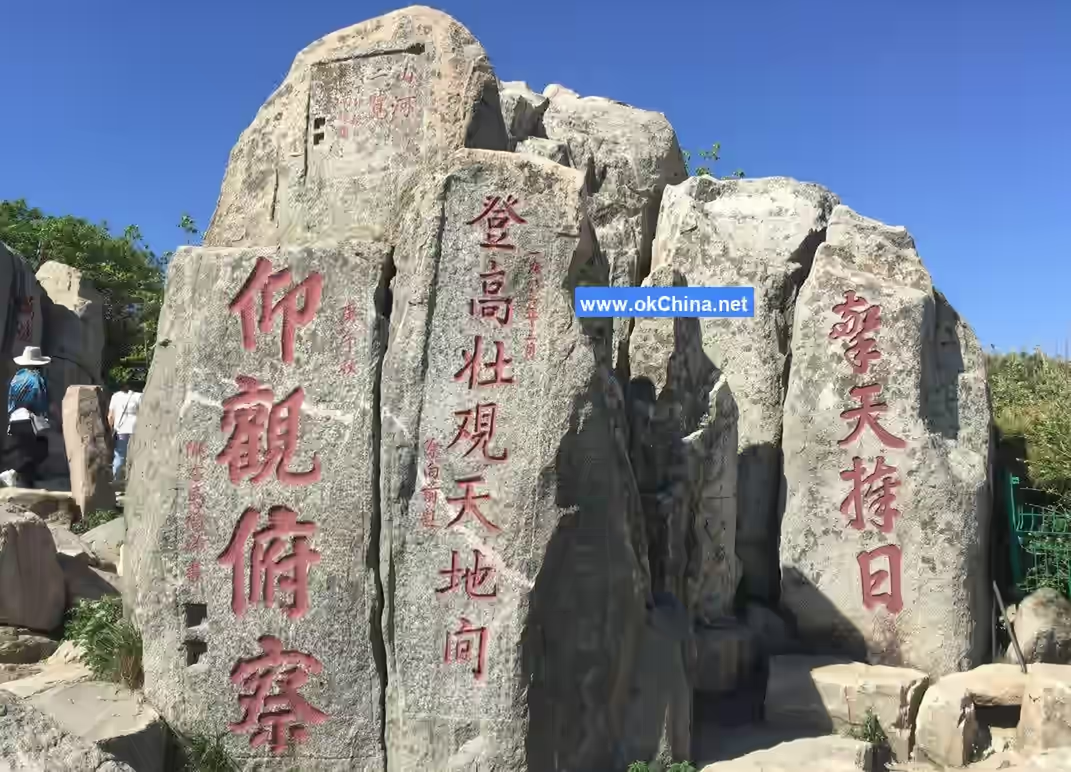
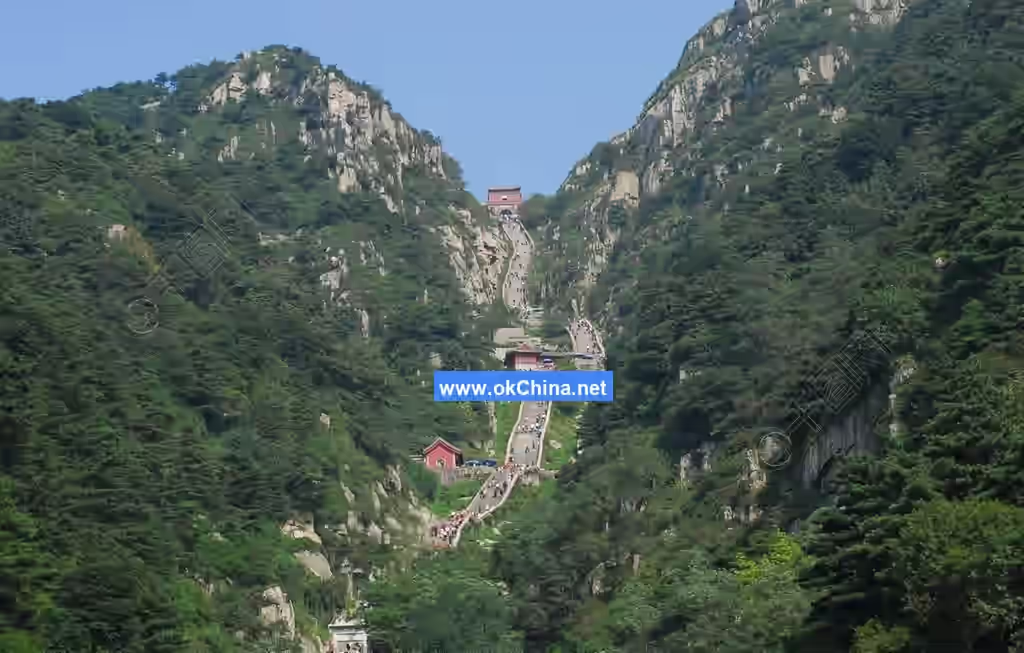
The Eighteen Bends of Mount Tai is the most treacherous section of the mountain's climbing path, consisting of 1,827 stone steps and covering an area of 8 square kilometers. It is one of the main landmarks of Mount Tai. The Eighteen Bends is located north of Dui Song Mountain. On the elevated terrain, cliffs flank the path, formerly known as Yunmen (Cloud Gate) and now called Kaishan (Mountain Opening), which was created during the reconstruction of the path in the late Qianlong era of the Qing dynasty. The Eighteen Bends begins here. North of Kaishan is Longmen (Dragon Gate), where the Longmen Arch once stood but was later destroyed. On the western cliff, there is a large inscription of "Longmen" in wild cursive script, carved by Wei Xiang during the Daoguang era of the Qing dynasty. East of the arch site is Da Long Valley. Ahead lies the New Path Entrance. During the Wanli era of the Ming dynasty, the provincial administrator Lü Kun built the Dutian Bridge across the ravine and constructed a new path along the upper reaches of Long Valley, leading directly to the South Divine Gate of the Bixia Temple, making it convenient for climbers to ascend and descend the summit. Both the bridge and the path were destroyed during the Qianlong era of the Qing dynasty. North of the New Path Entrance, two mountains stand steeply: Feilong Cliff to the east and Xiangfeng Ridge to the west. Between them lies a narrow gorge called Shibi Valley (Stone Wall Valley). In the valley, the South Heavenly Gate is located above, and the Shengxian Arch is below, connected by the Eighteen Bends. The South Heavenly Gate is situated precisely at the valley entrance, exemplifying how Mount Tai's ancient architecture fully utilizes the geographical environment, enhancing and beautifying the natural landscape through human effort. It is one of the important landmarks of Mount Tai. On both sides of Shibi Valley, there are inscriptions such as "Heavenly Gate Long Roar," "Layered Cliffs and Empty Valley," "Heavenly Gate Cloud Ladder," and "As If Ascending to the Sky." There is a saying that Mount Tai has three sections of the Eighteen Bends: from Kaishan to Longmen is the "Slow Eighteen," from there to Shengxian Arch is the "Neither Fast Nor Slow Eighteen," and from there to the South Heavenly Gate is the "Fast Eighteen," totaling over 1,630 steps. On the western cliff of the "Fast Eighteen," there is a Welcoming Buddha. The rock layers of the Eighteen Bends have an inclination of 70 to 80 degrees, rising 400 meters within a distance of less than 1 kilometer.
3.16 Bixia Temple
The Bixia Temple is located at the summit of Mount Tai and is dedicated to the goddess Bixia Yuanjun. It was first built in the first year of the Dazhong Xiangfu era of the Song dynasty (1008 AD). The temple is divided into inner and outer courtyards by its main gate. The main hall in the inner courtyard houses a bronze statue of Bixia Yuanjun, with a roof covered in bronze tiles, while the east and west side halls are covered with iron tiles.
3.17 Heavenly Street
The Heavenly Street of Mount Tai refers to the street stretching from the South Heavenly Gate eastward to the Bixia Temple, with a total length of about one li (approximately 0.5 kilometers). The section north of the South Heavenly Gate, about 100 meters long, is called the North Heavenly Street. After passing through the South Heavenly Gate and ascending two flights of steps, one reaches the Heavenly Street, which has long been likened to a market suspended in the sky. Along the approximately one-kilometer-long Heavenly Street, there are numerous hotels, restaurants, and shops. According to records, the Heavenly Street began to flourish during the Qing dynasty, when shopkeepers used physical objects as signs, such as "Wooden Mallet," "Wooden Bowl," and "Parrot." East of the Heavenly Street stone arch and north of the road are the site of Emperor Qianlong's traveling palace and the former study of the Tang dynasty literary figure Su Yuanming. The north side of the street features later-constructed imitation ancient buildings, while the south side has a long stone railing where visitors can lean and enjoy the night view of Tai'an City. The Heavenly Street—a market in the sky—is also one of China's top ten unique markets. Historically, shops here have used physical objects as trademarks, such as the "Strainer Shop," "Gourd Shop," and "Double Dipper Shop."
3.18 Self-Sacrifice Cliff
The Self-Sacrifice Cliff is located south of the Sun Viewing Peak and is also known as the Self-Love Cliff. It is steep on three sides, with an abyss below. In ancient times, people often prayed to deities and jumped off the cliff to demonstrate their sincerity, hoping to cure their parents' illnesses. In the early Wanli era of the Ming dynasty, Governor He Qiming built a wall along the cliff to prevent such unnecessary deaths and renamed the site the Self-Love Cliff. During the Kangxi era of the Qing dynasty, the prefect of Tai'an, Zhang Qifeng, rebuilt the wall and stationed watchmen to guard it. In 1965, a round gate was opened at the southern end of the wall, and a viewing stone railing was built along the cliff edge. On the cliff, there is a large stone about 3.3 meters high, with the inscription "Zhan Lu Tai" (Viewing Lu Platform) beside it, also known as the Flagpole Stone. Legend has it that Confucius once stood here to gaze toward the capital of Lu, Qufu. On the stone, there are inscriptions from 1983 by Zhao Puchu, "Creation Gathers Divine Beauty," and by Zhou Erfu, "Mist Horizontally, Clouds Leaning." Northeast of the stone, there is a flat large stone at the edge of the cliff called the Kezhi Platform, with inscriptions from the Zhenghe era of the Song dynasty. On the southern cliff face, halfway up, there is a stone niche with a statue of Manjushri riding a lion, believed to be from the Northern Song dynasty. Three meters to the left, there are inscriptions such as "Yucheng County, Yingwang Mansion, Yongqiu County, Yuncheng Hengzheng, Second Year of Yuan (1087 AD)"; five meters to the right, there are inscriptions such as "Inner Palace Attendant High-Ranking Huangfu Jiming, Inner Palace Attendant Dual-Serving Official Zhou Dezheng, Right Reminder and Direct Historian Li Di."
3.19 Longevity Bridge
Above the Black Dragon Pool of Mount Tai, there is an east-west bridge. The bridge is vermilion red. Walking on it, one can see the scenery of the pool. This is the Longevity Bridge.
4. Historical Evolution
4.1 Naming
In ancient times, it was initially called Huoshan (Fire Mountain) and Taishan (Great Mountain). The character "大" (da) appears in both oracle bone and bronze inscriptions, pronounced as "tai." Moreover, "太山" (Taishan) means "great mountain." In pre-Qin ancient texts, "大" (da) and "太" (tai) were interchangeable. According to "Pian Ya Xun Zuan · Shi Ming Cheng": "In ancient times, the character '太' was often written without a dot, as in '太极' (Taiji), '太初' (Taichu), '太室' (Taishi), '太庙' (Taimiao), '太学' (Taixue), etc. Later, a dot was added to distinguish it from the character '大' (da), thus splitting them into two." According to traditional readings of ancient characters, "大" also has three pronunciations: "da," "tai," and "dai." During the Spring and Autumn and Warring States periods, due to the extension of homophones and the evolution of synonyms, "太" (tai) and "泰" (tai), "代" (dai) and "岱" (dai), and "岱" (dai) and "岳" (yue) became interchangeable. Thus, specialized names such as "泰山" (Taishan), "岱山" (Daishan), "岱宗" (Daizong), and "岱岳" (Daiyue) emerged successively. The name "泰山" first appeared in the "Book of Songs." "泰" (tai) means extremely great, smooth, and peaceful. The "Yi · Shuo Gua" states, "Tread and be peaceful, then be secure." The character "泰" extended from its original meanings of greatness and smoothness to "great and stable, stable and secure." Subsequently, expressions such as "as stable as Mount Tai," "the country is prosperous and the people are at peace," and "as weighty as Mount Tai or as light as a feather" emerged.
4.2 Human Activities
4.2.1 Pre-Qin Period
Mount Tai entered human awareness early. As early as 500,000 years ago, the "Xintai Man" of the Paleolithic era thrived at the foot of Mount Tai. During the Neolithic Age, the Dawenkou culture, represented by the Dawenkou site at the foot of Mount Tai, emerged. Against the backdrop of this advanced culture, Mount Tai became a sacred mountain revered by many ethnic groups. During the Xia, Shang, and Zhou dynasties, Mount Tai worship reached its peak as a representation of faith. Since the First Emperor of Qin, 12 emperors have performed Fengshan ceremonies and offered sacrifices at Mount Tai, forming a culture of imperial worship.
During the Xia dynasty, Emperor Yu performed Fengshan ceremonies at Mount Tai, and the Shang tribe's minister Xiangtu established a capital at the foot of Mount Tai. During the reign of Shang Emperor Tang, Fengshan ceremonies were performed at Mount Tai and Yunyao. During the reign of Shang Emperor Wuyi, the Dongyi tribe near Mount Tai grew increasingly powerful. After the establishment of the Zhou dynasty, multiple eastern campaigns were launched against the Dongyi, with the area near Mount Tai being one of their ancestral聚居区. In the twelfth year of King Wu of Zhou, the Duke of Zhou, Dan, was enfeoffed at Qufu, placing Mount Tai within the territory of the State of Lu. During the Spring and Autumn and Warring States periods, Mount Tai, as one of the "Four Sacred Mountains," was managed by feudal lords. Later, the officials managing Mount Tai became专职官员 dedicated to presiding over its worship.
4.2.2 Qin to Han Dynasty Period
During the Qin dynasty, Mount Tai belonged to Jibei Commandery and Qi Commandery. After unifying China, the First Emperor of Qin, in the third year of his reign (219 BC), toured the east and performed Fengshan ceremonies at Mount Tai. In 209 BC, the Second Emperor of Qin also performed Fengshan ceremonies at Mount Tai and erected stone inscriptions to commemorate his achievements. During the Han dynasty, the Taishan Commandery was established to manage Mount Tai and administrative affairs, integrating governance, religion, rituals, and military justice. The prefects and commandants of Taishan Commandery during the Han dynasty were often renowned scholars,功臣, or generals. For example, during the reign of Emperor Xuan of Han, the Confucian scholar Yan Wang, and during the reign of Emperor Ai, the Confucian scholar Gong She. Additionally, officials such as the Yue Ling (Mountain Official), Miao Ling (Temple Official), and the Daiyue Zhenshi Duyuhou (Joint Manager of Mount Tai) were appointed to jointly manage Mount Tai. It was not until the Kaibao era of the Song dynasty, when the county seat was moved to the ancient Daiyue Town, that the county magistrate began to concurrently manage Mount Tai. During the reign of Emperor Wu of Han, the King of Jibei presented Mount Tai and its surrounding territories, and the king became the祠官 responsible for imperial sacrifices at Mount Tai. Emperor Wu of Han performed Fengshan ceremonies at Mount Tai eight times.
4.2.3 Wei, Jin, and Northern and Southern Dynasties Period
During the Wei, Jin, and Northern and Southern Dynasties, various major religions in China flourished and spread. Buddhism and Taoism进驻 Mount Tai, promoting the融合 of its原始信仰 and emerging religions, transforming it into a "religious mountain." In the fifth year of the Yixi era of the Jin dynasty, Chancellor Liu Yu launched a northern expedition against the Southern Yan, capturing Mount Tai. After the fall of the Southern Yan, Mount Tai was recovered as Jin territory. During the Yixi era, the Indian monk Buddhabhadra arrived at Mount Tai and built a temple on its northern foothills, named the Buddhabhadra Temple, also known as the Yunchan Temple.
4.2.4 Sui, Tang, Song, and Jin Dynasties Period
During the Sui, Tang, Song, and Jin dynasties, the peak of Chinese literature, art, and academic development was also reflected in Mount Tai culture. Scholar-officials, primarily literati,竞相 ascended Mount Tai, leaving behind大量诗文华章. Especially during the盛唐 and late Jin periods, Mount Tai literary creation迎来 two peaks, with frequent masterpieces by renowned writers. In the sixth year of the Wude era of the Tang dynasty, the separatist Xu Yuanlang, who controlled the Mount Tai area, was defeated by Tang forces, and Mount Tai从此 began to be controlled by the Tang court. During the Zhenguan era, caves were carved and Buddha statues were built at the summit of Lingyan Mountain. In the sixth year of the Xianqing era, in the second month, Empress Wu Zetian of Emperor Gaozong of Tang ordered the Taoist priest Dongyue先生 Guo Xingzhen to perform rituals and create statues at Mount Tai, erecting a dual stele to record the events, known as the "Mandarin Duck Stele." In the first year of the Qianfeng era, in the first month, Emperor Gaozong of Tang performed Fengshan ceremonies at Mount Tai and禅 at Sheshou Mountain, erecting stele inscriptions such as the "Deng Feng Ji Hao Wen" at Mount Tai.During the Song Dynasty, the emergence of the Taishan Academy and the Taishan School marked a shift in the cultural mainstream toward the literati, despite frequent activities by emperors, monks, and Taoists on Mount Tai. This period can be referred to as the "Cultural Mountain" era for Mount Tai.
4.2.5 Yuan, Ming, and Qing Dynasties
During the Yuan, Ming, and Qing dynasties, folk beliefs on Mount Tai flourished. With the widespread dissemination of the belief in Bixia Yuanjun across the country, a surge of pilgrims journeyed to Mount Tai to offer incense. This influenced the activities of emperors and literati on the mountain, which began to reflect folk customs. Additionally, from the Jin and Yuan dynasties to the Qing Dynasty, counties were established under prefectures and departments. Magistrates, prefects, and county magistrates regarded the worship and management of Mount Tai as one of their primary duties. They also appointed dedicated officials, such as the Taishan Guard and Acting Taishan Guard (temporary appointments), to oversee Mount Tai. The Qing imperial court dispatched officials or ordered governors, provincial administration commissioners, Tai'an prefects, department magistrates, and county magistrates to perform rituals on Mount Tai, whether praying for snow, rain, abundant harvests, or averting disasters such as floods, droughts, river breaches, and earthquakes. During the Republic of China period, institutions such as the "Government Preservation Committee," "Antiquities Preservation Committee," and "Mount Tai Forest Farm" were established in Tai'an County to administer Mount Tai.
4.2.6 Republic of China Period
During the Republic of China period, General Feng Yuxiang, opposing the Nationalist government's non-resistance policy, retreated to Mount Tai twice: in 1932 and from August 1933 to October 1935. During his time there, he built the Martyrs' Shrine and the Monument to the Luanzhou Uprising Martyrs of the 1911 Revolution on Mount Tai to commemorate the martyrs of the Luanzhou Uprising.
4.2.7 After the Founding of the People's Republic of China
After the founding of the People's Republic of China, the "Mount Tai Antiquities Preservation Committee" and "Mount Tai Forest Farm" were established. In 1955, these were renamed the "Tai'an County Cultural Relics Preservation Office" and "Mount Tai Restoration Committee." Simultaneously, the Shandong Provincial Government established the "Mount Tai Construction Committee." In 1956, it was renamed the "Shandong Province Mount Tai Management Office," and in 1958, it was upgraded to a bureau under the leadership of Jinan City. The "Communist Party of China Mount Tai Working Committee" was also established. In 1961, it was designated as the "Tai'an Prefecture Mount Tai Administration Bureau." In July 1968, the Tai'an Regional Revolutionary Committee abolished the Mount Tai Administration Bureau, and Mount Tai was temporarily managed by the Regional Film Exhibition Hall. In May 1970, the Mount Tai Management Committee was established. In April 1976, the Mount Tai Administration Bureau was restored. In 1978, the State Council officially opened the Tai'an (Mount Tai) scenic area to the public. In May 1985, after Tai'an was designated as a prefecture-level city, the Mount Tai Scenic Area Management Committee was established based on the existing administrative structure. In April 1996, the Mount Tai Management Committee merged with the Municipal Tourism Bureau, but in December 1998, it was separated and re-established as an independent entity.
4.3 Myths and Legends
4.3.1 Pangu Creates the World
Among the countless famous mountains in the world, why have emperors and common people throughout history revered Mount Tai above all others? Legend has it that in the earliest times, when the world was newly formed and heaven and earth had just separated, a man named Pangu grew between them. Each day, the sky rose by one zhang, the earth thickened by one zhang, and Pangu grew taller by one zhang. Day after day, year after year, he lived supporting heaven and earth. After 18,000 long years, the sky became extremely high, the earth extremely thick, and Pangu extremely tall. His breath turned into wind, his exhalations into thunder, and his blinking eyes emitted flashes of blue light, which became lightning. When he was happy, the sky turned sunny and bright; when he was angry, it became overcast and rainy. Eventually, Pangu grew old and passed away. In an instant, the giant fell, and his head transformed into the Eastern Peak (Mount Tai), his abdomen into the Central Peak, his left arm into the Southern Peak, his right arm into the Northern Peak, his feet into the Western Peak, his eyes into the sun and moon, his hair into grass and trees, and his sweat into rivers. Because Pangu created the world, later generations revered him as the ancestor of humanity, and his head became Mount Tai. Thus, Mount Tai is known as the "First Mountain Under Heaven" and the leader of the Five Sacred Mountains.
4.3.2 The Great Deity of the Eastern Peak
The Great Deity of the Eastern Peak is the god of Mount Tai, also known as the Lord of Mount Tai or the Lord of the Five Sacred Mountains. He ranks second in the Jade Purity Palace and leads the Five Sacred Mountains. Legend says he is the fifth-generation descendant of Pangu. He governs human souls, overseeing life and death, social status, and official positions, and is regarded as the origin of all things. From the Warring States period to the Han Dynasty, Mount Tai remained the sacred site for emperors to perform the Feng and Shan rituals to report their achievements to heaven.
4.3.3 Bixia Yuanjun
Bixia Yuanjun, also known as the Jade Maiden of Mount Tai, is commonly called the Lady of Mount Tai or the Old Lady of Mount Tai. Taoism holds that Bixia Yuanjun "protects all living beings and responds to the nine provinces," "commands the divine soldiers of the sacred mountain and observes the good and evil in the human world." She is an important goddess in Taoism and one of the most influential goddesses in Chinese history.
As for her origins, one account says she is a jade maiden sent by the Yellow Emperor, while another claims she is the Jade Maiden of Mount Hua. However, she is generally regarded as the goddess of Mount Tai and the daughter of the deity of Mount Tai.
4.3.4 Taishan Shigandang
At the foot of Mount Tai, nearly every household embeds a "guardian deity" in the walls of their homes: Taishan Shigandang. These stone tablets are ubiquitous in the Tai'an area, and visitors to Mount Tai often take one home as a souvenir. Today, this "guardian deity," used for protecting homes, warding off evil, and ensuring peace, has gradually become a folk belief. Through stone carvings and myths, its powerful protective legacy continues to be passed down.
Comments
Post a Comment