Pan Mountain Scenic Area in Tianjin
I. Introduction
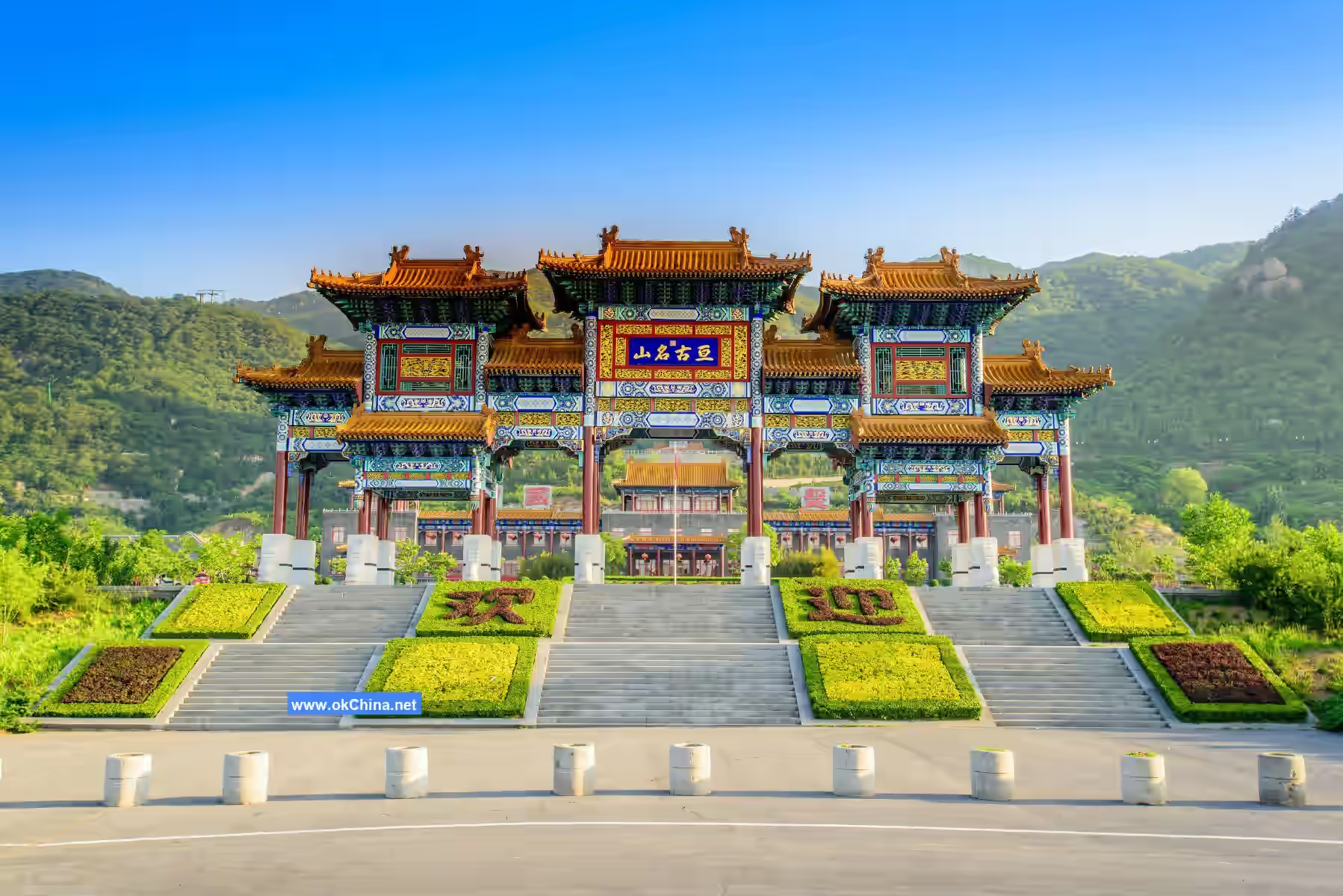
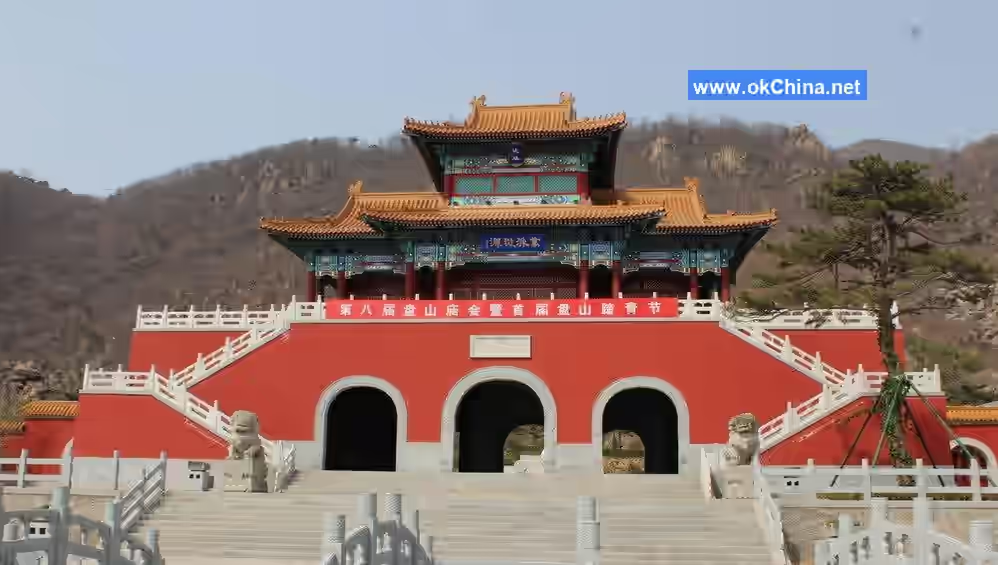
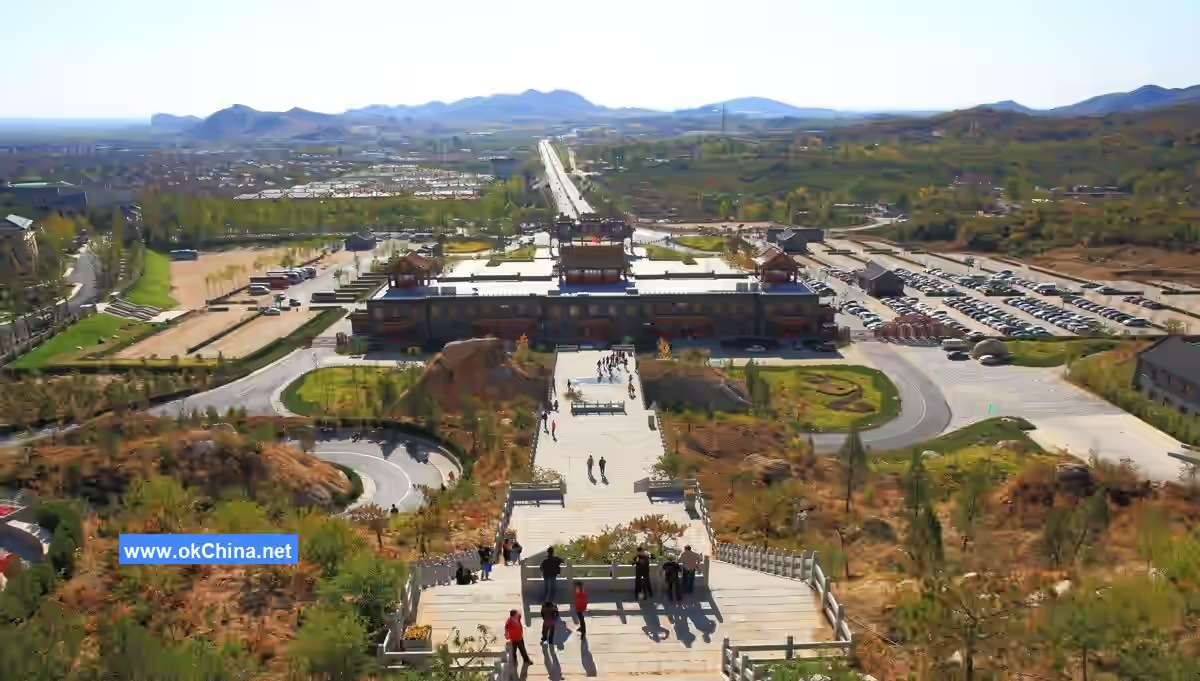
The Pan Mountain Scenic Area in Tianjin is located 15 kilometers northwest of Jizhou District, Tianjin. It is 60 kilometers west of Beijing, 120 kilometers east of Tangshan City in Hebei Province, and 110 kilometers south of Tianjin. The scenic area is accessible via the Tianjin-Jizhou Expressway and Beijing-Pinggu Expressway, which lead directly to the parking lot, as well as the Beijing-Shenyang Expressway and National Highway 102. Covering an area of 106 square kilometers, it is renowned as the "First Mountain East of Beijing" due to its prominent location east of the capital.
Pan Mountain was historically known as Wuzhong, Xuwu, Sizheng, and Panlong. Legend has it that during the late Eastern Han Dynasty, the renowned scholar Tian Chou declined an imperial appointment from Emperor Xian and chose to live in seclusion here. As a result, the mountain came to be known as Tian Pan Mountain, later abbreviated as Pan Mountain. It is a national scenic area and a 5A-rated tourist attraction, celebrated for its harmonious blend of natural landscapes, historical sites, Buddhist culture, and imperial heritage.
"Among the mountains north of Ji, Pan Mountain stands supreme." Since ancient times, Pan Mountain has captivated countless literati with its breathtaking scenery, inspiring numerous poems and writings. This has left behind a wealth of precious historical and cultural heritage, forming a distinctive Pan Mountain cultural tradition. It can be said that Pan Mountain is not only a magnificent natural wonder but also a culturally significant mountain. Buddhist culture, in particular, plays a prominent role in Pan Mountain's heritage. It is believed that Buddhism was introduced to Jixian County during the Eastern Han Dynasty, with the first Buddhist temple in the area—Xianglin Temple—built at the foot of Pan Mountain. During the Tang Dynasty, Buddhism flourished on Pan Mountain, earning it the reputation as the "Eastern Wutai Mountain." More than ten temples, including Yunzhao Temple, Wansong Temple, Tiancheng Temple, Tianxiang Temple, Qianxiang Temple, Ganhua Temple, Shangfang Temple, and Zhongpan Temple, were constructed during this period. By the Ming and Qing dynasties, especially during the Qing Dynasty, Pan Mountain entered its golden age. The Qing court allocated funds multiple times for large-scale construction, expansion, and renovation of the temples. As a result, Pan Mountain boasted 72 temples and nearly a thousand monks, solidifying its fame as the "First Mountain East of Beijing."
II. Geographical Environment
Location and Boundaries
The Pan Mountain Scenic Area is situated between 40°05′–40°06′ north latitude and 117°15′–117°18′ east longitude. It lies in the northern part of Guanzhuang Township, Jizhou District, 12.5 kilometers northwest of the county seat. It is 60 kilometers west of Beijing, 120 kilometers east of Tangshan City in Hebei Province, and 110 kilometers south of Tianjin. The scenic area is accessible via the Tianjin-Jizhou Expressway and Beijing-Pinggu Expressway, which lead directly to the parking lot, as well as the Beijing-Shenyang Expressway and National Highway 102.
Geology
The geological strata of the Pan Mountain Scenic Area's heritage protection zone consist of dolomite and limestone from the Middle and Upper Proterozoic Changcheng and Xian Systems, as well as Mesozoic granite.
Topography
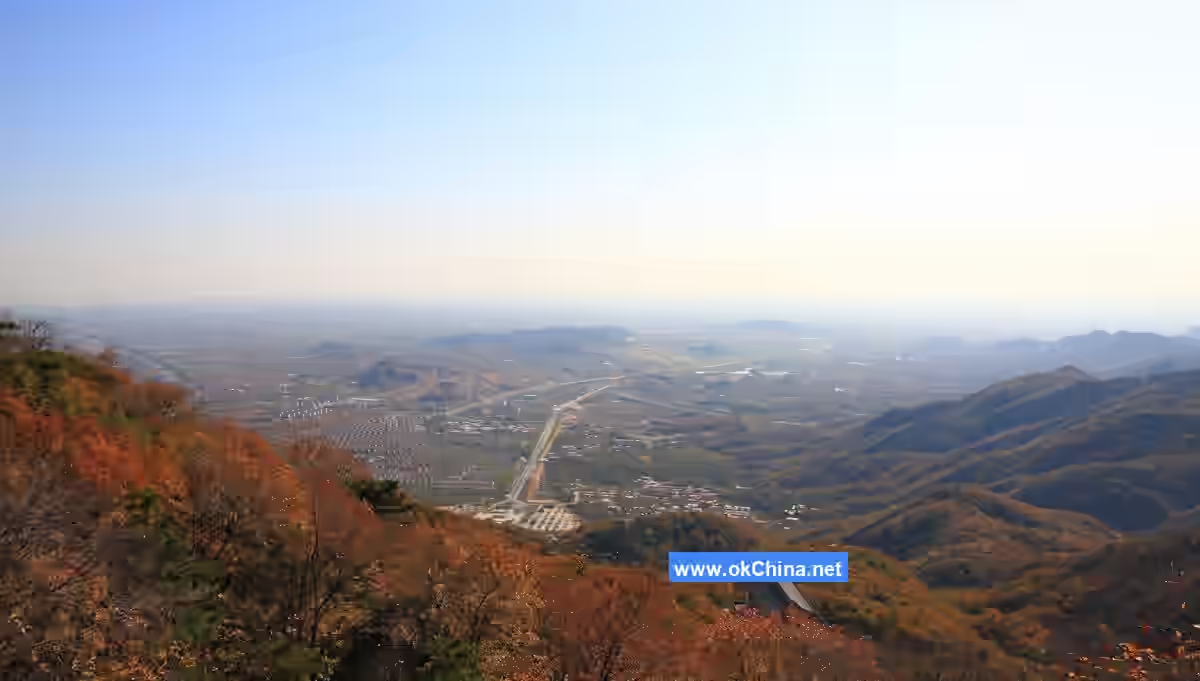
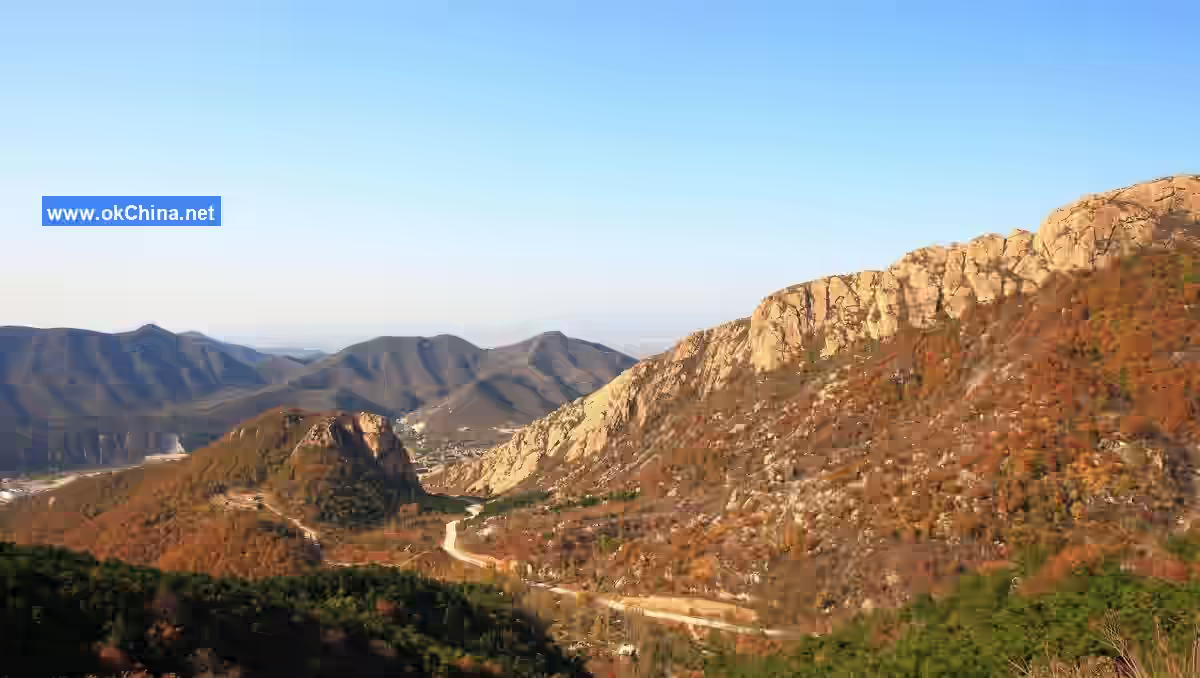
The topography of the Pan Mountain Scenic Area is primarily characterized by low mountain and hilly terrain. The slopes are steep, mostly ranging from 20° to 30°, with many cliffs reaching inclines of 70° to 80°. Due to joint development and spherical weathering, the area features rugged and peculiar rock formations.
Soil
Most of the soil in the Pan Mountain Scenic Area is leached cinnamon soil, a zonal soil type in the warm temperate zone of North China. In the mid-mountain areas above 800 meters in elevation, influenced by topography, climate, and vegetation, mountain brown forest soil has developed, which is also a zonal soil type in the warm temperate zone of North China.
Hydrology
The rivers in the Pan Mountain area belong to the Ju River system. Due to the fault contact between Pan Mountain and the North China Plain, the lack of transitional hilly terrain, and the significant elevation difference with higher terrain in the north and lower in the south, the rivers in the area mostly flow from north to south, with short courses and rapid currents. The main rivers include the Zhang River, originating from the Zigai Peak of Pan Mountain, and the Tuerzhi River, a tributary of the Tubawei River, which originates from the Guayue Peak, the main peak of Pan Mountain.
Vegetation
The vegetation in the Pan Mountain Scenic Area primarily consists of natural Chinese pine forests, oriental arborvitae forests, and oak forests. The flora is complex, dominated by North China regional components, with additional elements from Northeast China, Inner Mongolia, and tropical and subtropical regions. The vegetation types are diverse, including deciduous broad-leaved forests such as oak forests, goldenrain tree forests, sumac forests, aspen forests, and Manchurian walnut forests; coniferous forests such as natural oriental arborvitae forests and Chinese pine forests; mixed coniferous and broad-leaved forests of Chinese pine, arborvitae, and oak; as well as shrub and grassland vegetation types.
Mineral Resources
Jizhou District, where Pan Mountain is located, is the primary source of solid minerals in Tianjin. Energy minerals include coal; metal minerals include manganese, tungsten, molybdenum, gold, and iron; non-metallic minerals include cement limestone, construction dolomite (limestone), construction diabase, ceramic clay (purple shale), metallurgical dolomite, barite, pyrite, cement clay, cement shale, potassium-bearing rock, marble, sepiolite, granite, silica, medical stone, construction sand, molding sand, peat, boron, and brick clay. However, among the solid mineral deposits in Jizhou District, only ceramic clay (purple shale), construction dolomite (limestone), and potassium-bearing rock are large-scale deposits, while the rest are small to medium-sized (predominantly small).
Layout and Orientation
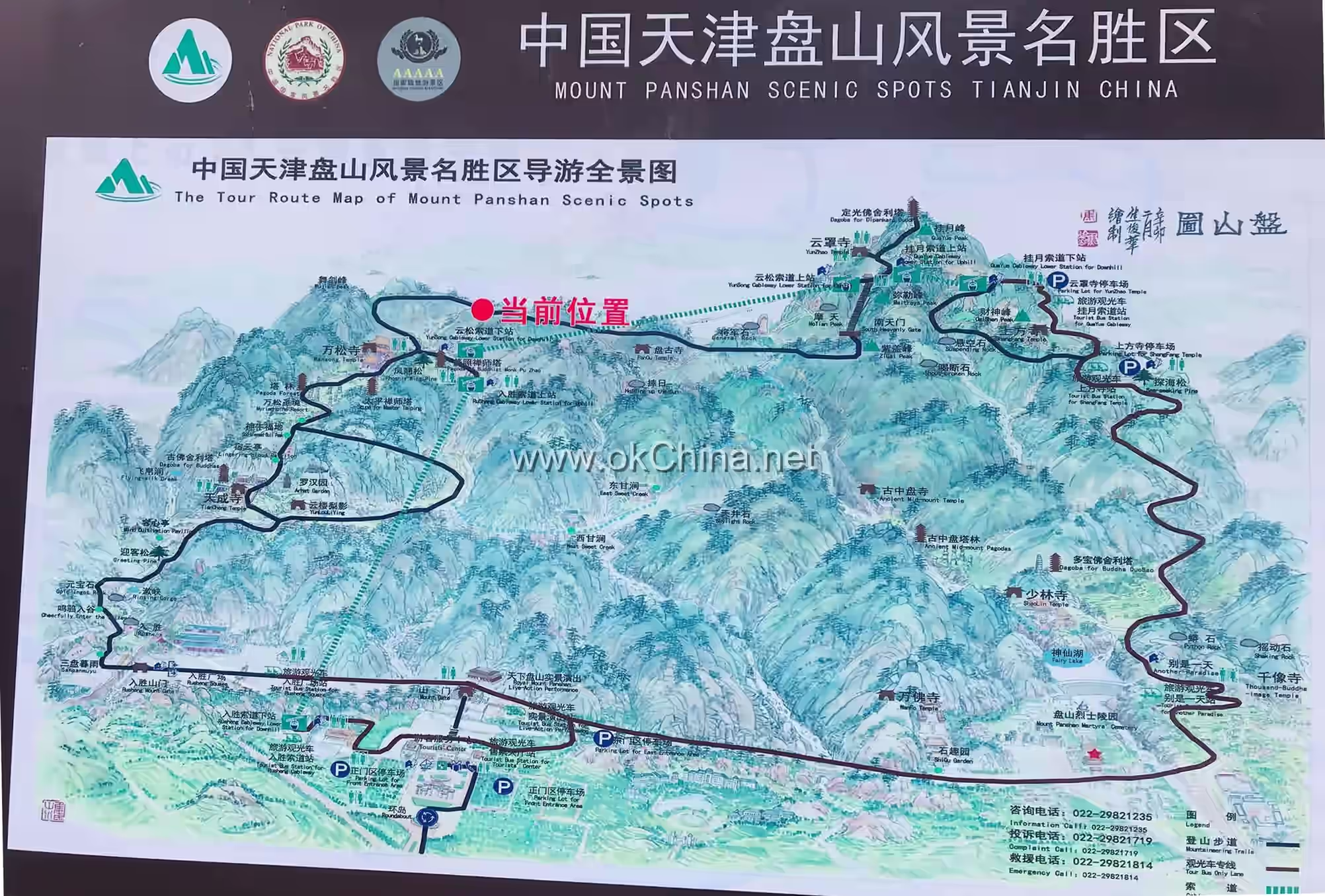
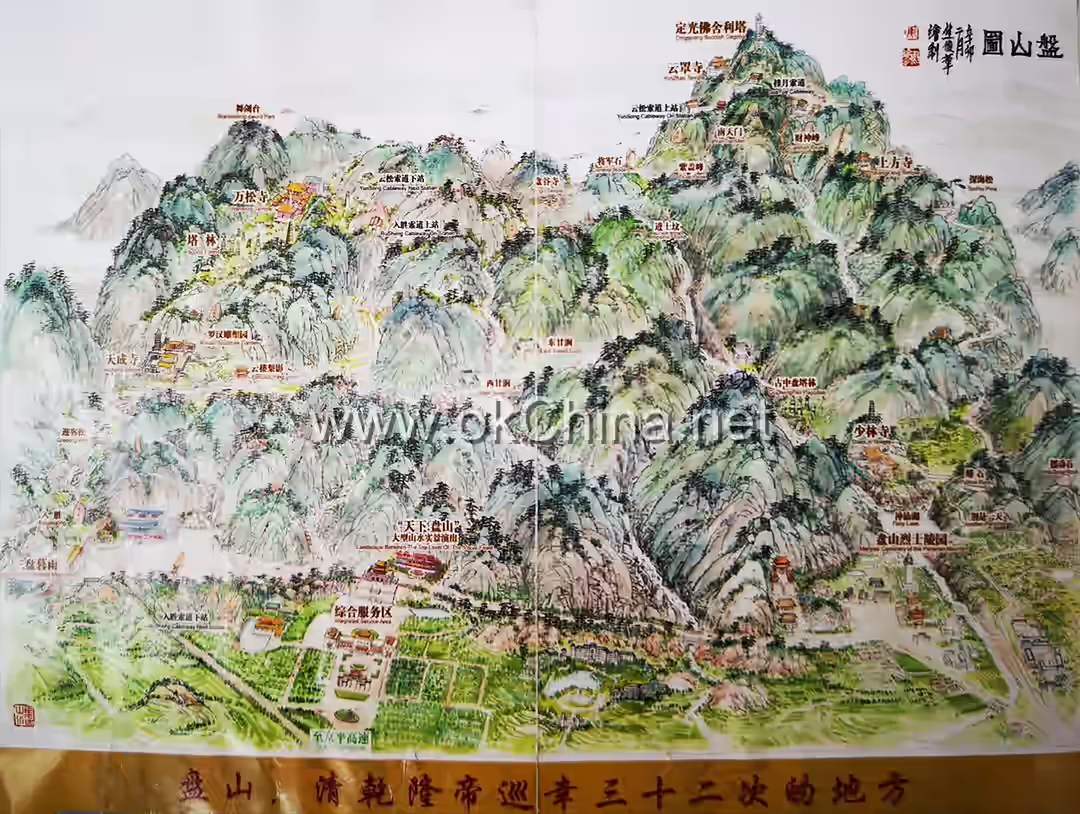
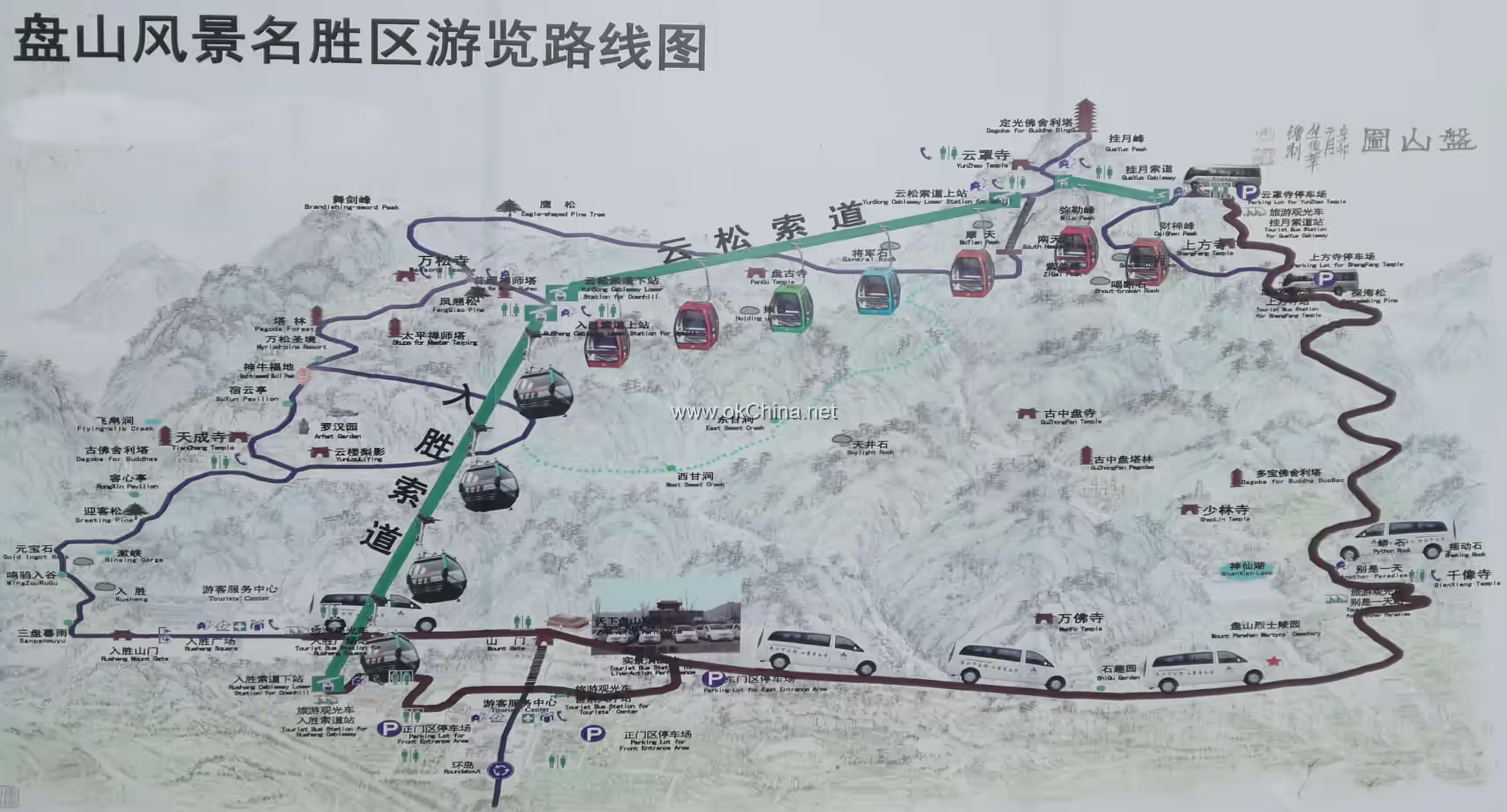
Pan Mountain is a segment of the southern edge of the Yanshan Mountain Range, stretching 20 kilometers from east to west and 10 kilometers from north to south. The Pan Mountain Scenic Area covers 106 square kilometers and features attractions such as the "Three Pans," "Five Peaks," and "Eight Stones," as well as ancient structures like Tiancheng Temple, Wansong Temple, Yunzhao Temple, and the Pagoda of Buddhist Relics. Ascending from the western route, the mountain terrain is divided into upper, middle, and lower pans, each with its unique scenery: pines in the upper pan, rocks in the middle pan, and water in the lower pan, collectively known as the "Three Pans' Splendor." The five peaks—Guayue Peak, Zigai Peak, Zilai Peak, Jiuhua Peak, and Wujian Peak—echo the five peaks of Wutai Mountain in Shanxi, earning Pan Mountain the title "Eastern Wutai." The main peak, Guayue Peak, stands at an elevation of 864 meters. The five peaks cluster together, creating a captivating landscape. The "Eight Stones" include Xuankong Stone, Yaodong Stone, Liangjia Stone, Jiangjun Stone, Jiamu Stone, Tianjing Stone, Hama Stone, and Mang Stone.
III. Main Attractions
Attractions
Three Pans in Evening Rain
One of the "Ten Scenic Spots of Tianjin," the "Three Pans in Evening Rain" refers to Pan Mountain. The "Three Pans" denote the three scenic levels of Pan Mountain, while "Evening Rain" describes the misty clouds at dusk. Every March, peach, apricot, and pear blossoms cover the mountainsides. As the spring breeze blows, petals flutter like a gentle rain of flowers. In midsummer, after rain clears at dusk, clouds and mist envelop the mountain, creating a hazy, dreamlike atmosphere that seems neither fully clear nor rainy—hence the name "Three Pans in Evening Rain." This unique phenomenon is also attributed to Pan Mountain's terrain and climate: the scenery varies with elevation and season, forming the natural wonder of "snowflakes drifting in the upper pan, misty rain in the middle pan, and sunset glow in the lower pan." A poem describes it: "Peaks spray jade pearls, enticing willow branches to stretch. The pond reflects the three pans, a mesmerizing view one cannot leave." At dusk, when mist and clouds shroud the mountain, the three pans—the upper pan famed for its pines, the middle pan for its rocks, and the lower pan for its water—are enveloped in a mystical haze. Visitors can witness the surreal scene of "seemingly clear yet not clear, seemingly rainy yet not rainy." At this moment, "clouds surge and spread across the mountain like a vast sea of snow, with peaks emerging like masts in the wind," making Pan Mountain appear even more enchanting and majestic. Since ancient times, this unique landscape has been praised by poets and scholars, who named it the "Three Pans in Evening Rain."
Rusheng (Entering the Wonderland)
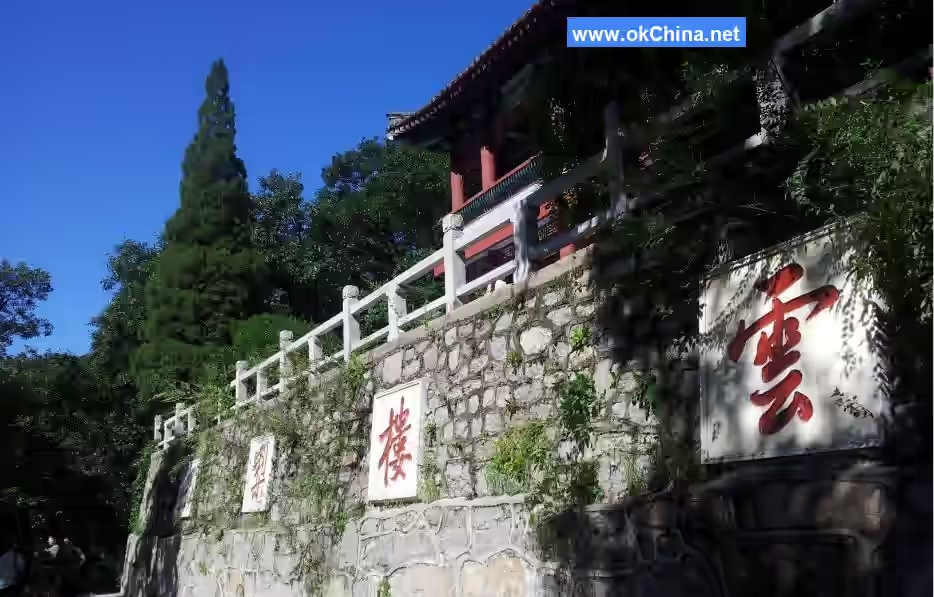
As visitors step through the mountain gate and reach the "Rusheng" attraction, they are greeted by inscriptions on the cliffs. "Rusheng" was handwritten by Ronglu, whose courtesy name was Zhonghua, a military minister and governor-general of Zhili during the late Qing Dynasty. "Rusheng" signifies entering the pure land of Buddhism, inspired by the ancient poem: "Lush mountain hues lead into a wondrous realm, where echoes of streams fill the empty valley."
Yuanbao Stone
In the valley between the East and West Fuqing Ridges, steep cliffs and elegant peaks flank a winding stream with clear, rushing water. A stone lies across the path, several meters long and over three meters high, wider at the top and narrower at the bottom, resembling a yuanbao (a traditional Chinese ingot). Named Yuanbao Stone, it bears the inscription: "Here, there are lofty mountains and steep ridges, strange rocks and peculiar pines." The inscription was left by a scholar from the ancient Miyun County who was captivated by Pan Mountain's beauty. Inspired by the line from the famous calligrapher Wang Xizhi's "Preface to the Orchid Pavilion Collection"—"Here, there are lofty mountains and steep ridges, dense forests and tall bamboos"—he adapted it to describe Pan Mountain's unique pines and rocks.
To the south is a stone carving left by Mr. Fu Zengxiang, who served as the tutor of Emperor Guangxu in the late Qing Dynasty and was the first director of the Commercial Press in China. He visited Pan Mountain three times with Zhou Xueyuan, Jiang Yong, Xing Duan, and Zhou Zhaoxiang, and authored the three-volume "Special Issue on Visiting Pan Mountain," which has contributed to the study of Pan Mountain's history.
Welcoming Pine
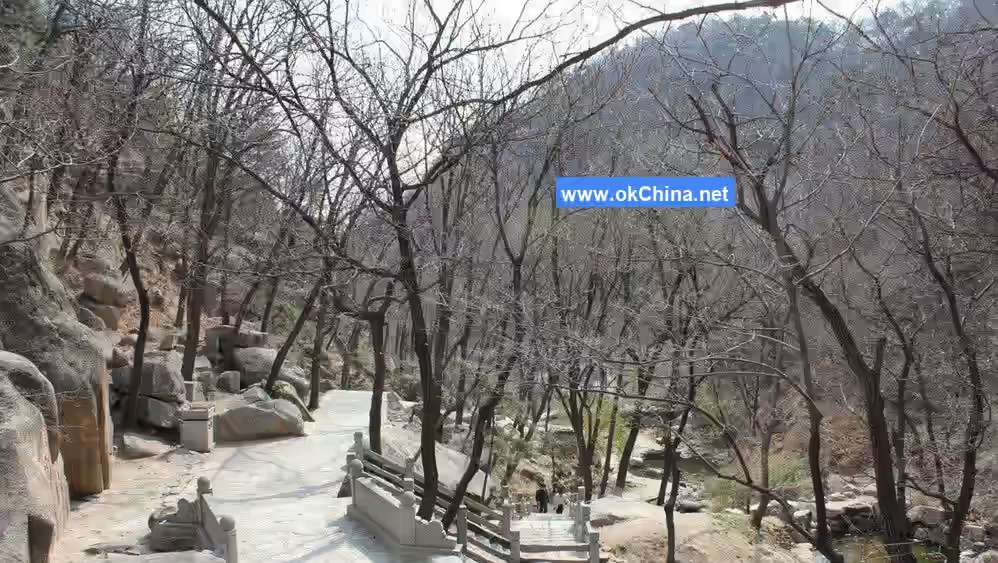
Following the winding stone steps and crossing the "Immortal Bridge," visitors encounter the Welcoming Pine, hailed as a "rare treasure." This pine tree is 400 to 600 years old and stands solemnly, as if waving to greet guests.
Tiancheng Temple
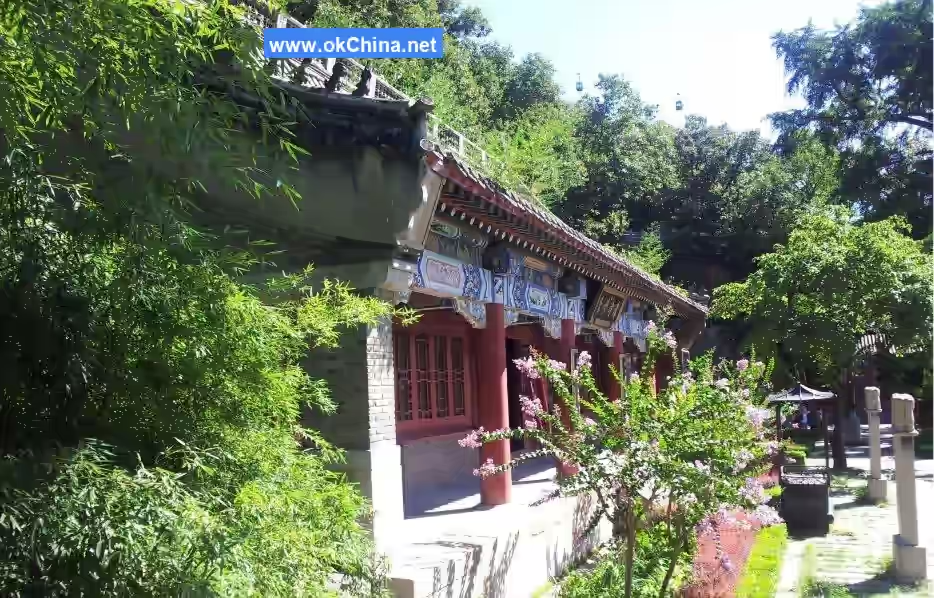
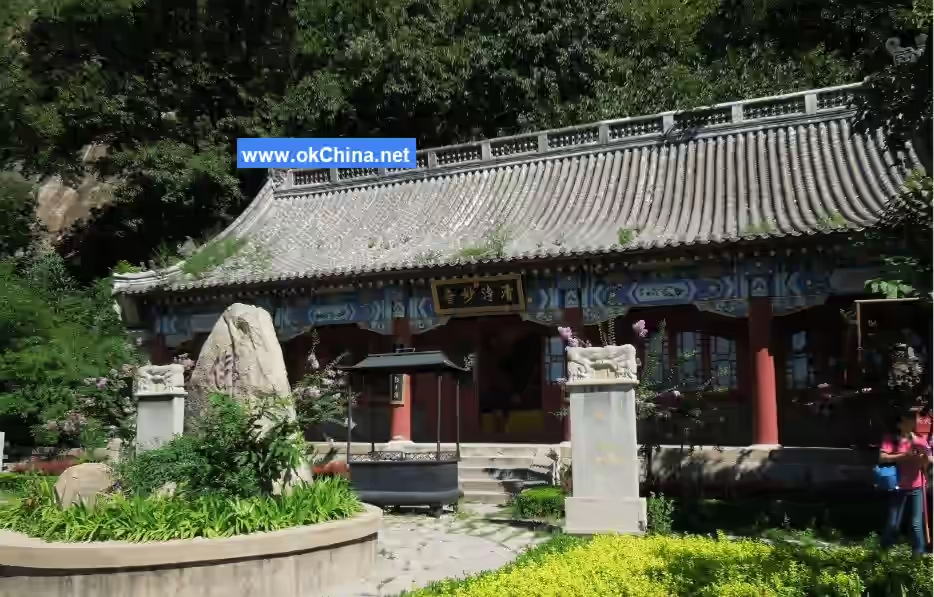
Formerly known as Fushan Temple and also called "Tiancheng Dharma Realm," Tiancheng Temple is a key attraction in the Pan Mountain scenic area. It faces Cuiping Peak, and two ginkgo trees stand in front of the temple, each 25 meters tall with a trunk circumference of 3.1 meters, aged over 800 years. The temple's founding date is unclear, but it is suspected to have been built during the Tang Dynasty due to the presence of the tomb of Monk Puhua, a Tang Dynasty figure, to the west of the temple. The temple was expanded and renovated during the Liao, Ming, and Qing dynasties. The Jiangshan Yilan Pavilion, located within Tiancheng Temple, bears the inscription "Jiangshan Yilan" (A Glimpse of the Country) personally written by Emperor Qianlong. The pavilion faces a stream and backs against rocks, with five bays, intricately carved beams, and painted rafters, showcasing exquisite craftsmanship.Behind Tiancheng Temple stands a peak named Cuiping Peak. At its base, an ancient pagoda gleams, and in front of the pagoda stands a fragrant cypress, as old as the pagoda itself, accompanied by two tall and straight ginkgo trees, forming a naturally picturesque scene.
Eastern Wutai Mountain
The five peaks of Panshan are also known as the Five Terraces: Zigai Peak is the Central Terrace, Zilai Peak is the Northern Terrace, Jiuhua Peak is the Eastern Terrace, Wujian Peak is the Western Terrace, and Xianshi Terrace is the Southern Terrace. Since the rise of Buddhism in the Tang Dynasty, 72 temples and 13 exquisite pagodas have been successively built on Panshan. As a result, emperors, generals, and ministers from various dynasties continuously visited the mountain for meditation and Buddhist worship, making it a sacred Buddhist site. Corresponding to the Buddhist sanctuary "Wutai Mountain" in Shanxi, it is known as the "Eastern Wutai Mountain." The inscription "Eastern Wutai Mountain," handwritten by Zhao Puchu, the president of the Chinese Buddhist Association, is carved on Cuiping Peak. Beside the Suyun Pavilion, the four large characters "Qi Xiang Wan Qian" (Boundless Scenery), inscribed by a famous calligrapher from Tianjin, are written in the "Jimao" clerical script.
Shenniu Blessed Land
The Shenniu Blessed Land residential area is located on Huanxi Ridge of Panshan. Here, not only are there rugged rocks and elegant pine breezes, but also the legendary stories of the divine ox passed down through generations.
The area is themed around the legend of the divine ox, relying on the unique pine and rock wonders, integrating rock formations, pine trees, and legends. Naturally crafted bizarre rocks are everywhere. There is the endearing Divine Ox Rock, the ethereal Cloud-Moving Rock, the lifelike Longevity Rock, as well as the Golden Basin Gathering Treasure Rock and the Ugly Duck Welcoming Spring Rock, among others. Among the extraordinary pines are the inseparable Unity Pine, the affectionately entwined Lovers Pine, the coiled and sky-shading Umbrella Pine, and the unbreakable Rock-Embracing Pine. Pines grow in rock crevices, and rocks accompany the pines.
The small ridge to the north is the Divine Ox Tomb. Legend has it that the divine ox was buried here after its sacrifice. Several vivid rock paintings depicting the legend of the divine ox are carved on the ridge, which visitors can freely explore. The winding paths and lively scenes make one feel immersed in the scenery, sometimes within and sometimes outside it, creating a sense of mystery and enhancing the emotional experience. In front of the tomb grows divine ox grass, said to be the sacred grass of the divine ox, which regrows as it is eaten and remains lush throughout the seasons. On the western cliff, there are stone railings, melon trellises, thatched sheds, and ancient plows. Eschewing ornate elegance, it embraces rustic simplicity, forming its own pastoral charm.
Pagoda Forest
The Panshan Pagoda Forest, located south of Wansong Temple, consists of 99 tomb pagodas of eminent monks from various dynasties. The stone pagodas are square, hexagonal, or bowl-shaped, with or without eaves, solid or hollow, all carved from granite, making them extremely rare. The main pagodas, the Pagoda of Master Puzhao and the Pagoda of Master Taiping, are brick structures with clear and vivid relief patterns on the bricks.
Wansong Temple
Wansong Temple is the largest temple on Panshan, originally named Li Jing Temple after the famous Tang Dynasty general Li Jing, who once resided here. In the early Qing Dynasty, the poet and Vice Censor-in-Chief Song Luo believed that "the names of former sages should not be directly invoked," so he renamed it Wei Gong Temple. Wansong Temple is described as having "green mountains and clear waters, vines and moonlight, pine breezes," with "majestic temple halls and solemn Buddha statues, truly a Buddhist sanctuary in the eastern capital region." Master Puzhao presided here, chanting the four-character Buddha name and guiding people toward goodness. East of the temple are the Pagoda of Master Puzhao and his tomb, with two steles in front recording the historical environment of Wansong Temple. In the spring of the 43rd year of the Kangxi reign (1704), Emperor Kangxi "visited again and graciously decreed its name changed to Wansong Temple." Although today's Wansong Temple still features ancient temple bells and towering pagodas, it does not live up to its name with "ten thousand pine shadows" or "pine breezes in myriad valleys." Wansong Temple is the largest among the 72 temples on Panshan.
General Rock
About two li southwest of Guayue Peak, beside the road, stands a bluish stone. This rock is three meters high and two meters wide. From a distance, it resembles a mighty and majestic general guarding the mountain ridge. This is one of the "Eight Strange Rocks of Panshan," known as General Rock.
Southern Heavenly Gate
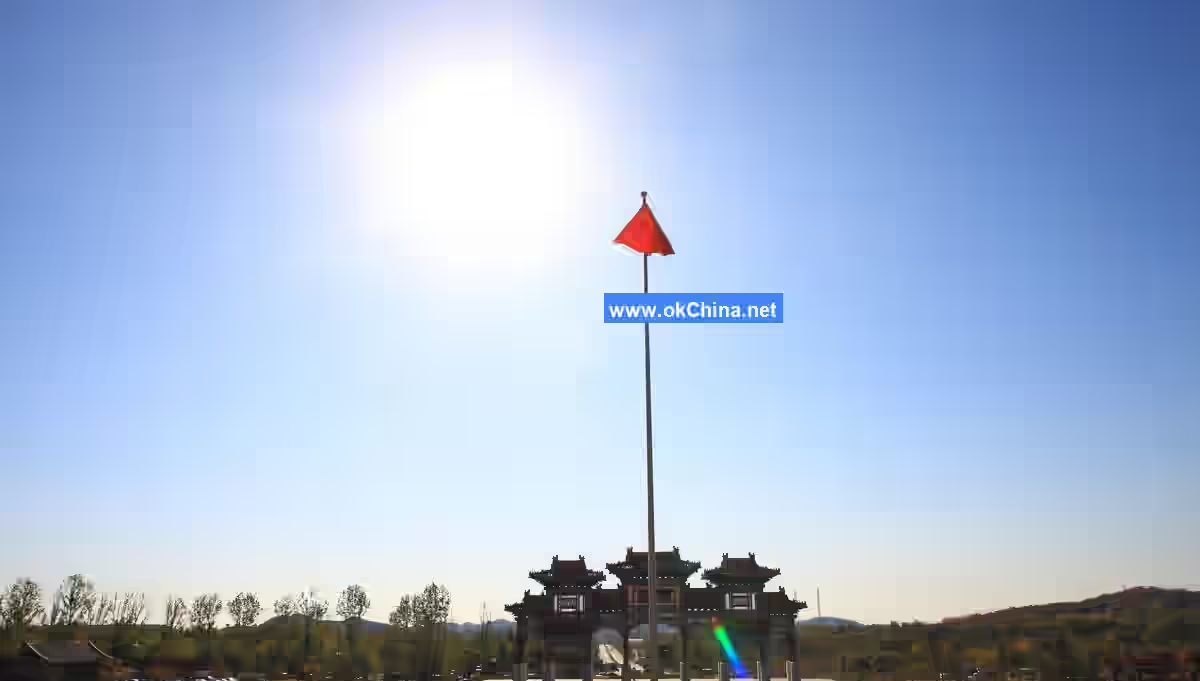
The Southern Heavenly Gate of Panshan is situated west of Mile Peak, north of Zigai Peak, and south of Guayue Peak. It mainly features attractions such as the Chaotian Archway, the Ascending Sky Ladder, and the Southern Heavenly Gate Pavilion. The Ascending Sky Ladder starts at the foot of Mile Peak and extends between the Sun Rock and Moon Rock, with a slant length of 380 meters, a horizontal projection distance of 324 meters, a width of 3 meters, and a relative height difference of 150 meters. At the starting point, there is a jade archway named Chaotian Archway, 7 meters wide and 7.6 meters high, adorned with exquisitely carved qilin statues. At the top stands the Southern Heavenly Gate Pavilion. This pavilion incorporates innovative elements from northern Chinese architectural styles. It is delicate and intricate, with double-eaved gable and hip roofs, yellow glazed tiles, and swirling golden-colored paintings. It bears plaques and couplets inscribed by Emperor Qianlong of the Qing Dynasty and contemporary famous calligraphers. The frontal plaques "Southern Heavenly Gate" and "Thousand Chapters of Purple Brocade" highlight the grand scenic feature of "thunder looking down upon the mountain waist's struggle, sun and moon gazing horizontally at the suspended forest" and the pavilion's name. Passing through this hall, one can appreciate the extraordinary views of Yunzhao Temple, Guayue Peak, and the Dingguang Buddha Relic Pagoda, offering a sense of ascending to great heights and gazing upon peril, with the special feeling that "the universe is vast and boundless, yet my heart shares its breadth."
Yunzhao Temple
Located at the foot of the main peak, Guayue Peak, Yunzhao Temple is the highest-altitude temple on Panshan. Originally named Xianglong Temple, it was built by Master Daozong during the Taihe period of the Tang Dynasty and is one of the famous temples among the 72 Buddhist temples on Panshan. The temple houses the Mile Hall and Huanglong Hall, enshrining the Thousand-Petaled Treasure Lotus Buddha of the Imperial Collection. It was renovated during the Wanli period of the Ming Dynasty and was granted the name Yunzhao Temple in the 30th year of Wanli. Because the temple is near the summit, often shrouded in clouds and mist, it was named Yunzhao Temple. Perched atop Panshan, Yunzhao Temple has long been renowned and is considered the foremost among Panshan's temples, hailed as the "Palace of Brahma in the Clouds." When clouds gather atop the mountain, the golden splendor is hidden; when clouds disperse, the rugged peaks shine brilliantly. Visiting this temple gives a sense of "looking up at the pagoda, the sky seems near; looking down, the mundane world churns below." Emperor Qianlong called this place "extraordinarily sublime."
Guayue Peak
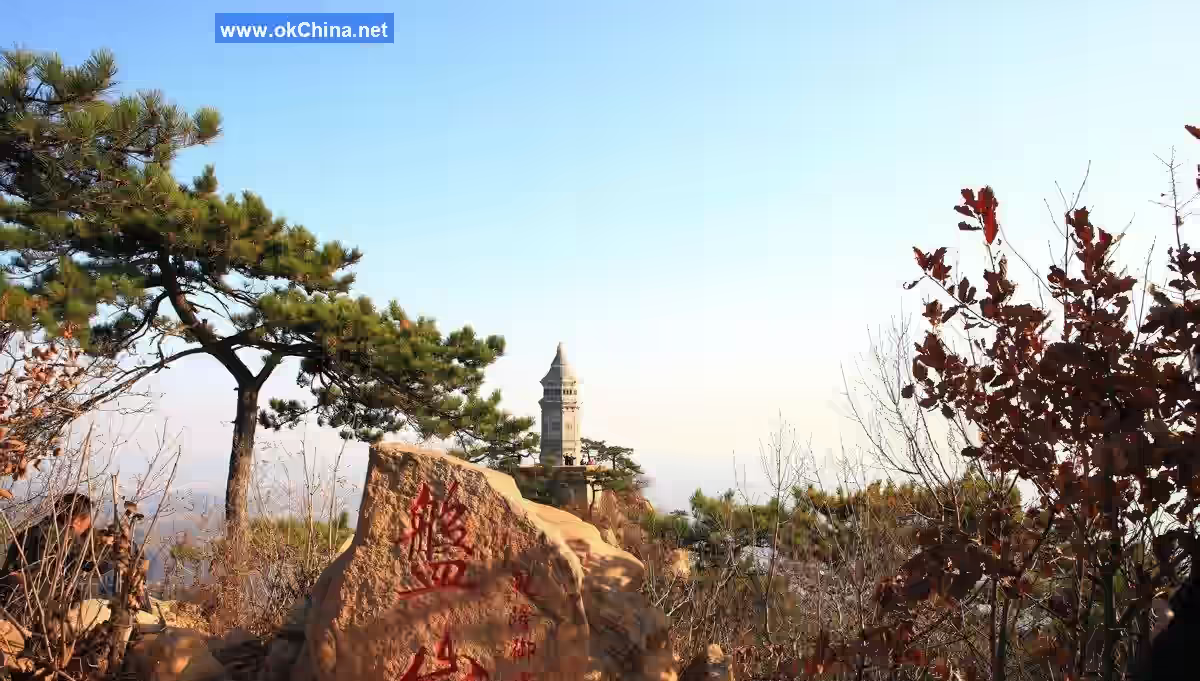
Heading east from Yunzhao Temple and ascending the steps, the stone stairs are only wide enough for one person, creating a daunting and perilous atmosphere. On the eastern cliff face, the four large characters "Qu Tian Chi Wu" (Only Five Feet from Heaven) are carved. Further up is "Panting Rock," inscribed with "Yi Lan Zhong Shan Xiao" (A Glimpse Makes All Other Mountains Small), written by Chen Guorui. Continuing upward leads to the summit of Panshan—Guayue Peak. Guayue Peak stands at an altitude of 864.4 meters, sharp at the top and steep below, the pinnacle of Panshan. A couplet reads: "Clouds and Zen soar skyward to pluck the moon; the immortal peak builds a pagoda to pierce the heavens."
Zilai Peak
Zilai Peak is the second highest peak of Panshan, with an altitude of 857 meters, also known as the Northern Terrace. In ancient times, it housed the Huanglong Patriarch Hall.
Dingguang Buddha Relic Pagoda
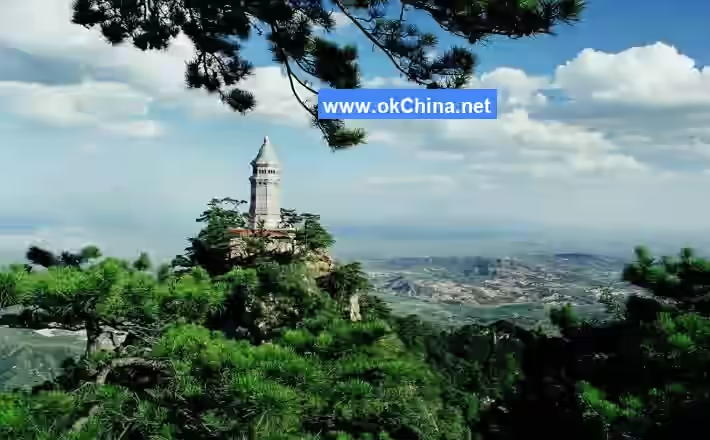
The Dingguang Buddha Relic Pagoda is located atop Guayue Peak. It is named after Master Zhiyuan, who once stored 60 Buddha relics and one Buddha tooth inside the pagoda. The pagoda was built by Master Zhiyuan in the first year of Yanhe of Tang Ruizong (712) and was renovated during the Liao, Ming, and Qing dynasties. The pagoda is octagonal, three stories high, made of brick, and consists of a base, a Sumeru pedestal, the pagoda body, the spire, and the finial. It was renovated in 1985. The Ancient Buddha Relic Pagoda, located west of Tiancheng Temple, is the largest among the ancient pagodas of Panshan. It is octagonal with thirteen stories, standing 22.63 meters tall, with a light yellow pagoda body. The front of the pagoda has a door with an inner niche, and the sides feature relief-carved floral windows. The eaves are imitations of wooden bracket sets in brick carving, with dense eaves at the corners, hung with 104 bronze bells, constructed with large grooved bricks.
Northern Shaolin
According to the "Jixian County Annals," Northern Shaolin Temple was originally named "Faxing Temple" and later called Northern Shaolin Chan Temple. It is located on the open slopes of the "Central Range" on the southeastern foothills of Panshan in Jixian County, Tianjin. Built during the Wei and Jin dynasties, it has a history of about 1,500 years, making it the earliest Buddhist temple recorded in the local annals of Jixian County and also the earliest temple in Tianjin.
Historical records indicate that during the Yuan Dynasty, Taoism was revered. In the 23rd year of the Zhiyuan era (1286), the Taoist master Zaoyunzi sent his disciple Zhang Zhige to select a site for a Taoist temple, ultimately choosing Panshan. Subsequently, the Taoist group renamed it Qiyun Temple. In the second year of the Yanyou era of Emperor Renzong of Yuan (1315), Emperor Renzong issued an edict to restore Qiyun Temple as a Buddhist monastery, renaming it "Northern Shaolin Chan Temple." Master Xueting Fuyu then taught the monks in the temple to practice Shaolin martial arts.
During the Ming Dynasty, the temple was granted the name Northern Shaolin. It was renovated in the Yichou year of Chenghua and the Dinghai year of Jiajing. In the ninth year of the Shunzhi reign of the Qing Dynasty, the Duobao Buddha Pagoda was renovated. During the Kangxi period, the monk Benzhu repaired the temple. In the tenth year of the Qianlong reign, the main hall was renovated under imperial decree, and Emperor Qianlong inscribed the plaque "Dan Zhi Shen Qu" (Divine Pleasure at a Fingertip). During the Anti-Japanese War, the Japanese army designated Panshan as a "no-man's land," and most of the temples on Panshan were destroyed during this period. After the founding of the People's Republic, Shaolin Temple was allocated to the Brick Kiln Village of Guanzhuang Town for use. Villagers gradually built houses on the temple grounds, damaging the original planar remains. In 1992, the existing mountain gate foundation, stone inscriptions, ancient pagodas, and cliff carvings of Northern Shaolin Temple were announced as Tianjin Municipal Cultural Relics Protection Units.
March 26, 2015 — During the spring equinox, the wild mountain peach blossoms in the Northern Shaolin Temple scenic area of Panshan, Jixian County, Tianjin, which is undergoing restoration and reconstruction, are in full bloom, fragrant and radiant. According to local farmers, around the Qingming Festival each year, mountain peach blossoms and wild apricot blossoms in the Northern Shaolin Temple scenic area bloom in profusion, attracting a continuous stream of tourists to enjoy the flowers.
Yushi Village
According to page 1885 of "Rixia Jiuwen Kao," Emperor Shunzhi personally bestowed the name "Yushi Village" over 350 years ago. Today, it still embodies its beautiful and virtuous meaning, the spirit of strength and honesty, and the rich cultural heritage of a village—Yushi Village.
Panshan's famous "Five Peaks, Eight Rocks, and Seventy Temples"—Zigai Peak, Liangjia Rock, Wanfo Temple, and Emperor Qianlong's inscription "Thousand Feet of Snow"—are all located in Yushi Village. Among Panshan's three wonders of pines, rocks, and water, the wonders of rocks and water are found in Yushi Village. The low-sodium, high-silicon maifan stone mineral water contains 8.4 mg/L of sodium and 43 mg/L of silicon. Drinking maifan stone mineral water has certain health benefits and disease prevention effects. Bathing in the maifan stone bath can enhance skin elasticity and capillary function, prevent skin diseases, relieve fatigue, and make the skin rosy and smooth.The waters of Immortal Lake, crevice water from cliff sides, holy water from Ten Thousand Buddha Temple, and stream water from Thousand-Foot Snow are all integral parts of the water attractions, truly symbolizing thriving fortune and good luck. The persimmons, walnuts, and oil chestnuts here were once tributes to the imperial court and are now renowned both domestically and internationally.
Ten Thousand Buddha Temple
Panshan Ten Thousand Buddha Temple, originally named "Stone Buddha Hall," is located on the southern slope of Panshan Mountain, at the west gate of the Stone Fun Garden. It consists of four main parts: the screen wall, the Heavenly King Hall, the iron bell, and the Mahavira Hall. The Ten Thousand Buddha Hall of Panshan Ten Thousand Buddha Temple houses China's largest stone carving of the Three Saints Buddha, with 10,960 Buddha statues enshrined. In 1993, led by Han Zhen, the people of Yushizhuang, drawing upon their rich cultural heritage, rebuilt the Stone Buddha Hall one kilometer west of its original site and renamed it "Ten Thousand Buddha Temple." Backed by steep peaks and overlooking perilous cliffs, it is the only Buddhist sanctuary in the eastern Beijing and northern Tianjin region that fully embodies the Buddha, Dharma, and Sangha. The temple is clearly visible from dozens of miles away. The three characters "Ten Thousand Buddha Temple" were inscribed by Zhao Puchu, former Vice Chairman of the National Committee of the Chinese People's Political Consultative Conference and President of the Chinese Buddhist Association.
Inside the hall stands the largest stone carving of the "Western Three Saints" in the country. In the center is "Amitabha Buddha," standing 8.1 meters tall, flanked by Avalokitesvara Bodhisattva and Mahasthamaprapta Bodhisattva, each 7.6 meters tall. The eastern, northern, and western walls of the hall, from the base to the ceiling, form the Ten Thousand Buddha Wall, featuring 10,960 niche-style small shrines, each containing a Buddha statue. In 1997, the people of Yushizhuang renovated the Stone Buddha Hall, adding auxiliary halls, a screen wall for Ten Thousand Buddha Temple, the Heavenly King Hall, the Mahavira Hall, east and west auxiliary halls, and the ninety-nine-step Water Sound Staircase. Thus, "Ten Thousand Buddha Temple" was finally completed. Today, "Ten Thousand Buddha Temple" has become an important venue designated by the Tianjin Buddhist Association for Buddhist activities among devotees.
Ten Thousand Buddha Temple is one of Tianjin's religious activity sites, inhabited by monks, with morning bells and evening drums, and frequented by pilgrims. On the 19th day of the second lunar month, the 15th day of the seventh lunar month, the 19th day of the ninth lunar month, and the eighth day of the twelfth lunar month, large-scale Buddhist ceremonies are held here.
On the first and fifteenth days of the lunar month, as well as during auspicious occasions like the Spring Festival, devotees come here to worship.
Unique Pines
Bell-Hanging Pine
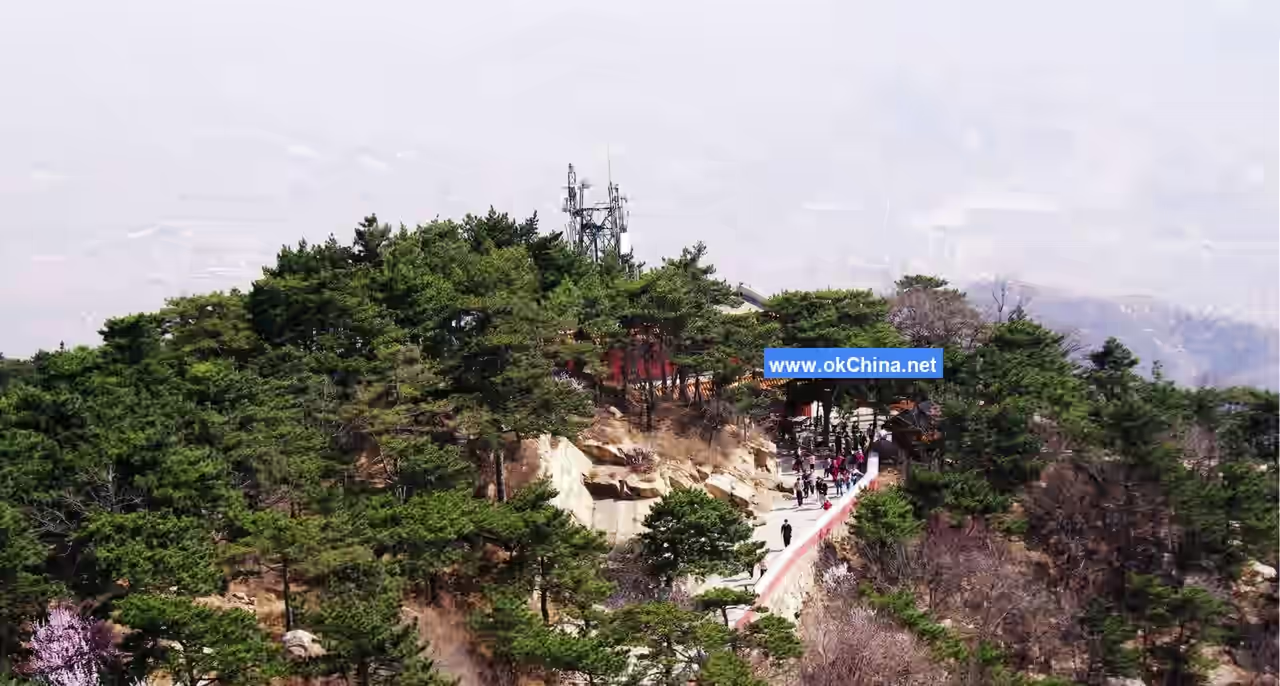
Ascending to the summit of Panshan Mountain, one can see a pine tree standing out prominently in the pine forest of Zilai Peak, known as the Bell-Hanging Pine. This pine, over 10 meters tall with lush branches, has a deep groove at the fork of its trunk. Older locals of Panshan know that this large pine tree once hung a thousand-pound iron bell. In the past, when the monks of Yunzhao Temple struck the great bell, its sound could be heard clearly dozens of miles away. It is said that this pine existed as early as the Tang Dynasty's Kaiyuan era when Yunzhao Temple was built, and the bell was hung from it. This dates back over 1,200 years, making the Bell-Hanging Pine the undisputed "millennium elder" of Panshan.
Phoenix-Tail Pine
The Phoenix-Tail Pine, located on the ruins of the Wanghai Tower east of Wansong Temple, is 500 years old. It grows parallel to the ground from a steep cliff, with branches extending horizontally into the air, resembling a phoenix raising its tail to fly or a peacock spreading its feathers, hence the name "Phoenix-Tail Pine."
Peculiar Stones
Shouted-Break Stone and Suspended Stone
Legend has it that during the Three Kingdoms period, Liu Bei, Guan Yu, and Zhang Fei were leisurely traveling here. After several consecutive days of mountain climbing, Liu Bei felt fatigued and discussed with Guan Yu and Zhang Fei: "Second brother, third brother, after days of climbing, I feel tired. Let's sit down and rest for a while." Zhang Fei, straightforward and restless by nature, kept looking around. Guan Yu wanted Zhang Fei to sit down and said, "Third brother, sit down, and let's play a game of chess in this quiet place." So the two brothers took out a chessboard from their horse's saddlebags, set up the pieces, and began playing. Perhaps inspired by the scenery, Zhang Fei made brilliant moves, cornering Guan Yu. Guan Yu was surprised, as Zhang Fei had never played so well before. What was happening today? What move could turn the tide? While pondering, a woodcutter carrying a load passed by. Seeing a red-faced man and a black-faced man playing chess below, he curiously set down his load and leaned on a large rock to watch. After a while, he thought the red-faced man had a move to turn defeat into victory and grew anxious for Guan Yu. In his excitement, he pushed the rock he was leaning on, causing it to fall. Guan Yu and Zhang Fei, engrossed in their game, suddenly heard a loud noise above. Looking up, they saw the large rock hurtling toward them. There was no time to dodge. At this critical moment, Guan Yu, quick-witted, picked up a chess piece and threw it into the air with a "whoosh," propping the falling rock halfway down the mountain, with two-thirds of it suspended precariously. Seeing the danger had passed and amazed by his brother's divine skill, Zhang Fei shouted, "Great skill!" His voice, like a thunderclap, split a massive granite rock opposite into two halves. This is the origin of the "Suspended Stone," one of Panshan's Eight Peculiar Stones, and Zhang Fei's Shouted-Break Stone.
Camel Stone
In front of the mountain gate of Wansong Temple stands a giant rock shaped remarkably like a camel, serving as a natural screen. This is the famous Camel Stone. The Camel Stone must be viewed from the west to reveal its form. On the front of the camel, the inscription reads "Famous Mountain Ancient Temple," while the back bears eight poems composed by Emperor Qianlong. Except for the poem "Wansong Temple," which remains clear, the others are eroded and illegible. A line from "Wansong Temple" reads: "Everywhere in Tianpan is beautiful, the ten thousand pines express my heart. Sitting in the temple tower amidst the emerald green, the sounds of nature are unrestrained."
Rocking Stone
Behind Qianxiang Temple, on a cliff, lies the Rocking Stone. Liu Tong, a Ming Dynasty scholar, wrote in Scenic Spots of the Imperial Capital that half a li behind the temple, there is a stone, two zhang long and over a zhang high and wide, perched on a base stone. When pushed, it rocks, astonishing viewers. It is one of Panshan's Eight Peculiar Stones. The Qing Dynasty poet Wang Ying wrote in his poem "Rocking Stone":
If the stubborn stone has a spirit, its perch is perilous indeed.
No need to wait for Master Shenggong; it nods to every passerby.
Beside the Rocking Stone is a cave named "Qizhen Cave," with the seal script inscription "Amitayus Buddha" at its entrance. Inside the cave is a relief sitting Buddha, about 2 meters tall, the only natural grotto in Tianjin. It is said to be where Master Hanshan encountered a hermit.
Heavenly Well Stone
On the southern ridge of Dongganjian Guanyin Nunnery, there is a stone called Heavenly Well Stone, also known as Immortal Spring Stone. Inscribed with "Heavenly Pool," it is over two zhang long and lies atop three smaller stones. Beneath the large stone is a gap through which one can see the opposite side, isolated from the ground. On the stone is a small well, one chi eight cun deep and the width of a bowl's mouth. When water is scooped out, it immediately refills. The well does not overflow and never dries up throughout the four seasons, making it one of Panshan's mysteries.
Beautiful Waters
Dripping Cascade
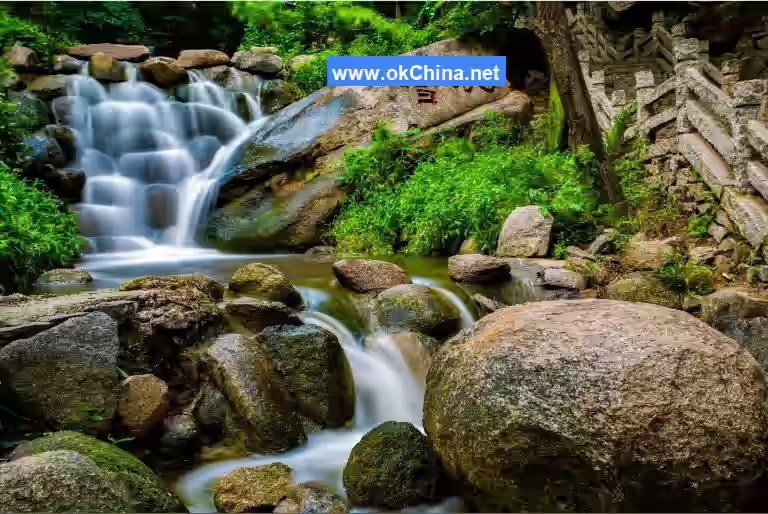
The scenery of Dripping Cascade varies with the seasons, wind, and weather. In spring and autumn, when rain is scarce, the water curtain is like silk, drifting with the wind, light and graceful. After summer thunderstorms, the waterfall resembles an angry silver dragon, roaring down with earth-shaking force. When struck by the setting sun, it appears like a multicolored rainbow, magnificently beautiful.
Stone Path Flowing Spring
Crossing the Immortal Bridge, one is greeted by Stone Path Flowing Spring. The waterfall cascades steeply down the mountain wall, forming a stream that meanders through the winding valley, with rippling blue waves. The water splits upon encountering a large rock at the stream's head, remaining clear and unclouded.
Flying Silk Stream
West of the Ancient Buddha Relic Pagoda lies the "Flying Silk Stream." In summer and autumn, stream water cascades down from Cuiping Peak, resembling flying silk, hence the name. A poem praises it: "The waterfall and flying spring pour down from the peak, looking like strands of plain silk floating."
Cuiping Peak features cliffs as if carved by an axe, inscribed with: "Thousands of ancient trees burst forth from the stone crevices, layered like scales. During late spring and early summer, green emerald reaches for the sky; in frosty autumn, yellow leaves scatter across the ground." Wang Goushan remarked, "The mountain's winding chambers are almost otherworldly."
Dongganjian
Heading east from Xiganjian and crossing a ridge covered with ancient pines, one arrives at Dongganjian. Emperor Qianlong's poem "Dongganjian" reads: "Xiganjian connects to Dongganjian, the path overgrown with vines is serene. Looking back at Tiancheng in the white clouds, temple bells drift from the emerald haze." Dongganjian has the site of Guanyin Nunnery, with an unknown founding date. Monk Zhongjiang renovated it during the Kangxi era. In the 14th year of Qianlong's reign, "imperially ordered double-eaved wings added to the hall," bestowed the plaque "Dongganjian," and inscribed three imperial cliff poems.## IV. Scenic Area Culture
Religious Culture
Religious culture is a prominent aspect of Mount Pan culture. Historically, Buddhism and Taoism developed alternately on Mount Pan, competing and spreading alongside each other. During the Eastern Han Dynasty, Buddhism began to spread into the Jizhou District. The first Buddhist temple, Xianglin Temple, was built at the foot of Yushan Mountain, twenty li east of Mount Pan. By the Tang Dynasty, over ten temples had been constructed, including Yunzhao Temple, Wansong Temple, Tiancheng Temple, Tianxiang Temple, Qianxiang Temple, Ganhua Temple, Shangfang Temple, Zhongpan Temple, Shuangfeng Temple, Puji Temple, Xiangshui Temple, and Baiyan Temple. During the Ming and Qing dynasties, especially the Qing Dynasty, Mount Pan was said to boast 72 temples. Notably, a stand-in for Emperor Qianlong became a monk on Mount Pan during this period. This era marked the peak of Mount Pan's Buddhist development, establishing it as one of the important Buddhist sacred sites in the Jingdong region and even nationwide. Cai Shiying of the Qing Dynasty recorded in the "Stele Inscription for the Renovation of Zhengfa Chan Temple": "Ancient Zhongpan is the Eastern Wutai Mountain of the capital." Hence, Mount Pan also gained the title "Eastern Wutai Mountain." This fully affirms Mount Pan's status and role in the development of Buddhism.
Shaolin Temple is the earliest built among the many temples on Mount Pan (except for Xianglin Temple) and is one of the earliest historically verifiable Buddhist temples in the Jizhou District and even Tianjin. Records in Zhi Pu's "Annals of Mount Pan," Zhu Yizun's "Old Stories of the Capital," and Yu Minzhong's "Examination of Old Stories of the Capital" all state: "Shaolin Temple, originally named Faxing Temple, is said to have been built during the Jin-Wei period (the Two Jin Dynasties and the Northern Wei of the Northern and Southern Dynasties)." In terms of founding date, Mount Pan's Shaolin Temple is no later than the Shaolin Temple on Songshan Mountain in Henan. In terms of scale, Mount Pan's Shaolin Temple was grand in architecture, with "an ancient Buddha relic pagoda within the temple reaching two hundred chi in height." The pagoda's height should be 46.6 meters. The existing Duobao Buddha Pagoda on the site, built by monks during the Ming and Qing periods, is 20 meters tall. In terms of influence, Mount Pan's Shaolin Temple is historically recorded as the only branch of the Songshan Shaolin Temple, historically known as the "Northern Shaolin Temple."
After two thousand years of development and construction, Mount Pan has left behind numerous ancient structures including temples, monasteries, nunneries, pagodas, platforms, pavilions, and bridges. According to Zhi Pu's "Annals of Mount Pan," Mount Pan once had 22 temples, 2 monasteries, 29 nunneries, 10 meditation rooms, 9 shrines, 5 platforms, 5 bridges, 1 stockade, 4 pavilions, 2 verandas, 3 Buddha pagodas, and over 100 bone pagodas. The surviving Ancient Buddha Relic Pagoda and Dipamkara Buddha Relic Pagoda have been listed as municipal-level cultural relics protection units; the Duobao Buddha Pagoda and Pagoda of Master Puzhao have been listed as county-level cultural relics protection units.
Poetry Culture
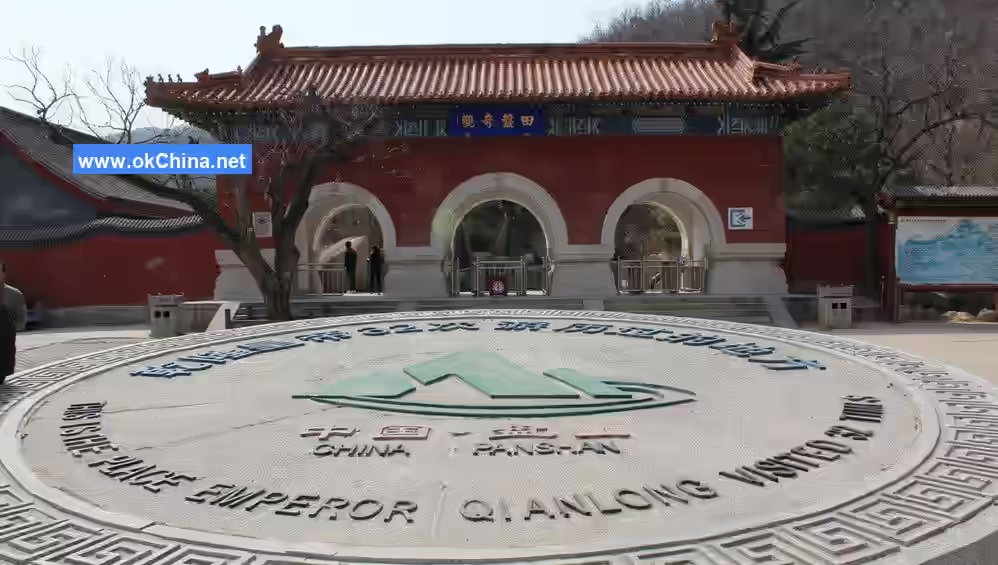
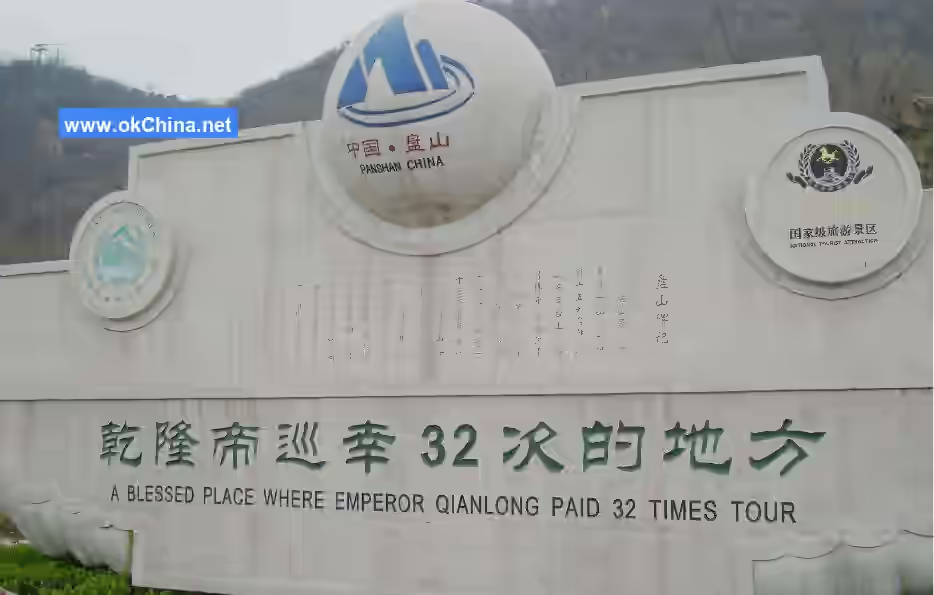
Due to its extraordinary landscapes and scenic beauty, Mount Pan has been a favored destination for emperors, generals, scholars, and literati throughout history. Figures such as Emperor Wu of Wei Cao Cao, Emperor Taizong of Tang, Emperor Taizong of Liao, Emperor Shengzong of Liao, Emperor Shizong of Jin, and Qing Dynasty emperors Kangxi, Qianlong, Jiaqing, and Daoguang all toured Mount Pan to worship Buddha and practice meditation. The attention from successive rulers led to large-scale construction on Mount Pan, establishing temples and enhancing its cultural landscape. Shaolin Temple was built during the Wei-Jin period; Tiancheng Temple, Wansong Temple, Yunzhao Temple, Shangfang Temple, Qianxiang Temple, Tianxiang Temple, and the Dipamkara Buddha Relic Pagoda were built during the Tang Dynasty; the Ancient Buddha Relic Pagoda was built during the Liao Dynasty; and Pangu Temple was built during the Qing Dynasty. During the Qianlong era of the Qing Dynasty, the imperial traveling palace, Jingji Mountain Villa, was also constructed. Emperor Qianlong stayed here 32 times, and Emperor Jiaqing stayed 7 times. The visits by emperors throughout history further elevated Mount Pan's prestige.
Some emperors, literati, and military generals, inspired by the scenery during their visits to Mount Pan, often composed poems, couplets, named sites, or inscribed plaques, praising Mount Pan's attractions and expressing their inner sentiments. For example, after returning from his eastern campaign against Goguryeo, Emperor Taizong of Tang, Li Shimin, once stationed troops on Mount Pan and wrote the famous lines: "Halting the war chariot in the emerald wild, the dragon banners turn for the march. Distant mountains beautiful like silk, long rivers winding like ribbons. Sea mists form towers a hundredfold, cliff pines spread a canopy of a thousand zhang. Here one may roam and admire, why must one go beyond Xiangcheng?" Emperors Kangxi and Qianlong left even more poems, couplets, and inscribed plaques on Mount Pan. Upon his first imperial tour to Mount Pan, Emperor Qianlong of the Qing Dynasty exclaimed, "Had I known of Mount Pan earlier, why would I have gone south of the Yangtze?" There are also many poems about Mount Pan by military generals. The patriotic Tang Dynasty general Li Jing, who held positions such as Minister of War, ascended the West Terrace of Mount Pan upon returning from the eastern campaign with Emperor Taizong. Drawing his sword and performing a dance, he chanted the "Song of the Sword Dance": "Ascending the layered ridges, I gaze all around, seizing the rainbow's flash, I sever the flying rainbow. Alas, alas, the three armies sing triumphant return." Gazing from the heights, dancing the sword to sever the rainbow, the spirit is majestic and bold. The general's heroic bearing, talent, and character are fully revealed in the poem, also leaving behind the famous scenic name "Sword Dance Terrace" for posterity. The Ming Dynasty anti-Japanese pirate general Qi Jiguang also left an eternal masterpiece on Mount Pan, the poem "Ascending the Summit of Mount Pan": "A frosty horn blast, plants and trees wither; opposing cloud masses, the stone gate opens. Northern winds and frontier wine cannot make me drunk; fallen leaves and returning crows come in countless flocks. If only carved spears could dispel the aura of slaughter, why mind aging with white hair as a frontier talent? Who will join me in carving my name upon the peak? The ancient General Li's Sword Dance Terrace." The poem expresses admiration for the Tang Dynasty patriotic general Li Jing and also conveys his own lofty aspirations to resist foreign aggression. Even more literati and scholars throughout history toured and praised Mount Pan. These include Chen Shou, author of the Jin Dynasty "Records of the Three Kingdoms"; literary master Tao Yuanming; Li Daoyuan, author of the Northern Wei "Commentary on the Water Classic"; Tang Dynasty poets Chen Zi'ang and Gao Shi; Ming Dynasty literary figures Fang Xiaoru, Yuan Hongdao, Mi Wanzhong, Wang Shizhen, and Liu Tong; Qing Dynasty dramatists Kong Shangren and Hong Sheng; and literary scholars Wang Shizhen, Zhu Yizun, Gao Shiqi, and Li Wei, among others. They left behind no fewer than a thousand poems, depicting the magnificent scenery of Mount Pan from various perspectives.
V. Scenic Area Activities
Folk Tourism Cultural Festival
The Mount Pan Temple Fair is a traditional folk cultural activity formed historically. The Folk Tourism Cultural Festival, developed on the basis of the Mount Pan Temple Fair, is a large-scale event integrating characteristic elements such as folk performances, grand Buddhist ceremonies, displays of folk customs, and calligraphy and painting exhibitions.
Event Time: Mid-April each year.
Revolutionary Education Activities
Mount Pan Martyrs' Cemetery is a national patriotic education base and also a youth education and training activity center. During the War of Resistance Against Japan, the Jizhou District was an important part of the Jin-Cha-Ji Anti-Japanese Base Area, with the Mount Pan region at its core. Twenty-eight famous significant battles occurred here, including the 1938 Eastern Hebei Anti-Japanese Armed Uprising and the Baicaowa Ambush. The scenic area retains numerous anti-Japanese war sites. Revolutionary tradition education activities are held here annually during the Qingming Festival period.
Mountain Wilderness Sports Meet
The International Mountain Wilderness Sports Meet is one of the six important activities of the National Mass Mountaineering Fitness Campaign approved by the General Administration of Sport of China. The sports meet organically combines sports and tourism, holding significant importance for promoting civilized and healthy lifestyles, fostering external exchanges and cooperation, and advancing the development of tourism and national fitness campaigns citywide.
Event Time: Mid-September each year.
Comments
Post a Comment