

Six Tripods Mountain
1. Introduction
The Six Tripods Mountain Cultural Tourism Area in Yanbian Korean Autonomous Prefecture, abbreviated as the Six Tripods Mountain Cultural Tourism Area, is a tourist attraction located in Dunhua City, Yanbian Korean Autonomous Prefecture, Jilin Province.
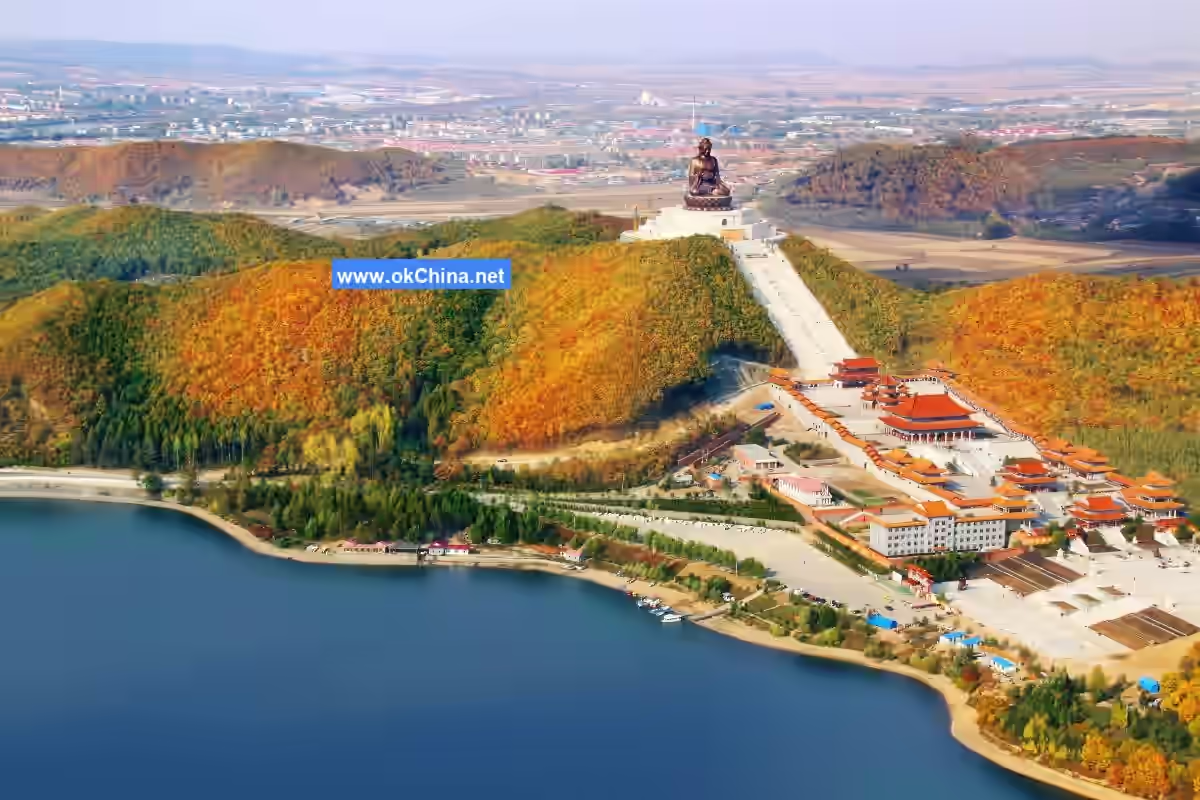
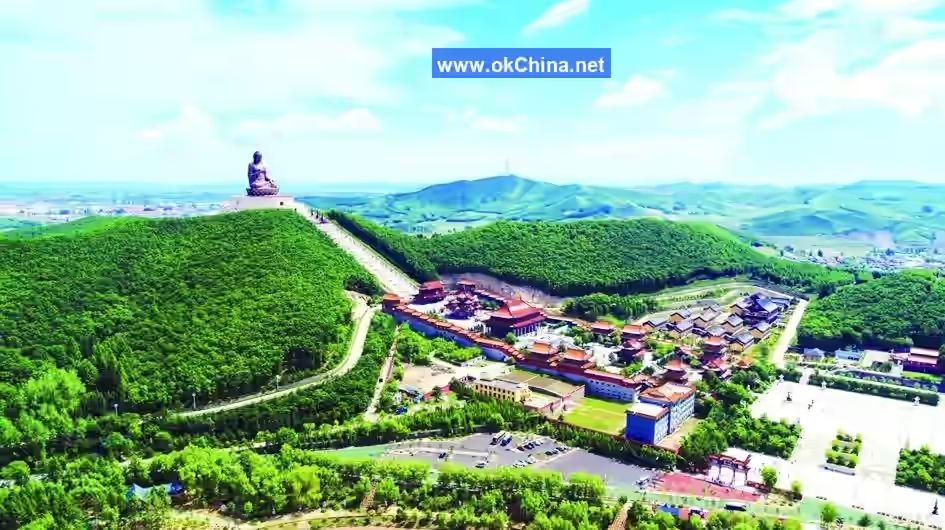
The Six Tripods Mountain Cultural Tourism Area has a total planned control area of 52 square kilometers, with a core scenic area of 10 square kilometers. Centered around Sacred Lotus Lake, it is divided into eight functional zones: the Entrance Service Area, Buddhist Culture Park, Qing Ancestor Culture Park, Bohai Culture Park, Ecological Agriculture Park, Health and Fitness Resort Area, Valley Wellness Resort Area, and Tourism Economic Industrial Park. The scenic area features the earliest Tang and Bohai Kingdom royal and noble burial complex—the Six Peaks Mountain Ancient Tombs, a national key cultural relics protection unit; the sacred site for Manchu people to trace their roots and worship ancestors—the Qing Ancestral Temple; the Jilin Modern Literature Exhibition Base—Zhang Xiaotian Literature Museum; the Sakyamuni Bronze Seated Buddha—Golden Tripod Great Buddha; the world-renowned nunnery—Zhengjue Temple; and the Religious Culture Exhibition Center—Buddhist Art and Culture Museum, among other attractions.
On October 15, 2015, the Six Tripods Mountain Cultural Tourism Area in Yanbian Korean Autonomous Prefecture, Jilin Province, was approved by the National Tourism Attraction Quality Rating Committee as a National AAAAA Tourist Attraction. It became the second such attraction in Yanbian Korean Autonomous Prefecture and the fifth in Jilin Province.
2. Development History
In May 2012, the People's Government of Jilin Province approved the establishment of the Dunhua Six Tripods Mountain Cultural Tourism Area. Since its establishment, the scenic area has undertaken construction projects including: the construction of Zhengjue Temple, the construction of Niangniang Temple, the main structure of the Golden Tripod Great Buddha, the Buddhist Art and Culture Museum and Prajna Heavenly Stairs, the Jade Buddha Garden, the protection and environmental improvement of the Bohai Ancient Tombs, the construction of the Qing Ancestor Culture Park, the Manchu Folk Culture Garden, the scenic area entrance gate, the Golden Culture Park, the International Health and Wellness Industrial Park, the tourist service center, the renovation of Sacred Lotus Lake and surrounding greening, Golden Tripod Avenue, ecological parking lots, fire lanes, and other infrastructure projects.
3. Geographical Environment
3.1 Location
The Six Tripods Mountain Cultural Tourism Area is located in Dunhua City, Yanbian Korean Autonomous Prefecture, Jilin Province. It lies on the southern bank of the Mudan River, 3 kilometers south of the urban area of Dunhua City. The total planned control area of the scenic area is 52 square kilometers, with a core scenic area of 10 square kilometers.
3.2 Topography
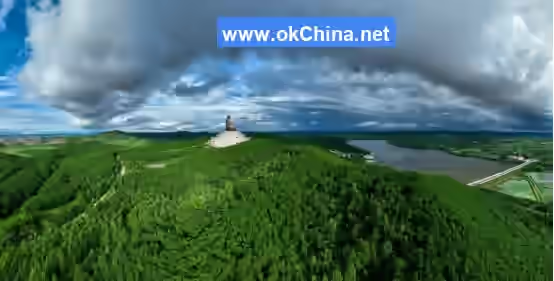
The Six Tripods Mountain Cultural Tourism Area belongs to the hilly region of the Changbai Mountains, surrounded by mountains and water, with peaks encircling the area.
3.3 Climate Characteristics
Dunhua City, where the Six Tripods Mountain Cultural Tourism Area is located, is situated in the mid-temperate zone of the Northern Hemisphere and experiences a continental monsoon climate with distinct seasonal winds. The spring is dry and windy, the summer is warm and rainy, the autumn is mild and cool, and the winter is cold. The average annual temperature in Dunhua City is 3.5°C, with an annual precipitation of 381.3 mm. The annual sunshine duration is 2,241.9 hours, with a sunshine percentage of 50%. The extreme maximum temperature is 31.4°C, and the extreme minimum temperature is -28.1°C. The frost-free period lasts 124 days.
4. Main Attractions
4.1 Six Tripods Gate
The overall design of the Six Tripods Gate adopts a triple-gate structure arranged in an arc, with a total of six gates. The slanted, open walls of the gate resemble an eagle spreading its wings, welcoming visitors from all directions.
4.2 Bohai Ancient Tombs
The Bohai Ancient Tombs are the burial sites of the early royal family and nobles of the Bohai Kingdom. With a simple and ancient layout, the tombs are divided into two burial areas, containing a total of 235 tombs of various sizes. They are among the first batch of national key cultural relics protection units and have been included in the tentative list for UNESCO World Heritage status. The most famous among them is the tomb of Princess Zhenhui, the second daughter of Da Qinmao, the third king of the Bohai Kingdom. The epitaph of Princess Zhenhui is the first discovered Bohai stone inscription in China. Artifacts such as stone lions, beast-faced bricks, and incense burners are important relics that help unveil the mysteries of the Bohai Kingdom.
4.3 Qing Ancestral Temple
Nurhaci was the first emperor in the history of the Qing imperial family. After the establishment of the Qing Dynasty, he was revered as Qing Taizu and is considered the founder of the Qing Dynasty and the founding ruler of the Later Jin. However, when discussing Qing Taizu, one must also mention the Qing始祖 (founding ancestor).
Dunhua, a historically significant city, was the capital of the Bohai Kingdom over a thousand years ago. Centuries later, Bukūri Yongšun established the first early Manchu regime here, known as Manchuria, marking the beginning of the glorious history of the Manchu people. He is the Qing始祖 of the Qing imperial family, Aisin Gioro Bukūri Yongšun, the ancestor of the Manchu people.
Bukūri Yongšun is a figure rich in mythological lore. According to the "Draft History of Qing," he was recorded as follows: "始祖 Bukūri Yongšun, his mother was Fekulen. Legend has it that she became pregnant after swallowing a red fruit brought by a magpie. As he grew older, he quelled the rebellion of the three clans and was revered as Beile. He resided in the Odoli City in the E Mo Hui wilderness east of Changbai Mountain, naming his tribe Manchuria. Thus began Manchuria."
This account is vividly depicted in the Qing Ancestral Temple within the Six Tripods Mountain Cultural Tourism Area in Dunhua. Two murals in the temple summarize the origin of Bukūri Yongšun and his deeds in quelling the rebellion of the three clans. In essence, it tells the story of a fairy who descended to bathe, accidentally swallowed a red fruit brought by a magpie, became pregnant, and soon gave birth to Bukūri Yongšun.
According to records, Bukūri Yongšun could speak at birth and grew rapidly with the wind, soon becoming a tall and strong youth. The fairy then told him of his origins and gave him a willow raft. Bukūri Yongšun rode the raft to the location of Dunhua, quelled the rebellion of the three clans, and established the first early Manchu regime, known as Manchuria.
Thus, Dunhua naturally became the birthplace of the Qing imperial family. The Qing Ancestral Temple is located on the western shore of Sacred Lotus Lake and the southern foothills of Six Tripods Mountain, surrounded by the Eight Banners Mountains. As the cradle of the Manchu people, the Qing Ancestral Temple fills the cultural gap of the ancestral homeland of the Manchu people in the Changbai Mountains. It is the world's largest ancestral temple for Qing and Manchu worship, a sacred site for Manchu people to trace their roots and worship ancestors, and a spiritual home. The Qing Ancestral Temple integrates intangible cultural heritage such as Shamanistic rituals, symbolizing the generational transmission of the celestial, terrestrial, cultural, and bloodline connections between the Bohai people and the Jurchens.
4.4 Zhengjue Temple
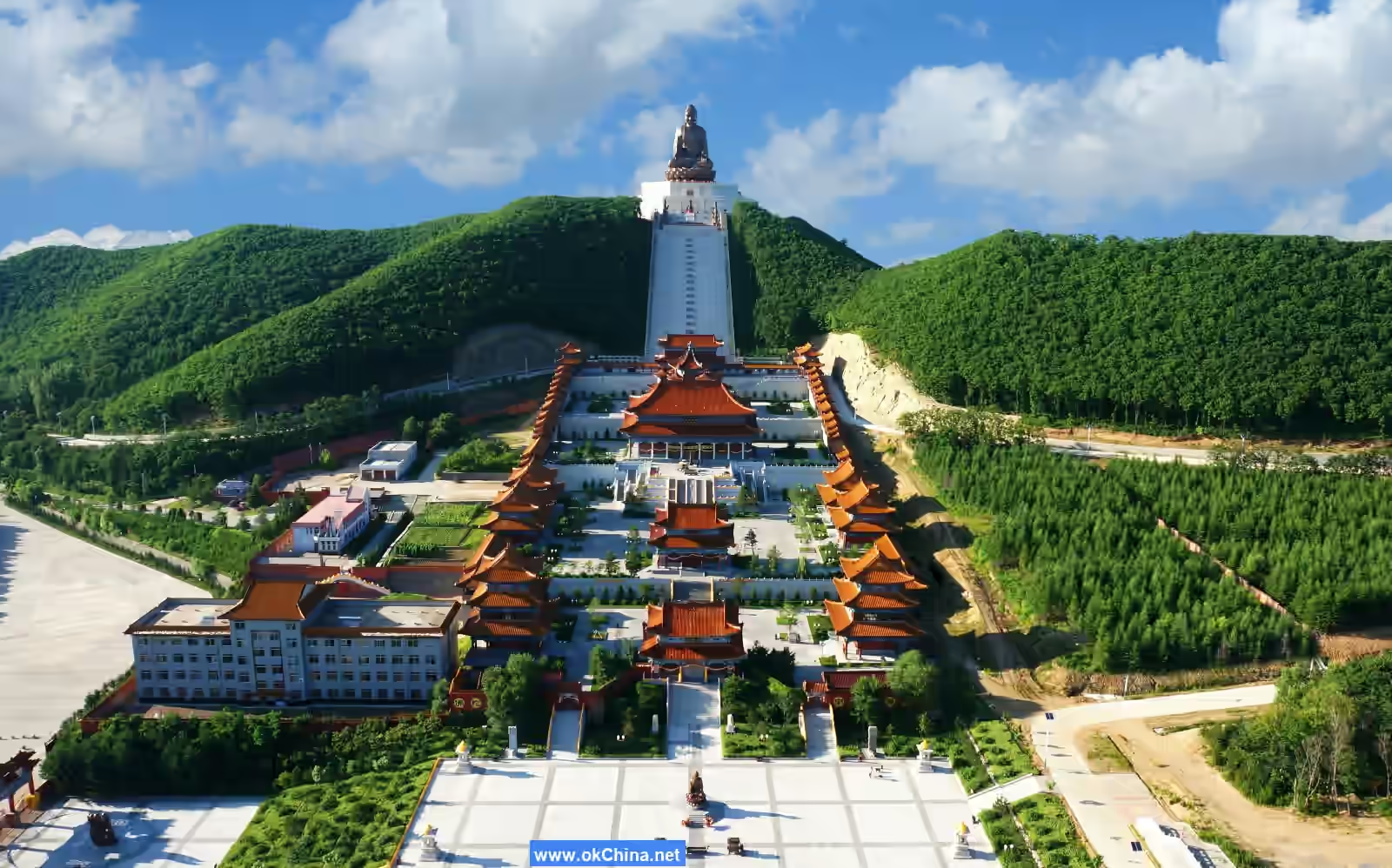
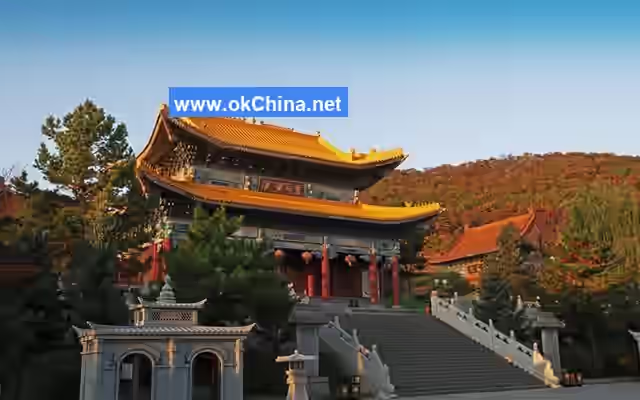
Zhengjue Temple was originally built in the late Qing Dynasty during the Guangxu era but was unfortunately destroyed during the Cultural Revolution. The magnificent nunnery seen today was rebuilt at a new location by the third-generation successor of Zhengjue Temple, the Chinese-American Buddhist nun Venerable Shi Foxing. Zhengjue Temple consists of five main halls: the Mountain Gate Hall, Heavenly King Hall, Mahavira Hall, Guanyin Hall, and Sutra Repository.
4.5 Jade Buddha Garden
The Jade Buddha Garden is located in a naturally formed circular basin on the southern shore of Sacred Lotus Lake, surrounded by mountains on three sides and facing water on one side. It is grand in scale, simple, and elegant. The Jade Buddha Garden has a three-story pavilion-tower structure: the first floor houses the Jade Buddha Hall, the second floor is the Ten Thousand Buddha Pavilion, and the top floor is the Relic Pagoda, used for enshrining Buddhist relics. The pagoda roof is circular, with 18 Dharma bells hanging down. The pagoda body is shaped like a precious gourd, adorned with three layers of 108 small golden lotuses around its waist. The pagoda base is surrounded by white railings, with 18 large lotuses blooming above. The entire pagoda appears as if supported by lotuses, and when the breeze blows, Buddhist chants seem to arise. The Jade Buddha Garden has 52 steps, symbolizing the 52 stages required for a person to cultivate and attain Buddhahood. After ascending the steps, visitors arrive at the Cloud Terrace Square, flanked by two rows of eight exquisitely carved "Eight Classes of Heavenly Beings" bluestone merit pillars. Inside the Jade Buddha Hall, a 7.6-meter-long, 32-ton reclining statue of Sakyamuni, carved from a single piece of Burmese jade, is enshrined, considered the largest of its kind in the world. Beside the head, back, and feet of the reclining Buddha stand over two-meter-tall statues of the Ten Great Disciples made of Burmese jade. In the Ten Thousand Buddha Pavilion, visitors can see a three-dimensional, 360-degree circular "卍"-shaped Ten Thousand Buddha City, containing 10,080 niches enshrining 10,080 seated Buddha statues made of Burmese jade.
4.6 Golden Tripod Great Buddha
The Golden Tripod Great Buddha is the world's tallest bronze seated Buddha. It was consecrated on September 23, 2011, by 108 eminent monks, including Venerable Chuan Yin, President of the Chinese Buddhist Association, Venerable Jing Hui, Vice President, and Venerable Sheng Hui. The Golden Tripod Great Buddha is seated atop the mountain behind Zhengjue Temple, facing south with its back to the Mudan River, embracing Zhengjue Temple in front, and overlooking the Changbai Mountains in the distance. It stands in correspondence with the Tian Tan Buddha in Hong Kong, representing one Buddha in two bodies, located in the north and south respectively, jointly blessing the land of China and bestowing wisdom and blessings upon devotees from all corners of the world.
4.7 Zhang Xiaotian Literature Museum
The Zhang Xiaotian Literature Museum began construction in June 2015. The museum covers an area of 5,100 square meters, with a building area of 3,400 square meters. It was completed and its exhibitions were set up on August 26, 2017. The exterior features a wooden plaque measuring 8 meters long and 1.6 meters wide, inscribed with the six characters "Zhang Xiaotian Literature Museum" by the renowned Chinese writer and scholar Wang Meng. The interior primarily includes functions such as exhibition halls, a multimedia screening room, a book repository, a lecture hall, management and service rooms, and literary and artistic creation studios.
The Zhang Xiaotian Literature Museum has two floors. The first floor is mainly the literary works exhibition area, while the second floor is the film and television works exhibition area. The four large forged copper reliefs on both sides of the lobby are created based on movie stills from films scripted by Mr. Zhang Xiaotian, including "Sun Yat-sen," "The Founding Ceremony," "Yongning Stele," and "The Taiping Heavenly Kingdom."
4.8 Buddhist Art and Culture Museum
The world-class Buddhist Art and Culture Museum is designed to comprehensively and three-dimensionally showcase the Buddhist cosmology. It integrates classical statues, paintings, and carving techniques, using a celestial vault-style backdrop to construct the Three Realms and Twenty-Eight Heavens from Buddhist mythology, providing a panoramic view of the Buddhist world. The overall architecture represents the pinnacle of Buddhist architectural art and is considered a treasure of traditional Chinese craftsmanship. Standing quietly within, one can deeply contemplate the compassion and wisdom of the Buddha, receive and uphold the classics, which will bring unprecedented awe and enlightenment.
4.9 Sacred Lotus PoolVast and crystal-clear, the winding waters stretch far and wide,
Where lotus leaves stand gracefully, their emerald canopies spread wide.
For miles the blossoms bloom, their fragrance carried on the breeze,
As sunset’s crimson glow bathes the lotus pond in a radiant sheen.
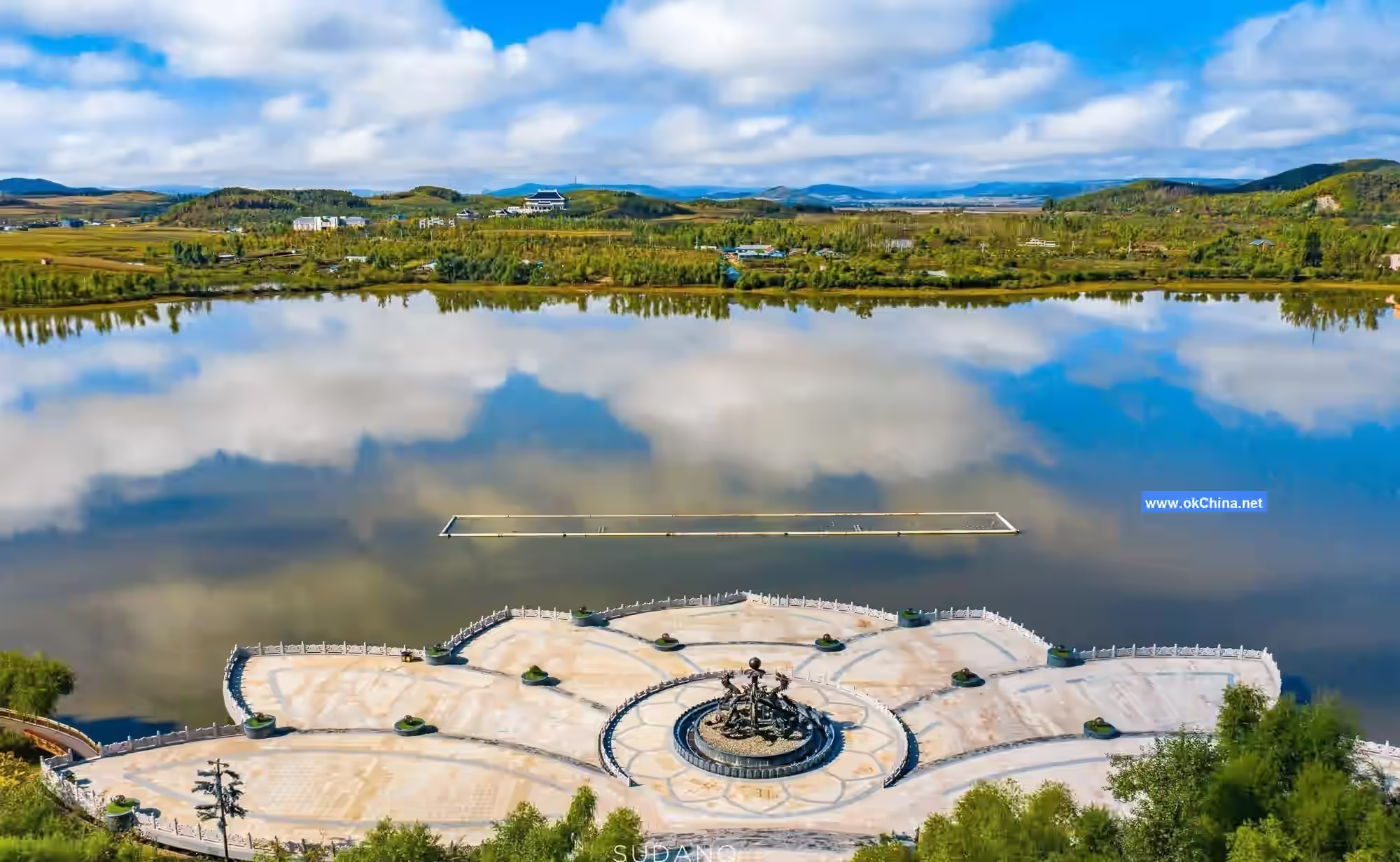
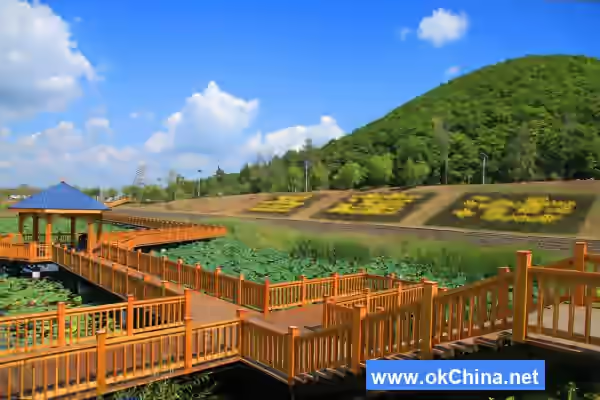
Every year in the height of summer, at the foot of the Golden Tripod Buddha, lies a serene expanse of green waters and sacred lotus leaves—this is the beloved Sacred Lotus Pond, cherished by tourists and locals alike. During July and August, as dawn breaks through the mist, the pond is bathed in a soft golden glow, filled with a refreshing fragrance. Lotus leaves blanket the water’s surface like jade plates adorned with rolling pearls, while lotus blossoms stand tall and pure, flawless in their elegance.
In the evening, as the crescent moon hangs in the western sky, young birds waddle among the lotus leaves, and fish play amidst the green ripples. The shimmering reflections on the water create a scene of untamed beauty. Accompanied by the soothing sounds of Buddhist chants and music, the lush greenery frames the delicate pink blooms, while a subtle fragrance drifts among the upright reeds. Visitors lean against the long corridor to rest, quietly admiring the blooming pond, finding joy in the harmony of nature. A unique sense of coolness washes over the heart, as if in a fairyland, where the self and the surroundings merge into one.
Comments
Post a Comment