Mount Heng
1. Introduction
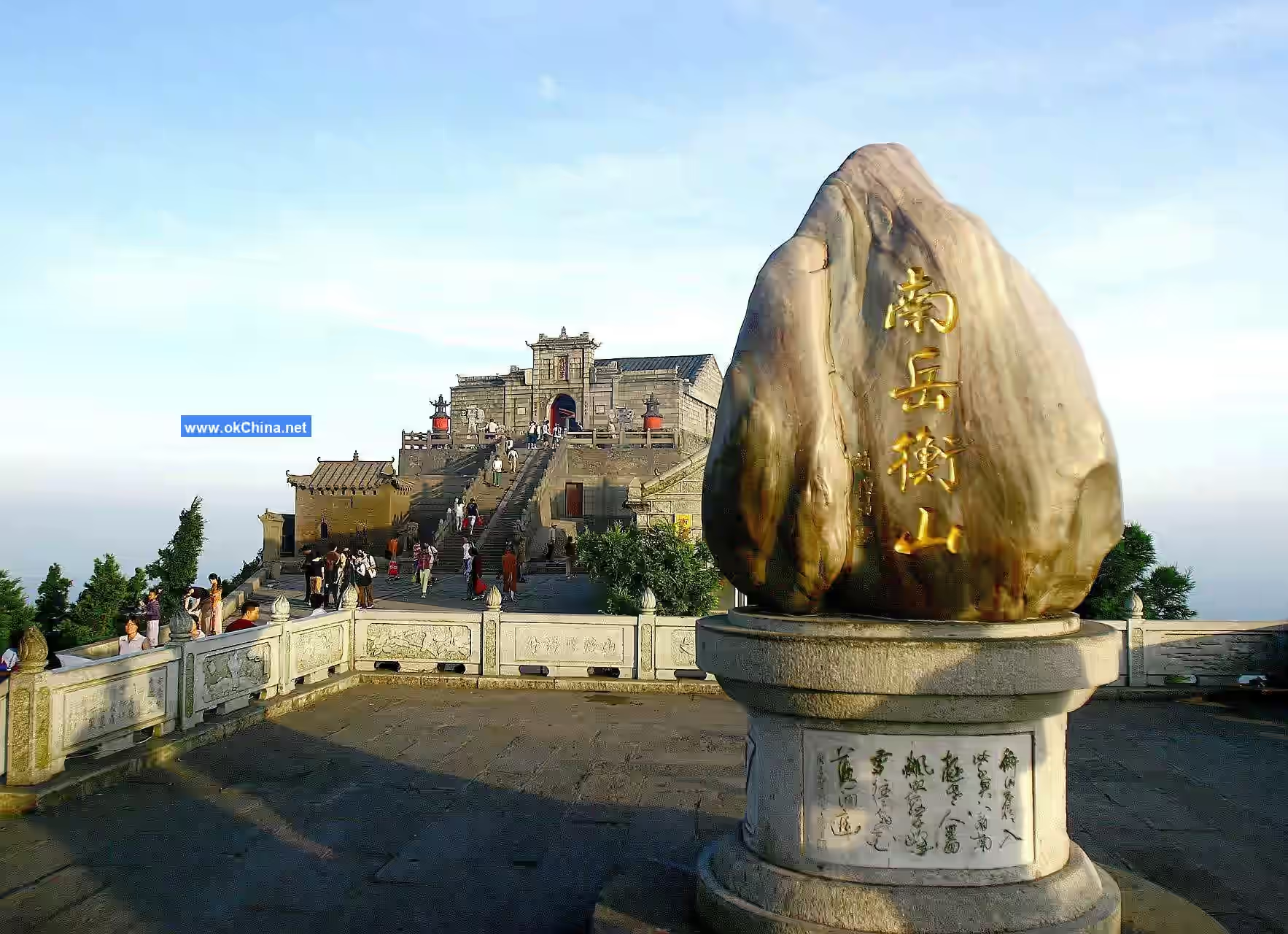
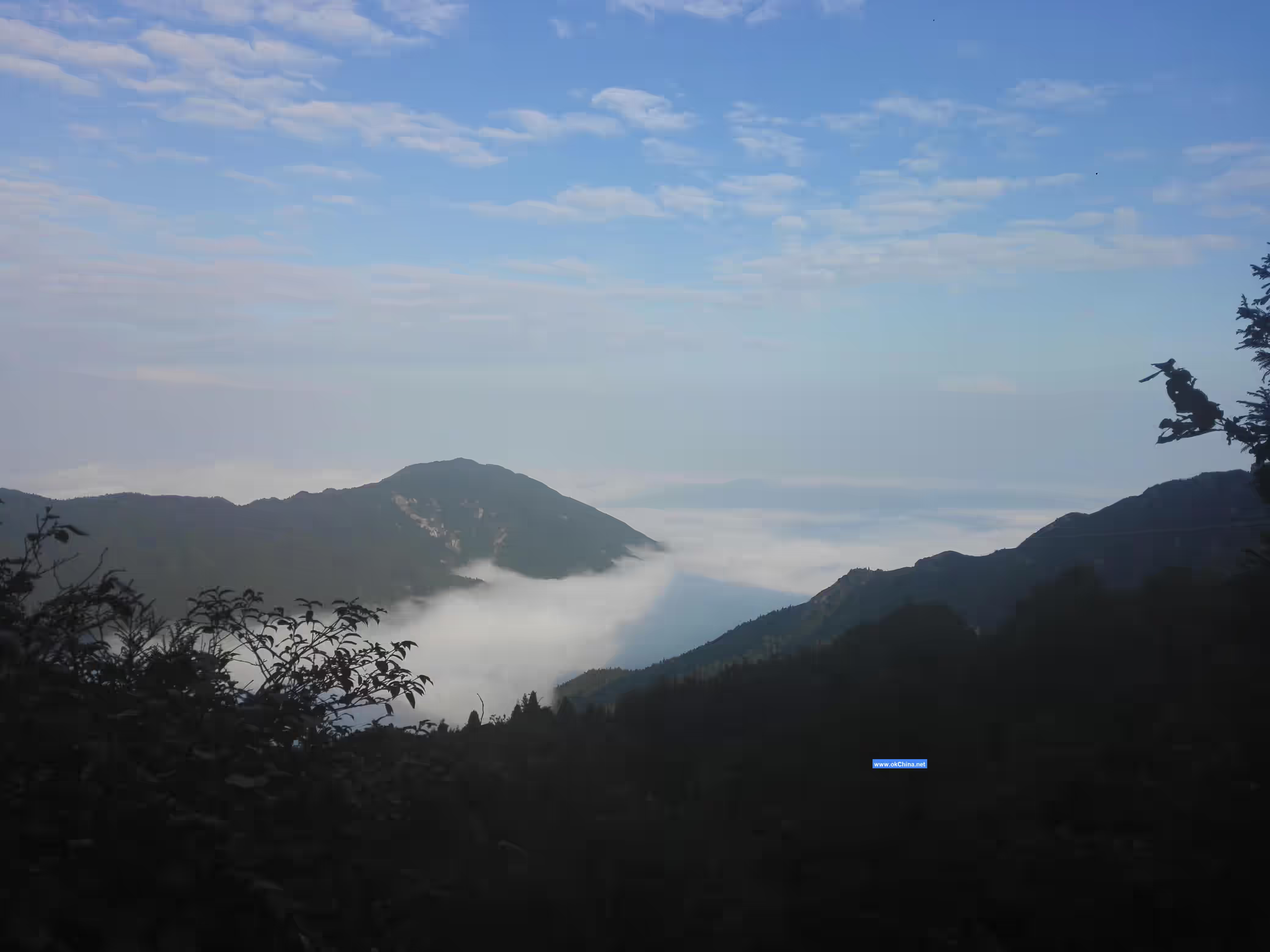
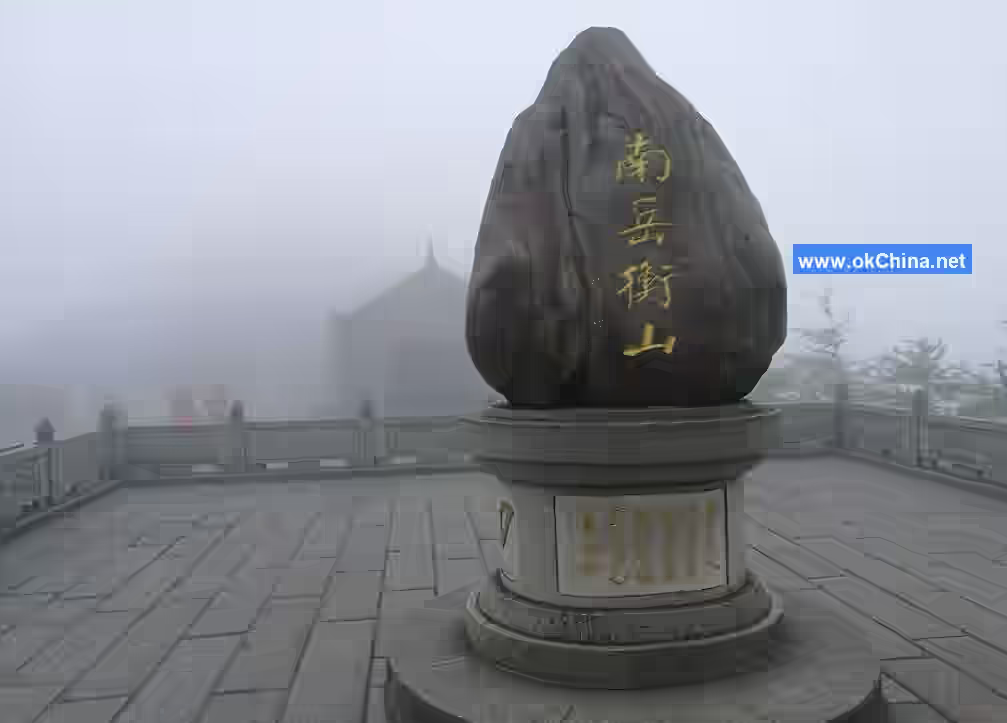
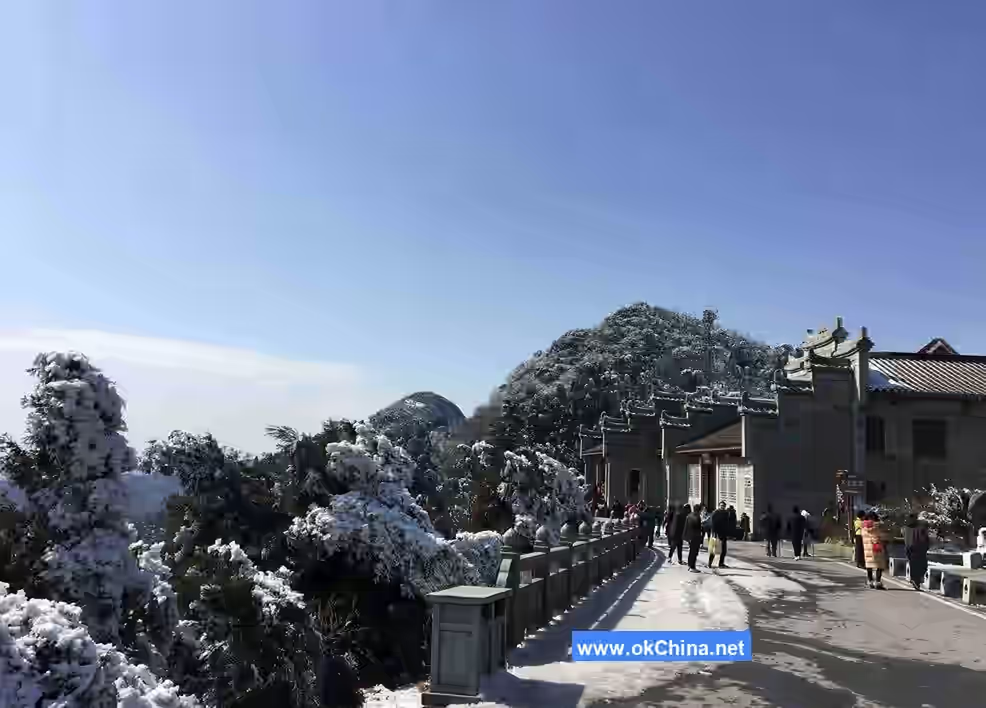
Mount Heng, also known as the Southern Mountain, the Mountain of Longevity, or Nanshan, is primarily located in the Nanyue District of Hengyang City, Hengshan County, and the eastern part of Hengyang County in Hunan Province. According to the "Gan Shi Xing Jing" (Gan and Shi's Classic of Stars) from the Warring States period, it is named Mount Heng because its location corresponds to the wings of the Zhen constellation among the twenty-eight lunar mansions. It is said to "respond to the celestial balance" and "weigh virtue and measure things," akin to a weighing instrument capable of balancing heaven and earth.
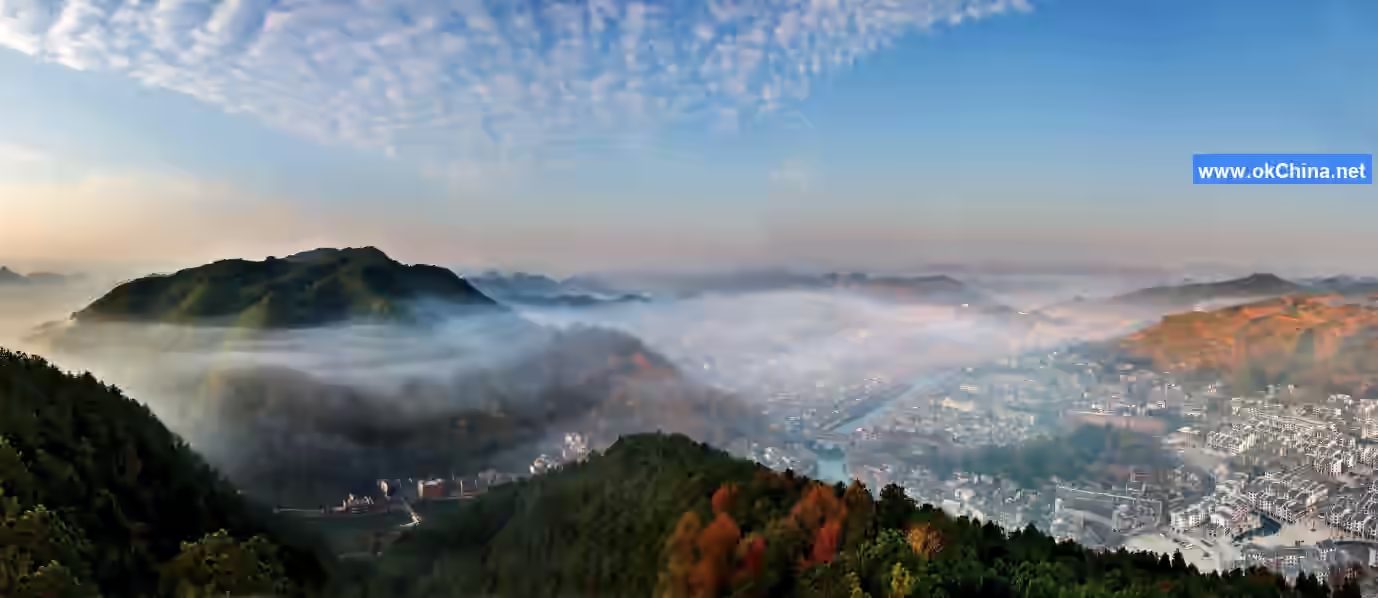
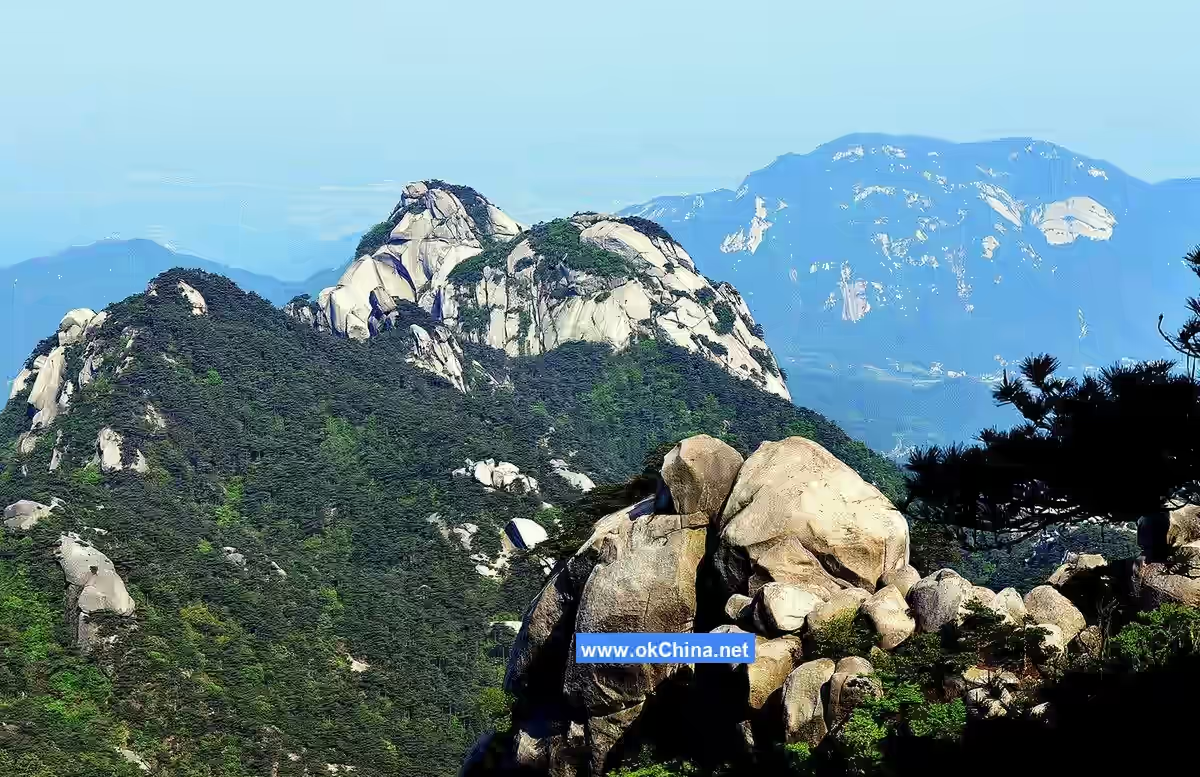
The main peaks of Mount Heng include Huiyan Peak, Zhurong Peak, Zigai Peak, and Yuelu Mountain, among others. The highest peak, Zhurong Peak, stands at an elevation of 1,300.2 meters. The main body of Mount Heng lies between 27°4′–27°20′ north latitude and 112°34′–112°44′ east longitude, stretching northeast to southwest. It spans 38 kilometers from Futianpu Township in Hengshan County in the north to Zhangmu Township in Hengyang County in the south, and 17 kilometers at its widest point from Jiepai Town in Hengyang County in the west to Nanyue District of Hengyang City in the east, covering a total area of 640 square kilometers.
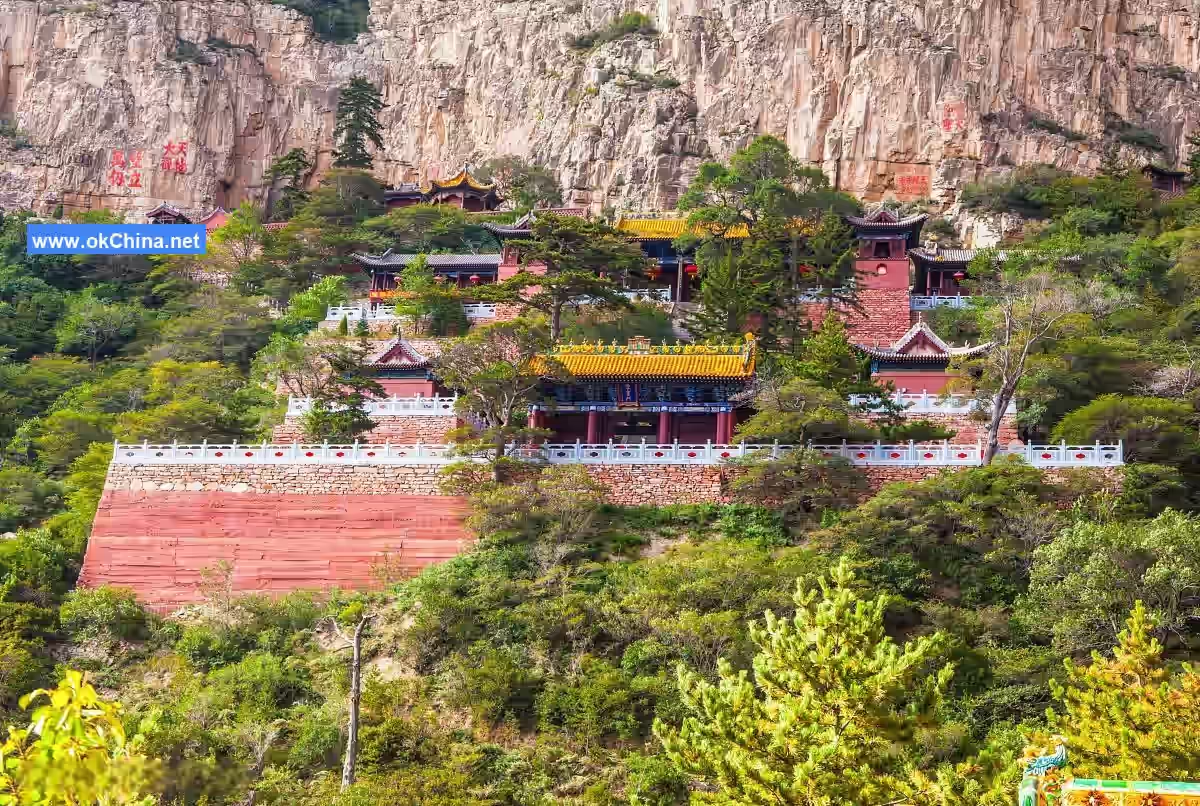
Mount Heng is a renowned sacred site for both Taoism and Buddhism in China, with over 200 temples, monasteries, nunneries, and Taoist temples scattered around the mountain. In ancient times, it was a place where emperors like Tang Yao and Yu Shun hunted and offered sacrifices to the gods of land and grain, and where Xia Yu sacrificed a horse to heaven and earth while seeking methods to control floods. The mountain deity of Mount Heng is Zhurong, the folk-revered god of fire. Appointed by the Yellow Emperor to guard Mount Heng, he taught people to use fire and nurtured all things. After his death, he was buried at Chidi Peak on Mount Heng and is locally revered as the Holy Emperor of the Southern Mountain. Among the Taoist "Thirty-Six Grotto Heavens and Seventy-Two Blessed Lands," four are located within Mount Heng. Additionally, two genuine sarira (relics) of Buddha Shakyamuni are enshrined in the Vajra Sarira Pagoda at Nantai Temple on Mount Heng.
2. Main Scenic Areas
2.1 Main Peaks
The Southern Mountain, Mount Heng, comprises seventy-two peaks scattered across counties and cities such as Hengyang, Hengshan, Hengdong, Changsha, Xiangtan, and Shuangfeng, spanning an area of 800 li. It begins with Huiyan Peak in Hengyang in the south and ends with Yuelu Mountain in Changsha in the north, centered around Zhurong Peak within the Nanyue area. Forty-four of these peaks are located within the administrative region of Nanyue.
2.1.1 Zhurong Peak
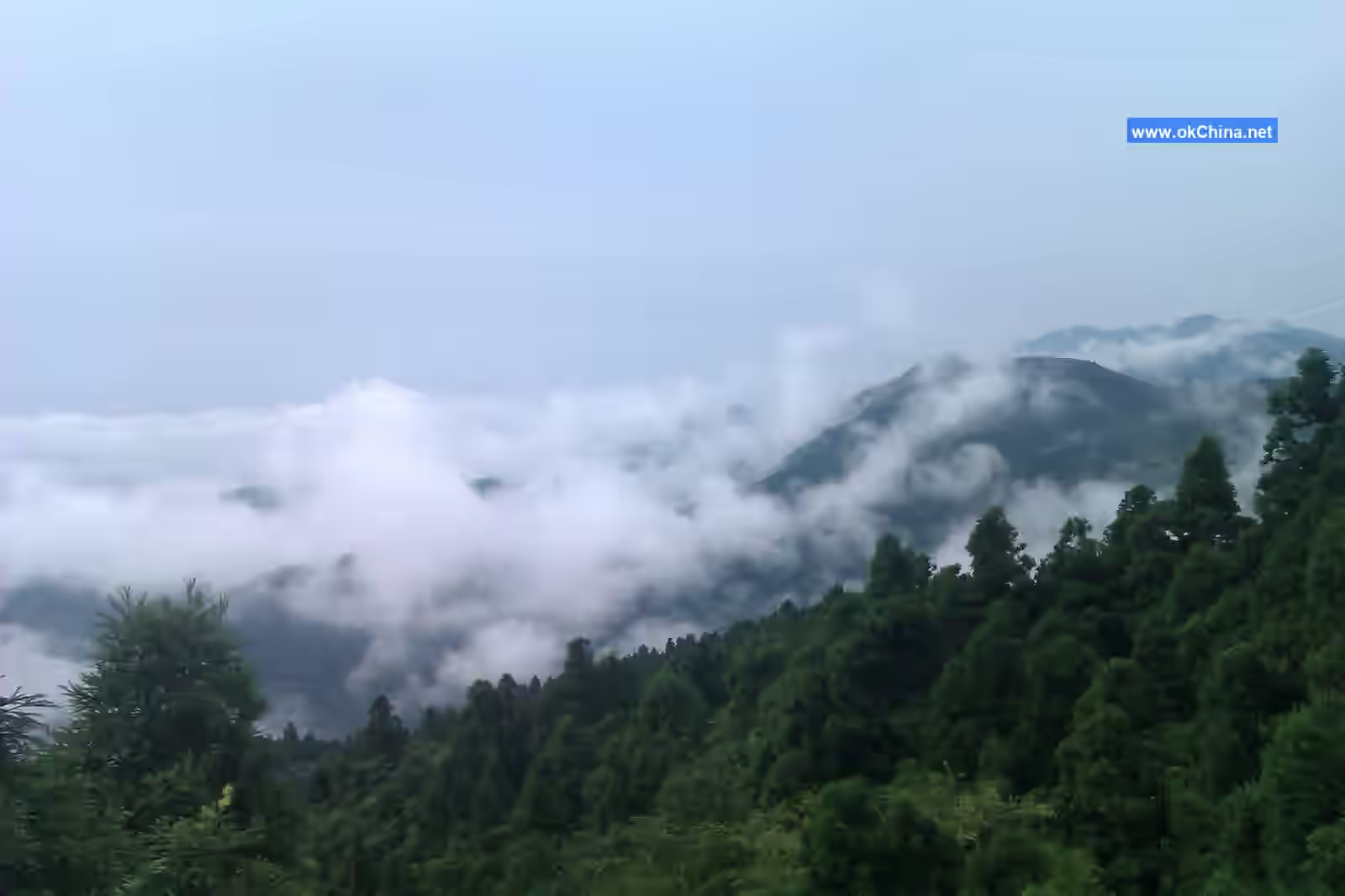
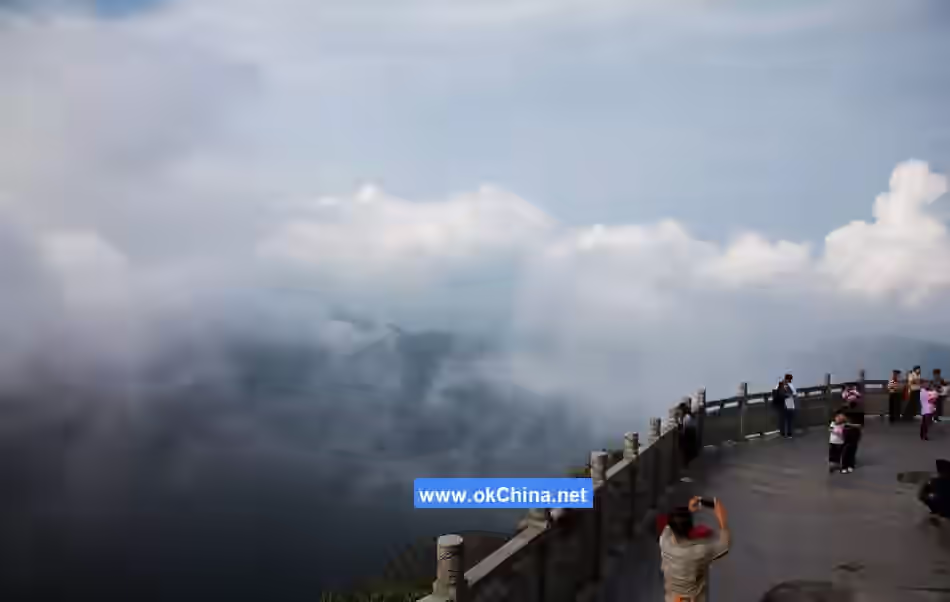
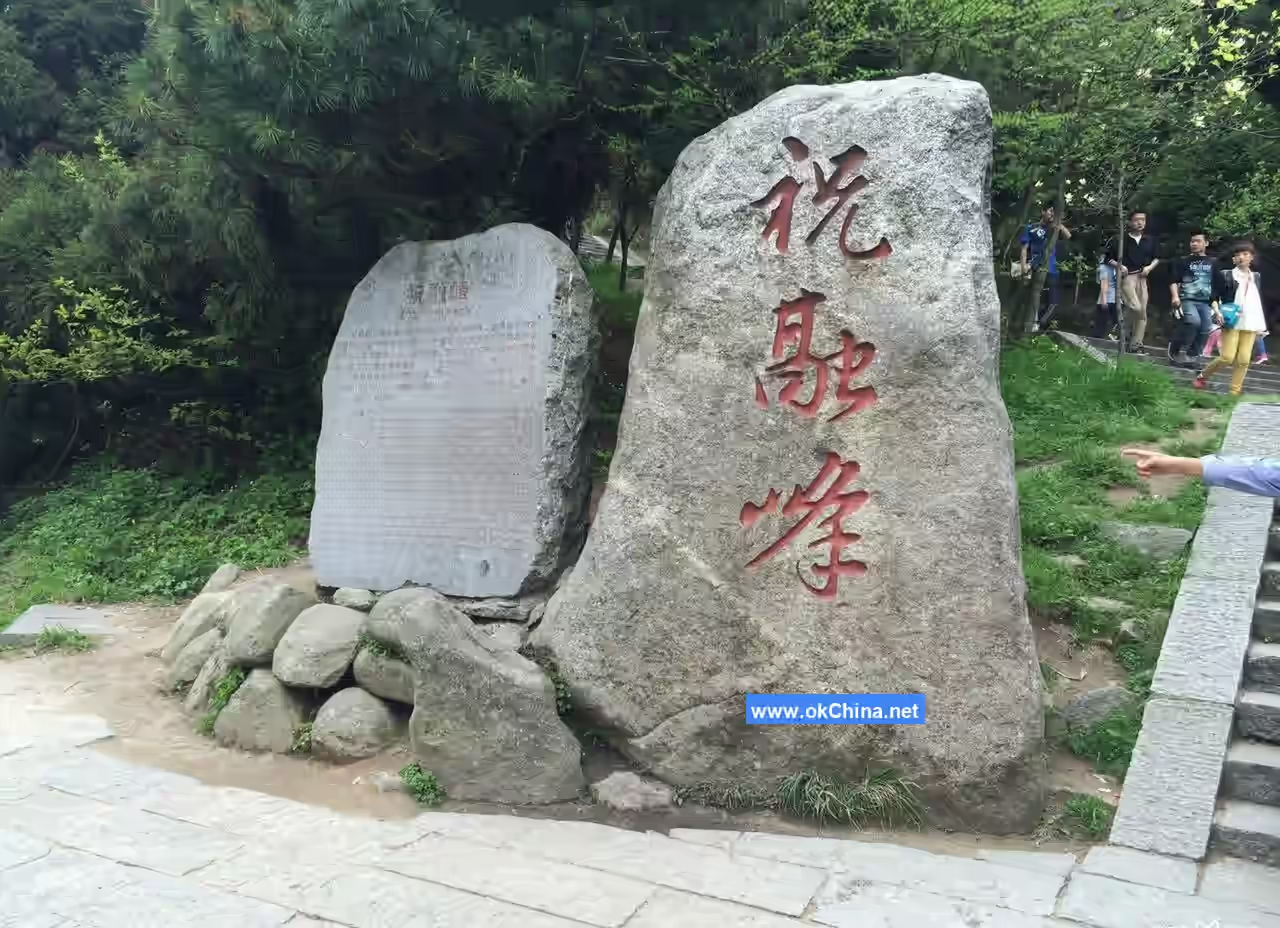
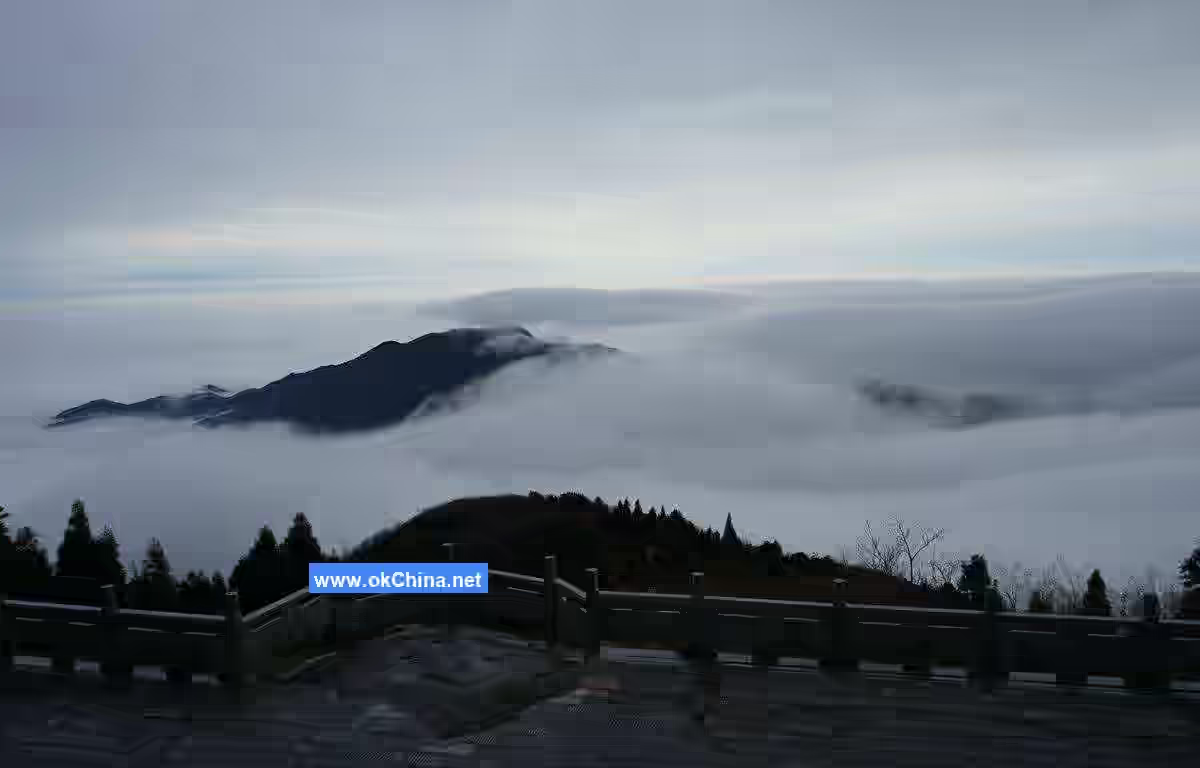
Zhurong Peak is the highest peak of Mount Heng and a mountain dedicated to commemorating the cultural ancestor Zhurong. "The Loftiness of Zhurong Peak" is considered the foremost of the "Four Wonders" of Nanyue's scenery. Perennially shrouded in mist and clouds and set against the backdrop of surrounding peaks, its prominence is further accentuated by its location in the relatively low-lying basin of southern Hunan, making it appear to pierce the heavens. In ancient language, "Zhu" means enduring forever, and "Rong" means brightness; thus, "Zhurong" signifies eternal brightness. The great Tang dynasty literary figure Han Yu praised it in his poem "Visiting Zhurong Peak": "Ten thousand zhang, Zhurong rises from the earth, / Seen and unseen in the light mist." The Northern Song poet Huang Tingjian wrote: "Ten thousand zhang, Zhurong pierces the purple sky, / Where the road ends, a fairy bridge is laid. / Above, the blue vault and stars seem near; / Below, the mortal world appears far away."
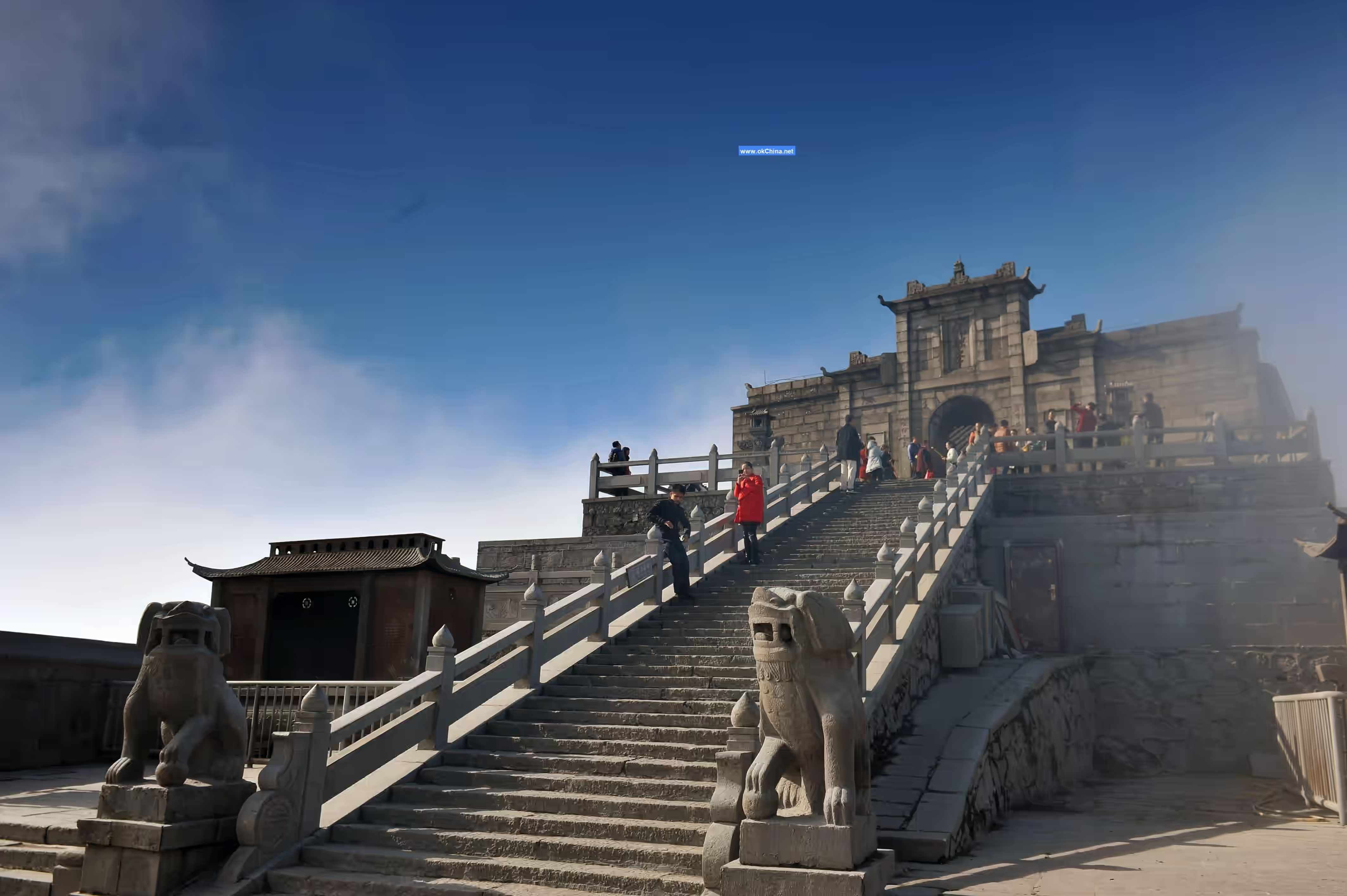
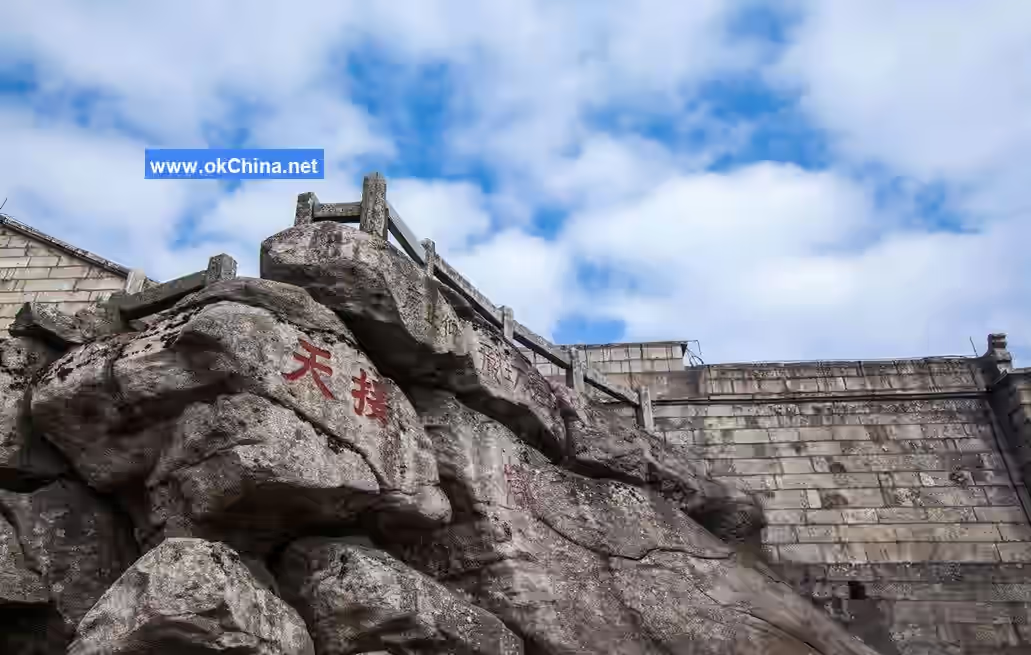
Ascending the "Heavenly Steps" leads directly to the Zhurong Hall atop Zhurong Peak. The hall was built to commemorate the merits of the fire god Zhurong. Structures existed here before the Sui dynasty, originally as the Temple of the Heavenly Official Huowang. Later, the temple was moved downhill (becoming the precursor of the Nanyue Temple) and renamed Tianchi Nunnery. During the Ming dynasty, it became Kaiyun Shrine, and it was not until the Qianlong era of the Qing dynasty that it was renamed Zhurong Hall. The entire hall consists of two sections, constructed entirely of granite. The roof is covered with tin-coated iron tiles, each 70 cm long, 30 cm wide, and weighing 15 kg. Among these tiles, several dozen iron tiles cast during the Song dynasty have been preserved, remaining smooth and rust-free for a millennium.
2.1.2 Tianzhu Peak
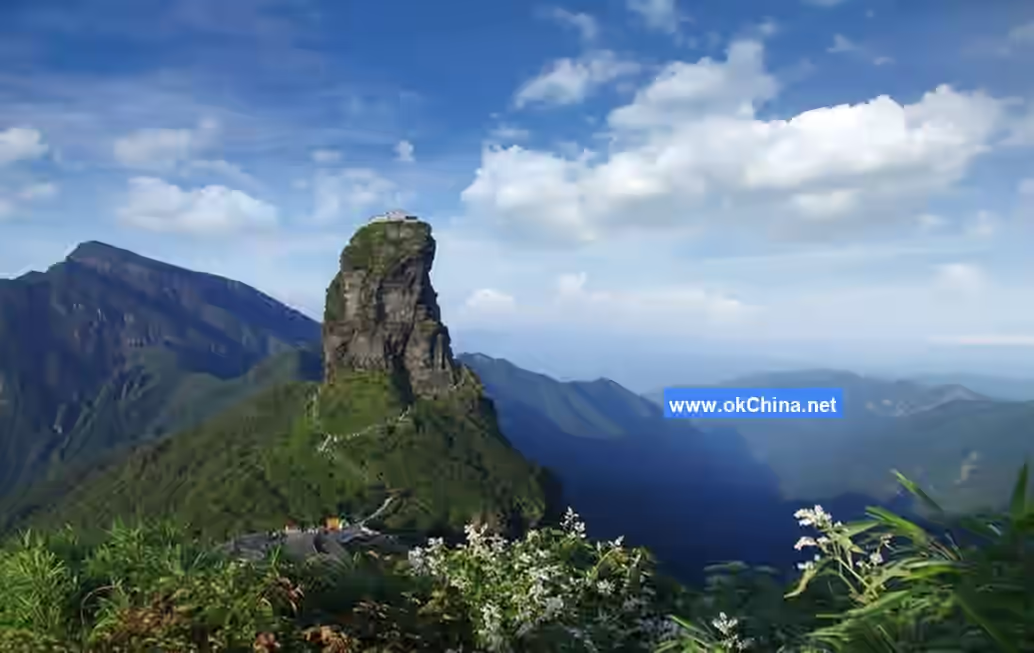
Tianzhu Peak is one of the seventy-two peaks of Mount Heng, with an elevation of 1,061 meters, located within Yanshou Village in Nanyue Town. When viewed from below, a high peak catches the eye, atop which are two summits resembling twin pillars piercing the sky. Due to its steep and towering form, which resembles a pillar giving a sense of propping up the sky and supporting the earth, it is named Tianzhu Peak (Heavenly Pillar Peak). The "Jiuyu Zhi" records: "Among the 360 famous mountains with pillars, this is the sixth pillar." On the small circular platform at the peak stands an octagonal pavilion with drooping eaves, 4 meters high, with two stories and four doors, built of granite, serving as a watchtower for fire alerts. On the stone cliff below the tower, the four characters "Nan Tian Zhu Shi" (Southern Heavenly Pillar Stone) are inscribed in regular script.
2.1.3 Huiyan Peak
Huiyan Peak is the first among the seventy-two peaks of the 800-li Mount Heng, hence known as the First Peak of Nanyue. With an elevation of 96.8 meters and a total area of 6.32 hectares, it is situated on the banks of the Xiang River in Yanfeng District, Hengyang City. It is a municipal-level key cultural relics protection unit and a national AAA-level tourist attraction. There are two legends about the origin of its name. One says that northern wild geese fly south to winter here and return north when spring warms. The other says the mountain resembles a swan goose stretching its neck, raising its head, and spreading its wings as if about to soar into the sky. The ancient city of Hengyang is thus elegantly called "Goose City" because of this peak. The title "First Peak of Nanyue" carries two meanings: geographically, it is the first peak from south to north among the seventy-two peaks of Nanyue, sharing fame with peaks like Zhurong, Tianzhu, and Yuelu; secondly, Nanyue has a long history of "incense culture," and it has been said since ancient times that pilgrimages to Nanyue begin from this first peak. The ancient Yanfeng Temple, with a history of 1,500 years, is located on Huiyan Peak. Throughout the ages, eminent monks have preached here. Legend says the "Longevity Buddha" left a kasaya robe at Yanfeng Temple, which houses a "Longevity Buddha Hall," serving as important evidence for Nanyue being called the "Mountain of Longevity."
2.1.4 Shilin Peak
Shilin Peak, commonly known as Leibo Di or Daling. On its eastern cliff face, there are two protruding peaks that, when viewed from below, resemble towering granaries reaching into the clouds. Hence, legends surrounding this feature emerged. Some say these two stone peaks not only look like granaries but also have two doors, with stone statues standing beside them, and one door clearly appears locked. On stormy, thunderous nights, people below can hear the sounds of doors closing. These two doors are usually one open and one closed. When both doors are shut, it foretells a bountiful harvest on earth; when both are open, it brings famine. Others say the stone granary contains not only grain but also honey. Ancient texts record many scenic spots and historical sites on the peak, such as Yuqing Temple, the Alchemy Platform of Master Chen, Guizai Stone, Leihong (Thunder Pool), Fengxue (Wind Cave), the Sutra-Chanting Altar, and Yudan Spring. Today, only Leigong Well (Leihong) remains. "Yudi Jisheng" (Volume 55, Hengzhou) states: Shilin Peak "is in Nanyue, its peak towering like a granary." "Qing Yitong Zhi · Hengyang Fu Yi" notes: Shilin Peak "is shaped like a granary, with two doors, one open and one closed."
2.1.5 Zigai Peak
Zigai Peak is one of the seventy-two peaks of Mount Heng. "Taiping Yulan" (Volume 39) quotes Sheng Hongzhi's "Jingzhou Ji": "Mount Heng has three peaks, one named Zigai, where pairs of white cranes are often seen circling above." "Yudi Jisheng" (Volume 55, Hengzhou) states: Zigai Peak "is in Nanyue. It often appears shrouded in purple mist, its shape like a canopy." All peaks of Nanyue face Zhurong Peak as if bowing in respect, except for Zigai Peak, which stands upright facing south. Du Fu wrote in his poem "Gazing at the Mountain": "Zhurong, five peaks supreme, / Peak after peak bows low. / Zigai alone pays no homage, / Rivaling in height, they gaze afar."
2.1.6 Yuelu Mountain
Yuelu Mountain is the last of the seventy-two peaks of Nanyue, with an elevation of 300.8 meters. It integrates the essence of ancient Chinese culture—Confucianism, Buddhism, and Taoism—embodying the cultural connotations of Yuelu Mountain developed by historical giants of thought, eminent monks, aged Taoists, and literati. At its foot lies the Yuelu Academy, ranked first among the Four Great Academies of ancient China. Midway up the mountain is the ancient Lushan Temple, known as the "First Scenic Spot of the Han and Wei Dynasties, the Foremost Taoist Site in Hunan." With a history of over 1,700 years, the ancient Lushan Temple is the birthplace and center of Buddhism in Hunan Province.
2.2 Main Attractions
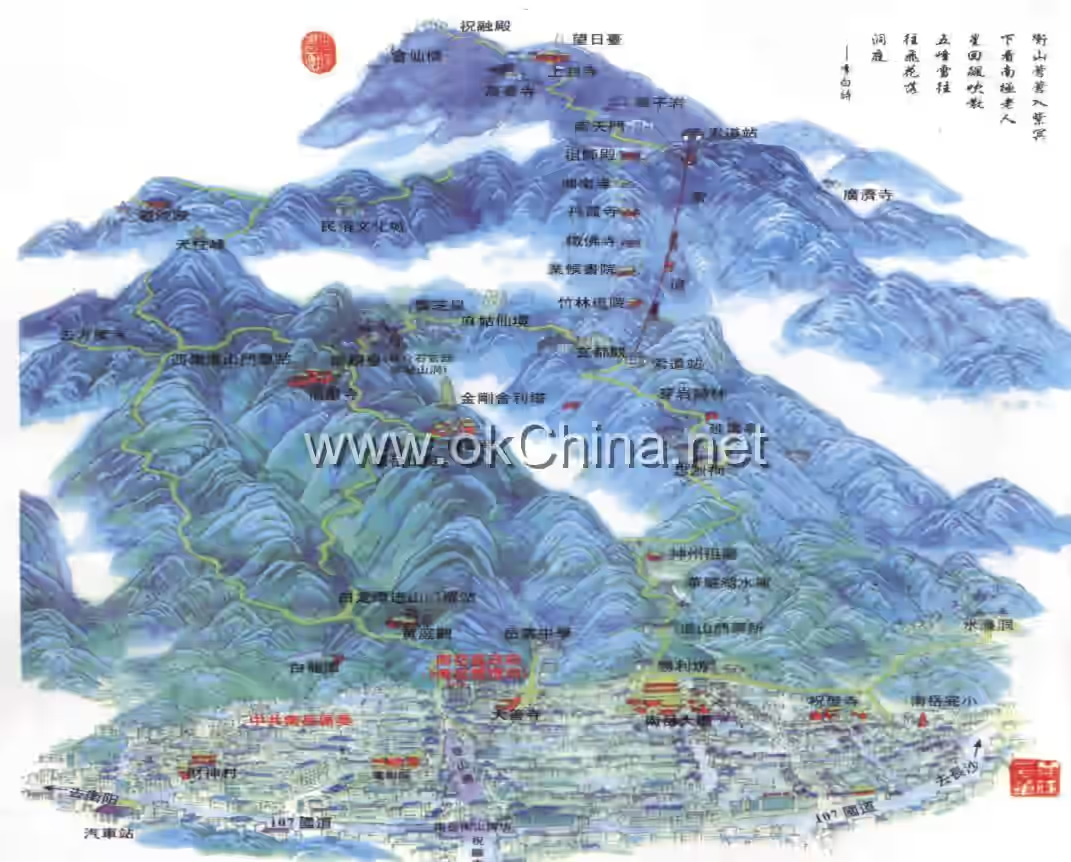
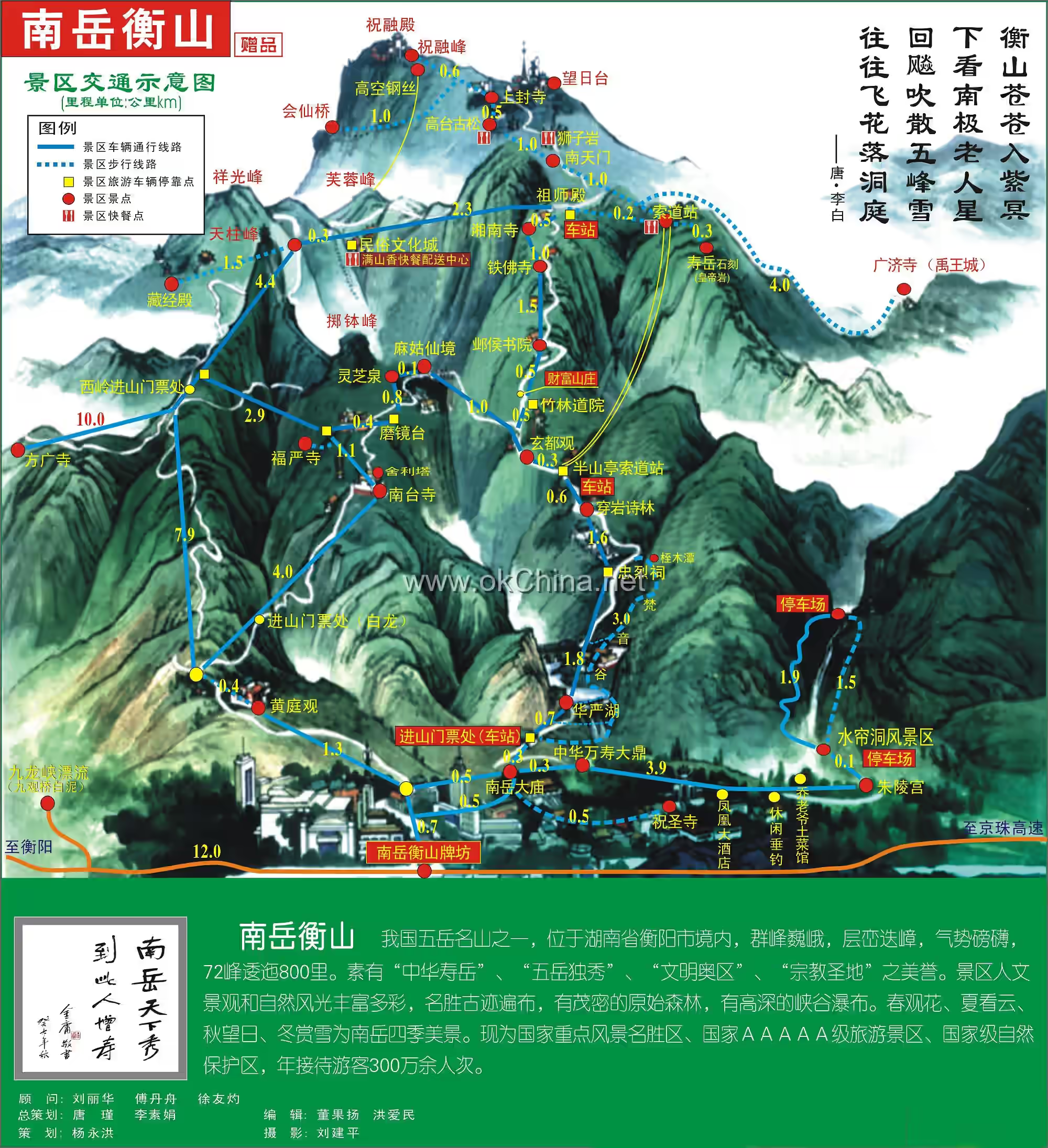
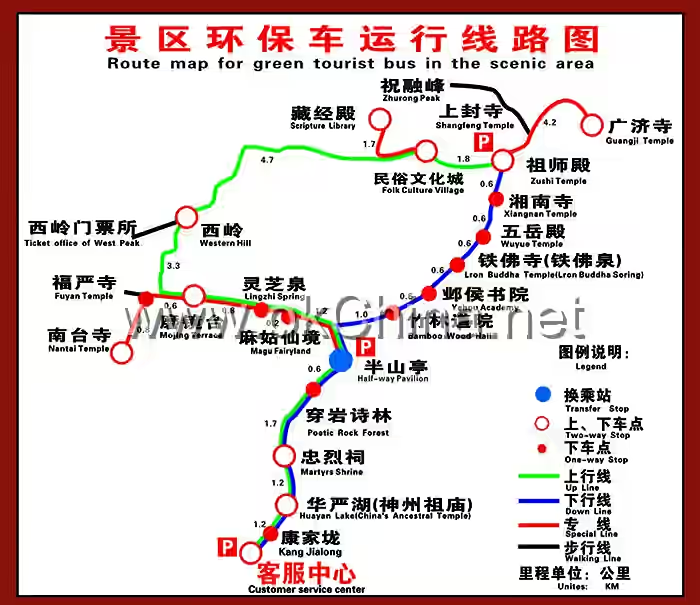
The Mount Heng Tourist Area in Nanyue District, Hengyang City, is located 35 kilometers south of downtown Hengyang. Under the jurisdiction of Nanyue District, it covers a total area of 184 square kilometers and was among the first batch of national key scenic areas announced by the State Council in 1982. It features 9 streams, 10 bridges, 24 springs, 15 caves, 9 ponds, 9 pools, and 38 cliffs. "The Loftiness of Zhurong Peak, the Elegance of the Scripture Collection Hall, the Profundity of Fangguang Temple, and the Wonder of the Water Curtain Cave" are traditionally known as the "Four Wonders of Nanyue." "The Seclusion of Magu's Fairyland, the Delight of Chuanyan Poetry Forest, the Grandeur of Longfeng Flying Waterfall, and the Antiquity of King Yu's Ancient City" are considered the "New Four Scenes of Nanyue." The Nanyue Tourist Scenic Area is located in central-eastern Hunan, centered around the main peak Zhurong, covering 184 square kilometers. It is roughly divided into eight tourist areas—Nanyue Ancient Town, Water Curtain Cave, Loyalty Memorial Hall, Mojing Terrace, Zhurong Peak, Scripture Collection Hall, Fangguang Temple, and Longfeng Pool—and one summer resort area, Xiling.
Nanyue was listed among the first batch of national key scenic areas in the 1980s and was included in China's National Natural and Cultural Heritage List in the 21st century.
2.2.1 Nanyue Ancient Town
Nanyue Ancient Town, also known as the Four Streets of Yueshi, is an ancient market town that developed from an incense market. It backs onto the Nanyue Temple and faces National Highway 107, primarily centered around the incense trade. The town is busiest during the annual incense season in August. Main attractions include: Nanyue Temple, Zhusheng Temple, and Huangting Temple, all initially built during the Tang dynasty. Nanyue Temple and Zhusheng Temple preserve a wealth of ancient architectural artistry. Exiting West Street and turning north along the western mountain road for about three li leads to Huangting Temple, built on a cliff overlooking Bailong Pool, with beautiful scenery. Though small, the temple is exquisite, tranquil, cooled by pine breezes, and soothed by the sound of streams. Above the temple is the former site of the National Normal College from the 1940s. The winding mountain paths, meandering streams, verdant pines and bamboos, and farmhouse chimneys dot the landscape. Ascending via the western route, one can still envision the springtime apricot blossoms and the intellectual fervor of the past. It was also the site of four military conferences of the National Government's Military Commission in the 1930s and 1940s. Below Bailong Pool stands a small farmhouse called "Juying Pu," the former site of the Chinese Communist Party delegation at the Cadre Training Class.
2.2.2 Scripture Collection Hall
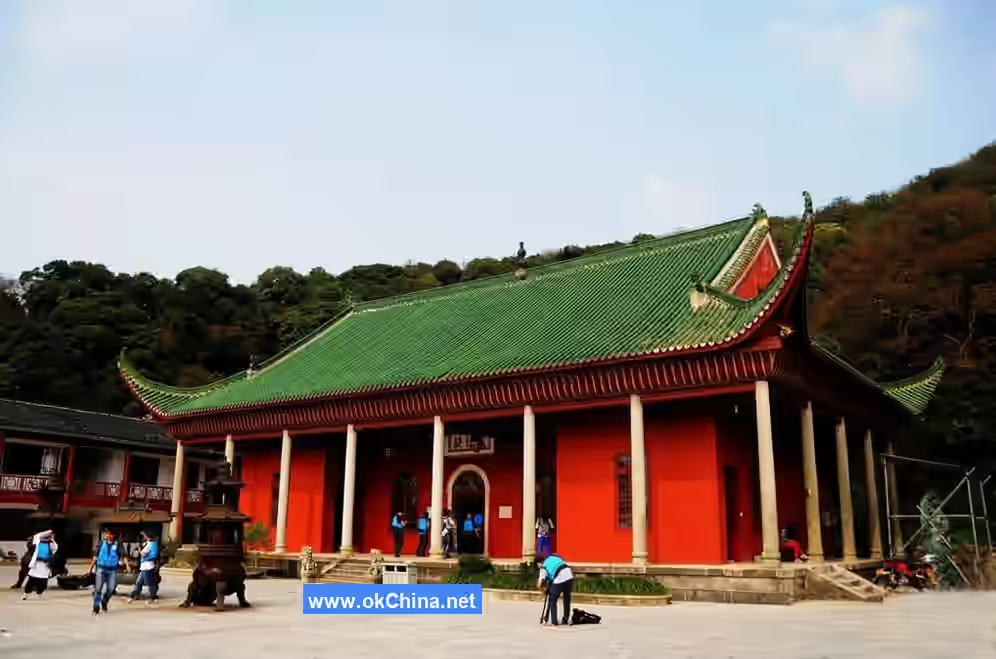
The Scripture Collection Hall is located below Xiangguang Peak and was built by Chan Master Huisi in the second year of the Guangda era (568 AD) of the deposed Emperor Chen of the Southern Dynasties. Because Emperor Taizu of the Ming dynasty bestowed a complete set of the Buddhist canon to be stored in the temple, it was named the "Scripture Collection Hall." It was later renamed Xiangguang Temple and Puguang Temple successively before reverting to Scripture Collection Hall. The current structure was rebuilt in 1933.
2.2.3 Fangguang Temple
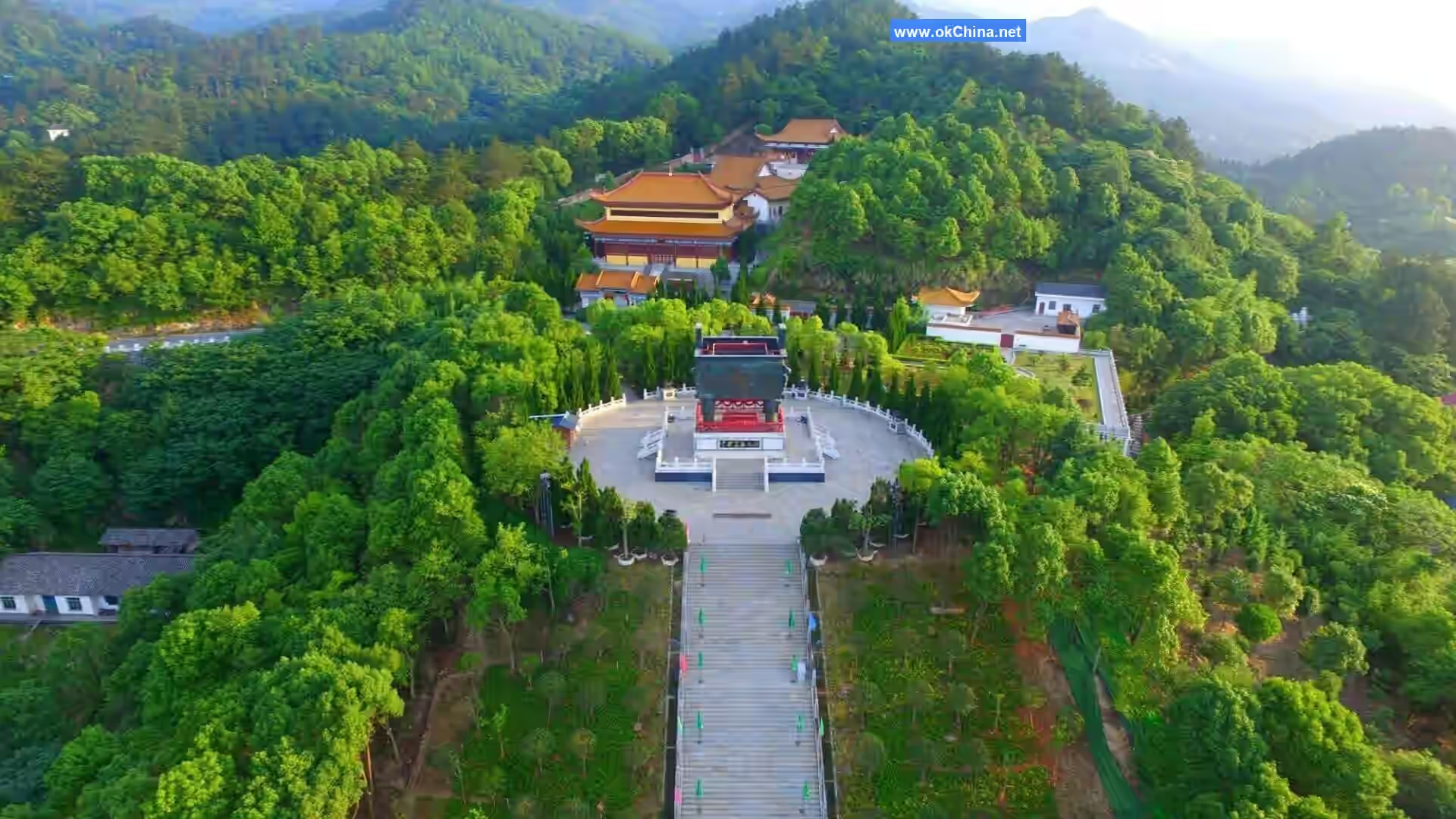
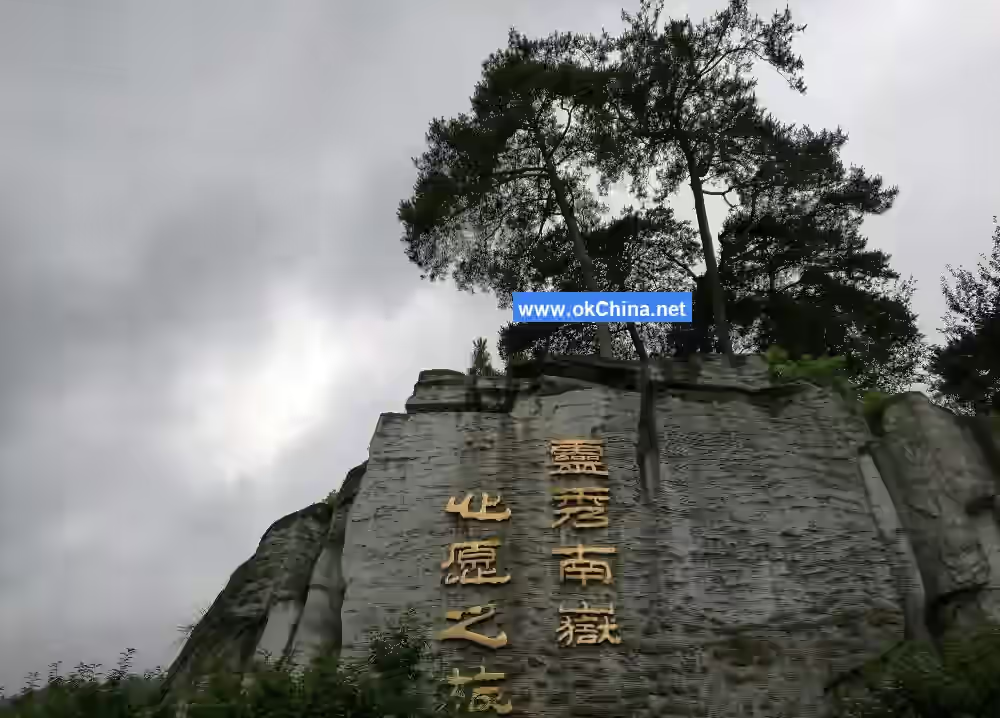
Fangguang Temple is located below Lotus Peak in Nanyue District. The name Fangguang derives from the Buddhist concept of the Dharma spreading widely in all ten directions. The temple was first built in the second year of the Tianjian era of the Liang dynasty during the Northern and Southern Dynasties (503 AD) and has been renovated through various dynasties. Inside the temple are the four characters "Tian Xia Ming Shan" (Famous Mountain Under Heaven) written by Emperor Huizong of the Song dynasty.#### 2.2.4 The Longevity Grand Ding The Longevity Grand Ding, officially named the "Chinese Longevity Grand Ding," is recognized by the Guinness World Records as the "World's First Ding." It is currently the world's largest, heaviest bronze vessel with the most inscribed "longevity" characters. The Chinese Longevity Grand Ding is the central attraction of the Chinese Longevity Altar scenic area in Nanyue, situated on the Jiahe Peak of Mount Hengshan in Nanyue.
2.2.5 Water Curtain Cave
Located in Shuilian Village, Nanyue Township, approximately 4 kilometers from Nanyue Town, the Water Curtain Cave was anciently known as the Zhuling Cave. Legend has it that it connects to the Zhuling Cave on Shigu Mountain in Hengyang. The water source of the Water Curtain Cave originates from the summit of Zigai Peak in Nanyue, flows through mountain caves, and converges into a stone cave over 6 meters wide and of unfathomable depth. When the cave overflows, the water cascades vertically, forming a waterfall over 60 meters high.
2.2.6 Dashan Temple
Dashan Temple is the "place of preaching" for Master Huisi, the patriarch of the Tiantai school of Buddhism and the founding master of Nanyue Buddhism. It is located on Zhurong Road, west of the Nanyue Grand Temple. Backed by Beizhi Street and facing Zhurong Road—the main ascending route of Mount Hengshan—to its west front, the temple is oriented north-south. Along its central axis stand the Heavenly King Hall, the Great Buddha Hall, and the Dharma Hall, with meditation halls and morality halls flanking the eastern and western wings.
2.2.7 Nanyue Grand Temple
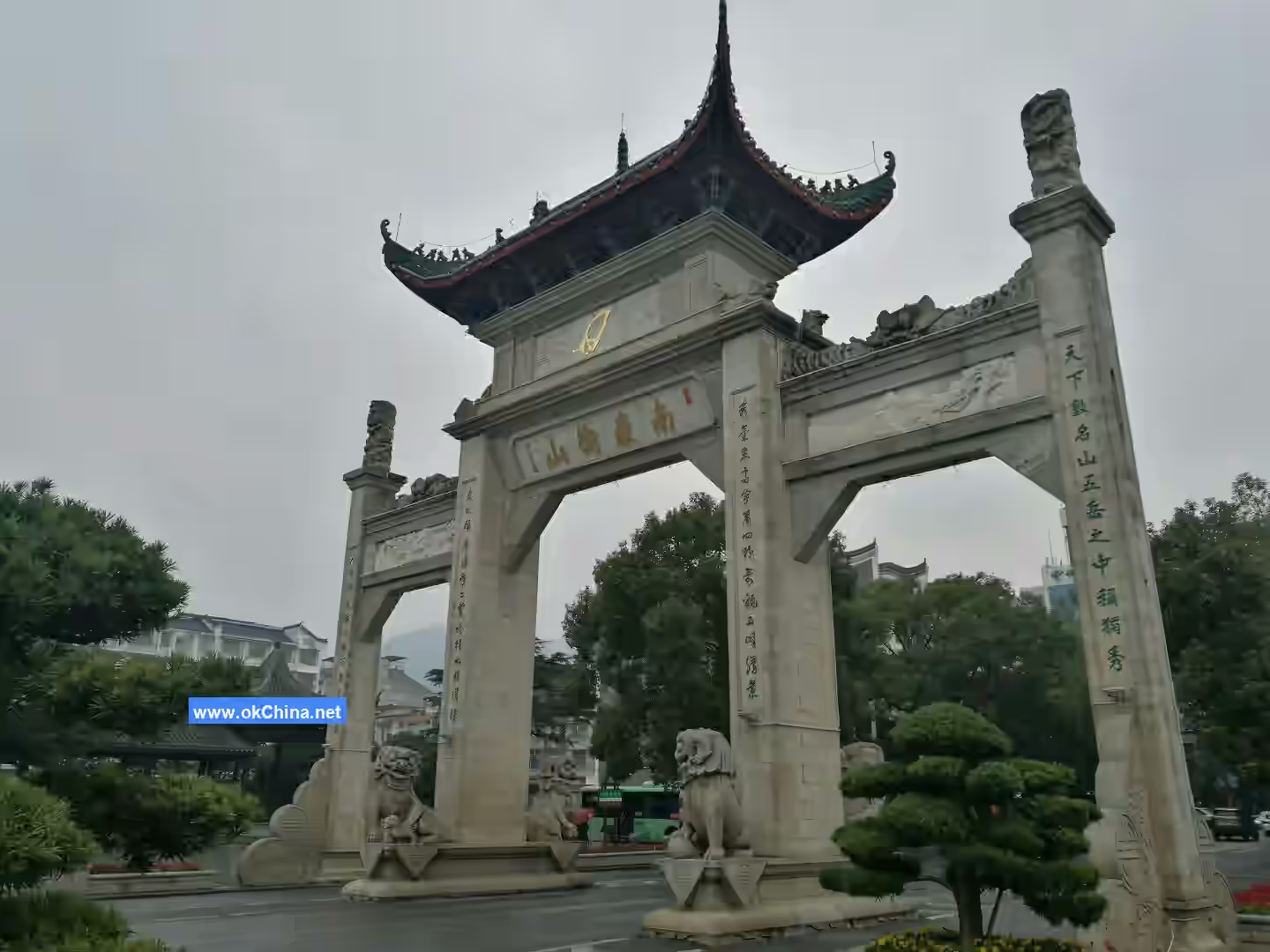
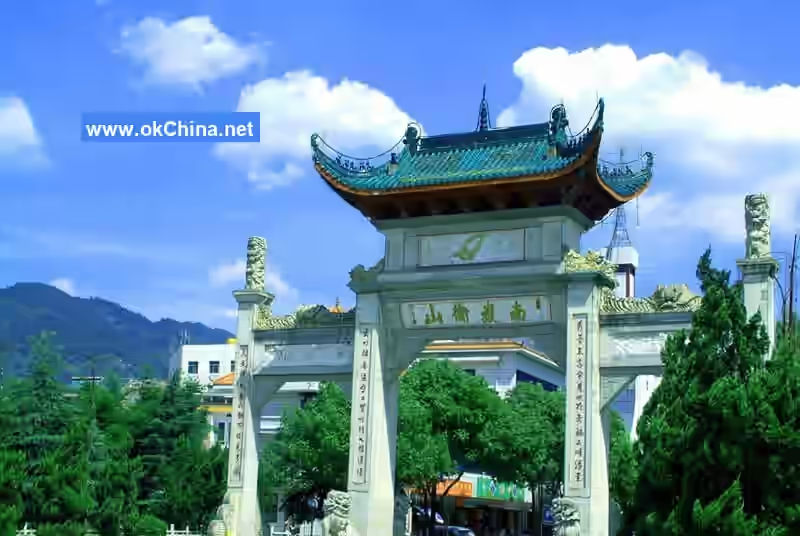
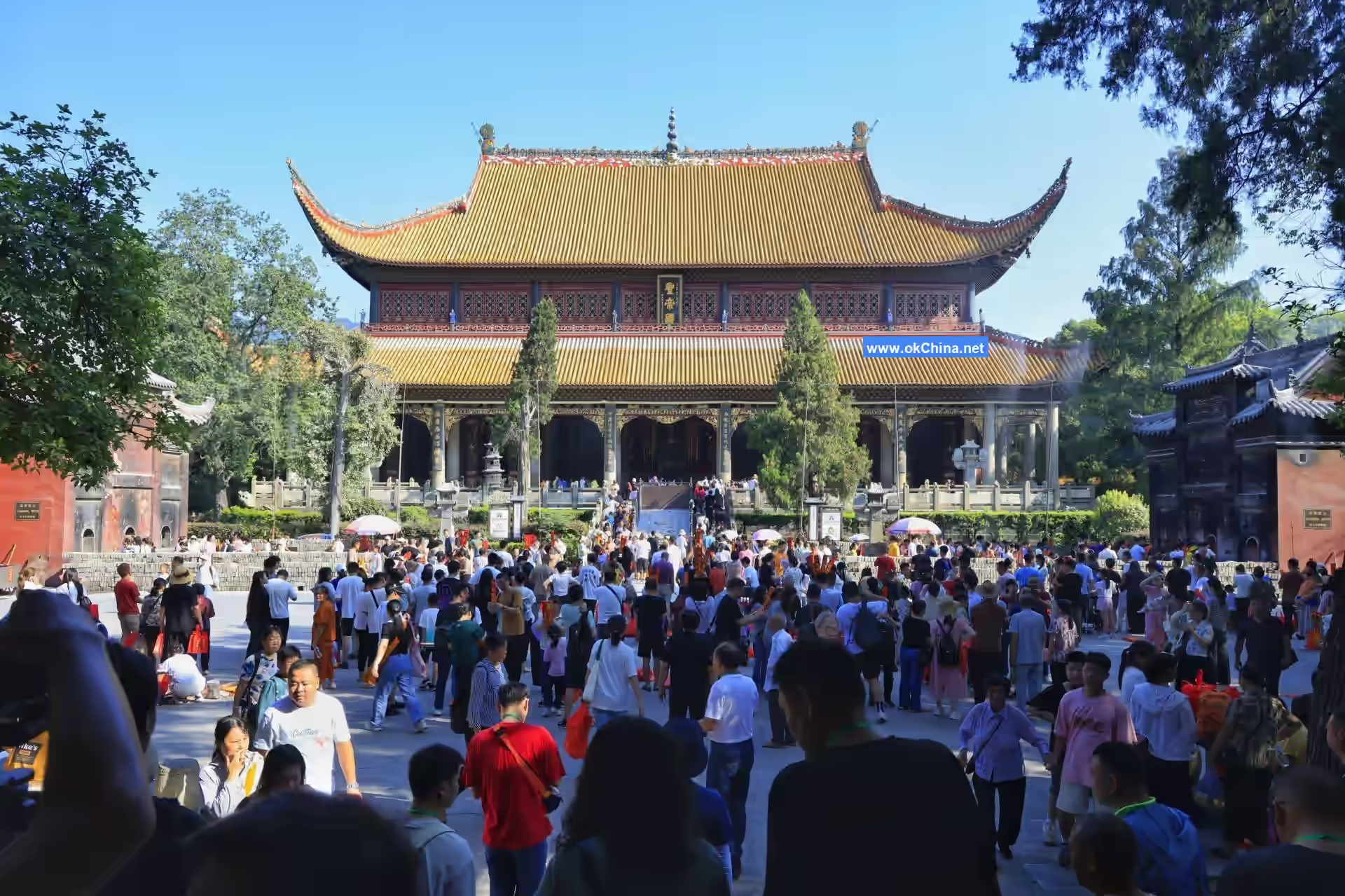
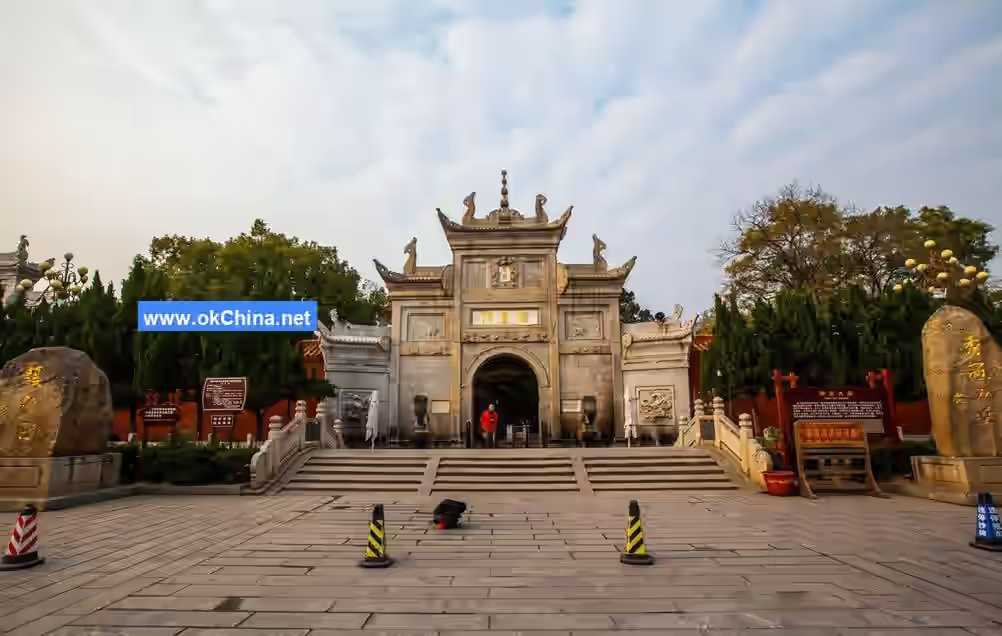
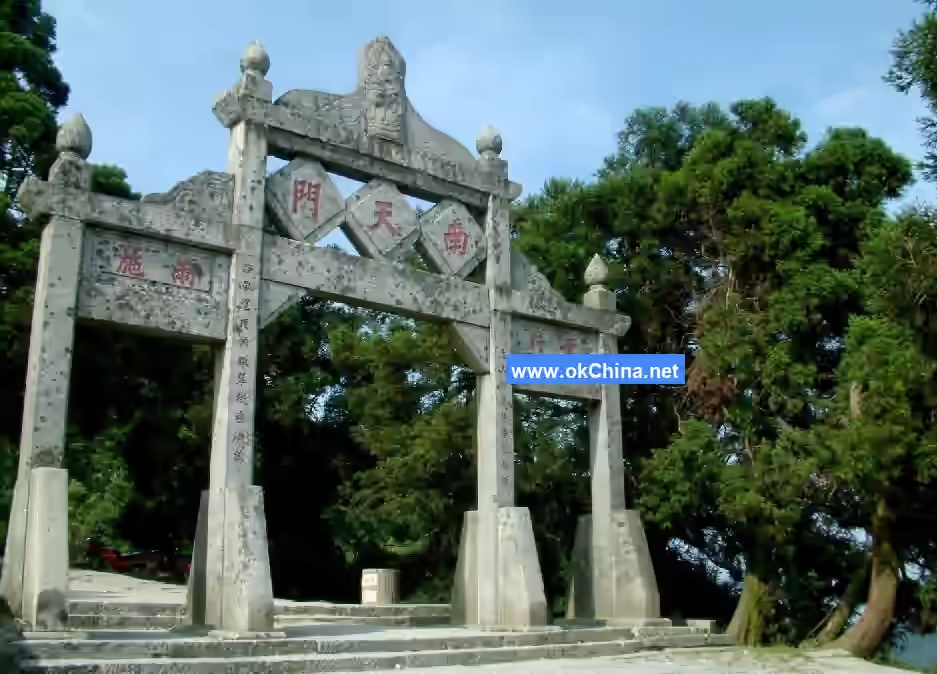
Situated at the northern end of Nanyue Town's North Street, the Nanyue Grand Temple faces south with the Chidi Peak behind it and the Shoujian Stream in front. The temple complex is rectangular, covering a total area of 98,500 square meters, making it the largest ancient architectural complex in Hunan Province. Its main gate, called the Lingxing Gate, is an archway-style structure built from granite, with east and west side gates on either side.
3. Cultural Resources
3.1 Origin of Nanyue
The term "Nanyue" (Southern Sacred Mountain) first appeared in the "Shenzi Waipian" by Shen Dao during the Spring and Autumn and Warring States periods: "(Emperor Shun) then made a southern tour, reaching Nanyue in May; then a western tour, reaching Xiyue (Western Sacred Mountain) in August; then a northern tour, reaching Beiyue (Northern Sacred Mountain) in November. The rituals were all like those for the ancestral temple. Upon returning, he rested outside the palace for three days of purification, personally reported to the ancestral temple using a special sacrifice, ordered officials to inform the commandery temples, the altars of soil and grain, and the famous mountains and great rivers within the domain, and only then held court." The "Nanyue" mentioned here stands alongside Dongyue (Eastern Sacred Mountain), Xiyue, and Beiyue as objects of imperial inspection tours. Furthermore, this passage lists the "Four Sacred Mountains," with "Nanyue" being one of them. From the phrase "southern tour... reaching Nanyue, then western tour... reaching Xiyue, then northern tour... reaching Beiyue," it is evident that these "Four Sacred Mountains" were distinguished and designated based on the east, south, west, and north directions relative to the "emperor's" state. The later concept of the "Five Sacred Mountains" likely added a central direction—Zhongyue (Central Sacred Mountain)—to these four. Although later explanations for the "five" in "Five Sacred Mountains" included theories like the "Five Colors" and "Five Elements," this concept of the "Five Directions" can be considered its origin or primary cause.
The "yue" in "Four Sacred Mountains" or "Five Sacred Mountains" was anciently equivalent to "mountain." Its meaning is defined in modern dictionaries as "a lofty, high mountain." In the ancient dictionary "Shuowen Jiezi" by Xu Shen of the Eastern Han Dynasty, it is explained as: "Yue: Dongfang (Eastern), Nanhuo (Southern), Xihua (Western), Beiheng (Northern), Zhongtaishi (Central)—these are where the king goes on inspection tours." Here, "yue" specifically refers to the "Five Sacred Mountains." Besides clearly identifying the specific referents of the "Five Sacred Mountains," it also tells us that "yue" are places the king "goes on inspection tours to," i.e., the objects of inspection tours. In Kong Yingda's "Chunqiu Zhengyi," one can also find: "The 'Shi Shan' says: South of the river is Hua, east of the river is Yue, north of the river is Heng, south of the river is Heng. Li Xun said: Hua is Xiyue Huashan; Dongyue is Taishan; Heng is Beiyue Hengshan; Heng is Nanyue Hengshan." The "Shili Tudi Ming" says: "Dongyue, Taishan, is Mount Tai in Fenggao County; Nanyue is Xiangnanshan in Changsha; Xiyue is Huashan southwest of Huayin County in Hongnong; Beiyue is Hengshan northwest of Quyang County in Zhongshan." Guo Pu annotated that Hengshan is also called Changshan, avoiding the taboo of Emperor Wen of Han.
The "Erya" begins its "Shi Shan" chapter by mentioning these four mountains, clearly indicating they are the Four Sacred Mountains. Therefore, commentators all explain them as such. Moreover, various books, histories, biographies, and records all regard Tai, Heng, Hua, and Heng as the Four Sacred Mountains; the Four Sacred Mountains must be these four mountains. The "Shi Shan" further states: "Taishan is Dongyue, Huashan is Xiyue, Huoshan is Nanyue, Hengshan is Beiyue." The discrepancy between "Tai" and "Heng/Huo" is that these two sacred mountains are one mountain with two names. From the above, it is known that the ancients' "yue" meant "mountain," specifically famous mountains distributed in the four directions of the territory. "Yue" were the "mountains" located in the east, south, west, and north—or east, south, west, north, and center—of the territory, which ancient emperors inspected. The "Shuowen" says: "Mountain (shan) means to disseminate; it disseminates qi, gives birth to all things, has rocks and is high; it is pictographic." This is synonymous with the modern definition of "yue" as "a lofty, high mountain." Furthermore, Ying Shao's "Fengsu Tong" states: "Yue means to examine merits and virtues and assign duties. Thus, there is one great mountain in each of the four directions. When the Son of Heaven inspects and arrives at its foot, he examines the merits and virtues of the feudal lords and assigns duties, hence it is called yue." The "Baihu Tong" states: "What is yue? It means to examine, to examine merits and virtues." Also, in the "Shangshu Zhengyi": "Yue are the great mountains of the four directions. Now the great ministers of the royal court are all called the Four Sacred Mountains, which is the same as the duties managed by Xi and He. From this, we know the Four Sacred Mountains are the four sons of Xi and He mentioned above. Another explanation for calling them yue is that they were in charge of the feudal lords of the four sacred mountains, hence the name. It is said the feudal lords each paid homage at the foot of their respective sacred mountain, meaning the feudal lords of the four directions were assigned to the four sacred mountains." Thus, "yue" could refer to officials governing the four directions, or to the activity of examining and assigning duties to feudal lords at the sacred mountains of the four directions, but both meanings were derived from the concept of the great mountains of the four directions.
"Nanyue" is the great mountain in the southern part of the territory. Historically, it was either one of the "Four Sacred Mountains" or later one of the "Five Sacred Mountains." Together with the other three or four sacred mountains, it originally belonged to the category of ancient political geography, representing the political and territorial boundaries determined by the Central Plains people from their perspective.
3.2 Anecdotes and Legends
Due to his affinity with fire, Zhurong became skilled in managing and using it. The Yellow Emperor appointed him as the Fire Official in charge of fire. In the south, there was a tribal leader named Chiyou who frequently invaded the Central Plains, making life unbearable for its people. The Yellow Emperor summoned the people of the Central Plains to unite. Led by Zhurong and several other generals, Zhurong used fire attacks to defeat Chiyou, achieving great merit. The Yellow Emperor rewarded him generously, and he became an important minister.
When the troops returned victorious, they passed by a range of mountains south of Yunmeng Marsh. The Yellow Emperor called Zhurong forward and deliberately asked, "What is this mountain called?" Zhurong replied, "This is called Hengshan." The Yellow Emperor asked again, "What is the origin of this mountain?" Zhurong answered, "In ancient times, heaven and earth were a chaotic mass, like an egg. Pangu separated heaven and earth, and only then did living beings emerge. He lived for eighteen thousand years. After his death, he lay upon the land of the Central Plains. His head faced east and became Taishan; his feet pointed west and became Huashan; his abdomen protruded and became Songshan; his right hand pointed north and became Hengshan; his left hand pointed south and became the Hengshan before us." As soon as he finished, the Yellow Emperor immediately followed up, "Then why is it named Hengshan?" Zhurong promptly replied, "This mountain stretches between Yunmeng and Jiuyi. Like a steelyard, it can weigh the lightness and heaviness of heaven and earth, measure the moral virtue of emperors, hence it is named Hengshan (衡山, with 'heng' meaning 'to weigh/balance')." The Yellow Emperor, pleased with his fluent responses, said happily, "Excellent! You are so familiar with southern affairs; I intend to entrust you with an important task." But the Yellow Emperor did not specify what the task was.
The army encamped at Hengshan. The Yellow Emperor ascended the highest peak to receive homage from the various southern tribes. Many tribal chiefs gathered, and everyone was joyful. Zhurong, caught up in the moment, played a tune composed by the Yellow Emperor himself—the music of Xianchi. The Yellow Emperor's consort, Leizu, also danced to the rhythm. Seeing this, everyone danced around the Yellow Emperor. After dancing to their heart's content, the Yellow Emperor asked everyone to quiet down and said, "Since my accession, I have pacified Yuwang, slain Chiyou, established the calendar, invented writing, created musical scales, compiled medical texts, and with Leizu's sericulture and silk production, established the system of clothing. Now the world is unified. I will establish the Five Sacred Mountains: Dongyue Taishan, Xiyue Huashan, Nanyue Hengshan, Beiyue Hengshan, and Zhongyue Songshan. From now on, the Fire Official Zhurong shall guard Nanyue." Upon hearing this, everyone shouted, "Long live! Long live!" Only then did Zhurong realize that this was the important task the Yellow Emperor had mentioned.
After the Yellow Emperor departed, Zhurong remained at Hengshan to formally administer southern affairs. He lived on the highest peak of Hengshan and frequently inspected the people in various areas. Seeing that the people often ate raw food, he taught them to obtain fire and cook their food. Seeing them walk in darkness at night, he taught them to use pine torches. Seeing the heavy miasma and numerous mosquitoes causing frequent illness, he taught them to light fires and use smoke to drive away mosquitoes and miasma. The people respected him greatly. Every year after the autumn harvest in August, they came in groups to pay homage. They said, "Zhurong, our population has flourished, our poultry are numerous, and our grains are abundant. You have brought us so many benefits. We thank you and wish to honor you as emperor. You transform through fire; fire is red, so we shall call you the Red Emperor." From then on, Zhurong was honored by all as the Red Emperor.
Zhurong lived on Hengshan until over a hundred years old before passing away. The people buried him on a peak of Hengshan and named that peak Chidi Peak (Red Emperor Peak). The highest peak where he lived has since been called Zhurong Peak. On the summit of Zhurong Peak, the people built a Zhurong Hall, honoring him as the Nanyue Sacred Emperor, forever commemorating his virtues and achievements.
3.3 Distinctive Culture#### 3.3.1 Buddhist Culture
Buddhist culture arrived at Mount Nanyue approximately 200 years later than Taoist culture. The earliest Buddhist monks to reach Mount Nanyue were Huihai and Xidun during the Tianjian era of the Liang Dynasty (502–519 AD). Subsequently, Huisi arrived at the mountain in the second year of the Guangda era of the Chen Dynasty (568 AD). Huisi passed on his teachings to his disciple Zhi, who later transmitted them to Zhang'an Guanding, Fahua Tiangong, and Jingxi Zhanran, forming the Tiantai Sect (also known as the Fahua Sect). Huisi of Mount Nanyue is revered as the Third Patriarch of Tiantai, and Zhi as the Fourth Patriarch. The doctrines of this sect spread as far as Japan and were widely disseminated. The Sixth Patriarch of Southern Chan, Huineng, propagated the Dharma at Caoxi in Guangdong, which evolved into the most important Buddhist sect that came to Mount Nanyue. Huineng's teachings branched into two lineages: one known as the Nanyue lineage and the other as the Qingyuan lineage. The representative figure of the Nanyue lineage was the Seventh Patriarch of Southern Chan, Huairang, who resided at the Banruo Temple (now the Fuyan Temple) on Mount Nanyue, established the sect, accepted disciples, and passed on the teachings to Mazu Daoyi. Through successive transmissions, this lineage gave rise to the Guiyang and Linji sects. The representative figure of the Qingyuan lineage was Xingsi, who passed on the teachings to Xitou Xiqian of Mount Nanyue. Xiqian resided at the Nantai Temple on Mount Nanyue and, through successive transmissions to Yaoshan, Yunyan, Dongshan, and Caoshan, formed the Caodong Sect. Other transmissions, through Wenyan and Wenyi, respectively formed the Yunmen and Fayan sects. The two sects from Huairang of Mount Nanyue (Guiyang and Linji) and the three sects from Xingsi of Qingyuan (the teacher of Xitou) (Caodong, Yunmen, and Fayan) combined into five sects, which in Buddhist history are referred to as "One Flower, Five Leaves." Later, the sixth-generation descendant of the Linji lineage, Shishuang Yuan, further divided into the Yangqi and Huanglong branches, hence also known as "Five Leaves, Seven Sects." Centered around Mount Nanyue, the disciples of the Chan tradition spread across the world, reaching as far as Japan and Korea. Chan culture is indeed the essence of Mount Nanyue's Buddhist culture. Subsequently, monks such as Chengyuan, Rimu, and Fazhao of the Pure Land Sect, Huikai of the Vinaya Sect, and Weijin of the Huayan Sect successively came south, further expanding the Dharma and flourishing Buddhist culture. Wang Fuzhi's "Ode to Mount Nanyue" contains the lines: "Its crouching and soaring are beyond enumeration. Its light joins the imperial net, its might shakes the poison drum. It establishes the roles of ruler and minister, and further combines host and guest. Majestic as the adornments of the Flower Treasury, how much more can be said of the twin trees?" This describes the flourishing development of Buddhism on Mount Nanyue. Many among the monks lived in seclusion ("crouching") on Mount Nanyue, but once their teachings moved emperors, they were honored as state preceptors ("soaring"), reaching the highest ranks of nobility and influencing the world. From the Northern and Southern Dynasties to the Tang Dynasty, 18 monks including Huihai, Huisi, Zhi, Dashan, Fazhao, Huicheng, and Daming (Huikai) of Mount Nanyue were celebrated as the Eighteen Eminent Monks of Mount Nanyue. Among them, monks such as Huisi, Zhi, and Fazhao successively served as state preceptors for emperors of the Liang, Sui, and Tang dynasties, receiving great reverence and trust. Many monks received posthumous titles from emperors: for example, Huisi was posthumously titled Chan Master Yuanhui Miaosheng; Huairang was titled Chan Master Dahui and Great Master Guanyin; Daoyi was titled Chan Master Daji; Xiqian was titled Chan Master Wuji; and Weijin was titled Great Master Baowen. High-ranking officials, literati, and poets maintained interactions with Mount Nanyue monks, composing poems and discussing the Dao, a tradition that continued through the ages and flourished particularly during the Tang Dynasty.
The legendary tale of Li Bi rising to the position of prime minister after eating the roasted taro of Lazy Can while in seclusion on Mount Nanyue persists to this day. Prime Ministers Qi Ying and Zhao Jing, Minister of War Cao Wanggao, Pei Zhou, and Vice Minister Linghu Huan were all friends and teachers of the monk Daming. Liu Zongyuan composed epitaphs for monks such as Daming, Mituo, Bozhou, Fazheng, and Xicao. Tang Dynasty poets Wen Tingyun, Liu Yuxi, Lü Wen, Pei Shuo, Liu Zhaoyu, Ren Hua, and Liu Changqing, as well as Song Dynasty poets Huang Tingjian, Tao Gu, Zhang Xiaoxiang, Zhao Feng, and Xu Zhongxuan, and Ming Dynasty poets Luo Hongxian, Gu, and Tan Yuanchun all wrote poems dedicated to Mount Nanyue monks or temples. The Neo-Confucianism of Song Dynasty scholars Zhu Xi and Zhang Shi, and Ming Dynasty scholars Zhan Ganquan, Wang Yangming, Luo Xixian, and Zou Donglang also incorporated elements of metaphysical and Buddhist doctrines and scriptures in many aspects. Zhan Ganquan's "Explanation of the Heart-Mind Nature Diagram" and "Admonition on Rest and Preservation" are particularly evident in this regard. The Chan tradition of Mount Nanyue advocated "sudden enlightenment," the so-called "the mind is Buddha." It rejected ascetic practices and the scholastic繁琐哲学 of monasticism. Therefore, Chan's tenets were easily accepted and practiced, allowing the entire sect to flourish and spread its followers across the world. The Linji and Caodong sects were even described as "Linji rules the world, Caodong half the sky." In the late Qing Dynasty, the Japanese monk Meixiao presented a copy of the "Tripitaka" to the Nantai Temple; Meixiao was a 42nd-generation disciple of the Caodong lineage. The lines from "Ode to Mount Nanyue"—"Resplendent in gold and jade, secure and towering. Peaks joined by incense, eaves connected by bell sounds. Flowers rain to form paths, white clouds rest upon peaks."—evoke the historically magnificent, multi-storied buildings of Mount Nanyue's temples. Their architectural artistry, combined with the stunning natural landscape, also became integrated into the unique culture of Mount Nanyue. According to Li Yuandu's "Records of Mount Nanyue," there were approximately 150 Buddhist temples on Mount Nanyue throughout history, five to six times the number of Taoist temples, indicating its prosperity. After several wars, 12 temples remain on Mount Nanyue to this day. Currently, five are open to the public: Zhusheng, Fuyan, Nantai, Shangfeng, and the Scripture Depository Hall. Consecration ceremonies, ordination assemblies, and academic seminars have been held there, characterized by grand scale and frequent activities.
3.3.2 Taoist Culture
The earliest Taoist to enter Mount Nanyue was Zhang Daoling in the late Eastern Han Dynasty. He traveled from Mount Tianmu to Mount Nanyue, paid respects at the Green Jade Altar and the Bright Heaven Altar, and worshipped at the Temple of Zhurong. Subsequently came Pi Yuan and Wang Gushen. Chen Tianfu's "Collection of Overall Excellence" from the Song Dynasty records: "Pi Yuan and Wang Gushen lived together at the Qizhen Temple on Qulong Peak of Mount Nanyue, practicing embryonic breathing and returning to the origin, achieving the Dao after several years. Emperor Wu of Jin, Sima Yan, bestowed upon Wang Gushen the title Master Taiwei and upon Pi Yuan the title Master Taisu."
From the Han to the Wei and Jin dynasties, Taoists were deeply engaged in refining the inner elixir, what is now called qigong. Alchemy involving cinnabar and mercury was the outer elixir, involving substances, and represented ancient chemistry. On a large rock to the right of the ruins of the Mituo Temple at the foot of Mount Nanyue's Zigai Peak is inscribed the "Ode to the Reverted Elixir," which elaborates on the methods of alchemy and is the work of Taoists from the Wei and Jin periods. The arrival of Taoism in the south certainly had a profound impact on alchemical techniques and pharmacology, but Taoist thought and culture had an even deeper influence among the people. Later, the so-called "Nine Immortals" who came to Mount Nanyue after the two Taoists Pi and Wang annotated the "Dao De Jing" here, disseminated the "Huangting Neijing Jing," "Taishang Baowen," and the "Chart of the True Form of the Five Sacred Mountains," embedding Taoist metaphysics and the discourse on immortals deeply into people's hearts. The study of talismans, charts, and prognostication merged with the original shamanistic practices of the Chu region, and the practice of establishing teachings and performing rituals in the Mount Nanyue area continued uninterrupted, with temple fairs and deity competitions persisting to this day. The proliferation of shrines and Taoist temples also began during this time. Their arts moved emperors, their ways influenced ministers, not to mention the multitude of believers among the common people. In the early Tang Dynasty, following the advice of Sima Chengzhen, True Lord temples were built on each of the Five Sacred Mountains. The deity of Mount Nanyue was enfeoffed as the Heavenly King of Governance, and officials were dispatched to offer sacrifices. This demonstrates the spiritual power of Taoism. According to Li Yuandu's "Records of Mount Nanyue," Taoist temples on Mount Nanyue existed from the early Jin Dynasty, such as the Qizhen Temple and Nanyue Temple, with more built in subsequent dynasties, reaching a peak in the Tang Dynasty with up to 28 temples. With red walls, green tiles, lush trees, and shaded paths, the small structures amidst the famous mountains presented an exquisite scene. Numerous temples meant numerous Taoist followers.
The most famous Taoists in the history of Mount Nanyue during the Northern and Southern Dynasties included Xu Lingqi, Deng Yuzhi, and Zhang Tianyao. During the Tang Dynasty, Taoists such as Sima Zhen and his disciples Xue Jichang, Wang Xianqiao, and later Deng Ziyang were granted the title of Heavenly Master. Sima Chengzhen was bestowed the title Master White Cloud. Subsequently, Taoist Zhang Taixu was granted the title Master Yuanhe. Taoist Liu Yuanjing was granted the title Master Guangcheng and appointed as Grand Master of Imperial Entertainments with Silver Seal and Blue Ribbon, serving as a Grand Academician of the Chongxuan Institute, with additional purple绶, official seal, and administrative staff, making him the first Taoist on Mount Nanyue to hold an official third-rank position. With frequent imperial edicts of favor and high officials visiting in succession, the influence of the Taoist community grew increasingly prosperous with official support, reaching its zenith in the Tang Dynasty. Correspondingly, Taoist culture permeated various fields more deeply. During this period, interactions and poetic exchanges between literati and Taoists also became a significant feature of Mount Nanyue's Taoist culture. Historical records indicate many Tang Dynasty poets and notable figures had associations with Taoists. For example, Tang Prime Minister Li Bi, during his early seclusion on Mount Nanyue, studied under Taoist Zhang Taixu. During the reign of Tang Emperor Jingzong, Vice Minister of Personnel Zhao Lu composed the "Biography of Master Guangcheng" for Liu Yuanjing, and Grand Tutor of the Heir Apparent Lu You composed the "Inscription on the Stone Chamber of Master Guangcheng." Han Yu wrote a preface for the "Poem of the Stone Cauldron Couplets" by Mount Nanyue Taoist Xuanyuan Miming. Tang poets Chu Guangxi, Cui Tu, Zhang Qiao, Bao Rong, Li Qunyu, and Wang Yuan all wrote poems dedicated to Mount Nanyue Taoists or temples. Moreover, many Taoists with higher cultural education and deeper metaphysical cultivation also wrote books and established theories. For instance, during the Liu Song period of the Northern and Southern Dynasties, Xu Lingqi authored "Records of Mount Heng," the first monograph documenting Mount Nanyue.
3.3.3 Culture of Blessings and Longevity
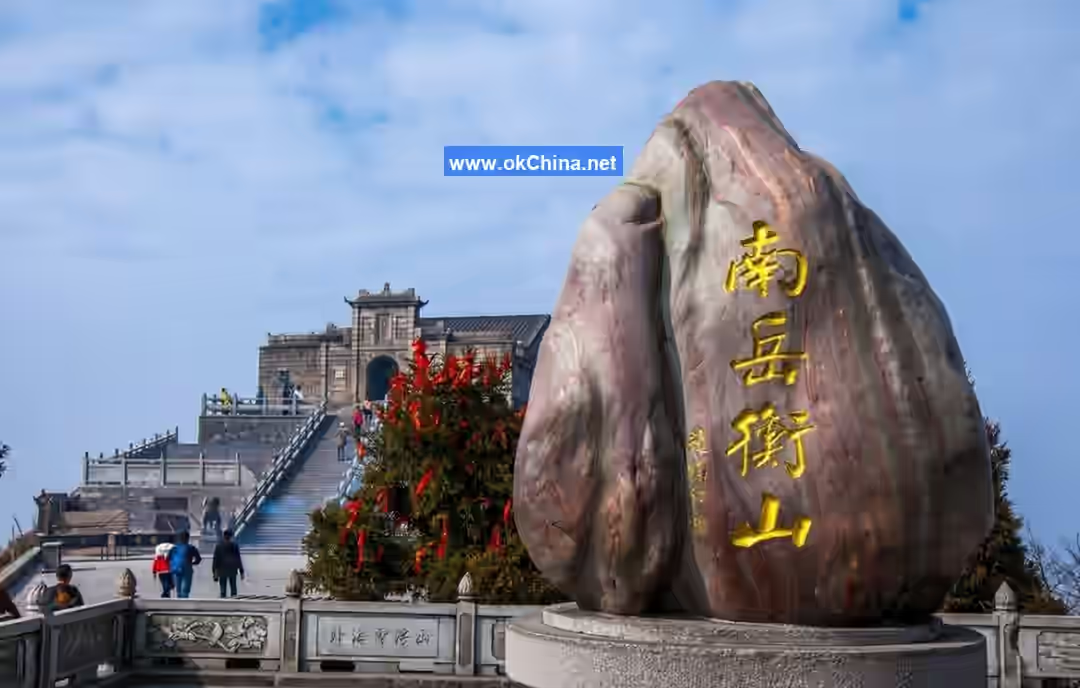
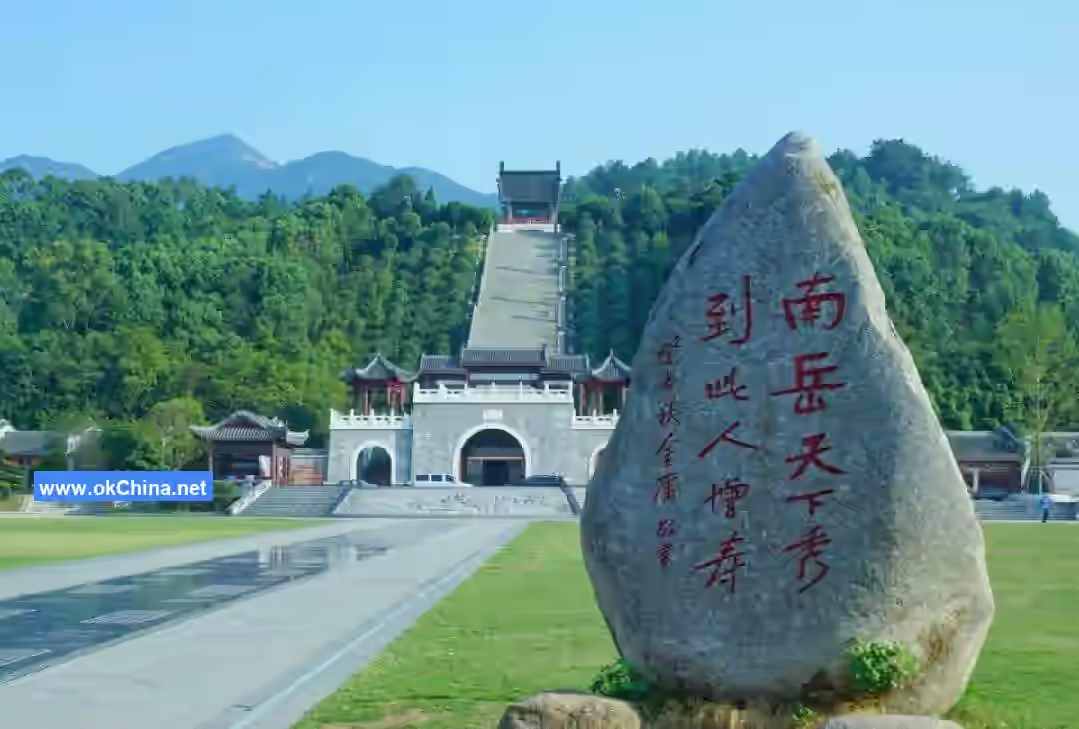
The culture of longevity on Mount Heng (Nanyue) has a long history. The "Classic of Stars" records that Mount Heng corresponds to the Zhen star among the Twenty-Eight Mansions, and the Zhen star governs the lifespan of mortals; hence, Mount Heng is also known as the Mountain of Longevity. Emperor Huizong of the Song Dynasty inscribed the giant stone carving "Mountain of Longevity" on Mount Heng, which still exists on the Emperor Rock of Jinjian Peak. The first sentence of the "Stele Inscription on the Reconstruction of the Mount Heng Temple" personally composed by Emperor Kangxi reads: "Mount Heng is a great guardian of the southern heavens, corresponding to the Jade Balance of the Northern Dipper, also named the Mountain of Longevity," once again officially designating Mount Heng as the Mountain of Longevity. Historical records through the ages have often referred to Mount Heng as the mountain comparable to longevity or the mountain presiding over longevity. In China, people often use the phrase "May your happiness be as vast as the Eastern Sea, and your longevity as enduring as the Southern Mountain" to express good wishes. The so-called "longevity as enduring as the Southern Mountain" originally comes from the "Book of Songs·Xiaoya": "Like the moon's constancy, like the sun's rising, like the longevity of the Southern Mountain." It比喻 a person's lifespan as enduring as the Southern Mountain. The "Southern Mountain" in "longevity as enduring as the Southern Mountain" refers precisely to Mount Heng.Mount Heng in southern China, known as the Mountain of Longevity among the Five Sacred Mountains, has long been revered as a holy site for blessings and longevity, with a profound culture of fortune and longevity. Zhu Rong, the ancestral deity of humanity and the principal god of Mount Heng, resided here and is regarded as the deity overseeing fortune, prosperity, and longevity in the mortal world. Historical records referring to Mount Heng as the "Mountain of Longevity" are abundant, with many ancient texts such as Chunqiu Yuanming Bao, Kaiyuan Zhanjing, Chunqiu Ganjing Fu, Fei Zhi's Zhouyi, and Tangshu Tianwenzhi documenting this designation. Ciyuan explicitly defines "Shou Yue" (Mountain of Longevity) as Mount Heng. Since the Han Dynasty, Mount Heng has been called the "Mountain of Longevity." The Han-era Xingjing records that Mount Heng corresponds to the Zhen star among the 28 lunar mansions, which governs the lifespan of all living beings, hence its alternative name "Mountain of Longevity." A famous couplet at the Fuyan Temple on Mount Heng reads: "Fuyan is the first ancient temple of the Southern Mountain, and Prajna is the unparalleled Dharma gate of the patriarch." This indicates that the "Southern Mountain" refers to Mount Heng. Thus, the phrase "May your longevity rival the Southern Mountain" means "May your longevity rival Mount Heng." After Emperor Huizong of the Song Dynasty left the stone inscription "Shou Yue" on the Golden Slip Peak of Mount Heng, the name "Mountain of Longevity" gained even greater renown. The first sentence of the Imperial Stele Inscription on the Renovation of the Mount Heng Temple from the 47th year of Kangxi's reign (1708) states: "Mount Heng is a great guardian of the southern heavens, corresponding to the Northern Dipper and Jade Balance, and is also known as the Mountain of Longevity. It bestows blessings upon official positions and prosperity upon descendants, as recorded in the stars, a tradition of long standing." In the 10th year of Yongzheng's reign (1723), an imperial edict declared, "Mount Heng is the mountain that governs the emperor's longevity." The Tang Dynasty poet Li Bai wrote: "Mount Heng's verdant peaks pierce the purple heavens, looking down upon the Southern Pole Old Man Star," with the "Southern Pole Old Man Star" being the Star of Longevity.
Mount Heng boasts a brilliant and rich culture of longevity. Sites named with the character "寿" (longevity) or its variants are ubiquitous, such as the Palace of Ten Thousand Longevity, Longevity Peace Palace, Longevity Stream Bridge, Longevity Stream, Hundred Longevity Pavilion, Extended Longevity Pavilion, Extended Longevity Village, and Longevity Buddha Hall. The Grand Temple of Mount Heng is an architectural culmination of the longevity culture, with the character "寿" prominently displayed everywhere—on eaves, beams, pillars, and decorative frames. The Imperial Stele Pavilion features 100 different seal-script versions of the character "寿" on its lintels, earning it the name "Hundred Longevity Pavilion." Another important reason for Mount Heng being called the Mountain of Longevity is its natural conditions, which are conducive to health preservation, fitness, and extending life.
3.3.4 Academy Culture
The academy culture of Mount Heng began during the reign of Emperor Suzong of the Tang Dynasty when Li Bi, the Marquis of Ye, retired to the foot of Yanxia Peak on Mount Heng to study and discuss Daoism. His residence housed an extensive collection of books. Later, his son Li Fan, as the governor of Suizhou, built the Mount Heng Academy (now known as the Yehou Academy) in memory of his father, around 816–824 AD, making it the earliest academy in Chinese history. Mount Heng has the largest number of academies in the country. Zeng Guofan of the Qing Dynasty wrote in Record of the Renovation of Master Hu Wending's Academy: "Among the academies of the world, those of Chu are the most prosperous; among the academies of Chu, those of Heng are the most prosperous, due to the solemnity of the mountain." According to Hunan General Records, during the Guangxu period of the Qing Dynasty, there were 17 academies within the present-day Mount Heng area, including the Yehou, Lu Pan, and Jixian Academies.
During the Song Dynasty, Hu Anguo and his son lectured at the Mount Heng Academy. Later, Zhang Shi studied under the Hu family, further developing the teachings of Cheng Yi and Hu Anguo. The philosophies of Zhu Xi and Zhang Shi converged here, forming the renowned "Huxiang School," which emphasized patriotism and the philosophy of "applying knowledge to practical use." Thus, Mount Heng is the birthplace of the Huxiang School. In the Ming Dynasty, scholars such as Wang Yangming, Zou Shouyi, Zhan Ganquan, Jiang Xin, Yin Tai, and Wang Zongmu lectured at the Wending Academy and Ganquan Academy, leading to significant developments in the "Neo-Confucianism" and "School of Mind" philosophies of the Song and Ming dynasties. At the end of the Ming Dynasty, Wang Fuzhi synthesized these teachings, critiquing the subjective and objective idealist philosophies (Neo-Confucianism) of Zhu Xi and Wang Yangming, and championing naive materialism and patriotism, leaving a profound impact on later generations. Thus, Tan Sitong of the late Qing Dynasty praised him: "All things awaken to the dawn of heaven and earth, relying on the thunderous voice of Mount Heng."
3.3.5 Anti-Japanese War Culture
On July 7, 1937, Japan launched a full-scale war of aggression against China. Within less than a year, cities such as Beijing, Tianjin, Shanghai, and Nanjing were occupied by Japanese forces. In late October 1938, as the Japanese army launched new offensives, the key cities of Guangzhou and Wuhan fell successively, making the war situation extremely dire. After the War of Resistance entered a stalemate phase, Chiang Kai-shek convened a meeting of senior military officials in October 1938 and invited Zhu De to attend. At the meeting, Zhu De proposed that the Kuomintang and the Communist Party jointly organize a guerrilla training class, which Chiang Kai-shek agreed to.
In November 1938, Chiang Kai-shek held the first supreme military conference of the Republic of China at Mount Heng, with Communist representatives Zhou Enlai, Ye Jianying, and Guo Moruo invited to attend. At this conference, Chiang Kai-shek decided to accept the Communist Party's suggestion to jointly establish the "Mount Heng Guerrilla Training Class" and to build the "Loyalty and Martyrdom Shrine" at Mount Heng to bury soldiers who died in the war. It was decided to establish the guerrilla training class at Mount Heng, named the "Military Commission Mount Heng Guerrilla Training Class," with the Communist Party invited to send personnel. The Communist Party Central Committee decided to send Ye Jianying, Li Tao, Bian Zhangwu, Wu Xiru, Xue Zizheng, and Li Chong to participate in teaching. Soon after, the training class was established and renamed the "Military Training Department Mount Heng Guerrilla Training Class," with Chiang Kai-shek as the director and Bai Chongxi and Chen Cheng as deputy directors; Tang Enbo and Ye Jianying served as the chief and deputy education officers. Later, Tang was transferred to the front lines in Henan, and Li Mo'an was appointed by Chen Cheng to succeed him as education officer.
Trainees came from four sources: officers of colonel and captain ranks selected by various war zones according to allocated quotas; party and government personnel selected by provincial and county governments and Kuomintang party branches; personnel recommended by the Three Principles of the Youth League; and some high school graduates directly recruited from areas such as Mount Heng, Hengyang, Qujiang, Guilin, and Ji'an (with female trainees accounting for one-tenth). After graduation, trainees were assigned in batches to serve in various war zones. A small number of trainees held the rank of colonel or lieutenant colonel, while the majority were majors. Some notable Chinese and foreign figures also came to lecture or give reports, including Soviet advisors teaching coordinated artillery operations; Mr. Hu Yuzhi lecturing on "Analysis of Japanese Imperialism"; and Japanese anti-war writer Kaji Wataru giving special lectures on "Dissection of Japanese Militarism and Democratic Struggles in Japan." Ho Chi Minh of the Vietnamese Communist Party, under the pseudonym Hu Guang, studied and worked at the training class and later became the Chairman of the Vietnamese Communist Party.
The second Mount Heng military conference was held in late October 1939 as a joint meeting of party, government, and military officials from various war zones in the south, focusing on summarizing the lessons of the Battle of Northern Hunan.
Near the Mid-Hill Pavilion on Mount Heng, there is an old villa known as the "Chiang-Soong Residence," built by He Jian, the chairman of Hunan Province during the Nationalist Government period, hence also called the He Mansion. Between 1930 and 1944, Chiang Kai-shek visited Mount Heng eight times, staying here five times with his wife Soong Mei-ling. Hidden among the towering ancient trees behind the house is a mysterious reinforced concrete structure known as the "Mount Heng Command Post." Descending dozens of steps leads to an underground chamber of about twenty square meters, capable of accommodating dozens of people, with well-equipped drainage, ventilation, and lighting systems. Here, Chiang Kai-shek, Soong Mei-ling, and senior Kuomintang generals took shelter from Japanese air raids and directed the war effort. This underground chamber remained sealed for over sixty years before being rediscovered and cleared by later generations. The highest military command center in Taiwan still uses the name "Mount Heng Command Post."
3.4 Celebrity Poems and Records
3.4.1 Li Bai
Li Bai spent his life traveling, indulging in poetry and wine. He once said, "I seek immortals across the Five Sacred Mountains, undeterred by distance, for I love to roam famous mountains in my lifetime." Long yearning to visit Mount Heng, he traveled via Changsha in the autumn of 758 AD during the reign of Emperor Suzong, ascending the Xiang River to visit Mount Heng. Li Bai's poem Visiting Fangguang Temple is recorded in Chen Tianfu's Collection of Mount Heng's Highlights from the Song Dynasty, Hunan General Records compiled during the Guangxu period of the Qing Dynasty, and Li Yuandu's Records of Mount Heng. The poem reads: "Leisurely resting in the holy temple, my drowsy eyes awaken; where is the most serene at this moment? The window filled with bright moonlight, the sky wind calm, occasionally hearing one or two sounds of the jade chime." The scene depicted is the deep autumn ambiance of an ancient temple in a famous mountain. In 759 AD, Li Bai was pardoned and visited Hunan for the third time. That year, he wrote the poem Seeing Off General Chen Returning to Hengyang in Wuchang, with a preface. The first four lines of the poem are: "Mount Heng's verdant peaks pierce the purple heavens, looking down upon the Southern Pole Old Man Star. The swirling wind scatters snow from the five peaks, often sending flying blossoms to Lake Dongting." These lines exaggerate the height of Mount Heng, inspired by the poet's visit the previous autumn and his imagination.
3.4.2 Du Fu
The New Book of Tang: Biography of Du Fu records: "During the Dali era (766–779 AD), Du Fu left Qutang, descended to Jiangling, drifted along the Yuan and Xiang rivers, and ascended Mount Heng." In the first month, Du Fu left Sichuan with his family and passed through the Three Gorges. In the third month, he reached Jiangling in Hubei, and by the end of winter, he arrived at Yuezhou (modern Yueyang) in Hunan. In the fourth year (769 AD), he reached Tanzhou (modern Changsha) in the first month and left for Hengzhou (modern Hengyang) in late spring. While passing Mount Heng, he wrote the famous poem Gazing at the Mountain. In this poem, he describes the formations of the five peaks—Zhurong, Zigai, Tianzhu, Furong, and Shilin: "Zhurong, the five peaks revered, each peak rising and falling; Zigai alone refuses to bow, vying in height, standing tall in mutual gaze." He then writes: "Pressed by the long journey, I have no leisure to climb the lofty ridges." In the fifth year (770 AD), in the fourth month, the Hunan military commander Zang killed the Tanzhou prefect and Hunan regiment training commander Cui (Wei Zhijin had already passed away), plunging Tanzhou into chaos. Du Fu was forced to travel south to Hengzhou. While passing Mount Heng, he wrote the poem Inscribed on the New School at the Temple of Confucius in Hengshan County, Presented to Magistrate Lu; after arriving in Hengzhou, he wrote the poem The Red Phoenix. The poem reads: "Have you not seen? The mountains of Xiaoxiang, with Mount Heng towering high; atop the mountain, the red phoenix cries mournfully. Turning sideways, it gazes long, seeking its flock; wings drooping, beak silent, its heart weary with sorrow. Pitying the hundred birds trapped in nets, even the smallest yellow sparrow cannot escape. May the bamboo seeds be shared with ants and insects, letting the owls and harpies roar in fury." Through the depiction of the red phoenix, symbolizing Mount Heng, Du Fu expresses sympathy for the suffering of the people and resentment toward wicked and evil individuals.
Comments
Post a Comment