

Baoding City Baishi Mountain Scenic Area
I. Introduction
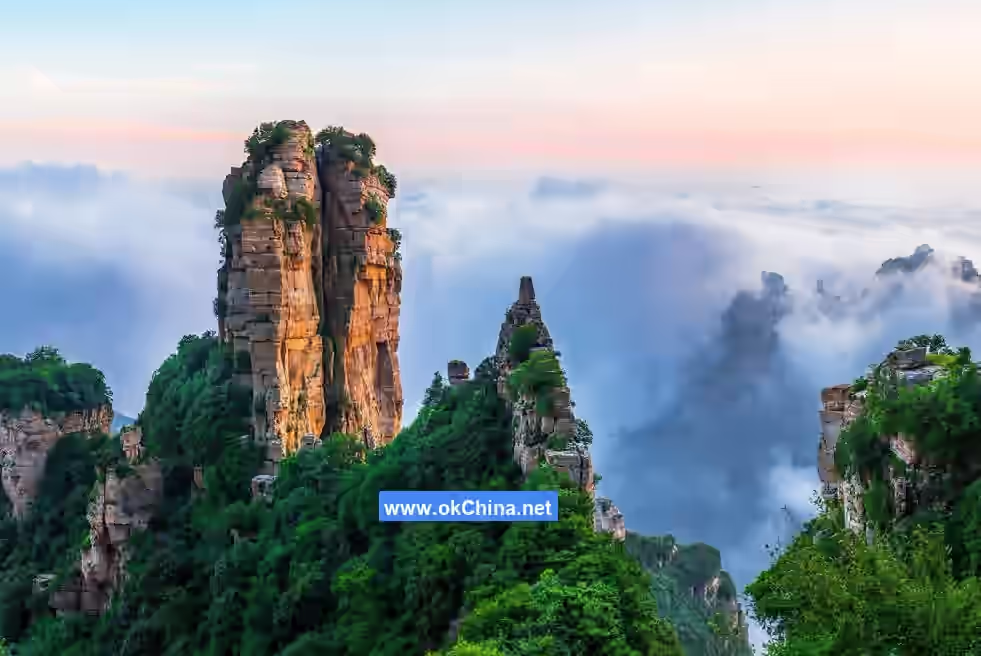
Baoding City Baishi Mountain Scenic Area is located in Fenglianggou Village, Baishishan Town, Laiyuan County, Baoding City, Hebei Province. Baishi Mountain is named for its extensive white marble formations, featuring a marble structural peak forest landscape, which represents a new type of peak forest landform in China. The mountain is characterized by its tall stature, few curves, many edges, significant elevation differences, and high density. It boasts "three summits, six platforms, nine valleys, and eighty-one peaks," with a main ridge stretching over 7,000 meters. The highest peak is known as the "dragon's head" rising from the northwest of the North China Plain. Key attractions within the Baoding City Baishi Mountain Scenic Area include Baishi Qingyun, Jiang Taigong Fishing, Bajie Marrying a Wife, and Twin Heroes Guarding the Mountain.
In 2004, Baoding City Baishi Mountain Scenic Area was rated as a National Scenic Area by the National Tourism Administration and as a National Forest Park by the National Forestry Department. On September 18, 2006, Baoding City Baishi Mountain Scenic Area, Yesanpo Scenic Area, and China's Fangshan World Geopark jointly applied for and passed the evaluation of the World Geopark Review Committee to become a World Geopark. On February 25, 2017, the National Tourism Administration announced that, after evaluation by the National Tourism Resources Planning and Development Quality Assessment Committee, Baoding City Baishi Mountain Scenic Area was rated as a National AAAAA Tourist Attraction.
II. Historical Evolution
- During the Warring States Period: The ridge served as the boundary between the Yan and Zhao states.
- During the Liao and Song Dynasties: Baishi Mountain acted as the border between the two nations.
III. Geographical Environment
Location and Territory
Baishi Mountain is situated in the southern part of Laiyuan County, Baoding City, Hebei Province, China, approximately 15 kilometers from Laiyuan County. It borders Laishui County and Yi County to the east, Tang County, Shunping County, and Fuping County to the south, Lingqiu County in Shanxi Province to the west, and Yu County in Hebei Province to the north. Baishi Mountain lies in the hilly region at the northern end of the Taihang Mountains, standing prominently among the mountains along the Juma River. Its geographical coordinates range from 114°36′ to 114°49′ east longitude and 39°04′ to 39°15′ north latitude. Surrounded by mountains, Baishi Mountain is located in an intermontane basin at the convergence of the Taihang, Yanshan, and Hengshan mountain ranges, covering a total area of about 60 square kilometers.
Geology and Landforms
Baoding City Baishi Mountain Scenic Area is renowned for its unique mountainous landscape, combining five major characteristics: wonder, grandeur, peril, illusion, and beauty. The highest elevation in the scenic area reaches 2,018 meters, with a relative height exceeding 1,000 meters. The core area of Baishi Mountain features a pristine marble peak forest known as the "Sigezhuang Rock Mass," representing a typical marble peak forest landform and a new type of peak forest landscape in China.
Baishi Mountain is tall and imposing, featuring "three summits, six platforms, nine valleys, and eighty-one peaks." Its main ridge extends over 7,000 meters, with the highest peak, Foguangding, standing at 2,096 meters above sea level, acclaimed as the "dragon's head" rising from the northwest of the North China Plain. The geological history of Baishi Mountain dates back to the Mesoproterozoic Jixianian Period's Wumishan Stage, approximately 1.1 billion years ago, when dolomite underwent changes due to regional metamorphism. During the Yanshanian Period of the Mesozoic Era (about 140 million years ago), the intrusion of granite further metamorphosed the dolomite, forming white dolomitic marble. This rock experienced more intense metamorphism near the granite, resulting in radial wollastonite veins, which form the material basis for the peak forest landscape of Baishi Mountain.
The dolomitic marble strata exhibit a gentle, nearly horizontal dip, ensuring the vertical stacking stability of the peak rock layers. Subsequent tectonic activity developed two sets of vertical joints in the dolomitic marble, which controlled the vertical development of the rock peaks. Over long periods of surface water erosion, gravitational collapse, and weathering, the spectacular marble peak forest landform was ultimately formed.
The soil in the low hilly areas of Baishi Mountain Scenic Area is primarily cinnamon soil, while areas above 1,000 meters in elevation are dominated by brown soil. Due to variations in terrain, climate, and vegetation, soil types exhibit distinct vertical zonation. From the foothills to the summit, the soil types sequentially include mountain calcareous cinnamon soil, mountain leached cinnamon soil, mountain brown soil, and mountain meadow soil. The parent materials and rocks mainly consist of loess, granite gneiss, granite, and marble.
Climate Characteristics
Baoding City Baishi Mountain Scenic Area falls within the warm temperate semi-humid monsoon climate zone, with pronounced mountainous climate features. The annual average temperature at Baishi Mountain is 21.6°C. Located in a temperate continental monsoon climate zone, the area experiences significant seasonal shifts in prevailing wind directions, with distinct seasonal climate characteristics: dry and windy springs with large daily temperature variations and low precipitation; hot summers with the highest rainfall, accounting for about 71% of the annual total; clear and mild autumns with low wind speeds; and dry winters with scarce precipitation.
Animal Resources
Baoding City Baishi Mountain Scenic Area is home to nationally protected animals such as the North China leopard, as well as numerous goats, badgers, roe deer, golden pheasants, mountain hares, and other species.
IV. Main Attractions
Overview
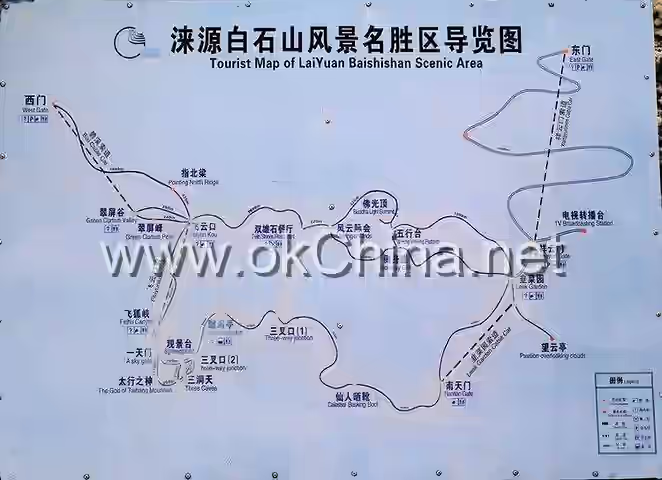
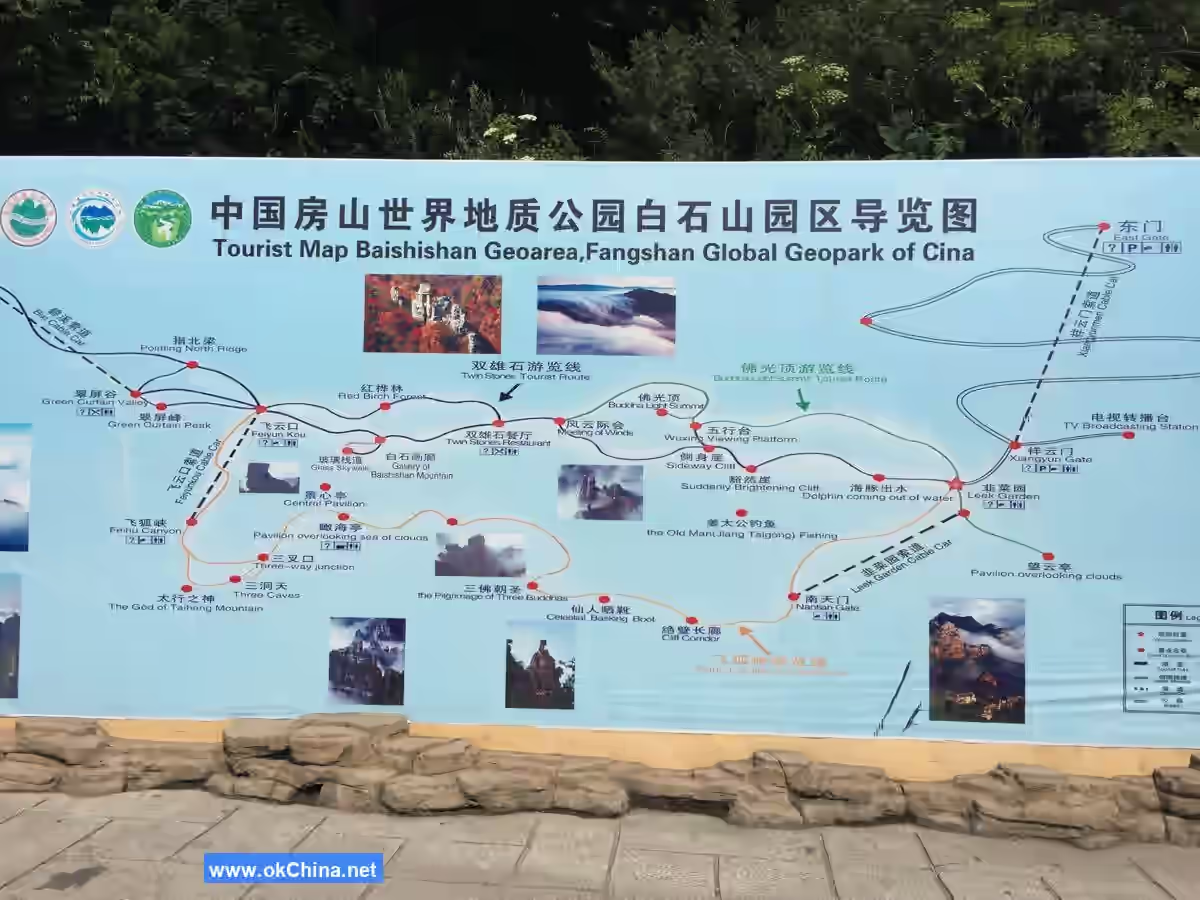
The main attractions of Baoding City Baishi Mountain Scenic Area include the Peak Forest, Juma Source, and Ten Waterfall Gorge.
Ten Waterfall Gorge
Ten Waterfall Gorge is located within the Baishi Mountain Scenic Area, covering an area of over 4,000 square meters. It is a large granite canyon, with its water source originating from the Longhu Spring at an elevation of 1,400 meters. This spring water is fissure water from the granite body, flowing out along the joints within the rock. The stream in Ten Waterfall Gorge flows for 4,000 meters, winding through mountains and rocks, with ten consecutive waterfalls. Each waterfall has a pool above it, and each pool discharges into a waterfall. The Feilong Waterfall has a drop of 48 meters and a width of 3 meters, while the Shuanglong Waterfall cascades down in two stages with a total drop of 60 meters. The gorge features a picturesque arrangement of mountain rocks, continuous waterfalls, and abundant, clear pool water. During the rainy season, the water flows vigorously, while in dry periods, it becomes a gentle trickle, each offering a unique charm.
Summit Buddha's Halo
Within the Baishi Mountain World Geopark lies a famous natural wonder—the Buddha's Halo. Observing this phenomenon requires specific weather conditions. Visitors must ascend to a certain height above the cloud layer. When sunlight projects their shadow onto the clouds, a colorful halo appears around the shadow, creating a magical sight.
Feilong Waterfall
Feilong Waterfall has a drop of over 30 meters, with rapid water flow plunging into a deep pool, creating a majestic and spectacular scene. Around early May each year, the ice waterfall begins to melt, with water and ice blocks reflecting each other, forming a unique landscape.
Yunpan Valley
Yunpan Valley is located on the southern side of the Baishi Mountain World Geopark, forming a deep and secluded canyon. The area is rich in dolomite and peaks, earning its name from the perennial clouds and mist that envelop it. Among its features, the Yunpan Screen stands about 200 meters high, steep and smooth, with a natural cave halfway up the mountain called Yunpan Cave, adding an element of mystery.
Clouds and Mist
"Baishi Qingyun" (Clear Clouds over Baishi) ranks first among the twelve ancient scenic beauties of Laiyuan. During summer, clouds and mist appear on about two-thirds of the days in Baoding City Baishi Mountain Scenic Area, a result of the area's unique natural mountainous conditions. The clouds and mist swirl around the peaks, and when illuminated by sunlight, the peaks in the sea of clouds resemble sails or boats.
Juma Source
The Juma Spring Group includes the Laiyuan Spring, Yishui Spring, and Juma River Spring, formed after the Yanshan Movement approximately 140 million years ago. These are ascending springs controlled by tectonic fractures. The Juma Spring Group covers an area of 6 square kilometers, and the temperature difference between the spring water and the external environment causes mist to rise. Consequently, the Juma River is the longest non-freezing river in northern China.
Other Recommended Attractions
- Three Caves Sky: Famous for its peaks resembling kissing lovers. Legend has it that couples who share a kiss here will receive the thousand-year blessing of Baishi Mountain.
- Natural Corner Café: Located at the summit of Baishi Mountain, nearly all seats are by the window, allowing visitors to enjoy coffee while admiring the scenic views and passing tourists outside.
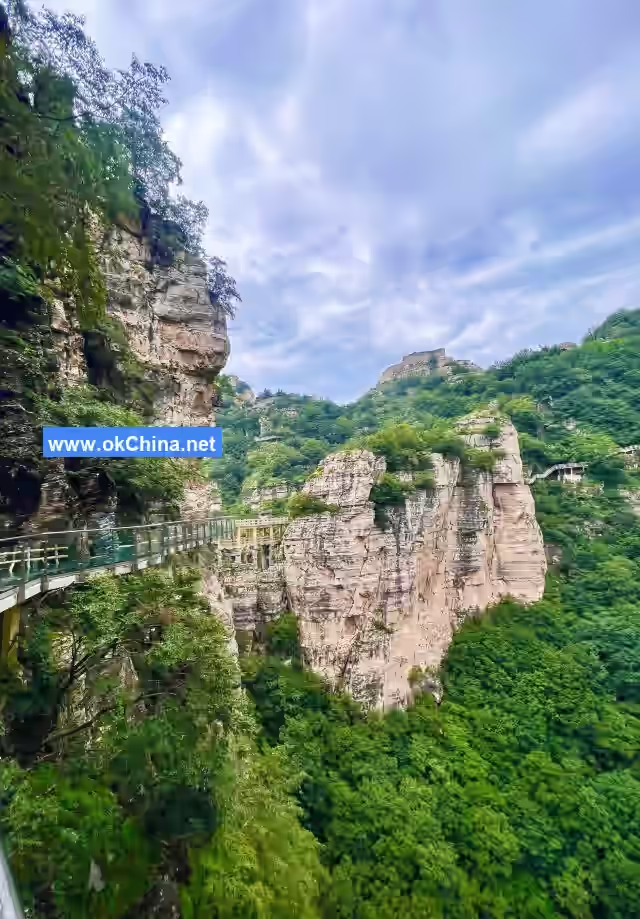
- Twin Heroes Glass Walkway: Stretching 95 meters long and 2 meters wide, this walkway is suspended in the air, offering a thrilling challenge. Visitors can experience the excitement of walking at high altitudes while overlooking the magnificent mountain scenery below.
- Twin Heroes Rock: The viewing platform here is an excellent spot to observe the Small Cave Sky. Above and to the side of the Small Cave Sky, a clear spring flows year-round, reminiscent of the Water Curtain Cave, creating a unique landscape.
- Foguangding: The highest point of Baishi Mountain, at an elevation of 2,099 meters. Upon reaching the summit, visitors can gaze into the distance, enjoying natural wonders such as the peak forest, clouds and mist, and the Buddha's Halo. It is also an ideal location for watching sunrise and sunset.
V. Cultural Activities
Origin of the Name
Baoding City Baishi Mountain Scenic Area is named for its abundance of white marble. The upper dolomite cap of Baishi Mountain formed in a marine environment 1 billion years ago. Crustal movements created two or more sets of vertical joints in this dolomitic marble. Over hundreds of millions of years, weathering expanded these vertical fissures, transforming the rock layers into towering, pillar-like peaks. Moreover, these pillar-like peaks stand on a stable granite base, allowing these wondrous and perilous peak forests to be preserved through ongoing geological movements.
Comments
Post a Comment