
Mausoleum of Genghis Khan
1. Introduction
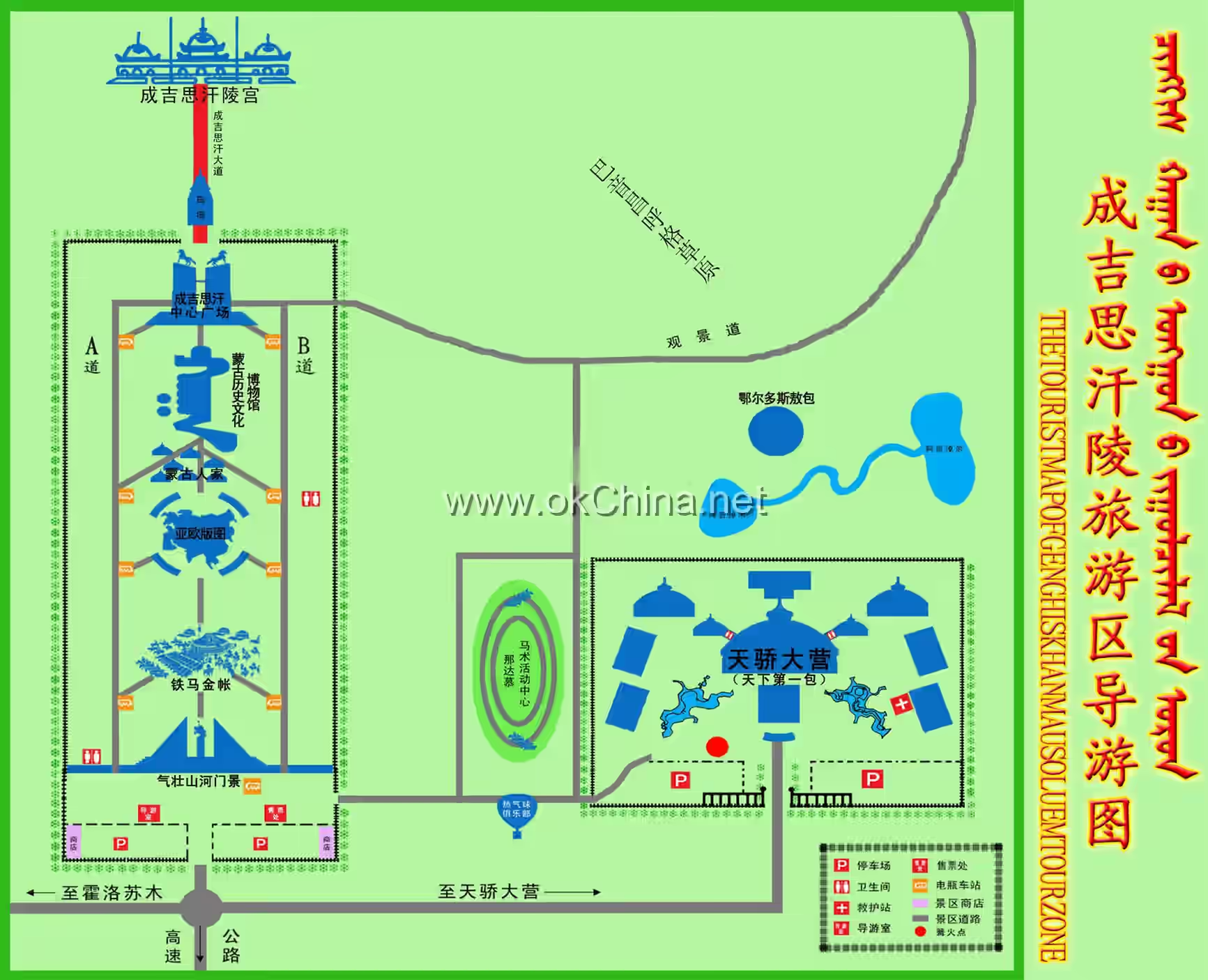
The Genghis Khan Mausoleum Tourist Area in Ordos City, abbreviated as the Genghis Khan Mausoleum Tourist Area or Genghis Mausoleum Tourist Area, commonly known as the Donglian Scenic Area (not the actual Mausoleum of Genghis Khan), is located in Ejin Horo Banner, Ordos, Inner Mongolia. Adjacent to the nationally protected key cultural relic site, the Mausoleum of Genghis Khan, it is the world's first large-scale cultural tourism area themed around Genghis Khan culture. It is recognized as a National Cultural Industry Demonstration Base, a National AAAAA-level Tourist Attraction, and a leading tourist destination in Inner Mongolia.
It is important to note that the tourist area and the Mausoleum of Genghis Khan (a national-level site) are two separate attractions, which are often easily confused. The tourist area is located approximately 3 kilometers from the nationally protected Genghis Mausoleum, and it is the tourist area that is closer to the Baotou-Maoming Expressway.
The Mausoleum of Genghis Khan (Cyrillic Mongolian: Чингис хааны онгон), abbreviated as Genghis Mausoleum, is the cenotaph of Genghis Khan, the first Great Khan of the Mongol Empire. It is situated on the grasslands of Ejin Horo Banner, Ordos City, Inner Mongolia Autonomous Region, about 40 kilometers from downtown Ordos. Due to the Mongolian tradition of "secret burial," the exact location of the true tomb of Genghis Khan remains a mystery. Historical records indicate that the camel wool believed to have absorbed Genghis Khan's last breath—his soul—has been preserved at the mausoleum for centuries. The current mausoleum has been relocated multiple times and was finally moved back to its original site in Ejin Horo Banner from the Kumbum Monastery in Qinghai in 1954. Covering an area of approximately 5.5 hectares, the mausoleum holds immense value for the study of Mongolian and even the broader nomadic cultures of northern China and is designated as a nationally protected key cultural relic site.
2. Related Figures
Genghis Khan
Genghis Khan, originally named Temüjin, was the founder and first Great Khan of the Mongol Empire. His rule established one of the largest contiguous land empires in history. Genghis Khan was born around 1162 into a noble family in what is now Mongolia. His father, a chieftain of a small tribe, was poisoned by a rival tribe when Temüjin was four years old, plunging the family into destitution. Temüjin, his mother, and his siblings struggled to survive in extreme poverty.
2.1 Early Life
Genghis Khan's youth was marked by challenges and hardships. He and his family faced attacks from other tribes and endured harsh living conditions. Growing up in such an environment, Temüjin demonstrated exceptional leadership and unwavering determination from a young age. To survive, he relied on his intelligence and courage, gradually earning the respect of surrounding tribes.
2.2 Establishing Tribal Alliances
As an adult, Temüjin began building his own power base. He formed alliances with other tribes, using marriage and political strategies to consolidate his position. In 1186, he was elected Khan of the Mongols and subsequently embarked on unifying the Mongol tribes. This process was fraught with wars and betrayals, but through his outstanding military prowess and diplomatic skills, he gradually united the fragmented Mongol tribes under his banner.
2.3 Conquest and Expansion
Genghis Khan officially declared himself emperor in 1206, founding the Mongol Empire. His military spirit and strategies enabled him to rapidly conquer neighboring peoples and states. His army was renowned for its mobility and combat effectiveness, often achieving victory against numerically superior foes and swiftly breaking through enemy lines. His "divide and rule" tactics effectively weakened opposing forces.
Genghis Khan's conquests spanned from the Jin Dynasty in northern China to the Khwarazmian Empire in Central Asia, and even as far as Eastern Europe. Over several decades, he forged a vast empire stretching across Eurasia. Through these conquests, he not only expanded Mongol territory but also facilitated cultural exchanges between East and West.
2.4 Political and Economic Reforms
While building his empire, Genghis Khan implemented a series of political and economic reforms. He established an effective administrative system and enacted the Great Yassa (Mongol law code) to maintain social order. He valued commerce, encouraged the prosperity of the Silk Road, and promoted exchanges between East and West. Under his rule, the Mongol Empire became a thriving hub of trade, attracting numerous merchants and fostering cultural interactions.
2.5 Culture and Religion
Genghis Khan was tolerant of different religions and cultures. He allowed conquered peoples to continue practicing their own faiths, a policy that reduced resistance to his rule and promoted cultural diversity. While Genghis Khan himself adhered to traditional Mongolian beliefs, he was open to Buddhism, Christianity, Islam, and other religions.
2.6 Legacy and Influence
Genghis Khan died in 1227 at approximately 65 years of age. His descendants continued his work, further expanding the Mongol Empire. His influence was profound, reshaping the world's geopolitical landscape and leaving a lasting impact on subsequent history. The existence of the Mongol Empire facilitated East-West exchanges, spurred trade development, and influenced the historical trajectories of numerous nations and peoples.
Genghis Khan is regarded as a national hero, and his image is widely revered in Mongolia. His achievements are etched into history, symbolizing courage and wisdom.
Genghis Khan was a complex and legendary figure whose life was filled with war, conquest, intelligence, and leadership. His story is not only part of Mongolian history but also a significant chapter in world history. During his reign, the rise of the Mongol Empire altered the course of human history, laying the groundwork for future civilizational exchanges and development. Genghis Khan's legacy continues to influence the world today, making him a historical figure worthy of deep reflection.
3. Historical Formation
3.1 The Mausoleum of Genghis Khan
3.1.1 Origins
The Mausoleum of Genghis Khan originally consisted of the "Eight White Yurts" (or Eight White Tents), which were revered by all Mongols as the "supreme sacred site." These eight white felt tents served as places of worship and sacrifice, not as burial grounds for his physical remains. As the Mongols were a nomadic people, the establishment of the Eight White Yurts accommodated their mobile lifestyle, allowing them to relocate and conduct rituals wherever they went.
After Genghis Khan's death in 1227, the sacrificial white yurt was initially established in Ordos and remained concealed. Historical records indicate that following Genghis Khan's passing, white palace tents dedicated to him were set up on the northern Mongolian steppe and south of the Muna Mountain (present-day Ordos), regarded as the "supreme sacred site of all Mongols" and receiving the highest level of worship. "This white palace tent became the prototype for the later 'Eight White Yurts.'" However, "from the reign of Ögedei to Kublai Khan, due to frequent military campaigns, the rituals for Genghis Khan remained relatively simple and traditional."
In 1264 (the first year of the Zhiyuan era of the Yuan Dynasty), Kublai Khan emerged victorious in the power struggle and moved the Mongol capital from Karakorum in northern Mongolia to Yanjing (present-day Beijing), later renamed "Dadu."
In 1266 (the third year of the Zhiyuan era), Kublai Khan established the Imperial Ancestral Temple in Dadu. Following advice from Bayan and others, he "designated it as an eight-chamber temple," which fundamentally institutionalized and legalized the structure of the Eight White Yurts. "Although the sacred objects enshrined in the Eight White Yurts of Genghis Khan underwent some changes in different historical periods, their core remained unchanged: the palace tents of Genghis Khan and his wife always held the central position. Therefore, the Eight White Yurts were always perceived as an integral whole, with their basic content largely unchanged." While establishing the eight-chamber temple in Dadu, Kublai Khan also "imperially decreed the system of seasonal sacrifices for the eight chambers of the Imperial Ancestral Temple." The formulation of the "Four Seasonal Grand Ceremonies" established a comprehensive and systematic framework for the rituals at the Mausoleum of Genghis Khan, which continues to this day. Many Mongolian documents assert that "Ordos (Muna Huoshiwen) is where the Eight White Yurts of Genghis Khan were first established." The History of the Mongolian People's Republic (1996 edition) also records: "After Genghis Khan's death, the Eight White Yurts were established in Ordos," and "from then on, Genghis Khan's White Palace came to be known as 'Naiman Chagan Ordos,' meaning 'Eight White Yurts.'" Over time, the Eight White Yurts of Genghis Khan were relocated multiple times, enduring numerous challenges. "During the Yuan Dynasty, there were four locations where Genghis Khan was worshipped. Specifically, in the Ordos region of the Hetao area, Karakorum in northern Mongolia, the Yuan capital Shangdu, and the Yuan capital Dadu, all had sites dedicated to the worship of Genghis Khan. This situation persisted for a hundred years."
3.2.2 Westward Relocation
After the July 7th Incident (Marco Polo Bridge Incident) in 1937, driven by the policy of "to conquer China, one must first conquer Manchuria and Mongolia," Japan occupied most of Suiyuan (western Inner Mongolia). In late October of that year, they established the Mongol United Autonomous Government in Guisui, renaming Guisui to "Hohhot City." Simultaneously, they dispatched spies in an attempt to leverage the influence of Genghis Khan's Mausoleum to manipulate the situation in Inner Mongolia.In early 1939, during his visit to Chongqing, Shagdurjab, the league leader of the Yeke Juu League, proposed to the Nationalist Government that Genghis Khan's coffin be relocated to the Korgolbei Banner in the northwest of Qinghai Province to avoid the ravages of war. Chiang Kai-shek agreed and appointed Prince Shag, along with Fu Zuoyi, Chairman of the Suiyuan Provincial Government, and Deng Baosan, Commander-in-Chief of the Shanxi-Shaanxi-Suiyuan Border Region, as officials to oversee the relocation and conduct sacrificial rites, with Prince Shag serving as the chief officiant. The funds for the relocation were allocated from the national treasury. When determining the burial site, it was considered that Genghis Khan had passed through Gansu during his campaign against the Western Xia, so it was decided to temporarily move Genghis Khan's coffin to Xinglong Mountain in Yuzhong County, Gansu Province. In June 1939, the coffins of Genghis Khan and his wife Börte, the coffin of his wife Hulan, and Genghis Khan's war deity, the Black Banner (Har Sülde), were moved westward to Xinglong Mountain in Yuzhong County, Gansu Province. During the journey, the Communist Party also held a memorial ceremony. In early August 1949, Ma Bufang, the military and political governor of the Northwest, ordered the relocation of Genghis Khan's coffin to Kumbum Monastery in Qinghai Province, which became the final stop of the westward relocation of Genghis Khan's mausoleum.
3.3.3 Return and Reconstruction
In June 1953, in response to the demands of the Mongolian people, the People's Government of the Inner Mongolia Autonomous Region submitted a report to the Government Administration Council of the Central People's Government, requesting the return of Genghis Khan's mausoleum to Ejin Horo Banner. Premier Zhou Enlai of the Government Administration Council immediately approved the report and allocated 800,000 yuan in special funds for the construction of a new Genghis Khan mausoleum. The Inner Mongolia Autonomous Region Government established a committee to oversee the relocation and construction of the mausoleum.
In December 1953, the Government Administration Council of the Central People's Government of the People's Republic of China approved the request of the Inner Mongolia Autonomous Region to relocate Genghis Khan's mausoleum from Kumbum Monastery in Qinghai to Ejin Horo and decided to allocate special funds from the central government for the construction of the Genghis Khan Mausoleum Park. Ulanhu, Chairman of the Autonomous Region, personally selected the site and laid the foundation for the park.
On March 15, 1954, a delegation of 29 people from the Inner Mongolia Autonomous Region, led by Ejin Horo League leader Oqirhuyag, traveled by car to Xining to prepare for the return of Genghis Khan's coffin. On March 29, the delegation, together with leaders and the masses in Xining, Qinghai, held a grand ceremony at Kumbum Monastery to request the return of the coffin. After the ceremony, on April 3, Genghis Khan's coffin, the coffin of Hulan Khatun, the Sülde, and the accompanying Darkhad people, along with the delegation, returned to Inner Mongolia. On April 7, 1954, the remains were returned to their original location in Ejin Horo. On April 23, the first grand sacrifice after the return of the mausoleum was held in Ejin Horo.
In the spring of 1955, the construction of the Genghis Khan Mausoleum officially began. The construction of the mausoleum park was undertaken by the Inner Mongolia Autonomous Region Construction Engineering Bureau, with the design by engineer Guo Yuncheng from the Design Office of the Inner Mongolia Autonomous Region Planning Committee. The reconstruction project of the Genghis Khan Mausoleum was completed on October 30, 1955, and the mausoleum park was finished in 1956. In May 1956, the coffins of Genghis Khan and several of his wives were placed in the mausoleum palace. At the same time, the Eight White Tents of Genghis Khan, the Har Sülde, and other sacred objects distributed across various banners of Ordos were gathered at the Genghis Khan Mausoleum, and a ceremony was held to mark the completion of the new mausoleum palace. In 1982, it was included in the second batch of National Key Cultural Relics Protection Units. Comprehensive renovation and construction began in 2004.
4. Main Scenic Areas
4.1 Genghis Khan Mausoleum Palace
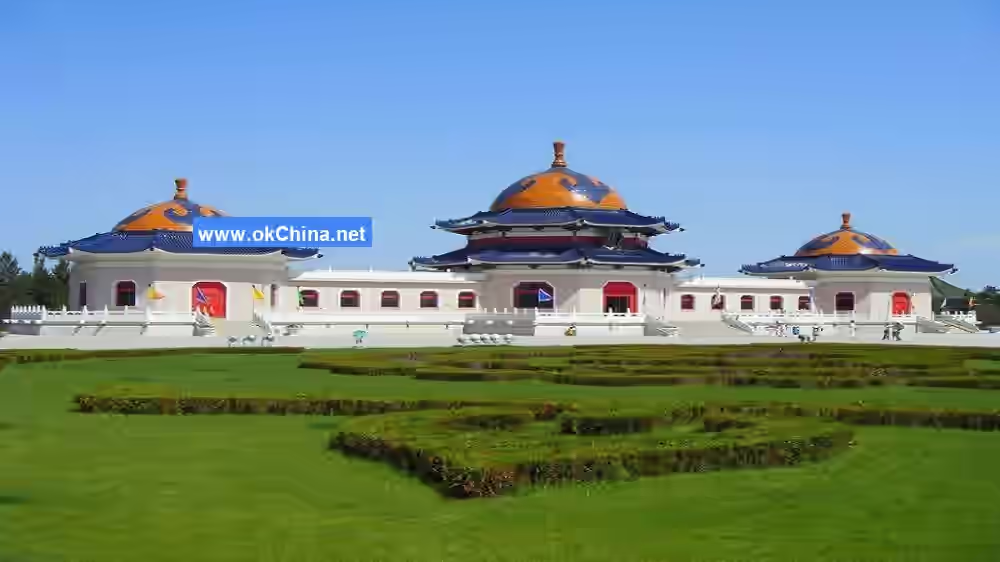
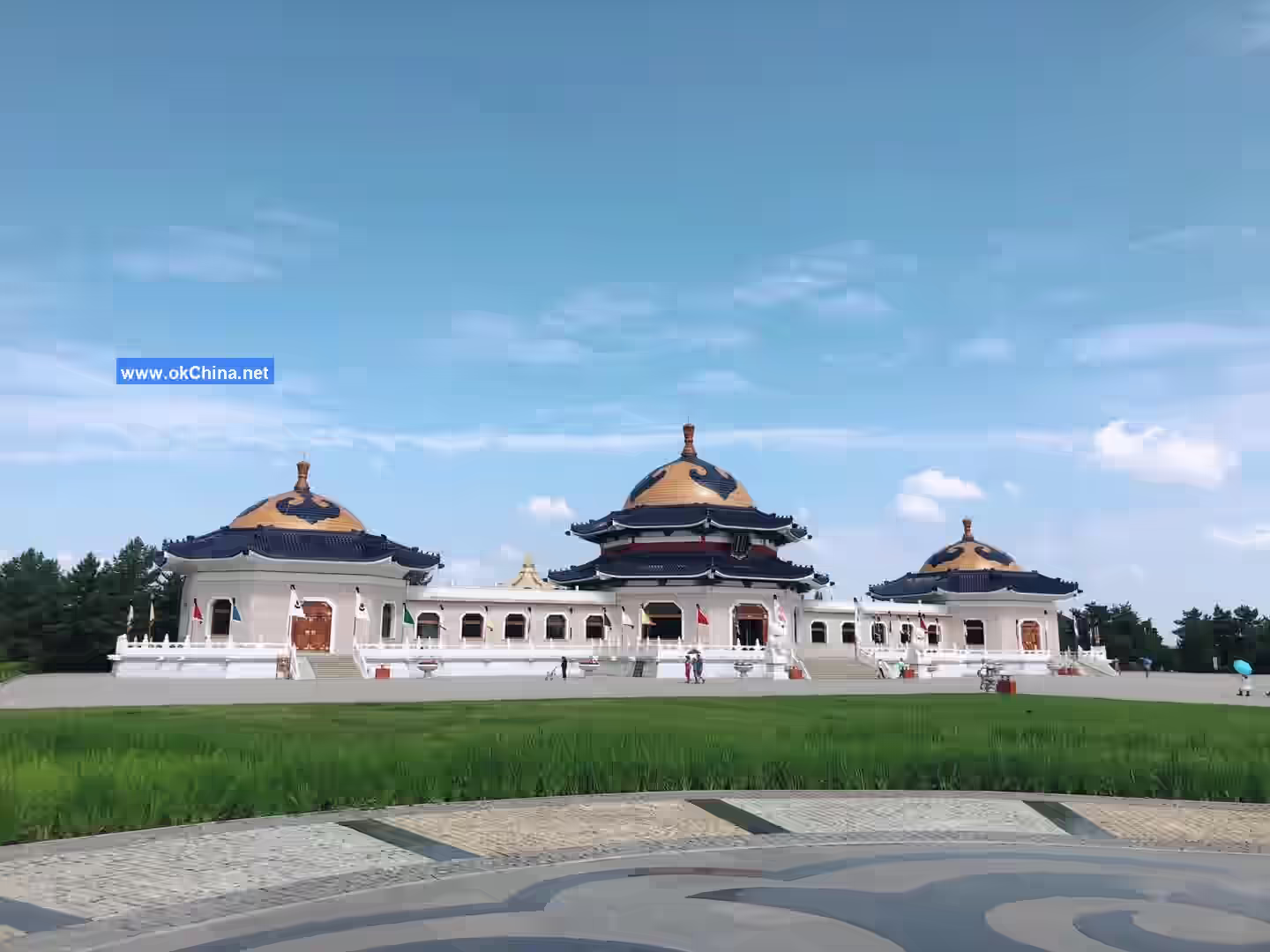
The mausoleum palace is a sacred site for worshipping Genghis Khan. Its architecture retains the shape and characteristics of the Eight White Tents of Genghis Khan, making it a representative building of the Mongolian ethnic group. The Genghis Khan Mausoleum Palace consists of the main hall, rear hall, east and west halls, and east and west corridors. The mausoleum palace covers an area of 2,000 square meters, with the main hall standing 24.18 meters high and the east and west halls 18 meters high. The mausoleum palace houses the Eight White Tents (rooms) of Genghis Khan and features large-scale murals. In the center of the eaves hangs a plaque inscribed with "Genghis Khan Mausoleum" by former Vice President Ulanhu.
4.2 Exhibition Hall
The Genghis Khan Mausoleum Historical and Cultural Exhibition Hall is divided into six sections: "A Historical Great Man Who Went Global," "Warm Care," "Changes of the Genghis Khan Mausoleum," "Construction of the Genghis Khan Mausoleum Park," "The Mysterious Genghis Khan Sacrifice," and "The Darkhad, the Guardians of the Mausoleum." Through pictures and artifacts, the exhibition systematically showcases the historical vicissitudes of the Genghis Khan Mausoleum, the ancient and mysterious Genghis Khan sacrifices, the profound historical and cultural connotations of the mausoleum, and its development and changes.
4.3 Sülde Altar
The white marble Sülde Altar, carved with Mongolian ethnic patterns, is a place dedicated to Genghis Khan's war deity. The "Four-Tasseled Har Sülde," composed of the main Sülde and four accompanying Süldes, represents Genghis Khan's invincible war deity and protective deity of peace and auspiciousness. It symbolizes Genghis Khan's spirit of advancing bravely and overcoming all evil. The tassels of the Sülde are made from the manes of ninety-nine stallions. The altar also houses the Alag Sülde (Colorful Banner) of the Great Mongol Empire. The altar is 15.4 meters high and 54 meters in diameter.
4.4 Stele Pavilion
In the southeast and southwest corners of the Genghis Khan Mausoleum Palace courtyard, there are two stele pavilions housing tall stone steles. The pavilions feature eight pillars, double-layered eaves, and glazed tile roofs, representing typical Chinese pavilion architecture. Inside the pavilions stand tall stone steles with giant stone tortoises as their bases. One stele is inscribed with "Genghis Khan," and the other with "Genghis Khan Mausoleum." The inscriptions, carved in both Mongolian and Chinese, summarize Genghis Khan's arduous military career and the centuries-long history of the Genghis Khan Mausoleum.
4.5 Yisui Khatun Hall
The Yisui Khatun Hall is dedicated to Yisui Khatun, the wife of Genghis Khan's youngest son Tolui. The hall also houses the spirit bundles of Genghis Khan's brothers Khasar and Belgutei, as well as Tolui.
4.6 Altan Gandur Ovoo
The Altan Gandur Ovoo was established by ancient people to commemorate Genghis Khan dropping his horsewhip. When Genghis Khan led his army through Ordos, he was captivated by the lush water and grass, considering it a geomantic treasure. In his moment of fascination, he accidentally dropped his horsewhip. To commemorate this event, an ovoo was erected. After the establishment of the Genghis Khan Mausoleum Park, the annual Chagan Sürüg Grand Sacrifice to Heaven is held here on the 21st day of the third lunar month.
4.7 Ninety-Nine Steps
The Mongolian people worship the eternal sky, believing that the sky, which governs all things on earth, is composed of ninety-nine heavens. Genghis Khan once tethered ten thousand herds of livestock by the Kherlen River and sprinkled the milk of ninety-nine white mares to worship the sky. The ninety-nine steps symbolize auspiciousness and blessings. From a distance, they resemble an ever-flowing river, representing the "Mongol" (Mönkh Gol) created by Genghis Khan as an "eternal river" that flows endlessly and lasts forever.
4.8 Bronze Statue Square
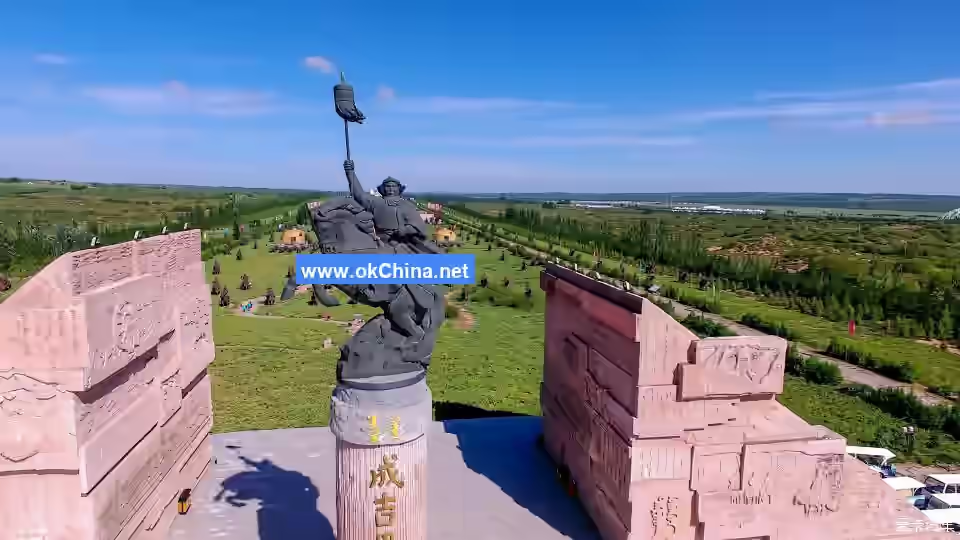
The Genghis Khan Bronze Statue Square symbolizes the vast blessings bestowed upon the world by the sky and earth. The tall bronze statue of Genghis Khan on an expedition recreates the scene of Genghis Khan praising Ordos during his western campaign as "a place where deer dwell, where hoopoe birds raise their young, where a declining dynasty revives, and where white-haired elders enjoy peace." It also captures the awe-inspiring demeanor of the great man who rose from horseback. The bronze statue is 6.6 meters high, and the square has a diameter of 66 meters, symbolizing Genghis Khan's lifespan. The surrounding pine and cypress trees extend outward in an umbrella shape, representing the spirit of Genghis Khan.
4.9 Record of the Reconstruction of the Genghis Khan Mausoleum
The stele recording the reconstruction of the Genghis Khan Mausoleum is a massive natural stone, 9 meters wide, 2.3 meters high, and 1 meter thick. The inscription is written in Mongolian, Chinese, English, and Japanese, grand and elegant in style, adding a new scenic feature to the Genghis Khan Mausoleum.
4.10 Entrance Archway
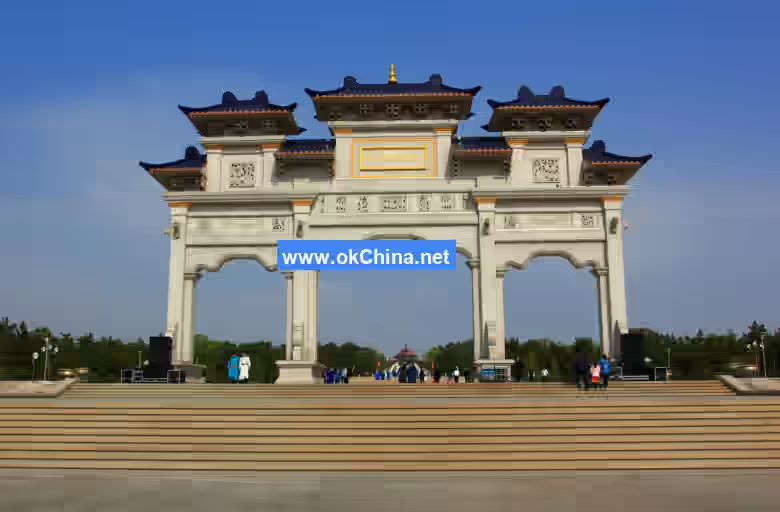
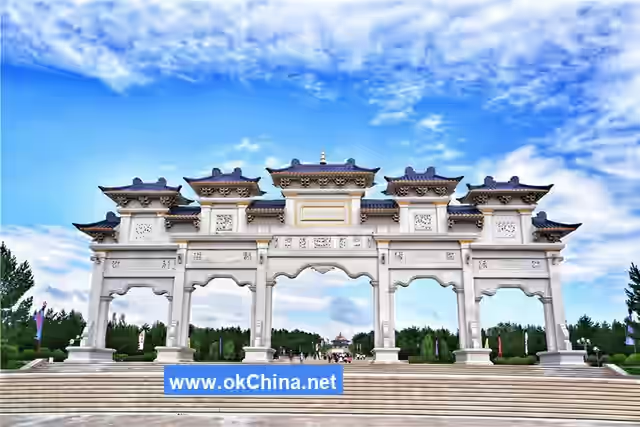
The entrance archway of the Genghis Khan Mausoleum Park serves as the landmark for entering the park. Its shape resembles a milky-white yurt rising from the green grass, a majestic monument commemorating the achievements of the great historical figure. The archway-style gate is adorned with a stone plaque inscribed with "Genghis Khan Mausoleum" by former Vice President Ulanhu, adding a solemn touch.
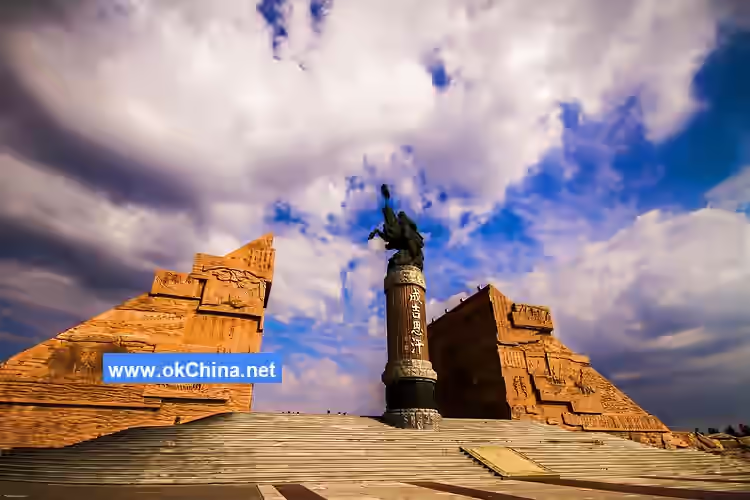
4.11 Majestic Gate Scenery
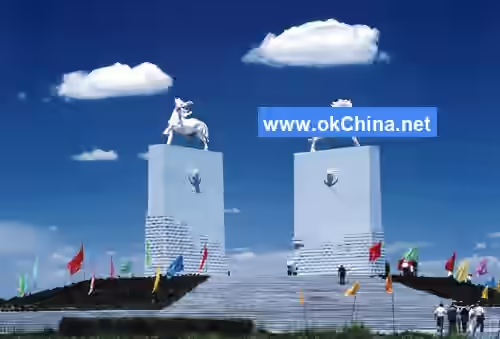
The gate scenery is shaped like the character "山" (mountain), as if a giant peak has been split open. A towering statue of Genghis Khan on horseback emerges from the center, standing tall and firm. The eastern and western peaks are carved with... The gate scenery is solid, profound, and majestic, symbolizing the creation of heaven and earth, hence the name "Majestic Gate Scenery Area."
4.12 Bayan Changhag Grassland
The Bayan Changhag Grassland covers approximately thirty square kilometers and is a pristine grassland largely untouched by human activity. In the past, it was a forbidden area of the Genghis Khan Mausoleum. Here flows the legendary Taogao Bulag Holy Spring, said to have gushed forth when Genghis Khan's funeral cart became stuck.
4.13 Great Ejin Horo Site
On the northern slope of Bor Talogai, one kilometer south of the Genghis Khan Mausoleum Park, and in the center of Genghis Khan's sacred path, there is a protected site—the original location of the Genghis Khan Mausoleum. After the Eight White Tents (rooms) and Sülde of Genghis Khan were enshrined in various banners of Ordos, the Ejin Horo, which housed Genghis Khan's palace tent, became known as the "Great Ejin Horo." In 1954, with the care of the central government, the Genghis Khan Mausoleum was reconstructed and completed in 1956. The palace tent for worshipping Genghis Khan and the Eight White Tents were moved to the magnificent and splendid mausoleum palace. To commemorate the site that housed Genghis Khan's palace tent for 307 years, a stele marking the "Great Ejin Horo Site" was erected for protection.
4.14 Mongolian History and Culture Museum
The museum's design is shaped like the Mongolian character for "Khan" (meaning emperor), making it one of the representative contemporary Mongolian architectural works. The museum houses precious Mongolian historical artifacts and exquisite, unique ethnic items. It is the only museum in the world dedicated to the collection, research, and exhibition of Mongolian history and culture, serving as an important base for inheriting and promoting the long-standing historical and cultural heritage of the Mongolian ethnic group.### 4.15 The Long Scroll of Mongolian History
This 206-year historical panorama, spanning from the birth of Genghis Khan to the Yuan dynasty rulers' withdrawal from Dadu (the Great Capital) to the northern grasslands and the establishment of the Northern Yuan regime, authentically reflects the most glorious chapter of the Mongolian nation's history. It depicts the historical process of achieving the unification of the Chinese nation and accelerating the development of world civilization. The scroll holds the record as the longest of its kind in the world.
4.16 The Eurasian Territory Map
The Eurasian Territory Map is the largest attraction in Chinese and world history that recreates the territory of the Mongol-Yuan Empire in the form of a map.
5. Cultural Value
5.1 National Psychology
From the perspective of Mongolian national psychology, the Mausoleum of Genghis Khan is a sacred site, the "supreme deity of all Mongols." It has taken root deep in the heart of every Mongolian, becoming an indispensable component of Mongolian national culture. Firstly, Genghis Khan rose from adversity with astonishing courage, grand vision, and indomitable spirit. He tenaciously struggled, unified the various Mongol tribes, established the Great Mongol State, forged the Mongolian nation in the modern sense, and instilled immense national confidence and pride in the Mongolian people. Secondly, he significantly enhanced the productivity and cultural level of Mongol society, enabling the Mongolian people to swiftly change their impoverished and backward living conditions and emerge from a state of cultural obscurity. Thirdly, the western expeditions led by him and his descendants allowed the Mongolian nation to step onto the international stage for the first time with a new visage, making the Mongols renowned and awe-inspiring worldwide. All these achievements leave later generations of Mongols and people of other ethnicities in awe and admiration. Finally, the excellent qualities embodied by Genghis Khan—simplicity and sincerity, loyalty and trustworthiness, magnanimity, bravery and unity, perseverance, and unyielding spirit—have also had an immeasurable impact on the formation of the common psychological character of the Mongolian nation. Considering these factors, the sacred status of Genghis Khan in the hearts of the Mongolian people is easily understood. This also renders the Mausoleum of Genghis Khan extremely sacred and venerable, making it a holy land in the hearts of the Mongolian people.
5.2 Mongol-Yuan Culture
First, due to the Eight White Yurts of Genghis Khan, the Ordos region has preserved Mongol-Yuan culture for a long period, lasting seven hundred years. The Mongolian nation is the culmination of nomadic culture. Since the death of Genghis Khan, the formation and development of the Ordos tribe have been most directly linked to Genghis Khan himself and the "Golden Family," making it one of the most important carriers of Mongol-Yuan culture. After entering the Hetao region, they brought with them the most authentic traditional culture of the 13th-century Mongols and the aristocratic court culture of the Yuan dynasty. Moreover, due to the sacred, special, and important nature of their mission, even when influenced by surrounding cultures, they maintained many norms and systems established since Kublai Khan without any alteration. They strictly adhered to the lifestyle passed down by their ancestors, living day after day without change, faithfully upholding their duties and obligations.
Second, the existence of the Mausoleum of Genghis Khan formed the most unique vehicle of transmission—the Darqad people. "Since the establishment of the Eight White Yurts of Genghis Khan, the Darqad people have guarded, worshipped, and managed the deities enshrined within them for generations. Under the difficult conditions of the past, moving north and south, they protected the deities worshipped by Genghis Khan and completely preserved the ancient sacrificial culture of the 13th century" [2].
Third, due to the Mausoleum of Genghis Khan, the Ordos region has completely preserved Mongolian culture and transmitted the highest standard of Mongol-Yuan culture—the court culture decreed by Yuan emperors. Because of the sacred mission they bear, the composition of the Ordos Mongol tribe primarily consists of descendants of the elite from various tribes most trusted by Genghis Khan. "Coupled with the mission entrusted by Mongol emperors and the Golden Family, in terms of the cultural heritage they carry, they possess the noblest cultural attributes of the Mongolian ethnicity. This includes Mongolian court culture, imperial culture, as well as the transmission of ancient Mongolian classics and esoteric knowledge. Not only in modern times but even in ancient times, many cultural details and connotations typically unknown and inaccessible to common people have been continuously perpetuated within this group according to tradition, remaining strongly present and manifested to this day, becoming treasures of Mongolian culture" [10]. Precisely because of this, several very famous Mongolian historical texts also originated from Ordos, such as the Erdeni-yin Tobči (The Bejeweled Summary), Altan Tobči (The Golden Summary), and Altan Debter (The Golden Book) from the Ming and Qing periods. This indicates that Ordos has a profound foundation for in-depth research and transmission of its traditional ethnic culture.
5.3 Historical Value
From the perspective of Chinese history, Genghis Khan is not only the great founder of the Mongolian nation but also a national hero of the Chinese nation [11]. Genghis Khan and his descendants, one after another, unified the Mongolian Plateau and subsequently unified all of China, ending over four hundred years of prolonged division and warfare in China since the late Tang dynasty. They established the Yuan dynasty with an unprecedentedly vast territory, essentially laying the foundation for the map of the Chinese nation today. For this reason, the Mausoleum of Genghis Khan, as a monument commemorating him, not only symbolizes the unification of the Mongolian nation but also signifies the enduring unity of China.
From the perspective of world history, Genghis Khan is one of the figures who has had the greatest impact on the world in the past two thousand years. At the turn of the millennium, Time magazine selected the "Ten Most Influential People of the Millennium," and Genghis Khan topped the list. His influence far surpassed that of Peter the Great, Julius Caesar, Napoleon, and others. The great empire he and his descendants established redrew the world map and profoundly influenced the course of European history. He enabled the "broadest and most open handshake" between humankind. Therefore, people from all over the world remain deeply interested in Genghis Khan and Mongolian culture, and the Mausoleum of Genghis Khan in Ordos naturally possesses world cultural value.
In February 2023, the Mausoleum of Genghis Khan was selected as a recommended project for the "Seventh Batch of Chinese 20th-Century Architectural Heritage" [29].
6. Mongolian Customs
6.1 Secret Burial Tradition
According to Hei Da Shi Lue (Brief Account of the Black Tatars): "(The Mongols) have no mounds over their graves; they trample them with horses to make them level like flat ground. As for the tomb of Temüjin (Genghis Khan), arrows were planted to form an enclosure over thirty li wide, with patrols as guards." Historical records state that when Mongolian nobles died, their bodies were placed inside hollowed-out logs and buried deep underground. A young camel was killed in front of its mother, then horses were released to trample the ground stained with the young camel's blood, and soldiers were stationed to guard the area [28] until no trace remained on the surface, after which they would leave. Those with knowledge of the location were killed. This illustrates one characteristic of Mongolian burial customs. This is closely linked to the Shamanistic belief in the separation of body and soul. Qizhongyi, the last Jasagh prince of the Yeke Juu League, believed: "From the perspective of Mongolian customs and the previously practiced Shamanism, worshipping ancestors primarily involves worshipping the soul, not the bones. According to Mongolian tradition, when a person is dying, their last breath—the soul—leaves the body and attaches to nearby camel wool. According to historical records, the camel wool that absorbed the last breath—the soul—of Genghis Khan's ancestors has been preserved for centuries at the Mausoleum of Genghis Khan in Ordos" [12].
Legend has it that during Genghis Khan's burial, for the sake of secrecy, tens of thousands of warhorses were used to trample the burial site firm, and a solitary tree served as a tomb marker. To facilitate finding the tomb later, at the burial site, a young camel was killed in front of its mother, and its blood was sprinkled over the grave. By the following spring when grass sprouted, the burial site became indistinguishable from the surrounding area. In such circumstances, later generations, when worshipping Genghis Khan, would lead that mother camel to the site. Upon reaching the grave, the mother camel would wail mournfully, remembering her slain offspring. The worshippers would then conduct grand ceremonies at the spot where the camel wailed. However, after that mother camel died, no one could ever find Genghis Khan's tomb again. Therefore, apart from suspected burial sites on the Mongolian Plateau, there is no confirmed mausoleum.
6.2 Tomb Guardians
The Darqad people are a tribe within the Mongolian ethnicity specifically dedicated to guarding the Mausoleum of Genghis Khan. "Darqad" is a Mongolian term meaning "those who bear the sacred mission." To this day, the Darqad people have faithfully guarded Genghis Khan's spirit for nearly eight hundred years, with a current population of approximately two thousand [13]. The title "Darqad" originated during Kublai Khan's reign. "Around 1282 (the 19th year of the Zhiyuan era), during the Yuan dynasty under Kublai Khan, the four seasonal grand ceremonies for Genghis Khan were officially established, producing standardized sacrificial texts and prayers. The guardians and officiants had detailed divisions of labor. These专职祭祀者 (full-time officiants) began to be called Darqad at that time. Furthermore, within the court, to standardize the sacrifices at the Imperial Ancestral Temple for Genghis Khan and others, specific officials were appointed to manage and preside over the sacrifices: the Grand Preceptor, Chancellor, Hongjin, and Charbi, leading the 'Eight Great Yamant,' and the son of Bo'orchu was granted the title 'Grand Preceptor,' his grandson the title 'Chancellor,' making them serve the sacrifices for Genghis Khan for generations" [2]. The Mongol Empire and the Yuan dynasty also granted the Darqad people the privilege of exemption from military service and taxes. During the Qing dynasty, these privileges were further clarified and guaranteed, with explicit regulations from the Qing government's Court of Colonial Affairs. Moreover, additional rights were granted on the original basis, such as allowing the Darqad to collect sacrificial offerings in Mongolian regions and providing them with free mounts at post stations. These privileges also ensured their possibility, uniqueness, and professionalism as carriers of the sacrificial culture. This is also unique in the history of world cultural transmission.
Comments
Post a Comment