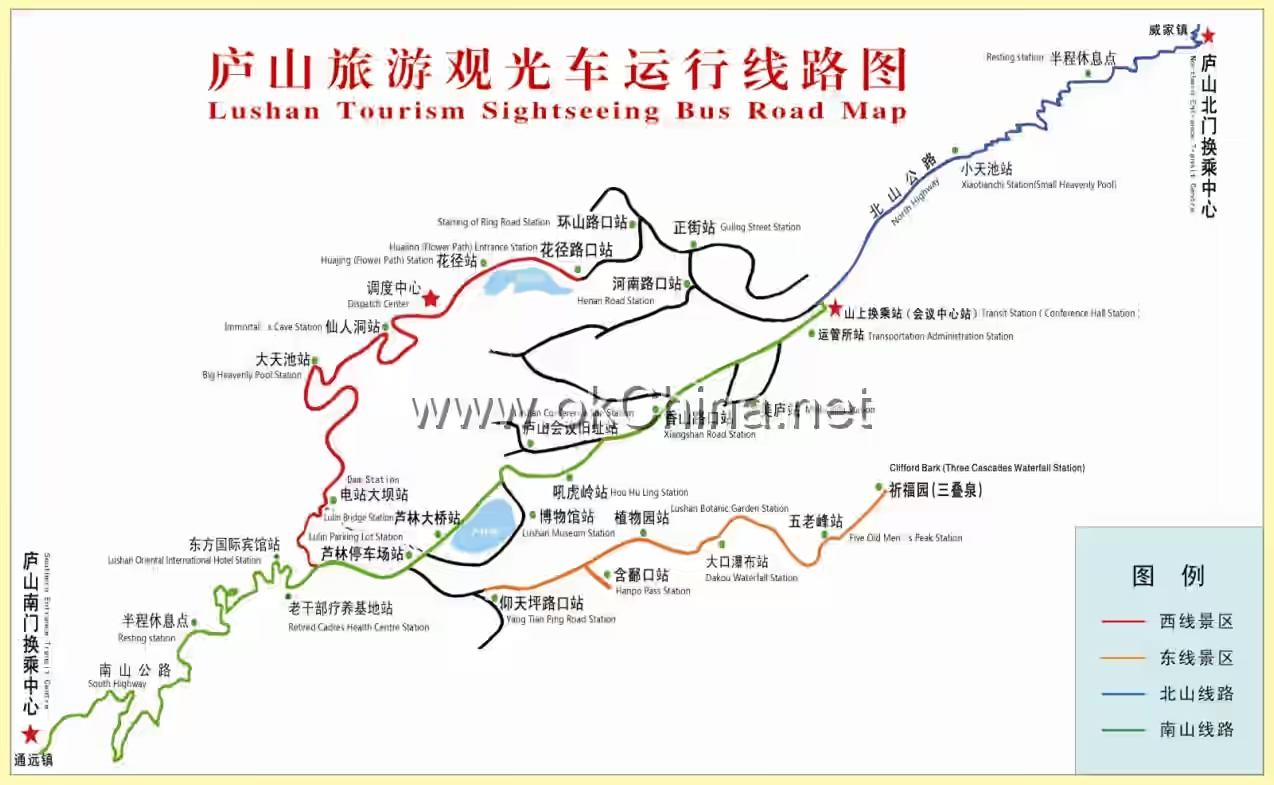
Lushan Scenic Area, Lushan City, Jiujiang City
1. Introduction
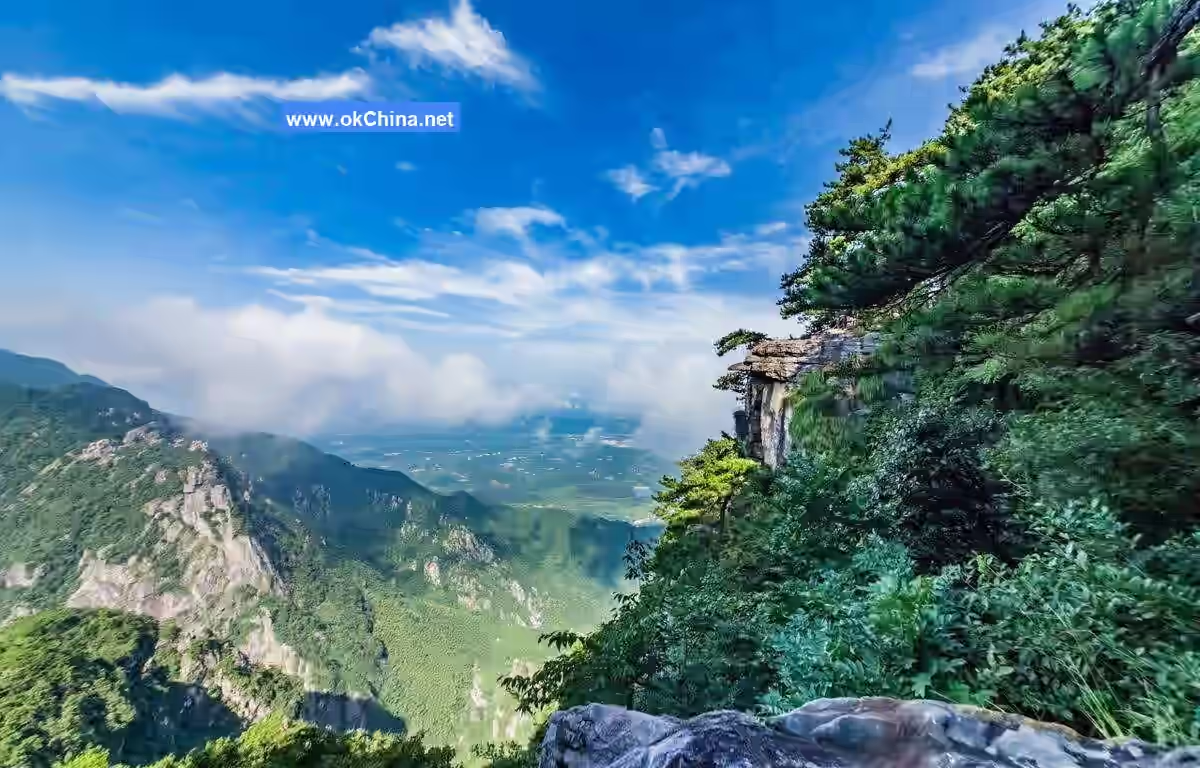
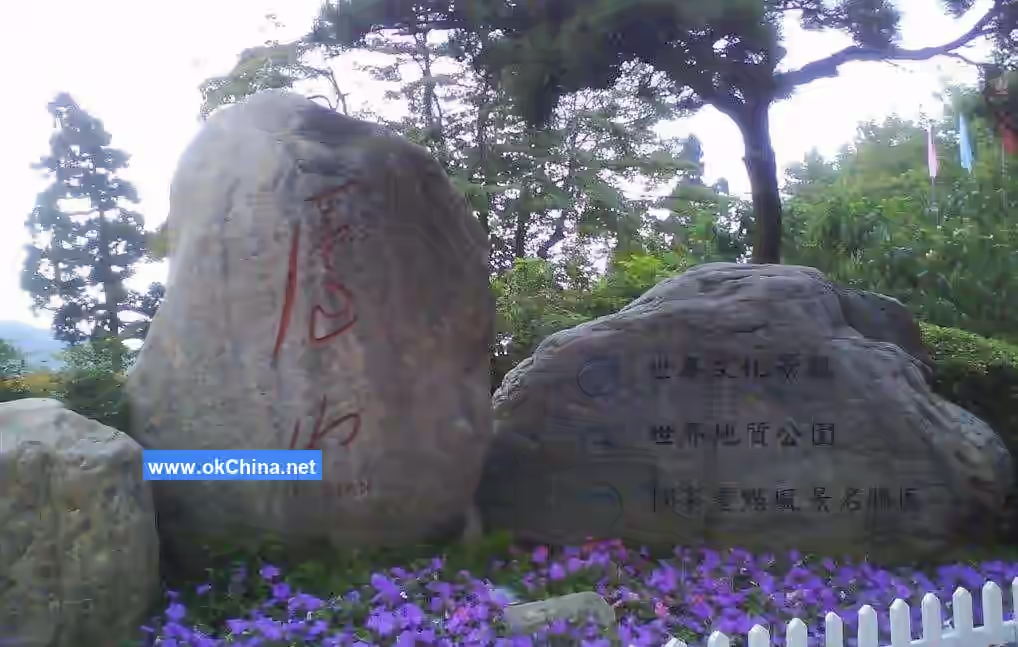
The Lushan Scenic Area, under the jurisdiction of Jiujiang City, Jiangxi Province, is located 36 kilometers south of Jiujiang City, bordering the Yangtze River to the north and Poyang Lake to the south. It is approximately 25 kilometers long from north to south and 20 kilometers wide from east to west. Most peaks in the scenic area are over 1,000 meters above sea level, with the main peak, Hanyang Peak, reaching 1,474 meters. It is a famous tourist destination and summer resort in China and was inscribed on the UNESCO World Heritage List as a "World Natural and Cultural Heritage Site" in 1996.
2. Naming
The earliest written record of the name "Lushan" appears in the Shangshu·Yugong: "South of the Min Mountains, reaching Mount Heng. Passing through Jiujiang, arriving at Fuqian Yuan." Here, "Fuqian Yuan" is an alternative name for Lushan. Additionally, Lushan has other names such as Nanzhang Mountain and Tianzi Zhang. The earliest historical record using the name "Lushan" is in Sima Qian's Records of the Grand Historian: "I ascended Lushan in the south to observe Yu's dredging of the nine rivers."
The Book of Songs·Xiaoya·Xin Nanshan mentions "a hut in the middle of the fields," while the Guoyu·Chuyu records that the location of Lushan was called "Lu Yi" during the Warring States period. Sun Fang of the Jin Dynasty wrote in his Ode to Lushan: "South of Xunyang Commandery lies Lushan, the guardian of the nine rivers, facing the marsh of Pengli and level plains," also discussing Lushan's geography.
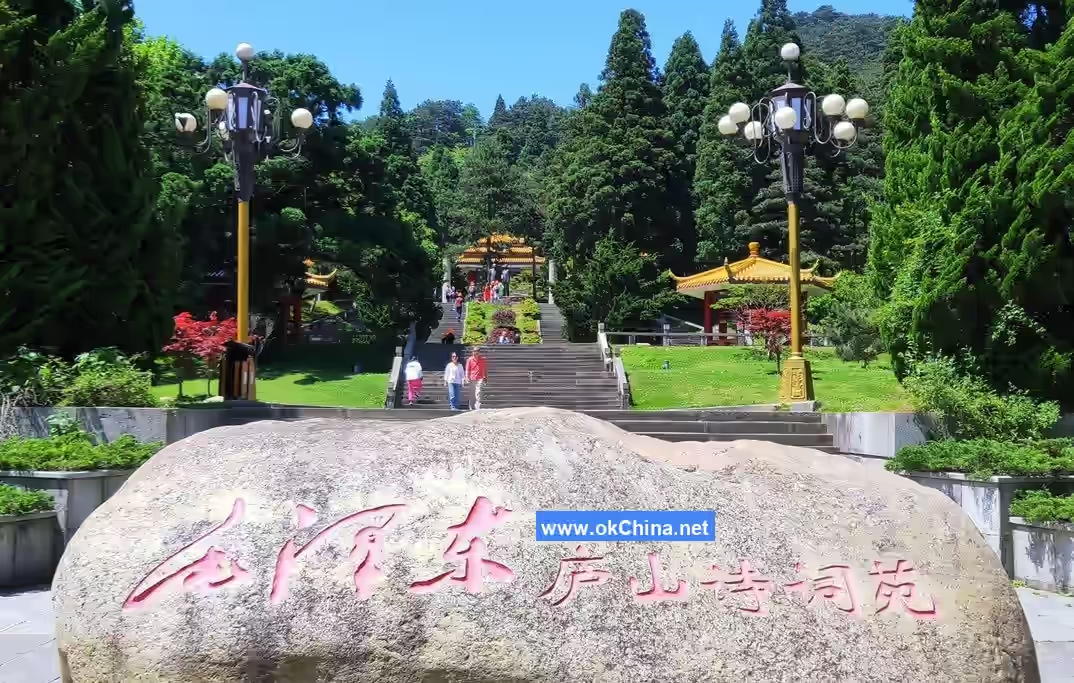
Lushan is a cultural mountain with a long history, dotted with scenic spots and historical sites. Over thousands of years, countless literati, artists, and notable figures have left behind a vast collection of paintings, calligraphy, and widely celebrated literary works. Su Shi's depiction of Lushan's mist and clouds in "I can't tell the true shape of Lushan, because I myself am in the mountain"; Li Bai's description of the Xiufeng Horse-tail Waterfall in "The waterfall flies down three thousand feet, I wonder if it's the Milky Way falling from the ninth heaven"; and Mao Zedong's lines about the Immortal Cave where Lü Dongbin cultivated immortality, "A natural Immortal Cave, infinite scenery lies on perilous peaks," are all perfect examples of poetry and scenery blending, renowned worldwide. Legend has it that during the Yin and Zhou periods, seven brothers surnamed Kuang built a hut and lived in seclusion here, later becoming immortals. Their hut transformed into a mountain, hence the name. As the ancients said, "The extraordinary beauty of Kuanglu (Lushan) is second to none under heaven." Since Sima Qian recorded Lushan in the Records of the Grand Historian, poets and writers of successive dynasties have been drawn to it. Over 1,500 poets, including Tao Yuanming, Xie Lingyun, Li Bai, Bai Juyi, Su Shi, Wang Anshi, Lu You, Xu Zhimo, and Guo Moruo, climbed the mountain, leaving behind many precious masterpieces. A group of cultural luminaries engaged in extensive literary and artistic creation on Lushan, making it the birthplace of Chinese pastoral poetry, the cradle of Chinese landscape poetry, and the origin of Chinese landscape painting. Subsequently, over 1,500 literati, politicians, and artists, including Li Bai, Bai Jiyi, Su Shi, and Wang Anshi, visited Lushan to live and tour, composing more than 10,000 poems and verses praising the mountain. Su Shi's lines, "Viewed from the front, a mountain range; from the side, a peak. Far, near, high, low—each view differs. I can't tell the true shape of Lushan, because I myself am in the mountain," vividly depict Lushan's scenery and have become a celebrated masterpiece for centuries.
3. Geographical Environment
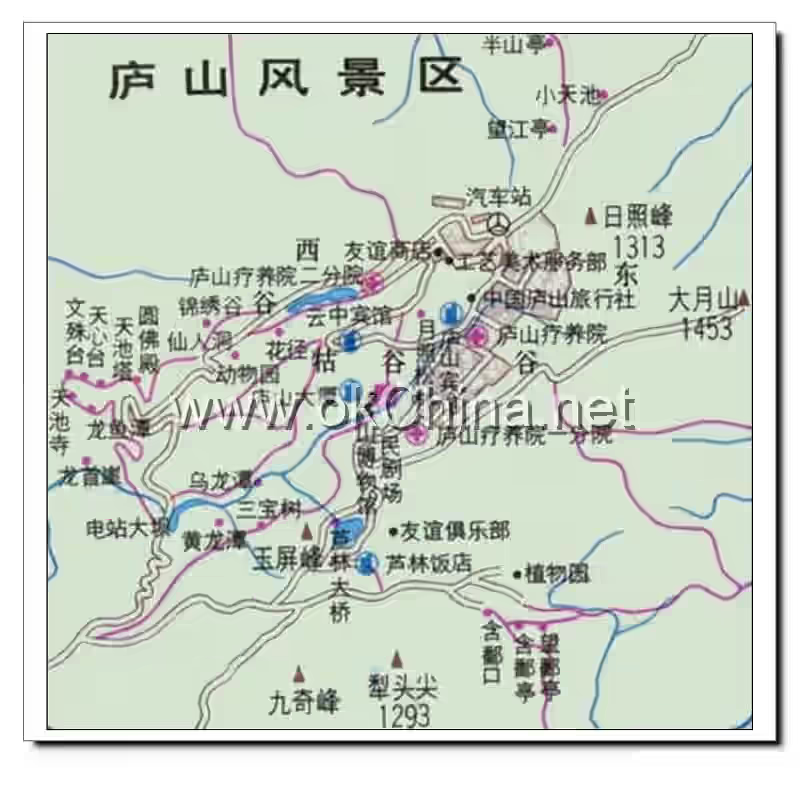
Lushan is located in Jiujiang City, Jiangxi Province, bordered by Wuyuan and Poyang Lake to the east, Tengwang Pavilion to the south, the Beijing-Kowloon Railway artery to the west, and the mighty Yangtze River to the north. It is a horst block mountain, stretching 29 kilometers from north to south and about 16 kilometers from east to west, covering an area of 302 square kilometers, between 115°52′—116°8′ east longitude and 29°26′—29°41′ north latitude. Its elevation ranges from 25 to 1,473.8 meters. There are 171 named peaks since ancient times, with the main peak, Great Hanyang Peak, reaching 1,474 meters.
3.1 Climate Conditions
Lushan experiences late springs, short summers, early autumns, and long winters. Historical records show the highest temperature is only 32°C, the lowest is -16.8°C, and the annual average is 11.4°C, indicating a moderate climate. Seasonal averages are also relatively normal: spring averages 11.5°C, summer 22.6°C, autumn 17.4°C, and winter around 1°C.
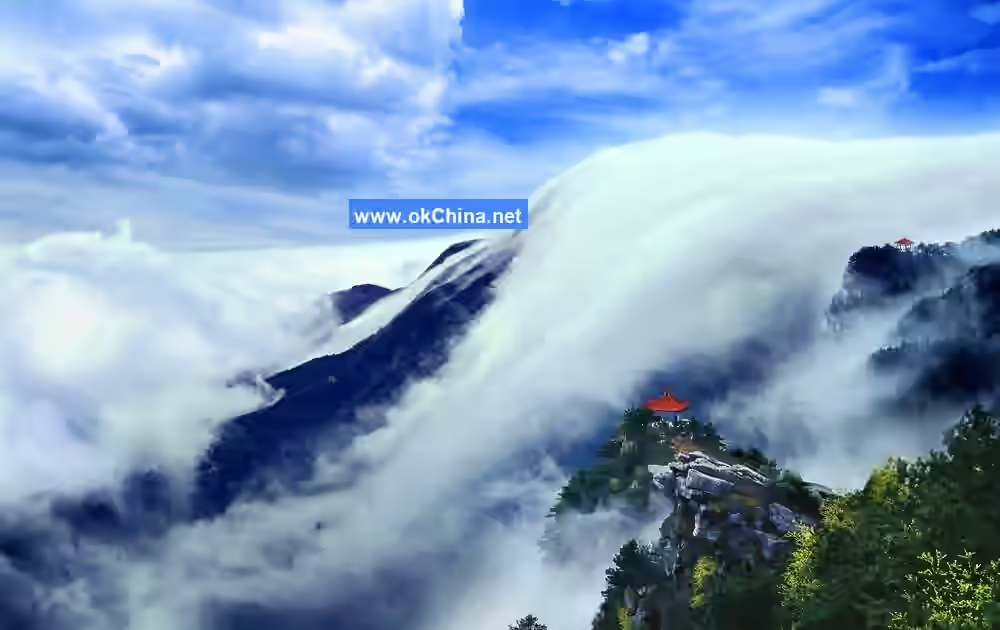
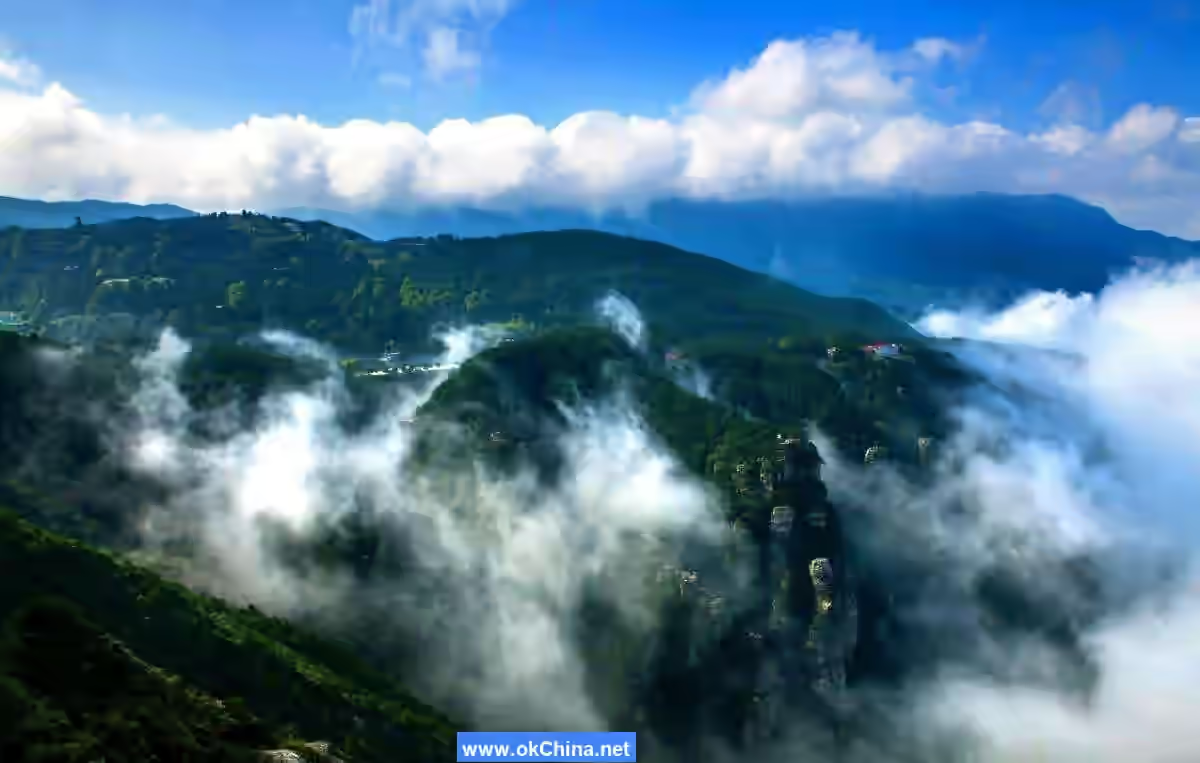
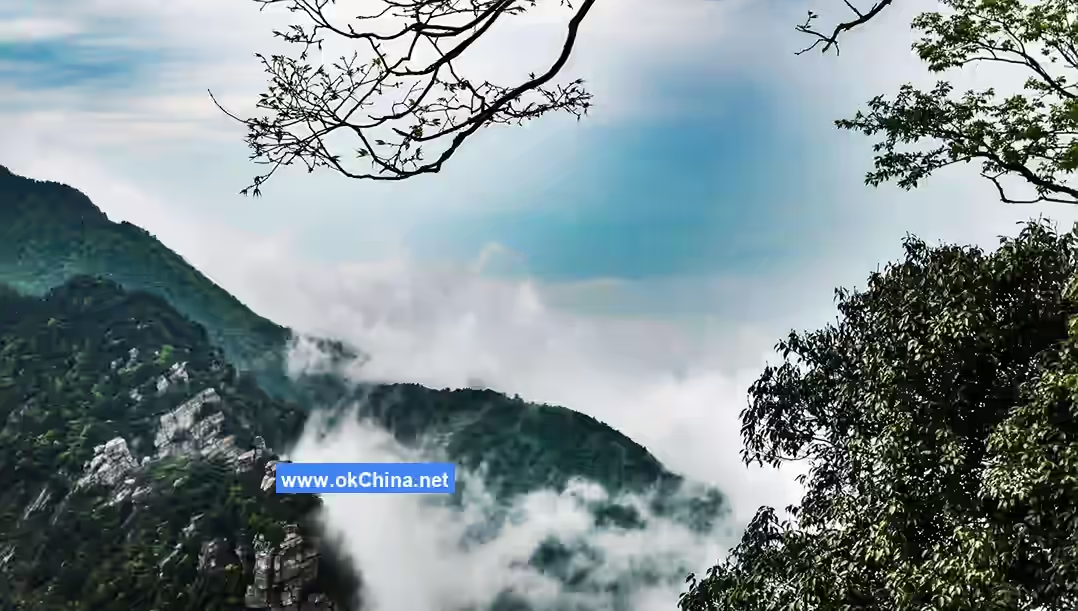
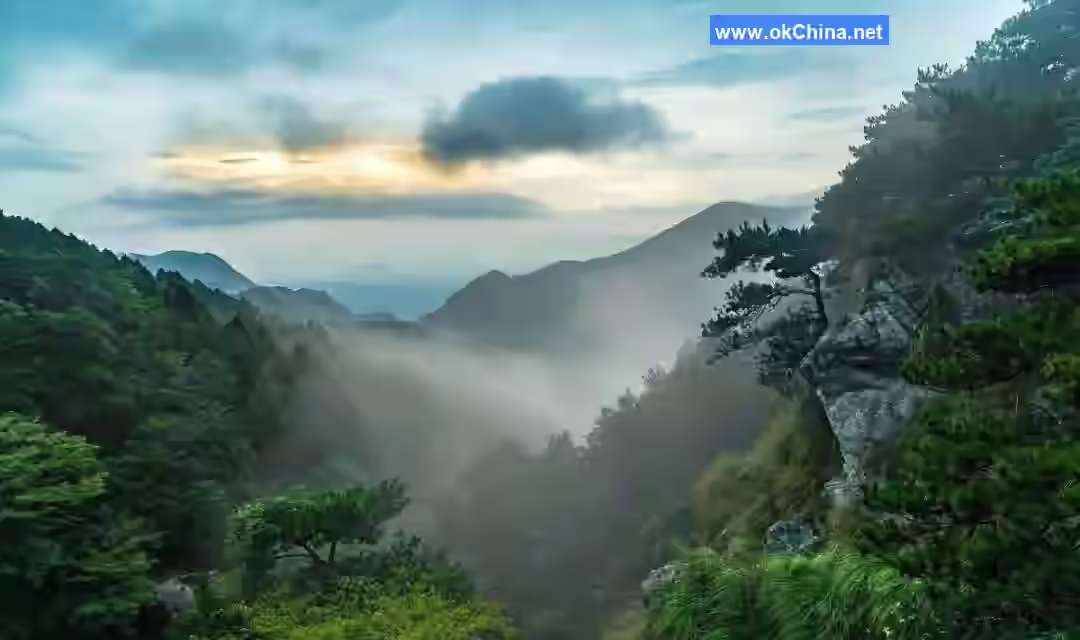
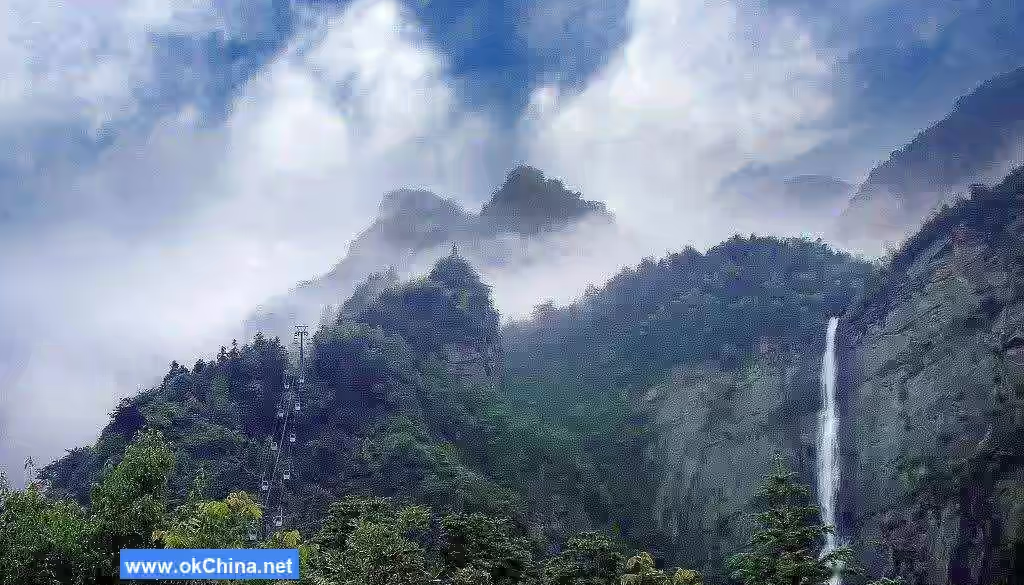
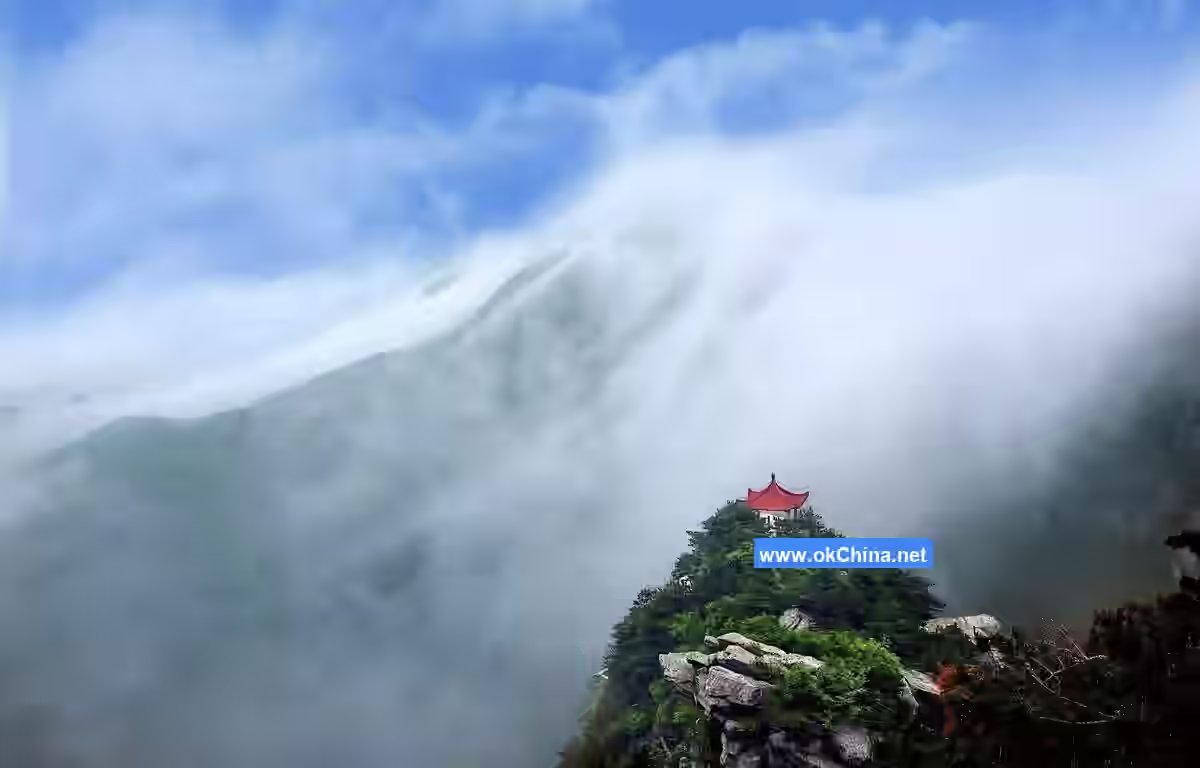
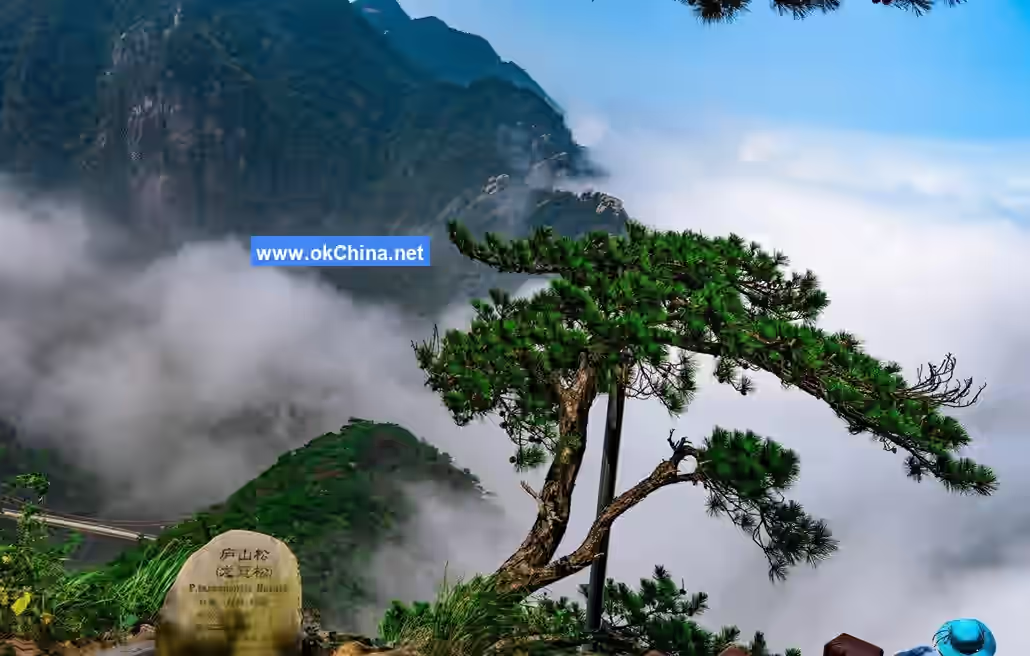
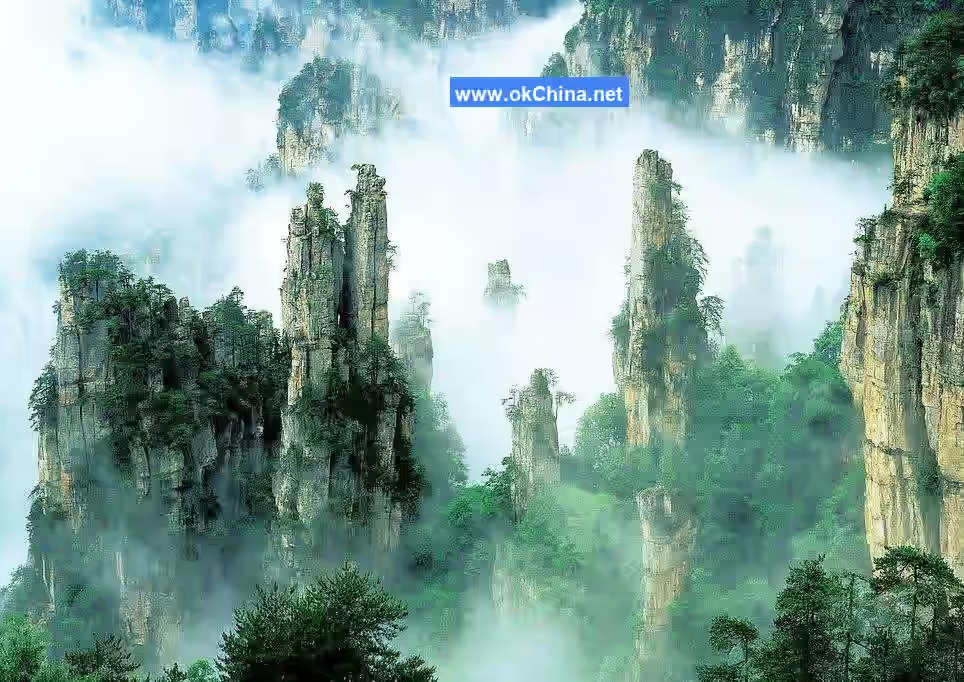
Due to its high altitude and surrounding rivers and lakes, moist air currents are blocked by the mountains, making it prone to cloud formation and rainfall. Consequently, Lushan receives abundant rainfall, with an annual average of 1,917 mm and an average of 168 rainy days per year. Lushan also experiences frequent fog, averaging 192 foggy days annually. Remarkably, the mist and clouds on Lushan constantly appear, disappear, and change unpredictably, adding to its enchanting scenery. Lushan's water sources mainly come from atmospheric precipitation. With abundant rainfall and over 90 peaks and ridges shaped by crustal movements and glacial erosion, some gorges naturally form steep cliffs and deep ravines, creating numerous waterfall beds. Coupled with perennial water sources, this results in many spectacular waterfalls, a unique feature of Lushan.
The peaks of Lushan are all above 1,000 meters, with the highest, Hanyang Peak, reaching 1,474 meters. Dense forests cover the mountain, surrounded by rivers and lakes below, and with frequent rainfall and high humidity, there is a significant temperature difference between the mountain top and base in summer. Every midsummer, the Poyang Lake basin can be scorching hot, with temperatures exceeding 39°C, while the average summer temperature on the mountain is only about 22.6°C, with morning and evening temperatures often between 15–20°C. In January 2024, the cold froze the waterfalls, creating a scene that matched the poetic line "hanging before the stream."
3.2 Hydrological Features
The valley water systems in the Lushan area form independent networks, each originating from Lushan and flowing into rivers and lakes. Wide valleys on the mountaintop are connected through river capture, with deeply incised V-shaped valleys often featuring waterfalls and cascades that transition into deep gorges on the mountain sides. Within the scenic area, dams are often built at captured bends to store water, forming lakes, and water supply and drainage systems are constructed to regulate water usage or generate supplementary electricity, while also enhancing water-based tourism.
3.3 Natural Resources
3.3.1 Geological Resources
Lushan has well-preserved outcrops of all three major rock types (sedimentary, igneous, and metamorphic), with igneous and metamorphic rocks being the most significant. Relics of Paleoproterozoic amphibolite-facies metamorphic rocks are widely distributed, with the epidote granulites at Laohutan Waterfall and Hongshanwa Waterfall being the most complete and fresh. The granulite relics at Lower Shuangjian Peak, Yulianquan Waterfall, Wolonggang Waterfall, and Drunken Stone are the most well-preserved and possess aesthetic value. There are also sillimanite schist, kyanite schist, and others.
Sedimentary rock relics with certain aesthetic value mainly include numerous purple-red jasper pebbles in conglomerates from the early Sinian period and purple-red reticulated limestone from the late Ordovician period.
3.3.2 Biological Resources
Lushan has 2,155 species of wild plants. Forty major plant species were first discovered on Lushan or named after Lushan (Guling). Lushan is rich in wildlife and rare animals. There are 33 known mammal species and 171 bird species. Poyang Lake at the foot of Lushan also hosts a world-famous migratory bird reserve. Rare animals like the leopard are distributed from the foothills to the mountaintop. Lushan has over 2,000 insect species, including many rare varieties and new species. Thirty-three insect species were first discovered on Lushan or named after Lushan (Guling). Poyang Lake has 139 fish species.
4. Main Attractions
4.1 Immortal Cave (Xianren Dong)
The Immortal Cave is located on the western slope of Tianchi Mountain in Lushan, also at the southern end of Jinxiu Valley, at an altitude of 1,031 meters. The cave is about 10 meters high and 10 meters deep, formed from sandstone cliffs, making it one of Lushan's famous attractions. Due to continuous natural weathering and long-term water erosion, it gradually formed a natural grotto. Because it resembles a Buddha's hand, it was originally called Buddha's Hand Rock. Legend has it that the famous Tang Dynasty Taoist Lü Dongbin cultivated himself in this cave until he achieved immortality. Later generations renamed Buddha's Hand Rock to Immortal Cave to honor Lü Dongbin. Under the overhang of Buddha's Hand Rock, a cave opens up, forming the Immortal Cave. The cave walls bear stone inscriptions like "Jade Liquid of the Cave Heaven," and a stone statue of Lü Dongbin is placed in the "Chunyang Hall" at the center. By the Qing Dynasty, Buddha's Hand Rock had become a Taoist blessed land and was renamed Immortal Cave. This is the subject of Mao Zedong's famous lines: "A natural Immortal Cave, infinite scenery lies on perilous peaks."
4.2 Shimenjian (Stone Gate Gorge)
Shimenjian is located on the western slope of Lushan in Jiujiang City, Jiangxi Province, at an altitude of 400 meters. The scenic area covers approximately 4 square kilometers with over a hundred scenic spots, traditionally known as the "West Gate of Lushan." It is named for the opposing peaks of Tianchi Mountain and Tiechuanfeng, which resemble a gate, and the waterfall within. The mountains on both sides of the gorge grow a variety of tropical, subtropical, and temperate plants, including photinia, wild tung, and tulip trees outside the gorge. Additionally, there are two thousand-year-old boxwood trees, considered a "botanical wonder of Lushan." Shimenjian combines grandeur, peril, wonder, and beauty, serving as a comprehensive showcase of geological changes, biological evolution, natural creation, and historical culture. It is the most typical representative of Lushan's Quaternary glacial relics and is praised as the "Supreme Beauty of Kuanglu" and "Absolute Victory of Landscape."
4.3 Sandiequan (Three-Step Waterfall)
Also known as Sanjiquan or Shuilianquan, Sandiequan is located at the lower part of Wulao Peak, covering a total area of 16.5 square kilometers at an altitude of 1,160 meters. The waterfall cascades down a three-tiered cliff with a total drop of 155 meters. Ancient people said, "Among Lushan's waterfalls, Sandiequan is foremost," praising it as the "Number One Wonder of Lushan." Sandiequan is formed by the convergence of stream water from Dayue Mountain and Wulao Peak. It flows from Dayue Mountain, passes behind Wulao Peak, pours from the northern cliff mouth onto a large flat rock, then plummets to a second large flat rock, and finally sprays onto a third flat rock, creating the three steps, hence its name. Among the three steps, the first is a straight vertical drop where water plunges from a height of over 20 meters; the second is curved, flowing directly into a pool.
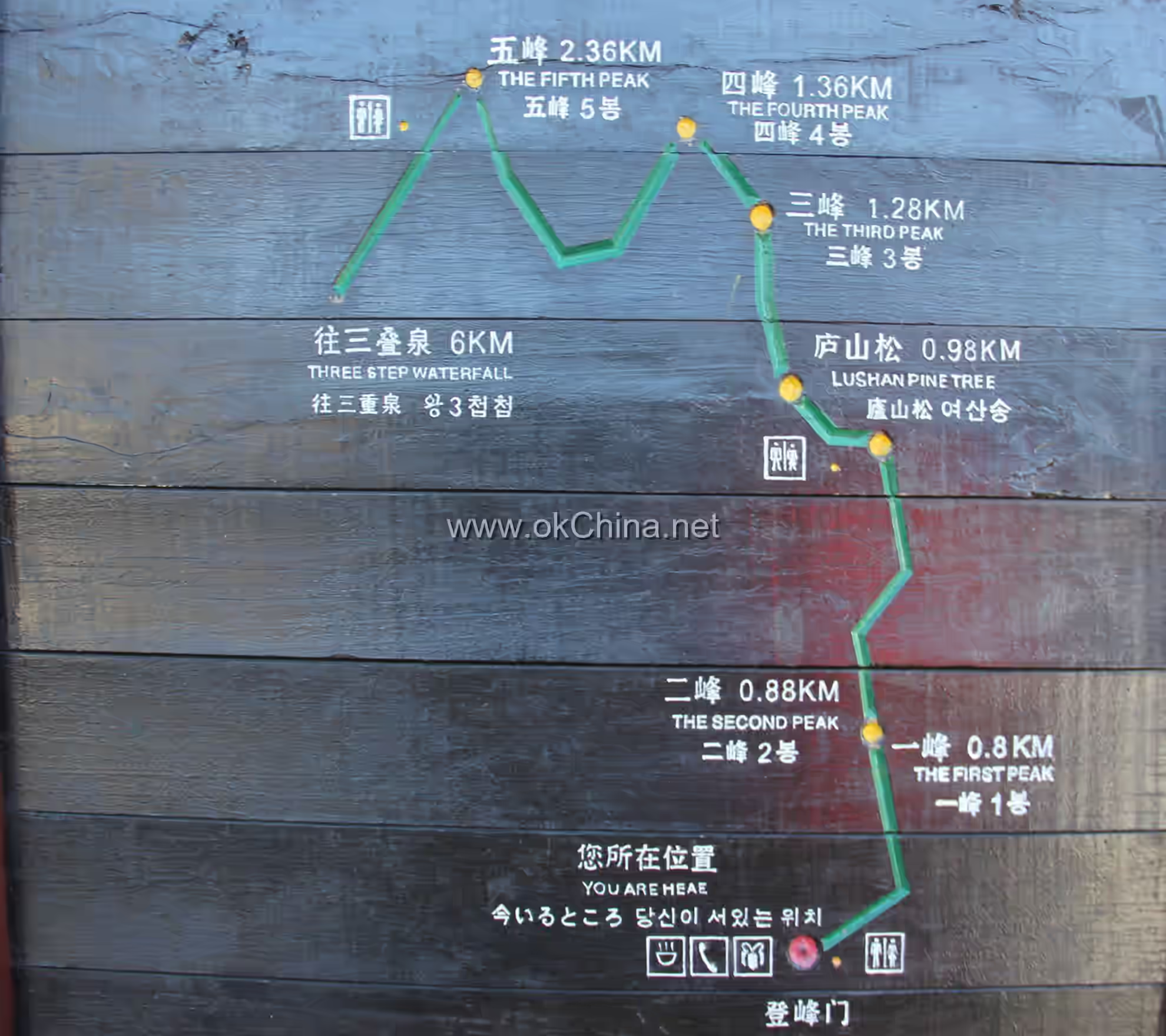
4.4 Wulao Feng (Five Old Men Peak)Wulao Peak is located in the southeast of Mount Lu in Jiujiang City, Jiangxi Province, with an altitude of 1,436 meters and a height of 194 meters. The summit of the mountain is broken by a col, dividing it into five adjacent peaks. When viewed from below, they resemble five elderly men sitting on the ground, which is why these five peaks, originally part of the same mountain, are collectively called "Wulao Peak." The peak connects to Poyang Lake at its base and reaches the sky at its summit, making it the most majestic and spectacular scenic spot on the mountain. Among the five peaks, the third is the steepest, featuring bizarre rocks and stones in various forms; the fourth is the highest, with cloud-piercing pines twisted like dragons at its summit. Below it are five smaller peaks: Lion Peak, Golden Seal Peak, Stone Ship Peak, Lingyun Peak, and Flagpole Peak. Further down are Guanyin Cliff and Lion Cliff, with Qinglian Temple nestled in the valley behind.
4.5 White Deer Cave Academy
White Deer Cave Academy is located at the southern foot of Wulao Peak on Mount Lu in Jiangxi. Together with Yuelu Academy in Changsha, Hunan, Yingtian Academy in Shangqiu, Henan, and Songyang Academy in Dengfeng, Henan, it is known as one of the "Four Great Academies of China." Legend has it that the academy's founder can be traced back to Li Bo of the Southern Tang Dynasty. Li Bo kept a white deer that followed him all day, earning him the nickname "White Deer Gentleman." Later, when Li Bo served as the governor of Jiangzhou (present-day Jiujiang), he revisited the area and built pavilions, terraces, and towers, channeled mountain springs, and planted flowers and trees, turning it into a scenic attraction. Because the surrounding peaks encircle the area like a cave, it was named White Deer Cave. In terms of layout, the academy faces south, featuring a large courtyard-style compound with multiple sections, meticulously arranged. Structurally, it is built with stone, wood, or brick and wood, primarily in the architectural styles of the Ming and Qing dynasties. The roofs are gabled with hard ridges, exuding an elegant and serene atmosphere.
4.6 Donglin Temple
Donglin Temple is located at the western foot of Mount Lu in Jiujiang City, Jiangxi Province, 16 kilometers north of Jiujiang City and 50 kilometers east of Guling Street on Mount Lu. It is named Donglin Temple because it lies east of Xilin Temple. Founded in 386 AD by the renowned monk Huiyuan of the Eastern Jin Dynasty, Donglin Temple is one of the oldest temples on Mount Lu. During the Han and Tang dynasties, it became one of the eight major Buddhist sites in China, housing structures such as the Heavenly King Hall, Three Saints Hall, and Mahavira Hall. Donglin Temple is the birthplace of the Pure Land School of Buddhism (also known as the Lotus School) and is regarded as the ancestral temple by the Japanese Pure Land School and True Pure Land School. The Tang Dynasty monk Jianzhen visited here and introduced Donglin teachings to Japan. To this day, Japanese Donglin Buddhism still reveres Huiyuan as its founder. The temple's halls and scenic spots, such as the Clever Spring, have been restored. In 1983, it was designated by the State Council as a nationally key Buddhist temple in Han Chinese regions, a famous national Buddhist site, and one of the three major international exchange sites in Jiangxi Province.
4.7 Brocade Valley
Brocade Valley stretches from Tianqiao along the stone steps on the left to Immortal Cave, covering a distance of about 1.5 kilometers at an altitude of 1,102 meters. It is a famous scenic spot newly developed on Mount Lu in 1980. Legend has it that this was where Huiyuan, a renowned monk of the Eastern Jin Dynasty, gathered flowers and herbs. The valley blooms with flowers all year round, resembling brocade, hence its name. The Northern Song Dynasty writer Wang Anshi wrote in a poem: "Returning home with a smile at dawn, I become the host of this famous mountain. By chance, I venture to the five lakes in high spirits, invited to enjoy spring in Brocade Valley." It is said to have been composed spontaneously during his visit.
4.8 Flower Path
Flower Path Park is located by Rugin Lake, 2 kilometers southwest of Guling Street. Accessible by road, visitors can walk along Dalin Road and see glacial relics along the way—a massive glacial boulder known as the "Flying Stone." Flower Path is traditionally believed to be the place where the Tang Dynasty poet Bai Juyi composed his poem "Peach Blossoms at Dalin Temple." When Bai Juyi was demoted and served as the military advisor of Jiangzhou (Jiujiang), he visited Mount Lu in 816 AD. It was late spring, and while peach blossoms had already fallen at the foot of the mountain, they were in full bloom here. Moved by the sight, Bai Juyi wrote: "In April, all flowers fade in the mortal world, but peach blossoms at the mountain temple begin to bloom. I often regret spring's departure with nowhere to find it, not knowing it has turned and come here."
4.9 Xiufeng
Xiufeng is located at the southern foot of Mount Lu, with an altitude of 53 meters. It is the collective name for peaks such as Incense Burner Peak, Twin Sword Peak, Manjusri Peak, Crane Cry Peak, Lion Peak, Turtle Back Peak, and Sister Peaks. At the foot of Crane Cry Peak once stood Xiufeng Temple, one of the "Five Great Monasteries of Mount Lu." Originally named Kaixian Temple, it was later renamed Xiufeng Temple after Emperor Kangxi inscribed its name. Within Xiufeng, there are scenic spots such as "Shuyu Pavilion," "Jade Gorge," "Dragon Pool," "Waterfall," "Waterfall Viewing Pavilion," and "Sunshine Pavilion," along with many historical relics left by famous figures. The renowned Kaixian Waterfall was praised by the great Tang Dynasty poet Li Bai: "Sunlight streaming on Incense Burner kindles violet smoke; far off I watch the waterfall plunge to the long river, flying waters descending straight three thousand feet, till I think the Milky Way has tumbled from the ninth height of Heaven."
4.10 Bilongtan Waterfall
Mount Lu has many waterfalls with names containing the character "dragon," such as "Sleeping Dragon Pool," "Divine Dragon Pool," "Black Dragon Pool," and "Yellow Dragon Pool." About 10 li from Guling on Mount Lu, deep within layered cliffs and secluded forests, lies a massive pool known as "Bilongtan Waterfall," also called Wangjiapo Waterfall. This waterfall was discovered by a woodcutter in the early 1920s, after which tourists flocked to see it, regarding it as a supreme wonder on the northern side of the mountain. Its water originates from the northern foot of Suozi Ridge, winding through layered rocks and stones. Before flowing into Bilongtan, it divides into three tiers of cascading waterfalls, each splitting into two white, ribbon-like streams, extending for dozens of meters. A "Waterfall Viewing Pavilion" stands beside the pool, and a large horizontal rock in the pool offers a view of Poyang Lake to the east.
4.11 Three Precious Trees
About 300 meters up the forest stone steps from Huanglong Pool lie the Three Precious Trees, at an altitude of 1,027 meters. Three towering ancient trees stand tall—two are cryptomeria, over 600 years old, and one is a ginkgo tree, 1,600 years old. Their trunks are so large that several people cannot encircle them, and they resemble pagodas. Legend has it that these are thousand-year-old ancient trees. A stone tablet at their base bears the inscription "Handwritten by Monk Tan Shen of the Jin Dynasty." The trees are now under key protection.
4.12 Meilu Villa
Meilu Villa is located at No. 180 Hedong Road, Lushan District, Jiujiang City, Jiangxi Province. "Meilu" once served as Chiang Kai-shek's summer capital residence and "Chairman's Field Headquarters," and was the "beautiful house" where the "First Lady" lived. The villa, shaded by greenery, is built with stone and wood. The main building has two floors, and the annex has one floor, covering an area of 455 square meters with a floor area of 996 square meters. The entire Meilu garden covers 4,928 square meters, with the building occupying less than 10% of the area, making the garden particularly spacious and clean. The main building feels neither clumsy nor frail, creating a harmonious beauty.
4.13 Lulin Lake
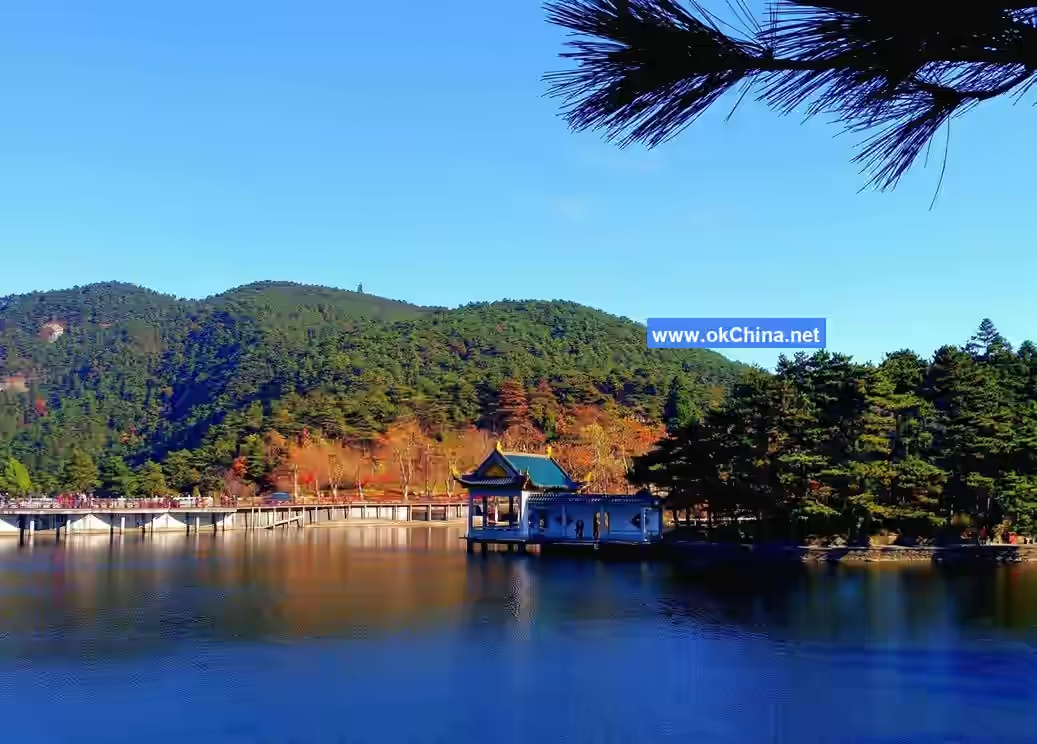
Lulin Lake is at an altitude of 48 meters, and Lulin Bridge stands 30 meters high, integrating the bridge and dam to form the lake. From Huanglong Temple, it takes about 20 minutes to walk up the winding stone steps to Lulin Bridge. Two to three million years ago, during the Quaternary glacial period, Mount Lu was a typical ice cellar, and this area was the largest valley for accumulating ice and snow on the mountain. In 1954, a dam was built here to store water, creating a flat lake in the high gorge. Comrade Mao Zedong swam in the lake multiple times.
4.14 White Deer Cave Academy
White Deer Cave Academy is located southeast of Wulao Peak, covering a mountainous area of 3,000 mu and a floor area of 3,800 square meters. It is a nationally key cultural relic protection unit in China. The academy "began in the Tang Dynasty, flourished in the Song Dynasty, and continued through the Ming and Qing dynasties," with a history of over 1,000 years. During the Zhenyuan period of the Tang Dynasty (785–805 AD), Li Bo secluded himself here to study, keeping a white deer for amusement, earning him the nickname "White Deer Gentleman." During the Changqing period (821–943 AD), when Li Bo served as the governor of Jiangzhou (present-day Jiujiang), he built terraces and pavilions at White Deer, planted flowers and trees, and established the academy. The existing architectural complex of White Deer Cave Academy is arranged in a series along Guandao Stream from west to east, consisting of the academy gate tower, Ziyang Academy, White Deer Academy, and Yanbin Hall. All buildings face south, constructed with stone, wood, or brick and wood, featuring gabled roofs with hard ridges, exuding an elegant and serene atmosphere.
5. History and Culture
5.1 Culture
Mount Lu, described as "majestic, elegant, and outstanding in the southeast," has long been favored by numerous writers and artists. It has served as a retreat for hermits, renowned monks, and Taoist masters, as well as a stage for politicians and celebrities, imbuing the mountain with rich cultural significance and profound cultural depth.
The landscape culture of Mount Lu is a brilliant reflection and historical epitome of Chinese landscape culture. The nature of Mount Lu is poetic and "humanized." Since the Eastern Jin Dynasty, poets have composed over 4,000 poems, songs, and odes about Mount Lu with their passionate enthusiasm and exquisite writing. Poems such as "Climbing the Summit of Mount Lu and Gazing at the Peaks" by Xie Lingyun of the Eastern Jin Dynasty and "Gazing at Stone Gate" by Bao Zhao of the Southern Dynasty are among the earliest Chinese landscape poems, making Mount Lu one of the birthplaces of Chinese landscape poetry. The poet Tao Yuanming created works throughout his life with Mount Lu as the backdrop, and the pastoral style he pioneered influenced the entire Chinese poetry scene after him. The Tang Dynasty poet Li Bai visited Mount Lu five times, leaving behind 14 poems, including "Sending a Message to Censor Lu Xuzhou from Mount Lu." His "Gazing at the Waterfall of Mount Lu" flows eternally alongside the waterfall, becoming a household masterpiece in China and among overseas Chinese communities. The Song Dynasty poet Su Shi's "Inscribed on the Wall of West Forest Temple" is widely circulated and profoundly influential, with the lines "I cannot tell the true shape of Lu Mountain because I myself am in the mountain" becoming a famous phrase full of dialectical philosophy. Landscape culture is the spiritual achievement created by people using natural landscapes as material. It is an important part of traditional Chinese culture, a magnificent realm carved out by the Chinese nation in the process of understanding and transforming the objective world and themselves, and a vital spiritual pillar in shaping the image of the Chinese nation.Mount Lu's landscape is a comprehensive entity that relies on its natural scenery and is permeated with cultural elements. Through the contemplative eyes of poets, calligraphers, painters, writers, and philosophers, Mount Lu has given rise to numerous historical sites exuding a particularly rich cultural atmosphere. As a Singaporean scholar once remarked, "If the historical landscape of Mount Tai was created by emperors, then the historical landscape of Mount Lu was created by literati."
Tao Yuanming, using the Kangwang Valley of Mount Lu as a cultural backdrop, wrote The Peach Blossom Spring, which radiates the brilliance of a utopian idealism. The Two Maidens of Mount Lu from the Southern Dynasties, set against the backdrop of Mount Lu, became a renowned early Chinese tale of the strange and supernatural. The Tang Dynasty poet Bai Juyi's poem Peach Blossoms at the Great Forest Temple gave rise to a famous scenic spot—the Flower Path. He also built the "Thatched Cottage on Mount Lu," and his Record of the Thatched Cottage on Mount Lu is a masterpiece documenting ancient Chinese landscape gardens. The Song Dynasty Neo-Confucian scholar Zhu Xi revived the White Deer Grotto Academy, elevating it to the foremost of China's four great ancient academies. Here, Song-Ming Neo-Confucianism was cultivated for generations, faithfully recording the process and history of this profoundly characteristic cultural phenomenon. The Regulations of the White Deer Grotto Academy established by Zhu Xi became the standard and norm for feudal education in China, also influencing the course of Chinese historical culture.
Landscape poetry and landscape painting are two magnificent achievements in Chinese landscape culture. Landscape poetry flourished brilliantly on Mount Lu, and landscape painting also showcased its elegance there, radiating dazzling brilliance. The Painting of Mount Lu created by the Eastern Jin painter Gu Kaizhi became the first independent landscape painting in the history of Chinese art. From then on, master painters of successive dynasties used Mount Lu as a medium, expressing its aesthetic realm through this art form. The first theoretical breakthrough in Chinese painting was also Gu Kaizhi's "theory of conveying spirit," which, however, was influenced by the philosophical idea of "the form perishes but the spirit does not vanish," expounded by the eminent Eastern Jin monk Huiyuan on Mount Lu. Zong Bing, one of the "Eighteen Eminent Virtuous Ones" of the Lotus Society at Donglin Temple on Mount Lu, wrote Preface to Painting Landscapes, which became the first true treatise on Chinese landscape painting. His exposition of the "theory of refreshing the spirit" through landscapes broke the aesthetic view of "the gentleman's virtue lies herein," heralding the rise of a new aesthetic trend.
Literati and artists expressed their emotions and ideas about Mount Lu with rich and vivid strokes, endowing it with a profound cultural heritage. Scientists conducted scientific explorations of Mount Lu, revealing the true essence of its beauty. The modern geologist Li Siguang, focusing on the Quaternary geology and landforms of Mount Lu, published a series of research works, including Mount Lu During the Ice Age, thereby pioneering the theory of Quaternary glaciation. This, in turn, sparked academic debates among Chinese and foreign scholars regarding the Quaternary glaciation of Mount Lu, composing a century-long symphony of Chinese Quaternary geology.
5.2 Religion
In the vast land of our motherland, when speaking of the four famous Buddhist mountains, almost everyone knows them. However, the religious culture of Mount Lu, a World Cultural Heritage site, is even more captivating. The uniqueness of Mount Lu's religious culture lies in the fact that "six religions are housed within one mountain, a phenomenon unmatched anywhere else in the world." In this mist-shrouded spiritual mountain, Buddhism and Taoism progressed from rivalry to mutual encouragement. In this ethereal mountain of immortals, four highly resilient "cultural seeds"—Christianity (Protestantism), Catholicism, Eastern Orthodoxy, and Islam—were transplanted. They took root, sprouted, and grew robustly on Mount Lu, transforming it into a gathering place for religions and a Garden of Eden for deities. The distinctive position of religious culture within Mount Lu's culture is extremely prominent.
When discussing Mount Lu's religious culture, the most notable Buddhist site is undoubtedly Donglin Temple. Founded in the 11th year of the Taiyuan era of the Eastern Jin Dynasty (386 AD) with funding from Huan Yi, the Inspector of Jiangzhou, and built by Huiyuan, this temple was once one of the eight major Buddhist centers in China and briefly became the second most important Buddhist center nationwide. The temple houses precious cultural relics such as the "Tang Dynasty Sutra Pillar," "Guardian Deva Warriors," "Fragmentary Stele of Liu Gongquan at Donglin Temple," "Fragmentary Stele of Li Beihai at Donglin Temple," and "Stele of Wang Yangming's Visit to Donglin Temple." Throughout history, numerous poets and scholars, including Tao Yuanming, Li Bai, Bai Juyi, Liu Gongquan, Su Shi, Huang Tingjian, Yue Fei, Lu You, and Kang Youwei, have visited Donglin Temple, leaving behind many precious calligraphic works and poems, making it the crown jewel of Buddhist monasteries in Jiangxi. This led to a prosperous period for Buddhism on Mount Lu, characterized by "enduring bell tolls and curling incense smoke."
Just as Buddhism was flourishing on Mount Lu, the renowned Taoist master Lu Xiujing of the Southern Dynasties also came to establish a Taoist center there, leading to the rapid development of Taoism on Mount Lu. This also marked the beginning of a period of coexistence and mutual flourishing for Buddhism and Taoism on the mountain. Speaking of the blessed caves and heavens of Taoism on Mount Lu, the Immortal's Cave is paramount. In fact, the Immortal's Cave is merely a rock cave formed from sandstone, gradually shaped by natural weathering and long-term water erosion. It is not only a scenic spot beloved by visitors throughout history but also a blessed cave and heaven of Taoism. Legend has it that the famous Tang Dynasty Taoist Lü Dongbin cultivated himself in this cave until he achieved immortality. Later generations renamed the cave "Immortal's Cave" to honor him. Inside the cave is a stone pavilion—the Chunyang Hall—flanked by two couplets: "Called both master and ancestor, he is Taoist yet also Confucian" and "An ancient cave of a thousand years, spiritually extraordinary; the immortal who was drunk three times at Yueyang." Beside the cave, under the verdant cliffs, a pavilion with painted bracket sets and soaring eaves was built against the mountain and overlooking the ravine, named the Laojun Hall. The hall is a single-story building with a hip-and-gable roof, appearing both solemn and elegant. Inside, it houses a statue of the Supreme Elder Lord Laozi (Li Dan) riding an ox.
Historically, Mount Lu had 360 temples and over 200 Taoist monasteries, making it a religious center in southern China. While Buddhism and Taoism were vying for supremacy on Mount Lu, with Jiujiang being forcibly opened as a treaty port in 1858, foreigners were allowed to travel inland, conduct trade, and preach freely, opening the door for foreign missionaries to enter Jiujiang. The Methodist Episcopal Church, the American Board of Commissioners for Foreign Missions, and the Anglican Church, all Christian denominations, began arriving in China in the early 19th century and ascended to Guling on Mount Lu in 1886. The pioneer was a missionary named Edward Selby Little from Kent, England. Having just arrived in China in 1886 and residing in Hankou at the time, Little heard that religious groups in Hankou were involved with Mount Lu. Using money and privileges granted by unequal treaties, he seized the Changchong area of Mount Lu, initiating the development of Guling and missionary activities. Between 1895 and 1920, the Christian forces led by Little became rampant and widespread. On Mount Lu alone, there were 13 churches and 16 Christian denominations. Every summer, Christian missionaries would gather on Mount Lu, often numbering in the hundreds. These church organizations held discussions, ran training sessions, deliberated church matters, propagated religious doctrines, and established schools, hospitals, and charitable institutions, extending the reach of religion to every corner of Mount Lu.
When the Christian forces led by Little began developing Guling, Catholic and Eastern Orthodox forces also followed closely behind, quick to act. In the 23rd year of the Guangxu reign (1897), the Russian Eastern Orthodox priest Nisa illicitly purchased land in the Lulin area of Mount Lu, later subleasing the Xingzhou area. Thus, the Russian Eastern Orthodox Church freely proceeded with "building and all arrangements" in the leased Xingzhou area. According to The Chronicles of Mount Lu, "The Russian Eastern Orthodox Church has historically encroached upon much land beyond its boundaries." Eastern Orthodox influence on Mount Lu became quite prominent for a time. After the victory of the Russian October Revolution in 1917, the Soviet government repeatedly pressured the Beiyang warlord government, leading to the signing of the Agreement on General Principles for the Settlement of the Questions between China and the Soviet Union on May 31, 1924. From then on, Tsarist Russian influence in China vanished, and Eastern Orthodox influence on Mount Lu dissipated.
Seeing the British and Russian religious forces swarming the mountain, French missionaries also grew impatient and intensified their infiltration. In September 1914, Fan Ti'ai, then overseeing six prefectures and five religions in northern Jiangxi, signed a lease, forcibly renting land on Mount Lu and acquiring 77 mu of new land, which became the base for Catholic expansion on Mount Lu led by Fan Ti'ai. During this period, there were many Catholic church organizations on the mountain, including nine denominations such as the Seventh-day Adventists, the Methodist Church, the London Missionary Society, and the Yale Foreign Missionary Society. Using the leased land as their camp and churches as centers, they coordinated with Christian and Eastern Orthodox forces, engaging in extensive activities. At this time, the specters of foreign religious forces roamed everywhere on Mount Lu.
In contrast to the dominance of Western religious forces on Mount Lu, Islam arrived quietly and remained relatively obscure. In 1925, a small number of Muslims built the only sanctuary for their religious activities on Mount Lu—a mosque. Its influence was weak and insignificant, overshadowed by the numerous churches. The long-established Buddhism and Taoism on Mount Lu also lost ground under the impact and exclusion of Western religious forces, declining like the setting sun, their former glory fading.
Times change, and stars shift. Whether it is Buddhism and Taoism, which have experienced prosperity and decline, or Christianity, Catholicism, Eastern Orthodoxy, and Islam, which介入庐山 in modern times, all now exhibit a new vitality and vigor in a fresh posture. The diverse religious architectures, the multitude of religious followers, the curling incense smoke, and the clear, pleasing Buddhist chants constitute the mysterious and captivating religious world of Mount Lu. One mountain encompassing six religions presents a brilliant scenic line on Mount Lu and a subject of perpetual inquiry, thus attracting the attention of religious figures both domestically and internationally. As a uniquely characteristic religious site in China, the Mount Lu Scenic Area Administration spares no effort in building the brand of "Famous Religious Mountain," actively integrating religious culture with tourism, and developing distinctive religious cultural tours. Religious sites such as Donglin Temple, Xilin Temple, Huanglong Temple, Nonna Pagoda Monastery, Immortal's Cave Taoist Temple, Christian churches, Catholic churches, and the mosque present a series of mysterious, profound, and mottled landscapes for pilgrims and tourists from home and abroad visiting the mountain.
In recent years, religious cultural tourism has been burgeoning on Mount Lu. The number of religious figures visiting the mountain for specialized religious tourism increases yearly. Mount Lu, the famous religious mountain where "six religions gather on one mountain," attracts domestic and international tourists with its unique charm.
5.3 ProseMount Lu's landscape culture is a brilliant reflection and historical epitome of China's landscape culture. The nature of Mount Lu is poeticized and also "humanized." Since the Eastern Jin Dynasty, poets have composed over 4,000 poems and verses celebrating Mount Lu with their heroic passion and masterful writing. Works such as "Ascending the Summit of Mount Lu and Gazing at the Peaks" by Xie Lingyun of the Eastern Jin Dynasty and "Gazing at Stone Gate" by Bao Zhao of the Southern Dynasties are among China's earliest landscape poems, making Mount Lu one of the birthplaces of Chinese landscape poetry. The poet Tao Yuanming created works throughout his life with Mount Lu as the backdrop, and the pastoral poetic style he pioneered influenced the entire Chinese poetry scene after him. The Tang Dynasty poet Li Bai visited Mount Lu five times, leaving behind 14 poems, including "Sending a Message to Imperial Censor Lu Xuzhou from Afar on Mount Lu." His "Gazing at the Waterfall on Mount Lu" flows eternally alongside the waterfall of Mount Lu, becoming a household name across China and among overseas Chinese communities and a masterpiece of ancient Chinese poetry. The Song Dynasty poet Su Shi's "Inscribed on the Wall of West Forest Temple" is widely circulated and profoundly influential, with the lines "I cannot tell the true face of Mount Lu, because I myself am in the mountain" becoming a famous phrase full of dialectical philosophy.
The scenery of Mount Lu is a comprehensive entity based on its landscape, permeated with cultural and historical sites. Through the perspectives of poets, calligraphers, painters, writers, and philosophers, Mount Lu has given rise to numerous historical relics exuding a particularly rich cultural atmosphere. As commented by a Singaporean scholar, "If the historical landscape of Mount Tai was created by emperors, the historical landscape of Mount Lu was created by literati."
5.4 Academy
Located at the foot of the Five Old Peaks in the southeast of Mount Lu, 30 kilometers from downtown Jiujiang, the area boasts 3,000 mu of dense primeval forest and 5,000 square meters of ancient architectural space. Surrounded by mountains and water, serene and secluded, with two mountains flanking the banks and a stream flowing through, the terrain is high on all sides and low in the middle, resembling a cave when viewed from above. It is praised as having "the beauty of springs and rocks, without the noise of the marketplace." Designated as a national key cultural relic protection unit in 1988, it belongs to a national first-level natural protection area. It is a major scenic spot of Mount Lu's "World Cultural Landscape," an important window for the external promotion of Jiangxi Province's ancient culture, and an ideal destination for tourism, sightseeing, leisure, and vacationing, receiving 80,000 domestic and international visitors annually.
During the Zhenyuan era of the Tang Dynasty, scholars Li Bo and his elder brother Li She from Luoyang, Henan, retreated here to study in seclusion. Li Bo kept a white deer for amusement, which followed him wherever he went, earning him the nickname "Mr. White Deer." During the Changqing era, Li Bo, recommended by the great literary figure Han Yu, served as the prefect of Jiangzhou (present-day Jiujiang). He planted flowers and trees extensively in the cave and built pavilions and terraces, turning it into a gathering place for literati to lecture, compose, and recite poetry. During the Shengyuan era of the Southern Tang Dynasty (940 AD), the court established the "Mount Lu National Academy" here, making it as renowned as the "Imperial Academy" in Jinling (present-day Nanjing), with a history of over 1,060 years. At the beginning of the Northern Song Dynasty, local gentry in Jiangzhou built an academy in the cave, marking the origin of the name "White Deer Cave Academy." It became one of the "Four Great Academies" of China, alongside Yuelu, Songyang, and Suiyang. In the sixth year of the Chunxi era of the Southern Song Dynasty (1179), the renowned thinker and educator Zhu Xi served as the prefect of Nankang and comprehensively revived the White Deer Cave Academy, making it a model for later academies. The "White Deer Cave Academy Guidelines" he established were revered as a standard by later generations, with influence extending both domestically and internationally. During the Yuan, Ming, and Qing dynasties, the academy was repeatedly destroyed and rebuilt, enduring through the ages. At its peak, it housed over a thousand students and more than 360 rooms. For thousands of years, the White Deer Cave Academy has made significant contributions to cultural dissemination, educational development, and talent cultivation, earning the titles "Foremost Academy Under Heaven" and "Number One Academy in the Land."
5.5 Architecture
The villa gardens of Mount Lu originated in the second half of the 19th century. Built in European and American folk architectural styles, the villas are nestled against the mountains, beside secluded valleys, along streams, and near cliffs, embodying emotional depth and aesthetic brilliance.
The East Valley resembles a villa exhibition, preserving villas in over twenty different styles from countries such as the United States, Britain, France, Germany, Russia, Finland, the Netherlands, Austria, and Italy. During the Republican era, many civilian and military officials also built villas of various styles on Mount Lu, among which the "Meilu" villa of Chiang Kai-shek and his wife is the most distinctive. These uniquely styled buildings retain their original charm to this day.
The beauty of Mount Lu's villas is primarily reflected in their integration with nature, exquisite and elegant designs, and diverse styles. Influenced by Western aesthetic trends, the villas bear a distinctive cultural imprint. They feature British arched corridor architectural elements, Baroque-style imitations, eclectic architectural products, and Gothic architectural remnants. Through romanticist representation techniques, one can also discern the aesthetic appeal of Chinese garden architecture.
The villas in the East Valley are closely associated with modern and contemporary Chinese and foreign celebrities, with nearly every villa having a captivating story. Stepping into the villa gardens, one can experience a strong sense of exotic charm. Villas such as Meilu, the original Scherman Villa, and the original Williams Villa have been designated as national cultural relic protection units. Among China's famous mountains, only Mount Lu boasts such a large-scale "global village."
Comments
Post a Comment