Luofu Mountain in Huizhou City
1. Introduction
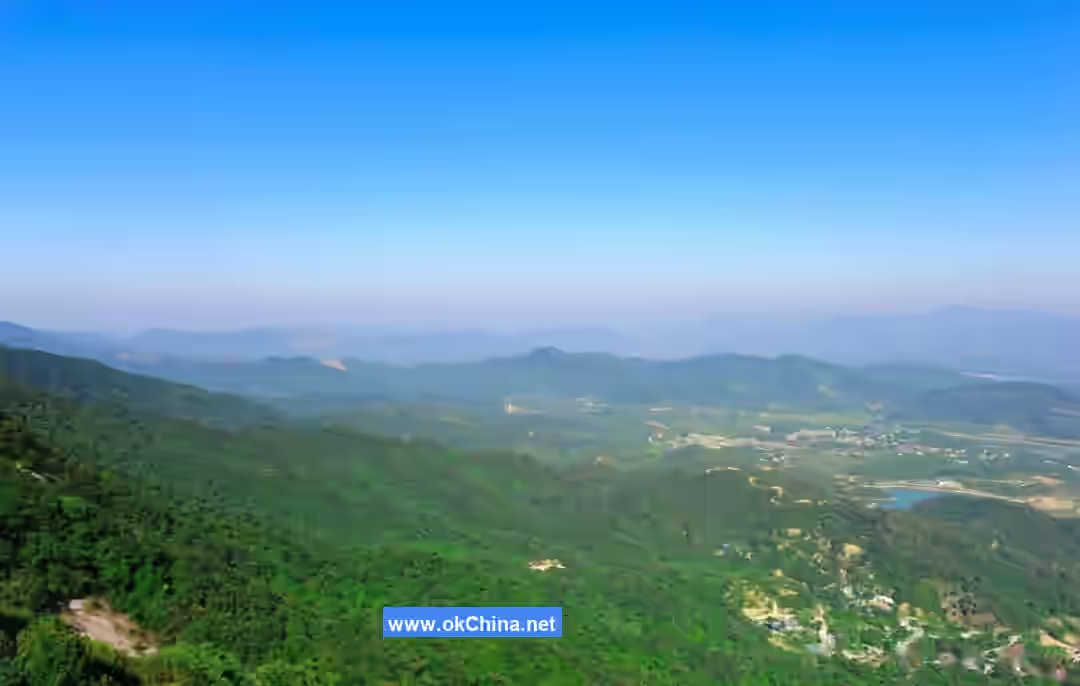
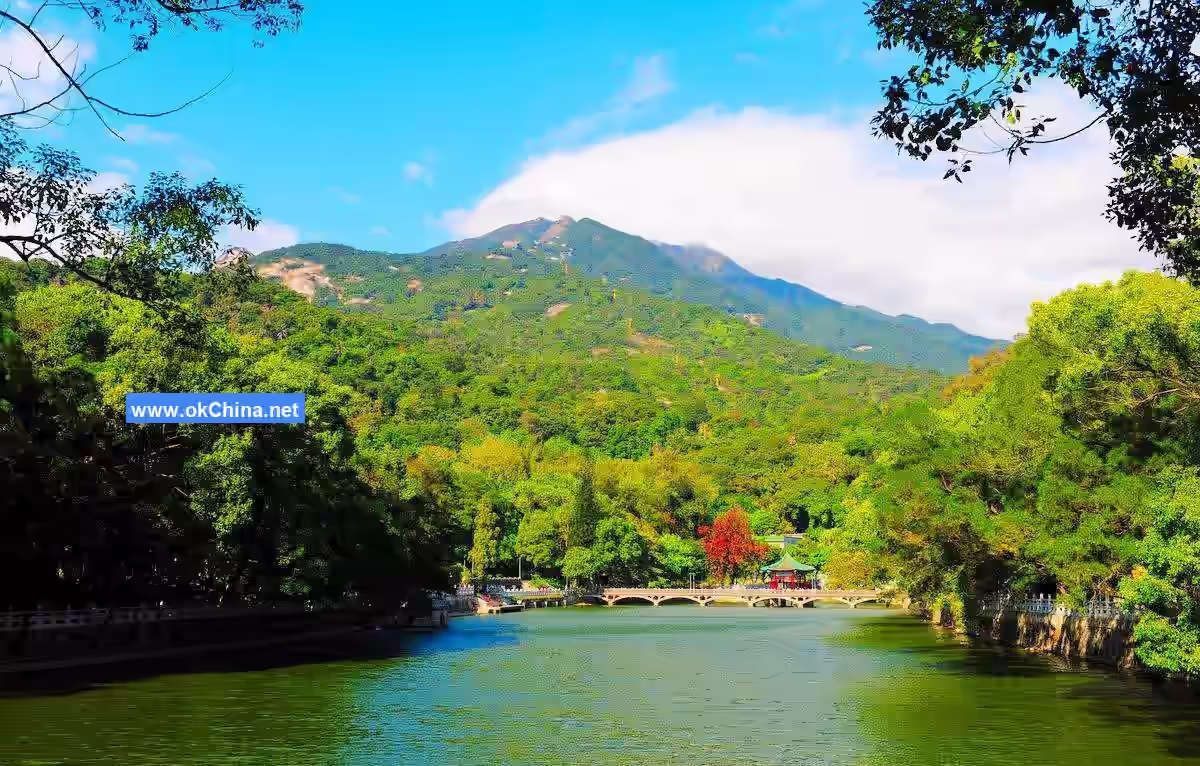
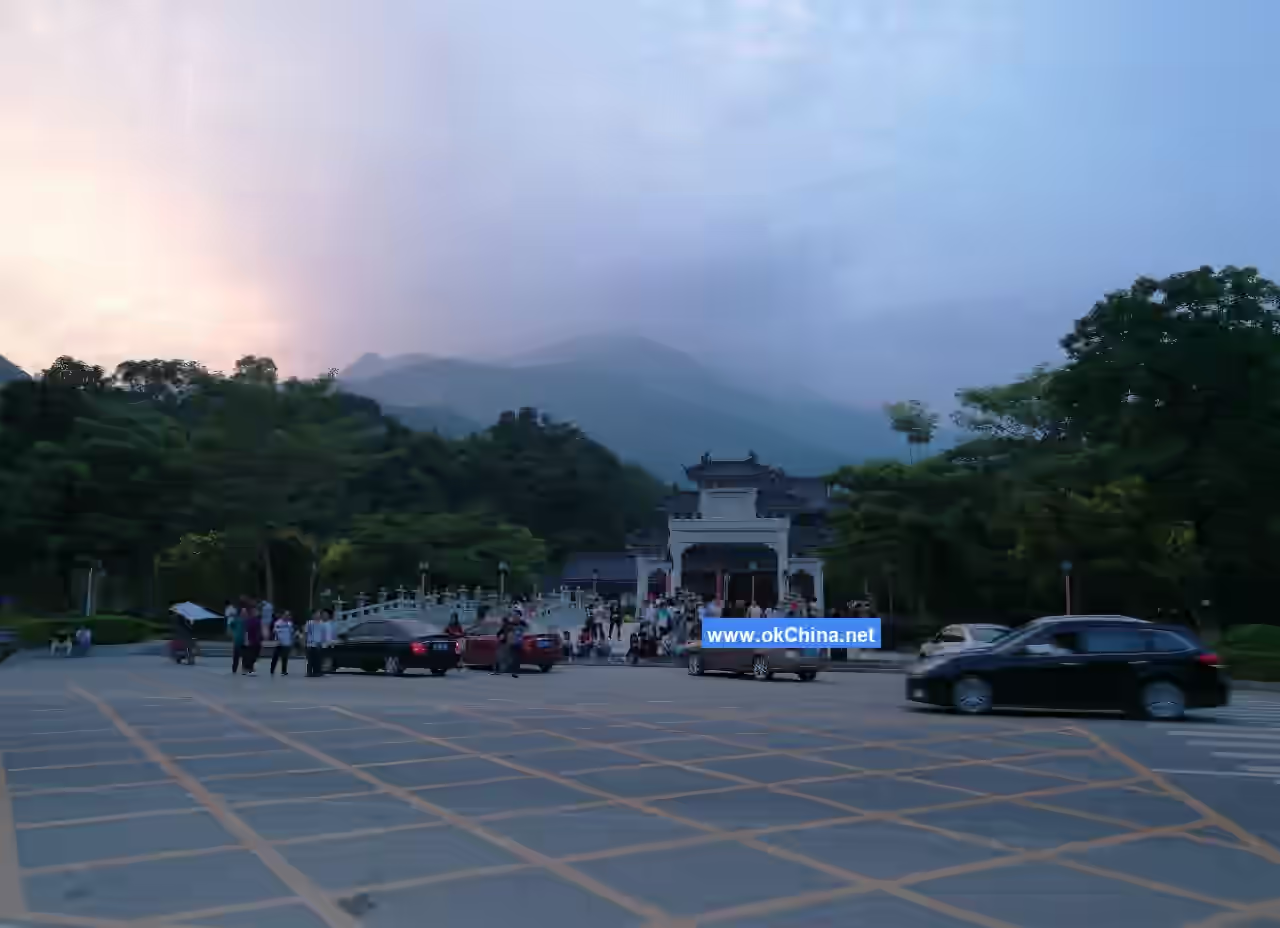
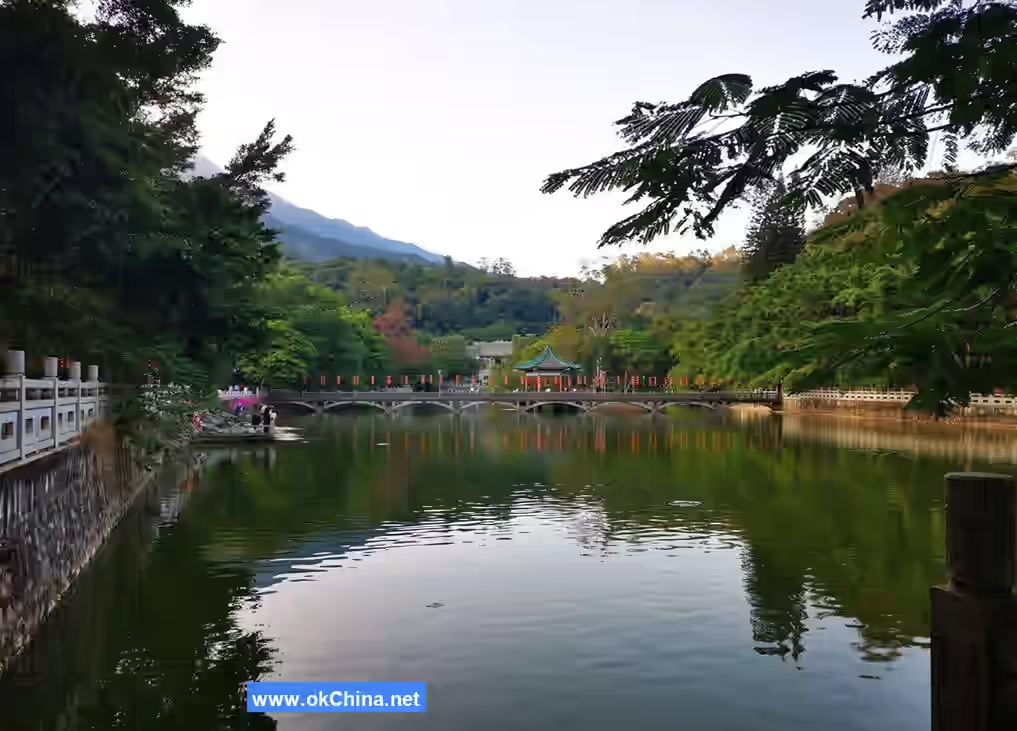
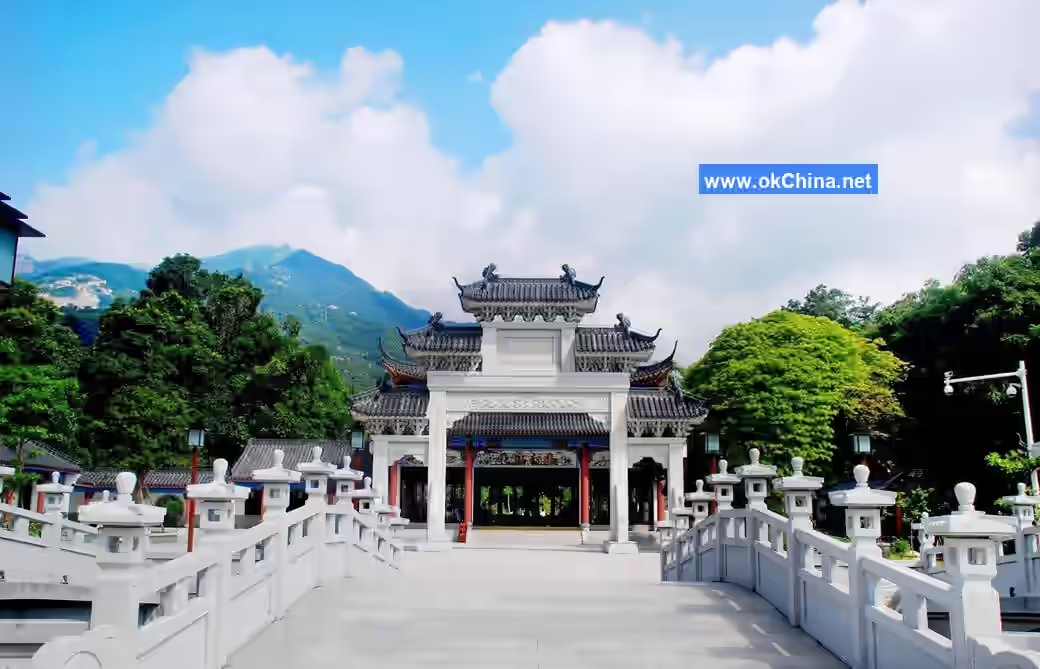
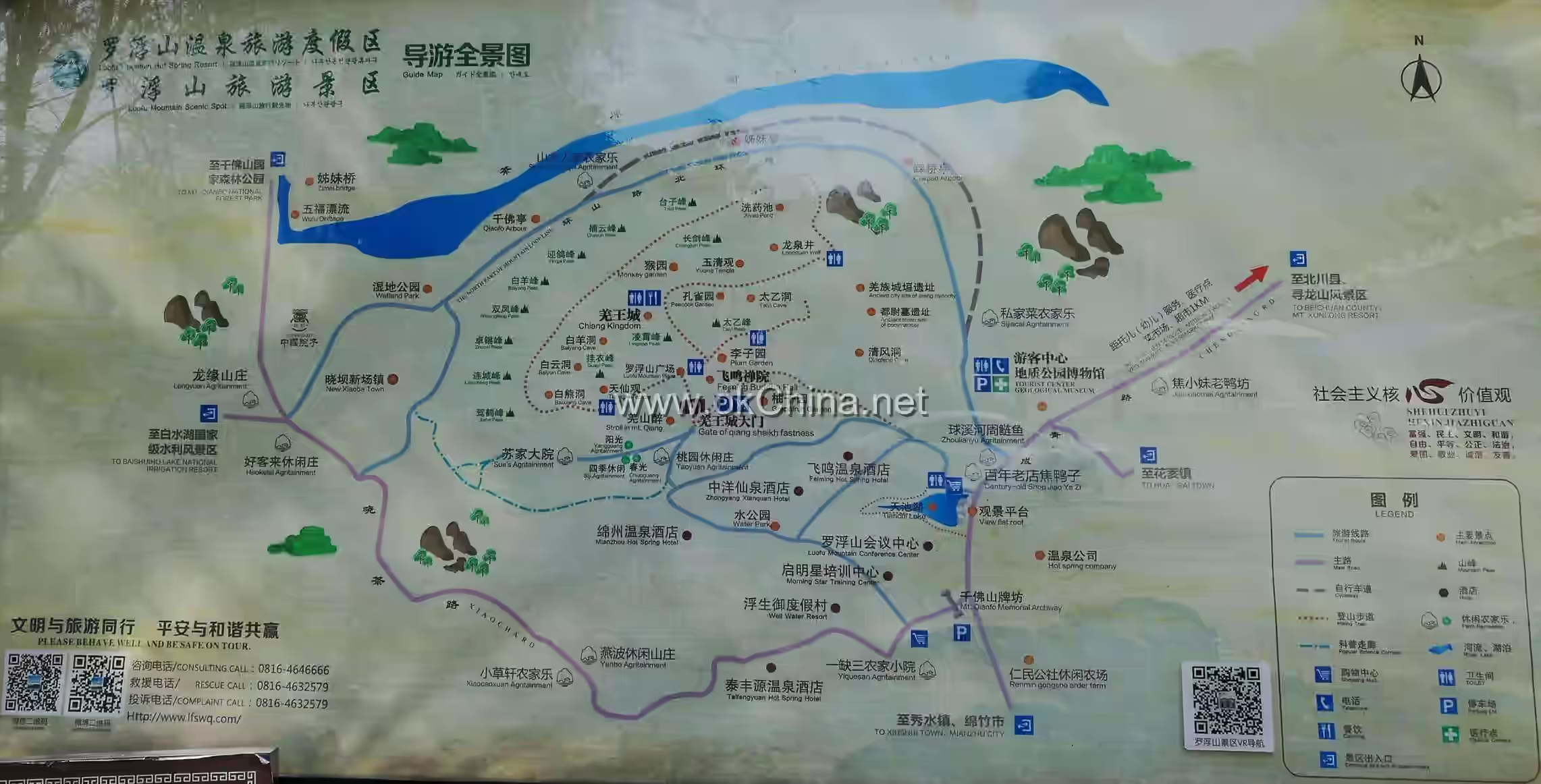
Luofu Mountain Scenic Area in Huizhou City is located on the banks of the Dongjiang River in Guangdong Province, 35 kilometers from Boluo County, Huizhou City, bordering Zengcheng and Longmen counties. It covers an area of 260 square kilometers, featuring 432 peaks of various sizes, 980 famous waterfalls and springs, 18 spectacular cave heavens, and 72 secluded stone chambers and rock formations.
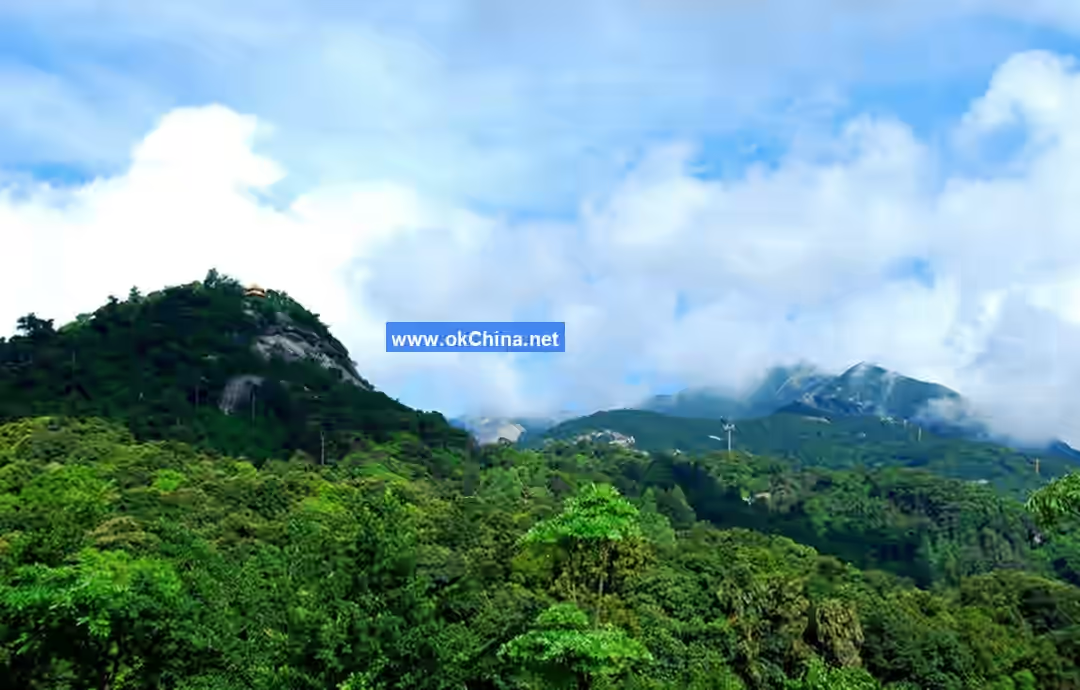
Situated near the Tropic of Cancer, Luofu Mountain Scenic Area in Huizhou City experiences high temperatures and abundant rainfall year-round, belonging to the South Asian subtropical monsoon climate zone. Combined with diverse soil types, this has made the area a natural botanical garden of the South Asian subtropics. It is home to numerous evergreen trees and broad-leaved forests, as well as a large number of vines and herbaceous plants. The area boasts over 3,000 plant species, including 1,240 medicinal herbs. Luofu Mountain also hosts many ancient plant groups, such as Psilotum nudum and Lycopodium species. The mountain is renowned for its three distinctive features: peculiar peaks and strange rocks, famous waterfalls and springs, and spectacular cave heavens. Notable peaks include Feiyun Peak, Tieqiao Peak, Yunü Peak, Luotuo Peak, and Shangjie Peak. Luofu Mountain has over 980 famous waterfalls and springs, including the well-known Baili Waterfall, Baishuimen Waterfall, Huanglongdong Waterfall, Bailian Lake, Furong Pond, Changsheng Well, and the Zhuoxi Spring praised by the Northern Song literatus Su Shi. Additionally, Luofu Mountain features 18 major cave heavens, such as Zhuming Penglai, Taoyuan, Hudie, and Yele, as well as 72 minor cave heavens, including Tongtian, Luohan, Fuhu, and Dishui. Among these, Zhuming Cave is the largest cavern on the mountain.
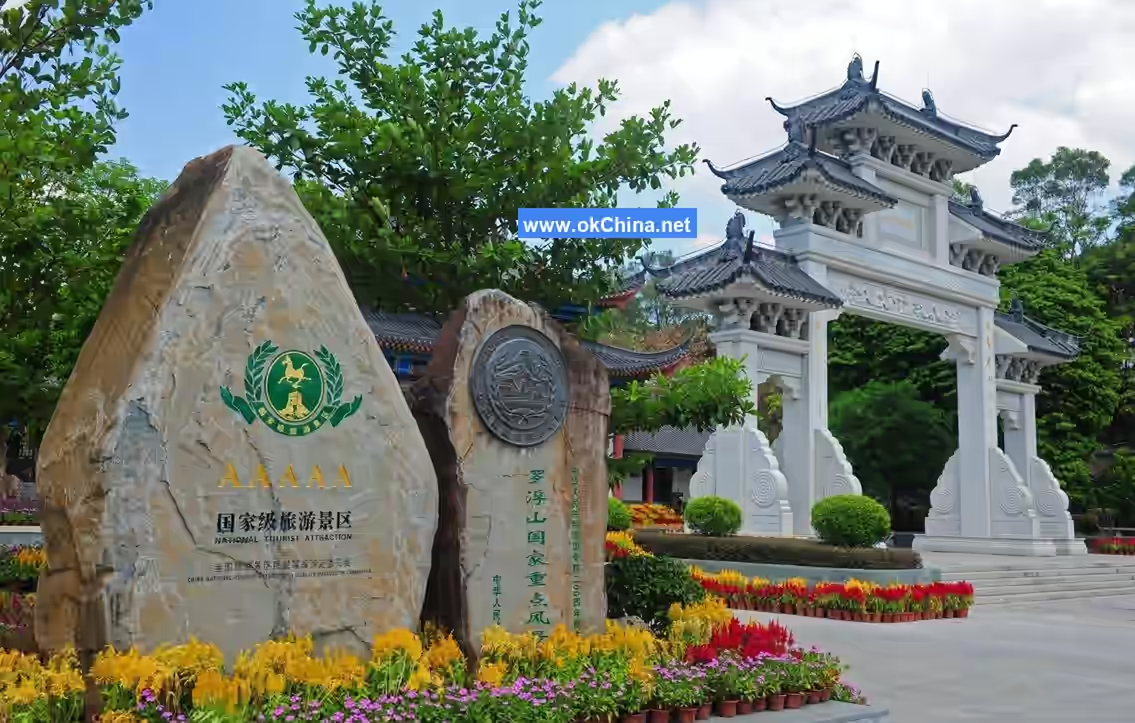
Luofu Mountain has long been known as the "First Mountain of Lingnan." Since the Qin and Han dynasties, it has been revered as a sacred mountain. The historian Sima Qian compared Luofu Mountain to the "Yue Mountain," and it is recognized as one of China's Ten Famous Mountains. It is also a renowned Taoist mountain in China, referred to as the Seventh Cave Heaven and the Thirty-Fourth Blessed Land in Taoism. Designated as a "National Key Scenic Area" and a summer resort in China, it is acclaimed as the "First Mountain of Lingnan."
2. Geographical Environment
2.1 Location and Territory
Luofu Mountain Scenic Area in Huizhou City is located on the banks of the Dongjiang River in the northwest of Boluo County, Huizhou City, Guangdong Province. It spans Boluo County, Longmen County, and Zengcheng District, covering an area of approximately 260 square kilometers. It is 35 kilometers from Boluo County, 55 kilometers east of Huizhou, 99 kilometers west of Guangzhou, 45 kilometers south of Dongguan, and 150 kilometers south of Shenzhen. The coordinates of Luofu Mountain Scenic Area in Huizhou City are 113°54′48″ to 114°05′12″ east longitude and 23°12′30″ to 23°20′33″ north latitude.
2.2 Geology
Luofu Mountain Scenic Area in Huizhou City features an ancient mountain body, structurally belonging to the Eastern Guangdong Block. It has been in an uplift state since the Mesozoic era. Over long-term weathering and erosion, most of the strata covering the granite intrusions from the Yanshan Movement period have been stripped away, exposing the granite and forming a granite dome mountain body.
2.3 Climate Characteristics
Luofu Mountain Scenic Area in Huizhou City belongs to the South Asian subtropical monsoon climate zone, with high temperatures year-round. The annual average temperature is 21.5°C, with July averaging 26°C and January averaging 11°C. The area enjoys ample sunshine, with nearly 2,000 hours of annual sunshine. The average annual precipitation ranges from 1,800 to 1,900 millimeters, mainly concentrated from April to September, accounting for 86% of the annual rainfall, with distinct wet and dry seasons. The frost-free period lasts about 350 days per year. Disastrous weather mainly includes typhoons and cold dew winds. From the foot to the summit, the average temperature difference is 5.3°C, the pressure difference is 112.7 millibars, and the relative humidity difference is 7.1%. For every 100-meter increase in altitude, the temperature decreases by 0.44°C, the pressure decreases by 9.2 millibars, and the relative humidity increases by 0.6%. The climate exhibits significant vertical variation.
2.4 Natural Resources
Located near the Tropic of Cancer, Luofu Mountain Scenic Area in Huizhou City experiences high temperatures and abundant rainfall year-round, belonging to the South Asian subtropical monsoon climate zone. Combined with diverse soil types, this has made the area a natural botanical garden of the South Asian subtropics. It is home to numerous evergreen trees and broad-leaved forests, as well as a large number of vines and herbaceous plants. The area boasts over 3,000 plant species, including 1,240 medicinal herbs. Luofu Mountain also hosts many ancient plant groups, such as Psilotum nudum and Lycopodium species. It is a region rich in rare and endangered plant species in Guangdong, many of which are ancient relic plants or endemic to China. The mountain also abounds in fruits such as lychee, longan, pomelo, orange, and mandarin. In addition to its rich plant resources, Luofu Mountain is also home to abundant animal resources. Known species include 39 amphibians and reptiles, over 40 bird species including the precious five-colored bird, and over 70 insect species. There are also three species listed as National Second-Class Protected Animals and included in the CITES Appendix.
3. Main Attractions
3.1 Overview
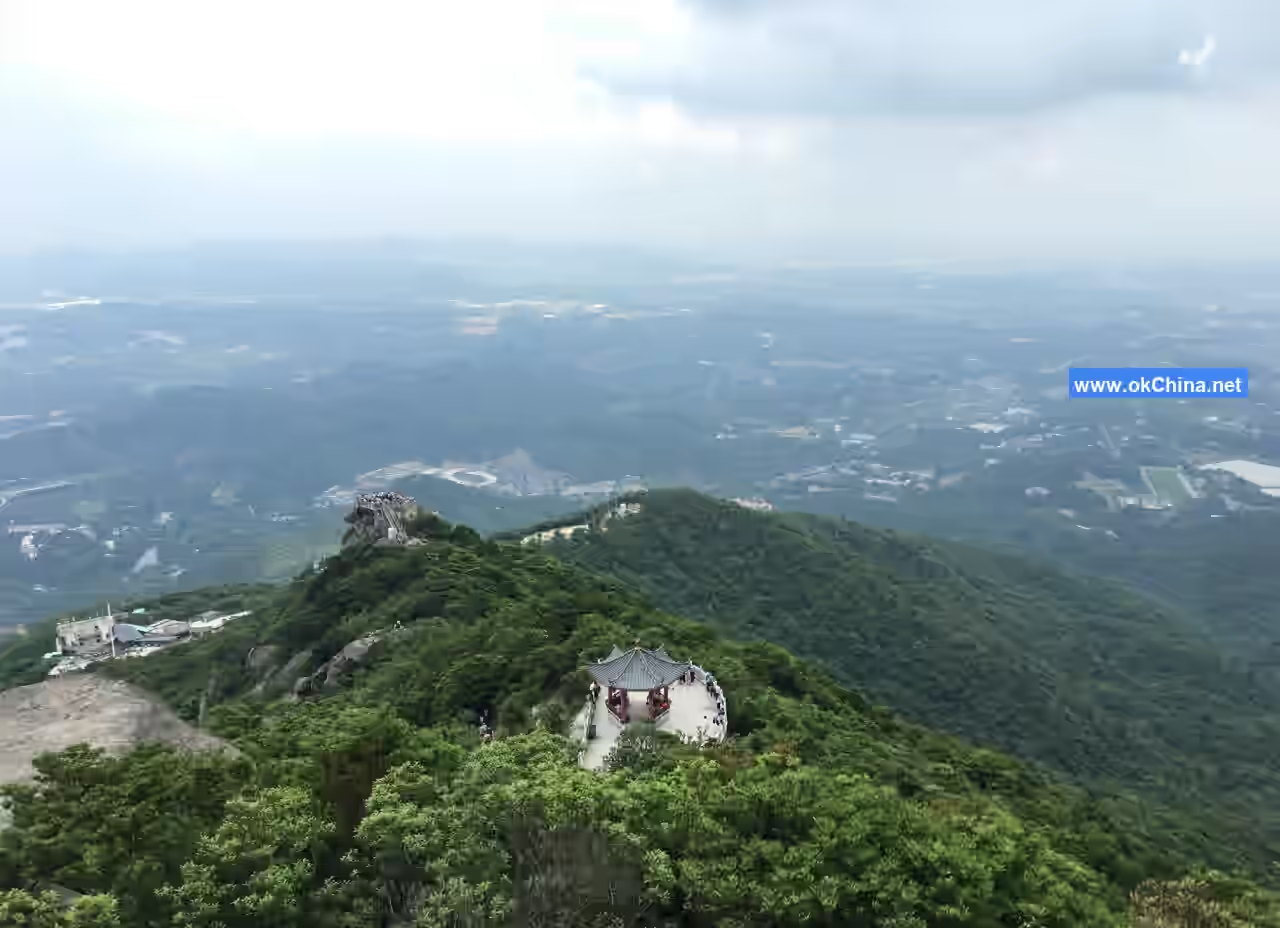
Luofu Mountain, also known as Dongqiao Mountain, is one of the Four Famous Mountains of Guangdong, alongside Xiqiao Mountain, Danxia Mountain, and Dinghu Mountain. It is often called the "Penglai Fairyland" and is one of China's Ten Famous Taoist Mountains. The historian Sima Qian once compared Luofu Mountain to the "Yue Mountain," hence its reputation as the "First Mountain of Lingnan." Luofu Mountain is renowned for its three distinctive features: peculiar peaks and strange rocks, famous waterfalls and springs, and spectacular cave heavens. The mountain comprises 432 peaks of various sizes, with notable ones including Feiyun Peak, Tieqiao Peak, Yunü Peak, Luotuo Peak, and Shangjie Peak. Among these, Feiyun Peak is the main peak, standing at 1,296 meters above sea level and named for its towering height into the clouds. Luofu Mountain boasts over 980 famous waterfalls and springs, including the well-known Baili Waterfall, Baishuimen Waterfall, Huanglongdong Waterfall, Bailian Lake, Furong Pond, Changsheng Well, and the Zhuoxi Spring praised by the Northern Song literatus Su Shi. Additionally, Luofu Mountain features 18 major cave heavens, such as Zhuming Penglai, Taoyuan, Hudie, and Yele, as well as 72 minor cave heavens, including Tongtian, Luohan, Fuhu, and Dishui. Among these, Zhuming Cave is the largest cavern on the mountain.
3.2 Bailian Lake
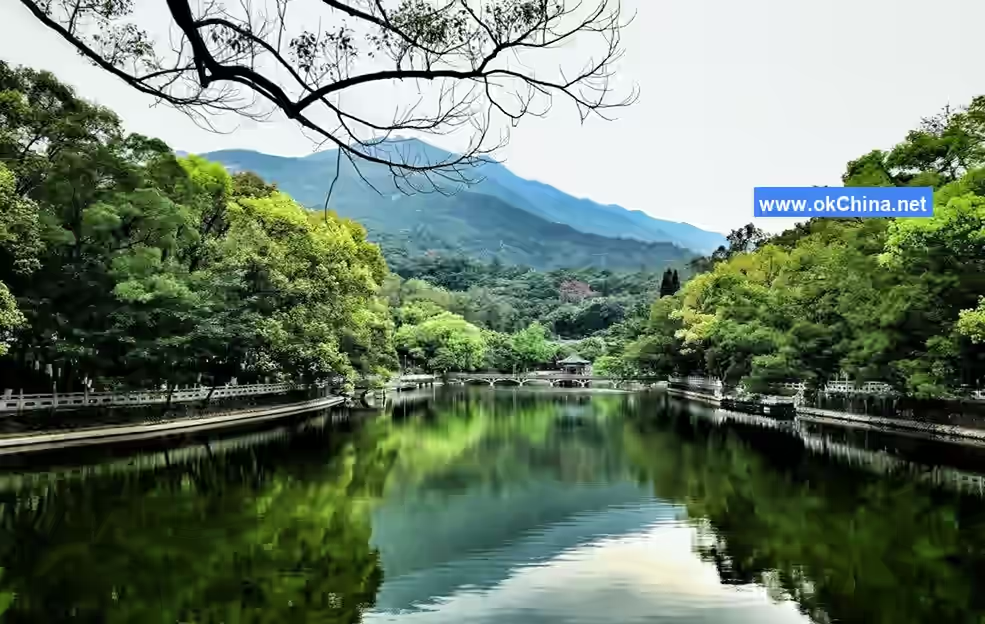
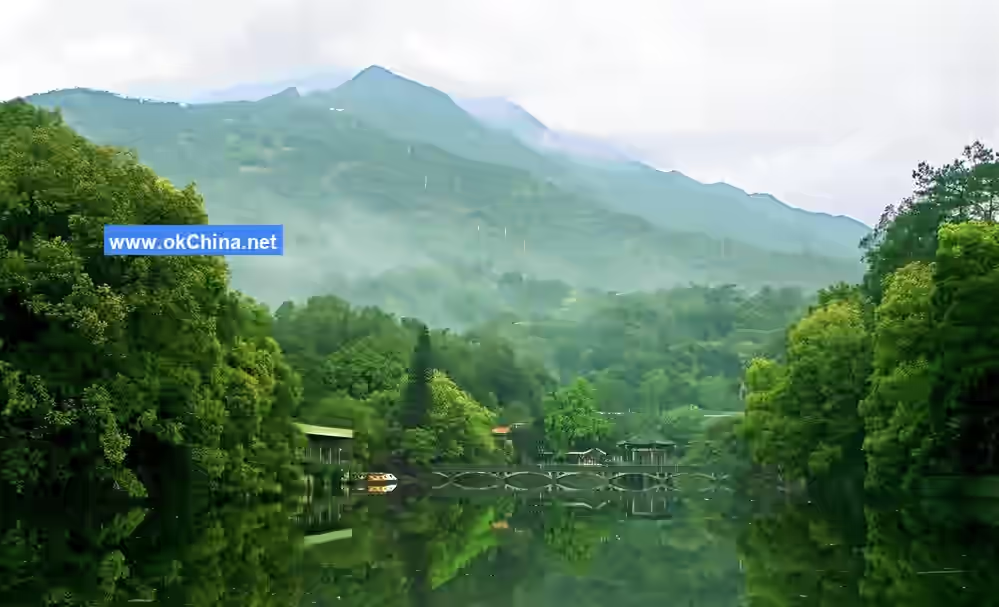
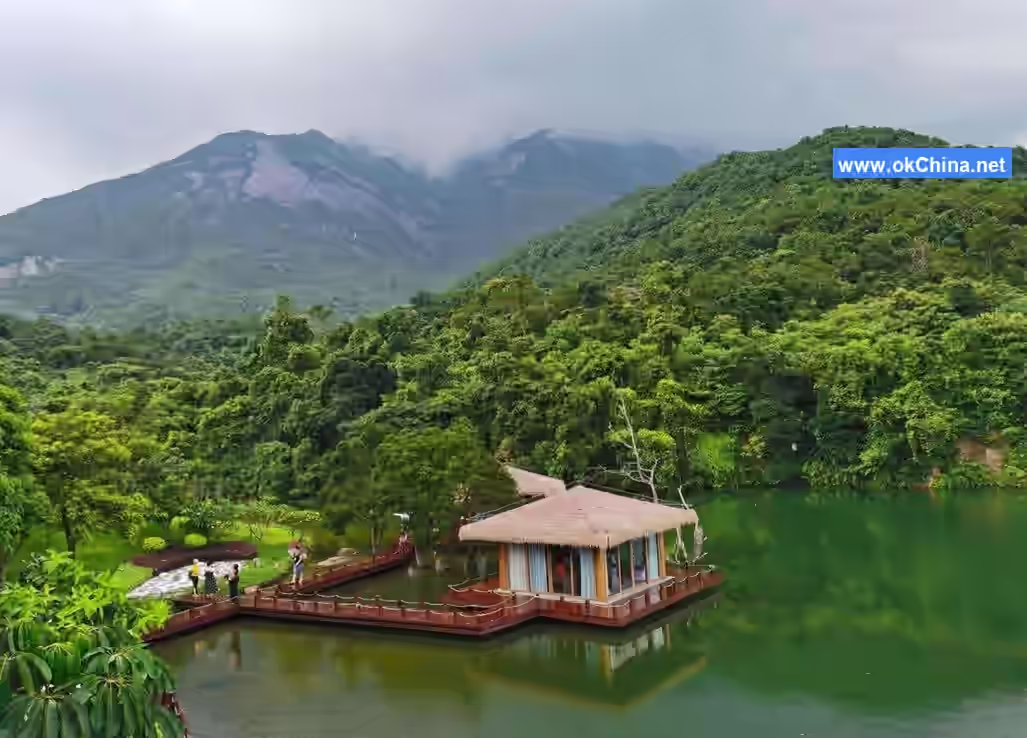
Legend has it that in ancient times, immortals and mountain hermits often planted white lotuses in this lake. Over time, the lake became filled with lotus flowers, earning it the name "Bailian Lake" (White Lotus Lake). There is also a magical story associated with Bailian Lake: It is said that during the Song Dynasty, a local man named Zhang Songqing was born in Boluo. Before his birth, his father dreamed of a poem gifted by someone, with the first two lines reading: "On the White Lotus Lake, a white lotus child; Once he achieves fame, the world will know." Zhang Songqing's later fate indeed reflected these lines. Born near Luofu Mountain, he studied diligently for ten years, imbued with the mountain's spiritual energy, and eventually topped the imperial examinations, later serving as the prefect of Zhaoqing. Another notable figure from the Song Dynasty, the renowned Neo-Confucianist Zhou Dunyi, often visited Bailian Lake to admire the lotus flowers and express his love for them. It is said that his famous essay "On the Love of the Lotus" was inspired by the scenery of Bailian Lake. Using the lotus to express his ideals, he left an immortal poem at Luofu Mountain: "In the mortal world, few have leisure by day, Especially with worldly ties to weigh. Alone I climb Luofu's lofty height, My noble heart restored to its true light."
3.3 Zhuming Academy
The famous Ming Dynasty educator Zhan Ruoshui, after receiving permission to retire and return to his hometown in the 20th year of the Jiajing reign (1541), founded the Ganquan Academy in Qingxia Valley, Zhuming Cave, Luofu Mountain. The scale of the academy is recorded in the essay "Record of Zhuming Cave": "Inside, there are five rooms for lodging; in front, a hall with five bays; further ahead, a gate matching the number of the hall and lodging rooms. Eight wings flank the corridors, enclosed by a surrounding wall, with a spring channeled into the kitchen..." It also notes: "Its teaching philosophy was based on 'everywhere apprehending heavenly principle,' with three thousand disciples." This reflects the flourishing state of Confucian lectures at the time. As recorded in the "Luofu Mountain Chronicles": "The prosperity of lectures was unparalleled within the country." An epitaph lamented: "Luofu's mountain range, a cave of immortals divine. In life, one can study; in death, bones can enshrine. Only books and plum blossoms, their fragrance will combine." This shows the deep connection between Luofu Mountain and Confucian culture. Therefore, holding the "Kai Bi Li" (Inaugural Writing Ceremony) at Zhuming Academy on Luofu Mountain holds profound educational significance for children's启蒙 education, while also laying a foundation for promoting traditional Chinese Confucian culture and inheriting Chinese civilization.
3.4 Ge Hong Museum
The Ge Hong Museum is located in the Zhuming Cave Scenic Area of Luofu Mountain, Boluo County, Huizhou City, Guangdong Province. With a total floor area of over 3,000 square meters, its plaque bears the inscription personally written by Tu Youyou. Based on Ge Hong's culture and the traditional Chinese medicine culture of Luofu Mountain, the museum primarily uses audiovisual technologies such as animation, VR, and 4D movies, along with over 500 historical artifacts, to showcase the life, works, and medical contributions of Ge Hong and his wife. It presents Ge Hong's health preservation culture to visitors through physical objects or experiential methods, allowing them to personally engage and providing a platform for直观科普 (intuitive popular science) of traditional Chinese medicine culture. The museum also fully displays Ge Hong's traditional Chinese medicine culture through hand-painted illustrations.
3.5 Ziyun Trail
The Ziyun Cave Trail is approximately 1.2 kilometers long. Along this trail, there is an exploration guide featuring sections like "The Social Circle of the Mountain Tallow Tree," "Gazing Up at White Waves in the Forest," "The Five-Colored Bird Leading Mountain Songs," and "Butterfly Traces and Fairy Trails." As part of the smart scenic area development, a "Nature Education Classroom" route has been created for the elderly and children who find climbing difficult, enhancing visitors' experiential and participatory engagement, encouraging active involvement and multi-dimensional感受 (sensory experience).
3.6 Hero Slope
Hero Slope is located at an elevation of 957 meters, with a total length of about 119 meters and 313 steps. Legend has it that Ge Hong and his wife Bao Gu often traversed this slope together to gather and identify medicinal herbs while practicing medicine. Through their efforts to激发潜能 (stimulate potential), they eventually refined a翠绿色液体 (emerald-green liquid), naming it "Hundred Herb Oil,"承袭 (carrying on) the meaning of "Shennong Tasting a Hundred Herbs." Later, people often referred to this slope as "Hero Slope," implying that "one who climbs this steep slope in one go is a true hero."### 3.7 Plum Mountain Farewell Dream Plum Mountain Farewell Dream features nearly 1,000 plum trees. From December to February each year, clusters of plum blossoms adorn the branches of trees all over the mountain, making it the best time to view the plum blossoms. Luofu plum blossoms have long been famous. As early as the Sui Dynasty, they were praised as "heralding spring before the world and fragrance before all other trees." In the Northern Song Dynasty, Su Shi praised them with the verse: "At the foot of Luofu Mountain lies the Plum Blossom Village, where jade and snow form the bones and ice the soul." As for the "Farewell Dream," there is a magical story of celestial encounter. It is said that during the Kaihuang era of the Sui Dynasty, there was an official named Zhao Shixiong. Disgusted by the corruption and tyranny in the court, he resigned and retreated into seclusion in Luofu Mountain. One day, he arrived at the "Plum Blossom Village." It was winter, and plum blossoms were blooming all over the mountains. Intoxicated by the fragrance, he pushed open the courtyard gate of a house and saw a beautiful woman coming to greet him. She was exceptionally lovely with a charming smile. They sat together, drinking and toasting, finding great rapport. Soon after, a young boy in green appeared in the room to perform songs and dances for their entertainment. Later, both Shixiong and the woman became drunk and gradually fell asleep. The next day, when Zhao Shixiong awoke, he found himself under a plum tree with a small bird singing incessantly. Recalling the events of the previous night, he concluded that the plum tree was the woman he had seen, and the bird was the boy in green. Realizing that the joyous encounter was merely a dream, Zhao Shixiong was filled with immense melancholy. The典故 of Shixiong's plum dream has been frequently alluded to in later poetry and prose, perhaps because his drunken dream speaks to the universal human longing for fateful encounters and the fear that they may never come true.
3.8 Rainbow Skirt Flying Torrent
Rainbow Skirt Flying Torrent embodies the essence of Luofu Mountain's pristine landscape in its cascading waterfall. The waterfall presents enchanting and varied forms as its water volume changes with the seasons. Above the rocks are carved the characters "Flying Torrent," and there is also an exquisite small bridge named "Rainbow Skirt."
3.9 Lion Peak
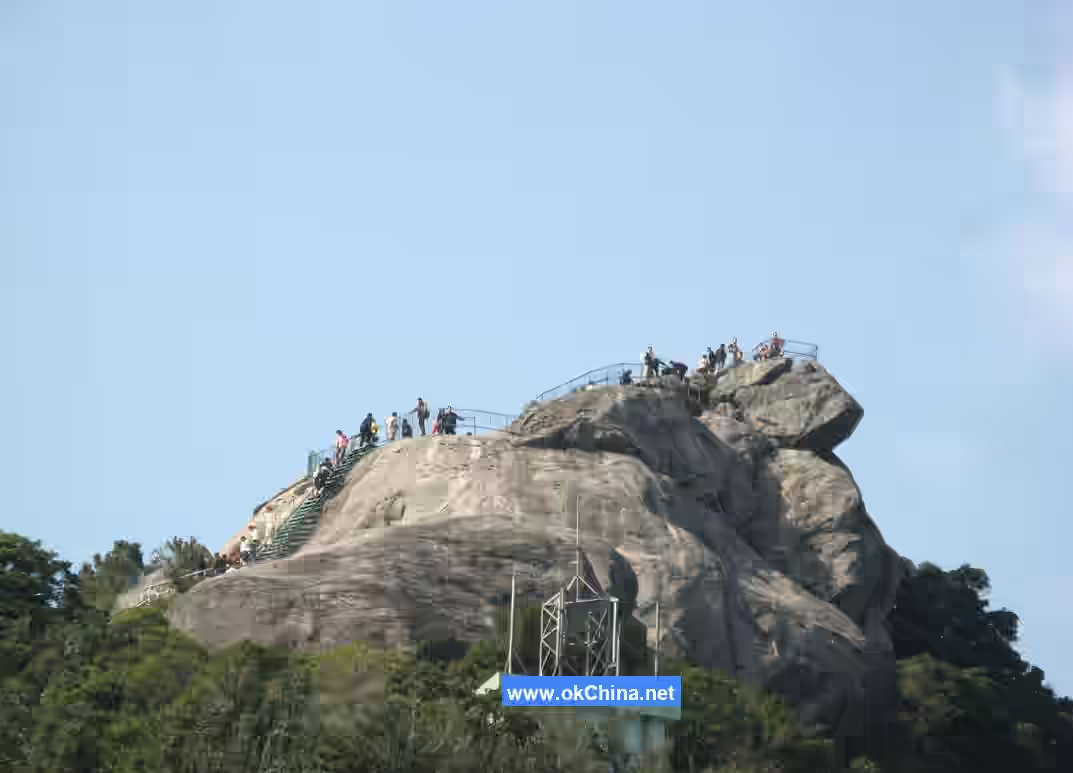
Lion Peak is a famous scenic spot in Luofu Mountain. The shape of the peak resembles a lion, which, according to Feng Shui interpretation, serves as a divine beast guarding the Chongxu Ancient Temple. Lion Peak is also known as Magu Peak. Magu is a famous immortal in Taoism. Legend has it that during the Eastern Han Dynasty, Magu appeared at Cai Jing's home, looking only about eighteen years old, with beautiful features. However, she claimed to have witnessed the East Sea turn into mulberry fields three times. As mentioned, Magu was beautiful and thus fond of dressing up. It is said that once she came to Lion Peak and found a large stone here, smooth and bright like a mirror, especially after rain. She chose this spot as her dressing table. Upon learning of such a stone, female immortals like He Xiangu also often came here to adorn themselves. Legend holds that during the Tianbao era of the Tang Dynasty, during a grand vegetarian feast at the Chongxu Ancient Temple, five-colored clouds suddenly appeared in the sky. Then, a dignified-looking fairy maiden, riding a five-dragon chariot, descended from the misty clouds to Lion Peak, which immediately radiated colorful light, a magnificent sight. Therefore, this place is often regarded as a site where immortals roam. There is also the scenic spot "Magu's Dressing Mirror." Legend says that when girls reach sixteen or seventeen, if they look into this mirror, they will become more beautiful.
3.10 Yellow Dragon Temple
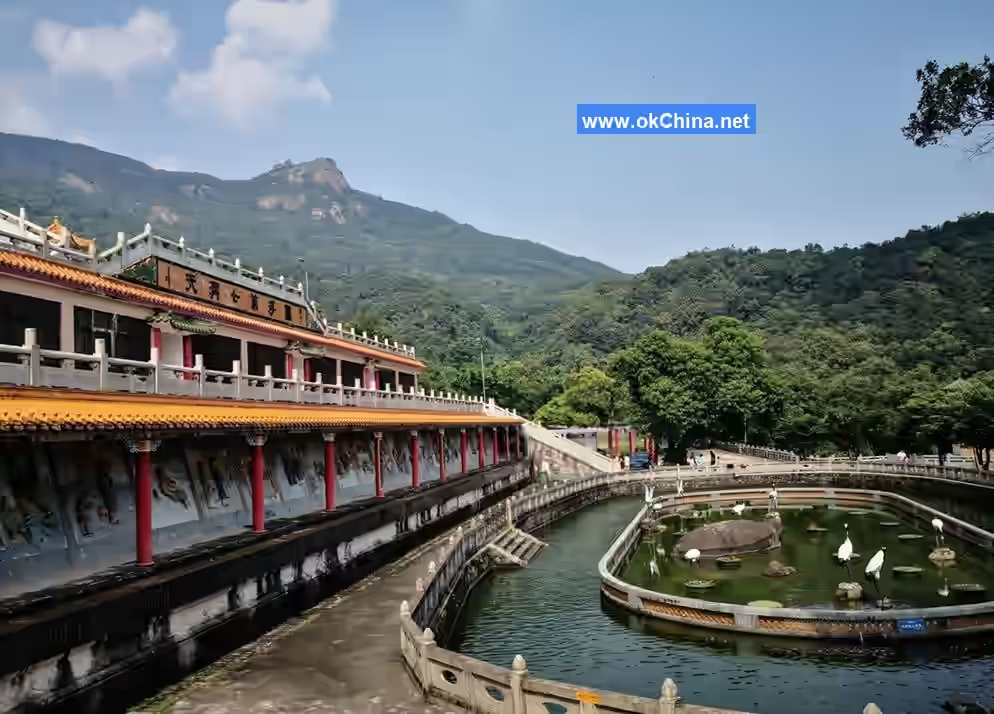
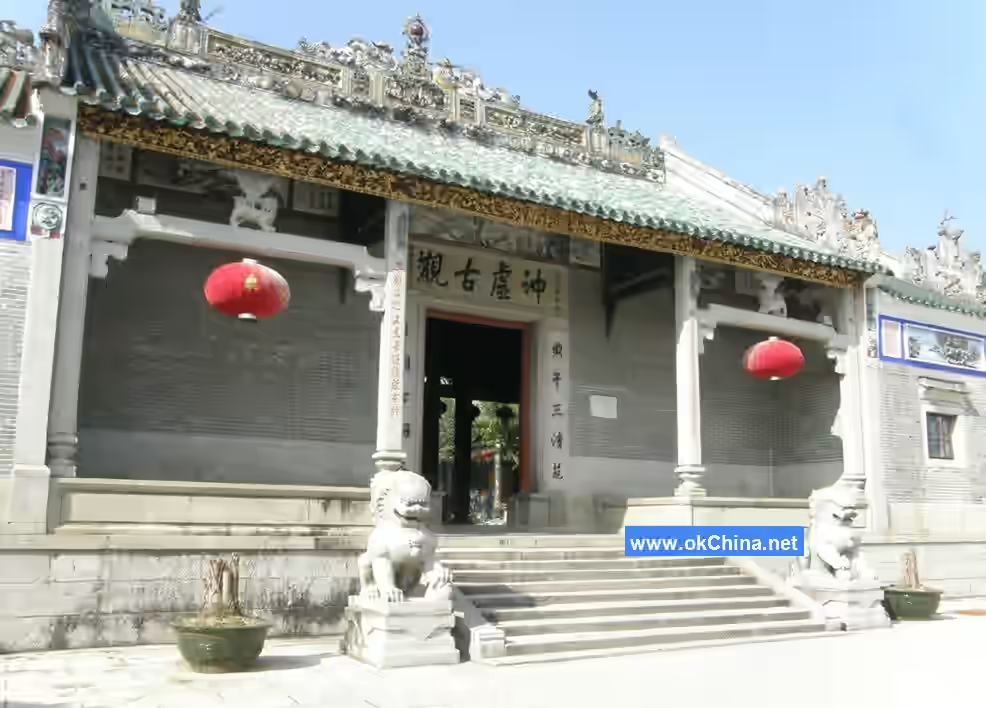
The Yellow Dragon Temple is located in the Yellow Dragon Cave at the foot of the Jade Maiden Peak on the southwestern foothills of Luofu Mountain. It is one of the famous eighteen "Cave Heavens" wonders of Luofu Mountain. The existing Yellow Dragon Temple covers a total area of approximately 15,000 square meters, making it the largest in area and most magnificent in architectural scale among the existing temples and monasteries on Luofu Mountain. It is also one of the major Taoist temples of the Quanzhen Longmen Sect in South China, with the largest land area and building footprint, and the strongest religious cultural atmosphere.
3.11 Luofu Medicine Garden
Luofu Medicine Garden was established by Ge Hong in a small village near Guanyuan Cave as a place for planting and washing medicinal herbs, lecturing, and treating the common people. The place name "Medicine Garden Village" still exists today. An inscribed poem reads: "Pine gates and stone paths are overgrown with fragrant grass, fallen blossoms fill the courtyard with deep, deep fragrance."
3.12 Herb-Washing Pool
The Luofu Herb-Washing Pool is where Ge Hong washed the medicinal herbs he gathered. Ancient people carved the characters "Herb-Washing Pool" on large stones beside the Yellow Dragon Stream and the Chongxu Ancient Temple for visitors to identify.
3.13 Lost Sandal Pavilion
At the Luofu Lost Sandal Pavilion, Ge Hong often discussed scriptures and doctrines with Bao Jing at night. A Double Swallow Pavilion was built nearby to commemorate this. The Zhichuan Alchemy Furnace is Ge Hong's furnace for refining elixirs. The Seven Stars Altar is where Ge Hong organized prescriptions and studied medicine. The Longevity Well, Brewing Spring, and Dripping Rock are the water sources Ge Hong used for drawing water to refine elixirs and brew medicines.
3.14 Sulao Temple
Sulao Temple is located in Sulao Village, Changning Town, Boluo County, Huizhou City, Guangdong Province. Old records praise it: "Truly a profound region where spirits dwell, a blessed land for cultivation." It has been regarded as a sacred place for self-cultivation throughout the ages. The Boluo County Cultural Relics Record states: "Sulao Temple is located north of Luo Ridge and south of Fu Mountain. In front lies a lotus pond, its ripples delightful to behold." The predecessor of Sulao Temple was the North Nunnery founded by Ge Hong. The Inscription on Rebuilding Sulao Temple records: "Sulao Cave is where Anqi Sheng toasted the goddess. The mysterious fragrance of dark hills and jade-green brewed into sweet dew, its taste like酥醪 (fine wine), scattered throughout heaven." It is said the name "Sulao" originates from this, and later generations thus renamed it Sulao Temple. The temple faces southeast towards northwest, with a width of 75 meters, a depth of 36 meters, and a building area of 2,700 square meters. Its main structures include the twin pavilions "Pure Sun" and "Imprinted Moon," the main hall, Penglai Pavilion, vegetarian hall, guest hall, Taoist quarters, etc. Sulao Temple features a courtyard layout in the siheyuan style. On both sides within the temple are several dozen small single-story houses used as dormitories for Taoist priests, storerooms, and dining halls. In front of the gate are nine stone steps. Above the main gate is inlaid a stone plaque reading "Sulao Temple," inscribed by Bao Jun of Xiangshan during the Qing Dynasty's Daoguang era.
3.15 Ge Xian Shrine
Ge Xian Shrine is dedicated to the Immortal Elder Ge Hong. Ge Hong, a figure from the Eastern Jin Dynasty, is said to have visited the Immortal Village, both to bring elixirs to aid the world and to meet destined individuals to offer guidance. In Shangjing Xinwu Village, an old gatehouse red stone still exists, inscribed with the three large characters "Ge Fang Li" (Ge's Visit Lane). The river section at Xiancun Xu and the tributaries flowing into it (streams from areas like Jigang, Qiaotou, Cenbei, Xinwu, Guanting, Baotian, Lantian, etc.) are collectively called Ge Water, also known as Immortal Stream. Later generations raised funds to build Ge Xian Shrine in memory of Ge Hong. Ge Xian Shrine underwent a large-scale renovation in the 6th year of the Tongzhi era of the Qing Dynasty (1867) and has remained largely unchanged for over 140 years. The architecture of Ge Xian Shrine is symmetrical, modeled after a Taoist temple. The stone-carved couplet at the main gate reads: "Seeing through form and emptiness, I pay no heed to the ten li of mist and flowers; As immortals and Buddhas arrive, my eyes swallow a riverful of breeze and moonlight." Inside the gate, about a zhang in, is a high incense-burning platform built of square granite blocks. On both sides of the platform are granite steps leading to the high platform and altar. On the altar stands a statue of the Great Immortal Ge.
3.16 Immortal Meeting Bridge
The Immortal Meeting Bridge is said to have been built by Su Dongpo. At the time, he was serving as a prefect in Huizhou. One day while touring Luofu Mountain, on his way back he reached this spot, but the bridge was broken and he could not cross. Then he encountered an old man who gave him a bamboo pole to mend the broken edges of the bridge, and the bridge was instantly formed. When Su Dongpo tried to thank the old man, he had disappeared. Su Dongpo then realized he had met an immortal. To commemorate this event, Su Dongpo repaired the bridge and inscribed the characters "Immortal Meeting Bridge."
3.17 Dongjiang Column Memorial Hall
The Dongjiang Column of the Guangdong People's Anti-Japanese Guerrilla Force was a people's anti-Japanese army created and led by the Communist Party of China in the Dongjiang region of Guangdong Province. In the arduous struggle against Japan, under the leadership of the Party Central Committee and the Guangdong Party organization, the Dongjiang Column grew from nothing, from small to large, gradually developing into an armed force of over 11,000 personnel. Far from the main forces of the Eighth Route Army and the New Fourth Army, isolated behind enemy lines, and under attack from Japanese, puppet, and顽固 forces, the Dongjiang Column closely relied on the masses, fiercely striking the enemy along the Dongjiang River. It became a strong armed force on the South China anti-Japanese battlefield, renowned throughout the southern regions and internationally. The Dongjiang Column was praised by the CPC Central Committee as "a banner of liberation for the Guangdong people" and "a mainstay of China's War of Resistance," comparable to the Eighth Route Army and the New Fourth Army. The Dongjiang Column Memorial Hall has been recognized with honors including "National List of Anti-Japanese War Memorial Facilities and Sites," "Guangdong Provincial Patriotic Education Base," "Guangdong Provincial Party History Education Base," "Guangdong Provincial National Defense Education Base," and "Guangdong Provincial Red Tourism Demonstration Site." The total area is 5,584 square meters, with a building area of 3,300 square meters. The hall contains a "Prologue Hall," "Exhibition Hall," "Red Classroom," "Boluo County Battle Site Exhibition and Revolutionary Story Corridor," and a temporary exhibition "Salute to the Heroes of the Striving Era." Supporting facilities include meeting reception rooms, a New Era Civilization Practice Book Bar, security room, offices, and other functional spaces. The hall displays nearly 1,000 authentic historical photographs and over 300 revolutionary artifacts. Important artifacts include the printing press of the Dongjiang Column's Forward Newspaper (a National Second-Class Cultural Relic) and proclamations issued by the Dongjiang Column and Border Column at the time.
4. Recreational Activities
4.1 Luofu Mountain Cableway
The Luofu Mountain Cableway employs the world's most advanced automatic detachable gondola system. It has a total length of 1,537 meters, a vertical drop of 466 meters, and a speed of 3.5–6.0 meters per second. The one-way ride takes approximately 5–9 minutes. The cableway has a one-way passenger capacity of 1,800 people per hour. Riding the cableway uphill takes visitors directly to the foot of Eagle Beak Rock, sparing them the effort of mountain climbing and greatly enhancing sightseeing comfort and safety. Riding the cable car allows visitors to appreciate the beautiful scenery of Luofu Mountain from different directions and angles. Along the way, one can gaze at or overlook Lion Peak, Sage Peak, Eagle Beak Rock, the full view of Xiangang Reservoir, the Zhuming Cave Scenic Area, and more.
4.2 Luofu Mountain Jungle Adventure
Luofu Mountain Jungle Adventure is an outdoor experience project combining sports, entertainment, and challenge. Currently, four routes are available: Young Warrior Route A, Young Warrior Route B, Platinum Warrior Route, and Gold Warrior Route. Equipped with professional safety gear throughout, visitors navigate through the mountain forest using actions like stepping, jumping, climbing, and sliding to challenge obstacles such as Flying Trapeze, Aerial Tunnel, Extreme Flying Net, and Suspended Bridges.### 4.3 Luofu Mountain Jungle Coaster The Luofu Mountain Jungle Coaster is a two-person, non-powered sled that glides downhill along a track. Additionally, it offers an uphill climbing function, allowing riders to ascend the slope seated in the track car. It can also spiral and turn, providing a thrilling high-speed descent from slopes with a drop of nearly one hundred meters.
4.4 Luofu Mountain Jungle Glass Drift
The Luofu Mountain Jungle Glass Drift is a newly introduced, highly entertaining, participatory, and interactive tourism and recreational project in the Luofu Mountain Scenic Area of Huizhou City. It is a giant water slide primarily constructed from titanium alloy steel and high-strength tempered glass, built along the mountain's slope. The design of the Luofu Mountain Jungle Glass Drift is unique; the slide is sometimes shaded by lush green trees and sometimes under blue skies with white clouds, while below, there are sometimes babbling streams and sometimes obstructing strange rocks. The highest point of the Luofu Mountain Jungle High-Altitude Glass Drift is tens of meters above the ground, and visitors can ride either solo or in pairs. Due to the high smoothness of the glass water slide, significant slope drops, long sliding distances, and rapid acceleration, the experience is highly stimulating.
4.5 Luofu Fantasy Water Show
The water design of the Luofu Fantasy Water Show is based on the Taoist cultural motif "Seven Stars Reflecting on a Lotus." Utilizing techniques such as lasers, lighting, water screens, and fountains, it is artistically choreographed to create a cross-media modern fountain show. The viewing area is distributed in a 360-degree ring around the lake.
5. History and Culture
5.1 Overview
Luofu Mountain is a famous mountain in Lingnan. Historically, Taoism, Buddhism, and Confucianism coexisted here for a long time, making Luofu Mountain a culturally rich mountain with profound connotations. It preserves numerous acclaimed inscriptions, stone carvings, poetic masterpieces, and historical sites, including over 200 key scenic and historical spots, more than 180 cliff carvings, and 13 religious temples and monasteries.
5.2 Myths and Legends
Legend has it that Luo Mountain and Fu Mountain were originally not one mountain. On a remote island in the Eastern Ocean lived the daughter of the Dragon King of the East Sea. One day, the Dragon Princess went to Luo Mountain to gather herbs and relax, where she encountered Xiao Huanglong, the son of the Dragon King of the South Sea, digging a well. However, for every shovelful of earth he dug, the ground would fill back in. Upon asking, she learned that the Dragon King of the East Sea refused to send rain, and Xiao Huanglong was digging the well to save the people. The East Sea Dragon King had said, "I will make the earth grow back for every shovelful you dig. Unless a single dragon becomes a pair, and the twin dragons play with a pearl, you will never dig out water." Thus, Xiao Huanglong could never succeed. Moved by his kindness, the Dragon Princess helped him. Together, the two dragons dug and soon created a well. Then, the Dragon Princess jumped into the sea, spat out a dragon pearl from her mouth, and played with Xiao Huanglong until the sea churned violently. Finally, she threw the pearl into the well, and immediately, a clear spring gushed forth, saving the people. The Dragon Princess then settled on Luo Mountain. When the Dragon King of the East Sea found out, he locked Xiao Huanglong at the bottom of the well and captured the Dragon Princess, imprisoning her on the remote island. The Dragon Princess's sincere love moved the ten-thousand-year-old divine turtle carrying the island, and the turtle quietly moved the island closer to Luo Mountain. Upon hearing the news, Xiao Huanglong broke his chains, rushed out of the deep well, and embraced the Dragon Princess tightly. From then on, Luo and Fu Mountains merged into Luofu Mountain.
5.3 Taoism
Taoism regards Luofu Mountain as the seventh of the Ten Great Grotto-Heavens, named the "Vermilion Brilliance Illuminating Truth Grotto-Heaven." It is also listed as the thirty-fourth Blessed Land, called the "Spring Source Blessed Land." Legend has it that during the reign of King Ling of Zhou, Fuqiu Gong and Prince Jin ascended Mount Song and later attained the Dao at Luofu Mountain. During the Qin Dynasty, Anqi Sheng, known as the Millennial Elder for selling medicine in the Eastern Sea, once gathered calamus from the streams of Luofu Mountain to consume and later ascended to immortality there. The Calamus Stream is named after this event. In the seventh year of the Xianhe era of the Eastern Jin Dynasty (326 AD), Ge Hong, hearing that cinnabar was produced in Jiaozhi, sought an official post in Julou to facilitate gathering materials for alchemy. Upon reaching Guangzhou, he was detained by Governor Deng Yue. Thereafter, he resided in Luofu Mountain, practicing Daoist cultivation, refining elixirs, and writing books. Ge Hong was a significant figure in the Taoist Dan Ding (Elixir Cauldron) School, passionate about refining immortal pills from lead, mercury, cinnabar, and herbs, hoping to explore a path to immortality. His extant works include the 70 volumes of Baopuzi (Inner and Outer Chapters), Zhouhou Beiji Fang (Emergency Formulas to Keep Up One's Sleeve), Shenxian Zhuan (Biographies of Immortals), Jiyi Zhuan (Collection of Marvels), Jinkui Yaofang (Golden Cabinet Prescriptions), and over 600 pieces of inscriptions, poems, and prose. These works hold practical value for the study of medicine, chemistry, history, and literature. Due to the legend that Ge Hong refined a "golden elixir" containing mercury at Luofu Mountain and "achieved immortality through liberation from the corpse," the mountain has become an influential Taoist sacred site nationwide.
5.4 Historical Figures
Ge Hong (284–364 AD), courtesy name Zhichuan, self-styled Baopuzi, known as "Immortal Ge," was a native of Jurong, Danyang. He was a renowned Taoist theorist, medical expert, and literary figure of the Jin Dynasty. Born into a prominent scholar-official family in Jiangnan, his great-grandfather and grandfather were distinguished ministers of the Eastern Wu regime. By his father's generation, the family fortunes had suddenly declined. Consequently, Ge Hong engaged in farming to support himself: "personally tilling the fields, working under the stars and treading on grass," but he never abandoned his ideal of writing: "personally cutting firewood to trade for paper and brushes, writing and studying books at night" (Book of Jin: Biography of Ge Hong). Later, he studied Daoist methods and alchemy under Zheng Yin. In the second year of the Tai'an era of the Western Jin Dynasty (303 AD), when Zhang Chang and Shi Bing rebelled in Yangzhou, Ge Hong participated in suppressing the rebellion and was later promoted to General Fubo for his merits. In the fourth year of the Jianxing era (316 AD), he returned to his hometown. When the Eastern Jin Dynasty was founded, in recognition of his past contributions, he was granted the title of Marquis of Guannei. During the Xianhe era, he served as Assistant to the Minister over the Masses and later as Consultant Military Officer, among other positions. He eventually resigned from office and lived in seclusion, spending his final years refining elixirs and writing at Luofu Mountain. His representative works include Baopuzi, Zhouhou Beiji Fang, Shenxian Zhuan, and Xijing Zaji.
Comments
Post a Comment