
Longhu Mountain Scenic Area in Yingtan City
1. Overview
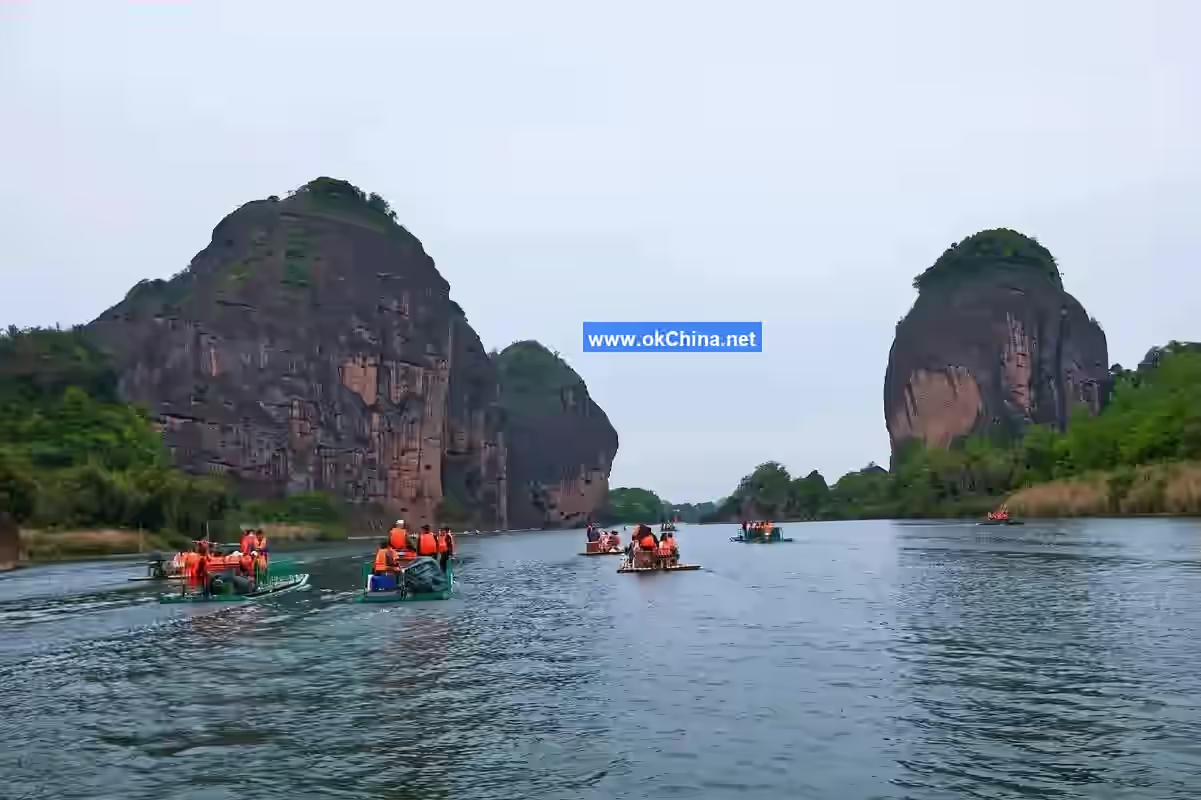
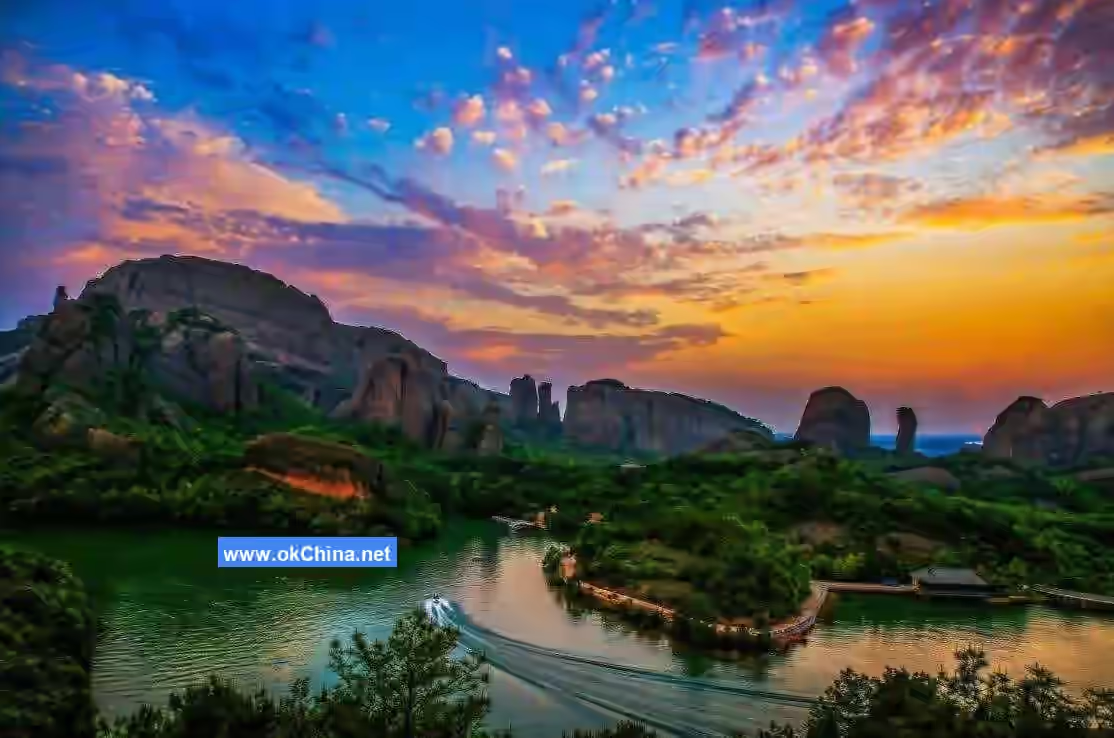
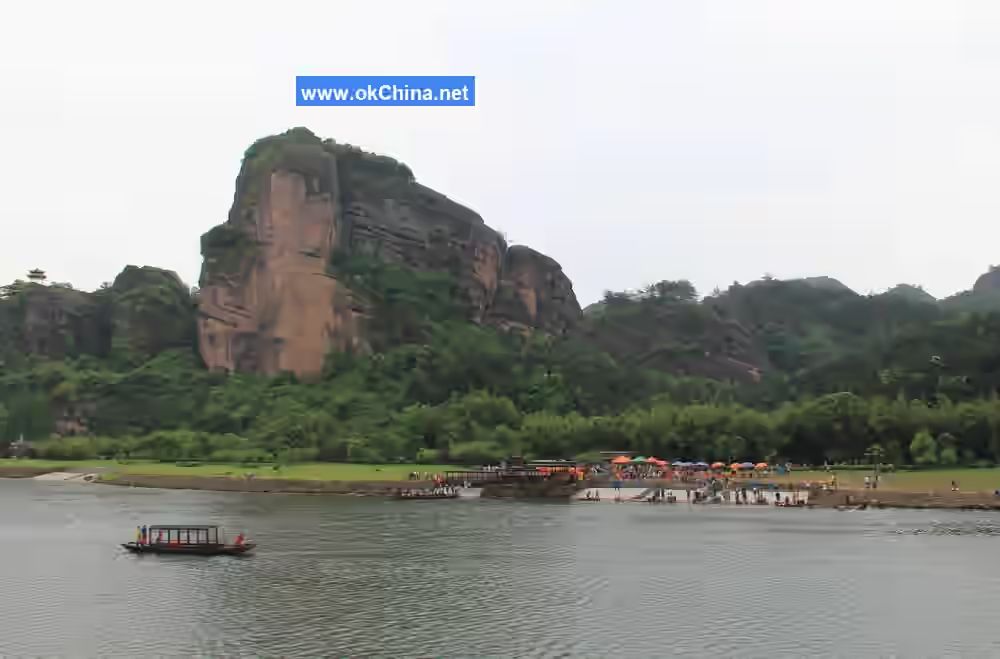
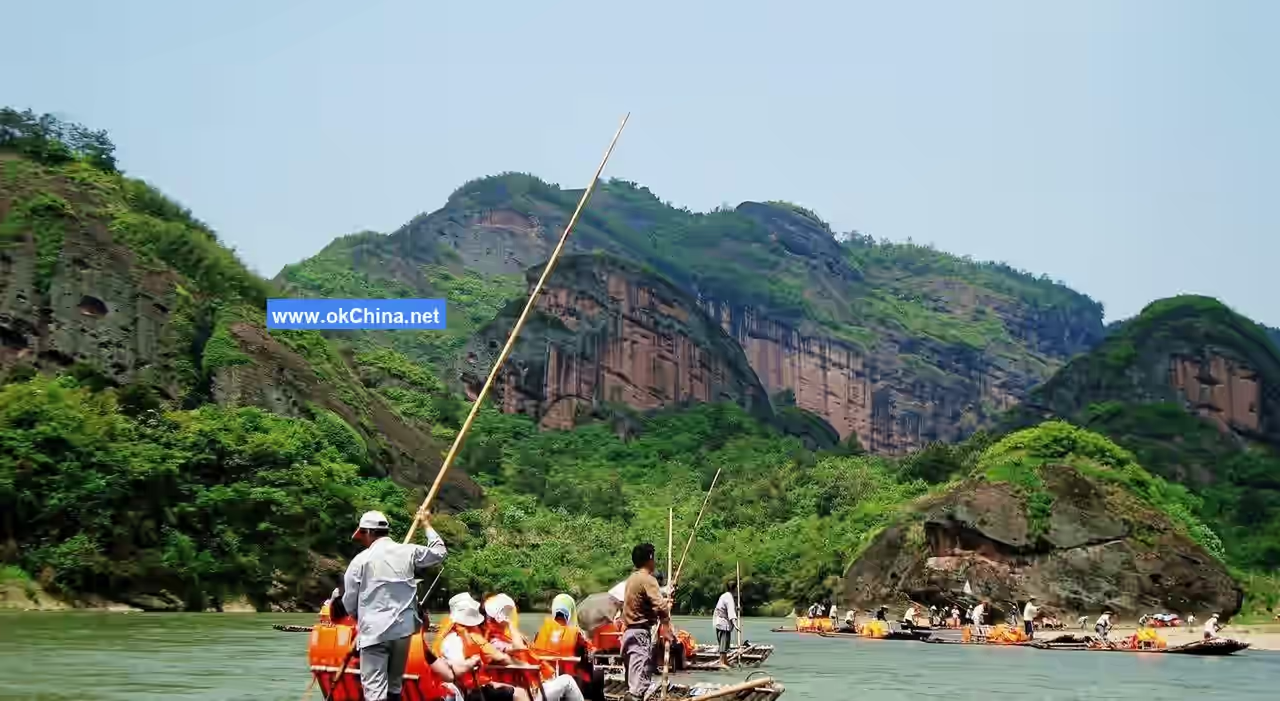
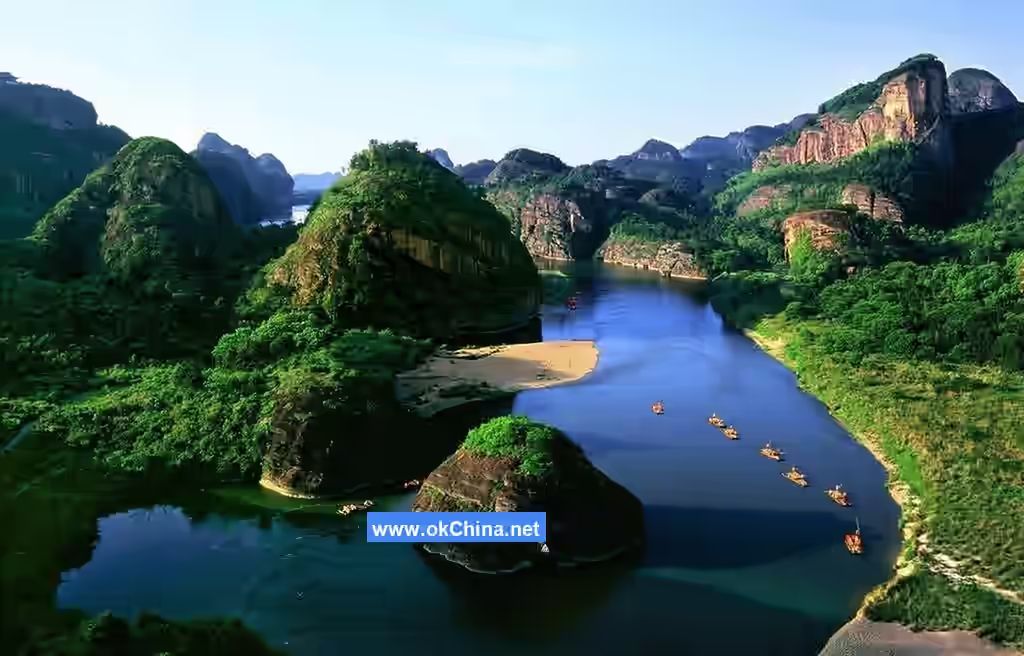
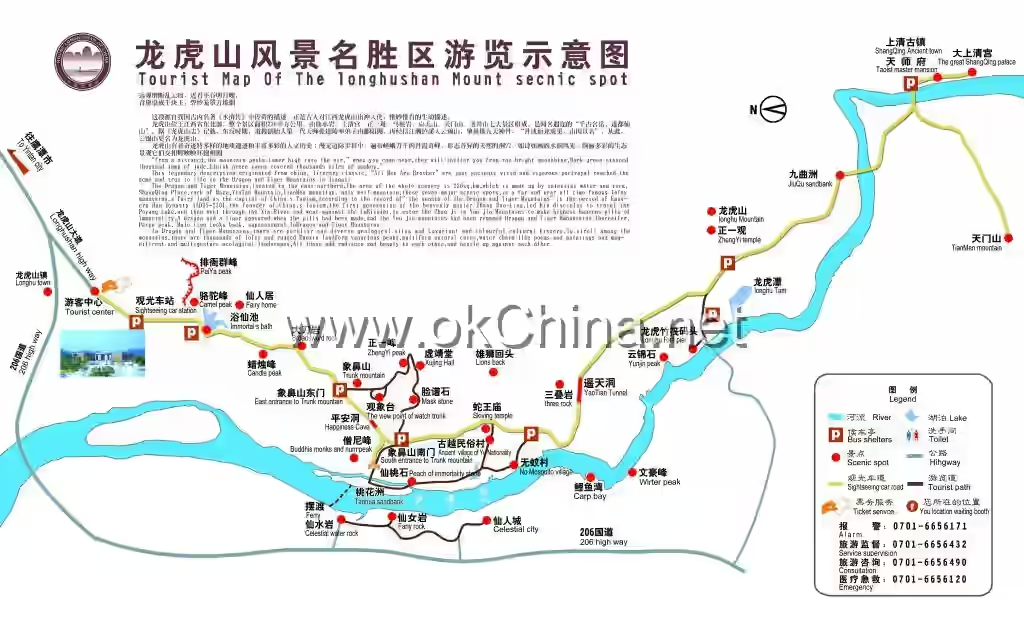
The Longhu Mountain Scenic Area in Yingtan City is located within Shangqing Town and Longhushan Town, Guixi County, Yingtan City, Jiangxi Province. It is 18 kilometers from the city center and covers an area of 200 square kilometers. Longhu Mountain was originally named Yunjin Mountain. In the middle of the Eastern Han Dynasty, Zhang Daoling, the founder of the Zhengyi Dao (Way of the Orthodox Unity), practiced alchemy here. Legend has it that "when the elixir was completed, a dragon and tiger appeared, and the mountain was thus named." The Longhu Mountain Scenic Area belongs to the warm and humid subtropical monsoon climate zone, with four distinct seasons, a mild climate, an average annual temperature of 17.9°C, ample sunlight, abundant rainfall, and a long frost-free period. The terrain gradually decreases from south to north with significant elevation changes and diverse features, forming three types of landforms: mountains, hills, and river-lake plains. The area boasts over 460 plant species from 100 families and 250 genera, and more than 40 species of mammals, accounting for about 40% of the province's 106 species. Longhu Mountain is known as the "Danxia Fairyland," featuring 52 scenic spots and over 230 natural and cultural landscapes. The main scenic areas include the Shangqing Palace Scenic Area, Tianshi Mansion Scenic Area, Longhu Mountain Scenic Area, Zhengyi Temple Scenic Area, Tianmen Mountain Scenic Area, Immortal City Scenic Area, and Elephant Trunk Mountain Paiya Rock Scenic Area. Longhu Mountain is the birthplace of Chinese Taoism and one of the Four Sacred Mountains of Taoism in China. Its Taoist holy sites, emerald waters and red cliffs, and ancient cliff tombs are known as the "Three Wonders." During the Song, Yuan, and Ming dynasties, successive generations of Celestial Masters were granted the title of "First Rank," and Longhu Mountain led Taoism in southern China, becoming the center for the dissemination of Chinese Taoism and the "place where a hundred deities received their duties." At the peak of Taoism's prosperity, Longhu Mountain had 10 Taoist palaces, 1 Taoist temple, and 836 Taoist monasteries. The Longhu Mountain Scenic Area in Yingtan City is a UNESCO Global Geopark, a National Natural and Cultural Heritage Site, a National AAAAA Tourist Attraction, and a National Key Scenic Area.
2. Geographical Environment
2.1 Location and Territory
The Longhu Mountain Scenic Area in Yingtan City is located in the southwestern suburbs of Yingtan City, Guixi County, Jiangxi Province. It lies on the western wing of the eastern Jiangxi hills, where the northwestern branch of the Wuyi Mountains transitions to the Poyang Lake Plain, within the Shangqing River basin, a tributary of the Xinjiang River originating from the foothills of the Wuyi Mountains. Its scope centers around the Xianshuiyan Scenic Area, covering approximately 200 square kilometers.
2.2 Topography and Landforms
The terrain of the Longhu Mountain Scenic Area gradually decreases from south to north with significant elevation changes and diverse features, forming three types of landforms: mountains, hills, and river-lake plains. The southern part is mountainous, with the highest peak reaching 1,124.6 meters; the central part is hilly, with most elevations between 240 and 280 meters; the northern part consists of river-lake plains and low, gentle hills below 90 meters. The geological background in the southeast is dominated by volcanic rocks, metamorphic rocks, and granite; the central and northern parts are characterized by Danxia landforms; the northern edge is part of the Wuhu Plain.
3. Main Attractions
3.1 Xianshuiyan Scenic Area
The Xianshuiyan Scenic Area is one of the core scenic areas of Longhu Mountain, featuring numerous natural and cultural landscapes.
3.1.1 Sengni Peak
Sengni Peak ("Eternal Love Beneath the Lovers' Peak"): Also known as Lovers' Peak, the mountain is about 200 meters high. The front peak resembles a female head, while the rear peak has a crack on its head, resembling an injured man leaning on the woman's back. Historically called the Male and Female Stones, the Longhu Mountain Annals record: "The Male and Female Stones are below Xianyan; two rocks stand like people, back-to-back, commonly called the Husband and Wife Stones." Geologically, Sengni Peak is a collapse remnant stone peak landscape formed by long-term erosion, scouring, and weathering.
3.1.2 Immortal Peach Rock
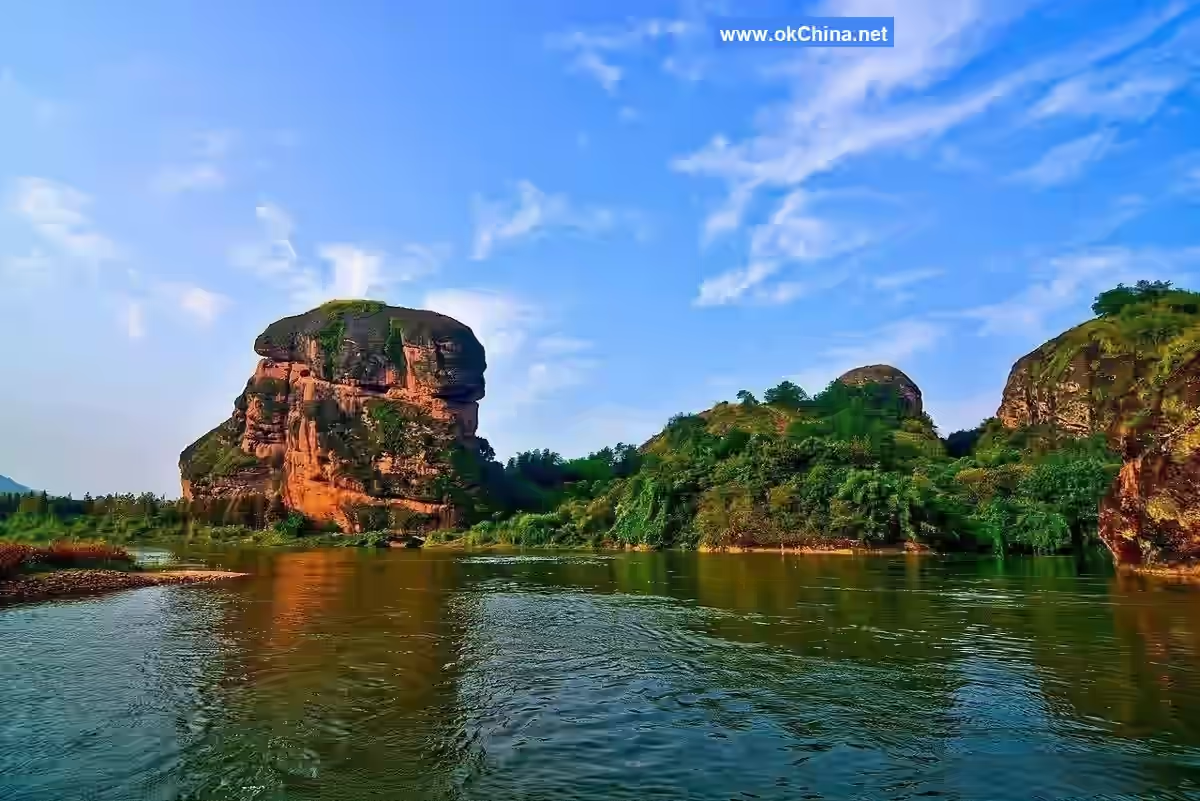
The Immortal Peach Rock is over 80 meters high. From a distance, it resembles a giant peach with a bite taken out of it. Legend says it is a peach picked by Sun Wukong from the Peach Orchard of Immortality when he wreaked havoc in heaven; taking a bite can grant 9,000 years of life, making it a folk symbol of longevity. The Immortal Peach Rock is a collapse remnant stone peak landscape formed by rainwater scouring and weathering.
3.1.3 Lotus Rock
Lotus Rock is located next to the Immortal Peach Rock. It consists of over ten giant rocks shaped like petals arranged in a circle, resembling blooming lotus petals. From afar, it looks like a lotus flower floating motionless in water. A small rock in the center resembles a lotus seed pod, and a small frog-shaped rock beside it completes the scene of "Frog Playing with Lotus." Lotus Rock is a small peak cluster landscape formed by rocks that collapsed from a higher mountain.
3.1.4 Jade Comb Rock
Jade Comb Rock resembles a comb used for hair. Folklore says it can comb away worries and sorrows from the heart. It is a tooth-shaped landscape formed by rocks that collapsed from the mountain body and were hollowed out along joints by flowing water.
3.1.5 Immortal Mushroom Rock
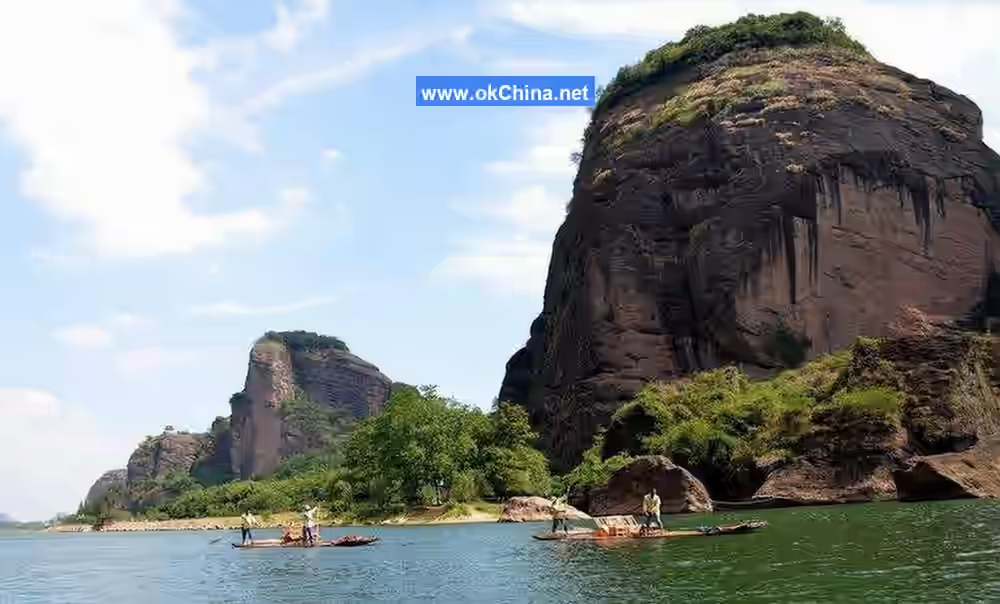
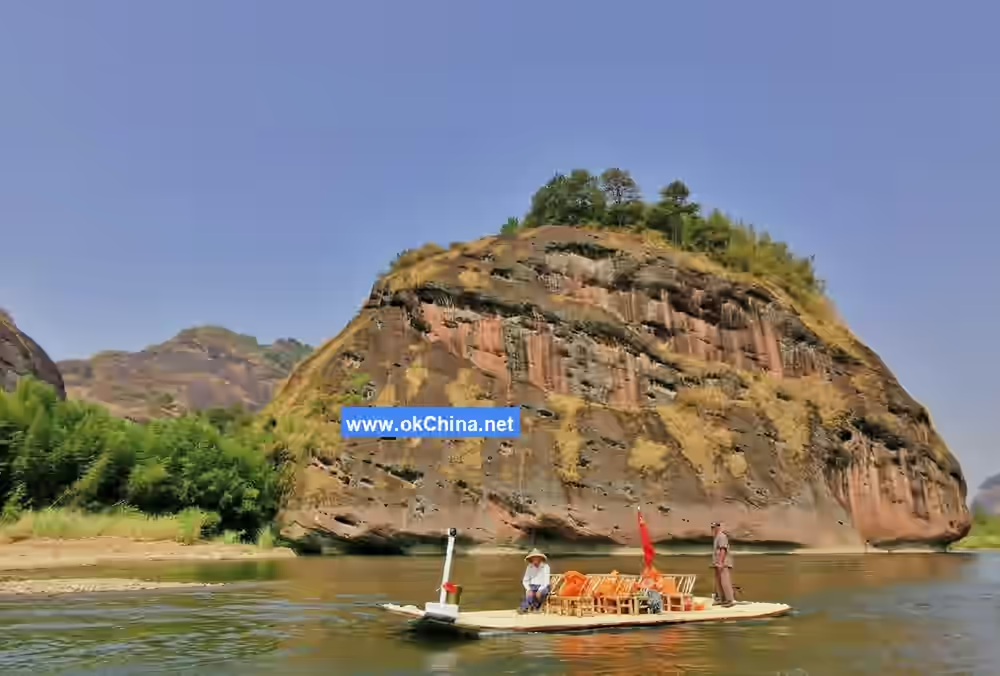
The Immortal Mushroom Rock peak emerges from the water with a rounded top, about 30 meters high, resembling a large mushroom standing in the water. Legend says it was a gift from the Eight Immortals to Celestial Master Zhang. The rock was shaped by long-term river erosion, with its base hollowed into a ring-shaped groove, making the whole structure look like a mushroom standing in water.
3.1.6 Stone Drum Peak
Stone Drum Peak, also known as Literary Master Peak, is about 80 meters high and resembles a giant drum. Viewed from the north, it looks like the head of Lu Xun or Maxim Gorky, hence its alternate name.
3.1.7 Daotang Rock
Daotang Rock is a cliff about 60 meters high. The side facing the water has been scoured by the river, forming a large horizontal cave. The water below the rock is deep and turbulent. Legend says Celestial Master Zhang performed Taoist rituals here to pray for the safety and blessings of passing travelers.
3.1.8 Brocade Rock
Brocade Rock is a stone peak about 100 meters high and 300 meters long. From a distance, the peak looks as if split by an axe, descending vertically with colorful hues resembling a giant brocade shawl. Legend says this shawl, woven by the Weaving Maiden from heaven, is a colorful gate on earth; passing through it brings happiness and good fortune. The top of the shawl is inhabited by many wild birds, whose white droppings stain the red cliff face.
3.1.9 Fairy Maiden Rock
Fairy Maiden Rock is a natural landscape about 100 meters high, facing north. The lower part of the northern cliff resembles a nude woman, hailed as the "World's Most Unique Scenery."
3.1.10 Elixir Ladle Cave
Elixir Ladle Cave is located on the cliff of Jinzhong Peak on the west bank of the lower reaches of the Shangqing River in the Xianshuiyan section. The cave is about 2 meters above the water surface and about 10 meters high, resembling a wooden ladle used for scooping.
3.1.11 Cliff Tomb Cluster
The most concentrated area of cliff tombs from the Spring and Autumn and Warring States periods is on the cliffs of the west bank of the lower reaches of the Shangqing River in the Xianshuiyan section. These tombs are located 10 to 60 meters above the water, with the caves mostly facing east. Ancient people suspected they were dwellings of immortals and collectively referred to them, along with other caves, as the Twenty-Four Rocks. Based on their external shapes and features, they were named separately as Three Teachings Rock, Water-Viewing Rock, Immortal Granary Rock, Wine Jar Rock, Immortal Coffin Rock, Medicine Basket Rock, Alchemy Furnace Rock, Clog Rock, Loom Rock, Stable Rock, Eagle Perch Rock, Dyeing Tool Rock, Mortar and Pestle Rock, Immortal Music Rock, Lion Rock, Immortal Dog Rock, Immortal Goat Rock, Well-Windlass Rock, Iron Furnace Rock, Clay Material Rock, Immortal Boat Rock, Immortal Bed Rock, Hermitage Rock, Chess Playing Rock, etc. The Tang Dynasty poet Wang Zhenbai wrote in a poem: "White clouds rise by day from the alchemy furnace, red leaves in autumn bear seal script. Twenty-four rocks in the heavens, a rooster's crow breaks the clear clouds." The Xianshuiyan cliff tombs from the Spring and Autumn and Warring States periods are considered the best in China due to their concentration, large number, perilous locations, and rich cultural relics.
3.1.12 Mosquito-Free Village
Mosquito-Free Village is located in Xujia Village within the Xianshuiyan Scenic Area on the east bank of the Luxi River in Longhu Mountain, Jiangxi. It has about 50 households with over 200 people, recorded as descendants of Xu Zhenjun. Historically, villagers made a living by fishing and farming. Many villagers live long lives, so it is also called the Longevity Village. The village is nestled against mountains and beside water, warm in winter and cool in summer, with a mild climate. However, it has a peculiar phenomenon: there are no mosquitoes, hence the name "Mosquito-Free Village."
3.2 Paiya Peak
Paiya Peak is the first gateway to Longhu Mountain. The mountain range runs north-south in a narrow, elongated shape, with the highest peak at 267.5 meters. Paiya Peak consists of multiple groups of peaks lined up in a row with undulating ridges, including Camel Peak, Lotus Rock, Drunken Arhat, Carp Peak, and Zhuangyuan Peak. In a secluded valley lies Fox Rock. On the mountain in front of the valley, a rock is split as if cut by a knife or axe, commonly called "Big Knife Cut," said to have been formed when Guan Yu tested his blade.
3.3 Immortal City
Immortal City, also named after a poem by the Tang Dynasty poet Gu Kuang: "Towers and pavilions, colorful and green, distinctly far, I hear immortals dwell in this city. Wishing to ascend the immortal city, no path is found, by the water, among flowers, human voices sound," is one of the main attractions of Longhu Mountain. The entire peak rises abruptly from the ground like a pillar supporting the sky. Visitors pass through three mountain gates and climb 720 steps to reach the summit. Along the way, there are over ten scenic spots including Immortal Rat Rock, Phoenix Bridge, Immortal Water Well, Immortal Nun Nunnery, Clear and Turbid Pools, Dragon Transformation Pool, and Doushuai Palace.
3.4 Longhu Mountain Scenic Area
The Longhu Mountain Scenic Area includes Dragon Mountain and Tiger Mountain, located behind Zhengyi Temple. The main peak, Big Tiger Head, is 247 meters high and is considered the heart of the hundred-mile Longhu Mountain area. Legend says that during the Eastern Han Dynasty, the first Celestial Master, Zhang Daoling, came here to practice alchemy and cultivate the Dao. A green dragon and white tiger appeared and circled the alchemy cauldron. When the elixir was completed, the dragon and tiger appeared, so the name was changed to Longhu Mountain. Another theory says the two peaks face each other, resembling a dragon and a tiger, hence the name. Dragon Mountain and Tiger Mountain stand facing each other, surrounded by attractions such as Water Curtain Cave, Cauldron Washing Pool, Xue Family Fortress, and Twin Lions Rolling a Ball.
3.5 Seven Star Pools
The Seven Star Pools are located in front of Zhengyi Temple and are part of the temple's attractions. They consist of seven circular pools arranged to mimic the shape of the Big Dipper in the sky. Bounded by a path, the four pools to the north form the Dipper's bowl, named respectively Tian Shu (Alpha Ursae Majoris), Tian Xuan (Beta Ursae Majoris), Tian Ji (Gamma Ursae Majoris), and Tian Quan (Delta Ursae Majoris). The three pools to the east form the Dipper's handle, named respectively Yu Heng (Epsilon Ursae Majoris), Kai Yang (Zeta Ursae Majoris), and Yao Guang (Eta Ursae Majoris). The Big Dipper was one of the objects of star worship by ancient people, representing prayers for peace throughout the seasons and favorable weather. The Seven Star Pools in front of Zhengyi Temple reflect this ancient wish and also serve the function of water storage for fire prevention.### 3.6 Ceremonial Gate The Ceremonial Gate of Zhengyi Temple is located behind the main gate. Ceremonial gates generally refer to the gate inside the main gate of an official compound, symbolizing the presence of proper decorum and formality. The Ceremonial Gate demonstrates the noble status and majesty of Zhengyi Temple. Painted on the Ceremonial Gate are the Four Door Gods, protectors of Taoism: Tianpeng Yuzhen Shouyuan Zhenjun holding a precious seal, Tianyou Renzhi Lingfu Zhenjun holding a sword, Yisheng Baode Chuqing Zhenjun holding a halberd, and Yousheng Zhenwu Lingying Zhenjun holding a fire wheel.
3.7 Nine-Bend Islet
Nine-Bend Islet is located south of Zhengyi Temple on the north bank of the Shangqing River, approximately 3 kilometers from the temple. It is a national ecological agriculture demonstration site, with the entire scenic area covering over 450 mu (about 30 hectares). The area features attractions and facilities such as bamboo groves, pear orchards, peach orchards, fishing ponds, leisure areas, conference halls, and villas. It is an agricultural ecological park integrating sightseeing, leisure, vacationing, conferences, and scientific research.
3.8 Shangqing Palace Scenic Area
The Shangqing Palace Scenic Area is a significant Taoist cultural attraction on Longhu Mountain, boasting abundant historical relics and cultural landscapes.
3.8.1 Shangqing Ancient Town
Shangqing Ancient Town is a historic town with a history spanning over a thousand years. Located within the Shangqing Palace Scenic Area, 25 kilometers from Yingtan City, the town is home to numerous historical sites and monuments. The approximately 2-kilometer-long ancient street features attractions such as Changqing Lane, Liuhou Family Temple, Celestial Master's Mansion, Liuhou Residence, Tianyuande Medicine Shop, and a Catholic church.
3.8.2 Great Shangqing Palace
Great Shangqing Palace, initially named Celestial Master's Thatched Cottage and also known as Zhenxian Temple, Shangqing Palace, and Shangqing Zhengyi Palace, is located in the eastern part of Shangqing Town, Longhu Mountain, Guixi County, Yingtan City, Jiangxi Province. Situated at the foot of Longhu Mountain, it embraces Elephant Mountain to the left, faces the Luxi River at its gate, overlooks Yunlin, and rests against Taishi. It served as the place where successive Celestial Masters worshipped deities. Founded during the Eastern Han Dynasty, it has been a religious site for the Zhengyi Dao lineage since the establishment of its altar in the Northern Song Dynasty, enduring through the Song, Yuan, Ming, and Qing dynasties. It is the ancestral temple of the Zhengyi Dao branch of Chinese Taoism, where successive Celestial Masters expounded doctrines, performed rituals, and subdued demons.
3.8.3 Celestial Master's Mansion
The Celestial Master's Mansion is located in Shangqing Town, Guixi, Yingtan City, Jiangxi Province. It was first built at Guannenkou in Shangqing Town in the 4th year of the Chongning era of the Song Dynasty (1105 AD). It was relocated to Changqing Lane in Shangqing Town in the 6th year of the Yanyou era of the Yuan Dynasty (1319 AD) and moved to its current site in the 1st year of the Hongwu era of the Ming Dynasty (1368 AD). It was destroyed by fire in the 13th year of the Kangxi era of the Qing Dynasty (1674 AD). In April 1983, the State Council designated the Sihan Celestial Master's Mansion as a nationally protected key Taoist temple, listing it as one of China's 21 major Taoist temples.
3.8.4 Tianmen Mountain
Tianmen Mountain is located in the southeastern part of Shangqing Town, Longhu Mountain, Guixi City, Jiangxi Province, about 7 kilometers from Shangqing Town. Facing the Sihan Celestial Master's Mansion to the north and south, it covers an area of over 6,000 mu (about 400 hectares), with its highest peak reaching over 1,300 meters above sea level, making it the highest peak in the Longhu Mountain scenic area. Legend has it that Tianmen Mountain is where Celestial Master Zhang achieved immortality and ascended to heaven. Emperor Qianlong visited this site during his southern tours.
3.8.5 Shengjing Mountain
The Shengjing Mountain scenic area is divided into four main parts: a comprehensive service area, a main rafting entertainment area, a transfer service area, and an ecological exploration sightseeing area. Its main projects include canyon rafting, a visitor center, Shengjing Fairyland Park, a resort hotel, a tourist cableway, hiking trails, and a 4D immersive projection time tunnel.
3.8.6 Yingtian Mountain
Yingtian Mountain, also known as "Chanshi Mountain" or "Elephant Mountain," is located 8 kilometers east of Shangqing Town. With an elevation of 811 meters, the mountain features nine peaks connected like an emerald screen. Master Mazu, founder of the Buddhist monastic system in the Tang Dynasty, once resided on the northern part of the mountain. During the Yuanfeng era of the Song Dynasty, the monk Ying built a temple at the southern foot's Jijiao Ridge, naming it "Yingtian Temple," after which the mountain was renamed "Yingtian Mountain." In the 14th year of the Chunxi era of the Southern Song Dynasty (1187 AD), the educator Lu Jiuyuan, invited by his disciple Peng Shichang, came to Yingtian Mountain. Observing the mountain's shape resembling a giant elephant, he named it "Elephant Mountain," calling himself "the Old Man of Elephant Mountain." He established the Elephant Mountain Thatched Cottage, inscribed the plaque "Elephant Mountain Retreat," and lived there lecturing for five years (1187-1191 AD), attracting over a thousand disciples. In the 2nd year of the Shaozhao era of the Southern Song Dynasty (1191 AD), Lu Xiangshan (Lu Jiuyuan) was appointed to govern Jingmen, and the Elephant Mountain Retreat gradually declined. Yuan Fu, the Jiangdong judicial commissioner and a second-generation disciple of Lu Xiangshan, petitioned the court to relocate the retreat to the foot of Sanfeng Mountain across the Xin River from Guixi County town, citing inconvenient transportation at Yingtian Mountain. In the 5th year of the Shaoding era of the Southern Song Dynasty (1132 AD), it was granted the plaque "Elephant Mountain Academy," which became one of the four great academies of the Southern Song Dynasty. The main scenic spots in the Yingtian Mountain area include the ruins of Elephant Mountain Retreat, the ruins of Yingtian Temple, the Seven-Level Waterfall, Nine Peaks Linked Like a Screen, Archery Rock, Sutra Rock, and Resting Rock.
3.9 Mazu Rock and Hongwu Lake Scenic Area
The Mazu Rock and Hongwu Lake Scenic Area combines the natural scenery and cultural landscapes of Longhu Mountain.
3.9.1 Mazu Rock
The Mazu Rock scenic area is located about 5 kilometers northeast of Xiangxi Village, Shuibei Village Committee, Honghu Township, Yujiang District, Yingtan City, Jiangxi Province. The area is surrounded by a 10-li (about 5 km) ring of mountains with steep rock cliffs. Initially named "Immediate Horse Rock" because the summit rock resembled a horse's head, it was later renamed Mazu Rock after the eminent Tang Dynasty monk Master Mazu Daoyi (709-788 AD), founder of the Chinese Buddhist monastic system and the Hongzhou school, who had a profound influence on the spread of Southern Chan Buddhism in Jiangxi and Hunan during the mid-Tang, forming the "Jianghu School." He taught Chan scriptures here. Inside is a horseshoe-shaped valley. Its main attractions include One-Line Sky, Daizong Lecture Hall, Piercing Rock, and Moon Pool.
3.9.2 Swan Lake
Swan Lake is located beside the Honghao Highway in Longhu Mountain, Yingtan City, Jiangxi Province, 2 kilometers from National Highway 206 and 4 kilometers north of Xianshui Rock. Attractions include the Thousand Buddha Cave, Bodyguard Peak, and Screw Ridge, which have attracted many literati and artists throughout history. The Ming Dynasty traveler Xu Xiake visited here in October of the 9th year of the Chongzhen era (1636 AD) and recorded the caves and temples in his diary. The famous Chan master Mazu once lectured here, attracting many monks to build dwellings in a series of connected caves about 250 meters long, capable of accommodating a thousand people. Circular marks chiseled by people at that time can still be seen on the cave walls. The lake is named for its swan-like shape.
3.9.3 Incense Burner Peak
The Incense Burner Peak scenic area is located 3 kilometers west of Koushang Village Committee, Yujia Township, Guixi City, Jiangxi Province. It is one of the ninety-nine peaks of Longhu Mountain. It is named for its flat, round summit resembling an incense burner. The Qing Dynasty "Longhu Mountain Annals" records: "Incense Burner Peak is northwest of Longhu Mountain, standing tall and erect. Stone steps were chiseled for a winding ascent; along the way, stone holes were also chiseled for climbing. At the summit, there is a Chan temple." Incense Burner Peak stands majestically, surrounded by the Incense Burner Peak Reservoir. There is a cave halfway up the mountain containing cliff tombs from the Spring and Autumn and Warring States periods. Attractions here include Immortal Cave, Immortal Bed, Thousand-Zhang Slope, and Courage-Testing Cliff, with springs, bamboo forests, and stone tomb ruins above. The Ming Dynasty poet Huang Yingyuan wrote in his poem "Visiting Incense Burner Rock of Longhu Mountain": "Spring mist vast, rain dim, locking Incense Burner's myriad ren of green. This day viewing from boat is not enough; when shall I lean on staff and knock on the rock's door?"
3.9.4 Hongwu Lake
The Hongwu Lake scenic area consists of the Honghu and Wuhu reservoirs and their surrounding landscapes, located in the central part of Honghu Township, Yujiang County, Yingtan City, Jiangxi Province. The Wuhu Reservoir was built in 1957 and is the second-largest reservoir in Yujiang County. It has a total storage capacity of 22.4 million cubic meters and a maximum surface area of 7,000 mu (about 467 hectares). The lake surface resembles a palm, hence its name. There is a small island in the lake whose size varies with water level fluctuations. The lake and mountain scenery change dramatically with the seasons and climate. A main dam, 42.3 meters high and 1,165 meters long, is built at the northern end of the reservoir. The reservoir is rich in fish, including over 20 species such as crucian carp, silver carp, carp, grass carp, and eel, with an annual yield of 75,000 to 100,000 kilograms. It is also home to many birds, including over 10 precious species like white cranes, gray cranes, wild geese, and wild ducks, making it a famous migratory bird area.
3.10 Guigu Cave Scenic Area
The Guigu Cave Scenic Area combines Taoist culture and natural landscapes of Longhu Mountain.
3.10.1 Ningzhen Temple Ruins
The Ningzhen Temple ruins are located at the foot of Guigu Cave, 35 kilometers south of Shangqing Palace, covering an area of about 1,800 square meters. Judging from the remaining stone foundations, this was once a large-scale Taoist temple. It was funded and established by Li Jing, the middle ruler of the Southern Tang, and his son, the later ruler Li Yu. In the 11th year of the Baoda era of the Southern Tang (953 AD), Taoists Wei Xiaoran and Wu Baohua practiced cultivation here. It was renovated during the Jiayou era of Emperor Renzong of the Northern Song Dynasty (1056-1063 AD). During the Zhiyuan era of the Yuan Dynasty (1271-1294 AD), Taoist Wu Yushun rebuilt it, featuring four halls, four chambers, and side rooms with accompanying quarters. The great Yuan Dynasty calligrapher Zhao Mengfu wrote a poem "Guigu Rock": "The rock before Guigu, Tang characters each strange. When shall I brush off the green moss, to read closely the Laojun stele?" It has been over 2,300 years since Master Guigu practiced Taoism and taught disciples here. At the end of 1998, a statue of Master Guigu was erected on the ruins of Ningzhen Temple. Approved by the Yingtan City Religious Affairs Bureau, several Taoist disciples have since taken vows and practiced here. Affiliated with the Zhengyi sect, it is a site for worshipping the patriarch and deities of the Taoist Fifteenth Grotto-Heaven, as well as a main venue for fellow Taoists to gather, exchange knowledge, promote Taoist culture, and engage in religious activities.
3.10.2 Guigu Cave
Guigu Cave is located halfway up Yunmeng Mountain, shaped like a cliff dwelling, open outside and narrowing inside. It is about 3 meters high, 8.5 meters deep, and 4.8 meters wide. The cave walls are composed of marine sedimentary rock. On both sides of the entrance are artificially chiseled door sills, with stone holes above for installing doors. The cave entrance is guarded by a symbolic carp figure. On the upper left and right sides of the entrance are natural stone bells and stone drums. It is said that in ancient times, when the drum was struck, it could be heard in Dongyuan Village. The cave ceiling features symbolic sun, moon, and stars. Legend says there is a shallow concave circular hole on the ceiling, called the natural moon stone, which is said to move. Over hundreds of years, it has slowly moved from the center of the ceiling to its edge. In the past, whenever people visited Guigu Cave, they would observe the position of the moon stone. A legend states: "When the moon stone descends the mountain, the world will achieve great harmony." At the deepest part of the cave is a statue of Master Guigu.#### 3.10.3 Millennial Leguminous Wisteria The Millennial Leguminous Wisteria grows on the right side of the Ghost Valley Cave. The ancient vine's shape remarkably resembles a coiled dragon, complete with dragon eyes, dragon whiskers, and a dragon mouth, leading local people to also call it the Dragon Vine. With a diameter of 24 cm, a circumference of 72 cm, and a thickness comparable to a water bucket, the Dragon Vine stands several zhang tall and is located beside the left side of the Ghost Valley Cave. The great Yuan Dynasty poet Yuan Jue praised it in a poem: "Across the primeval stone it sprawls, this vine of a thousand years short and long; Moved by the hermit of the cliff, who drinks alone from the ancient stream water." This vine was already a thousand years old by the Yuan Dynasty, and it now has a history of approximately 2,000 years.
3.10.4 Ghost Valley Small Cave
The Ghost Valley Small Cave is located about 100 meters to the right of the Ghost Valley Cave, with an irregularly shaped entrance. The entrance is 35 cm wide, 50 cm high, with an opening diameter of about 45 cm. The opening faces upward and is smooth and glossy. Above the cave, massive, rugged rocks rise like towering pavilions and layered towers, forming a natural roof for this spiritual cave. The interior is dimly lit, the cave is about 8 meters deep, spiraling in shape, with stalactites hanging upside down and a rugged rock scenery. Bats inhabit the cave, scattering in all directions upon seeing people but never colliding with them. To enter the cave, one must face the yellow earth, prostrate oneself completely, first lower the left foot, then the right foot, thrust the body in, then raise both hands together and descend vertically to reach the ground. This cave is where Master Ghost Valley secluded himself for cultivation.
3.10.5 Zhang Yi's Well
Zhang Yi's Well is also known as the Forest Spring Well. It is located over 30 meters to the left of the Ghost Valley Large Cave, situated within a natural cliff cave. The well mouth resembles a horizontally lying precious gourd, with an opening diameter of about 2 meters. The spring water is clear to the bottom, neither overflowing nor drying up. Even if bamboo leaves fall in, they do not rot, and there is not a trace of any peculiar odor. It is said that this well was managed and maintained by Zhang Yi, a disciple of Master Ghost Valley, and is reputed to have the quality of "where the forest spring stops, it forever becomes an elixir mound."
3.11 Longhu Mountain National Geopark
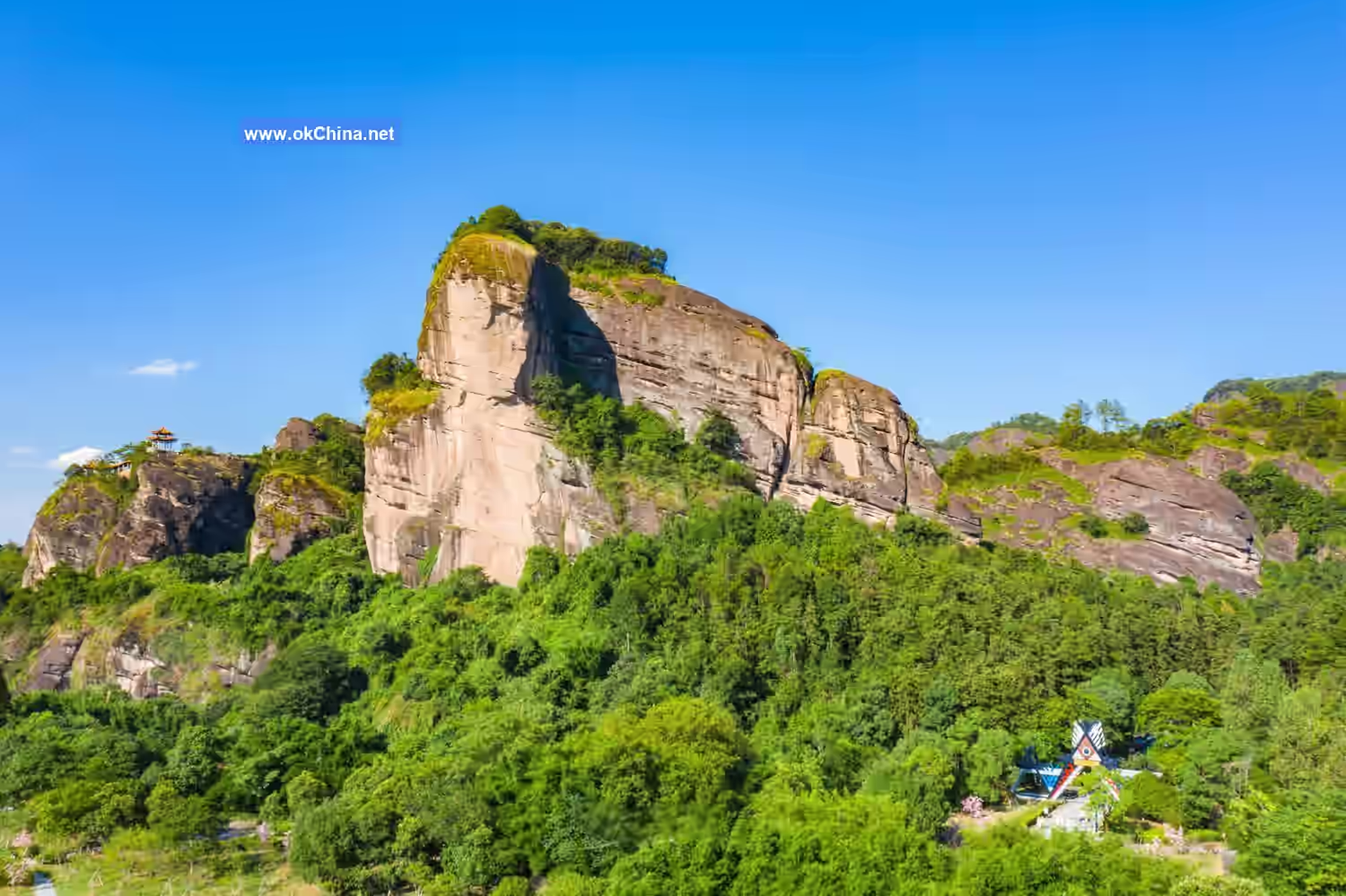
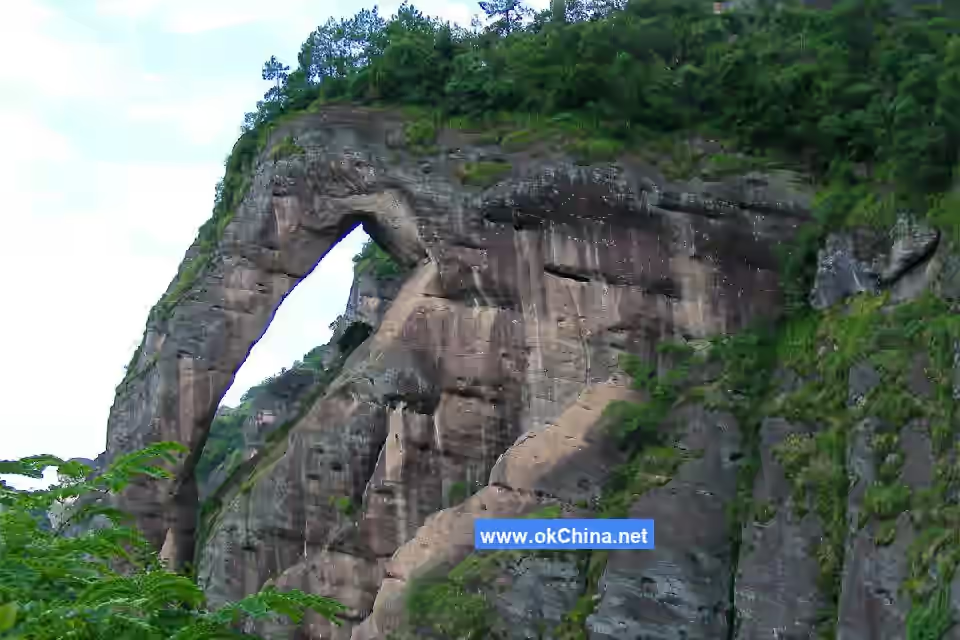
Longhu Mountain National Geopark is distinguished by its unique, typical, and comprehensive Danxia landform landscapes, integrated with rich Taoist cultural and cliff tomb cultural landscapes, supplemented by volcanic rock geological and geomorphological relics. It is a national geopark primarily serving functions of scientific investigation, science education, sightseeing, and cultural tourism. Elephant Trunk Hill is one of the most typical landscapes in the Longhu Mountain Geopark. It is a residual stone beam arch-type landscape formed by long-term erosion, dissolution, weathering, and collapse. A stone beam hangs down from a peak about 100 meters high, making the entire mountain look like a giant stone elephant drawing water. The scenic area centered around Elephant Trunk Hill also includes Immortal Pillbox Peak, Gentian Cliff, Elephant Viewing Platform, Zhengyi Immortal Peak, Hundred-Year Cave Mansion, Golden Dragon Drawing Water, Hanging Vines, Xujing Hall, She Village, Axe-Cleaved Divine Mountain, Mask Rock, Lion Looking Back, Golden Turtle Raising Its Head, and more. "Immortal Elephant After Rain" is one of the eight major land route scenic spots of Longhu Mountain.
4. Cultural Resources
4.1 Historical Evolution
During the Xia, Shang, and Western Zhou periods, the Longhu Mountain area belonged to the territory of Yangzhou. In the 24th year of Qin Shi Huang (223 BC), Qin general Wang Jian conquered Chu. The court established Jiujiang Commandery in the Gan-Yue region, under which was Fan County; Longhu Mountain belonged to it. In the 28th year of Qin Shi Huang (219 BC), Fan County was divided to establish Yuhan County, which included townships like Gexing, Geyang, and Jinxing; Longhu Mountain belonged to Jinxing Township. At the end of the Qin Dynasty, rebel armies rose everywhere, and the land fell into chaos. The Longhu Mountain area came under the jurisdiction of Fan County Magistrate Wu Rui. In the 1st year of Yuankang era of Jin Dynasty (291 AD), Jinxing Township of Yuhan was separated to establish Jinxing County; Longhu Mountain belonged to it. In the 4th year of Wude era of Tang Dynasty (621 AD), Poyang Commandery was changed back to Raozhou; the county and township affiliation of Longhu Mountain remained unchanged. In the 8th year of Wude era of Tang Dynasty (625 AD), Xiongshi Garrison was established in Jinxing Township of Yugan County, located between the city gate and Shawan of present-day Shangqing Town. Troops were stationed to defend the strategic junction between Jiangxi and Fujian. The garrison commander was called the Military and Civilian Garrison Commander. The Longhu Mountain area was effectively under its jurisdiction until the garrison was abolished and placed under county administration in the 8th year of Kaibao era of Song Dynasty. In the 1st year of Qianyuan era of Tang Dynasty (758 AD), parts of Raozhou, Quzhou, Jianzhou, and Fuzhou were carved out to establish Xinzhou. Longhu Mountain still belonged to Jinxing Township of Yugan County, Raozhou. In the 1st year of Yongtai era of Tang Dynasty (765 AD), upon the petition of Li Mian, the Surveillance Commissioner of Hongzhou, the western township of Yiyang and the southeastern township of Yugan were separated to establish Guixi County, subordinate to Xinzhou. From then on, Longhu Mountain belonged to Guixi County. In the 8th year of Kaibao era of Song Dynasty (975 AD), Song general Cao Bin conquered Southern Tang and pacified the Jiangnan region, gaining 19 prefectures. Guixi County's Longhu Mountain came under Song control, belonging to Xinzhou under Jiangdong Circuit. Xiongshi Garrison was abolished and reverted to Guixi County. Longhu Mountain belonged to Xianyuan Township of Guixi County until the end of the Qing Dynasty. In the 10th year of the Republic of China (1921), the Longhu Mountain area belonged to Shangqing Township (present-day Shangqing Town) and Jianpu Township (present-day Longhu Mountain Town) of Yingtan District, Guixi County. On May 4th, the 38th year of the Republic of China (1949), the Chinese People's Liberation Army liberated Guixi. On May 7th of the same year, the Guixi Supervisory Commissioner's Office was established in Yingtan Town, and Guixi County was placed under it.
4.2 Origin of the Name
In the middle of the Eastern Han Dynasty, Zhang Daoling, the founder of the Way of the Celestial Masters (Zhengyi Dao), practiced alchemy here. Legend says, "When the elixir was completed, a dragon and a tiger appeared, hence the mountain got its name."
4.3 Taoist Culture
"Celestial Master" was the leadership title Zhang Daoling bestowed upon himself when he founded Taoism. At that time, he established twenty-four parishes (zhi) in the Ba-Shu region, implementing a theocratic system equivalent to dioceses. The leader of each parish was called a "Dugong," while Zhang Daoling himself served as the Dugong of the first parish (the central diocese) (hence the origin of the Taoist artifact "Yangping Zhi Dugong Seal") and assumed the title "Celestial Master." Since then, the title of Celestial Master became hereditary. His descendants who succeeded him all assumed the title "Celestial Master," and those not of Zhang lineage could not inherit the position. Zhang Daoling (the Patriarch Celestial Master), his son Zhang Heng (the Successor Celestial Master), and his grandson Zhang Lu (the Lineage Celestial Master) were all active in the Ba-Shu area. Legend says they all ascended to the heavens and joined the ranks of immortals. His great-grandson Zhang Sheng (the Fourth Generation Celestial Master) moved to and settled at Longhu Mountain towards the end of the Han Dynasty. After the Fourth Generation Celestial Master migrated from Shu to Longhu Mountain and settled there, Longhu Mountain became the "Ancestral Court of the Celestial Masters." For a long time, it was the "Taoist Capital" or the Southern "Taoist Capital," its status self-evident. Therefore, Longhu Mountain can be considered one of the birthplaces of Taoism. The Celestial Master's Mansion at Longhu Mountain is where successive Celestial Masters resided and is called the Ancestral Court of Zhengyi Dao. Zhengyi Dao, also known as the Way of the Celestial Masters, evolved from the Way of the Five Pecks of Rice. At the end of the Han Dynasty, after Zhang Lu surrendered to Cao Cao, the Way of the Five Pecks of Rice in Ba-Shu split. One branch spread to the Jiangdong region, called Zhengyi Dao, and moved from Hanzhong to Longhu Mountain. Therefore, as early as the Eastern Han Dynasty when Zhengyi Dao flourished, the Taoist temples and monasteries at Longhu Mountain were grand in scale and numerous, including 10 major Taoist palaces, 81 Taoist temples, 50 Taoist cloisters, along with many cultural and educational buildings like the Imperial Edict Pavilion, Scripture Repository, and Study Hall. Those preserved to this day include the Celestial Master's Mansion, Shangqing Palace, and Zhengyi Temple. In the early Ming Dynasty, Emperor Taizu Zhu Yuanzhang granted the 42nd Celestial Master Zhang Zhengchang the authority to "permanently oversee all Taoist affairs under heaven," expanding the Zhang Celestial Master's power from overseeing Taoist affairs in Jiangnan to overseeing national Taoist affairs. The Longhu Sect became the most prominent Taoist sect, Longhu Mountain became the national center of Taoism, and the Celestial Master became the spiritual leader of Taoism nationwide. However, during the Qing Dynasty, the religious status of Longhu Mountain gradually declined. In the mid-Qianlong period of the Qing Dynasty, the Celestial Master's rank was once demoted from the first rank to the fifth rank, later restored to the third rank. Nevertheless, out of respect for popular belief and tradition, the Qing court still granted the Celestial Master the hereditary succession of the teaching, treating him with the grace of a third-rank official and establishing this "as a permanent precedent." Until the late Qing Dynasty, although the status of Longhu Mountain Taoism declined (in fact, the overall status of Taoism declined), its status as the Ancestral Court of Taoism remained very lofty, second only to places like the White Cloud Temple at Wudang Mountain.
4.4 The Mystery of the Hanging Coffins
The 202 hanging coffins on the cliffs of Longhu Mountain remained an unsolved mystery for a long time. In the 1970s, people discovered decaying wooden planks floating down from Immortal Water Cliff onto the Luxi River. Subsequently, it was found that there were numerous burial niches in the crevices of the sheer cliffs, at varying heights above the water. In 1978, archaeologists conducted surveys within a radius of about 2.5 kilometers and discovered over 100 cliff tombs. The archaeological excavation lasted three months, scientifically clearing 14 cliff tombs, with 11 located at Water Rock and the others at places like Immortal Rock near Water Rock. The excavation retrieved 39 coffins, 16 relatively complete human skeletons, and over 220 artifacts including pottery, proto-celadon ware, bamboo and wooden utensils, textile tools, and textiles from the tombs. Radiocarbon dating of the coffins by the National Cultural Heritage Administration's Institute of Cultural Relics Protection Science and Technology revealed that the coffins date back approximately 2,500 years, confirming that these cliff tombs belong to the Spring and Autumn and Warring States periods.### 4.5 Historical Celebrities
4.5.1 Lu Jiuyuan
Lu Jiuyuan (1139–1193), courtesy name Zijing, art name Cunzhai, was known to the world as Master Xiangshan. Originally from Qingtian, Jinxi County, Jiangxi Province, he was a renowned philosopher and educator during the Southern Song Dynasty of China. Lu Jiuyuan passed the imperial examination (Jinshi) in the eighth year of the Qiandao era (1172) of the Song Dynasty and once served as a county registrar. In the fourteenth year of the Chunxi era (1187) of the Southern Song Dynasty, his student Peng Shichang visited a friend in Shangqing Town. Seeing that Yingtian Mountain in Shangqing was "high-peaked with deep valleys, lush forests, and clear springs," he discussed with friends the idea of building a thatched cottage to invite Lu Jiuyuan to come up the mountain to lecture. Lu Jiuyuan readily agreed. With his wife "donating items from her dowry to assist," a thatched cottage was built for him to live in. Noticing that the shape of Yingtian Mountain resembled an elephant, he named it Xiangshan Jingshe (Elephant Mountain Retreat) and called himself the Old Man of Xiangshan. His students flocked to study with him, building their own dwellings around the retreat, forming a sizable academy. Within less than five years, nearly a thousand people came to study there. Even the already famous Neo-Confucian master Zhu Xi yearned to visit; he wrote to Lu Jiuyuan, saying, "I have heard that the efforts to develop Xiangshan are progressing well, and the number of students is increasing. I regret not being able to visit and witness its wonders and scenery." After Lu Jiuyuan's death, his disciples relocated Xiangshan Jingshe to the foot of Sanfeng Mountain in Guixi and received an imperial edict bestowing the plaque "Xiangshan Academy." Due to its remarkable teaching achievements and profound influence, it became as famous as the Yuelu, Bailu, and Lize Academies, collectively known as one of the "Four Great Academies of the Southern Song Dynasty" in Chinese history. Lu Jiuyuan's educational philosophy formed its own system, with "understanding principles, aspiring to the Way, and cultivating character" as its founding purpose. The most prominent feature of his teaching was the absence of strict regulations; he advocated leading by example, emphasized practical application of learning, and guided students from the simple to the complex, from the easy to the difficult, step by step. It can be said he was a highly esteemed educator of his time. Lu Jiuyuan promoted the "Heart-Mind" theory, proposing the idea that "the mind is principle," asserting that "the principles of heaven, humanity, and things reside only within our minds," and believing that "the universe is my mind, and my mind is the universe." His doctrines were later inherited and developed by Wang Yangming of the Ming Dynasty, forming a school of thought known as the Lu-Wang School. Consequently, Lu Jiuyuan is honored by later generations as a "Great Confucian for All Ages" and is a famous philosopher of the Southern Song Dynasty. His writings and lectures were compiled posthumously into the Complete Works of Xiangshan, comprising thirty-six volumes. One branch of Lu Jiuyuan's descendants now resides in Xiyuan Lujia Village, Longhushan Town.
4.5.2 Zhu Danxi
Zhu Danxi (1281–1358), given name Zhenheng, courtesy name Yanxiu, was a famous physician of the late Yuan Dynasty from Yiwu, Zhejiang. Because his family had lived for generations by the Danxi stream, he was known as "Master Danxi." In his early years, he studied under renowned physicians, read extensively, and developed innovative ideas. In medicine, he believed that the human body is often "yin deficient and yang excessive," founding the famous Nourishing Yin theory, making him a representative figure of the Nourishing Yin School in traditional Chinese medicine. In practice, he treated patients based on syndrome differentiation of cold, heat, deficiency, and excess, prescribing accordingly with often miraculous results. He is revered as one of the Four Great Physicians of the Jin-Yuan period and one of China's Ten Great Medical Masters. His theories spread to Japan, forming the Danxi School within Japanese Kampo medicine, and a "Danxi Society" exists in modern times. Zhu Danxi was not only highly skilled in medicine but also possessed noble medical ethics. He would see patients regardless of weather, provided relief for impoverished patients, and gladly gave away medicine. His works include Differentiation of Cold Damage Disorders, Elaboration on the Essentials of External Medicine, Supplement to the Amplified Materia Medica, and Profound Insights from the Golden Cabinet. Zhu Danxi practiced medicine in Shangqing, Guixi, for many years. During a major dysentery epidemic in the Shangqing area, he tirelessly administered medicine day and night, saving many lives. To express their gratitude, the common people, after his death, voluntarily raised funds to erect a statue of Zhu Danxi in the "Changqing Temple" at the west end of Shangqing Town, renaming it "Lord Zhu Temple." Every year on the 22nd day of the seventh lunar month, people from nearby areas gather in Shangqing for a fair, congregating on the ancient street of Shangqing to buy, sell, visit relatives and friends, creating a lively folk custom scene.
4.5.3 Xia Yan
Xia Yan (1482–1548), courtesy name Gongjin, art name Guizhou, was from Guizhou Village, Shangqing Town. He passed the imperial examination (Jinshi) in the twelfth year of the Zhengde era (1517) of the Ming Dynasty. In the first year of the Jiajing era (1522), the 16-year-old Emperor Shizong ascended the throne. Xia Yan repeatedly submitted memorials urging the emperor to attend to state affairs, earning high praise from court officials and the emperor alike. Xia Yan was ordered to rectify court personnel, eliminating over 3,200 redundant officials. In the seventh year of Jiajing (1528), Xia Yan was transferred to the Ministry of Personnel and submitted a memorial requesting the emperor to "personally plow the southern suburbs and the empress to personally engage in sericulture in the northern suburbs, setting an example for the empire," suggesting the emperor and empress lead by example to encourage the empire to value agriculture and sericulture. Xia Yan also assisted Emperor Shizong in revising the sacrificial rites of the Confucian Temple and various other rituals, winning the emperor's appreciation and trust. In the twelfth month of the fifteenth year of Jiajing (1536), he was promoted to Grand Secretary of the Wuying Hall. In the eighteenth year of Jiajing (1539), he was granted the titles of Junior Tutor, Grand Guardian of the Heir Apparent, Special Advancement to Grand Master of Imperial Entertainments, and Pillar of State. He served as the Chief Grand Secretary (equivalent to prime minister). In the twenty-first year of Jiajing (1542), Xia Yan was dismissed and returned to Jiangxi due to an erroneous character in an imperial decree draft. He built the "Xianglu Thatched Hall" at the foot of Xiangshan Academy in his hometown, Guixi, to live in. He was reinstated in the twenty-fourth year of Jiajing (1545). In the twenty-sixth year of Jiajing (1547), regarding the Hetao region—fertile land surrounded by rivers on three sides but constantly harassed by Tatar invasions—he actively recommended and supported Zeng Xian, the Vice Minister of War overseeing three border regions, in advocating the recapture of Hetao. He was framed by the powerful minister Yan Song and dismissed from office. In the tenth month of the twenty-seventh year of Jiajing (1548), he was again framed. The emperor ordered the arrest and execution of Xia Yan, who had already been dismissed and was returning home, on the road to Tongzhou. After Emperor Jiajing's son, Emperor Muzong, succeeded to the throne, Xia Yan was rehabilitated and posthumously granted the title "Wenmin." Xia Yan's works include the eighteen-volume Guizhou Collection and Drafts of Memorials from the Ministry of Rites, which have been passed down. His poetry could expose social contradictions. For example, in Observing Women Transplanting Rice on the Road to Anxiang, he wrote: "South village, north village, compete in planting rice; New brides, young sisters-in-law, and old grannies alike; Green skirts tied at the waist, white cloths wrapping their heads; Hands tossing new seedlings like tossing shuttles; Drums beating incessantly, songs never ceasing; Seeming to have more strength in their arms than men; Since ancient times, men plow and women weave, Yet here one body diligently performs both tasks. Alas! How many ladies in the capital, With ten fingers unmoving, bodies adorned with gold."
4.5.4 Zhang Yuchu
Zhang Yuchu (1340–1410), courtesy name Zixuan, art name Wuweizi, alternative name Qishan. In the tenth year of the Hongwu era (1377) of the Ming Dynasty, he was enfeoffed as the 43rd Celestial Master. In the twenty-third year of Hongwu (1390), he was ordered to rebuild the Great Shangqing Palace. During the reign of the Jianwen Emperor, he was once demoted, so he built the Xianquan Jingshe (Xianquan Retreat) to live in at the foot of Huangruo Peak (5 kilometers southeast of Longhu Mountain). In the fourth year of the Yongle era (1406), he was commissioned to compile and edit Daoist texts. Zhang Yuchu could recite texts after reading them once, was well-versed in the classics, histories, and various schools of thought, and excelled at calligraphy and painting. He painted ink bamboo and exquisite orchids, forming his own style, and was called "the Confucian among the immortals." He believed that "literature conveys the Dao," and only when "the Dao is full, principles are clear, and spirit is sufficient, can one express it in writing and achieve correctness of nature and emotion." His works include the twenty-volume Xianquan Collection, the ten-volume Longhu Mountain Gazetteer, as well as Ten Regulations for the Daoist Community and Comprehensive Meaning of the Supreme Marvelous Scripture of Salvation, among others passed down. He was a Celestial Master who synthesized Daoist theory.
4.5.5 Lou Jinyuan
Lou Jinyuan (1689–1778), courtesy name Sanchen, art name Langzhai, self-styled Shangqing Waishi (Unofficial Historian of Shangqing). He was from Lou County, Songjiang (present-day Songjiang County, Shanghai). Lou Jinyuan studied Daoism at Longhu Mountain from a young age and attained deep mastery of Daoist theory, rules, and practices. In the fifth year of the Yongzheng era (1727) of the Qing Dynasty, he accompanied the 55th Zhang Celestial Master on a routine audience in the capital and was ordered to remain in Beijing to handle affairs. In the eighth year of Yongzheng (1730), he was appointed as the fourth-rank Superintendent of Longhu Mountain and enfeoffed as the Abbot of the Qin'an Hall, commissioned to repair the Great Shangqing Palace. In the eleventh year of Yongzheng (1733), he was granted the title Miao Zheng Zhenren (Marvelous Upright Perfected Person) and appointed as the founding Abbot of the Daguangming Hall. After Emperor Qianlong succeeded to the throne, he was granted the title of Grand Master for Thorough Counsel, given a third-rank salary, put in charge of the Daoist Registry seal, and served as Abbot of the Beijing Dongyue Temple. Among Orthodox Unity Daoist priests of the Qing Dynasty, Lou Jinyuan authored the most works, including one volume of Commentary on the Zhuangzi, one volume of Imperially Selected Sayings of Miao Zheng Zhenren, and a revised sixteen-volume Longhu Mountain Gazetteer. He also edited, revised, and published the ten-volume Yellow Register Liturgical Texts, making the Qing Dynasty's fasting and offering rituals comprehensively documented in this book.
Comments
Post a Comment