
Mount Lao
1. Introduction
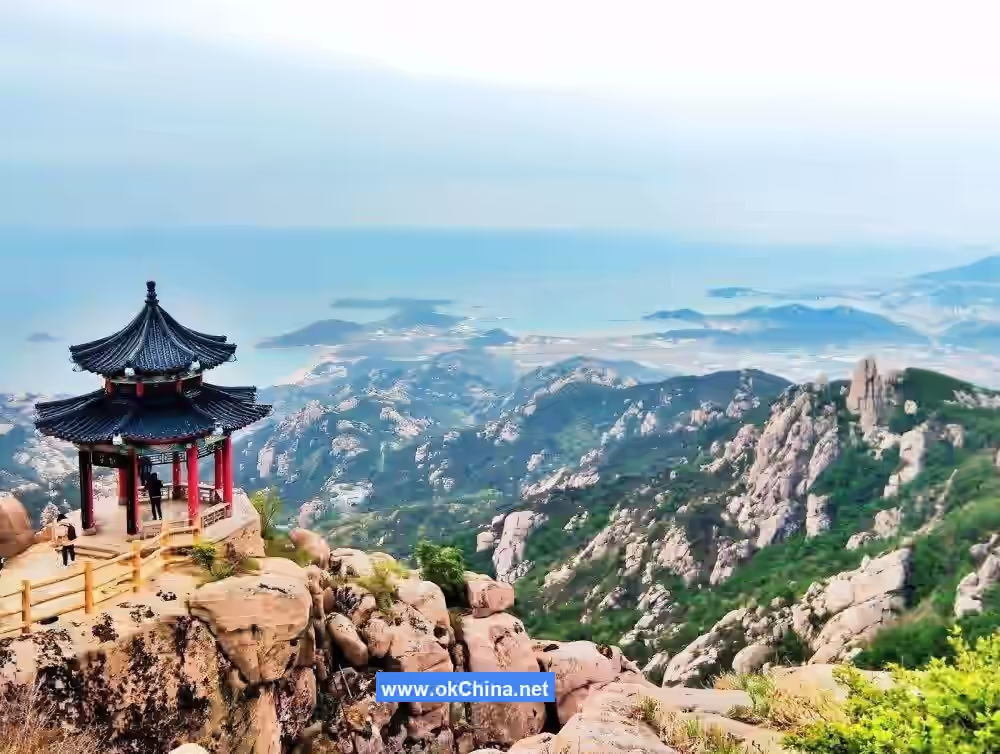
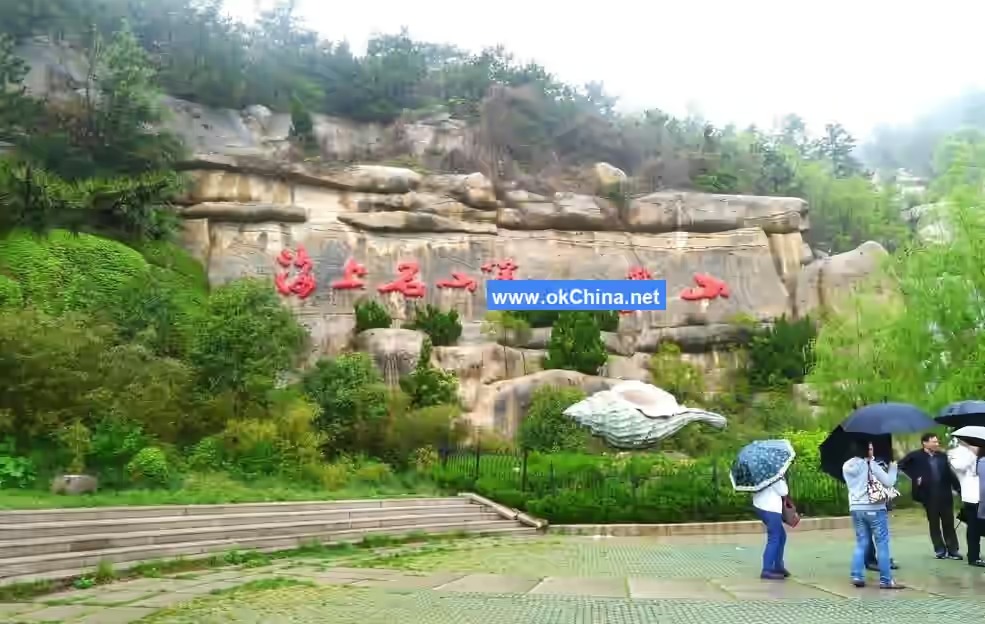
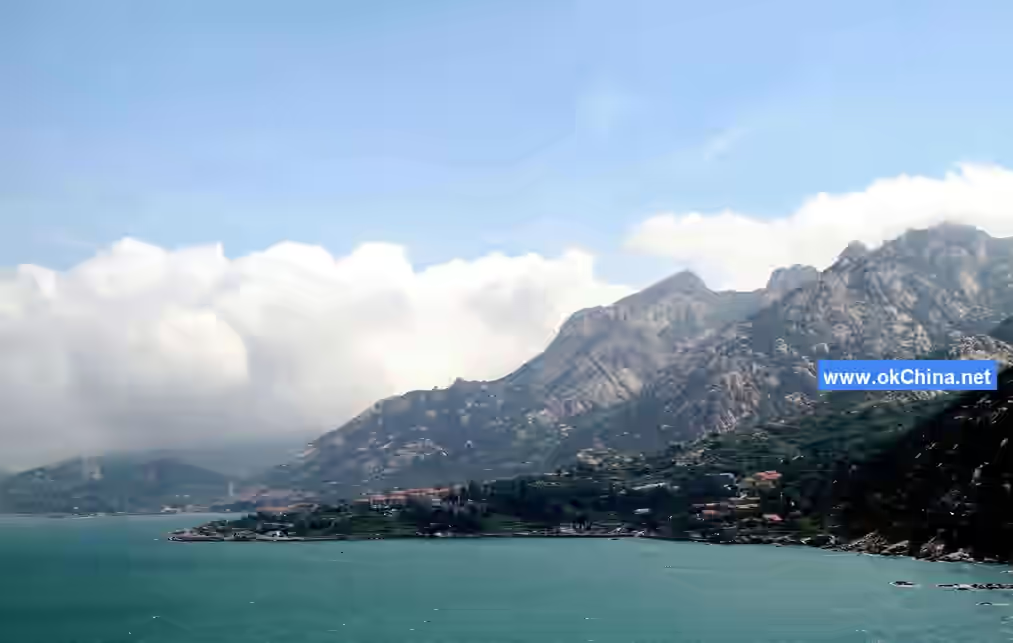
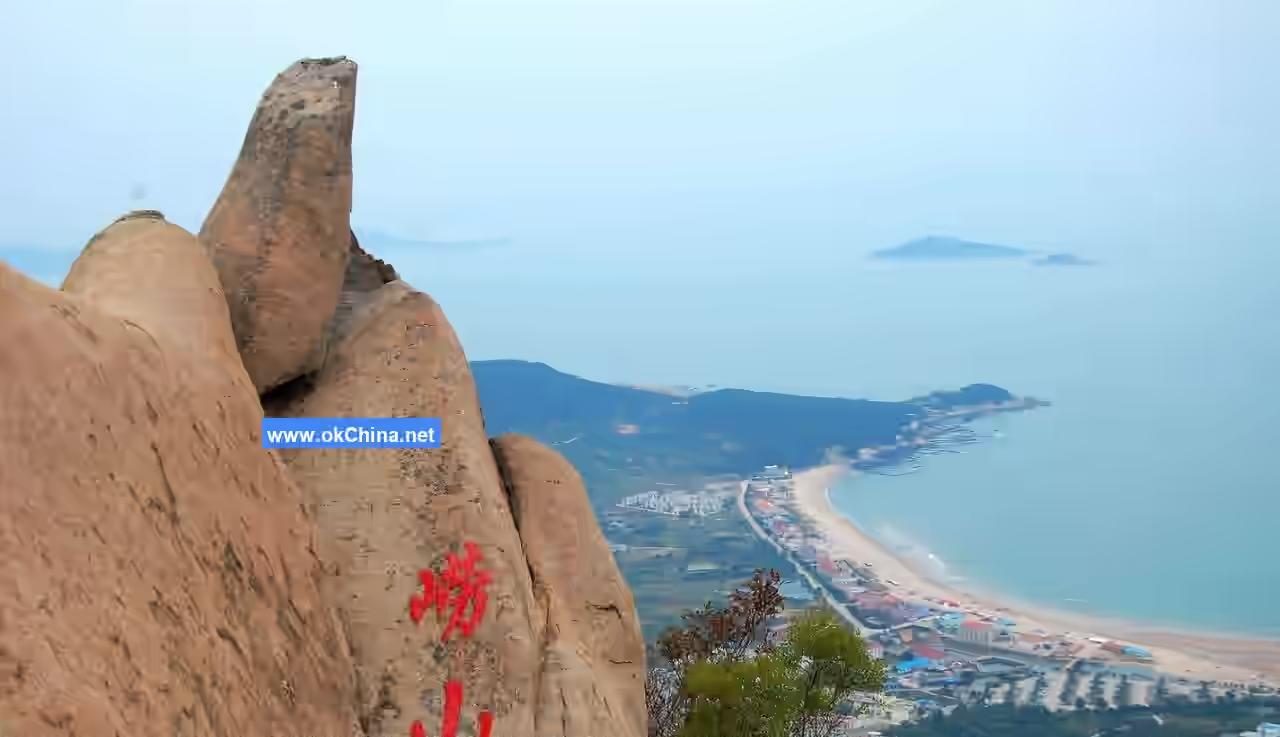
Mount Lao, historically also known as Mount Lao, Mount Lao, Mount Ao, etc., is located in the Laoshan District of Qingdao City, Shandong Province. It is a famous tourist mountain in China and the highest peak along China's coastline, renowned as the "Number One Mountain on the Sea." It covers a total area of 446 square kilometers.
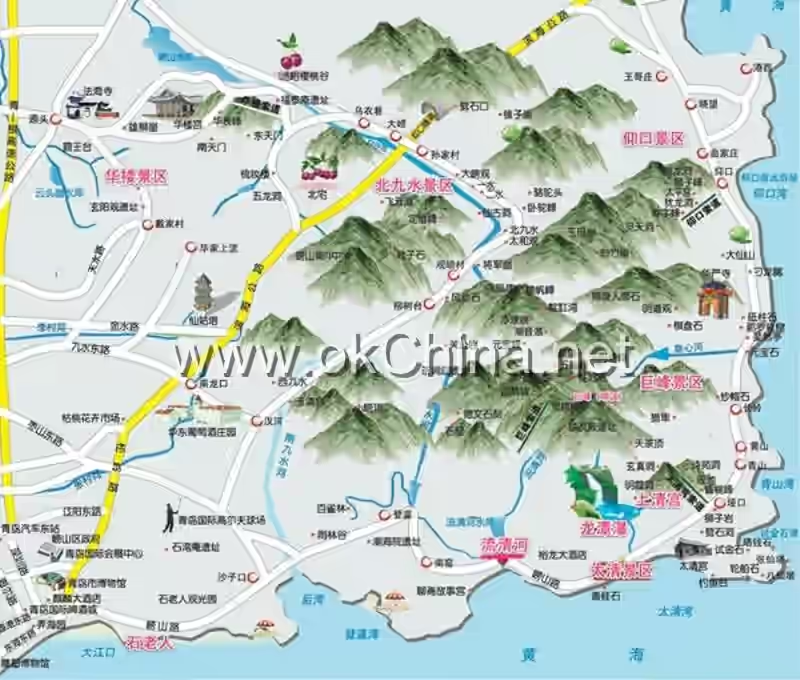
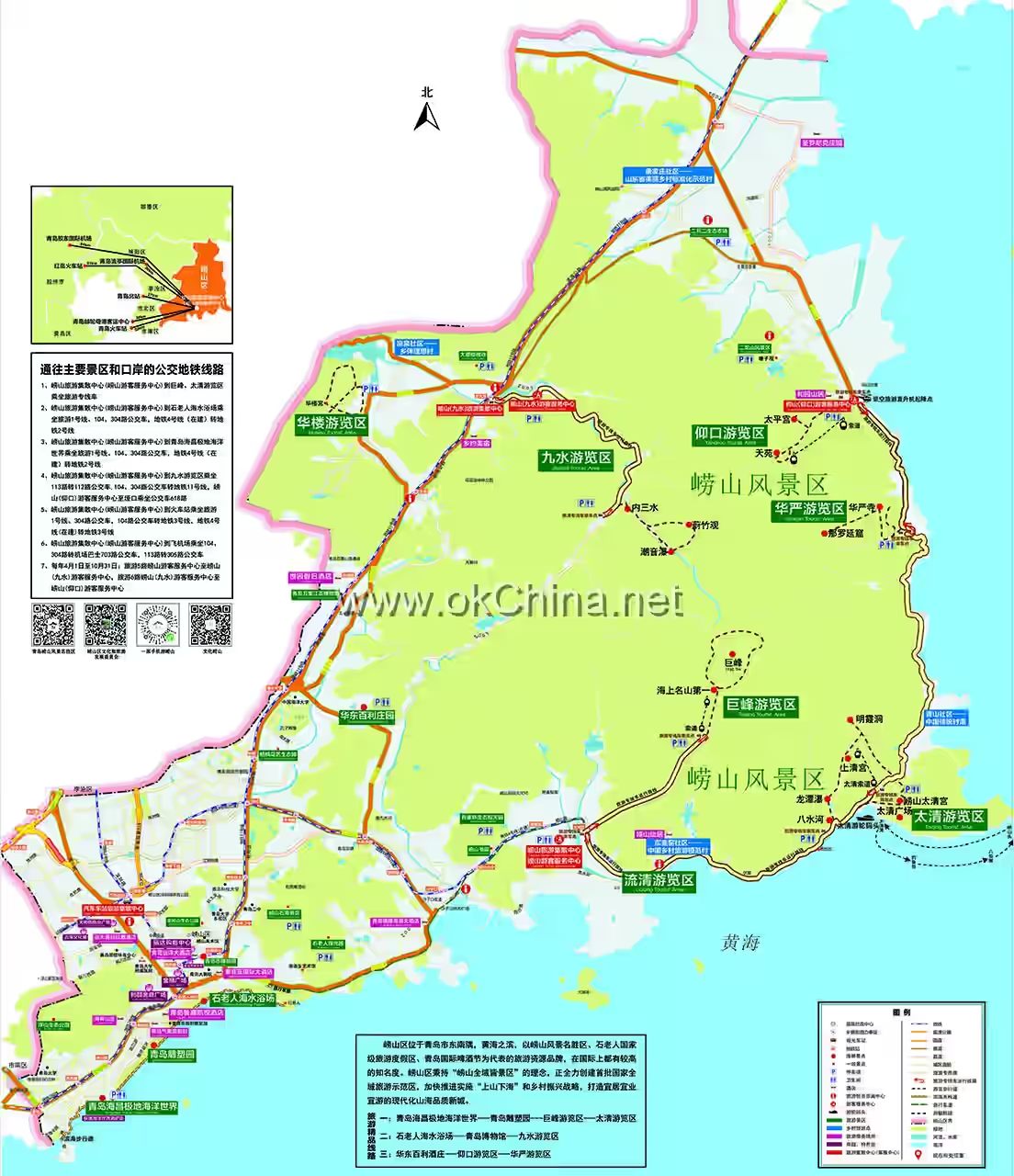
The terrain of Mount Lao is high in the east and gentle in the west. Its main peak is Jufeng, also known as Laoding, with an elevation of 1,132.7 meters and a summit area of approximately 1.5 square kilometers. It features a warm temperate continental monsoon climate with distinct seasonal changes, characterized by abundant rainfall, moderate annual temperatures, and a mild climate. Mount Lao boasts rich water resources with pure and clear water quality, serving as one of the important water sources for Tsingtao Beer. The area is home to a wide variety of flora and fauna, with forest coverage reaching 62.2%. Vegetation types include forests, shrublands, grasslands, and psammophytes. Wildlife includes mammals such as foxes and badgers, birds like cuckoos, sparrowhawks, and owls, as well as over 200 species of marine life including mackerel, hairtail, and chub mackerel. Additionally, Mount Lao contains abundant mineral resources such as granite and 681 types of medicinal herbs, earning it the title "Natural Medicine Repository." The core scenic areas of Mount Lao mainly include seven zones: Jufeng, Taiqing, Huayan, Yangkou, and Jiushui, among others. Key tourist routes include "Inquiring the Way at Taiqing," "Jufeng Panorama," "Taiping Birthday Wishes," "Huayan Prayers," and "Jiushui Gallery." Mount Lao is also one of the important birthplaces of Taoism in China, celebrated as the "Second Taoist Quanzhen Forest in the World."
2. Geographic Information
2.1 Location and Boundaries
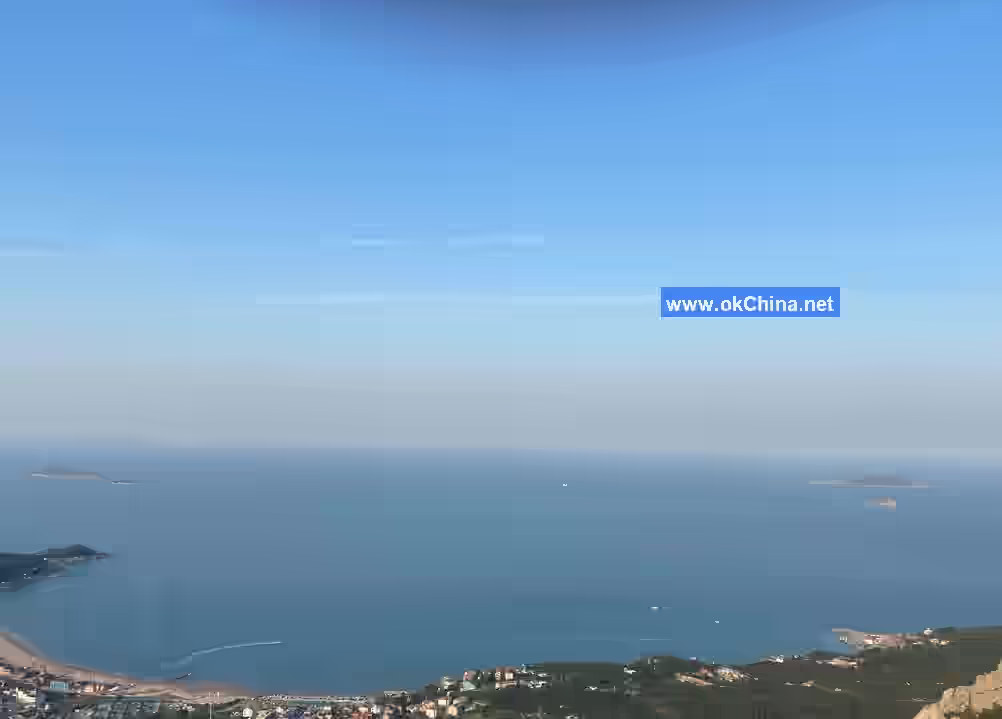
Mount Lao is situated on the coast of the Yellow Sea in the southern part of the Shandong Peninsula, between latitudes 36°05′N to 36°19′N and longitudes 120°24′E to 120°42′E, approximately 40 kilometers from downtown Qingdao. The mountain area borders the sea to the southeast, while its western side adjoins the Shinan, Shibei, Sifang, Licang, and Chengyang districts of Qingdao from south to north. Its northern boundary neighbors Jimo District.
2.2 Topography and Landforms
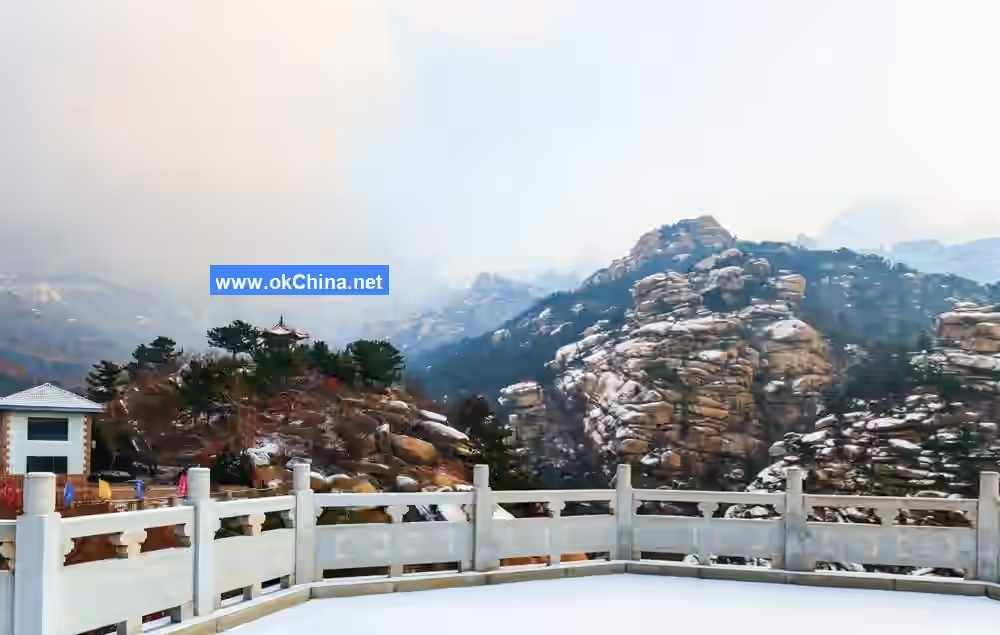
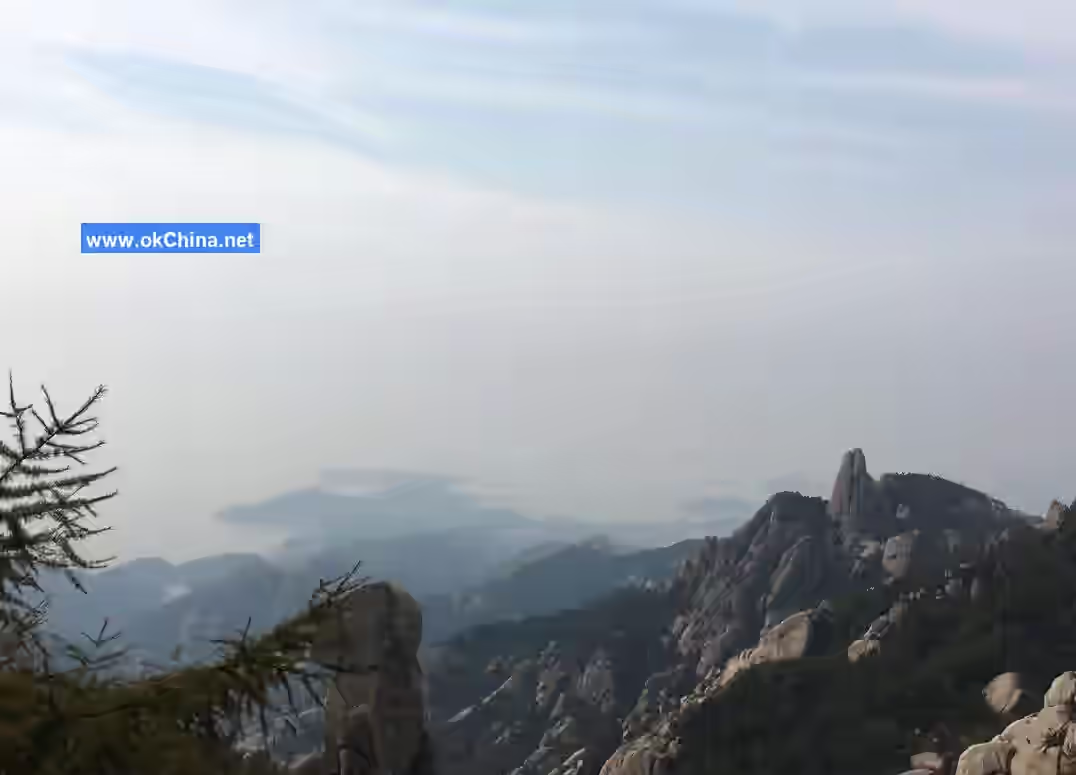
Mount Lao faces the Yellow Sea to the southeast and borders Jimo City to the north. The eastern side is higher and steeper, connecting to the sea, while the western side is gentler, characterized by hilly terrain. The mountain range centers around Laoding and extends in all directions, particularly stretching longer to the northwest and southwest. Its remaining ridges extend northward along the eastern coast to eastern Jimo City, westward to the shores of Jiaozhou Bay, and southwestward into downtown Qingdao, forming over ten peaks and undulating hills.
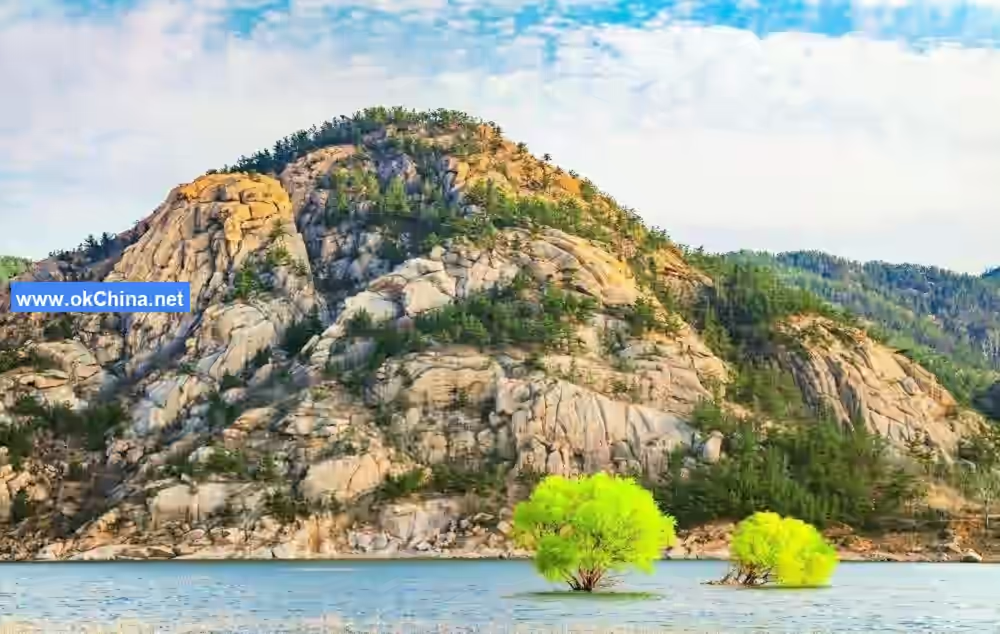
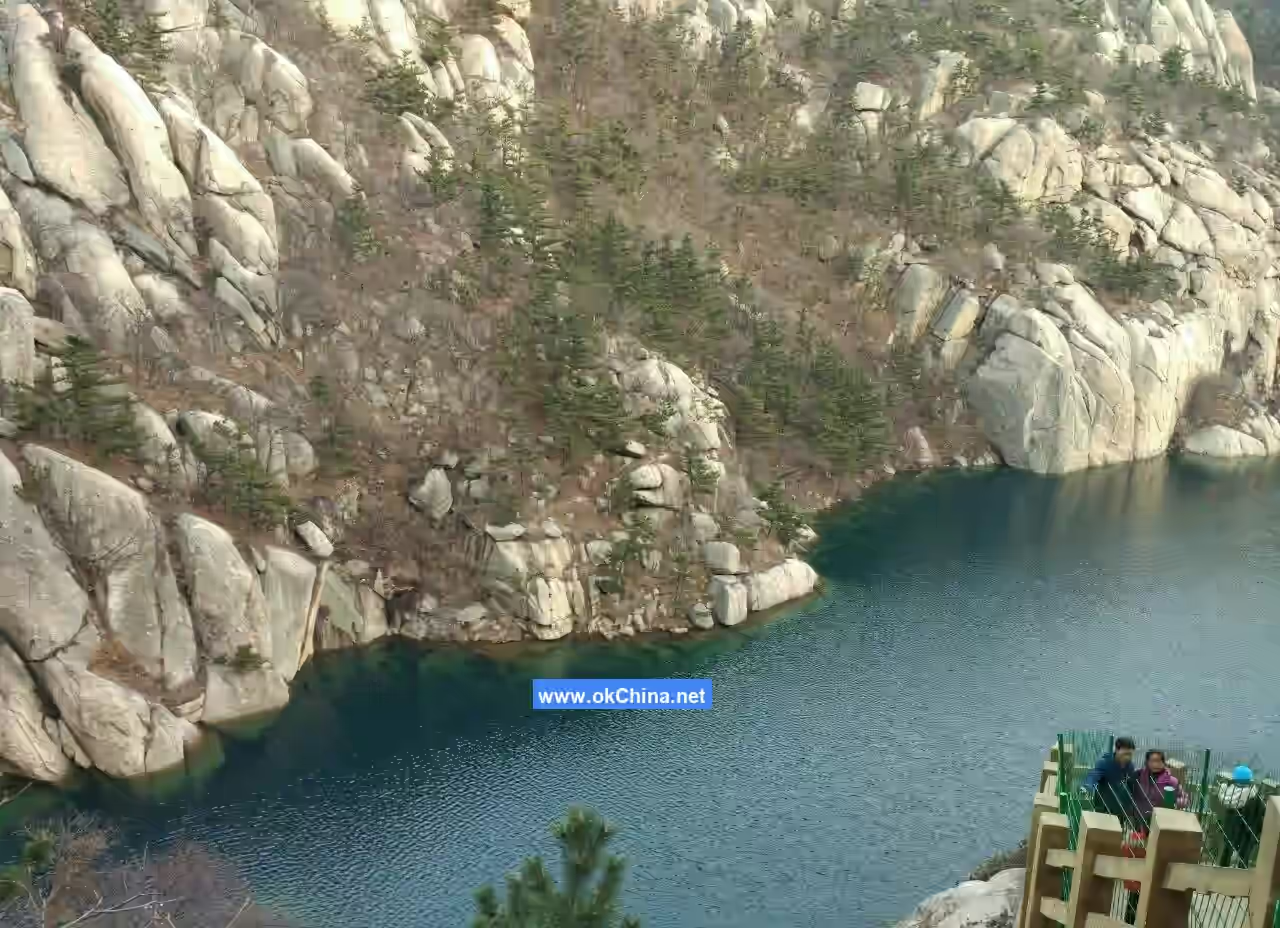
The landforms of Mount Lao can be roughly divided into two layers by elevation: the upper layer consists of peak landforms at around 1,000 meters above sea level, formed during the Pleistocene through alternating glacial and interglacial climates. The lower layer features granite landforms, primarily comprising glacial accumulation and erosion landforms, as well as formations resulting from post-glacial fluvial activity and chemical weathering. Accumulation landforms include boulder fields, stone rivers, and lateral moraine ridges, while erosion landforms include U-shaped valleys, ancient cirques, and horn peaks. Additionally, Mount Lao has developed unique landform types such as moraine coasts, moraine island groups, and varves.
According to its natural mountain range orientation, Mount Lao can be divided into four branches: the Jufeng Branch, Sanbiao Mountain Branch, Shimen Mountain Branch, and Wushan Branch. The Jufeng Branch includes the main ridge of Jufeng and the mountains extending directly into the Yellow Sea from Dongliushui, with its highest peak being Jufeng, located in the eastern part of the mountain area at 1,132.7 meters above sea level. Jufeng forms the main body of Mount Lao, with its branch ridges extending in five directions: northeast, east, southeast, south, and west. The Sanbiao Mountain Branch, commonly known as Biao Mountain, is a major northwestern extension of Mount Lao, including mountains west of the Shiren River and north of the Baisha River. Its main peak is Sanbiao Mountain, located in the northwestern part of the mountain area at 683 meters above sea level, and it divides into three sub-branches: the main ridge, northeast, and southwest. The Shimen Mountain Branch includes mountains south of the Baisha River and north of Zhangcun, with its main peak being Shimen Mountain, located in the western part of the mountain area at 570 meters above sea level. This branch is divided into northern and southern sub-branches by the Chajian area of the western Jufeng ridge. The Wushan Branch includes mountains south of the Zhangcun River and along the northern coast of the Yellow Sea, with its main peak being Wushan, located in the southwestern part of the mountain area at 398.3 meters above sea level.
2.3 Geological Structure
The geological structure of the Mount Lao area belongs to fault-block uplift, primarily divided into three categories: Cathaysian structures, characterized by compressional-shear faults mostly developed in the eastern mountainous area, controlling the distribution of Mount Lao granite and its dikes. These structures are multi-active and large-scale, generally trending northeast, including the Qianjin–Xiazhuang–Dazaoyuan Fault and the Puli–Beizhai–Fushan Fault. Neocathaysian structures, developed in the eastern and southern mountainous areas, mostly trending northeast with some northwest trends, are primarily shear-dominated compressional-shear faults, including the Yuantou–Luojianjian Fault, Tiejiazhuang–Qianbutou Fault, Gouya–Kutao–Zhujiawa Fault, and Xiahe–Hanhe–Nanyao Fault. East-west trending structures, distributed in the western and northern hills, trend nearly east-west, often appearing as steep cliffs or negative topography, including the Tieqishan–Tuzhai Fault and Houjin–Loujinshi Fault. Due to multiple tectonic activities, the surrounding rocks exhibit well-developed joints and fractures.
2.4 Climate Characteristics
Mount Lao features a warm temperate continental monsoon climate with distinct seasonal changes, characterized by abundant rainfall, moderate annual temperatures, mild winters without severe cold, cool summers without intense heat, and an overall temperate climate. Due to its proximity to the Yellow Sea and significant marine influence, it also exhibits maritime climate characteristics such as cool springs, mild summers, warm autumns, temperate winters, small diurnal temperature variations, long frost-free periods, and high humidity. Combined with the complex topography of Mount Lao, the eastern mountainous area receives more precipitation and has humid air, creating distinct microclimate zones. The area near Taiqing Palace is praised as "Little Jiangnan," while the northern part of Jufeng is called "Little Guandong." The central low mountains and hilly areas receive moderate precipitation, forming a semi-humid temperate zone.
Precipitation within Mount Lao varies with the seasons, and monthly precipitation amplitudes are significant. Springs are dry, summers experience concentrated rainfall, autumns are unstable, and winters have the least precipitation. The first frost in Mount Lao generally occurs in mid-October, with an average annual frost-free period of 179 days. From November to March of the following year, north and northwest winds prevail. From April to August, south and southeast winds are more common. In September and October, north and south winds are roughly equal in strength.
3. Historical Development
3.1 Geological Formation Period
The mountain mass of Mount Lao had already become a compound anticlinal fold during the Luliang Movement of the Sinian Period. However, the massive granite body of Mount Lao began forming during the Cretaceous Period. During the late Yanshan Movement, 68 to 130 million years ago, magma rising from deep within the Earth's crust cooled several kilometers below the surface. The rocks are flesh-red and white, with minerals crystallizing into granular forms, geologically named "Mount Lao Granite." At its formation, it was not exposed to the surface. Since the Cenozoic Era, crustal uplift and erosion by rain, snow, and flowing water gradually stripped away the overlying rocks, exposing the granite. It was only in the mid-Cenozoic Era, about 2 million years ago, that Mount Lao began to take on its present outline.
3.2 Ancient Development Period
In ancient times, Mount Lao was part of the Dongyi territory and has long been praised as a "Divine Abode and Immortal Residence" and a "Cave Heaven and Blessed Land," highly regarded by emperors, generals, scholars, and artists, and deeply favored by hermits, eminent Taoists, and Buddhist monks. During the Spring and Autumn Period, Mount Lao belonged to the State of Qi. After the Qin unification of China, it was placed under Langya Commandery. Legend has it that Qin Shi Huang once ascended Mount Lao to gaze toward Penglai, and Xu Fu set sail from here in search of the elixir of immortality. During the Han Dynasty, the county of Buqi was established, and Emperor Wu of Han visited the area to offer sacrifices to deities. During the Eastern Han Dynasty, scholars Pang Meng and Zheng Xuan, and later during the Northern and Southern Dynasties, Ming Sengshao, successively established academies on Mount Lao, writing books and teaching students, initiating a tradition of village education. In the 16th year of the Kaihuang era of the Sui Dynasty (596 AD), Jimo County was established, and Mount Lao was incorporated into it. The great Tang Dynasty poet Li Bai left the famous line for Mount Lao: "I once on the eastern sea, dined on purple mists at Mount Lao." Figures such as Yuan Dynasty Minister of Rites Wang Sicheng, Grand Academician Zhang Qiyan, and scholar Dai Liang; Ming Dynasty Grand Academician Gao Hongtu, Censor Huang Zongchang, Shandong Education Commissioner Zou Shan and Chen Yi, and Governor Zhao Xian; Qing Dynasty scholars Gu Yanwu, Wang Shishen, and Hanlin Academician Yin Linji all left their marks on Mount Lao. Notably, the great writer Pu Songling regarded Mount Lao as his second home, composing widely loved works such as "The Taoist Priest of Mount Lao" and "Xiang Yu," which made Mount Lao famous throughout the world.
3.3 Modern Development Period
In 1898, the Qing government was forced to sign the "Jiaozhou Bay Concession Treaty," transferring most of the Mount Lao area south of the Baisha River and west of Zhuantaling from Renhua Township, Jimo County, into the Jiaozhou Bay Concession. In 1914, Japan replaced Germany in occupying Jiaozhou Bay. After the Chinese government recovered Qingdao in 1922, it was reorganized as the Jiaozhou Bay Commercial Port, and Mount Lao belonged to the Licun District of the port. In 1929, after the Nanjing National Government took over Qingdao, Licun District was placed under Qingdao Special City. In 1935, the other half of the Mount Lao area north of the Baisha River and east of Zhuantaling was again transferred from Jimo County into Qingdao City. After the founding of the People's Republic of China, the Mount Lao area successively belonged to the Laoshan Office, Laoshan Suburban District, Laoshan County, and Laoshan District under the jurisdiction of Qingdao City.
4. Major Attractions
4.1 Jufeng Scenic Area
4.1.1 Jufeng
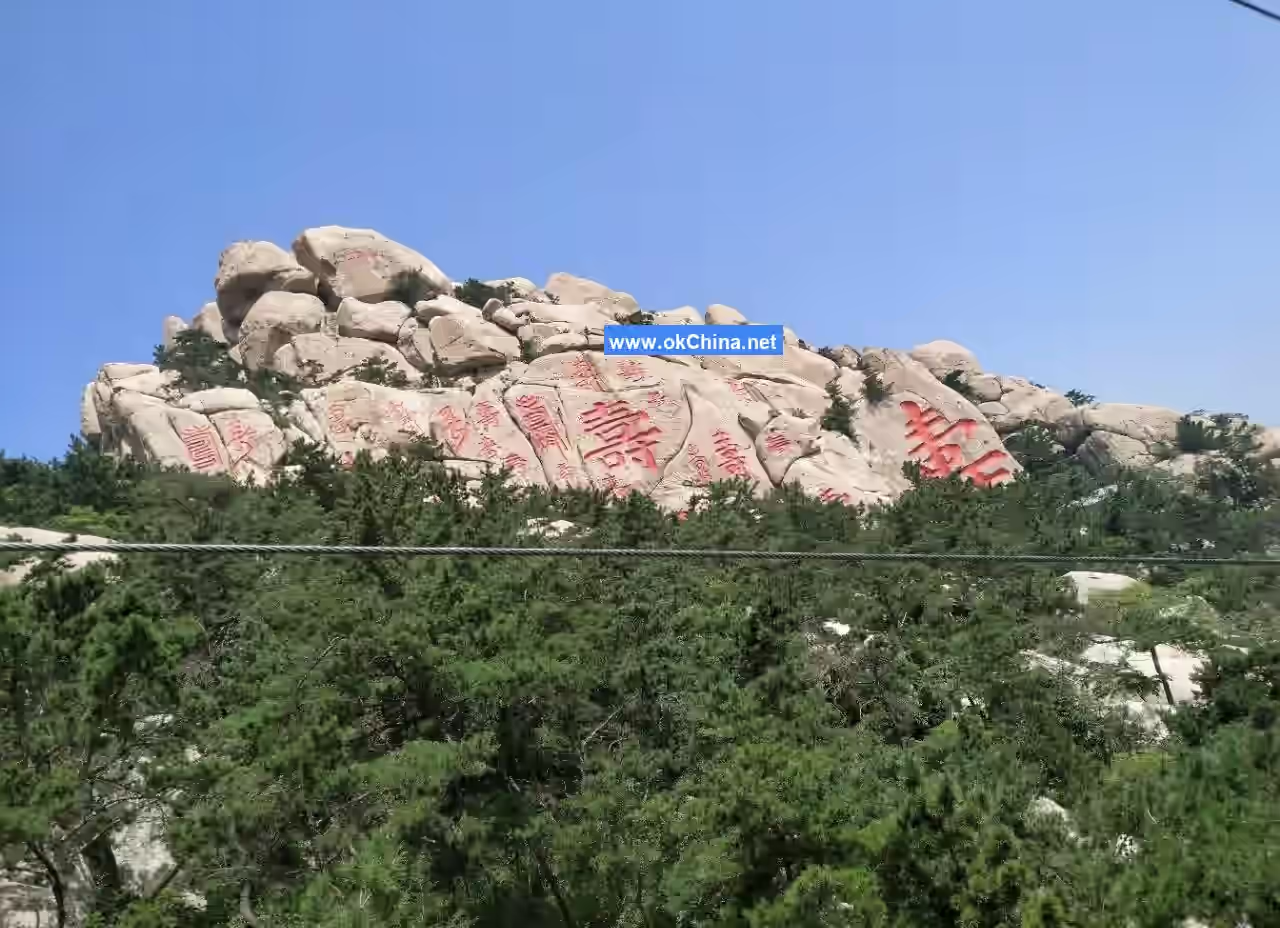
Jufeng is the highest peak of Mount Lao, also known as "Laoding," with an elevation of 1,132.7 meters. It is the highest peak along China's 18,000-kilometer mainland coastline. The summit is composed of rocky clusters, about 100 meters high and approximately 600 meters wide. At the top, there is a square rock several feet wide called "Gai Ding," also known as "Ke Zhang," which is the very peak of Jufeng and can only accommodate three or four people. Jufeng has cliffs on three sides, with only the southwestern side being climbable. In 1933, stone steps were carved along the rock crevices, and a concrete platform capable of holding over ten people was built. After 1949, an observation tower about 10 meters high was constructed on the platform. The stone walls of Jufeng are inscribed with cliff carvings such as "Solely Esteemed Here" and "Marvelous View of the East Sea." Jufeng is one of the main elevated viewing spots on Mount Lao, with its four wonders being "Jufeng Sunrise," "Sea of Clouds Spectacle," "Mount Lao Fireball," and "Jufeng Buddha's Halo."#### 4.1.2 Qiannü Peak Qiannü Peak is a small peak located southwest of the Giant Peak. It is called "Beauty Peak" because its shape strikingly resembles a graceful, slender woman. In 1986, Deng Yingchao, then Chairwoman of the Chinese People's Political Consultative Conference, visited Mount Lao and, upon seeing this peak, inscribed the name "Qiannü Peak" for it. About 1 kilometer ahead from Qiannü Peak, one can reach the Giant Peak.
4.1.3 Tianyi Spring
Tianyi Spring, also known as Yuan Spring, is located at the foot of Danlu Peak, north of the Giant Peak, at an elevation of 1,100 meters. The water is sweet and cool, with a milky white color. It is the highest-altitude spring on Mount Lao. Its water remains warm in winter and cool in summer, flowing continuously in a trickle and spraying to a height of over ten centimeters. It is the source of the Baisha River, the largest river on Mount Lao. Beside it are carved the characters "Yuan Quan" (Original Spring).
4.2 Taiqing Scenic Area
4.2.1 Taiqing Palace
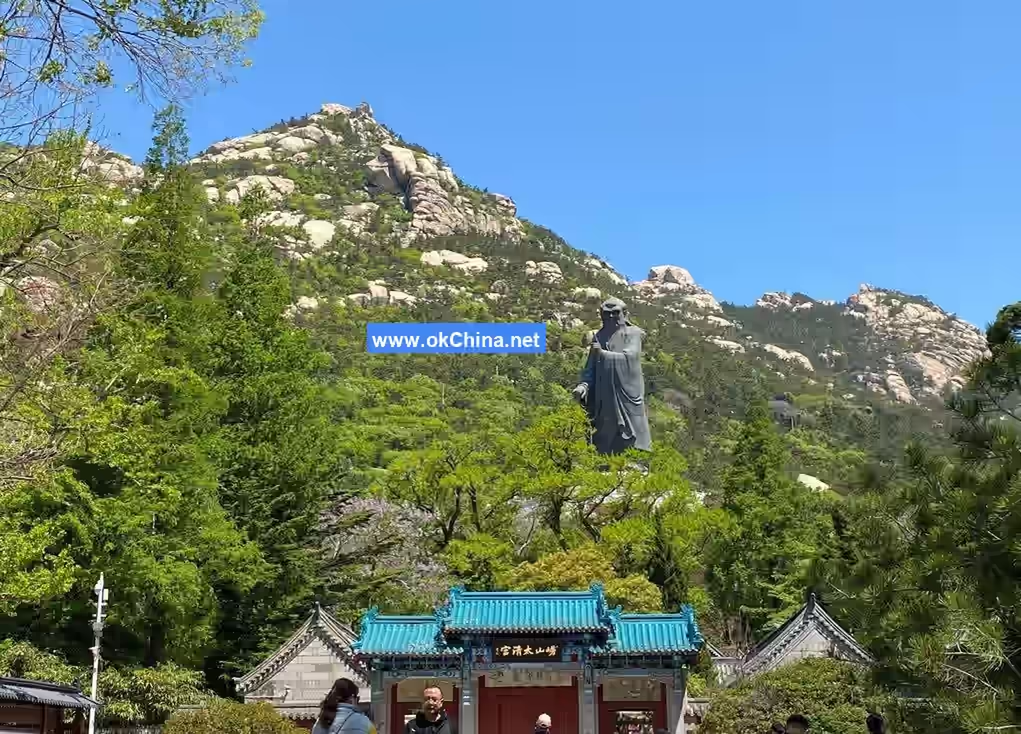
Taiqing Palace, commonly known as the Lower Palace, is located at the southern foot of Mount Lao and is the largest ancient Taoist temple on the mountain. Its construction began in the first year of the Jianyuan era of Emperor Wu of the Western Han Dynasty (140 BC), when Zhang Lianfu built a Sanguan Temple. Two years later (138 BC), another temple was built to enshrine the statues of the Three Pure Ones, named Taiqing Palace. During the Tang Dynasty, Li Zhexuan expanded the halls and rooms, enshrining the statues of the Three Sovereigns and naming it Sanhuang Nunnery. During the Five Dynasties period, in the second year of the Tongguang era of the Later Tang Dynasty (924 AD), Liu Ruozhuo built the "Quhu Nunnery" to enshrine a statue of Laozi. In the first year of the Jianlong era of Emperor Taizu of the Song Dynasty (960 AD), Liu Ruozhuo was commissioned to renovate the Taiqing Palace buildings, constructing a new Sanguan Hall and renovating the Sanhuang Hall, by which time Taiqing Palace had reached considerable scale. Famous Taoists such as Qiu Chuji and Zhang Sanfeng came here to practice in seclusion, drawn by its reputation.
Taiqing Palace covers an area of over 30,000 square meters, with a building area of over 2,500 square meters. It comprises more than 150 halls and rooms, divided into three main halls with independent enclosing walls and single-entry mountain gates: the Sanguan Hall, the Sanqing Hall, and the Sanhuang Hall. In scale, Taiqing Palace is second only to the Baiyun Temple in Beijing and is known as the "Second Great Forest of Complete Perfection Taoism" in China. Within the Taiqing Palace courtyard are ancient trees and famous flowers such as ginkgo, crape myrtle, peony, and camellia. Outside the courtyard of the Sanqing Hall, below the stone steps, there is a clear spring named "Shenshui Spring" (Divine Water Spring). The spring water is clear, cool, and sweet, neither drying up in severe drought nor overflowing in heavy floods, making it one of the famous springs of Mount Lao.
4.2.2 Shangqing Palace
Shangqing Palace, also known as the Upper Palace, is located in a secluded valley on the southeastern foothills of Mount Lao. It was first built in the early Song Dynasty but was later destroyed by a mountain torrent. During the Dade period of the Yuan Dynasty, Taoist Li Zhiming rebuilt it, and it has been repaired repeatedly throughout successive dynasties. Shangqing Palace consists of two main courtyards, front and rear, with a side courtyard, totaling 28 halls and rooms. It covers an area of approximately 1,000 square meters. The main halls face south. Along the central axis from south to north are the mountain gate, the main hall, and the rear hall. The front hall originally enshrined the Three Pure Ones, while the rear hall enshrines the Jade Emperor. The side halls on the left and right enshrine the "Three Officials" and the "Seven Perfected Ones," respectively.
4.2.3 Mingxia Cave
Mingxia Cave was originally a detached courtyard of Shangqing Palace, formed by the collapse and stacking of huge rocks. The cave's forehead bears the inscription "Mingxia Cave," carved in the third year of the Da'an era of the Jin Dynasty. The cave interior is tall and spacious. During the Kangxi period of the Qing Dynasty, it was struck by lightning, causing more than half of it to collapse underground. To the east of the cave, a rugged giant rock still bears the inscription "Tian Ban Zhu Xia" (Crimson Clouds at Mid-Sky). To the west of the cave, the Doumu Palace is the main existing structure. Its main hall faces south, is three bays wide, and features a flush gable roof of brick and stone construction. It was first built in the second year of the Dading era of the Jin Dynasty and was renovated during the Ming and Qing dynasties.
4.3 Huayan Scenic Area
4.3.1 Huayan Temple
Huayan Temple is located halfway up Mount Naluoyan, west of Fanlinghou Village on the eastern foothills of Mount Lao. It is the largest existing Buddhist temple on Mount Lao. Originally named Huayan Nunnery, it was a branch temple of the Zhunti Nunnery in Jimo City. The Zhunti Nunnery was converted from a garden into a temple by the Huang family of Jimo during the Wanli period of the Ming Dynasty. Since private construction of "temples" and "monasteries" was not permitted in ancient times, it was named "Nunnery." Huayan Nunnery was built by Huang Zongchang, a Ming Dynasty censor and native of Jimo, in the sixteenth year of the Chongzhen era (1643 AD). The construction spanned over 30 years before completion. It was initially named Huayan Nunnery, also known as Huayan Chan Temple, and was renamed Huayan Temple in 1931.
4.3.2 Danaluoyan Cave
Heading west along the mountain stream from Huayan Temple leads to Danaluoyan Cave. This natural stone cave is 7 meters wide and over 10 meters each in height and depth. Its walls are sheer like cut cliffs. There is a round hole in the cave ceiling, resembling a volcanic vent, through which daylight penetrates. According to monks, the Buddha Naluoyan achieved enlightenment while practicing in this cave. Such a massive granite cave is rare in China. Among the Twelve Scenic Spots of Mount Lao, it is called "Naluo Buddha Cave."
4.4 Yangkou Scenic Area
4.4.1 Taiping Palace
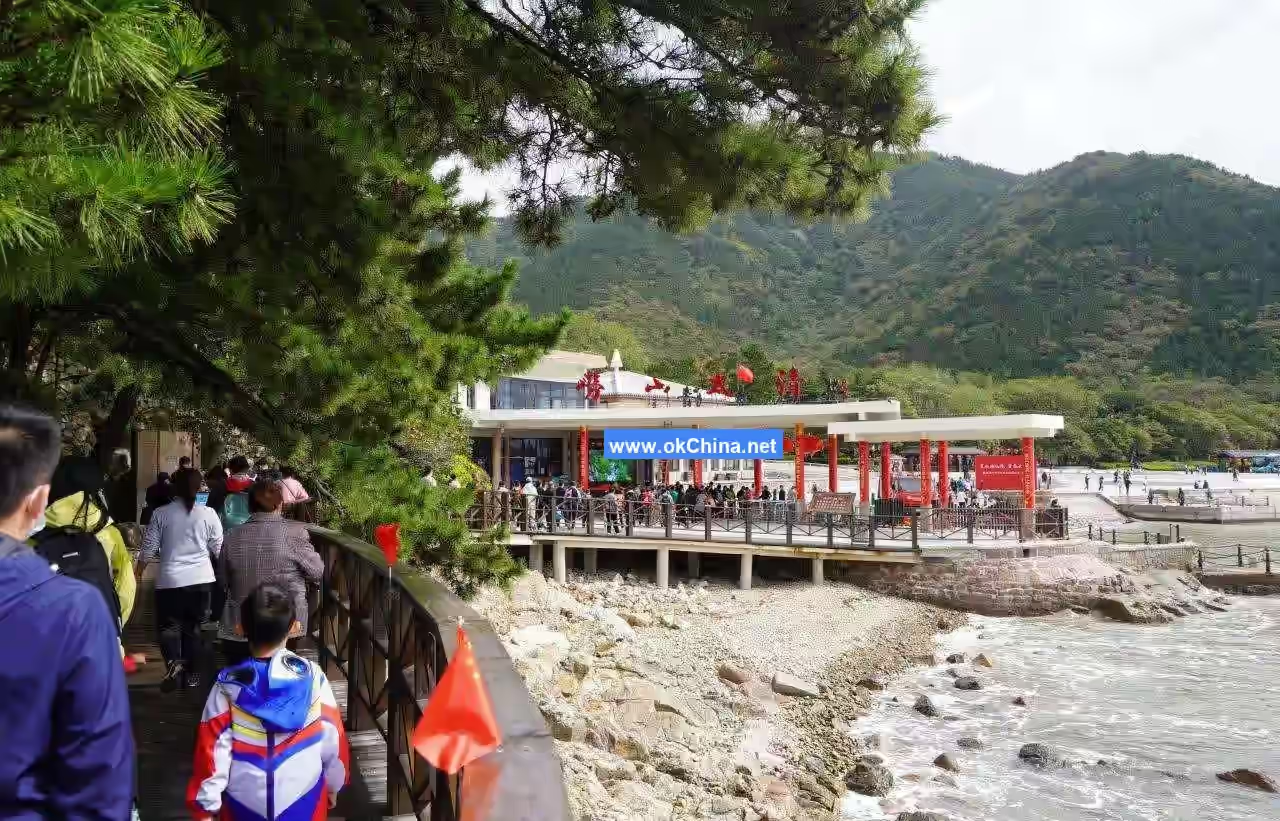
Taiping Palace is located at the foot of Shangyuan Mountain on the shore of Yangkou Bay. It was initially called "Shangyuan Palace," meaning the garden bestowed by the "Emperor." It was first built during the Taiping Xingguo period of the Song Dynasty, hence it was once named "Taiping Xingguo Monastery." In the early Yuan Dynasty, it was renamed Taiping Palace. Along with Shangqing Palace and Taiqing Palace, it is a Taoist temple commissioned by Emperor Taizu of the Song Dynasty. Nestled against the mountains and overlooking the sea, Taiping Palace boasts beautiful scenery and is an excellent spot for viewing the sunrise, gazing at the sea, listening to the waves, and admiring the pine trees. The surrounding area features strange caves, cliff carvings, peculiar rocks, and elegant peaks, making it a famous tourist attraction.
The halls of Taiping Palace are arranged in a "品"-shaped layout. On the screen wall inside the courtyard gate, the four characters "Hai Shang Gong Dian" (Sea Palace) are inscribed in single-line carving. The structure is严谨,端正饱满, and was engraved when the palace was built. The main hall originally enshrined the Three Pure Ones and the Jade Emperor. The side hall to the east enshrines the Three Officials, while the west side hall venerates Zhenwu. During later renovations, some additional deities were also enshrined. The west courtyard houses a tea room. In the courtyard is a well named "Long Xian" (Dragon Saliva), with a poem by Zou Shan, the Ming Dynasty Shandong Education Commissioner, carved on a stone beside it. The east courtyard has a bell pavilion containing a newly cast antique-style iron bell, listed as a scenic spot called "Shangyuan Morning Bell."
4.4.2 Lion Peak
Lion Peak is located northeast of Taiping Palace. This strange peak rises abruptly, facing the mountains with its back to the sea, remarkably resembling a giant roaring lion. It is inscribed with "Shan Hai Qi Guan" (Marvelous View of Mountains and Sea), written by Ming Dynasty Shandong Education Commissioner Zou Shan, with characters 40 cm in diameter. Near the peak's summit, there is a cave shelter shaped like a lion's mouth, capable of accommodating over ten people. The cave walls are covered with overlapping stone carvings, their inscriptions still faintly discernible. These include inscriptions from Lan Tian and Chen Yi in the twelfth year of the Jiajing era of the Ming Dynasty (1533 AD), as well as writings from a Jin Dynasty traveler in the fifth year of the Mingchang era (1194 AD). Lion Peak is an excellent location for viewing the sea sunrise. "Lion Peak Welcoming the Sun" and "Lion Ridge Amidst Clouds" are both famous scenic spots of Mount Lao.
4.4.3 Yangkou Bay
Yangkou Bay is located on the eastern foothills of Mount Lao, east of Yingdinggu. To the south is Quanling, and to the north is Fengshan, forming a crescent-shaped bay. It stretches 2.2 kilometers from north to south, with a broad, gentle beach extending about 1,200 meters from east to west. The entire Yangkou Bay covers an area of approximately 2.0 square kilometers. It features charming scenery, beautiful landscapes, ample sunshine, clear seawater, and fine, soft golden sand. It also contains mineral deposits of "海底玉" (seafloor jade) green stone.
4.5 Jiushui Scenic Area
4.5.1 Chaoyin Waterfall
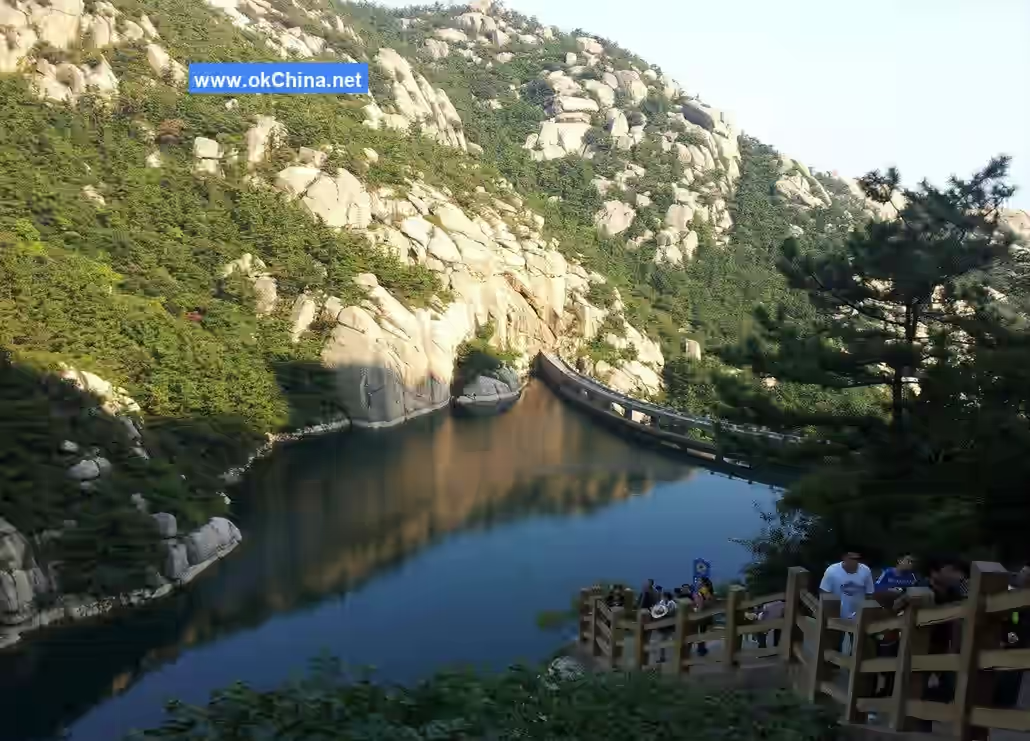
Chaoyin Waterfall, also known as "Fish Scale Waterfall," is located at the terminal point of the Jiushui (Nine Waters) stream. It gets its name because the sound of the water resembles the tide, and its appearance looks like fish scales. On the steep cliff beside the waterfall, the three large characters "潮音瀑" (Chaoyin Waterfall) are carved, written by Ye Gongchuo in the 1930s. The waterfall cascades down the cliff in three steps: the first drop is about 6 meters, the second about 5 meters, and the third about 10 meters, weaving into a water curtain about 5 meters wide that plunges directly into the clear pool below the cliff. The three cascades flow in different directions, resembling a long silk ribbon unfurling in the air. The clear pool below the waterfall has a diameter of about 22 meters and is 5 meters deep. It is shaped like a vat, indigo blue in color, and clear to the bottom, named "Dian Gang Wan" (Indigo Vat Bay). Beside Chaoyin Waterfall stands a stone "Xian Fang" (Immortal Boat), built to commemorate the anti-Japanese soldiers who died here. On top of the western cliff is the "Guanpu Ting" (Waterfall Viewing Pavilion), where visitors can view the waterfall and listen to the tide. "Yan Pu Chao Yin" (Cliff Waterfall and Tide Sound) is one of the famous scenic spots of Mount Lao.
4.5.2 Weizhu Temple
Weizhu Temple, originally named Weizhu Nunnery, is located beneath Fenghuanggu (Phoenix Summit) on the northern foothills of Mount Lao. It was first built in the seventeenth year of the Wanli era of the Ming Dynasty (1589 AD) by the Complete Perfection Taoist priest Song Chongru of the Huashan sect. It covers an area of 2.6 mu and consists of two successive courtyards. Weizhu Nunnery was initially called "Sanyuan Hall." The main hall enshrines statues of Zhenwu the Great Emperor, Guanyin Bodhisattva, and the Three Officials. Among them, the statues of Zhenwu the Great Emperor and Guanyin Bodhisattva are exquisitely carved from sandalwood and are considered the finest wooden deity statues among Mount Lao's Taoist sites. The Three Officials statues are cast in bronze; though not large in scale, they are very distinctive.
4.5.3 Sphinx-like Stone
The giant Sphinx-like Stone is found 1.5 kilometers east of Weizhu Temple. The stone sits atop a peak, about 40 meters high, facing west. The "lion's body" is formed from a single massive rock, naturally shaped in a leaping posture, with another large rock pressing on its back, hence it is also called "Stone-Pressed Sphinx Stone." Most remarkably, its "human face," when viewed from the side, has distinct eyes, nose, and mouth in proper proportion, realistically shaped, strikingly similar to the profile of the Egyptian Sphinx. It displays marvelous craftsmanship that seems divinely created, inspiring awe.
4.6 Other Attractions
4.6.1 Guandi Temple
Guandi Temple is located southwest of Yangkou Bay, at the foot of Zhutou Peak (Pig Head Peak) southeast of Shangyuan Mountain. It faces a stream in front and is surrounded by ancient pines and oaks. The temple covers an area of 900 square meters, with a building area of over 100 square meters. It is a serene and beautiful Taoist temple. In the Mount Lao area, since the early Qing Dynasty, it became customary to build Guandi Temples alongside Tudì (Earth God) Temples, spreading to villages throughout the mountainous region by the late Qing. However, this is the only Taoist temple on Mount Lao primarily dedicated to Guan Yu. Guandi Temple was originally a branch temple of Taiping Palace (another branch temple being Donghua Palace) and separated from Taiping Palace in the twelfth year of the Guangxu era of the Qing Dynasty (1886 AD). In 1929, it was renovated under the supervision of Taoists Liu Taiqing and Jia Taicheng, achieving its current scale. After renovation, it comprised a main hall of three bays and 26 Taoist living quarters, forming a two-courtyard compound. Entering the mountain gate leads to the front courtyard, which has a central hall of three bays serving as a passage hall. On either side are colorful statues of Guan Ping and Zhou Cang, each over 2 meters tall. Flanking the hall are four side rooms on each side. The rear courtyard is a quadrangle layout. Bypassing the screen wall, there is a main hall of three bays, enshrining a colorful seated statue of Guan Yu over 2 meters tall. The walls are painted with murals depicting Guan Yu's life, such as "Oath of the Peach Garden," "Lifting the Red Robe with His Sword," "Blocking Cao Cao at Huarong," and "Going Alone to the Meeting," all executed with细腻工整 brushwork and well-proportioned figures. On either side of the main hall are three side rooms each, with four wing rooms on the east and west sides, all built in the flush gable style with brick and wood structures. The temple houses four volumes of scriptures including the Daodejing, along with scrolls of calligraphy and paintings. The courtyard is planted with peonies, camellias, boxwoods, and other plants.In 1984, the Guan Yu Temple was designated as a county-level cultural heritage site. In 1989, it was announced as a municipal-level cultural heritage site, and in 2007, it was elevated to a provincial-level cultural heritage site. In May 2013, it was declared a national-level cultural heritage site.
4.6.2 Mingdao Temple
Mingdao Temple is located in front of Zhaofeng Ridge on the eastern foothills of Mount Lao, at an altitude of 640 meters. It is the highest-altitude Taoist temple still existing on Mount Lao. Built in the 53rd year of the Kangxi reign of the Qing Dynasty (1741) by Taoist priest Song Tiancheng, the temple covers an area of over 1,380 square meters. It is divided into two courtyards: the eastern courtyard houses the "Jade Emperor Hall," and the western courtyard houses the "Three Pure Ones Hall," dedicated to the colored statues of the Jade Emperor and the Three Pure Ones. During the Guangxu period (1875–1908), at the peak of the temple's prosperity, there were 78 Taoist priests and over 160 mu of land. Nestled among mountains, Mingdao Temple enjoys a serene environment, surrounded by peculiar peaks and strange rocks, and is rich in mythological stories.
5. Related Culture
5.1 Naming
Mount Lao has historically been known by various names, including "Lao Mountain," "Lao Mountain (牢山)," "Buqi Mountain," "Laosheng Mountain," "Great Lao Mountain," "Small Lao Mountain," "Futang Mountain," "Ao Mountain," and "Lao Mountain (崂山)." Among these, "Lao Mountain" first appeared in the Book of Songs: "The mountains and rivers are far and wide, and they are vast." The Zheng annotation of the Book of Songs·Xiaoya·Yuzao Zhishi states: "Lao means vast." However, interpretations of "Lao Mountain" are not entirely consistent. One theory suggests that the mountain is steep and rugged, making ascent and descent laborious, hence the name "Lao Mountain." Another theory, based on research by the late Ming and early Qing scholar Gu Yanwu, claims that when Qin Shi Huang visited Mount Lao, it caused great hardship and expense to the people, leading to the name "Lao Mountain."
Additionally, Mount Lao is also called "Buqi Mountain," a name derived from the Book of Han·Chronicles of Emperor Wu. In the 1950s, archaeologist Wang Xiantang conducted excavations at a primitive society site in the northern part of Mount Lao, confirming that two tribes, the "Bu" and "Qi," lived in the northern area of the mountain in ancient times. The land and mountain were named after these tribes, hence "Buqi Mountain." This name is also used in the Records of the Three Kingdoms·Biography of Cui Yan.
The name "Lao Mountain (牢山)" comes from Faxian's A Record of Buddhist Kingdoms from the Eastern Jin Dynasty. One explanation is that locals believed the mountain was as solid as a rock, immovable and firm, hence "Lao Mountain." Another explanation relates to ancient Chinese astrology, which posited a correspondence between celestial constellations and terrestrial regions. Among the Thirty-Six Heavenly Stars, the Tianlao Star corresponded to this mountain, leading to the name "Lao Mountain." Additionally, in the Tang Dynasty, Li Xian's Annotations to the Book of the Later Han referred to the northern part of the mountain as "Great Lao Mountain" and the southwestern part as "Small Lao Mountain," collectively known as "Two Lao Mountains." The name "Futang Mountain" appears in the Extensive Records of the Taiping Era and was changed during the reign of Emperor Xuanzong of Tang. At that time, Taoist priest Wang Min enjoyed the emperor's favor, and Taoist Li Huazhou from Mount Nan worried that the emperor would become too attached to worldly pleasures and neglect Taoist practices. He advised Wang Min to leave the capital, and Wang Min requested to go to Lao Mountain to refine elixirs. Emperor Xuanzong granted permission and renamed "Lao Mountain" as "Futang Mountain." In the Song Dynasty, the Universal Geography of the Taiping Era changed it to "Laosheng Mountain."
During the Yuan Dynasty, Qiu Chuji, the founder of the Quanzhen Longmen sect of Taoism, visited Mount Lao and composed a poem praising the mountain, referring to it as "Ao Mountain." After Genghis Khan appointed Qiu Chuji as the state preceptor and immortal, entrusting him with overseeing Taoist affairs nationwide, Taoists followed their master's intent and called the mountain "Ao Mountain." This name appears only in inscriptions from the Yuan and Ming Dynasties. The character "崂" first appeared in the History of the Southern Dynasties. After Huang Zongchang compiled the Records of Mount Lao in the late Ming Dynasty, the name "Mount Lao" gradually gained acceptance. It was officially named "Mount Lao" during the Qing Dynasty.
In summary, the mountain's original name should be "Lao" or "崂." During the Han Dynasty, it was called "Buqi"; during the Jin and Northern and Southern Dynasties, it was called "Lao"; in the Tang Dynasty, it was also known as "Great Lao," "Small Lao," and "Futang." During the Ming and Qing Dynasties, "Lao" and "崂" were primarily used, with "Lao" and "Ao" also occasionally employed. In modern times, the character "崂" has been exclusively adopted.
5.2 Religious Culture
5.2.1 Taoist Culture
Mount Lao is one of the important birthplaces of Taoism in China, renowned as the "Second Taoist Forest of Quanzhen Taoism." At its peak, it was said to have "nine palaces, eight temples, and seventy-two nunneries." Since the Spring and Autumn Period, Mount Lao has attracted a group of practitioners engaged in health preservation and self-cultivation. Ming Dynasty records mention that "King Fuchai of Wu once ascended Mount Lao and obtained the Lingbao Duren Jing." By the late Warring States period, Mount Lao had become renowned as the "Eastern Sea Immortal Mountain."
In the first year of the Jianyuan era of Emperor Wu of the Western Han Dynasty (140 BCE), Zhang Lianfu came to Mount Lao, built a thatched hut to worship the Three Officials, and began teaching disciples, laying the foundation for Taoism on Mount Lao. From the Western Han Dynasty to the end of the Five Dynasties period, Taoism on Mount Lao primarily belonged to the Taiping Tao and the Celestial Master Taoism reformed by Kou Qianzhi during the Northern and Southern Dynasties. Sect-wise, it was associated with the Louguan Sect, Lingbao Sect, and Shangqing Sect (also known as the Maoshan Sect and Gezao Sect). In the early Song Dynasty, Taoist priest Liu Ruozhuo of Mount Lao was granted the title "Huagai Zhenren" by Emperor Taizu of Song, and all Taoist temples on Mount Lao were unified under the newly established "Huagai Sect." Since the Jin and Yuan Dynasties, with the rise of the Quanzhen sect of Taoism, temples on Mount Lao successively converted to various branches of the "Northern Seven Perfected Ones." After Genghis Khan appointed Qiu Chuji, Taoism on Mount Lao flourished. By the Ming Dynasty, three new sects emerged from the "Longmen Sect" of Mount Lao Taoism, bringing the total number of sects to ten. Taoism on Mount Lao and its surrounding areas continued to thrive. In 1952, the Qingdao Municipal Government allocated special funds for the major renovation of Taoist temples on Mount Lao, ensuring the protection and survival of Taoism there. After the 1970s, the Qingdao Municipal Government gradually and systematically restored some Taoist temples on Mount Lao, implemented religious policies, recalled Taoist priests, rebuilt statues, and returned temple properties, allowing Taoism on Mount Lao to resume normal religious activities.
The Taoist temples still existing in the Mount Lao area include Taiqing Palace, Shangqing Palace, Mingxia Cave, Taiping Palace, Tongzhen Palace, Hualou Palace, Weizhu Nunnery, Baiyun Cave, Mingdao Temple, Guan Yu Temple, Baifu Nunnery, Dalao Temple, and Taihe Temple. Among these, Taiqing Palace, Shangqing Palace, Mingxia Cave, and Taiping Palace have been renovated and serve as important venues for Taoist religious activities.
5.2.2 Buddhist Culture
Buddhism on Mount Lao began during the Wei and Jin Dynasties, flourished during the Sui and Tang Dynasties, experienced another peak in the Ming Dynasty, and gradually declined in the late Qing Dynasty, spanning over 1,700 years. Chongfo Temple (commonly known as Jinggou Temple) on Mount Lao was built in the fifth year of the Jingyuan era of Emperor Yuan of Wei (264 CE), making it the oldest temple on Mount Lao and marking the beginning of Buddhism there. In the eighth year of the Yixi era of the Eastern Jin Dynasty (412 CE), the monk Faxian, who had traveled to India and other places to seek scriptures, encountered a typhoon on his return journey and drifted to the area around Kaolao Island on the southern coast of Mount Lao in Buqi County. At that time, Buqi County was the seat of Changguang Commandery. The devout Buddhist governor Li Yi, hearing that Faxian was a renowned monk who had traveled to the West to obtain scriptures, welcomed him to Buqi City, where he preached Buddhism. A stone Buddha temple (i.e., Chaohai Temple) was also built at his landing site. From then on, Buddhism gained fame and spread widely on Mount Lao. Subsequently, Shizhu Nunnery (later renamed Huiju Temple) and Shilian Temple (commonly known as Chengyang Temple) were built on Mount Lao. The establishment of Fahai Temple during the Northern Wei Dynasty marked the initial formation of Buddhism on Mount Lao. During the Song and Yuan Dynasties, Buddhism and Taoism coexisted harmoniously. However, during the Wanli era of the Ming Dynasty, Buddhism faced setbacks. Despite this, with the support of many renowned monks and local gentry, Buddhism on Mount Lao continued to develop. In 1985, the Qingdao Municipal Government established a preparatory committee for the Buddhist Association, allocated special funds to restore Huayan Temple and Fahai Temple on Mount Lao, and designated these two temples as municipal-level cultural heritage sites in Qingdao.
To date, there are 32 known Buddhist temples on Mount Lao: 6 built before the Sui Dynasty, 4 built during the Tang Dynasty, 1 built during the Song Dynasty, 16 built during the Ming Dynasty, and 5 built during the Qing Dynasty.
5.3 Intangible Cultural Heritage
5.3.1 Mount Lao Folktales
Mount Lao folktales primarily refer to the folk legends and stories popular in the Mount Lao District of Qingdao City (formerly Mount Lao County) and parts of Licang District, Chengyang District, and Jimo District. Commonly known as "lagua'er," these are oral literary works collectively created by the people of Mount Lao over thousands of years and form an important part of Mount Lao's cultural heritage. Mount Lao folktales are rich in content, intricate in plot, and vivid in language, with many well-known stories such as "The Legend of Mount Lao," "The Story of the Stone Old Man," and "The Date Pit." Through these stories, people praise the wisdom and strength of the Mount Lao people, extol their diligence and kindness, and express their own aspirations and ideals. Mount Lao folktales include传奇 stories,生活 stories, and love stories, with love stories being particularly representative of the Mount Lao region. In 2008, Mount Lao folktales were included in the National Intangible Cultural Heritage List.
5.3.2 Mount Lao Taoist Music
The origins of Mount Lao Taoist music can be traced back to ancient Dongyi music. During the Western Han Dynasty, sacrificial practices were prevalent on Mount Lao, and the incantations of the time resembled the chants and folk songs of the mountain people, reflecting strong Dongyi traditions. In the late Eastern Han Dynasty, the classical scholar Zheng Kangcheng lectured on Mount Lao (then called Buqi Mountain), bringing court music to the mountain for the first time. According to legend, the famous Tang Dynasty Taoist Wu Yun visited Mount Lao and composed "Qingping Diao·Ode to the Queen Mother's Peach Peak," which later evolved into the "Buxu" temple altar chant still used by Mount Lao Taoists today. In the eighth year of the Yuanfeng era of the Song Dynasty (1085), Su Dongpo visited Taiping Palace and taught the large-scale qin composition "Returning Home" to Taoist priests such as Qiao Xuran. Since then, Mount Lao guqin music has held a place in the history of Chinese guqin music. In the late Qing and early Republican periods, Mount Lao became a center for guqin music in Shandong and even nationwide, producing masters such as Chu Shoushi, Wen Gaoheng, Ye Taien, Jiang Qingshan, Sun Duxian, Xue Yiliao, Han Taichu, and Shen Yin, who left behind famous compositions like "Viewing the Sea" and "Bamboo Under the Moon." In December 2006, Mount Lao Taoist music was included in the Shandong Provincial Intangible Cultural Heritage List.
Comments
Post a Comment