1. Introduction
1.1 Laojun Mountain
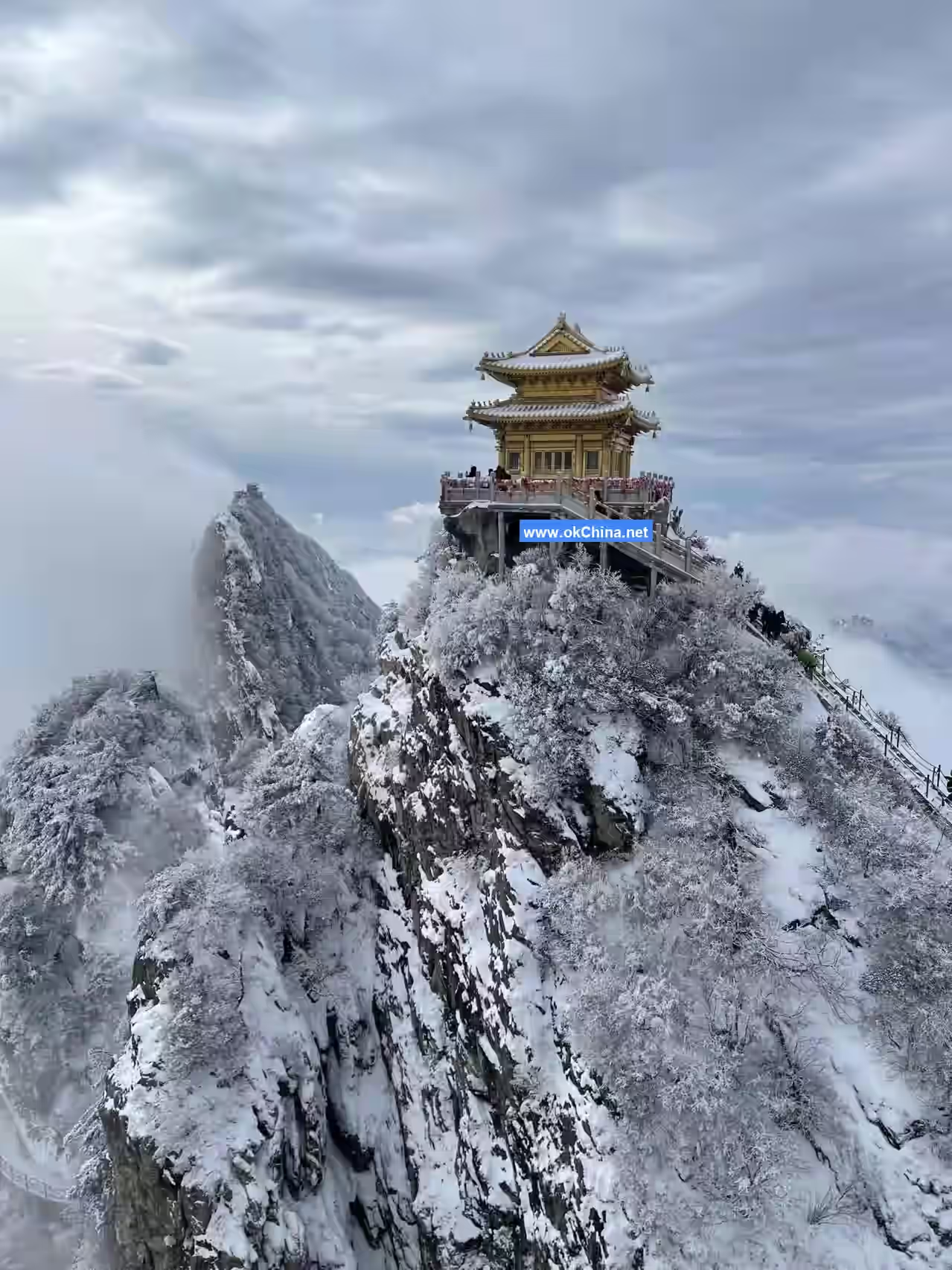
Laojun Mountain (The Laojun Mountain), known as "the unparalleled sacred realm, the world's foremost immortal mountain," is located three kilometers southeast of Luanchuan County in the ancient capital of Luoyang, which served as the capital for thirteen dynasties. It is the main peak of the 800-li Funiu Mountains, an extension of the Qinling Mountains, with an altitude of 2,200 meters. Originally named Jingshi Mountain, it boasts a human history spanning over two thousand years and is the mountain range with the longest history in Taoism.
During the Spring and Autumn Period, Laozi (Li Er), widely recognized as the founder of Taoism, retreated here for seclusion and cultivation, making it the "Source of Tao" (the origin place of Taoism) and the "Ancestral Court" (the courtyard of the patriarch). Construction of the Laojun Temple on the mountain began during the Northern Wei Dynasty to commemorate him. In the 11th year of the Zhenguan era of the Tang Dynasty (637 AD), Emperor Taizong of Tang dispatched Yuchi Jingde to renovate the Tieding (Iron Top) Laojun Temple on Jingshi Mountain and bestowed upon it the name "Laojun Mountain." In the 31st year of the Wanli era of the Ming Dynasty (1603 AD), Emperor Shenzong of Ming issued an edict declaring Laojun Mountain a "Famous Mountain Under Heaven" and allocated treasury funds to build halls, making it the only mountain range in Chinese history to be officially granted the title "Famous Mountain Under Heaven" by an emperor.
Laojun Mountain features six scenic areas with 179 attractions, including 16 temples such as Taiqing Palace, Shifang Courtyard, Lingguan Hall, Vinegar-Sprinkling Hall, Sheepfold, Jiuku Hall, Scripture Transmission Tower, Guanyin Hall, Sanqing Hall, and Laojun Temple. On the southern side of Mazong Ridge, a stone forest landscape covering over 3,000 mu is open to tourists, hailed by geologists as the "Stone Forest of the North."
Laojun Mountain is currently a UNESCO Global Geopark, a National AAAAA Tourist Attraction, a National Geopark, a National Nature Reserve, a Provincial Key Cultural Relics Protection Unit, a Provincial Scenic Area, a sacred pilgrimage site for Taoist believers in northern China, and an outstanding representative of the landscape culture of the Central Plains.
In 2014, the bronze statue of Laozi on Laojun Mountain was recorded by the Guinness World Records headquarters as the "Guinness World Record – Tallest Bronze Statue of Laozi in the World."
1.2 Jiguan Cave
Jiguan Cave is located in Luanchuan County, Luoyang City, Henan Province, three kilometers west of the county town, on the mountainside of Jiguan Mountain, a branch of the Funiu Mountains which are an extension of the Qinling Mountains, at an altitude of 1,021 meters.
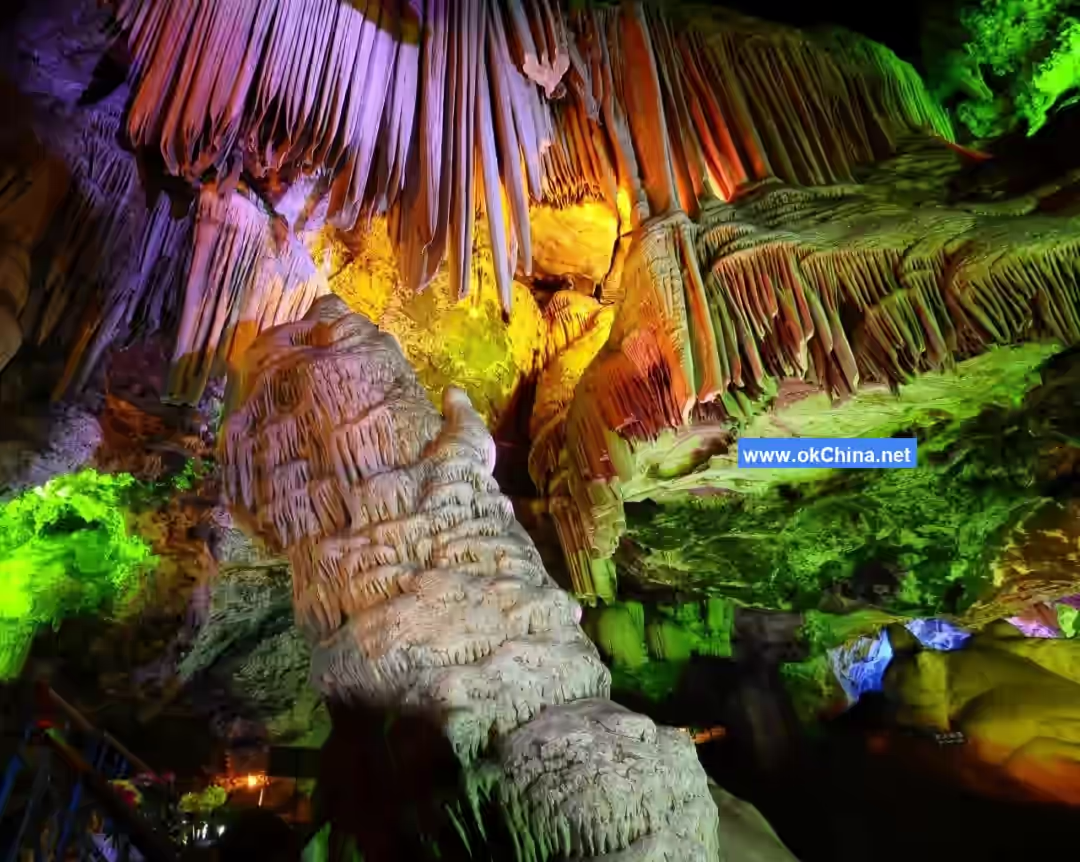
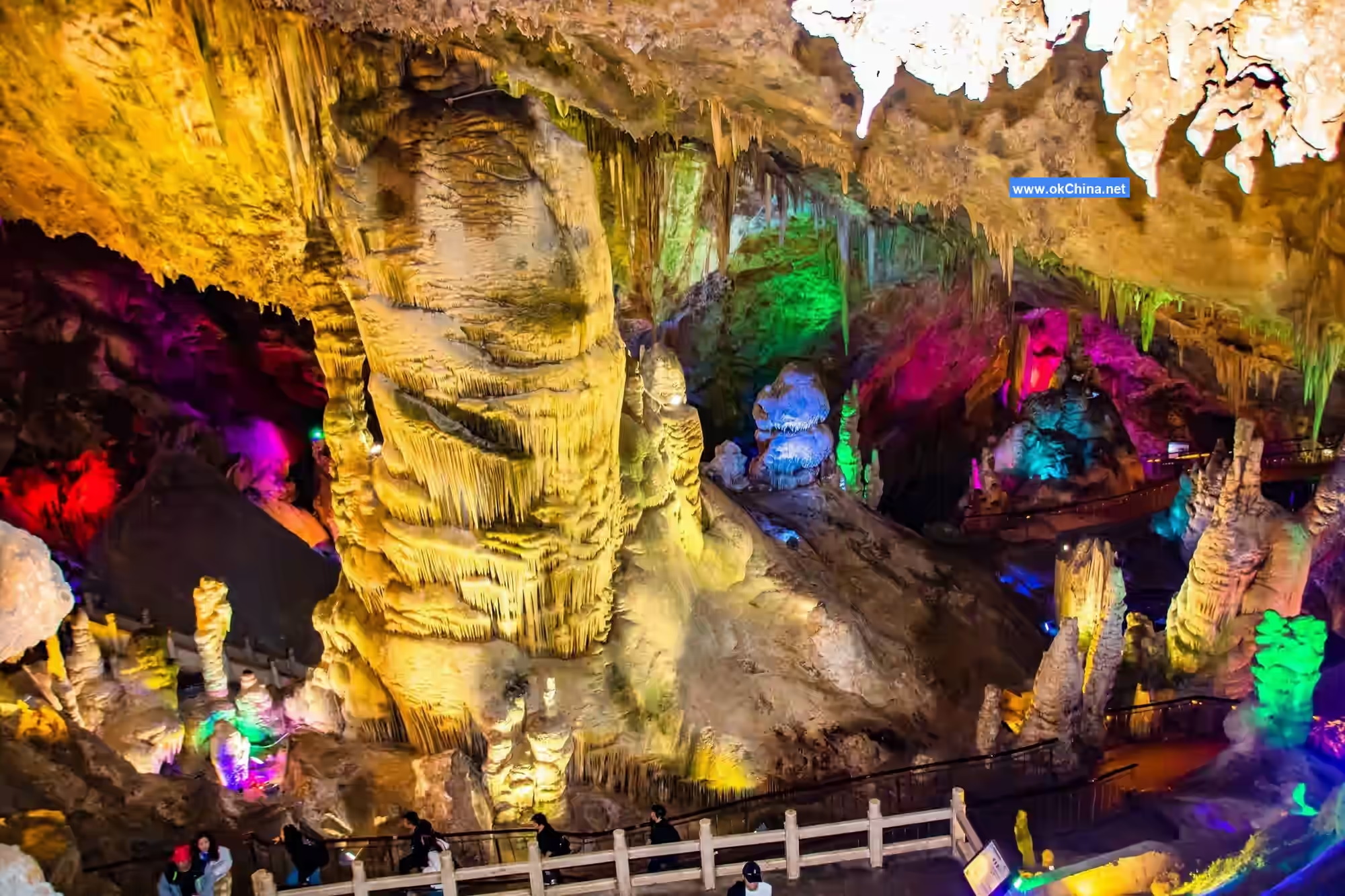
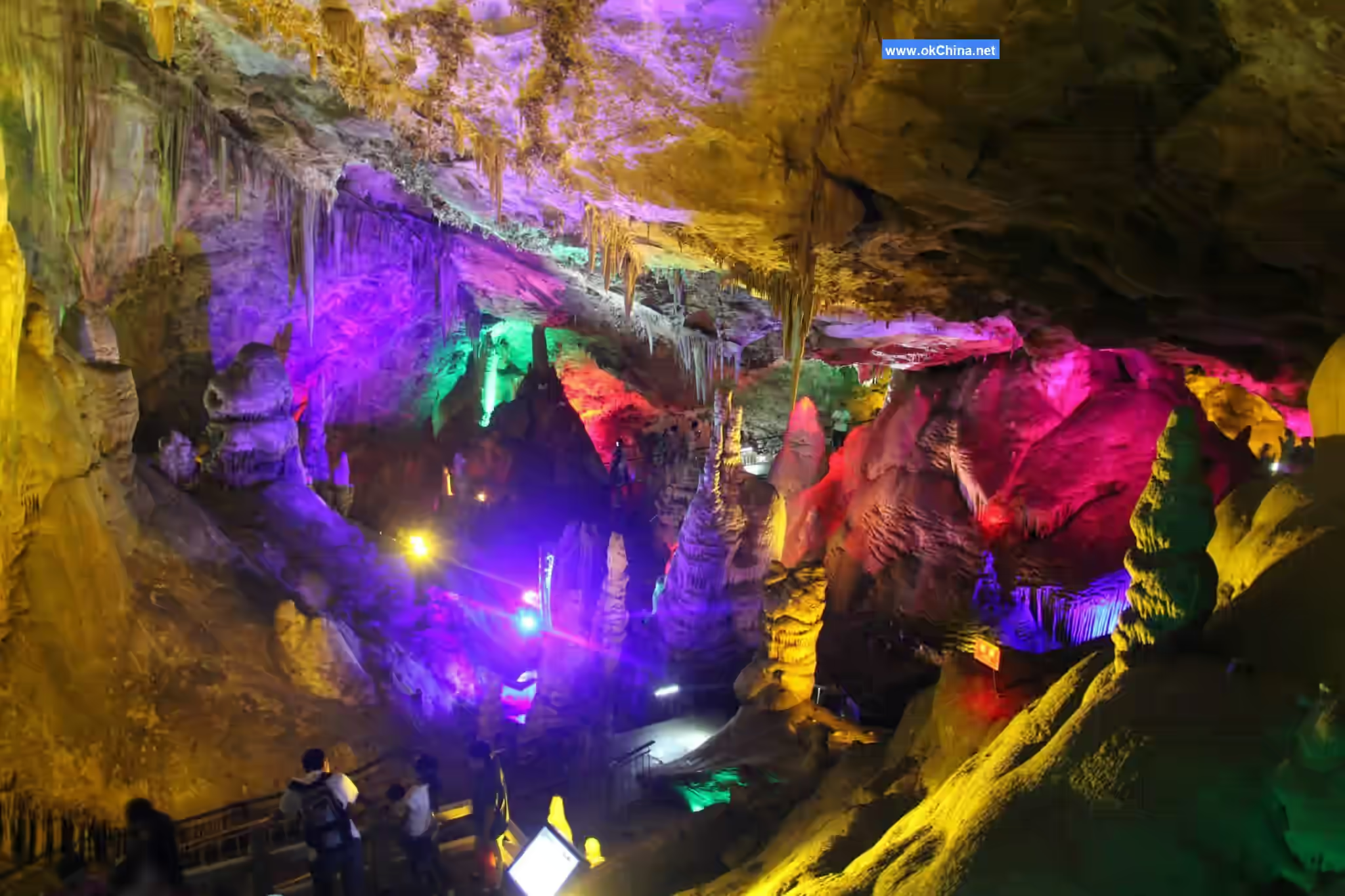
Jiguan Cave is a large limestone karst cave, a karst landform. The cave stretches for 5,600 meters, with an appreciable length of over 1,800 meters and an appreciable area of 23,000 square meters. Such caves are rare in northern China, earning it the reputation as the "Premier Cave Mansion of the North."
2. Geographical Environment
2.1 Laojun Mountain
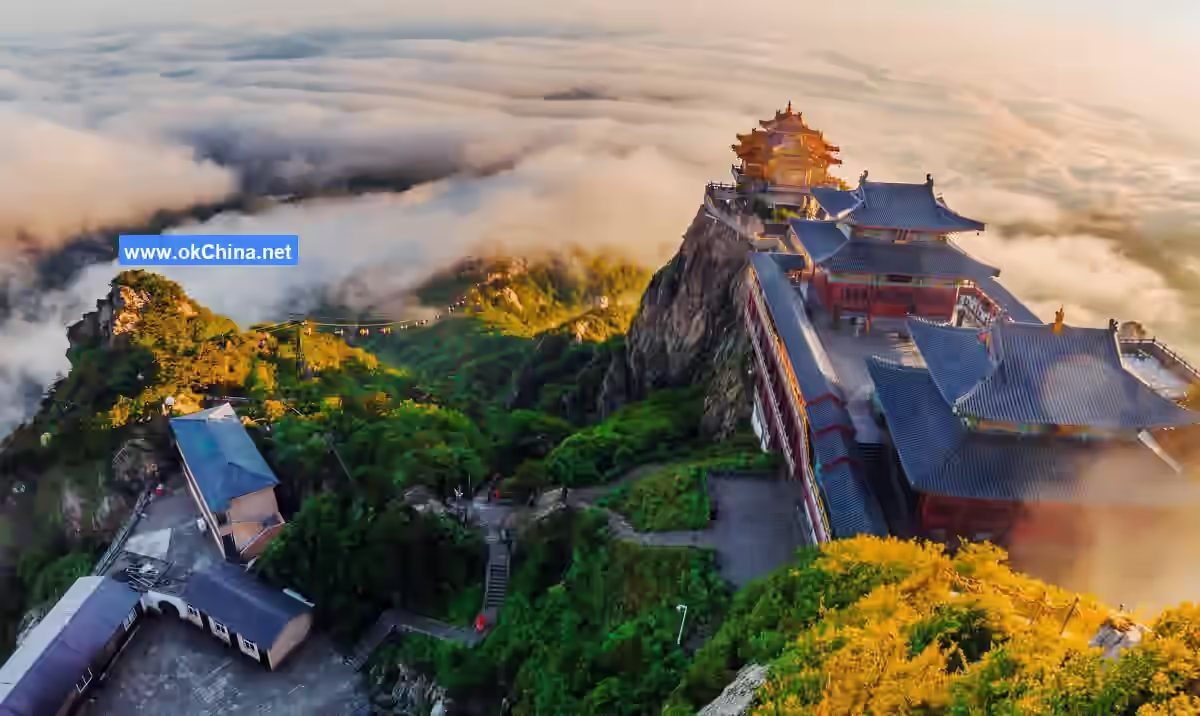
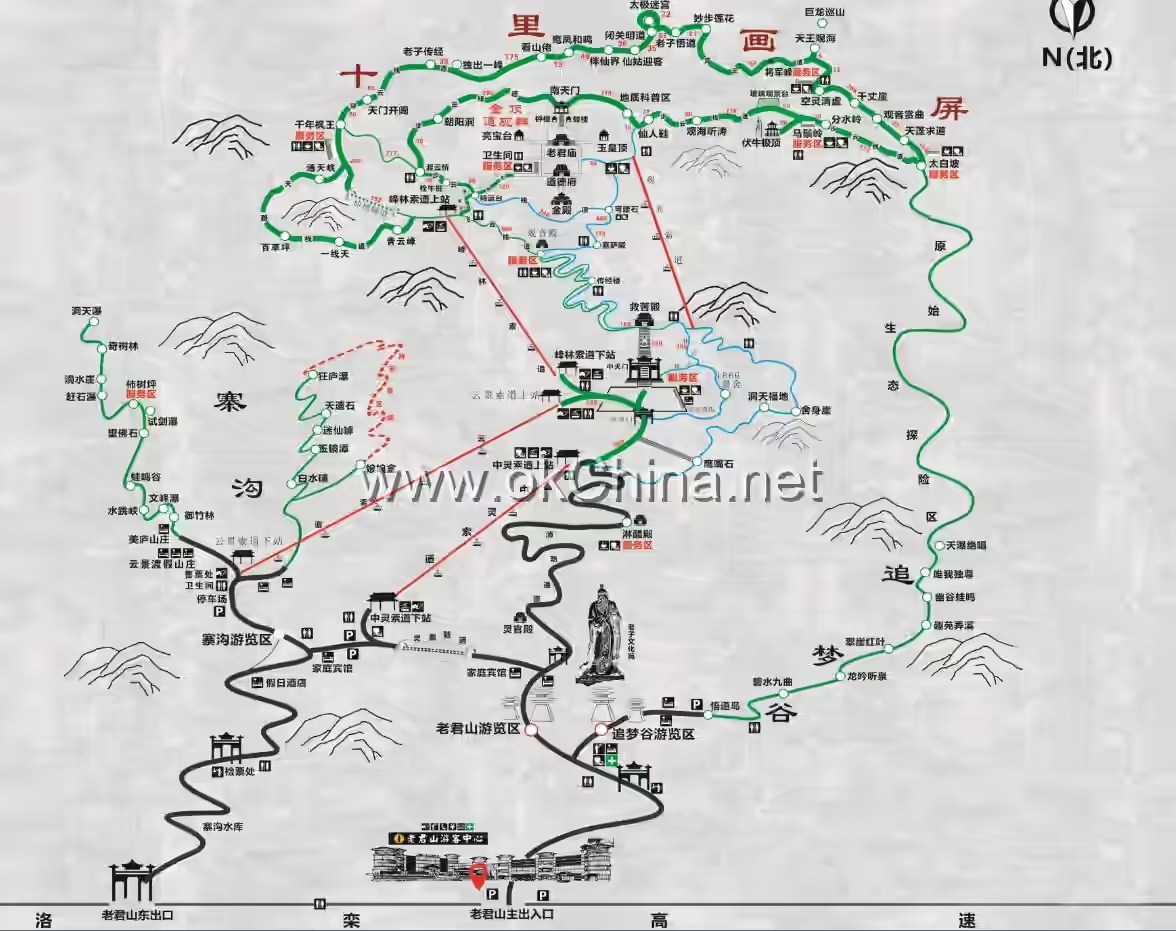
Laojun Mountain is one of the core scenic areas of the Funiu Mountain National Geopark. It records the geological evolution, including orogeny, dating back 1.9 billion years. The mountain features unique landscapes such as the distinctive "detachment peak forest" landform and spectacular stone forest scenic areas, which are profoundly awe-inspiring. The mountain is lush with trees and picturesque, with mountain springs visible everywhere, seeping from crevices in the rocks. Hidden within the verdant forests are over a dozen waterfalls, where clear torrents plunge from cliffs tens of meters high. After rain, Laojun Mountain is often shrouded in clouds and mist swirling around its peaks. If you reach the summit, you have the chance to witness breathtaking seas of clouds and sunrises. The Laojun Mountain scenic area is vast, primarily divided into the central main scenic area of Laojun Mountain, the western Zhuimeng Valley scenic area, and the eastern Zhaigou scenic area.
2.1.1 Climate Characteristics
Laojun Mountain has a temperate monsoon climate, with an average annual temperature of 12.4°C, 2,103 hours of annual sunshine, a frost-free period of 198 days, and an average annual precipitation of 872.6 mm. The highest annual precipitation reaches 1,386.6 mm, and the lowest is 403.3 mm.
2.1.2 Topography and Landforms
Laojun Mountain in Luoyang is located three kilometers southeast of Luanchuan County, Luoyang City, in western Henan Province. The original landscape of Laojun Mountain is well-preserved, recording the tectonic evolution processes of the southern margin of the North China ancient landmass over 1.9 billion years, including rifting, dispersal, accretion, amalgamation, collision, and orogeny.
The topography of Laojun Mountain is primarily characterized by low to medium mountains interspersed with river valleys, with significant relief. It belongs to the Western Henan Subdivision of the North China Stratigraphic Region, spanning the Xiong'er Mountain and Funiu Mountain districts. Exposed strata include: the Archean Taihua Group, the Lower Proterozoic Kuanping Group, the Middle Proterozoic Changcheng System Xiong'er Group, Jixian Guandaokou Group, and Luanchuan Group, the Upper Proterozoic Qingbaikou System Taowan Group, the Paleozoic Ordovician Erlangping Group, and the Cenozoic Paleogene and Quaternary systems. Lithology and facies vary greatly. Regional deep-seated major faults are distributed, resulting in complex geological structures.
2.2 Jiguan Cave
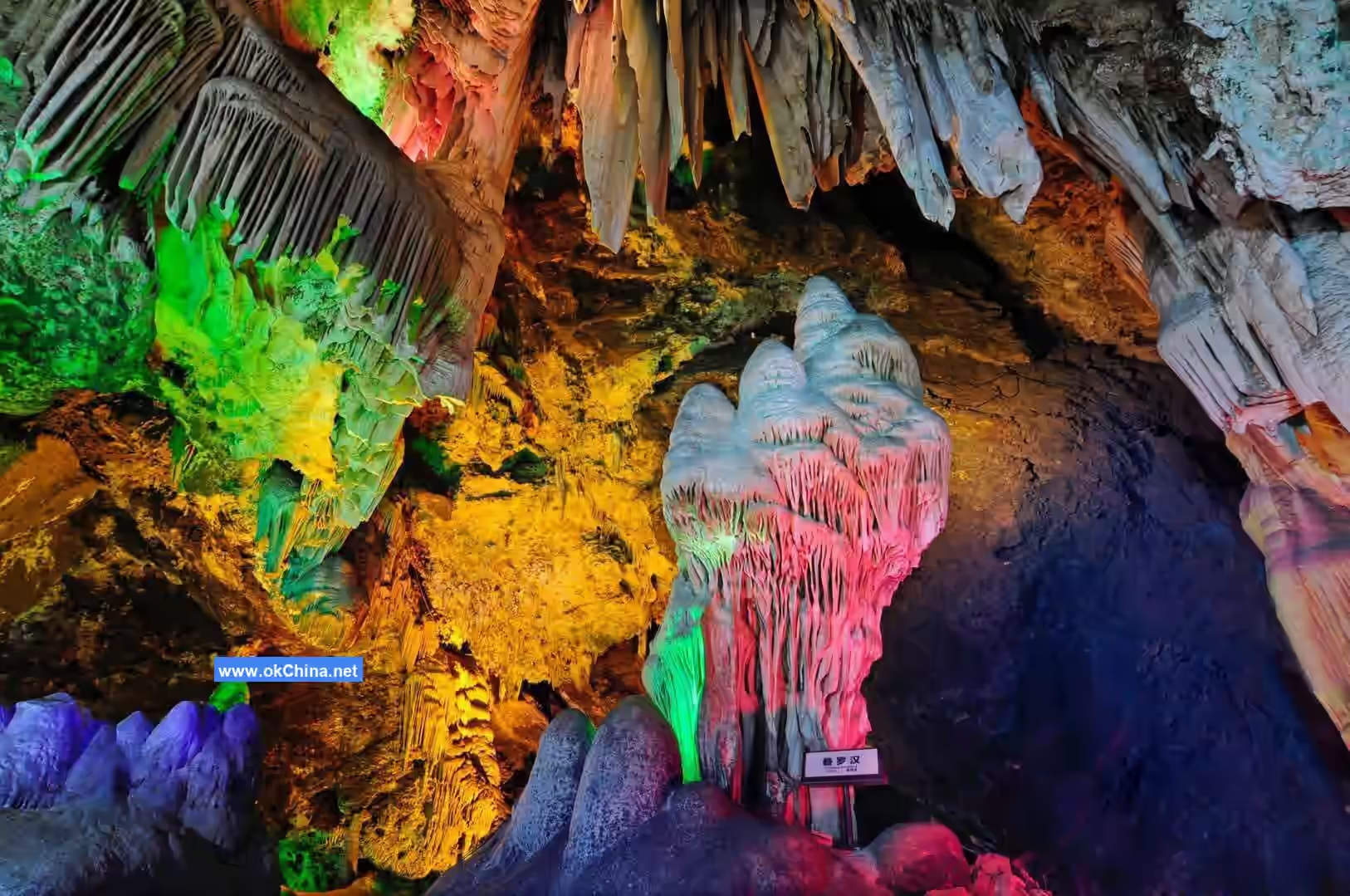
Jiguan Cave is a limestone karst cave. Its scenery is primarily composed of stalagmites and stalactites. Both stalagmites and stalactites have calcium carbonate as their chemical composition. Rainwater and carbon dioxide in the air act on limestone to form a calcium bicarbonate solution. As this solution flows and drips, it releases carbon dioxide, leaving behind calcium carbonate which solidifies and petrifies into stalagmites and stalactites of myriad forms. Stalagmites and stalactites grow approximately 1 centimeter every 100 years. Geological measurements indicate that the Yicai Hall (Hall of Overflowing Colors) formed about 600 million years ago, with the "Dolphins Playing with a Pearl" stalagmite forming roughly 54,000 years ago. The cave flowers (stone flowers) in the cave are calcite crystal flowers, which are carbonate crystals. They must attach to moonmilk stone and spread outwards under the action of non-gravitational water, accumulating over years to form flower-like shapes. Stone shields, helicities, and soda straws record the complex and diverse forms of fluid dynamics. Jiguan Cave possesses high aesthetic value and also involves aspects of physics, chemistry, geography, meteorology, and nature. Its multidisciplinary significance makes it a precious natural heritage.
3. Main Attractions
3.1 Laojun Mountain
Laojun Mountain features six scenic areas with 179 attractions, including 16 temples such as Taiqing Palace, Shifang Courtyard, Lingguan Hall, Vinegar-Sprinkling Hall, Sheepfold, Jiuku Hall, Scripture Transmission Tower, Guanyin Hall, Sanqing Hall, and Laojun Temple.
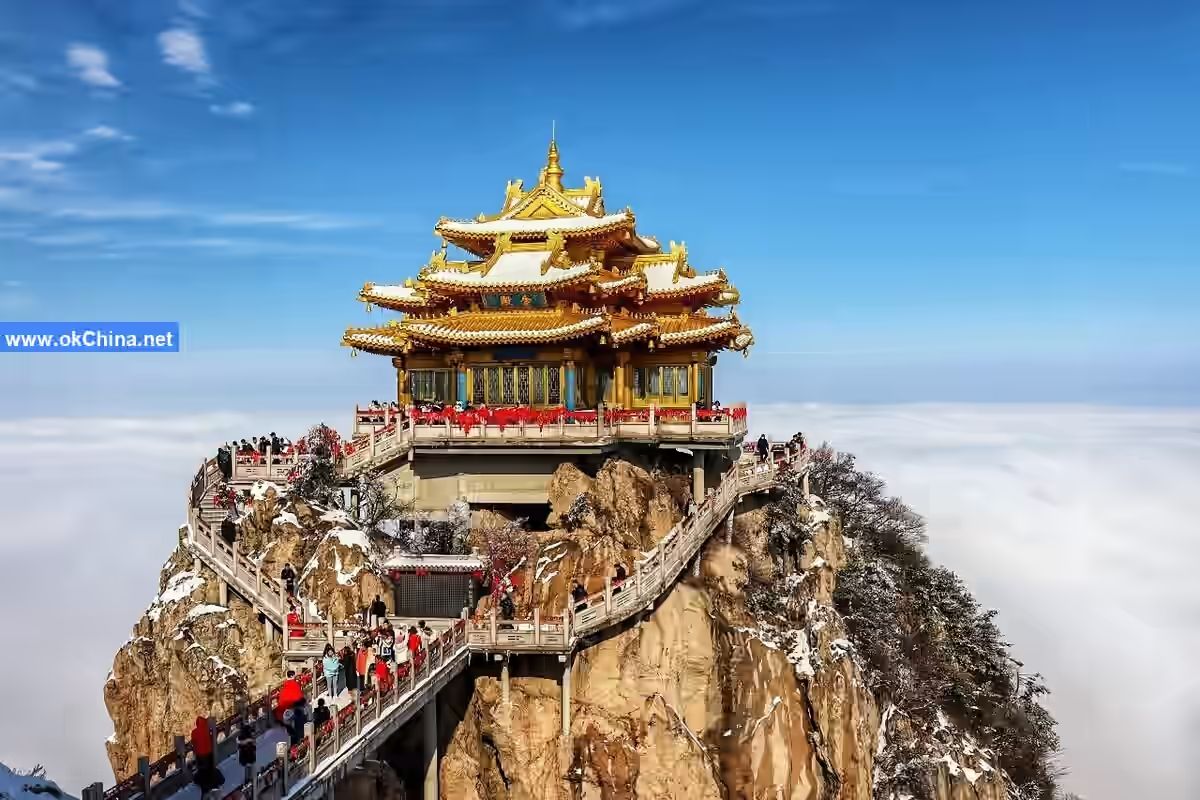
From the Northern Wei Dynasty to the present, these temples have been destroyed and rebuilt repeatedly. Among the existing temples, the Laojun Temple at the summit is the largest in scale. The temples along the Taoist cultural area of Laojun Mountain have a long history. The Laojun Temple at the summit is described as having "the Golden Summit of Wudang in the south, and the Iron Summit of Laojun in the north." On the southern side of Mazong Ridge, a stone forest landscape covering over 3,000 mu is open to tourists, hailed by geologists as the "Stone Forest of the North."
3.1.1 Laozi Cultural Garden
The Laozi Cultural Garden is a sacred site for inheriting and promoting Laozi's philosophy. It adopts Han Dynasty architectural style, with the central theme being "The Great Dao Travels Under Heaven, Harmony Revitalizes China."
3.1.2 Bronze Statue of Laozi
The bronze statue of Laozi on Laojun Mountain was recorded by Guinness World Records in 2014 as the "Guinness World Record – Tallest Bronze Statue of Laozi."
3.1.3 Golden Summit Taoist Temple Complex
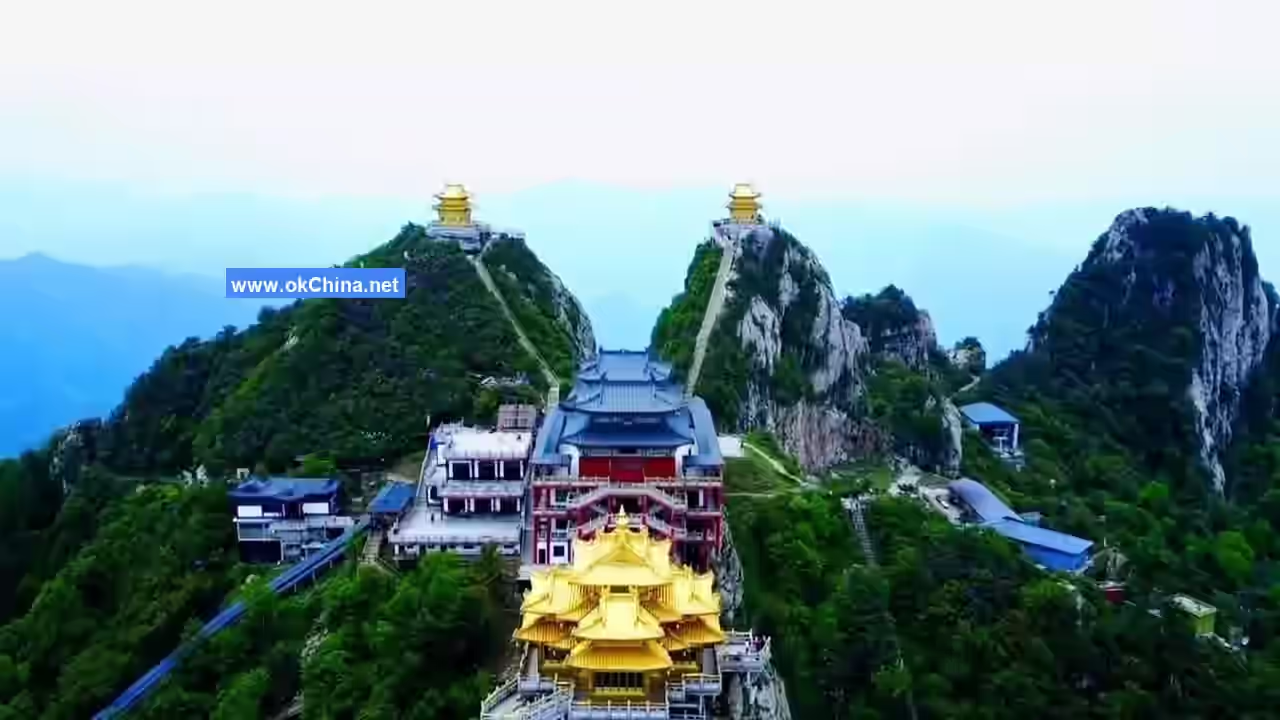
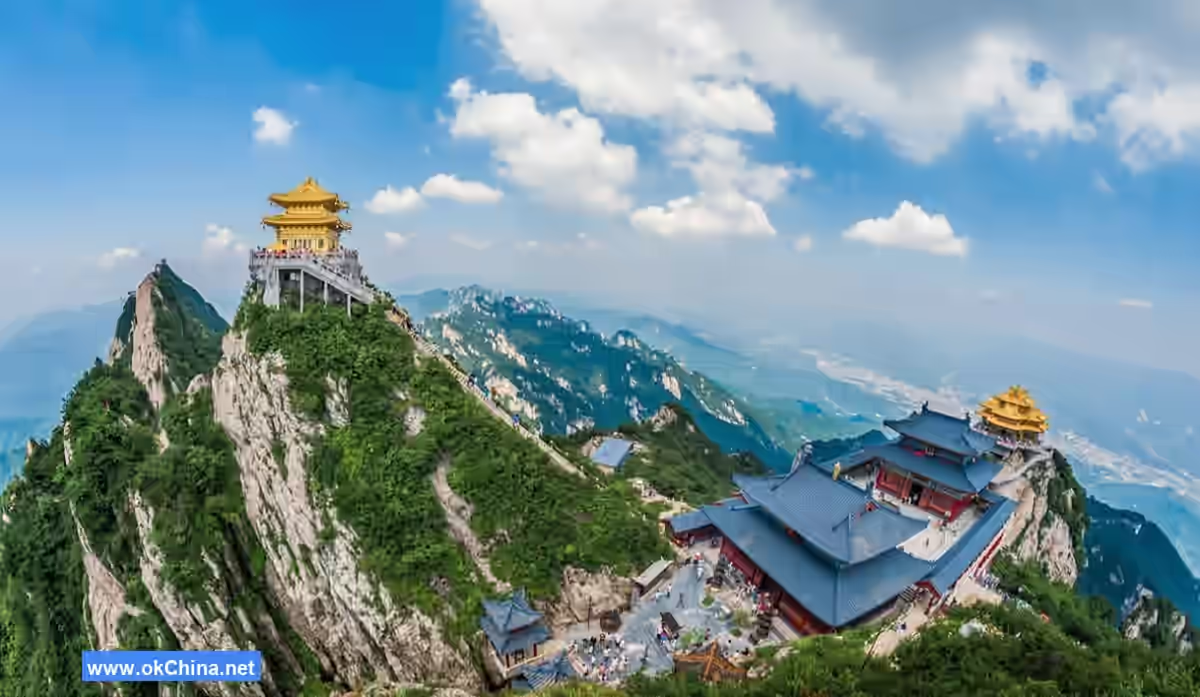
The Golden Summit Taoist architectural complex of Laojun Mountain is built upon the mountaintop and mainly includes Laojun Temple, Daode Mansion, Wumu Golden Hall, Liangbao Terrace, Yuhuang Summit, Bell and Drum Towers, South Heavenly Gate, Chaoyang Cave, Great Dao Courtyard, Shendao Heavenly Bridge, and cloisters. All structures employ the imperial palace architectural style of the Ming and Qing dynasties. Particularly, the three golden summits—the Golden Hall, Liangbao Terrace, and Yuhuang Summit—are highlights of the Laojun Mountain temple complex.
3.1.4 Taiqing Temple
The Taiqing Temple at the summit was first built during the Northern Wei Dynasty and has been renovated throughout successive dynasties. Yuchi Jingde of the Tang Dynasty once supervised its renovation. It flourished most during the Ming Dynasty, featuring iron rafters and tiles, resplendent and magnificent. For thousands of years, it has been a central Taoist sacred site for pilgrims from Henan, Shaanxi, Anhui, Hubei, and other regions. Pilgrims from the southeastern coastal areas also come attracted by its fame. For instance, the Jiulong Bafeng pilgrimage group from Kaohsiung, Taiwan, often numbers over a hundred people per visit.
3.1.5 Longyin Tingquan (Listening to Springs at Dragon's Chant Pavilion)
Longyin Pavilion is a viewing pavilion situated on the Laolongwo (Old Dragon's Nest) plank path. Due to its unique location, listening to the chorus of waterfall and spring sounds here is a great delight for visitors. The stream flows down from Pearl Beach and, reaching below Longyin Pavilion, is constricted by rocks into a rapid current rushing into a deep pool. After a series of collisions, fast and slow, it leaves behind over a dozen waterfalls of varying sizes. The sound of the waterfalls can echo within the valley's natural sound-reflecting walls.
3.1.6 Zhongding Yunyong (Clouds Surging at Central Summit)
The sea of clouds is a major wonder of Laojun Mountain, with the sea of clouds at Zhongding (Central Summit) being the most spectacular. When the sea of clouds appears, looking out, clouds veil thousands of li and mist locks ten thousand peaks. It feels like standing in a vast, boundless ocean, with emerald peaks appearing and disappearing, seemingly moving yet still. When the sea of clouds appears with clear skies above and overcast below, it presents the spectacle of "the sea reaches the horizon where sky forms the shore, the mountain reaches its ultimate peak where man becomes the summit."
3.1.7 Fenglin Zuiqiu (Maple Forest Intoxicated with Autumn)
Past Laolongwo lies a forest of Chinese pine. The tourist path winds through the forest, giving a sense of a secluded, winding path. Below the forest lies Pearl Beach. Round, smooth pebbles, under the reflection of water, resemble scattered pearls on a plate. The clear stream murmurs softly among the pearls. Together with the pine whispers like light mist, it washes away the worries of visitors from the bustling city, inspiring them with colorful dreams of life.
3.1.8 Sheshen Cliff (Self-Sacrifice Cliff)
Sheshen Cliff is the first beautiful natural scenic spot encountered during the mountaintop tour. Looking up, one sees ancient pines touching the clouds and perilous cliffs seemingly about to topple, truly majestic and grand. This is the famous scenic spot "Sheshen Cliff" on Laojun Mountain. At sunset, here "the lingering glow reflects on a thousand mountain hues, the uneven ravines all enter the painting." The magnificent sunset glow illuminates the fantastically shaped perilous peaks and strange rocks, creating wondrous sights and a riot of colors, leaving visitors in awe.
3.1.9 Fenglin Yanlan (Peak Forest Amid Mist and Haze)
Within an area of nearly a thousand mu, there are over three thousand stone peaks of various sizes and shapes. Among these strange rocks and peaks, the most famous is the Laojun Enlightenment Peak, where century-old pines still grow in the crevices of natural stone cliffs.
3.1.10 Shili Huaping (Ten-Li Painted Screen)
The peak forest landscape of Laojun Mountain in Luoyang appears as if cleaved by knives and axes, jagged like dog's teeth, draped in green and adorned with red, majestic, grand, and richly varied. This is due to the difference between the Laojun Mountain granite body and other granites. The Laojun Mountain rock mass is composed of "porphyritic biotite monzonitic granite." It is a relatively young rock mass formed during the uplift and orogeny of the Qinling orogenic belt between 140 and 80 million years ago. Domestic geologists have named it the "Laojun Mountain Rock Mass." Within the peak forest, every step offers a new view; the scenery changes with each step, each scene picturesque like a painting, hence the name "Ten-Li Painted Screen."### 3.1.11 Sea of Redbuds Every year from March to April, the redbuds in the Zhui Meng Valley of Laojun Mountain bloom in splendid profusion, creating a dazzling spectacle. They are early-blooming "harbingers of spring," flowering on branches even before leaves emerge, hence also known as "Man Tiao Hong" (Full Branch Red).
The redbuds of Laojun Mountain are of the Northern Giant Redbud species, also called Wusang, Brother Tree, or Friendship Tree. Their purple-red flowers, shaped like butterflies, are strikingly beautiful and lovely. They are a unique plant species distributed on the shady slopes of Laojun Mountain at altitudes between 800 and 2000 meters. The Laojun Mountain redbuds are characterized by six major features: early flowering, long blooming period, vibrant color, dense blossoms, large tree form, and high flower quality. The main varieties include clustered redbuds (shrubs), weeping redbuds, and racemose redbuds (trees). They are highly adaptable, preferring sunlight, and are tolerant of cold, drought, and even waterlogging. Both the roots and bark of the redbud can be used medicinally, with effects such as promoting blood circulation and qi flow, reducing swelling and pain, and detoxifying various poisons.
3.1.12 Frog Chorus in the Secluded Valley
It was here that Laozi, Li Er, achieved profound enlightenment and ascended in a single step to the peak of Funiu Mountain. The strange rocks in the river valley under the Wudao Bridge seem to possess life. When Laozi reached this spot and sat down to rest, he had just closed his eyes in a daze to commune with the heavenly deities when the incessant croaking of frogs, rising and falling, disturbed his peace. Laozi pointed his finger, using stillness to overcome motion, and transformed them into stone.
3.2 Jiguan Cave (Rooster Crown Cave)
Jiguan Cave stretches 5,600 meters in length, divided into five levels with a height difference of 138 meters. The developed section is 1,800 meters long, with a viewing area of 23,000 square meters. It is divided into eight scenic areas, named in order: Jade Pillar Pool, Overflowing Color Hall, Layered Curtain Palace, Cave Sky River, Immortal Gathering Palace, Jade Pool Palace, Hidden Elegance Pavilion, and Stone Forest Workshop.
3.2.1 Jade Pillar Pool
Upon reaching the cave entrance and passing through a 30-meter-long, 2.5-meter-high artificial tunnel, visitors enter the first scenic area, the Jade Pillar Pool. The highest point of the cave ceiling here is 49 meters from the ground, capable of accommodating over 500 people simultaneously. This area is densely populated with stalagmites and stone pillars of varying heights and thicknesses, making it the most concentrated area for such formations in the cave. It is named "Jade Pillar Pool" due to a pool of clear underground water located within.
3.2.2 Immortals Welcoming Guests & Immortal Gazing Afar
Directly ahead of the pool water stand several stalagmites resembling little immortals smiling and waving to welcome tourists, hence named "Immortals Welcoming Guests." The tallest of these stalagmites is 0.9 meters, the shortest 0.6 meters. On the left wall of the cave, 10 meters from this spot, is the earliest discovered cave entrance, with a diameter of 0.94 meters. Though small, it was once the only passage for people to enter and exit. Proceeding another 15 meters leads to the most concentrated location of scenery in the first scenic area. Here, one can view the landscape on the right side of the walkway called "Golden Turtle Ferrying the Immortal Elder." The massive "Golden Turtle" is composed of three naturally piled rocks, and on its back grows a 1.1-meter-high stalagmite resembling an elderly immortal with a high bun and slightly hunched back. Directly 18 meters in front of this scene, on the cave wall, is a niche containing a stalagmite 0.3 meters in diameter and 0.8 meters high, remarkably like a small immortal wearing a pointed hat. To the left of this "little immortal" is a stone shield, 0.4 meters in diameter and 0.94 meters high, with its folded drapery resembling a short-sleeved shirt fluttering in the wind. Together, they form the scene "Immortal Drying Clothes." Below and to the right of "Immortal Drying Clothes" is the scene "Snow Goat Kicking Up Its Hooves," a flowstone formation shaped like a frolicking goat.
3.2.3 Heavenly Dog Guarding the Moon
On the cave wall 22 meters directly in front of "Golden Turtle Ferrying the Immortal Elder" is a triangular flowstone. From its top downwards, stalagmites ranging from 0.4 to 0.5 meters in height are arranged, resembling five Buddha statues meditating on a mountain, hence named "Five Buddhas Painting the Mountain." Seventeen meters to the right front of "Golden Turtle Ferrying the Immortal Elder," a stalagmite resembles an alert wolfhound with perked ears. Coincidentally, directly above it on the cave ceiling is a natural ventilation shaft 0.8 meters in diameter, extending 38 meters up to the mountaintop, like a bright moon suspended from the ceiling. Together, they form the scene "Heavenly Dog Guarding the Moon." This is the only natural ventilation shaft in the cave.
3.2.4 Overflowing Color Hall
The second scenic area, the Overflowing Color Hall, is the earliest formed cave chamber, dating back approximately 600 million years. It features an open, canyon-like terrain. Stalactites hang from the ceiling, and stalagmites are scattered across the floor, creating a dazzling display of flowing colors, hence its name.
Standing at the center of the walkway in the second scenic area and looking down into the valley floor of the "Overflowing Color Hall," one sees a stalagmite 0.45 meters in diameter and 0.7 meters high, resembling a kind-faced God of Longevity. The rock to its left looks like a 2.83-meter-long "crocodile" with its mouth open and tail raised, seemingly listening attentively to the "God of Longevity's" earnest teachings and gaining enlightenment. This scene is named "Crocodile Paying Homage to Longevity." On the hillside 5 meters to the left front of this spot, a group of stalagmites resembles a tiger vigorously pulling a jade peak forward, adding brilliance and treasure to the Overflowing Color Hall, named "White Tiger Pulling the Jade Peak." On the cave wall to the upper right of "Crocodile Paying Homage to Longevity," two stalactites are particularly eye-catching. One resembles a fish tail stuck in a cave entrance, called "Carp Leaping over the Dragon Gate," vividly lifelike. The other looks like a hippopotamus peeking out to admire the world's beauty, with its mouth agape and eyes wide open, its rich expression astonishing, named "Hippo Peeking at the View." As one admires the scenery to the corner of the walkway, on the left side, a dolphin seems to leap out of the water, balancing a red ball on its head to showcase its charm for guests, named "Dolphin Playing with a Pearl," remarkably lifelike.
Descending from the second to the third scenic area involves a height difference of nearly 30 meters via a 75-meter-long staircase. Along the way down, on the left side, two stalagmites can be seen. One, with a diameter of 1 meter and height of 2.73 meters, rises from the ground like a "Long March 1 rocket" ready for launch. The other, 0.88 meters in diameter and 2.1 meters high, resembles an old man wearing a snow cap and cloak, bravely trudging forward through a heavy snowstorm.
3.2.5 Layered Curtain Palace
The third scenic area, the Layered Curtain Palace, derives its name from the rows of stone drapery (flowstone curtains) on the ceiling. It is one of the most spectacular halls in the cave, featuring large areas of hanging stalactites.
Upon entering the third scenic area, the first sight is the landscape "Stacked Arhats." This is a 4-meter-high, straight and upright stalagmite. Its top is arranged with three small dome-shaped stalagmites resembling three plump arhats sitting stacked on top of each other, hence the name. Walking around to view it from behind reveals that the stalagmite tilts along the slope, as if vying with the Leaning Tower of Pisa. The view changes with every step, offering unexpected effects from different angles. This landscape is also the iconic promotional image for the scenic area. Proceeding along the walkway to the viewing platform presents a distinctive stalagmite: thick at the bottom and thin at the top. The lower section is 1.3 meters in diameter and 2 meters high, while the upper section is 0.54 meters in diameter and 1.1 meters high. The upper section resembles a woman with long hair looking into the distance, as if awaiting the return of a loved one, named "Stone of the Waiting Wife." Thirteen meters to the left front of the "Stone of the Waiting Wife," on the cave wall, is "Drunken Arhat." This is a white flowstone about 4 meters high, resembling a drunken, pot-bellied arhat lying down, with chest exposed, clothes disheveled, and head tucked away in panic. Its comical shape is amusing. To the right of the "Stone of the Waiting Wife" is a pointed-top stalagmite called "General Stone," 0.7 meters in diameter and 1.87 meters high. It vividly resembles a general from ancient battlefields, clad in a war robe, wearing a long sword at his waist, exuding extraordinary bearing and great majesty.
Previously, moving from the third to the fourth scenic area required passing through a muddy hole less than 1 meter in diameter and 5 meters deep, necessitating ropes for ascent and descent, which was extremely inconvenient. Later, artificial reinforcement and construction formed a spiral passageway descending one and a half turns into the ground—the "Jasper Snail."
3.2.6 Cave Sky River
Passing through the Jasper Snail leads to the fourth scenic area, the Cave Sky River. An endlessly flowing underground river gushes out from rock crevices, its source and destination unknown, its sound deafening to the ears, hence the name. This river has a daily flow of 600 tons. Samples tested by the Henan Geological Research Institute show the water is rich in over 20 trace elements beneficial to human health, such as iron, potassium, calcium, zinc, and magnesium, making it a high-quality mineral water. Ascending the first section of iron stairs, one can see the left cave wall covered with snowflake-like stone flowers,洁白透亮、晶莹, called Snowflake Stone. Two meters from the Snowflake Stone, on the right side of the path, is a horizontal pool covering about 3 square meters. Unaffected by drought or flood year-round, its water level remains consistently moderate, neither rising nor falling, making it one of the cave's wonders.
Climbing the second section of iron stairs reveals cave walls dotted with fluorescent grape-like stone flowers,姹紫嫣红, appearing in clusters or scattered patches, exceptionally precious. Neighboring the stone grapes is a stone column 0.05 meters in diameter and 3.1 meters high, uniform in thickness, straight and upright, called the "Sea-Calming Needle." This is also the thinnest stone column in the cave and a key protected landscape. Three meters away from the stone grapes, the cave wall is covered with a layer of bud-like stone flowers, shaped like coral in the sea,熠熠生辉. These are the Coral Stones.
3.2.7 Immortal Gathering Palace
The fifth scenic area, where stalagmites take on various forms, as if numerous immortals are joyfully gathering together, hence named "Immortal Gathering Palace."The floor of the "Gathering of Immortals Palace" is 28 meters from the cave ceiling. Upon entering the palace, the first sight is a massive, hill-like deposit called Amber Ridge, standing 8 meters high and stretching 60 meters long. At the far right end, perpendicular to the entire cave wall, is a 23-meter-wide, 19-meter-high flowstone formation that resembles a cascading waterfall, majestic and powerful. It is the largest and most complete stone waterfall discovered in the cave to date. Where the stone waterfall meets the cave ceiling, a stone niche has formed. Inside the niche lies an "Immortal's Bed," with clearly defined headboard and footboard, its dimensions comparable to a real bed—truly marvelous. From right to left along Amber Ridge, scenes such as "Journey to the West," "Eight Immortals Crossing the Sea," "Pagoda Hill," and "Mushroom Rock" unfold one after another, too many to enumerate. The figures and landscapes are vividly lifelike: "Tang Monk" wears a Buddhist crown and appears serene; "Monkey King" forges ahead, sweat streaming down his cheeks; the "Eight Immortals" each display unique expressions, with Zhang Guolao particularly carefree as he "rides his donkey backward." Adorned with "pagodas" and "mushrooms," the scene blends reality with illusion, creating a palace-like atmosphere.
At the center of Amber Ridge stands a stone pillar, 13 meters in diameter and 28 meters tall, majestic and towering, connecting heaven and earth. Water seeping from the cave ceiling slowly trickles down the pillar, making it appear exceptionally crystalline and translucent, earning it the name "Jade Pillar Holding Up the Sky." To the left of this sight, there is a white stalagmite, 0.9 meters in diameter and 1.7 meters tall, resembling an old longevity god holding a celestial peach—kindly and beaming with joy—hence named "Longevity God Holding Peach." Two meters above and to the left of the "Longevity God," there is even the "Longevity God's Wife," happily holding her grandchild as she welcomes guests from all directions. Strolling into the fifth scenic area, clusters of stone flowers cover the cave walls like blooming chrysanthemums, competing in splendor. Among them, the largest chrysanthemum stone measures 0.3 meters in diameter, with enormous blossoms and unique shapes, acclaimed as the "Cockscomb Stone Flower King."
3.2.8 Jade Pool Palace
The sixth scenic area, the Jade Pool Palace, not only "treasures" many rare and unusual formations of great scientific value but also boasts so many sights that it is said "every three steps reveal a new scene."
The entrance to the Jade Pool Palace, the "South Heavenly Gate," is exceptionally narrow and perilous. On either side, there are smooth stalagmites that, when illuminated, become transparent and dazzling, hence named transparent stones. The "Jade Pool Palace" derives its name from a natural pool of crystal-clear water at the entrance of the "South Heavenly Gate." In the water grow nine thick stalagmites, with the central one resembling an exquisitely carved "Queen Mother's Throne," 1.6 meters in diameter and 3.1 meters tall. About 1.5 meters in front of this sight, a stalagmite lies horizontally, resembling a sea lion frolicking in the water. On the cave wall to its left front, droplets of water fall onto a thick stalagmite, as if a plump carp is opening its mouth to catch the water. This scene is named "Carp Playing in Water." Particularly remarkable are the clearly visible mouth, head, body, and especially the "scales" of the "carp." Even more wondrous is the water seeping from the cave wall, falling like silver threads precisely into the "carp's" open "mouth." Adjacent to this beautiful sight is a massive deposit covering 67 square meters—White Jade Mountain. White Jade Mountain appears as if carved from white jade, hollow and smooth throughout. Between it and the "Carp Playing in Water" scene hangs a "Heavenly Palace Ice Lantern," 0.53 meters in diameter and 0.61 meters long, resembling either icicles in deep winter or palace lanterns, with clear textures and smooth, distinct edges. Here, the cave ceiling is densely covered with transparent, hollow soda straws, over 200 in number, with the longest reaching 0.7 meters. Opposite the "Carp Playing in Water" scene stands an upright stone shield, 1.5 meters tall with a shield plate diameter of 0.7 meters. Due to its unique formation and its massive, rare, and extraordinary form, it is honored as the "First Shield in Asia."
The treasure of the cave, the "Seven-Story Pagoda," is a stalagmite 0.3 meters in diameter and 0.8 meters tall. Its lifelike shape conforms to ancient Chinese pagoda architectural style, neat and flawless. Looking up at the cave ceiling, one can see a hanging stone shield on the cave wall, with a horizontally positioned shield plate 2.8 meters in diameter. Surrounded by curtain-like shield drapes, even the imperial parasols of ancient emperors pale in comparison. It is exceptionally rare in China.
The next viewing spot can be the photography platform in the sixth scenic area. Along the way, stalagmites resembling monkeys, puppies, or white pigeons are scattered by the path, full of charm. Especially notable is the stalagmite in the middle of the path called the "Stumbling Stone." It is said that stepping over it brings smooth progress and continuous advancement. To the right of the "Stumbling Stone," sheet-like stalactites connect to the ground, forming a stone "qin" (a Chinese zither) 3.2 meters wide and 2 meters tall. Arranged neatly and densely, tapping it lightly produces clear, melodious sounds that linger. Standing on the photography platform, the most eye-catching sight is a massive stone pillar. Measurements indicate it formed over approximately 5 million years. The pillar naturally bears exquisite relief patterns resembling a golden dragon coiling downward, with its head, body, tail, and claws clearly distinguishable. Named "Coiling Dragon Jade Pillar," it is hailed by authorities as the "First Pillar in China" due to its majestic height, lengthy formation period, and lifelike dragon pattern, unique in the country.
The elevation difference between the sixth and seventh scenic areas is 32 meters, reachable by climbing an 80-meter-long natural tunnel. The tunnel walls are adorned with large amounts of calcite crystal flowers, in shapes of snowflakes, chrysanthemums, and corals, forming a massive crystal cluster that grows from small to large, exceptionally precious. The "Stone Peony" is the largest type of stone flower, a wonder among wonders. It measures 0.14 meters in diameter, pure and bright, with peerless beauty. It can be admired on the cave wall to the left after ascending 33 steps from the photography platform in the sixth scenic area. On the cave wall to the left front of the white peony, there is also a small stone shield, 0.16 meters in diameter and 0.14 meters tall, resembling a delicate embroidery disk. It is also the smallest stone shield in the cave.
3.2.9 Hidden Elegance Pavilion
The seventh scenic area, the Hidden Elegance Pavilion, is a smaller viewing area within the cave. Though small in size, it is exquisite and compact, filled with a dazzling array of sights. The area is divided into two levels. On the cave ceiling, there is an opening 1.6 meters in diameter. Peering through it, one sees dense clusters of stalagmites and stone flowers inside, with enchanting scenery. The stalactites hanging around the opening resemble curtains or drapes. As this area is not fully developed and not all sights can be appreciated, it is called the "Hidden Elegance Pavilion." Among the hanging stalactites at the opening, one stalactite and a protruding stalagmite on the ground grow toward each other, separated by only 1 centimeter. According to geological experts, given normal drip rates, it would take 40–70 years of simultaneous growth from above and below for them to connect. Thus, this sight is whimsically called the "Millennium Kiss."
Another attraction here is called "Lovers' Stone," formed by two slender stalagmites joining together over a long time, resembling an affectionate couple embracing. It is located 2.5 meters forward on the same side as the "Millennium Kiss." To the right front of the "Lovers' Stone" stands a stalagmite 1.2 meters tall, with a round body and pointed top, clearly showing 11 layers, reminiscent of Islamic pagoda architecture. On the cave wall opposite the "Lovers' Stone," a stone flag grows—a sheet-like stalactite formed by water deposition along a winding crack in the cave ceiling, shaped like a flag fluttering in the wind.
3.2.10 Stone Forest Workshop
The eighth scenic area, the Stone Forest Workshop, is the last developed area in the cave. Its characteristics include dispersed sights and complex formations. The most captivating feature for visitors is a series of stalactites of varying lengths hanging neatly on the cave wall, forming a stone curtain 8 meters wide and 6.4 meters long, resembling an inverted stone forest that rivals the Stone Forest in Lunan. Directly in front of the stone curtain lies a pool of emerald water, named "Lotus Pond" due to the lotus pods growing in it. Lotus pods are round or oval, with flat surfaces and thin edges, resembling lotus leaves floating on water. They are formed by the synergistic action of gravitational and non-gravitational water or multiple modes of gravitational water movement. In northern karst caves, they have only been found in four locations within the Chicken Crown Cave. The surface of Lotus Pond is as calm as a mirror, reflecting the cave ceiling scenery, creating an undersea world with coral clusters, deep canyons, and an air of mystery. Turning to the right, flowstone deposits formed by water flowing down the cave wall create terraced fields on the ground, named "Flowstone Dams." On the same side of the cave wall as the stone curtain, two adjacent stone shields grow. One, with a shield plate 0.51 meters in diameter, faces the viewing platform, while the other, 0.77 meters in diameter, faces the opposite direction, forming a peculiar yin-yang phenomenon. Known in geological circles as the "Yin-Yang Shield," it is rare worldwide. Finally, to the right of the stone curtain, a mixed deposit 4.8 meters long resembles a turtle, facing the exit as if pointing the way, hence named "Silver Turtle Shows the Way."
Bidding farewell to the Stone Forest Workshop in the eighth scenic area, one exits the cave through a 120-meter-long, 2.5-meter-high artificial tunnel.
4. Development History
4.1 Laojun Mountain
Laojun Mountain was anciently named "Jingshi Mountain," meaning "a room gathering the beauty of the eight-hundred-li Funiu Mountains." Because Laozi, the founder of Taoism, retreated here for cultivation, it was later renamed "Laojun Mountain," a name that persists to this day. Laojun Mountain stands at an elevation of 2,217 meters and is the main peak of the eight-hundred-li Funiu Mountains. Its geological landscape is a world-class resource.
Laojun Mountain is located in Luanchuan County, Luoyang. Historically, Luanchuan was long under the jurisdiction of Lushi County.
The "Lushi County Annals · Stele Records" mention Laojun Mountain, stating, "During the Northern Wei Dynasty, to commemorate, a Laojun Temple was built on the mountain. It was rebuilt during the reign of Emperor Taizong of Tang, supervised by the minister Yuchi Jingde."
This Laojun Temple had iron rafters and tiles, also known as the Iron Top. It was especially prosperous during the Ming Dynasty. During the Wanli period of the Ming Dynasty, Gao Chu, the magistrate of Lushi County, wrote "Ode to Climbing Jingshi Mountain," in the preface of which he noted: "Upon arriving in Lushi, I heard of a mountain towering to the sky, commonly said to be the dwelling of Laozi, hence named Laojun Mountain." This shows that the tradition of Laozi retreating to Jingshi Mountain has long been prevalent.During the Eastern Zhou period, Li Er, known as the "Keeper of the Archives," retreated to this mountain for seclusion and cultivation. He was later revered by Taoism as the Supreme Lord Lao, and Emperor Taizong of the Tang Dynasty bestowed upon the mountain the name "Mount Laojun," a name that has persisted to this day. Mount Laojun derives its name from the Supreme Lord Lao, Li Er, who practiced seclusion and cultivation here, boasting a rich Taoist cultural history spanning over 2,000 years.
After completing the Tao Te Ching, Laozi bid farewell to Yin Xi, the guardian of Hangu Pass, and departed riding a green ox. Records of the Grand Historian notes, "No one knows where he ended up." According to historical records, Laozi retreated to Jingshi Mountain in Luoyang, which is now known as Mount Laojun. Consequently, Laozi's philosophy and Taoist culture have profoundly influenced the Mount Laojun region, making it an outstanding representative of the landscape culture of the Central Plains. Temples such as the Laojun Temple, Lingguan Hall, Lincu Hall, and Daode Mansion are characterized by their simple yet solemn architecture and have long been sacred pilgrimage sites for Taoist devotees across northern China.
During the Northern Wei period, the Laojun Temple was constructed on the mountain in commemoration.
In the 11th year of the Zhenguan era (637 AD), Emperor Taizong of the Tang Dynasty, Li Shimin, dispatched Yuchi Jingde to oversee the reconstruction of the Laojun Temple and personally inscribed a plaque bearing the words "Famous Mountain Under Heaven."
During the Wanli era of the Ming Dynasty, Gao Chu, the magistrate of Lushi County, composed Ode to Ascending Jingshi Mountain, in the preface of which he wrote, "Upon arriving in Lushi, I heard of a mountain towering into the heavens, commonly known as the dwelling place of Laozi, hence named Mount Laojun."
In 1644, Li Zicheng captured Beijing, and Emperor Chongzhen hanged himself in martyrdom. The 16-year-old Crown Prince Zhu Cilang fell into Li Zicheng's hands and followed the Dashun army to Shanhaiguan to suppress Wu Sangui. After the defeat, he fled to Luanchuan, where he disguised himself as a Taoist priest on Mount Laojun for over 30 years. He was secretly revered as emperor by loyalists who followed him until his death at the age of 51. At the foot of Mount Laojun, there originally existed the Crown Prince's tomb and stele, with four inscriptions serving as irrefutable evidence.
The poet Wang Xinjian composed a poem titled Mount Laojun, which reads:
"Cloudy peaks in countless layers, autumn brings clarity here.
Greeted by lush greenery, turning away from the sound of springs.
The Golden Summit exudes purple aura, stone forests breathe immortal breeze.
Deep ravines lie in silence, butterflies unknown by name."
In 1997, it was approved by the State Council to establish a national-level nature reserve. It is also recognized as a UNESCO Global Geopark and a national geopark.
On September 11, 2010, the "Laozi Culture International Forum" successfully concluded in the Mount Laojun scenic area of Luanchuan. Over a hundred renowned research experts from China, Japan, South Korea, Belgium, and other countries attended the forum.
On April 25, 2017, the Immortal Realm Pilgrimage Festival was held at Mount Laojun in Luoyang, Henan. In front of the world's tallest statue of Laozi in the Mount Laojun Laozi Cultural Garden, hundreds of Taoist priests from all directions entered the mountain to pay homage to the Taoist patriarch Laozi, creating a spectacular scene stretching over a hundred meters.
4.2 Jiguan Cave
Jiguan Cave was discovered during the Qianlong era of the Qing Dynasty. The old Luanchuan County Annals described it as follows: "Jiguan Cave has four halls, like the dens of dragons and snakes," "bats are as dense as weaving, dangers lurk everywhere," "woodcutters, armed with knives and sticks, entered in groups holding candles," and "its depth is unfathomable, and they returned in fear." In August 1992, the county committee and government decided to develop Jiguan Cave. Led by the county cultural bureau and implemented by the county tourism development company, an investment of 1.8 million yuan was made to create new entrances and exits, lay paths inside the cave, install colored lighting, and construct archways and buildings. The project was completed on March 31, 1993, and opened to the public on April 10.
5. Historical and Cultural Heritage
5.1 Taoist Culture
Mount Laojun has a Taoist cultural history spanning over two thousand years. Legend has it that after Laozi transmitted the Tao Te Ching, he bid farewell to Yin Xi, the guardian of Hangu Pass, and departed riding a green ox. Records of the Grand Historian notes, "No one knows where he ended up." Other records indicate that Laozi retreated to Jingshi Mountain in Luoyang, which is now known as Mount Laojun. Jingshi Mountain was renamed Mount Laojun because Laozi practiced seclusion and cultivation here. During the Northern Wei period, a temple was built on the mountain to commemorate Laozi. During the Zhenguan era of the Tang Dynasty, it received imperial recognition, and the "Iron-Roofed Laojun Temple" was constructed. Emperor Taizong of the Tang Dynasty bestowed upon it the name "Mount Laojun," which has been used ever since. In the 19th year of the Wanli era of the Ming Dynasty (1591), an imperial edict was issued to confer Taoist scriptures upon Mount Laojun, officially designating it as a "Famous Mountain Under Heaven."
Mount Laojun is home to 16 temples, including Taiqing Palace, Shifang Courtyard, Lingguan Hall, Lincu Hall, Shepherd's Pen, Jiuku Hall, Scripture Transmission Tower, Guanyin Hall, Sanqing Hall, and Laojun Temple. Among these, the Laojun Temple, Lingguan Hall, Lincu Hall, and Daode Mansion are characterized by their simple yet solemn architecture and have long been sacred pilgrimage sites for Taoist devotees across northern China. These temples have been repeatedly destroyed and rebuilt from the Northern Wei period to the present day, with the Laojun Temple at the summit being the largest among the existing structures.
5.1.1 Golden Summit Taoist Temple Complex
The Golden Summit Taoist temple complex on Mount Laojun is built around the mountain peak and primarily includes the Laojun Temple, Daode Mansion, Wumu Golden Hall, Liangbao Terrace, Yuhuang Summit, Bell and Drum Towers, South Heavenly Gate, Chaoyang Cave, Grand Courtyard, Heavenly Bridge of the Divine Path, and winding corridors. All structures follow the imperial palace architectural style of the Ming and Qing dynasties, with the three golden summits of the Golden Hall, Liangbao Terrace, and Yuhuang Summit serving as highlights of the complex.
5.1.2 Taiqing Palace
The Taiqing Palace at the summit was first built during the Northern Wei period and has been renovated in successive dynasties. During the Tang Dynasty, Yuchi Jingde oversaw its reconstruction, and it reached its peak during the Ming Dynasty, featuring iron rafters, iron tiles, and a resplendent appearance. For thousands of years, it has been a central Taoist pilgrimage site for devotees from Henan, Shaanxi, Anhui, Hubei, and other regions. Pilgrims from the southeastern coastal areas also visit, with groups such as the Jiulong Bafeng pilgrimage group from Kaohsiung, Taiwan, often numbering over a hundred people per visit.
5.2 Historical Research
According to historical records, "Mount Laojun, anciently named Jingshi, features a central peak piercing the heavens, with verdant ridges standing tall, located forty li from the ridge summit (forty li from the old north street) and extending over seventy li." As the founder of Taoism, Laozi, retreated to this mountain for seclusion and cultivation, it was later renamed Mount Laojun, a name that has persisted to this day.
5.3 Jiguan Cave
According to local folklore, Jiguan Mountain was formed from the petrified remains of a rooster that was crushed by a heavenly eagle while secretly entering the cave in search of treasure. From a distance, the mountain's silhouette resembles a rooster raising its crest and crowing, hence its name. Jiguan Cave is hidden within Jiguan Mountain, with the mountain named for its shape and the cave named after the mountain. On Jiguan Mountain, white-bark pines take root in the rocks, birch trees form forests, forsythia blooms cover the fields, and clusters of azaleas line the pathways. Two exquisitely painted temples stand on the mountain, becoming important sites for pilgrims to offer sacrifices and fulfill vows on the first and fifteenth days of the lunar month. Devotees from all directions gather here, with a continuous stream of people coming to pay homage and fulfill their vows.
Comments
Post a Comment