Mount Jiuhua
1. Introduction
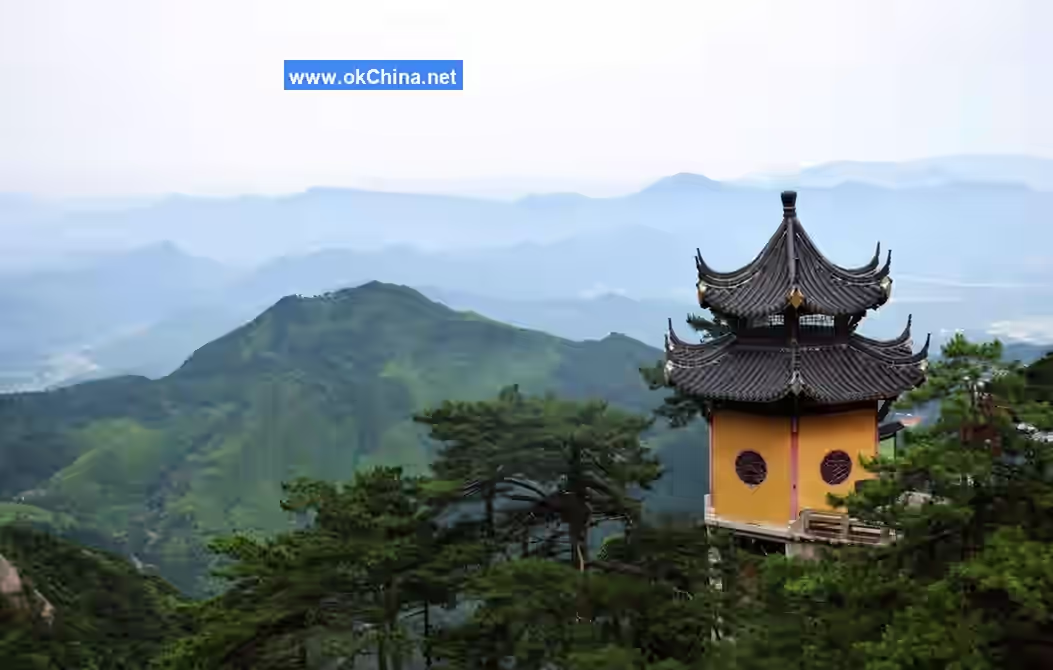
Mount Jiuhua, anciently known as Jiuzi Mountain, is located southwest of Qingyang County, Chizhou City, Anhui Province. It is a UNESCO Global Geopark and one of the Four Sacred Buddhist Mountains of China. The scenic area covers a planned area of 120 square kilometers with a protected area of 174 square kilometers. It is a national-level mountain scenic area renowned for its Buddhist culture and its natural and cultural landscapes.
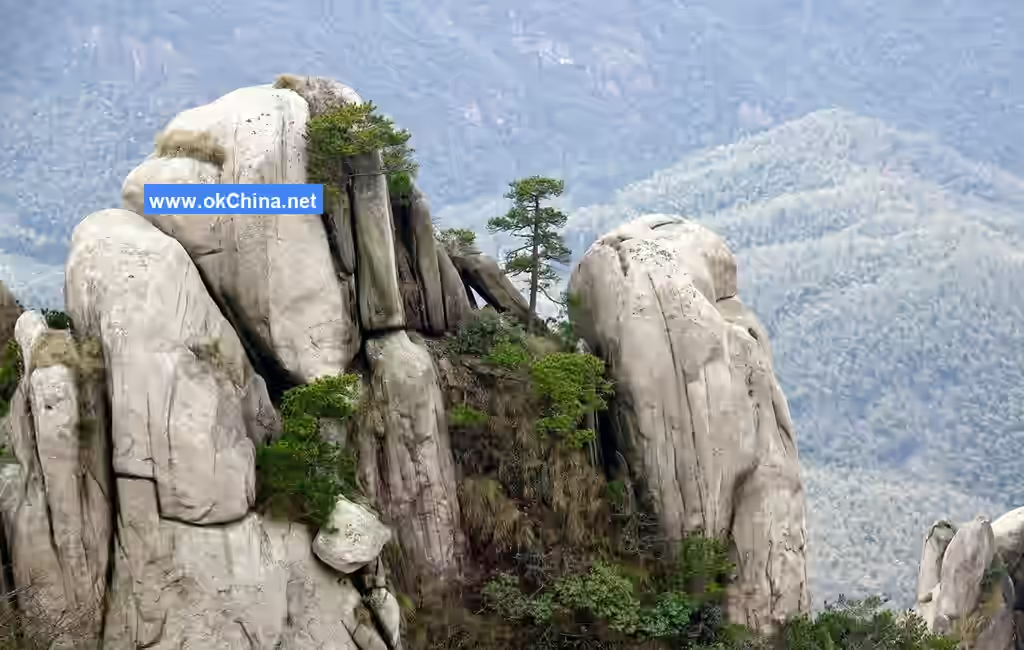
Mount Jiuhua is dotted with ancient temples, with 99 temples currently standing. Among these, 9 are designated as National Key Temples and 30 as Provincial Key Temples. Over 10,000 Buddha statues preserved from various dynasties have earned the mountain the reputation as the "Lotus Buddhist Kingdom." Since the Jin and Tang dynasties, literary giants such as Tao Yuanming, Li Bai, Su Dongpo, and Wang Anshi have visited, leaving behind numerous enduring poems. The mountain houses over 2,000 cultural relics and more than 500 poems and literary works by historical celebrities and scholars, along with over 20 sites of ancient academies and study halls. Among its treasures are Tang Dynasty palm-leaf sutras, Ming Dynasty Tripitaka, sutras written in blood, an imperial edict from Emperor Wanli of the Ming Dynasty, and calligraphy by Emperors Kangxi and Qianlong of the Qing Dynasty, all considered rare and precious. The Mount Jiuhua Scenic Area features mid-mountain topography, primarily composed of granite with mountain yellow-brown soil, and belongs to the northern subtropical humid monsoon climate zone. The landscape comprises ninety-nine peaks, numerous streams, waterfalls, secluded caves, uniquely shaped pines, and strange rock formations. With a forest coverage rate exceeding 90%, it is home to over 1,460 plant species and 216 rare wild animal species. Due to its ecological diversity and integrity, the mountain experiences distinct seasons, each offering a different scenic beauty.
As a model of the organic integration of natural landscape and Buddhist culture, Mount Jiuhua is among the first batch of National Key Scenic Areas and a National 5A Tourist Attraction. In January 2006, it was listed as a National Natural and Cultural Heritage site, and in December 2012, it was designated as a National Geopark.
2. Historical Development
2.1 Eastern Jin to Sui Dynasty Period
Buddhism spread to the Wu region (present-day Jiangsu and Anhui) along the Yangtze River during the Three Kingdoms period and began to disseminate in the Mount Jiuhua area during the Eastern Jin Dynasty. According to the Jiuhua Mountain Annals from the Jiajing period of the Ming Dynasty, in the fifth year of Long'an (401 AD) of the Eastern Jin, an Indian monk named Beidu arrived at Huacheng Peak (present-day Jiuhua Street) on Mount Jiuhua and built a thatched hut named "Jiuhua." The Da Qing Yi Tong Zhi · Chizhou Fu Zhi · Xian Shi from the Jiaqing period of the Qing Dynasty further records that Beidu, from Anchan Peak, established a site at Huacheng, initiating a Buddhist center and is traditionally regarded as the pioneering figure of Buddhism on the mountain. By the second year of Tianjian (503 AD) of Emperor Wu of Liang, tiger infestations were rampant on Mount Jiuhua. After the arrival of Monk Fuhu (Subduer of Tigers), the tiger menace ceased, leading to the naming of his temple as "Fuhu Nunnery." During this period, although scattered monks resided and propagated Buddhism on the mountain, their influence was minimal.
2.2 Tang Dynasty Period
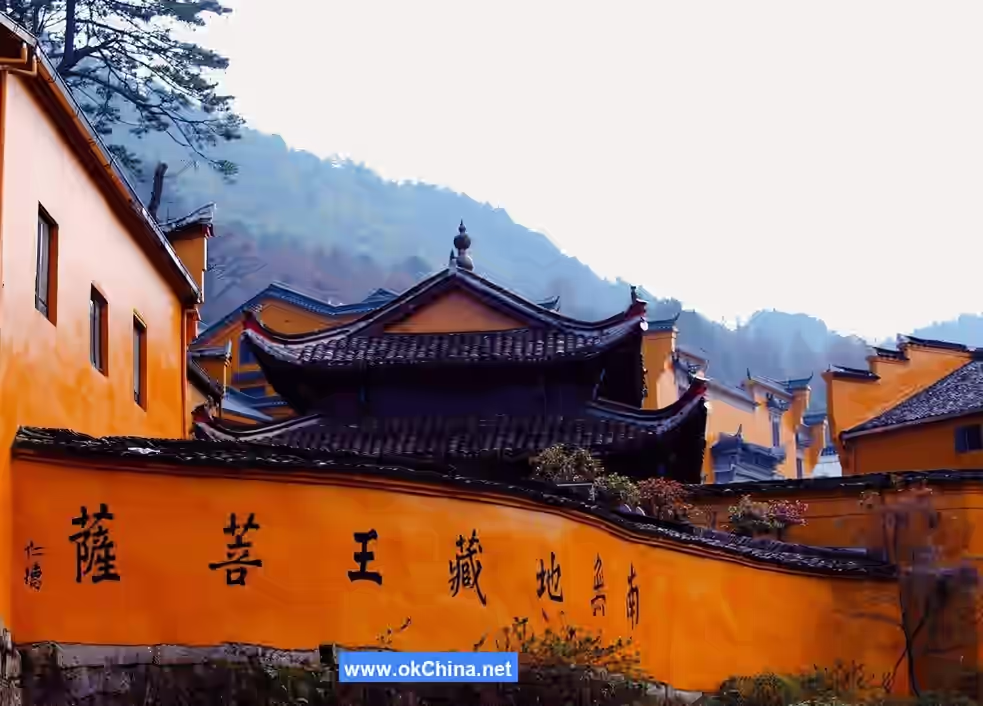
Buddhism in China flourished during the Tang Dynasty, and Buddhism on Mount Jiuhua began to thrive accordingly, with monks successively entering the mountain to propagate the Dharma. Around the end of the Kaiyuan era (approximately 740-741 AD), a monk named Tanhao came to Mount Jiuhua and established a temple named Huacheng. Later, the Silla monk Kṣitigarbha (Dizang) crossed the sea to China and practiced asceticism on Jiuzi Mountain (Mount Jiuhua). Around the beginning of the Zhide era (approximately 757 AD), local elders like Zhuge Jie from the foot of the mountain donated funds to purchase the "land in the valley" (the site of Monk Tanhao's Huacheng Temple) to construct halls for Monk Dizang. In the tenth year of Zhenyuan (794 AD), Dizang passed into nirvana. Three years later, his body remained lifelike, leading the monastic community to regard him as a manifestation of a Bodhisattva. As his secular surname was Jin, he was revered as "Golden Kṣitigarbha" (Jin Dizang), and a flesh-body pagoda (the Dizang Pagoda) was built to enshrine him. From then on, Mount Jiuhua was established as a Buddhist site, with continuous incense offerings.
During the Tang Dynasty, over twenty temples and nunneries were gradually built on and around Mount Jiuhua, including Haihui Temple, Qing'en Temple, Faleyuan, Xianyin Nunnery, Miaofeng Temple, Duobao Temple, Chengtian Temple, Chongsheng Temple, Miaoyin Temple, Fuhai Temple, Yuanji Temple, Fu'anyuan, Shuangfeng Nunnery, Jiuzi Temple, Wuxiang Temple, and Longchi Nunnery. During the Huichang era (841-846 AD), Emperor Wuzong persecuted Buddhism (known in Buddhist history as the "Huichang Persecution"). Nearly a dozen monasteries on Mount Jiuhua were destroyed, but the incense offerings at Huacheng Temple on the mountain continued.
2.3 Song and Yuan Dynasties Period
The Song Dynasty provided certain protections to Buddhism to strengthen imperial rule. According to statistics, the number of monasteries on Mount Jiuhua increased to over forty during the Song Dynasty, building upon the foundations of the late Tang and Five Dynasties periods. Newly built famous monasteries in the front and rear mountains included Jingju Temple, Shengquan Temple, Guangsheng Temple, Guangfu Temple, Tiantai Temple, Cuifeng Temple, Caoxi Temple, Long'anyuan, Wutaiyuan, Yongfu Temple, and Xingjiao Temple, with twelve of them receiving imperial plaques. Some highly influential Chan masters of the time, such as Yutian, Jizu, Yunze, and Hongji, came to Mount Jiuhua to teach the Dharma.
During the Yuan Dynasty, Tibetan Buddhism was revered by the court. Buddhism on Mount Jiuhua largely maintained its Song Dynasty status. Simultaneously, a number of new temples were built, such as Xifeng Hall and Chengde Hall. In the late Yuan Dynasty, a peasant war involving multiple forces, including those of Zhu Yuanzhang, Chen Youliang, and Zhang Shicheng, erupted in the middle and lower reaches of the Yangtze River, lasting over a decade. The entire Chizhou region, where Mount Jiuhua is located, became one of the main battlefields. Devotees could not pilgrimage to the mountain, monks lost their economic sources, and life fell into hardship. Temples fell into long-term disrepair, with some being destroyed. During the three to four decades spanning the late Yuan and early Ming dynasties, many monasteries were left without monks, leading to a temporary decline of Buddhism.
2.4 Ming Dynasty Period
The Ming Dynasty treated various religions equally. Emperor Hongwu (Zhu Yuanzhang) personally wrote over eighty articles praising Buddhism, such as the Preface to the Heart Sutra, included in the Imperially Commissioned Collection for Protecting the Dharma. Simultaneously, he keenly observed the corrupt practices within Buddhism and vigorously rectified monastic discipline to eliminate malpractices. Against this backdrop of imperial support for Buddhism, Buddhism on Mount Jiuhua also entered a period of prosperity. During the Ming Dynasty, over thirty temples and nunneries were newly built or rebuilt on Mount Jiuhua, including Tiantai Temple, Zhaoyin Temple, Deyun Nunnery, Zhenru Nunnery, Zhuyun Nunnery, Shang'an Mountain Lodge, Stone Nunnery, Yuansu Mountain Lodge, and Yangzhen Mountain Lodge. The Huacheng Temple basin became densely populated with temples, forming the center of Buddhism on Mount Jiuhua. The number of temples and nunneries across the entire mountain (including thatched huts and retreats in the front and rear mountains) exceeded one hundred. The number of monks on Mount Jiuhua increased, and pilgrim devotees became numerous. By this time, Mount Jiuhua was already recognized alongside Mount Wutai in Shanxi, Mount Emei in Sichuan, and Mount Putuo in Zhejiang as one of the Four Sacred Buddhist Mountains of China. Furthermore, during this period, both monastic and lay communities confirmed Jin Dizang as the manifestation of Kṣitigarbha Bodhisattva and Mount Jiuhua as his sacred site. From then on, Mount Jiuhua became the center for the propagation of Kṣitigarbha Bodhisattva worship in Chinese Buddhism.
2.5 Qing Dynasty Period
The Qing Dynasty's Buddhist policy inherited that of the Ming, offering considerable support to Buddhism in Han Chinese regions. Due to donations from officials, gentry, and devotees, numerous temples were newly built or expanded on Mount Jiuhua during the mid-Qing period. Huacheng Temple possessed 72 monastic dwellings, some of which later declared themselves "Chan forests" or "Chan monasteries." These subsequently branched out to form large monastic complexes such as Qiyuan Temple, Baisui Palace (Longevity Palace), and Dongya Temple. The number of monks reached three to four thousand. From the third year of Xianfeng to the second year of Tongzhi (1853-1863), the Taiping Heavenly Kingdom forces fiercely battled Qing troops in the Mount Jiuhua area. Coupled with the Taiping's anti-Buddhist actions, most temples were destroyed in the warfare, leaving only over ten monastic dwellings around Huacheng Temple. Subsequently, the Qing court spent over thirty years gradually restoring Buddhism on Mount Jiuhua. During the Guangxu era, the court bestowed three sets of the Dragon Tripitaka (Longzang) each to temples like Ganlu Temple and Baisui Palace on Mount Jiuhua. By the late Qing, the entire mountain housed over 150 temples, including notable new ones like Zhantanlin, Jiulian Nunnery, Tianran Nunnery, Tianchi Nunnery, Huayun Nunnery, Jixiang Temple, Xin'an Temple, Songshu Nunnery, and Xizhu Nunnery. The four major monastic complexes—Qiyuan Temple, Ganlu Temple, Dongya Temple, and Baisui Palace—began to take shape.
2.6 Republic of China Period
The Xinhai Revolution overthrew the feudal monarchy. During the May Fourth Movement, some progressive young students and teachers raised slogans like "Down with the Confucian Shop" and opposed imperialism and feudalism, which included criticism and rejection of religion. As the Mount Jiuhua area was far from the capital, although some temples flourished or declined, it maintained its status as a famous Buddhist mountain. In 1913, the Qingyang County Buddhist Association was established, renamed the Mount Jiuhua Buddhist Association the following year. Subsequently, with the patronage of upper echelons in the Kuomintang (Nationalist Party), Buddhism on Mount Jiuhua revived. During the 1920s and 1930s, the mountain still had over 150 temples and nunneries. Baisui Palace, Dongya Chan Temple, Qiyuan Temple, Ganlu Temple, Shangchan Hall, Lotus Temple, and Leshan Temple successively developed into the seven major monastic complexes of Mount Jiuhua. Temples like Wuxiang Temple, Huiju Temple, and Zhantanlin were rebuilt and expanded. After 1919, a number of thatched huts and retreats were newly built in the Zhongmin Garden area, accommodating some nuns and ending the long history of Mount Jiuhua having no nuns since the Tang Dynasty.
In July 1937, the War of Resistance Against Japan broke out, plunging Buddhism on Mount Jiuhua into difficulty. Income from temple lands elsewhere sharply decreased, pilgrims became scarce, monks lived in poverty, and temples fell into disrepair. In 1940, Japanese troops raided Mount Jiuhua, bombing and destroying six temples including Dongya Xiayuan, Fahua Temple, and Jiulian Nunnery.
2.7 After the Founding of the People's Republic of China
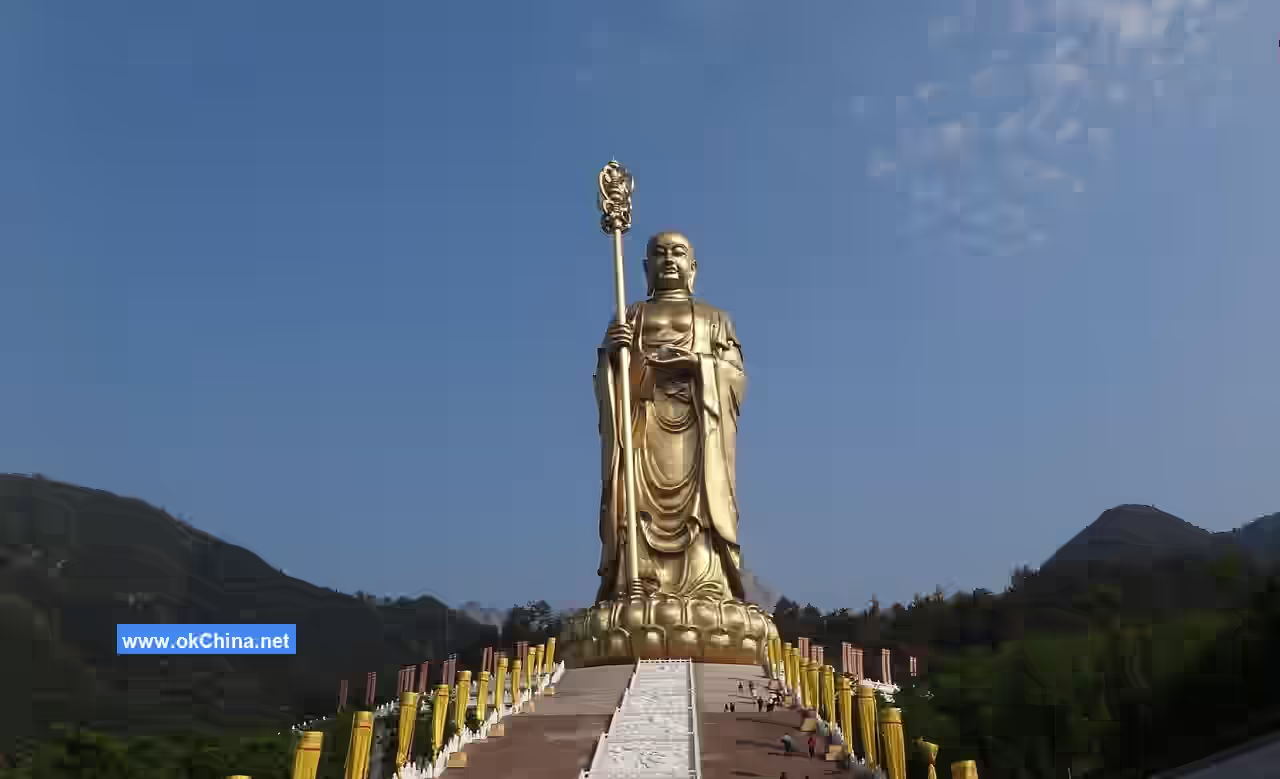
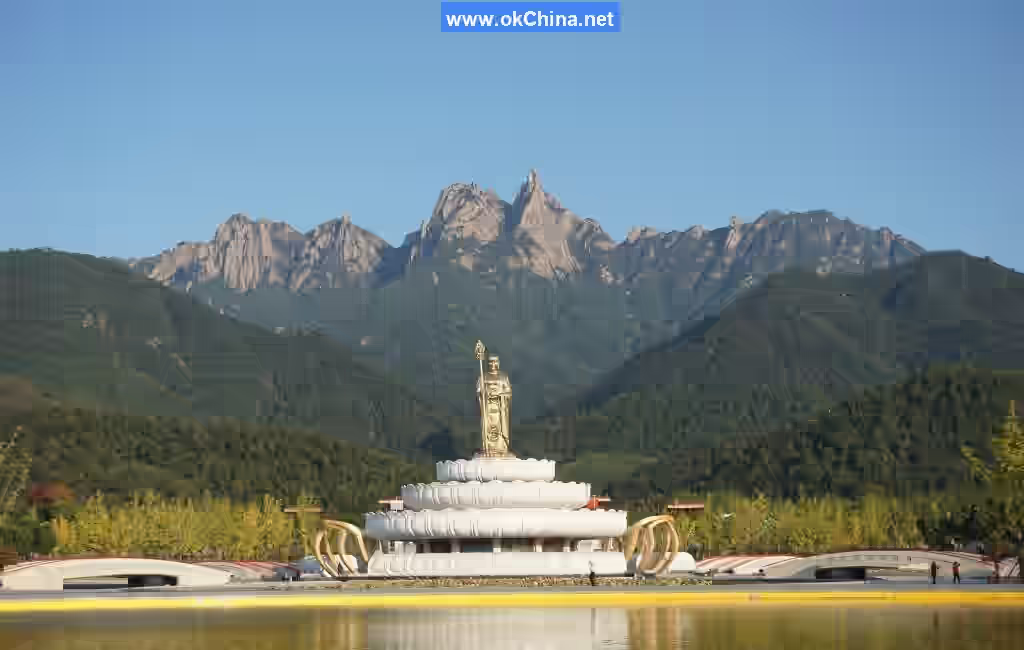
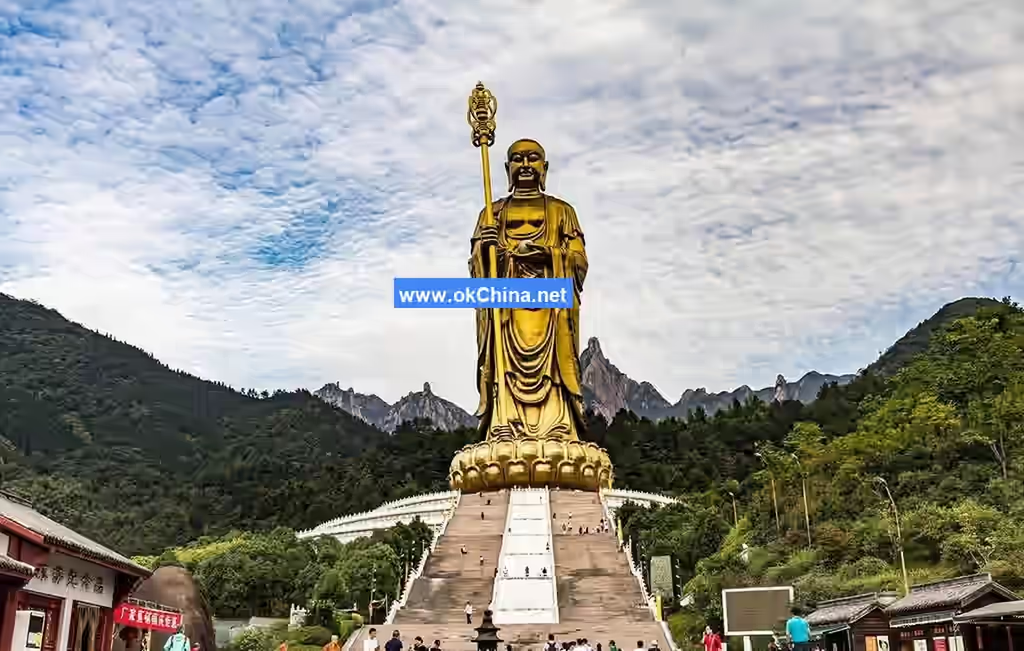
In the early years after the founding of New China, Mount Jiuhua had over 90 remaining temples. To protect the famous Buddhist mountain, the old Mount Jiuhua Buddhist Association was dissolved. Representative meetings were held by various temples to handle internal Buddhist affairs, leading and organizing monks and nuns to participate in socialist transformation and construction. During the Cultural Revolution, the Mount Jiuhua Buddhist Association ceased its activities. Under the impact of ultra-leftist ideology, some temples were demolished, others fell into disrepair or collapsed due to fire, Buddha statues were smashed, and incense offerings were prohibited. By 1979, the Mount Jiuhua Buddhist Association resumed its activities. In 1983 and 1984, the State Council and the Anhui Provincial People's Government issued documents respectively, designating nine famous temples on Mount Jiuhua—Huacheng Temple, Roushen Hall (Flesh-body Hall), Baisui Palace, Ganlu Temple, Qiyuan Temple, Tiantai Temple, Zhantanlin, Huiju Temple, and Shangchan Hall—as National Key Temples, and thirty others, including Ersheng Hall, as Provincial Key Temples. These temples received varying degrees of restoration with government funding and support from Buddhist devotees.In 1995, Master Rende, the former president of the Jiuhua Mountain Buddhist Association, initiated the construction of the 99-meter-tall bronze statue of Ksitigarbha Bodhisattva (now completed). Thanks to the implementation of national religious policies, significant progress has been made in resource protection, ecological restoration, cultural revival, scenic area development, tourism workforce, and tourism infrastructure at Jiuhua Mountain. In 2007, the Jiuhua Mountain Scenic Area was rated as a 5A-level tourist attraction and has since become a destination for domestic and international tourists and pilgrims.
On October 23, 2024, the foundation-laying ceremony for the Jiuhua Mountain Shizifeng Scenic Area Passenger Cableway Project, with a total investment of 326 million yuan, was held at the project site.
3. Geographical Environment
3.1 Topography and Landforms
Jiuhua Mountain is one of the three major mountain ranges in southern Anhui (Huangshan, Jiuhua Mountain, and Tianmu Mountain—Baiji Mountain Range). Tectonically, it is located in the central part of the Lower Yangtze Platform Depression of the Yangtze Paraplatform. The fold and fault structures in the Jiuhua Mountain area are well-developed, and magmatic activity is frequent. The main body of Jiuhua Mountain consists of a strongly uplifted fault zone composed of granite, while its peripheral areas, except for some sedimentary rocks, are mostly composed of granodiorite forming a slightly uplifted fold-fault block zone.
The uplift amplitude of Jiuhua Mountain decreases stepwise from the core to the periphery. The granite body in the core forms a steep central canyon area, where many peculiar peaks and strange rocks are distributed. The outer mountains are composed of granodiorite and sedimentary rocks, which are less hard than granite and more easily eroded. Thus, the entire Jiuhua Mountain range is composed of numerous mid-mountains, low mountains, and hills with varying heights, staggered arrangements, diverse forms, and significant size differences.
3.2 Climate and Hydrology
Jiuhua Mountain belongs to the northern subtropical humid monsoon climate type, characterized by distinct monsoons, four distinct seasons, mild temperatures, ample sunlight, abundant rainfall, concentrated summer rain, and significant plum rains. The climate in the Jiuhua Mountain area exhibits both the general characteristics of the northern subtropical humid monsoon climate and the specific features of a mountainous climate—shady, cool, and humid—due to the influence of altitude and topography. In winter, the average temperature in most parts of Jiuhua Mountain is around 0°C, with an extreme minimum of -13.3°C; in summer, the maximum temperature reaches 34.5°C. Due to its unique climatic conditions, Jiuhua Mountain experiences annual hazardous weather events such as cold waves, frost, typhoons, heavy rain, and hail.
The groundwater in Jiuhua Mountain belongs to the bedrock fissure water type. It is primarily recharged by atmospheric precipitation, with an average annual precipitation of about 2,100 mm and an average annual evaporation of about 900 mm. Discharge mainly occurs through lateral flow or springs. Especially around the basins within the mountains, along the contact zones between the first and second granite intrusions, hot springs often emerge in clusters due to well-developed joints and fissures. The water temperature is generally around 20°C, and the water quality is sweet and pleasant, making it an excellent and inexpensive raw material for beverages. Shallow pore water is mainly distributed in the valley plains of the Qingtong River, Jiuhua River, and Laba River, where water can be found at depths of 6–7 meters, with abundant quantities. The tap water source for Qingyang County is drawn from the pore water in the valley plain of the Qingtong River.
The rivers and streams of Jiuhua Mountain belong to the middle and upper reaches of the primary and secondary tributaries of the Yangtze River system. They flow radially outward from the central part of the mountain, embedded between mountains and hills. The largest rivers are the Jiuhua River and Qingtong River, both primary tributaries of the Yangtze River, developed along fault zones and lithological contact zones. In the southern part of the mountain, the Lingyang River and Laba River are the largest, both flowing south into Taiping Lake and then into the Yangtze River via the Qingyi River. The longitudinal profiles of the river valleys flowing out of Jiuhua Mountain are stepped, with many knickpoints and steep slopes, forming spectacular waterfalls such as Longchi Waterfall, Jiuzi Spring, and Shugu Spring. Among the streams, the Five Streams are the most famous, collectively referring to Longxi, Shuxi, Lanxi, Piaoxi, and Shuangxi, which converge into the Jiuhua River. The confluence point is Wuxi Town, the gateway to Jiuhua Mountain. The most famous waterfall is Bitao Pond, renowned as the largest waterfall in Jiuhua Mountain.
3.3 Soil
The soils of Jiuhua Mountain are divided into five categories: mountain meadow soil, brown soil, cinnamon soil, fluvo-aquic soil, and paddy soil. Mountain meadow soil and brown soil are distributed above 800–1,000 meters, while cinnamon soil, fluvo-aquic soil, and paddy soil are mainly found in low mountains, hills, and plains.
3.3.1 High Mountain Soil Layers
Mountain meadow soil is distributed in low-lying areas at an altitude of about 1,300 meters. The soil layer is shallow, less than 50 cm thick. The soil texture is relatively strong, mostly sandy clay loam, with sand content reaching 60%, increasing from the surface downward. The soil is acidic, with high organic matter content.
Mountain yellow-brown soil is distributed at altitudes of 600–1,100 meters on Jiuhua Mountain. As altitude increases, deciduous components increase, and the vegetation consists of evergreen deciduous broad-leaved mixed forests and Huangshan pine forests. This soil type is transitional between yellow-red soil and brown soil. The soil exhibits strong humus accumulation and leaching, with weak aluminization. Clay minerals are mainly montmorillonite and illite, with small amounts of kaolinite and gibbsite. The soil is acidic, with high nutrient content.
Mountain brown soil is distributed at altitudes of 1,000–1,300 meters. The vegetation consists of mountain dwarf forests and shrubs, with sparse and stunted trees and Huangshan pines. The soil color is predominantly brown, with a thicker upper layer. The humus layer is about 30 cm thick, with a solid granular structure. The soil is acidic, with very high organic matter content.
3.3.2 Low Mountain Soil Layers
Below 600 meters, the soil is transitional between red soil and yellow soil or brown soil. The soil exhibits desilication-aluminization and biological enrichment. The parent material is weathered granite. Soil profile differentiation is distinct. The humus layer is dark brown with granular or nutty structure; the illuvial layer is yellowish-red or yellowish-orange with blocky structure. Clay minerals are mainly kaolinite. The soil is acidic, with high organic matter content in the surface layer.
3.4 Biodiversity
Due to its complex topography, vertical climatic variation, thick weathered soil layers, abundant rainfall, and lush vegetation, Jiuhua Mountain has formed a favorable ecosystem. In particular, the dense forest vegetation system plays a role in water conservation, soil preservation, carbon sequestration and oxygen release, atmospheric purification, and biodiversity protection, making Jiuhua Mountain a natural oxygen bar and a treasure trove of plant and animal genes. According to partial surveys conducted in the early 1980s, there are over 1,400 naturally distributed vascular plant species in the mountain, including rare trees such as ginkgo, fragrant fruit, wingceltis, red bean tree, cyclocarya paliurus, and golden larch. Precious medicinal herbs include gastrodia elata, fritillaria, eucommia, stone fungus, coptis chinensis, and polygonum multiflorum. Animals inhabiting the deep mountains and dense forests include 48 species of mammals such as clouded leopards, large and small civets, black muntjacs, blue sheep, macaques, and sika deer, as well as 168 species of birds including long-tailed pheasants, black storks, silver pheasants, and mountain eagles. Insects and lower plants have not yet been fully surveyed.
4. Important Attractions
4.1 Four Major Areas
4.1.1 Huatai Area
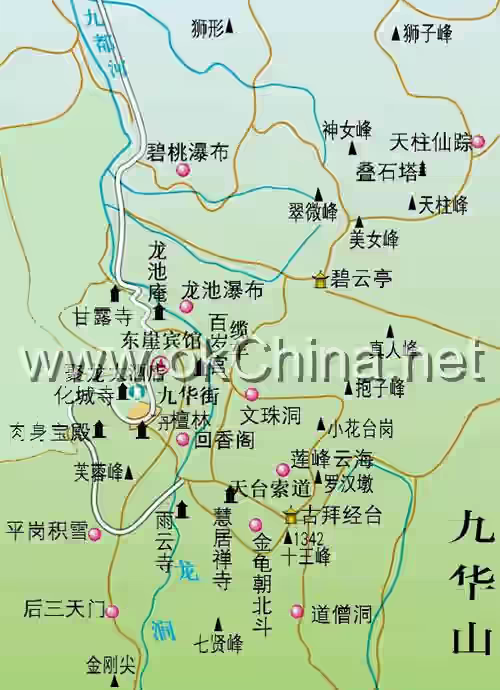
As one of the core scenic areas of Jiuhua Mountain, the Huatai Area is the central part of Jiuhua Mountain National Forest Park and Geological Park, located in the middle of Jiuhua Mountain and covering an area of 10 square kilometers. The area is renowned for its magnificent scenery, characterized by peculiar peaks and strange rocks, sea of clouds and rime, and a vast expanse of flowers. It is often said, "The spiritual Jiuhua Mountain is most beautiful at Huatai." The unique geological landforms form the famous "Natural Sleeping Buddha" wonder. Additionally, Huatai Peak is the highest point in the area, offering a panoramic view of Jiuhua Mountain from its summit.
4.1.2 Tiantai Area
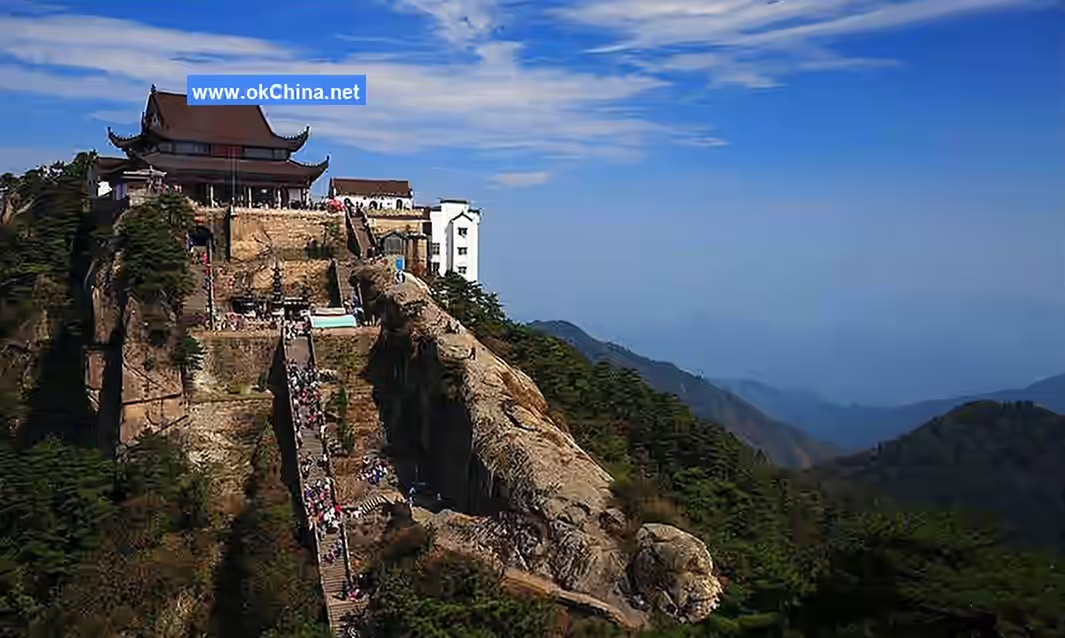
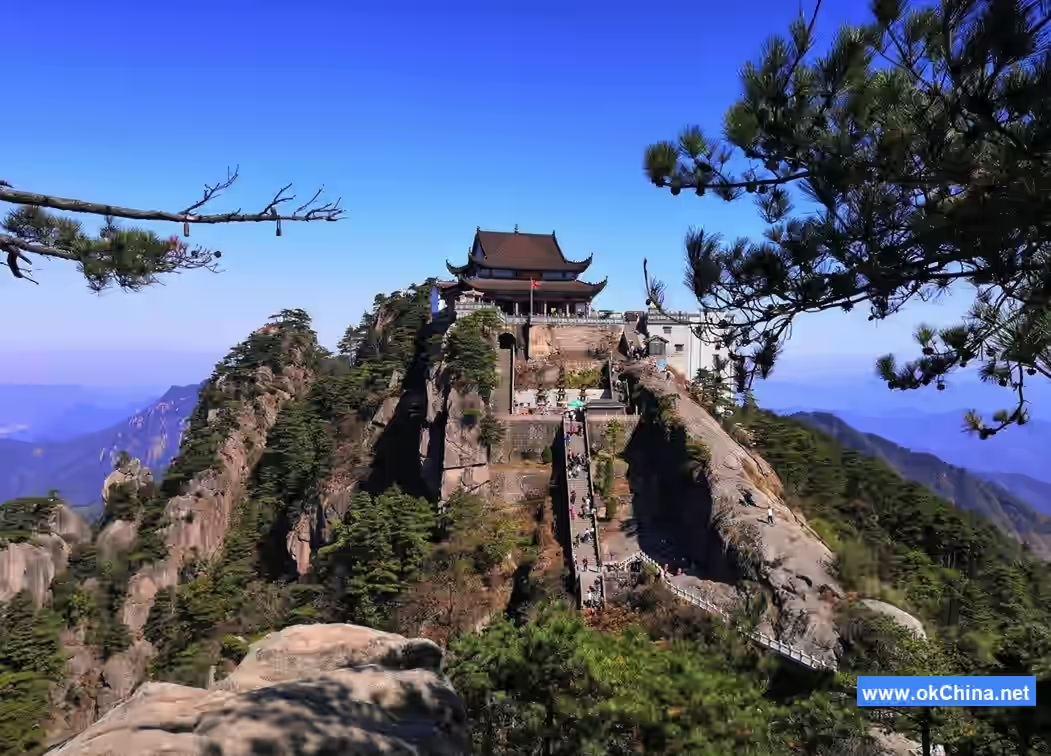
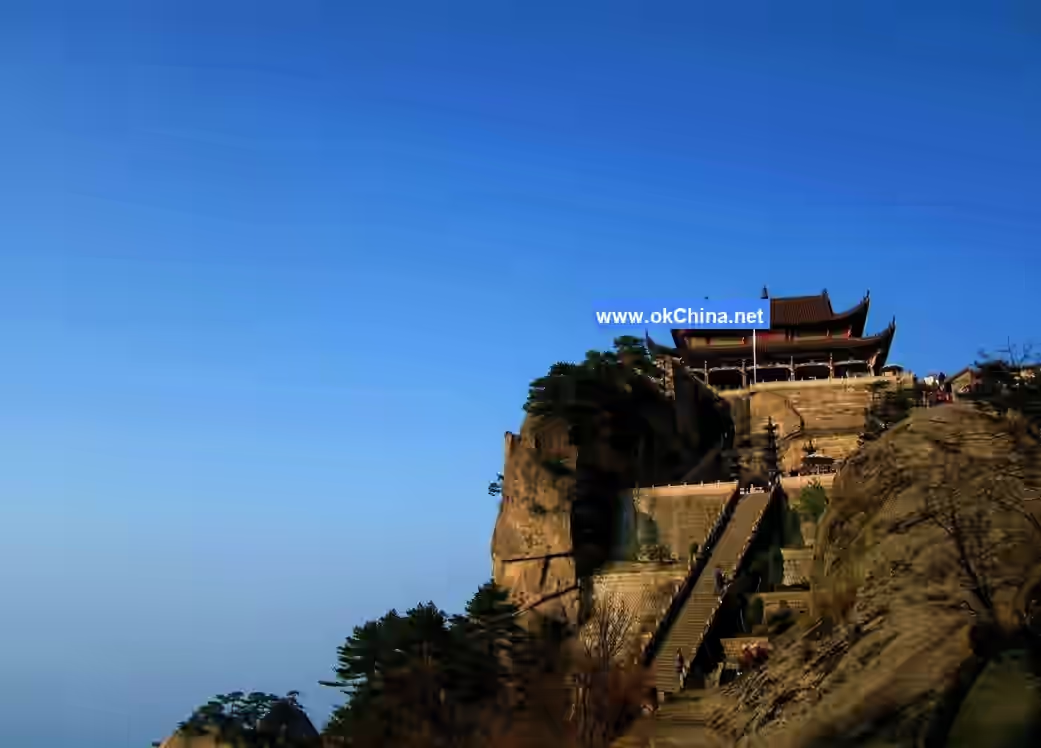
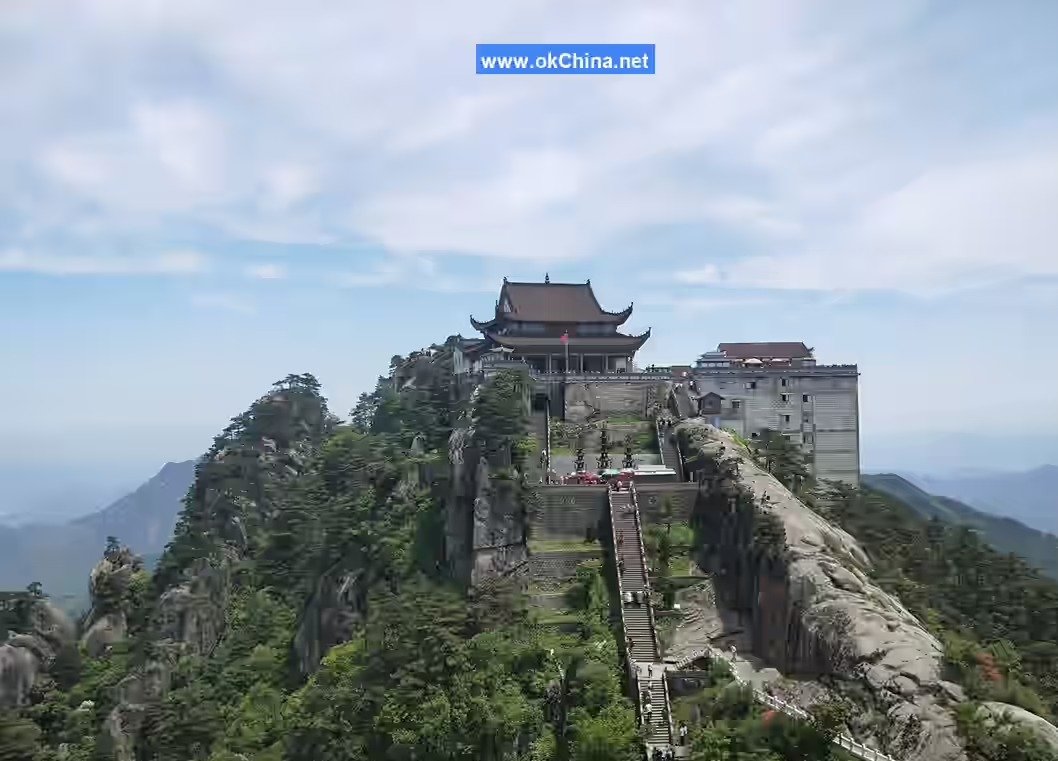
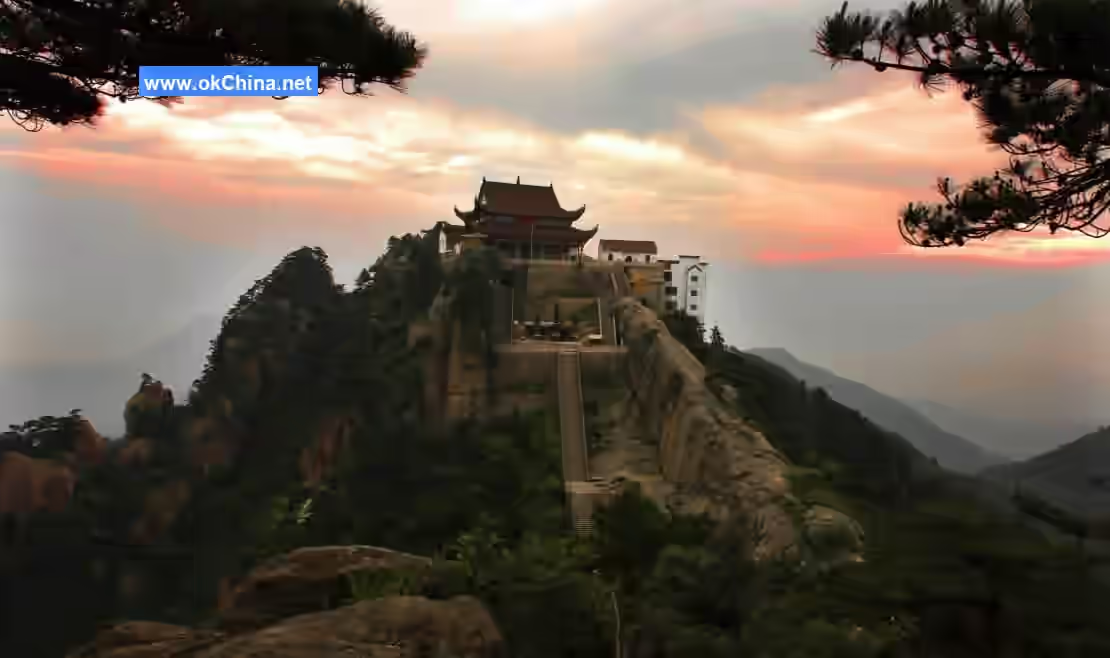
The Tiantai scenic area is a high-altitude tourist zone of Jiuhua Mountain. As a traditional and essential scenic area, it features towering peaks, layered cliffs, and rugged rocks, characterized by "majesty, peculiarity, uniqueness, and spirituality." Also known as Tiantai Peak, it stands at 1,306 meters above sea level, second only to Shiwang Peak and Qixian Peak among Jiuhua Mountain's ninety-nine peaks. The Ksitigarbha Temple, historically known as Tiantai Temple, is located at the summit. Major attractions in this area include Shiwang Peak, Candle Peak, Tiantai Peak, One-Line Sky, Dapeng Listening to Scriptures Stone, Daoseng Cave, Suspension Bridge Nunnery, Upper Guanyin Peak Courtyard, Ancient Worship Scripture Platform, and Tiantai Temple. Visitors can take a cable car from Phoenix Pine to Tiantai Temple, which takes about 10 minutes, or hike up the mountain steps, which takes about 4 hours.
4.1.3 Dayuan Cultural Park Area
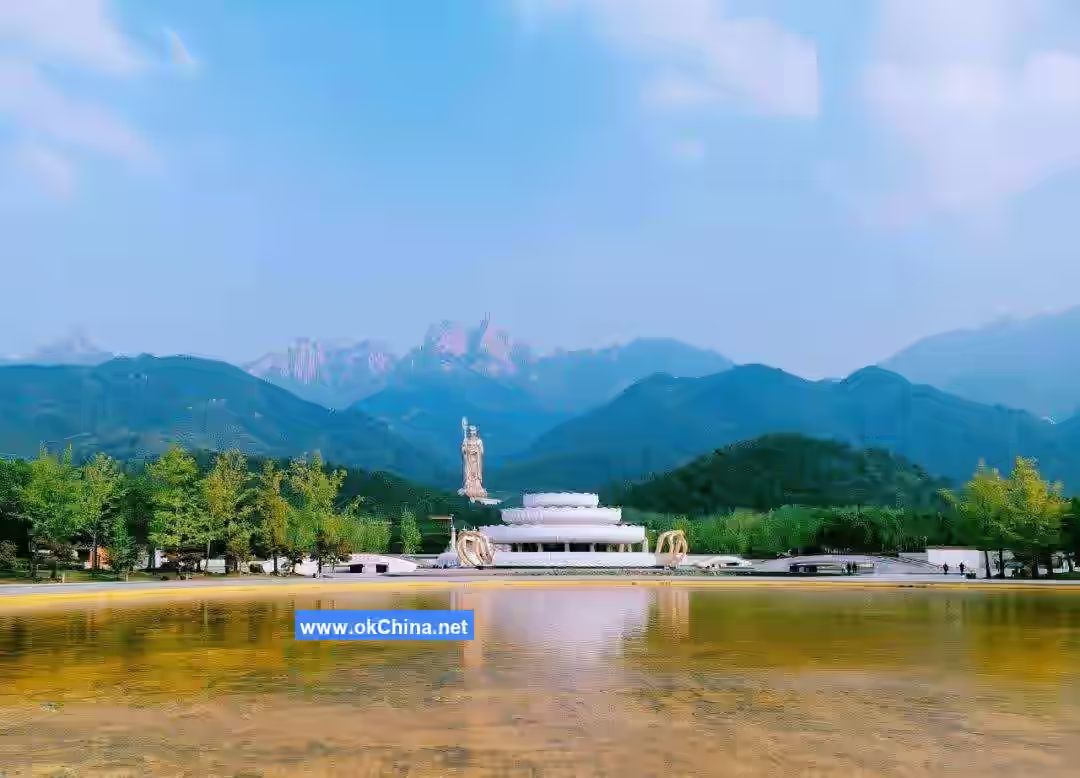
The Jiuhua Mountain Dayuan Cultural Park is located at Kecun, on the northern foothills of Jiuhua Mountain Scenic Area—one of China's four major Buddhist mountains, a national key scenic area, and the world-recognized sacred site of Ksitigarbha Bodhisattva. The park consists of the 99-meter-tall statue of Ksitigarbha Bodhisattva and supporting attractions and service facilities, covering an area of over 1,500 acres. The architecture in the Dayuan Cultural Park mainly includes halls, pavilions, bridges, corridors, towers, and terraces. In the evenings, a large-scale Buddhist cultural theme performance, "Dayuan Ruyuan" (Great Vow Fulfilled), is held here.
4.1.4 Minyuan Area
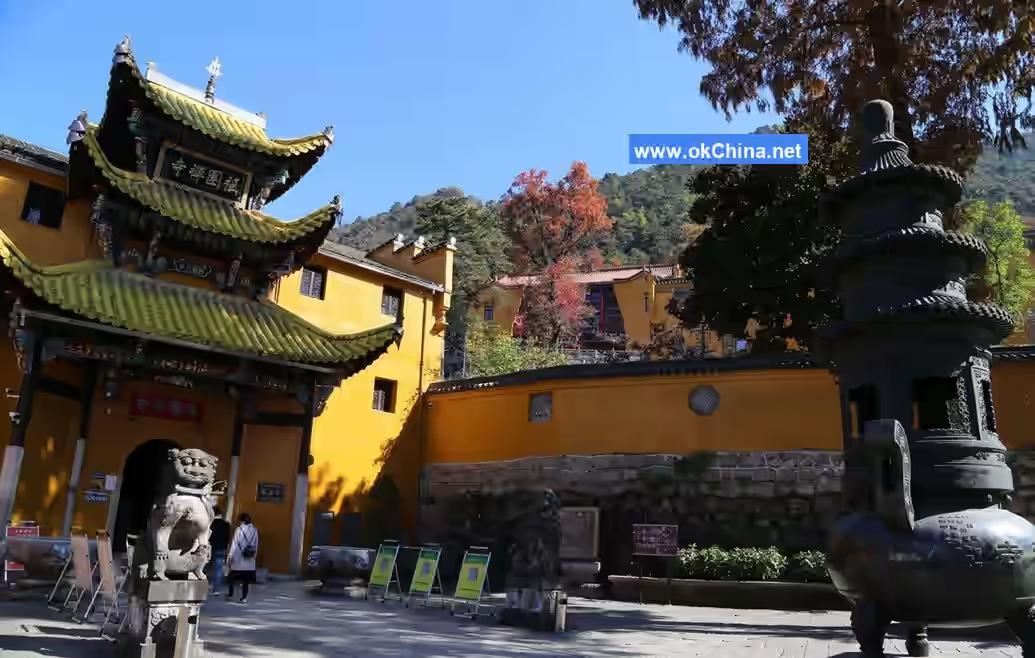
The Minyuan scenic area is located on the western foothills of the Tiantai area, facing Jiuhua Street across a peak. It is a large north-south trending canyon covering about 6 square kilometers, integrating natural and cultural landscapes into a comprehensive tourist zone. Its main attractions include Longxi Stream, strange rocks, ancient Phoenix Pine, Huayan Cave, the lower cable car station, Huiju Temple, over 20 residential-style nunneries, and the 160-hectare "Minyuan Bamboo Sea."### 4.2 Flesh Body Hall The Flesh Body Hall, originally named the Golden Ksitigarbha Pagoda and commonly known as "Laoye Ding" (Old Master Summit), is located at the head of Shenguang Ridge west of Jiuhua Street. It was first built during the Zhenyuan period of the Tang Dynasty. In his later years, Golden Ksitigarbha used this place as the South Platform for reading sutras. Three years after his nirvana, his face remained lifelike, which was taken as a sign of the Bodhisattva's descent and manifestation. Consequently, a three-story stone pagoda was built here to enshrine his flesh body, known as the Flesh Body Pagoda or Ksitigarbha Tomb. Because a "circular light" once appeared at the pagoda's base, later generations named the place Shenguang Ridge (Divine Light Ridge). The hall is surrounded by ancient trees reaching for the sky, with dense shade covering the sky. The hall itself is 15 meters high, with its mountain gate facing southwest, featuring imposing red walls and a majestic, grand structure. Entering the hall requires ascending eighty-one steps. Above the south entrance hall are two horizontal plaques: the upper one inscribed with the four characters "Rou Shen Bao Dian" (Flesh Body Hall), and the lower one with the five characters "Dong Nan Di Yi Shan" (The Foremost Mountain in the Southeast). In 1983, the hall was designated by the State Council as a nationally key Buddhist monastery in Han Chinese regions.
4.3 Shiwang Peak
Shiwang Peak is located south of Tiantai Peak, connected by a ridge, with an elevation of 1,342 meters, making it the highest peak of Mount Jiuhua. On the eastern and western sides of the peak, perilous cliffs are stacked layer upon layer. Ascending to its summit and gazing into the distance, the surrounding peaks appear like "children and grandchildren gathered around one's knees," creating the意境 of "seeing all other mountains appear small." To the southwest lies "Bowl Peak," to the northwest lies "Arhat Peak," and "Yanxian Terrace" is located west of Shiwang Peak. Heading south leads to the old site of "Lao Changzhu," where the Zhenru Nunnery was built.
4.4 Ancient Sutra-Worshipping Platform
The Ancient Sutra-Worshipping Platform, also known as Dayuan Nunnery, is situated on a platform west of Tiantai Peak. Monk Ksitigarbha once worshipped sutras here, and a pair of concave footprints remain on the rock. The nunnery was first built during the Qing Dynasty, majestically perched between the steep cliffs of Tiantai Peak valley, with the Mahavira Hall as its main structure. The main hall faces west, featuring double eaves with upturned corners, exuding a majestic气势. The north side houses the Ksitigarbha Hall; the east side features a three-story Huizhou-style building—the Ten Thousand Buddhas Tower; the south side consists of a five-story residential-style monastic quarters. The entire complex is古朴典雅 with harmonious style. Surrounding it are奇景怪石 such as "Great Peng Bird Listening to Sutras Stone," "Golden Turtle Facing the Big Dipper," "Guanyin Floating Across the Sea," "Ten Kings Paying Homage," and "Immortal Beating the Drum." Additionally, the Sutra-Worshipping Platform serves as the terminal station for the cable car from Minyuan to Tiantai.
4.5 Huacheng Temple
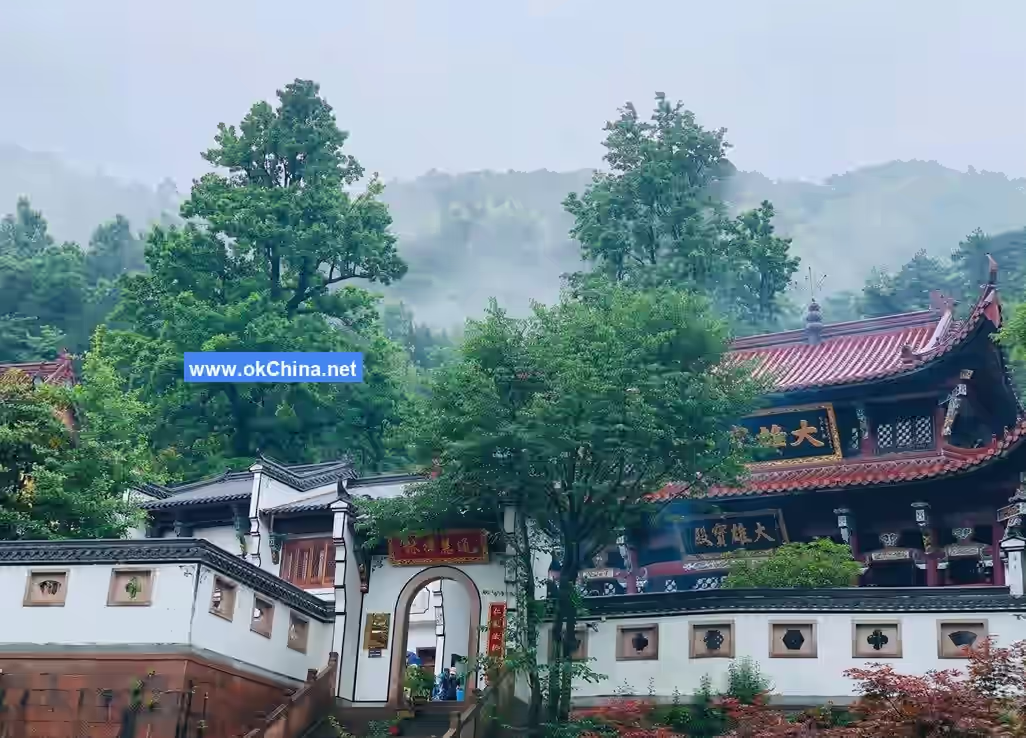
Huacheng Temple is built in a high mountain basin, facing Furong Peak to the south, backed by Baiyun Mountain to the north, adjacent to Dongya Cliff to the east, and connecting to Shenguang Ridge to the west. Encircled on all sides like a city, ancient people described it as "inner and outer peaks surrounding like emerging jade lotuses." Huacheng Temple is a four-courtyard compound structure. The first courtyard is the Lingguan Hall, with a depth of 16.5 meters, a width of five bays, featuring two small wells, and side rooms on both sides. Its platform base is 3.7 meters higher than the ground level. The second courtyard is the Heavenly Kings Hall, 20 meters wide and 20.5 meters deep, with a sunken courtyard for drainage and side corridors on the east and west. The caisson ceiling above the hall is surrounded by a circle of painted panels, resembling a sky full of stars,严谨 in structure and精美 in design. Its platform base is 1.5 meters higher than the first courtyard. The third courtyard is the Mahavira Hall, 20.5 meters deep. The lintel and above of the hall feature water-pattern latticework. The front Buddha pedestal of the hall is made of white marble. Directly above the Mahavira Hall are three large and small caisson ceilings, built in the 15th year of the Guangxu reign (1889). The octagonal parts of the large caisson are carved with eight flying dragons,加上 the coiled dragon and pearl ball at the caisson's apex, forming the "Nine Dragons Playing with a Pearl." The final courtyard is the three-story Sutra Repository, 20 meters high and 14 meters deep. Its platform base is 2.7 meters higher than the main hall and is a Ming Dynasty structure.
4.6 Baisui Palace
Baisui Palace is located on Mokong Ridge (also known as "Chaxiao Peak") of Mount Jiuhua. Initially named "Zhaixing Nunnery" and also known as "Wannian Chan Temple," it is one of the "Four Great Monasteries" of Mount Jiuhua, along with Zhiyuan Temple, Dongya Temple, and Ganlu Temple. As the second Flesh Body Hall on Mount Jiuhua, enshrining the flesh body of Chan Master Wuxia, it is a typical monastery in the style of western Anhui folk residences. The five-story tall building integrates the mountain gate, main hall, flesh body hall, storerooms, dining hall, monks' quarters, guest rooms, and toilets (dongsi) into a single整体, without separate building configurations. Baisui Palace fully utilizes the south-to-north downward slope, with floors climbing from low to high, rising layer by layer, forming a曲折幽深,恢宏多变 maze. Viewed from below the main gate, the main hall appears as a single story, while the side rooms on the east side of the main hall are two stories, with a total height of only 10 meters. However, viewed from its back door, the east wall reaches 55 meters high, constituting five stories. Yet the roof is just a single完整的 southern Anhui folk residence-style four-sided roof with a courtyard.
4.7 Chandan Chan Forest
Chandan Forest is located southwest of Jiuhua Street. The entire temple complex consists of four hall-style living quarters and a palace-style Mahavira Hall. The east side houses monks' quarters and monastic cells, an open hall, a three-story pavilion, with an inner small courtyard for drainage. The west side is the Yunshui Hall (Cloud and Water Hall), an open hall with four bays, two stories, and a small courtyard. Between the monks' quarters and the Yunshui Hall is the front hall, internally divided by wooden partitions into the Maitreya Hall and the Skanda Hall, with a depth of 20.5 meters. On both sides of the hall are two-story pavilions. In front of the Skanda Hall are two small statues: one of Monk Jidian (Crazy Ji) and another of a疯僧. The center of the hall enshrines a statue of Sakyamuni Buddha, flanked by attendants Ananda and Kasyapa, with Guanyin, Ksitigarbha, and others on the sides. On both sides of the main hall are flower halls, two stories high, with a garden named "Shan Zhong Tian" (Heaven in the Mountains).
4.8 Ganlu Temple
Ganlu Temple is located halfway up Huacheng Peak on Mount Jiuhua and is one of the "Four Great Monasteries" of Mount Jiuhua, along with Zhiyuan Temple, Dongya Temple, and Baisui Palace. The entire temple covers a construction area of 3,500 square meters, composed of three groups of folk residence-style buildings combined with a palace-style Mahavira Hall, built against the mountain and reaching five stories high. The temple has an irregular layout. The Skanda Hall and the Reception Hall groups of buildings on the north side are arranged on a platform base 2.5 meters high, featuring three-story pavilions. The walls of the Reception Hall have four rows of windows, though actually only three stories; the top row of windows增加层次感. South of the Skanda Hall is the 15-meter-high Mahavira Hall, with a front corridor. The hall body is built on a 6.8-meter-high platform base, 17 meters wide and 15.5 meters deep. East of the main hall is a two-story continuous corridor building with an inner courtyard, 22 meters deep and 15 meters wide. The upper and lower floors house the Patriarch Hall, Abbot's Quarters, Meditation Hall, and Guest Rooms respectively.
4.9 Tiantai Temple
Tiantai Temple, also known as "Ksitigarbha Temple" or "Ksitigarbha Chan Temple," is located atop Tiantai Peak on Mount Jiuhua, at an elevation of 1,306 meters, making it the highest-situated temple on the mountain. It is north of the Pengri Pavilion on Tiantai Peak. The temple was first built in the Ming Dynasty and renovated during the Qing Guangxu period. It构造成楼阁 according to the mountain's高低, with five stories up and down, housing the Ten Thousand Buddhas Tower, Ksitigarbha Hall, etc. Inside are enshrined statues of Sakyamuni, Golden Ksitigarbha, Maitreya, and others, with many small wooden Buddha carvings suspended between beams and walls.
4.10 Seasonal Landscapes
4.10.1 Sea of Flowers
The Huatai Scenic Area of Mount Jiuhua is one of its high mountain scenic areas, named for its abundance of mountain flowers. Every spring and summer, rare azaleas in red, yellow, white, purple, and other colors, along with tulips of 23 varieties and 7 color series, bloom in competition, resembling a "Heavenly Street Flower Market." The tulip blooming period starts from mid-March and lasts until mid-April. In May, in the Azalea Valley between Big and Small Huatai, azaleas bloom all over the mountain slopes, with thousands of branches and stamens, every tree full of flowers.
4.10.2 Sea of Clouds
In deep winter, Mount Jiuhua after sunrise features变幻光影,缥缈云雾,美如仙境. The sea of clouds surges between peaks and valleys,气势磅礴,构成了一幅雄伟壮阔的云海画卷.
5. Cultural Resources
5.1 Cultural Activities
5.1.1 Peace Locks
Visitors and pilgrims coming to the mountain, when reaching Tiantai or higher altitude areas, either purchase a lock with companions or buy one with their family. They lock the iron lock onto the guardrail chains and then throw the key down into the valley底, praying for平安, hence called "Peace Locks."
5.1.2 Laba Congee
The eighth day of the twelfth lunar month is revered by Buddhism as Buddha's Enlightenment Day. Monks and nuns in temples often cook "Eight-Treasure Congee" using eight ingredients such as glutinous rice, sesame seeds, Job's tears, longan, red dates, shiitake mushrooms, and lotus seeds. They invite surrounding mountain villagers to share the sacred meal and distribute it to the elderly and children of households, showing reverence to Buddha. This gradually evolved into the folk custom of cooking八宝粥 (called Laba Congee) for consumption.
5.1.3 Dragon Lanterns
During the New Year or major节日活动 in Mount Jiuhua and nearby villages, dragon lantern and lion lantern dances are often performed for celebration and entertainment. Dragon lanterns are made by bending bamboo strips into拱形, one arch per board, each board about 1.5 meters long, with candles lit inside. There are as few as nine boards or as many as several dozen boards (always an odd number), with one person carrying and dancing each board, accompanied by锣鼓随行.
5.1.4 Meat Year and Vegetarian Year
Local villagers of Mount Jiuhua celebrate two New Years each year: the Meat Year and the Vegetarian Year. The Meat Year refers to the 28th day of the twelfth lunar month (27th in a short month). Many families on Mount Jiuhua贴春联,放鞭炮, prepare酒菜, gather together as a family, drink alcohol, eat meat, celebrate the Meat Year, and worship ancestors. The next day, they clean pots, bowls, and utensils with草木灰 to remove腥膻 and begin素食. The Vegetarian Year refers to the 30th day of the twelfth lunar month (29th in a short month). Some local residents prepare丰富的素宴, others simply stir-fry a few vegetarian dishes or cook a bowl of vegetarian noodles. After the斋饭, they bathe and purify themselves, then the whole family goes to the Flesh Body Hall to worship Ksitigarbha Bodhisattva and burn New Year incense.
5.1.5 Mount Jiuhua Temple Fair
The Mount Jiuhua Temple Fair, also known as the Ksitigarbha Temple Fair, is a large-scale folk pilgrimage节日活动 that arose to commemorate Ksitigarbha Bodhisattva's birthday, originating in the Tang Dynasty. The 30th day of the seventh lunar month each year is Ksitigarbha's诞日. If there is no 30th day in that year's seventh lunar month, Ksitigarbha's birthday is set on the 29th day. Traditional contents of the Mount Jiuhua Temple Fair include performing Mulian Opera, Nuo Opera, holding dragon and lion lantern festivals, and conducting various sutra chanting and Buddhist activities such as the Yinzhi Assembly, Water-Land Dharma Assembly, and Ksitigarbha Dharma Assembly. The mountain一时云集土特产品, becoming a商贸集散地. On the 30th day of the seventh month, worshipping devotees涌向 the Ksitigarbha Flesh Body Hall,燃香膜拜,祈福许愿,不分昼夜绕着 the Ksitigarbha Pagoda打转,口念佛,菩萨名号.
5.2 Folk Legends#### 5.2.1 Sending the Boy Down the Mountain
After the story spread that Kim Gyo-gak was practicing asceticism on land borrowed from Lord Min at the foot of the Jiuzi Mountain, he made a great vow: "I will not attain Buddhahood until hell is emptied; I will not realize Bodhi until all sentient beings are delivered." This attracted a large number of pilgrims and devotees. One day, an old man and his young grandson were attacked by a fierce tiger on their way up the mountain. The old man was killed by the tiger. At that moment, Kim Gyo-gak arrived, used his spiritual power to drive away the tiger, saved the little boy, buried the old man, and took the boy in. Six years passed, and after searching everywhere for the boy's parents in vain, Kim Gyo-gak decided to take him as his disciple. In the seventh year, a woman came to the temple, claiming to be the boy's mother and describing the birthmark on the child's body to prove her identity. After the mother and son were reunited, Kim Gyo-gak arranged accommodation for them and decided to personally escort them down the mountain the next day. The next morning, Kim Gyo-gak, accompanied by his disciples and the boy's mother, descended the mountain. The bond between master and disciple was deep, and their parting was filled with both joy and reluctance.
5.2.2 Lord Min Donates Land
Legend has it that the master of the Jiuhua Mountain area was named Min Ranghe, a man known for his philanthropy. He built bridges, repaired roads, practiced medicine, distributed medicine, provided alms to monks, and preached in the Jiuzi Mountains. People called him Lord Min. One day, Lord Min heard that a wandering monk known as the "Cave Monk" had come to the mountains and was quite pleased. On the thirtieth day of the seventh lunar month that year, Lord Min invited the monks on the mountain to a vegetarian feast and sent his son personally to Nantai to invite the Cave Monk to attend. Kim Gyo-gak thought to himself that, as a stranger, he should also ask the benefactor for a piece of land to stand on. He gladly accepted the invitation and went to the Min residence. Upon seeing the Cave Monk arrive, Lord Min stepped forward and bowed, making a request: "If the venerable monk does not disdain, please visit often in the future." Kim Gyo-gak expressed his thanks and stated that as an outsider who had come to this noble land to practice, he hoped Lord Min would lend him a small piece of land for a dwelling. Lord Min asked how large a site Kim Gyo-gak needed. Kim Gyo-gak replied, "A space the size of a kasaya is sufficient." Lord Min then told Kim Gyo-gak he could choose freely. After thanking him, Kim Gyo-gak took off his kasaya and unfurled it into the air. The kasaya grew larger and larger, eventually covering all ninety-nine peaks and ridges of the Jiuzi Mountains, large and small. Witnessing this, Lord Min proclaimed Kim Gyo-gak a divine monk and offered all ninety-nine peaks of the Jiuzi Mountains to the divine monk as his monastic site. Later, influenced increasingly by Buddhism, Lord Min first sent his son to become a monk, and then he himself followed suit. Both father and son took Kim Gyo-gak (Jin Dizang) as their master. From then on, Lord Min and his son practiced asceticism devoutly with Kim Gyo-gak in the Jiuzi Mountains, ultimately achieving enlightenment.
5.2.3 The Empress Pagoda Well
Legend has it that Jin Dizang's mother, longing deeply for her son, personally came to Jiuhua Mountain. Faced with her son's determination to practice Buddhism, she also decided to stay on Jiuhua Mountain. One day, Jin Dizang said to his mother: "There is a well in this square. Below the well lies another realm where people can transcend the Saha World, avoid the sufferings of hell, and ascend to the Dharma Hall." One evening later, Jin's mother saw her son performing evening prayers on the platform by the pond, but when she looked by the well, she saw him reciting scriptures at the bottom of the well. Without hesitation, she jumped into the well. The monks rushed to rescue her but could not retrieve her. At that moment, the people saw Jin's mother's figure appear amidst the evening mist rising in the western sky. Those who understood called this the power of Ksitigarbha Bodhisattva, liberating his mother to ascend to heaven.
5.3 Historical Figures
5.3.1 Jin Dizang (Kim Gyo-gak)
Jin Dizang (696 AD – 794 AD) was a Silla monk, a close relative of the royal Kim clan of ancient Silla (located in the southeastern part of the Korean Peninsula today). The Tang dynasty scholar Fei Guanqing, in his "Record of Huacheng Temple on Jiuhua Mountain," described him as having "prominent, unusual bones on his neck, a stature of seven feet, and strength a hundredfold that of an ordinary man." Jin Dizang entered Jiuhua and resided at Dongya (commonly known as Sheshen Cliff), where he practiced meditation and asceticism. He once suffered a poisonous sting but remained seated motionless and undisturbed. In the early Zhide era (756-758 AD), elders like Zhuge Jie from the foot of the mountain climbed together and saw the monk sitting with closed eyes in a stone chamber. Beside him was a tripod with a broken leg, containing leftover rice cooked with a little white clay. The elders could not help but feel profound respect for his ascetic practices. Consequently, they gathered people to cut timber and constructed halls and platforms on the old foundation of the former Huacheng Temple. In the early Jianzhong era (780-783 AD), Zhang Yan, the prefect of Chizhou, admiring the monk's virtue and conduct, petitioned the court to transfer the old plaque "Huacheng" to this temple. Jin Dizang widely spread teachings here, his reputation reaching far and wide. Even monks from Silla, hearing of him, crossed the sea to China to attend upon him. On the thirtieth day of the seventh lunar month in the tenth year of the Zhenyuan era (794 AD), Jin Dizang passed away (entered nirvana). His corpse remained lifelike for three years, his hands soft as cotton, and his joints made sounds like shaking a golden chain when moved. Later, his disciples moved his肉身 (flesh body) into a stone pagoda. It is said that circular light often appeared there like fire, so people called it "Shenguang Ridge" (Divine Light Ridge). Thus, the Roushen Hall (Flesh Body Hall) was built to protect the stone pagoda.
5.3.2 Li Bai
Li Bai, a great poet of the Tang Dynasty, was known for "loving to roam famous mountains throughout his life." In the winter of the thirteenth year of the Tianbao era (754 AD), invited by his friends Gao Ji from Qiu Pu and Wei Quanyu from Qingyang, he gathered at Xiahou Hui's hall on the western foothills of Jiuhua Mountain. Gazing at the distant pines and snow, with the nine peaks resembling lotus flowers, Li Bai was inspired to give the mountain a beautiful name and composed a poem impromptu. Thus, the three jointly composed the "Joint Verse on Changing the Name of Jiuzi Mountain to Jiuhua Mountain." From then on, Li Bai's excellent line, "The divine mountain opens into Jiuhua," became the definitive naming piece for Jiuhua Mountain. According to records in historical editions of the "Jiuhua Mountain Gazetteer," legend says that Li Bai, warmly invited by his friend Wei Zhongkan, once resided for a time by the Longnü Spring on Dongya of Jiuhua Mountain, studying there. Additionally, to the right of the "Shangchan Hall" temple on Jiuhua Mountain, there is a spring called "Jinsha Spring" (Golden Sand Spring), inscribed by Li Bai.
5.3.3 Wang Anshi
Wang Anshi, a Northern Song statesman and literary figure, submitted a ten-thousand-word memorial in the third year of the Jiayou era (1058 AD), advocating for political reform. After the reforms failed, he retired to Jiangning (present-day Nanjing) in his later years. He once traveled up the Yangtze River, visited Jiuhua, and wrote poems such as two titled "Lodging at the Pavilion of Huacheng Temple," "Inscription on the Half Pavilion Wall," and "Seeing Off a Monk Traveling to Tiantai." His poems describe the tranquil and beautiful environment of the ancient temple and express his satisfaction with the hospitality of the temple monks. Another of his poems, titled "Answering Pingfu on the Boat While Viewing Jiuhua," adds a "majestic and marvelous" color to Jiuhua Mountain.
5.4 Taoist Culture
Taoism is an indigenous Chinese religion originating during the reign of Emperor Shun (125-144 AD) in the late Eastern Han Dynasty. The earliest religious activities on Jiuhua Mountain were Taoist. Jiuhua Mountain is listed among the "Seventy-two Blessed Places" of Taoism, ranking thirty-ninth. Taoism on Jiuhua Mountain flourished during the Tang Dynasty. During the Kaiyuan era (713-741 AD) of the Tang, the court granted special permission for Taoist followers to build the Kaiyuan Temple on Jiuhua Mountain and issued an edict to establish a center for Yuanzhen.
Some traditional folk Taoist religious customs are still preserved on Jiuhua Mountain. For example, in spring and autumn, farmers on Jiuhua Mountain would invite a troupe to make offerings at the nearby local Earth God temple, praying for longevity and a bountiful year. This is called the "Earth God Assembly." On the days of the Spring and Autumn She festivals, farmers would make offerings at the nearby Shegong temple, praying for favorable weather and abundant harvests. This is called the "Shegong Assembly."
5.5 Buddhist Culture
Buddhism began to be introduced into China during the reign of Emperor Ming of Han (58-74 AD). After a process of Sinicization, it became a religious culture in inland China distinct from Tibetan Buddhism such as Lamaism. Buddhism on Jiuhua Mountain originated in the early 5th century. By the mid-Tang Dynasty, it became the sacred site of Ksitigarbha Bodhisattva. After曲折 (tortuous) development through the late Tang, Five Dynasties, Song, and Yuan periods, it formed one of the important centers for the dissemination of Chinese Buddhism during the Ming and Qing dynasties. It is listed alongside Mount Wutai, Mount Putuo, and Mount Emei as one of the Four Sacred Mountains of Chinese Buddhism. Culturally, Buddhism on Jiuhua Mountain is characterized by the coexistence of Ksitigarbha faith, the combined practice of Chan (Zen) and Pure Land Buddhism, and the blending of the three teachings (Buddhism, Taoism, Confucianism).
6. Value and Significance
Jiuhua Mountain has a long history and profound culture, possessing both natural beauty and cultural significance. It is an outstanding representative of China's famous sacred mountains and was among the first batch of national-level scenic areas in China. As a Buddhist mountain, it boasts numerous temples and historic sites. Its unique residential-style and combined-style temples reflect the architectural style of southern Anhui folk houses, demonstrating the integration of religion with local culture and possessing outstanding historical and aesthetic value. The extensive existing Buddhist temples are one of the important scenic resources of Jiuhua Mountain. Key national temples such as Huacheng Temple, Roushen Baodian (Flesh Body Treasure Hall), Baisui Gong (Hundred-Year Palace), Ganlu Temple (Sweet Dew Temple), Zhiyuan Temple, Tiantai Temple, Zhantanlin, Huiju Temple, and Shangchan Hall are typical representatives. Furthermore, Jiuhua Mountain has a superior ecological environment and outstanding natural aesthetic value. Its perilous peaks, strange rocks, secluded valleys, flying waterfalls, and flowing springs represent traditional Chinese landscape aesthetic culture.
Comments
Post a Comment