The Mausoleum of the Yellow Emperor
1. Introduction
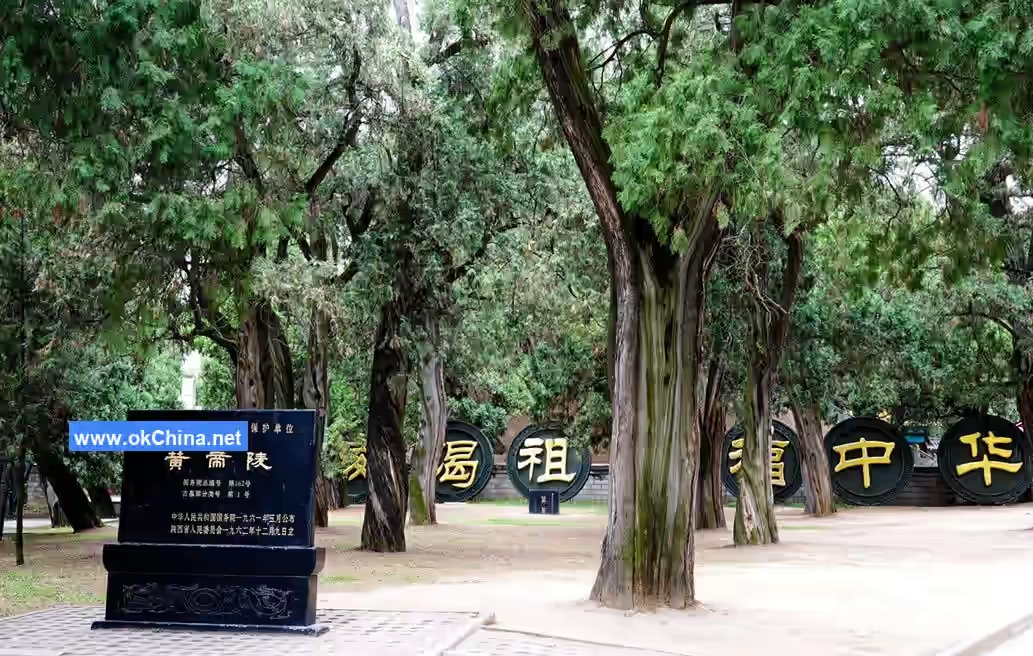
The Mausoleum of the Yellow Emperor is the burial place of Xuanyuan Huangdi (the Yellow Emperor). It is the Yellow Emperor's mausoleum recorded in the Records of the Grand Historian, located on Qiao Mountain north of Huangling County, Yan'an City, Shaanxi Province. Historically known as "Qiao Mausoleum," it has been a site for emperors and notable figures throughout history to offer sacrifices to the Yellow Emperor. The earliest recorded sacrifice to the Yellow Emperor dates back to the third year of Duke Ling of Qin (422 BCE), when he "established the Wuyang Shangzhi altar exclusively for sacrificing to the Yellow Emperor." Since Emperor Wu of Han personally led 180,000 troops to sacrifice at the Yellow Emperor's Mausoleum in the first year of the Yuanfeng era (110 BCE), Qiao Mountain has consistently been the site for state ceremonies conducted by successive dynasties, preserving various cultural relics from the Han Dynasty to the present. The "Yellow Emperor's Hand-Planted Cypress" in front of the mausoleum is over 5,000 years old, said to have been planted by the Yellow Emperor himself, making it the oldest cypress tree in the world.
2. Geographical Environment
2.1 Location and Area
Qiao Mountain, where the Mausoleum of the Yellow Emperor is located, lies about one kilometer north of Huangling County, Yan'an City, Shaanxi Province. It is an eastern extension of the Ziwu Mountain Range. The Ziwu Range runs north-south, with the north referred to as "Zi" and the south as "Wu," hence its name. Qiao Mountain covers a total area of 566.7 hectares, featuring a robust and majestic terrain surrounded on three sides by the Ju River. The mountain is densely forested, with ancient cypresses covering 89.1 hectares, totaling over 81,600 ancient cypress trees, including more than 30,000 that are over a thousand years old. This is the oldest, largest, and best-preserved ancient cypress forest in China.
2.2 Geology and Topography
According to the Taiping Huanyu Ji by Song Leshi: "Qiao Mountain, as mentioned in the Classic of Mountains and Seas, has the Pugu Water originating at its base, flowing through, hence the name Qiao Mountain." The Dushi Fangyu Jiyao by Gu Zuyu of the Qing Dynasty states: "The Ju River flows to the north of the county, passing through the mountain, hence the name Qiao." The Ju River winds around Qiao Mountain in a U-shape from west to east. Looking down from the mountain, rivers are visible to both the east and west, as if water flows beneath the mountain, giving it the name Qiao Mountain. The Yellow Emperor's Mausoleum derives its name "Qiao Mausoleum" from the mountain.
On July 11, 1992, the People's Daily published an article titled "The Feng Shui Axis of the Yellow Emperor's Mausoleum," which stated: "The Feng Shui axis of the Yellow Emperor's Mausoleum is the line connecting the main ridge of Qiao Mountain to the Yellow Emperor's tomb mound and the peak of Yintai Mountain. All structures in the mausoleum area are built along this axis, with the tomb mound precisely aligned on this line." This line runs northwest to southeast, meaning the orientation of the Yellow Emperor's tomb differs from the traditional north-south (facing south) or west-east (facing east) alignments of later emperors. Instead, it is aligned with the geography, facing southeast with its back to the northwest, perfectly matching the orientation of Qiao Mountain, the Ziwu Range, and the Kunlun Mountains, known as the "dragon vein." This reflects the fundamental geographical pattern of China: "The sky leans to the northwest, and the earth is incomplete in the southeast."
3. Main Attractions
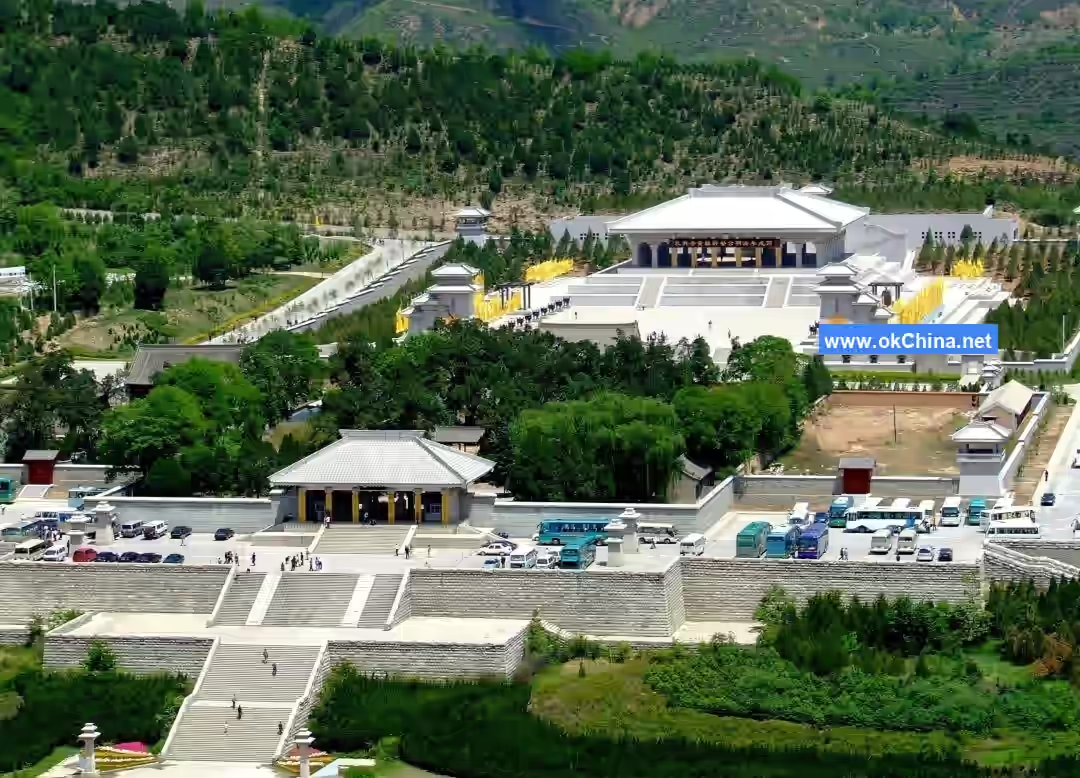
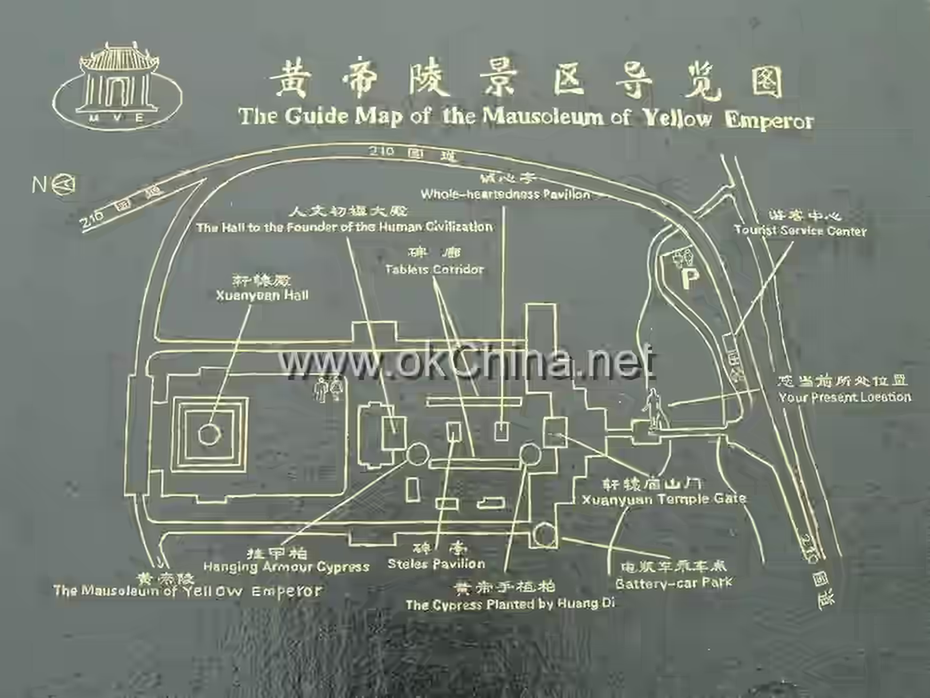
The Yellow Emperor Mausoleum Scenic Area primarily consists of two parts: the Xuanyuan Temple and the Yellow Emperor's Mausoleum. Xuanyuan Temple is located at the foot of Qiao Mountain, while the Yellow Emperor's Mausoleum sits atop the mountain.
3.1 Yellow Emperor Mausoleum Marker Stele
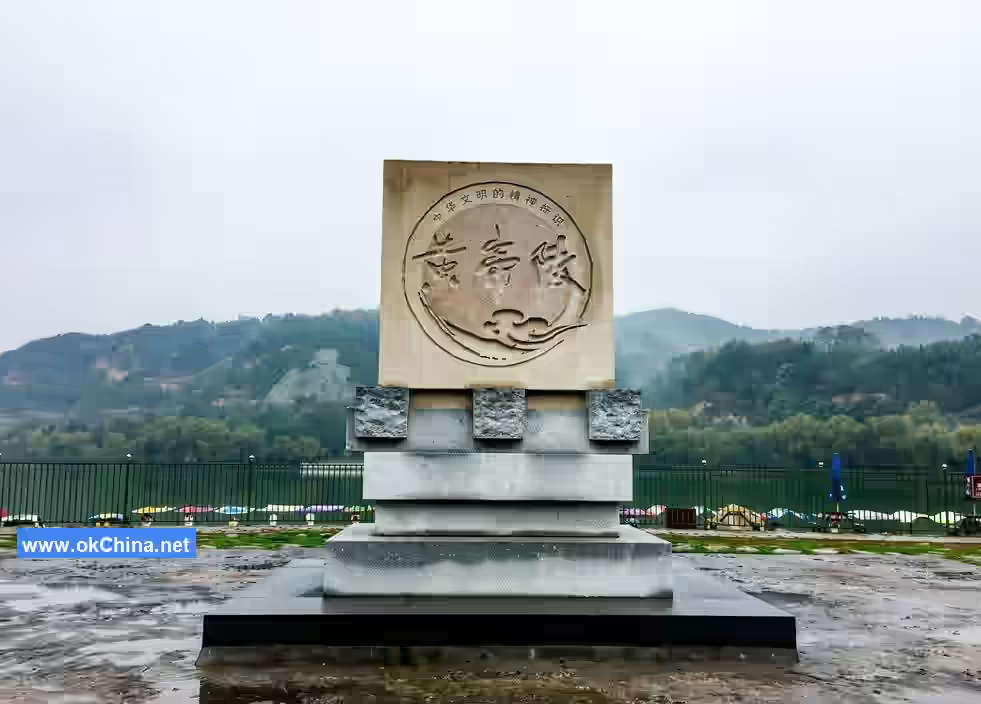
Located in front of the Yinchí Square at the Yellow Emperor's Mausoleum, the marker stele was completed on March 16, 2017. The front of the stele is engraved with the emblem of the Yellow Emperor's Mausoleum. The circular background draws from the traditional Chinese concept of "the sky is round," with alternating solid and void elements representing the transformation of time and space. The earth and auspicious cloud patterns below the circle symbolize the deep roots and enduring legacy of the Chinese civilization founded by the Yellow Emperor. The design and creation of the marker stele incorporate the inscription "Yellow Emperor's Mausoleum" by Guo Moruo, commissioned by Chairman Mao Zedong, as its central element. It highlights the concept proposed by the General Secretary that "the Yellow Emperor's Mausoleum is the spiritual symbol of Chinese civilization," affirming its lofty status and dignity in Chinese history. The stele stands 4.5 meters tall, symbolizing the "nine-five" imperial dignity and the reverence of people from all corners of the world for the progenitor Yellow Emperor.
3.2 Xuanyuan Square
Located at the southernmost end of the scenic area, Xuanyuan Square is a broad, asymmetrical semi-circular plaza covering 10,000 square meters. The ground is paved with 5,000 natural river pebbles from the Qinling Mountains, each 0.5 to 0.6 meters in diameter, symbolizing the 5,000-year history of the Chinese nation.
3.3 Yinchí (Seal Pond)
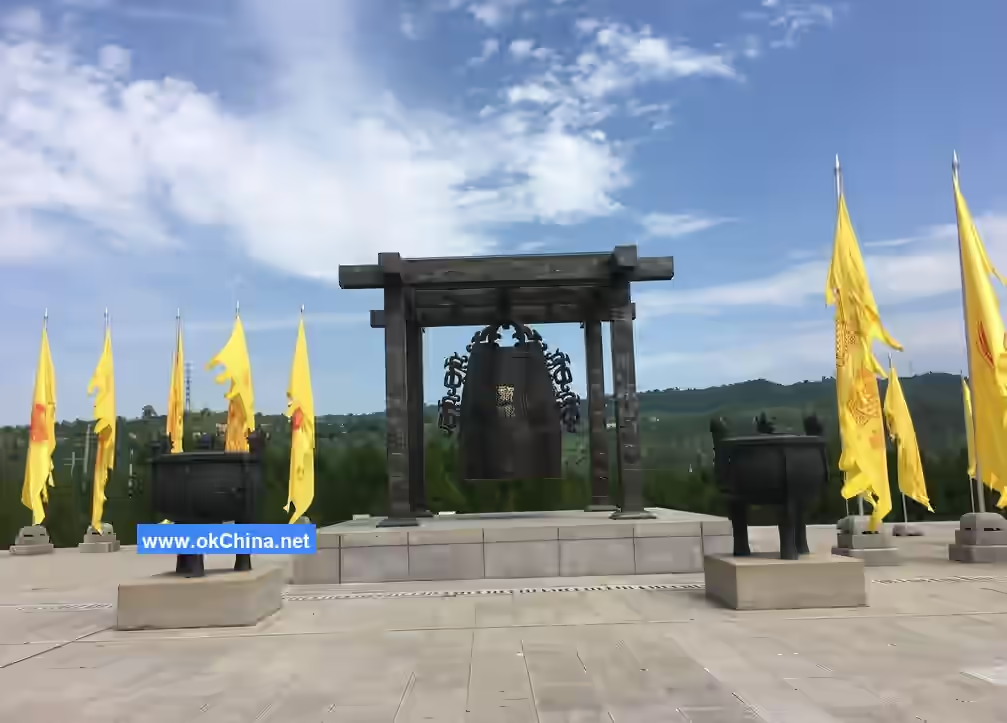
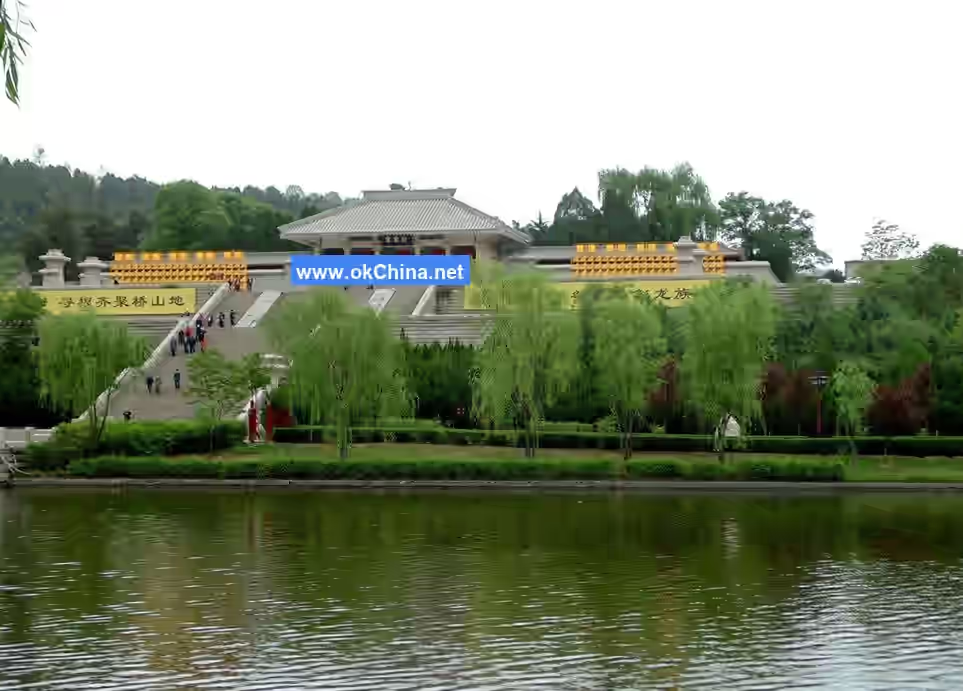
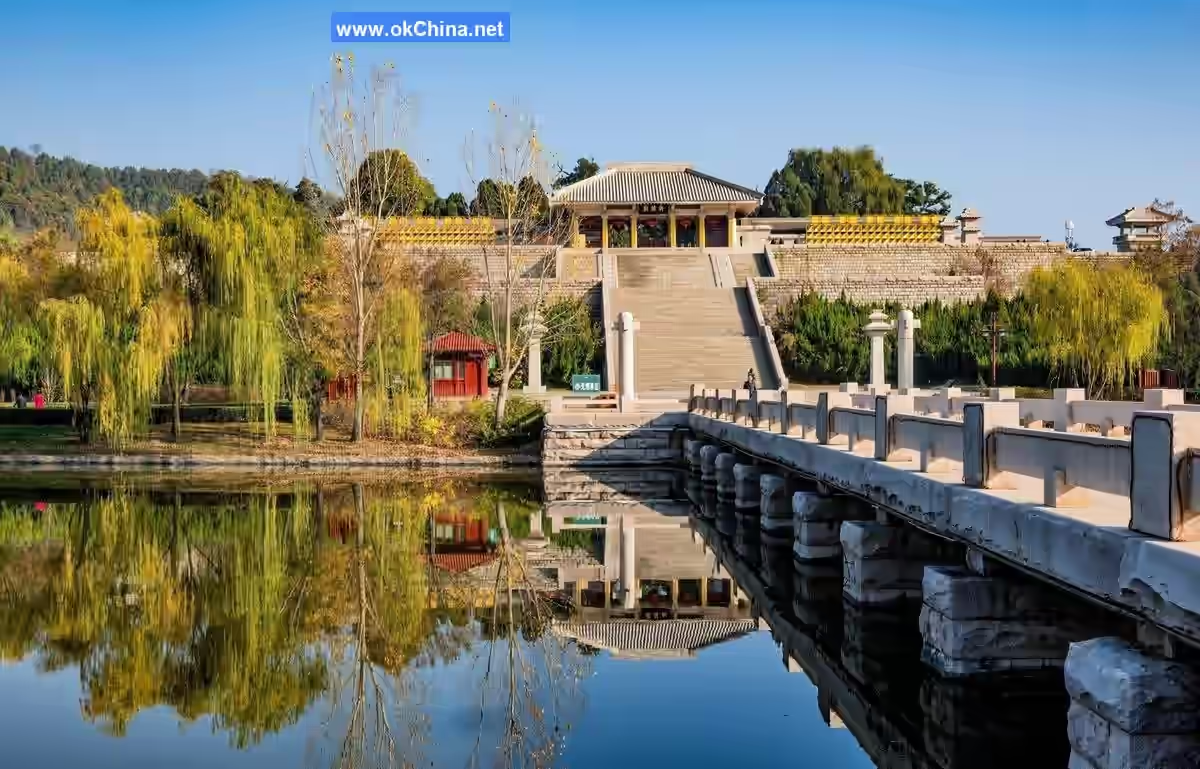
North of Xuanyuan Square lies the winding Ju River, anciently known as "Ji River." The Yellow Emperor was surnamed Ji because he "grew up by the Ji River." Another legend says the river was originally called "Zu River" (Ancestor River). When the Yellow Emperor was summoned to "ascend on a dragon" back to the heavenly palace, his ministers and people wept不舍, their tears flowing down from the peak of Qiao Mountain into the "Zu River." When Li Daoyuan wrote the Commentary on the Waterways Classic, he considered that since the "Zu River" was formed by the tears of the Yellow Emperor's people, it might as well be renamed "Tear River." Later, to reflect both the people's tears and the "Ancestor River," the name was changed to "Ju River." The section of the Ju River between Qiao Mountain and Yintai Mountain, located below Yintai Mountain, is also called "Yinchí" (Seal Pond). It symbolizes the water used by the Yellow Emperor to wash his seal, as legend says he often cleansed his jade seal here, with Yintai Mountain opposite serving as his seal platform. Yinchí covers over 300 acres, with a water area of about 200,000 square meters and a total storage capacity of 460,000 cubic meters. It recreates the natural landscapes of "Autumn Wind over the Ju River" and "Night Moon over Qiao Mountain," while also encircling the Yellow Emperor's Mausoleum with mountains and water.
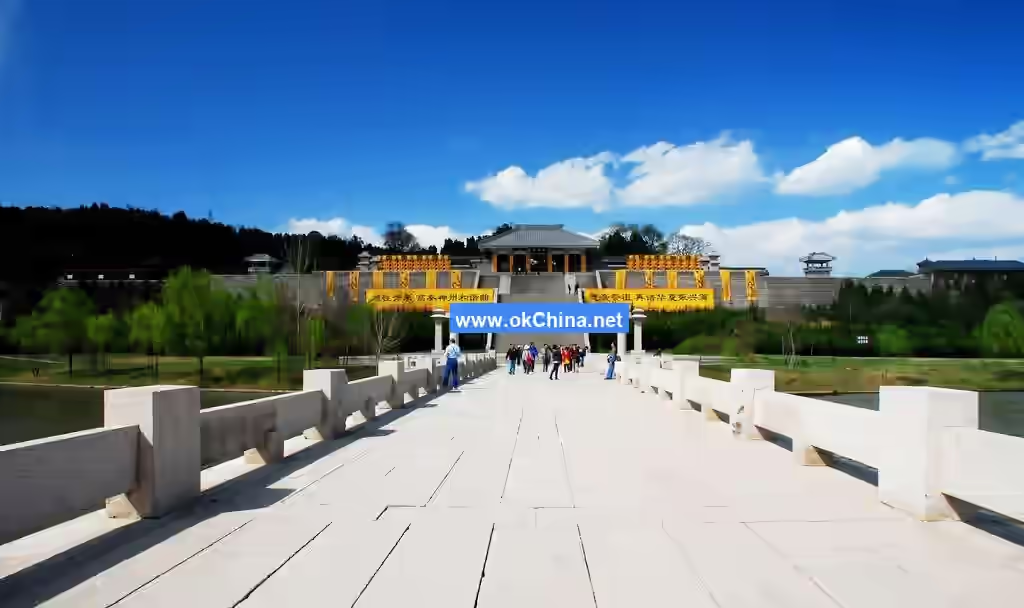
3.4 Xuanyuan Bridge
Spanning Yinchí is the Xuanyuan Bridge, which leads to the Xuanyuan Temple on the northern bank. Modeled after ancient beam bridges over the Ba River, the Xuanyuan Bridge is 66 meters long, 8.6 meters wide, and 6.15 meters high, with nine spans. The bridge deck features railings with classical patterned carvings on the panels. The entire bridge is constructed of granite, with each stone beam measuring 5.71 meters in length and weighing 10 tons. A total of 121 stone beams were used, creating a rough,古朴, and厚重 visual effect.
3.5 North Bridge Square
The northern end of Xuanyuan Bridge opens into North Bridge Square, which connects to the Dragon Tail Path of Xuanyuan Temple. Covering 1,584 square meters, the square is paved with granite. Four granite ornamental columns, each 4.8 meters tall, stand here, enhancing the solemn atmosphere in front of the temple and serving as one of the landmarks of the mausoleum's temple area.
3.6 Dragon Tail Path
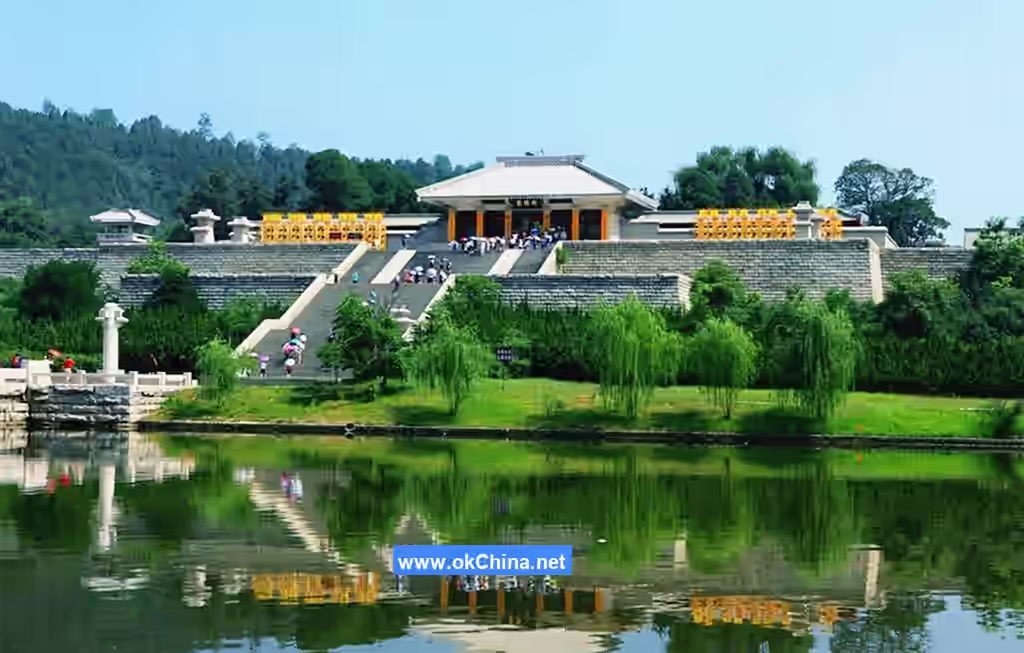
In front of Xuanyuan Temple lies the Dragon Tail Path, consisting of 95 stone steps divided into five ascending sections, symbolizing the Yellow Emperor's "nine-five" imperial dignity and supreme status.
3.7 Mountain Gate
Ascending from the Dragon Tail Path leads to the mountain gate of the temple complex. Located on the central axis of Xuanyuan Temple, the mountain gate is a stone structure in the Han Dynasty style, covering 224 square meters with a five-bay layout. It features 18 monolithic granite columns, each 4.8 meters tall. The gate's platform is 2.72 meters higher than the temple's front square. The stone plaque above the gate, inscribed with "Xuanyuan Temple," was written by Mr. Jiang Dingwen during the Qingming Festival in 1938 when he came to offer sacrifices.
3.8 Yellow Emperor's Hand-Planted Cypress
Inside the mountain gate of Xuanyuan Temple, on the west side, stands a tall ancient cypress known as the famous "Yellow Emperor's Hand-Planted Cypress." Over 5,000 years old, it is said to have been planted by Xuanyuan Huangdi, hence its name, also called "Xuanyuan Cypress." The cypress has vigorous and straight branches, lush green leaves, with its main trunk slightly倾斜 to the south. It stands 19 meters tall with a trunk diameter of 11 meters, its crown spreading like a canopy, majestic in appearance. The Guoshu Jicheng records: "In Zhongbu County, there is the Xuanyuan Cypress in Xuanyuan Temple. According to miscellaneous records, it was planted by the Yellow Emperor himself, with a girth of 2.4 zhang, reaching towards the sky." Beside the tree is a stele pavilion housing a stone tablet inscribed: "This cypress is 58 chi tall, with a lower girth of 31 chi, middle girth of 19 chi, and upper girth of 6 chi, making it the foremost among cypresses." The Yellow Emperor's Hand-Planted Cypress is the oldest surviving cypress in China. In 1982, after inspecting cypress trees in 27 countries, British forestry expert罗皮尔 concluded that only the Yellow Emperor's Hand-Planted Cypress was the most robust and ancient, praising it as the "Father of World Cypresses." On December 9, 1998, the "Selection and Maintenance Committee for China's Famous Trees" ranked it first among China's hundred famous trees, earning it the誉 as the "Crown of World Cypresses."
3.9 Sincerity Pavilion
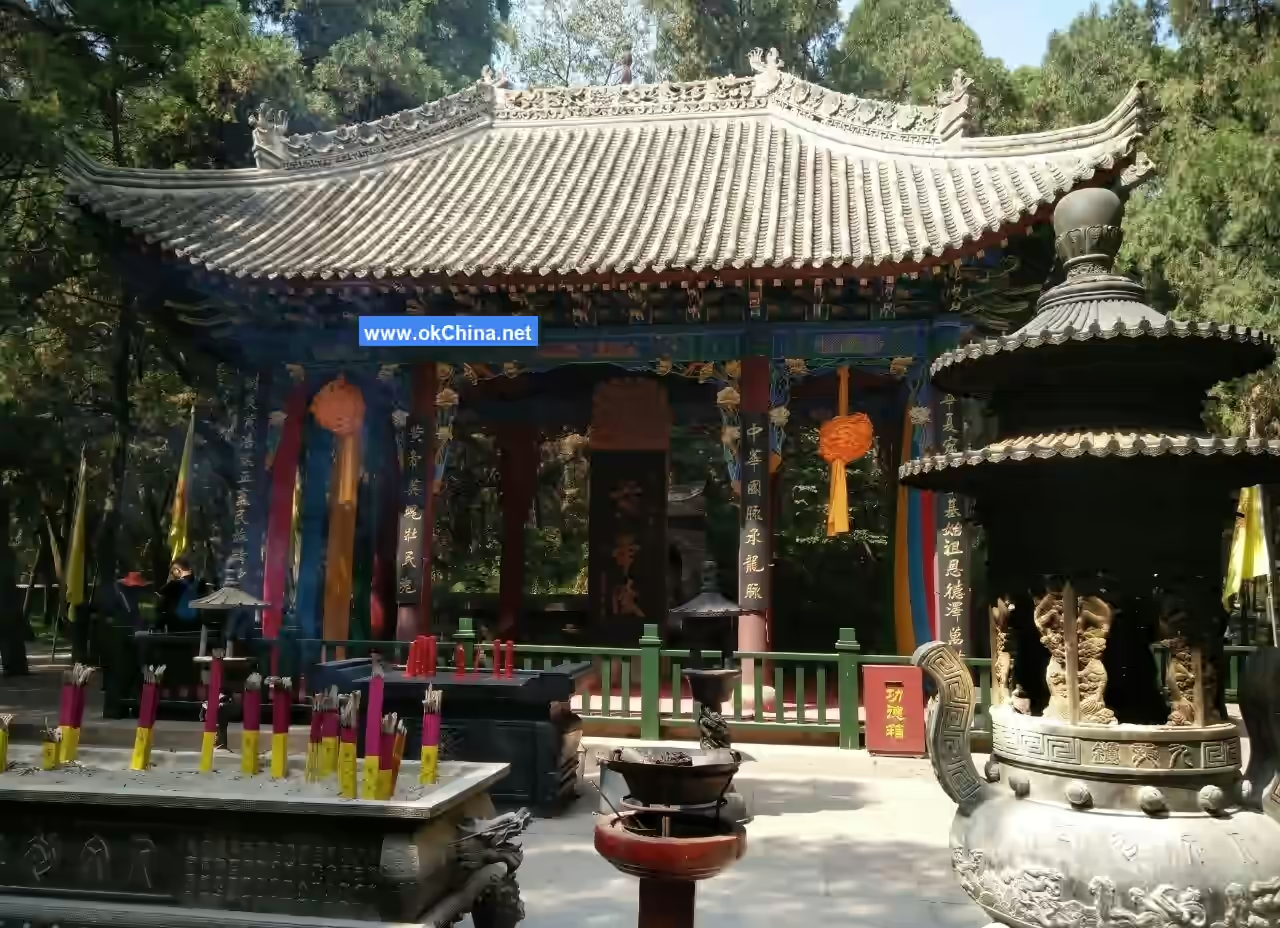
Proceeding north along the central axis leads to the Sincerity Pavilion, originally called the Passing Pavilion. It has five bays in width and one bay in depth, covering about 85 square平方米. The pavilion features a hip-and-gable roof with closely interlocked gray板瓦 and筒瓦, eaves with滴水 tiles at the front, and no walls on all four sides. Below the lintels are lattice decorations with旋子彩绘. The central bay has Ruyi-shaped stone steps on the north and south sides of its platform, while the side bays have外围 railings. The pavilion's columns bear two couplets: "Observe the phenomena of heaven and earth nurturing life; read the timeless classics on statecraft and governance" and "Sincerely worship the sacred land and cultural ancestor; heartfelt sacrifice embodies the affection of Chinese sons and daughters." To the southeast in front of the pavilion stands a brick wall with an inscription: "When历代 emperors, generals, scholars, poets, modern government officials, social elites, compatriots, overseas Chinese, and华裔 come to pay homage to the Yellow Emperor, they first tidy their attire, prepare offerings, calm their minds, and clear distractions in the Sincerity Pavilion before proceeding slowly into the hall to offer their deepest respects."### 3.10 Stele Pavilion North of the Sincerity Pavilion is the Stele Pavilion. Its form is similar to that of the Sincerity Pavilion, but its area is slightly larger. The central part remains a passage pavilion, with brick walls on the east and west sides. It has a width of five bays and a depth of one bay. It features a round-ridge roof covered with gray cloth-like flat tiles and cylindrical tiles, with Xuanzi decorative paintings between the architraves and friezes. On the south-facing pillars of the Stele Pavilion is a couplet: "Five thousand years of history, thirty thousand miles of land." Before 1987, the Stele Pavilion housed 47 stone steles. In 1988, most of the steles were moved to the Stele Corridor on the east side of the Xuanyuan Temple. The Stele Pavilion is an important pavilion for displaying significant steles, and it currently houses four steles. On the west side are two steles. The front one is the handwritten inscription "Eulogy for the Mausoleum of the Yellow Emperor" personally written by Mao Zedong on April 5, 1937, when the Kuomintang and the Communist Party jointly paid homage to the Mausoleum of the Yellow Emperor. The rear one is a stele inscribed by Deng Xiaoping for the Mausoleum of the Yellow Emperor. The stele is engraved with Deng Xiaoping's handwritten inscription "Descendants of Yan and Huang" in four large characters, signed by Deng Xiaoping, dated 1988. The stele body is 3 meters high, 0.9 meters wide, and about 0.3 meters thick. On the east side are two steles. The front one is a poem titled "Ode to the Yellow Emperor" composed by Dr. Sun Yat-sen in 1912 when he served as the Provisional President of the Republic of China: "Five thousand years since China's founding, Xuanyuan of the Divine Land has been celebrated since ancient times. He created the south-pointing chariot, quelled the rebellion of Chi You. In world civilization, only I am first." The rear one is inscribed with the three large characters "Mausoleum of the Yellow Emperor" written by Chiang Kai-shek, Chairman of the Central Committee of the Kuomintang, in the winter of 1942, when the name was changed from Qiaoling to the Mausoleum of the Yellow Emperor. This stele was originally erected in front of the tomb of the Yellow Emperor. After liberation, it was replaced by a stele inscribed by Guo Moruo. The existing stele is a re-engraved version.
3.11 Hong Kong, Macao, and Taiwan Eulogy Steles
To the west and in front of the Stele Pavilion stand four stone steles: the Hong Kong Return Monument, the Macao Return Monument, the "Taiwan Retrocession Tribute Group" Eulogy Stele for the Mausoleum of the Yellow Emperor, and the Eulogy Stele for the Tenth Anniversary of Hong Kong's Return to the Motherland at the Mausoleum of the Yellow Emperor.
3.12 Hanwu Armor-Hanging Cypress
Beside the stone with the Yellow Emperor's footprint stands a Hanwu Armor-Hanging Cypress, also known as the General Cypress. Records state: "Emperor Wu of Han hung his armor on this tree upon returning from his expedition to the north." The trunk is densely covered with mottled scars, arranged in rows, as if broken nails are embedded within, making it the most peculiar among the cypress grove. Especially before the Qingming Festival each year, the cypress sap flowing from the branches of this ancient tree congeals into spherical shapes, which are particularly spectacular when reflected by sunlight, attracting people from all over to pay homage to the mausoleum and their ancestors. However, after the Qingming Festival, the sap flow ceases, and the ancient tree, from its branches to its trunk, returns to its original densely packed armor-like scars.
3.13 Hall of the First Ancestor of Humanity
The Hall of the First Ancestor of Humanity in the Xuanyuan Temple is the main hall for worshipping Xuanyuan Huangdi (the Yellow Emperor) and the principal structure of the entire temple complex, located at the center of the temple grounds. It was rebuilt during the Ming Dynasty and underwent a major renovation in 1959. The Hall of the First Ancestor of Humanity covers an area of 282 square meters, with a width of seven bays and a depth of three bays. The hall features a hip-and-gable roof with carved openwork ridges. The roof is covered with interlocking gray cloth-like flat tiles and cylindrical tiles, with drip tiles and end tiles on the eaves. Bracket sets are present on the front eaves and the other three sides. The central bay of the front eaves has six partition doors, while the side bays each have four partition doors. The friezes and architraves under the eaves are decorated with He Xi style paintings and bracket set paintings. The paintings on the two sides, the back, and the interior beams are all exquisite and magnificent. Hanging on the lintel of the main hall is a large plaque inscribed with "First Ancestor of Humanity" by the original Kuomintang patriotic general Cheng Qian during the summer sacrificial ceremony in the 27th year of the Republic of China (1938). The calligraphy is strong and elegant, with strokes like iron and silver.
3.14 Xuanyuan Huangdi Relief Sculpture
In the wooden niche at the center of the main hall is enshrined a large stone relief sculpture of Xuanyuan Huangdi. This relief sculpture of the First Ancestor of Humanity of the Chinese nation is based on the stone statue of the Yellow Emperor from the Wu Liang Shrine built in Jiaxiang, Jining, Shandong, in the first year of the Jianhe era of Emperor Huan of the Eastern Han Dynasty (147 AD). Approved by the National Cultural Heritage Administration, it was appropriately enlarged and carved by incorporating modern aesthetic concepts. The relief sculpture of the Yellow Emperor is a full-body figure, made of Shaanxi Fuping black jade stone. It is 3.6 meters high, 3.3 meters wide, and weighs 11 tons. The relief depicts Xuanyuan Huangdi standing steadily, stepping eastward while looking back westward, raising his arm and hand, with simple headgear and plain clothing. The patterns around the niche are: Vermilion Bird above, Black Tortoise below, Azure Dragon on the left, and White Tiger on the right. Both the niche and the Xuanyuan Huangdi relief sculpture were funded by a donation of 80,000 RMB from Hong Kong compatriots Mr. Zhan Zhaolin and Mr. Cheng Wanqi, who came specifically to pay homage at the mausoleum during the Qingming Festival in 1987.
3.15 Stele Corridor
On the east and west sides of the central axis from the mountain gate of the Xuanyuan Temple to the Hall of the First Ancestor of Humanity are two long stele corridors, designed in the architectural style of the Han Dynasty. The stele corridors arrange the historically preserved steles of the Mausoleum of the Yellow Emperor in chronological order and by content category. The west corridor displays, from north to south, 56 ancient steles from the Song Dynasty to the late Qing Dynasty, recording ancestor worship and events. The east corridor displays, from south to north, steles inscribed with texts praising the Yellow Emperor's virtues by Party and state leaders and modern calligraphers, as well as merit steles commemorating contributions to the restoration project of the Mausoleum of the Yellow Emperor.
3.16 Sacrificial Square
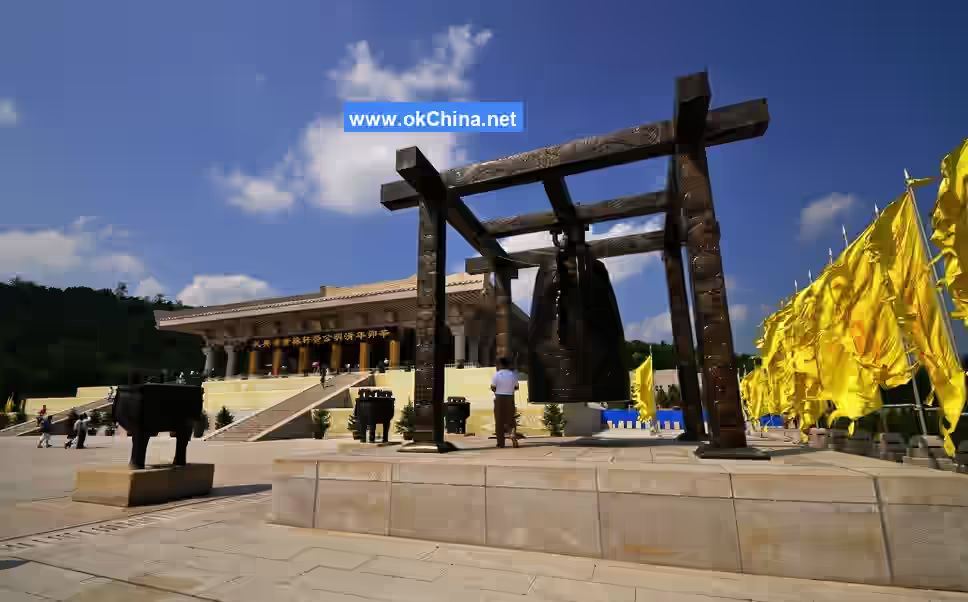
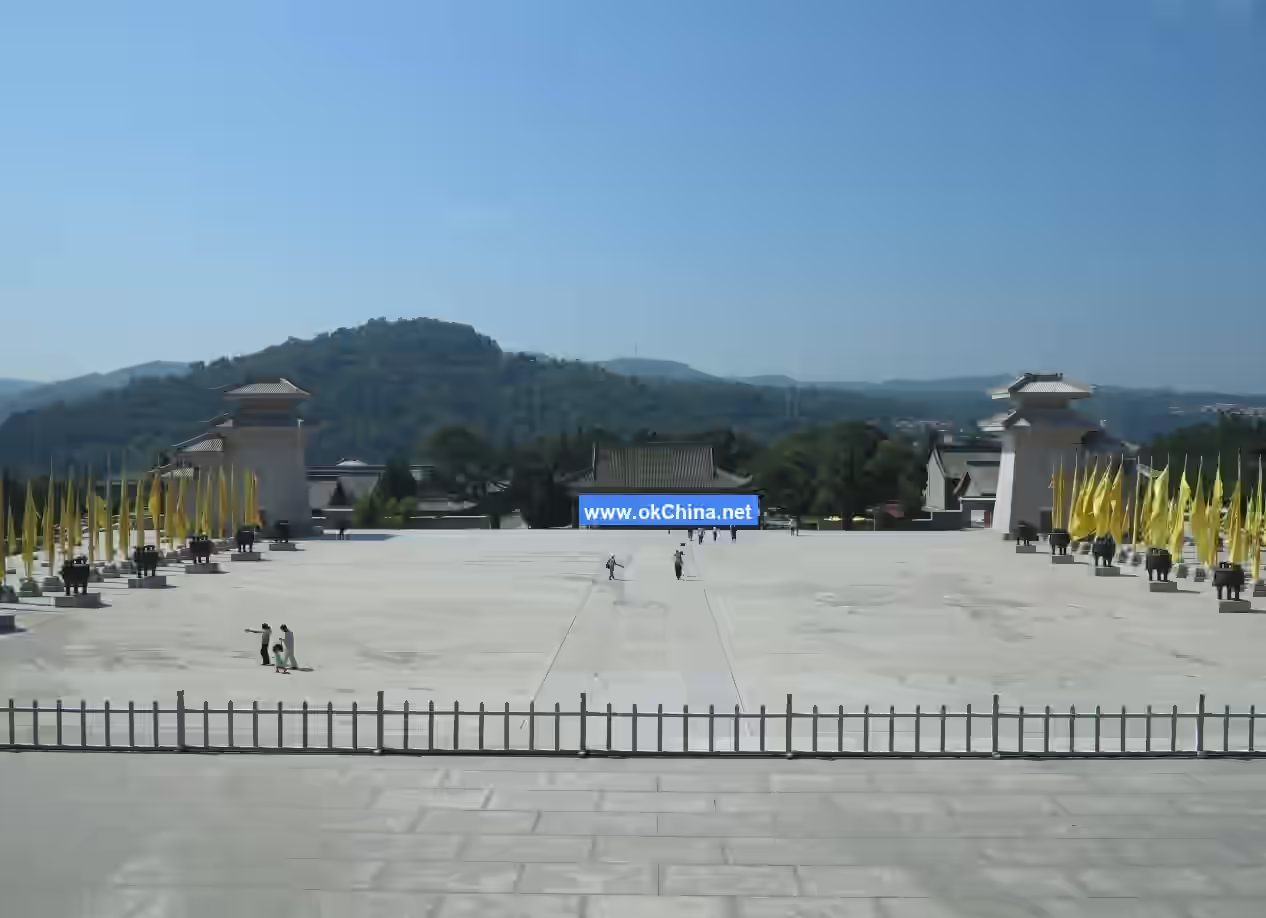
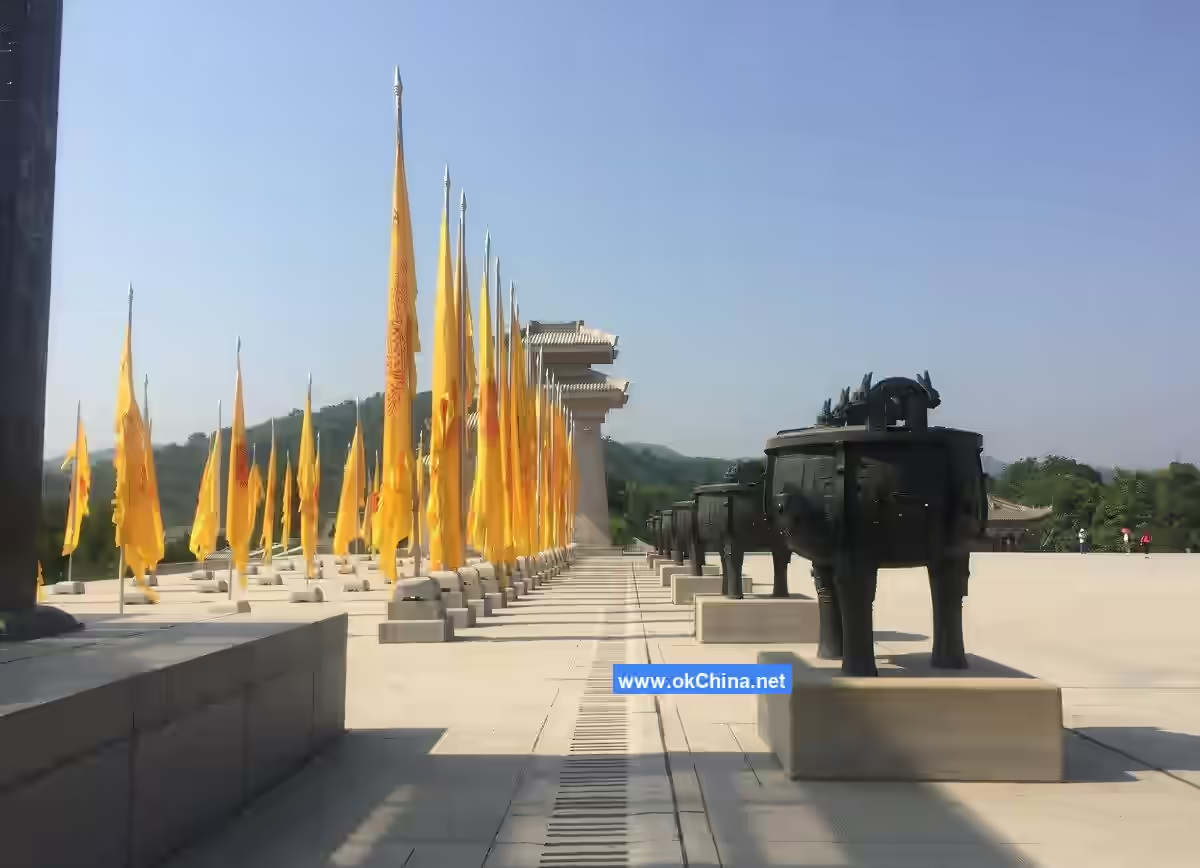
North of the Hall of the First Ancestor of Humanity is the Sacrificial Square, covering an area of 10,000 square meters, capable of accommodating 5,000 people for sacrificial activities. The square's ground is paved with granite. At the southern end, on the east and west sides, stand three-tiered que (watchtower) structures each. In front of the platforms of the que are placed eight bronze-cast Hong Shu Gui (ritual vessels). On the east and west sides are arrayed nine bronze-cast ox tripods, each 2 meters high, and 56 dragon flags representing the 56 ethnic groups. Additionally, on the east side is a large bell named "Dragon Soul," and on the west side stands a large drum named "Dragon Might." The entire sacrificial courtyard is solemn, majestic, and awe-inspiring.
3.17 Dragon Soul Bell
The "Dragon Soul" bell is a ritual vessel used for public sacrifices at the Mausoleum of Xuanyuan Huangdi. Its design combines the form of a ceremonial musical bell, the acoustics of a temple bell, and the style of the era. The bell body is 3.8 meters tall overall, with a mouth diameter of 2.456 meters, and weighs 13 tons. The "Dragon Soul" bell primarily takes the form of Zhou Dynasty bronze bells unearthed at Zhouyuan in Shaanxi. Its main patterns are based on Han Dynasty pictorial representations of the Yellow Emperor's achievements, with unearthed Zhouyuan jade dragon-phoenix ornaments and auspicious cloud patterns as background decorations. The bell loop features two standing phoenixes, with double dragons as flanges on both sides. The center of the bell face bears the seal script characters "Dragon Soul." The overall shape of the bell is dignified, concise, unique, and exquisite, expressing the breadth and profundity of Chinese civilization and embodying the meanings of an era inscribed on bells, the auspicious union of dragon and phoenix, and the harmony between heaven and humanity.
3.18 Dragon Might Drum
The Dragon Might Drum weighs 750 kilograms, with a drumhead diameter of 2.5 meters, a drum shell diameter of 2.7 meters, and a drum height of 1.5 meters. It complements the Dragon Soul Bell perfectly, appearing majestic and awe-inspiring.
3.19 Xuanyuan Hall
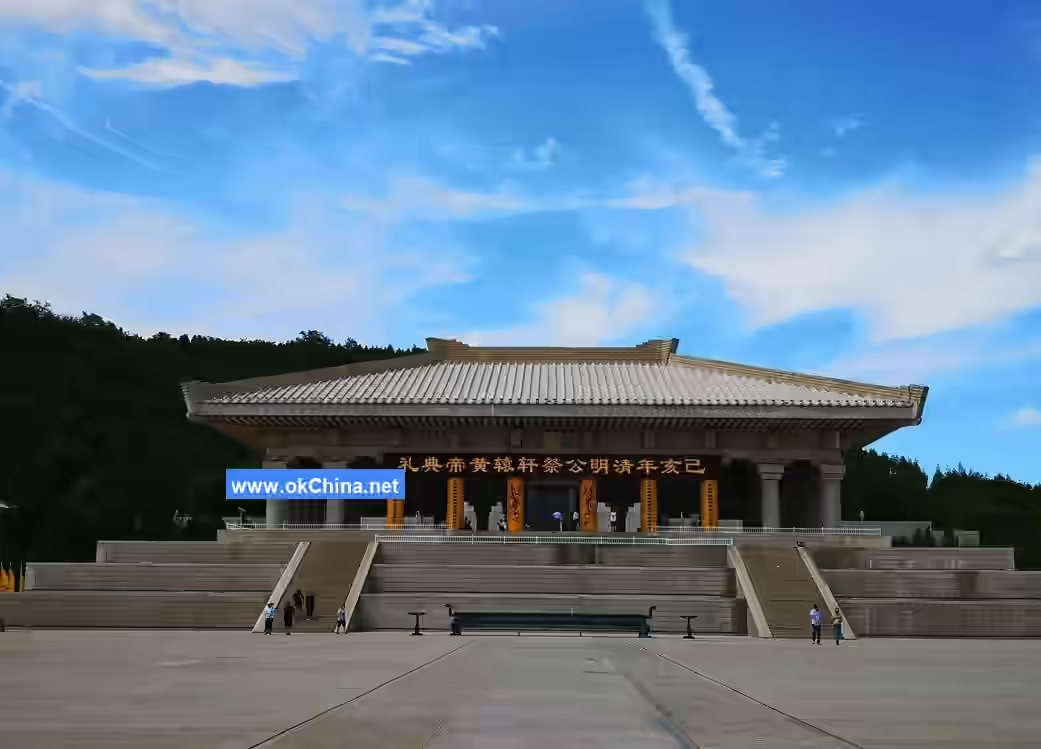
At the northern end of the Sacrificial Square, atop a three-tiered stone platform with a total height of 6 meters, stands majestically the Xuanyuan Hall. Functional facilities are built in concealed locations, purifying the environment. No other pavilions, towers, or corridors are built within the hall area. Relying on the grand environment formed by the mountains, rivers, landforms, and vegetation, it embodies the realm of "great form has no shape." Under the eaves at the center of the hall hangs a plaque inscribed with "Xuanyuan Hall" in clerical script by the famous calligrapher Mr. Huang Miaozi. The Xuanyuan Hall has a floor area of 1,700 square meters. Thirty-six circular stone columns, each 3.8 meters high, enclose a rectangular space of 40 meters by 40 meters. There are no walls between the columns. The structure is topped with a massive inverted-funnel-shaped roof, reflecting the style of the "Yellow Emperor's Mingtang." It is the most distinctive landmark building in the temple area. The deep, long eaves, the massive bracket sets, and the simple,古朴的屋脊 (simple and古朴 roof ridge) make the entire structure appear grand and solemn, possessing ancient Han style. At the center of the roof is a circular skylight 14 meters in diameter. The blue sky, white clouds, and sunlight directly illuminate the interior, making the entire space vast,神圣 (sacred), and通透 (transparent and bright). The floor inside the hall is paved with five colors of granite: blue, red, white, black, and yellow, alluding to the traditional "five-colored earth" and symbolizing the Yellow Emperor's grace covering the land of the motherland. The entire Xuanyuan Hall design takes the meaning of "round heaven and square earth," connecting with heaven and earth, bathed in sunlight and rain, symbolizing the simple cosmic理念 (concept) of China's remote ancestors. A stone carving of the Yellow Emperor stands inside the hall.
3.20 Statue of Xuanyuan Huangdi
Slightly north of the center inside the Xuanyuan Hall stands a tall granite stele — the Statue Stele of Xuanyuan Huangdi. The stele has a total height of 7.6 meters, a base width of 5.68 meters, and a thickness of 3.48 meters. The two giant stone slabs for the front and back each weigh about 16 tons. Its造型特点 (design characteristics) resemble both a traditional ancestral tablet and a traditional stele in front of a tomb, while also resembling a古朴 (simple and古朴) shrine. According to traditional cultural concepts, it is named "Spirit Tablet." The front of the stele is carved with an image of Xuanyuan Huangdi. This image, like the one in the Hall of the First Ancestor of Humanity, is 3.9 meters high and 2.6 meters wide. It was加工而成 (processed) using the Han Dynasty pictorial stone carving technique of "reduced relief with incised lines." It is composed of 16 large pieces of bluish-gray granite arranged in the shape of the oracle bone script character for "ancestor" (祖), presenting a严谨朴素 (rigorous and simple),重拙写实 (heavy, unadorned, and realistic) ancient Han charm.
3.21 China Century Cypress
On the west side of the Xuanyuan Temple, a road leads to Qiaoshan Mountain. One can walk up the mountain or take the scenic area shuttle bus. On the mountainside stands a "China Century Cypress." The "China Century Cypress" was planted on the birthday of the Yellow Emperor, the second day of the second lunar month in the Gengchen year (March 7, 2000). It is a symbol of national unity and the reunification of the motherland. It was cultivated with soil collected from 34 provinces, municipalities, autonomous regions, and special administrative regions, representing regional characteristics, and watered with water取自 (taken from) the estuaries of the Yellow River and the Yangtze River. It expresses all Descendants of Yan and Huang's admiration and remembrance for the First Ancestor of Humanity, Xuanyuan Huangdi, and their prayers for blessings in the new century.
3.22 Mount Tai Five-Colored Stone
Beside the "China Century Cypress" stands a Mount Tai five-colored stone weighing 15 tons. The "Record of the Gengchen Year Yellow Emperor's Birthday," composed and written by Mr. Chen Ruixian, a member of the Académie des Beaux-Arts of France and a Chinese artist, is engraved on it. Using stone to记录 (record) the ancestor's virtue, it寓意 (implies) that the divine land's state is as stable as Mount Tai, and the responsibility of Chinese people to振兴国家治理世事 (revitalize the nation and govern the world) is weightier than Mount Tai.
3.23 Tomb Path
Starting from the "China Century Cypress," a walking path leads to the Mausoleum of the Yellow Emperor at the mountaintop. The Tomb Path and the Spirit Path are important passages into the tomb area, constructed along the mountain body using techniques of physical discontinuity with conceptual continuity, and curves不离 (not straying from) straight lines. The total length of the path is 455 meters, of which the Tomb Path is 260 meters and the Spirit Path is 195 meters. Both are 5 meters wide, entirely paved with granite slabs, comprising 277 steps in total.### 3.24 Dragon Horn Cypresses Ascending the Sacred Path, ancient cypresses tower on both sides. Mount Qiao, with its fertile soil, is densely forested, covering an area of 89.1 hectares with over 81,600 ancient cypress trees, including more than 30,000 that are over a thousand years old. This constitutes the oldest, largest, and most well-preserved ancient cypress forest in China. The ancient cypresses on Mount Qiao are not only numerous and ancient but also diverse in species, primarily consisting of oriental arborvitae, along with hinoki cypress, Chinese juniper, and prickly cypress. The Dragon Horn Cypresses, also known as "Twisted Cypresses," are named for their symmetrical positions above the "dragon head" of the "Coiling Dragon Ridge" at the Mausoleum of the Yellow Emperor, resembling dragon horns.
3.25 Tianyuan Divine Wisdom
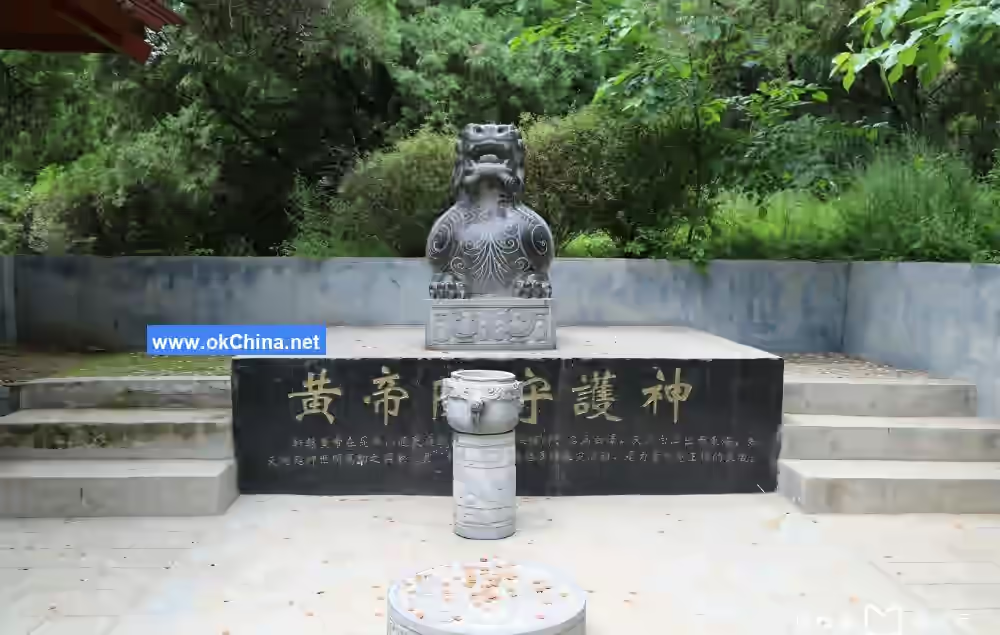
Along the Sacred Path stands the Tianyuan Divine Wisdom, the guardian deity of the Mausoleum of the Yellow Emperor. Legend holds that Tianyuan is an ancient totem of the Huaxia people, a mystical dragon carrying the "River Chart" on its back. It possesses knowledge of the rise and fall of all things in heaven, earth, the spirit world, and the mortal realm, embodying mysterious foresight. The Yellow Emperor encountered this divine dragon, named "Baize," on Mount Kunlun, and appointed it as his guardian deity, a symbol of wisdom, power, and royal authority. It is said that using the "River Chart" can bring blessings, and touching the dragon's horns can ward off evil and avert disasters.
3.26 Dismounting Stele
Located about 200 meters from the Mausoleum of the Yellow Emperor, beside the buffer platform connecting the Spirit Way and the Sacred Path, this stele was erected during the Jiajing reign of the Ming Dynasty. It bears the inscription: "All civil and military officials must dismount here." In ancient times, due to the rugged mountain paths, most pilgrims traveled by horse or sedan chair. Upon reaching this point, they would dismount or alight, adjust their attire, compose themselves, and proceed respectfully to the mausoleum. Although modern visitors typically ascend on foot rather than by horse or sedan, they are still expected to approach the mausoleum grounds with reverence. Those arriving by vehicle must also disembark here as a sign of respect.
3.27 Cultural Relics Protection Stele
On March 4, 1961, the Mausoleum of the Yellow Emperor was announced by the State Council as one of the first batch of Major Historical and Cultural Sites Protected at the National Level, designated as "Ancient Tomb No. 1," earning it the title "The First Mausoleum Under Heaven."
3.28 Mausoleum Precinct
The Spirit Way leads directly to the mausoleum area. The precinct is enclosed by a continuous wall of blue bricks, 1.6 meters high, following the mountain's contours and painted red, symbolizing supreme dignity and grandeur. The wall is topped with red rafters and green tiles, exuding an antique charm. The entire precinct measures approximately 210 meters north-south and 72 meters east-west (42 meters wide at the front, 81 meters at the rear). There are two gates, located on the eastern and western sides.
3.29 Hanwu Immortal Platform
Entering the precinct through the east gate, one finds a 24-meter-high rammed-earth platform on the left, first built in the first year of the Yuanfeng era of the Western Han Dynasty (110 BC). A stele beside it bears the inscription "Hanwu Immortal Platform," erected in the 37th year of the Jiajing reign of the Ming Dynasty (1558), signed "Written by Tang Qi of Chinan." Also known as the Hanwu Prayer-for-Immortality Platform, the Records of the Grand Historian: Treatise on the Feng and Shan Sacrifices records: "In the first year of Yuanfeng, Emperor Wu of Han, Liu Che, 'inspected the northern frontier, commanded over a hundred thousand troops, and upon returning, sacrificed at the Yellow Emperor's tomb on Mount Qiao.'" After his triumphant northern campaign with 180,000 troops, Emperor Wu stopped at the Mausoleum of the Yellow Emperor on his return to report his military achievements to his ancestors. Wishing for longevity and immortality, he also ordered his 180,000 soldiers to pile earth here, constructing a platform surrounded by verdant cypresses. Later generations thus named it the Prayer-for-Immortality Platform. The Zhongbu County Annals also record: "The Hanwu Immortal Platform stands to the left of the Yellow Emperor's Mausoleum, towering above the forest. Emperor Wu inspected the northern frontier, returned, sacrificed to the Yellow Emperor, and built a platform to pray for immortality." The platform has a lower circumference of 120 meters and an upper circumference of 22.5 meters, located 45 meters from the tomb mound. Two stone winding paths lead to the top, which is surrounded by ancient cypresses and rises above the treetops. From the summit, one can enjoy a panoramic view. Folklore says, "Ascending the platform once adds a year to one's life."
3.30 Lingxing Gate
Passing through the Lingxing Gate beside the Hanwu Immortal Platform and ascending to the summit of Mount Qiao leads to the tomb mound of the Yellow Emperor.
3.31 Sacrificial Pavilion
In front of the Yellow Emperor's tomb mound stands the Sacrificial Pavilion. It is 10 meters wide and 6.15 meters deep, built in the hip-and-gable roof style with upturned eaves, presenting a majestic appearance. An altar table, sacrificial vessels, and various offerings are placed in front of the pavilion. Inside stands a tall stele, 4.3 meters high and 1.2 meters wide, inscribed with the three large characters "Huang Di Ling" (Mausoleum of the Yellow Emperor). These were handwritten by Guo Moruo in May 1958, entrusted by Mao Zedong. The pavilion is supported by eight pillars, with wind chimes hanging from the four upturned corners, which chime in unison with the breeze. Two couplets adorn the pillars: one reads, "Laying the grand foundation of Huaxia, the progenitor's virtue benefits all generations; Establishing the noble spirit of Yan and Huang, the national ethos shines through the ages." The other reads, "The Chinese nation's lineage inherits the dragon's vein; The Yellow Emperor's heroic soul strengthens the people's spirit." The floor is paved with granite, pure, bright, simple, and solemn. From ancient times to the present, the annual Qingming Festival and Double Ninth Festival grand sacrificial ceremonies are mostly held here, making it an important site for Chinese descendants worldwide to commemorate their ancestor's merits and express national sentiment.
3.32 Stele in Front of the Mausoleum
Another stele stands in front of the Yellow Emperor's Mausoleum, behind the one inscribed by Guo Moruo. It bears the four characters "Qiao Shan Long Yu" (Mount Qiao, Where the Dragon Was Ridden), meaning the place where the Yellow Emperor ascended to heaven riding a dragon. The inscription is dated "The ninth day of the tenth month, Bing Shen year of Jiajing, Ming Dynasty (1536), written by Tang Qi of Diannan." Legend says that when the Yellow Emperor Xuanyuan ascended to heaven on a dragon here, his people, reluctant to see him leave, pulled off his clothes, hat, boots, sword, etc., and buried them here, constructing the tomb mound as an eternal memorial. Originally, there was another ancient stele in front of the tomb inscribed "Ancient Xuanyuan Yellow Emperor Qiao Mausoleum," erected by Bi Yuan, the Governor of Shaanxi during the Qing Dynasty, in the 41st year of the Qianlong reign (1776), but it is now lost.
3.33 Tomb Mound of the Yellow Emperor
The tomb mound of the Yellow Emperor is located at the center of Mount Qiao's summit, oriented northwest-facing southeast. It is 3.5 meters high, with a circumference of 48 meters, covering an area of about 200 square meters. The mound is an earth tumulus, oblate in shape, 3.5 meters high, 16 meters in diameter, with a circumference of 48 meters, enclosed by a brick wall. The lower part of the mound is built upon a square platform to enhance the sacredness of the tomb. The combination of the square platform and the round mound, with a round top and square base, symbolizes the "round heaven and square earth" and the "union of heaven and earth."
3.34 Longyu Pavilion
Located north of the Yellow Emperor's Mausoleum at an elevation of 994 meters, the Longyu Pavilion is the highest point within the mausoleum area. Its architectural style draws from Han Dynasty pavilions, featuring imitation wooden construction characteristics, built with reinforced concrete and faced with granite. The five-story pavilion is approximately 20 meters high, square in shape (4.2m x 4.2m), with a floor area of 160 square meters. The south facade bears the three large characters "Long Yu Ge" (Dragon-Riding Pavilion) in Han clerical script. Inside, the walls feature 12 thematic paintings depicting the Yellow Emperor's achievements: Birth of the Yellow Emperor, Rise of the Tribe, Granting Surnames and Establishing Clans, Cultivating Virtue and Strengthening the Military, Building Boats and Oars, Promoting Medicine, Sowing the Five Grains, Engaging in Agriculture and Sericulture, Making Clothing, Distinguishing Social Ranks, Establishing Rites and Music, Creating an Official System, Mount Qiao, Where the Dragon Was Ridden, First Ancestor of Humanity, etc. From the Yellow Emperor's birth to his ascension to heaven on a dragon, these paintings provide further insight into his numerous inventions and outstanding accomplishments.
4. Historical Evolution
4.1 Ancient History
Records of the Grand Historian, Volume One, Basic Annals of the Five Emperors records: "The Yellow Emperor died and was buried on Mount Qiao." In remote antiquity, Mount Qiao was the dwelling place of the Youjiao clan and was called Mount Jiao. During the Yellow Emperor's era, it was known as "Xuanyuan Hill" or "Xuanyuan Terrace," from which the Yellow Emperor derived his name "Xuanyuan." The central palace of the Yellow Emperor's city was located here, later evolving into Mount Qiao. After the Yellow Emperor, allied with the Yan Emperor, defeated Chi You, he transformed from the leader of the Huaxia tribal alliance into the sovereign of all under heaven, leading the Huaxia people from a primitive era into civilization. His monumental achievements naturally earned him the reverence and worship of later generations. After his death, to express their remembrance of this First Ancestor of Humanity, people raised a burial mound on Mount Qiao and established a temple for sacrifices. For thousands of years after the Yellow Emperor's death, sacrificial activities have never ceased. From the Yu, Xia, Shang, and Zhou dynasties to the Qin, Han, Sui, Tang, Song, Yuan, Ming, and Qing dynasties, apart from periods when the Yellow Emperor was also worshipped as a "celestial deity" or "emperor," he was invariably worshipped as an ancestor.
After Qin Shi Huang conquered the six states and unified the realm, he decreed that the tombs of the Son of Heaven be called "ling" (mausoleum), while commoners' graves were called "mu" (tomb). The Han Dynasty further stipulated that a "miao" (temple) must be established beside the Son of Heaven's mausoleum. At the beginning of the Han Dynasty, Emperor Gaozu Liu Bang issued an edict: "I greatly value sacrifices and revere worship. The sacrifices to the Supreme Deity and the various mountain and river spirits that should be worshipped shall each be performed according to their proper seasons as before," and he built the "Xuanyuan Temple" on the western foothills of Mount Qiao. Later, Emperor Wu of Han personally sacrificed at the Mausoleum of the Yellow Emperor. Records of the Grand Historian, Volume Twelve, Basic Annals of Emperor Xiaowu and Volume Twenty-Eight, Treatise on the Feng and Shan Sacrifices record: "The following winter, the Emperor deliberated: 'In ancient times, they first mobilized the troops and then performed the Feng and Shan sacrifices.' Thereupon he inspected the northern frontier, commanded over a hundred thousand troops, and upon returning, sacrificed at the Yellow Emperor's tomb on Mount Qiao, dismissing the troops at Xuru." In the winter of the first year of Yuanfeng (110 BC), Emperor Wu led a hundred thousand troops to inspect the northern frontier and made a special trip to Mount Qiao on his return to sacrifice at the Yellow Emperor's tomb. This is the first recorded mention of the Mausoleum of the Yellow Emperor in official history.
From the Tang and Song dynasties onward, due to the attention of successive emperors, continuous repairs and additions of earth increased the size of the tomb mound. In the fifth year of the Dali era of Emperor Daizong of Tang (770 AD), Zang Xirang, the military governor of Fufang, petitioned: "In Fuzhou, there is the Xuanyuan Yellow Emperor's Mausoleum. I request that a temple be established, with sacrifices offered in all four seasons, and listed in the sacrificial canon." This received Emperor Daizong's approval. The Tang Dynasty undertook large-scale construction at the Qiao Mausoleum, initiating a two-year major renovation project, building the Yellow Emperor Temple, and planting 1,140 cypress trees. From then on, sacrifices to the Yellow Emperor were elevated to a state ceremony, and the Qiao Mausoleum became the only officially designated site for worshipping the Yellow Emperor. This not only helped standardize the sacrificial ceremonies but also objectively served to strengthen political rule and cultural identity.After the turmoil of the late Tang Dynasty and the Five Dynasties period, the imperial mausoleums of previous dynasties, including the Mausoleum of the Yellow Emperor, had fallen into a state where "woodcutting and gathering were not prohibited." The destruction of sacrificial buildings made normal worship activities impossible. Therefore, upon ascending the throne, Emperor Taizu of Song, Zhao Kuangyin, issued two decrees in the first year of the Jianlong era and the early years of the Qiande era, stipulating that the Mausoleum of the Yellow Emperor, as well as the mausoleums of Emperor Yan, Gaoxin, Emperor Yao, Emperor Shun, and Emperor Yu of Xia, should each have "five households assigned to guard the mausoleums, with grand sacrificial ceremonies held in spring and autumn each year," and that "any damaged structures should be repaired." In the second year of the Kaibao era, due to continuous erosion by the Ju River, frequent landslides and water collapses occurred on the western slope of Qiao Mountain, threatening the survival of the temple complex. Local officials petitioned the court, and Emperor Taizu of Song issued an edict to relocate the Xuanyuan Temple from the western slope of Qiao Mountain to the eastern slope, where the Yellow Emperor's traveling palace was located, which is its current site.
In the sixth year of the Jiayou era of the Song Dynasty (1061), Emperor Renzong of Song, Zhao Zhen, issued an imperial decree ordering local officials of Fangzhou (present-day Huangling County) to mobilize the common people to plant over 1,400 cypress trees that year. At the same time, three households were exempted from all corvée labor and taxes to specifically guard and plant cypress trees on Qiao Mountain. A stone stele was erected in front of the Mausoleum of the Yellow Emperor, which is the earliest surviving official document regarding the protection of the Mausoleum of the Yellow Emperor.
In the second year of the Taiding era of the Yuan Dynasty (1325), Emperor Taiding of Yuan issued an edict to protect the Mausoleum and Temple of the Yellow Emperor and erected the "Stele of the Imperial Edict Forbidding the Felling of Trees at the Yellow Mausoleum." The stele recorded Emperor Taiding's decree to protect the structures of the Xuanyuan Temple, forbid the felling of trees at the Qiao Mausoleum, exempt temples and monasteries from land and commercial taxes, and impose heavier penalties on those who damaged the Qiao Mausoleum. This stele is also the only surviving Yuan Dynasty inscription related to the Mausoleum of the Yellow Emperor in China and serves as a precious physical artifact for studying the Mausoleum during the Song and Yuan periods. In the first year of the Zhizheng era of Emperor Huizong of Yuan (1341), Emperor Huizong issued an edict to rebuild the Baosheng Palace on the west side of the Xuanyuan Temple, which had been destroyed by fire.
During the Ming Dynasty, the Mausoleum of the Yellow Emperor on Qiao Mountain was designated as a state sacrificial ceremony, and worship activities were never interrupted. In the third year of the Hongwu era of Emperor Taizu of Ming (1370), Emperor Taizu Zhu Yuanzhang issued an edict to worship the Yellow Emperor and repair the Mausoleum and Temple of the Yellow Emperor. At the same time, two fifth-rank officials were appointed to guard the mausoleum at the Xuanyuan Temple, a role later assumed concurrently by the county magistrate. This practice was adopted by later generations, and the system of the county magistrate concurrently serving as the mausoleum guard became institutionalized. Zhu Yuanzhang not only arranged for ministers to worship the Yellow Emperor on his behalf but also elevated the local administrative level—most county magistrates in the Ming Dynasty were seventh-rank officials, but since the magistrate of Zhongbu County had to concurrently serve as the guard of the Yellow Mausoleum, they were treated as fifth-rank officials. In the seventh year of the Hongwu era (1374), a seated statue of the Yellow Emperor was created. In the forty-second year of the Jiajing era of the Ming Dynasty (1563), Emperor Shizong Zhu Houcong repaired the Xuanyuan Temple. In the autumn of the first year of the Tianqi era (1621), Emperor Xizong Zhu Youxiao renovated the Mausoleum and Temple of the Yellow Emperor. In the ninth year of the Chongzhen era (1636), the magistrate of Zhongbu County rebuilt the Mausoleum and Temple of the Yellow Emperor. During the Ming Dynasty, a total of 21 imperial sacrificial stele inscriptions were preserved.
4.2 History of the Qing Dynasty
In the third year of the Shunzhi era (1646), Emperor Shunzhi of Qing ordered an envoy to worship the Mausoleum of the Yellow Emperor and conducted the first renovation of the Mausoleum and Temple of the Yellow Emperor during the Qing Dynasty. Thereafter, emperors such as Kangxi, Yongzheng, Qianlong, Jiaqing, and Daoguang dispatched officials to the Mausoleum of the Yellow Emperor on Qiao Mountain for over thirty worship activities and nine major renovations. Among these, there were three renovations during the Kangxi era, two during the Yongzheng era, one during the Qianlong era, one during the Jiaqing era, and two during the Daoguang era. The Qing Dynasty followed the Ming system, with worship at the Mausoleum of the Yellow Emperor generally held every three years as a grand ceremony. Most ceremonies were conducted by special envoys sent by the emperor, with more solemn rituals and larger scales. In addition to regular worship, special ceremonies were added for occasions such as the emperor's ascension to the throne, the empress dowager's birthday, floods or droughts, bountiful harvests, and the pacification of border troubles. During the Qianlong era, Bi Yuan, the Governor of Shaanxi, inscribed the stele "Ancient Xuanyuan Yellow Emperor Qiao Mausoleum" in front of the mausoleum. From then on, the name "Qiao Mausoleum" became even more renowned.
4.3 The Republican Era
After the establishment of the Republic of China, in March of the first year of the Republic (1912), Dr. Sun Yat-sen dispatched an important official to worship the Mausoleum of the Yellow Emperor and personally wrote a sacrificial text, praising, "For five thousand years, the Chinese nation has flourished; since ancient times, Xuanyuan of the Divine Land has been celebrated. He created the south-pointing chariot, pacified the rebellion of Chi You. Among the civilizations of the world, only ours stands first," reflecting strong national confidence and pride. After the September 18 Incident, Japanese imperialism intensified its war of aggression against China. To unite the people of the entire nation in the War of Resistance and present a united front against external threats, patriots from various regions proposed the ritual of national tomb-sweeping. In April of the 23rd year of the Republic (1934), the Central Committee of the Chinese Kuomintang and the National Government worshiped at the Mausoleum of the Yellow Emperor and designated the Qingming Festival each year as the "National Tomb-Sweeping Day" for public worship at the Mausoleum of the Yellow Emperor. In the same year, the pilgrimage road was rebuilt and opened to traffic. On the Qingming Festival of the 26th year of the Republic (1937), representatives from both the Kuomintang and the Communist Party went to the Mausoleum of the Yellow Emperor to pay their respects together. Mao Zedong personally wrote the "Sacrificial Text for the Mausoleum of the Yellow Emperor," declaring, "The national front is the remedy to save the nation; four hundred million people are firmly resisting," which became a solemn vow to announce to the ancestors, unite against foreign aggression, and establish a nationwide anti-Japanese united front. In the 28th year of the Republic (1939), the Shaanxi Provincial Government urgently ordered the establishment of a management office for the Mausoleum and Temple of the Yellow Emperor, with the director concurrently served by the magistrate of Zhongbu County. In the autumn of the same year, repairs began on the Mausoleum and Temple of the Yellow Emperor, including "the main gate, the worship hall, the walls, and any missing parts," although "the grand scale of the system still awaited future efforts." The repairs were completed in March of the following year. In the 31st year of the Republic (1942), considering the unparalleled lofty status of the Yellow Emperor's far-reaching fame and prestige, and to distinguish it from the Qiao Mausoleum of Emperor Ruizong of Tang on Feng Mountain in Pucheng, Shaanxi, the Third Administrative Inspectorate Office of Shaanxi Province changed the name from Qiao Mausoleum to the Mausoleum of the Yellow Emperor. Since then, the name "Mausoleum of the Yellow Emperor" has been used to this day. In the winter of the 31st year of the Republic (1942), Chiang Kai-shek, Chairman of the Central Committee of the Kuomintang, inscribed the three characters "黄帝陵" (Mausoleum of the Yellow Emperor) and ordered them to be carved into a stone stele placed in front of the Mausoleum of the Yellow Emperor. In the 32nd year of the Republic (1943), to renovate the Mausoleum and Temple of the Yellow Emperor, a committee was established to raise funds from society and expand the main hall of the Temple of the Yellow Emperor, among other projects. In the 33rd year of the Republic (1944), during the most difficult period of the War of Resistance, the National Government renamed Zhongbu County to Huangling County, further highlighting the unique status of the Mausoleum of the Yellow Emperor.
4.4 After the Founding of New China
After the founding of New China, Chairman Mao Zedong personally instructed Premier Zhou Enlai to arrange for the repair and protection of the Mausoleum of the Yellow Emperor and entrusted Comrade Guo Moruo to inscribe the stele "黄帝陵" (Mausoleum of the Yellow Emperor). From 1959 to 1961, the Shaanxi Provincial Government allocated funds to renovate the main hall of the Temple of the Yellow Emperor. In 1962, the Mausoleum of the Yellow Emperor was listed by the State Council as the first of the first batch of national key cultural relics protection units under the category of ancient tombs. In 1964, the stele pavilion and main gate were rebuilt. In 1976, the Cultural Bureau of the Shaanxi Provincial Revolutionary Committee allocated funds to repair the mountaintop worship hall, the main hall of the Temple of the Yellow Emperor, and the surrounding walls. After 1978, Shaanxi Province designated the Mausoleum of the Yellow Emperor as a key maintenance and renovation unit, carrying out two phases of construction projects in 1984 and 1987.
Since the 1980s, large numbers of compatriots from Hong Kong, Macao, Taiwan, and overseas Chinese have traveled thousands of miles to Qiao Mountain to worship at the Mausoleum of the Yellow Emperor. In 1988, Deng Xiaoping, Chairman of the Central Military Commission of the Communist Party of China, inscribed the words "Descendants of Yan and Huang" for the Mausoleum of the Yellow Emperor. Since 1992, Shaanxi Province has carried out large-scale renovations of the Mausoleum of the Yellow Emperor. On the Qingming Festival of 1993, Jiang Zemin, then General Secretary of the Central Committee of the Communist Party of China, President of the State, and Chairman of the Central Military Commission, inscribed the words "Chinese civilization has a long history" for the Mausoleum of the Yellow Emperor. Since 1994, national leaders have made special trips to Shaanxi every year to participate in public worship ceremonies. The supreme, continuous, and unique nature of the worship ceremonies at the Mausoleum of the Yellow Emperor in Shaanxi has been widely recognized by descendants of Yan and Huang both at home and abroad. In 1998 and 2000, monuments commemorating the return of Hong Kong and Macao, inscribed by the first Chief Executives of the Special Administrative Regions, Tung Chee-hwa and Edmund Ho Hau-wah, respectively, were successively erected at the Mausoleum of the Yellow Emperor. These monuments interpret the cultural identity of tracing one's roots and have凝聚了向心力量 for the great rejuvenation of the Chinese nation.
Comments
Post a Comment