Hangzhou West Lake Scenic Area
1. Introduction
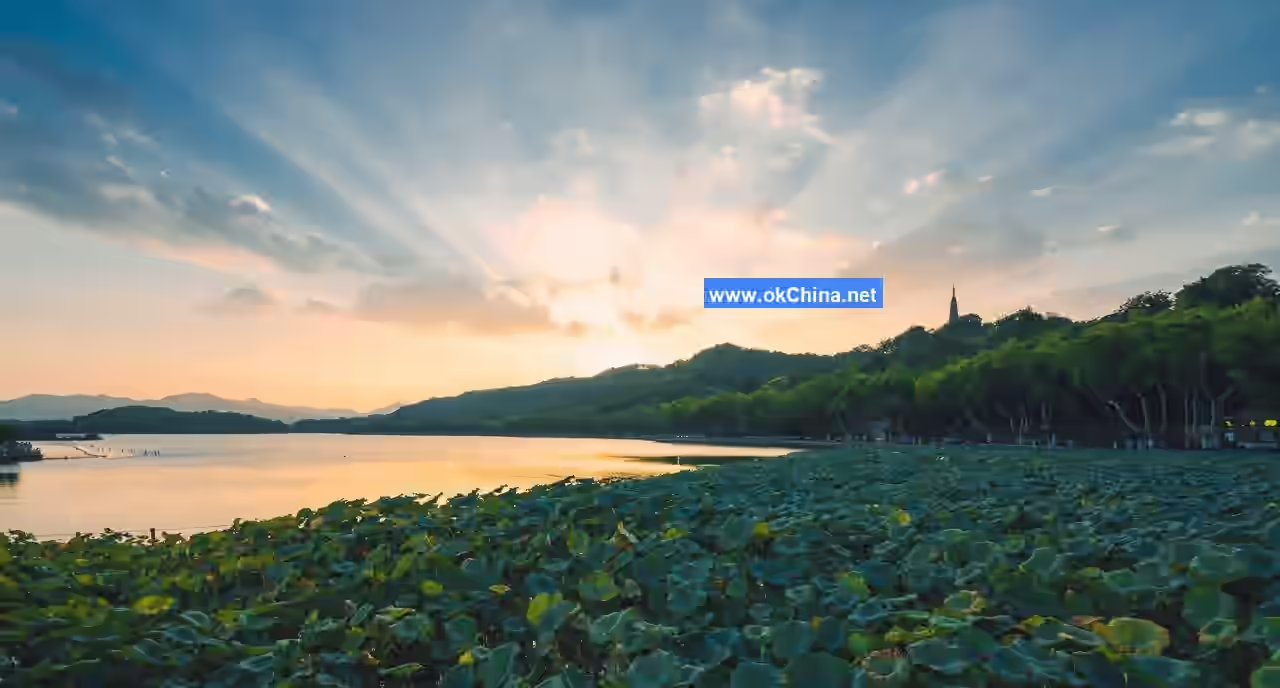
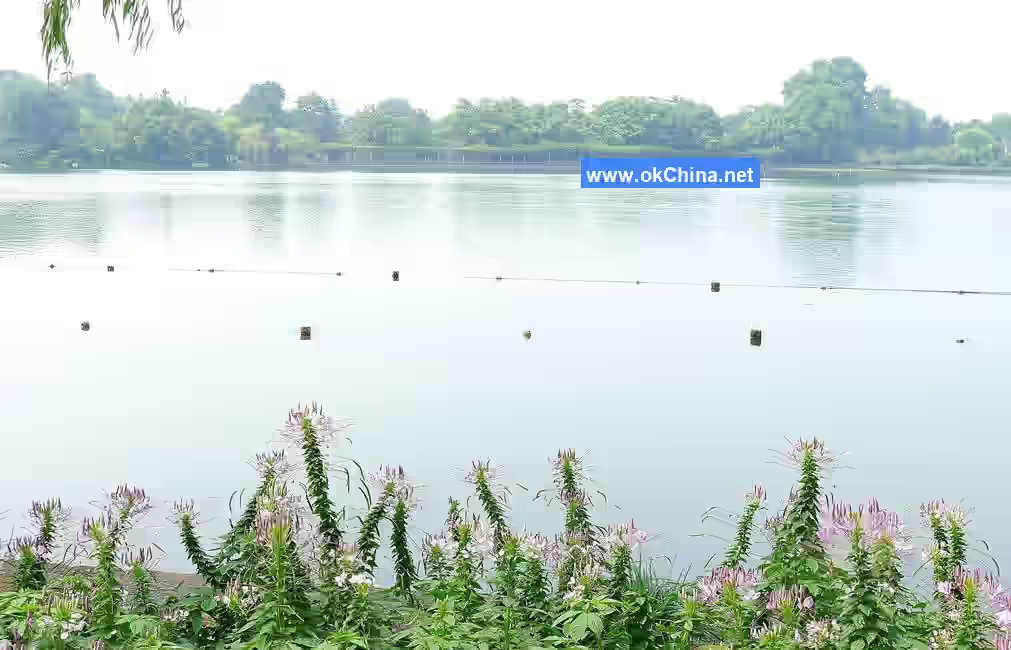
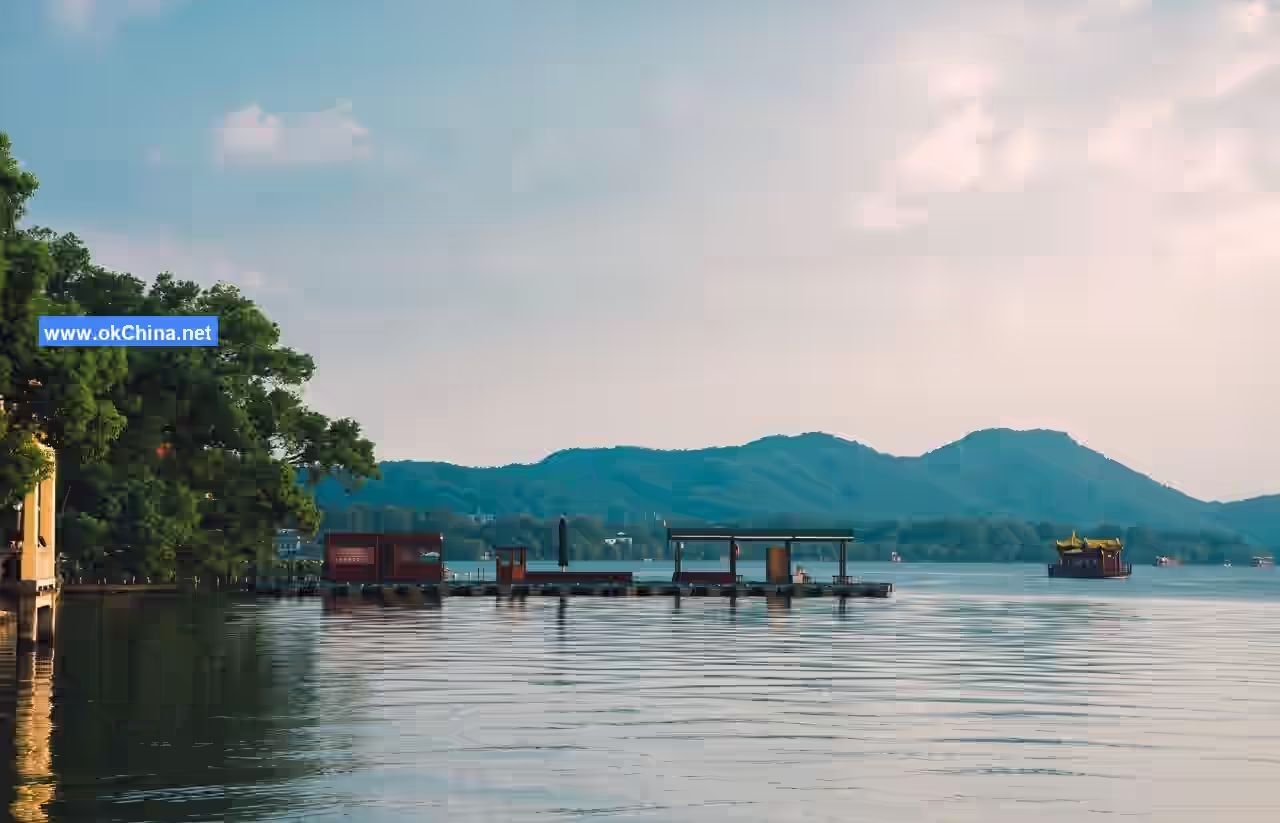
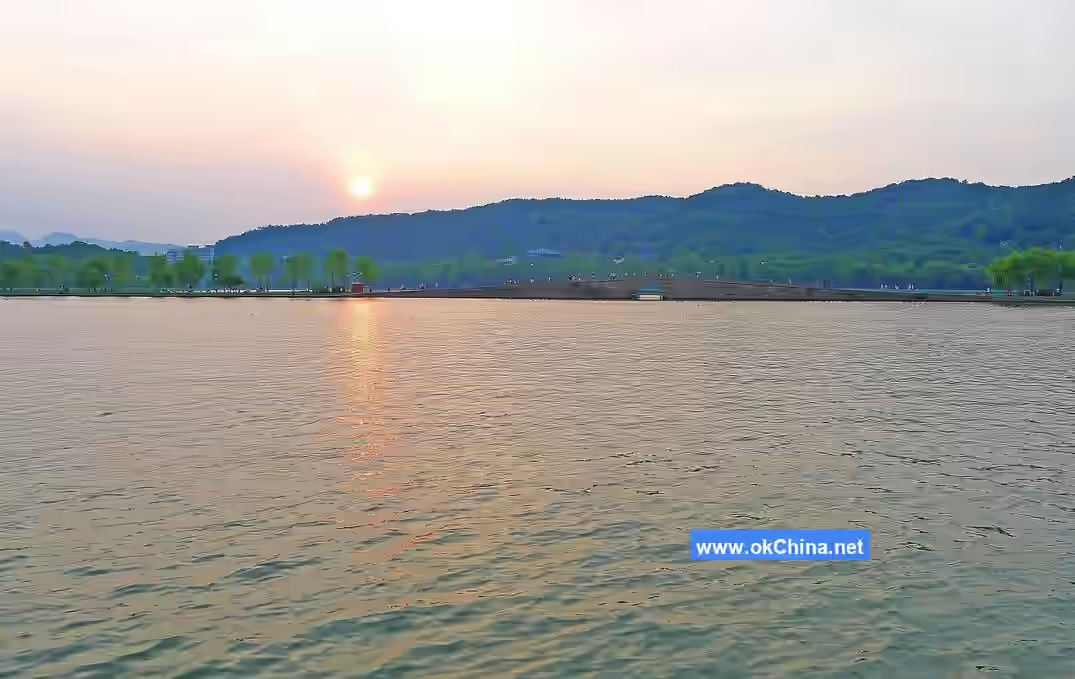
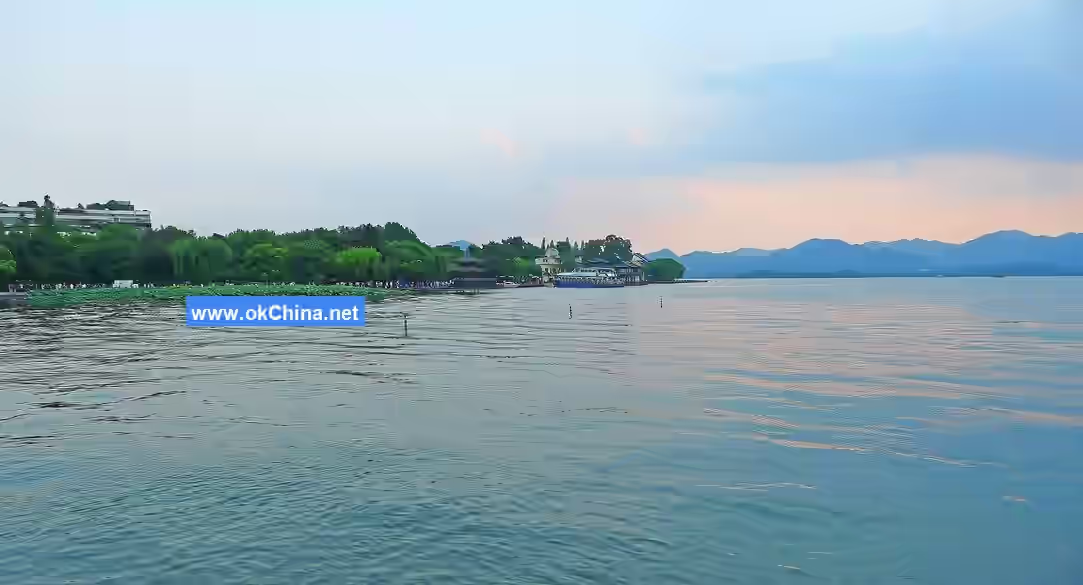
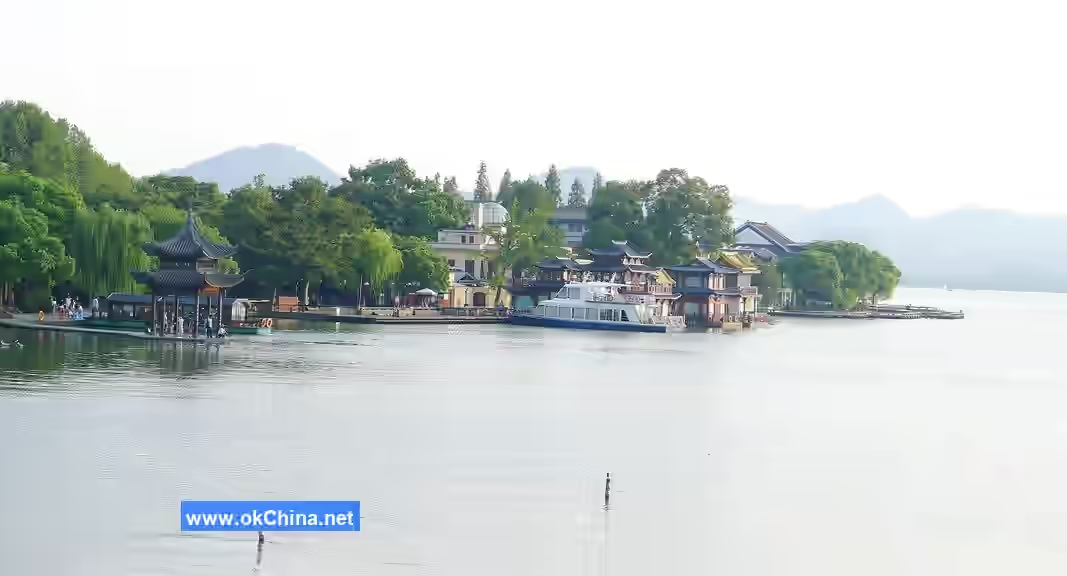
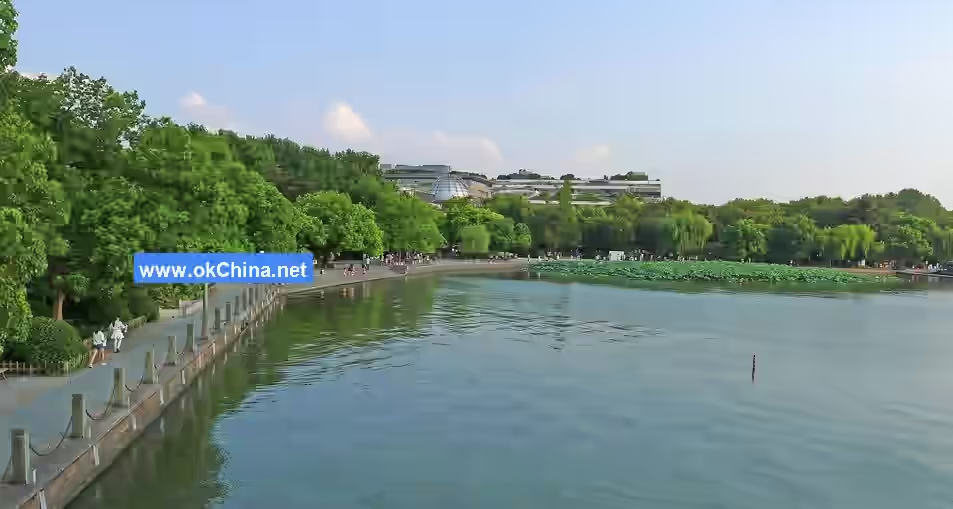
The Hangzhou West Lake Scenic Area (The West Lake) is located at No. 1 Longjing Road, Xihu District, Hangzhou City, Zhejiang Province, China. It has a catchment area of 21.22 square kilometers, a lake surface area of 6.38 square kilometers, and a total area of approximately 60 square kilometers. It is a natural and cultural landscape.
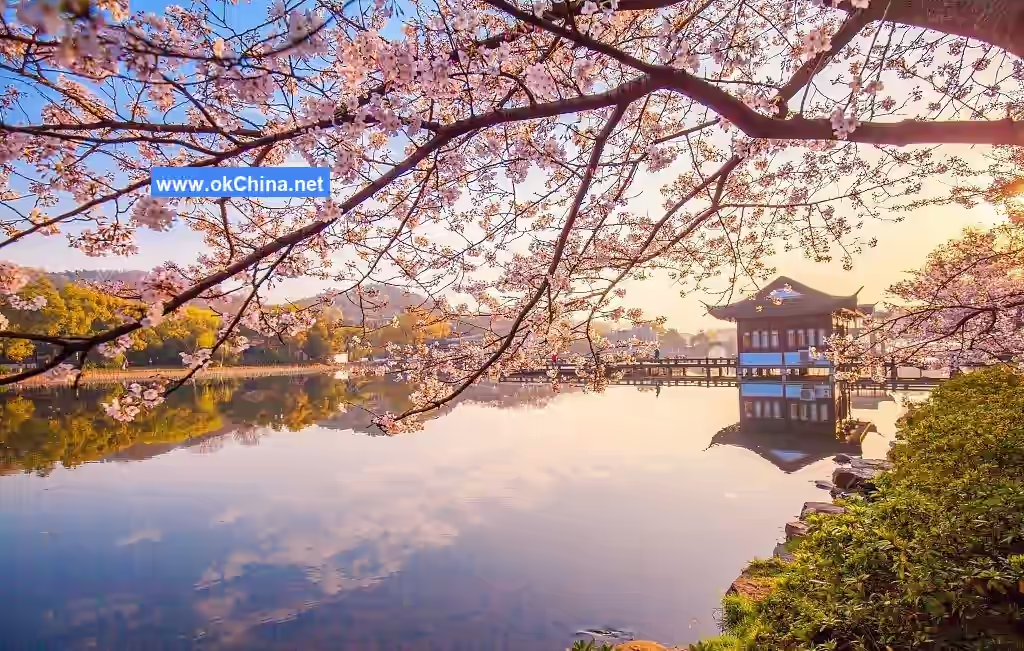
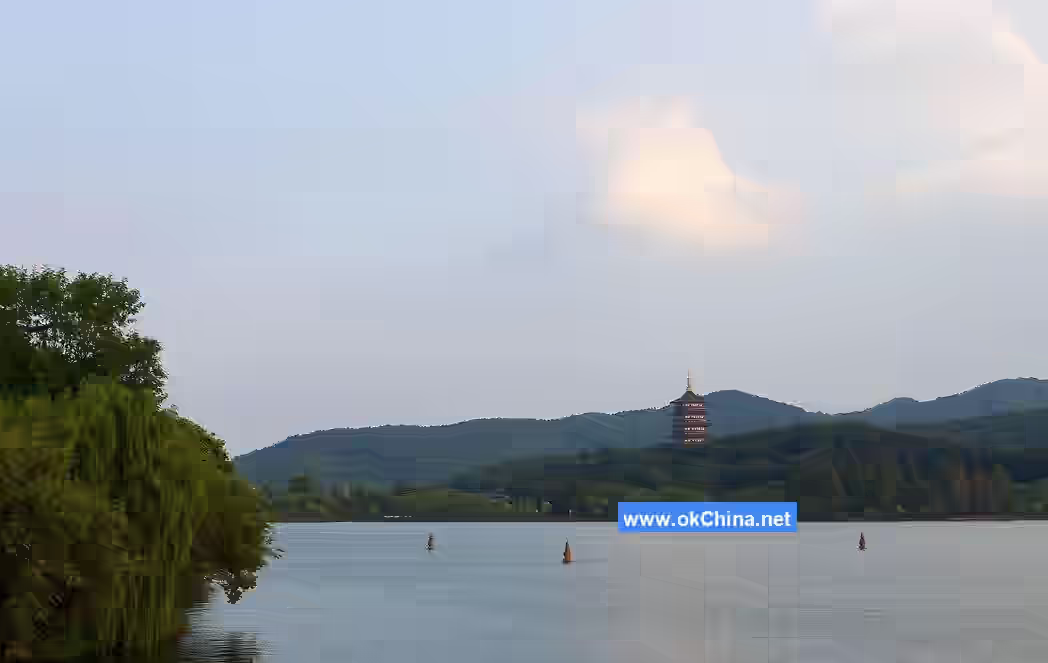
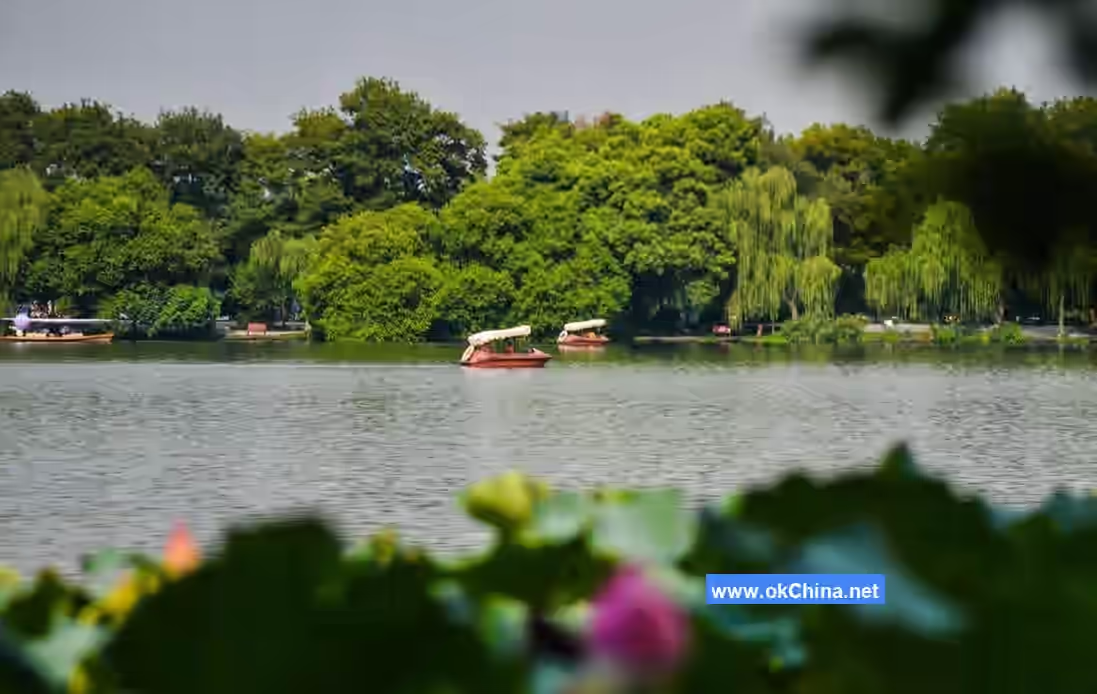
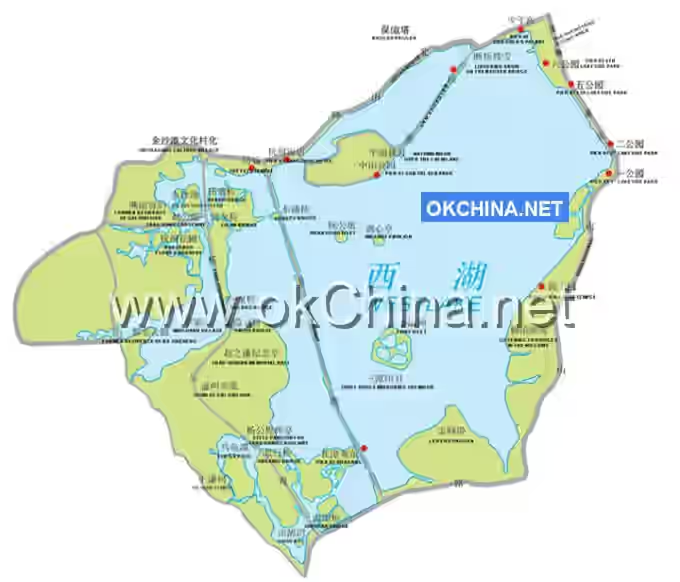
The outline of West Lake is nearly elliptical, with a relatively flat lake bottom. The average water depth of the lake is 2.27 meters. The lake is divided by Gushan (Solitary Hill), Baidi (Bai Causeway), and others into five water bodies, including Outer West Lake, Xili Lake, and Beili Lake. Xiaoyingzhou, Huxinting (Mid-Lake Pavilion), and Ruangongdun stand in the center of Outer West Lake. Leifeng Pagoda and Baochu Pagoda face each other across the lake, forming the basic pattern of "One Hill, Two Pagodas, Three Islands, Three Causeways, and Five Lakes." The scenic area has a subtropical monsoon climate, characterized by warm, humid conditions and abundant rainfall.
Over 2,000 years ago, silt accumulated between Wushan and Baoshi Mountain, forming a sand spit that later converged into a sandbar, creating an inner lake—West Lake. In the second year of the Changqing era of the Tang Dynasty (822 AD), Bai Juyi served as the prefect of Hangzhou and undertook water conservancy projects, dredging West Lake. During the late Northern Song Dynasty, Su Shi dredged West Lake and constructed the Su Causeway. In the late Yuan Dynasty, West Lake was neglected and gradually fell into disrepair. It was not until the Ming Dynasty that Hangzhou began to recover its prosperity. During the Republic of China period, the number of scenic spots and cultural relics around West Lake continuously increased. After the founding of the People's Republic of China, projects such as sewage interception around the lake were implemented to improve water quality. West Lake boasts over 100 scenic spots, with the most famous being the "Ten Scenes of West Lake," "New Ten Scenes of West Lake," and "Three Reviews: Ten Scenes of West Lake."
Throughout the development of West Lake's cultural landscape, literati such as Bai Juyi and Su Shi left behind numerous poems and verses. Local myths and legends, such as "The Legend of the White Snake" and "The Legend of Liang Shanbo and Zhu Yingtai," are also widely circulated. The cultural and historical sites within the scenic area bear witness to the development of Chinese traditions such as Buddhism, Taoism, and the tea-and-Zen culture that have been passed down to this day.
2. Historical Evolution
2.1 Naming
West Lake was originally called Wulin Water. The Book of Han: Treatise on Geography states: "Qiantang, governed by the Western Commandant. Wulin Mountain is the source of Wulin Water, which flows east into the sea, covering a distance of 830 li." West Lake has many alternative names. Legend has it that during the Han Dynasty, a golden ox appeared in the lake near present-day Yongjin Gate, so West Lake was anciently called Golden Ox Lake, also known as Mingsheng Lake. Because it belonged to Qiantang County, it was once called Qiantang Lake. By the Tang Dynasty, Li Bi constructed a stone sluice gate to discharge lake water, and for a time, it was also called Stone Sluice Lake. Bai Juyi dredged the lake and built a causeway, dividing the lake into upper and lower parts. The lower lake has since vanished, becoming part of the modern urban area, while West Lake is referred to as the upper lake. During the Song Dynasty, Wang Qinruo requested that West Lake be made a release pond, and a release stele was erected at the foot of Baoshi Mountain, giving West Lake the name Release Pond. In Su Shi's poem Drinking on the Lake, First in Sunny Weather, Then in Rain, there is the line: "I would like to compare West Lake to Lady Xizi, who looks beautiful whether lightly or heavily made up." Hence, West Lake is also called Xizi Lake. Southern Song scholar Lou Keyu compared West Lake to a virtuous person, giving it the name Virtuous Lake. The scholar Sun Yiyuan, who wore the attire of a noble recluse and lived in seclusion by the lake, also called West Lake the Noble Lake. Other names include Qian Water, Mingsheng Lake, Stone Sluice Lake, Lianyan Lake, Xiling Lake, and Longchuan. However, only two names have been universally recognized throughout history and appear in historical documents: one is Qiantang Lake, because Hangzhou was anciently named Qiantang; the other is West Lake, because the lake is located west of Hangzhou city. The earliest appearance of the name "West Lake" was in Bai Juyi's poems Returning Late from West Lake and Looking Back at Gushan Temple, Dedicated to My Guests and Returning by Boat to Hangzhou. After the Northern Song Dynasty, most literary works by famous writers used the name West Lake, and the name Qiantang Lake gradually became less known. Su Shi's Petition to Dredge Hangzhou West Lake was the first official document to use the name "West Lake."
2.2 Human Activities
Qin Dynasty Period
Over 2,000 years ago, West Lake was part of the Qiantang River. Due to silt accumulation, sand spits gradually formed at the foothills of the southern and northern mountains—Wushan and Baoshi Mountain. Eventually, these two sand spits converged to form a sandbar, creating an inner lake to the west of the sandbar, which is West Lake. This occurred approximately during the Qin and Han periods. Zhang Dai's Dreaming of West Lake records: "Dashi Temple, according to old history, when Qin Shi Huang traveled east to the sea, he moored his boat to this rock." This Dashi Temple is located at the foot of Baoshi Mountain on the north side of West Lake, and the site of "Qin Shi Huang's Mooring Rock" still exists.
Sui and Tang Dynasties Period
In the sixth year of the Daye era of the Sui Dynasty (610 AD), the Jiangnan Canal was excavated, connecting with the northern canal and linking the five major water systems of the north and south. During the Tang Dynasty, West Lake covered an area of about 10.8 square kilometers, nearly twice the size of the modern lake. The western and southern parts of the lake extended to the foot of the western hills, while the northeastern part reached the area around Wulin Gate. Pilgrims could boat to the foot of the hills and then walk up to worship. Due to the lack of water conservancy projects at the time, West Lake would sometimes flood during heavy rains and dry up during prolonged droughts. In the ninth month of the second year of the Jianzhong era (781 AD), Li Bi was transferred to serve as the prefect of Hangzhou. To address the issue of drinking water, he implemented a method of channeling water into the city. Specifically, he excavated six wells in the densely populated areas around Qiantang Gate and Yongjin Gate, using the method of "opening underground conduits" (i.e., burying tile pipes and bamboo tubes) to channel West Lake water into the city. Most of these six wells have since vanished, with only the site of Xiangguo Well remaining west of Jingting Bridge on Jiefang Road.
In the tenth month of the second year of the Changqing era (822 AD), Bai Juyi served as the prefect of Hangzhou. During his tenure, he undertook water conservancy projects, expanded stone sluices, dredged West Lake, built dams and sluice gates, increased the lake's water capacity, and solved irrigation problems for farmland between Qiantang (Hangzhou) and Yanguan (Haining). The causeway that Bai Juyi oversaw was actually located near Shihan Bridge outside Qiantang Gate and was called Bai Gongdi (Bai's Causeway), not the modern Baidi (Bai Causeway). Bai constructed a causeway outside Qiantang Gate, built a stone sluice gate to store lake water, and inscribed Record of the Qiantang Lake Sluice on a stone stele, detailing the function of the causeway and methods for water storage, discharge, and protection. Although the site of Bai Gongdi no longer exists, Bai Juyi left behind not only water conservancy projects that benefited later generations but also a large number of poems about West Lake. His most famous works include Spring Stroll by Qiantang Lake, Spring Inscription on the Lake, and Recalling Jiangnan.
Five Dynasties, Ten Kingdoms, and Song Dynasties Period
The most significant influences on West Lake in history were during the extremely prominent periods of the Wuyue Kingdom and the Southern Song Dynasty in Hangzhou's development. The comprehensive development and basic formation of West Lake occurred precisely during these two dynasties. During the Five Dynasties and Ten Kingdoms period, the Wuyue Kingdom (907–960 AD) made Hangzhou its capital. Because the successive kings of Wuyue were devout Buddhists, they constructed numerous temples, pagodas, sutra pillars, and grottoes around West Lake, expanded Lingyin Temple, founded Zhaoping Temple, Jingci Temple, Li'an Temple, Liutong Temple, and Taoguang Nunnery, and built Baochu Pagoda, Liuhe Pagoda, Leifeng Pagoda, and White Pagoda, earning the area the nickname "Buddhist Kingdom." Lingyin Temple, Tianzhu Temple, and other monasteries, as well as watching the Qiantang River tidal bore, were popular tourist attractions at the time. Due to the geological conditions of West Lake, silt accumulated rapidly, making dredging a routine maintenance task. Therefore, King Qian Liu of Wuyue established a thousand-strong lake-dredging army in the second year of the Baozheng era (927 AD) to clear weeds and dredge springs, ensuring the preservation of West Lake's water body.
During the late Northern Song Dynasty, the poet Su Shi made significant contributions to the management of West Lake. From the Five Dynasties to the late Northern Song Dynasty, West Lake was left unattended for many years, with water chestnut grass clogging and occupying half of the lake's surface. In the fifth year of the Yuanyou era (1090 AD), Su Shi submitted Petition to Dredge Hangzhou West Lake to Emperor Zhezong of Song, asserting: "Hangzhou having West Lake is like a person having eyebrows and eyes; it cannot be abandoned." In the fourth month of the same year, he mobilized 200,000 laborers to dredge West Lake, using the excavated water chestnut grass and silt to construct a 2.8-kilometer-long causeway running north-south across the lake. He built six stone arch bridges on the causeway, dividing the lake into eastern and western parts and connecting the southern and northern hills. Later generations commemorated him by naming this long causeway "Su Causeway."
In 1127, after the Southern Song Dynasty established its capital in Lin'an, Hangzhou became the national political, economic, and cultural center. The population surged, and the economy flourished. In addition to pilgrims, tourists to Hangzhou now included envoys, merchants, monks from various countries, scholars traveling to the capital for imperial examinations, and domestic merchants coming to Hangzhou for trade. The scenic spots of West Lake began to gain widespread fame. At that time, boating tours on West Lake were extremely popular. According to ancient records, "there were no fewer than several hundred boats of various sizes on the lake," all "exquisitely crafted with carved railings and painted arches, moving as if on flat ground."
Yuan, Ming, and Qing Dynasties Period
During the Yuan Dynasty, West Lake remained a place of revelry. According to History of Yuan, Volume 23, in the second year of the Zhida era (1309 AD), "at the Jiangzhe Hangzhou post station, within half a year, over 1,200 envoys passed through, including Sangwu and Baoheding, who presented lions, leopards, crows, and falcons, staying for twenty-seven days, with people and livestock consuming over 1,300 jin of meat." Merchants and travelers from Western Regions and European countries increasingly visited Hangzhou. The most famous among them was the Italian traveler Marco Polo. In the late Yuan Dynasty, following the Southern Song's "Ten Scenes of West Lake," there emerged the "Ten Scenes of Qiantang," expanding the scope of tourism compared to the Song Dynasty. During the Zhiyuan era of Emperor Shizu of Yuan, West Lake was once dredged and used as a release pond, but parts of the lake gradually became overgrown with water chestnut grass and turned into mulberry fields. However, by the late Yuan Dynasty, West Lake was neglected in management, with wealthy nobles reclaiming land along the lake, causing West Lake to gradually become desolate, with most of the lake surface silted up into fields of wild rice and lotus ponds.Until the Xuande and Zhengtong periods of the Ming Dynasty (1426–1449), Hangzhou began to recover its prosperity, and local officials also started to pay attention to West Lake. In the 16th year of the Hongzhi era (some sources say the 3rd year of the Zhengde era, i.e., 1508), Prefect Yang Mengying, overcoming significant resistance from wealthy elites and with the support of Censor-in-Chief Che Liang, petitioned to dredge West Lake, with funding allocated by the Ministry of Works. According to Volume 1 of the Ming Dynasty’s Records of West Lake Sightseeing: "Work commenced in February of that year... employing laborers for 152 days, with 6.7 million man-days of work, costing 23,607 taels of silver, and demolishing 3,481 mu of farmland and marshes... From then on, West Lake was restored to its former state from the Tang and Song dynasties." The dredging project expanded the water surface west of Su Causeway to areas like Hongchun Bridge and Maojiabu. The silt dredged from the lake was used not only to widen Su Causeway but also to construct a long causeway in the western part of the inner lake, later named Yanggong Causeway. In the 35th year of the Wanli era (1607), Qiantang County Magistrate Nie Xintang built a circular causeway from south to west around the release pond on the islet of Xiaoyingzhou in the lake, creating a unique landscape. In the 39th year, Yang Wanli continued to build an outer embankment, and by the 48th year, the layout was perfected. Three small stone pagodas were erected outside the pond, known as the Three Pools Mirroring the Moon.
During the Qing Dynasty, the multiple southern tours of Emperors Kangxi and Qianlong to Hangzhou promoted the restoration and construction of West Lake. Kangxi visited Hangzhou five times and inscribed calligraphy for the "Ten Scenes of West Lake," which had formed during the Southern Song Dynasty. Local officials built pavilions and erected steles for these inscriptions, giving fixed viewing locations to previously unspecified scenes such as "Twin Peaks Piercing the Clouds" and "Autumn Moon over the Calm Lake." During the Yongzheng era, the "Eighteen Scenes of West Lake" were introduced, further expanding Hangzhou’s tourism scope. Qianlong visited Hangzhou six times, composing poems and engraving them on stone for the "Ten Scenes of West Lake." He also inscribed the "Eight Scenes of Longjing," drawing attention to the scenic Longjing area in the remote mountains. During the Qianlong era, Hangzhou natives Zhai Hao and Zhai Han co-authored the book A Guide to Lakes and Mountains, which recorded 1,016 scenic spots around West Lake.
During the Ming and Qing dynasties, West Lake underwent several dredging projects, with the excavated silt used to create two islands in the lake: Mid-Lake Pavilion and Xiaoyingzhou. During the Yongzheng era, West Lake covered an area of 7.54 square kilometers, but over 20 hectares were overgrown with weeds. After large-scale dredging, the lake expanded to areas west of the modern West Lake Road, including Hongchun Bridge, Maojiabu, Wuguitan, and Chishanbu. In the 5th year of Yongzheng (1727), Zhejiang Governor Li Wei spent 42,742 taels of silver to dredge the lake channels, constructing stone weirs at Jinshagang, Chishanbu, Dingjiashan, and Maojiabu to regulate the flow of sand and water into the lake. In the 5th year of Jiaqing (1800), Zhejiang Governor Yan Jian proposed dredging West Lake for water conservancy, later overseen by Governor Ruan Yuan, who used the excavated silt to build a mound (known as Ruan Gong Mound). By this time, the modern outline of West Lake had taken shape. In the 3rd year of Tongzhi (1864), the West Lake Dredging Bureau was established, with Qiantang native Ding Bing appointed as its head.
Republican Era
During the Republican era, the number of scenic spots and cultural relics around West Lake continued to increase. The government converted the imperial garden of the Qing Dynasty’s temporary palace on Gushan into a public park. Hangzhou’s park construction began with the Lakeside Park. In the first year of the Republic (1912), the Zhejiang Military Government demolished the city walls from Qiantang Gate to Yongjin Gate and the barracks walls, constructing Lakeside Road along the lake. A railing was installed 20 meters from the lake, and flowers and trees were planted extensively, creating the Lakeside Park. The approximately one-mile-long Lakeside Park was divided into Parks 1 to 5. In the 6th year of the Republic (1917), the Great Compassion Pavilion of Lingyin Temple was renovated, and the Yue Fei Temple and Tomb underwent several restorations. On August 29–30, 1922, the Chinese Communist Party held a special meeting at West Lake, deciding conditionally to allow Communist Party members to join the Chinese Nationalist Party as individuals, promoting the first Kuomintang-Communist cooperation, historically known as the "West Lake Conference."
From 1923 to 1924, the dilapidated King Qian Temple was restored, and a garden was constructed. On September 25, 1924, the nearly thousand-year-old Leifeng Pagoda collapsed due to long-term looting of its foundation. In 1927, the park was renamed Zhongshan Park, with its left side converted into the Zhejiang Martyrs’ Shrine to honor Zhejiang soldiers who died in the capture of Nanjing. Tombs for martyrs such as Xu Xilin and Qiu Jin were also built near Xiling Bridge. From 1923 to 1930, Huanglong Cave was renovated. From 1928 to 1933, the Zhejiang Provincial Government erected statues and monuments, including the "Statue of Chen Yingshi" at the Third Park Pier, the "Memorial Tower for Northern Expedition Martyrs" at the Second Park Pier, and the "Monument for the 88th Division Martyrs of the Battle of Shanghai" at the Fifth Park Pier.
From June 6 to October 20, 1929, the Zhejiang Provincial Government held the first West Lake Expo, attracting over 20 million visitors. The expo was held in lakeside areas such as Broken Bridge, Gushan, Yue Fei Temple, and Beishan, aiming to promote domestic goods and encourage industry. In addition to over a thousand domestic delegations, groups from the United States, Japan, the United Kingdom, and Indonesia also attended. In the spring of 1930, the Hangzhou Municipal Government used silt from lake dredging to fill and level land north of Changsheng Road to Qiantang Gate, covering about 21 mu, and opened it as the Sixth Park. In 1932, the leaning Baochu Pagoda was repaired and reinforced. In late March 1937, Chiang Kai-shek and Zhou Enlai held secret talks at Yanxia Cave near West Lake to discuss establishing an anti-Japanese national united front, laying the foundation for the second Kuomintang-Communist cooperation, historically known as the "West Lake Talks."
After the Founding of the People's Republic of China
After the founding of the People's Republic of China, the beautiful scenery of Hangzhou's West Lake gained favor from the country's top leaders. Among these, the most notable were Liu Zhuang (now the West Lake State Guesthouse), where Mao Zedong often stayed, Wang Zhuang (now the Xizi State Guesthouse), and the 704 Project built by Lin Biao (now the Zhejiang Hotel). In December 1953, Mao Zedong presided over the drafting of the first Constitution of the People's Republic of China at Liu Zhuang (some say Wang Zhuang) by West Lake in Hangzhou. In late February 1972, U.S. President Richard Nixon and Zhou Enlai initialed the Shanghai Communiqué in the Octagonal Pavilion at Liu Zhuang, a milestone in Sino-U.S. diplomatic history.
From 1978 to 1985, West Lake underwent a lakeside sewage interception project and a water diversion project, improving the water quality of the lake. After the Cultural Revolution, the number of tourists visiting West Lake increased rapidly. In 1982, West Lake was selected as one of the first batch of national key scenic areas. In 1984, five organizations, including the Hangzhou Daily, initiated a selection for the New Ten Scenes of West Lake. In September of the same year, the General Office of the State Council stated: "Build Hangzhou into a tourism center in southeastern China and a first-class international scenic tourism city." Subsequently, the Hangzhou government restored historical sites such as Lingyin Temple, Tianzhu Temple, Jingci Temple, Yue Fei Temple, Dacheng Hall, and the "Ten Scenes of West Lake" stele pavilions, expanded attractions like Hupao Spring, built new parks such as Lotus in the Breeze at Quyuan Garden, opened the "Lingfeng Plum Blossom" scenic spot, launched antique-themed recreational activities at Huanglong Cave and Ruan Gong Mound, and organized night garden and music night market activities.
In 1985, West Lake was selected as one of China's Top Ten Scenic Spots. In 2000, the West Lake Expo was held again by the lakeside. The New West Lake Expo (officially named the "China Hangzhou West Lake International Expo") attracted 1.4 million domestic and international visitors, generating tourism revenue of 1.12 billion RMB. Since then, the West Lake Expo has been established as an annual large-scale conference and exhibition event in Hangzhou.
Starting from National Day in 2004, Hangzhou Flower Nursery, Lotus in the Breeze at Quyuan Garden, and Viewing Fish at Flower Pond Park were opened free of charge to tourists and citizens. Together with the four major parks on the southern line opened in 2002, the West Lake shoreline became a large open park. On March 20, 2009, Prince Bay Park was opened free to tourists. On June 24, 2011, at the 35th UNESCO World Heritage Committee meeting in Paris, the "West Lake Cultural Landscape of Hangzhou" was officially inscribed on the World Heritage List. From mid-January 2014, the Hangzhou Municipal Government began special actions to close and rectify high-end clubs and service venues, including those in the West Lake scenic area.
3. Geographical Layout
3.1 Location and Boundaries
The West Lake Scenic Area is located at No. 1 Longjing Road, Xihu District, Hangzhou City, Zhejiang Province, in the western part of Hangzhou's urban area, covering an area of approximately 60 square kilometers, with a lake surface area of 6.38 square kilometers.
The West Lake Scenic Area extends east from Songmuchang and Baolu Road turning to the north of Shaonian Gong Square in Hangzhou's urban area, passing through Baisha Road, Huancheng West Road, Hubin Road, and Nanshan Road to the south of Wansongling, including all attractions of Wushan, Ziyangshan, and Yunju Mountain. To the south, it runs from Gulou along the eastern foothills of Wushan, Ziyangshan, and Yunju Mountain, passing through Fengshanmen along Fenghuangshan Road to Tianhuashan, then along the West Lake water diversion channel to the north bank of the Qiantang River, turning to the north of Liufangling via the Coral Sand Reservoir. To the west, it extends from Liufangling, Zhuganshan, Jiuquling, and Mingrenling to the east of the ridge line of Meiren Peak, Beigaofeng, Lingfeng Mountain, and Laoheshan. To the north, it runs from the foothills of Laoheshan (west wall of Zhejiang University), turning 30 meters north of Qingzhiwu Road, connecting Yugu Road, Zhejiang University Road, and Shuguang Road to the south of Songmuchang.
3.2 Topography and Geomorphology
3.2.1 Topography
West Lake is surrounded by mountains to the south, west, and north, with higher elevations in the west and central areas. The mountain ridges form a horizontal T-shape, belonging to the Tianmu Mountain range, mostly consisting of hills below 300 meters in elevation. The northern and southern areas are plains. The lake surface is divided by Bai Causeway, Su Causeway, Yanggong Causeway, and Zhao Gong Causeway. The outline of West Lake is nearly elliptical, with a relatively flat lake bottom. The average depth of the lake is 2.27 meters, with a maximum depth of about 5 meters and a minimum depth of less than 1 meter.
3.2.2 ClimateThe West Lake Scenic Area in Hangzhou is characterized by a subtropical monsoon climate, featuring warm and humid conditions, distinct seasons, ample sunlight, abundant rainfall, a well-coordinated high-temperature period with the rainy season, and pronounced seasonal wind shifts. In summer, southerly winds prevail, while in winter, northerly winds are more common. Throughout the year, the alternation of winter and summer monsoons brings significant seasonal changes in cloud cover and weather patterns, resulting in a climate marked by rainy springs, hot and humid summers, crisp autumns, and dry, cold winters.
The West Lake Scenic Area enjoys ample sunshine, plentiful rainfall, warm and humid temperatures, and clearly defined seasons. Winters and summers are long, while springs and autumns are short. In winter, cold Siberian air masses frequently invade the area, often bringing rain or snow before and after their arrival, with clear weather prevailing during their dominance and winds generally blowing from the northwest. Local topography influences microclimates, leading to some variations. Spring sees abundant and prolonged rainfall. In early summer, the confrontation between cold and warm air masses results in the persistent "Plum Rain." By midsummer, the area comes under the influence of the Pacific subtropical high-pressure system, leading to drier weather. The annual average temperature is 16.2°C, with summer averaging 28.6°C and winter averaging 3.8°C. The frost-free period lasts 230–260 days. The average annual rainfall is 1,435 mm, with an average relative humidity of 76%.
3.2.3 Hydrology
West Lake has a catchment area of 21.22 square kilometers, an annual runoff of 14 million cubic meters, and a storage capacity of nearly 14 million cubic meters, with a natural water exchange rate of once per year. The lake's natural surface water sources are four streams: Jinsha Stream, Longhong Stream, Chishui Spring, and Changqiao Stream. The lake's water system has a flushing coefficient of 1.49. During the dry season, when sluice gates are closed, the flow velocity is nearly zero. Even during flood periods, the flow velocity generally remains below 0.05 meters per second. West Lake draws water from the Qiantang River, with an annual intake of approximately 120 million cubic meters.
3.2.4 Water Conservancy
In 1986, Hangzhou completed the West Lake Water Diversion Project, significantly improving the lake's water quality. In 2003, the West Lake Water Distribution Project was constructed, consisting mainly of two water pretreatment plants and a pipeline network. The project uses sedimentation methods to treat water drawn from the Qiantang River. The Yuhuang Pretreatment Plant, located south of Yuhuang Mountain, treats 300,000 cubic meters of Qiantang River water daily, which is then channeled into West Lake via Prince Bay Park and Huagang Xiaonan Lake. The Chishanbu Pretreatment Plant, located at Chishanbu, treats 100,000 cubic meters of Qiantang River water daily, which is directed into the newly expanded western area of West Lake via Yanggong Causeway (formerly Xishan Road). After the project's completion, 400,000 cubic meters of pretreated Qiantang River water, with a transparency of 1.2 meters, flows into West Lake daily.
3.3 Biodiversity
3.3.1 Fauna
As of 2024, the West Lake Scenic Area is home to 27 species of large benthic invertebrates, 36 species of fish, 26 species of amphibians, 56 species of reptiles, 144 species of birds, and 33 species of mammals. As of June 2020, the area hosts over 20 species of mammals, and the lake surface alone supports 38 species of waterfowl. Areas such as Dingjiashan and Wuguishan serve as habitats for egrets, with a population exceeding 20,000.
3.3.2 Flora
As of 2011, the West Lake Scenic Area contains 1,369 species of seed plants from 184 families and 739 genera, including 28 species of gymnosperms from 7 families and 19 genera, 1,272 species of angiosperms from 150 families and 675 genera, and 68 species of ferns from 27 families and 45 genera. The area around West Lake is rich in ancient and famous trees, many of which are closely associated with religious temples, primarily distributed around Lingyin, Tianzhu, Wushan, and Gushan. There are 125 ancient and famous trees over 300 years old, including 69 camphor trees, 11 sweetgum trees, 2 evergreen chinquapin trees, 13 ginkgo trees, and 22 other species such as catalpa, hackberry, juniper, sandpaper tree, wintersweet, mountain ash, and pistachio.
3.4 Layout and Orientation
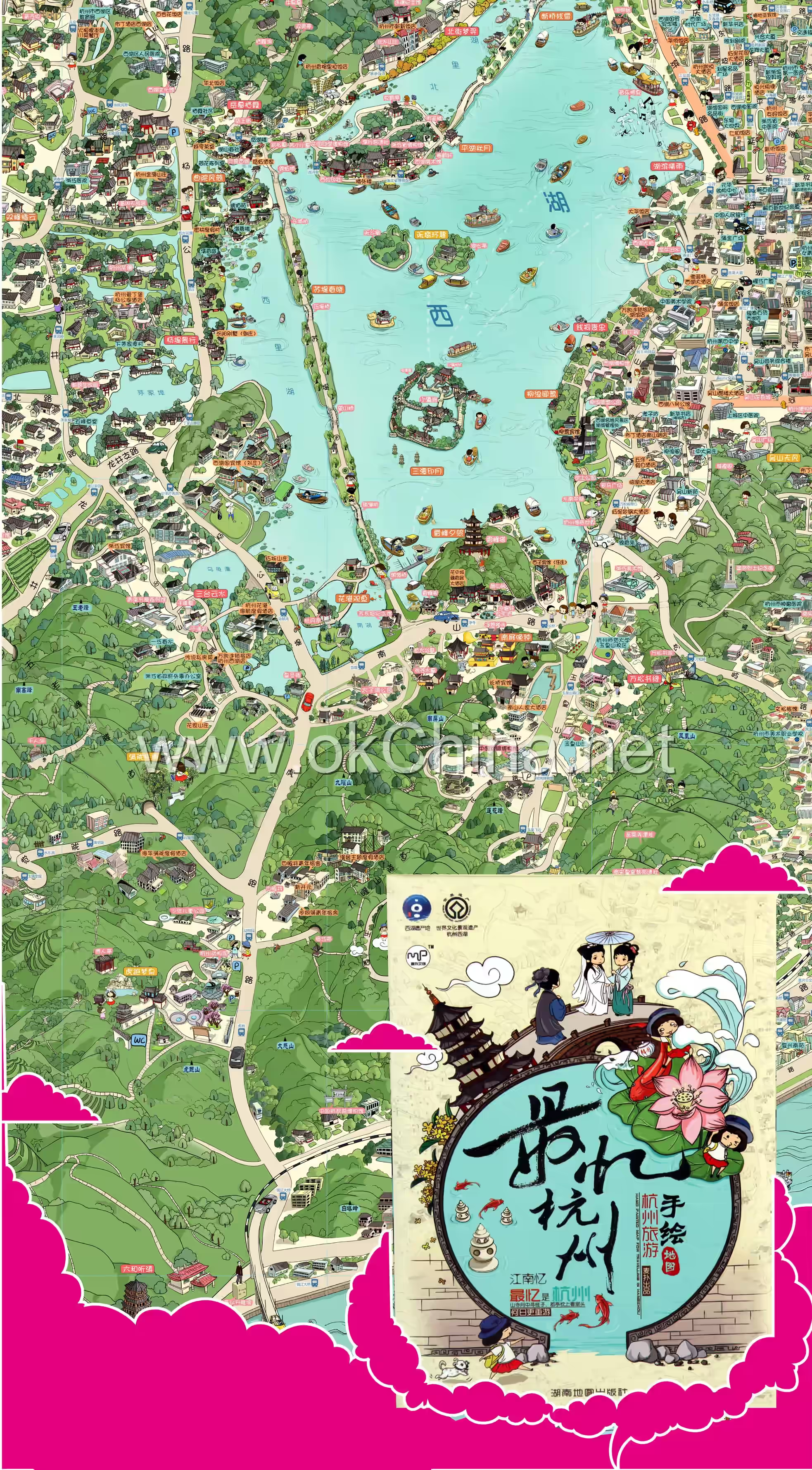
The West Lake Scenic Area in Hangzhou boasts over 100 attractions, with the "Ten Scenes of West Lake," "New Ten Scenes of West Lake," and "Three Reviews: Ten Scenes of West Lake" being the most famous. West Lake is divided by Gushan, Bai Causeway, Su Causeway, and Yanggong Causeway into five water bodies of varying sizes: Outer West Lake, West Inner Lake, North Inner Lake, Little South Lake, and Yue Lake. Su Causeway and Bai Causeway traverse the lake, while three small islands—Xiaoyingzhou, Mid-Lake Pavilion, and Ruangongdun—stand in the center of Outer West Lake. Leifeng Pagoda on Sunset Hill and Baochu Pagoda on Precious Stone Hill face each other across the lake, forming the basic layout of "one hill, two pagodas, three islands, three causeways, and five lakes."
4. Major Attractions: Ten Scenes of West Lake
4.1 Spring Dawn at Su Causeway
Su Causeway stretches nearly three kilometers from the foot of Nanping Hill in the south to the base of Qixia Ridge in the north. It was constructed during the Northern Song Dynasty by the poet Su Dongpo, who served as the prefect of Hangzhou, using silt dredged from West Lake. Later generations named it Su Causeway in honor of his contributions to the lake's management. The long causeway spans the water, connecting the southern and northern hills. During the Southern Song Dynasty, Spring Dawn at Su Causeway was listed as the foremost of the Ten Scenes of West Lake. In the Yuan Dynasty, it was also known as "Six Bridges in Misty Willows" and included among the Ten Scenes of Qiantang. The causeway extends with six undulating arch bridges, named from south to north: Yingbo, Suolan, Wangshan, Yadi, Dongpu, and Kuahong. Yadi Bridge is located approximately at the golden section of the causeway and historically served as a passage for boats traveling east-west on the lake. The "Spring Dawn at Su Causeway" monument pavilion is situated south of the bridge and is one of the best spots on the lake for viewing the sunrise.
4.2 Breeze-Ruffled Lotus at Quyuan Garden
Located in the northwest corner of West Lake, Breeze-Ruffled Lotus at Quyuan Garden is renowned for its lake and lotus scenery. Historical records indicate that during the Song Dynasty, there was an official winery near Hongchun Bridge. In summer, the breeze carried the fragrance of lotus and wine, earning the area the name "Quyuan Lotus Breeze." In the Qing Dynasty, the winery closed, and Emperor Kangxi, while touring the lake, changed "Qu" to "Qu" and "Lotus Breeze" to "Breeze-Ruffled Lotus." The scenic area underwent extensive expansion, becoming a large garden spanning over 420 acres, themed around lotus and wine culture. The garden is divided into five sections: Yue Lake, Zhusu Garden, Wind Lotus, Quyuan, and Lakeside Dense Forest. The layout of pavilions, terraces, towers, and waterside pavilions is elegant, with lotus ponds covering about 38 acres, featuring rare and precious varieties such as red lotus, white lotus, double-petaled lotus, golden-spotted lotus, and twin lotus.
4.3 Autumn Moon Over the Calm Lake
Autumn Moon Over the Calm Lake is one of the Ten Scenes of West Lake. During the Southern Song Dynasty, it had no fixed location. The modern viewing spot is at the western end of Bai Causeway, backed by Gushan and facing Outer West Lake. A Lake-Viewing Pavilion was built in the Tang Dynasty, and a Dragon King Temple was added in the Ming Dynasty. During the reign of Emperor Kangxi in the Qing Dynasty, it was named Autumn Moon Over the Calm Lake. On clear autumn days, the lake is as calm as a mirror, and the bright autumn moon shines in the sky, with moonlight and lake water reflecting each other. A stone tablet inscribed with "Autumn Moon Over the Calm Lake" was erected by the lakeside.
4.4 Lingering Snow on the Broken Bridge
The Broken Bridge is located at the eastern end of Bai Causeway. It was built as early as the Tang Dynasty, as mentioned in Zhang Hu's poem "Inscribed at Gushan Temple in Hangzhou." The bridge was reconstructed in 1921, measuring 8.8 meters long, 8.6 meters wide, with a single arch spanning 6.1 meters. The current bridge was renovated in 1941 and further refined in the 1950s. Nearby are the "Cloud and Water Light" waterside pavilion and the Lingering Snow on the Broken Bridge monument pavilion. The interpretation of the scene varies, but it generally refers to the sight after a winter snowfall when the snow on the sunny side of the bridge melts, while the shaded side retains silvery residual snow. Viewed from a distance, the bridge appears broken yet unbroken, making it an excellent spot for appreciating West Lake's snow scenery. Legend has it that the Broken Bridge is where Lady White Snake and Xu Xian pledged their love.
4.5 Viewing Fish at Flower Pond
Viewing Fish at Flower Pond is located in the southwest corner of West Lake, adjacent to Su Causeway to the east and bordering Little South Lake to the south and West Inner Lake to the north. A small stream from the foot of Huajia Mountain flows into West Lake here. Because flowers and trees were planted along the stream, fallen petals often drifted into the water, giving it the name "Flower Harbor." During the Southern Song Dynasty, the eunuch Lu Yunsheng built a private garden not far away at the foot of Huajia Mountain. The garden was lush with plants, and a pond was dug to raise colorful fish for enjoyment, gradually attracting visitors. It was called Lu Garden and also named Flower Harbor due to its proximity to Huajia Mountain. When court painters created the series of paintings for the Ten Scenes of West Lake, this scene was included. In 1699, during the Qing Dynasty, Emperor Kangxi visited West Lake and inscribed "Viewing Fish at Flower Pond" on a stone tablet erected by the fish pond. Later, Emperor Qianlong visited West Lake during his southern tour and composed a poem inscribed on the back of the tablet, which includes the lines: "At the foot of Huajia Mountain flows Flower Harbor, where flowers adorn the fish and fish nibble the flowers." Today, Viewing Fish at Flower Pond is a large park covering over 20 hectares, divided into five sections: Red Fish Pond, Peony Garden, Flower Harbor, Large Lawn, and Dense Forest.
4.6 Orioles Singing in the Willows
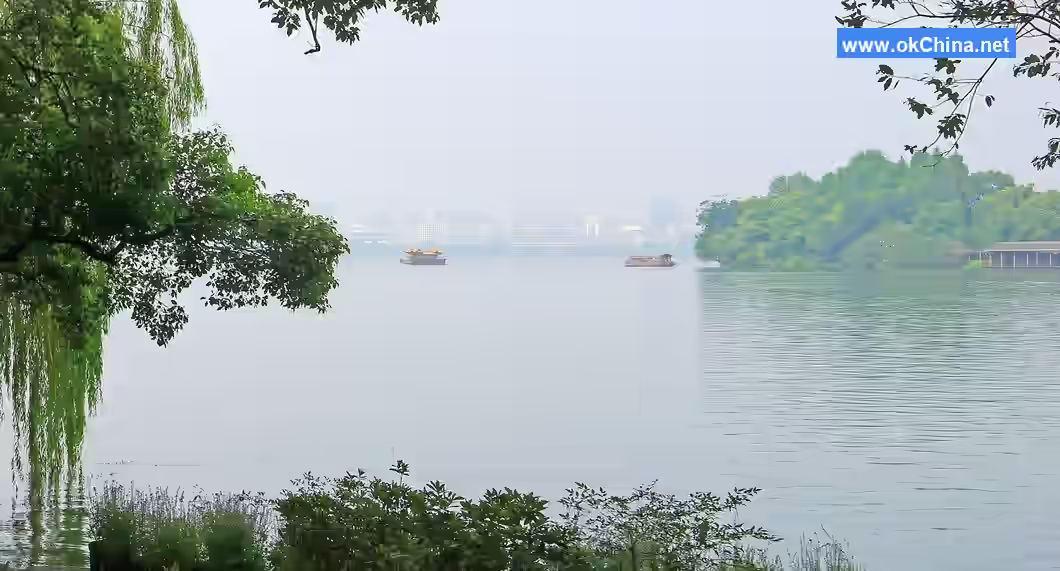
Orioles Singing in the Willows is located on the southeastern shore of West Lake, at Qingbo Gate. During the Southern Song Dynasty, it was an imperial garden called Gathering Scenery Garden. The Qing Dynasty restored the scene of Orioles Singing in the Willows. It is now a large park covering 17 hectares, divided into four sections: Friendship, Oriole Singing, Gathering Scenery, and South Garden. The park's landscape is defined by verdant willows and melodious oriole songs. Along the kilometer-long lakeside embankment and main paths, weeping willows and distinctive varieties such as lion willows, drunken willows, and washing willows are planted. In the central section, the Oriole Singing Pavilion was built, and not far from it, a large aviary called "Hundred Birds Paradise" was installed. The former Qianwang Temple in the northern part of the park was renovated into a Jiangnan-style private garden, with courtyards and scenic areas, retaining the old name "Gathering Scenery Garden." The southeastern part of the park is designated for public recreational activities, featuring an open-air stage, making it a popular spot for Hangzhou residents and tourists for morning exercises, holiday leisure, and festive celebrations. The willows in Orioles Singing in the Willows are distinctive: some with swaying tendrils resembling a tipsy imperial concubine, called "drunken willows"; others with dense foliage like a lion's head, called "lion willows"—hence the name "Orioles Singing in the Willows."
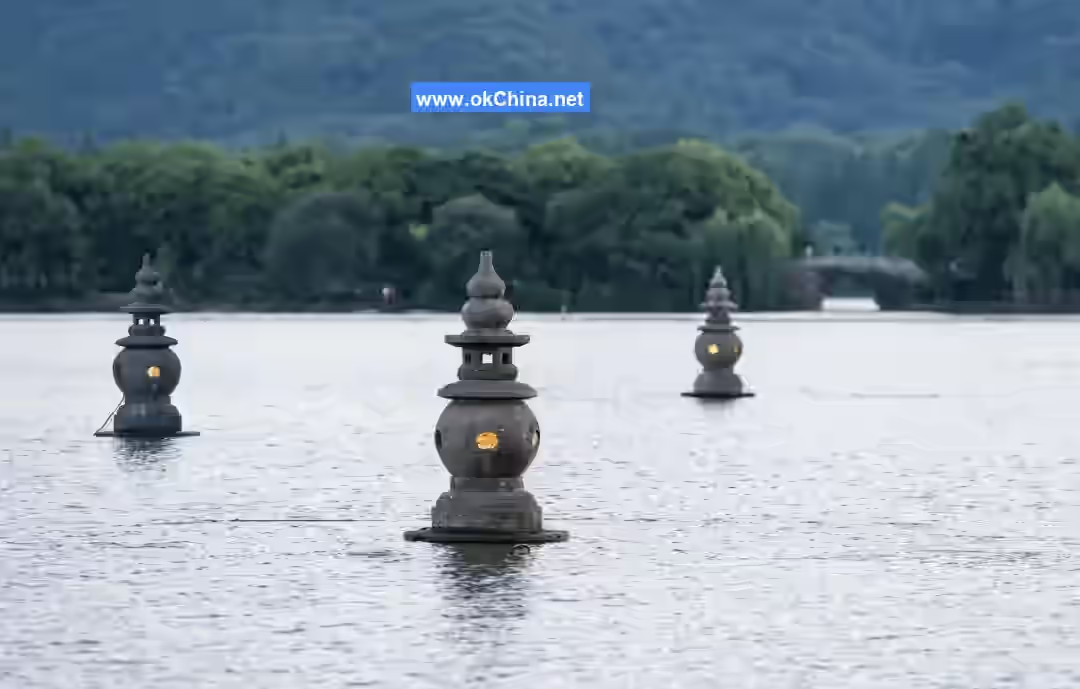
4.7 Three Pools Mirroring the MoonThe Three Pools Mirroring the Moon Island, together with the Mid-Lake Pavilion and Ruan Gong Mound, stand like a tripod and are collectively known as the "Three Islands in the Lake." They resemble the three legendary islands of Penglai from ancient Chinese mythology, hence the island is also called Little Yingzhou. The entire island, including the water surface, covers an area of about seven hectares. It is connected by winding bridges from north to south and by earthen embankments from east to west. The bridges and embankments intersect in a cross shape, dividing the water surface on the island into four parts, with an outer ring of embankments surrounding the water. Viewed from above, the land on the island resembles a giant Chinese character "田" (field), creating a scene of islands within the lake and lakes within the islands. On Little Yingzhou, there are garden structures such as the Kaiwang Pavilion, Tingting Pavilion, Nine Lion Rock, Xianfang Terrace, Yingcui Pavilion, and the "My Heart Mirrors Yours" Pavilion. In the southern part of the lake, three stone pagodas were built. It is said that they were originally constructed by Su Dongpo when he dredged West Lake in Hangzhou (the existing pagodas were rebuilt during the Ming Dynasty). The pagodas are hollow, with five equally spaced round holes arranged on their spherical bodies. On moonlit nights, when the holes are covered with thin paper and lights are lit inside the pagodas, the shapes of the holes are reflected on the lake surface, creating many moons—both real and illusory—hence the name "Three Pools Mirroring the Moon."
4.8 Twin Peaks Piercing the Clouds
The viewing location and method for Twin Peaks Piercing the Clouds have changed repeatedly from ancient times to the present, though the two peaks in the south and north remain unchanged. The twin peaks refer to South Peak and North Peak, located in the southwest and northwest of West Lake, respectively. The two peaks stand facing each other from a distance, stretching over ten miles apart. South Peak is close to the lake, with a height of 257 meters. North Peak, at an elevation of 314 meters, is the mountain on which Lingyin Temple is situated. Ascending from the west side of the temple involves climbing thousands of stone steps, winding through thirty-six bends, with clear mountain streams and overlapping forests along the way. During the Southern Song Dynasty, Twin Peaks Piercing the Clouds was listed as one of the Ten Scenes of West Lake. Emperor Kangxi of the Qing Dynasty renamed it Twin Peaks Piercing the Clouds and built a scenic monument pavilion beside Hongchun Bridge. Regarding this scene, later investigations suggest that it was originally a view admired from the lake, but it was moved to land during the early Qing Dynasty for the purpose of erecting the monument.
4.9 Leifeng Pagoda in Evening Glow
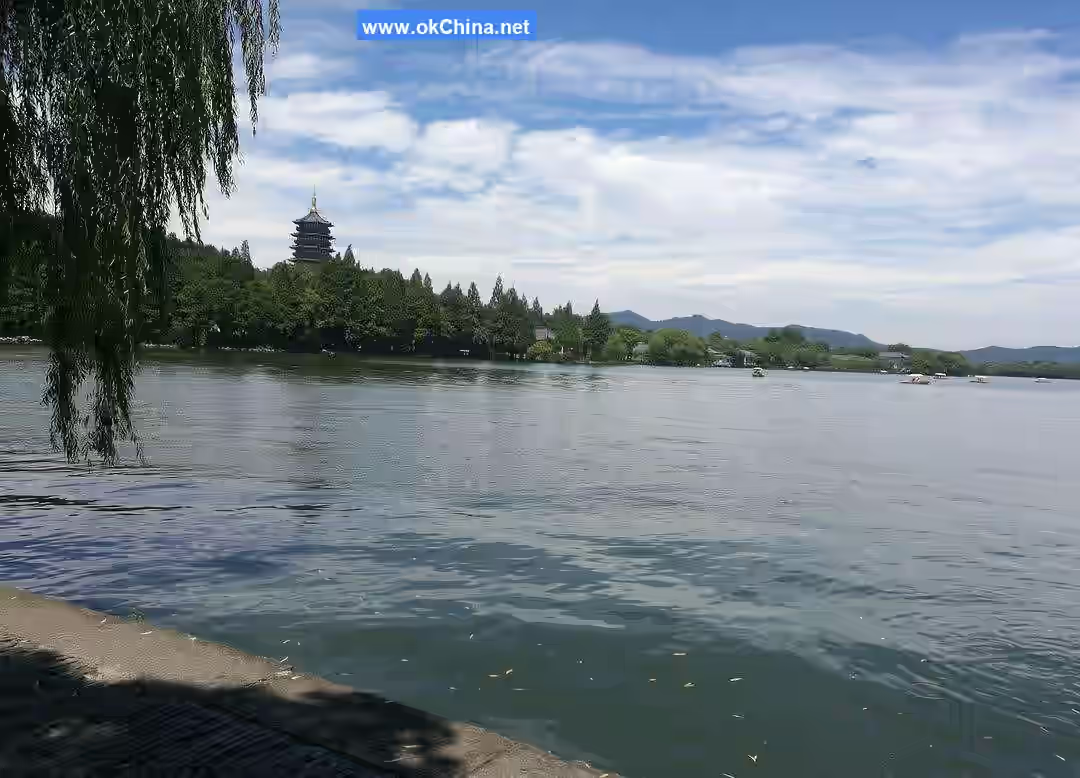
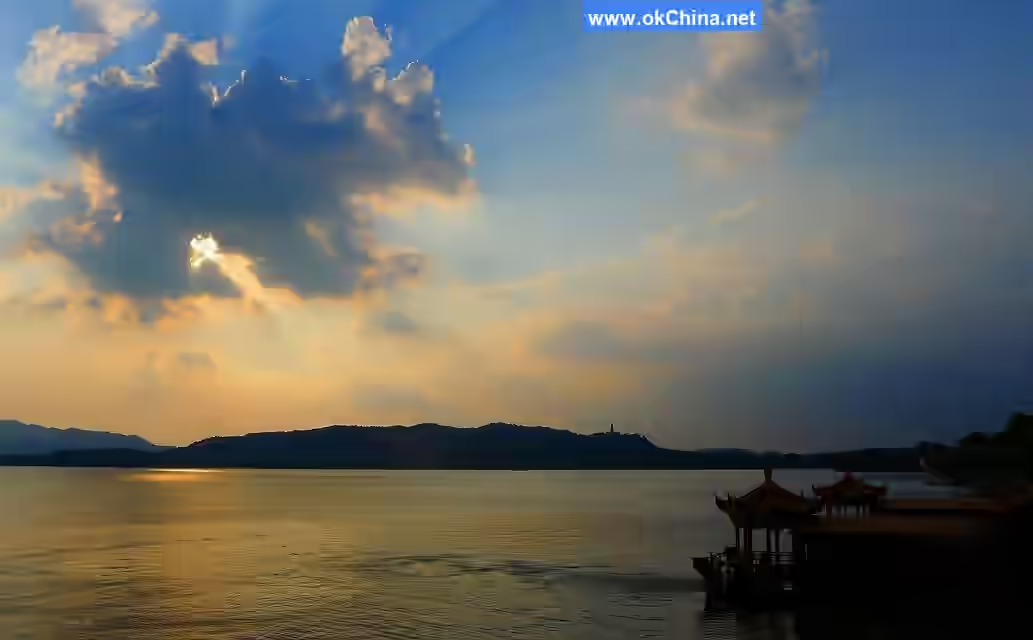
Leifeng Pagoda is located on Sunset Hill on the southern shore of West Lake, in front of Jingci Temple. It was built by Qian Hongchu, the King of Wuyue during the Song Dynasty, as a repository for Buddhist scriptures. Because the hill where the pagoda stands is named Leifeng, later generations renamed it "Leifeng Pagoda." Whenever the setting sun shines upon it, the pagoda’s shadow stretches across the sky, and its pavilions and terraces gleam with golden splendor, hence the name "Leifeng Pagoda in Evening Glow." During the Jiajing period of the Ming Dynasty, the external corridors of the pagoda were burned down by Japanese pirates. The bricks from the pagoda’s foundation were stolen by superstitious individuals, leading to its collapse on September 25, 1924. On December 26, 2000, the reconstruction project of Leifeng Pagoda officially commenced. The new pagoda was built on the original site of Leifeng Pagoda. The new pagoda stands 71 meters tall with five sides and eight stories, nestled against the hill and facing the lake. The ancient pagoda ruins are covered with a glass canopy, setting a national precedent for the in-situ preservation of ancient pagoda ruins in China.
4.10 Evening Bell Ringing at Nanping Hill
Evening Bell Ringing at Nanping Hill is the earliest recorded scene among the Ten Scenes of West Lake. In the late Northern Song Dynasty, the painter Zhang Zeduan once painted the "Evening Bell Ringing at Nanping Hill." Nanping Hill stretches horizontally along the southern shore of West Lake, with a height of less than 100 meters but extending over a thousand meters in length. The hill is adorned with peculiar rocks and lush green trees. In the first year of the Xiande era of the Later Zhou Dynasty (954 AD), Qian Hongshu, the ruler of the Wuyue Kingdom, built a temple at the foot of Nanping Hill, which later became Jingci Temple, one of the two major Buddhist centers in West Lake, standing opposite Lingyin Temple to the north and south. Jingci Temple houses historical sites such as the Zongjing Hall, Huiri Pavilion, Jizu Hall, and the Timber Transport Well, with a release pond in front of the temple gate. Rebuilt in 1986, it is a two-story building with a hip roof and triple eaves. The upper story houses a large temple bell, while the lower story is the Ksitigarbha Hall of Jingci Temple. The large temple bell is 3 meters high, with a diameter of 2.3 meters and weighs over 10 tons. Another famous Buddhist temple at the foot of Nanping Hill, Xingjiao Temple, was built in the fifth year of the Kaibao era of the Northern Song Dynasty (972 AD) and was once the stronghold of the Tiantai Buddhist sect. Jingci Temple, Xingjiao Temple, and nearby smaller temples form another cluster of Buddhist temples on the lake, following Lingyin and Tianzhu. The Nanping Hill area is composed of limestone, with many cavities in the mountain. Combined with the peak’s cliff-like barrier, whenever the evening bell of the temple rings, the sound waves propagate to the hill, and the rocks and cavities are forced to vibrate, accelerating the sound waves and rapidly increasing their amplitude to form resonance. The rocks and cavities then produce a soundbox effect, enhancing the resonance. As the evening bell rings, the echoes reverberate melodiously through the mountains.
5. Cultural Activities
5.1 West Lake Longjing Tea Harvest Festival
Hangzhou’s West Lake District holds the West Lake Longjing Tea Harvest Festival annually in late March and early April. It has become an influential agricultural festival, serving as a platform to showcase tea products, exchange tea culture, and discuss the tea industry. The opening ceremony of the West Lake Longjing Tea Harvest Festival usually takes place in late March, coinciding with the peak harvesting period for West Lake Longjing tea. The festival signifies the large-scale market release of the new year’s West Lake Longjing tea. The West Lake Longjing Tea Stir-Frying Competition is a staple event during the spring tea season. Master tea stir-fryers demonstrate their exquisite skills on-site, showcasing ten techniques such as shaking, pressing, spreading, pressing, flicking, grabbing, pushing, cupping, pressing, and grinding. The awards ceremony for the competition is held during the opening ceremony, where certificates are presented to winners of the "King Competition" and "Rising Star Competition."
5.2 Impression West Lake
Impression West Lake is a large-scale urban landscape live performance set against the natural backdrop of West Lake, located in the Yuehu Scenic Area of West Lake. Based on Hangzhou’s ancient folk legends and myths, Impression West Lake integrates representative elements of West Lake’s cultural history with natural scenery, lighting, music, and performance. Created by director Zhang Yimou’s team with music composed by Japanese musician Kitaro, it premiered in 2007 and has since undergone multiple revisions. It has been performed over 3,000 times, attracting more than 400,000 visitors annually and a cumulative total of over 4 million visitors. The entire performance of Impression West Lake is divided into five acts: "Meeting," "Falling in Love," "Parting," "Reminiscence," and "Impression." It draws inspiration from timeless love stories such as Xu Xian and the White Snake, and Liang Shanbo and Zhu Yingtai, exploring Hangzhou’s ancient folk legends and myths and recreating representative elements of West Lake’s cultural history. The performance uses the sky as a curtain, the lake as a stage, and the landscape as scenery, combined with lighting and music. The theme song "Impression West Lake · Rain" is performed by Zhang Liangying.
5.3 Hangzhou West Lake Day
June 24th is designated as "Hangzhou West Lake Day" each year. On this day, the West Lake Scenic Area organizes various cultural activities. In 2024, to celebrate the 13th anniversary of West Lake’s successful inscription as a UNESCO World Heritage Site and the fifth "Hangzhou West Lake Day," the West Lake Scenic Area introduced惠民 measures—on June 24th, 16 fee-charging attractions under the West Lake Scenic Area, including the zoo, botanical garden, Magnolia Hill Tea Garden, Feilai Peak, and Guo’s Villa, offered free admission to citizens and tourists. Additionally, the scenic area hosted a series of cultural exhibitions and interactive experiences. On the evening of June 24th, the "Pinghu Qiuyue" event—the "Chinese Poetry Conference—West Lake Poetry Gathering," jointly organized by China Central Television and the Hangzhou West Lake Scenic Area Management Committee—was broadcast live by the lakeside. The program invited cultural guests to interpret West Lake culture through poetry, disseminate the value of West Lake as a World Heritage Site,梳理 the traditional cultural context of West Lake, and explore the cultural connotations of West Lake poetry.
Comments
Post a Comment