Kulangsu Scenic Area, Xiamen City
1. Introduction
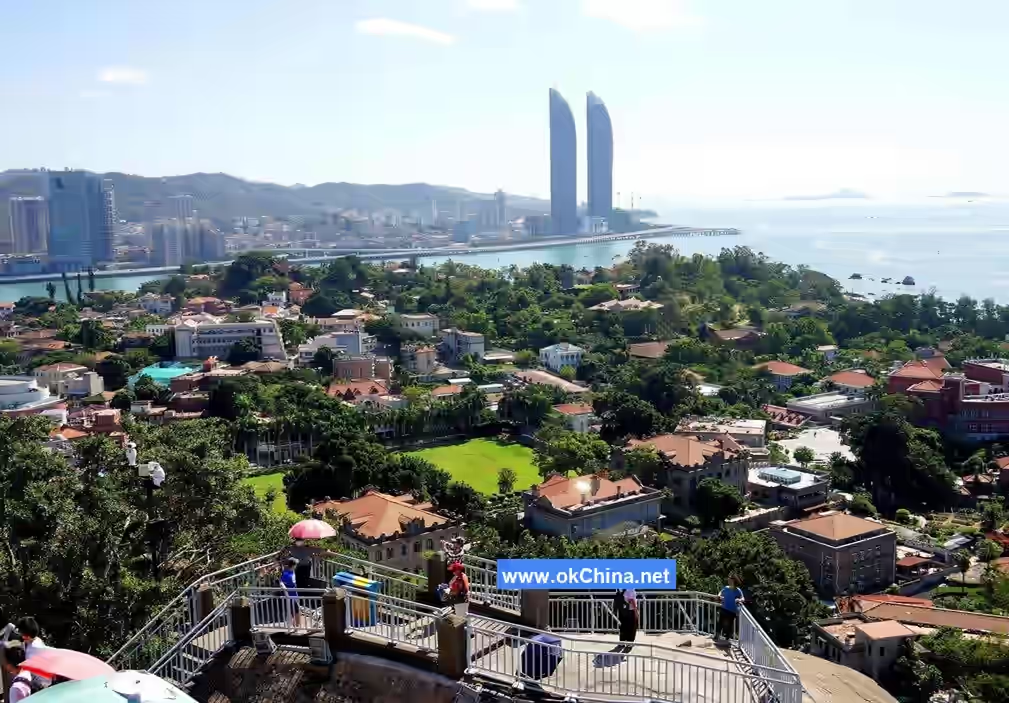
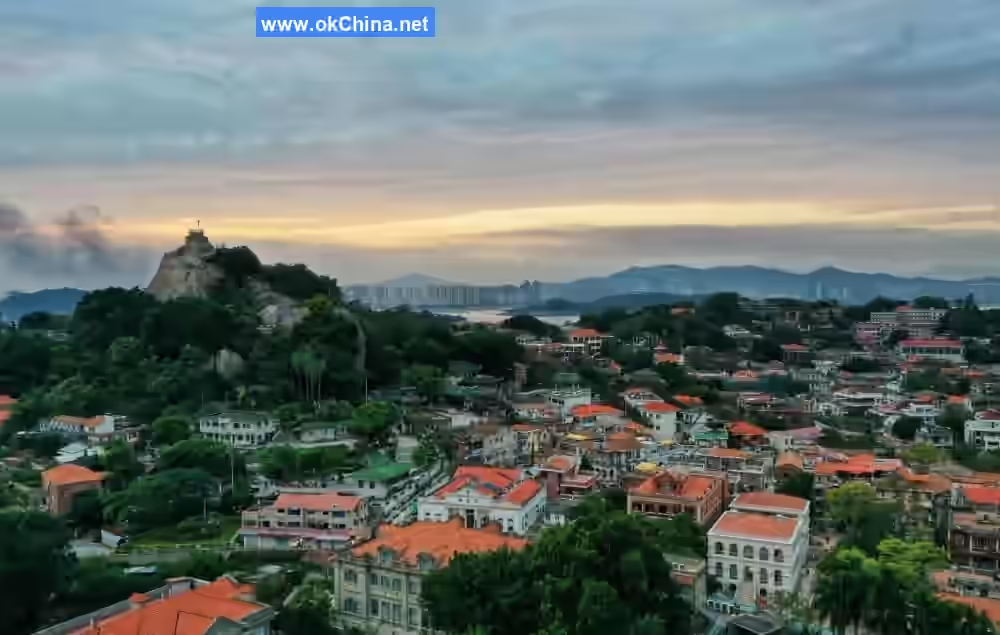
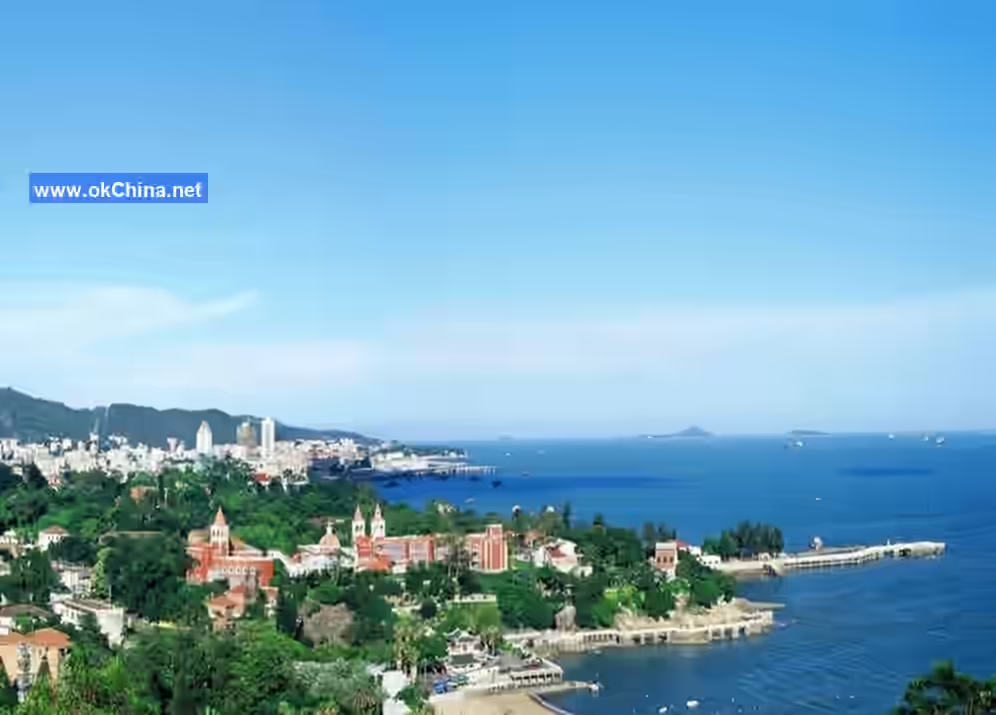
Kulangsu (English: Kulangsu), originally named "Yuanshazhou" and also known as "Yuanzhouzai", was called "Wulongyu" during the Southern Song Dynasty and has been known as "Kulangsu" since the Ming Dynasty. It is located in the southwestern corner of Xiamen City, Fujian Province, facing Xiamen Island across the sea. Covering an area of approximately 1.88 square kilometers with an elevation ranging from 35 to 100 meters, it is renowned as the "Garden on the Sea."
The terrain of Kulangsu is higher in the southwest and lower in the northeast. The island is mostly mountainous, featuring natural landscapes such as sea reefs and rocky hills. Its coastline is winding and surrounded by the sea. It enjoys a subtropical maritime monsoon climate, characterized by year-round warmth and humidity, with mild winters and cool summers. Major attractions include Sunlight Rock, Shuzhuang Garden, and Haoyue Garden.
Human activity on Kulangsu dates back to the Neolithic Age. Settlement began during the Song Dynasty, and development occurred in the Ming Dynasty. In 1573, the island's earliest stone inscription, "Gulang Dongtian," appeared on Sunlight Rock. In 1650, Koxinga (Zheng Chenggong) used Sunlight Rock to train his naval forces, leaving behind historical sites like the "Naval Training Platform." In 1842, Britain, the United States, and Spain successively established consulates on Kulangsu. In 1945, following Japan's unconditional surrender, Kulangsu, which had been occupied by Japan, returned to the people of Xiamen. During the Kuomintang rule, Kulangsu was established as a district. After the founding of the People's Republic of China, it continued to be called Kulangsu District. In 2003, after the administrative division of Kulangsu District in Xiamen was abolished, the Kulangsu Sub-district Office was established. In 2014, the "Island-wide Museum" plan was implemented, integrating key historical buildings into a public, open, wall-less eco-museum system and initiating cultural relic restoration design projects.
Kulangsu integrates historical, cultural, and natural landscapes. It preserves over a thousand buildings of diverse architectural styles and maintains a tradition of musical culture. It is home to the "first and world-class" Piano Museum and the "only one in China and the world's largest" Organ Museum, earning it the reputation as the "Piano Island" and "Hometown of Music." Kulangsu has been honored as a National 5A-level Tourist Attraction and a National Key Cultural Relics Protection Unit, among other accolades. On July 8, 2017, "Kulangsu: a Historic International Settlement" was inscribed on the UNESCO World Heritage List.
2. Geographical Environment
2.1 Location and Territory
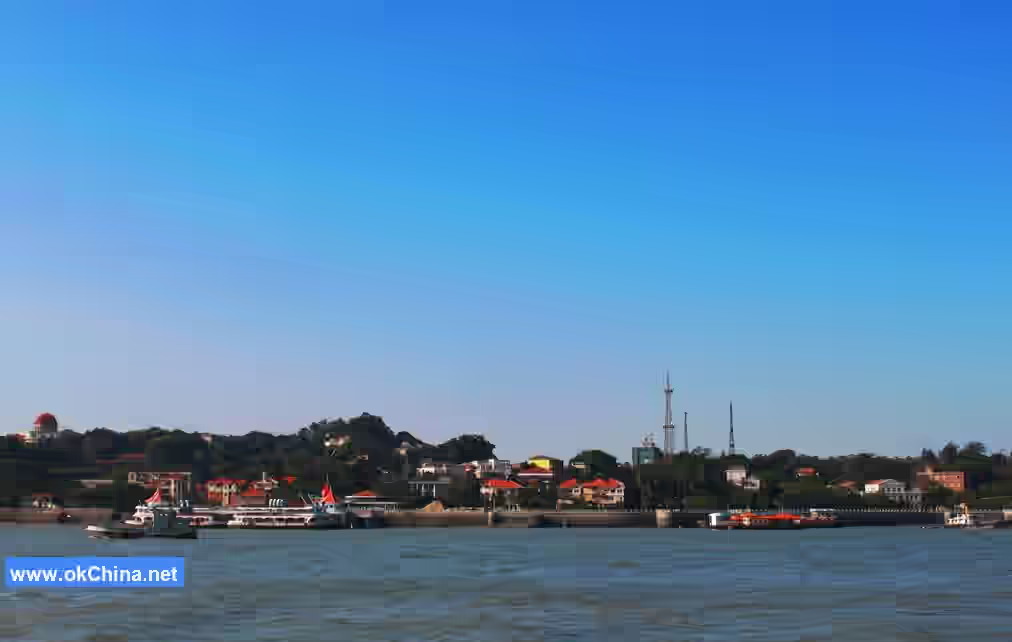
Kulangsu is located in the southwestern corner of Xiamen City, Fujian Province, between 24°26′-27′ N latitude and 118°03′-04′ E longitude. It is separated from Xiamen Island by a 500-meter-wide strait and situated at the mouth of the Jiulong River, facing Xiamen's urban area across the 600-meter-wide Egret River Strait. It covers an area of approximately 1.88 square kilometers, with an elevation ranging from 35 to 100 meters.
2.2 Topography and Landforms
The terrain of Kulangsu is higher in the southwest and lower in the northeast. The island is mostly mountainous, featuring natural landscapes such as sea reefs and rocky hills. It is divided by the north-south aligned "Yanwei Mountain - Bijia Mountain - Jimu Mountain - Yingxiong Mountain" and the east-west aligned "Langdong Mountain - Jimu Mountain - Longtou Mountain - Shengqi Mountain" into several relatively flat areas: the Longtou area on the east side facing Xiamen, the coastal Tianwei Road area on the southeast side, and the Neicuo'ao area on the northwest side.
2.3 Geology
The entire island of Kulangsu is composed of medium-grained granite from the late Yanshanian period, approximately 108 million years ago. The granite is an acidic intrusive rock, formed by magma intruding several kilometers below the Earth's surface and slowly cooling and solidifying, later exposed due to crustal movements and weathering/erosion. It contains 50%-55% potassium feldspar, 15%-20% plagioclase, about 25%-30% quartz, and 1%-2% biotite. Minerals within the rock commonly exhibit phenomena such as flattening, elongation, and directional distribution, indicating that the magma intrusion process occurred locally within a long-active fault zone, subjecting it to strong ductile shearing.
Geological exploration data indicate that Xiamen Island and Kulangsu were connected to the mainland in ancient geological times. Tens of millions of years ago, the NE-trending Xigang Fault "cut" Xiamen Island off from the mainland, and the NW-trending Egret River-Zhongshan Fault subsequently cut Kulangsu off from Xiamen Island. These faults are deep and major fractures, clearly reflected as linear structures in Earth resource satellite imagery. The existence of the NW-trending Egret River Fault, whose fractured rocks within the fault zone were continuously eroded by seawater and waves, gradually formed the 500-meter-wide Xiamen-Kulangsu Channel. There is also another NW-trending fault approximately parallel to the Egret River Fault cutting through the southwestern edge of Kulangsu; to the west lies the NE-trending Xigang Fault; the southern edge features a major fault with a strike of 280° at the mouth of the Jiulong River in Xiamen Harbor, cutting through the Songyu Peninsula - Kulangsu - southern edge of Xiamen Island, where the geomorphology exhibits typical fault coast characteristics. The NW-trending Xiamen Harbor Fault is a regional major fault, exerting some control over the deposition of the Longhai Plain sequence and the formation of Xiamen Harbor. From a tectonic perspective, Kulangsu is a fault-block island formed by the intersection of several faults.
2.4 Climate
Xiamen has a subtropical maritime monsoon climate. It is warm and humid with excellent light and heat conditions, abundant rainfall, mild winters without severe cold, and cool summers without intense heat. Seasonal changes follow a regular pattern: in spring, monsoons shift from northeast to southerly, transitioning from cold to warm with increasing rainfall; summer is moderated by sea breezes and thunderstorms, bringing coolness to hot days, with occasional typhoons; autumn is mostly sunny with little rain; winter features northeast monsoons, cold but not harsh.
The annual average temperature in Xiamen is 21.2°C. The annual average maximum temperature is 24.5°C, and the annual average minimum is 18.7°C. The annual extreme maximum temperature is 38.4°C, and the annual extreme minimum is 2°C. The average temperature of the coldest month is above 13°C, and there is no frost throughout the year. The annual minimum sea surface temperature is 10°C, the maximum is 31.5°C, and the annual average ranges from 20.7°C to 21.6°C.
Sea-land breezes in Xiamen are very distinct. Typically, from midnight to noon, west to northwest winds prevail (generally force 1-2, maximum force 4). From afternoon until before midnight, south to southeast winds prevail (generally force 3-4, maximum force 6). Summer monsoons are generally southeast to southwest, beginning in June, prevailing in July, and secondary in August, averaging only force 2-3. Winter monsoons occur from late September to early April of the following year, with wind speeds greatest in November, generally from northeast to east-northeast.
Sea fog occurs from November to June of the following year, most frequently in March (up to 8 times per month, followed by 6 times). July to October is a fog-free period. If fog occurs, visibility is within 1 kilometer. Visibility is poorer from March to May and best from July to October. Dense fog generally occurs at midnight and in the morning, lasting continuously for up to 3 days at most and as short as 1 hour.
Thunderstorms are most frequent from May to August. December to February of the following year is a thunder-free period. Thunderstorms often cause heavy rain.
2.5 Biodiversity
2.5.1 Flora
Kulangsu has ancient towering trees, with 23 species totaling 186 ancient and famous trees, including notable specimens like Columnar Araucaria, Round-leaf Livistona, and Five-angled Euphorbia. Green space coverage is about 40%, with over 90 families and more than 1,000 species of trees, shrubs, vines, and ground cover plants. The plant resources around key historical and architectural features on Kulangsu comprise 97 families and 292 species, relatively rich in total, predominantly common landscaping seedlings, including Cat's Claw Vine, Red Gourd, Chicken Dung Vine, Boston Ivy, and Five-claw Golden Dragon.
2.5.2 Fauna
The main wild animals on Kulangsu island belong to the class Aves: sparrows, house swallows, magpies, mynas, turtledoves, egrets, seagulls, etc. Additionally, there are captive ornamental animals in island gardens such as peacocks, parrots, and mynas. Kulangsu and its intertidal zone share 382 species of organisms. Among them, 74 are economic species, mainly including Green Mussel, Saccostrea cucullata (hooded oyster), Purple Sea Urchin, Naked Sipunculid Worm, Ark Shell, Comb Pen Shell, and Mud Snail. Located in the western sea area of Xiamen, Kulangsu has marine biological resources including fish, shrimp, and crabs.
3. Main Attractions
3.1 Sunlight Rock
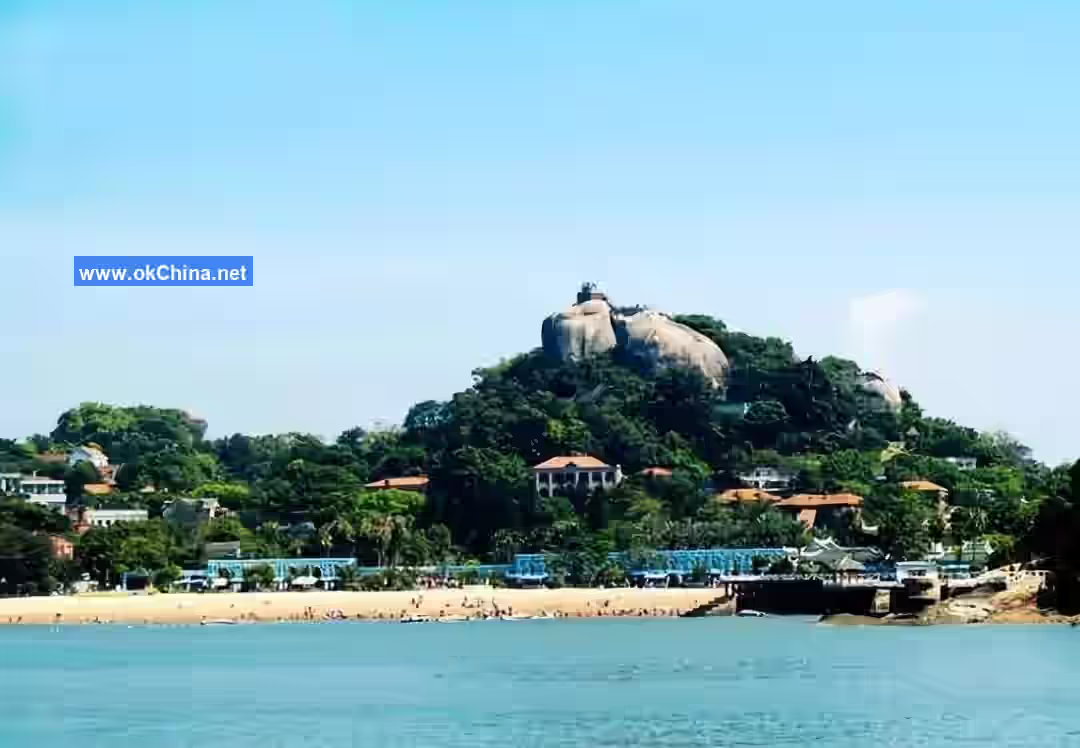
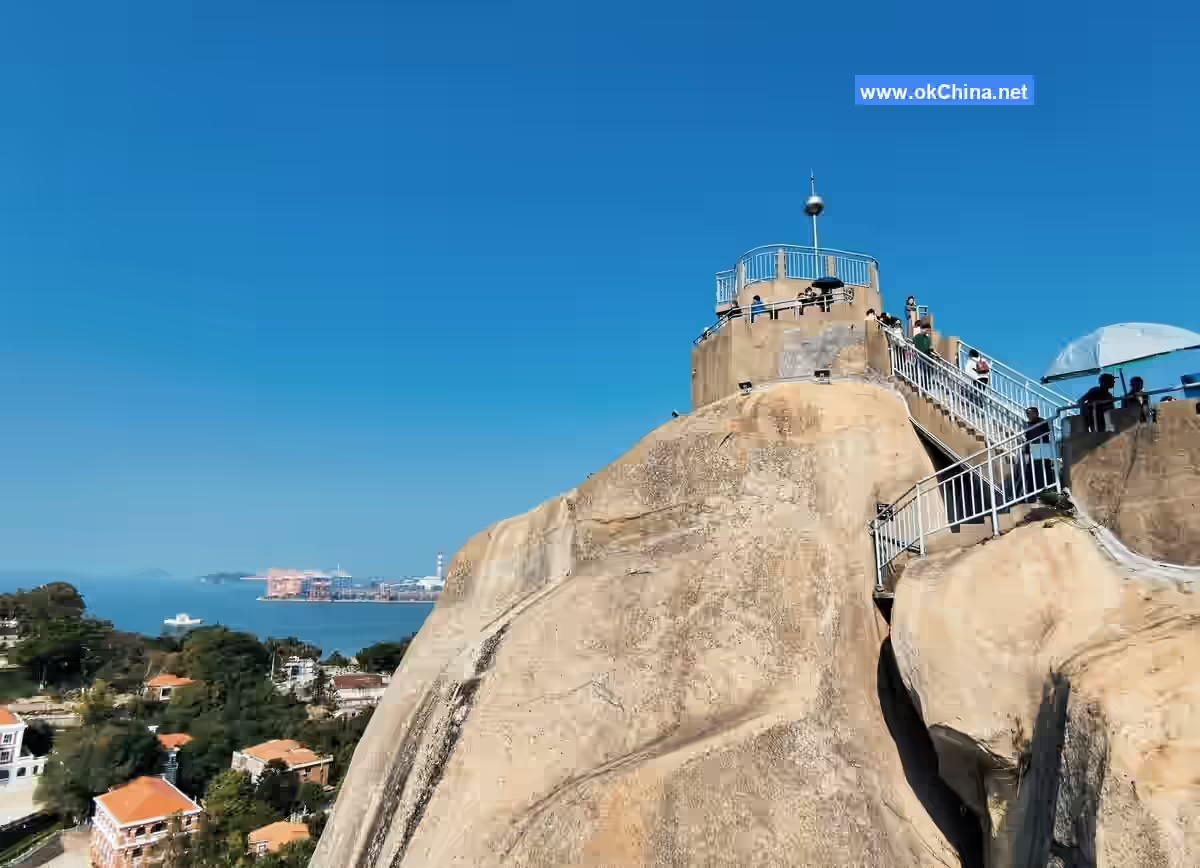
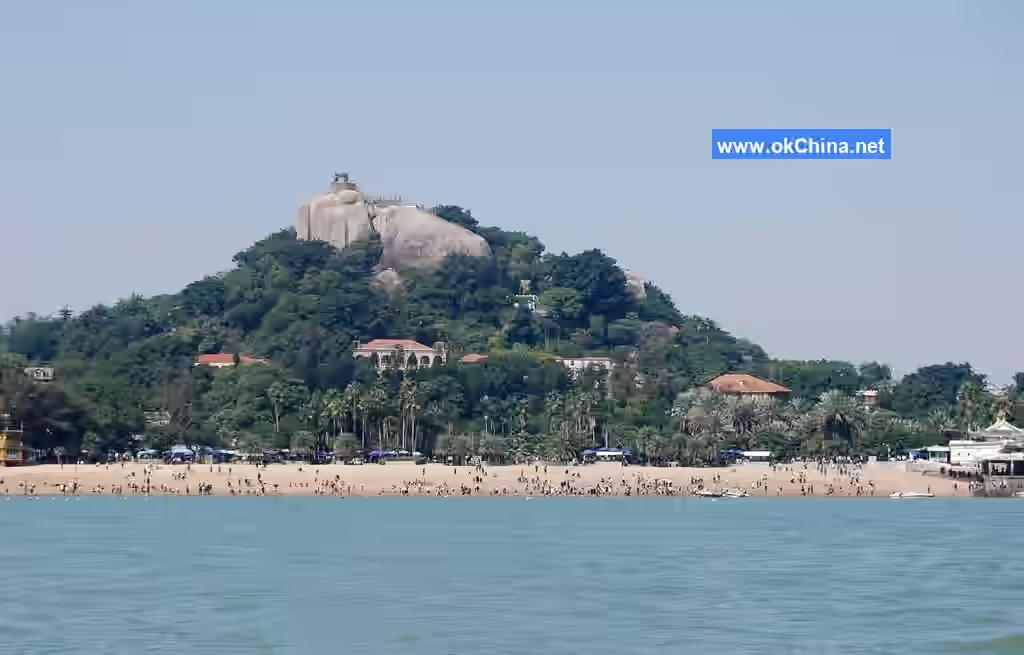
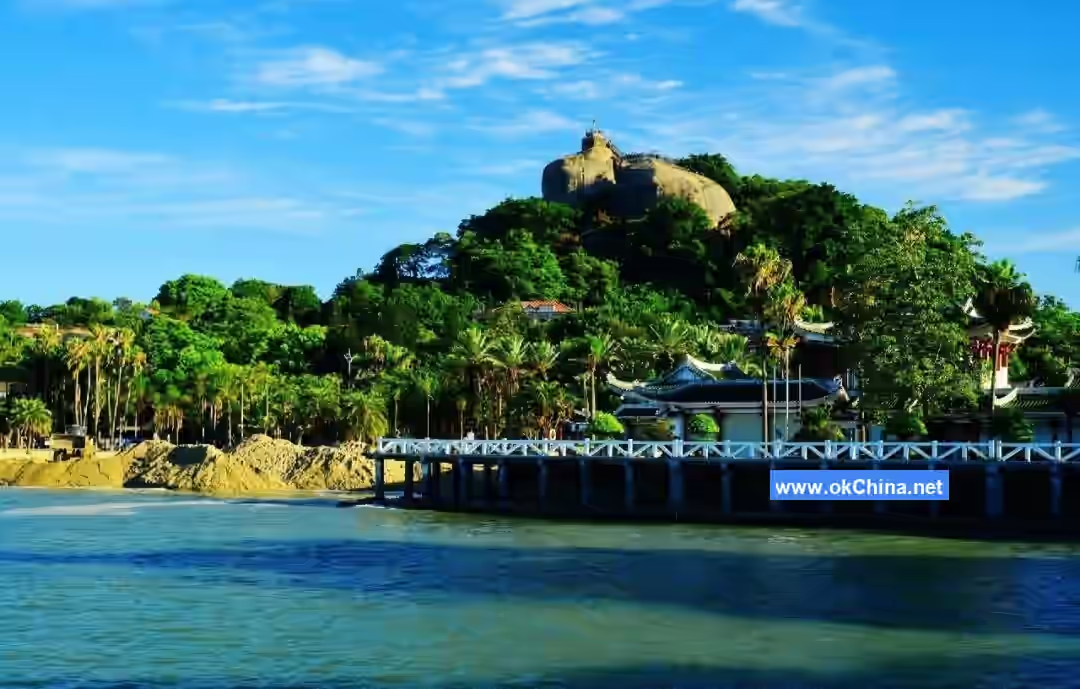
Commonly known as "Yanzaishan" and also called "Huangyan," legend has it that when Koxinga arrived at Huangyan and saw scenery surpassing Japan's Mount Nikko, he split the character "Huang" to name it "Riguang Yan" (Sunlight Rock). The Sunlight Rock scenic area consists of Sunlight Rock and Qin Garden. Sunlight Rock towers in the south-central part of Kulangsu, formed by two giant rocks, one vertical and one horizontal, leaning against each other, constituting the summit of Longtou Mountain. With an elevation of 92.7 meters, it is the highest peak on Kulangsu. Sunlight Rock Temple, commonly known as "Yi Pian Wa" (A Piece of Tile), is actually a natural stone cave, roofed by a huge rock, with the temple later built according to the mountain's terrain during the Ming Dynasty's Zhengde and Wanli periods (specifically the 14th year of Wanli). The temple was repeatedly destroyed and rebuilt. During the Tongzhi reign of the Qing Dynasty, the Yuanming Hall was built to worship Maitreya, and an octagonal pavilion was constructed in front of the temple, hung with a plaque reading "Sunlight Temple." After liberation, the Yuanming Hall was converted into a Buddha Recitation Hall. The Main Hall (Daxiong Baodian) was built in the 16th year of the Republic of China (1927).
3.2 Shuzhuang Garden
Located on the southeastern coast of Kulangsu, Shuzhuang Garden was built in 1913. It was originally the private garden of the wealthy Taiwanese merchant Lin Erjia. In 1956, the owner donated the garden to the state. Shuzhuang Garden backs against Huangyan (Sunlight Rock), faces the sea, neighbors Guanhai Garden to the east, and overlooks Gangzaihou to the west. The garden is renowned for its layout and excels in borrowed scenery. Utilizing the garden design techniques of concealment, borrowing, and ingenuity, it harmonizes the garden with natural features, creating a landscape where the scenery changes with every step. The entire garden is divided into two main parts: Canghai Yuan (Sea-Concealing Garden) and Bushan Yuan (Mountain-Supplementing Garden), each featuring five scenic spots. The five scenes of Canghai Yuan are Meishou Tang, Renqiu Ge, Zhenshuai Ting, Sishisi Qiao (44 Bridge), and Zhaoliang Ting. The five scenes of Bushan Yuan are Wanshi Shanfang, Shier Dongtian (Twelve Cave Heaven), Yi'ai Wulu, Tingchao Lou, and Xiaolan Ting.
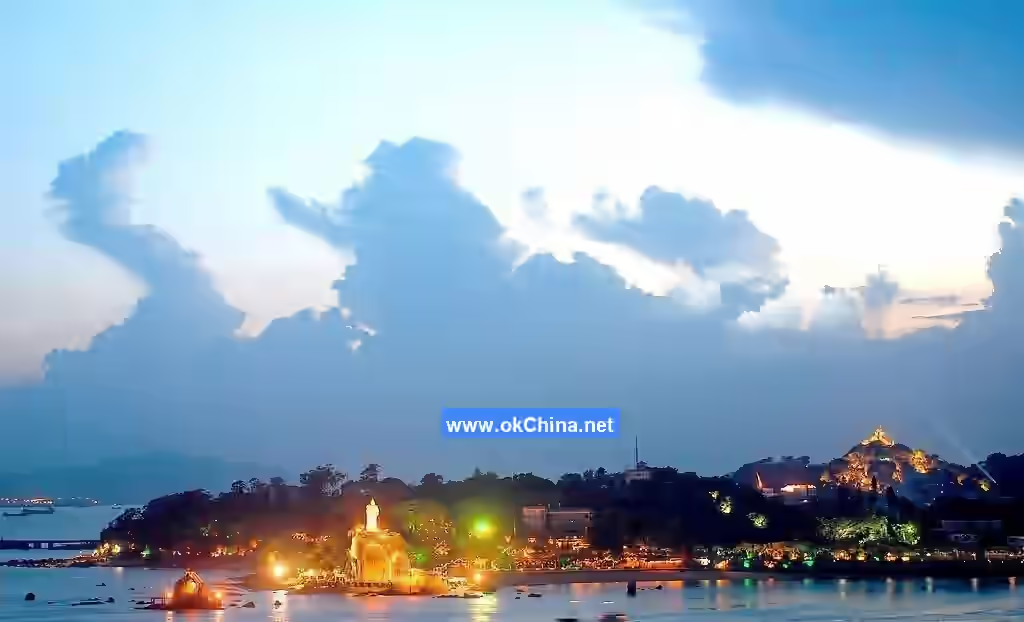
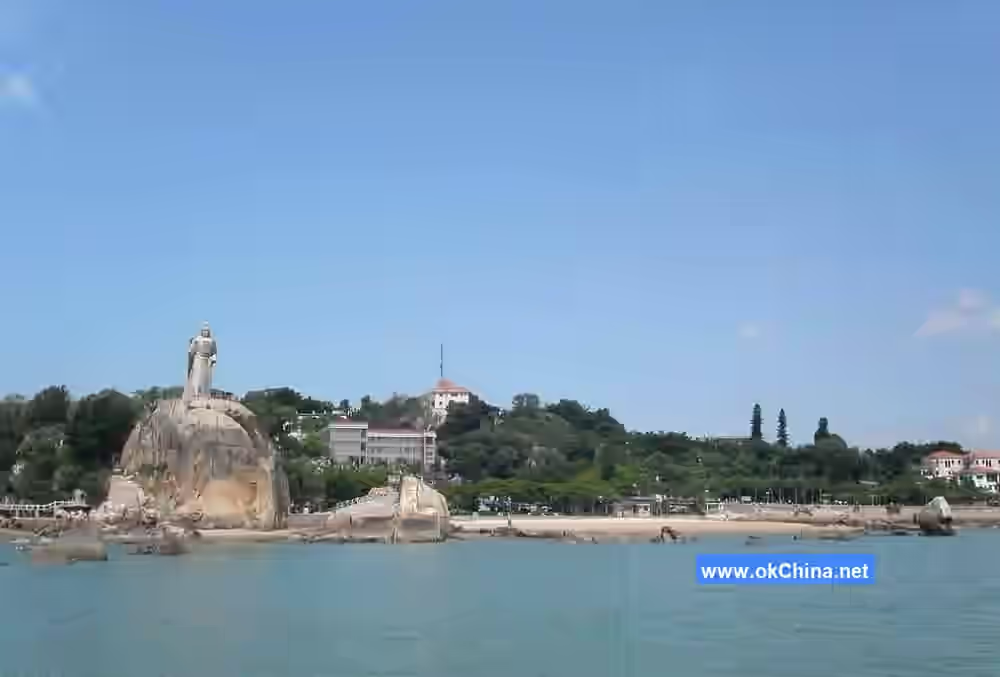
3.3 Haoyue GardenLocated on the Fuding Rock seafront in the eastern part of Gulangyu Island, covering an area of 30,000 square meters and stretching along the Lujiang River, this garden features a layout of sandy beaches, rocks, green trees, and pavilions. Established in 1985, the garden is named "Haoyue Garden" after the line "Thinking of you, I cannot sleep; the bright moonlight penetrates the white curtain" from the Yanping Two Kings Collection. Within the garden stands a massive bronze statue of Zheng Chenggong and his generals, measuring 13.7 meters in length, 4.7 meters in height, and weighing 18 tons of copper. In this colossal bronze sculpture, Zheng Chenggong and his generals Chen Ze, Chen Guang, Chen Yonghua, and Yang Chaodong, standing on his left and right, are slightly larger than life-size, while the rest of the troops extend to both sides.
3.4 Ancient Summer Resort Cave
Supported by stone walls on both sides, a massive granite rock appears to descend from the sky, creating a feeling of immense pressure and a sense of great peril. The inscription "Ancient Summer Resort Cave" was written by Shi Shijie, a Taiwanese literatus of the late Qing Dynasty. The stone cave is bright, dry, and well-ventilated. Passing through the Ancient Summer Resort Cave and turning left, there is a slender, elegant pavilion with delicate supports, using the rock as its cool platform. Named "Umbrella Pavilion," it provides shade and shelter from rain for visitors.
3.5 Longtou Mountain Stronghold
Sunlight Rock, also known as Longtou Mountain, faces Xiamen's Hutou Mountain across the sea, with a dragon and a tiger guarding Xiamen Harbor, known as "Dragon and Tiger Guarding the River." Originally, there was a "Sunrise Pavilion" here, which has long been destroyed. Taiwanese Shi Guoqiu wrote an essay titled Record of the Sunrise Pavilion. This stronghold gate is the entrance to the "Longtou Mountain Stronghold," where Zheng Chenggong stationed troops on Gulangyu. The round holes in the rock were carved by soldiers to pitch tents. Moved by the scene, General Cai Tingkai, former commander of the 19th Route Army of the Nationalist Party, wrote a seven-character quatrain: "With a heart to mend the heavens single-handedly, troops have been stationed in Fujian since ancient times; the ancient fortress remains today, recalling heroes beneath Sunlight Rock," praising Zheng Chenggong exceptionally. Mr. Cai Yuanpei also composed a seven-character quatrain: "Roaring winds subdue the sea waves, commanding with calm amid high battle clouds. Insects, sand, apes, and cranes may perish in time, but noble spirit stands unwavering and untarnished." Here, "insects, sand, apes, and cranes" refers to those who served in the military.
3.6 Zheng Chenggong Memorial Hall
Established on January 28, 1962, to commemorate the 300th anniversary of Zheng Chenggong's recovery of Taiwan. Zheng Chenggong, originally named Sen, courtesy name Damu, was born in Shijing, Nan'an, Fujian. When the Southern Ming Emperor Longwu ascended the throne in Fuzhou, impressed by his loyalty to the court, he bestowed upon him the surname "Zhu" and renamed him "Chenggong." Thus, he was commonly known as "Zheng Guoxing" among the people, and the Yongli Emperor enfeoffed him as the Prince of Yanping. His father, Zheng Zhilong, secretly surrendered to the Qing, prompting Zheng Chenggong to flee to Kinmen, vowing to resist the Qing to the death. Using Kinmen and Xiamen as his base, he fought fiercely against the Qing army for many years, once advancing to the gates of Nanjing but ultimately defeated due to overconfidence. On a bright day in April of the 18th year of the Shunzhi reign (1661), after thorough preparation, Zheng Chenggong led hundreds of warships and 25,000 officers and soldiers, setting out from Liaoluo Bay in Kinmen to recover Taiwan, which had been occupied by the Dutch for 38 years, and vigorously developed Taiwan. Zheng Chenggong passed away from illness in Taiwan in July of the 19th year of the Shunzhi reign (1662), at the young age of 39. For over 300 years, the people of Fujian and Taiwan have held Zheng Chenggong in high esteem, honoring him as a national hero, with the people of Taiwan revering him as the "Sage King Who Opened Taiwan." The Zheng Chenggong Memorial Hall is divided into seven sections, displaying over 300 cultural relics, documents, photographs, and models. Among them, the official seals and Zhangzhou military pay ledgers are original artifacts from that era, making them particularly precious.
3.7 Gulang Cave Heaven
The scenic beauty of Sunlight Rock has been renowned far and wide, attracting numerous literati and scholars throughout history. Enchanted by the winds and sea waves, they composed poems and left behind many precious handwritten works. Passing through the mountain gate of Sunlight Rock Temple and looking up, one can see a massive cliff. The inscription on the cliff—"Gulang Cave Heaven"—vividly summarizes the fairyland-like scenery of Sunlight Rock and was written by Ding Yizhong in the first year of the Wanli era of the Ming Dynasty. "First on Lujiang" highlights Sunlight Rock as the premier scenic spot in Xiamen, inscribed by Lin Zhen in the first year of the Daoguang era of the Qing Dynasty. "Winds and Sea Waves" aptly describes the characteristics of Sunlight Rock and was written by Xu Shiying in the fourth year of the Republic of China.
3.8 Heroes Garden
Built to commemorate the martyrs who liberated Xiamen and attacked Gulangyu, it consists of three parts: a small memorial square, a memorial sculpture, and a memorial room. By the end of September 1949, the 10th Corps of the Chinese People's Liberation Army had liberated the mainland of southern Fujian, forming a three-sided encirclement of the Nationalist forces in Kinmen and Xiamen. On October 15, the 31st and 29th Armies of the Corps launched a cross-sea operation against Xiamen. At 18:00 that day, fleets from two battalions each of the 271st and 277th Regiments of the 31st Army set out from Haicang and other places in two columns toward the southwestern part of Gulangyu. With the close cooperation of supporting boatmen, brave PLA commanders and fighters landed on the beach at the foot of this mountain. Regimental Commander Wang Xingfang of the 271st Regiment and hundreds of other commanders and fighters, along with supporting boatmen like Zhang Shuijin's family, unfortunately died heroically in the battle. After two days and nights of bloody combat, our army finally liberated the entire islands of Xiamen and Gulangyu, achieving ultimate victory. After the liberation, the people renamed this mountain (originally "Qizaiwei Mountain") Heroes Mountain. In 2000, the Gulangyu District People's Government established "Heroes Garden" on the mountain.
3.9 Piano Museum
The Gulangyu Piano Museum, completed in January 2000, is located in the "Tingtao Pavilion" of Shuzhuang Garden, covering an area of 450 square meters. It consists of two sections, A and B, each with two floors. The museum displays over 40 antique pianos collected by patriotic overseas Chinese Hu Youyi, including rare gilded pianos, the world's earliest square pianos and the earliest and largest upright pianos, antique hand-cranked pianos, foot-pedal automatic player pianos from a century ago, and eight-pedal antique pianos.
3.10 Gangzaihou Beach Bathing Area
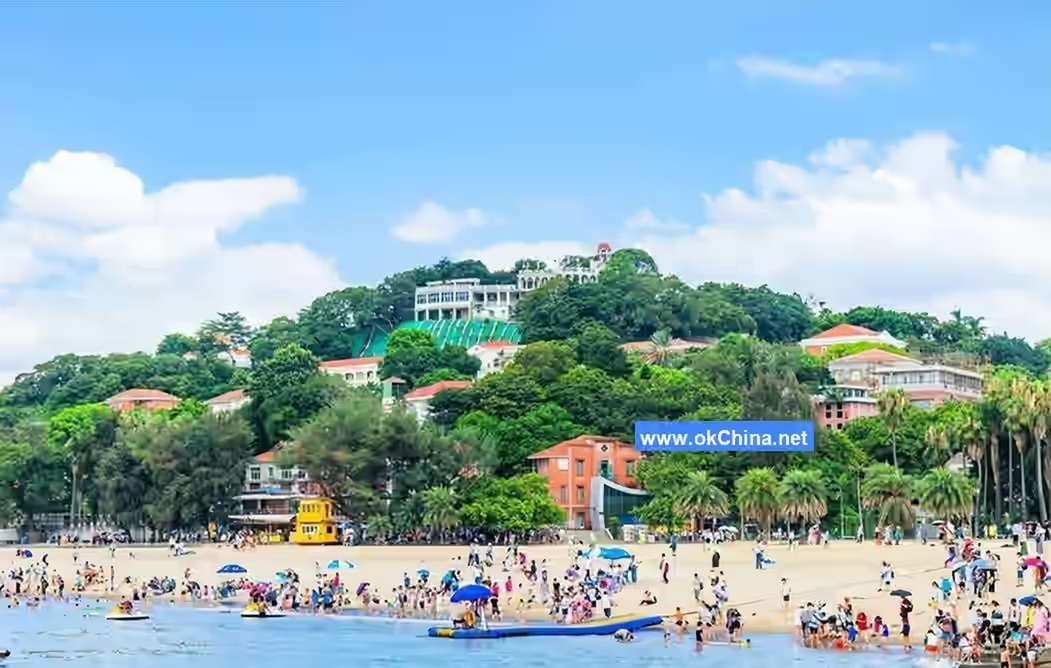
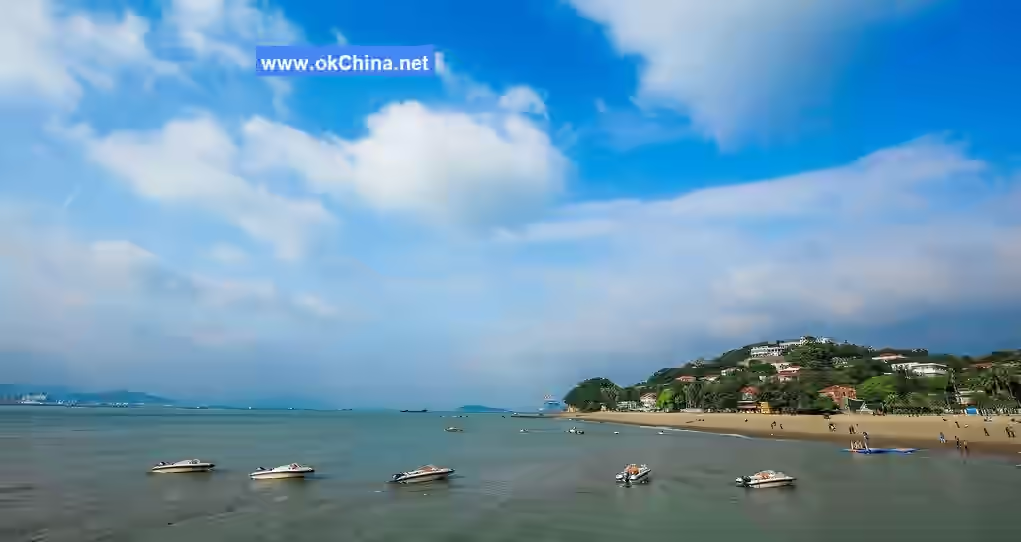
On the wide sandy beach of Gangzaihou, the sand is fine and soft, the slope gentle, the waves calm, and the seawater flow slow, with no sharks present. For five and a half months each year, the seawater temperature remains above 20°C, making the swimming season last up to half a year. With two tides daily, the suitable swimming time exceeds six hours, making it a natural beach bathing area. Various service facilities are complete, and water entertainment projects such as yachts and motorboats are available. In 1998, the National OP-Class Sailing Championship was held here.
3.11 Organ Museum
On the evening of January 28, 2005, the world's largest organ museum—the Gulangyu Organ Museum—opened to the public, hosting a pipe organ concert. The museum's first large pipe organ, "Norman Bill," made its debut, officially introduced to tourists and citizens. The museum houses over 5,000 organs.
3.12 Trinity Church
Over seventy years ago, as about a hundred believers from Xiamen's New Street Church, Zhushu Church, and Xiagang Church of the Chinese Christian Church gradually moved to Gulangyu, they found it inconvenient to cross the sea back to Xiamen Island for worship during typhoons or rainy weather. Thus, believers from the three congregations united to establish a church on Gulangyu, naming it "Trinity Church," also embodying the doctrine of the Holy Trinity—Father, Son, and Holy Spirit. In 2006, it was designated as a sixth batch national key cultural relics protection unit.
3.13 Longtou Road Commercial Street
This is the main commercial street of Gulangyu. With the rise of tourism, many handicraft and painting shops have opened along both sides of Longtou Road, selling local crafts such as bead embroidery, lacquer thread carving, colored tying, colored sculpture, and colored porcelain, as well as antiques, jade, paintings, and porcelain from all over the country. Additionally, many southern dried goods shops have opened.
3.14 Fishbone Art Gallery
Compared to other cultural museums on Gulangyu, this is a significant local feature, housed in an old villa from the 1940s. The gallery features a huge shark bone as its treasure; moreover, all the paintings on display are made from natural fishbones pieced together one by one. From the second-floor platform, a panoramic view of Gulangyu can be seen.
3.15 Xiamen Underwater World
After disembarking from the ferry and turning right not far away, one can see a giant octopus bronze sculpture, which marks the entrance to Xiamen Underwater World. Here, there is a specimen of the world's largest sperm whale captured in Xiamen waters. Originally Gulangyu Park, Xiamen Underwater World is located on the eastern shore of Gulangyu at Huangjiadu, housing over 10,000 fish of more than 350 species from oceans and freshwater bodies around the world. The underwater tunnel is 80 meters long and 1.5 meters wide. Entering the tunnel and standing on the electric walkway, visitors can see concave large fish tanks on both sides, experiencing a world of fish from all directions, up and down, with fish swimming close by. There are opportunities to see divers feeding fish underwater.
3.16 Lu Gangzhang Statue
Lu Gangzhang is known as the "pioneer of the language modernization movement." Devoted to saving and strengthening the nation through "language salvation and education salvation," he dedicated his life to painstaking research, creating seven "firsts" in Chinese linguistics: the first to invent phonetic alphabets, the first to invent punctuation marks, the first to advocate vernacular Chinese, the first to promote a national language, the first to advocate simplified Chinese characters, the first to promote horizontal writing, and the first to promote phonetic literacy. Lu Gangzhang lived on Gulangyu his entire life and was buried on Jishan, Gulangyu after his death. To commemorate his outstanding contributions to Chinese language modernization, allow more people to remember this Gulangyu sage, and develop a distinctive tourist attraction rich in Gulangyu's cultural heritage, the Gulangyu-Wanshi Mountain Scenic Area Management Committee invited young sculptor She Guofu from Fujian Arts and Crafts College to create a bronze statue of Mr. Lu Gangzhang on the occasion of his 150th birthday. The statue is 2.4 meters tall, with the bust measuring 1.1 meters. From the statue to Lu Gangzhang's grave, the management committee built a 500-meter-long stone path engraved with punctuation marks and Chinese pinyin.
3.17 International Engraving Art MuseumLocated in a sea-view building of over 500 square meters opposite Shuzhuang Garden, the first floor is designated as an international exhibition hall, while the second floor serves as a Chinese exhibition hall. The museum houses 407 works from five countries: China, Japan, South Korea, Singapore, and Malaysia. Most of these works were selected for the 5th National Engraving Art Exhibition and the 8th International Engraving Art Exhibition in 2004, representing the highest standards of engraving art both domestically and internationally.
3.18 The Palace Museum Kulangsu Foreign Artifacts Museum
This is the first thematic branch established by the Palace Museum outside Beijing, dedicated to showcasing foreign artifacts collected by the Palace Museum from the Ming and Qing dynasties onward. It serves as an important window for cultural exchanges between China and foreign countries. Located at the "Former Site of the Salvation Hospital and Nursing School" on Kulangsu (a sixth-batch national key cultural relics protection unit), it is adjacent to the Sanqiutian Pier where tourists disembark. The site covers an area of 11,000 square meters, with a building area of 5,180 square meters and an exhibition area of over 2,800 square meters. It officially opened to the public on May 13, 2017.
3.19 Yu Garden
Yu Garden is located on Fuxing Road in the southeastern part of Kulangsu. It was built to commemorate the renowned Chinese obstetrician and gynecologist Dr. Lin Qiaozhi (1901–1983). The garden covers an area of 5,700 square meters, with a naturally harmonious architectural layout. A white marble statue of Dr. Lin Qiaozhi sits on the stone platform of Yu Garden, depicting her with a kind expression and simple attire. The "Exhibition Room of Dr. Lin Qiaozhi's Life and Achievements" displays over 100 photos of Dr. Lin's studies, work, and daily life, as well as many items she used during her lifetime. Two Araucaria trees planted in the garden by Comrade Deng Yingchao symbolize Dr. Lin's elegant and noble character.
3.20 Haitiantanggou
Haitiantanggou is located on Kulangsu and was built in 1921. It is one of the top ten villas on Kulangsu and was designated as a key historical and architectural building by the Xiamen Municipal Government in April 2002. It is the only villa complex on Kulangsu designed with a symmetrical layout along a central axis. It was built by overseas Chinese from the Philippines, Huang Xiulang, on the former site of a foreign club in the concession. The old villa of "Haitiantanggou" is a masterpiece combining Chinese and Western cultures. The gate tower is in a typical traditional Chinese style, featuring double eaves, bracket sets, and upturned corners. The buildings on both sides commonly adopt ancient Greek column styles, with window decorations mostly in Western style, while the walls and corners feature Chinese carvings. The central building originally housed a foreign club, which Huang Xiulang purchased and transformed into a palace-style structure with an ancient-style large roof, built by craftsmen from Putian. It features a double-eave hip-and-gable roof with highly upturned corners adorned with intertwined branches. The front part of the roof is designed to resemble a pavilion with double eaves and a pointed top, crowned with a precious gourd. Internally, it is an octagonal caisson ceiling made of wooden strips, extending from the second floor to the top, with Chinese flower-and-bird paintings on the walls. This "pavilion" is purely decorative. Haitiantanggou consists of five old villas, three of which are currently open to the public.
3.21 Catholic Church
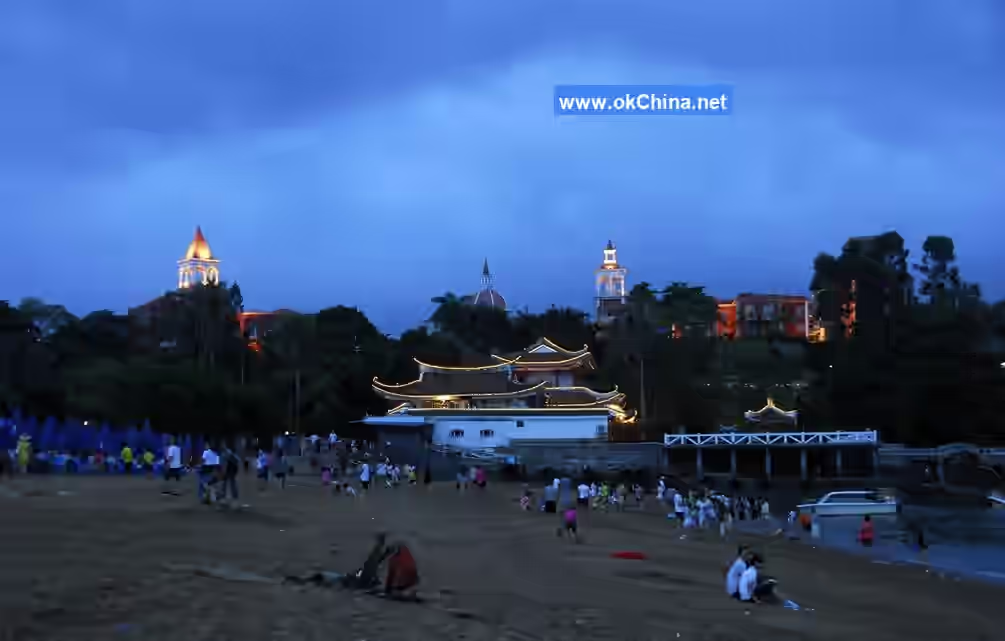
The Kulangsu Catholic Church is located at No. 34 Lujiao Road. The site originally housed the Spanish Consulate, which was later converted into the French Consulate after the Spanish Consulate was abolished. In 1916, Spanish Dominican missionary Manuel Prat was appointed Bishop of the Xiamen Diocese by the Holy See. He exchanged a building on Tianwei Road, which served as the Dominican convent, for the French Consulate and converted the consulate into the bishop's residence. In 1917, a church was built in front of the bishop's residence to serve as the cathedral, with a building area of 287 square meters. The church is a Gothic-style single-bell-tower structure. The main altar in the center enshrines a statue of Jesus the King, with two smaller altars on either side, accommodating about 200 people. The patron saint of the Kulangsu Catholic Church is Jesus the King, and it is also known as the Church of Jesus the King.
3.22 Lin Yutang's Former Residence
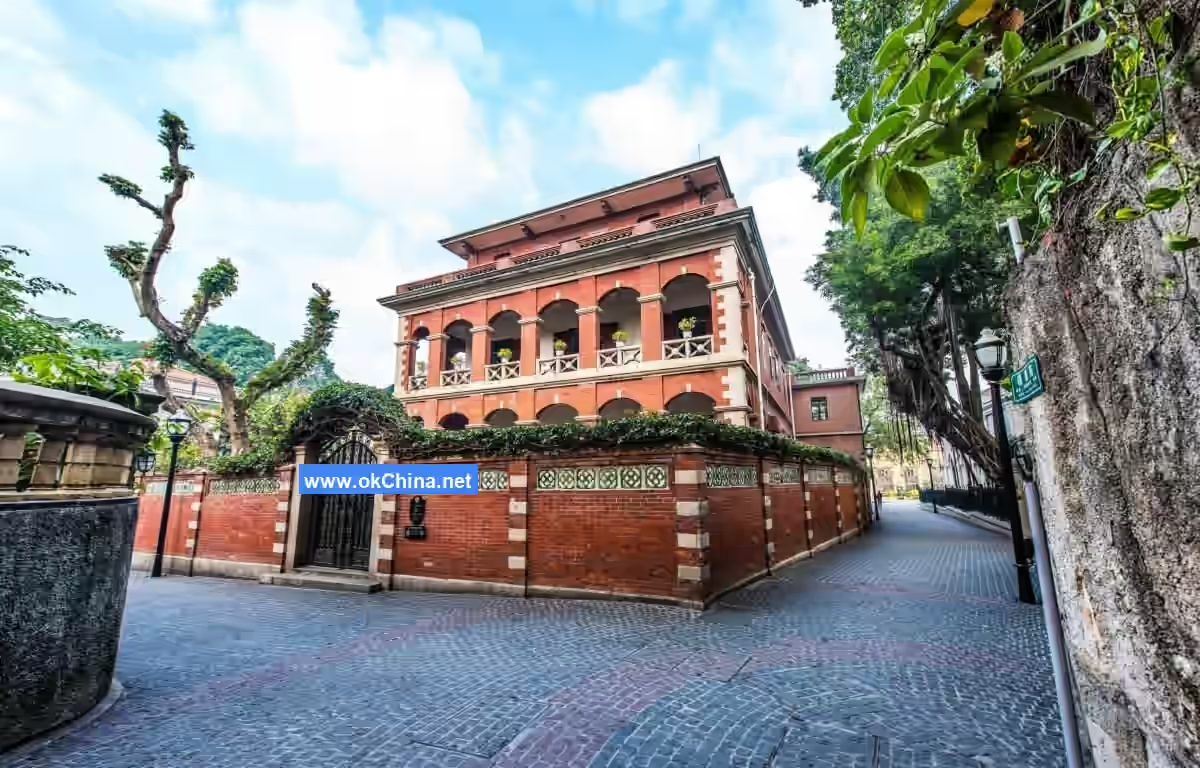
Lin Yutang's former residence is located at No. 44 Zhangzhou Road on Kulangsu. It is a U-shaped villa and one of the oldest villas on Kulangsu, built around the 1850s. It was once the residence of Lin Yutang and his wife, Liao Cuifeng. The villa is in English style, with arched corridors. The front part consists of two rooms flanking a hall, with a two-story sloping roof. The central rear part features a small flower garden, with two-story buildings on either side connected to the main front building. The backyard also includes a fish pond. The villa's moldings are intricate and overlapping, while the second-floor railings are relatively simple. The underground moisture-proof layer is not too low, ensuring dryness and comfort in the rooms above. In front of the arched hall on the first floor, there is a long stone staircase surrounded by ancient banyan trees, longan trees, and magnolias, casting dense shade over the small garden.
4. Scenic Area Culture
4.1 Historical Development
Kulangsu appeared as early as the Neolithic Age over 3,000 years ago. By the Song Dynasty, people began to settle on Kulangsu, and the population gradually grew over time. During the Ming Dynasty, Kulangsu was developed. In 1573, the earliest stone inscription on the island, "Gulang Dongtian," appeared on Sunlight Rock. In 1586, the Lotus Nunnery was established on Sunlight Rock. In 1650, Zheng Chenggong set up camp on Sunlight Rock to train naval forces, leaving behind sites such as the "Camp Gate," "Naval Training Platform," and "Fujing Spring."
In August 1841, the British fleet captured Kulangsu and set up artillery on the hilltop to control Xiamen. In August 1842, the Qing government signed the unequal Treaty of Nanjing with Britain, making Xiamen one of the five treaty ports. Subsequently, Britain, the United States, and Spain established consulates on Kulangsu.
After the Opium War, Xiamen was designated as one of the five treaty ports, and countries such as Britain, the United States, Germany, France, and Japan established consulates on the island. In 1844, the U.S. government sent Columbus to Xiamen and set up a "Communication and Postal Office" next to the Tianwei Ball Field on Kulangsu, also acting as a consulate. In 1865, the office was upgraded to a consulate and later moved to Sanhe Road (now No. 26 Sanming Road).
In 1902, after the "Xiamen Kulangsu Public Land Regulations" and the "Supplementary Public Land Regulations" came into effect, the British-led Municipal Council and Mixed Court were established on the island to handle local administrative and judicial affairs. From then on, Kulangsu effectively became an international settlement. During the occupation of Xiamen, after the Pearl Harbor incident, the island was occupied by Japan.
In December 1941, the Pacific War broke out, and Japan occupied Kulangsu exclusively. On August 15, 1945, Japan surrendered unconditionally, and Kulangsu returned to the hands of the people of Xiamen. At the end of 1945, during the Kuomintang rule, a district was established on Kulangsu. After the founding of the People's Republic of China, it continued to be called Kulangsu District.
On April 26, 2003, the former Kulangsu District, Kaiyuan District, and Siming District were merged to form the new Siming District. At the same time, after the abolition of the Kulangsu District as an administrative division, the Kulangsu Subdistrict Office was established within its administrative area.
On July 13, 2006, historical buildings on Kulangsu were transformed into bars, cafes, bookstores, etc. Relevant departments launched investment promotions for some historical buildings with clarified property rights.
On November 29, 2014, Xiamen implemented the "Island-wide Museum" plan for Kulangsu, incorporating key historical buildings and multinational consulates into a public, wall-less ecological museum system. In the same year, Kulangsu completed the restoration design plans for 13 national key cultural relics protection units, including the former U.S. Consulate, the former HSBC Manager's Residence, the Catholic Church, Anxian Building, and the former Xiamen Customs Commissioner's Residence.
4.2 Architectural Culture
Before the Opium War, Kulangsu was a sparsely populated island for a long time. It was not until the Song and Yuan dynasties that it was named "Yuanshazhou," and the name "Kulangsu" began to be used during the Ming Dynasty. The island's economy was mostly semi-fishing and semi-agricultural, and the earliest houses were simple dwellings. The original residential forms of the Southern Fujian Triangle naturally influenced the housing styles on Kulangsu. Thus, before foreigners arrived on Kulangsu, the houses on the island were no different from those on the mainland—the Southern Fujian coastal golden triangle (Xiamen, Zhangzhou, Quanzhou). On modern Kulangsu, there still exist ancient residential complexes with two or four courtyards.
From the late Ming and early Qing dynasties until the Opium War, architecture on Kulangsu began to change, with the emergence of Western buildings. After Xiamen became a treaty port, foreign colonists settled or temporarily resided on Kulangsu. Kulangsu became their preferred location for development. With its superior geography, climate, and scenic conditions, Kulangsu was suitable for living, so 90% of the buildings on Kulangsu are residential. Foreigners first rented local houses to manage churches, schools, and hospitals. As their influence grew and they gained a foothold, they gradually built missionary schools, missionary hospitals, churches, religious bookstores, and consulates. The largest number of constructions were still residential buildings such as mansions and villas. Many early overseas Chinese who went abroad to make a living returned to their ancestral homes in Southern Fujian after achieving success, choosing Kulangsu as the best place to settle. They invested in Kulangsu and built many luxurious residences. Many of these buildings were enormous in scale, surpassing those of foreigners, and were constructed with the finest materials and techniques at great expense. On Kulangsu, many of these grand residences have been converted into public buildings by the government.
After liberation, the Xiamen Municipal People's Government and the Kulangsu District Government took over some large buildings. After renovation and decoration, some public spaces were completely revitalized. For example, the enormous "White House-style" building—Lin Heshou's "Bagua Building"—was converted into the Kulangsu Organ Museum. Many larger mansions and villas, with their inadvertently created forms, have been renovated and transformed into buildings that suit their shapes and functions, becoming meaningful and iconic structures on Kulangsu.Approximately 70% of the buildings on Gulangyu Island were constructed from the early 20th century to the 1920s and 1930s. In addition to structures built by foreigners and overseas Chinese, local military personnel and civilians also actively built houses. Some local celebrities and wealthy families often hired foreign designers to create blueprints, used existing designs, or imitated the styles of surrounding houses, resulting in residences that were often grand in scale, richly decorated, and meticulously crafted. Beyond residential buildings, many overseas Chinese also invested in public utility structures, established construction companies, formed construction teams, and developed numerous roads, neighborhoods, and shops. Notable overseas Chinese entrepreneurs such as Huang Yizhu, Li Qingquan, and Huang Zhongxun invested heavily in Gulangyu, developing the real estate industry, constructing and selling residential properties, and founding public utilities like telephone and telegraph companies, waterworks, and docks. Before the War of Resistance Against Japan, the buildings on Gulangyu were well-arranged and varied in design. During the War of Resistance and the Liberation War, some structures suffered varying degrees of damage.
Comments
Post a Comment