
Guangfu Ancient City Scenic Area in Handan
I. Introduction
Guangfu Ancient City Scenic Area in Handan, abbreviated as Guangfu Ancient City Scenic Area, is a tourist attraction located in Yongnian District, Handan City, Hebei Province. Guangfu Ancient City boasts a profound historical and cultural heritage, picturesque northern water town scenery, and a long-standing Tai Chi culture. It is a unique ancient city, water city, and Tai Chi city in China.
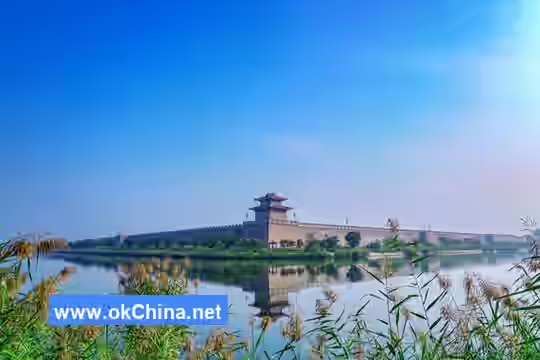
Guangfu Ancient City has a history of over 2,600 years. Its ancient city wall has a circumference of 4.5 kilometers, and the inner city covers an area of 1.5 square kilometers. The city is situated within the Yongnian Depression, which spans 46,000 mu. Surrounding the city wall is a 5-kilometer-long, 100-meter-wide moat, beyond which lies wetlands. The "one city, two waters" landscape forms a unique feature of Guangfu. The depression is perennially waterlogged and is praised as the "Little Jiangnan of the North." Guangfu Ancient City is the birthplace of Yang-style and Wu-style Tai Chi, having produced the founders of the two major schools, Yang Luchan and Wu Yuxiang. It is known as the "Home of Tai Chi," from where Tai Chi spread across China and the world.
Guangfu Ancient City Scenic Area focuses on enhancing attractions such as Yang Luchan’s Former Residence, Wu Yuxiang’s Former Residence, Guangfu Museum, the Government Office, Fu Gong Memorial Temple, and Guangfu Water Street. It aims to create a world-class Tai Chi cultural tourism destination integrating ancient city sightseeing, Tai Chi sports, Tai Chi wellness, ancient city exploration, and wetland leisure.
On February 25, 2017, Guangfu Ancient City Scenic Area in Handan was officially recognized as a National AAAAA Tourist Attraction by the National Tourism Administration of the People’s Republic of China, becoming the second National 5A tourist attraction in Handan.
II. Geographical Environment
Location and Territory
Guangfu Ancient City Scenic Area in Handan is located in Guangfu Town, Yongnian District, Handan City, Hebei Province, 25 kilometers from the district government seat in Linmingguan.
Topography
Guangfu Ancient City Scenic Area is situated in the center of the Yongnian Depression, one of the three major depressions in Hebei Province, covering an area of 46,000 mu. Surrounding the city wall is a 5-kilometer-long moat. The average elevation of the depression’s land surface is 41 meters, and it is perennially waterlogged, earning it the praise of "Little Jiangnan of the North" and "Second Baiyangdian."
Climate Characteristics
Guangfu Ancient City Scenic Area features a typical temperate semi-humid continental monsoon climate, characterized by distinct seasons, mild temperatures, ample sunlight, simultaneous rain and heat, and periodic droughts. The prevailing wind direction throughout the year is southerly.
Hydrological Features
Located on the southern edge of the North China Plain and surrounded by the Yongnian Depression, Guangfu Ancient City Scenic Area exhibits distinct geographical features of a plain wetland. The water surfaces within the depression are primarily artificial fish ponds, reed marshes, and lotus ponds, forming natural wetlands.
III. Main Attractions
Ancient City and City Wall
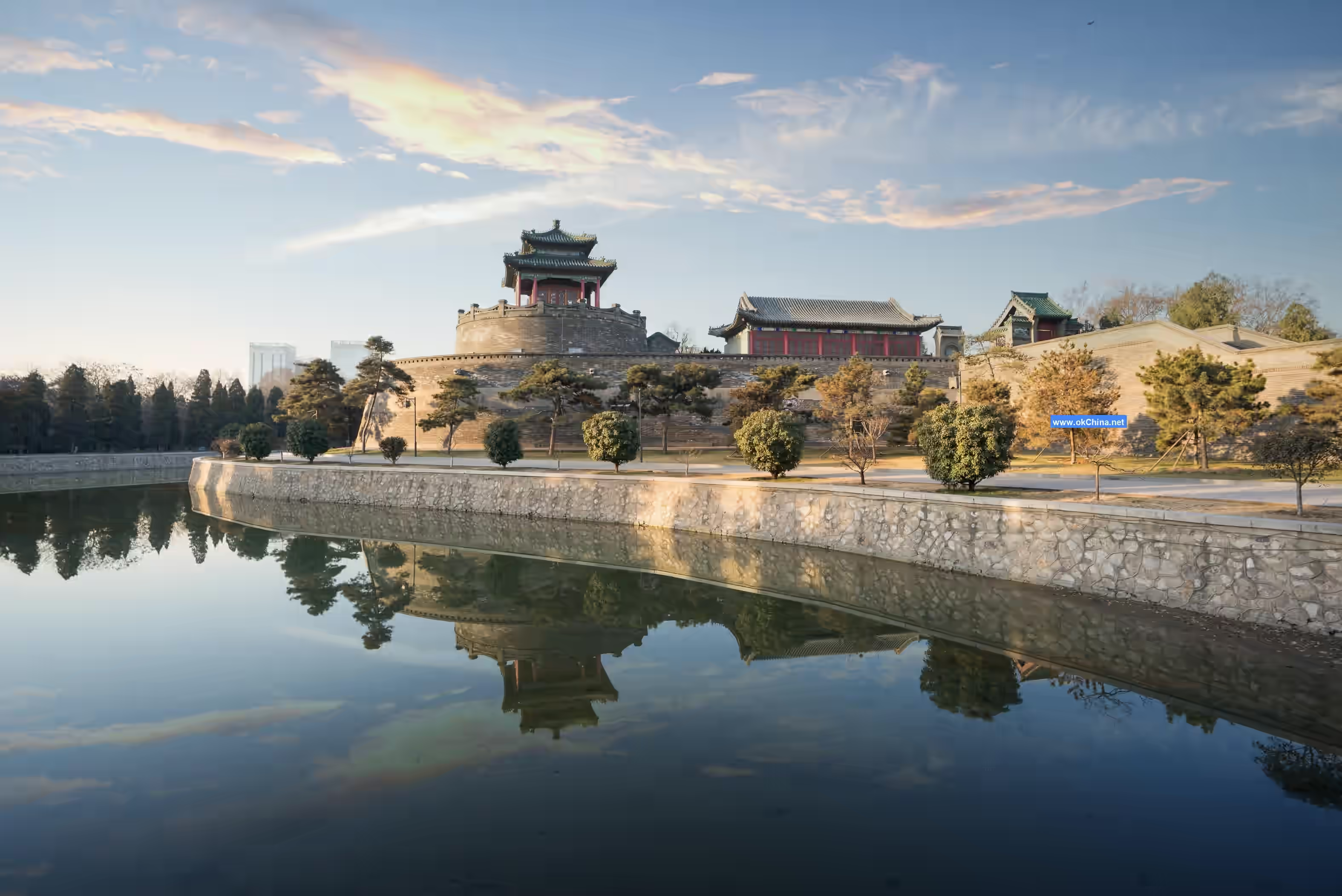
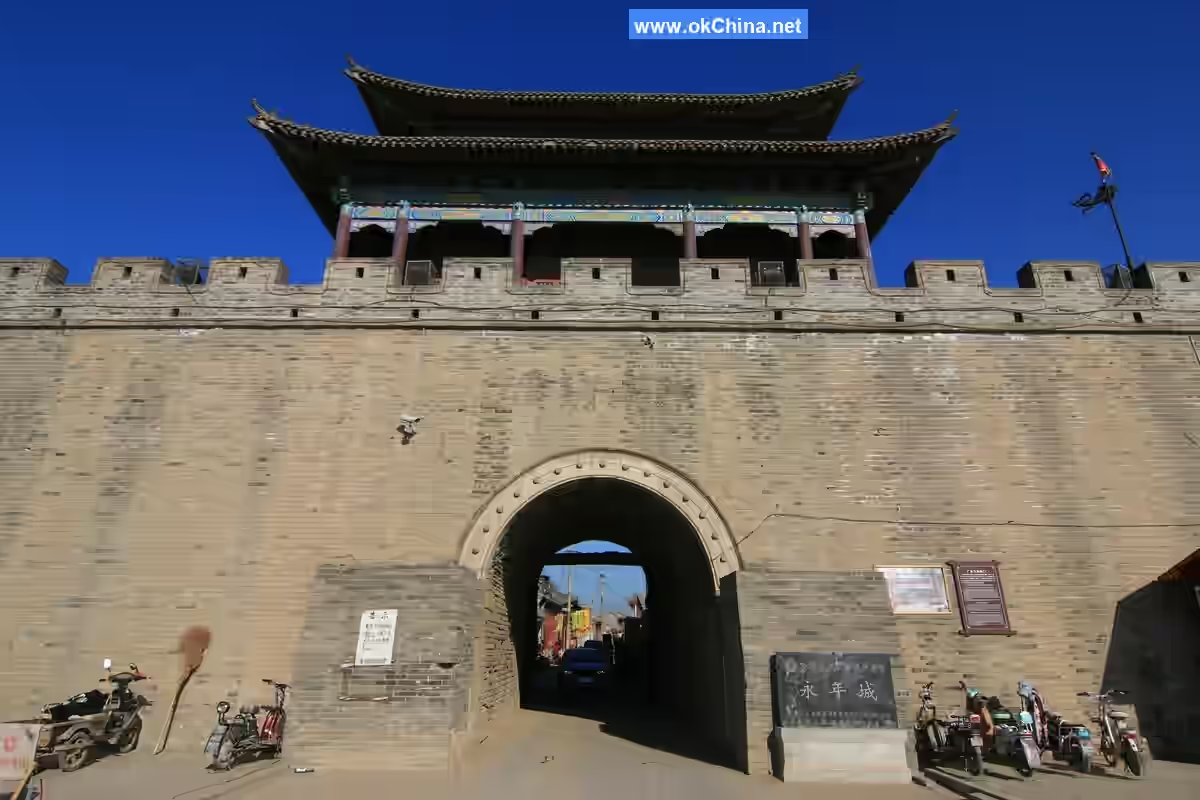
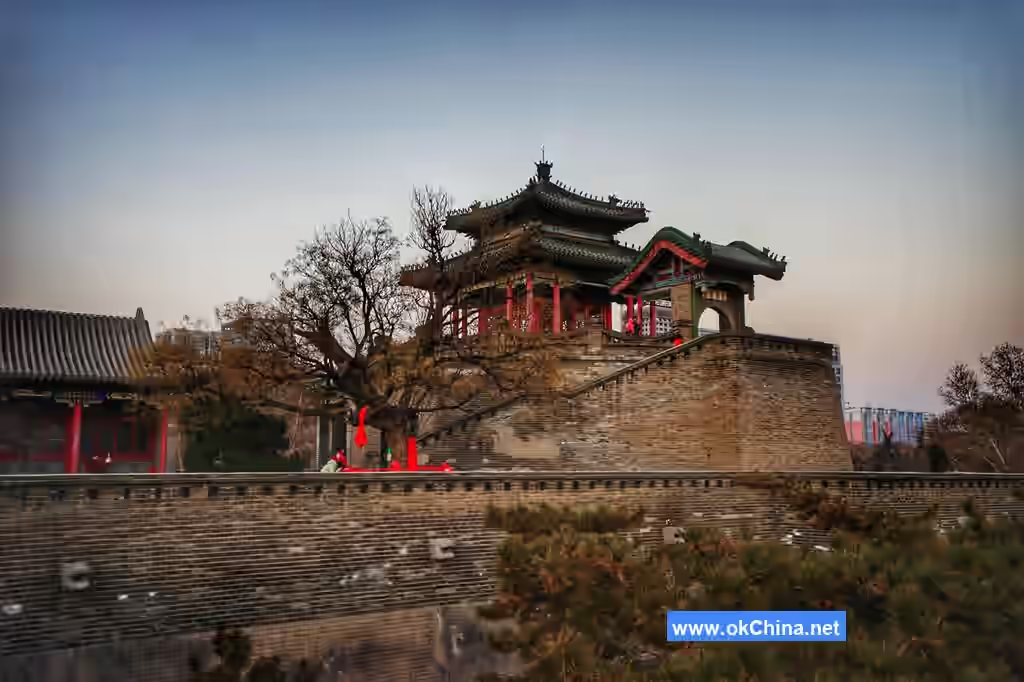
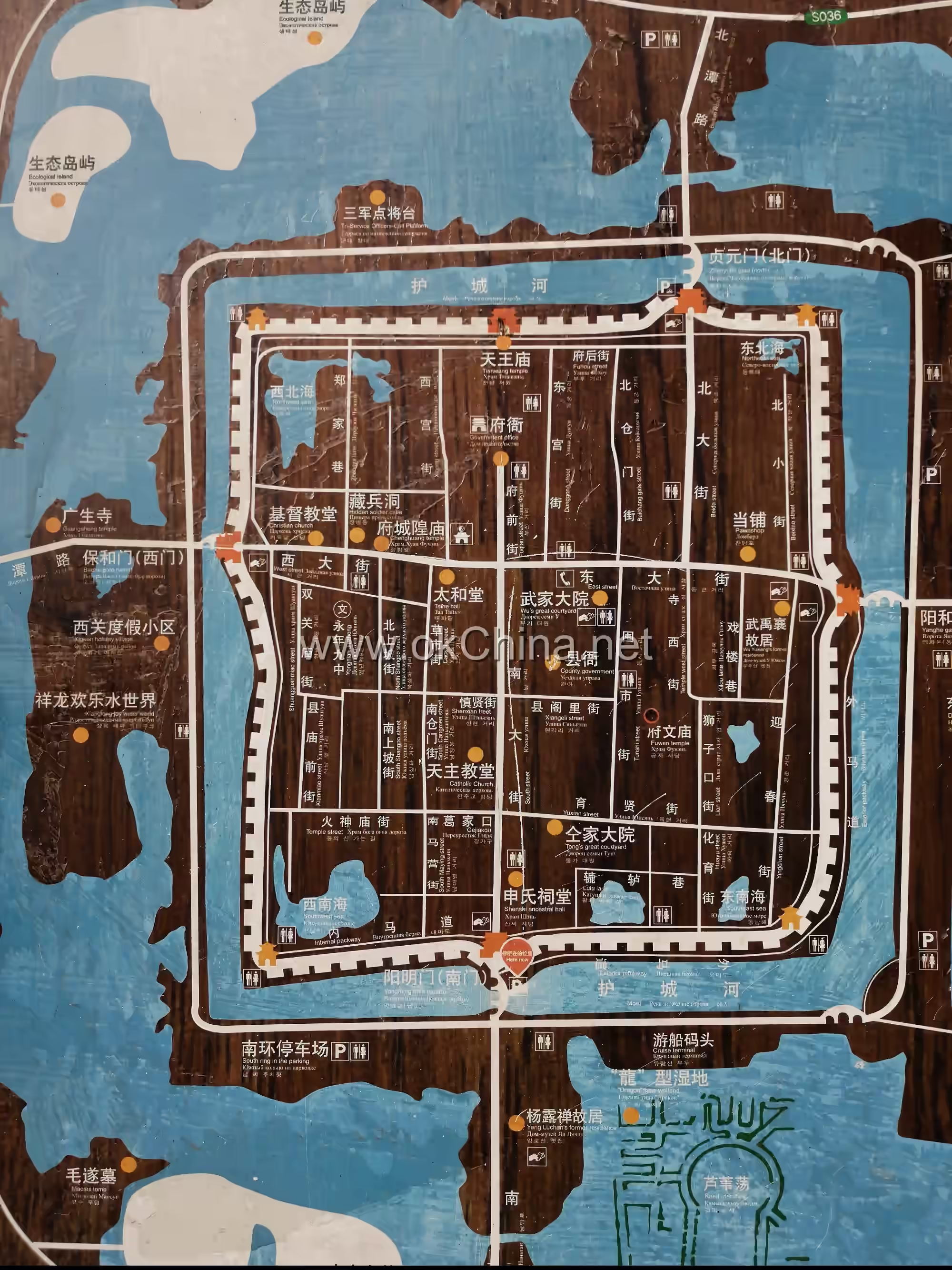
The ancient city and its wall are now designated as a National Key Cultural Relics Protection Unit. During the Spring and Autumn Period, it was called Quliang. In the Han Dynasty, it belonged to Guangping Kingdom and Guangping Commandery. During the Northern and Southern Dynasties, in the 20th year of Taihe of the Northern Wei Dynasty (496 AD), the seat of Guangping Commandery was moved to Quliang City. In the Sui Dynasty, it was called Guangnian and Yongnian City. In the Tang Dynasty, it was also known as Mingzhou. During the Yuan Dynasty, it served as the seat of Guangping Circuit, and in the Ming and Qing Dynasties, it was the seat of Guangping Prefecture. Before the Yuan Dynasty, the Guangfu city wall was made of earth. The existing wall dates to the Ming Dynasty and includes structures such as the eastern and western barbicans, four city gates, corner towers, and gate towers, showcasing the architectural artistry of ancient Chinese city walls. The streets within the city retain the scale and orientation of Ming Dynasty streets, and many Qing Dynasty residential buildings are well-preserved. Since the establishment of the county in the Western Han Dynasty, the city has served as the county seat. Subsequently, whether as a commandery, prefecture, or county, its administrative seat remained here, making it the political, economic, military, and cultural center of southern Hebei at the time. In the second year of Wude of the Tang Dynasty (619 AD), Dou Jiande established his capital here, naming the state Xia. According to Lu Tai’s "Brief Records" from the Ming Dynasty: "Guang Prefecture connects Yan and Zhuo to the north, Zheng and Wei to the south, Qi and Lu to the east, and Qin and Jin to the west. Historically, it is known as a major metropolis between the Zhang and He rivers." The Qing Dynasty’s "Yongnian County Annals" record: "The old city wall was built of earth, with a circumference of 6 li and 240 bu. During the Yuan Dynasty, it was expanded to 9 li and 13 bu, square in shape, 3 zhang and 5 chi high, and 2 zhang and 5 chi wide. It had four gates: east called Yanghe, west called Baohe, south called Yang, and north called Zhenyuan. It was rebuilt during the Chenghua period of the Ming Dynasty. In the 21st year of Jiajing of the Ming Dynasty (1542 AD), the wall was heightened and faced with bricks and stones. Gate towers, four corner towers, and 26 watchtowers were built on top, with 29 internal passages and surrounding gates and walls. In the 43rd year of Jiajing of the Ming Dynasty (1564 AD), Prefect Cui Dade added four barbicans for flood prevention and military defense. In the 12th year of Chongzhen of the Ming Dynasty (1639 AD), the old 1,752 battlements were reduced to 876, 57 additional watchtowers were built, the parapet walls were raised by 3 chi, and additional gate towers and watchtowers were added outside each barbican. In the 7th year of Kangxi of the Qing Dynasty (1668 AD), the city was flooded, and several sections collapsed. Repairs were carried out periodically thereafter. In the 7th year of Tongzhi of the Qing Dynasty (1868 AD), additional battlements were added, and eastern, western, and northern gate pavilions were constructed." The streets within the city consist of four main streets, eight small streets, and seventy-two alleys.
Guangping Prefectural Office
Guangping Prefectural Office, historically one of the three famous prefectures south of the capital, is located at the northern end of the north-south central axis of Guangfu Ancient City, facing South Street, with a relatively high architectural standard. The prefectural office was built on the original site of the Wanchun Palace constructed by Xia King Dou Jiande in the early Tang Dynasty. According to the Ming Dynasty’s Jiajing-era "Guangping Prefecture Records," the original construction date of the prefectural office is unknown, only noting that it was destroyed by war at the end of the Yuan Dynasty. In the 8th year of Hongwu of the Ming Dynasty (1375 AD), Prefect Shi Zhao rebuilt it. In the 15th year of Wanli of the Ming Dynasty (1587 AD) and the 9th year of Chongzhen of the Ming Dynasty (1636 AD), Prefects Jiang Yizhong and Cheng Shichang both carried out renovations. Since the Qing Dynasty, fifteen prefects have repaired or added other buildings. In the 17th year of the Republic of China (1928 AD), County Magistrate Xu Zhizhou rebuilt it again. After reconstruction, the prefectural office covers an area of approximately 53,000 square meters, with a building area of over 5,600 square meters, comprising 19 courtyards of varying sizes and more than 160 rooms. The architectural layout is symmetrical along the central axis. At the southernmost end is the ceremonial gate. Inside the ceremonial gate, on either side, the six departments of the prefectural office are arranged according to the tradition of civil officials on the left (east) and military officials on the right (west), with civil officials taking precedence. From north to south on the east side are the Personnel and Household Departments and the Rites Department, while from north to south on the west side are the Military and Justice Departments and the Works Department, corresponding to the six ministries of the imperial court. The main hall of Guangping Prefectural Office is the core institution, where the prefect received imperial edicts, held grand ceremonies, and tried major cases. On the east side of the central axis are the East Reception Hall, Horse God Temple, Grand Flower Hall, East Lake Theater, kitchen, etc. On the west side are the West Reception Hall, Advisors’ Room, Lotus Pond, Officials’ Room, Self-Comfort Pavilion, accounting office, and other buildings.
Yang Luchan’s Former Residence
Yang Luchan’s Former Residence is located at Nanguan in Guangfu City and is now a Hebei Provincial Key Cultural Relics Protection Unit. Originally, there were two courtyards, north and south. The north courtyard served as the residence, and the south courtyard as the shop, covering an area of 980 square meters, but they were long destroyed. The former residence faces west and is divided into two sections. Originally, it included five tea sheds, main rooms, side rooms, a martial arts hall, and other structures. After the First China Yongnian International Tai Chi Friendship Meeting in 1991, to promote Tai Chi culture, the Yongnian County Government established the Yang Luchan Former Residence Preparatory Committee and rebuilt and expanded it on the original site in 1992. The former residence consists of two courtyards, front and back, in the northern Qing Dynasty architectural style.
Wu Yuxiang’s Former Residence
Wu Yuxiang’s Former Residence is located on East Street (also known as Yingchun Street) within the city, covering an area of 9,000 square meters. Originally, it had 75 rooms, of which 42 remain. It is a building from the Daoguang period of the Qing Dynasty. In the southern part of the front courtyard, where the inverted rooms are located, a spacious and bright sedan room was built. North of the sedan room is the main building of Wu Yuxiang’s Former Residence. This architectural complex faces south and consists of three axes: east, west, and central. The buildings on the central axis form the core of the compound, following the common northern three-courtyard siheyuan (quadrangle) layout. On either side of the central axis buildings, there were originally east and west axis buildings. Although also three-courtyard siheyuan, their architectural nature and style were similar to those on the central axis, but their scale and building height were slightly lower, and the decorations were simpler. These no longer exist. The eastern part is now civilian housing, and only two study rooms remain in the southern section of the western axis. Originally, in the backyard of the Wu-style former residence, there was a rear garden measuring 60 meters east-west and 40 meters north-south. The garden was lush with flowers and trees, featuring rockeries, lotus ponds, pavilions, a turtle pond, and a martial arts training ground, but it no longer exists.
Hongji Bridge
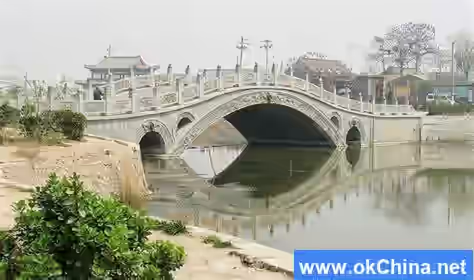
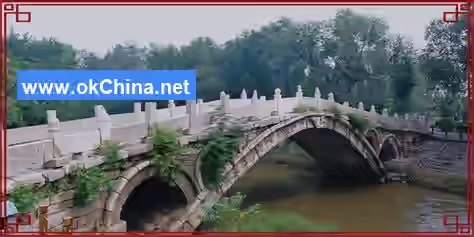
Hongji Bridge is located in Dongqiao Village, 25 kilometers east of Guangfu Town, Yongnian District, Handan City, Hebei Province, spanning the Fuyang River from east to west. Hongji Bridge is a single-arch open-spandrel stone arch bridge built with bluestone. The large arch resembles a rainbow flying across, with two small arches at each end, creating a grand and spectacular design. The bridge is 48.9 meters long from east to west, 6.82 meters wide, with a main arch span of 31.88 meters and a rise of 6.02 meters. It is composed of 18 longitudinal single arches, connected by iron waistbands between the arch stones. The exterior is carved with dragon heads, phoenixes, two dragons playing with a pearl, etc. The exterior of the small arch at the western end is carved with flying dragons and intertwining flowers. The bridge deck has 18 square balusters on both sides, with carvings of lions, monkeys, peaches, etc. There are 34 parapet panels and 4 drum-shaped bearing stones, carved with animals, flowers, and relevant historical allusions. On the exterior of the central parapet panel, "Hongji Bridge" is inscribed, with the notation: "Built by Guangping Prefect Jia Yingbi, Judge Gong Jiachen, Subprefect Zhou Ping, and Assistant Prefect Dong Xuan. Erected on an auspicious day in the tenth month of the Renwu year, the tenth year of Wanli." Originally, a stele from the 14th year of Daoguang commemorating the bridge’s renovation stood at the bridgehead. Hongji Bridge is also known as the sister bridge of Zhaozhou Bridge. In May 2006, it was announced by the State Council as part of the sixth batch of National Key Cultural Relics Protection Units.
Wu Family Compound
Wu Family Compound is located on Tunshi Street, south of East Street in Guangfu. Originally the former residence of Wu Ruqing, it follows the layout of a large four-courtyard, three-section mansion for a third-rank official. It is largely preserved in its original state, representing a traditional large official residence with four courtyards and three sections. It is the most complete and largest existing large-scale residential compound in Guangfu, possessing significant historical, cultural, and artistic aesthetic value.The Wu Family Compound is divided into three sections along east, central, and west axes. The eastern section includes a courtyard house and a garden square, while the western section features a private school and an opera tower.
Ganlu Temple
Ganlu Temple is located 300 meters south of the road at Dongguan in Guangfu Ancient City, Yongnian District, Hebei Province. To the east lies a small forest park, to the south a thousand-acre ecological sightseeing garden, to the west the Dongguan New Village of Guangfu Ancient City, and to the north the renowned Tai Chi Square and Silicon Valley Chemical Industrial Park. It is a famous ancient temple with a history of over a thousand years in southern Hebei. Originally built during the Northern Wei Dynasty, Ganlu Temple, like the ancient Guangfu City, has weathered the vicissitudes of history, experiencing periods of prosperity and decline over its 1,400-year history. According to the Yongnian County Annals, the temple was renovated during the Ming Dynasty and renamed Lotus Nunnery before being changed back to Ganlu Temple. During the Republican era, the temple was completely destroyed in the chaos of local bandit warfare. It was restored in 2006.
Guangfu Museum
The Guangfu Museum consists of two floors with a total construction area of 4,000 square meters. It is divided into three chapters: Guangfu, Tai Chi, and Yongnian. Utilizing sound, light, electricity, multimedia, and other technologies, the museum comprehensively showcases Guangfu’s historical culture, local customs, traditional practices, stories and legends, revolutionary history, ancient city culture, natural wetlands, and Tai Chi heritage across different sections and themes. The design is simple and elegant, highlighting Guangfu’s ancient charm and historical depth. Each chapter employs distinct classical elements in its layout, ensuring a harmonious flow and unity among the three sections.
Yongnianwa Wetland Park
Yongnianwa Wetland Park encircles Guangfu Ancient City, covering a total area of 1,070 hectares. It officially became a national wetland park in December 2017 after passing national evaluation. Yongnianwa is the third-largest wetland in Hebei Province, following Baiyangdian and Hengshui Lake. It primarily consists of natural wetlands and artificial wetlands, with natural wetlands further divided into marsh wetlands and lake wetlands. The wetland park is rich in animal and plant resources and is located along the central migration route for migratory birds in China. Every spring and autumn, large numbers of migratory birds pass through and rest here temporarily, while many summer migratory birds also inhabit and breed in the area. Yongnianwa is the only naturally formed typical inland freshwater wetland in southern Hebei and is designated as a national key flood storage and detention area by the Ministry of Water Resources. The construction of Yongnianwa Wetland Park has received significant attention from leaders at various government levels.
IV. Cultural Activities
Humanistic History
Throughout history, Guangfu Ancient City has attracted countless dignitaries, scholars, and artists who lingered and marveled at its charm. Tang Dynasty poet Li Bai and Qing Dynasty painter Zheng Banqiao, among others, left behind numerous poems and paintings. Notably, during the mid-Qing Dynasty, Fang Guancheng, the Governor-General of Zhili, passed through the area while combating locusts and distributing grain. Staying at Lotus Pavilion and gazing at the ancient city, he composed an impromptu poem:
"Rice fields stretch across a thousand plots, reed banks extend far and wide,
As I walk, my sleeves fill with the fragrance of lotus breezes.
Below Quliang City, the scent is as vast as the sea,
Near the eastern tower at dawn, water lies close by.
I long to set a small boat adrift beyond the dusty world,
And rest peacefully on a couch bathed in dew and light.
Where the worries of the hall have completely vanished,
My pure delight finds momentary harmony with gulls and fish."
This poem vividly captures the scenery of the ancient city at that time.
Guangfu boasts a long history and has long served as the political center of southern Hebei. It has produced numerous renowned figures across generations, including military leaders, statesmen, and experts in calligraphy, medicine, poetry, strategy, and divination, many of whom left behind rich literary works. Notable figures include Mao Sui, famous for his wit and courage; Ju Shou, whose strategic vision rivaled that of Zhuge Liang; Sima Shu, one of the Ten Great Talents of the Dali era in the Tang Dynasty; and Zhang Gai and Shen Hanguang, among the Three Great Talents of the Southern Region.
Tai Chi
Guangfu is also a fertile ground for profound folk culture. Its folk arts have a long and deep history, rich in meaning and endless fascination. The folk arts of Guangfu are diverse performance forms created by the people over thousands of years of labor and daily life.
Yang-style Tai Chi is expansive and graceful, while Wu-style Tai Chi is compact and precise. Both styles are known for their combination of softness and strength, blending gentleness with firmness. They are often described as "living sculptures, flowing music, and the pinnacle of sports." Yang-style and Wu-style Tai Chi have widespread influence, with disciples all over the world. Yongnian has been designated as the "Hometown of Tai Chi" by the National Sports Commission. It has hosted eight consecutive International Tai Chi Exchange Events, each attracting over a thousand Tai Chi enthusiasts and practitioners from various schools, making it a popular tourist attraction.
Guangfu has been awarded the titles "China Tai Chi Research Center" and "Hometown of Chinese Tai Chi" by the China Folk Artists Association. Since 1991, over ten China Tai Chi Exchange Conferences have been held in Guangfu, attracting enthusiasts from nearly 30 countries and regions. Every year, tens of thousands of Tai Chi lovers from Hong Kong, the United Kingdom, the United States, Japan, and other countries and regions come to compete, observe, and exchange skills.
Comments
Post a Comment