Goguryeo Cultural Relics and Historic Sites Tourist Area
1. Introduction
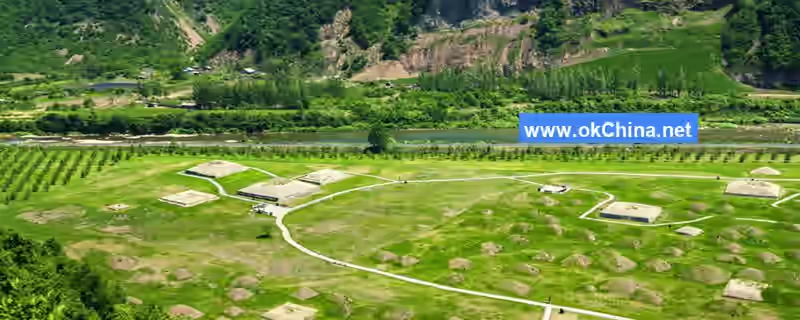
The Goguryeo Cultural Relics and Historic Sites Tourist Area in Tonghua City, abbreviated as the Goguryeo Cultural Relics and Historic Sites Tourist Area, is a tourist attraction located in Ji'an City, Tonghua City, Jilin Province. The total area of the scenic spot is 857,679 square meters.
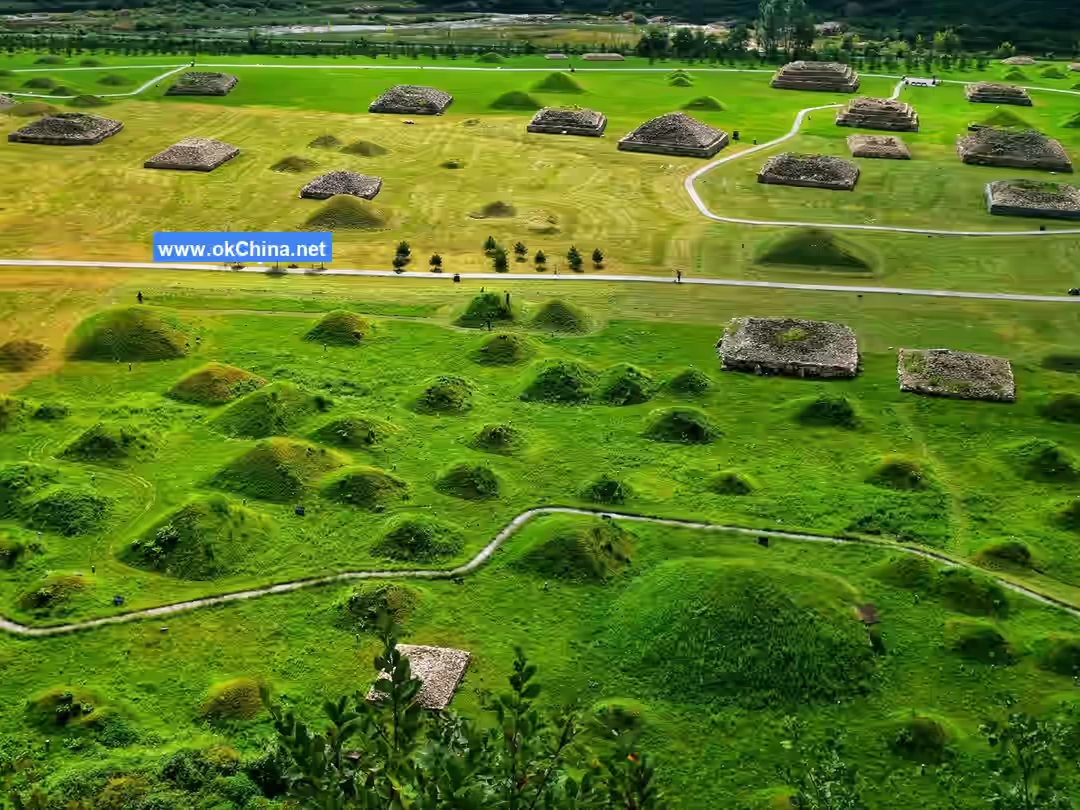
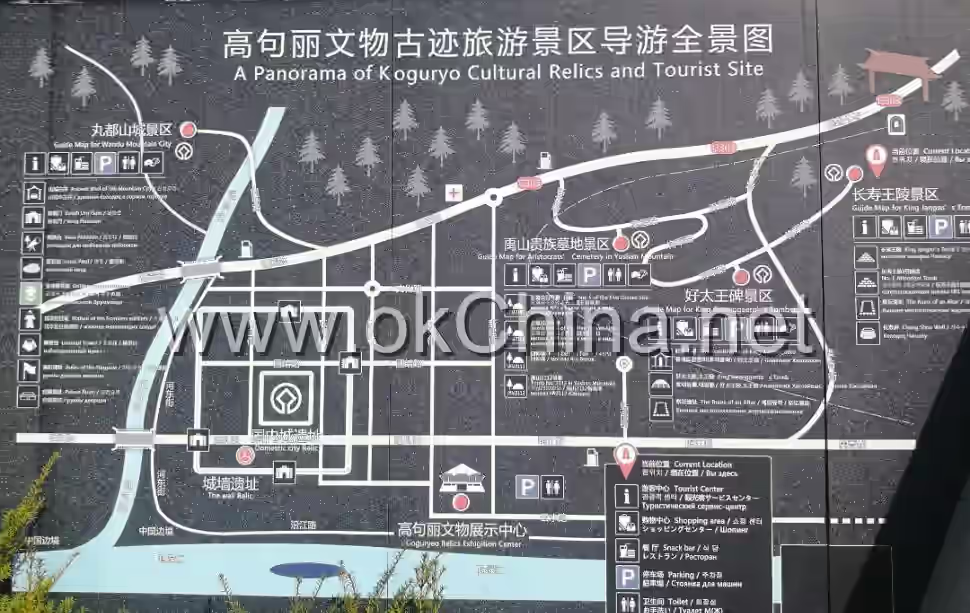
The Goguryeo Cultural Relics and Historic Sites Tourist Area opened to the public in 1980. Its main attractions include the Goguryeo Cultural Relics Exhibition Center, the Tomb of King Jangsu, the Stele of King Gwanggaeto (including the Tomb of King Gwanggaeto), the Yushan Noble Tombs, and the Wandu Mountain Fortress. The Ji'an City Museum is China's only specialized exhibition hall dedicated to Goguryeo. It currently houses over 11,000 cultural relics from the primitive society, Goguryeo, Balhae, and Liao-Jin periods, with more than 1,000 items on display. The Tomb of King Jangsu is the mausoleum of King Jangsu (Go Yeon), the 20th ruler of Goguryeo, and is the best-preserved among the 18 confirmed royal tombs. The Stele of King Gwanggaeto was erected in the 10th year of the Yixi era of the Eastern Jin Dynasty (414 AD). The stele body is carved from a single piece of breccia tuff and serves as a commemorative monument for King Gwanggaeto (Go Damdeok), the 19th ruler of Goguryeo. The Wandu Mountain Fortress was initially named "Weinayan Fortress" and was built in the 3rd year of the Yuanshi era of the Western Han Dynasty (3 AD). It is one of the famous city sites from the early and middle periods of Goguryeo. In the 3rd year of the Jian'an era of the Eastern Han Dynasty (198 AD), King Sansang (Go Yeon-u), the 10th ruler of Goguryeo, reinforced and expanded the fortress, constructing large-scale palaces and renaming it Wandu Fortress.
On January 7, 2020, the Goguryeo Cultural Relics and Historic Sites Tourist Area in Tonghua City, Jilin Province, was designated as a National AAAAA Tourist Attraction by the Ministry of Culture and Tourism of the People's Republic of China. It became the first National AAAAA Tourist Attraction in Tonghua City and the seventh in Jilin Province.
2. Geographical Environment
2.1 Location and Area
The Goguryeo Cultural Relics and Historic Sites Tourist Area is located in Ji'an City, Tonghua City, Jilin Province, with a total area of 857,679 square meters.
2.2 Climate Characteristics
Ji'an City, where the Goguryeo Cultural Relics and Historic Sites Tourist Area is located, generally experiences a northern temperate continental climate. The area south of the Laoling Mountains exhibits a distinct semi-continental oceanic monsoon climate. The four seasons are distinct, with spring winds arriving early and autumn frosts arriving late. The Laoling Mountain Range runs from northeast to southwest across the entire city, forming a natural barrier that blocks cold winds from the north. This allows warm and moist maritime air currents to travel upstream along the Yalu River, creating two microclimate zones in Ji'an City: south and north of the Laoling Mountains (the area south of the mountains has a semi-continental, semi-oceanic climate characterized by mild temperatures, humid air, abundant rainfall, and weak winds; the area north of the mountains has a temperate continental monsoon climate; there is a 10-15 day lag in temperature changes between the south and north of the mountains). The climatic conditions in Ji'an are considered the "four best" in the province: the highest average rainfall (annual rainfall of 800-1000 mm), the highest accumulated temperature (annual accumulated temperature of 3650°C), the longest frost-free period (about 150 days), and the lowest wind speed (annual average wind speed of 1.6 m/s).
3. Main Attractions
3.1 Ji'an City Museum
The Ji'an City Museum, also known as the Goguryeo Cultural Relics Exhibition Center, is located at No. 10333 Yunshui Road, Ji'an City. It has a construction area of 6,459 square meters (with an exhibition area of nearly 3,000 square meters), four floors, a plane diameter of 54 meters, and a vertical height of 23.5 meters. The overall structure is shaped like an eight-petaled lotus flower, reflecting traditional Chinese feng shui concepts and the Goguryeo people's fondness for lotus flowers and stone. The exhibition is titled "Exhibition of Goguryeo Historical Relics" and displays over 1,000 cultural relics. It comprehensively and intuitively presents the architectural features, production and daily life, military capabilities, culture and arts, religious beliefs, and other historical aspects of the Goguryeo people during the period when their capital was in Ji'an, recreating the glorious history of Goguryeo.
3.2 Yushan Noble Tombs
The Yushan Noble Tombs are a group of Goguryeo noble tombs, consisting of 12 ancient tombs. Tomb No. 5 of the Five Helmets Tombs is the only mural tomb open to the public and is one of its typical representatives. The tomb chamber is rectangular with a truncated, corbelled caisson ceiling. The interior stone walls are covered with colorful paintings. The four walls depict the Azure Dragon, White Tiger, Vermilion Bird, and Black Tortoise according to their respective directions, interspersed with flames, lotus flowers, human figures, and monster figures supporting the beams. The beams feature coiling dragons, and the caisson ceiling depicts deities, flowing clouds, stars, etc. Goguryeo murals are known for their bright colors, smooth lines, and rich content, earning them the title "Dunhuang of Northeast Asia."
3.3 Tomb of King Jangsu
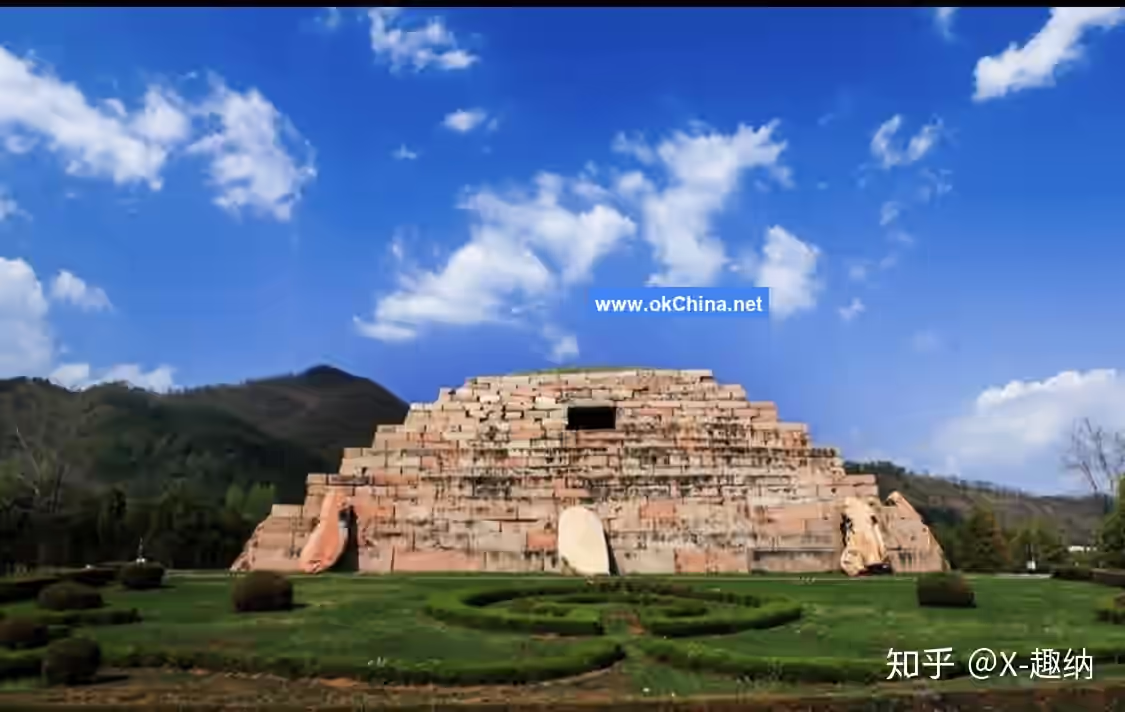
The Tomb of King Jangsu is the mausoleum of King Jangsu (Go Yeon), the 20th ruler of Goguryeo, built in the early 5th century, around the time of King Jangsu's accession to the throne.
The Tomb of King Jangsu was robbed in early times. In the late years of the Tongzhi reign of the Qing Dynasty, disaster victims from central China went beyond the Shanhai Pass to seek livelihood and entered the restricted area of Changbai Mountain. Seeing the grandeur of this tomb, they mistook it for the tomb of a general guarding the frontier, and it was erroneously passed down as the "Tomb of King Jangsu."
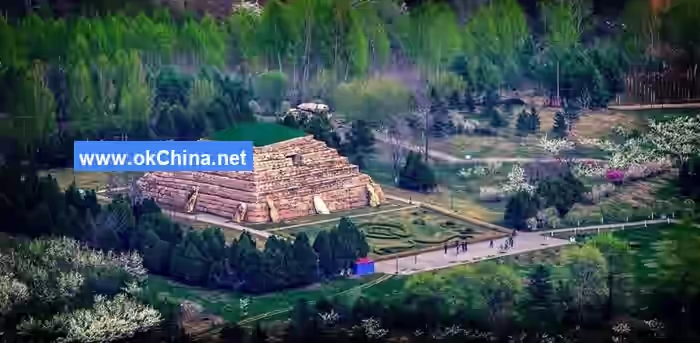
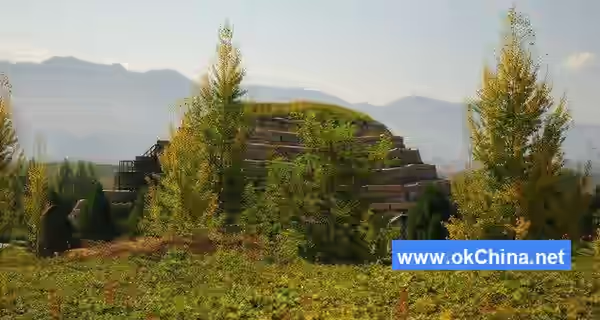
The Tomb of King Jangsu is backed by Longshan Mountain to the north, leans against Yushan Mountain to the west, has the Yalu River to the southeast, and faces an open sloping land in front, oriented towards the Stele of King Gwanggaeto and overlooking the Goguryeo capital city of Gungnae Fortress. It boasts superior terrain and magnificent architecture.
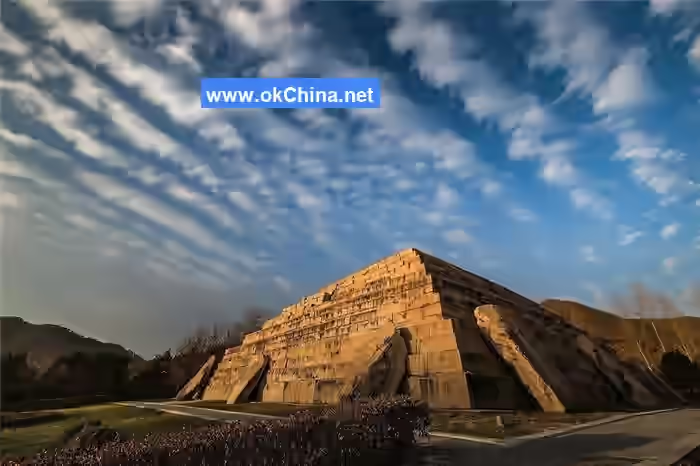
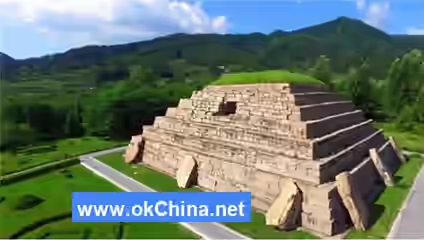
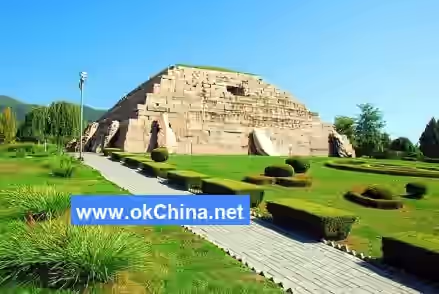
According to historical records, Goguryeo lasted for 705 years with 28 rulers. Among them, 18 royal tombs should be distributed within the Donggou Ancient Tomb Complex in Ji'an. The Tomb of King Jangsu is the best-preserved among the currently confirmed royal tombs. It belongs to the type of stepped stone-chamber tomb with a square platform. Its appearance is that of a truncated square pyramid, hence it is called the "Pyramid of the East." The Tomb of King Jangsu is built with finely crafted granite stone slabs. The base is nearly square, with a side length of 31.58 meters. Above it, there are seven steps formed by 22 layers of stone slabs gradually tapering inward. The tomb is 12.40 meters high and uses over 1,100 stone slabs.
The tomb chamber is built from the third step, and the tomb passage entrance is on the fifth step. The orientation is approximately 230 degrees (southwest). The tomb chamber is 5 meters long and 5 meters wide, with a height of 5.5 meters. Inside, one large and one small stone coffin platform are placed lengthwise. The capstone is a massive granite slab weighing over 50 tons. The top of the tomb has side lengths of 13.2-13.7 meters, with over 20 holes on each side where railings and structures on the tomb top originally existed. During excavation, a batch of architectural components such as cylindrical tiles, flat tiles, lotus-patterned eaves tiles, and iron chains inscribed with characters like "Tiao Yi" and "Tiao Liu" were unearthed from the soil.
The Tomb of King Jangsu is constructed with huge stone slabs filled with river pebbles in between. Its own weight creates outward tension. To counteract this tension and ensure stability, each side was originally supported by three massive stones weighing over 10 tons each; 11 of these stones remain today (one is missing from the middle of the rear side).
These massive stone slabs were transported from a quarry 22 kilometers away. Over 1,500 years ago, lacking transportation and lifting tools, Goguryeo craftsmen used methods like ice transportation, rolling logs, and earthen ramps to transport the stone slabs one by one and then stack them one by one, requiring immense hardship and effort. The construction of the Tomb of King Jangsu fully reflects the wisdom and ingenuity of the Goguryeo people.
The Tomb of King Jangsu once had a very extensive tomb garden and burial precinct. During conservation and repair work, a culvert was discovered about 60 meters to the south, which drained seepage water from the tomb top and chamber. To the northeast of the Tomb of King Jangsu, there is a row of subsidiary tombs oriented southeast-northwest; only one remains today, which is a stepped stone-chamber tomb. About 200 meters to the southwest, there is a sacrificial site covering an area of 5 hectares.
In the 4th year of the Shiguang era of the Northern Wei Dynasty (427 AD), the Goguryeo capital moved south to Pyongyang. There is doubt whether this tomb is indeed the Tomb of King Jangsu. However, based on the architectural style of Goguryeo royal tombs, the evolutionary pattern of their forms, and unearthed artifacts such as tiles, eaves tiles, and iron chains, it can be proven that the Tomb of King Jangsu was built in the early 5th century. Goguryeo kings built their tombs after ascending the throne, and King Jangsu was no exception. The relocation of the Goguryeo capital was due to the development trends of Goguryeo's power and the shift of its economic and cultural center. By the time King Jangsu moved the capital, the Tomb of King Jangsu was already completed, so he would not have started another tomb. He could only be buried here after his death. Since Gungnae Fortress was both the old capital and an important city, it was entirely reasonable for him to be buried there. Similar cases were common in the Central Plains region.
The tomb garden of the Tomb of King Jangsu is perfectly designed, and its stone craftsmanship is exquisite and refined. It can be considered the pinnacle of Goguryeo's stone-accumulation structure tombs and also a unique masterpiece—after this, stone-built tombs are no longer seen among Goguryeo royal tombs.
3.1 Stele of King Gwanggaeto
The Stele of King Gwanggaeto is the tomb stele of the 19th ruler of Goguryeo—"King Gwanggaeto the Great, Expander of Territory, Bringer of Peace and Security." It is also called the Gwanggaeto Stele or the Gwanggaeto Tomb Stele.
The Stele of King Gwanggaeto is made from a single piece of breccia tuff, slightly shaped, and roughly square-columnar in form. This type of stone is commonly found along the Yalu River in areas like Liangmin and Shangxia Huolong in Ji'an. The stele is 6.39 meters high, with face widths varying between 1.34 and 2.0 meters. After Goguryeo craftsmen shaped it, they erected it, then inscribed and carved the text. It is inscribed on all four sides with Chinese characters, totaling 44 lines with 41 characters per line. Excluding spaces for formatting and damaged/missing parts, there are 1,775 characters in total. The inscription is in Chinese characters, each about 9-10 cm in size, written in a solemn and heavy clerical script (lishu), while also retaining some elements of seal script (zhuan) and regular script (kai), forming a square and upright calligraphic style. It is an important example of the transition from clerical to regular script in Chinese calligraphy.
The inscription on the Stele of King Gwanggaeto is roughly divided into three sections.
The first section narrates the mythological legend of Goguryeo's founding: In the past, when the founding ancestor, King Dongmyeong, laid the foundation, he came from Northern Buyeo, the son of the Heavenly Emperor and the daughter of the River Earl. He was born from a split egg, possessing sagely virtue from birth. He ordered his carriage and traveled south, passing by the Amni River in Buyeo. The king, arriving at the ford, said: "I am the son of the August Heaven, the daughter of the River Earl, King Dongmyeong. For me, connect reeds to form a raft and turtles to float." Instantly, reeds connected to form a raft and turtles floated. Then he crossed. At the valley of Biryu, west of Holbon, he built his capital on the mountain.
Based on this, most scholars believe that the founding ancestor of Goguryeo, King Dongmyeong, came from Northern Buyeo (Buyeo was the most powerful northeastern minority regime during the Western and Eastern Han periods, centered around present-day Jilin City). The Goguryeo ancestor traveled south from Buyeo to the Jolboncheon area in the Hunjiang River basin (present-day Wunu Mountain City in Huanren) and established the Goguryeo regime.King Gwanggaeto the Great, whose personal name was Go Dam-deok, was the son of King Gogugyang, Go I-ryeon. In the 16th year of the Taiyuan era of the Eastern Jin Dynasty (391 AD), Go Dam-deok ascended the throne. He passed away in the 8th year of the Yixi era of the Eastern Jin Dynasty (412 AD). In the 10th year of the Yixi era (414 AD), his son, King Jangsu, Go Ryeon, erected this massive Gwanggaeto Stele 200 meters east of King Gwanggaeto's tomb to commemorate his father's achievements and to record the tomb-keeping households.
During King Gwanggaeto's 22-year reign, the Goguryeo state enjoyed political stability, economic prosperity, and a powerful military. The stele inscription records, "The people were at peace in their occupations, the state was rich and the people prosperous, the five grains were abundant and ripe." To commemorate King Gwanggaeto's lifetime achievements and to inscribe the tomb-keeping households, this stele was erected.
The second section, in considerable detail, records the military campaigns and activities of King Gwanggaeto's life, his expeditions in all directions to expand the territory.
In 395, because the Birye people did not submit, the King personally led a campaign to subdue them. In 396, the King personally led a naval force to attack the remnants of a state. In 398, he dispatched a detachment to observe the land and valleys of Bulsin, and opportunistically captured the city of Mosira and added over 300 men and women from the Tara Valley. In 399, Baekje violated its oath and allied with Wa (Japan). The King inspected and pacified Pyeongyang. In 400, he dispatched an army of 50,000 infantry and cavalry to rescue Silla. In 404, Wa acted treacherously, invading the Daebang region. The King personally led a punitive expedition. In 407, he dispatched an army of 50,000 infantry and cavalry to attack Baekje. They were slaughtered and completely destroyed. In 410, the King personally led a large army to subjugate Eastern Buyeo.
The stele primarily records campaigns against Baekje and Wa, while also aiding Silla. Baekje and Silla were two states in the southern Korean peninsula, west and east of the Nakdong River respectively. Wa refers to ancient states on the Japanese archipelago. Wa people repeatedly crossed the sea to harass Silla and Baekje on the Korean peninsula and, allied with Baekje, invaded Goguryeo's southern borders. Therefore, King Gwanggaeto personally led his army to defeat the Wa invaders, conquer Baekje, and capture 64 Baekje cities and over 1,400 villages.
Regarding the 396 campaign where King Gwanggaeto attacked Baekje and repelled the Wa invaders, to justify the military action, the stele inscription records the reason. This is the famous "Sinyo Year" clause, located in the lower part of the eighth line and upper part of the ninth line on the first face: "Baekje and Silla were formerly subject peoples who had long paid tribute. But Wa came crossing the sea in the Sinyo year, repeatedly defeating Baekje and Silla, making them subject peoples."
King Gwanggaeto's life, capturing cities and seizing lands, demonstrates formidable military prowess. Combining the stele inscription with relevant historical texts reveals the entirety of his military career. Of course, the stele does not record King Gwanggaeto's defeats, but this does not mean he never suffered losses. Furthermore, the "50,000 infantry and cavalry" mentioned in the inscription is likely an exaggeration. Nevertheless, the historical facts recorded on the stele are highly credible and possess significant historical value.
The third section records King Gwanggaeto's tomb-keeping households: 30 gukyeon (state households) and 300 ganyeon (guard households), totaling 330 families. The status of gukyeon was slightly higher than that of ganyeon, with a proportional relationship of one leading ten, serving as a microcosm of Goguryeo's social organization system of squads and platoons.
Simultaneously, it also engraves King Gwanggaeto's teachings during his lifetime and the tomb-keeping system, which holds great significance for researching Goguryeo's social life and royal burial customs.
During the early Qing Dynasty, from the Kangxi to Qianlong reigns, the Changbai Mountain region was sealed off for over two hundred years. The Gwanggaeto Stele was gradually forgotten amidst overgrown weeds. In the 3rd year of the Guangxu reign of the Qing Dynasty (1877 AD), Huanren County was established, and the scholar Guan Yueshan discovered the Gwanggaeto Stele. For over a hundred years, people have made rubbings, conducted textual research, and studied it. The Gwanggaeto Stele has become a specialized field of study internationally, continuously sparking research fervor.
The Gwanggaeto Stele is the earliest extant and most textually extensive archaeological historical material from Goguryeo. The discovery of the Gwanggaeto Stele confirmed the existence and center of the Goguryeo civilization, which had been forgotten by the world since the Middle Ages, holding an important position among archaeological sites in Northeast Asia.
3.1 Wandu Mountain Fortress
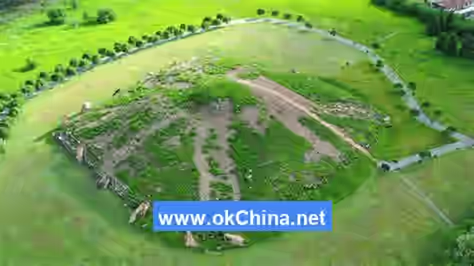
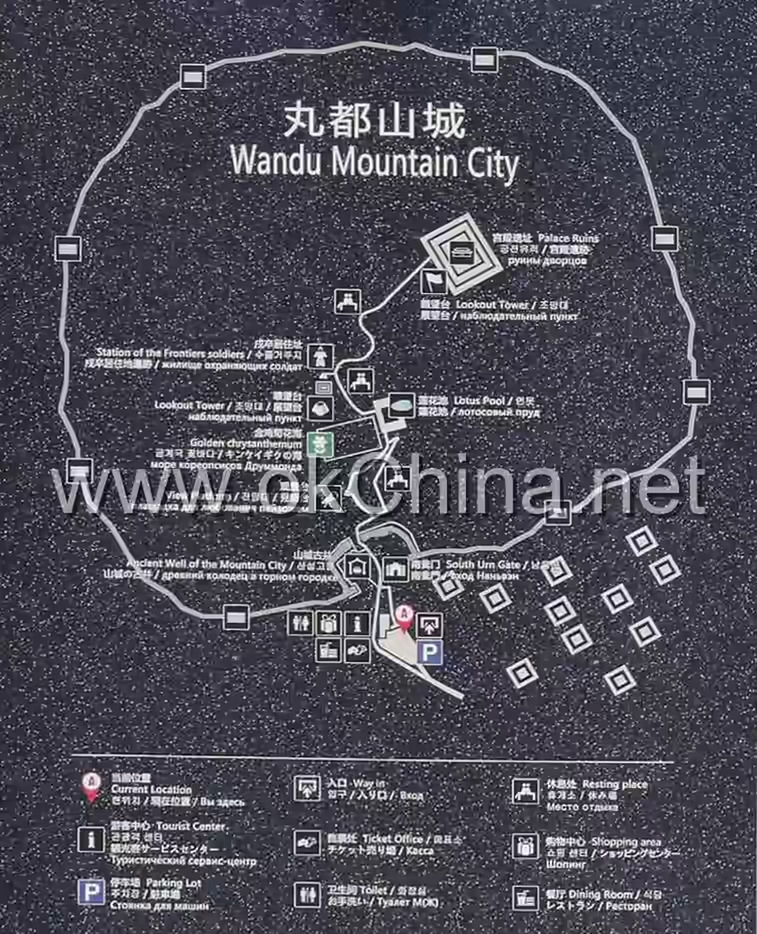
Wandu Mountain Fortress is located on a high mountain north of Ji'an city, 2.5 kilometers from the Gungnae Fortress. It is one of the famous city sites from the early and middle periods of Goguryeo. It served both as the military defensive fortress for Gungnae Fortress and was also used as a Goguryeo capital city, playing a significant role in Goguryeo's historical development. Wandu Mountain Fortress and Gungnae Fortress were interdependent, serving as complementary capitals, creating a new model of a composite capital city in the history of world capital architecture, writing a magnificent chapter in the history of ancient world capitals.
Wandu Mountain Fortress was initially named "Winaam Fortress." Historical records state that in the 3rd year of the Yuanshi era of the Western Han Dynasty (3 AD), Goguryeo moved its capital to Gungnae and built "Winaam Fortress." In the 2nd year of the Jian'an era of the Eastern Han Dynasty (197 AD), Goguryeo engaged in a large-scale war with the Gongsun regime, which was also subject to Cao Wei. Goguryeo was defeated, and Gungnae Fortress was destroyed. In the 3rd year of the Jian'an era (198 AD), the tenth Goguryeo King, King Sansang, reinforced and expanded Winaam Fortress, constructing large palaces, and renamed it Wandu Fortress. In the 14th year of the Jian'an era (209 AD), King Sansang moved the capital to Wandu. From then on, the overall layout of Wandu Mountain Fortress was basically complete, becoming the only mountain fortress capital during the Goguryeo period planned with a large palace site as its core.
Wandu Mountain Fortress was constructed by following the natural contours of the mountain to build its walls, resulting in undulating heights. Where cliffs were steep and perilous, low walls were built or none at all; where ridges were gentle, high walls were erected, creating high walls and sheer cliffs outside to enhance defensive capabilities. The mountain fortress is high in the north and low in the south, shaped like a "dustpan" tilting southward. The walls form an irregular rectangle with a circumference of 6,395 meters.
The eastern wall, the western section of the northern wall, and the northern section of the western wall are relatively well-preserved, reaching heights of 4-5 meters. They are constructed from over twenty layers of neatly trimmed rectangular and square stone blocks, demonstrating a rigorous structure. The stones generally measure 40-90 cm in length, 20-50 cm in width, and 10-30 cm in thickness. From bottom to top, each layer is slightly set back. The upper part has a parapet wall about 1 meter high, with a row of construction holes in the lower part of the parapet's inner wall, spaced about 2 meters apart. The entire fortress has six gate sites. There is one barbican gate at the southern valley entrance. Two gate sites each were discovered on the northeastern and northwestern city walls. One gate site is seen in the western part of the southern wall. No gate site was found on the western city wall.
There are two springs within Wandu Fortress, one at the northwest corner and one at the eastern foot of the mountain. They converge at the southern gate and flow into the Tonggou River.
Within the fortress, there are three surface ruins, one reservoir, and 38 tombs. The palace site is on the eastern hillside, measuring 96.5 meters north-south and 80 meters east-west, built on three terraced levels, with rubble and rows of foundation stones everywhere. The watchtower, also called the general's platform, is on a high ridge 200 meters north of the southern gate, built with piled stones, 11.75 meters high. From the platform, one can see the Tonggou plain and Gungnae Fortress. Fifteen meters north of the watchtower, a dwelling site for garrison soldiers was discovered. To the southeast, there is a reservoir also called "Horse Drinking Bay" or "Lotus Pond," with stone retaining walls still present in the northern part. The tombs within the fortress are mostly stone tombs, likely buried after the fortress was abandoned.
After the establishment of the Goguryeo regime, it repeatedly received investiture from Central Plains regimes and was subject to Central Plains dynasties of different periods. However, with the shifting balance of power between the Central Plains dynasties and Goguryeo itself, Goguryeo also frequently clashed with Central Plains dynasties and surrounding local powers. As the capital of Goguryeo in its early and middle periods, Wandu Mountain Fortress witnessed numerous battles. In the 4th year of the Jianwu era of the Eastern Han Dynasty (28 AD), Han forces attacked Goguryeo, pressing close to the capital. The Goguryeo king, nobles, and ministers retreated to Wandu. With provisions nearly exhausted, the situation was critical. The Left Assistant Euljudo offered a plan: to use carp from the pond and fine wine to entertain the Han army. An envoy, on behalf of King Daemusin, apologized to the Liaodong army commander: "I, a foolish man, have offended your superior state. I have caused you, General, to lead a million-man army to toil in my humble territory. Having nothing better to offer, I dare to present these meager things for your attendants." The Han army, thinking Wandu Fortress had ample water, grass, and grain, and that a prolonged siege would be disadvantageous, withdrew their troops.
In the 6th year of the Zhengshi era of Cao Wei (245 AD), because Goguryeo's King Dongcheon harassed Xi'anping in Liaodong, Guanqiu Jian, the Cao Wei Governor of Youzhou, led troops to attack Goguryeo. The first battle was at Liangkou; the Goguryeo army was defeated and fled. The Youzhou army pursued them to Chijianxian (around present-day Maxian Township Bancha Ridge), "bound the horses and suspended the chariots to ascend Wandu," and carved a stone to record the achievement. In the 30th year of the Guangxu reign of the Qing Dynasty (1904 AD), the Guanqiu Jian Victory Stele was unearthed on the hillside of Tianqiao Gully northwest of Bancha Ridge. The stele inscription precisely records the historical fact of Guanqiu Jian's campaign against Goguryeo and the capture of Wandu Mountain Fortress.
In the 8th year of the Xiankang era of the Eastern Jin Dynasty (342 AD), Goguryeo's King Gogugwon rebuilt Wandu Fortress and moved the capital there. Not long after, Murong Huang, the King of Yan, led an army that captured Goguryeo, burned the palaces of Wandu Fortress, and left. King Gogugwon moved the capital back to the plain fortress again. From then on, Wandu Fortress gradually declined.
Wandu Mountain Fortress uses the surrounding mountains as a screen, the mountainside for palaces, and valley entrances as gates, fully embodying the traditional Chinese concept of "feng shui." The mountain fortress had strong defenses, yet inside it was spacious and comfortable with a beautiful environment, integrating architecture, military, life, production, and the natural environment into one harmonious whole. It pioneered the architectural model of a "dustpan-shaped" mountain fortress perfectly integrated with the natural environment. This creation based on local conditions has strong ethnic characteristics and fully demonstrates the Goguryeo people's architectural talent and city-building philosophy. Goguryeo's ingenious ideas in constructing Wandu Mountain Fortress made it an outstanding example of medieval capital city architecture.
4. Cultural Activities
4.1 Main Activities
On the morning of May 18, 2024, the Ji'an City Museum carried out activities for International Museum Day (May 18).
4.2 Specialty Cuisine
Ji'an Fire Pot Ji'an Fire Pot is a traditional delicacy known for its rich and fragrant ingredients. It encompasses over ten types of ingredients including beef, pork, tripe, pork stomach, beef tendon, tofu, Korean sausage (sundae), soybean sprouts, and more, making it extremely abundant. A heated flat pan is layered with meat, tofu, and bean sprouts. Pre-cooked meat ingredients stir-fried with secret seasonings are added, along with some Korean sausage. The pot base is heated with charcoal fire, keeping the dish steaming hot throughout. The preparation technique of the fire pot has undergone continuous inheritance and innovation, gradually adding numerous flavors like seafood, pork, mutton, chicken, mushrooms, etc., breaking the traditional impression of the unchanging Korean fire pot.
Comments
Post a Comment