
Fujian Tulou (Yongding · Nanjing) Tourist Area
1. Introduction
Yongding
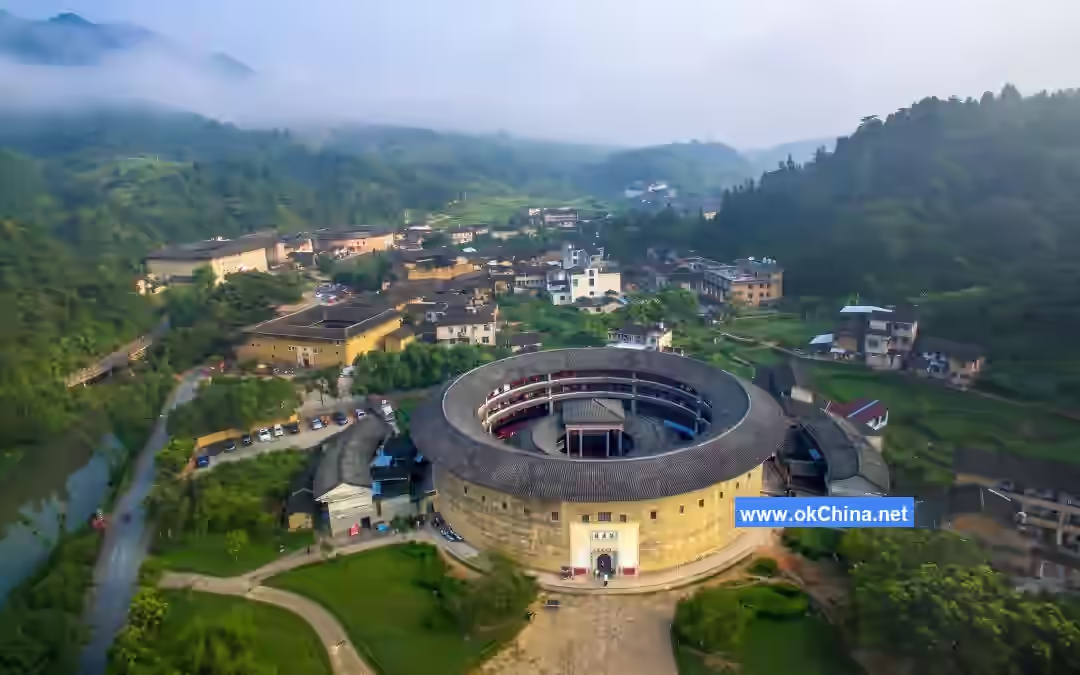
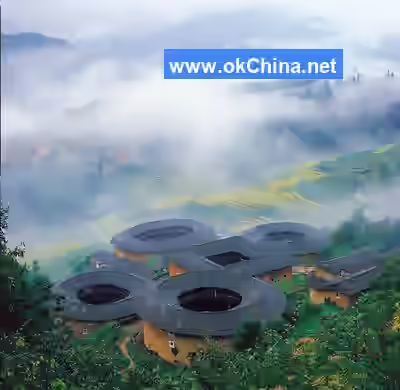
The Fujian Tulou (Yongding) Tourist Area, with its core area located in Hukeng Town, Yongding District, Longyan City, Fujian Province, is an important component of the UNESCO World Heritage Site "Fujian Tulou." It is renowned worldwide for its long history, rich variety, grand scale, ingenious structure, comprehensive functionality, and profound cultural significance. The Fujian Tulou (Yongding) Tourist Area was designated as a National Intangible Cultural Heritage Tourist Area in 2022.
Within the Fujian Tulou (Yongding) Tourist Area, the oldest tulou is Chengqi Lou, whose construction began during the Chongzhen era of the Ming Dynasty (1628-1642). The second, third, and fourth concentric rings were built successively, and the entire structure was completed in the 48th year of the Kangxi reign of the Qing Dynasty (1710). The tourist area is primarily composed of several tulou clusters, including the Hongkeng Tulou Cluster, Nanxi Tulou Cluster, Gaobei Tulou Cluster, and Chuxi Tulou Cluster.
Nanjing
The Fujian Tulou (Nanjing) Tourist Area, also known as the Nanjing Tulou Scenic Area, is located in Shuyang Town and Meilin Town, Nanjing County, Zhangzhou City, Fujian Province, covering an area of approximately 3.03 square kilometers.
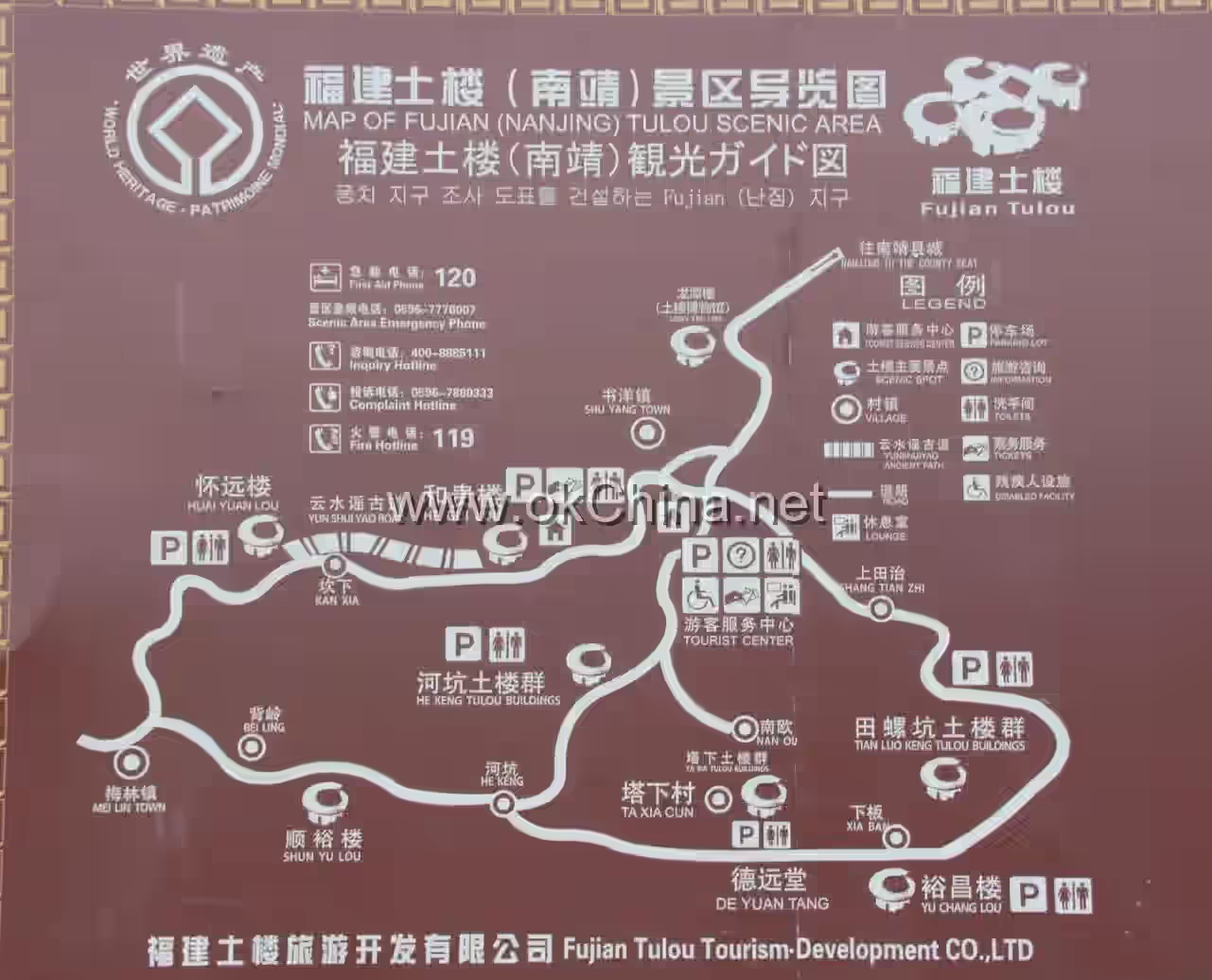
The Fujian Tulou (Nanjing) Tourist Area mainly consists of three parts: the Fujian Tulou Tianluokeng Scenic Area (Tianluokeng Village), the Fujian Tulou Yunshuiyao Scenic Area (Yunshuiyao Village), and the Fujian Tulou Hekeng Tulou Folk Culture Scenic Area. These three scenic areas boast beautiful landscapes, each with its own distinct characteristics and rich cultural heritage, integrating culture, history, and folklore.
2. Historical Development
Yongding
In the first year of the Yongping era of the Western Jin Dynasty (291 AD), the imperial court erupted into the "War of the Eight Princes," which lasted for 16 years and led to the Yongjia Rebellion. Eight prominent clans of the Jin imperial lineage (Lin, Huang, Chen, Zheng, Zhan, Qiu, He, Hu) were forced to migrate south. Lin Shiyin (also known as Lin Lu), the 47th-generation descendant of Lin Jian, served as a staff officer in the Prince of Langya's residence. He accompanied Sima Rui in moving the garrison from Xiapi (southwest of present-day Pizhou County, Jiangsu) to Jianye (present-day Nanjing). In the fifth year of the Yongjia era (311 AD), Lin Lu was promoted to General Zhaoyuan for his military achievements. After Emperor Yuan of the Eastern Jin ascended the throne, Lin Lu was appointed as the Prefect of Hepu (several coastal counties in present-day Guangxi). In the third year of the Taining era of Emperor Ming of the Eastern Jin (325 AD), he returned upon imperial decree, was appointed as the Prince of Jin'an (present-day Fuzhou) Commandery, and subsequently settled in Jin'an, becoming the progenitor of the Lin clan in Fujian.
In the 13th century (late Song to early Yuan Dynasty), the Lin clan established their foundation in Hongkeng.
Nanjing
In the second year of the Chuigong era of the Tang Dynasty (686 AD), after the Tang minister Chen Yuanguang petitioned for the establishment of Zhangzhou, Nanjing had its first administrative records. People gradually migrated from the coastal areas upstream along the rivers, especially expanding into the Boping Ridge area. With population growth and social stability, by the Ming Dynasty, the "Maritime Silk Road" trade flourished, ushering in a period of significant development for Nanjing. In the vast, deep mountainous and forested regions of the Boping Ridge area, human settlements had formed on a considerable scale. However, due to their distance from the administrative center of Nanjing and the treacherous terrain, where roaming bandits and wild beasts were frequent, single-surname or multi-surname clans had no choice but to live together in compact communities. They built circular fortress-like structures to defend against bandits and beasts, forming the prototype of the tulou dwelling style. It was not until the Kangxi and Qianlong periods of the Qing Dynasty that the construction of Nanjing tulou entered its golden age, with a large number of tulou springing up like mushrooms after rain.
3. Main Attractions of Fujian Tulou · Yongding
3.1 Hongkeng Tulou Cluster
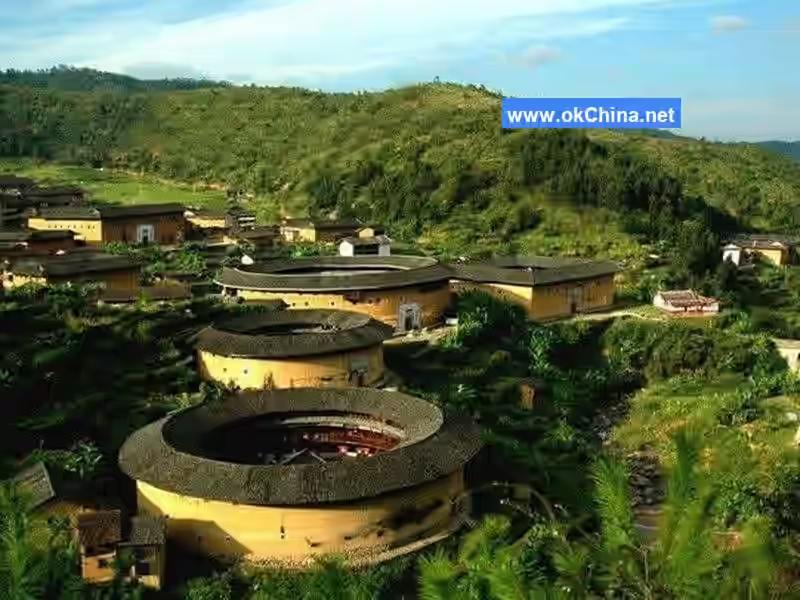
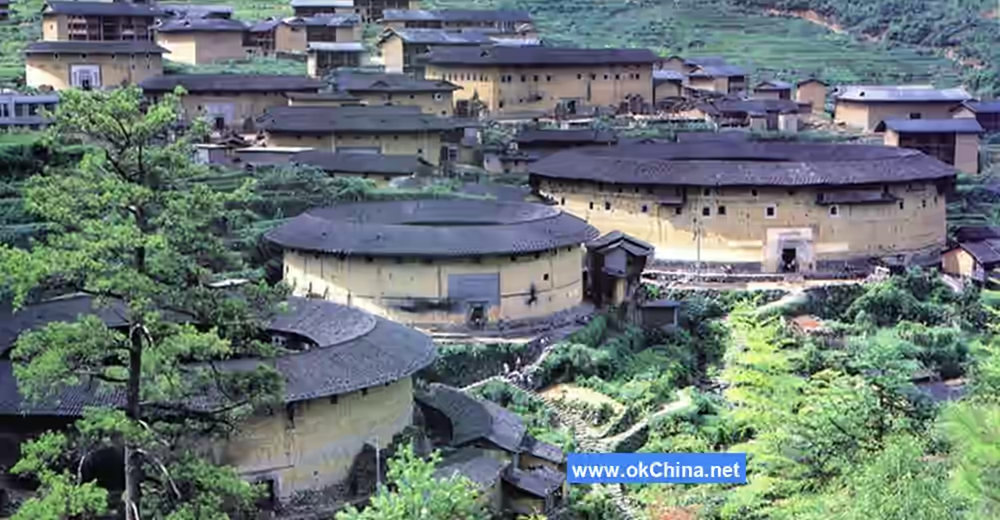
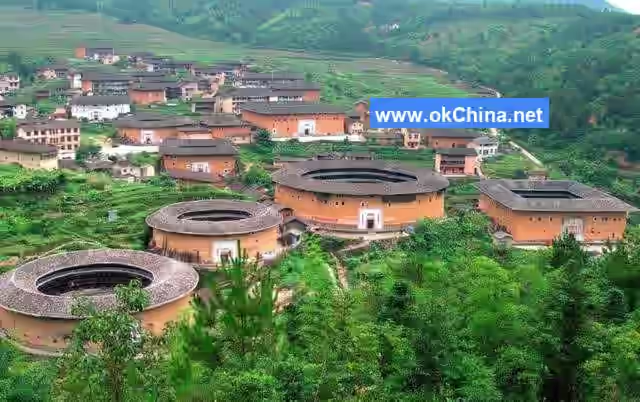
The Hongkeng Tulou Cluster is located in Hongkeng Village, Hukeng Town, Yongding County, Fujian Province. Here, tulou of various styles are ingeniously built against mountains and beside waters, including the "Prince of Tulou" Zhencheng Lou, the classic "Five-Phoenix" style Fuyu Lou, the palace-style square tulou Kuiju Lou, and the miniature circular tulou Rusheng Lou. The pristine natural environment with lush greenery and clear breezes, combined with the simple yet elegant tulou, depicts the idyllic, pastoral poetic life of the Hakka people.
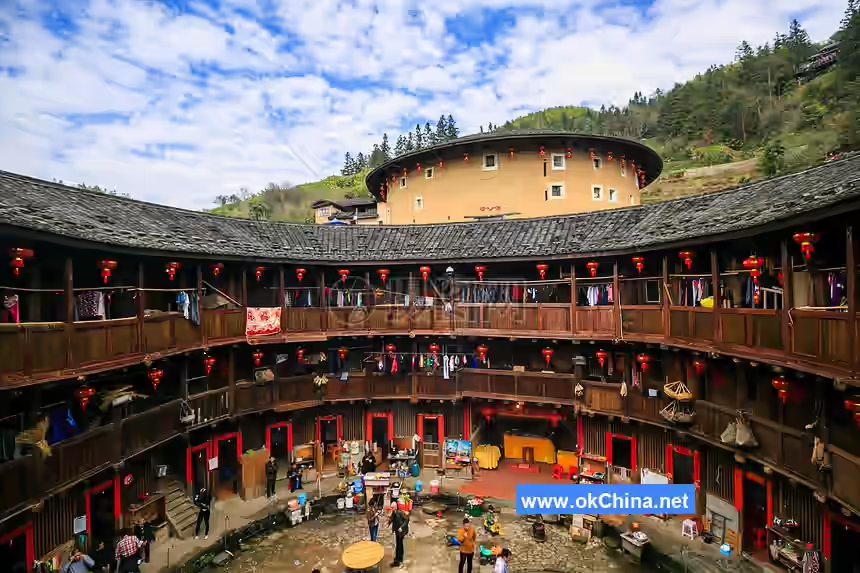
Zhencheng Lou is located in Hongkeng Village, Hukeng Town. Built in the first year of the Republic of China (1912), it covers an area of 5,000 square meters. It features a post-and-lintel structure with a gabled roof and is divided into inner and outer rings, creating a layout of "a building within a building, and buildings outside the building." The front gate corresponds to the "Xun" trigram (wind), while the back gate corresponds to the "Qian" trigram (heaven). The outer ring has four floors, with 48 rooms on each floor, six rooms per trigram. Each trigram has its own staircase, forming an independent unit. The trigrams are connected by archways. Inside the building, there is one main hall, two wells (symbolizing the yin and yang poles of the "Eight Trigrams"), three gates (the main gate and two side gates, representing the three talents of heaven, earth, and man in the Eight Trigrams), and eight units. Firewalls separate the trigrams, so a fire in one trigram would not affect the entire building. There are also gates between trigrams; when closed, each trigram becomes an independent section; when opened, all sections are connected. If a thief entered, closing the trigram gates would trap them like "catching a turtle in a jar." The ancestral hall resembles a stage, with four large stone pillars, each nearly 2 meters in circumference and about 7 meters high, standing in front. Thirty rooms on two floors on either side of the stage form an inner ring. The exquisite cast-iron lattice railings on the second-floor corridor were transported from Shanghai and installed here. The main hall and lintels bear inscriptions from the early Republic of China period by President Li Yuanhong, such as "Lǐ Táng Guān Xíng" and "Yì Shēng Zǎi Dào." The building also contains over twenty permanent couplets and inscriptions, fully showcasing the cultural essence of tulou.
3.2 Nanxi Tulou Cluster
The Nanxi Tulou Cluster is surrounded by mountains and waters, presenting a scene of elegant beauty. Among the many tulou, Zhenfu Lou, Yanxiang Lou, and Huanji Lou are particularly distinctive. The "Princess of Tulou," Zhenfu Lou, is not only laid out according to the traditional concepts of the I Ching's Eight Trigrams, rich in stone couplets and cultural depth, but also a masterpiece blending Hakka tulou architecture with modern Western architectural art. Within it, distant mountains, nearby waters, earthen walls, and dark tiles complement each other, deeply integrating humans with nature. Yanxiang Lou is set against verdant, layered hills with clear springs flowing nearby. Green bamboo, arched bridges, and heavy-laden persimmon trees beside the building together compose a serene and leisurely ink-wash landscape painting. This building is renowned for its emphasis on culture and education, having produced many talented individuals, earning it the reputation of a "Scholarly Family." The most legendary, Huanji Lou, has withstood multiple earthquakes over 300 years. Even when its thick wall cracked nearly 20 centimeters during a quake, the crack miraculously closed up slowly over the following decades, leading people to call it the "Earthquake-Resistant Fortress."
Zhenfu Lou was built in the second year of the Republic of China (1913), covering an area of over 4,000 square meters with three main halls and 96 rooms. It is a magnificent circular tulou designed according to the Eight Trigrams layout. It extensively uses stone and brick materials with fine carvings and is a tulou that combines traditional external earthen structure with Western-style interior, known as the "sister building" of Zhencheng Lou. Its builder, Su Zhentai, came from a poor background. After a few years of private schooling, he first learned tobacco processing, then tobacco selling. He made a fortune in the tobacco business in Guangdong and Shanghai, chose this geomantically auspicious site, and spent tens of thousands of silver dollars to build Zhenfu Lou.
3.3 Gaobei Tulou Cluster
The Gaobei Tulou Cluster is embraced by green hills and encircled by clear waters, with all buildings connected by bluestone pathways. At its core lies the "King of Tulou," Chengqi Lou, the largest circular tulou in Fujian with the most concentric rings. The oldest square tulou, Wuyun Lou, is known as the "Indestructible Building"; its main outer wall has been leaning inward due to an earthquake for nearly a century. Additionally, there is the "Doctor Tulou" Qiaofu Lou, famous for producing ten doctors, and Shize Lou, which is as stable and balanced as a "Grand Tutor's Chair," simple, neat, and dignified.
Chengqi Lou has a diameter of 73 meters, an outer wall circumference of 1,915 meters, and a corridor circumference of 229.34 meters. The entire structure consists of three concentric circles around a central core. The outer ring has four floors, is 16.4 meters high, with 72 rooms on each floor. The second ring has two floors, with 40 rooms on each floor. The third ring is a single story with 32 rooms. The center is the ancestral hall. The entire building has 400 rooms, three main gates, and two wells, covering a total area of 5,376.17 square meters. It houses over 60 households with more than 400 residents. The three main rings are stacked concentrically, with an ancestral hall towering at the center. There are four staircases and 400 rooms. At its peak, Chengqi Lou housed over 80 households and more than 800 people.
3.4 Chuxi Tulou Cluster
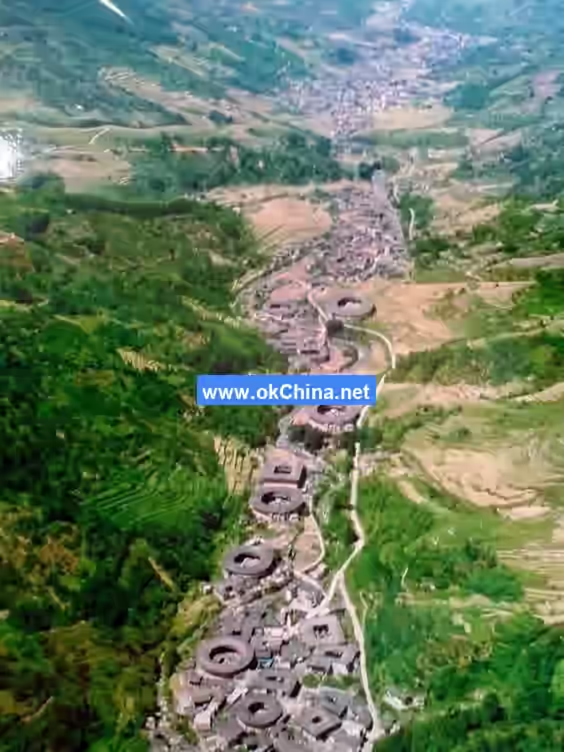
The Chuxi Tulou Cluster is located deep within mysterious mountains. Tulou of various shapes are built along a stream, arranged in a picturesque, staggered manner. Among them stand Jiqing Lou, the oldest circular tulou in Fujian, and Shanqing Lou, the youngest. Surrounded by distant mountains and layered terraced fields, they represent a perfect integration of humans and nature, forming a beautiful scene reminiscent of a paradise.
Jiqing Lou is the tulou with the most and most peculiar staircases in Fujian. All its rooms, staircases, and partition walls are constructed entirely of fir wood, with adjacent parts joined by mortise and tenon without a single iron nail. It served as an important outdoor filming location for the popular CCTV TV series "Journey to the South Seas" and "Finding the Path."
3.5 Zhongchuan Ancient Village
The Zhongchuan Ancient Village scenic area is located in Zhongchuan Village, Xiayang Town, Yongding District. It has created what historians and writers call the incredible "Zhongchuan Cultural Phenomenon" and is hailed as the "Number One Overseas Chinese Hometown in the World." Representative buildings in the scenic area include the Aw Boon Haw Memorial Hall—Haw Par Villa, the Tiger and Leopard Pagoda, the Hu Clan Ancestral Temple, and Fuzi Lou, which is shaped like the Chinese character for "wealth" (富).
Upon entering the ancient village, the first sight is the clusters of orderly arranged tulou, either circular or square, resembling simple yet solid fortresses on the earth. The circular tulou are ingeniously structured with concentric rings and symmetrical, rational room layouts. Viewed from above, they look like giant flying saucers that have landed on earth. The square tulou are dignified and imposing, their straight lines and majestic walls demonstrating the wisdom and strength of the Hakka ancestors. The tulou walls are thick and solid; having endured wind, rain, and the passage of time, they still stand firm, silently guarding generation after generation of Hakka people.
Wandering through the streets and alleys of the ancient village is like stepping into the long river of history. The winding bluestone paths are flanked by ancient residences with upturned eaves, bracket sets, carved beams, and painted rafters. Exquisite wood, stone, and brick carvings are everywhere, depicting flowers, birds, fish, insects, figures, and stories with vivid realism. The delicate craftsmanship compels admiration for the superb skills of ancient artisans. These carvings are not merely decorations but also carriers of Hakka cultural heritage, narrating the prosperity and glory of bygone eras.The ancestral hall in the ancient village stands solemn and dignified, symbolizing the cohesion and centripetal force of Hakka families. Inside the hall, ancestral tablets are enshrined, and the high-hanging plaques bear witness to the family's glorious achievements. Here, one can deeply feel the Hakka people's emphasis on family heritage and ancestor worship, as well as their cultural tradition of revering the past and honoring their roots.
Additionally, Zhongchuan Ancient Village is rich in humanistic stories and legends. Anecdotes of famous figures and traditional customs have been passed down through generations, adding profound cultural depth to this land. The distinctive Hakka cuisine, such as Yongding dried vegetables, Hakka rice wine, and stuffed tofu, allows visitors to further appreciate the unique charm of Hakka culture while savoring the flavors.
Zhongchuan Ancient Village is a place where history and culture intertwine, an ideal destination to escape the hustle and bustle and experience tranquility and simplicity. Here, every stone and every tile holds a story, waiting for visitors to explore, listen, and embark on an unforgettable journey into Hakka culture.
3.6 Hakka Family Precepts Museum
As China's first Hakka Family Precepts Museum, located beside the "Prince of Tulou"—Zhencheng Lou, it has garnered widespread attention and high praise from all sectors of society since its opening. It serves as a field teaching site for the Fujian Provincial Party School, a patriotic education base, and a research and practice base for primary and secondary school students in Fujian Province. The museum's content is divided into eight sections: Hakka Origins, Ancestral Precepts and Family Rules, Hakka Halls, Hakka Private Schools, Couplets and Inscriptions, Family Precept Stories, Hakka Proverbs, and Family Virtues.
3.7 Fujian Tulou Natural Museum
Located in the world cultural heritage site and national 5A-level tourist attraction—Yongding Hakka Tulou Folk Culture Village, the Fujian Tulou Natural Museum was established with investment from Fujian Olive Tree Cultural Industry Investment Co., Ltd. It is the largest natural museum in Fujian Province and the only underground palace-style natural museum. With a total investment of several hundred million yuan, it covers an area of 13 acres and houses over 40,000 exhibits. The museum is divided into eight exhibition areas: the Paleontological Fossil Specimen Exhibition Area themed on the evolution of life; the Spectacular Karst Cave of Stalactites; the Mineral Crystal and Natural Wonder Stone Exhibition Area; the Biological Specimen Exhibition Area; the Simple and Elegant Hakka Folk Culture Ancient Street; the Intuitive and Systematic Exhibition of Hakka Tulou Architectural Techniques; the Fun-Filled 4D Oil Painting Interactive Area; and the Antique Root Carving Art Gallery.
4. Main Attractions of Fujian Tulou (Nanjing)
The Fujian Tulou (Nanjing) Tourist Attraction consists of three main areas: the Tianluokeng Area, the Yunshuiyao Area, and the Hekeng Tulou Folk Culture Village Area, covering approximately 3.03 square kilometers.
4.1 Tianluokeng Area
The Tianluokeng Area includes attractions such as the iconic "Tianluokeng Tulou Cluster," the "Yuchang Lou" known for its tilted structure, the "Taxia Village" with its Tai Chi water town charm, and the "Zhang Family Temple Deyuan Hall." Among these, 20 tulou structures, including the Tianluokeng Tulou Cluster, Hekeng Tulou Cluster, Huaiyuan Lou, and Hegui Lou, are recognized as UNESCO World Heritage Sites. Deyuan Hall is a nationally protected cultural relic.
4.1.1 Tianluokeng Tulou Cluster
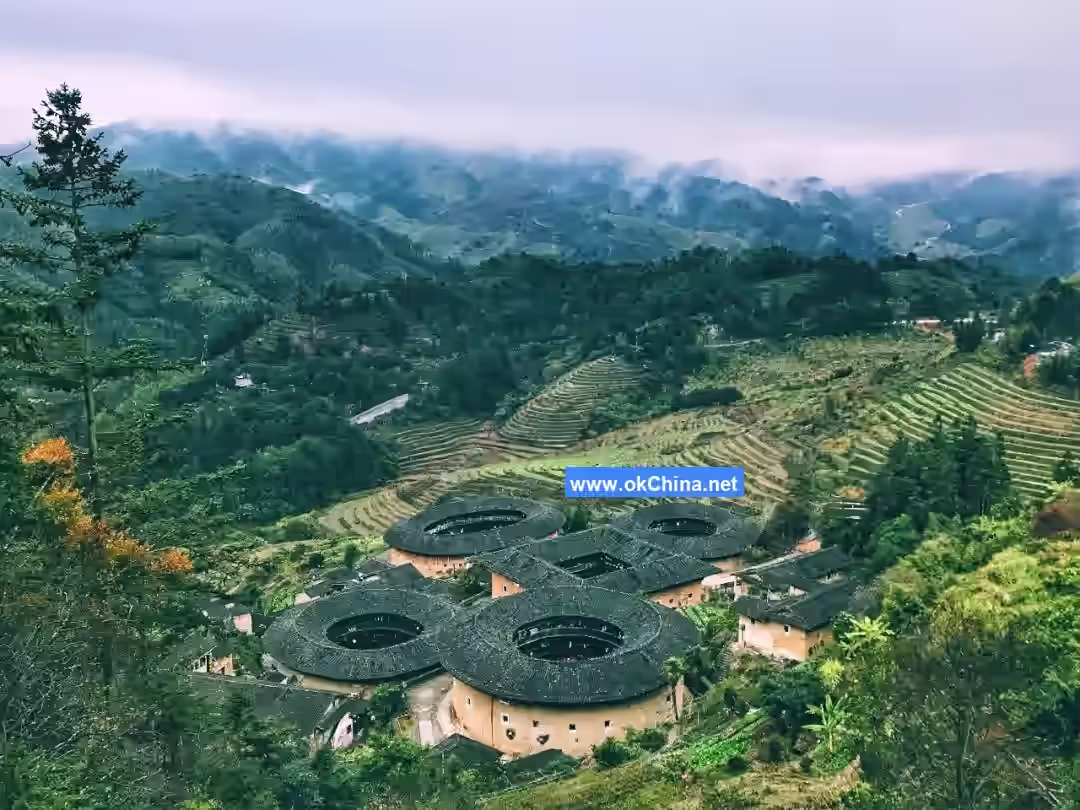
Located in Shangban Village, Shuyang Town, Nanjing County, the Tianluokeng Tulou Cluster is renowned as the most beautiful architectural composition among Fujian tulou, serving as an iconic symbol and a representative of Fujian tulou. It is colloquially known as "Four Dishes and One Soup."
As a model of Hakka tulou clusters in Fujian, the Tianluokeng Tulou Cluster consists of one square building, three round buildings, and one oval building: Buyun Lou, Zhenchang Lou, Ruiyun Lou, Hechang Lou, and Wenchang Lou. The square Buyun Lou stands at the center, surrounded by the other four. Situated on the Hudong Mountain slope at an altitude of 787.8 meters, construction began in the late Yuan and early Ming dynasties and continued until the 1960s, spanning over 600 years. The cluster was planned and laid out according to the "Mingtang Wushi" concept from the Kaogong Ji Tu, following the order of the Five Elements (metal, wood, water, fire, and earth) to create a unique architectural composition. It is a nationally protected cultural relic, one of the first "Chinese Historical and Cultural Villages," and one of the first "Chinese Landscape Villages." All residents are members of the Huang clan. It was inscribed on the UNESCO World Heritage List in 2008.
4.1.2 Buyun Lou
Buyun Lou, located at the center of the Tianluokeng Tulou Cluster, is a square tulou built by Huang Qilin, the 12th-generation descendant of the Huang clan, during the Kangxi period of the Qing Dynasty (1662–1722). Its name signifies "rising to prominence." The building faces southwest with a northeast orientation, covering an area of 1,050 square meters and a floor area of 1,393 square meters. It stands three stories high (11.93 meters), with an internal corridor layout, 26 rooms on each floor totaling 78 rooms, four staircases, one main gate, and four shooting ports on the top floor. The base wall is 1.15 meters thick. The building is designed with a lower front and higher rear, following the natural terrain and ascending step by step from the entrance hall to the rear hall.
4.1.3 Hechang Lou
Hechang Lou, a round tulou located east of Buyun Lou, was initially built in the late Yuan and early Ming dynasties (around 1354). It faces southwest with a northeast orientation, covering an area of 1,268 square meters and a floor area of 1,658 square meters. Standing three stories high (12.3 meters), it features an internal corridor layout with 22 rooms on each floor totaling 66 rooms, two staircases, one main gate, and four shooting ports on the top floor. The base wall is 1.2 meters thick, and the inner courtyard is paved with cobblestones and includes a well. Originally built as a square structure, it was burned down by bandits in the 1930s and rebuilt as a round tulou on the same site in 1953.
4.1.4 Zhenchang Lou
Zhenchang Lou, a round tulou located west of Buyun Lou, means "revitalizing prosperity." It was jointly funded by members of the Huang clan and built in the 19th year of the Republic of China (1930). Facing southwest with a northeast orientation, it covers an area of 976 square meters and a floor area of 1,232 square meters. The building is three stories high (11.53 meters) with a diameter of 33 meters, featuring an internal corridor layout, 26 rooms on each floor totaling 78 rooms, two staircases, and one main gate. The base wall is 1.2 meters thick, and the inner courtyard is paved with cobblestones. The central hall is not aligned with the main gate but offset to the left, reflecting the feng shui culture of "not flaunting wealth."
4.1.5 Ruiyun Lou
Ruiyun Lou, a round tulou located southeast of Buyun Lou, was jointly funded by members of the Huang clan and built in the 25th year of the Republic of China (1936). "Ruiyun" refers to peonies, symbolizing auspiciousness and prosperity. Situated in the inner corner of the five tulou, it embodies the concept of gathering energy and reflecting modesty and harmony. Facing southwest with a northeast orientation, it covers an area of 1,063 square meters and a floor area of 1,176 square meters. The building is three stories high (11.2 meters) with a diameter of 35 meters, featuring an internal corridor layout, 26 rooms on each floor totaling 78 rooms, two staircases, one main gate, a base wall thickness of 1.2 meters, a cobblestone-paved inner courtyard, and a well.
4.1.6 Wenchang Lou
Wenchang Lou, an oval tulou located southwest of Buyun Lou, was jointly funded by members of the Huang clan and built in 1966. Its name means "flourishing literary fortune," with "Wenchang" also referring to the "Wenchang Dijun," a folk deity overseeing scholarly achievements and official ranks. Facing southwest with a northeast orientation, it covers an area of 1,288 square meters and a floor area of 2,210 square meters. The building measures 45.7 meters in length and 34.5 meters in width, standing three stories high (11.8 meters). It features an internal corridor layout, 32 rooms on each floor totaling 96 rooms, two staircases, and one main gate. The top floor of the outer wall has three watchtowers and four shooting ports, with a base wall thickness of 1.2 meters. The inner courtyard is paved with rough stones and includes a well. The door is made of thick fir wood and iron sheets, and the earthen walls are over 1 meter thick, capable of withstanding bullets. The two door leaves are 10 centimeters thick, and the door bolt is embedded within a wall several meters long, making it impossible to open from the outside—a remarkable design for bandit and theft prevention.
4.1.7 Taxia Village
Taxia Village, located in Shuyang Town, Nanjing County, boasts a long history and rich cultural heritage. It is recognized as a "Chinese Landscape Village," a "Chinese Traditional Village," and a "Chinese Historical and Cultural Village." Known as the "Picturesque Water Town, Dreamlike Homeland," the village is nestled in a narrow, elongated terrain described as "one river between two banks." A mountain stream approximately 1 kilometer long meanders through the valley, with clear and emerald waters. Eleven stone arch bridges of varying styles span the stream, and 42 tulou buildings line both banks. Surrounded by lush mountains and clear waters, the tulou resemble exquisite landscape paintings from the Ming and Qing dynasties, earning Taxia the nickname "Zhouzhuang of Southern Fujian." The Zhang Family Temple Deyuan Hall in Taxia Village, a nationally protected cultural relic, is one of the most well-preserved and visually impressive ancient clan temples in China, with 24 stone dragon flagpoles standing in front of the hall.
Taxia Village is a typical Hakka settlement with a long history and profound cultural heritage. Its well-preserved Tai Chi-shaped village layout, nestled between two mountains with a river flowing through, reflects the Hakka tradition of clan cohesion and bloodline ethics. The tulou, built on terraces facing the water and centered around "halls and courtyards," serve as a testament to Hakka traditions and provide valuable insights into the historical evolution of Fujian tulou and large-scale rammed earth residential construction techniques. Historical relics such as Deyuan Hall and the stone dragon flagpoles, along with traditional customs like the "Spring Sacrifice" and "Zuodafu," highlight the Hakka people's preservation and inheritance of Central Plains culture, offering rich evidence for studying the evolution of Central Plains culture and the history of Han migration southward. Protecting Taxia Village as a historical and cultural village is of great significance for promoting the excellent cultural traditions of the Chinese nation and preserving local historical continuity.
4.1.8 Deyuan HallDeyuan Hall, also known as the Zhang Clan Ancestral Hall or "Zhang Family Temple," is the ancestral shrine of the Zhang clan. In the first year of the Xuande era of the Ming Dynasty (1426), descendants of the Zhang clan's founding ancestor who migrated to Fujian settled in Taxia Village. During the late Ming and early Qing dynasties, the Zhang clan members in Taxia constructed the "Zhang Family Temple," Deyuan Hall. This ancestral hall is one of the most completely preserved ancient clan temple buildings in China and is designated as a National Key Cultural Relics Protection Unit. Deyuan Hall faces southeast with its back to the northwest, covering a built area of 400 square meters. In the stone courtyard in front of the main hall stand 24 stone dragon flagpoles, each over 10 meters tall, making it the site with the most stone dragon flagpoles among village-level ancestral halls nationwide. The tops of the flagpoles are carved with brush tips for civil officials and seated lions for military officials, symbolizing achievement, success, and honorable status. The feng shui architectural layout of Deyuan Hall exemplifies the pinnacle of Southern Fujian architectural characteristics.
4.1.9 Yuchang Building
Yuchang Building, located in Shuyang Town, Nanjing County, was initially built in the first year of the Zhida era of the Yuan Dynasty (1308) and is the oldest existing tulou (earthen building) in Fujian. It is a product of early joint-stock ownership, jointly funded and built by members of the Liu, Luo, Zhang, Tang, and Fan clans. The building has five floors, stands 18.2 meters tall, and contains 270 rooms. It features five staircases and is divided into five major sections. On the ground floor, there are 22 wells in the kitchens, the highest number among all Fujian tulou. At the center of the inner courtyard stands a single-story circular ancestral hall. In front of the hall, a yin-yang Bagua (Eight Trigrams) pattern is laid with pebbles, divided into five sections representing "metal, wood, water, fire, and earth." The most distinctive feature of Yuchang Building is its slanted pillars, with the maximum inclination reaching 15 degrees, giving it a precarious appearance. However, despite over 700 years of weathering and numerous earthquakes, it remains standing, safe and sound, making it a living specimen of ancient residential architecture.
4.2 Yunshuiyao Scenic Area
The Yunshuiyao Scenic Area is located in Meilin Town, Nanjing County, encompassing Pushan Village, Guanyang Village, and Kanxia Village. Attractions include: "Yunshuiyao Ancient Town," the extraordinary building "Hegui Lou" built on marshland, the most exquisite double-ring circular tulou "Huaiyuan Lou," "Millennium Ancient Banyan Tree Grove," "Ancient Path," "Old Street," "Lovers' Bridge," "Ancient Stage," "Ruins of the Burnt Building," "Yinghui Lou," "Guangju Lou," and more. Among these, Huaiyuan Lou is a UNESCO World Heritage site.
4.2.1 Yunshuiyao Ancient Town
Yunshuiyao Ancient Town is a historic village featuring serene ancient paths, centuries-old banyan trees, magical tulou, and beautiful mountains and rivers. The Changjiao Scenic Area in Nanjing County boasts World Heritage sites Hegui Lou and Huaiyuan Lou, the province's tallest, largest, and most concentrated grove of millennium-old banyan trees, a century-old old street, and a millennium-old ancient path. Along the stream bank is a grove of 13 banyan trees ranging from a hundred to a thousand years old. One of these ancient banyans has a canopy covering 1,933 square meters, branches extending over 30 meters, and a trunk base so large it takes more than ten adults to encircle it, making it the largest banyan tree discovered in Fujian Province. Under the banyan trees, a very smooth cobblestone ancient path stretches into the distance, historically verified as the essential route from Changting Prefecture (Longyan City) to Zhangzhou Prefecture (Zhangzhou City). Beside the ancient path stands a row of two-story old brick-and-wood houses, forming the centuries-old old street market of Changjiao. Most of these old shops still retain the characteristic of using wooden planks as walls. The most striking features in the village are the numerous tulou scattered at the foot of the mountains, along the streams, and across the fields. Among these tulou, whose construction began in the mid-Yuan Dynasty, 53 are well-preserved. These tulou come in various forms. Besides Hegui Lou, built on marshland and hailed as "the world's most extraordinary," and Huaiyuan Lou, the most exquisitely crafted and best-preserved double-ring circular tulou, there are also stilted buildings, bamboo-pole buildings, mansion-style tulou, and others, each with a unique style. The distinctive natural landscapes and unique cultural resources of Yunshuiyao Ancient Town have attracted numerous film directors and producers to shoot here. Since 1997, eight movies, TV series, and MTVs, including Searching for a Distant Home and A Century of Changes, have been filmed here. At the end of 2005, the movie The Knot, adapted from the literary screenplay Searching by Zhang Kehui (Vice Chairman of the 10th National Committee of the Chinese People's Political Consultative Conference and Honorary Chairman of the Taiwan Democratic Self-Government League), which was based on his own and several other Taiwanese compatriots' life experiences, was also filmed here.
4.2.2 Hegui Lou
Hegui Lou is located in Pushan Village, Meilin Town, Nanjing County. Its name implies "harmony is precious." Built in the 10th year of the Yongzheng era of the Qing Dynasty (1732), it is a corridor-style earthen and wooden structure. Applying the principle of buoyancy, Hegui Lou was built on 3,000 square meters of marshland using pine wood piles and a raft foundation. It is the tallest square tulou built on such terrain, resembling a terrestrial "Noah's Ark." The wall height-to-thickness ratio of this tulou reached 13:1 over two hundred years ago, demonstrating outstanding architectural achievement and high value for architectural technology research.
4.2.3 Huaiyuan Lou
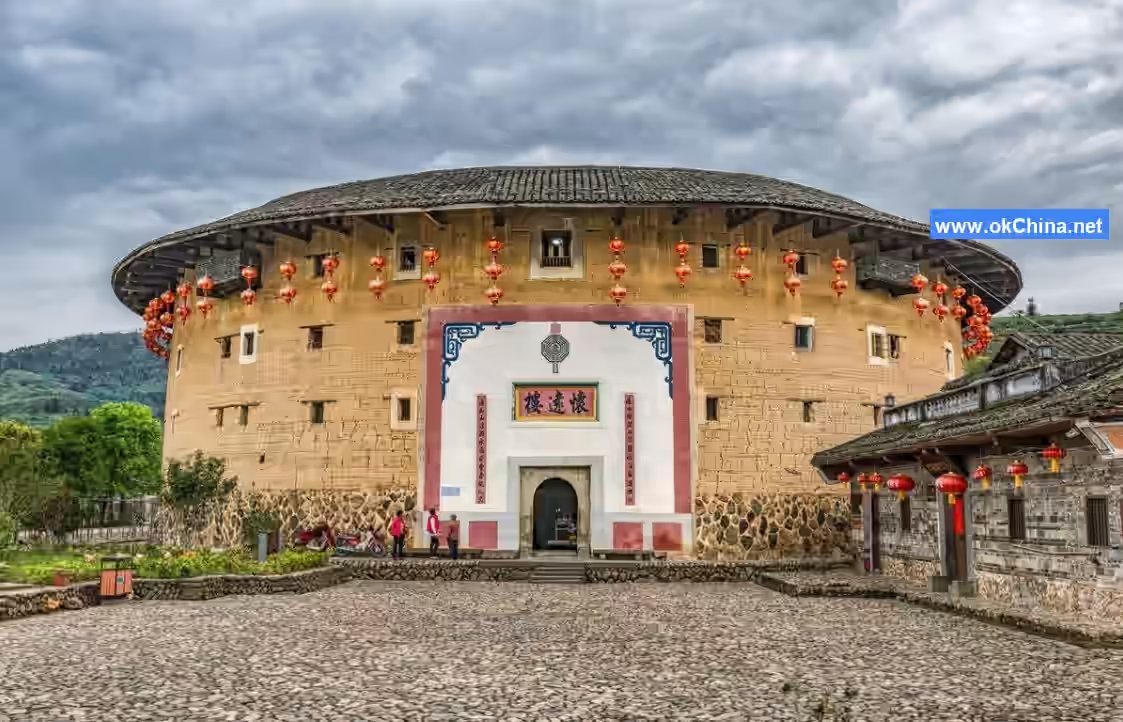
Huaiyuan Lou is located in Kanxia Village, Meilin Town, Nanjing County. Built in the late Qing Dynasty (1905-1909), it is the most exquisitely crafted and best-preserved double-ring circular tulou among all the tulou included in Fujian's "World Cultural Heritage" application. Constructed using the mature "inclined wall" technique to create a drum-shaped tulou, it represents the culmination of millennia of development in the Central Plains' rammed earth technique and is a representative of the highest achievement in rammed earth civilization. The couplets on pillars, carved beams, and painted rafters inside the building interpret the philosophy of "loyalty and filial piety as the foundation, farming and studying to perpetuate the family." It is an outstanding example of the perfect integration of Southern Fujian architectural style with Chinese Confucian culture and serves as physical evidence of significant historical events in modern Chinese history.
4.3 Hekeng Tulou Folk Culture Village Area
The Hekeng Tulou Folk Culture Village Area features the most densely concentrated cluster of tulou in Fujian. Seven square tulou built during the Ming and Qing dynasties and seven circular tulou built in modern times form two sets of the celestial phenomenon "Big Dipper" on the ground.
4.3.1 Hekeng Tulou Cluster
The Hekeng Tulou Cluster is located in Qujiang Village, Shuyang Town, Nanjing County. Its planning and layout are based on the concept of "emulating heaven and earth." The square and circular tulou were planned together and constructed in phases. Within an area of less than 1 square kilometer, 13 large tulou are densely arranged. These consist of 6 square tulou: Chaoshui Lou, Yangzhao Lou, Yongsheng Lou, Shengqing Lou, Yongrong Lou, Yonggui Lou; 6 circular tulou: Yuchang Lou, Chungui Lou, Dongsheng Lou, Xiaochun Lou, Yongqing Lou, Yuxing Lou; and 1 pentagonal tulou: Nanxun Lou. This makes it the densest tulou community in Fujian. The construction period spans 423 years, from the earliest Chaoshui Lou (1549–1553) to the latest Yongqing Lou (1967–1972), reflecting the historical evolution of tulou development across different eras, essentially forming a settlement of tulou from "old, middle-aged, and young" generations. The square and circular tulou together form two sets of the "Big Dipper" celestial phenomenon on the ground. In January 2008, Hekeng Village was listed as a third batch provincial-level historical and cultural village. In July 2008, the Hekeng Tulou Cluster was inscribed on the UNESCO World Heritage List.
5. Cultural Resources
5.1 Hakka Culture
The historical background of Hakka culture is an epic of migration, integration, and inheritance. Its origins can be traced back to the Central Plains region of ancient China. The ancestors of the Hakka people migrated southward from the Central Plains due to wars, famines, and other reasons, experiencing multiple periods of historical turmoil such as the Eastern Jin Dynasty, the late Tang Dynasty, the late Song Dynasty, and the late Ming and early Qing dynasties. They gradually migrated from areas like Henan, Shanxi, and Shaanxi to Jiangxi and Fujian, eventually settling in Guangdong, Guangxi, Taiwan, and other regions, forming today's distribution pattern. As "outsiders," the Hakka people refer to themselves as "guests" (Hakka), emphasizing their role as inheritors of Central Plains culture. Despite migrating to the south, they have consistently maintained their identification with Central Plains culture, particularly evident in language and traditional customs. Hakka, one of the seven major dialects of Chinese, retains many characteristics of ancient Chinese and serves as an important marker of Hakka identity. During the migration process, the Hakka people experienced cultural fusion with southern indigenous peoples such as the She and Yao ethnic groups, absorbing local languages and lifestyles while also integrating Central Plains culture with southern indigenous culture, forming a unique Hakka cultural system. To survive in new environments, the Hakka people formed tight-knit social organizations centered on the family, constructing collective residential buildings like the defensive tulou, embodying a spirit of unity and mutual aid. Historically, the Hakka people were involved in numerous wars, such as the Taiping Rebellion and the War of Resistance Against Japan, demonstrating their resilient spirit. Furthermore, the Hakka place great emphasis on education. Historically, many Hakka individuals entered officialdom through the imperial examination system, such as Lin Zexu and Huang Zunxian. Additionally, since the 19th century, a large number of Hakka people have emigrated to Southeast Asia, the Americas, and other regions. While spreading Hakka culture overseas, they have also absorbed local cultures, forming a unique overseas Hakka culture. Hakka culture is not only a symbol of Hakka identity but also a typical representative of the unity within diversity of Chinese culture. It preserves the essence of Central Plains culture while integrating southern indigenous culture, showcasing the unique cultural system formed by the Hakka people through migration and integration.
5.2 Tulou CultureTulou culture is an important component of Hakka culture, with its historical background closely linked to the migration, living environment, and cultural heritage of the Hakka people. Tulou originated in regions such as Fujian and Guangdong in southern China and is a unique architectural form created by the Hakka people to adapt to mountainous terrain and defensive needs. As "outsiders," the Hakka people often faced land disputes with indigenous inhabitants or other Han Chinese groups after migrating to the south. To protect their families and property, they built tulou with defensive functions, forming a tightly-knit social organization centered around the family. Tulou are mostly circular or square in shape, with thick and sturdy outer walls, housing multiple families inside, reflecting the Hakka spirit of unity and mutual assistance. Tulou are not only residential spaces but also important carriers of Hakka cultural heritage and social organization. They are equipped with facilities such as ancestral halls and schools for ancestor worship, education, and social activities, showcasing the Hakka people's emphasis on family and culture. The design of tulou integrates the architectural style of the Central Plains with the characteristics of the southern mountainous environment, preserving the essence of Central Plains culture while adapting to local natural conditions. Over time, tulou have gradually become a symbol of Hakka culture, recognized as a UNESCO World Heritage site and a typical representative of the diverse yet unified Chinese culture. Tulou culture is not only a symbol of Hakka identity but also a reflection of the unique cultural system formed through their migration and integration, demonstrating the wisdom and spirit of unity created by the Hakka people in challenging environments.
5.3 Folk Culture
The Hakka folk customs of Yongding exhibit distinct local characteristics among many traditional folk cultures. Representative examples include Welcoming the Spring Ox, Beating the Newlyweds, Walking Ancient Tales, April Eighth, and Making Great Blessings. The Lin family's "Welcoming the Spring Ox" activity in Xipi Village, Gaobei Town, Yongding, takes place annually on the day of the beginning of spring, between the second and twelfth days of the first lunar month. This tradition has persisted for over 400 years, with programs increasing year by year, rituals gradually becoming more complete, and the scale growing larger. The Lu family in Kanshi, Yongding, with tens of thousands of members, practices the unique custom of "Beating the Newlyweds." The clan elder holds a wooden mallet and gently rolls it over the left shoulders of the lined-up newlyweds, then rolls it up to the right shoulder while speaking auspicious words wishing the couple a happy marriage and lifelong companionship. This custom has been passed down for over 500 years and remains a cherished local tradition. The "Walking Ancient Tales" in Fushi, Yongding, is a grand carnival activity during the Lantern Festival in rural areas, inherited continuously since the Qianlong and Jiaqing periods of the Qing Dynasty. "Walking Ancient Tales" refers to a costumed parade during the Lantern Festival, where participants dress up as characters from historical legends, operas, or real-life stories, carried on platforms by young adults. The event features a grand lineup, rich programs, and captivating performances. The "April Eighth" tradition in Chendong Township, Yongding, is a centuries-old folk activity of "Welcoming Deities and Touring the Village," lasting three days. It attracts gatherings of relatives and friends, making it even livelier than the Spring Festival, as reflected in the local saying, "We don’t prioritize the New Year or other festivals; we only prioritize 'April Eighth.'" The Lantern Festival's "Welcoming Flower Lanterns" in Zhongchuan Village, Xiayang Town, Yongding, a famous hometown of overseas Chinese, is the largest folk cultural and entertainment activity of the year here. In the Hakka dialect, "welcoming lanterns" is homophonous with "welcoming offspring," symbolizing the auspicious sign of a flourishing population. The "Making Great Blessings" activity in Hukeng Town, Yongding, is a deity-welcoming event, also known as "Carrying the Bodhisattva." It involves inviting a puppet troupe to perform several major plays, with a small blessing made annually and a great blessing made every three years. The term "great blessing" signifies large-scale and grand celebrations. Organized by surname clans or villages, the event typically lasts at least three days, with three days of theatrical performances and deity worship, usually held during the agricultural slack season after the autumn harvest. Over time, these ancient customs have been completely preserved, allowing visitors to inadvertently experience the rich Hakka folk culture.
5.4 Specialty Snacks
The Hakka people have many traditional famous dishes and flavor-packed snacks, characterized by rich, salty, fragrant, fresh, and hot tastes. The most renowned is the beef series, such as beef balls, beef soup, and beef offal soup. Taro buns, made with taro paste as the skin and filled with minced lean meat, fresh bamboo shoots, squid, and mushrooms, are colloquially known as "cows taking a bath." Yongding beef balls are made from premium fresh beef, minced into a paste mixed with a small amount of tapioca starch and salt, carefully shaped into balls, and served in soup with seasonings. They are fresh, refreshing, and non-greasy. Another famous dish in the Yongding beef series is "Stir-Fried Eight Crispy Beef Parts," which combines eight parts of beef offal for a stir-fry that is crispy, tender, and uniquely flavorful.
Other specialty foods include Hakka pickled duck feet, dried vegetable braised pork, stuffed tofu, and salted duck. Taro buns and stir-fried rice cakes are also unique Hakka staple foods. "Yongding Dried Vegetables," one of the Eight Famous Dried Foods of western Fujian, are paired with pork belly or a small amount of lean meat to make dried vegetable braised pork. This dish features tender meat and crisp vegetables with a rich, savory flavor, making it an excellent accompaniment to rice or wine. Additionally, Hakka rice wine is a notable specialty. It tastes mellow and sweet upon first sip, often leading first-time drinkers to underestimate its potency. However, its strong aftereffect carries a hint of "the wine doesn’t intoxicate, but the drinker intoxicates themselves."
Comments
Post a Comment