





Fenghuang Ancient Town
1. Introduction
Fenghuang Ancient Town, formerly known as Zhen'gan City, is located in the southwest of Xiangxi Tujia and Miao Autonomous Prefecture, Hunan Province. Covering an area of approximately 10 square kilometers, it is composed of 28 ethnic groups including the Miao, Han, and Tujia, making it a typical multi-ethnic settlement area.
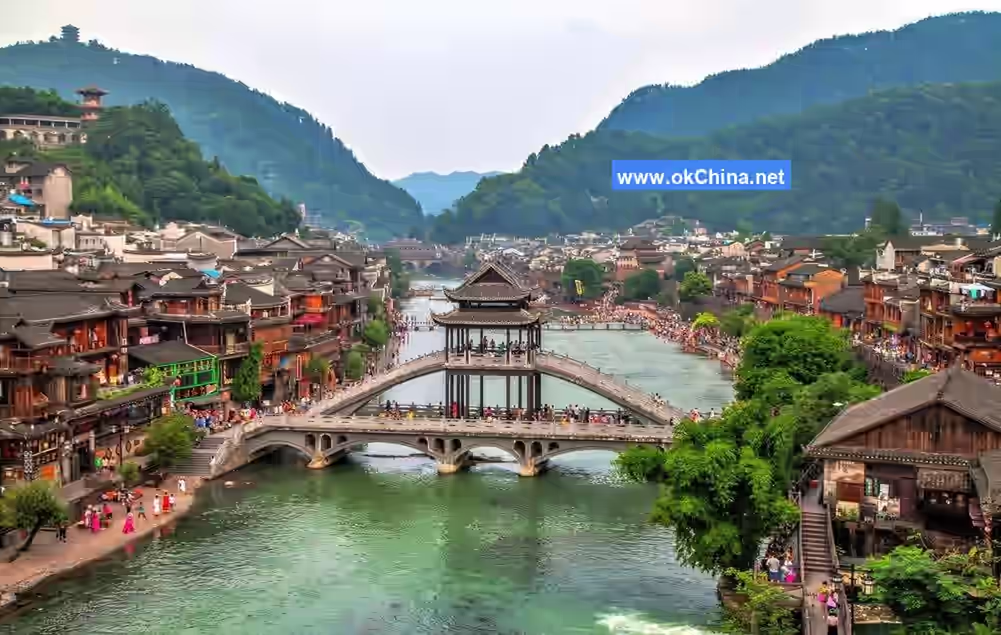
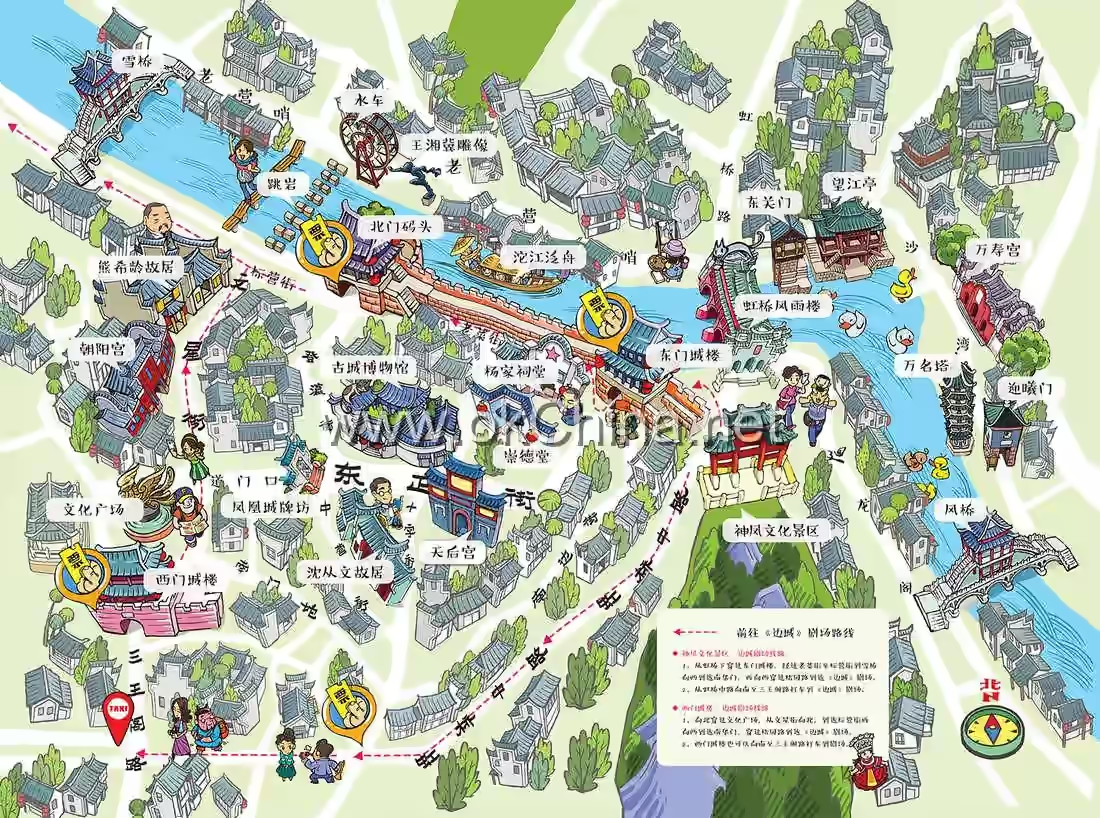
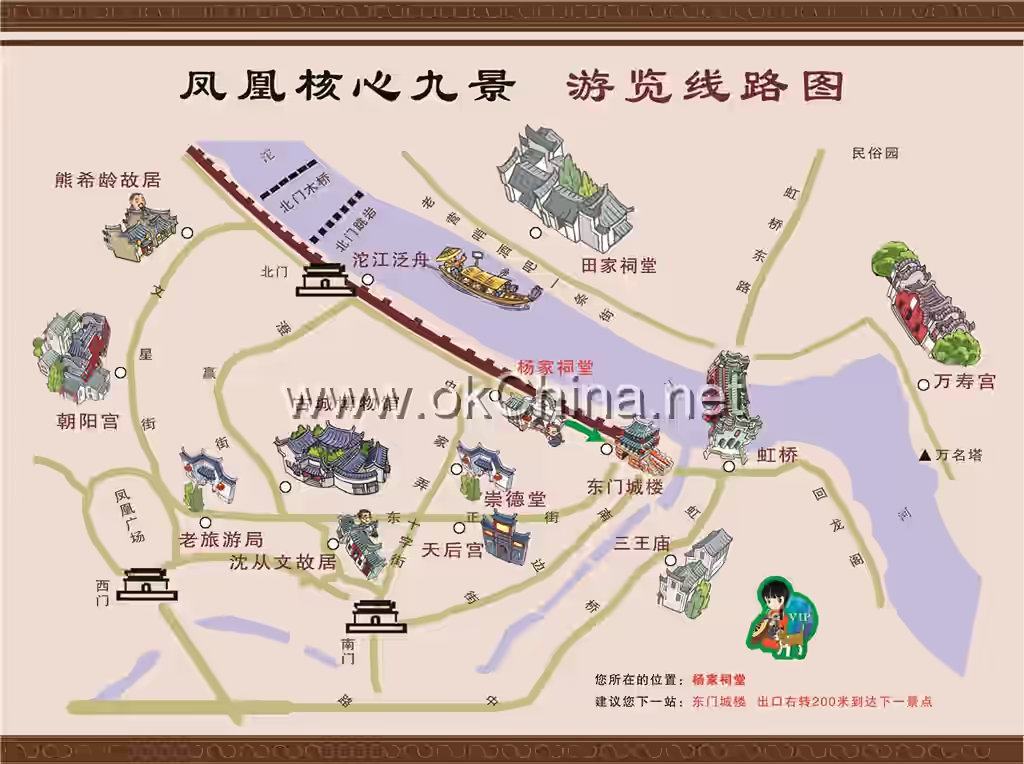
Situated in the southern part of the Wuling Mountains and on the eastern side of the Yunnan-Guizhou Plateau, it is named after the nearby mountain resembling a phoenix ready to take flight. The town was established in the 43rd year of the reign of Emperor Kangxi of the Qing Dynasty (1704 AD). The ancient city gates at the East Gate and North Gate still stand. The town features bluestone-paved streets, riverside stilted wooden houses, as well as structures like the Chaoyang Palace, Ancient Town Museum, Yang Family Ancestral Hall, Shen Congwen's Former Residence, Xiong Xiling's Former Residence, Tianwang Temple, Dacheng Hall, and Wanshou Palace, all exuding the distinctive charm of the ancient town. The town currently boasts 68 cultural heritage ancient buildings, 116 ancient sites, over 120 residential houses with Ming and Qing dynasty characteristics, and more than 30 various temples, ancestral halls, pavilions, and towers. It is the county with the largest number of surviving cultural relic buildings in southwest China.
2. Geographical Environment
2.1 Location and Territory
Fenghuang Ancient Town is located in the southwest of Xiangxi Tujia and Miao Autonomous Prefecture, Hunan Province, in the southern part of the Wuling Mountains and on the eastern side of the Yunnan-Guizhou Plateau, approximately 52 kilometers from the prefectural capital, Jishou City. Its coordinates lie between 109°18′ and 109°48′ east longitude, and 27°44′ and 28°19′ north latitude. It borders Luxi County to the east, Mayang County to the south, Tongren City and Songtao Miao Autonomous County of Guizhou Province to the west, and Jishou City and Huayuan County to the north. Historically described as "anchoring Yunnan-Guizhou to the west, controlling Chen and Yuan to the east, restraining Sichuan and Hubei to the north, and holding Guangxi's border to the south," it is a crucial passageway connecting Huaihua, Jishou, and Tongren in Guizhou. It is 27 kilometers from Tongren Fenghuang Airport, 57 kilometers from Huaihua Zhijiang Airport, and 280 kilometers from Zhangjiajie Hehua Airport. National Highway G209 and Provincial Highway S308 run through the area, and the Zhicheng-Liuzhou Railway passes through the territory. Fenghuang Ancient Town neighbors Dehang Miao Village in Jishou, Mengdong River in Yongshun, and Fanjing Mountain in Guizhou, serving as a vital route between Huaihua and Jishou with convenient transportation.
2.2 Topography and Landforms
The terrain of Fenghuang Ancient Town is complex. The valley and hilly areas in the east and southeast form the first terrace level, primarily consisting of low mountains and high hills, along with some tablelands and valley plains. The surface is deeply dissected with narrow valleys and steep slopes, generally below 500 meters in elevation. The central belt from northeast to southwest constitutes the second terrace level, with elevations between 500 and 800 meters. The mid-mountain area in the northwest forms the third terrace level, with elevations above 800 meters.
2.3 Climate Characteristics
Fenghuang Ancient Town has a subtropical monsoon humid climate, characterized by warmth, humidity, abundant rainfall, and sufficient sunshine. It features distinct seasons: cold winters, hot summers, warm springs, and cool autumns. The annual average temperature is 15.9°C. January and February are the coldest months, with an average monthly temperature of 2°C; July to September are the hottest, with an average monthly temperature of 30°C. The average annual precipitation is 1308.1 mm. There are two distinct rainy periods annually: April-May (spring rain) and June-July (plum rain). Snow occurs in winter.
2.4 Hydrological Features
The Tuo River in western Hunan is the largest river in Fenghuang County, a primary tributary of the Wu River. It has two sources: the northern source is the Wuchao River, originating in the canyon of Heshaonan Mountain in Heku. It has treacherous rapids and swift currents, often becoming impassable after heavy rain. The Tuo River traverses the central region of Fenghuang County from west to east, flowing through nine townships including La'er Mountain, Machong, Luochaojing, Duli, Nanhua Mountain, Tuojiang Town, Guanzhuang, Qiaoxikou, and Mujiangping. It converges with the Wu River at Hexi in Luxi County and finally joins the Yuan River at Wuxi Town. The main stream is 131 kilometers long, with a 96.9-kilometer section within Fenghuang County and a drainage area of 732.42 square kilometers. The multi-year average flow rate is 11.89 cubic meters per second, with a natural elevation drop of 533 meters.
3. Main Attractions
3.1 Tian Family Ancestral Hall
Located on Laoyingshao Street on the north bank of the Tuo River, the Tian Family Ancestral Hall was initially built in the 17th year of the Daoguang reign of the Qing Dynasty (1837 AD). It was funded by Tian Xingshu, a native of Fenghuang of Miao ethnicity who served as Imperial Commissioner and Governor of Guizhou at the time, along with his clansmen. In the early Republic of China period, Tian Yingzhao (son of Tian Xingshu), the Garrison Commander of Western Hunan and a Lieutenant General in the Kuomintang, invested heavily to complete its final construction. This is a clan ancestral hall complex with strong ethnic characteristics. It includes a main gate, main hall, opera stage, and over 20 rooms, along with courtyards, a pond, and corridors. It also features two gates named "Five Blessings" and "Six Smoothness." In front of the ancestral hall gate are six fan-shaped steps made of red sandstone slabs. Before the steps lies a relatively wide open ground. The main gate has three sections: left, center, and right. The central gate is splayed (八字形), with the side sections built of blue bricks, flanked by a pair of stone elephants and a pair of stone drums, exuding grandeur. The main hall of the ancestral hall combines a post-and-lintel (抬梁式) and column-and-tie (穿斗式) timber frame structure, with a flush gable roof (硬山顶). Its height, depth, and width are all 20 meters. The column bases are stone drums, and it features cat-arch gable walls (猫拱背山墙). Blue stone steps lead to the front of the main hall. The opera stage in the Tian Family Ancestral Hall is a hexagonal ancient building with upturned eaves and a hip-and-gable roof (歇山顶), decorated with ruyi-shaped bracket sets (如意斗拱). It has side rooms on the left and right for performers to rest during intervals.
3.2 Shen Congwen's Tomb
The location of Shen Congwen's tomb was originally called "Dumu Garden" (杜母园), a garden built by Tian Xingshu (the aforementioned native of Fenghuang of Miao ethnicity who served as Imperial Commissioner and Governor of Yunnan-Guizhou during the Qing Dynasty) for his mother, Madame Du. The tomb has no raised mound or ornate decorations. A distinctive feature is an irregular, naturally colored five-colored giant rock, excavated from behind the grave, standing upright. The rock is 1.9 meters high and weighs over 6 tons. Its front side bears an imitation of Shen Congwen's handwriting, engraved with his philosophical statement: "Think as I think, and you may understand 'me'; think as I think, and you may know man." The back side is engraved with an elegiac couplet composed and written by Professor Zhang Chonghe of Yale University and carved by Professor Liu Huansu, Shen Congwen's nephew-in-law and a famous sculptor at the Central Academy of Fine Arts: "Unbending yet yielding, his writings shine like stars; both kind and modest, he remained a man of true heart." The last characters of these four phrases, when connected, read "Congwen Rang Ren" (从文让人), meaning "Congwen yields to others."
3.3 North Gate Ancient City Tower
The North Gate Ancient City Tower was first built during the Ming Dynasty. Located on the north side of Fenghuang, commonly called the North Gate Tower, its original name is "Bihui." During the Yuan and Ming dynasties, Fenghuang was the seat of the Wuzhai Chiefdom, with an earthen wall. During the Jiajing reign of the Ming Dynasty, the Zhen'gan Regional Commander was moved here from Mayang for defense. In the 35th year of Jiajing (1556 AD), the earthen wall was rebuilt into a brick city wall with four main gates, each topped with a tower. Successively during the Qing Dynasty, Fenghuang Subprefecture (厅) and the Zhen'gan-Chen-Yuan-Yong-Jing Military Defense Circuit (镇竿镇辰沅永靖兵备道) were established here. In the 54th year of the Kangxi reign (1715 AD), the brick wall was further rebuilt into a stone wall, and the north gate was named "Bihui Gate," which has been preserved ever since. The North Gate Ancient City Tower is constructed with locally sourced red sandstone slabs, showcasing exquisite and meticulous craftsmanship. The city gate forms a half-moon arch with two iron-clad doors studded with large round-headed iron nails. The tower itself is built with blue bricks, featuring a double-eaved hip-and-gable roof (重檐歇山顶) and a column-and-tie (穿斗式) timber structure on a stone base with an arched top. The outward-facing side of the tower has two levels of gun ports, four on each level, providing defensive control over a 180-degree area outside the city gate.
3.4 Chen Dounan Residence
Built in the 28th year of the Guangxu reign of the Qing Dynasty (1902 AD), the Chen Dounan Residence is located at No. 1 Wujia Lane within the ancient town, between the East Gate Tower and the Yang Family Ancestral Hall. Covering an area of 366.6 square meters, it consists of a front section, courtyard, central hall, and rear section, forming a "four waters returning to the hall" (四水归堂) corridor-style courtyard. Surrounded by high and deep firewalls, it is a typical Jiangnan-style quadrangle courtyard. The Chen Dounan Residence served as a general's mansion during the Republic of China period. Two major generals of the National Revolutionary Army came from the Chen family: General Chen Dounan (1886-1931). Between 1924 and 1925, he was a colleague of He Long in the Xiangxi Patrol and Defense Force, and they maintained a close relationship. He participated in the Second Northern Expedition in 1926. In 1928, when He Long's Worker-Peasant Revolutionary Army faced setbacks in southern Hubei and northern Hunan and came to western Hunan, Chen Quzhen dispatched Chen Dounan to support He Long's revolutionary forces. The clay statues of the Chen ancestors are the masterpieces of Zhang Qiutan, a successor of the "Clay Figurine Zhang" tradition, praised by experts and professors as national-level, even world-class clay sculpture artworks. The Chen Dounan Residence has been used as an interior filming location for over ten famous film and television dramas, including The Bandit Suppression in Wulong Mountain, Bloodshed in Western Hunan, Father's War, The Soldier, Saving Soldier Situ Hui, The Last Miao King, My Heart Soars, and Past Events in Western Hunan.
3.5 Tuo River Stilted Houses
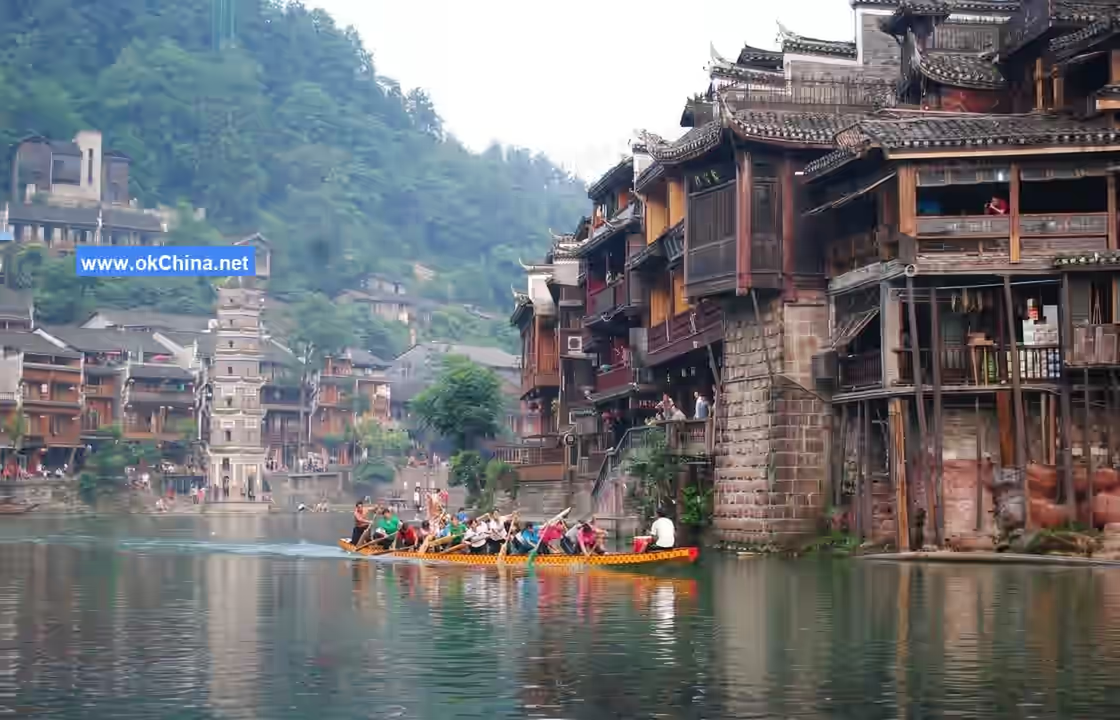
The stilted house cluster is located at Huilongge in the southeast of the ancient town, facing the ancient official road in front and overhanging the Tuo River at the back. It is one of the ancient architectural complexes in Fenghuang Ancient Town with strong Miao architectural characteristics. This stilted house cluster stretches 240 meters and belongs to the architectural styles of the Qing Dynasty and early Republic of China.
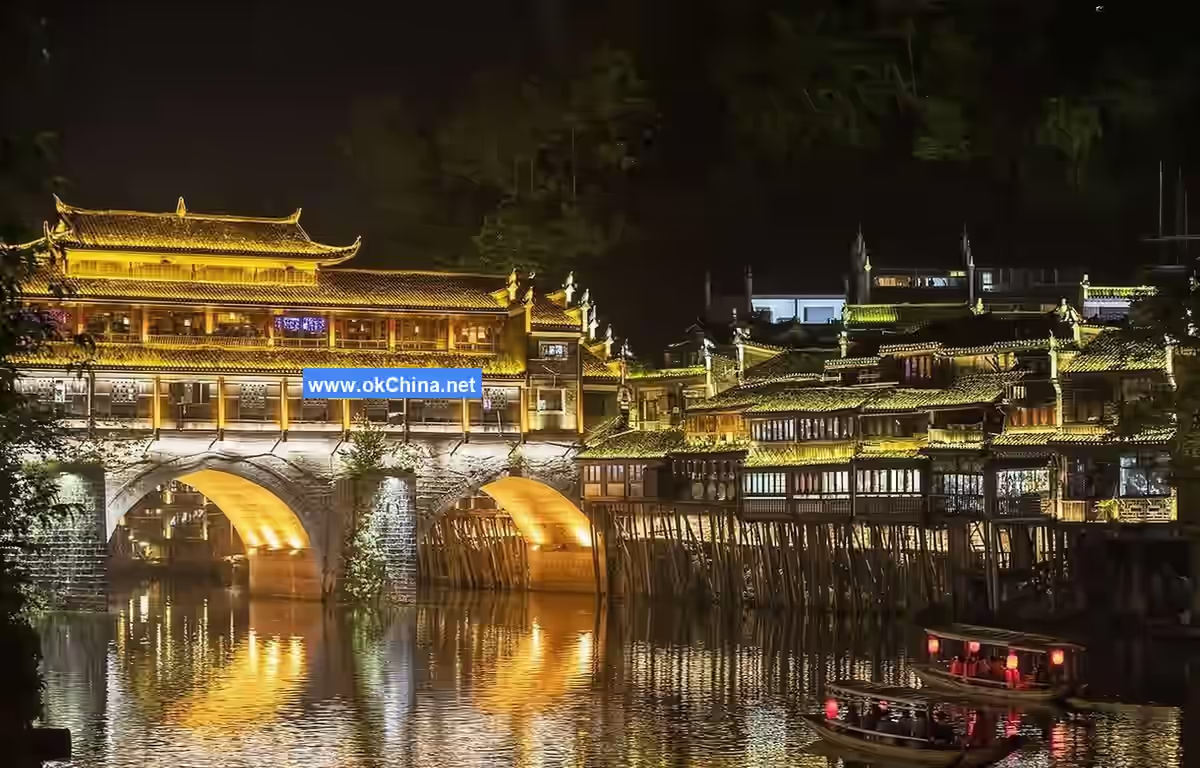
This type of building has two stories. Both stories typically feature a column-and-tie (穿斗式) timber structure with five columns and six or eight ties, holding high craft value. The upper story is spacious, while the lower story occupies an irregular footprint. The construction of the upper story is complex, with fine and meticulous workmanship, featuring a hip-and-gable roof (歇山顶) with upturned ridges, carved railings, doors, and windows. The lower story is not used as formal rooms but is also exquisitely carved with patterns like golden gourds, various animal heads, or floral designs. Supported by cantilevered beams, it overhangs above the Tuo River channel, forming a unique landscape. Whenever the weather clears after rain, a thin mist rises over the Tuo River, and the staggered stilted houses are reflected in the water. The entire complex resembles an enduringly beautiful painting, captivating viewers endlessly.
3.6 Wenchangge Primary School
Wenchangge Primary School in Fenghuang Ancient Town was built in the 31st year of the Guangxu reign of the Qing Dynasty (1905 AD). Located in the south of the historically and culturally famous city of Fenghuang on the Hunan-Guizhou border, it sits at the northern foot of the scenic Nanhua Mountain National Forest Park. Tian Xingkui, a young native of Fenghuang, traveled east to Japan to study at Hongwen Normal School, where he met Huang Xing, Qiu Jin, and others, and joined the Tongmenghui (Chinese Revolutionary Alliance). After completing his studies and returning to China in 1905, driven by the idea that "revitalizing China lies in nurturing talent," he founded the "Mengyang School" (the predecessor of Wenchangge Primary School) at the foot of Nanhua Mountain in his hometown, Fenghuang, becoming its first principal.### 3.7 Stone Slab Old Street Stone Slab Old Street is a bluestone street less than 5 meters wide. Starting from Daomenkou and heading west, it passes through Cross Street, East Main Street, West Main Street, Huilong Pavilion, Yingshaochong, Doushanla, Jieguan Pavilion, Shen Congwen's Tomb, and extends all the way to the "Number One Spring Under Heaven," spanning over 3,000 meters in total. It is the most bustling commercial street in Fenghuang.
3.8 Wanming Pagoda
Wanming Pagoda is located on the north bank of Tuojiang River's Shawan, complementing the Xiachang Pavilion and Rainbow Bridge. The pagoda is constructed from blue bricks, mixed mortar, and reinforced concrete. It is hexagonal with seven stories, each featuring six upturned eaves adorned with hanging bronze wind chimes. The pagoda stands 22.98 meters tall, with a diameter of 4.5 meters at the first story, decreasing by 0.3 meters per subsequent story. The first story displays six pairs of inscribed couplets, all composed by renowned figures, varying in style from celebratory to reflective.
3.9 Qifeng Mountain
This is the original site of Qifeng Temple, though the temple no longer exists. From this mountain, one can enjoy views of the Tuojiang River, stilted houses, Rainbow Bridge, Duocui Tower, Wanming Pagoda, and other scenic spots.
3.10 Wishing Pavilion
Located at the "dragon's head" position of Fenghuang Ancient Town's geomantic dragon vein, the Wishing Pavilion is situated on the riverside stone path next to the "Rainbow Bridge" in the Fenghuang scenic area, atop the East Gate tower pavilion. Known for its auspicious feng shui and beautiful landscape, locals have long come here to make wishes and pray for blessings. It is famed as a place that "gathers the spiritual essence of mountains and waters, locking past and present lives"—hence the name Wishing Pavilion.
3.11 Rainbow Bridge
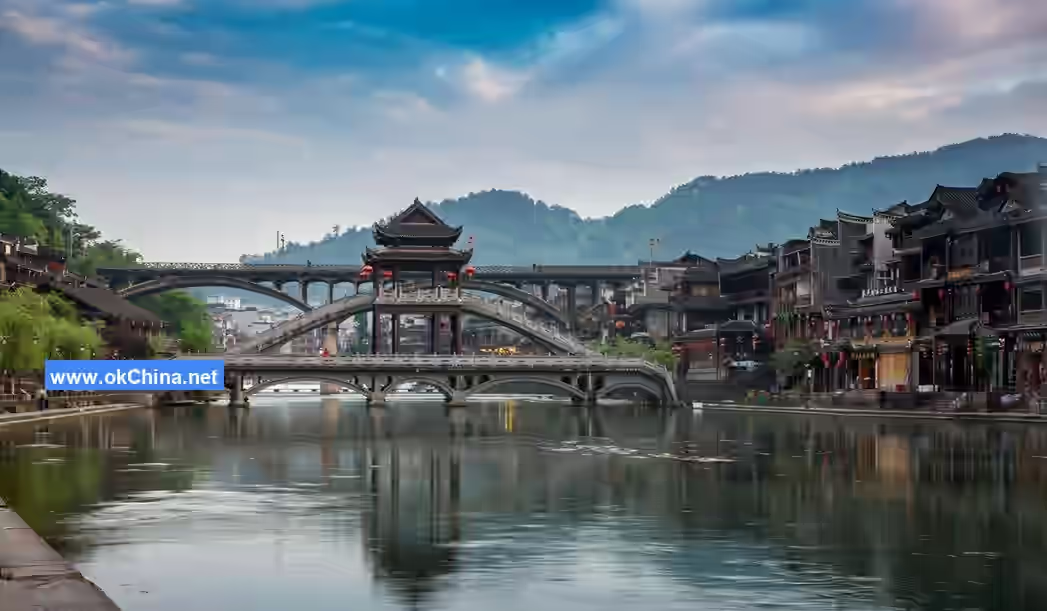
Originally named Wohong Bridge, also known as the "Wind and Rain Tower," the Rainbow Bridge was built in the early years of the Ming Hongwu period and is located at the center of Fenghuang. From the Rainbow Bridge, one can take in the panoramic view of the entire Fenghuang town and the picturesque scenery along both banks of the Tuojiang River. The bridge has two levels: the first floor mainly houses shops and grocery stores, while the second floor is a folk culture building containing calligraphy and painting works related to the Rainbow Bridge Wind and Rain Tower from ancient times to the present.
3.12 Shen Congwen's Former Residence
The old house on Zhongying Street was originally built in the fifth year of the Tongzhi reign of the Qing Dynasty (1866) by Master Shen Congwen's grandfather, Shen Hongfu (who served as the Provincial Military Commander of Guizhou during the Qing Dynasty). The house features a post-and-lintel wooden structure with two rows of rooms, sealed with fire bricks. It is small and exquisite, antique and elegant, embodying the distinctive architectural style of the Ming and Qing periods in western Hunan.
3.13 Xiong Xiling's Former Residence
Xiong Xiling's Former Residence is located in a small alley on North Wenxing Street in the ancient town. Covering an area of 800 square meters, the doors and windows are made of wood, carved or painted with patterns. The design is generous and the craftsmanship exquisite, representing a typical ancient Miao courtyard architectural style, rich in ethnic charm.
3.14 Chaoyang Palace
Chaoyang Palace, also known as the Chen Family Ancestral Hall, is the most completely preserved masterpiece of a modern imitation-ancient ancestral hall in Fenghuang Ancient Town. Inside the hall, on both sides of the ancient stage, hangs a famous couplet: "A space of a few feet can represent a family, a state, or the world; figures over millennia include the wise, the foolish, and the divine." Located on the northwest side of the ancient town, Chaoyang Palace was built in the fourth year of the Republic of China (1915). It was funded by donations from the clan, initiated by local gentry Chen Kaibing and Chen Kaifan, brothers of Chen Quzhen, who was known as the "King of Western Hunan." In the twelfth year of the Republic of China (1923), Chen Quzhen, then the commander of the Western Hunan Defense Forces, expanded and improved it. From then on, the main gate, main hall, stage, left and right boxes, kitchen, toilet, and other 14 rooms formed an integrated complex, constituting a typical southern-style quadrangle courtyard. It became a venue for the Chen clan to gather, watch operas, or hold important events. The entire structure features double eaves with blue tiles, upturned roof corners, and three layers of bracket sets under the eaves. The main ridge has chiwen ornaments at both ends and a colorful gourd-shaped finial in the center. The layout is symmetrical and reasonable, making it an architectural masterpiece. The main gate of Chaoyang Palace is a purplish-red brick archway, 8 meters high. On both sides of the gate is inscribed a couplet: "Auspicious birds rise from the weeds, their wings beating against the sky for ten thousand miles; Distinguished guests arrive at the border, their eyes beholding the towers, always full of sentiment." Symmetrically arranged on the left and right are 12 relief sculptures of landscapes, flowers, and birds. The gate tower's upturned eaves and corners are particularly distinctive. Facing the main hall is the ancient stage, rich in local flavor, where classical operas, Yang opera, Nuotang opera, and Chenhe high-pitched opera are often performed.
3.15 Wanshou Palace
Wanshou Palace is situated in the scenic Shawan outside the East Gate, backed by Dongling Mountain and facing the Tuojiang River. Its initial construction began in the late Ming and early Qing periods, with large-scale building taking place in the twentieth year of the Qianlong reign of the Qing Dynasty (1755). In the fourth year of the Xianfeng reign (1854), Yang Si from Jiangxi built the Xiachang Pavilion on the west side. In the seventeenth year of the Republic of China (1928), the Yang Tower was added north of the main gate. Thus, Wanshou Palace formed a grand architectural complex with exquisite and unique design, and delicate carvings. The people of Fenghuang built a temple on the mountainside opposite Wanshou Palace—Zhunti Nunnery, also called Jiangxin Chan Temple. This nunnery has two large circular windows, each over three meters in diameter, opened in the front earthen red wall, facing Wanshou Palace. People from Jiangxi built a small white pagoda in Shawan, its spire gleaming brightly in the sunlight, pointing toward the wall of Zhunti Nunnery. The people of Fenghuang sculpted a "Skeleton Bodhisattva" statue in the back hall of Zhunti Nunnery. This bodhisattva resembles the monk Jigong, holding open a large "cosmic bag."
3.16 Huangsiqiao Ancient City
Thirty kilometers due west from Fenghuang County lies Huangsiqiao Ancient City. Strategically located at the vital communication point between Hunan and Guizhou, the city enjoys a broad terrain: to the east lies the strategic pass of Qilichong, to the south the perilous Tingziguan, to the west the long and solid frontier wall barrier, and to the north the obstacle of high mountains and deep valleys. It is an important ancient city dominating the western part of Zhen'gan. Huangsiqiao Ancient City is the best-preserved fortress in China. Originally built as a military garrison in the third year of the Tang Chuigong period (687 AD), it served as an outpost for successive rulers to prevent conflicts with the western Miao people. The city is constructed from blue stone. The city walls are 5.6 meters high, 2.9 meters thick, and 2.4 meters wide, covering an area of 2,900 square meters. The city has three gates: "Heyu Gate," "Shicheng Gate," and "Riguang Gate." Each gate is topped by a tall gate tower over ten meters high in Qing-style architecture. All three gate towers have hip-and-gable roofs, with lower layers covered by waist eaves and small blue tiles above, featuring upturned eaves and corners, creating a magnificent sight. The upper part of the city wall is shaped like saw teeth, with 300 crenels and two protruding artillery platforms. The city's construction combines local indigenous building techniques with imperial craftsmanship, giving it a simple and solid character. It is built from local bluestone limestone, which is resistant to temperature changes, cold, and moisture, making it sturdy and durable. The stone blocks were strictly selected, each uniformly six inches thick, with surfaces finely drilled and chiseled for consistency. The masonry technique was also highly refined: the gaps between stones were filled and bonded with a mixture of glutinous rice porridge and lime, making the structure extremely solid.
3.17 Shujiatang Ancient Fortress
Shujiatang, also known as Shujiatang, is a key tourist attraction in Fenghuang, western Hunan, located 31 kilometers west of the county in the eastern part of Huanghe Township. Due to its location at the border of Hunan, Guizhou, and Sichuan (now Chongqing), the area was historically plagued by banditry. Shujiatang served both defensive purposes and functioned as a garrison for offensive operations. According to research, Yang Zaisi, the third son of Yang Liulang (a descendant of the Northern Song Yang family generals), was ordered to pacify the south. Seeing the strategic terrain, he set up camp here, and Shujiatang gradually became a military stronghold—a garrison camp. As the local tribes submitted, the area also became an economic and cultural center. In May 2000, Professor Luo Zhewen, an expert on the Great Wall, visited for investigation. Based on the existing wall foundations, he determined that the fortress dates back at least 800 years. During the Wanli period of the Ming Dynasty, when southern Miao people rebelled, the government allocated over ten thousand taels of silver to suppress the rebels. Over four years, Shujiatang and the surrounding ancient camps were reinforced. Shujiatang was built with barracks at the foot of the mountain and interconnected forts on the mountaintop, forming a fortress. Shujiatang Ancient Fortress has two distinctive features: First, it is ancient and marvelous. The fortress is surrounded by grand ancient walls, roughly circular in shape. The walls wind and twist, full of variation. Having endured centuries of weathering, though now worn and darkened, the ancient fortress still exhibits a kind of desolate beauty. Second, it is simple yet elegant. The ancient fortress is encircled by mountain streams on its east, south, and west sides. The streams are clear and visible to the bottom, and numerous ponds surround the city, forming a natural defensive line.
3.18 Tuojiang River Stepping Stones
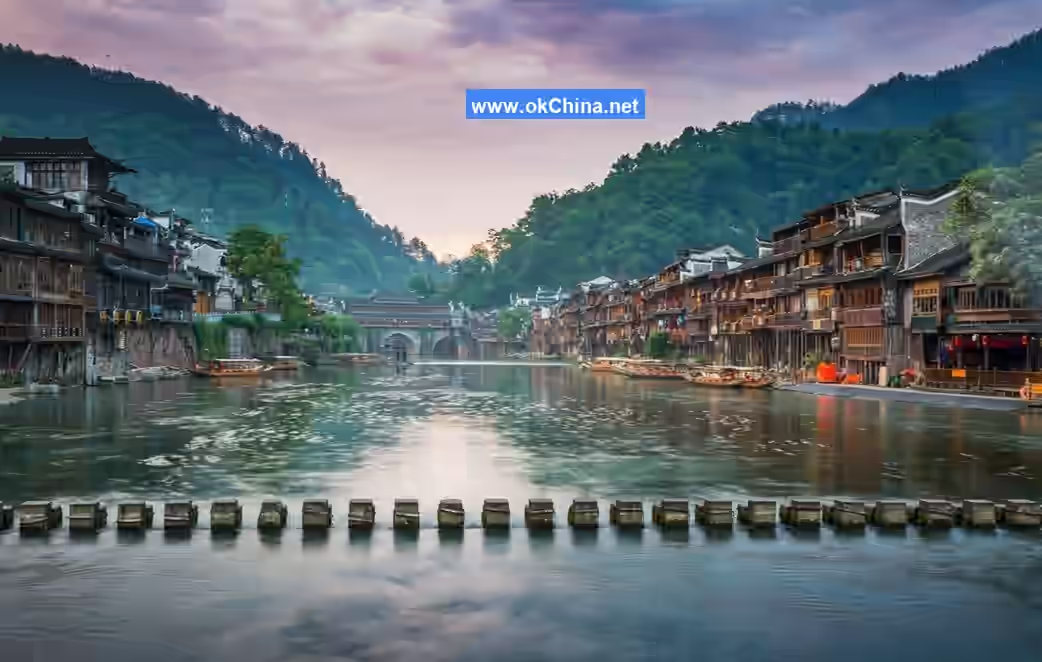
The Tuojiang River Stepping Stones are one of the most popular scenic spots in the ancient town. This is an ancient pathway bridge, first built during the Tang Dynasty, serving as the necessary route from Qianzhou into the then Wuzhaisi City. It was rebuilt in the 43rd year of the Kangxi reign of the Qing Dynasty (1704) and remained the ancient road from Fenghuang to Qiancheng. Originally, the stepping stones consisted of over forty red rectangular stone blocks, each spaced about two feet apart, facilitating townspeople carrying loads into the city. However, during annual floods, some stones would be knocked over or washed away. During the Republic of China period, County Magistrate Li Zongqi had wooden planks laid over the stones, making passage more convenient than before, but both stones and planks were still washed away. In 1950, after the establishment of the Fenghuang County People's Government, the missing stones were replaced and enlarged, with two stones joined into one. The stepping stones now span 100 meters with 15 stone blocks total, covered with thick wooden planks. Iron chains were anchored into holes drilled in the riverbed stones and secured with iron wires, making the stepping stones sturdy and well-preserved. Today, they not only remain a vital passage for people on both banks but have also become a beautiful and distinctive ethnic feature of Fenghuang Ancient Town. In the autumn of 2000, to further improve conditions for crossing the river and to better beautify the ancient town, Fenghuang County allocated funds to build a new double-row stepping stones several dozen meters downstream from the old ones. The two rows stand side by side across the river, one slightly higher than the other, spaced about a foot apart. Each row consists of 66 stone blocks lined up across the river surface, with the distance between each stone being just a small step. One row is for coming, the other for going.### 3.19 Guantianshan Miao Village Guantianshan Ancient Miao Village is located within the territory of Fenghuang, a National Historical and Cultural City. It is adjacent to National Highway 209, making transportation extremely convenient. Situated on the same National Highway 209 line as other tourist attractions such as the underground palace Qiliang Cave (one of the eight major scenic spots of the ancient Fenghuang town), Ximenxia Rafting, and the "Love Valley" reconstructed with investment from the great master of culture and art, Mr. Huang Yongyu, it lies at the central node of the golden tourism corridor from Zhangjiajie to the ancient Fenghuang town. This makes it the optimal sacred tourism destination for self-driving tours from Hunan, Hubei, Guizhou, and Chongqing, as well as for tour groups organized by major travel agencies. It has served as an outdoor filming location for numerous film and television productions, including Border Town, The Story of Suppressing Bandits in Western Hunan, Blood Drum, Bloody Western Hunan, Past Events of Western Hunan, Xiaoxiao, a Girl from Hunan, and Divine Marksman's Blood Vendetta.
3.20 China Miao Nationality Museum
The China Miao Nationality Museum is situated in the mysterious location known as the "Miao King's Palace" — the Bagong Miao Village in Shanjiang Town, Fenghuang County. The museum covers an area of 1,864 square meters with a building area of 1,200 square meters, making it the largest, highest-grade, and most extensively exhibited private Miao museum in the country. It is divided into nine exhibition halls, including Miao Farmhouse, Ancient Dwellings, Affluent Household, Warrior's Home, Shaman's Hut, and Glimpses of Costumes, along with a Miao Folk Custom Garden and a living area. It houses over 10,000 collections covering all aspects of life such as clothing, food, housing, and transportation. Located in Bagong Miao Village, this Miao museum uses family culture as its entry point, integrating historicity, ethnicity, and artistry to showcase to the world the Miao people's unceasing labor and relentless struggle throughout thousands of years of evolution, as well as their奇异神秘、绚丽多姿 (奇异神秘、绚丽多姿)奇异神秘、绚丽多姿奇异神秘、绚丽多姿奇异神秘、绚丽多姿奇异神秘、绚丽多姿奇异神秘、绚丽多姿奇异神秘、绚丽多姿奇异神秘、绚丽多姿奇异神秘、绚丽多姿奇异神秘、绚丽多姿奇异神秘、绚丽多姿奇异神秘、绚丽多姿奇异神秘、绚丽多姿奇异神秘、绚丽多姿奇异神秘、绚丽多姿奇异神秘、绚丽多姿奇异神秘、绚丽多姿奇异神秘、绚丽多姿奇异神秘、绚丽多姿奇异神秘、绚丽多姿奇异神秘、绚丽多姿奇异神秘、绚丽多姿奇异神秘、绚丽多姿奇异神秘、绚丽多姿奇异神秘、绚丽多姿奇异神秘、绚丽多姿奇异神秘、绚丽多姿奇异神秘、绚丽多姿奇异神秘、绚丽多姿奇异神秘、绚丽多姿奇异神秘、绚丽多姿奇异神秘、绚丽多姿奇异神秘、绚丽多姿奇异神秘、绚丽多姿奇异神秘、绚丽多姿奇异神秘、绚丽多姿奇异神秘、绚丽多姿奇异神秘、绚丽多姿奇异神秘、绚丽多姿奇异神秘、绚丽多姿奇异神秘、绚丽多姿奇异神秘、绚丽多姿奇异神秘、绚丽多姿奇异神秘、绚丽多姿奇异神秘、绚丽多姿奇异神秘、绚丽多姿奇异神秘、绚丽多姿奇异神秘、绚丽多姿奇异神秘、绚丽多姿奇异神秘、绚丽多姿奇异神秘、绚丽多姿奇异神秘、绚丽多姿奇异神秘、绚丽多姿奇异神秘、绚丽多姿奇异神秘、绚丽多姿奇异神秘、绚丽多姿奇异神秘、绚丽多姿奇异神秘、绚丽多姿奇异神秘、绚丽多姿奇异神秘、绚丽多姿奇异神秘、绚丽多姿奇异神秘、绚丽多姿奇异神秘、绚丽多姿奇异神秘、绚丽多姿奇异神秘、绚丽多姿奇异神秘、绚丽多姿奇异神秘、绚丽多姿奇异神秘、绚丽多姿奇异神秘、绚丽多姿奇异神秘、绚丽多姿奇异神秘、绚丽多姿奇异神秘、绚丽多姿奇异神秘、绚丽多姿奇异神秘、绚丽多姿奇异神秘、绚丽多姿奇异神秘、绚丽多姿奇异神秘、绚丽多姿奇异神秘、绚丽多姿奇异神秘、绚丽多姿奇异神秘、绚丽多姿奇异神秘、绚丽多姿奇异神秘、绚丽多姿奇异神秘、绚丽多姿奇异神秘、绚丽多姿奇异神秘、绚丽多姿奇异神秘、绚丽多姿奇异神秘、绚丽多姿奇异神秘、绚丽多姿奇异神秘、绚丽多姿奇异神秘、绚丽多姿奇异神秘、绚丽多姿奇异神秘、绚丽多姿奇异神秘、绚丽多姿奇异神秘、绚丽多姿奇异神秘、绚丽多姿奇异神秘、绚丽多姿奇异神秘、绚丽多姿奇异神秘、绚丽多姿奇异神秘、绚丽多姿奇异神秘、绚丽多姿奇异神秘、绚丽多姿奇异神秘、绚丽多姿奇异神秘、绚丽多姿奇异神秘、绚丽多姿奇异神秘、绚丽多姿奇异神秘、绚丽多姿奇异神秘、绚丽多姿奇异神秘、绚丽多姿奇异神秘、绚丽多姿奇异神秘、绚丽多姿奇异神秘、绚丽多姿奇异神秘、绚丽多姿奇异神秘、绚丽多姿奇异神秘、绚丽多姿奇异神秘、绚丽多姿奇异神秘、绚丽多姿奇异神秘、绚丽多姿奇异神秘、绚丽多姿奇异神秘、绚丽多姿奇异神秘、绚丽多姿奇异神秘、绚丽多姿奇异神秘、绚丽多姿奇异神秘、绚丽多姿奇异神秘、绚丽多姿奇异神秘、绚丽多姿奇异神秘、绚丽多姿奇异神秘、绚丽多姿奇异神秘、绚丽多姿奇异神秘、绚丽多姿奇异神秘、绚丽多姿奇异神秘、绚丽多姿奇异神秘、绚丽多姿奇异神秘、绚丽多姿奇异神秘、绚丽多姿奇异神秘、绚丽多姿奇异神秘、绚丽多姿奇异神秘、绚丽多姿奇异神秘、绚丽多姿奇异神秘、绚丽多姿奇异神秘、绚丽多姿奇异神秘、绚丽多姿奇异神秘、绚丽多姿奇异神秘、绚丽多姿奇异神秘、绚丽多姿奇异神秘、绚丽多姿奇异神秘、绚丽多姿奇异神秘、绚丽多姿奇异神秘、绚丽多姿奇异神秘、绚丽多姿奇异神秘、绚丽多姿奇异神秘、绚丽多姿奇异神秘、绚丽多姿奇异神秘、绚丽多姿奇异神秘、绚丽多姿奇异神秘、绚丽多姿奇异神秘、绚丽多姿奇异神秘、绚丽多姿奇异神秘、绚丽多姿奇异神秘、绚丽多姿奇异神秘、绚丽多姿奇异神秘、绚丽多姿奇异神秘、绚丽多姿奇异神秘、绚丽多姿奇异神秘、绚丽多姿奇异神秘、绚丽多姿奇异神秘、绚丽多姿奇异神秘、绚丽多姿奇异神秘、绚丽多姿奇异神秘、绚丽多姿奇异神秘、绚丽多姿奇异神秘、绚丽多姿奇异神秘、绚丽多姿奇异神秘、绚丽多姿奇异神秘、绚丽多姿奇异神秘、绚丽多姿奇异神秘、绚丽多姿奇异神秘、绚丽多姿奇异神秘、绚丽多姿奇异神秘、绚丽多姿奇异神秘、绚丽多姿奇异神秘、绚丽多姿奇异神秘、绚丽多姿奇异神秘、绚丽多姿奇异神秘、绚丽多姿奇异神秘、绚丽多姿奇异神秘、绚丽多姿奇异神秘、绚丽多姿奇异神秘、绚丽多姿奇异神秘、绚丽多姿奇异神秘、绚丽多姿奇异神秘、绚丽多姿奇异神秘、绚丽多姿奇异神秘、绚丽多姿奇异神秘、绚丽多姿奇异神秘、绚丽多姿奇异神秘、绚丽多姿奇异神秘、绚丽多姿奇异神秘、绚丽多姿奇异神秘、绚丽多姿奇异神秘、绚丽多姿奇异神秘、绚丽多姿奇异神秘、绚丽多姿奇异神秘、绚丽多姿奇异神秘、绚丽多姿奇异神秘、绚丽多姿奇异神秘、绚丽多姿奇异神秘、绚丽多姿奇异神秘、绚丽多姿奇异神秘、绚丽多姿奇异神秘、绚丽多姿奇异神秘、绚丽多姿奇异神秘、绚丽多姿奇异神秘、绚丽多姿奇异神秘、绚丽多姿奇异神秘、绚丽多姿奇异神秘、绚丽多姿奇异神秘、绚丽多姿奇异神秘、绚丽多姿奇异神秘、绚丽多姿奇异神秘、绚丽多姿奇异神秘、绚丽多姿奇异神秘、绚丽多姿奇异神秘、绚丽多姿奇异神秘、绚丽多姿奇异神秘、绚丽多姿奇异神秘、绚丽多姿奇异神秘、绚丽多姿奇异神秘、绚丽多姿奇异神秘、绚丽多姿奇异神秘、绚丽多姿奇异神秘、绚丽多姿奇异神秘、绚丽多姿奇异神秘、绚丽多姿奇异神秘、绚丽多姿奇异神秘、绚丽多姿奇异神秘、绚丽多姿奇异神秘、绚丽多姿奇异神秘、绚丽多姿奇异神秘、绚丽多姿奇异神秘、绚丽多姿奇异神秘、绚丽多姿奇异神秘、绚丽多姿奇异神秘、绚丽多姿奇异神秘、绚丽多姿奇异神秘、绚丽多姿奇异神秘、绚丽多姿奇异神秘、绚丽多姿奇异神秘、绚丽多姿奇异神秘、绚丽多姿奇异神秘、绚丽多姿奇异神秘、绚丽多姿奇异神秘、绚丽多姿奇异神秘、绚丽多姿奇异神秘、绚丽多姿奇异神秘、绚丽多姿奇异神秘、绚丽多姿奇异神秘、绚丽多姿奇异神秘、绚丽多姿奇异神秘、绚丽多姿奇异神秘、绚丽多姿奇异神秘、绚丽多姿奇异神秘、绚丽多姿奇异神秘、绚丽多姿奇异神秘、绚丽多姿奇异神秘、绚丽多姿奇异神秘、绚丽多姿奇异神秘、绚丽多姿奇异神秘、绚丽多姿奇异神秘、绚丽多姿奇异神秘、绚丽多姿奇异神秘、绚丽多姿奇异神秘、绚丽多姿奇异神秘、绚丽多姿奇异神秘、绚丽多姿奇异神秘、绚丽多姿奇异神秘、绚丽多姿奇异神秘、绚丽多姿奇异神秘、绚丽多姿奇异神秘、绚丽多姿奇异神秘、绚丽多姿奇异神秘、绚丽多姿奇异神秘、绚丽多姿奇异神秘、绚丽多姿奇异神秘、绚丽多姿奇异神秘、绚丽多姿奇异神秘、绚丽多姿奇异神秘、绚丽多姿奇异神秘、绚丽多姿奇异神秘、绚丽多姿奇异神秘、绚丽多姿奇异神秘、绚丽多姿奇异神秘、绚丽多姿奇异神秘、绚丽多姿奇异神秘、绚丽多姿奇异神秘、绚丽多姿奇异神秘、绚丽多姿奇异神秘、绚丽多姿奇异神秘、绚丽多姿奇异神秘、绚丽多姿奇异神秘、绚丽多姿奇异神秘、绚丽多姿奇异神秘、绚丽多姿奇异神秘、绚丽多姿奇异神秘、绚丽多姿奇异神秘、绚丽多姿奇异神秘、绚丽多姿奇异神秘、绚丽多姿奇异神秘、绚丽多姿奇异神秘、绚丽多姿奇异神秘、绚丽多姿奇异神秘、绚丽多姿奇异神秘、绚丽多姿奇异神秘、绚丽多姿奇异神秘、绚丽多姿奇异神秘、绚丽多姿奇异神秘、绚丽多姿奇异神秘、绚丽多姿奇异神秘、绚丽多姿奇异神秘、绚丽多姿奇异神秘、绚丽多姿奇异神秘、绚丽多姿奇异神秘、绚丽多姿奇异神秘、绚丽多姿奇异神秘、绚丽多姿奇异神秘、绚丽多姿奇异神秘、绚丽多姿奇异神秘、绚丽多姿奇异神秘、绚丽多姿奇异神秘、绚丽多姿奇异神秘、绚丽多姿奇异神秘、绚丽多姿奇异神秘、绚丽多姿奇异神秘、绚丽多姿奇异神秘、绚丽多姿奇异神秘、绚丽多姿奇异神秘、绚丽多姿奇异神秘、绚丽多姿奇异神秘、绚丽多姿奇异神秘、绚丽多姿奇异神秘、绚丽多姿奇异神秘、绚丽多姿奇异神秘、绚丽多姿奇异神秘、绚丽多姿奇异神秘、绚丽多姿奇异神秘、绚丽多姿奇异神秘、绚丽多姿奇异神秘、绚丽多姿奇异神秘、绚丽多姿奇异神秘、绚丽多姿奇异神秘、绚丽多姿奇异神秘、绚丽多姿奇异神秘、绚丽多姿奇异神秘、绚丽多姿奇异神秘、绚丽多姿奇异神秘、绚丽多姿奇异神秘、绚丽多姿奇异神秘、绚丽多姿奇异神秘、绚丽多姿奇异神秘、绚丽多姿奇异神秘、绚丽多姿奇异神秘、绚丽多姿奇异神秘、绚丽多姿奇异神秘、绚丽多姿奇异神秘、绚丽多姿奇异神秘、绚丽多姿奇异神秘、绚丽多姿奇异神秘、绚丽多姿奇异神秘、绚丽多姿奇异神秘、绚丽多姿奇异神秘、绚丽多姿奇异神秘、绚丽多姿奇异神秘、绚丽多姿奇异神秘、绚丽多姿奇异神秘、绚丽多姿奇异神秘、绚丽多姿奇异神秘、绚丽多姿奇异神秘、绚丽多姿奇异神秘、绚丽多姿奇异神秘、绚丽多姿奇异神秘、绚丽多姿奇异神秘、绚丽多姿奇异神秘、绚丽多姿奇异神秘、绚丽多姿奇异神秘、绚丽多姿奇异神秘、绚丽多姿奇异神秘、绚丽多姿奇异神秘、绚丽多姿奇异神秘、绚丽多姿奇异神秘、绚丽多姿奇异神秘、绚丽多姿奇异神秘、绚丽多姿奇异神秘、绚丽多姿奇异神秘、绚丽多姿奇异神秘、绚丽多姿奇异神秘、绚丽多姿奇异神秘、绚丽多姿奇异神秘、绚丽多姿奇异神秘、绚丽多姿奇异神秘、绚丽多姿奇异神秘、绚丽多姿奇异神秘、绚丽多姿奇异神秘、绚丽多姿奇异神秘、绚丽多姿奇异神秘、绚丽多姿奇异神秘、绚丽多姿奇异神秘、绚丽多姿奇异神秘、绚丽多姿奇异神秘、绚丽多姿奇异神秘、绚丽多姿奇异神秘、绚丽多姿奇异神秘、绚丽多姿奇异神秘、绚丽多姿奇异神秘、绚丽多姿奇异神秘、绚丽多姿奇异神秘、绚丽多姿奇异神秘、绚丽多姿奇异神秘、绚丽多姿奇异神秘、绚丽多姿奇异神秘、绚丽多姿奇异神秘、绚丽多姿奇异神秘、绚丽多姿奇异神秘、绚丽多姿奇异神秘、绚丽多姿奇异神秘、绚丽多姿奇异神秘、绚丽多姿奇异神秘、绚丽多姿奇异神秘、绚丽多姿奇异神秘、绚丽多姿奇异神秘、绚丽多姿奇异神秘、绚丽多姿奇异神秘、绚丽多姿奇异神秘、绚丽多姿奇异神秘、绚丽多姿奇异神秘、绚丽多姿奇异神秘、绚丽多姿奇异神秘、绚丽多姿奇异神秘、绚丽多姿奇异神秘、绚丽多姿奇异神秘、绚丽多姿奇异神秘、绚丽多姿奇异神秘、绚丽多姿奇异神秘、绚丽多姿奇异神秘、绚丽多姿奇异神秘、绚丽多姿奇异神秘、绚丽多姿奇异神秘、绚丽多姿奇异神秘、绚丽多姿奇异神秘、绚丽多姿奇异神秘、绚丽多姿奇异神秘、绚丽多姿奇异神秘、绚丽多姿奇异神秘、绚丽多姿奇异神秘、绚丽多姿奇异神秘、绚丽多姿奇异神秘、绚丽多姿奇异神秘、绚丽多姿奇异神秘、绚丽多姿奇异神秘、绚丽多姿奇异神秘、绚丽多姿奇异神秘、绚丽多姿奇异神秘、绚丽多姿奇异神秘、绚丽多姿奇异神秘、绚丽多姿奇异神秘、绚丽多姿奇异神秘、绚丽多姿奇异神秘、绚丽多姿奇异神秘、绚丽多姿奇异神秘、绚丽多姿奇异神秘、绚丽多姿奇异神秘、绚丽多姿奇异神秘、绚丽多姿奇异神秘、绚丽多姿奇异神秘、绚丽多姿奇异神秘、绚丽多姿奇异神秘、绚丽多姿奇异神秘、绚丽多姿奇异神秘、绚丽多姿奇异神秘、绚丽多姿奇异神秘、绚丽多姿奇异神秘、绚丽多姿奇异神秘、绚丽多姿奇异神秘、绚丽多姿奇异神秘、绚丽多姿奇异神秘、绚丽多姿奇异神秘、绚丽多姿奇异神秘、绚丽多姿奇异神秘、绚丽多姿奇异神秘、绚丽多姿奇异神秘、绚丽多姿奇异神秘、绚丽多姿奇异神秘、绚丽多姿奇异神秘、绚丽多姿奇异神秘、绚丽多姿奇异神秘、绚丽多姿奇异神秘、绚丽多姿奇异神秘、绚丽多姿奇异神秘、绚丽多姿奇异神秘、绚丽多姿奇异神秘、绚丽多姿奇异神秘、绚丽多姿奇异神秘、绚丽多姿奇异神秘、绚丽多姿奇异神秘、绚丽多姿奇异神秘、绚丽多姿奇异神秘、绚丽多姿奇异神秘、绚丽多姿奇异神秘、绚丽多姿奇异神秘、绚丽多姿奇异神秘、绚丽多姿奇异神秘、绚丽多姿奇异神秘、绚丽多姿奇异神秘、绚丽多姿奇异神秘、绚丽多姿奇异神秘、绚丽多姿奇异神秘、绚丽多姿奇异神秘、绚丽多姿奇异神秘、绚丽多姿奇异神秘、绚丽多姿奇异神秘、绚丽多姿奇异神秘、绚丽多姿奇异神秘、绚丽多姿奇异神秘、绚丽多姿奇异神秘、绚丽多姿奇异神秘、绚丽多姿奇异神秘、绚丽多姿奇异神秘、绚丽多姿奇异神秘、绚丽多姿奇异神秘、绚丽多姿奇异神秘、绚丽多姿奇异神秘、绚丽多姿奇异神秘、绚丽多姿奇异神秘、绚丽多姿奇异神秘、绚丽多姿奇异神秘、绚丽多姿奇异神秘、绚丽多姿奇异神秘、绚丽多姿奇异神秘、绚丽多姿奇异神秘、绚丽多姿奇异神秘、绚丽多姿奇异神秘、绚丽多姿奇异神秘、绚丽多姿奇异神秘、绚丽多姿奇异神秘、绚丽多姿奇异神秘、绚丽多姿奇异神秘、绚丽多姿奇异神秘、绚丽多姿奇异神秘、绚丽多姿奇异神秘、绚丽多姿奇异神秘、绚丽多姿奇异神秘、绚丽多姿奇异神秘、绚丽多姿奇异神秘、绚丽多姿奇异神秘、绚丽多姿奇异神秘、绚丽多姿奇异神秘、绚丽多姿奇异神秘、绚丽多姿奇异神秘、绚丽多姿奇异神秘、绚丽多姿奇异神秘、绚丽多姿奇异神秘、绚丽多姿奇异神秘、绚丽多姿奇异神秘、绚丽多姿奇异神秘、绚丽多姿奇异神秘、绚丽多姿奇异神秘、绚丽多姿奇异神秘、绚丽多姿奇异神秘、绚丽多姿奇异神秘、绚丽多姿奇异神秘、绚丽多姿奇异神秘、绚丽多姿奇异神秘、绚丽多姿奇异神秘、绚丽多姿奇异神秘、绚丽多姿奇异神秘、绚丽多姿奇异神秘、绚丽多姿奇异神秘、绚丽多姿奇异神秘、绚丽多姿奇异神秘、绚丽多姿奇异神秘、绚丽多姿奇异神秘、绚丽多姿奇异神秘、绚丽多姿奇异神秘、绚丽多姿奇异神秘、绚丽多姿奇异神秘、绚丽多姿奇异神秘、绚丽多姿奇异神秘、绚丽多姿奇异神秘、绚丽多姿奇异神秘、绚丽多姿奇异神秘、绚丽多姿奇异神秘、绚丽多姿奇异神秘、绚丽多姿奇异神秘、绚丽多姿奇异神秘、绚丽多姿奇异神秘、绚丽多姿奇异神秘、绚丽多姿奇异神秘、绚丽多姿奇异神秘、绚丽多姿奇异神秘、绚丽多姿奇异神秘、绚丽多姿奇异神秘、绚丽多姿奇异神秘、绚丽多姿奇异神秘、绚丽多姿奇异神秘、绚丽多姿奇异神秘、绚丽多姿奇异神秘、绚丽多姿奇异神秘、绚丽多姿奇异神秘、绚丽多姿奇异神秘、绚丽多姿奇异神秘、绚丽多姿奇异神秘、绚丽多姿奇异神秘、绚丽多姿奇异神秘、绚丽多姿奇异神秘、绚丽多姿奇异神秘、绚丽多姿奇异神秘、绚丽多姿奇异神秘、绚丽多姿奇异神秘、绚丽多姿奇异神秘、绚丽多姿奇异神秘、绚丽多姿奇异神秘、绚丽多姿奇异神秘、绚丽多姿奇异神秘、绚丽多姿奇异神秘、绚丽多姿奇异神秘、绚丽多姿奇异神秘、绚丽多姿奇异神秘、绚丽多姿奇异神秘、绚丽多姿奇异神秘、绚丽多姿奇异神秘、绚丽多姿奇异神秘、绚丽多姿奇异神秘、绚丽多姿奇异神秘、绚丽多姿奇异神秘、绚丽多姿奇异神秘、绚丽多姿奇异神秘、绚丽多姿奇异神秘、绚丽多姿奇异神秘、绚丽多姿奇异神秘、绚丽多姿奇异神秘、绚丽多姿奇异神秘、绚丽多姿奇异神秘、绚丽多姿奇异神秘、绚丽多姿奇异神秘、绚丽多姿奇异神秘、绚丽多姿奇异神秘、绚丽多姿奇异神秘、绚丽多姿奇异神秘、绚丽多姿奇异神秘、绚丽多姿奇异神秘、绚丽多姿奇异神秘、绚丽多姿奇异神秘、绚丽多姿奇异神秘、绚丽多姿奇异神秘、绚丽多姿奇异神秘、绚丽多姿奇异神秘、绚丽多姿奇异神秘、绚丽多姿奇异神秘、绚丽多姿奇异神秘、绚丽多姿奇异神秘、绚丽多姿奇异神秘、绚丽多姿奇异神秘、绚丽多姿奇异神秘、绚丽多姿奇异神秘、绚丽多姿奇异神秘、绚丽多姿奇异神秘、绚丽多姿奇异神秘、绚丽多姿奇异神秘、绚丽多姿奇异神秘、绚丽多姿奇异神秘、绚丽多姿奇异神秘、绚丽多姿奇异神秘、绚丽多姿奇异神秘、绚丽多姿奇异神秘、绚丽多姿奇异神秘、绚丽多姿奇异神秘、绚丽多姿奇异神秘、绚丽多姿奇异神秘、绚丽多姿奇异神秘、绚丽多姿奇异神秘、绚丽多姿奇异神秘、绚丽多姿奇异神秘、绚丽多姿奇异神秘、绚丽多姿奇异神秘、绚丽多姿奇异神秘、绚丽多姿奇异神秘、绚丽多姿奇异神秘、绚丽多姿奇异神秘、绚丽多姿奇异神秘、绚丽多姿奇异神秘、绚丽多姿奇异神秘、绚丽多姿奇异神秘、绚丽多姿奇异神秘、绚丽多姿奇异神秘、绚丽多姿奇异神秘、绚丽多姿奇异神秘、绚丽多姿奇异神秘、绚丽多姿奇异神秘、绚丽多姿奇异神秘、绚丽多姿奇异神秘、绚丽多姿奇异神秘、绚丽多姿奇异神秘、绚丽多姿奇异神秘、绚丽多姿奇异神秘、绚丽多姿奇异神秘、绚丽多姿奇异神秘、绚丽多姿奇异神秘、绚丽多姿奇异神秘、绚丽多姿奇异神秘、绚丽多姿奇异神秘、绚丽多姿奇异神秘、绚丽多姿奇异神秘、绚丽多姿奇异神秘、绚丽多姿奇异神秘、绚丽多姿奇异神秘、绚丽多姿奇异神秘、绚丽多姿奇异神秘、绚丽多姿奇异神秘、绚丽多姿奇异神秘、绚丽多姿奇异神秘、绚丽多姿奇异神秘、
Comments
Post a Comment