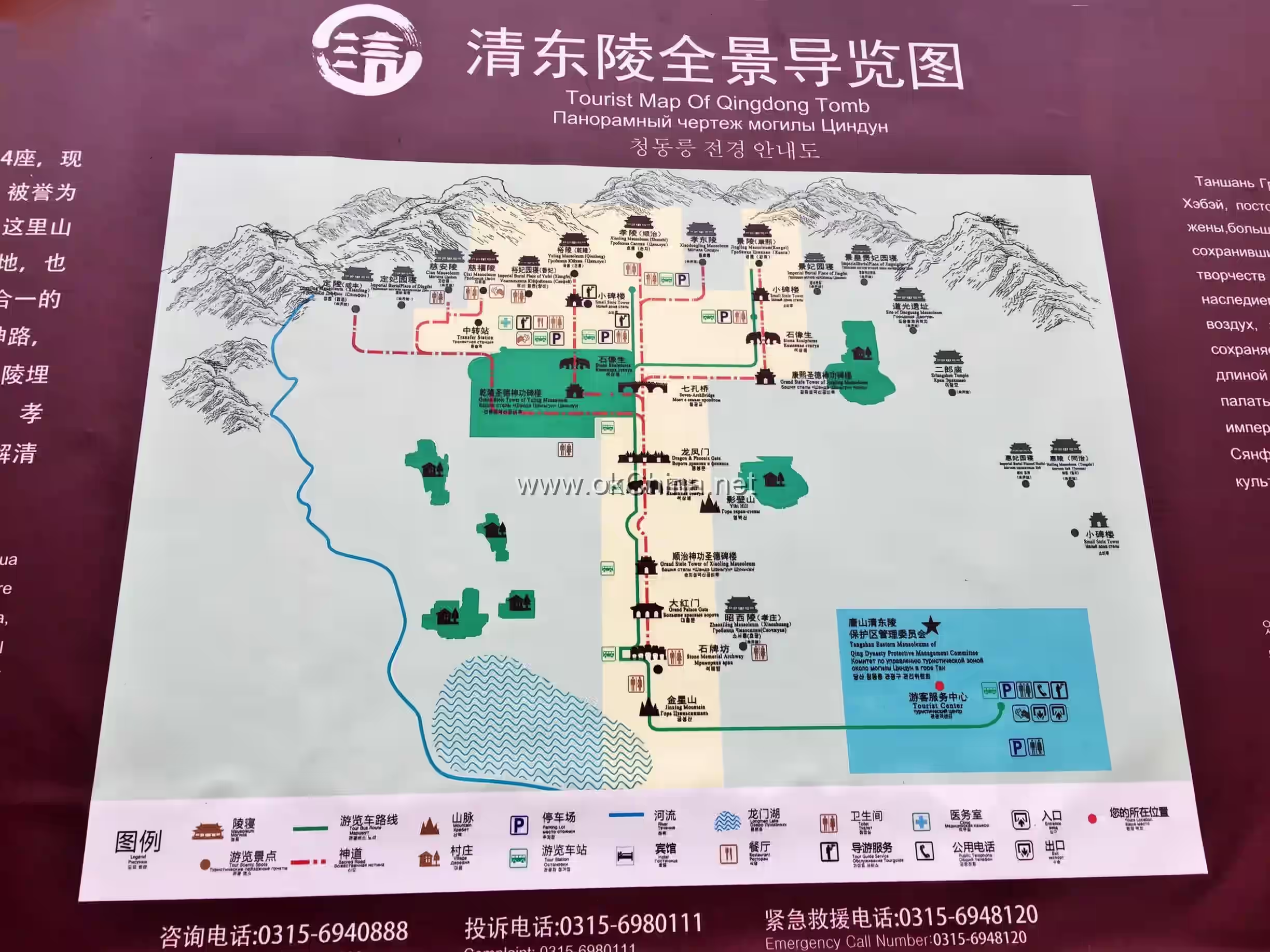
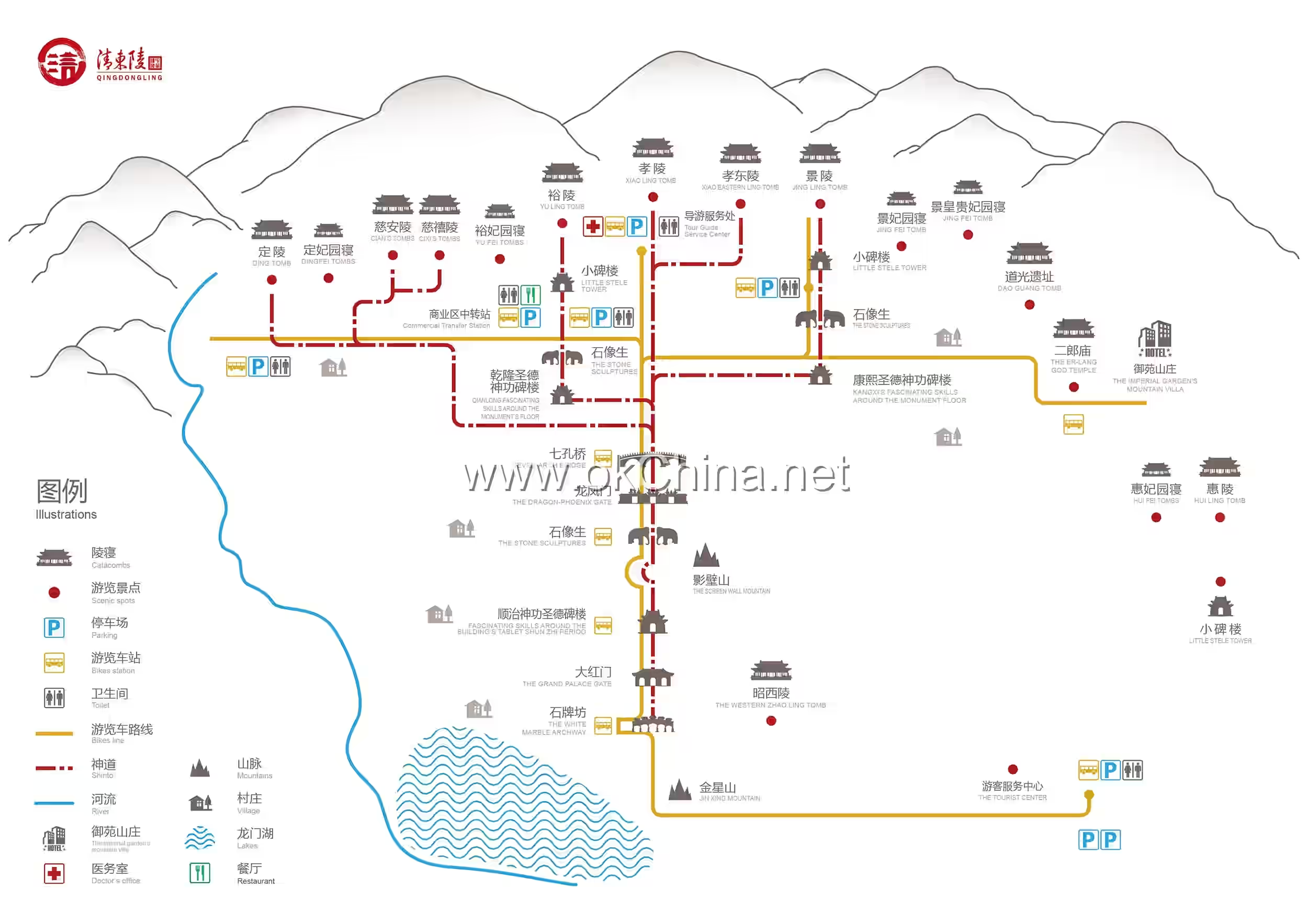
Introduction to the Eastern Qing Tombs Scenic Area
I. Overview
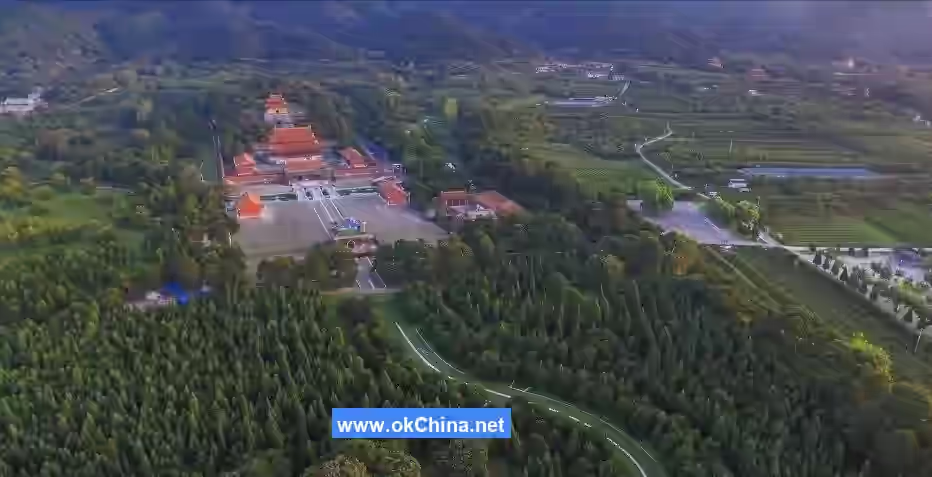
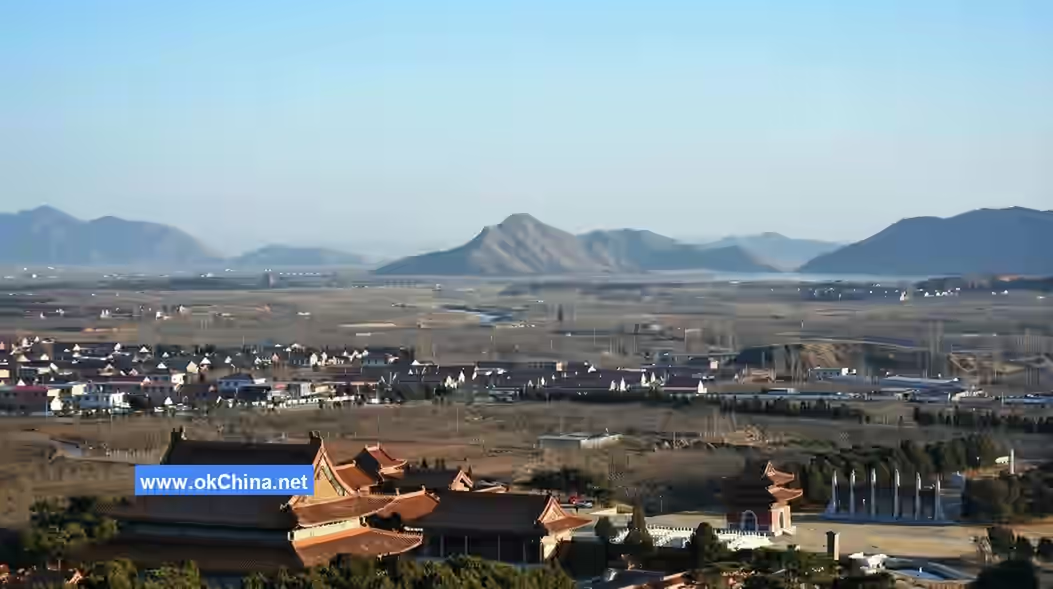
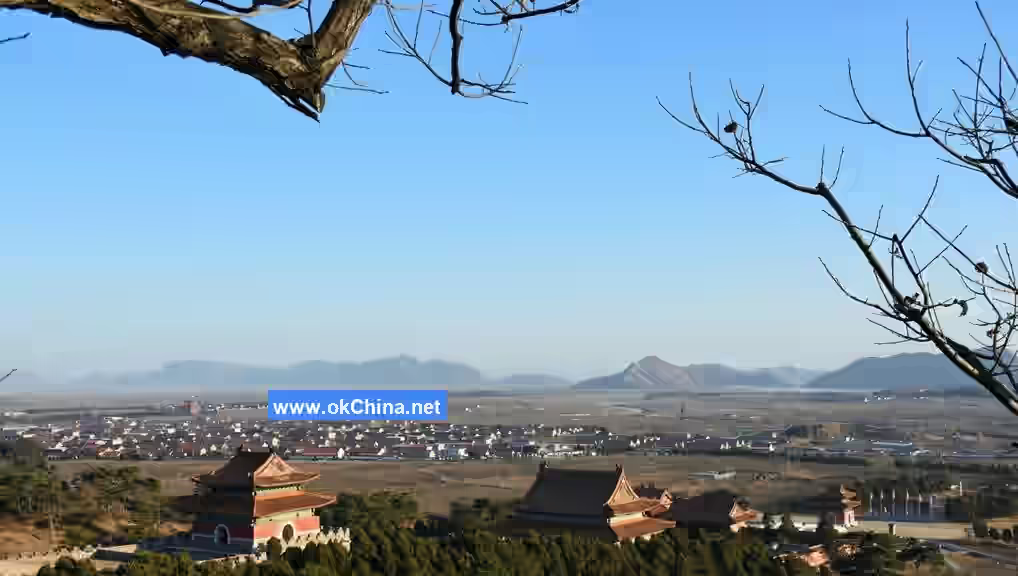
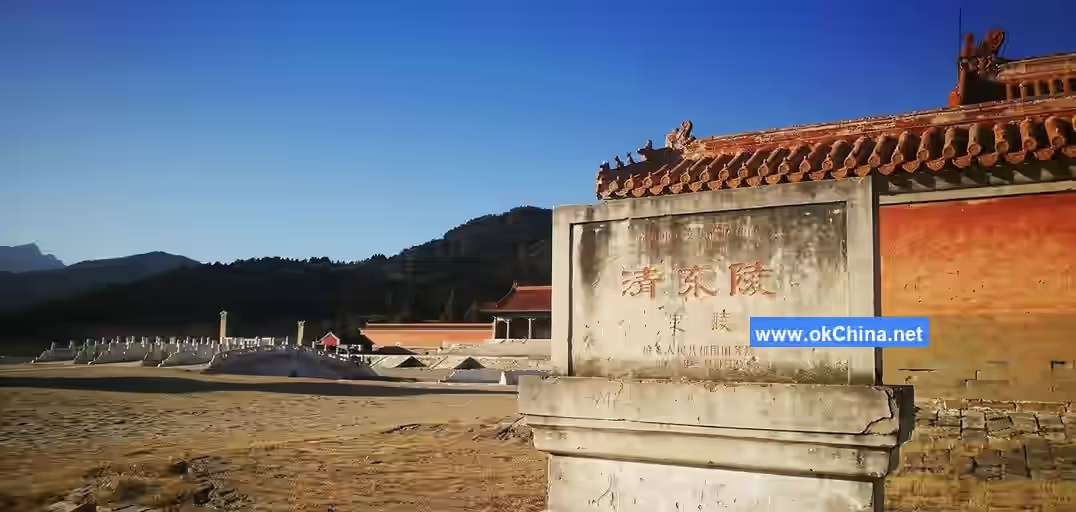
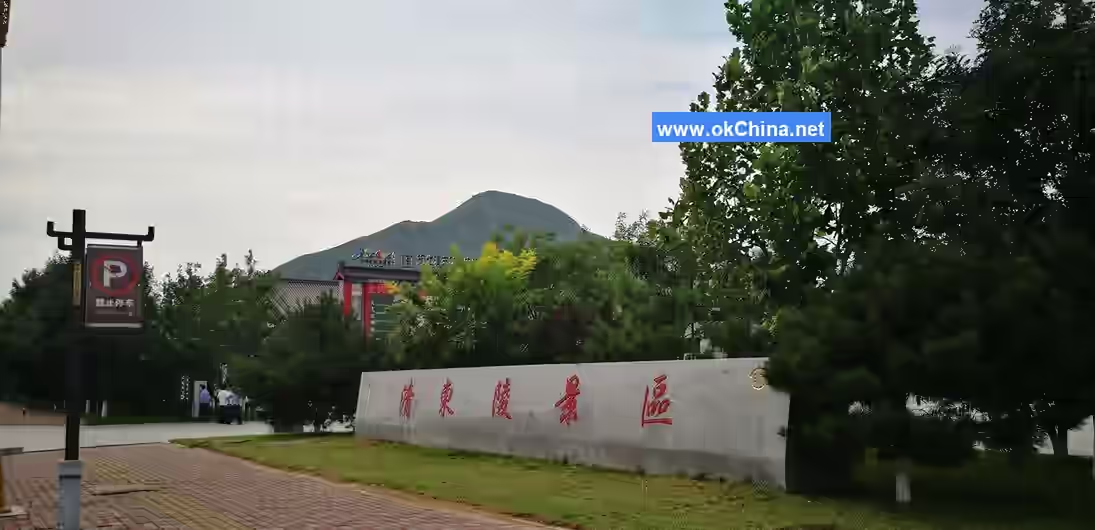
The Eastern Qing Tombs are located 30 kilometers northwest of Zunhua City, Tangshan City, Hebei Province, and 125 kilometers west of downtown Beijing, covering an area of 80 square kilometers. They represent the largest, most complete, and most appropriately arranged imperial mausoleum complex preserved in China.
Construction of the Eastern Qing Tombs began in 1661 (the 18th year of the Shunzhi reign) and spanned 247 years, resulting in the completion of 217 palace structures and memorial archways, which form 15 tomb complexes of varying sizes. The cemetery stretches 12.5 kilometers from north to south and 20 kilometers from east to west, housing the remains of 161 individuals, including 5 emperors, 15 empresses, 136 imperial concubines, 3 princes, and 2 princesses.
The development of the Eastern Qing Tombs spanned two and a half centuries, nearly coinciding with the entire duration of the Qing Dynasty. It is the final resting place of many prominent figures who significantly influenced Qing history, containing a wealth of historical information. The site serves not only as invaluable physical material for studying the regulations of Qing Dynasty tombs, burial systems, sacrificial rituals, architectural techniques, and craftsmanship but also as a typical example for researching Qing politics, economy, military affairs, culture, science, and art.
II. Historical Development
The construction of the 15 tombs in the Eastern Qing Tombs began with the Xiaoling Tomb of Emperor Shunzhi in 1661 (the 18th year of the Shunzhi reign) and concluded with the Putuoyu Dingdongling Tomb of Empress Dowager Cixi in 1908 (the 34th year of the Guangxu reign), spanning 247 years.
In 1661 (the 18th year of the Shunzhi reign), construction began on the Xiaoling Tomb for Emperor Shunzhi, the first emperor after the Qing entered the Shanhai Pass. The main structures were completed in 1664 (the 3rd year of the Kangxi reign, 11th month). In 1668 (the 7th year of the Kangxi reign), the Shengde Shengong Stele Pavilion was built.
In 1674 (the 13th year of the Kangxi reign), following the death of Empress Xiaochengren, the primary consort of Emperor Kangxi, preparations began for the Jingling Tomb. Construction commenced in 1676 (the 15th year of the Kangxi reign). When Empresses Xiaocheng and Xiaozhao were buried in 1681 (the 20th year of the Kangxi reign), the Long'en Hall of Jingling was still under construction. Concurrently, the Jingling Feiyuan Tomb for Emperor Kangxi's concubines was completed, becoming the first concubine tomb built by the Qing Dynasty inside the Shanhai Pass.
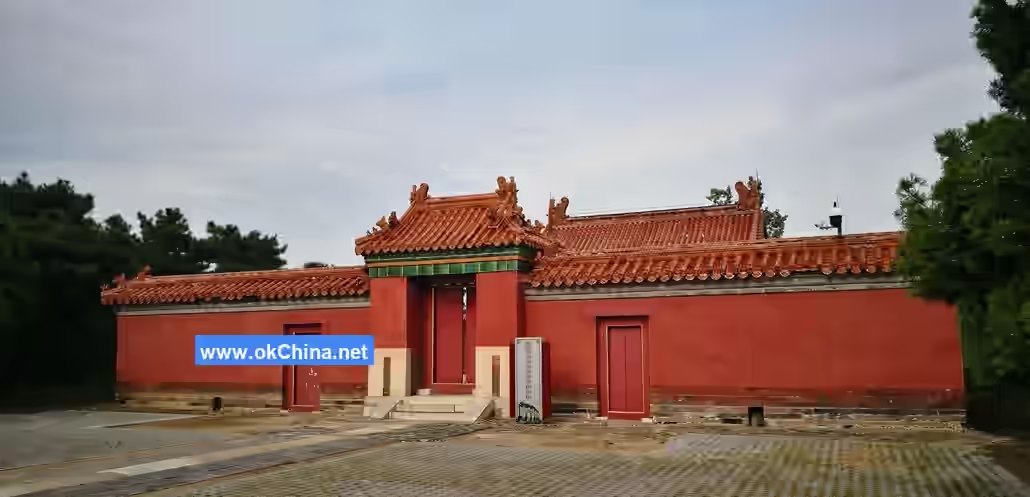
In 1688 (the 27th year of the Kangxi reign), Emperor Kangxi, following his grandmother's will, constructed the Zan'an Feng Hall outside the Fengshui Wall, east of the Great Red Gate. Thirty-seven years later, in 1725 (the 3rd year of the Yongzheng reign), Emperor Yongzheng decided to convert the Zan'an Feng Hall into the Zhaoxi Tomb. Construction began on the third day of the second lunar month that year and was completed by the end of the year. After the completion of Empress Dowager Xiaozhuangwen's Zan'an Feng Hall, Emperor Kangxi built a tomb for Empress Xiaohuizhang east of the Xiaoling Tomb, which was completed around 1693 (the 32nd year of the Kangxi reign, exact date pending verification). This was the first empress tomb constructed by the Qing Dynasty, setting a precedent for building separate tombs for empresses. Located east of the Xiaoling Tomb and part of the same system, it was named the "Xiaodong Tomb."
In the early years of the Yongzheng reign, Emperor Yongzheng selected Jiufeng Chaoyang Mountain in Zunhua as his eternal resting place and transported a large amount of building materials there. In 1729 (the 7th year of the Yongzheng reign), he abandoned the site under the pretext that it was "large in scale but incomplete in layout, with sandy soil in the burial chamber." He then chose a new site at Taining Mountain in Yi County, Hebei Province, to build the Tailing Tomb. This marked the beginning of the distinction between the "Eastern Tombs" and "Western Tombs."
Shortly after Emperor Qianlong ascended the throne, he built a separate tomb east of the Jingling Tomb for his grandmothers, Imperial Noble Consorts Quehui and Dunyi of Emperor Kangxi, known as the Jingling Imperial Noble Consort Tomb, commonly called the "Twin Consorts Tomb."
In 1742 (the 7th year of the Qianlong reign), Emperor Qianlong selected Shengshui Valley within the Eastern Tombs as his eternal resting place. Construction began in the second month of the following year and was completed in 1752 (the 17th year of the Qianlong reign). It was named the "Yuling Tomb" in 1799 (the 4th year of the Jiaqing reign).
In 1747 (the 12th year of the Qianlong reign), construction began on the Yuling Feiyuan Tomb and was completed in 1752 (the 17th year of the Qianlong reign). From 1755 to 1762 (the 20th to 27th years of the Qianlong reign), it was expanded to include the Fangcheng, Minglou, Baocheng, and east-west side halls.
To balance the relationship between the Eastern and Western Tombs, in 1796 (the 1st year of the Jiaqing reign), the retired Emperor Hongli (Qianlong) decreed that subsequent imperial tombs should be built alternately in the Eastern and Western Tombs according to the Zhaomu order.
Emperor Daoguang began constructing his tomb at Baohua Valley within the Eastern Tombs in 1821 (the 1st year of the Daoguang reign), completing it in 1827 (the 7th year of the Daoguang reign). The accompanying concubine and princess tombs were also finished. The year after the Baohua Valley Tomb was completed, water leakage was discovered in the underground palace. Emperor Daoguang then selected a new site within the Western Tombs and dismantled the already completed Baohua Valley Tomb and its concubine tomb in the Eastern Tombs, transporting the materials to the Western Tombs for reconstruction, leaving ruins within the Eastern Tombs boundary.
After Emperor Xianfeng ascended the throne, he chose Ping'an Valley within the Eastern Tombs as his tomb site. Construction began in 1859 (the 9th year of the Xianfeng reign) but was delayed due to the outbreak of the Second Opium War. After Emperor Xianfeng died at the Chengde Mountain Resort in 1861 (the 11th year of the Xianfeng reign), construction was expedited and completed in 1866 (the 5th year of the Tongzhi reign), named the "Dingling Tomb." The concubine tomb was subsequently completed. Due to war reparations and depleted state funds, much of the old materials from Emperor Daoguang's abandoned Baohua Valley Tomb were used in constructing the Dingling Tomb, resulting in inferior construction quality.
In 1873 (the 12th year of the Tongzhi reign), the Dingdong Tombs for Empress Dowager Ci'an and Empress Dowager Cixi began construction simultaneously at Puxiang Valley and Putuo Valley, about two li east of the Dingling Tomb, and were completed in 1879 (the 5th year of the Guangxu reign). Sixteen years later, Empress Dowager Cixi ordered the renovation of her own tomb. The renovation began in 1895 (the 21st year of the Guangxu reign) and was completed in 1908 (the 34th year of the Guangxu reign), lasting 13 years. Since both tombs are located east of the Dingling Tomb and are subordinate to it, they are collectively referred to as the "Dingdong Tombs." Empress Dowager Ci'an's tomb is specifically called the Puxiang Valley Dingdong Tomb, while Empress Dowager Cixi's tomb is called the Putuo Valley Dingdong Tomb.
Emperor Tongzhi did not select a tomb site during his lifetime. After his death, a site was hastily chosen at Shuangshan Valley within the Eastern Tombs, and the tomb was named the "Huiling Tomb." Construction began in 1875 (the 1st year of the Guangxu reign) and was completed in 1878 (the 4th year of the Guangxu reign). The concubine tomb west of the Huiling Tomb was built between 1876 and 1878 (the 2nd to 4th years of the Guangxu reign). Due to financial difficulties, just 21 years later in 1899 (the 25th year of the Guangxu reign), it was discovered that many of the wooden components of the Long'en Hall were damaged and decayed, necessitating dismantling and reconstruction. Reconstruction began that same year (1899) but was suspended due to the Eight-Nation Alliance's occupation of Beijing. It resumed and was completed in 1906 (the 32nd year of the Guangxu reign), lasting eight years.
In July 1928, Sun Dianying, commander of the 12th Army of the Nationalist Party, orchestrated a tomb robbery at the Eastern Tombs under the pretext of "bandit suppression," looting the Yuling Tomb of Emperor Qianlong and the Dingdong Tomb of Empress Dowager Cixi.
In September 1945, Zhang Jinzhong, head of the intelligence team of the 15th Military District of the Jidong Military Region under the puppet Jidong Anti-Communist Autonomous Government, which had jurisdiction over the Eastern Tombs, colluded with Wang Shaoyi, Mu Shuxuan, Jia Zhengguo, Zhao Guozheng, Li Shuqing, Liu En, Liu Jixin, and others to brazenly begin looting the tombs. Almost all of the 14 tombs in the Eastern Qing Tombs, containing 157 individuals, were plundered.
In 1952, the state established the Eastern Qing Tombs Cultural Relics Protection Office to manage the tombs.
In 1961, the Eastern Qing Tombs were listed by the State Council as one of the first national key cultural relics protection units.
In 1978, they were officially opened to Chinese and foreign tourists for visits.
On November 30, 2000, at the 24th session of the World Heritage Committee held in Cairns, Australia, the Eastern Qing Tombs were unanimously approved for inclusion in the World Heritage List.
III. Tomb Regulations
Emperor Tombs
Before entering the Shanhai Pass, the Qing Dynasty had already built three emperor tombs outside the pass: the Yongling, Fuling, and Zhaoling Tombs. These three tombs varied in regulations, indicating that there was no fixed system at the time. After entering the pass, the construction of tombs largely followed Ming Dynasty tomb regulations. The layout of each tomb in the Eastern Qing Tombs strictly adhered to the principle of "harmony between tomb regulations and landscape," requiring both "compliance with ceremonial regulations" and "integration with the beauty of mountains and rivers."
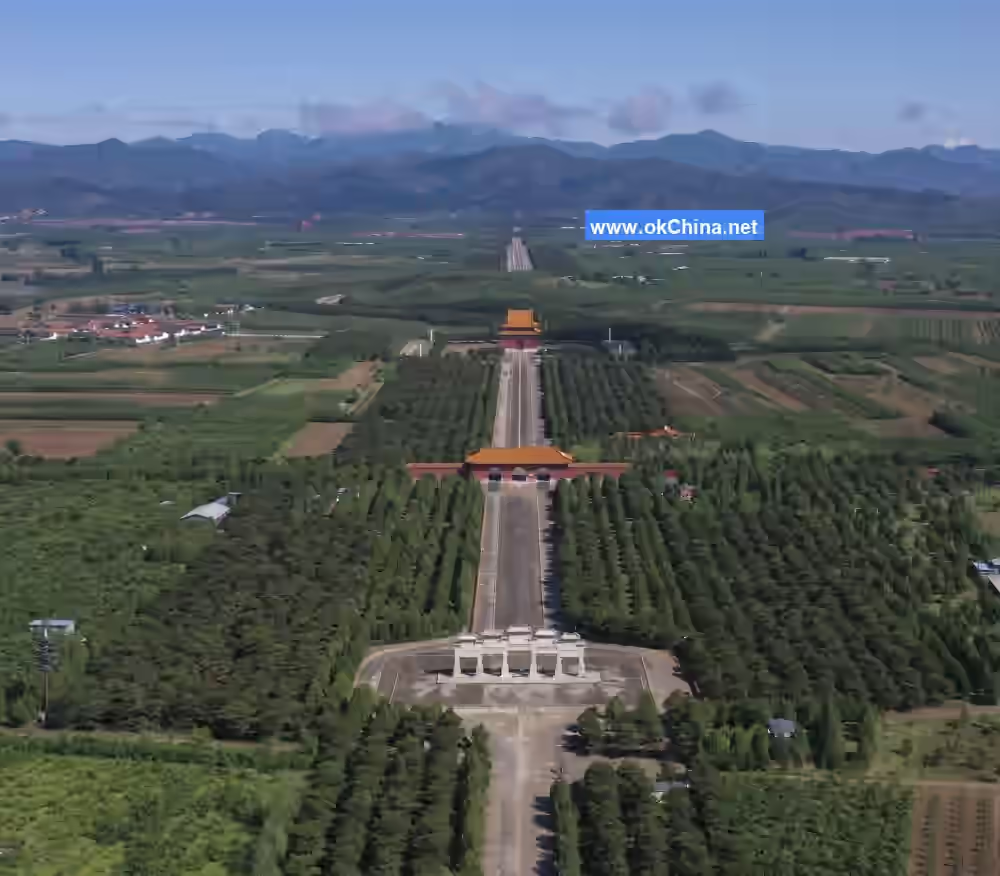
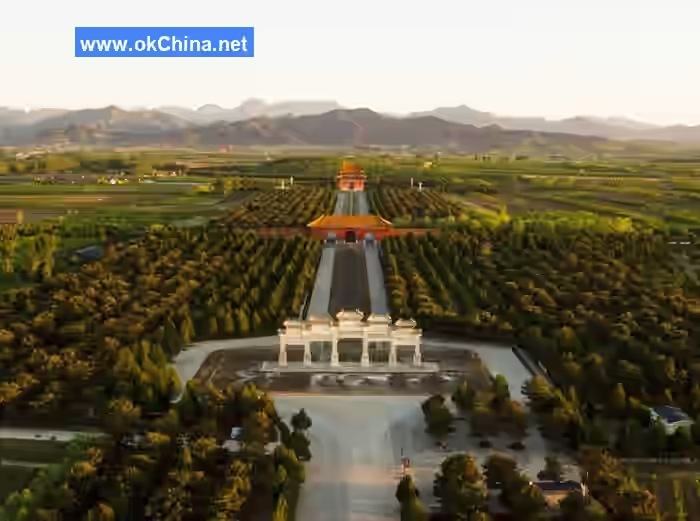
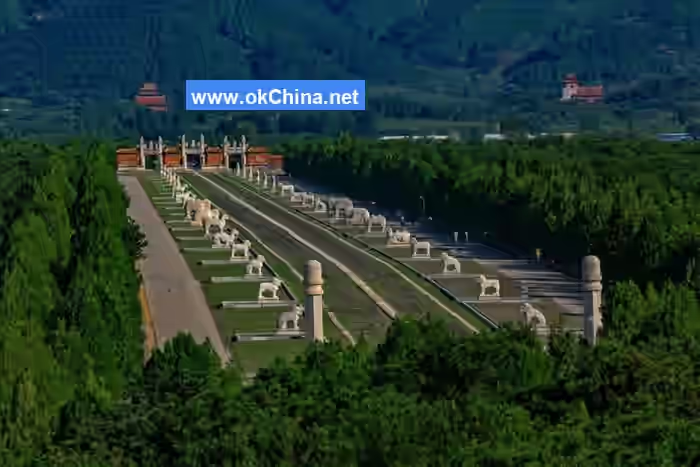
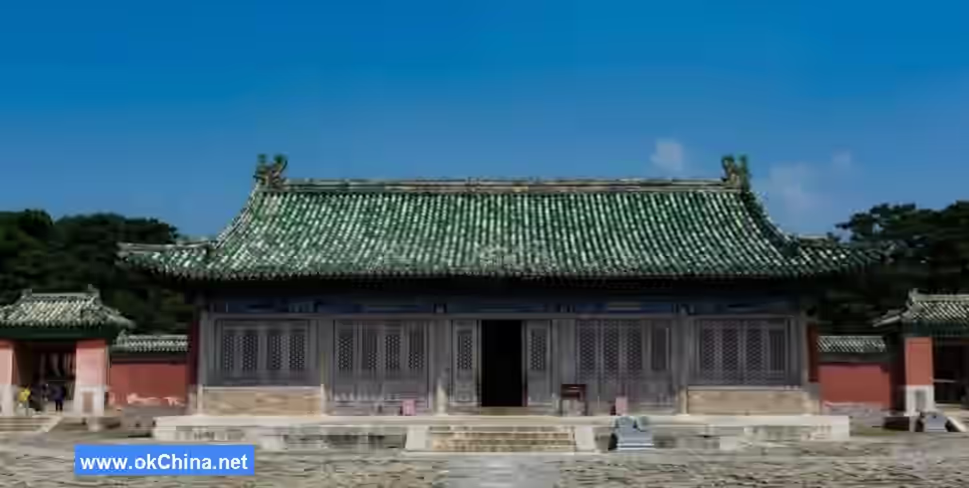
After the completion of Emperor Shunzhi's Xiaoling Tomb at the foot of Changrui Mountain, the regulations for Qing Dynasty emperor tombs were largely established. The layout can be divided into three areas: the Sacred Way Area, the Palace Area, and the Divine Kitchen and Storehouse Area. The Sacred Way Area of the Xiaoling Tomb is the most richly configured, featuring, from south to north: a stone memorial archway, east and west dismounting steles, the Great Red Gate, the Jufu Hall (a hall for visitors to change clothes and rest temporarily), the Shengde Shengong Stele Pavilion, stone statues, the Dragon and Phoenix Gate, a single-arch bridge, a seven-arch bridge, a five-arch bridge, east and west dismounting steles, a three-path three-arch bridge, and a flat bridge. The Palace Area was built according to the pattern of "court in front, resting place in the rear," featuring, from south to north: the Sacred Way Stele Pavilion, east and west morning rooms, the Long'en Gate, east and west incense burners (places for burning paper and ingots), east and west side halls, the Long'en Hall, the tomb gate, the Two-Pillar Gate, the Stone Five Offerings, the Fangcheng, the Minglou, the glazed screen wall and crescent city, the Baocheng, and the Baoding, beneath which lies the underground palace. The area north of the palace gate is enclosed by walls, forming three courtyards. The Divine Kitchen and Storehouse Area is located to the left front of the Palace Area, with buildings including: the Divine Kitchen (kitchen for preparing sacrificial offerings), north and south Divine Storehouses (storage rooms), and the Shengxi Pavilion (place for slaughtering cattle and sheep), all enclosed by walls and facing west. A well pavilion is built outside the walls. All roofed structures in the three areas (including walls), except for the guard rooms covered with plain tiles, are topped with yellow glazed tiles (including wall tops).Among them, the Great Red Gate is a single-eave hip-roofed building; the Shengde Shengong Stele Pavilion, the Sacred Way Stele Pavilion, the Long'en Hall, the Ming Tower, and the Shengxing Pavilion are double-eave hip-and-gable roofed buildings; the Jufu Hall, Long'en Gate, side halls, and Liao furnaces are single-eave hip-and-gable roofed buildings; the courtrooms are single-eave flush-gable roofed buildings; the Shenchu and Shenku are single-eave overhanging-gable roofed buildings; the mausoleum gate is a glazed floral gate; the well pavilion is a flat-roofed building; and the guardhouse is a single-eave round-ridge roofed building.
The Jing Mausoleum of the Kangxi Emperor, the second emperor after entering the Shanhai Pass, inherited the regulations of the Xiao Mausoleum. The palace area and the Shenchu-Ku area were the same as those of the Xiao Mausoleum, but the Sacred Way area underwent significant modifications:
- The Sacred Way connected to that of the Xiao Mausoleum, without separately constructing a stone memorial archway, Great Red Gate, or Jufu Hall.
- The Shengde Shengong Stele Pavilion was modified to erect dual steles, inscribed with Manchu and Chinese texts respectively.
- The stone statues were reduced from 18 pairs to 5 pairs.
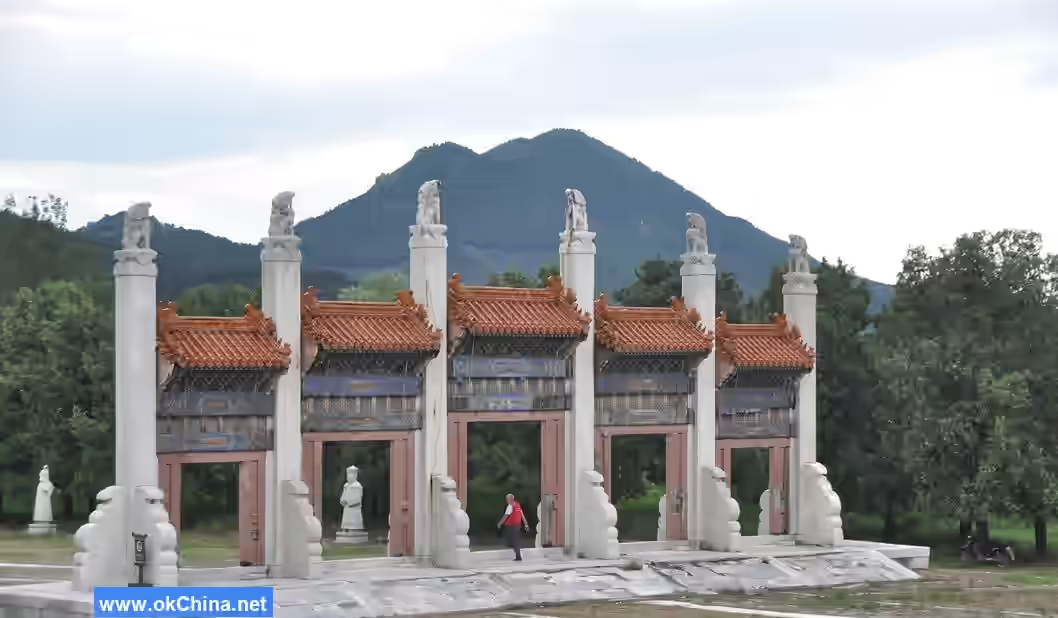
- The Dragon and Phoenix Gate was changed to a five-bay, six-pillar, five-story archway gate (during the Daoguang era, for uniformity, it was decreed that such archway gates should also be called Dragon and Phoenix Gates).
- The seven-arch bridge and single-arch bridge were eliminated.
- The five-arch bridge was relocated south of the stone statues.
The Yu Mausoleum of the Qianlong Emperor, the fourth emperor after entering the Shanhai Pass, inherited the regulations of the Jing Mausoleum but with slight expansions. First, a single-arch bridge was added north of the archway gate in the Sacred Way area. Second, the stone statues were increased to 8 pairs, three more than those in the Jing Mausoleum. Third, a three-way single-arch jade belt bridge was added in front of the mausoleum gate. Fourth, a three-arch flat bridge was symmetrically added on each side of the three-way three-arch bridge.
The Ding Mausoleum of the Xianfeng Emperor, the seventh emperor after entering the Shanhai Pass, largely followed the regulations of the ancestral mausoleums. It eliminated the Shengde Shengong Stele Pavilion, the single-arch bridge, and the two-pillar gate. The jade belt bridge in front of the mausoleum gate was changed to three flat and convenient bridges, and the stone statues were reduced to 5 pairs.
The Hui Mausoleum of the Tongzhi Emperor, the eighth emperor after entering the Shanhai Pass, was even more reduced in scale. Not only were stone statues not built, but even the Sacred Way connecting to the Xiao Mausoleum was removed, making it an isolated mausoleum severed from the lineage.
Empress Mausoleums
The first empress mausoleum built by the Qing Dynasty was the Xiao Dong Mausoleum of Empress Xiaohuizhang (the empress of the Shunzhi Emperor). Its layout was as follows: the Sacred Way area only had a three-arch bridge, the palace area did not include a two-pillar gate, and the rest was the same as the emperor's mausoleum. However, as the system was not yet fully established at the time, 28 concubines of the Shunzhi Emperor were also buried in this mausoleum, creating a situation where the empress mausoleum also served as a concubine burial garden.
The Zhao Xi Mausoleum, which buried Empress Xiaozhuangwen, was converted from a temporary resting hall and had extremely unique regulations. First, the Sacred Way area only included dismounting tablets and a Sacred Way stele pavilion, with no bridges or culverts. Second, the palace area was built with two layers of walls: the outer wall had the Long'en Gate at the front, while the inner wall had three glazed floral gates at the front. Third, the mausoleum gate was set on the partition walls on either side of the Long'en Hall. Fourth, the Long'en Hall was the highest-ranking double-eave hip-roofed building of the Qing Dynasty.
The Ding Dong Mausoleums of Empress Dowager Cian and Empress Dowager Cixi were the last two empress mausoleums built by the Qing Dynasty. Their regulations were largely based on the Xiao Dong Mausoleum but with some differences. First, dismounting tablets and a Sacred Way stele pavilion were added to the Sacred Way area, and flat bridges were symmetrically added on either side of the three-arch bridge. Second, concubines were no longer buried within the mausoleum.
Concubine Burial Gardens
The first concubine burial garden built in the Eastern Qing Tombs was the Jingling Concubine Burial Garden. Its layout only included the palace area, arranged from south to north as follows: a single-arch bridge and flat bridge, east and west side rooms, east and west guardhouses, palace gate, Liao furnaces, offering hall, and garden gate. In the rear courtyard, 49 small treasure mounds were built. The side rooms and guardhouses were covered with plain tiles. The main gate and offering hall were single-eave hip-and-gable roofed buildings, covered with green glazed tiles.
The Jingling Imperial Noble Consort Burial Garden was the second concubine burial garden built in the Eastern Qing Tombs. Out of respect and filial piety for the two imperial noble consorts of the Kangxi Emperor, the Qianlong Emperor expanded its regulations. Compared to the Jing Concubine Burial Garden, it had three main differences: first, east and west side halls with green-tiled single-eave hip-and-gable roofs were added. Second, a Danbi stone was placed in front of the offering hall's platform. Third, a square wall and a green-tiled single-eave hip-and-gable roofed Ming Tower were built for each of the two imperial noble consorts, making this burial garden the highest-ranking concubine burial garden of the Qing Dynasty.
The third concubine burial garden built in the Eastern Qing Tombs was the Yuling Concubine Burial Garden. Its regulations were similar to those of the Jingling Imperial Noble Consort Burial Garden, with the difference that no Danbi stone was placed in front of the offering hall, the garden gate was opened on the side walls flanking the offering hall, there was one square wall and Ming Tower, and 34 small treasure mounds were built in the rear courtyard.
The Dingling Concubine Burial Garden and the Huiling Concubine Burial Garden were the fourth and fifth concubine burial gardens built in the Eastern Qing Tombs, both following the same regulations as the Jingling Concubine Burial Garden.
IV. Layout and Structure
Mausoleum Layout
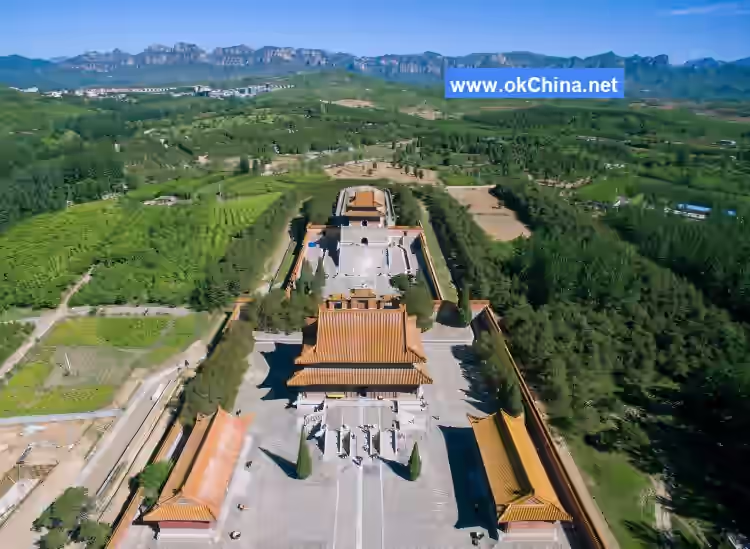
The Xiao Mausoleum of the Shunzhi Emperor, the first emperor after entering the Shanhai Pass, is located on the central axis stretching from Jinxing Mountain in the south to the main peak of Changrui Mountain in the north. The other emperor mausoleums are arranged in a fan shape on either side of the Xiao Mausoleum along the mountains, following the traditional concepts of "the center is the most honorable," "order by age," and "distinction by rank." Each mausoleum was constructed according to regulations with a series of buildings, following the overall layout of "court in front, resting place in the rear." The aesthetic principle of "hundred feet for form, thousand feet for momentum" runs through every mausoleum building.
To the left of the Xiao Mausoleum is the Jing Mausoleum of the Kangxi Emperor, and further left is the Hui Mausoleum of the Tongzhi Emperor. To the right of the Xiao Mausoleum is the Yu Mausoleum of the Qianlong Emperor, and further right is the Ding Mausoleum of the Xianfeng Emperor, forming a pattern where sons and grandsons accompany their fathers and grandfathers, highlighting the ethical concept of honoring elders.
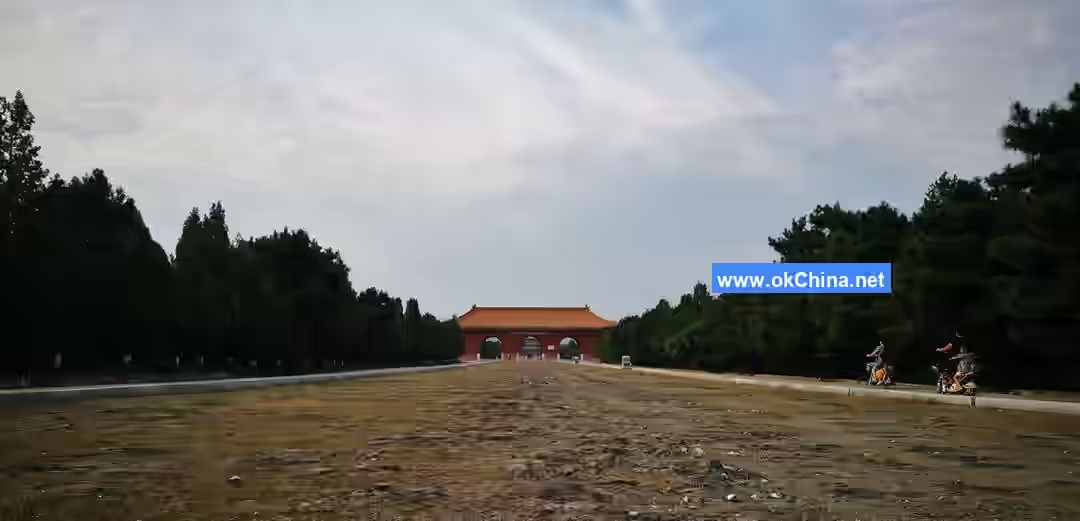
Empress mausoleums and concubine burial gardens were built beside the mausoleums of the emperors of their respective dynasties, indicating their subordinate and affiliated relationships. The Sacred Ways of empress mausoleums all connect to the Sacred Ways of their respective emperor mausoleums, and the Sacred Ways of each emperor mausoleum connect to the Sacred Way of the Xiao Mausoleum on the central axis of the tomb area, forming a vast branch-like system.
Architectural Sequence
Over time, 15 mausoleums were built here during the Qing Dynasty, burying more than 160 people. They all consist of structures such as palace walls, Long'en Halls, side halls, square walls with Ming Towers, and treasure mounds. Among these, the square wall with Ming Tower is the tallest building in each mausoleum, housing a stele inscribed with the posthumous title of the tomb's occupant in Chinese, Manchu, and Mongolian. Behind the Ming Tower is the "treasure mound" (large grave mound), beneath which lies the "underground palace" where the coffin is placed.
The Xiao Mausoleum takes Jinxing Mountain as its "facing mountain" (the mountain directly in front of the mausoleum), Yingbi Mountain as its "table mountain" (the small hill between the tomb and the facing mountain), and Changrui Mountain as its "backing mountain" (the mountain behind the tomb). The line connecting these three mountains forms the axis of the Xiao Mausoleum's architecture. Since the distance between Jinxing Mountain and Changrui Mountain exceeds 8 kilometers, the builders created a Sacred Way (a path specifically for coffins and spirit tablets) approximately 6 kilometers long, linking dozens of buildings from the stone memorial archway to the treasure mound. This Sacred Way was divided into three sections based on the terrain:
- The approximately 1.5-kilometer section from the stone memorial archway to Yingbi Mountain. In this section, a wide stone memorial archway and a tall Shengde Shengong Stele Pavilion (a square pavilion housing steles praising the emperor's virtues, also known as the Great Stele Tower) were placed, echoing Jinxing Mountain and Yingbi Mountain.
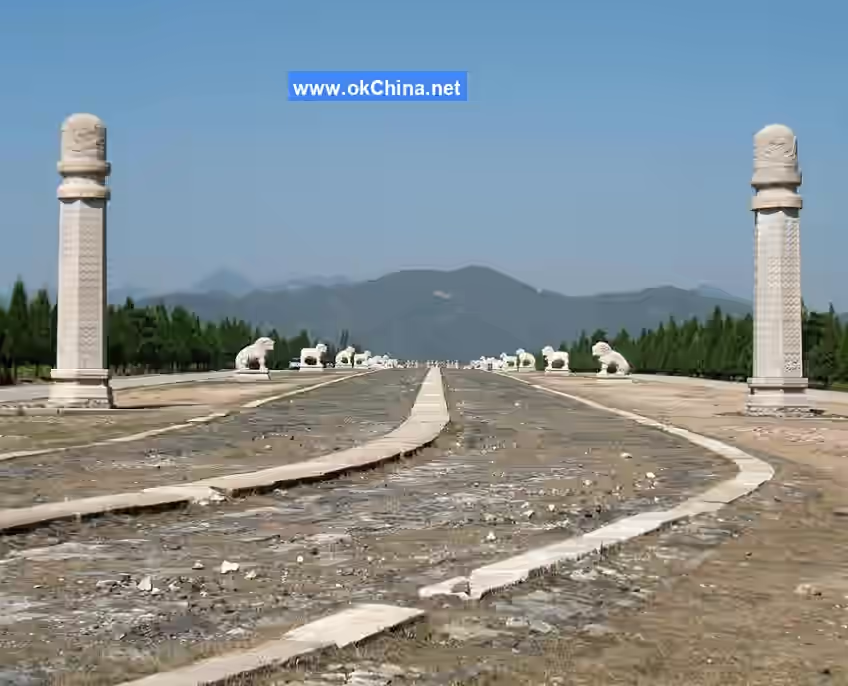
- The approximately 3.5-kilometer section from Yingbi Mountain to the five-arch bridge. In this section, low and flat structures such as stone statues (sculptures of stone figures and animals lining the Sacred Way), the Dragon and Phoenix Gate (a gate structure consisting of three stone-carved flame archways and four sections of glazed walls), a single-arch bridge, a seven-arch bridge, and a five-arch bridge were placed to harmonize with the surrounding flat terrain.
- The approximately 1-kilometer section from the five-arch bridge to the treasure mound. In this section, major ceremonial buildings such as the Sacred Way Stele Pavilion (a square pavilion housing steles inscribed with the posthumous titles of emperors and empresses), Long'en Gate (the main gate of the mausoleum courtyard), Long'en Hall (the main hall for grand sacrificial ceremonies), the square wall (a brick square platform), the Ming Tower (a square pavilion built on the square wall, housing a tomb stele and inscribed with the mausoleum's name on its eaves), the treasure mound, and the treasure city (the wall surrounding the treasure mound) were concentrated. Moreover, these buildings increase in height from south to north, coordinating with Changrui Mountain and the protective hills on either side (the hills flanking the mausoleum). The arrangement and combination of these buildings were guided by the principles of Feng Shui theory, with their size, height, distance, and density visually controlled according to the scale of "hundred feet for form, thousand feet for momentum." The scenic landscape was incorporated into the architectural frame as foreground, background, and contrast, achieving the goal of "gathering distant momentum to form a circle, assembling exquisite forms to display momentum."
V. Interred Figures
Zhao Xi Mausoleum
The Zhao Xi Mausoleum is located east of the Great Red Gate of the Eastern Qing Tombs and is the mausoleum of Empress Xiaozhuangwen, the empress of Emperor Taizong Huangtaiji of the Qing Dynasty.
The mausoleum faces south, and its architectural layout from south to north is as follows: dismounting tablets, Sacred Way stele pavilion, east and west courtrooms, east and west duty rooms, Long'en Gate, three glazed floral gates, east and west Liao furnaces, east and west side halls, Long'en Hall, mausoleum gate, stone five offerings, square wall, Ming Tower, treasure city, treasure mound, with the underground palace beneath the treasure mound. To the east in front of the mausoleum, a Shenchu-Ku for preparing sacrificial offerings was built.
In the 26th year of the Kangxi era (1687), Empress Xiaozhuangwen passed away from illness. Her will requested burial near the Xiao Mausoleum. According to ancestral rules and family laws, Empress Xiaozhuangwen should have been buried with Emperor Huangtaiji in the Zhao Mausoleum in Shengjing (Shenyang). Emperor Kangxi, unwilling to break ancestral rules but also reluctant to disobey his grandmother's will, had no choice but to build a temporary resting hall in the Eastern Qing Tombs. He dismantled and transported a hall with a hip roof located east of the Cining Palace in the Forbidden City, which his grandmother had favored during her lifetime, to the Eastern Qing Tombs to construct the temporary resting hall for housing the coffin. Throughout the Kangxi era, the issue of Empress Xiaozhuangwen's mausoleum remained unresolved. In the third year of the Yongzheng era (1725), Emperor Shizong, citing the prosperity of the state since Empress Xiaozhuangwen's temporary rest, the long reign of Emperor Shengzu, and the flourishing of descendants, deemed the site auspicious. Thus, he converted the temporary resting hall into the Zhao Xi Mausoleum. Construction began on the third day of the second lunar month in the third year of Yongzheng, and on the tenth day of the twelfth lunar month of the same year, Empress Xiaozhuangwen was buried in the underground palace.
Compared to other empress mausoleums of the Qing Dynasty, the Zhao Xi Mausoleum has unique architectural regulations:
- While the Long'en Halls of other mausoleums have hip-and-gable roofs, the Long'en Hall of the Zhao Xi Mausoleum has a hip roof.⒉ While other mausoleums have only one gate in front of the Long'en Hall, the Zhaoxi Mausoleum features two gates, correspondingly enclosed by inner and outer walls. ⒊ No horse-trough moat was excavated in front of the mausoleum, and no three-arch bridge was constructed.
Empress Xiaozhuangwen was the highest-ranking individual buried in the Eastern Mausoleums. She was deeply respected by her descendants. Every time an emperor visited the Eastern Mausoleums, he would first pay homage here before proceeding to other tombs.
Xiaoling Mausoleum
The Xiaoling Mausoleum is the burial place of Emperor Shizu of the Qing Dynasty, Aisin Gioro Fulin (Emperor Shunzhi). Located at the southern foot of the main peak of Changrui Mountain, it backs against Changrui Mountain and faces Jinxing Mountain to the front, positioned along the central axis of the mausoleum complex. The four subsequent imperial mausoleums are arranged on its left and right, reflecting the traditional concepts of "centrality as supreme," "order of seniority," and "distinction between noble and humble."
The site for the Xiaoling Mausoleum was chosen by Emperor Shunzhi during his lifetime. However, due to ongoing military conflicts and depleted state coffers in the early years of the dynasty, and because Emperor Shunzhi was still in his prime, construction was not urgently pursued. It was only after Emperor Shunzhi's death in the 18th year of his reign (1661) that construction began. The main structures were completed on the 19th day of the 11th month in the 3rd year of the Kangxi reign (1664).
This mausoleum was the first built by the Qing rulers inside the Shanhai Pass. It is grand in scale and majestic in appearance. Starting from the stone memorial archway at the foot of Jinxing Mountain, a series of structures are arranged northward: dismounting stele, Great Red Gate, robe-changing hall, Stele Pavilion of Divine Merit and Sacred Virtue, stone statues, Dragon and Phoenix Gate, single-arch bridge, seven-arch bridge, five-arch bridge, dismounting stele, three parallel three-arch bridges and Dongping Bridge, Sacred Way of Divine Merit, Divine Kitchen and Storehouse, eastern and western side halls, Long'en Gate, eastern and western incense burners, eastern and western side palaces, Long'en Hall, glazed floral gate, two-pillar gate, five altar offerings, square citadel, Ming Tower, treasure citadel, treasure dome, and underground palace. These dozens of structures, large and small, are connected by a sacred path approximately 6 kilometers long, forming a complete sequence. The arrangement and combination of these buildings were guided by the "theory of form and situation" in Feng Shui, with their size, height, distance, and density visually controlled according to the principle of "hundred feet for form, thousand feet for situation." The surrounding landscape was incorporated into the frame as foreground, background, and contrast for the architecture, achieving the goal of "retaining distant momentum in a circular form, gathering exquisite shapes to display grandeur." This creates a visual impression and artistic experience that is "lofty but not perilous, low but not humble, spacious but not empty, dense but not oppressive," and "stillness within motion, motion within stillness." Due to insufficient preparation for the mausoleum's construction and the urgent need to inter Emperor Shunzhi's remains, materials and components from some Ming Dynasty buildings, including the "Qingfu Hall" on the west bank of Beihai, were dismantled and reused.
Construction of the mausoleum began in the 1660s and lasted over 330 years until the 1990s. Having suffered significant damage from natural forces and human activities, it underwent comprehensive restoration from 1990 to 1992 with approval from the National Cultural Heritage Administration of the People's Republic of China. It was officially opened to the public in 1992.
Xiaodongling Mausoleum
The Xiaodongling Mausoleum is located east of the Xiaoling Mausoleum. It houses Empress Xiaohuizhang, consort of Emperor Shizu Fulin, along with 28 concubines, Gege, and Fujin.
The exact dates of construction and completion of the Xiaodongling Mausoleum are unknown. After its completion, it was initially called the "New Mausoleum." On the 21st day of the 2nd month in the 58th year of the Kangxi reign, it was officially named "Xiaodongling."
The architectural layout of the Xiaodongling Mausoleum, from south to north, includes: one three-arch bridge, eastern and western side halls (5 bays each), eastern and western guard rooms (3 bays each), one Long'en Gate (5 bays), eastern and western incense burners (one each), eastern and western side palaces (5 bays each), one Long'en Hall (5 bays), three mausoleum gates, one set of stone five altar offerings, and one square citadel, Ming Tower, treasure citadel, and treasure dome. In front of the square citadel, along both sides of the sacred path, there are 14 small treasure domes each, arranged longitudinally north-south in two rows per side. On the east side, the outer row has 10 small domes, and the inner row has 4. On the west side, the outer row has 11 small domes, and the inner row has 3. This arrangement of treasure domes still reflects the style of concubine garden tombs outside the pass in Shengjing.
As the Xiaodongling Mausoleum was the first empress mausoleum built in the Qing Dynasty, with no precedent to follow, its regulations were not yet complete. Subsequent empress mausoleums were improved and perfected based on this.
The tomb's occupant, Empress Xiaohuizhang, of the Borjigit clan, was the niece of Empress Xiaozhuangwen, Emperor Shunzhi's birth mother, and the daughter of Chorji, a Beile of the Khorchin Mongols. She entered the palace in the 5th month of the 11th year of Shunzhi (1654), was enfeoffed as a consort, and in the 6th month was established as empress. When Emperor Shunzhi died, she was only 21 years old. Empress Xiaohuizhang was highly revered during the Kangxi reign. She passed away on the 6th day of the 12th month in the 56th year of Kangxi (1717) at the age of 77 and was buried in the 57th year (1718).
The seven consorts are: Consort Gongjing, Consort Shuhui, Consort Duanshun, Consort Ningque, Consort Ke, Consort Zhen, and Consort Dao.
Additionally, the Xiaodongling Mausoleum also houses 17 Gege and 4 Fujin, all of whom were concubines of Fulin. Due to the nascent state of the palace system in the early Qing Dynasty, some of the emperor's attendants were also called Gege or Fujin. By the mid-Qing Dynasty, the imperial consort system became more refined, eliminating the confusion in ranks, titles, and designations. The Xiaodongling Mausoleum pioneered the practice of building separate mausoleums for empresses, and its regulations served as a model for later empress mausoleums.
Jingling Mausoleum
The Jingling Mausoleum is the burial place of Emperor Kangxi, Aisin Gioro Xuanye. It is located 1 kilometer east of the Qing Xiaoling Mausoleum. Construction began on the 10th day of the 2nd month in the 15th year of Kangxi (1676) and was completed in the 20th year of Kangxi (1681).
Jingling backs against Changrui Mountain to the north. Its architectural layout, from south to north, includes: Stele Pavilion of Sacred Virtue and Divine Merit, five-arch bridge, ornamental columns, stone statues, dismounting stele, Divine Kitchen and Storehouse, memorial archway gate, Stele Pavilion of the Sacred Way, two-pillar gate, stone five altar offerings, square citadel, Ming Tower, treasure citadel, treasure dome, and beneath the treasure dome, the underground palace. These structures, large and small, are connected by a 9.70-meter-wide sacred path, forming a complete sequence. This sacred path connects to the sacred path of the Xiaoling Mausoleum in the south and reaches the treasure citadel in the north, winding like a dragon with graceful curves.
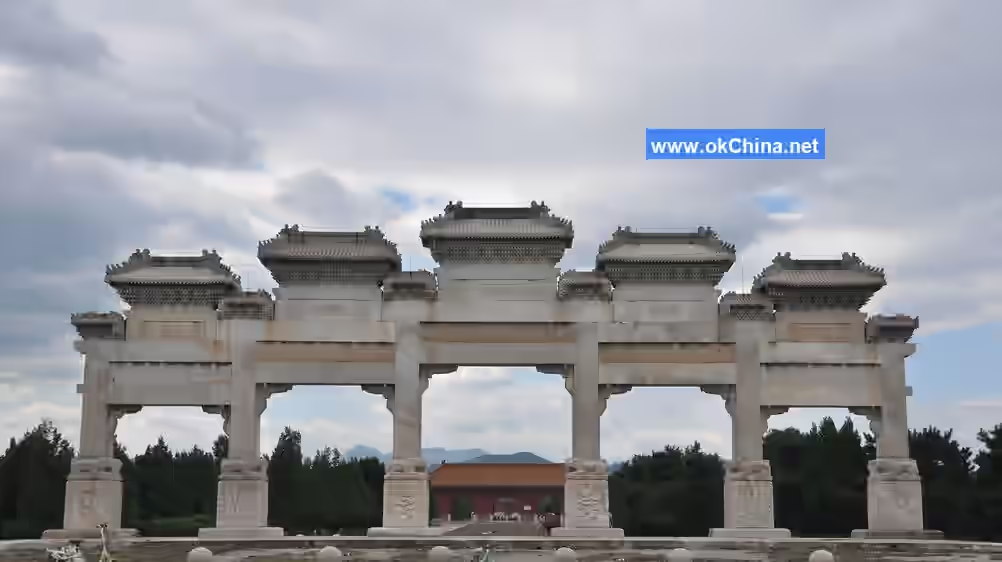
Jingling is the second imperial mausoleum built within the Eastern Mausoleums during the Qing Dynasty. Its scale is slightly smaller than that of Xiaoling. While generally modeled after Xiaoling, it introduced some modifications and innovations in certain aspects. For example, the Stele Pavilion of Sacred Virtue and Divine Merit houses two steles; the stone statues were reduced to 5 pairs; and the Dragon and Phoenix Gate was changed to a memorial archway gate. Jingling also introduced significant changes in burial practices, pioneering the system of burying the empress first and then attaching the burial of imperial noble consorts. Additionally, it abandoned the tradition of cremation and adopted earth burial. The architectural style and burial practices of Jingling were largely emulated by later generations, serving as a link between past and future.
The Stele Pavilion of Sacred Virtue and Divine Merit in Qing imperial mausoleums was built by the succeeding emperor to glorify the achievements of the previous emperor. The Stele Pavilion of Sacred Virtue and Divine Merit at Jingling was constructed between the 3rd and 5th years of the Yongzheng reign (1725-1727). According to Emperor Yongzheng's wishes, two steles were erected inside the pavilion, inscribed in Manchu and Chinese respectively, recounting the illustrious merits of Emperor Kangxi over more than 60 years. The inscription, written by Emperor Yongzheng himself, is over 4,300 characters long and serves as valuable historical material for studying the Kangxi era.
The arrangement of stone statues at Jingling differs from all other Qing imperial mausoleums. The sacred path from the five-arch bridge to the memorial archway gate curves due to the terrain, making symmetrical placement impossible. Therefore, the architectural designers of the time adapted to the path's curvature, setting the statues flexibly along the bends. This broke away from the rigid pattern, creating a dynamic and ever-changing visual effect as one walks, showcasing the intelligence and ingenuity of the people at that time.
Jingling Imperial Noble Consort Garden Tomb
The Jingling Imperial Noble Consort Garden Tomb is located 0.5 kilometers southeast of the Jingling Concubine Garden Tomb. It faces south and houses Imperial Noble Consort Quehui and Imperial Noble Consort Yi of Emperor Kangxi.
This garden tomb was built in the 4th year of the Qianlong reign (1739). Its architectural layout, from south to north, includes: a single-arch bridge and a flat bridge, eastern and western wing rooms, eastern and western guard rooms, main gate, incense burners, eastern and western side palaces, offering hall, garden tomb gate, and in the rear courtyard, two square citadels, Ming Towers, treasure citadels, and treasure domes built side by side east and west. The buildings inside the main gate are roofed with green glazed tiles, while the wing rooms and guard rooms are covered with gray cloth tiles. Building a separate garden tomb for these two consorts was an exception in the Qing Dynasty. During the 61st year of Kangxi (1722), when Hongli (Emperor Qianlong) lived in the palace, he received meticulous care from them. As these two consorts were still alive during the Qianlong reign, Emperor Qianlong, to show his filial piety and repay their nurturing kindness, not only built a separate garden tomb for them but also significantly expanded its scale and regulations.
According to Qing regulations, concubine garden tombs did not include eastern and western side palaces, square citadels, or Ming Towers. However, this garden tomb has all of them. Additionally, concubine garden tombs did not have a Danbi stone in front of the offering hall, but this garden tomb features a Danbi stone with the motif "Phoenix Facing the Sun," making it the highest-ranking concubine garden tomb in the Qing Dynasty.
Jingling Concubine Garden Tomb
The Jingling Concubine Garden Tomb is located 0.5 kilometers east of the Jingling Mausoleum. It houses 48 concubines and 1 prince of Emperor Kangxi.
The Jingling Concubine Garden Tomb was the first concubine garden tomb built inside the pass during the Qing Dynasty. It faces south. Its architectural layout, from south to north, includes: a single-arch bridge and a flat bridge, eastern and western wing rooms, eastern and western guard rooms, main gate, incense burners, offering hall, garden tomb gate, and in the rear courtyard, a group of treasure domes. There are 49 large and small treasure domes in total, arranged in seven rows. The tomb chambers beneath the domes are constructed in three types: stone vaults, brick vaults, and brick pools. The main gate, offering hall, incense burners, etc., are roofed with green glazed tiles; the wing rooms and guard rooms are covered with gray cloth tiles. The architectural regulations and scale are inferior to those of imperial and empress mausoleums. The layout of the Jingling Concubine Garden Tomb became the model for Qing Dynasty concubine garden tombs.
The Jingling Concubine Garden Tomb houses 49 individuals: 1 imperial noble consort, 11 consorts, 8 imperial concubines, 10 noble ladies, 9 constant attendants, 9 respondents, and 1 prince.These individuals each have their own burial certificates (with one empty certificate remaining), and their burial positions are determined by their status during their lifetime: those of higher status are placed at the front and center, while those of lower status are positioned at the back and on both sides. This garden tomb is the one with the highest number of concubines buried within it during the Qing Dynasty.
Consort Wenxi, of the Niohuru clan, was a member of the Manchu Bordered Yellow Banner, the daughter of Ebilun, the Grand Preceptor and Duke of Guoyi, and the younger sister of Empress Xiaozhaoren. In the 20th year of the Kangxi reign (1681), she was enfeoffed as a noble consort. In the 22nd year (1683), she gave birth to the tenth prince, and in the 24th year (1685), she gave birth to the eleventh princess. She passed away on the third day of the eleventh month in the 33rd year (1694) and was posthumously honored as Consort Wenxi. She was interred on the eighth day of the ninth month in the 34th year (1695).
Yuling Mausoleum
The Yuling Mausoleum is the tomb of the fourth emperor after the Qing Dynasty entered the Shanhai Pass, the Gaozong Emperor of the Qing Dynasty, Aisin Gioro Hongli, also known as the Qianlong Emperor. It is located at Shengshui Valley, west of the Xiaoling Mausoleum. Construction began in the 8th year of the Qianlong reign (1743) and was completed in the 17th year, costing over two million taels of silver.
The Yuling Mausoleum features an open sacred area, grand architecture, exquisite craftsmanship, and exceptional materials, creating an imposing atmosphere. From south to north, it includes the Shengde Shengong Stele Pavilion, the Five-Arch Bridge, stone statues, the Pailou Gate, the Single-Arch Bridge, the Dismounting Stele, the Well Pavilion, the Divine Kitchen Storehouse, the Eastern and Western Morning Rooms, the Three-Road Three-Arch Bridge and the Eastern and Western Flat Bridges, the Eastern and Western Guard Rooms, the Long'en Hall, the Three-Road Single-Arch Bridge, the Glazed Floral Gate, the Two-Pillar Gate, the Sacrificial Altar with Five Offerings, the Square City, the Ming Tower, the Treasure City, the Treasure Dome, and the Underground Palace. Its design both inherits from previous dynasties and incorporates expansions and innovations.
-
The stone statues are arranged in eight pairs, with one additional pair each of qilin, camels, and suanni compared to the Jingling Mausoleum of his grandfather, the Kangxi Emperor. Although the number is fewer than that of the Xiaoling Mausoleum, the variety is the same.
-
The eastern warm chamber of the Yuling main hall was converted into a Buddhist shrine, housing various Buddha statues and a large number of treasures. Later imperial mausoleums followed this example, establishing it as a standard practice.
-
In front of the mausoleum gate, three single-arch bridges of identical design span the Jade Belt River, featuring dragon and phoenix pillar-head railings, with leaning mountain dragons supporting the watch pillars at both ends of the bridges. These three arch bridges are beautifully shaped and exquisitely carved, unique among Qing Dynasty mausoleums.
-
The underground palace is adorned with intricate Buddhist-themed carvings: Buddhas of the Three Times, Buddhas of the Five Directions, Eight Great Bodhisattvas, Four Heavenly Kings, Twenty-Four Buddhas, Five Desires Offerings, lions, Eight Treasures, ritual implements, Buddhist flowers, and over thirty thousand words of Tibetan and Sanskrit mantras. The carving techniques are masterful and refined, with smooth and delicate lines, vivid and expressive forms, and a rigorous and orderly layout, earning it the titles "solemn and majestic underground Buddhist hall" and "treasury of stone carving art."
These characteristics of the Yuling Mausoleum reflect both the Qianlong Emperor's personal inclinations towards grandiosity and deep faith in Buddhism, as well as the comprehensive national strength of the Qing Dynasty at its peak.
The underground palace of the Yuling Mausoleum contains the Qianlong Emperor, two empresses (Xiaoxian and Xiaoyi), and three noble consorts (Huixian, Zhemin, and Shujia), totaling six individuals.
Yuling Concubine Garden Tomb
The Yuling Concubine Garden Tomb is the garden tomb for the concubines of the Qianlong Emperor, located beside the Yuling Mausoleum to the west. Construction began in the 12th year of the Qianlong reign (1747), with large-scale expansions in the 25th year (1760), and completion in the 27th year.
Initially called the Concubine Office, the Yuling Concubine Garden Tomb included a single-arch bridge and a flat bridge, eastern and western side rooms, eastern and western duty rooms, a main gate, a sacrificial stove, an offering hall, a glazed floral gate, treasure domes, all enclosed by a red wall. In the 25th year of the Qianlong reign (1760), following the death of the Qianlong Emperor's favored consort, Consort Chunhui, the emperor ordered the garden tomb to be renovated. Additions included eastern and western side halls (each with five bays), a square city, a Ming tower, and a treasure city. The three garden tomb gates and the flanking walls were dismantled and rebuilt on either side of the offering hall. The renovation was completed in the 27th year of the Qianlong reign (1762), directly costing 134,004.303 taels of silver.
The Yuling Concubine Garden Tomb contains one empress, two noble consorts, five consorts, six concubines, twelve ladies of honor, and four constant attendants of the Qianlong Emperor, totaling thirty-six individuals. Among the more notable figures are: Empress Ula Nara, Consort Chunhui, Consort Qinggong (née Lu), and Consort Rong.
Burials in the Yuling Concubine Garden Tomb spanned seventy-one years, from the interment of Concubine Yi in the 17th year of the Qianlong reign (1752) to that of Concubine Jin in the 3rd year of the Daoguang reign (1823).
The Yuling Concubine Garden Tomb is one of the higher-standard concubine garden tombs of the Qing Dynasty, showcasing the characteristics of the dynasty's peak period.
Dingling Mausoleum
The Dingling Mausoleum is the tomb of the Xianfeng Emperor, Aisin Gioro Yizhu, located at Ping'an Valley, the westernmost boundary of the Eastern Qing Tombs. Construction began on the thirteenth day of the fourth month in the 9th year of the Xianfeng reign (1859) and was completed in the twelfth month of the 5th year of the Tongzhi reign (1866), spanning seven and a half years and costing a net total of 3,134,547 taels of silver.
The site for the Dingling Mausoleum was selected by Lu Yingyi, the Governor of Jiangxi, and Bojun, the Minister of Personnel, among others. The Xianfeng Emperor also personally inspected it, considering Ping'an Valley to have "the left dragon winding, the right tiger crouching submissively, with the intimate cicada-wing and ox-horn sand formations faintly entwined for protection; the shrimp-whisker and golden-fish waters clearly demarcated, gathering spiritual light, with the burial method very true... truly a supremely auspicious site."
Although construction of the Dingling Mausoleum began in the 9th year of Xianfeng, large-scale building mainly occurred after the emperor's death. Soon after work commenced, a debate arose over the mausoleum's design. Song Jin, the Vice Minister of Works, argued that the Muling Mausoleum had eliminated the large stele pavilion, stone statues, two-pillar gate, square city, and Ming tower, while reducing the scale of the Long'en Hall and the eastern and western side halls, making it simple and unadorned, thus saving labor. Moreover, with the coffins of Emperor Wenzong and his empress awaiting burial, the tomb construction should proceed swiftly and follow the Muling design. Song Jin's suggestion was strongly refuted by Prince Li Shiduo and others. Ultimately, the two empress dowagers adopted Shiduo's recommendation, prioritizing the traditional design of ancestral mausoleums while also emulating Muling by eliminating the large stele pavilion and two-pillar gate, and omitting sutras and Buddha statues from the carvings in the underground palace. The design of the Dingling Mausoleum served as a model for later mausoleums like Huling and Chongling, playing a connecting role.
The materials for the Dingling Mausoleum were of two types: one consisted of procured materials, some purchased gradually during the Xianfeng Emperor's lifetime and others transported from various places after his death; the other comprised old materials from the original Baohuayu Mausoleum. The Baohuayu Mausoleum was originally built for the Daoguang Emperor but was abandoned due to water leakage in the underground palace. Using old materials from there was primarily to save costs and also to shorten the construction period. According to archives, most of the old materials were stone, such as 65 large white stone pieces including stone doors, stone statues, and stone watch pillars, 605,464 old bricks, 62 old partition screens, and 24 doors and windows, saving over 200,000 taels of silver.
The underground palace of the Dingling Mausoleum rises layer by layer, with a compact architectural layout and well-ordered heights, creating a distinct sense of layering.
The underground palace of the Dingling Mausoleum contains the Xianfeng Emperor and his Empress Xiaodexian.
Puxiangyu Dingdongling Mausoleum
The Puxiangyu Dingdongling Mausoleum is the tomb of Empress Xiaozhenxian (Empress Dowager Ci'an), located at Puxiang Valley on the southern foothills of Changrui Mountain, slightly to the west. Built side-by-side to the east is the Putuoyu Dingdongling Mausoleum of Empress Dowager Cixi. Both mausoleums are situated east of the Xianfeng Emperor's Dingling Mausoleum, hence collectively referred to as the Dingdongling Mausoleums.
In the 5th year of the Tongzhi reign (1866), Empress Dowagers Ci'an and Cixi dispatched Grand Secretary Zhou Zupei and others to the Eastern Qing Tombs to select their eternal auspicious sites. Since the area west of the Dingling Mausoleum bordered the West Great River with no available land, Pingdingshan and Putuoshan were chosen east of Dingling. On the ninth day of the third month in the 12th year of the Tongzhi reign (1873), Ci'an and Cixi took the opportunity of visiting the Eastern Qing Tombs to personally inspect Pingdingshan and Putuoshan. Finding the place "majestic and beautiful, surrounded by mountains and rivers," they designated it as their eternal auspicious site, renaming Pingdingshan to Puxiang Valley and Putuoshan to Putuo Valley.
Before construction began, the supervising ministers discovered that the burial positions of the two mausoleums could not be aligned side-by-side but were offset north-south. Consequently, the two empress dowagers adopted the ministers' suggestion: the marker stake for Puxiangyu was lowered by 1 zhang, 5 chi, and 2 cun and moved west by 4 chi, 7 cun, and 5 fen, while the marker stake for Putuoyu was raised by 7 chi and 4 cun and moved east by 8 cun, leveling the positions of the two mausoleums. Additionally, due to the low-lying, marshy terrain, an area outside the Eastern Tombs was selected to excavate pure, fine, sand-free soil for filling and raising the two auspicious sites.
Construction on both mausoleums began simultaneously on the twentieth day of the eighth month in the 12th year of the Tongzhi reign (1873). After six years, they were completed concurrently on the twentieth day of the sixth month in the 5th year of the Guangxu reign (1879). Ci'an's mausoleum cost 2,665,743.823 taels of silver, while Cixi's mausoleum cost 2,275,818.046 taels.
The Puxiangyu Dingdongling Mausoleum integrates many features of Qing Dynasty imperial and empress mausoleums, making it the most complete empress mausoleum. Its comprehensive layout, from south to north, includes: two eastern and western dismounting steles, one well pavilion, one central sacred way stele pavilion, one three-arch stone bridge, one eastern and one western auxiliary bridge each, five-bay eastern and western morning rooms each, three-bay eastern and western duty rooms each, a five-bay Long'en Gate, one eastern and one western sacrificial stove each, five-bay eastern and western side halls each, a five-bay Long'en Hall, three glazed floral gates, one stone altar with five offerings, one square city, one Ming tower, one treasure city, one treasure dome, all enclosed by a red wall. To the east is the Divine Kitchen Storehouse, containing a five-bay divine kitchen, three-bay northern and southern divine storehouses each, and one three-bay by three-bay animal slaughtering pavilion.
Putuoyu Dingdongling Mausoleum
The Putuoyu Dingdongling Mausoleum is the tomb of Empress Xiaozhenxian, also known as Empress Dowager Cixi, located at Putuo Valley on the southern foothills of Changrui Mountain, slightly to the west. It is 0.5 kilometers east of the Yuling Concubine Garden Tomb and separated from the Puxiangyu Dingdongling Mausoleum to the west only by a horse-trough ditch.
Cixi's mausoleum and Ci'an's mausoleum are identical in scale and design.Although the mausoleum was constructed with grand specifications and complete ceremonial systems, ranking among the finest of the Qing dynasty's empress tombs, Empress Dowager Cixi was not satisfied. Taking advantage of her sole authority, she used the pretext of long-term disrepair to order the complete demolition and reconstruction of the square city, Ming Tower, treasure city, Long'en Hall, eastern and western side halls, and eastern and western offering furnaces at the Putuo Valley Eternal Auspicious Site in the 21st year of the Guangxu reign (1895). Additionally, major repairs were carried out on the palace gates, audience halls, small stele pavilions, and divine kitchen warehouses, while the underground palace vaults and stone five offerings were also included in the maintenance. The reconstruction project began on the 24th day of the 11th month in the 21st year of Guangxu and concluded in the 10th month of the 34th year of Guangxu (1908), just a few days before Cixi's death, lasting a total of 13 years.
After the reconstruction, Cixi's mausoleum featured exquisite materials, fine craftsmanship, luxurious decorations, and magnificent splendor. The wooden structures of the three main halls were entirely made of precious rosewood. The colored paintings on the beams and ceilings were not applied with a base layer or pigments; instead, gold leaf was directly applied to the wooden components using the raised paste technique, featuring the highest-grade dragon and imperial seal patterns. The walls inside the halls were carved with brick patterns symbolizing "boundless fortune and longevity" and "endless happiness and longevity," all adorned with red and gold leaf. Sixty-four exposed pillars in the three halls were entirely wrapped with semi-three-dimensional gilded copper dragons. The protective walls were meticulously laid to the top, with the cornices carved with "endless fortune and flowing clouds" patterns. The stone railings surrounding the main hall and the moon platform, whether the panels, balusters, or drum stones, were all carved with reliefs of dragons, phoenixes, and auspicious sea and mountain patterns. Particularly notable is the Danbi stone in front of the hall, which, using high relief and openwork carving techniques, vividly depicts a phoenix soaring in the sky and a dragon emerging from the water, making it a rare masterpiece of stone carving art. The gold-leafed walls, gilded colored paintings, gilded coiled dragons, and exquisite stone carvings adorned the three halls with resplendent and unparalleled beauty. Such luxurious decorations were not only unique among the imperial mausoleums of the Ming and Qing dynasties but also rarely seen even within the Forbidden City.
Cixi's coffin contained a large number of priceless burial items, which ultimately led to a tomb robbery disaster. In July 1928, the warlord Sun Dianying looted Cixi's mausoleum, smashed the coffin, desecrated the corpse, and stole all the treasures. After the robbery, Puyi sent people to re-inter the remains, and the original state of the re-interment has been preserved to this day.
Dingling Concubine Garden Tomb
The Dingling Concubine Garden Tomb is located in Shunshui Valley, east of the Dingling Mausoleum, and serves as the burial ground for the concubines of Emperor Xianfeng. This garden tomb was constructed simultaneously with the Dingling Mausoleum and was completed in the eighth month of the fourth year of the Tongzhi reign.
During the construction of the Dingling Concubine Garden Tomb, some old materials from the Baohuayu Concubine Garden Tomb were reused, including: 5 stone beds, 5 stone doors, 4 lintels with door ornament tiles, 5 middle thresholds, 10 door frames, 10 horse-hoof pillars, and 37,752 pieces of various old bricks.
From design to construction, the Dingling Concubine Garden Tomb was built entirely according to the standard regulations for concubine garden tombs. Its structures, from south to north, include: a single-arch bridge and a flat bridge each, eastern and western guardhouses, a main gate, a left-side offering furnace, a five-bay offering hall, three garden tomb gates (including one glazed floral gate and two wall gates), and three rows of treasure mounds in the rear courtyard, totaling 15 mounds, all enclosed by a red wall.
The Dingling Concubine Garden Tomb houses the remains of 15 concubines of Emperor Xianfeng, including 2 imperial noble consorts, 2 noble consorts, 4 consorts, 4 concubines, and 3 constant attendants.
Huiling Mausoleum
The Huiling Mausoleum is the tomb of Emperor Muzong of the Qing Dynasty, Aisin Gioro Zaichun (Emperor Tongzhi), located in Shuangshanyu, three kilometers southeast of the Jingling Mausoleum. Zaichun reigned for 13 years (1862–1874) but never built a mausoleum during his lifetime. After his death, in the second month of the first year of the Guangxu reign (1875), the Qing court selected Shuangshanyu as the Eternal Auspicious Site, and on the 23rd day of the second month, the mausoleum was named Huiling. Construction began on the third day of the eighth month of the first year of Guangxu and was completed in the ninth month of the fourth year of Guangxu (1875–1878), lasting three years and one month, with a total cost of 4,359,110.89 taels of silver. The supervising ministers included Prince Chun Yixuan, Left Censor-in-Chief Kuiling, Vice Minister of Revenue Ronglu, and Acting Vice Minister of Works Weng Tonghe.
The architectural specifications of the Huiling Mausoleum followed those of the Dingling Mausoleum, except that it did not include the Shengde Shengong Stele Pavilion and the Two-Pillar Gate. Additionally, the stone statues and the spirit path connecting to the main tomb were omitted. The architectural layout, from south to north, includes: a five-arch bridge, two flat bridges, two stone watch pillars, a memorial archway gate, eastern and western dismounting steles, a spirit way stele pavilion, a divine kitchen warehouse, a well pavilion, three three-arch bridges, two flat bridges, eastern and western audience halls, eastern and western duty rooms, the Long'en Gate, eastern and western offering furnaces, eastern and western side halls, the Long'en Hall, three glazed floral gates, a stone five-offering altar, a square city, a Ming Tower, a treasure city, and a treasure mound, beneath which lies the underground palace. The mausoleum is surrounded by sand hills. Except for the eastern and western duty rooms, which have gray tile roofs, all other structures are covered with yellow glazed tiles.
Although this mausoleum was built during the late Qing Dynasty, the wood used was all nanmu, known for its hardness and commonly referred to as "copper beams and iron pillars." As a result, the large wooden framework remains well-preserved to this day.
Huiling Concubine Garden Tomb
The Huiling Concubine Garden Tomb is located in Xishuangshanyu, west of the Huiling Mausoleum, and serves as the concubine garden tomb for Emperor Muzong of the Qing Dynasty, Aisin Gioro Zaichun (Emperor Tongzhi).
The Huiling Concubine Garden Tomb was modeled after the Dingling Concubine Garden Tomb. Its main structures, from south to north, include: a single-arch bridge, a three-arch flat bridge on the east side, eastern and western side rooms, eastern and western duty rooms, a main gate, an eastern offering furnace, an offering hall, garden tomb gates, and treasure mounds, each with an underground palace beneath, all enclosed by a red wall. The structures outside the main gate have gray tile roofs, while those inside the main gate are covered with green glazed tiles.
The Huiling Concubine Garden Tomb houses the remains of four imperial noble consorts: Imperial Noble Consort Shushen, Imperial Noble Consort Xianzhe, Imperial Noble Consort Ronghui, and Imperial Noble Consort Shushen. The treasure mound of Imperial Noble Consort Shushen is located in the center of the front row, while the treasure mounds of the other three imperial noble consorts are in the back row, arranged from east to west: Imperial Noble Consort Gongsun, Imperial Noble Consort Xianzhe, and Imperial Noble Consort Ronghui.
Duangmin Gulun Princess Garden Tomb
The Duangmin Gulun Princess Garden Tomb is located southeast of the Eastern Qing Tombs, outside the Fengshui Wall, west of Xujiayu Village. This garden tomb was built in the first year of the Daoguang reign (1821). The supervising minister was Qingyu, a langzhong of the Eastern Tombs Internal Affairs Office. This garden tomb is the only princess garden tomb in the Eastern Qing Tombs.
The garden tomb faces south, and its structures, from south to north, include: eastern and western side rooms, eastern and western duty rooms, a main gate, an offering hall, garden tomb gates, and treasure mounds (two in total), all enclosed by a wall. The four treasure mounds, from west to east, belong to: the Second Princess, Duangmin Gulun Princess, Prince Shunhe, and Prince Huizhi.
Duangmin Gulun Princess was the first daughter of Emperor Daoguang. Her birth mother was the secondary consort Tongjia of the Qianlong Mansion, later Empress Xiaoshencheng. She was born at the you hour on the second day of the tenth month in the 18th year of the Jiaqing reign (1813) and died on the 20th day of the tenth month in the 24th year of Jiaqing (1819) at the age of seven. She was posthumously granted the title of Junzhu (commandery princess) and later, in the ninth month of the 25th year of Jiaqing (1820), was posthumously granted the title of Duangmin Gulun Princess. She was buried in the seventh year of the Daoguang reign (1827).
The Second Princess was the second daughter of Emperor Daoguang. Her mother was Consort Xiang of the Niohuru clan, later Consort Xiang. She was born on the 13th day of the first month in the fifth year of Daoguang (1825) and died on the 14th day of the seventh month of the same year, living only half a year. She was not granted any title. The Second Prince, Yigang, was the second son of Emperor Daoguang. His mother was Consort Jing, later Empress Xiaojingcheng. He was born on the 23rd day of the tenth month in the sixth year of Daoguang (1826) and died on the eighth day of the second month in the seventh year of Daoguang, not yet two years old. In the first month of the 30th year of Daoguang (1850), Emperor Xianfeng posthumously granted him the title of Prince Shun, with the posthumous name "He." The Third Prince, Yiji, was the third son of Emperor Daoguang, born to the same mother as the Second Prince. He was born on the seventh day of the 11th month in the ninth year of Daoguang (1829) and died on the 28th day of the 12th month, living only a little over a month. In the first month of the 30th year of Daoguang (1850), Emperor Xianfeng posthumously granted him the title of Prince Hui, with the posthumous name "Zhi."
VI. Cultural Relics and Remains
Xiaoling Spirit Way
The Xiaoling Spirit Way is approximately 6 kilometers long, stretching from the stone memorial archway at the foot of Jinxing Mountain in the south to the treasure city and mound at the foot of Changrui Mountain in the north. It follows the alignment of the three mountains—the facing mountain, the table mountain, and the backing mountain—connecting the dozens of structures of the Xiaoling Mausoleum to form the central axis of the tomb complex. The Xiaoling Spirit Way is the longest spirit way among the Qing tombs.
Xiaoling Stone Memorial Archway
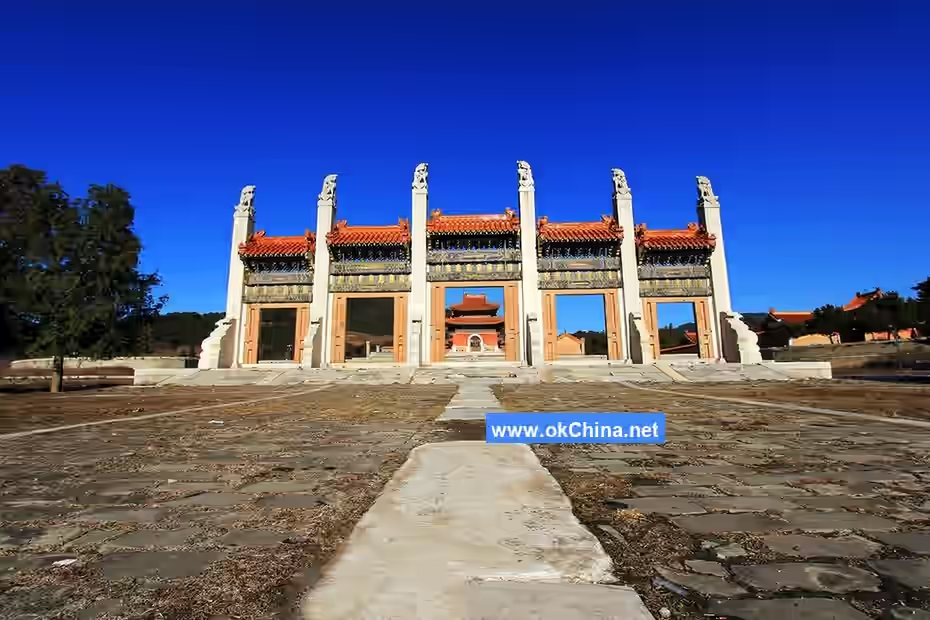
The Xiaoling Stone Memorial Archway is the widest surviving stone memorial archway in China. It imitates wooden structural forms, with five bays, six pillars, and eleven towers, spanning 31.35 meters in width and standing 12.48 meters tall. It is entirely constructed of massive bluish-white stone. The tops of the clamping stones are carved with round sculptures of qilins and lions, while the visible surfaces feature reliefs of cloud dragons, grass dragons, and double lions playing with a ball. The beams and lintels are carved with xuanzi-style colored paintings. The folding pillars and decorative panels are adorned with reliefs of auspicious clouds. The bracket sets, rafters, roof ridges, ridge beasts, cloud piers, and sparrow braces are all carved from stone. Despite two major earthquakes, it remains intact after 330 years.
Xiaoling Stone Statues
The Xiaoling Stone Statues consist of 18 pairs, including 3 pairs of civil officials, 3 pairs of military officials, 1 pair of standing horses, 1 pair of crouching horses, 1 pair of standing qilins, 1 pair of sitting qilins, 1 pair of standing elephants, 1 pair of crouching elephants, 1 pair of standing camels, 1 pair of crouching camels, 1 pair of standing suanni, 1 pair of sitting suanni, 1 pair of standing lions, and 1 pair of sitting lions. Additionally, there is one pair of watch pillars. All stone statues are carved from single blocks of stone. This group of stone carvings is symmetrically arranged on both sides of the spirit way, stretching over 800 meters from north to south.
Xiaoling Seven-Arch Bridge
Among stone bridges, the arch bridge is the highest grade. The seven-arch bridge is unique to the Xiaoling Mausoleum in the Eastern Qing Tombs. The bridge is 110 meters long, with 126 stone railings, 128 stone watch pillars, and 4 drum stones installed on both sides.
Yuling Shengde Shengong Stele Pavilion
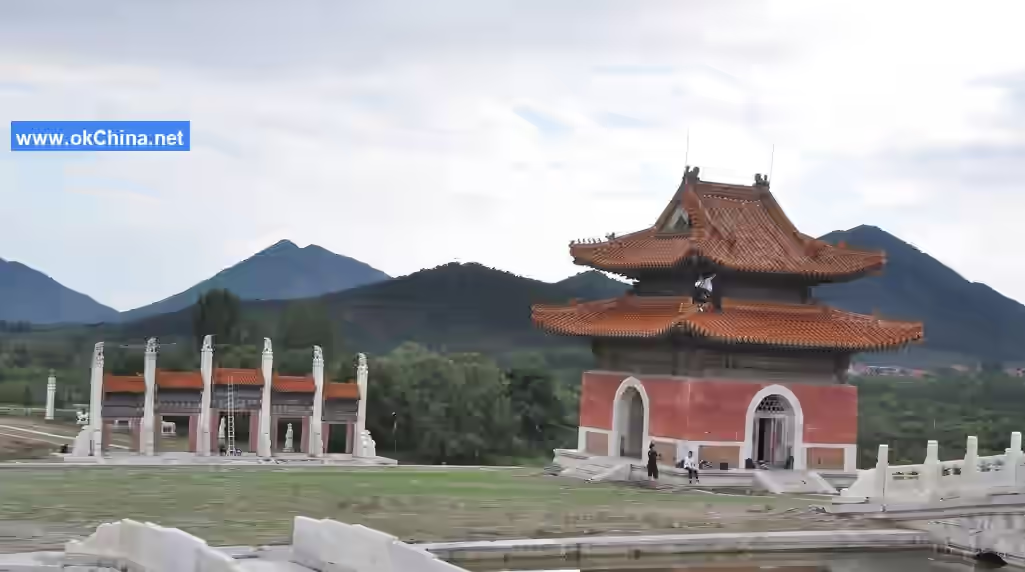
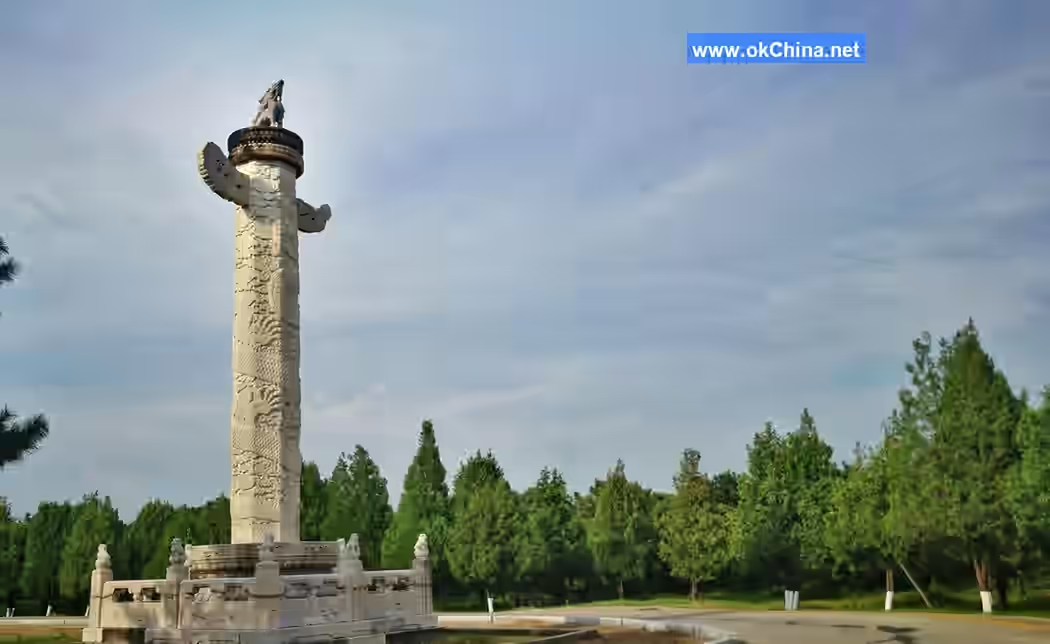
The Yuling Shengde Shengong Stele Pavilion is a double-eaved hip-and-gable structure covered with yellow glazed tiles. The thick platform base has arched openings on all four sides. Inside the pavilion, two steles, each 6.64 meters tall, stand on two massive stone-carved tortoise bases. The eastern stele is inscribed with Manchu script, while the western stele is inscribed with Chinese characters.The inscription was composed by Emperor Renzong (the Jiaqing Emperor) and personally written by the renowned Qing Dynasty calligrapher, Prince Cheng Yongxing, the eleventh son of Emperor Gaozong (the Qianlong Emperor). This stele remains intact to this day, with clear and legible characters. At each of the four corners of the square outside the pavilion stands a white marble ornamental column (huabiao). Each huabiao consists of a Sumeru base, a column shaft, a cloud-shaped board, a dew-collecting plate, and a crouching dragon. The column shaft is carved with a dragon soaring through clouds. The octagonal Sumeru base and railings are also densely carved with dragons in motion, ascending dragons, and frontal dragons, with a total of 98 dragons carved on a single set of huabiao.
The Underground Palace of the Yuling Mausoleum
Yuling is the mausoleum of the Qianlong Emperor. Its underground palace consists of nine vaults and four gates, extending 54 meters in depth. Starting from the first stone gate, all the flat water walls, moonlit walls, vault ceilings, and gate towers are covered with Buddhist-themed carvings, such as the Four Heavenly Kings, Eight Great Bodhisattvas, Five Dhyani Buddhas, Twenty-Four Buddhas, the Five Desires Offerings, lions, the Eight Treasures, ritual implements, and over 30,000 words of Tibetan and Sanskrit mantras. It is acclaimed as a "treasure trove of stone carving art" and a "solemn and majestic underground Buddhist hall."
The Three Halls of the Putuo Valley Eastern Dingling Mausoleum
The Putuo Valley Eastern Dingling Mausoleum is the tomb of Empress Dowager Cixi. The wooden structures of its Long'en Hall and the eastern and western side halls are entirely made of precious Huanghuali wood. The painted beams and brackets do not use a base layer or pigments; instead, gold leaf is applied directly onto the wood with raised paste, featuring the highest-grade dragon and imperial seal patterns. The walls inside the hall are carved with brick patterns symbolizing "boundless fortune and longevity, enduring happiness and long life," all gilded with red and gold. The 64 exposed pillars in the three halls are entwined with semi-three-dimensional gilded copper dragons. The protective walls are laid dry to the top, and the cornice bricks are carved with "endless fortune and flowing clouds" patterns. The stone railings surrounding the main hall, whether the panels, posts, or drum-bearing stones, are all carved in relief with various auspicious dragon and phoenix motifs, as well as patterns of sea waves and mountain cliffs.
The Jade Belt Bridge of the Yuling Mausoleum
The Jade Belt Bridge of the Yuling Mausoleum spans the Jade Belt River behind the Long'en Hall and in front of the tomb gate. It features a single-arch vault with three bridges arranged side by side. The bridge deck is flanked by white stone railings with dragon and phoenix pillar heads. This style of stone bridge is unique among Qing Dynasty mausoleums.
VII. Cultural Relic Value
Research Significance
The Eastern Qing Tombs hold significant academic research value. For example, the burial artifacts from the Eastern Qing Tombs have corresponding research significance and value. Investigating the excavation of these artifacts not only clarifies the political reflections of funeral culture, imperial ideology, and feudal hierarchical systems within the predominantly Confucian political environment of the feudal dynasty but also, to some extent, objectively restores the original historical context. By studying the burial artifacts of the Eastern Qing Tombs and further analyzing the preferences and ideologies of individual tomb occupants, valuable references can be provided for research on other deeds related to the tomb occupants.
Historical Value
Overview
The construction and management of the Eastern Qing Tombs spanned two and a half centuries, nearly coinciding with the entire duration of the Qing Dynasty. The construction began in the 18th year of the Shunzhi reign (1661) and took 247 years to complete. The earliest structures are nearly 400 years old, while the latest are close to a century old. They not only reflect the entire evolution of mausoleum regulations from the early to the late Qing Dynasty but also record the rise and fall of the Qing Dynasty from a unique perspective. The Eastern Qing Tombs house many prominent figures who had a significant impact on Qing history, such as Empress Xiaozhuangwen, a female politician of the early Qing Dynasty who assisted Emperors Shizu and Shengzu; the Kangxi and Qianlong Emperors, who initiated the "Prosperous Era of Kangxi and Qianlong"; and Empress Dowager Cixi, who presided over two regencies and ruled China for 48 years in the late Qing Dynasty. These figures played crucial roles on the stage of Qing history, shaping the nation's destiny and achieving high renown both domestically and internationally. Their tombs are rich in content and possess corresponding historical value. Additionally, the Eastern Qing Tombs represent the pinnacle of Chinese tomb construction activities. They achieved perfection in environmental quality, landscape integration, architectural design, and the harmony between architectural layout and natural surroundings, making them one of the most distinctive examples of imperial cemeteries in Chinese history. Due to the wealth of historical information they contain, the Eastern Qing Tombs are not only invaluable physical materials for studying Qing Dynasty mausoleum regulations, funeral systems, sacrificial rituals, architectural techniques, and craftsmanship but also typical examples for researching Qing Dynasty politics, economy, military affairs, culture, science, and art.
Archaeological Evidence
The burial artifacts from the Eastern Qing Tombs partially restore the original historical context. For example, among the burial treasures of Emperor Gaozong (the Qianlong Emperor) were a Western-style enamel-sheathed horn-handled small knife and a Western-style enamel toothpick case. Among the burial treasures of Empress Xiaozhuangxian (Empress Dowager Cixi) were Western-style gold-inlaid white diamond and pearl brooches, Western-style gold-inlaid white diamond peach-shaped large pearl clasps, and others. As the actual rulers of the Qing government, the presence of diverse Western artifacts in the tombs of the Qianlong Emperor and Empress Dowager Cixi indicates that the Qing rulers maintained a certain degree of acceptance and openness toward Western civilization. Another example is the historical record that Empress Xiaozhuangwen personally sewed imperial garments for Emperor Shengzu (the Kangxi Emperor). When the Kangxi Emperor was encoffined, Emperor Shizong (the Yongzheng Emperor) fulfilled his father's last wish by personally dressing him in the garments sewn by Empress Xiaozhuangwen before burial in the underground palace. The excavation of these imperial garments from the Eastern Qing Tombs not only reveals the deep affection between Empress Xiaozhuangwen and her grandson, the Kangxi Emperor, and the close relationships among royal family members at the time but also provides physical evidence to corroborate the historical record that the burial garments of Emperor Shengzu (the Kangxi Emperor) were indeed made by Empress Xiaozhuangwen.
Comments
Post a Comment