Deng Xiaoping's Former Residence
1. Introduction
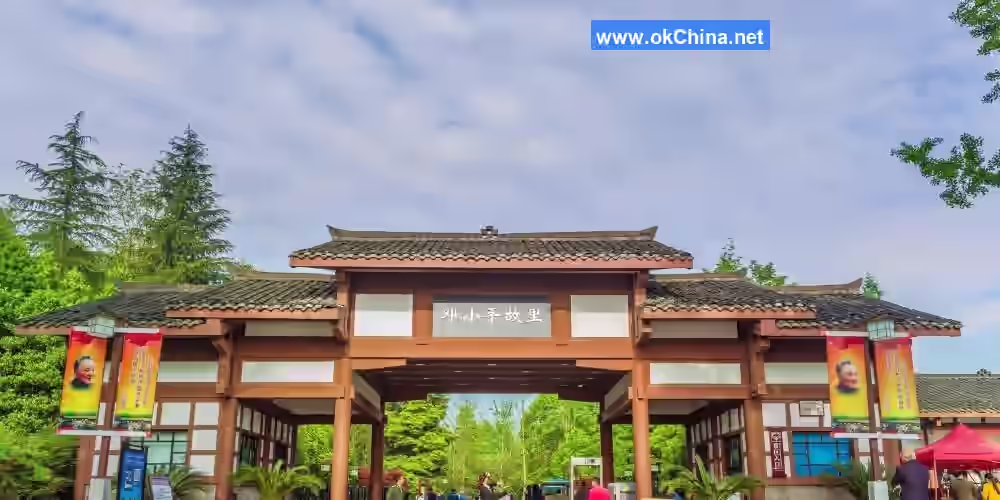
The Deng Xiaoping's Former Residence Tourist Area is a national AAAAA-level tourist attraction that integrates red tourism, eco-tourism, ancient town culture, and rural leisure vacations. It covers a total area of 3.19 square kilometers and mainly includes the Deng Xiaoping's Former Residence Core Area, the Foshou Mountain Scenic Area, the Hanlin Courtyard, Xiexing Old Street, and Paifang New Village, among other scenic spots. It contains 4 nationally protected key cultural relics sites and numerous examples of eastern Sichuan folk customs and natural landscapes. The Deng Xiaoping's Former Residence Core Area spans 830 mu (approximately 55.3 hectares). Approved by the Central Committee of the Communist Party of China, memorial facilities such as the Deng Xiaoping Bronze Statue Square, the Deng Xiaoping Former Residence Exhibition Hall, and the Deng Xiaoping Memorial Hall have been constructed. Nearly 20 important sites from Deng Xiaoping's youth, including Qingshui Pond, Shendao Stele, Dezheng Archway, and Cattle-Grazing Slope, have been restored. This has formed a lush, orderly, natural, intimate, and admirable "natural memorial hall" landscape.
The Deng Xiaoping's Former Residence Tourist Area has been designated as a National Patriotic Education Demonstration Base, National Integrity Education Base, National Youth Education Base, National Defense Education Demonstration Base, National First-Class Museum, National Youth Civilization Unit, and National Civilized Unit. It has successively received honors such as China's Top Ten Classic Red Tourism Scenic Spots, China's Tourism Brand Charming Scenic Spot, China's Top Ten Influential Red Tourism Brands, China's Top Ten Red Tourism Scenic Spots for Visitor Satisfaction, and has twice won the highest tourism award in Sichuan Province—the Golden Panda Award. Party and state leaders including Li Keqiang and Hu Jintao have visited Deng Xiaoping's Former Residence.
2. Geographical Environment
2.1 Climate Characteristics
The Deng Xiaoping's Former Residence Tourist Area in Guang'an City is located in the mid-subtropical humid monsoon climate zone, characterized by a mild climate suitable for agriculture throughout the four seasons. In summer, influenced alternately by the Pacific subtropical high-pressure system, the Qinghai-Tibet high-pressure system, plateau fluctuations, and the southwest warm and humid air currents, the area experiences abundant rainfall and sufficient heat, creating a climate where light, heat, and water coincide during the same season. The annual average temperature is 17.1°C.
2.2 Geographical Location
The Deng Xiaoping's Former Residence Tourist Area in Guang'an City is located in the northern suburbs of Guang'an City, in Paifang Village, Xiexing Town, Guang'an District. Its coordinates are between 30°01′–30°48′ north latitude and 105°56′–107°18′ east longitude, approximately 7 kilometers from downtown Guang'an.
3. Main Attractions
The Deng Xiaoping's Former Residence Tourist Area in Guang'an City currently features nearly 20 main attractions, such as the Hanlin Courtyard, Silkworm House Courtyard, Deng Shaochang's Tomb, as well as the Deng Family Old Well, Ancient Tree Slope, Cattle-Grazing Slope, Qingshui Pond, Inkstone-Washing Pond, and Shendao Stele. These sites fully showcase the footprints of Comrade Deng Xiaoping's activities during his youth.
3.1 Comrade Deng Xiaoping's Former Residence
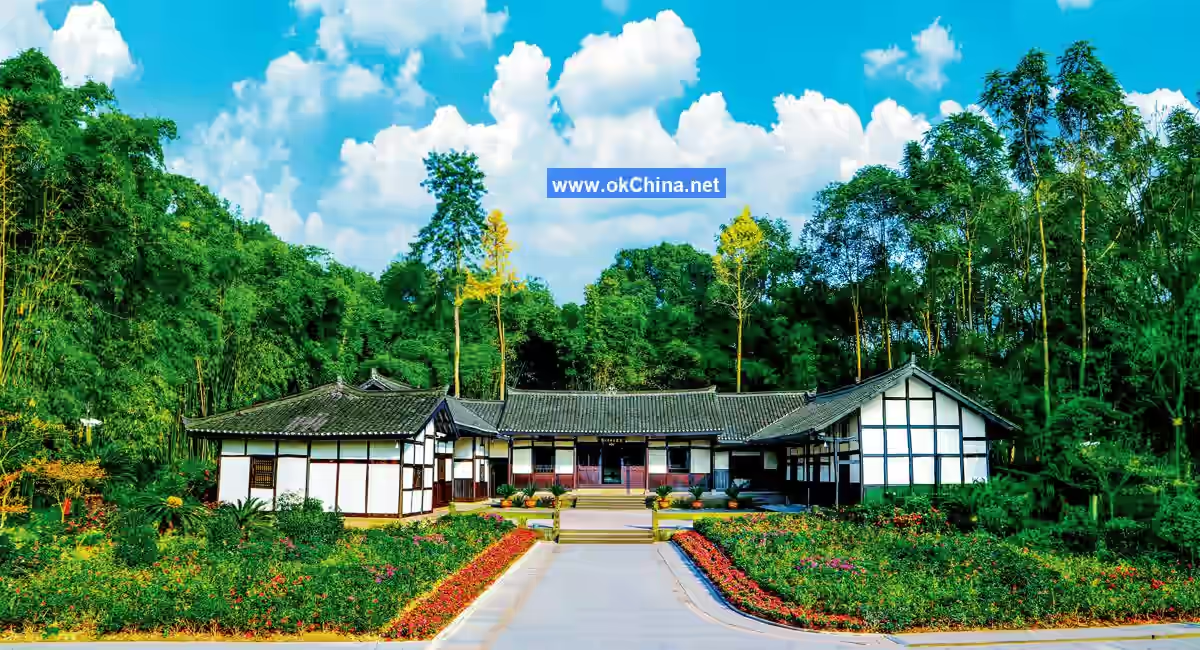
Comrade Deng Xiaoping was born here on August 22, 1904, and lived here for 15 years. Deng Xiaoping's Former Residence is an ordinary eastern Sichuan-style farmhouse with three courtyards, affectionately called "Deng Family Old Courtyard" by local people. Like many dwellings in eastern Sichuan, the residence is nestled among clusters of bamboo. The house faces west and covers an area of 883 square meters. The building features a suspended hill-style wooden structure with small black tile roofing and a post-and-lintel load-bearing system. It consists of 17 rooms divided into a main hall, left wing rooms, and right wing rooms.
3.2 Deng Xiaoping Former Residence Exhibition Hall
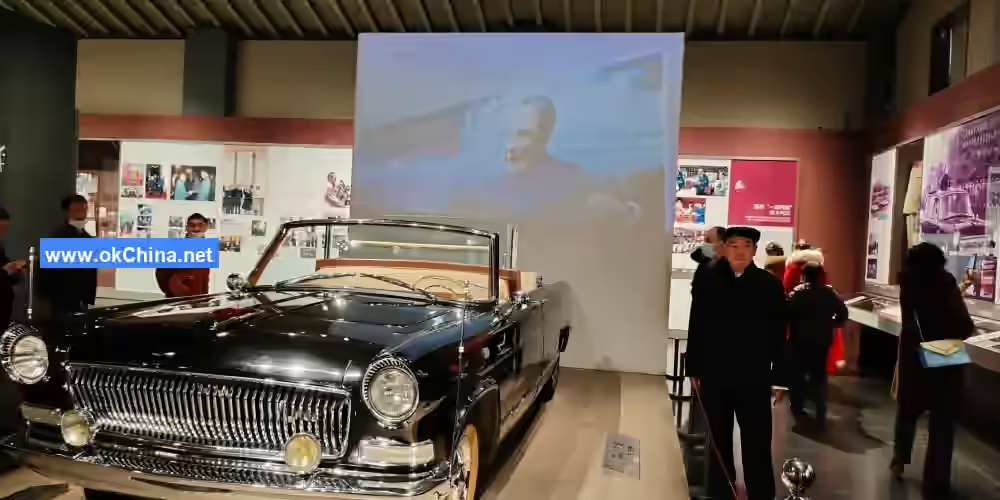
The Deng Xiaoping Former Residence Exhibition Hall is the only museum in China dedicated specifically to commemorating Comrade Deng Xiaoping. The exhibition hall comprises a preface hall, three exhibition halls, a film screening hall, and a treasured collection exhibition hall. It has collected 408 pictures, 170 cultural relics, and over 200 archival documents related to Comrade Deng Xiaoping. Using high-tech methods such as sound, light, and electricity, it vividly portrays Comrade Deng Xiaoping's glorious life of relentless struggle for China's revolution, construction, and reform. The building employs a reinforced concrete frame structure with a floor area of 3,800 square meters. The exhibition hall faces east and is arranged in a single row. It features three black tile sloping roofs, rising in three tiers, each higher than the last, culminating in a towering monument symbolizing Deng Xiaoping's legendary life of "three falls and three rises" and his monumental achievements.
3.3 Deng Xiaoping Memorial Hall
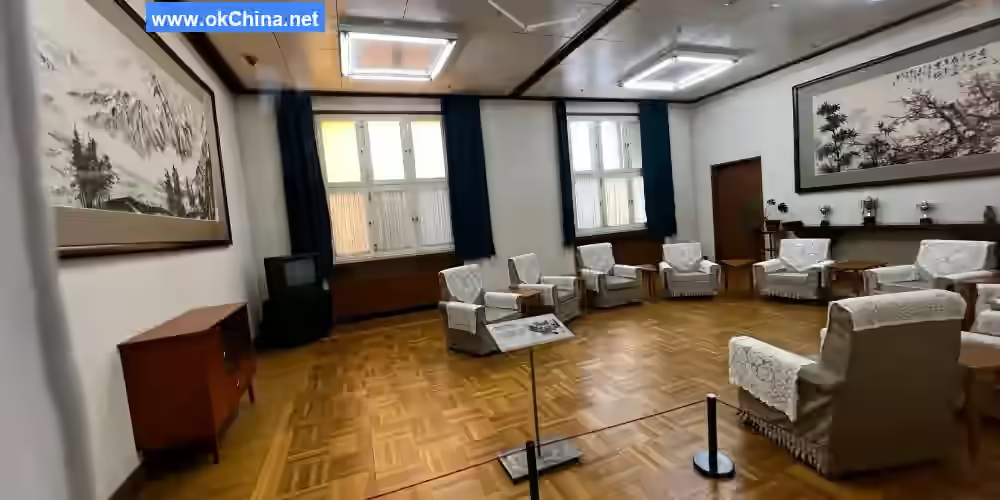
The Deng Xiaoping Memorial Hall is one of the key projects commemorating the 110th anniversary of Comrade Deng Xiaoping's birth and serves as another important memorial site to honor his noble character. It is located between the Deng Xiaoping Former Residence Exhibition Hall and Deng Xiaoping's Former Residence, approximately 70 meters southeast of the exhibition hall, and covers half the area of the exhibition hall. The Deng Xiaoping Memorial Hall is designed with the concept of "homecoming," guided by principles of intimacy, naturalness, and warmth in its architectural design. Its function is to display scenes from Comrade Deng Xiaoping's work and daily life, primarily exhibiting authentic personal artifacts. The exhibition theme is "Hello, Xiaoping," aiming to highlight Deng Xiaoping as an ordinary person beyond the political arena and express "the people's love for their people's leader." The entire exhibition serves as a complete complement to the basic exhibition "I Am the Son of the Chinese People" at the Deng Xiaoping Former Residence Exhibition Hall, further showcasing Deng Xiaoping's personal charm and allowing people to better understand his life, emotions, and world.
3.4 Deng Xiaoping Bronze Statue Square
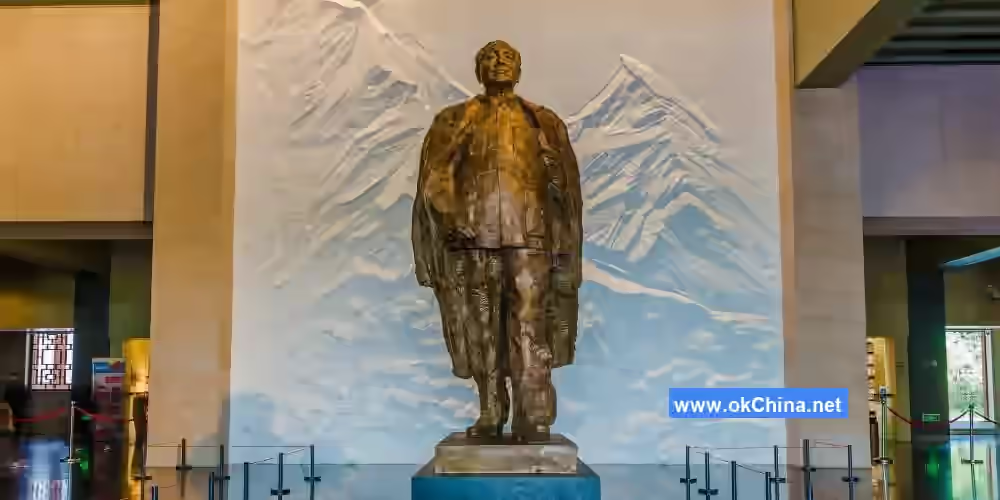
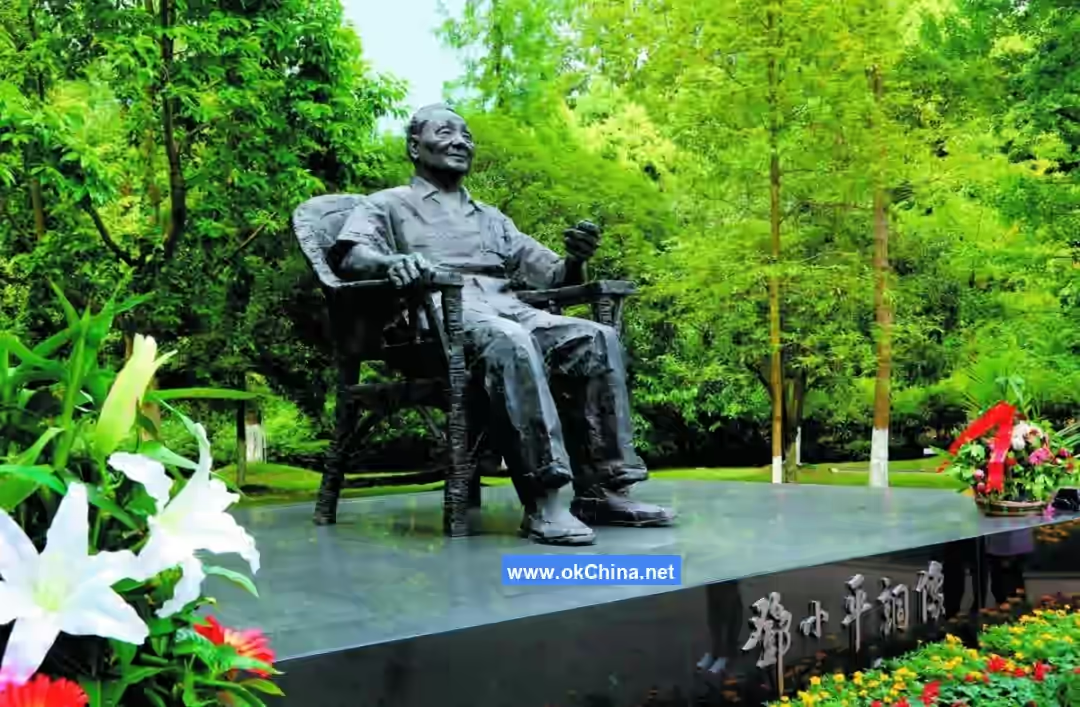
The Deng Xiaoping Bronze Statue Square is surrounded by three ridges, resembling a natural large armchair. The Deng Xiaoping bronze statue sits serenely within this natural environment of green grass and towering ancient trees. The bronze statue is 2.5 meters tall, weighs 1.2 tons, and faces south. Its base is made of Black Galaxy granite, with the inscription "Deng Xiaoping Bronze Statue" written by Comrade Jiang Zemin engraved on the front. This cast bronze seated statue depicts a gentle face with thin cheeks and sharp, profound eyes. Deng Xiaoping is dressed in a short-sleeved shirt, military-style trousers, and cloth shoes, sitting on a chair with a smile, affectionately gazing at the mountains and rivers of his hometown, as if having shaken off the dust of his travels and returned home to observe the development and changes of his native place. On August 13, 2004, General Secretary Hu Jintao personally unveiled the Deng Xiaoping bronze statue.
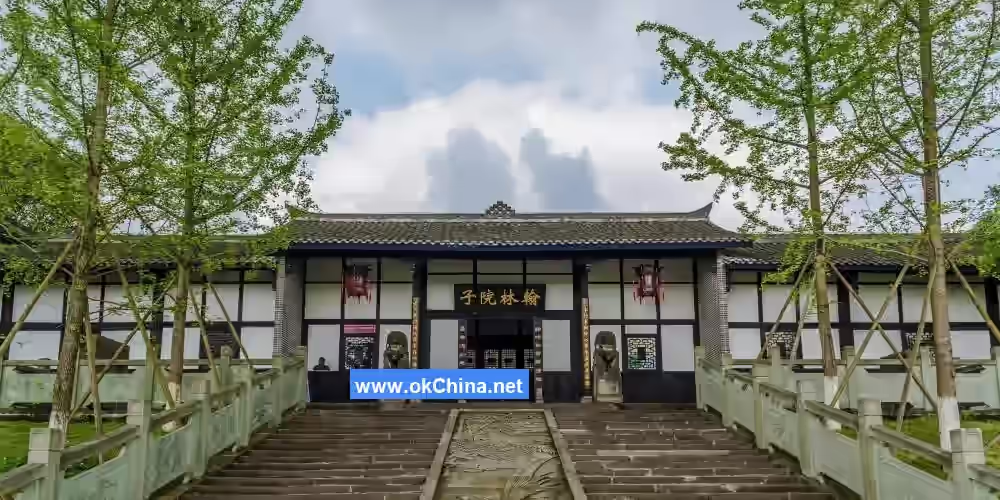
3.5 Hanlin Courtyard
The Hanlin Courtyard was built during the Qianlong reign of the Qing Dynasty, over 200 years ago. It was the former residence of Deng Shimin, a Hanlin academician in the Qing Dynasty and an ancestor of Deng Xiaoping. After Deng Shimin's passing, the Deng clan collectively decided to convert the Hanlin Courtyard into a school, establishing the first private school in Paifang Village. Deng Xiaoping began his education here at the age of five, with the school name Deng Xiansheng. The Hanlin Courtyard faces east and features a post-and-lintel wooden structure with a suspended hill-style roof and small black tile roofing. It is a large compound consisting of two interconnected quadrangles. The entire courtyard contains 36 rooms of various sizes, including a main gate, an opera tower, a main hall, and wing rooms, covering an area of 2,219 square meters with a building area of 1,671 square meters. In December 2002, the Hanlin Courtyard was declared a provincial-level cultural relics protection unit by the Sichuan Provincial Government.
3.6 Silkworm House Courtyard
The Silkworm House Courtyard was the workshop where the Deng family raised silkworms and reeled silk. It was built in the late Qing Dynasty and has a building area of 800 square meters. It currently houses exhibition rooms including a preface hall, exhibition halls, a silkworm rearing room, a cocooning room, silk reeling, silk weaving, silkworm and silk history and culture, silkworm science popularization, and silk tourism commodities. In December 2002, it was declared a provincial-level cultural relics protection unit by the Sichuan Provincial People's Government.
3.7 Deng Family Old Well
The Deng Family Old Well was dug when the Deng ancestors moved to Guang'an during the Ming Dynasty, over 500 years ago. The old well has a diameter of about 1 meter and resembles an ancient bronze treasure mirror embedded in the green lotus-leaf-filled paddy fields, clear and bright like a mirror. More remarkably, the well water is abundant year-round, its surface always 60 centimeters above ground level, overflowing the well rim and trickling continuously throughout the year. The well water is warm and mild in winter, cool and refreshing in summer, with pure, clear, and pleasant-tasting quality. This clear well water nurtured the great man Deng Xiaoping, who drank from the Deng Family Old Well until he left his hometown.
3.8 Cattle-Grazing Slope
Cattle-Grazing Slope is one of the main activity sites from Comrade Deng Xiaoping's childhood. The building on the right is the "Old Well Teahouse," which primarily uses water from the Deng Family Old Well to brew tea, encouraging people to remember the source while drinking. Cattle-Grazing Slope was where the children of Paifang Village herded cattle and also where young Xiaoping often played. The slope once witnessed Xiaoping's vigorous figure and the sound of his clear reading voice.
3.9 Ancient Tree Slope
Ancient Tree Slope is located at the north gate of Deng Xiaoping's Former Residence. On the slope stands a banyan tree over 170 years old, which young Xiaoping often climbed to play on. Deeply attached to his hometown, Xiaoping often mentioned this tree when reminiscing about his native place. Previously, a path under the tree was the necessary route for Xiaoping's childhood journey to school, witnessing the hardships of his early education. Through a century of changes, this ancient banyan has also witnessed the earth-shaking transformations of Paifang Village. At the same time, the simple and kind-hearted people of Paifang Village refer to this tree as the "Auspicious Tree."
3.10 Shendao Stele### 3.10 The Spirit Way Stele
The Spirit Way Stele was bestowed and erected by the imperial court during the Jiaqing reign of the Qing Dynasty to honor the merits and virtues of Deng Xiaoping's ancestor, Deng Shimin. Deng Shimin, styled Xunzhai and also known as Mengyan, passed the provincial-level imperial examination in the 10th year of the Yongzheng reign (1732) and attained the Jinshi degree (the highest level) in the 1st year of the Qianlong reign (1736). He entered the Hanlin Academy as a compiler and was later promoted to Expositor-in-waiting. In the 10th year of Qianlong (1745), he was appointed as the Chief Minister of the Dali Temple (equivalent to the President of the modern Supreme People's Court). Deng Shimin was loyal, upright, resolute, and fair as an official, achieving outstanding administrative accomplishments and earning widespread renown. In his old age, he requested retirement and returned to his hometown, where he passed away at home. He was posthumously honored with the title "Grand Master for Thorough Counsel." The Spirit Way Stele is located about 500 meters from Deng Xiaoping's former residence. The stele is approximately 5 meters high and bears the vertically inscribed regular script characters: "Spirit Way of Lord Deng, Grand Master for Thorough Counsel, Chief Minister of the Dali Temple." The top of the stele features a dynamically carved dragon playing with a pearl, within which the character "圣" (holy) is carved in relief. The stele stands on a Bixi (this creature resembling a turtle is called Bixi, with a dragon's head and a turtle's body, traditionally said to be the ninth son of the Dragon King, possessing immense strength). On either side of the stele stands a ornamental column, exquisitely carved with cloud and dragon motifs. The tops of these columns are carved with crouching stone lions. This stele is recorded in the "Guang'an Zhou New Gazetteer · Epigraphy Section." Unfortunately, the original stele was destroyed during the "Cultural Revolution." The current stele was reconstructed in 2000 and fully restored in March 2003.
3.11 The Virtuous Governance Archway
Approximately 100 meters from the Spirit Way Stele stands the Virtuous Governance Archway. Like the Spirit Way Stele, it was bestowed and erected by the imperial court to honor the merits and virtues of Deng Xiaoping's ancestor, Deng Shimin. The village, Paifang Village (Archway Village), derives its name from this very archway. The original archway was destroyed during the Cultural Revolution. The current archway was reconstructed in August 2002 on the original site, replicating the form and substance of the original. The archway is 12 meters high and 10 meters wide, featuring four pillars dividing three bays and three layers of eaves. The central ridge has openwork carvings, and both ends have chiwen ornaments corresponding to the upturned corners of the roof. The central gate spans 4 meters wide. The two pairs of drum-shaped bearing stones are carved with various bas-relief patterns, including "双狮滚带" (double lions rolling ribbons). The horizontal plaque above the central gate bears the inscriptions "德政坊" (Virtuous Governance Archway) and "功勒金石" (Merits Inscribed on Metal and Stone). The side gates are slightly lower and narrower than the central gate. Stone slabs are inlaid on these gates, featuring openwork carvings of various floral patterns and inscribed with the characters "恭谦" (Respectful and Humble), "正直" (Upright and Honest), "咏仁" (Ode to Benevolence), and "讼理" (Just Litigation). The four square pillars stand on four large rectangular stone bases. The pillars are carved with couplets: "宏扬法典千秋伟业,造福黎民一代名臣" (Promoting the legal code is a grand achievement for millennia; Benefiting the common people marks a generation's renowned official); "敏思勤行盛德若愚,为善最乐诗书传家" (Keen in thought, diligent in action, great virtue appearing simple; Doing good is the greatest joy, poetry and books pass down the family). The couplets and horizontal inscriptions are portrayals of Deng Shimin's lifetime achievements and virtuous character.
3.12 The Inkstone Washing Pond
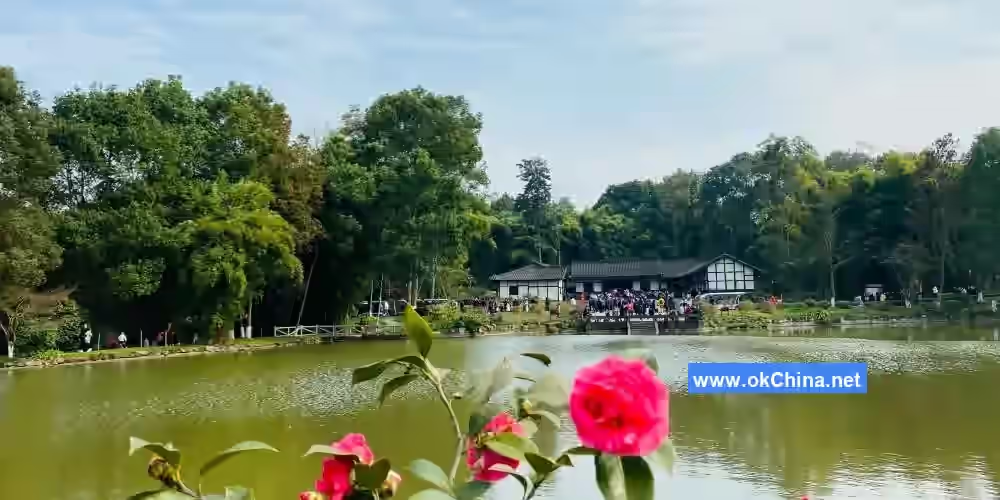
Named for its resemblance to an inkstone, this pond covers an area of about 8 mu. Comrade Deng Xiaoping often fetched water from here to grind ink and practice calligraphy in his childhood, and washed his brushes in the pond. It was restored to its original appearance with a donation of 600,000 RMB from the Sichuan Provincial Administration for Industry and Commerce. Nearly a thousand ornamental lotus plants have been cultivated in the pond, and a number of ornamental fish have been released. The Inkstone Washing Pond is located directly in front of the old Deng family residence. Just a dozen steps away lies a farm pond, several mu in size. It contains released fish and floating lotus plants, presenting a vibrant scene. Villagers nearby also wash clothes and vegetables in this pond. The young Deng Xiaoping was intelligent and clever, and also a diligent and eager learner. Besides playing, he particularly enjoyed learning to write Chinese characters with a brush from his father. Every day after returning home from school, Deng Xiaoping would go to the table his father had set up in the courtyard, stand on a stool, and practice brush calligraphy. After practicing, covered in ink, Deng Xiaoping would uninhibitedly go to the pond to wash his brushes and other items. However, no matter how much he washed, the water in the pond remained clear and green. Today, people refer to the pond where Comrade Xiaoping washed his brushes and ground his ink as a child as the "Inkstone Washing Pond."
3.13 The Hundred Flowers Pond
The Hundred Flowers Pond is planted with many ornamental lotus flowers. In early summer, green lotus leaves stretch to the horizon, covering the land with lushness. Lotus blossoms dot the surface, their fragrance filling the garden. A gentle breeze passes, causing the flowers to sway as if shyly whispering, dancing in the wind, adding much vitality and spirit to the tranquil scenery of the lake and hills. This scene inevitably brings to mind Zhou Dunyi's "On the Love of the Lotus": "The lotus is the gentleman among flowers." "It emerges from the mud yet remains unstained; it is cleansed by clear ripples yet not seductive. Its stem is hollow inside and straight outside; it does not branch or vine. Its fragrance grows more distinct from afar; it stands tall and serene, to be admired from a distance but not profaned by intimate handling."
3.14 The Tomb of Deng Shaochang
Deng Shaochang was Deng Xiaoping's father. Styled Wenming, he was born in 1886 and died in 1936 at the age of 50. Deng Shaochang studied at the Chengdu School of Law and Politics in his early years. After returning to his hometown, he taught, served as the head of the Xiexing Township militia, and later as the director of the Guang'an County militia bureau. Having received a modern education and seen the world, he was enlightened, upright, progressive in thought, and hated evil, deeply resenting the corruption of the Qing government and the tyranny of the imperialist aggressors. He joined the local Paoge organization, served as the "Third Master" in charge of the Xiexing "wharf," and was later promoted to "Flag-Holding Elder." He campaigned vigorously, actively engaging in anti-missionary activities and the "Railway Protection Movement." Around the time of the 1911 Revolution, revolutionary forces were established in Guang'an. The young and ardent Deng Shaochang joined the revolutionary army, becoming a battalion commander in the new soldier training camp, and led his troops in local armed uprisings. Deng Shaochang was respected and influential in his hometown. His greatest achievement in life was choosing the path for Deng Xiaoping to study in France. This decision had a significant impact on Deng Xiaoping's entire life and even the fate of China as a whole. In 2002, the Sichuan Provincial People's Government designated Deng Shaochang's tomb as a provincial-level cultural relics protection unit.
3.15 Mount Foshou (Buddha's Hand Mountain)
Mount Foshou is located in Guoshan Village, Xiexing Town, about 3 kilometers from Deng Xiaoping's former residence. The tombs of Comrade Deng Xiaoping's grandmother, née Dai, his birth mother, née Dan, and other female ancestors of the Deng family are situated on the mountainside of Mount Foshou, designated as a provincial-level key cultural relics protection unit. Mount Foshou is planted all over with oranges, pomelos, honey peaches, loquats, and other fruits. Throughout the year, flowers bloom in competition and the fragrance of melons and fruits fills the air, making it a famous "Mountain of Flowers and Fruits" known far and wide. Mount Foshou features undulating ridges and crisscrossing gullies. The mountain's form is peculiar; some say it resembles a seated Buddha, left hand forming a mudra, right hand resting on the knee, sitting upright on a lotus throne. The layers of gentle hills in the distance resemble devout pilgrims, piously bowing on the ground, creating an impression of a thousand people bowing their heads and ten thousand mountains paying homage.
3.16 Beishan Primary School
Beishan Primary School is located on the old street of Xiexing Town, Guang'an District, Guang'an City, about 2 kilometers from Deng Xiaoping's former residence. Built during the Qing Dynasty, it covers an area of 667.87 square meters with a building area of 327.54 square meters. Beishan Primary School was established in accordance with the "Regulations for Schools" promulgated by the Qing government and under the influence of the wave of school establishment across the country. It was jointly founded by an enlightened gentleman surnamed Liu from Xiexing Market and Deng Xiaoping's father, Deng Shaochang, among other progressive gentry. It opened in the 2nd year of the Xuantong reign (1910) and was the first new-style primary school in Xiexing Market. From 1911 to 1915, Deng Xiaoping received his initial modern education here. At that time, Beishan Primary School had over a hundred students, divided into four classes: A, B, C, and D. Deng Xiaoping was in Class D. The curriculum was completely different from that of traditional private schools, including vernacular Chinese, and newly added subjects such as arithmetic, moral education, physical education, and drawing. Early teachers at the school included Liu Xingyi, Deng Shaochang, Deng Junde, Chen Lushan, Jiang Nengbin, and others. These individuals were new-style teachers dissatisfied with feudal ethics, aware of the trends of the times, radical in thought, and who had participated in reformist activities. Besides teaching new learning, they also instructed students on historical events such as the Huang Chao Rebellion, the Taiping Heavenly Kingdom Movement, and the Boxer Movement. Deng Xiaoping studied diligently and was naturally gifted, consistently ranking at the top of his class. In several years of examinations, except for one time when he placed second due to illness, he always achieved first place, earning the admiration and respect of his teachers and classmates. On May 25, 2006, the State Council designated Beishan Primary School as a national key cultural relics protection unit.
4. Related Figures
Deng Xiaoping (1904–1997), a native of Guang'an, Sichuan, was born on August 22, 1904. His original name was Deng Xiansheng, and his school name was Deng Xixian. Deng Xiaoping was the core of the second generation of the Central Leadership Collective of the Communist Party of China, a great Marxist, proletarian revolutionary, statesman, military strategist, and diplomat. He was an outstanding leader of the Communist Party of China, the Chinese People's Liberation Army, and the People's Republic of China, the pioneer of the path of socialism with Chinese characteristics, the chief architect of China's socialist reform, opening-up, and modernization, and the main founder of Deng Xiaoping Theory.
Comments
Post a Comment