Baligou Scenic Area in Xinxiang City
1. Introduction
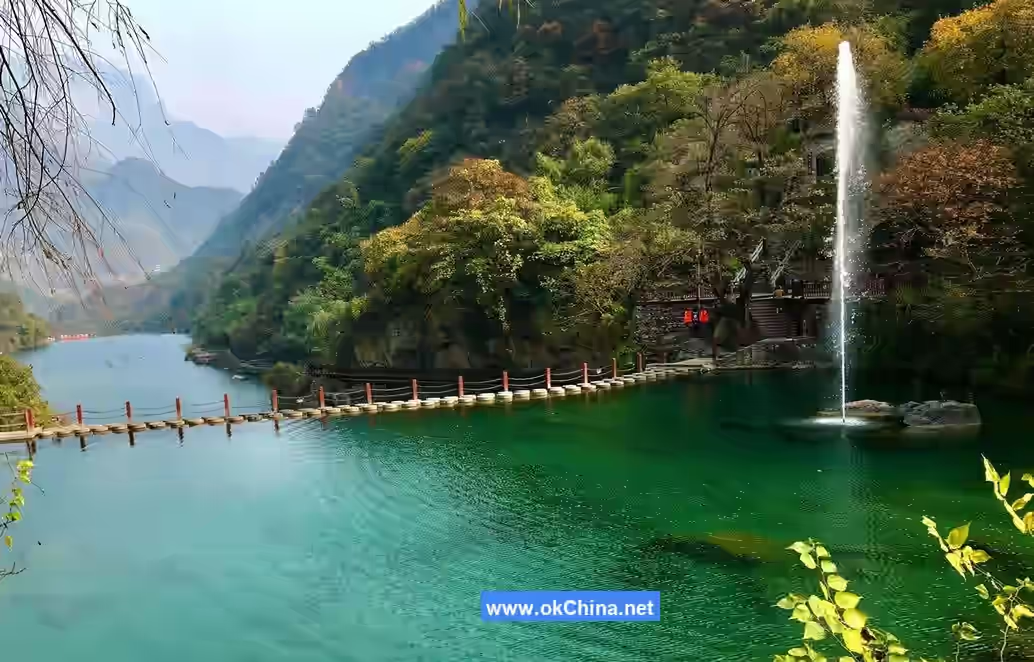
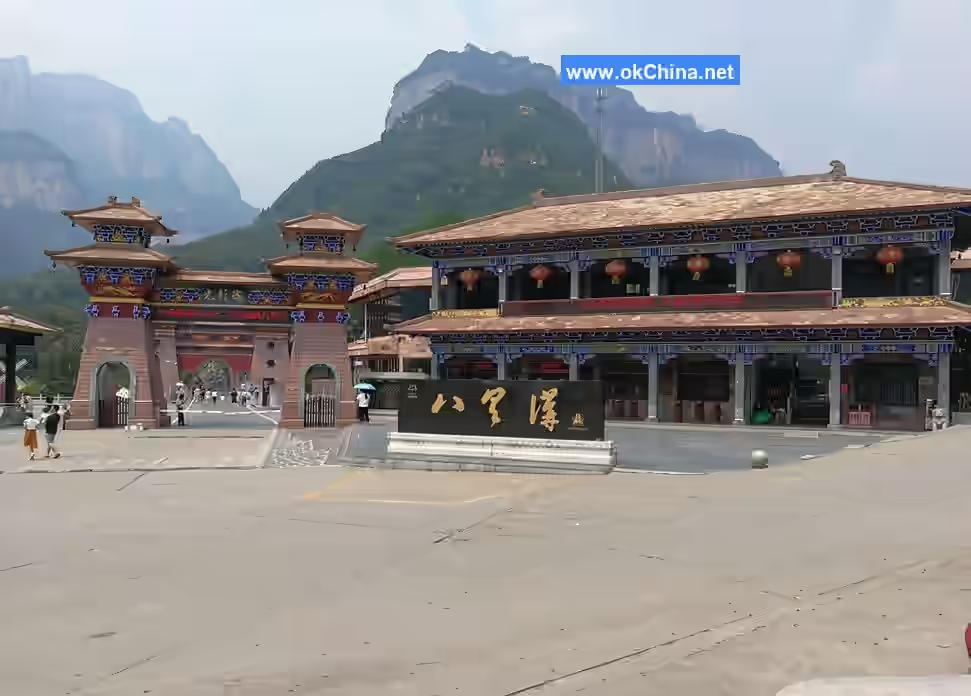
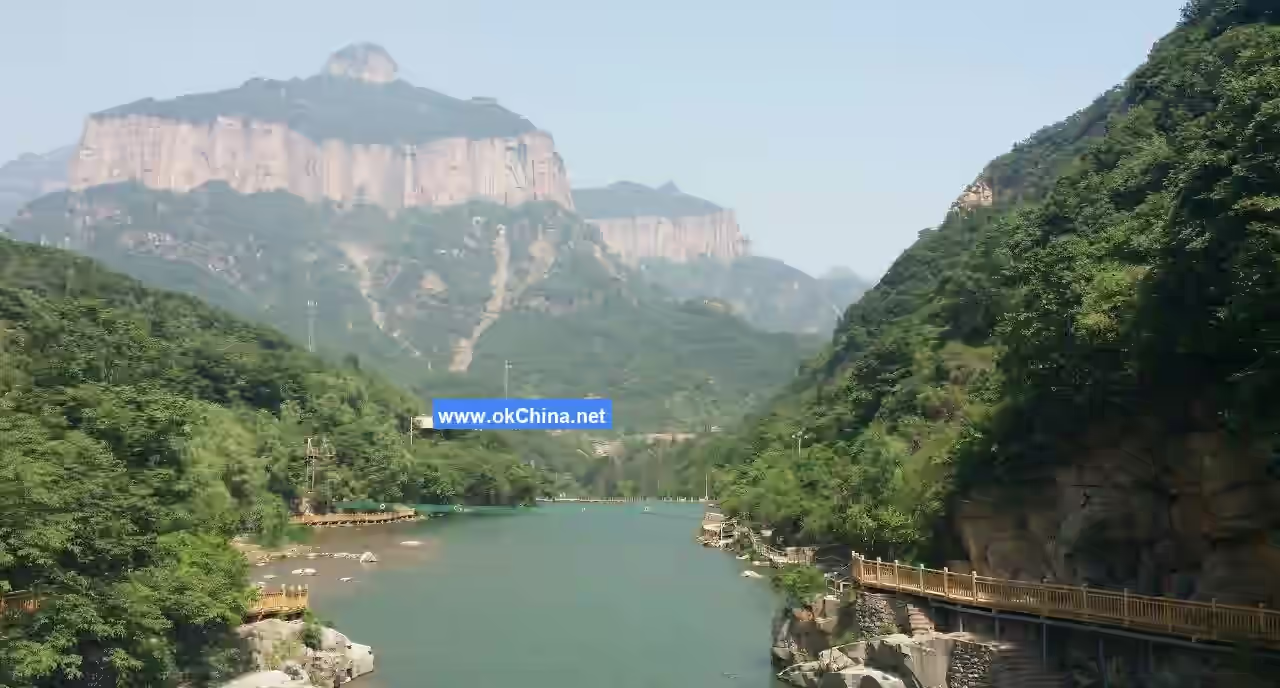
The Baligou Scenic Area in Xinxiang City, abbreviated as Baligou Scenic Area, is located in Huixian County, Xinxiang City, Henan Province. Situated at the southern foothills of the Taihang Mountains and at the border between Henan and Shanxi provinces, it covers a total area of 109 square kilometers. The scenic area has an annual average temperature of 14°C, with an average nighttime temperature of 18°C in the mountainous areas during summer. During the hottest days of summer, mornings feel like spring, afternoons like autumn, and nights like early winter. With a forest coverage rate of 90%, the area is home to over 1,700 plant species and boasts more than 5,000 negative oxygen ions per cubic centimeter of air, making it a "natural oxygen bar."
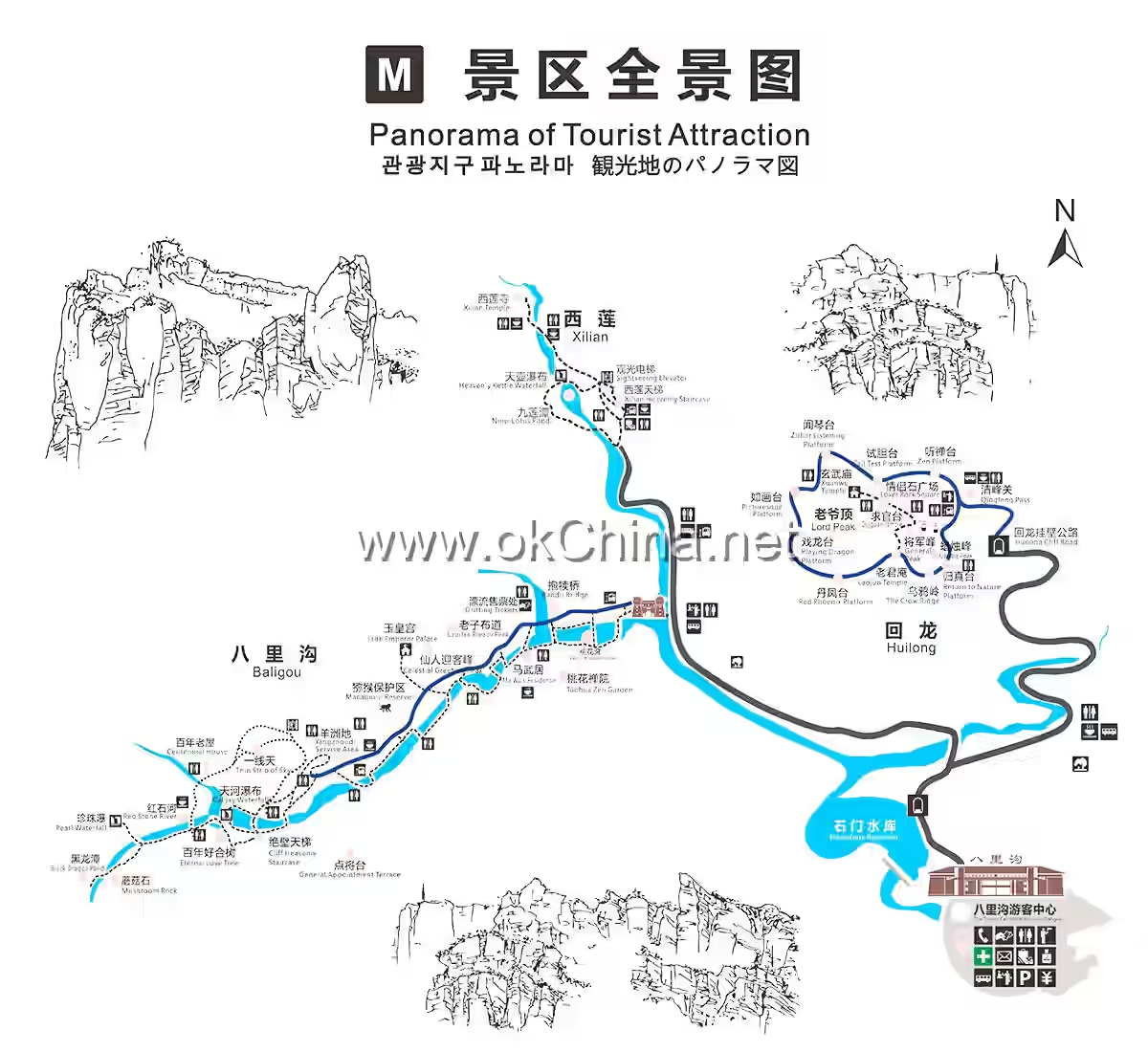
The Baligou Scenic Area in Xinxiang City encompasses seven ecological and cultural tourism zones: Baligou, Wanxian Mountain, Jiulian Mountain, Guan Mountain, Huilong·Tianjie Mountain, Qiugou, and Qiwangzhai. The area features cultural elements such as "Zhangshu" culture, Taoist culture, red culture, and landscape culture, along with numerous natural and cultural attractions.
Known as the "Soul of Taihang and the Backbone of China," the Baligou Scenic Area in Xinxiang City has been praised by landscape experts as "a unique wonder in Asia." In 2005, it was recognized as one of the Top Ten Scenic Areas in Henan Province. In 2006, it was approved as a National AAAA-level Tourist Attraction. On December 31, 2019, it was designated as a National AAAAA-level Tourist Attraction by the Ministry of Culture and Tourism.
2. Geographical Environment
2.1 Location and Territory
The Baligou Scenic Area in Xinxiang City is located in Huixian County, Xinxiang City, Henan Province. Situated at the southern foothills of the Taihang Mountains and at the border between Henan and Shanxi provinces, it covers a total area of 109 square kilometers.
2.2 Topography and Landforms
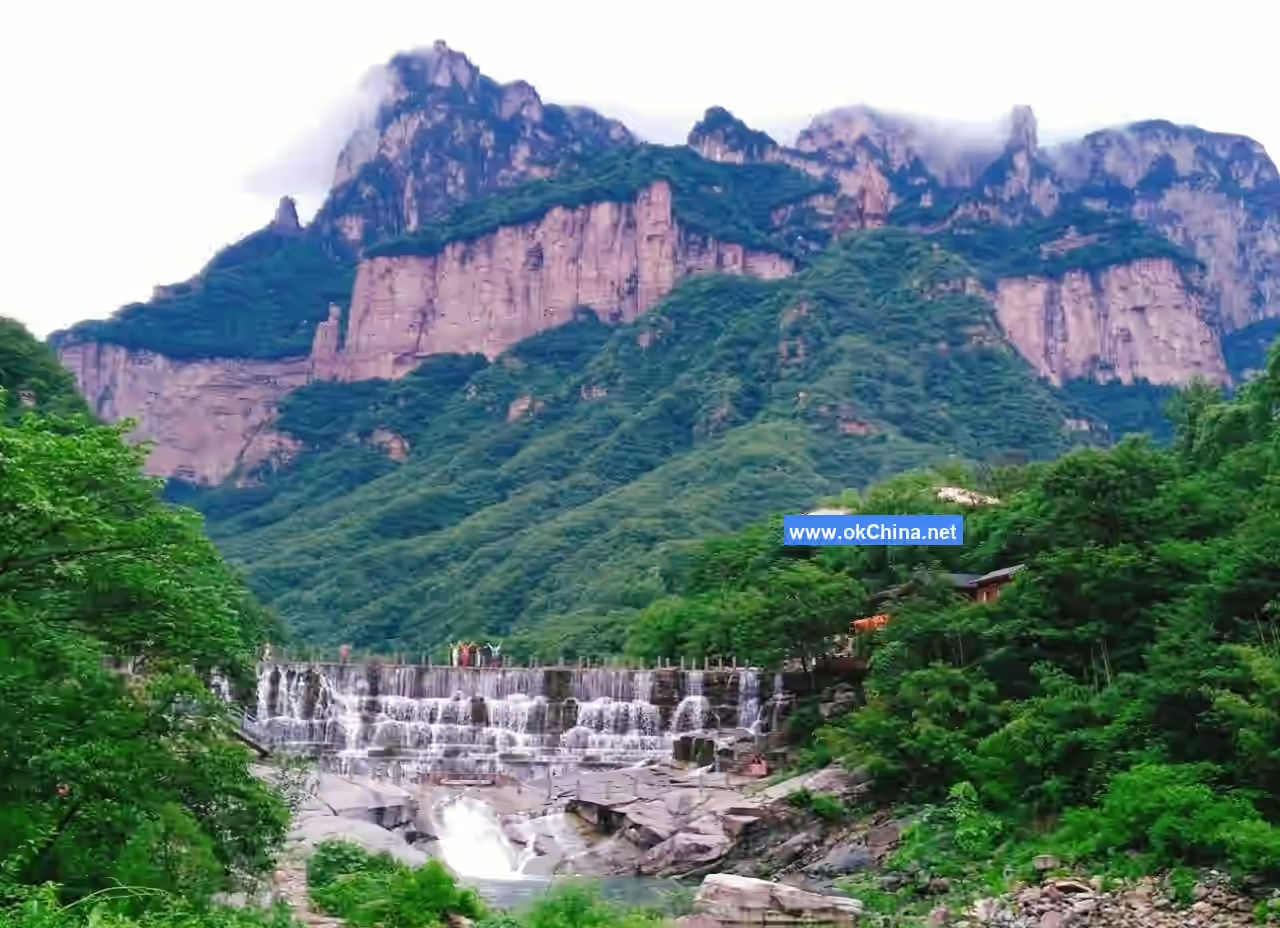
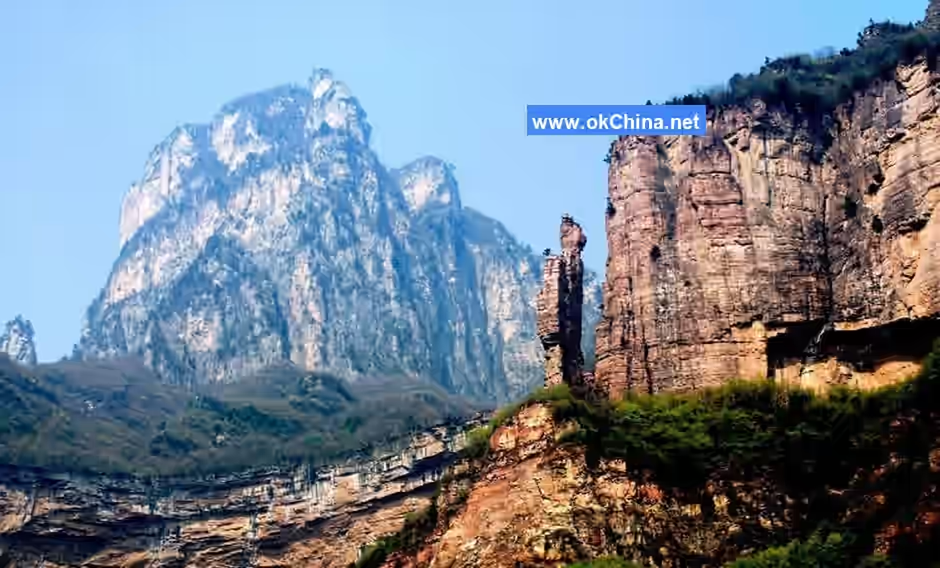
The Baligou Scenic Area in Xinxiang City is located in the deep mountainous region of the southern foothills of the Taihang Mountains, with elevations ranging from 300 to 1,700 meters. The mountains in the area feature three-tiered cliffs.
2.3 Climate Characteristics
The Baligou Scenic Area in Xinxiang City has an annual average temperature of 14°C, with an average nighttime temperature of 18°C in the mountainous areas during summer. During the hottest days of summer, mornings feel like spring, afternoons like autumn, and nights like early winter.
3. Main Attractions
Overview
The Baligou Scenic Area in Xinxiang City encompasses seven ecological and cultural tourism zones: Baligou, Wanxian Mountain, Jiulian Mountain, Guan Mountain, Huilong·Tianjie Mountain, Qiugou, and Qiwangzhai. It includes 4 National AAAA-level scenic spots, 3 National AAA-level scenic spots, 5 National Geoparks, 3 National Forest Parks, 4 National Macaque Nature Reserves, as well as numerous natural and cultural attractions such as National Intangible Cultural Heritage Tourism Zones, China Scientific Exploration Bases, Film and Painting Bases, and Traditional Chinese Villages.
3.1 Red Stone River
3.1.1 Overview
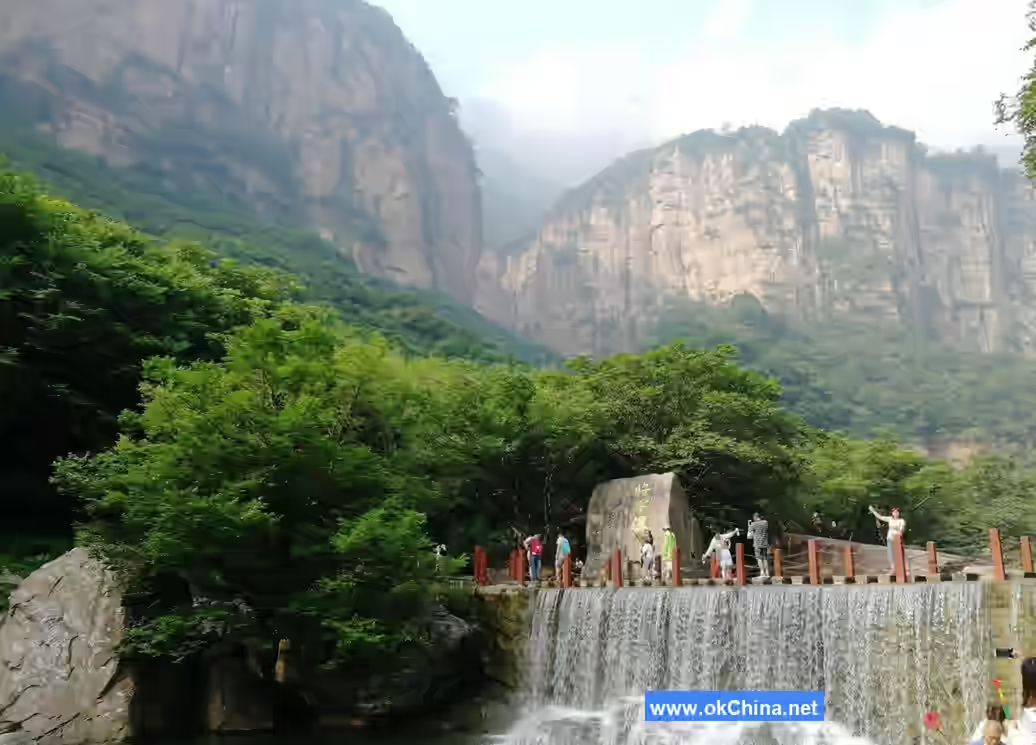
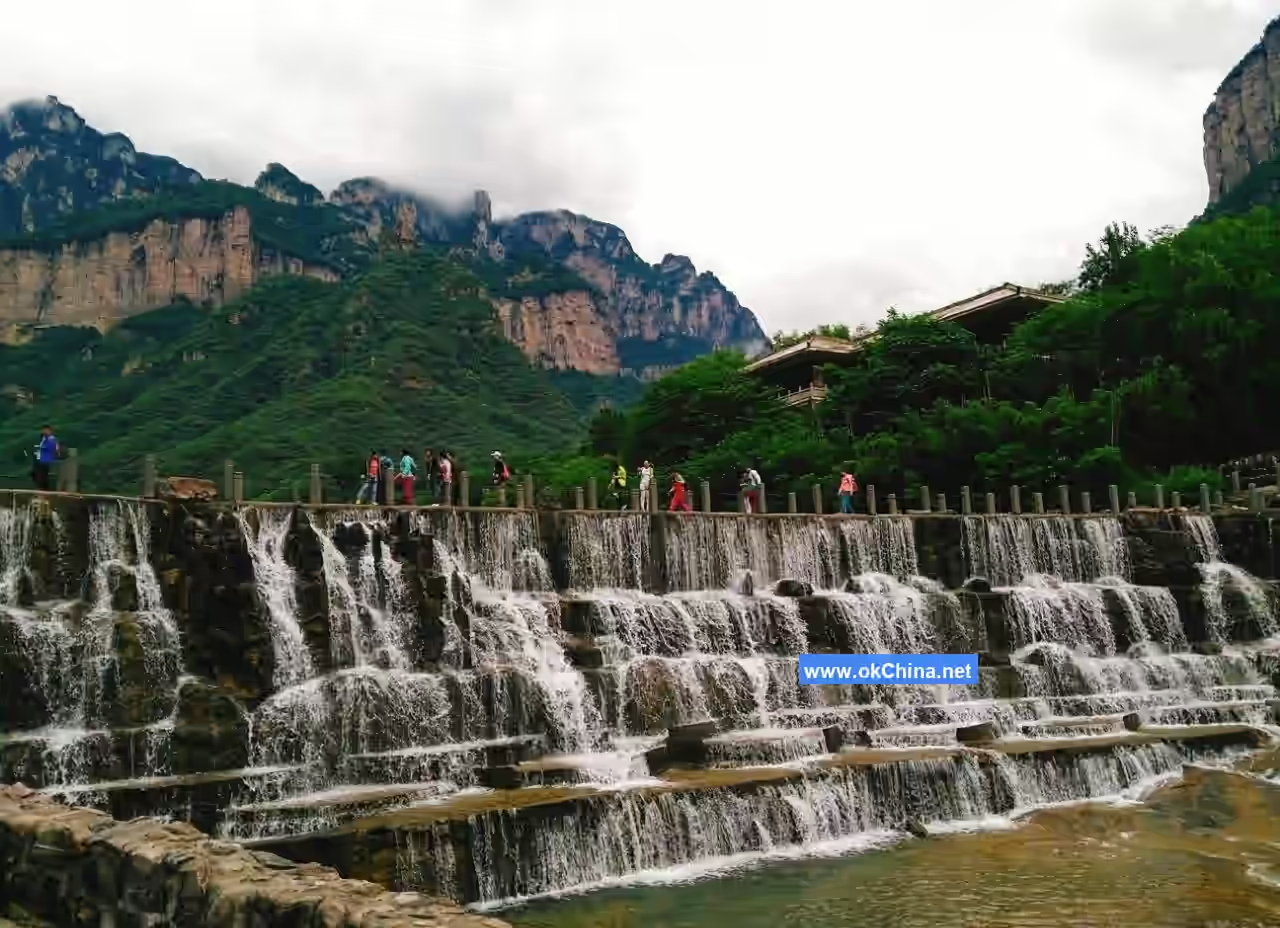
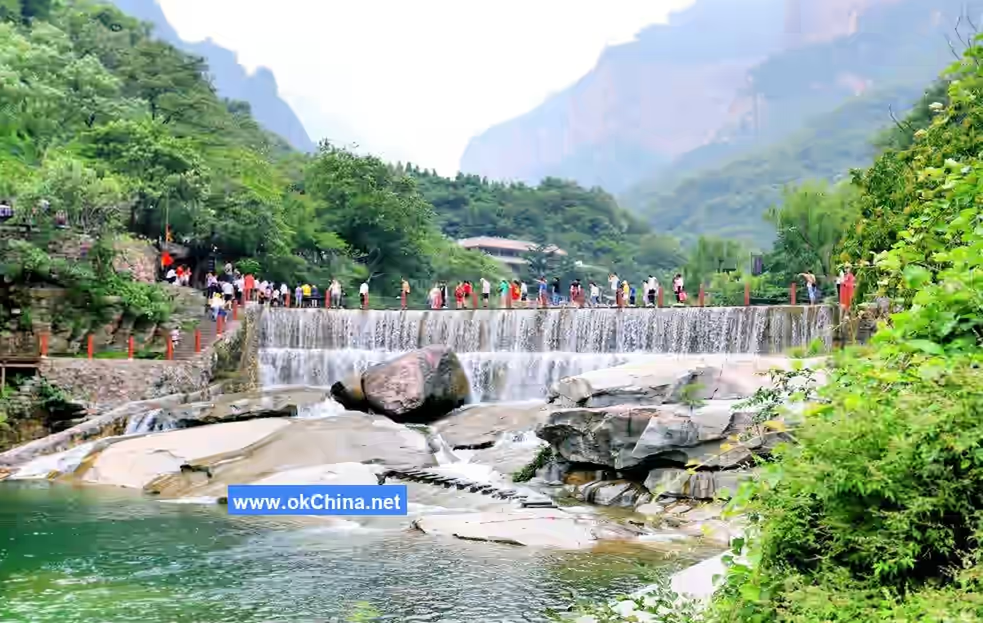
The "Red Stone River" is located at the source of the grand waterfall. Due to its elevation of 1,100 meters, it is also known as the "Taihang Milky Way." The riverbed is composed of red sandstone, smooth and glossy, with clear water flowing across it. The red stones and green water complement each other, creating a colorful and picturesque scene reminiscent of Wang Wei's poem: "The bright moon shines through the pines, clear springs flow over the stones." Attractions here include the Centennial Harmony Tree, Centennial Old House, Guanyin Cave, Echo Wall, Mushroom Stone, Black Dragon Pool, Fairy Pool, and Colorful Spring.
3.1.2 One-Line Sky
One-Line Sky is located at the strategic pass connecting the lower and upper Baligou. Looking up from the foot of the mountain, one can see steep cliffs between two mountains, often shrouded in clouds and mist. Only on clear, sunny days can a sliver of blue sky be seen through the gap between the mountains, hence its ancient name "One-Line Sky" or "Long Sky Sliver."
3.1.3 Sky Ladder Plank Road
The zigzag iron ladder on the cliff face is the Sky Ladder Plank Road. The plank road is 180 meters long with a vertical height of 130 meters and consists of 650 steps. It is constructed entirely of steel, with handrails and guardrails on both sides.
3.1.4 Red Stone River
The "Red Stone River" is located on Huluya (Gourd Cliff) and is named for its red sandstone riverbed. Originating from Shanxi, the river is 20 meters wide and 0.6 meters deep. Due to its location on a mountain over 1,000 meters above sea level, it is also called the "Taihang Milky Way." The crystal-clear water flows endlessly over the smooth, orderly red stone slabs. Under sunlight, it resembles a sparkling mirror, radiant and colorful, evoking Wang Wei's line: "The bright moon shines through the pines, clear springs flow over the stones."
3.1.5 Lover Stones
By the Red Stone River, two giant stones stand close together, resembling an inseparable couple deeply in love. Legend has it that the couple under the Centennial Harmony Tree would come to the Red Stone River every sunset to wash away the day's fatigue. Even in the water, they remained close, never parting. After a hundred years, they transformed into these "Lover Stones."
3.1.6 Baligou Village
Baligou Village is situated at an elevation of over 1,100 meters, giving it a unique mountaintop microclimate. There are no mosquitoes even in midsummer, and blankets are needed at night. The air in Upper Baligou Village is fresh, with negative oxygen ions measured at up to 30,000 per cubic centimeter—dozens of times higher than in the bustling city below—making it a true "Shangri-La."
3.1.7 Tide Sound Cave
Near the Red Stone River, there is a natural stone cave called "Tide Sound Cave," which remains cool even during the hottest summer days. Inside the cave, Guanyin Bodhisattva is enshrined. Legend says the cave's water source connects directly to the South China Sea, and standing inside, one can faintly hear the sound of ocean tides, hence the name "Tide Sound Cave." Another legend claims the faint sound is the voice of Guanyin from the South Sea preaching Buddhism. The spring in the cave flows year-round, with transparent, odorless, and impurity-free water rich in trace elements, sweet and suitable for drinking. It is said to enhance the aroma of tea and the sweetness of rice when used for cooking.
3.1.8 Echo Wall
Echo Wall is a massive rock resembling a stone wall. Standing beneath it and listening quietly, one can hear the murmuring of flowing water or the voices of tourists, hence the name "Echo Wall."
3.1.9 Mushroom Stone
It is said that when Liu Xiu fled to the "Mushroom Stone" and hid beneath it, he exclaimed in desperation, "Mushroom, grow quickly!" Before his words faded, the "Mushroom Stone" grew into its current shape. Thus, the Mushroom Stone is credited with saving an emperor's life.
3.1.10 Toad Stone
In front of the Mushroom Stone, there is a large rock that, when viewed from the west, resembles a giant toad poised to catch insects. Even more delightful are the three small toads beside it, like a mother with her three offspring. This rock is called the "Toad Stone." Local legend says the Toad Stone can croak, and if they croak together, it foretells a bountiful harvest that year.
3.1.11 Pearl Spring
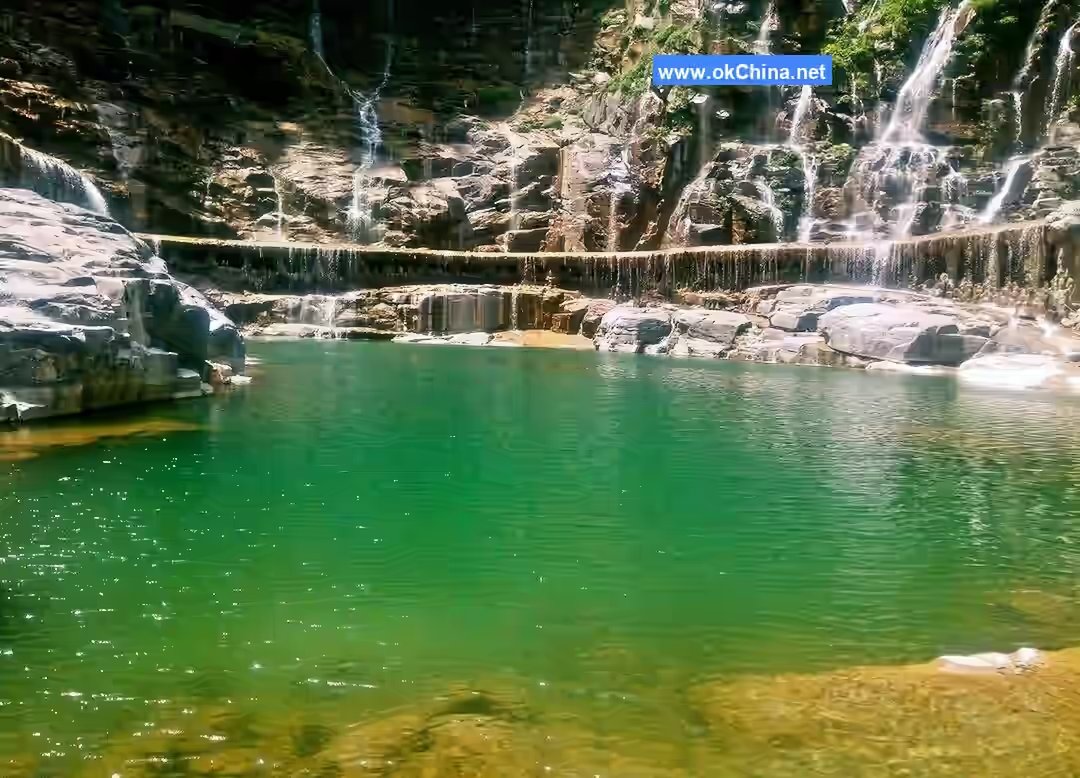
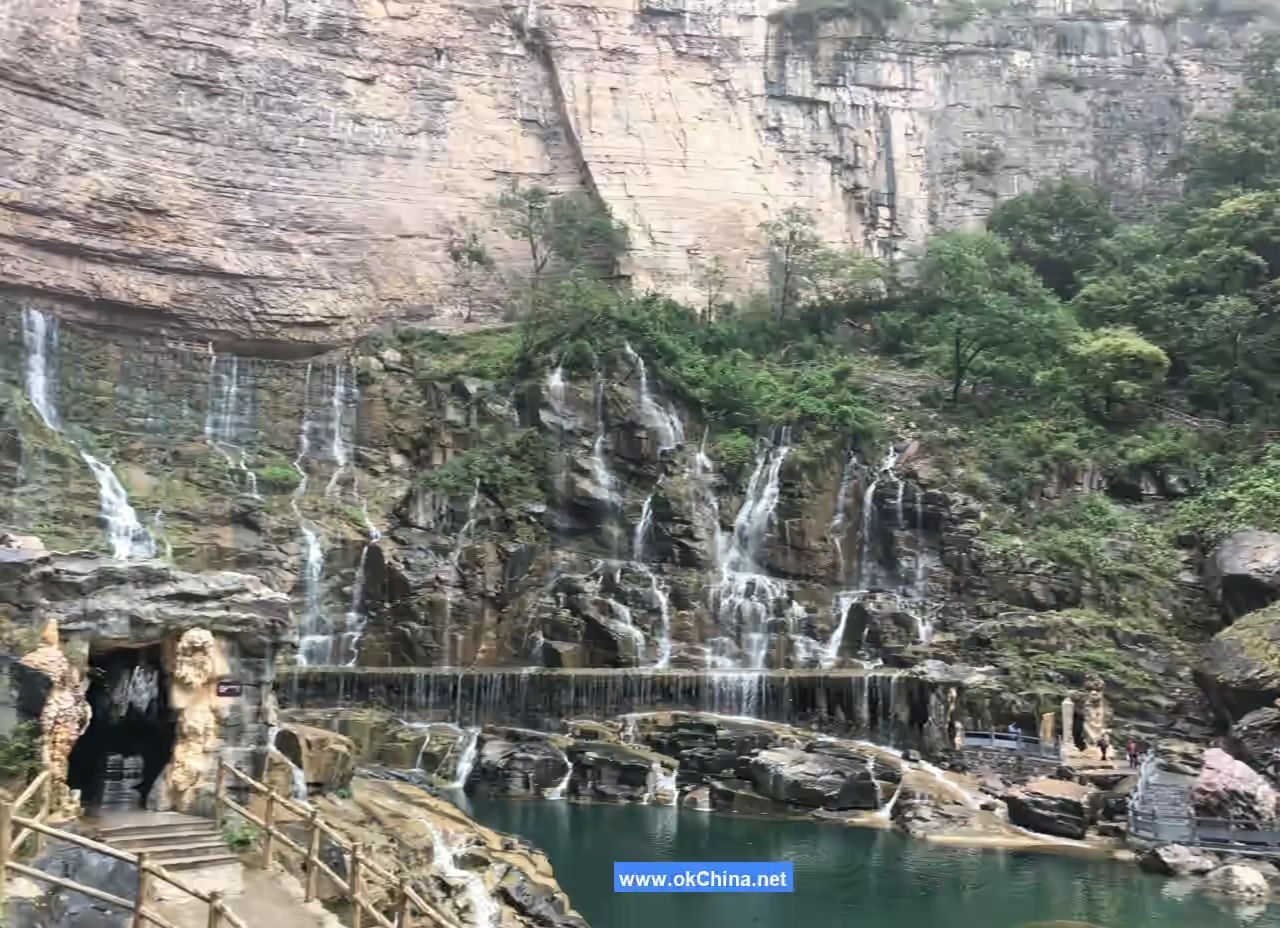
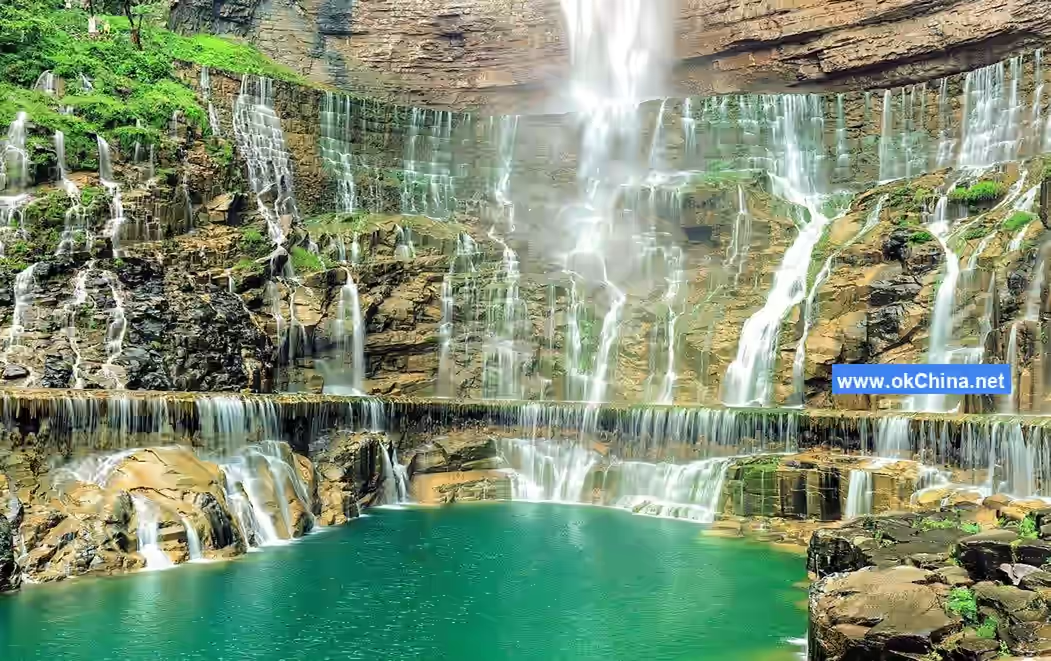
In a valley on the northern mountain, a spring gushes forth, cascading down the rocks like pearls and jade, needles and threads, strands and strings, resembling countless pearls rising and falling endlessly, hence the name "Pearl Spring."
3.1.12 Black Dragon Pool
Black Dragon Pool is associated with a legend of "Black Dragon Building a Palace." It is said that every year on the second day of the second lunar month (when dragons are believed to raise their heads), dragons gather here. One day, the Black Dragon volunteered to build a palace here for the dragons to reside in. The dragons then named this place "Black Dragon Pool." The Black Dragon was so delighted that it frequently emerged from the water, often spotted by people. It is said that anyone who sees it will be blessed with lifelong good fortune.
3.2 Milky Way Waterfall
3.2.1 Overview
Yangzhoudi is the core attraction of Baligou. The Taihang Milky Way Waterfall, with a drop of nearly 180 meters, rushes down from Huluya (Gourd Cliff). Behind the waterfall lies the Water Curtain Valley, where visitors can walk behind the waterfall and look up at the celestial cascade. Below the Milky Way Waterfall's curtain, there is a 200-meter-long Water Curtain Cave that visitors can traverse year-round, allowing them to get close to the water, step into it, and experience the "Northern Water World." Other attractions include the Cliff Sky Ladder and the Taihang Macaque Nature Reserve.
3.2.2 Yangzhoudi
Legend has it that when Liu Xiu came to the Taihang Mountains to recruit soldiers and buy horses, he was pursued by troops sent by Wang Mang. In his panic, he fled to this high mountain, surrounded by cliffs on three sides and a valley on the fourth, with no way out. Liu Xiu sighed to the heavens, closed his eyes, and leaped off the cliff. As the destined emperor, he was protected by heaven. A flock of sheep grazing on the hillside quickly gathered, and Liu Xiu landed on them, narrowly escaping death. After Liu Xiu became emperor, he named this place "Yang Jiudi" (Sheep Saved the Emperor). Over time, "Yang Jiudi" gradually evolved into "Yangzhoudi." This story illustrates the principle that those who uphold justice receive abundant support.
3.2.3 Taihang Milky Way Grand Waterfall
The Taihang Milky Way Grand Waterfall originates from the Red Stone River on a mountain 1,100 meters above sea level. The Red Stone River water surges through the mountain gorges and finally bursts out from the encircling Huluya (Gourd Cliff), thundering down like ten thousand galloping horses. The roar, reminiscent of dragons and tigers, echoes through the valley, inspiring awe for nature's creation. The Taihang Milky Way Waterfall is renowned for its "Four Wonders," "Four Beauties," and two major spectacles.
3.3 Peach Blossom Bay
3.3.1 Overview
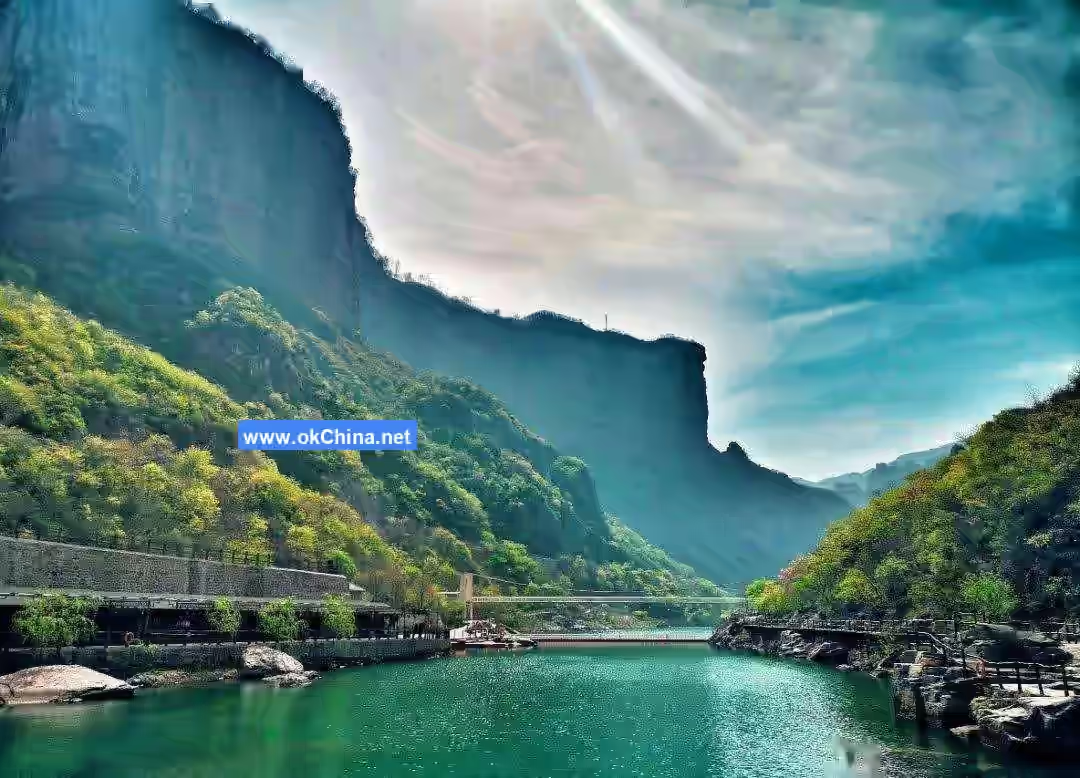
The Peach Blossom Bay section is surrounded by mountains and water, with peach trees covering the hills. In spring, the peach blossoms bloom brightly and vividly, hence the name Peach Blossom Bay. This section mainly features beautiful attractions such as Peach Blossom Bay Waterfall, Peach Blossom Pool, General Pool, and Baodu River Waterfall.
3.3.2 Secluded Path Bridge
The "Secluded Path Bridge" embodies the idea of "a winding path leading to seclusion." When crossing it, one should proceed slowly, steadily, and with mindfulness, experiencing the trembling, swaying sensation that brings both thrill and delight—the thrill of the precarious crossing and the delight of shaking off worries with each wobble.#### 3.3.3 Guanshan (Official's Mountain)
The "官" (guān) in Guanshan refers to the character meaning "official," as in gaining official rank and wealth. This is because the mountain resembles a coffin (棺材, guāncái), but no trees grow around it. Removing the wood radical (木) from "棺" (coffin) leaves "官" (official). The Guanshan area belongs to another scenic spot called Guanshan (关山), where the character "关" (guān) means "pass" or "gateway." Guanshan has been considered a geomantic treasure land since ancient times. Legend has it that in the late Qing Dynasty, Yuan Shikai was dismissed and exiled by the Qing government for reasons such as "his achievements overshadowing the emperor." Upon the invitation of his forthright friend Xu Shichang, he went into seclusion in the Hui County and Weihui area. Enchanted by the beauty of the Taihang Mountains, Yuan Shikai built a villa in Guanshan for enjoying the scenery and hunting. It is said that influenced by the spiritual energy gathered at Guanshan (Official's Mountain), the Qing government soon agreed to let him form a cabinet. Satisfied and ambitious, Yuan Shikai ended his reclusive life and regained power.
3.3.4 Peach Blossom Bay Waterfall and Peach Blossom Pond
The Peach Blossom Bay Waterfall is a curtain-style waterfall. The cascading water flows swiftly yet appears light and graceful, reminiscent of the famous TV series title Dreams Link by Taiwanese writer Qiong Yao. Above the waterfall lies the Peach Blossom Pond, where the water depth can reach about 13 meters. Activities such as zip-lining, swinging bridges, bamboo rafting, and drifting have been developed here, along with a relatively expansive sandy beach.
3.3.5 Baodu Bridge, General's Pool, and Baodu River Waterfall
Legend has it that Ma Wu, a general under Liu Xiu, the founding emperor of the Eastern Han Dynasty, lived in seclusion here as a youth to avoid enemies, making a living by herding cattle. He had to cross the river daily to graze his cattle. One day, an old cow gave birth to a calf. The kind-hearted Ma Wu, fearing the calf would be swept away by the rushing river, carried it across every day. Unknowingly, the calf grew, but Ma Wu continued to carry it, naturally developing immense arm strength. Later, Ma Wu followed Liu Xiu in campaigns north and south, making significant contributions and becoming a renowned general of the Eastern Han restoration. After returning to his hometown in glory, Ma Wu recalled the hardship of carrying the calf across the river and funded the construction of this bridge. To commemorate this interesting story, later generations named it "Baodu Bridge" (Calf-Carrying Bridge) and erected a statue of "Ma Wu Carrying the Calf" at the bridgehead. The pool beneath the bridge is called General's Pool. A local custom involves bathing newborn children with water from here, hoping they will grow up as strong and sturdy as Ma Wu.
3.4 Mountain God Temple
3.4.1 Overview
If the Peach Blossom Bay section is for appreciating water, then the Mountain God Temple section is primarily for appreciating mountains. This area is famous for its fantastically shaped peaks and rock formations, with surrounding peaks standing in various strange forms. Attractions include Laozi Preaching, Immortal Welcoming Guests, Tranquil Heart Pool, Drunken Immortal Bridge, and the Jade Emperor Palace.
3.4.2 Mountain God Temple
The Mountain God is considered the lowest-ranking minor deity, and the Mountain God Temple is the smallest temple. The Taihang Mountains are composed of many famous and unnamed peaks. In the past, each mountain had a Mountain God Temple built to enshrine its deity. Most of these small temples were located along steep mountain paths or near cliffs. Mountain dwellers, making a living by gathering firewood and herbs, had to traverse dangerous cliffs daily, risking fatal falls. For safety, they placed their hopes on the Mountain God, praying for protection.
3.4.3 Laozi Preaching
Laozi Preaching is famous for its fantastically shaped peaks and rock formations, with surrounding peaks standing in various strange forms. One peak ahead resembles an elder wearing a square scarf and a silk belt, seemingly sitting on a black ox and preaching scriptures tirelessly. This is the local legend of "Laozi Preaching." Laozi, from Luyi, Henan, left behind the five-thousand-character Tao Te Ching and is a great ancient Chinese philosopher and thinker. Legend says it was upon this mountain that Laozi observed the ceaseless flow of water in the Baligou Valley below and realized the Taoist principle that "the soft overcomes the hard."
3.4.4 Immortal Welcoming Guests
Ahead of the Laozi Preaching site, an isolated peak stands beside a sheer cliff. It resembles an immortal in a long robe, bowing with hands clasped, appearing respectful as if welcoming visitors. This is another famous Baligou attraction, "Immortal Welcoming Guests."
3.4.5 Tranquil Heart Pool
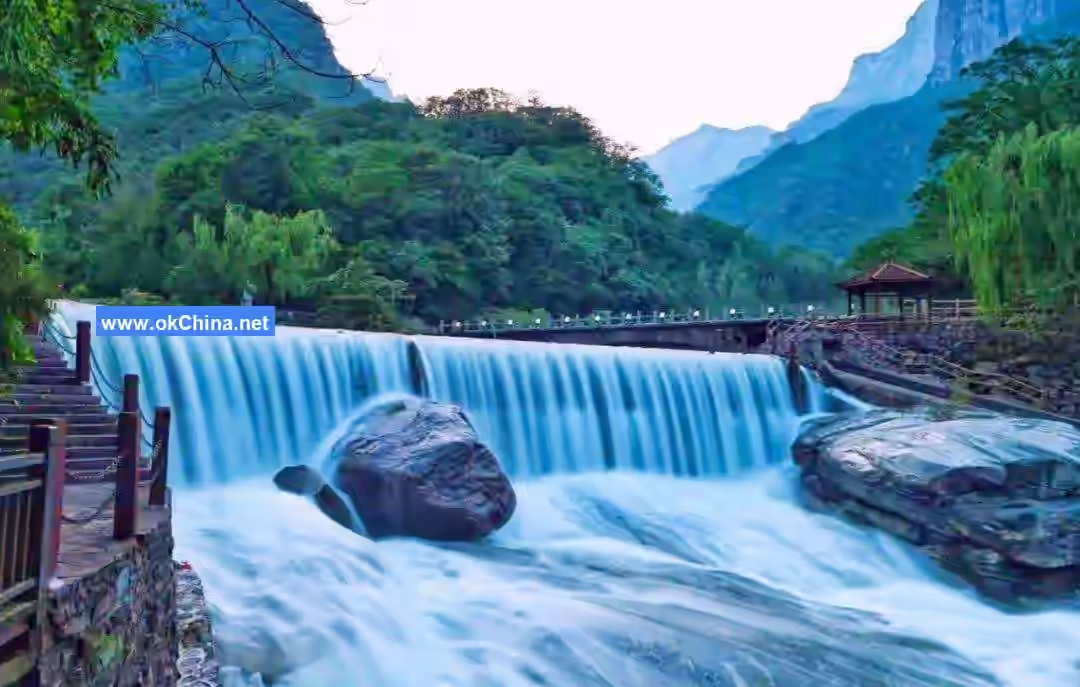
Although the Tranquil Heart Pool Waterfall is not large, it is light and agile, appearing delicate and beautiful against the backdrop of several large rocks. Above the waterfall is the Tranquil Heart Pool. On a large solitary rock in front of the pool, the characters "清幽" (qīngyōu, serene and secluded) are carved. Another flat-surfaced giant rock bears a poem by the Qing Dynasty poet Zheng Banqiao: "Biting into the green mountain, never letting go, its roots are anchored in the broken rock. Through countless trials and hardships, it remains strong and resilient, regardless of winds from east, west, south, or north." There's also a local saying: "Wash your hands in the Tranquil Heart Pool, and all worries will flee; wash your face in the Tranquil Heart Pool, for beauty and skincare it will be."
3.4.6 Drunken Immortal Bridge
Walking on this bridge, swaying left and right, the wobbly feeling is like being drunk—light as a cloud, floating like an immortal. Truly, "cross the Drunken Immortal Bridge, and even without being an immortal, you'll feel carefree."
3.4.7 Nine Buddha Niches
On Zhongshan Mountain, there is a recess called the "Nine Buddha Niches," housing nine Buddha statues. It is said that whoever sees one Buddha gains one layer of blessing; whoever sees two Buddhas gains two layers. The more Buddhas one sees, the more blessings one receives.
3.4.8 Jade Emperor Palace
The location of the Jade Emperor Palace is called Dahuangkan. Within this niche are thousand-ren sheer cliffs. Legend says this is where Nüwa smelted stones to mend the sky. In ancient times, the Gonggong tribe, active around Hui County and Xinxiang, engaged in a deadly struggle with the Yellow Emperor's tribe for supremacy. They fought from land to the celestial realm, from east to west, all the way to the foot of Kunlun Mountain, with no clear victor. In anger, Gonggong rammed and broke Kunlun Mountain, the pillar supporting heaven and earth. With the pillar broken, a giant crack appeared in the sky, and the earth tilted rapidly towards the southeast, threatening humanity with extinction. Unable to bear human destruction, Nüwa took five-colored stones from the Taihang Mountains, smelted them, and used them to mend the sky. The colorful rosy clouds in the sky are the five-colored stones Nüwa used. This place is also considered the sacred land where the human ancestors Fuxi and Nüwa propagated. Fuxi Peak is majestic and robust, while Nüwa Valley is gentle and beautiful. Fuxi Peak has long been famous for its "Four Wonders": sheer cliffs, hanging palaces, strange sandalwood trees, and peculiar rocks, with the Jade Emperor Palace being the foremost among them.
3.4.9 Ask Heaven Pavilion
Ask Heaven Pavilion is a hexagonal stone pavilion. Legend says that when Liu Xiu sought to overthrow Wang Mang's regime, he came here to ask heaven for guidance. The Jade Emperor appeared to him in a dream, instructing him to take Ma Wu and raise an army in Nanyang to seize the empire.
3.4.10 South Heaven Gate
The South Heaven Gate is a stone carving structure combining three-dimensional and relief carving techniques. It is 12.99 meters high, 77.99 meters wide, with a total relief area of 364.99 square meters, using 129.99 tons of bluestone. The cloud and dragon patterns symbolize the boundless nature of the South Heaven Gate. On four cloud-dragon stone pillars stand the Four Heavenly Kings, majestic and mighty. This grand bluestone sculpture is magnificent in form, unique in design, profound in meaning, and represents the painstaking effort of countless artisans,堪称一颗石雕明珠 (can be called a gem of stone carving).
3.4.11 Sincerity Stone
Behind the South Heaven Gate lies a large red heart-shaped stone named the Sincerity Stone, signifying that one should be sincere in character and action, as sincerity brings efficacy. People often stand before it, palms together, making sincere wishes for safety.
3.4.12 Macaque Nature Reserve
Taihang macaques are national second-class protected animals. The Taihang macaques in Baligou are the northernmost macaque population in the world, holding high economic, conservation, and scientific experimental value. This reserve has been designated by the World Wildlife Fund as an A-level protected area of national and global significance. The reserve features steep mountains, dense forests, and clear flowing springs, with troops of macaques often appearing within.
3.5 Laoye Summit
3.5.1 Overview
In Taoism, there is a saying: "In the south, the Golden Summit is at Wudang; in the north, the Iron Summit is in Taihang." The Iron Summit refers to Laoye Summit. Perched on an isolated cloud-reaching peak at 1570 meters above sea level, the summit's architectural complex, including the main hall of the "Mysterious Heaven Emperor," is constructed entirely of stone without beams, featuring an octagonal vaulted roof covered with iron tiles. It also houses iron-cast statues of the Dark Warrior deity, iron tripods, iron pots, etc.—all renowned for their association with "iron," earning it the title "Number One Iron Summit Under Heaven."
3.5.2 A Basin of Water
The "A Basin of Water" scenic spot is named for its spring water, which resembles a basin. Legend says that before the Patriarch ascended Laoye Summit, there was no water source here. The Dragon King, following the Jade Emperor's command, specially channeled water from the sea to this spot and cast a spell into the water to ensure the Patriarch could drink it and achieve immortality. Hence, this water never dries up in drought nor overflows in flood.
3.5.3 Candle Peak
"Candle Peak" is also called "Wax Juice Mountain" because it appears as if wax drips down from the mountain. Legend says that after the Patriarch achieved Taoist immortality on Laoye Summit, pilgrims from all directions flocked day and night, clogging the rugged mountain paths, often causing people to be pushed off the cliffs. Hearing this, the Patriarch lit a candle and placed it on this mountain to light the way for pilgrims. Unexpectedly, one year, a cult began harassing pilgrims at night. Upon hearing this, the Patriarch blew out the candle, causing the cult members to fall to their deaths below. He then exerted his power so that all pilgrims ascending the mountain would be under his protection. Thus, the candle turned into the mountain itself, symbolizing lighting the way for pilgrims and ensuring their safe journey.#### 3.5.4 General Peaks Next to the Candle Peak, there are two smaller peaks standing side by side. Their majestic and imposing forms resemble a pair of generals galloping across the battlefield, hence the name "General Peaks." Legend has it that these two peaks were sent down to earth by the deity to protect the Patriarch during his spiritual cultivation. After the Patriarch achieved enlightenment and secluded himself in Wudang Mountain, they remained standing here. Passersby continuously bow and pay homage to them, seeking protection for their own safety.
3.5.5 Lover Stones
Two mountain pillars resemble two intimate lovers. This is a pair of Lover Stones, shaped like whispering lovers reluctant to part; they also look like a newlywed couple gazing silently at each other.
3.5.6 Dragon's Lair and Tiger's Cave
Legend has it that the Dragon's Lair and Tiger's Cave reveals its treasures once every hundred years to aid good and virtuous people. It is said that there was originally a stele on top of Laoye Peak, inscribed with a couplet: "Climbing the cloud ladder, looking around four times, rugged and exquisite, finally reaching the Three-Heaven Gate; crossing the golden bridge, treading on silver sand, Dragon's Lair and Tiger's Cave, as if arriving at the Moon Palace." This refers to this treasure cave.
3.5.7 Three-Heaven Gate
The small temple on the Three-Heaven Gate is called the Official-Seeking Platform. During the Qing Dynasty's Xianfeng era, a scholar repeatedly failed the imperial examinations. Hearing from fellow candidates that to seek success in the exams, one must first worship the Patriarch at Laoye Peak to demonstrate the determination of "grinding an iron rod into a needle," he made the arduous journey specifically to Laoye Peak to pray for divine blessing. When he reached the Three-Heaven Gate, exhausted from the long trek, he sat at the entrance and fell into a drowsy sleep. In his hazy dream, he saw an immortal passing by who said to him, "The path to officialdom reaches the heavens; sincerity brings efficacy..." Upon waking, the scholar realized this was the immortal's guidance: to seek an official position, he must demonstrate sincerity at the Three-Heaven Gate. He immediately returned home, brought silver, and built this small temple on the Three-Heaven Gate, naming it the "Official-Seeking Platform." As the saying goes, "Belief makes gods, sincerity brings efficacy." A year later, he indeed passed the imperial examinations with honors. Since then, the reputation of this Official-Seeking Platform soared, attracting a continuous stream of seekers year after year, becoming a celebrated tale.
3.5.8 Laoye Peak
Laoye Peak, with an altitude of 1570 meters, is known as the "Number One Iron Summit Under Heaven." Legend holds that the Taoist Patriarch achieved immortality here. The common people called the Patriarch "Laoye" (Old Master), hence the name Laoye Peak. Also, because the Patriarch is Laozi, who is revered as the founding master of Taoism and was often depicted riding a purple cloud over high mountains, Laoye Peak is also called Zituan Wei (Purple Cluster Peak) and Qingfeng Wei (Green Peak). Furthermore, because it stands in opposition to Wudang Mountain in Hubei, thousands of miles away, it is also called Bei Tai Ding (Northern Supreme Peak). Additionally, due to its grandeur, elegance, peril, and steepness, it is hailed as the "First Peak of the Taihang Mountains."
The temple atop Laoye Peak is named the "Xuanwu Temple," dedicated to the Patriarch, namely Taishang Laojun (the Supreme Venerable Sovereign). Ancient Chinese believed "Xuanwu" was one of the Four Celestial Deities (Azure Dragon, White Tiger, Vermilion Bird, Black Tortoise), the collective name for the seven northern constellations among the Twenty-Eight Mansions. Its celestial image resembles a turtle with a snake coiled around it, so "Xuanwu" became synonymous with the turtle-snake entity. Ancient Chinese often used the five elements—metal, wood, water, fire, and earth—to explain the origin and changes of all things in the universe. According to the "Five Elements" correspondence, the north belongs to water. Deep water appears black, and black is "xuan" color, hence the term "xuan," the origin of the character. The image of the seven northern constellations resembles a turtle, and a turtle has a shell ("jia"), which easily reminds one of the armor ("jia") worn by ancient generals, thus linking it to martial prowess ("wu"). Hence, "Xuanwu" came to be. As "Xuanwu" was a celestial constellation, it gradually became mythologized as the ancient god of the north.
Laozi was born with white hair, hence called Laozi (Old Child/Master); also, because his ears were extremely long, he was also known as Lao Dan ("Dan" meaning long ears, metaphor for longevity). He was revered in Taoism as Taishang Laojun. Laozi's surname was Li, given name Er. During the Tang Dynasty, because the imperial family also bore the surname Li, they strongly promoted Taoism, revered Laozi as the founding ancestor, and bestowed upon him the title "Xuanyuan Emperor." By the Song Dynasty, the emperor felt the character "xuan" in the northern god "Xuanwu" and Laozi's title "Xuanyuan Emperor" created a taboo conflict, so "Xuanwu" was changed to "Zhenwu." Later, during the construction of a Taoist site, a turtle and a snake were unearthed. Taoist priests believed this was the northern god "Zhenwu" manifesting his spirit. "Zhenwu" was originally "Xuanwu." "Xuanwu" was connected to the "Xuanyuan Emperor," and it manifested at a Taoist site, which must mean the Taoist founding ancestor Taishang Laojun was manifesting. Thus, Laozi became linked with "Xuanwu." Therefore, Laozi became the northern god "Xuanyuan Shangdi" (Supreme Emperor of the Mysterious Origin).
3.5.9 Xuanwu Temple
The Xuanwu Temple on Laoye Peak is a provincial-level cultural relic protection unit. The construction date of the temple complex is unknown, but based on the development of religious history, it can be traced back to the Sui and Tang dynasties. The existing Xuanwu Temple has a width of 8.9 meters and a depth of 5.35 meters. It was restored during the Ming Dynasty. The entire structure is built entirely of stone without beams, features Eight Trigrams color paintings, and has a unique, thought-provoking style. Particularly astonishing to later generations are the iron tiles on the temple roof, the iron tripod, iron cauldron in front of the temple, and the iron statues inside the hall. It is said that at the time, there was only a narrow, treacherous path to the summit, and climbers ascended as if climbing to heaven. All the iron tiles covering the temple roof were carried up the mountain by goats. The saying "Southern Golden Summit, Northern Iron Summit; the Southern Summit is at Wudang, the Northern Summit is in Taihang" is universally acknowledged.
3.5.10 Shizi Ridge (Cross Ridge)
"Shizi Ridge" (Cross Ridge) is named for its cross-shaped mountain profile. With an altitude of 1763 meters, it is the highest peak in the southern Taihang Mountains. Viewed from afar, the peak stands like a thousand-foot cliff, with purple rocks vying in beauty; seen up close, the mountain appears emerald-green and sheer, with range upon range of peaks. The scenic beauty of Shizi Ridge is unparalleled in Taihang, making it a prime destination for tourism, adventure, leisure vacations, photography, and sketching.
3.6 Cloud Peak Gallery · 360° View of Taihang
3.6.1 Overview
The Cloud Peak Gallery · 360° View of Taihang scenic section is located on the Cloud Peak Gallery above the Red Rock Canyon. It winds like a jade belt around the cliff face, majestically unfolding the grand mountain landscape and vivid, seemingly within-reach close-up scenery like a scroll painting. You can appreciate the majesty of the Taihang Mountains and the awe-inspiring sight of the Red Rock Canyon from a 360-degree perspective.
3.6.2 Cloud Peak Gallery
The Cloud Peak Gallery is a gallery-like scenic belt located halfway up Laoye Peak. Starting from Qingfeng Pass, it loops for 8 kilometers and returns to Qingfeng Pass. Attached to Laoye Peak, connecting the Henan-Shanxi Pass, and overlooking Shizi Ridge, it captures the essence of the Taihang Mountains. Following the mountain's contours, seven optimally positioned viewing platforms were built: Listening-to-Zen Platform, Courage-Testing Platform, Picture-Perfect Platform, Dragon-Playing Platform, Danfeng Platform, and Returning-to-Truth Platform.
3.6.3 Listening-to-Zen Platform
The Listening-to-Zen Platform is an isolated peak separated from the main mountain body.
3.6.4 Courage-Testing Platform
The Courage-Testing Platform is entirely made of steel structure, extending over ten meters from the mountain body into the canyon. Standing on it feels like being suspended in the canyon, offering a unique and thrilling sensation. To its left front is another reclining Buddha from the "Two Buddhas Reclining in Taihang."
3.6.5 Hearing-Music Platform
The village by the Hearing-Music Platform is called "Back Village," named for its location behind Laoye Peak. It is also a natural village within the Huilong administrative village. Originally, the village had 5 households with 25 people. This small village grows many apricot trees. Every spring when the apricot blossoms bloom, it appears particularly antique and charming, making it an excellent place for nostalgia and wedding photography.
3.6.6 Picture-Perfect Platform
The most distinctive feature of the Picture-Perfect Platform is that it offers a view of the Guanshan Scenic Area at a glance. The opposite peaks belong to the Guanshan Scenic Area, where one can almost see the entire panorama of the Baligou Tourist Area, along with Wangmangling and Wanxian Mountain, perfectly framing Laoye Peak of the Huilong Tourist Area in the center. When sea of clouds rises, Laoye Peak resembles a celestial island in the sky, creating a picturesque scene, hence the name Picture-Perfect Platform.
3.6.7 Dragon-Playing Platform
Standing on the Dragon-Playing Platform and looking down left and right, two verdant mountain ridges appear like two azure dragons climbing the red rock cliff, known as "Two Dragons Playing on the Cliff." Below the red rock cliff are two remaining ridges, resembling two dragons with their heads facing the cliff and tails connecting to a reservoir, also paying homage to the Patriarch. On the right azure dragon ridge, a protruding rock stands out, flanked by two round hillocks resembling a turtle's shell. Two adorable turtles look like a couple, "Searching for you in dreams a thousand times, heads touching, whispering sweet nothings of longing."
3.6.8 Danfeng Platform
The sixth viewing platform of the Cloud Peak Gallery is named Danfeng Platform. Here, one can discover 11 places shaped like turtles, collectively known as the "Twelve Golden Turtles Stirring Taihang."
3.6.9 Returning-to-Truth Platform
The Returning-to-Truth Platform is named after the idea of the Patriarch's cultivation: "Forty-two years of effort achieved success, returning to truth through nines to ascend to the heavenly palace." The platform is built on Crow Ridge. Legend says that while the Patriarch was meditating in cultivation on Crow Ridge, a crow mistook his disheveled hair for a nest and laid eggs in it. The Patriarch, being extremely compassionate, could not bear to disturb it, so he waited until the young crows hatched before leaving. The crow was deeply grateful for the Patriarch's kindness. Long ago, local crops were often ravaged by many crows when ripe. After the Patriarch became a deity, people built a Patriarch temple here, asking for his protection. Since then, even when starving and cawing, the crows here no longer peck at the people's crops.### 3.7 Huilong Cliffside Highway
3.7.1 Overview
In the Huilong Cliffside Highway scenic section, the villagers of Huilong built an 8,000-meter-long sky road on sheer cliffs and excavated an over-1,000-meter-long S-shaped tunnel, creating a miracle in the history of rural road development. This tunnel is not only a vital artery connecting Henan and Shanxi provinces but also a textbook that strongly shocks the senses and soul, embodying the "Red Spirit that Touches China."
3.7.2 Hongmen Village, Dahei Mountain
"Hongmen Village" (Red Gate Village): Legend has it that when the Taoist patriarch, Taishang Laojun, entered Huilong for cultivation, he trekked over mountains and ridges until he and his horse were exhausted. Seeing a small, deserted temple here and the daunting, perilous mountains ahead, he felt intimidated and reluctant to proceed, wishing to stop and cultivate here. Upon learning this, the Jade Emperor sent the Fire God down to earth to burn down the temple, forcing the patriarch to climb towards the mountaintop. With no other choice, the patriarch moved on. The village has been named Hongmen ever since. The name "Dahei Mountain" (Big Black Mountain) is related to the legend of "The Burning of the Red Gate." At that time, the flames spread to the mountain, burning the forests and charring the mountain black, hence its name.
3.7.3 Huilong Village (Huilong Temple)
A legendary story circulates in Huilong Village: Long ago, the patriarch cultivated in a warm cave not far away but grew weary over time, unsure when he would achieve enlightenment, and began to consider returning to secular life. On his way back, passing through Huilong Village, he saw an old woman grinding an iron rod on a red rock by the roadside. Puzzled, he approached to inquire. The old woman said, "My daughter is getting married and needs an embroidery needle." The patriarch asked, "How long will it take to grind such a thick iron rod into a needle?" The old woman replied, "Nothing in the world is difficult for one who sets their mind to it; an iron rod can be ground down to a needle." With that, she vanished without a trace. The patriarch was instantly enlightened, realizing this was Guanyin Bodhisattva guiding him: cultivation requires enduring solitude and unwavering sincerity. Thus, he returned to his original place and eventually achieved enlightenment, ascending to immortality. Huilong Village is named after this event.
Later, local people built a Huilong Temple across the river to commemorate the patriarch, and the village was named "Huilong Village" after the temple. In the late 20th century, under the leadership of village Party Secretary Zhang Rongsuo, the people of Huilong became nationally renowned for carving roads through mountains and achieving prosperity. Subsequently, several TV dramas reflecting the Huilong spirit were filmed here, making Huilong Village a famous "Film and TV Village."
3.7.4 Longyin Gorge
"Longyin Gorge" (Dragon's Roar Gorge) is named for a large waterfall within the gorge that cascades from the high Jiufeng Mountain into the valley; its curtain resembles a dragon's mouth, and its roar sounds like thunder. The gorge extends over 4,000 meters and consists of two valleys forming a "人"-shaped character. It gathers the essence of water—waterfalls, pools, springs, and streams—which eventually converge into a river flowing into the ancient Shimen River.
3.7.5 Warm Cave
The "Warm Cave" is a large stone niche, sheltered from the wind and facing the sun, warm in winter and cool in summer. Inside the niche is a temple called the Patriarch Temple. Legend says the patriarch cultivated here for 42 years before achieving immortality, leaving behind many relics and captivating legends.
3.7.6 Qingfeng Pass
Qingfeng Pass is a strategic pass between Henan and Shanxi, with Shanxi not far to the north. Historically, its treacherous terrain made it easy to defend and hard to attack—a place where one could hold off ten thousand—making it a contested military stronghold. During the War of Resistance against Japan, the 8th Independent Brigade of the Kuomintang's First War Zone ambushed Japanese troops on a hill called "Muzhu Ridge" between East and West Gullies, annihilating over 400 enemies and achieving the "Great Victory at Muzhu Ridge." Also, because Laoye Peak is also called Qingfeng Wei and lies at the foot of this mountain, the pass was named "Qingfeng Pass" after the mountain. Originally, the character "青" in "Qingfeng Pass" did not have the "water" radical (氵). In 1936 (the 25th year of the Republic of China), Qingfeng Pass was damaged by Japanese artillery fire. Xu Dongji from Linqi raised funds to organize its repair. After completion, he had his eldest son, Xu Yingjie, inscribe the pass's name. As Xu Dongji particularly liked flowing water and considered the patriarch's cultivation site a pure, sacred place for immortals, he specifically added the water radical to the character "青," thus changing "青峰关" to "清峰关."
3.7.7 Stele Corridor
The Qingfeng Pass Stele Corridor faithfully records the over-500-year history of road building by the people of Huilong.
3.8 Little Western Heaven
3.8.1 Overview
The Little Western Heaven scenic section features attractions such as "Tonghui Bridge," Xilian Temple, Mahavira Hall, and the Slanted Mountain Gate.
3.8.2 Tonghui Bridge
"Tonghui Bridge," as the name suggests, is a bridge leading to wisdom.
3.8.3 Xilian Temple
Xilian Temple was first built during the Eastern Han Dynasty. Though not large, it boasts three wonders. One is that its mountain gate and halls are slanted front and back.
3.8.4 Slanted Mountain Gate
The Slanted Mountain Gate is one of Xilian Temple's wonders. However, atop this slanted gate sits a Guanyin Pavilion. Conventionally, halls are not built above mountain gates; very few temples have structures above their mountain gates. Here, not only is there a Guanyin Pavilion above the gate, but it also houses a north-facing, "reversed-seated" Guanyin, forming another wonder of Xilian Temple.
3.8.5 Mahavira Hall
The Mahavira Hall enshrines Sakyamuni Buddha. When Xilian Temple was first built, it did not enshrine Sakyamuni. It was only during the expansion ordered by Empress Wu Zetian that Sakyamuni Buddha was enshrined here.
3.8.6 Great Compassion Hall
The Great Compassion Hall enshrines the Thousand-Armed, Thousand-Eyed Guanyin Bodhisattva. This form of Guanyin is also called the Great Compassion Guanyin. The deities enshrined in the Great Compassion Hall fully embody the essence of traditional Chinese culture regarding filial piety and parental love.
3.8.7 Twelve Old Mothers Hall
The Twelve Old Mothers Hall enshrines twelve female folk deities. These twelve goddesses oversee various affairs concerning women, children, marriage, and family in the human world. According to relevant investigations, the worship of the Twelve Old Mothers originated earliest at Xilian Temple. Xilian Temple was the first to enshrine these twelve female folk deities together in one hall, after which other places followed suit, establishing their own Twelve Old Mothers Halls.
3.8.8 Primitive Belief Garden
To meet the belief needs of pilgrims and restore the traditional customs of folk deity worship at Xilian Temple, the Jiulian Mountain Scenic Area integrated this Primitive Belief Garden. The halls here are the Sanqing Hall and the Nanding Patriarch Hall. All belief-related activities performed by pilgrims in the halls and courtyard are not deliberately arranged but are the daily religious practices of devout men and women here.
3.8.9 Xianzhi Gorge
Legend says that the Queen Mother of the West and the Jiulian Old Mother once dressed and made up here. Accidentally, they overturned a rouge box, spilling the powder into the gorge. Since then, the gorge has displayed a colorful appearance, and people call it Xianzhi Gorge (Immortal Rouge Gorge).
3.8.10 Dripping Cliff
Dripping Cliff, as the name implies, features water dripping from the cliff face. The rock here is reddish due to its high iron content. The sound of gurgling water can be heard from afar. Reaching the stepping stone path, one sees a silvery shimmer of water and arrives at Mirror Pool.
3.8.11 Tianyun Pool
The waterfall to the east of Tianyun Pool (Heavenly Gestation Pool) is called Phoenix Waterfall, echoed by Dragon Waterfall to the north. This is one of Jiulian Mountain's most distinctive landscapes. The pool beneath Phoenix Waterfall on the east side of the rock is called the Hand-Washing Pool, and the pool beneath Dragon Waterfall is the Foot-Washing Pool.
3.8.12 Playing Dragons in Water
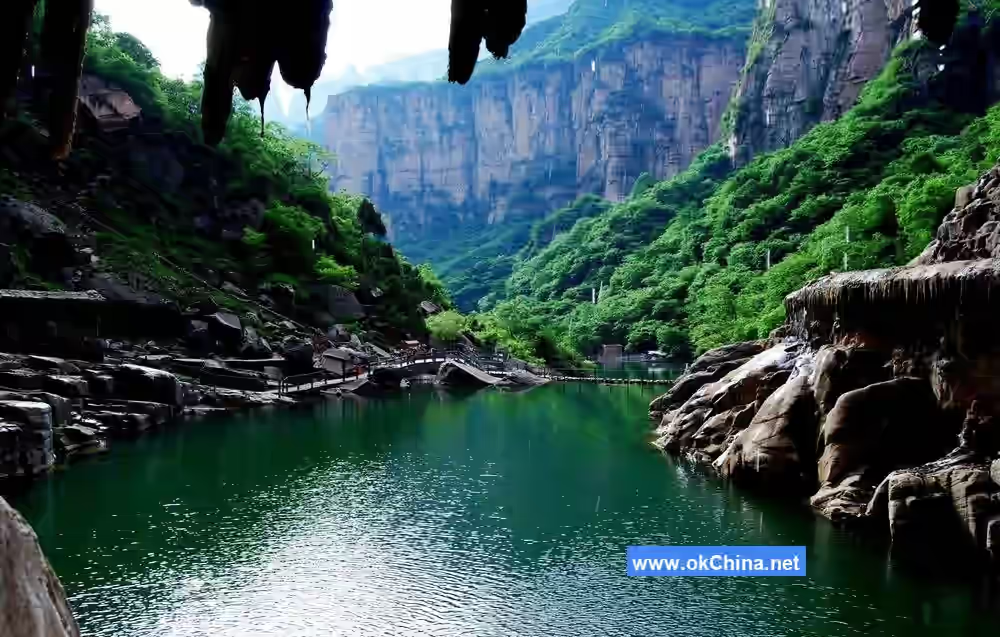
Here, the peaks are majestic, vegetation lush, emerald pools crystal clear, and cliff rocks exquisite. Upon careful observation and appreciation, the scenery, carved as if by supernatural craftsmanship, resembles a large potted landscape of a Jiangnan garden. Stalactites formed by water erosion hang upside down like dragon heads reaching into the water. Two streams trickle from these "dragon heads" into the emerald pool, vividly resembling playing dragons in water.
3.8.13 Ancient Plank Road
The Ancient Plank Road is about 150 meters long. The mottled marks remaining on the cliff face resemble a specially built ancient plank road. Walking along this ancient corridor and cliffside path, one can admire red cliffs, green water, blue sky, and natural geological landscapes formed by cross-bedding, bedding plane ripple marks, mud cracks, and other structures in the quartzite.
3.9 Xilian Gorge Scenic Section
3.9.1 Two Dragons' Mouths Bridge
Looking down from the majestic peaks, the winding Guanhou Gully and Xilian Gorge seem to clamp the flowing water in the gorge like two giant dragons. Here, they meet neck-to-neck. The patches of white stone by the bridge and the bridge itself resemble two dragon heads gazing at each other with open mouths, hence the name "Two Dragons' Mouths Bridge."
3.9.2 Xilian Gorge
Xilian Gorge stretches 8 kilometers from Two Dragons' Mouths Bridge to the Xilian Tourist Area. The gorge features towering strange rocks and babbling streams. The mountain path along the gorge winds through several small mountain villages—Dong'an, Wuliyao, and Nianping—passes Laotikou and Tianmenkou, and reaches the Heavenly Ladder. West of the Heavenly Ladder lies the essence of Xilian Gorge's natural landscape.
3.9.3 Hehe Pool
Hehe Pool is the first pool in the Xilian Tourist Area. Lotus flower and water lily refer to the same flower by two names. In Chinese, "荷" (he, lotus) is homophonous with "和" (he, peace/harmony), and "莲" (lian, water lily) is homophonous with "联" (lian, union). In traditional Chinese culture, lotus flowers and water lilies are often used as symbols of peace, harmony, cooperation, joint effort, unity, and union.#### 3.9.4 Tianhu Waterfall Above the Hehe Pond is the Tianhu Waterfall. Above the waterfall lies a large pool shaped like a teapot. Legend has it that the Nine-Lotus Old Mother, to relieve a drought, filled a pot with water and sprinkled rain upon the earth. She then discarded the pot here, which became the teapot-shaped pool. The waterfall jets out from the spout of this "pot," hence the name Tianhu (Heavenly Pot) Waterfall. With a drop of 100 meters, the waterfall's roaring descent embodies both the grandeur of "suspected silver river falling from the ninth heaven" and the subtlety of mist, rain, and wind.
3.9.5 Heavenly Ladder
The Heavenly Ladder consists of 999 steps. Midway up the ladder stands a stone tablet. Although the inscriptions are now blurred, it clearly records the origin of the ladder. Pilgrims and tourists ascending the mountain call this climbing path the Heavenly Ladder. Standing on the ladder and looking back down, the foot of the mountain is already far below. This ladder is named the New Jin Ladder. Heading east from the top, about over ten li away, there is another mountain path. Its steps are narrow, small, and steep, making the climb quite perilous. In the past, the mountain villagers used this ladder for their comings and goings, and it was named the Old Yuan Ladder.
4. Cultural History
4.1 Account Book Culture
The Xilian Temple in the Jiulian Mountain Scenic Area was first built during the Eastern Han Dynasty. Though not large, Xilian Temple boasts three wonders. The temple's mountain gate and the main hall at the back are not aligned; their positions are askew. This is the Slanted Mountain Gate of Xilian Temple. Many visitors have seen numerous temples where the mountain gate and the inner halls are built along a central axis. However, at Xilian Temple, the mountain gate and the hall are offset, making it one of the temple's great wonders.
The Slanted Mountain Gate is a major wonder of Xilian Temple. But atop this slanted gate sits a Guanyin Pavilion. By convention, halls are not built above mountain gates; it is extremely rare for a temple to have a hall constructed over its gate. Yet here, above the mountain gate, stands the Guanyin Pavilion, and it houses a Guanyin statue facing north (an "inverted seat" Guanyin, as it typically faces south). This forms another wonder of Xilian Temple.
Xilian Temple is a place of folk deity worship. It is uncommon nationwide for Buddhism, Taoism, and Confucianism to be enshrined together within a single temple. This illustrates that the people's reverence and worship of deities know no sectarian boundaries; as long as they can pray for favorable weather, national peace and prosperity, family happiness, and people's health, the common folk will venerate them.
Xilian Temple is built upon the Jiulian Terrace, creating the timeless wonder of "Nine Lotuses Holding the Sacred." The temple complex consists of three parts: first, the halls within the five courtyards here; second, the three halls of the Old Mother Temple on the western cliff, reached by climbing the 200-step Lianxin Ladder; and third, the Lotus Cave behind the temple.
Every year on the ninth day of the ninth lunar month, Jiulian Mountain holds its "Account Book" Cultural Festival. "Account Book" (Zhangshu) is a cultural custom of folk belief, now listed in Xinxiang City's intangible cultural heritage inventory.
The patterns and writings of the "Account Books" are incredibly varied and mysterious, not widely known or transmitted, making them both enigmatic and magical. Therefore, people also call the Account Books "Heavenly Scripts." This folk "Account Book" custom is considered the first of its kind in China, its mysteries difficult to unravel. Renowned domestic experts in folklore and folk culture are currently working to decipher the mysteries of the "Account Books" and explore their significance.
4.2 Taoist Culture
The Tianjie Mountain Scenic Area is one of the birthplaces of Taoism. Atop a solitary peak reaching into the clouds at an altitude of 1,570 meters stands a grand architectural complex, including the "Xuantian Shangdi" (Mysterious Heaven Supreme Emperor) main hall. Constructed from blue stone, it features an all-stone, beamless structure with an octagonal dome roof, iron tiles covering the cauldron-shaped top, and a cast-iron statue of the Dark Warrior deity. The site boasts numerous iron-cast buildings and artifacts, renowned for its ironwork and hailed as the "First Iron Summit Under Heaven." Taoist belief holds the saying, "The Golden Summit is in the south, the Iron Summit in the north; the Southern Summit is at Wudang, the Northern Summit is in Taihang." The temple complex on the sheer cliffs of the "First Iron Summit Under Heaven" follows the Taoist essence of "the Tao models itself on nature," adapting to the mountain's contours with a layout that is high and low, layered and well-proportioned, featuring an elegant and古朴 architectural style.
Legend has it that the Taoist patriarch attained immortality on Laoye Summit. The common people called the patriarch "Laoye" (Old Master), hence the name Laoye Summit. Also, because the patriarch is Laozi, revered by Taoism as its founding master, who was often depicted riding a purple cloud mass floating over high mountains, Laoye Summit is also called Zituan Wei or Qingfeng Wei. Furthermore, because it stands in opposition to the distant Wudang Mountain in Hubei, it is also called the Northern Tai Summit. Additionally, due to its majesty, beauty, peril, and steepness, it is hailed as the "First Peak of Taihang."
4.3 Red Culture
The Tianjie Mountain Scenic Area within Xinxiang's Baligou Scenic Area is a place boasting magnificent, dramatic, and poetically picturesque Taihang landscapes, coupled with cultural depth akin to enduring classics. Zhang Rongsuo, a National People's Congress deputy and Party secretary of Huilong Village, in the 1990s donated millions from his personal wealth. He led the village cadres and masses to build an 8,000-meter cliffside sky road on sheer precipices and bore a more than 1,000-meter S-shaped tunnel, creating a miracle in the history of rural road development. This tunnel is not merely a vital passage through the Taihang Mountains; it is also a textbook of "Red Spirit Touching China" that profoundly震撼s the vision and soul of the world.
4.4 Landscape Culture
The varied terrain and pleasant climate of the South Taihang Mountains have fostered a unique landscape culture. The mountains in South Taihang, Xinxiang, range in altitude from 300 to 1,800 meters. The overall morphology of the scenic area is exceptionally奇特, presenting three levels of cliffs. Traces left by prehistoric orogeny and geological erosion are very evident, featuring the rare Zhangshiyan landform characterized by red cliffs and danxia (red sandstone) precipices. The region exhibits diverse geology and landforms. Physiographic landscapes include typical geological structures, standard topographic profiles, red rock cliffs, biological fossil sites, erosional remnants, anthropomorphic rocks, and caves. High mountain water sources converge here, making water resources abundant within the area, with numerous waterfalls and reservoirs, contributing to diverse,灵动, and beautiful hydrological landscapes.
4.5 Jiulian Ponds
The Jiulian Ponds are nine interconnected ponds with interlinked waters. The mother of the Wanli Emperor, Empress Dowager Cisheng,自称 "Nine-Lotus Bodhisattva" within the palace. Hearing that there was a Jiulian Mountain in Huixian County, with a Xilian Temple on the mountain供奉 the Nine-Lotus Old Mother and a "Nine-Lotus Old Mother Lamp Oil Sacred Assembly," she was determined to make a pilgrimage to offer incense. During that year's Sacred Assembly, she brought palace maids and eunuchs, disguised as ordinary people, to Jiulian Mountain. After viewing the nine ponds and learning they had no names, she first bestowed the name Hehe Pond upon the pond below the waterfall, and then named the other eight ponds依次 as Furong Pond, Handan Pond, Shuiyun Pond, Shuizhi Pond, Junzi Pond, Changchun Pond, Yuhuan Pond, and Jingke Pond.
4.6 Candle Peak
Legend has it that after the patriarch attained enlightenment and became an immortal on Laoye Summit, pilgrims from all directions swarmed day and night, clogging the rugged mountain path, and people were often挤 off the mountain. Hearing this, the patriarch lit a candle and插 it on this mountain to light the way for pilgrims. Unexpectedly, one year, a邪教 often harassed pilgrims at night. Upon hearing this, the patriarch blew out the candle, causing the邪教 followers to摔死 at the mountain's foot. He also exerted his法力 so that all pilgrims ascending the mountain would have the patriarch's protection. Thus, the candle turned into a mountain peak, symbolizing lighting the way for pilgrims and保佑 people's safe journey.
5. Historical Evolution
As early as ancient times, Baligou was an important activity area for原始 tribes like the Gonggong clan.
Since the Wei and Jin dynasties, this area had already become a destination for those who loved mountains and waters to seek幽静 and explore scenic spots. Scholars and refined individuals came in succession, either choosing the land for seclusion or sightseeing, leaving behind numerous anecdotes and fine tales.
Notable figures include the Seven Sages of the Bamboo Grove from the Wei-Jin period; Wang Tong and Wang Bo from the Sui and Tang dynasties; the great Song dynasty scholar Shao Yong; poets Fan Chengda and Lu You; the Jin dynasty poet Yuan Haowen; the Yuan dynasty landscape painter Niu Shouzhen; and the Qing dynasty renowned Confucian Sun Qifeng, among others. The poem "Viewing the Waterfall at Stone Gate Mountain" written by Sun Qifeng's grandson, Sun Quan, became a classic work describing the great waterfall of Baligou.
During the Republican era, historical figures such as Yuan Shikai, Xu Shichang, and Feng Yuxiang also visited here. During the War of Resistance Against Japan and the Liberation War, the Taihang Mountain area was an important revolutionary base for the Eighth Route Army and the People's Liberation Army.
Comments
Post a Comment