Anren Ancient Town
1. Introduction
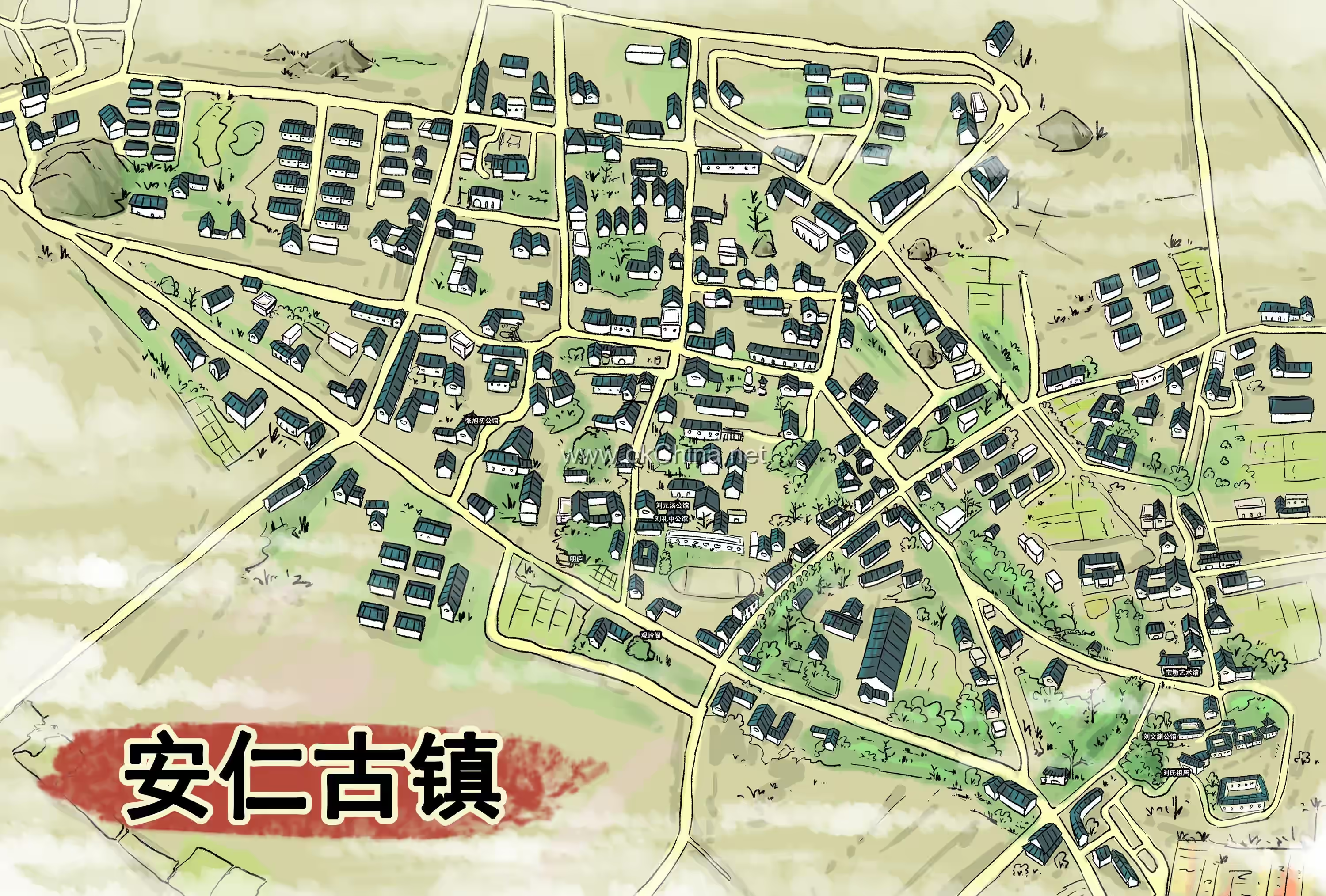
Anren Ancient Town is located in Dayi County, Chengdu City, Sichuan Province. Its planned area is 4.1 square kilometers, with boundaries extending west to the Liu Xiang Equestrian Statue, east to Exhibition Road, north to the Ring Town Road, and south to the Xiejiang River. The core scenic area covers 3 square kilometers and includes three key attractions: the Old Mansion Street, the Liu Family Manor Museum, and the Jianchuan Museum Cluster. Anren Ancient Town is approximately 39 kilometers from downtown Chengdu, 36 kilometers from Shuangliu International Airport, 10 kilometers from the Dayi Station on the Chengdu-Ya'an High-Speed Railway, 8 kilometers from the Dayi South Exit of the Chengdu-Wenjiang-Qionglai Expressway, and 8.5 kilometers from Dayi County Town.
Anren Ancient Town boasts a long history of over 1,400 years. As early as the third year of the Wude era in the Tang Dynasty (620 AD), Anren County was established (50 years earlier than Dayi County). It remained a county until the 21st year of the Zhiyuan era in the Yuan Dynasty (1284 AD), when its administrative status was abolished and its territory was incorporated into Dayi County. The town is home to two National AAAA-level tourist attractions (the Liu Family Manor, a National Key Cultural Relics Protection Unit, and the Jianchuan Museum Cluster, China's largest private museum cluster). It also features 27 well-preserved old mansions blending Chinese and Western architectural styles—the largest such collection in China—48 modern museum venues, 16 cultural relics protection units, over 10 million collected items, and 3,655 national first-class cultural relics.
Anren Ancient Town has been awarded numerous honors, including "China's Famous Historical and Cultural Town" by the Ministry of Construction and the State Administration of Cultural Heritage, "National Garden Town" by the Ministry of Housing and Urban-Rural Development, "National Cultural Industry Demonstration Base" by the Ministry of Culture, "National Patriotic Education Base" by the Publicity Department of the Central Committee of the Communist Party of China, the unique title of "China's Museum Town" by the Chinese Museums Association, and "China's Cultural Relics Protection Demonstration Town" by the Chinese Society of Cultural Relics. It has also been approved as one of the "First Batch of National Characteristic Towns," a "National AAAAA Tourist Attraction," and one of the "First Batch of Cultural and Tourism Characteristic Towns in Sichuan Province."
2. Geographical Environment
2.1 Location and Territory
Anren Ancient Town is approximately 39 kilometers from downtown Chengdu, 36 kilometers from Shuangliu International Airport, 10 kilometers from the Dayi Station on the Chengdu-Ya'an High-Speed Railway, 8 kilometers from the Dayi South Exit of the Chengdu-Wenjiang-Qionglai Expressway, and 8.5 kilometers from Dayi County Town. Its planned area is 4.1 square kilometers, with boundaries extending west to the Liu Xiang Equestrian Statue, east to Exhibition Road, north to the Ring Town Road, and south to the Xiejiang River. The core scenic area covers 3 square kilometers.
2.2 Topography and Landforms
Anren Town is situated in the western part of the Chengdu Plain, with terrain sloping from high in the west to low in the east. The landscape consists of mountainous hills and flat plains. The highest point is located in Group 3 of Qinian Village, with an elevation of 583 meters; the lowest point is in Group 10 of Quanshui Village, with an elevation of 500 meters.
2.3 Climate Characteristics
Anren Town experiences a subtropical monsoon climate characterized by four distinct seasons, with mild springs and autumns; hot summers with prevailing southeasterly winds and concentrated rainfall; and dry, cold winters with prevailing northerly winds. The multi-year average temperature is 16°C. The average annual frost-free period is 269 days. The average annual sunshine duration is 1,418 hours. The average annual precipitation is 1,095 millimeters, concentrated from July to September, with July being the wettest month. The prevailing wind direction throughout the year is northeast.
3. Main Attractions
3.1 Liu Family Manor Museum
The Liu Family Manor consists of the ancestral home of the Liu family and five mansions successively built by the Liu Wencai brothers. It covers an area of over 70,000 square meters, with a building area of more than 21,000 square meters. The manor is a complex of buildings combining Chinese and Western architectural styles. It retains the legacy of traditional Chinese feudal aristocratic residences, reflecting the enclosed social characteristics, feudal order, and hierarchical relationships of feudal society. At the same time, it incorporates features of Western castles and church architecture, which are more prominent in the New Mansion buildings. The main architectural style embodies traditional Chinese aesthetic preferences while integrating Western aesthetic characteristics in the details. This Sino-Western architectural complex is primarily brick-and-timber structured, showcasing the development of modern residential architecture in western Sichuan during the 1920s and 1930s. It is both a typical example of modern Sichuan landlord manor architecture and a residential complex with distinctive local characteristics of western Sichuan, formed by integrating Western architectural civilization with traditional Chinese architectural culture. It holds significant historical, artistic, cultural relics, and scientific and technological value.
The Liu Family Manor Museum bears witness to social and historical changes and showcases modern architectural techniques and traditional rural folk culture in western Sichuan. The museum's buildings, collections, clay sculptures, and relics are important physical materials for understanding and researching China's semi-colonial, semi-feudal society's politics, economy, culture, as well as Sichuan's warlord history, folklore, and modern residential architecture. They also represent a cross-section of China's modern social development history.
The museum houses a large number of cultural relics with rich connotations, such as Chinese rosewood inlaid with mother-of-pearl marble furniture—a relic from the Heavenly King's Palace of the Taiping Heavenly Kingdom, a nine-layer hollowed-out carved ivory ball, a thirteen-layer hollowed-out carved ivory pagoda, the clay sculpture Rent Collection Courtyard, couplets inscribed by Mr. Zhang Daqian, and Liu Wencai's large carved bed with gold-inlaid dragon pillars. Among the collections are over a hundred military operation and administrative division maps from the Sichuan warlords' "Defense Zone System" period, as well as hundreds of tax and land tax prepayment receipts (prepayments were collected from 1930 to 1976) and military fund-raising vouchers from that era. There are also numerous artifacts reflecting the cruel economic exploitation of peasants by the modern landlord class, such as thousands of land deeds, house deeds, account books, tenant rosters, land tax receipts, and tax receipts dating from the Daoguang era of the Qing Dynasty to 1949. Additionally, the collection includes various gold-inlaid and jade-embedded furniture, along with a large quantity of gold, silver, jewelry, antiques, and calligraphy and paintings.
3.1.1 Attractions within the Liu Family Manor
3.1.1.1 Liu Wencai Mansion
The Liu Wencai Mansion is a quadrangle courtyard composed of multiple courtyards, including the front courtyard, Xiaoyao Palace (Pleasure Palace), study, garden, and rear courtyard. The front courtyard is a two-section quadrangle, while the rear courtyard contains living quarters, storage rooms, a Buddhist hall, etc., followed by the study courtyard and then the rear courtyard. The Liu Wencai Mansion is the largest mansion within the Liu Family Manor complex, covering an area of 6,571 square meters with 205 rooms of various designs and 27 courtyards alone. The mansion is an irregular, enclosed complex of modern buildings with multiple courtyards.
3.1.1.2 Liu Wenhui Mansion
The Liu Wenhui Mansion covers an area of 8,406 square meters and consists of two independent three-section courtyards of equal size, one in the north and one in the south. The main gate is designed in the European Gothic architectural style, with inscriptions in both Chinese and Tibetan. A large garden serves as a transition between the gate and the front hall, and each garden also includes a tennis court.
3.1.1.3 Young Ladies' Building
The "Young Ladies' Building" in the Dayi Liu Family Manor has three floors, featuring a hexagonal plan with six sides on each of the three levels. The first and second floors are of equal area and form a continuous arcade with the exterior, creating a rounded circle. The top-floor corridor has an area equal to the sum of the corridors on the two lower floors, offering good lighting and open views, allowing one to overlook both the courtyard and the distant fields. The "Young Ladies' Building" is primarily brick-and-timber structured, with blue brick walls outlined with white lines, combining a hexagonal pyramidal roof, triangular windows, and columned arcades, presenting a Sino-Western architectural style.
3.1.2 Historical Development
- Since the 20th year of the Republic of China (1931), the Liu Wencai Mansion began construction and expansion, forming the front courtyard, Xiaoyao Palace, study, garden, rear courtyard, etc.
- In the 31st year of the Republic of China (1942), the Liu Wenhui Mansion was completed.
- In the 1930s, the "Young Ladies' Building" of the Liu Family Manor was completed.
- In October 1958, the Dayi Landlord Manor Exhibition Hall was officially established.
- In 1988, the Western Sichuan Folk Customs Exhibition Hall was established within the New Mansion.
3.2 Jianchuan Museum Cluster
The full name of the Jianchuan Museum is the Chengdu Jianchuan Museum Cluster. Founded by private entrepreneur Fan Jianchuan, it is located in Anren Town, Dayi County—known as China's Museum Town. It covers an area of 500 mu (approximately 33.3 hectares), with a building area of nearly 100,000 square meters, and houses over 8 million collected items, including 425 national first-class cultural relics.
With the theme "Collecting war for peace, lessons for the future, disasters for tranquility, and folk customs for heritage," the Jianchuan Museum Cluster has developed over 30 pavilions across four major series: the War of Resistance Against Japan, Folk Customs, the Red Era, and Earthquake Relief. Currently, 24 pavilions are open to the public. It is the largest private museum in China in terms of private capital investment, construction scale, exhibition area, and richness of collections.
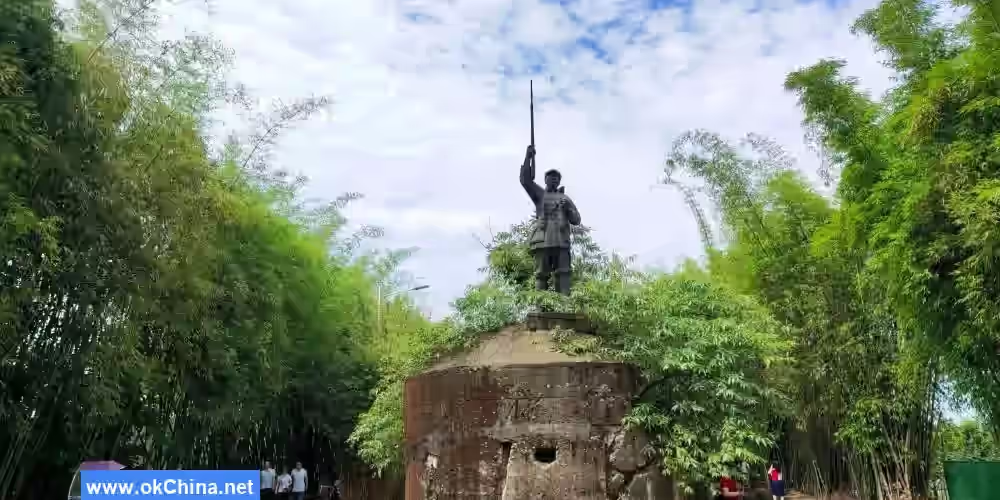
As of April 2021, the open exhibition halls include the Pillar of Resistance Hall, the Frontline Battlefield Hall, the Flying Tigers Hall, the Unyielding POW Hall, the Sichuan Army in the War of Resistance Hall, the Veterans' Handprint Square, and the Chinese Anti-Japanese Heroes Sculpture Square from the War of Resistance series. From the Red Era series, there are the Porcelain Exhibition Hall, Daily Necessities Exhibition Hall, Badges, Clocks, and Seals Exhibition Hall, Mirror Exhibition Hall, Educated Youth Life Hall, and Deng Gong Shrine. The Folk Customs series includes the Three-Inch Golden Lotus Cultural Relics Exhibition Hall, Old Mansion Furniture Exhibition Hall, and Traditional Chinese Medicine Cultural Relics Exhibition Hall. The Earthquake series includes the Shocking Diary Hall (May 12–June 12), Earthquake Artworks Hall, May 12 Earthquake Relief Memorial Hall, as well as the National Defense Weaponry Hall and the Aviation Third Front Museum.
In September 2018, the Jianchuan Museum was designated as a National Second-Class Museum. On November 18, 2020, it was selected as a "New Landmark of the Bashu Cultural Tourism Corridor."
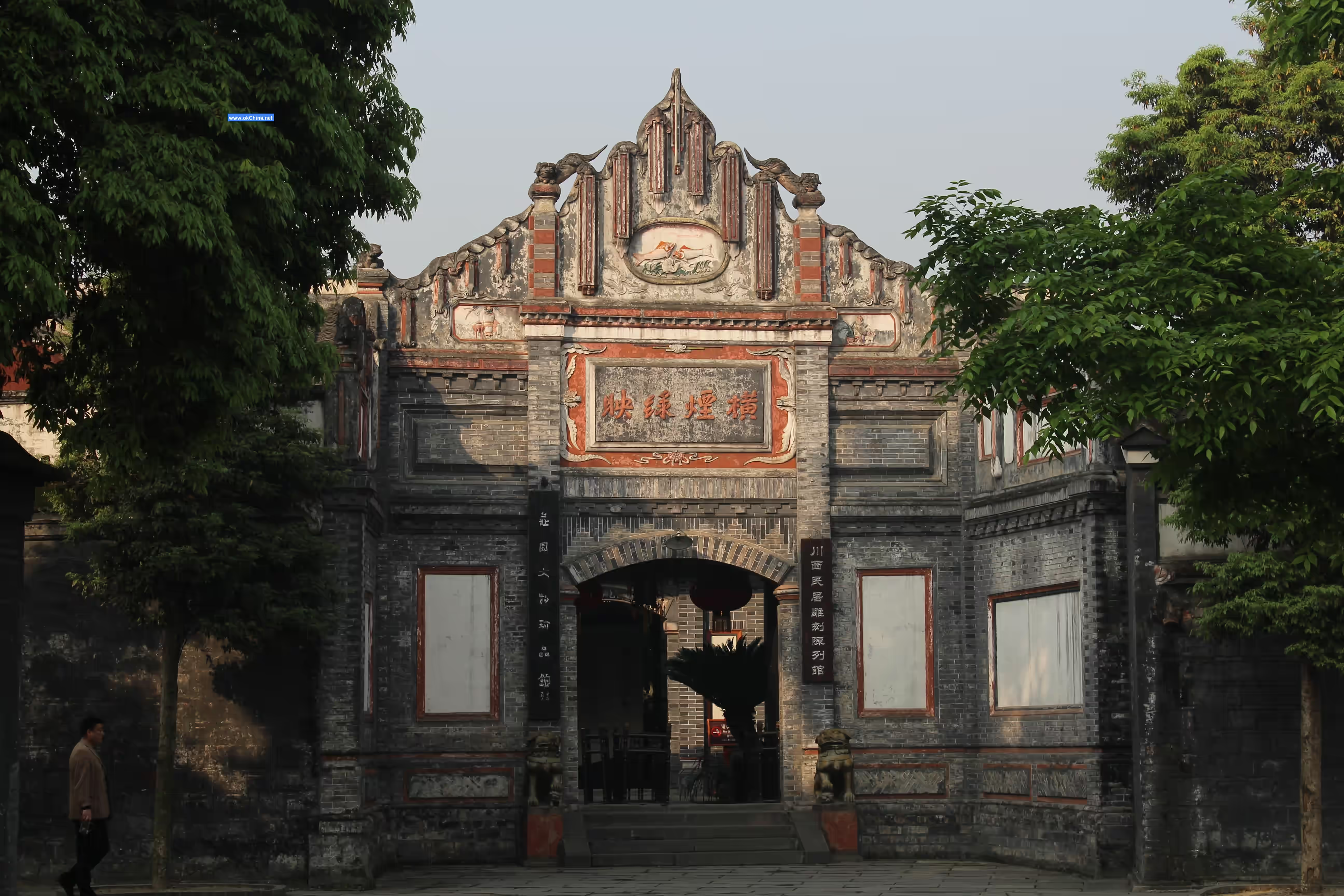
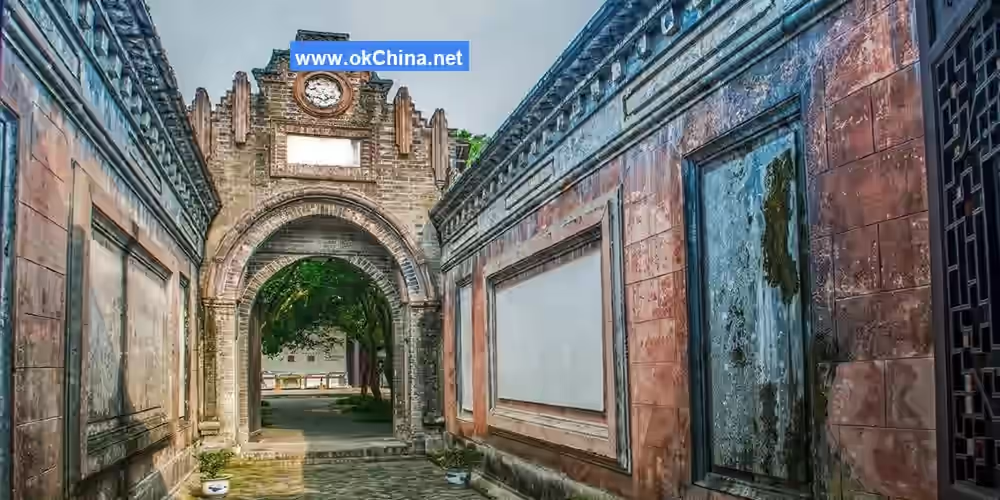
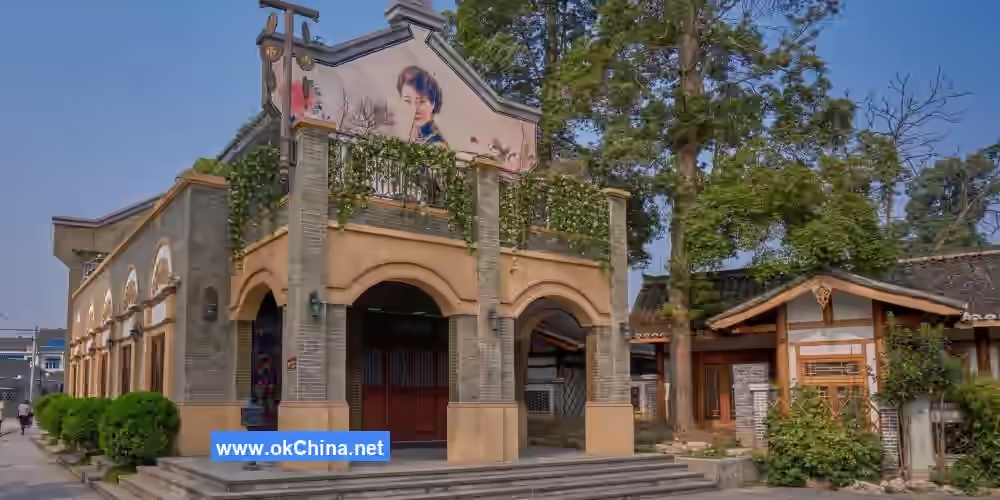
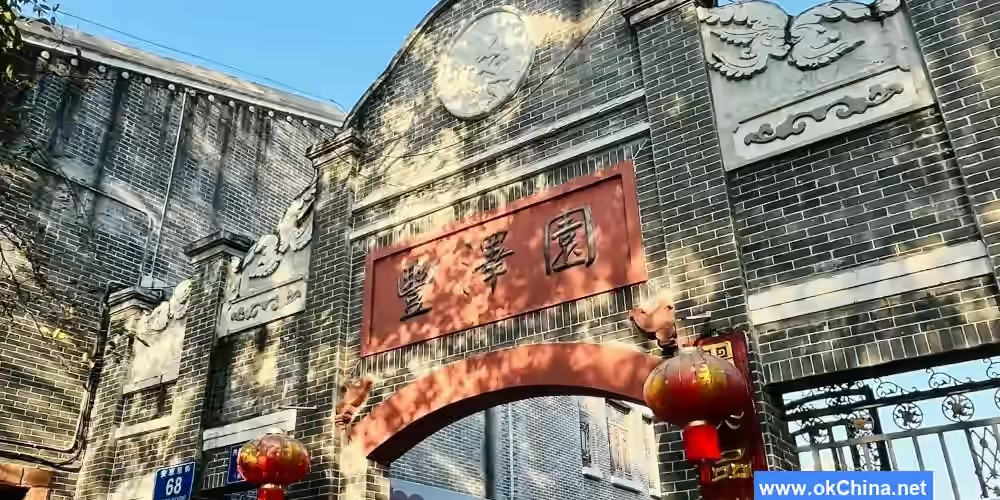
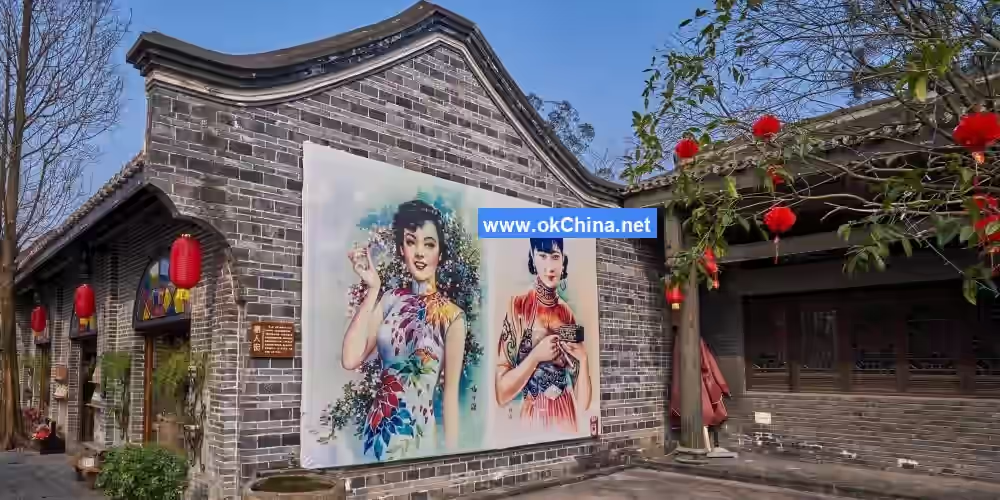
3.3 Anren Old Mansion StreetThe Anren Mansion Old Street is one of the three core resources of Anren Ancient Town. It is a historical architectural district preserved from the Republican era, consisting of Shuren Street, Yumin Street, Hongxing Street, and Deren Street, with a total length of approximately 1,200 meters (Shuren Street about 300 meters, Yumin Street about 200 meters, Hongxing Street about 260 meters, and Deren Street about 440 meters). It features 14 well-preserved mansions and over 210 residential houses, making it a comprehensive cultural tourism experience district integrating shopping, accommodation, entertainment, leisure, dining, sightseeing, and film appreciation.
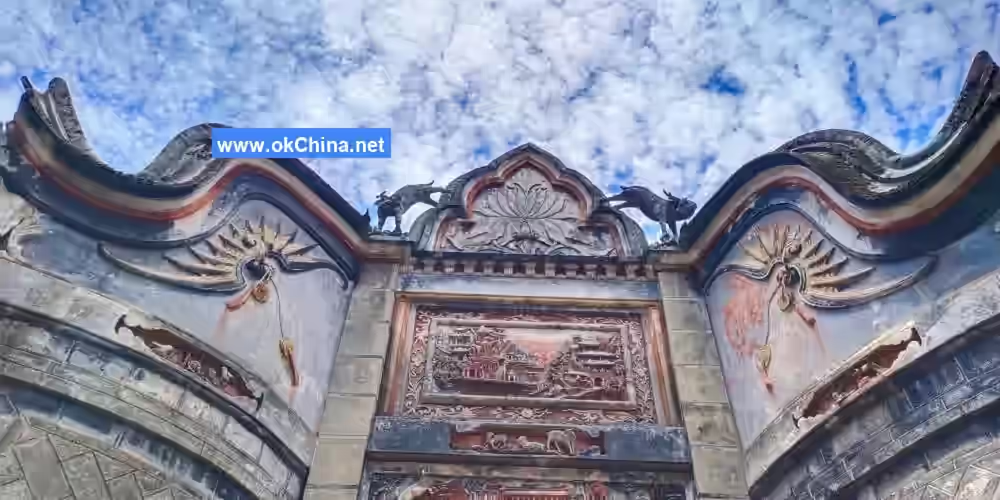
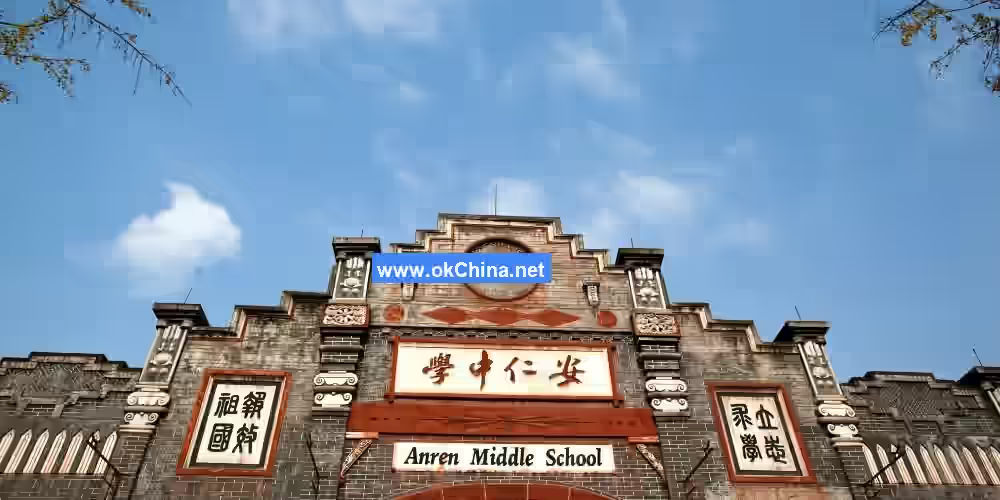
Most of the existing buildings on the Mansion Old Street were constructed during the late Qing Dynasty and early Republican era. They combine Chinese and Western architectural styles, featuring solemn, elegant, and dignified enclosed courtyards with high walls and deep compounds, forming the unique Western Sichuan mansion culture of Anren Ancient Town, acclaimed as the "finest example of Western Sichuan architectural culture."
3.4 Anren Planning Exhibition Hall
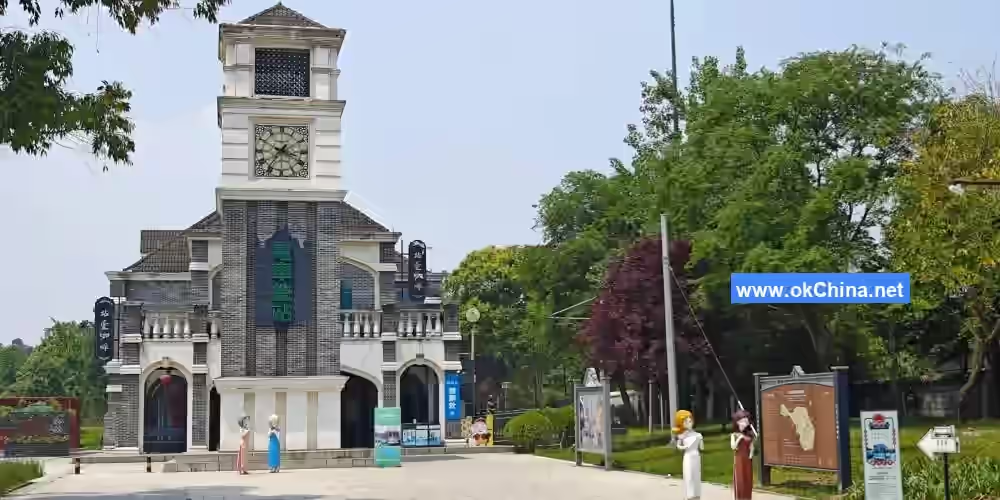
The Anren Planning Exhibition Hall, also serving as a tourist information center, covers a total area of nearly 1,000 square meters. It comprehensively showcases Anren's history, culture, tourism, and future development plans, functioning as a multifaceted exhibition space and serving as both an image showcase and a cultural tourism resource index for Anren. This hall is a centralized platform for displaying the achievements of Anren's planning and construction, a venue for visiting, exchanging, and learning about new urbanization projects, and another significant attraction and educational platform for local conditions in Anren Ancient Town. Through detailed historical exhibits, planning film screenings, and sand table models, the hall collectively outlines the blueprint and vision centered on the overall positioning of a "World Museum Town," promoting the coordinated development of the "three cultural industries": cultural museums, cultural creativity, and cultural tourism. It showcases Anren's fruitful results in implementing the "culture + tourism + new urbanization" strategy while providing tourist information services.
3.5 Hua Mansion
Located on the Mansion Old Street, Hua Mansion represents a new attempt at mansion revitalization. It introduces the National Non-State-Owned Museum Consortium of the Chinese Culture Promotion Society to create China's first "mansion-style museum cluster," Hua Mansion. With an investment of over 50 million yuan, the Zheng Ziquan Mansion, Liu Tizhong Mansion, and Liu Yuantang Mansion were transformed into a mansion-style museum cluster covering an area of 2,880 square meters.
Since its opening, it has hosted exhibitions such as "Treasures from the Hometown of Sakyamuni Buddha – The First Exhibition in China of Precious Collections from the National Museum of Nepal," "From the Hometown of Sakyamuni Buddha – Nepalese Statue Art Exhibition," "Afternoon Tea in the Tang Dynasty – Digital Art Exhibition of Ancient Chinese Tea Ware," "Imperial Edicts Have Arrived – Exhibition of Precious Imperial Edicts from the Ming and Qing Dynasties," and the Belt and Road initiative exhibition "Three Thousand Years of Chinese Civilization on the Grasslands – Exhibition of Northern Chinese Grassland Civilization."
3.6 Anren Academy
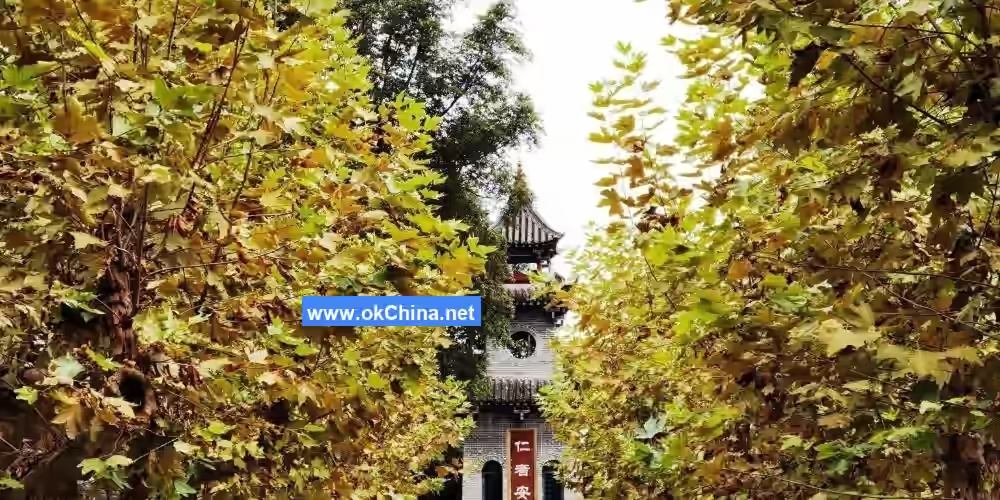
Anren Academy is a branch of the Sichuan Provincial Library, with a construction area of approximately 410 square meters. It opened for operation on January 1, 2015, and houses about 8,000 books of various genres. With a strong Republican-era ambiance, it is a comprehensive academy integrating book sales, book borrowing, kung fu tea art, and coffee leisure, acclaimed as the most beautiful academy in Southwest China.
4. History and Culture
4.1 Origin of the Place Name
The name of Anren Ancient Town derives from the meaning "the benevolent find peace in benevolence."
4.2 Historical Celebrities
From the establishment of Anren County to the end of the Qing Dynasty, incomplete statistics indicate that over 50 individuals passed the imperial examinations to become scholars, provincial graduates, or palace graduates. Many literary figures or talents emerged, such as the Song Dynasty literary figure Ji Yongzhang and his descendants, with three palace graduates over three generations, Zhan Yuequan and his descendants, with six palace graduates over three generations, and Gao Dengyi, the first person in New China to complete scientific expeditions to the Earth's three poles. During the Republican era, Anren produced over 50 military and political officials at or above the county or regiment level, including Liu Xiang, Chairman of Sichuan Province and Commander of the 21st Army; Liu Wenhui, Chairman of Xikang Province and Commander of the 24th Army; Liu Yuantang, Commander of the New 12th Army; Liu Yuanxuan, Acting Commander of the 24th Army; Liu Yuancong, Deputy Commander of the 24th Army; Zhang Chengxiao, Commander of the 11th Division of the 23rd Army; Liu Yuanzhang, Commander of the 137th Division of the 24th Army; Liu Shucheng, Commander of the New 17th Division of the Local Pacification Forces; and Chen Xiao, Commander of the 4th Division of the New 10th Army. Consequently, Anren is known as the "Three Armies, Nine Brigades, and Eighteen Regiments."
4.3 Cultural Activities
4.3.1 Anren Today
"Anren Today" is China's first mansion revitalization project exploring the "museum + new cultural experience consumption" model, creating an immersive mansion-based live performance project—Anren Today. The "Anren Today" project comprises four mansions: Yang Menggao Mansion, Liu Yuanhu Mansion, Liu Yuanxuan Mansion, and Chen Yuesheng Mansion. In the evenings, it primarily features the "Reviving the Mansion's Magical Night" performance project. Based on Anren's cultural heritage, it introduces experiential theater combining "story + interaction," using "Republican-era Anren" as a model. Utilizing technologies such as 3D imaging and holography, it transports audiences back to the Republican era, revitalizing Anren and narrating legendary stories. It aims to create China's sixth generation of performance art products and strives to build the largest Republican-era mansion cultural experience complex in China.
Comments
Post a Comment