Huangshan Ancient Huizhou Cultural Tourism Area
1. Introduction
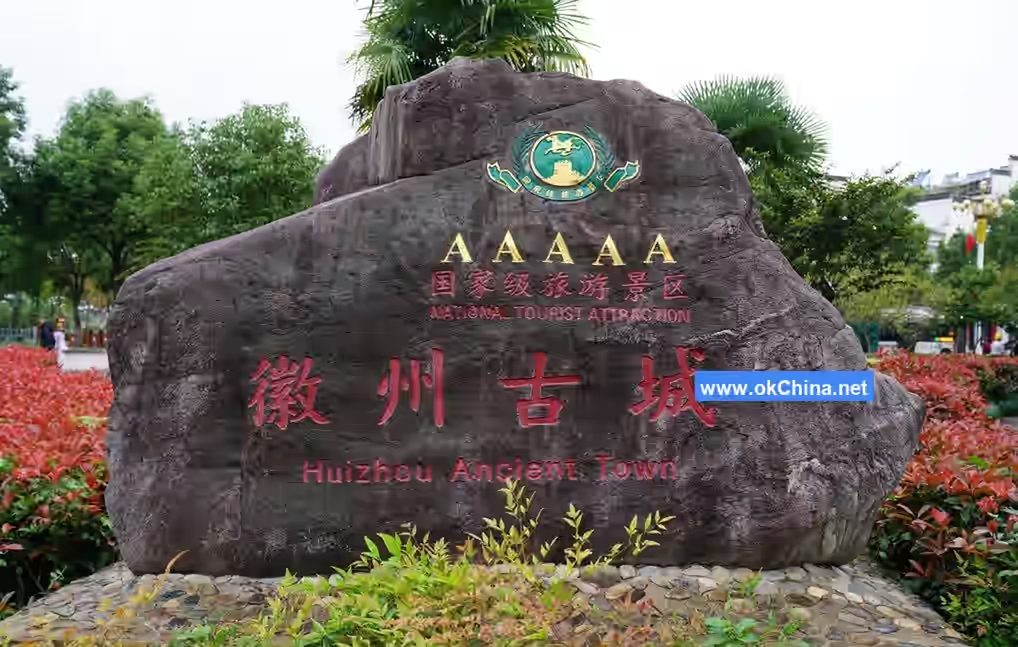
The Huangshan Ancient Huizhou Cultural Tourism Area is located in Huangshan City, Anhui Province. It lies to the north of Huangshan Mountain and borders Qiandao Lake to the south. Covering an area of 9.5 square kilometers, it is a cultural tourism area that gathers ancient city life, ancestral temple culture, memorial archway culture, Huizhou merchant culture, village culture, and residential architecture culture of ancient Huizhou. The main tourist attractions include five major scenic spots: Huizhou Ancient City, the Memorial Archway Complex & Bao's Family Garden, Qiankou Folk Houses, Chengkan, and Tangmo. In November 2014, the Huangshan Ancient Huizhou Cultural Tourism Area was awarded the honorary title of "National AAAAA Tourist Attraction".
2. Geographical Environment
2.1 Location and Territory
The Huangshan Ancient Huizhou Cultural Tourism Area is located in Huangshan City, Anhui Province, the birthplace of Huizhou culture. It lies to the north of Huangshan Mountain and borders Qiandao Lake to the south, situated between approximately 117°02′ to 118°55′ east longitude and 29°24′ to 30°24′ north latitude.
2.2 Climate Characteristics
The Huangshan Ancient Huizhou Cultural Tourism Area has a subtropical monsoon climate, characterized by hot and rainy summers, and mild, less rainy winters. The average temperature of the hottest month is above 22°C, while the coldest month ranges from about 0°C to 15°C. The annual temperature range is approximately 15°C to 25°C. Short periods of frost can occur, with a frost-free period exceeding 240 days. Annual precipitation ranges from 750 to over 1000 mm, with rainfall concentrated in summer and no distinct dry season.
3. Scenic Area Layout
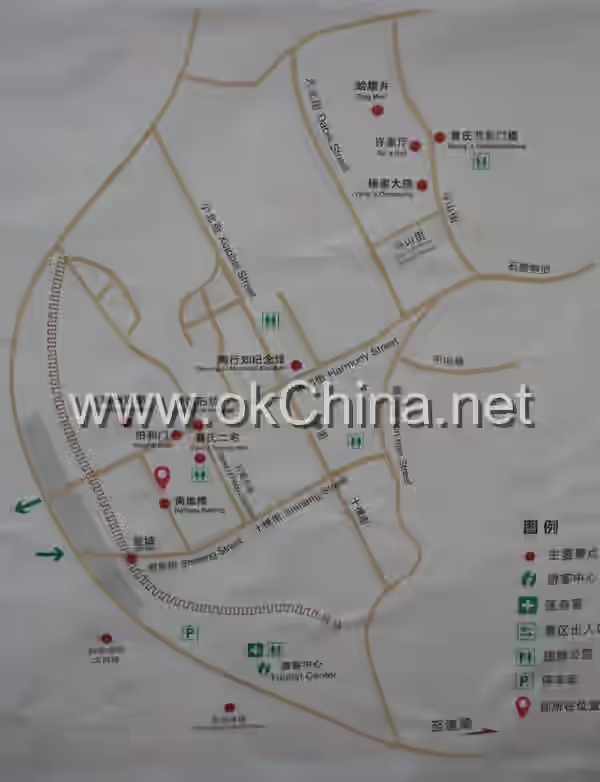
The Ancient Huizhou Cultural Tourism Area is located in Huangshan City, Anhui Province, the birthplace of Huizhou culture. It consists of five premium scenic spots: Huizhou Ancient City, the Memorial Archway Complex & Bao's Family Garden, Tangmo, Qiankou Folk Houses, and Chengkan. Nestled against Huangshan Mountain to the north and bordering Qiandao Lake to the south, with the Xin'an River flowing gently through, two thousand years of historical accumulation are evident. Every plant, brick, and tile here exudes the unique regional cultural character of the ancient city, villages, and architecture. The bundling of these five differentiated scenic areas brings together representative elements of ancient Huizhou, such as ancient villages, the ancient city, government offices, residences, memorial archways, Huizhou-style gardens, and Fengshui culture. It showcases Huizhou culture, one of China's three major regional cultures, and strongly promotes its inheritance.
3.1 Eastern Area
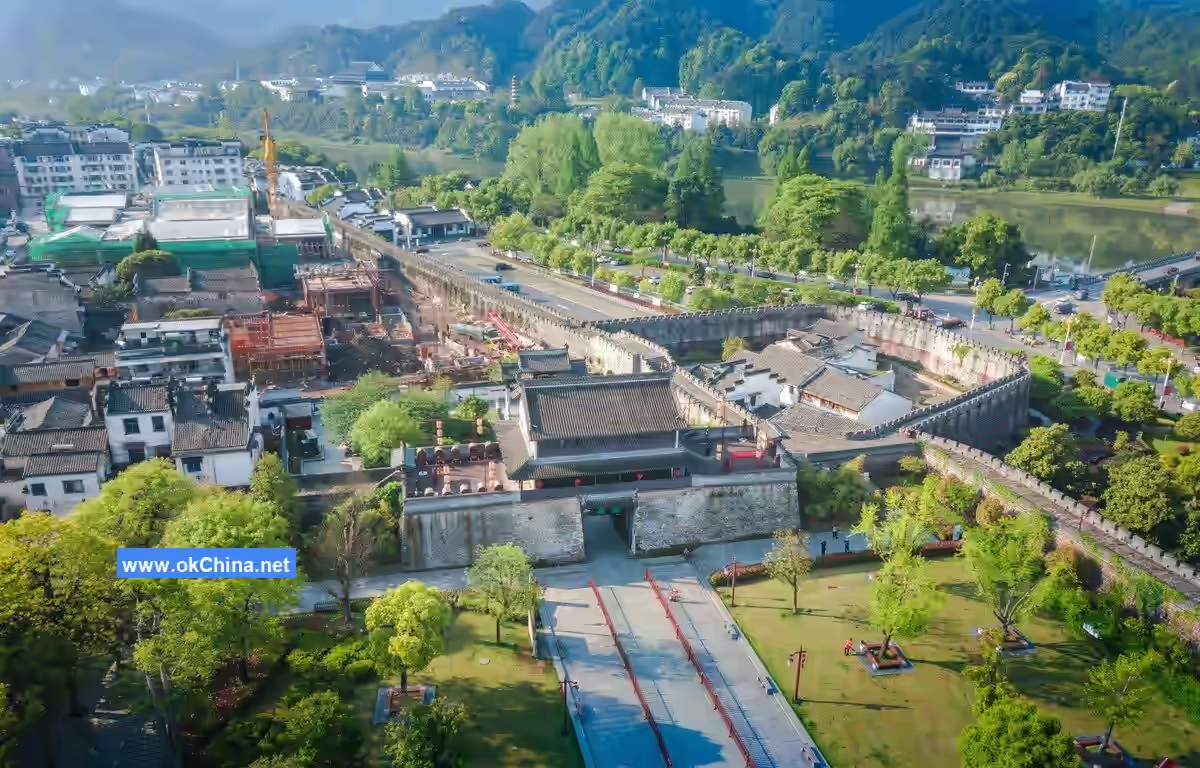
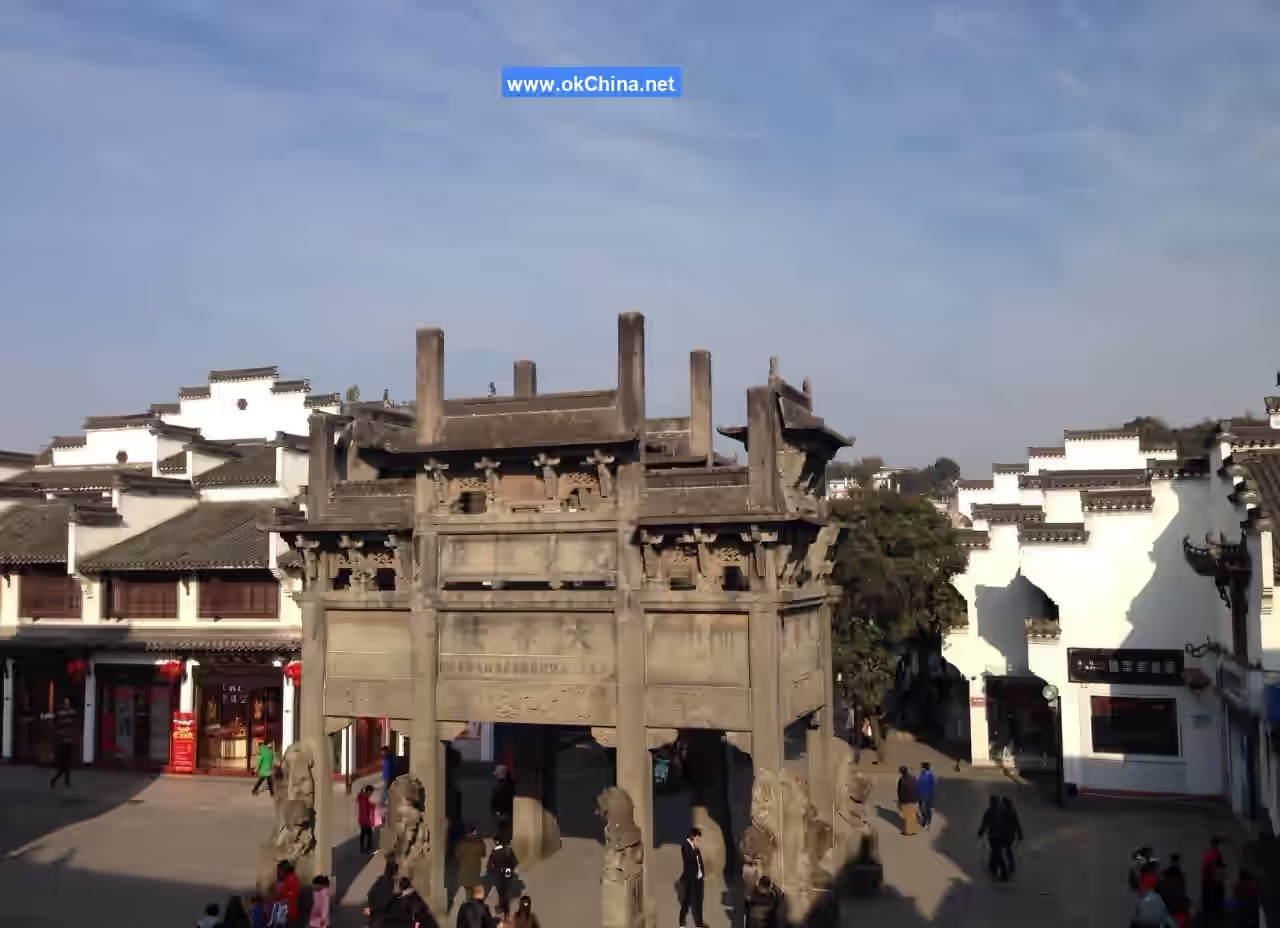
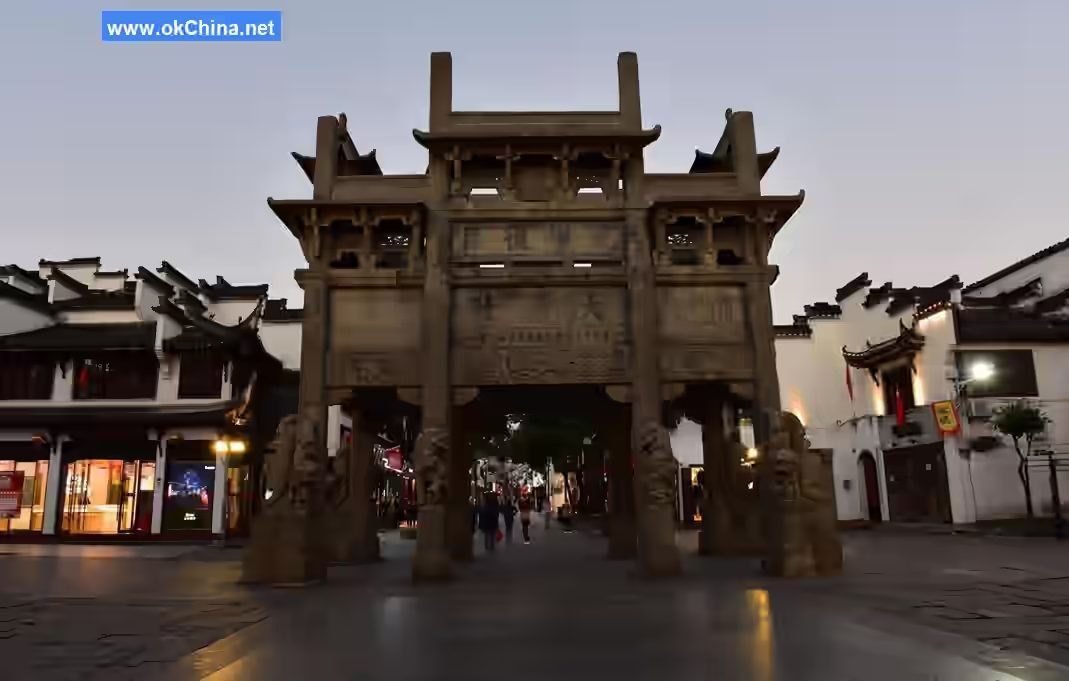
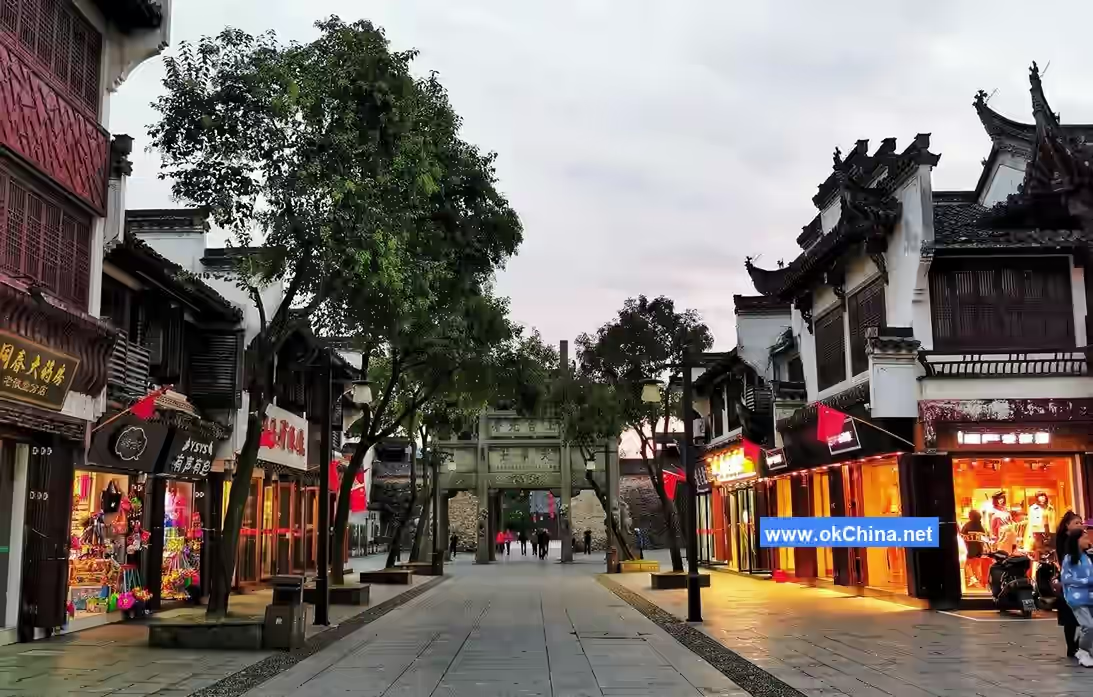
The eastern area primarily features the Huizhou Ancient City scenic spot. Huizhou Ancient City was the seat of the Huizhou Prefecture government and is one of the four best-preserved ancient cities in China today, with five peaks surrounding it and six rivers meandering. The Huizhou Prefecture Government Office, often called the "Forbidden City of Huizhou," is majestic and grand, considered the finest among government offices in the Jiangnan region. The Xu Guo Stone Memorial Archway is the only octagonal memorial archway in China. Emperor Wanli of the Ming Dynasty used this most solemn way to honor his beloved minister, Grand Secretary Xu Guo. It is now hailed as the "Oriental Arc de Triomphe."
3.2 Central Area
The central area comprises the Memorial Archway Complex & Bao's Family Garden and the Tangmo scenic area. Here lies the ancient village of Tangyue, which has spanned over 800 years from the Song and Yuan dynasties to the Ming and Qing dynasties. It features seven towering, solemn, and majestic memorial archways, a dignified and solemn ancestral hall for men, and an elegant, dignified, and unique ancestral hall for women. The Women's Ancestral Hall (Qingyi Hall) is the only one of its kind in China. Its exquisite and tasteful carvings make it a vivid resource for studying the Huizhou patriarchal clan system and the history of Huizhou merchants. Bao's Family Garden, harmoniously integrated with the archway complex, is set against the backdrop of a Huizhou merchant's private garden and focuses on Huizhou-style penjing (miniature landscapes). It gathers the essence of Huizhou penjing art while also featuring representative works from various domestic penjing schools. Incorporating the stylistic精华 of the Su, Xiang, Chuan, and Hui schools of penjing into one garden, it is acclaimed as the "Mother of Oriental Gardens."
Tangmo is renowned as China's premier "Water Entrance Garden Village." Its foundation was laid in the Tang Dynasty, nurtured through the Song and Yuan, and flourished during the Ming and Qing dynasties. Historically, due to its economic vitality and淳朴 folk customs, it was praised as the "Model Village of the Tang Dynasty." It is an ancient village with a long history and profound cultural积淀 in Huizhou. Tangmo is located within Qiankou Town, Huizhou District, Huangshan City, adjacent to the Tangyue Memorial Archway Complex in She County. It is famous for the well-known Tanqian Garden, which模拟 the scenery of West Lake, featuring pavilions, towers, waterside pavilions, and long bridges. The lake embankment is planted with sandalwood flowers and紫荆. The garden also boasts attractions like "Three Pools Mirroring the Moon," Mid-Lake Pavilion, Bai Causeway, and Jade Belt Bridge, resembling a miniature West Lake. The Mirror Pavilion is the centerpiece of this "Little West Lake." Its interior walls are built with marble, inlaid with stele rubbings of calligraphy masters such as Su Shi, Zhu Xi, Dong Qichang, Huang Tingjian, Ni Yuanlu, Wen Zhengming, Mi Fu, Cai Xiang, and Zha Shibiao. The collection is vast and magnificent, akin to a Xin'an Stele Garden. The idyllic scenery is优雅别致, seamlessly blending French romantic charm with the ancient Huizhou village.
3.3 Western Area
The western area includes the Qiankou Folk Houses and Chengkan scenic spots. Qiankou Folk Houses, also known as Zixia Mountain Villa, is situated at the southern foot of Zixia Peak in Qiankou Town, Huizhou District, Huangshan City, Anhui Province. It is a Huizhou-style architectural complex of Han ethnic residential buildings from the Ming Dynasty in Huizhou. Ingeniously laid out on a small hill, it showcases various styles of ancient dwellings. The complex includes, categorized by building type, ancestral halls, residences, small bridges, roadside pavilions, and memorial archways. In terms of time span, it延续 from the 8th year of the Hongzhi era (1495) in the Ming Dynasty to the mid-to-late Ming period. Notable figures from the early Qing Dynasty, such as Huang Zongxi, Shi Runzhang, Mei Geng, and Jin Zhijing, visited this place and left inscriptions here.
Chengkan is堪称 a marvel in the history of Chinese ancient architecture. It integrates natural landscapes, with the village sited and laid out according to the Eight Trigrams Fengshui theory of the Book of Changes, interpreting the ancient philosophical theory of the mutual generation and restriction of all things in heaven and earth. It is被誉为 the "Number One Fengshui Village in China." The village's long streets and short lanes resemble a maze. Strolling through them, the scenery changes with every step—walking a thousand alleys feels like wandering in a painting.
4. Main Scenic Areas
4.1 Huizhou Ancient City
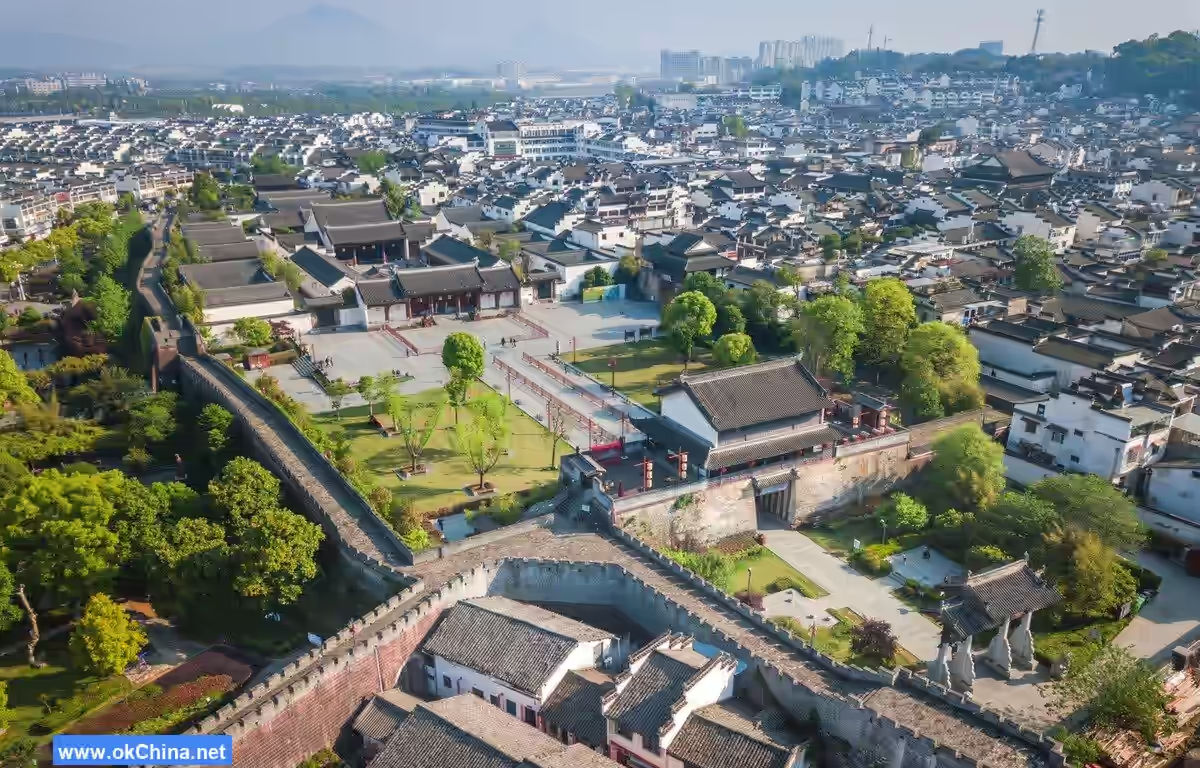
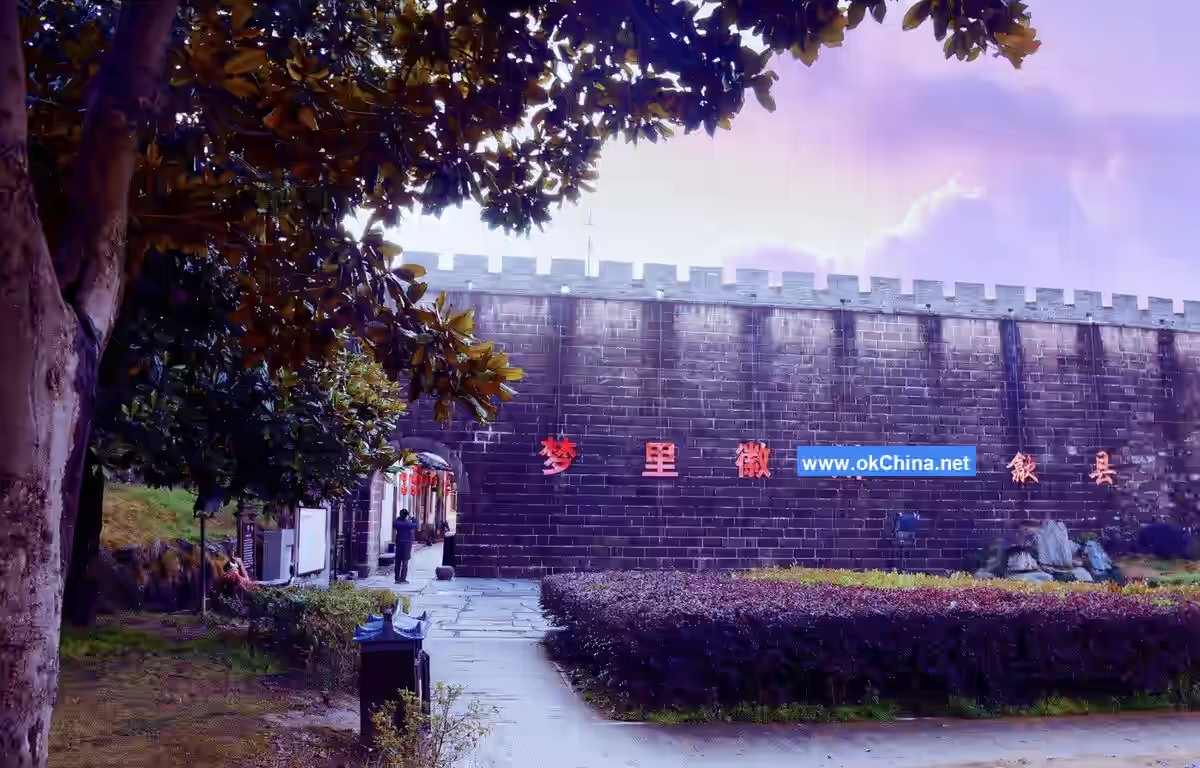
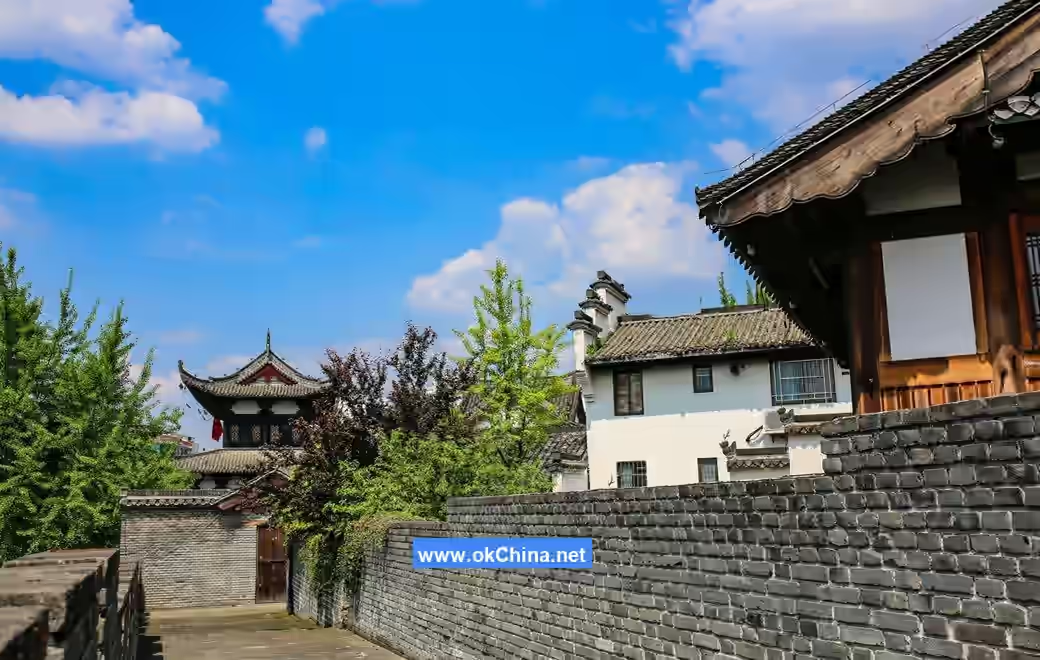
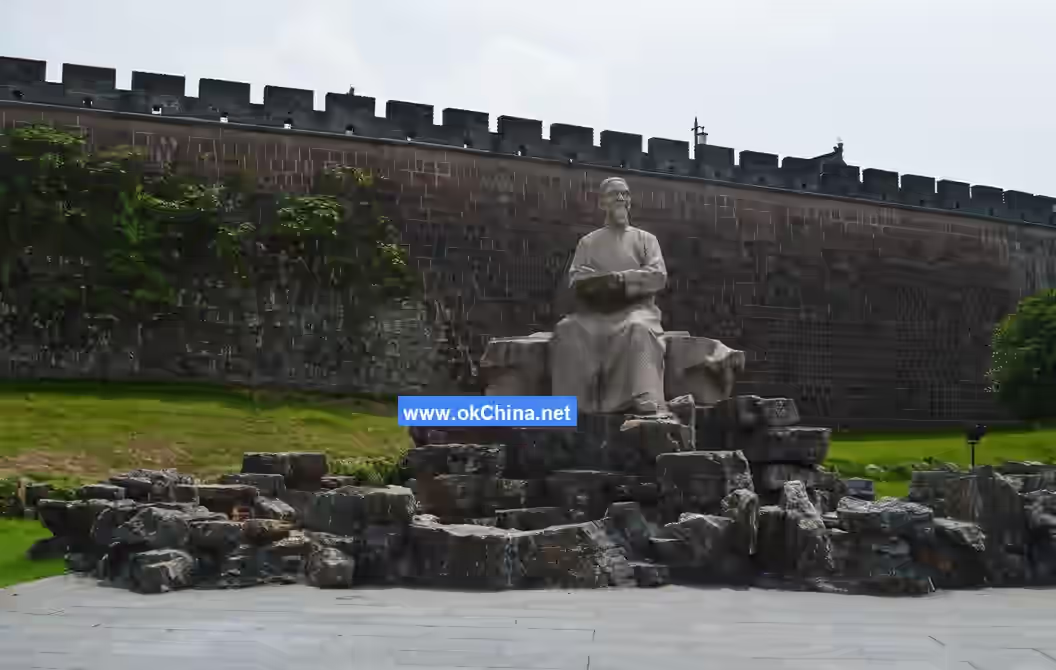
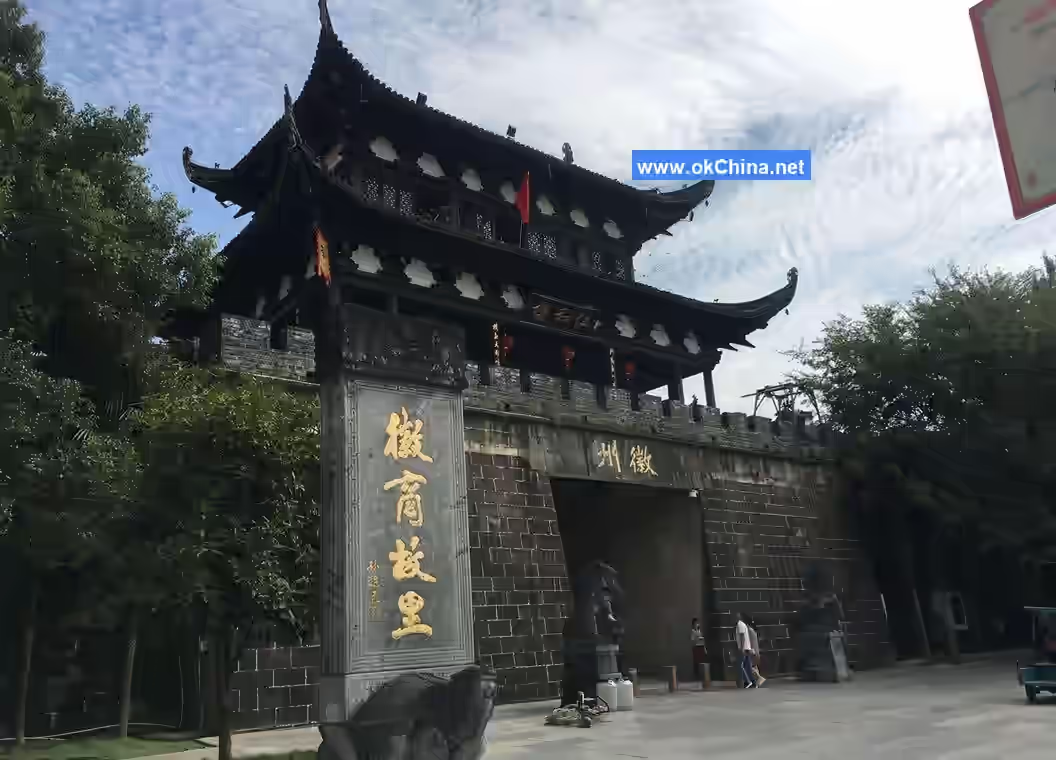
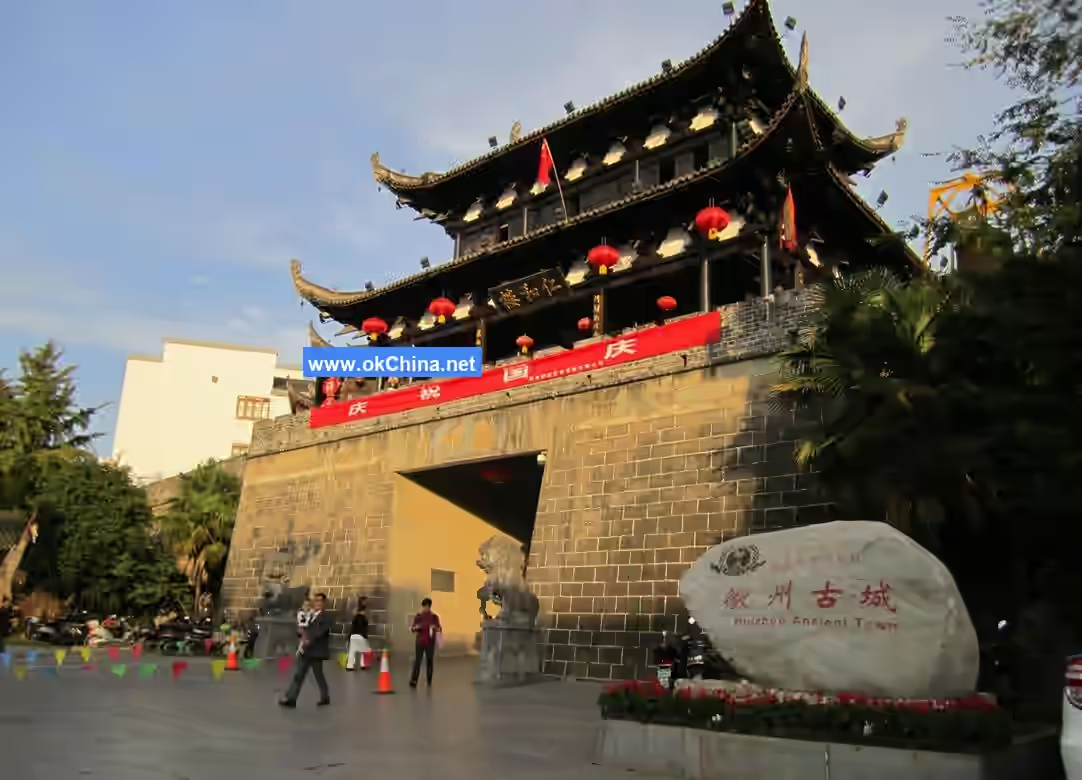
The Huizhou Ancient City scenic area is located in the county town of She County, a National Historical and Cultural City. It was the political, economic, and cultural center of ancient Huizhou, the seat of the ancient Huizhou Prefecture government, one of China's four great ancient cities, and the birthplace of Huizhou culture—one of China's three major regional cultures. It is a National AAAAA Tourist Attraction. The scenic area currently encompasses attractions such as the Huizhou Prefecture Government Office, Xu Guo Stone Memorial Archway, Ancient City Wall, Hui Garden, Huizhou Story Hall, Huizhou Opera Hall, Doushan Street, Tao Xingzhi Memorial Hall, and Huang Binhong Memorial Hall. It is renowned as the "Capital of Chinese Huizhou Inksticks," "Hometown of Chinese She Inkstones," "Home of Huizhou Opera (Huizhou Troupes)," "Home of Chinese Huizhou Culture," and "Home of Chinese Memorial Archways."
4.1.1 Xu Guo Stone Memorial Archway
The Xu Guo Stone Memorial Archway, also known as the Grand Secretary's Archway, is commonly called the "Eight-Legged Archway." Built in the 12th year of the Wanli era of the Ming Dynasty (1584 AD), it was constructed by Xu Guo, the Minister of Rites and Grand Secretary of the Eastern Hall during the Ming Dynasty. Located outside the Yanghe Gate of Huizhou Ancient City, it is the only surviving "eight-legged memorial archway" in China. The Xu Guo Stone Archway has four sides and eight pillars, forming a "口"-shaped structure. It is an imitation wooden structure,严谨 in construction and合理 in layout. It measures 11.54 meters north-south, 6.77 meters east-west, and 11.4 meters in height. The entire archway is composed of two front-and-back three-bay, four-pillar, three-story stone archways combined with two side single-bay, two-pillar, three-story stone archways. Made of bluish茶园 stone and imitating wooden structures, its图案雕饰 resemble the colorful paintings of Huizhou folk architecture. Every plaque, bracket set, and sparrow brace on the stone archway is adorned with exquisite carvings. Twelve lions perch on the stone bases, each in a different posture. It is a structure erected in feudal society to honor meritorious service, imperial examination success, virtuous governance, loyalty, filial piety, chastity, and righteousness. It is the best载体 for interpreting ancient Chinese history and culture and is also hailed as the "Oriental Arc de Triomphe." In 1988, the Xu Guo Stone Memorial Archway was announced by the State Council as a National Key Cultural Relics Protection Unit.
4.1.2 Huizhou Prefecture Government Office
The Huizhou Prefecture Government Office is located in the core area of the Huizhou Ancient City scenic spot in She County. It is the symbol of Huizhou Prefecture, built in the late Yuan and early Ming dynasties, retaining the layout of one central axis and five gates from the Hongzhi era of the Ming Dynasty. It is considered the most majestic prefecture government office architectural complex in China. It covers a total area of 24,000 square meters, with a building area of 9,800 square meters. It mainly includes the South Watchtower, Ceremonial Gate, Main Hall, Second Hall, and the Prefect's Residence complex. In 2009, the Huizhou Prefecture Government Office was restored on its original site according to the architectural regulations of the Ming Hongzhi period. The government office faces south, with symmetrical axes, orderly primary and secondary buildings, and a central main hall flanked by辅助 structures. From the screen wall to the prefect's residence, the distances and proportions between the courtyards resemble a scaled-down Forbidden City. Hence, ancient architecture experts say, "The prefecture office is a miniature Forbidden City, and the Forbidden City is an enlarged prefecture office." With three main routes and multiple courtyards,纵横巷道,整肃布置, and明确分区, it represents a typical official architectural style. The entire government office features a廊院式 layout, oriented north-south, facing the street in front. The three main courtyards of the government office, along with the eastern and western routes, the East and South Watchtowers, and the ancient city wall, form a representative ancient architectural complex of Huizhou Ancient City. It provides a comprehensive platform for academic research, cultural exchange, integrity education, tourism reception, and leisure entertainment.
4.1.3 Tao Xingzhi Memorial Hall
The Tao Xingzhi Memorial Hall is located on Zhonghe Old Street in She County. It was改建 in 1984 from the former site of Chongyi School, where Tao Xingzhi studied in his youth. It was expanded twice in 1991 and 2003, covering an area of 1,700 square meters. The main gate of the memorial hall faces south, built with青灰色水磨 bricks. The large square brick lintel is engraved with the gilded inscription "陶行知纪念馆" (Tao Xingzhi Memorial Hall) in the calligraphy of a former General Secretary. In the center of the entrance hall stands a full-body white marble seated statue of Tao Xingzhi. The second floor serves as an exhibition hall, displaying introductions to Tao Xingzhi's life, relevant documents, and artifacts. Behind the hall is the former site of Chongyi School. The memorial hall consists of a瞻仰厅 (Hall of Reverence), a放像厅 (Video Hall), a书画厅 (Calligraphy and Painting Hall), and five large exhibition halls. In the center of the Hall of Reverence is a 2.A 6-meter-high bust of Tao Xingzhi, carved from white marble, stands prominently. The hall also features an inscribed plaque by Soong Ching-ling reading "Model Teacher for All Ages," an inscription by Mao Zedong that says "Mr. Tao Xingzhi, the Great Educator of the People," Tao Xingzhi's handwritten calligraphy "Love Fills the World," an inscription by Jiang Zemin urging to "Study Tao Xingzhi's Educational Thought to Promote Educational Reform," and a famous quote of Tao Xingzhi handwritten by Guo Moruo. The exhibition hall is divided into seven periods showcasing Tao Xingzhi's illustrious life: born into a poor rural family; standing at the forefront of the May Fourth Movement after returning from studying in the United States; serving as the editor-in-chief of the magazine "New Education" and the general secretary of the Chinese Education Improvement Society; being among the first to pay attention to rural education; becoming a standard-bearer of the New Education Movement; traveling across the country to promote anti-Japanese education; and actively participating in the movement against civil war, hunger, and for democracy. In 1996, the Tao Xingzhi Memorial Hall was named one of the "One Hundred National Patriotic Education Bases for Primary and Secondary Schools" by the State Education Commission and five other ministries. In 1997, it was designated as a "National Patriotic Education Demonstration Base" by the Publicity Department of the Central Committee of the Communist Party of China.
4.1.4 Doushan Street
Doushan Street is located within Shexian County and is named after its proximity to Doushan Mountain. As a first-level protected area within the famous historical and cultural city, it is a tourist cultural attraction integrating ancient residences, streets, carvings, wells, and memorial archways. Built during the Ming and Qing dynasties, the street stretches over 300 meters and features typical Huizhou-style residences such as the Wang Family Residence, the Yang Family Courtyard (home of an official family), the Xu Family Hall (an ancient private school), the Pan Family Courtyard (home of a merchant family for generations), the thousand-year-old "Toad" Ancient Well, and the rare wooden shield archway known as the "Ye Family Chastity Archway."
4.1.5 Hui Garden
Hui Garden is situated in the bustling downtown area of Huizhou's main city, connecting Zhonghe Street to the south and Huizhou Road to the north. Covering an area of 20,000 square meters with a building area of 18,000 square meters, it is often referred to as the "Grand View Garden of Huizhou Culture." Following the construction principle of "emphasizing history, basing on the environment, pursuing excellence and beauty, and highlighting distinctive features," Hui Garden was built on the foundation of the ancient city's western wall and is regarded as a model for the preservation of Huizhou's ancient city. Construction began on March 25, 1999, and was completed on November 16, 2000. Hui Garden epitomizes the "Three Wonders of Huizhou Ancient Architecture"—memorial archways, ancestral halls, and residences—and integrates the essence of the "Three Carvings of Huizhou"—brick, wood, and stone carvings. Its main structures include Renhe Tower, Deyue Tower, Tea House, Huifeng Stone Archway, Hui Garden's First Tower, Deyi Tower, Chunfeng Tower, Overstreet Tower, Ancient Opera Tower, Lotus Pond and Jade Belt Bridge, Wanjin Linggui (Golden Turtle), Nine Dragons and Nine Phoenixes Wall, and Southeast Zou Lu Archway.
4.1.6 Nanqiao Tower
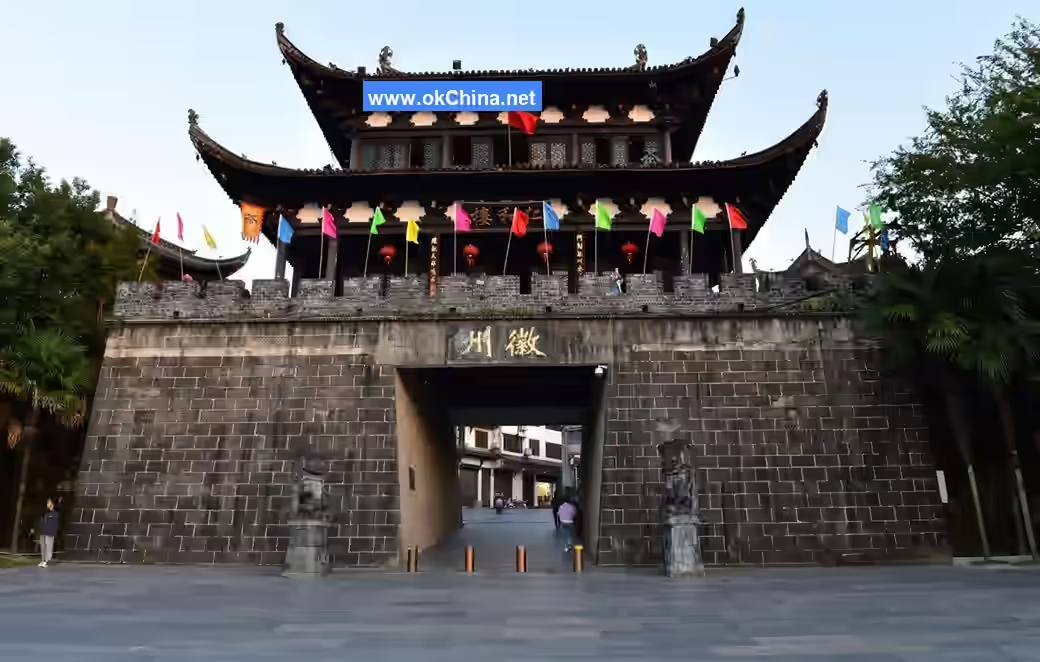
Nanqiao Tower was first built at the end of the Sui Dynasty, rebuilt during the Xuanhe period of the Song Dynasty, and underwent large-scale renovations in the 14th year of the Hongzhi era of the Ming Dynasty. It served as the main gate tower of the outer city of the Wu Prince Mansion of Wang Hua, a native of Shezhou (present-day Huizhou), and was the place where time was announced to people at night in ancient times, with the sound of the night watch drum spreading in all directions from the tower. Nanqiao Tower has three stories and three bays, standing about 20 meters high, 15 meters wide, and 10 meters deep. It is a brick-and-wood structure with a suspended roof, double eaves, a high ridge, purple walls, and blue tiles. Below is the gate tower, with a width of 4.5 meters, flanked by 13 wooden pillars on each side. Each pillar has a circumference of over 1 meter and leans against the wall at an angle of about 10 degrees to support the main beam. In 1997, the State Administration of Cultural Heritage allocated funds for its reconstruction, largely preserving the wooden structure style of the Qing Dynasty, while the gate tower retains the style of the Song Dynasty.
4.1.7 Taibai Tower
Taibai Tower is located at the head of Taiping Bridge and is a hall-style classical Huizhou architecture. Inside the tower, books about Li Bai's life, as well as calligraphy, paintings, plaques, and couplets, are displayed. The plaque above the screen wall bears the four large characters "Chang Tian Yi Shao" (A Spoonful of the Vast Sky), derived from Chapter 26 of the Doctrine of the Mean, "The Way of Heaven." It conveys the idea that although heaven and earth are vast and a spoonful of water is tiny, the principles of movement and change are interconnected, and it also reflects Li Bai's unrecognized talent, likened to a spoonful of water beyond the sky. The couplet on the pillars, "Four walls of clouds and mountains open drunken eyes, a tower of wind and moon speaks of the poet immortal," blends the scenery of Taibai Tower with the anecdote of Li Bai composing a hundred poems after a drink, creating a poetic and picturesque atmosphere. Legend has it that this was originally a tavern where the Tang Dynasty poet Li Bai drank while visiting Shexian County in search of the hermit Xu Yiping, whom he failed to meet. Later generations renamed the tavern "Taibai Tower" in memory of Li Bai. Additionally, historical sites such as Li Bai's Ferry, Suiyue Beach, and Wangxian Bridge remain here.
4.1.8 Xin'an Stele Garden
Xin'an Stele Garden is located on the opposite bank of Lianjiang River in the west of Shexian County, Anhui Province. It is a typical Huizhou-style private garden building, leaning against Taibai Tower and Piyun Peak, drawing from the waters of Lianjiang River, and facing Taiping Bridge. The entire stele garden consists of the Zhenshang Pavilion Courtyard, She Pond, Xiaotiandu Courtyard, Liangqing Hall Courtyard, and Piyun Xiaozhu Courtyard. The Zhenshang Pavilion Courtyard is marked by a pair of large lions at the gate, with the inscription "Gu Mo Yan Fen" (Ancient Ink Spreads Fragrance) above the gate, written by contemporary Shanghai calligher Chen Congzhou. The Momiao Corridor within Xin'an Stele Garden serves to connect various scenic areas and is a long corridor dedicated to displaying stele rubbings. Its niches house over 250 stone carvings, including Wu Zhen's "Qing Jian Tang," Wu Ting's "Yu Qing Zhai," "Huai Su's Autobiography," Dong Qichang's "Hua Chan Shi Sui Bi," and Deng Shiru's "Bao Shi Wu Lun Shu." These works collect artistic treasures from numerous calligraphers spanning over 1,300 years from the Jin to the Ming dynasties, including masters such as Wang Xizhi and Wang Xianzhi of the Jin Dynasty, Yu Shinan and Yan Zhenqing of the Tang Dynasty, Su Dongpo, Huang Tingjian, and Mi Fu of the Song Dynasty, Zhao Mengfu of the Yuan Dynasty, and Dong Qichang, Wen Zhengming, and Zhu Zhishan of the Ming Dynasty. The two sets of stele rubbings, "Qing Jian Tang" and "Yu Qing Zhai," are highly esteemed in the calligraphy circles of both China and Japan. The Japanese Calligraphy Museum holds fragments of old rubbings of "Yu Qing Zhai," treasuring them as precious models of calligraphy.
4.1.9 Yuliang Dam
Yuliang Dam is located in the south of Shexian County, stretching from the Yuliang Wharf in the north to the foot of Ziyang Mountain in the south. It is the largest ancient water conservancy project in Shexian County and the most renowned in Huizhou, often called the "First Dujiangyan of Jiangnan." The dam is 138 meters long, with a base width of 27 meters, a top width of 6 meters, and a height of about 5 meters. It is constructed from stone slabs in the shape of an irregular trapezoid. The dam surface features three spillways, gradually descending from north to south, allowing water to pass during normal water levels, while floodwaters flow over the entire dam surface during the rainy season. The dam body is built of stone, with connections between slabs using stone dovetail tenons and stone keys. Vertically, stone pillars are erected approximately every 1.5 meters to enhance structural strength between layers. Originally built during the Tang Dynasty and maintained through successive dynasties, the current dam was restored and completed in 2000 based on its reconstruction during the Kangxi era of the Qing Dynasty (1688-1693).
4.2 Archway Group · Bao Family Garden
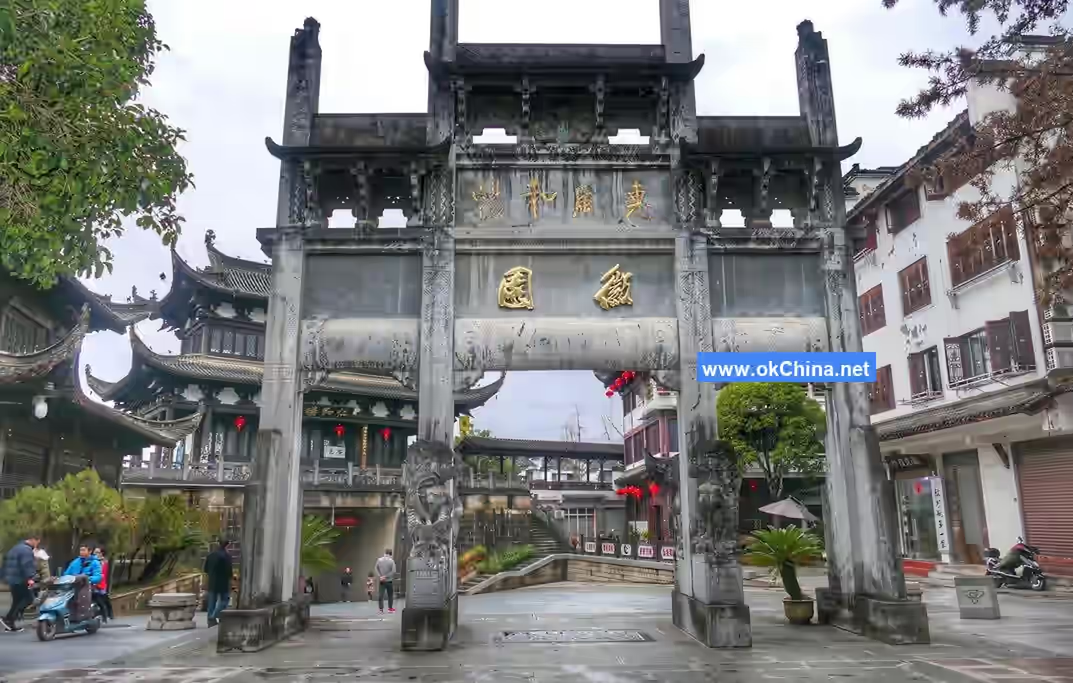
The Huangshan Shexian Archway Group and Bao Family Garden scenic area is located in the picturesque Tangyue Village of Shexian County, comprising ancient archways, ancestral halls, residences, and the Bao Family Garden. The site is 10 kilometers from the ancient city of Shexian and 27 kilometers from Tunxi, the seat of the municipal government. Tangyue is the settlement of the Bao family, who migrated here during the Jianyan period of the Southern Song Dynasty and have lived here for over 800 years. The stone archways, centered on the themes of "loyalty, filial piety, chastity, and righteousness," are arranged in a semi-arc from both ends toward the center. From west to east, they are the Bao Chan Filial Piety Archway, Cixiao Lane Archway, Bao Wenling's Wife Wang's Chastity and Filial Piety Archway, Charity Archway, Bao Wenyuan's Wife's Chastity and Filial Piety Archway, Bao Fengchang Filial Son Archway, and Bao Xiangxian Minister Archway. The scenic area is a national key cultural relics protection unit, a candidate site for World Cultural Heritage, a national AAAAA-level tourist attraction, a famous historical and cultural village in China, an Anhui Province famous brand, an Anhui Province famous trademark, the fifth batch of Anhui Province cultural industry demonstration bases, the second batch of Anhui Province intangible cultural heritage transmission bases, and one of Huangshan City's "Top Ten" tourist attractions.
4.2.1 Huifeng Garden
The garden within the Bao Family Garden, named "Huifeng Garden," covers an area of over 50 acres. It showcases over 2,000 bonsai works in various styles and houses more than 120 masterpieces by renowned artists, many of which have won gold medals in international and domestic bonsai competitions. Here, visitors can not only admire ancient Huizhou-style "Dragon Plum" bonsai, Sichuan-style curved Ginkgo bonsai, and tree bonsai from Lingnan, Huizhou, and Hubei styles but also appreciate the most poetic modern rock and tree-rock bonsai. The longest tree-rock bonsai in China, "Jiang Shan Ru Ci Duo Jiao" (The Land Is So Rich in Beauty), is displayed in front of the "Qinfen Pavilion" in Huifeng Garden. Its natural freshness, vivid form, and harmonious blend of trees and rocks have attracted hundreds of thousands of domestic and foreign visitors to stop and take photos.
4.2.2 Bao Family Ancestral Hall
The Bao Family Ancestral Hall, commonly known as the "Male Ancestral Hall," was first built during the Ming Dynasty. Facing south, it has three courtyards and five bays, constructed with brick, wood, and stone, showcasing strong local characteristics and a simple, elegant style. The hall houses a stele inscribed with an imperial edict, fully demonstrating the prominence of the Bao family in Tangyue during its time.
4.2.3 Ancient Ginkgo Stump
The ancient ginkgo stump dates back 1,200 years. The original tree crown covered about half an acre, and the tree stood dozens of meters tall before being destroyed during wartime. However, the base of the main trunk stubbornly survived and sprouted new branches. During the restoration of the Bao Family Garden, these newly sprouted branches were preserved and carefully cultivated, forming today's ginkgo forest.
4.2.4 Southern Charm
The treasure of the Bao Family Garden is "Southern Charm." This bonsai, with a trunk height of 1.28 meters and a crown spread of 2.8 meters, is one of the top large-scale ancient banyan bonsai in China, with a cultivation history of over 200 years.
4.3 Tangmo
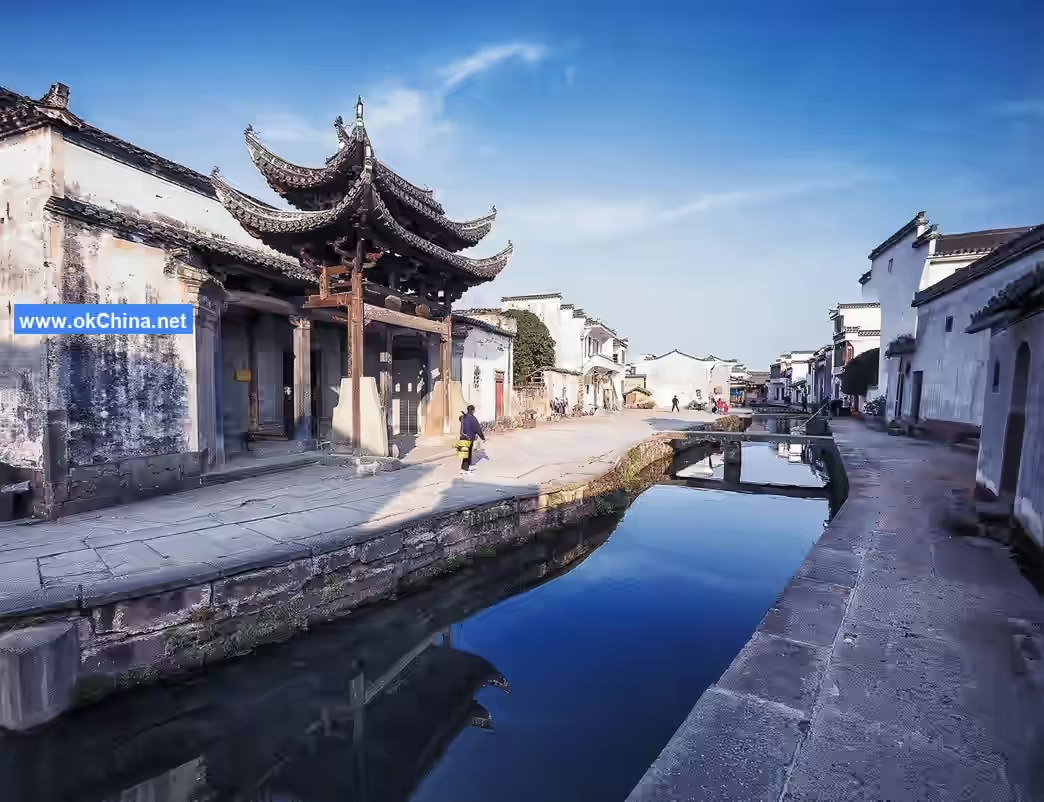
Tangmo, originally under the jurisdiction of Shexian County, now belongs to Huizhou District. Tangmo was founded by Wang Hua's great-great-grandfather, Wang Shuju, during the Tang Dynasty. It is renowned as the "First Village of Waterscape Gardens in China."Tangmo Village is supported by Lion Mountain, with hilly terrain and Elephant Mountain to the southwest, and small plains to the east, north, and west. The village features attractions such as the "Hanlin Brothers" Memorial Archway, Octagonal Pavilion, Centipede Bridge, Fengle River, Blue Stone Road, Gaoyang Bridge built in the Qing Dynasty, ancient ginkgo forest, Prince Pond, Prince Temple, ancient Huizhou-style "Zhuangyuan Mansion," the former residence of Xu Cunyu, a nunnery, the Xu Clan Ancestral Hall, and Tangmo Little West Lake. Tangmo Village can be described as a garden-style ancient architectural museum.
4.3.1 Tanganyuan Garden
Legend has it that during the early Qing Dynasty, a wealthy merchant from the local Xu family built this garden to fulfill his elderly mother’s wish to visit Hangzhou’s West Lake, which she could not do due to her frail health. The garden was named "Tanganyuan" after a verse from the Book of Songs, "Kankan伐檀兮,置之河之干兮," as it was filled with sandalwood flowers and had a gently flowing stream. The garden includes features like "Three Pools Mirroring the Moon," "Mid-Lake Pavilion," "Bai Causeway," and "Jade Belt Bridge." The "Jade Belt Bridge" divides the garden into an outer lake and an inner lake, creating a layout reminiscent of the "Outer West Lake" and "Inner West Lake." Crossing the bridge leads to the garden’s center, "Little Yingzhou" (Mirror Pavilion), which connects three ponds spanning 10 mu and irrigating 60 mu of farmland. The Mirror Pavilion, surrounded by water and exquisitely structured, serves as the focal point of the garden.
4.3.2 Shadi Pavilion
Built during the Zhengde era of the Ming Dynasty (1505–1521) and renovated during the Kangxi era of the Qing Dynasty, Shadi Pavilion is located at the outlet of Tanxi Stream and is also known as the Water Outlet Pavilion. The three-story pavilion has a hollow center, a square base, and a ground floor designed in a corridor style. It is supported by 12 stone pillars, with stone steps and benches on all four sides. The upper floor is an open pavilion, seamlessly blending interior and exterior, solid and void.
4.3.3 Gaoyang Bridge
Built during the Yongzheng era of the Qing Dynasty, Gaoyang Bridge serves as the entrance to the water street. This stone, double-arched bridge features a covered corridor, making it one of the few remaining covered bridges in the ancient Huizhou region. The bridge is 12.6 meters long and 7.4 meters wide, with a five-bay small hall built on it, covering an area of over 60 square meters. Its beams, pillars, eaves, and arches were constructed in the Ming Dynasty style.
4.3.4 Former Residence of Xu Chengyao
Known locally as the "Hanlin Academy," this residence, self-titled "Mianqin Biepu," covers several acres and is a grand Huizhou-style mansion. It includes living quarters, a study, gateways, a main hall, a front courtyard, and a backyard. Within the riverside walls lies a large garden adorned with rockeries, pavilions, and a variety of rare trees and flowers.
4.4 Qinkou Folk Houses
Qinkou Folk Houses is a specialized museum of ancient architecture, funded by the National Cultural Heritage Administration and located at the foot of Zixia Mountain in Qinkou Town, Huizhou District, Huangshan City, Anhui Province. Situated along the main route from Nanjing, Jiangxi, Shanghai, and Hangzhou to Huangshan, the museum consists of two sections: the Ming Garden and the Qing Garden, completed and opened to the public in 1990 and 2007, respectively. Adhering to the principle of "original dismantling and reconstruction, centralized protection," the museum preserves 24 typical ancient structures from the Ming and Qing dynasties, including residences, ancestral halls, memorial archways, pavilions, bridges, and opera stages. These buildings hold significant historical, artistic, and scientific research value, serving as precious examples for studying ancient Chinese architecture. The museum is hailed as "a living monograph of Ming Dynasty folk art" and "a model of harmonious integration of cultural and natural landscapes." Renowned ancient architecture expert Shan Shiyuan, former vice president of the Palace Museum, once remarked, "To see imperial palaces, go to Beijing; to see folk houses, visit Qinkou." In 1988, Qinkou Folk Houses was designated as a National Key Cultural Relics Protection Unit by the State Council. In 2007, it was rated as a National 4A-level Tourist Attraction. In 2008, following arrangements by the Central Propaganda Department and other ministries, the museum opened to the public free of charge as a public cultural service venue. In 2009, it was awarded the title of "Intangible Cultural Heritage Transmission Base of the Huizhou Cultural Ecological Protection Experimental Zone" by the Provincial Department of Culture and listed as a district-level patriotic education base. In 2014, as a key component of the Ancient Huizhou Cultural Tourism Zone, it was rated as a National 5A-level Tourist Attraction.
4.4.1 Sijian Di
Sijian Di is an early Ming Dynasty brick-and-wood hall and one of the earlier surviving examples of Huizhou architecture from the Ming period. It was built as a family shrine by the five grandsons of Wang Shan, a Jinshi scholar and official during the early Yongle era of the Ming Dynasty, for ancestral worship. A record from the 12th year of the Hongzhi era, "Memorial of the Ancestral Hall of Official Wang," details the reason and date of its construction, noting, "This is not a shrine for the entire Wang clan but for one family." The hall still houses a plaque inscribed with an imperial edict from the fourth year of the Yongle era, praising Wang Shan with words such as, "We specially command you to return to your hometown to achieve virtue and success, fulfilling Our expectations." The building spans three bays, measuring 12.32 meters in width and 18.26 meters in depth. Its wooden framework features large materials, with exquisite carvings on shuttle-shaped columns, crescent beams, lotus-shaped pedestals, bracket arms, and corbels. The maple-shaped brackets, resembling flowing clouds, reflect the architectural trends of the era. The use of upward brackets is rare in large wooden structures of the Ming Dynasty in southern China, making it a valuable artifact for studying the evolution of brackets after the Yuan Dynasty in Ningbo.
4.4.2 Caomen Hall
Caomen Hall is a hall building from the Jiajing era of the Ming Dynasty, originally part of the Wang clan’s branch ancestral hall on Qinkou Street. The main hall was destroyed during the Cultural Revolution, leaving only the entrance hall and two corridors. The hall spans nine bays, with a total width of 21.03 meters, a depth of 13.50 meters, and a height of 6.30 meters. Its layout is U-shaped, with a central courtyard and pond. The brick-and-wood structure features a gabled roof with decorative gable walls. The lintels are adorned with supplementary brackets, and the corbels extend with double-tiered brackets, with 45-degree diagonal brackets supporting the eaves in place of architraves. The bracket heads are carved with vigorous, segmented curves, and the T-shaped brackets feature carved tails. In terms of design, the hall not only reflects mid-Ming characteristics in components such as basin-shaped column bases, shuttle-shaped columns, brackets, and sparrow braces but also retains ancient methods from the Song and Yuan dynasties, such as the "erroneous corner brackets" (known as "讹角斗" in the Song Dynasty) and "照板" (supporting plates) beneath large brackets. These elements preserve the charm of Song and Yuan construction techniques, offering significant research value.
4.4.3 Fang Wentai Residence
Fang Wentai Residence is a brick-and-wood residential building from the mid-to-late Ming Dynasty, originally located in Shasha Village, Qinkou Township. This courtyard-style residence has two rows of three-bay buildings, with a total width of 9.33 meters, a depth of 15.9 meters, and a height of 8.8 meters. The ground floor includes a central entrance hall, flanked by side rooms, with a living room in the rear central bay and bedrooms in the side bays. A narrow courtyard separates the two rows, with corridors on both sides and a staircase in the right corridor. The upper floor features an ancestral worship seat in the central bay, with a cover plate at the staircase entrance. The interior is finely decorated, with lotus petal carvings on the railing posts beside the windows, three exquisitely carved cloud-shaped brackets on the upper part of the railings, and intricately carved openwork panels on the lower part, with a central openwork grid. The curved railings on the upper floor are the most distinctive feature, with seating boards placed between the eaves columns in the central bay. The railings curve outward, extending beyond the eaves columns, resembling a backrest, known as "flying chairs" or "beauty leans." The lower panels of the upper-floor railings are decorated with lattice-style doors, showcasing exquisite craftsmanship. The design of the curved railings is similar to those depicted in the Ming Dynasty Luban manual fragments housed in the "Tianyi Pavilion" in Ningbo, confirming that the construction methods of Fang Wentai Residence were typical of the Ming Dynasty in southern China. The column bases are uniquely shaped, transitioning from a square bottom to an octagonal middle and a circular top, with simple yet elegant lines. The upper floor is paved with bricks, and the rooms are adorned with wooden doors. In addition to ceiling tiles, some rooms feature suspended ceilings. The entire upper hall is painted, reflecting the high standard of wealthy households of the time.
4.4.4 Su Xuehen Residence
Su Xuehen Residence is a brick-and-wood residential building from the mid-Ming Dynasty, originally located in Zheng Village, She County. Initially owned by the Zheng family, it was purchased by the Su family during the late Qing Dynasty, who opened the "Su Dehe Tobacco Shop." After the founding of the People’s Republic of China, it became the residence of Su Xuehen. The building has a U-shaped layout, with three bays in width, two rows of rooms, and an upper floor. It measures 10.86 meters in width, 13.3 meters in depth, and 7.7 meters in height. The front of the main building faces a courtyard, with corridors on the left and right (the left narrower than the right), and a staircase in the left corridor. There is a noticeable height difference between the ground and upper floors, with the ground floor being 2.4 meters high and the upper floor 4.7 meters high. The ground floor central bay serves as a living room, with side bays as bedrooms, while the upper floor central bay features an incense altar, with side bays as bedrooms. The floor beams are square in cross-section, spaced 0.3 meters apart. Soundproofing is achieved with reed walls, and the courtyard includes "flying chairs." The roof framework uses a column-and-tie construction method, with slightly arched, narrow cross-section木材斧斫成略带弓月形木材穿插于柱子之间. Though plain in appearance, the cross-section resembles a lute. The beams feature gentle curves, typical of residential buildings of the era. The eaves and railings are uniquely designed, with the eaves supported by octagonal pillars standing on curved wooden railings, and external brackets inserted into these pillars. This method matches exactly the illustrations in the Ming Dynasty Luban manual housed in the "Tianyi Pavilion."
4.4.5 Leshan Hall
Leshan Hall, also known as the "Hall of the Elderly," is a two-row, three-bay brick-and-wood hall built during the mid-Ming Dynasty. It served as a venue for ancestral worship, entertainment for the elderly, and family discussions, combining the solemnity of a hall with the warmth of family gatherings. The hall is a single-story building, measuring 12.57 meters in width, 19.5 meters in depth, and 7.6 meters in height. It features a post-and-lintel wooden structure, blue bricks, small tiles, and horse-head gables. The wooden framework uses large materials, with shuttle-shaped columns and crescent beams of substantial cross-sections, basin-shaped column bases, and a reduced-column design in the central bay to expand the hall space. Five-purlins are placed between the principal columns, with lotus petal plates beneath the queen posts. Crescent beams connect the eaves columns and principal columns, adorned with camel humps and queen posts supporting single-step beams, decorated with cloud patterns at the ends.Large square bricks pave the ground, with a small hall and a water pool.
4.4.6 Fang Guantian Residence
The Fang Guantian Residence is an ordinary mid-Ming Dynasty dwelling, a brick-and-timber structure with three bays and an upper floor. Its total width is 8.7 meters, depth 7.95 meters, and height 6.65 meters. It features small bricks and tiles, a horse-head gable wall, and blue bricks paving the floor. Notably, a wooden base is added between the house pillars and their stone plinths, serving functions of earthquake resistance, moisture prevention, and decay resistance. Partitions are all decorated with plank walls, reed walls, grid-patterned windows, and corner tenon joints. The floor surface projects about one chi (approx. 0.33 meters) beyond the eave column architrave, supported by octagonal columns with bracket sets holding up the eave purlin. The main door is protected by inner and outer door hoods, with the inner hood decorated with "Overlord Fist" motifs. The residence has a compact and simple structure.
4.4.7 Wu Jianhua Residence
The Wu Jianhua Residence is a mid-Ming Dynasty folk house, adjacent to the Sijian Di (Department of Remonstrance). It was originally the residence of descendants of Wang Shan and was later sold to the Wu family in modern times. Initially built as a three-story building, it was converted to two stories by Wang descendants during the Ming-Qing period. This brick-and-timber structure features small blue tiles and horse-head gable walls. It has a width of three bays totaling 10.1 meters, a depth of 10.22 meters, and a total height of 8 meters. Although the upper floors were modified, the ground floor retains typical Huizhou Ming architectural styles, including shuttle-shaped columns, crescent beams, bracket sets, reed walls, apron panels, and wall decorations. The eaves around the courtyard in front of the main hall are equipped with brick gutters and ceramic downpipes. Constrained by the varying conditions of surrounding buildings at the time, the rear column frame and walls of this house are slanted, not forming right angles. The main door is not on the front facade but is located on the right corridor, with the staircase set in the left corridor.
4.4.8 Luo Xiaoming Residence
The Luo Xiaoming Residence was originally located on Middle Street in Chengkan and is a Ming Dynasty brick-and-timber folk house. Construction began during the Jiajing reign of the Ming Dynasty. It is said to have been the hall of the family of Luo Yinghe, Minister of Justice during the Jiajing reign. It is the only three-story residential building among the Qiankou Folk Houses. The layout of its planar space is flexible, with reasonably arranged vertical and horizontal circulation. The ground floor has five bays, while the second and third floors have three bays each. There are five main and secondary staircases (one from ground to second floor, three from second to third floor). The third floor houses a shrine for ancestral tablets and displaying portraits. Below the shrine are wooden apron panels and a wooden sumeru pedestal, covered with a flat ceiling. The main hall uses a flush gable with brick wind boards and straw-raincoat tiles for gable protection. Screen walls are built on the east and west wings and the enclosing courtyard opening, with vertically laid small blue tiles. Ridge ends feature traditional sparrow-tail ornaments and mixed-water golden floral panels. From its self-bearing timber structure to interior decoration and detailed ornamentation, the Luo Xiaoming Residence embodies typical Ming architectural characteristics. Distinctive features include the three-story building form, the shrine setup within a residence, auxiliary staircases added inside rooms, a small side door opened under the wooden staircase, and wooden lattice windows entirely composed of square mullions.
4.4.9 Yinshou Bridge
The "Yinshou Bridge" was built during the Ming Jiajing reign. It is a single-arch bridge funded by local nuns. One end of the bridge leads to a nunnery, the other to a village where "the crowing of cocks and the barking of dogs are heard." The three characters "荫秀桥" (Yinshou Bridge) are half carved in relief (yang) and half intaglio (yin). The bridge's center became the boundary between the Buddhist realm and the human world, hence it is also called the "Yin-Yang Bridge." Interestingly, the bridge's railings on both sides are built with arhat panels. Time flows, the small bridge remains. "The abbess has gone, no one knows where, while the arhats still smile in the spring breeze."
4.4.10 Fang Clan Ancestral Hall Archway
Walking past the "Yinshou Bridge," one encounters the "Stone Archway," built during the Ming Jiajing reign. The front of the archway bears no inscription, only a carving of a grimacing "ghost" holding a brush in its hand and stepping on a large square dou (a peck measure). The combination of "ghost" (鬼 guǐ) and "dou" (斗 dǒu) forms the character "魁" (kuí, meaning chief or star). The back of the archway is carved with an image of the moon palace and osmanthus tree. This indicates the Fang clan's hope that their descendants would produce many literary stars (魁星), pluck the osmanthus branch from the moon palace (achieve top honors in examinations), and bring honor to the family.
4.4.11 Shanhua Pavilion
Winding up the mountain, one finds a pavilion named "Shanhua Pavilion," built during the Ming Jiajing reign. The name "Shanhua" derives from the old saying "善化贤良释化愚" (Goodness transforms the virtuous and wise, Buddhism transforms the foolish). The pavilion is square, with four pillars standing open, featuring upturned eaves and corners, and an aesthetically pleasing shape. A couplet is carved on the crossbeam of the pavilion roof: "阴德无根方寸地中种出,阳春有脚九重天上行来" (Virtue has no root, it grows from a tiny plot of land; Spring has feet, it walks down from the ninth heaven), intending to persuade people that sincere good deeds accumulate virtue. Another couplet in this pavilion reads: "走不完的前程,停一停,从容步出,急不来的心事,想一想,暂且丢开" (The endless road ahead, pause a moment, step out calmly; Matters of the heart that cannot be rushed, think them over, set them aside for now), conveying profound meaning.
4.5 Chengkan
The Chengkan Scenic Area is located on the southern foothills of the Huangshan Scenic Area. It lies where the road from Huizhou District to Huangshan turns northeast for five kilometers at the Foziling section. It is 40 km north of Huangshan and 15 km south of the Huizhou District government seat—Yansi Town. Nestled among green mountains and bamboo forests, Chengkan integrates natural and cultural landscapes. The Chengkan Bagua Village (Eight Trigrams Village), located within the Chengkan Scenic Area, is the world's oldest and most mysterious village preserved to date. Chengkan currently possesses 49 nationally designated key cultural relics protection units. With "one village, two national treasures," it has been designated as: "China's No. 1 Feng Shui Village," "China's Famous Historical and Cultural Town," "China's Hometown of Ancient Architecture," "China's Hometown of National Treasures," "China's Best Ancient Town for Tourism," and a "National 4A Tourist Attraction."
4.5.1 Luo Dongshu Ancestral Hall
The Luo Dongshu Ancestral Hall is the largest artistic treasure of Chengkan Village. The ancestral hall is grand in scale and exquisitely constructed. Its architecture integrates "antiquity, elegance, beauty, and grandeur," making it a model of Huizhou ancient architecture, acclaimed as the "No. 1 Ancestral Hall South of the Yangtze." Above the screen door hangs a horizontal plaque with the golden characters "彝伦攸叙" (Yilun Youxu, meaning proper ordering of human relationships), inscribed by the great Ming Dynasty painter and calligrapher Dong Qichang. The characters are approximately one square meter each, vigorous and powerful.
4.5.2 Baolun Pavilion
Baolun Pavilion is a National Key Cultural Relics Protection Unit, originally named "Zhenjing Luo Dongshu Xiansheng Ci" (The Ancestral Hall of the Chaste and Serene Master Luo Dongshu). The ancient ancestral hall covers over five mu of land, imposing and majestic. The first entrance is the ceremonial gate, the second is the main hall, with a plaque in the hall inscribed by the famous Ming Dynasty calligrapher Dong Qichang. Behind the tall plank door screen wall of the main hall is another courtyard, beyond which the third section is the Baolun Pavilion. Baolun Pavilion is the essence of the entire ancestral hall. It is said that Luo Yinghe, who oversaw the continued construction of this hall, was an official highly favored by Emperor Shenzong during the Wanli reign. He used this place to enshrine imperial edicts and store precious items bestowed by the emperor, hence the name "Baolun Pavilion" (Pavilion of Precious Edicts). Later, the entire ancestral hall came to be conventionally called "Baolun Pavilion." Baolun Pavilion consists of three three-bay sections, plus staircase rooms at both ends, totaling eleven bays. The plaque "宝纶阁" (Baolun Pavilion), handwritten by Wu Shihong, hangs high under the eaves. The courtyard and the building are separated by black stone slab railings from Yixian County. The stone railings are adorned with floral and geometric pattern reliefs. The finial heads of the balustrades on the three steps are all decorated with carved stone lions. On the steps, ten stone columns with inwardly concave curved fronts stand at the forefront, with dozens of round columns arrayed behind, supporting the crisscrossing crescent beams. The domed roof and soaring eaves, the carved cloud-shaped bracket sets between beams and columns, the openwork beam-end corbels and king posts, lotus-support wood carvings—all are dazzling and breathtakingly beautiful. The painted patterns on the beams are elegant and brilliantly colored, remaining vivid and unfading even after over 400 years. On the left and right sides of Baolun Pavilion are staircases leading upstairs. Ascending 30 wooden steps, one sees neatly arranged round wooden columns on the upper floor, with exposed roof purlins decorated with polished blue bricks. This is the highest point in Chengkan Village, offering distant views of the misty clouds over Huangshan's Tiandu and Lotus Peaks. With its ingenious structure, exquisite carvings, and splendid paintings, integrating antiquity, elegance, grandeur, and beauty, Baolun Pavilion can be called a unique masterpiece of Ming Dynasty ancient architecture.
4.5.3 Luo Runkun Residence
The Luo Runkun Residence is situated in the middle section of Qian Street, built in the mid-Ming Dynasty. It faces east, is a two-story building, with house number "Qian Street 66." It is a quadrangle courtyard, featuring five-puzuo bracket sets, basin-shaped column bases, shuttle-shaped columns, and exquisite closely-spaced purlin window railings with carved floral designs in the bracket eyes. The "flying chairs" (beauty's rests) and window railings on the upper floor are particularly typical.
4.5.4 Yan Yi Tang (Swallow Wing Hall)
Yan Yi Tang is located at No. 1 Tiandeng Lane. It is a Ming Dynasty folk house, a two-entry, three-bay, three-story building. The brick carvings on the main door hood are of ancient and simple form. The irregular-shaped corbel heads connected to the side walls within the door wall and the round block-shaped bracket capitals are extremely rare in Huizhou.
5. Cultural Resources
5.1 Historical Evolution
Huizhou, abbreviated as "Hui," was anciently called Shezhou, also known as Xin'an. It governed six counties: Shexian, Yixian, Xiuning, Qimen, Jixi, and Wuyuan, collectively known as "one prefecture, six counties." It comprised present-day Huangshan City, Wuyuan County (now part of Shangrao, Jiangxi), and Jixi County (now part of Xuancheng, Anhui).
First year of the Taikang era of Emperor Wu of the Western Jin Dynasty (280 AD): The state of Wu was conquered, and Xindu Commandery was renamed Xin'an Commandery. The commandery name Xin'an is said to derive either from Mount Xin'an in Qimen County or from the meaning of "new peace."
Ninth year of the Kaihuang era of Emperor Wen of Sui (589 AD): Shezhou was established.
Third year of the Daye era of Sui (607 AD): Changed back to Xin'an Commandery.
During the turmoil at the end of Sui, twelfth year of Daye (616 AD): Wang Hua from Shexian raised an army and occupied Shezhou along with Xuan, Hang, Mu, Wu, and Rao—six prefectures in total, proclaiming himself King of Wu.
Fourth year of Wude of Tang (621 AD): Wang Hua submitted to the Tang dynasty and was enfeoffed as Duke of Yue. Xin'an Commandery was again changed to Shezhou, with the prefectural seat at Shexian.
Third year of Xuanhe of Song (1121 AD): After suppressing the Fang La Rebellion by people of Shezhou, Shezhou was renamed Huizhou.
The origin of the name Huizhou: one theory says it is because Jixi has Huiling (Hui Ridge) and Huixi (Hui Stream); another says "Hui" means beauty. In fact, the original meaning of the character "徽" (hui) is "rope" or "to bind." Using it as a name expressed the Song dynasty's desire, after the "turmoil," to strengthen control and governance over this land. From then on, until the third year of Xuantong of Qing (1911), for 790 years, the name Huizhou remained unchanged as a prefectural name.1934 Due to Chiang Kai-shek's military needs, Wuyuan was incorporated into Jiangxi. Later, because of the "Return to Huizhou" movement initiated by the people of Wuyuan and the efforts of fellow natives like Hu Shi, public pressure led to its return to the Huizhou region after the victory in the War of Resistance Against Japan. However, due to military administration issues, Wuyuan was again incorporated into Jiangxi Province in 1949, where it remains to this day. These are the two historical events of Wuyuan's affiliation with Jiangxi in Huizhou's history.
1987, in response to the central government's call to leverage Mount Huangshan for tourism development, Jixi County was swapped with Taiping County and incorporated into Xuancheng, and the Huizhou region was renamed Huangshan City.
5.2 Cultural Relic Value
5.2.1 Tangyue Memorial Archway Complex
The Tangyue Memorial Archway Complex embodies loyalty, filial piety, chastity, and righteousness, reflecting the ethical morals and patriarchal clan ideology of the ancient Huizhou people. As a witness to history, the complex not only embodies the wisdom of ancient laborers but is also a treasure of Huizhou stone architecture, with each archway meticulously designed and constructed. The architectural art of the Tangyue Archways crystallizes the intelligence and superb craftsmanship of the Chinese working people. Therefore, the Tangyue Archways hold extremely important value for researching the politics, economy, culture, architectural art, and the formation and development of Huizhou merchants during the Ming and Qing dynasties, and even for studying folk customs and dwellings. These archways have left future generations not only spiritual wealth but also riches in cultural art, architectural technology, and many other aspects.
5.2.2 Qinkou Folk Houses
Qinkou Folk Houses gather representative and classic Huizhou residences from the Ming and Qing dynasties. They include both magnificent and luxurious mansions and courtyards, as well as quiet and elegant pavilions and thatched cottages. Through the display of collected artifacts, folk crafts, and folk performances, it vividly recreates the living scenes of Huizhou society during the Ming and Qing dynasties. Secondly, its Ming Garden is fully equipped with pavilions, terraces, towers, gazebos, and halls, complete with interior furnishings. The individual buildings follow the mountain's contours, forming a village layout that reproduces the style of a Ming dynasty mountain villa. Among them, ancient Huizhou buildings like the Caomen Hall, Shanhua Pavilion, and Sijian Di are precious examples in the history of Chinese architecture. Sijian Di also houses a treasured gold plaque bestowed by the Yongle Emperor of the Ming dynasty. The conservation of Qinkou Folk Houses has evolved from protecting individual ancient buildings to cultural ecological preservation supported by human activities. During the conservation process, intangible cultural heritage is continuously explored and promoted, showcasing Huizhou's unique "Seven Unique Skills" (paper-cutting and character tearing, Huizhou-style carving, tea art production, Huizhou inkstick making, bamboo weaving craftsmanship, etc.). It plays an indispensable role in the construction of the ancient Huizhou cultural tourism area. As a model of Huizhou ancient architecture, Qinkou Folk Houses not only possess significant historical and artistic value but are also precious examples for researching Chinese architectural history, technology, design, and art.
5.3 Traditional Culture
5.3.1 Huizhou Merchants
Huizhou Merchants, also known as Xin'an Merchants or Huizhou Merchants, formed the "Huizhou Bang" (Huizhou Guild). It is the collective name for merchant groups originating from the old Huizhou Prefecture (Shexian, Xiuning, Wuyuan, Qimen, Yixian, and Jixi counties) and is one of China's three major merchant groups. Huizhou people have a long history in commerce, with records of Xin'an merchant activities as early as the Eastern Jin Dynasty. This developed through subsequent generations, forming merchant guild groups during the Chenghua and Hongzhi periods of the Ming Dynasty. From the Jiajing period of the Ming Dynasty to the Qianlong and Jiaqing periods of the Qing Dynasty, Huizhou merchants reached their peak. From the Daoguang and Xianfeng periods of the Qing Dynasty to the late Qing and early Republic of China era, Huizhou merchants gradually declined. As a formidable force in the Chinese business world, Huizhou merchants were once active throughout China, from the north to the south, on both sides of the Yellow River, and even in Japan, Siam, Southeast Asian countries, and Portugal. Their main industries were salt, pawnbroking, and tea/timber, followed by rice, grain, cotton cloth, silk, paper, ink, porcelain, etc. Among them, people from Wuyuan were often tea and timber merchants; from Shexian, salt merchants; from Jixi, restaurant owners; from Xiuning, pawnbrokers; and from Qimen and Yixian, mostly cloth and sundry goods merchants.
Huizhou Merchant Precepts This merchant: does not see profit as gain, but sees sincerity as gain; This trade: does not see wealth and honor as precious, but sees harmony as precious; This buying: does not see price suppression as the price, but sees fairness as the price; This selling: does not see profit-making as winning, but sees trust as winning; These goods: does not see rare goods as goods, but sees necessity as goods; This wealth: does not see amassing wealth as wealth, but sees equity as wealth; This promise: does not see a mere reply as an answer, but sees truth as the answer.
5.3.2 Penjing (Bonsai)
Huizhou-style Penjing, originating in the Southern Song Dynasty and flourishing during the Ming and Qing dynasties, is one of the main traditional schools of Chinese penjing. Huizhou penjing has unique shaping techniques, characterized primarily by neatness, symmetry, and solemnity. It is praised as "silent poetry, three-dimensional painting," possesses strong regional characteristics, and is an important component of Huizhou culture.
5.3.3 Tea Ceremony
The Huizhou Tea Ceremony emphasizes cultivating virtue through tea, refining sentiment through tea, making friends through tea, and honoring guests with tea. It focuses on the environment and atmosphere, seeking clear tea soup, clear aroma, and a clear mind; an elegant setting, elegant people, and elegant utensils. Relevant departments in Huangshan City have compiled ancient tea-drinking rituals and rules into a set of procedures for "Tea Ceremony Performances." These performances are conducted by four or eight young women and generally include the following steps: calming the breath, boiling water, burning incense, cleansing utensils, warming cups, appreciating the tea, adding tea, rinsing the tea, pouring water, offering tea, smelling the aroma, observing the color, and tasting the flavor. Huizhou Three Carvings are a traditional Han Chinese carving art popular in the region of the old Huizhou Prefecture's one prefecture and six counties (Yixian, Shexian, Qimen, Xiuning, Taiping, and Jixi in Anhui Province, and Wuyuan County in Jiangxi Province). It encompasses three traditional Han carving crafts with Huizhou style: wood carving, stone carving, and brick carving. It has a complete process flow and is mainly used for decorating residences, ancestral halls, temples, gardens, and for crafting antique furniture, screens/couplets, brush pots, fruit trays, etc. In 2006, it was included by the State Council in the first batch of national intangible cultural heritage lists.
5.3.4 She Inkstone
The She Inkstone is one of China's Four Great Famous Inkstones. Its main production site and place of fame is in ancient Huizhou's Shexian, hence the name. Wuyuan County in Jiangxi Province originally belonged to Huizhou, and the inkstones produced there are also called She Inkstones. She Inkstones appeared during the Han and Jin periods, and their reputation grew during the Tang Dynasty. After the Kaiyuan era, Longwei inkstone stone was discovered, making She Inkstones even more treasured. Li Yu, the last ruler of the Southern Tang, regarded the She Inkstone as "the best under heaven." He established an "Inkstone Office" in Shezhou and promoted the inkstone craftsman Li Shaowei to "Inkstone Official," causing the She Inkstone's status to soar from then on. The She Inkstone developed rapidly during the Song Dynasty, with increasing varieties and the continuous emergence of exquisite inkstones. Its numerous famous types, fine texture, and exquisite carving were unmatched among inkstones. From the late Yuan to early Qing, there are no records of official She stone mining; She Inkstone production merely maintained a remnant of the craft. After the founding of the People's Republic of China, She Inkstone production saw some development, and the "Golden Star" She Inkstone reappeared. After the reform and opening-up, Shexian and Wuyuan counties successively established She Inkstone factories, handicraft factories, and "Four Treasures of the Study" companies. The process became comprehensive, from quarrying inkstone stone to product manufacturing and decoration. New varieties like "Bean Spot," "Green Brush Silk," "She Red," and "Purple Cloud" were also developed. After the mid-1980s, She Inkstone entered the forefront of the national inkstone-making industry and won national high-quality product awards, export foreign exchange earning gold medals, and the "National Treasure" certificate awarded by relevant departments for its excellent quality.
5.3.5 Huiju Opera
Huiju Opera is an important local opera vocal style, mainly popular within Anhui Province and in areas like Wuyuan County, Jiangxi. In the late Ming and early Qing dynasties, the Luantan vocal style spread to Anhui, combined with local vocal styles and folk music, and formed the Bozi style in places like Shipai, Zongyang, and Tongcheng in Anqing Prefecture. In the late Qianlong period of the Qing Dynasty, Huiju troupes entered Beijing. Over about seventy years, spanning the Jiaqing, Daoguang, and Xianfeng reigns, they were immensely popular and dominated the Beijing theater scene. During this process, thanks to the efforts of opera artists like Cheng Changgeng, they continuously absorbed various excellent opera art elements from Beijing; influenced by Beijing opera tunes and rhythms, and especially with the entry of Han opera tunes into Beijing, achieving a Huiju-Hanju merger, and the combination of Pi (Xipi) and Huang (Erhuang), Huiju gradually evolved into Peking Opera around the Daoguang period. Huiju Opera has a history of over three hundred years and played a significant role in the development of Chinese opera. It not only gave birth to Peking Opera, but also has inseparable blood ties with dozens of local opera genres across northern and southern China. At the same time, Huiju Opera is an important component of Huizhou culture. It reflects many characteristics of Huizhou culture and even traditional Chinese culture in an intuitive way, making it worthy of in-depth study.
5.3.6 Wan'an Compass
The Wan'an Compass is the only existing compass in China made entirely by hand using traditional techniques. Its place of production is on Wan'an Old Street in Wan'an Town, Xiuning County, Anhui Province. The Wan'an Compass making industry emerged no later than the late Yuan Dynasty, developed during the Ming Dynasty, entered its peak period in the mid-Qing Dynasty, declined briefly in the late Qing, revived in the early Republic of China era and continued until the early 1960s. After a hiatus of nearly 20 years, production resumed in 1982. The Wan'an Compass inherits China's traditional compass-making techniques and has formed its own characteristics during long-term production, with strict requirements for the process flow and technical methods. Making a compass generally involves six steps. First, select premium wood called "Tiger Bone Tree" (scientific name: Bischofia polycarpa), saw it into rough compass blanks. Then, turn the blank round, polish it, and carve the hole for the magnetic needle. Next, draw grids and inscribe the dial surface on it. After that, boil tung oil and apply it to the compass. Installing the magnetic needle is the final and most critical step, performed by the master alone in a private room. This work includes magnetizing the steel needle, determining its center of gravity, and mounting it. Wan'an Compasses can be divided into three types by dial style: Sanhe Pan, Sanyuan Pan, and Zonghe Pan. By diameter, there are about 11 specifications.The Wan'an compass is renowned for its unique design, meticulous material selection, exquisite craftsmanship, and comprehensive variety, earning it the reputation as the authentic compass and the esteemed titles of "Huizhou Compass" and "Huizhou Dial." In 1915, the Wan'an compass and sundial were exhibited at the Panama-Pacific International Exposition, where they were awarded a gold medal.
5.3.7 Huizhou Three Carvings
Ancient Huizhou encompassed present-day Huangshan City in Anhui Province and Wuyuan County in Jiangxi Province. The Huizhou Three Carvings refer collectively to the three traditional crafts of wood carving, brick carving, and stone carving prevalent in the Huizhou region. Primarily used for decorating Ming and Qing dynasty architecture, these carvings are imbued with strong local cultural characteristics. As a branch of Huizhou architectural art, they are mainly employed in the decoration of residential houses, official residences, ancestral halls, temples, covered bridges, and memorial archways. Their origins can be traced back to the Tang Dynasty, and they reached their peak during the Ming and Qing Dynasties with the rise of Huizhou merchants.
5.3.8 Mulian Opera
Mulian Opera is an ancient theatrical form from Huizhou, performed throughout Huangshan City and neighboring counties, particularly flourishing in areas like Qimen and Shitai. The script, "Mulian Rescues His Mother and Advocates Goodness," was compiled by Zheng Zhizhen of Qimen during the Ming Dynasty. It is divided into three volumes (100 acts) and primarily tells the story of Liu Qingti, the wife of Fu Xiang, who is condemned to hell for blasphemy. Her son, Fu Luobu, driven by a fervent desire to save his mother, traverses the ten courts of hell, ultimately reuniting with her. In the past, during leap years in the lunar calendar, this opera was frequently performed in Huizhou folk traditions to ward off evil and avert disasters.
Comments
Post a Comment